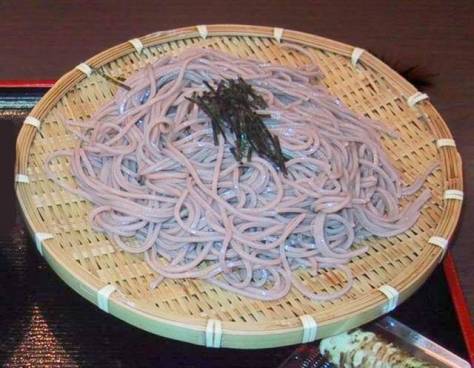
I’ve been asked for some time how to make your own soba/buckwheat noodles at home.
It is not that difficult, although you might need some particular tools.
Here is a simple recipe from which you can freely improvise.
INGREDIENTS:
Enough for 5 people
Buckwheat Flour/Soba-ko: 400g
Wheat flour (normal): 100g
Cold water: 250g
Some additional buckwheat flour for folding
TOOLS:
Large pan
Wooden rolling pin
Large Chinese/Japanese-style chopping knife
Wooden working surface/board
Board for guiding knife
RECIPE:
First step:
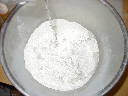
Pour buckwheat flour and Wheat flour into a large basin/pan and mix well.
Pour in one third of the water slowly in a thin flow. Mix with tip of fingers.
Step 2:
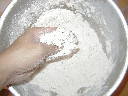
Break eventual hard lumps between fingers.
Step 3:
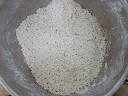
Repeat step 1 twice again until you obtain a fine mixture.
Work as fast as possible.
Step 4:
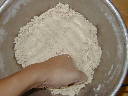
Once satisfied with the uniformity of the mixture, press hard with your knuckles.
Step 5:
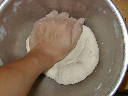
Once the flour has chamged into one lump, fold and press with palm of the hand.
Step 6:

Repeat Step 5 until lump has become shiny. Fold into a ball.
Step 7:
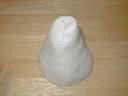
Shape the lump into a pyramid.
Step 8:
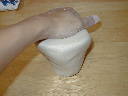
Turn pyramid onto its tip and press hard as to form a saucer.
Step 9:
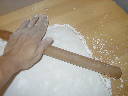
Start spreading lump with wooden roll pin. first angle by angle as to form square.
Step 10:
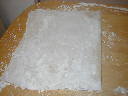
Once you have spread the lump until the square has diminished to a 2 mm thickness, first sprinkle some buckwheat flour all over the surface and fold in two.
Step 11:
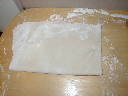
Sprinkle with buckwheat flour and fold again (4 layers).
Step 12:
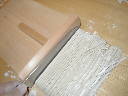
Cut soba lump with the heavy chopping knife, using the wooden guide board for even cutting by shifting the guide board slightly after each cut.
Step 13:
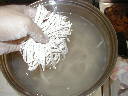
Bring a large large pan of water to boil, drop noodles into water separating them between your fingers as they fall out. Boil for 2~3 minutes stirring with long chopsticks.
Step 14:

Take noodles out of pan (the soba tsuyu/soba soup can be used hot later) with a sieve and coll down under running cold water. Drain.
Step 15:
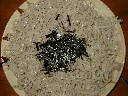
Serve onto plate with or without dry seaweed, wasabi, soba soup or whatever you feel like.
You could also make maki with the same soba.
Variations are many!
 SHIZUOKA GOURMET