WHALE MEAT (2)
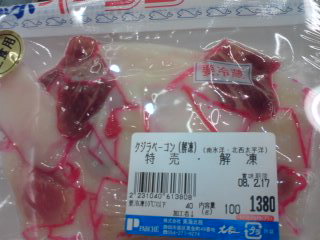
When I visited Parche Food Market inside Shizuoka JR Station to buy ingredients for dinner (my better/worse half having “ordered” a seafood Gratin), I thought I might as well as take a couple of picks to prove that whale meat is ordinary fare down here.
The whale meat had already gone, but whale bacon was still available.
Reading the label, it said the whales wre caught in Northwestern Pacific. Bacon is very popular here and can be eaten at izakaya.
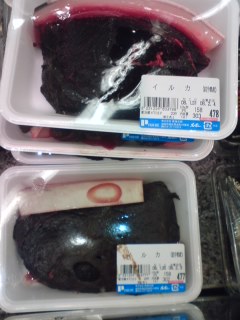
Plenty of dolphin meat was avalaible. This particularly came from Gunma Prefecture.
Dolphin meat is regularly served at Primary School lunches in Shizuoka Prefecture. The meat comes from dolphins who were accidentally caught in nets, or culled because of growing numbers (like hunters do with deer in the US)
—————-
WHALE MEAT (1)

One can easily eat whale meat at Sushi Restaurants In Shizuoka Prefecture or even buy it directly at supermarkets.

Most of it come from Sperm Whales/Mako Kujira.
Whale meat should not be confused with Iruka/Dolphins whose meat has appeared on Japanese tables since times immemorial. It concerns an entirely different taste and cooking.
Whale meat can be appreciated in various form:

“Kujira Tataki”, that is whale meat cooked in small cuts ready for sashimi.

“Kiujira Salad”, including Whale Tartare and Carpaccio.

“Kuijra Seikyoyaki”, a Japanese way of cooking and serving cut to be eaten with hot rice, or even instead of a beef steak.

“Kujira Karaage”, or deep-fried whale meat, great with sake!

As Sushi, it does come in many guises to accomodate various parts.
Each region has its own traditional ways and presentations.
Incidentally, whale meat is safer than any meat from land animal, as it is purely biological!
——
Setting the record straight:
I fully understand this article will not be appreciated by some people, but do not expect me to apologize for whatever reasons!
I would like to to remind short memories that whales were practically decimated from (under) the surface of this world in the 19th Century by US and European whalers for their oil used in lamps. When the US in particular realised that they were quickly running out, they pushed for mineral oil exploitation with the economical and political consequences we are still suffering from. In short the ovekilling of whales is the direct cause and link to wars in the Middle East.
Last but not least, who and what was Commodore Perry after all?
A whaler! The US had had promoted a common whaler captain to the grand rank of Commodore for the political and diplomatic needs of the time as he happened to ply his trade in nearby seas!
I mentioned that whale meat is safer than beef. Incidentally, who practically exterminated bisons as a policy for driving Indians (Amerindians) out of the way and now makes a big deal of protecting them?
Viande de Baleine (2)
Quand je suis allé au centre commercial “Parché” dans la gare de Shizuoka pour acheter de quoi dîner (ma moitié voulant manger un gratin de fruits de mer) je me suis dis qu’il pouvait être intéressant de prendre une photo de viande de baleine pour montre que son prix n’est pas si élevé ici.
Il n’y avait plus de viande de baleine, mais il restait du “bacon” du même animal. L’étiquette indique que les balaeines ont été pêchées dans le côté nord-ouest du Pacifique. On peut manger ce bacon assez facilement dans les izakayas du coin.
On trouve aussi pas mal de viande de dauphin, celle ci-dessus vient par exemple du département de Gunma et il arrive que celle-ci soit servie dans les écoles primaires au repas. Cette viande vient “normalement” des dauphins qui sont tombés accidentellement dans les files ou régulés par les chasseurs comme les sont les chevreuils dans certains pays.
—————-
Sur la viande de baleine
Sur Shizuoka, on trouve facilement de la baleine dans les restaurants de sushis, ou même dans les supermarchés locaux.
Ce sont pour la plupart des morceaux du cachalot/Mako Kujira.
Quand on voit la couleur on peut facilement confondre avec la viande de dauphin, qui est consommée depuis très longtemps au Japon, au moins depuis la préhistoire. Le goût n’est en rien similaire néanmoins.
Voilà quelques exemples d’assiettes :
“Kujira Tataki”, de la viande de baleine préparée en petits morceaux pour ls sashimis.
“Kujira Salad”, tartare et carpaccio de baleine.
“Kuijra Seikyoyaki”, une manière de préparer où l’on sert les morceaux à manger avec du riz cuit, ou même avec du steak.
“Kujira Karaage”, Une viande de baleine en friture, excellente avec du saké.
Bien entendu il existe différentes manières de préparer les sushis aussi, avec des spécificités régionales dans la présentation et la manière de découper.
On peut dire que la viande de baleine a la qualité d’être “biologique” dans la plupart des cas.
Sur les problèmes éthiques :
Je comprends que la viande de baleine puisse déranger certaines personnes, mais je ne présenterai pas d’excuses. Les européens et américains ont aussi décimé les baleines pour fabriquer des lampes à huiles et c’est seulement quand ils se sont rendu compte que le stock disparaissait qu’ils se sont mis à chercher de l’huile minérale avec des conséquences tout aussi lourdes. La surpêche est aussi une cause de guerre au Moyen Orient.
Qui était l’amiral Perry en fait ? Un chasseur de baleine !
Les États-Unis l’ont promu au niveau de commodore pour des raisons politique et diplomatiques car il exerçait sont business dans les mers voisines. Il faut aussi noter que les bisons ont été exterminés avec le même genre de résultats que l’on connaît.
 SHIZUOKA GOURMET
Being an avid lover of all things meaty, I do recognise the Titanic impact on the environment that live stock has. Having said that, I will not stop eating meat. However, if whale meat has almost no carbon footprint, why is the west not embracing this high protien, mass abundant source of meat. I do feel that the televised sea shepherd program might have something to do with it. Unfortunately, we live in a capitalist world where money rules. What can you do?
LikeLike
Whale sashimi is great! Let’s manage it, not bannning it.
LikeLike
I respect a culture wanting to preserve its heritage; however, the subject of whaling is not as simple as Western prejudice. There is a genuine concern over the quantities of mercury accumulated in its flesh…one reason many school have pulled dolphin meat from its menus. Also, there is a lack of unbiased (from both the pro and anti whalers) regulation and conservation of the practice. Lastly, some find the actual hunting methods cruel and less evolved than modern slaughtering practices…even that of deer which good hunters will try to bring down quickly.
I don’t begrudge anyone from eating their choice of animal. However, I do believe that (as with ALL animal processing venues…with the exception being Kobe beef which, let’s face it, live a pampered life) improvements should be made and every precaution taken to guarantee a safe product, humane kill, and conservation.
LikeLike
Way to go Robert! It’s especially an emotional debate here in Australia. I understand that 1) the catching is only done in regulation only utilizing the meat of the not endangered species. 2) That eating whale is so much of a less carbon foot print than beef for example. 3) that Australia unilaterally claims that some Antactic waters are theirs based on self declared rights of occupying a part of Antarctica and thus according to Australian law (not international law) whaling by Japanese is illegal in those waters. I don’t really love the taste of whales but just thinking logically without emotion, it seems like there’s nothing wrong with it.
LikeLike
Cheers, mate!
Whale is an issue indeed and it will always be…
Thanks for the objective comments!
Regards,
robert-Gilles
LikeLike