
Rutabaga roasted with Honey
SYNOPSIS:
Organic agriculture and biodiversity have in recent years brought about a rediscovery of many “forgotten” vegetables that people especially in Europe and France conscientiously tried to forget as they reminded them of the privations suffered during WWII. The same people had then to make do with untraditional vegetables because potatoes, carrots and so on were confiscated by occupying forces or their own armies.
With sustainibility and bioagriculture made more important by the deficiencies of modern mass agriculture, those “forgotten” vegetables have suddenly come to the fore for the pleasure of all, and that of course of vegetarians and vegans!
This particular series of postings will introduce these vegetables one by one. I hope they will become useful for a long time to come to all my vegan and vegetarian friends!
1) Scorsonere/Oyster Plant
2)Potimarron
3) Vitelotte
——————————————–
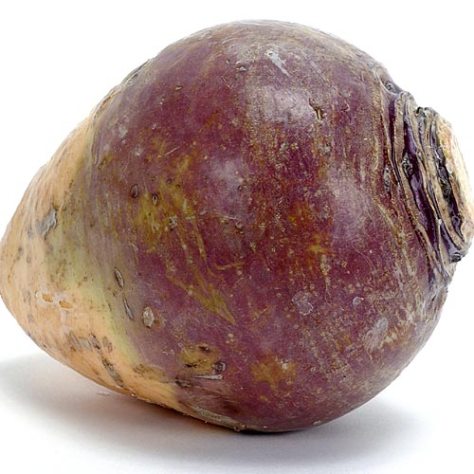
The rutabaga, swede (from Swedish turnip), or yellow turnip (Brassica napobrassica, or Brassica napus var. napobrassica) is a root vegetable that originated as a cross between the cabbage and the turnip. Its leaves can also be eaten as a leaf vegetable.
Prior to pumpkins being readily available in the UK and Ireland (a relatively recent development), swedes were hollowed out and carved with faces to make lanterns for Halloween. Often called “jack o’lanterns”, or “tumshie lanterns” in Scotland, they were the ancient symbol of a damned soul!
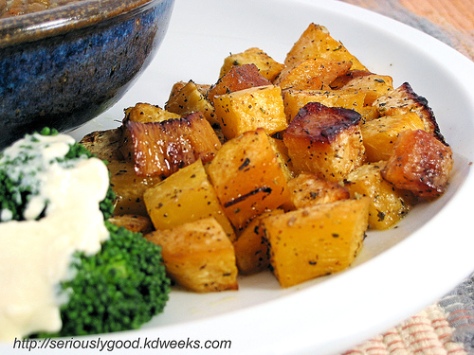
Roasted rutabagas
Rutabagas were an important nutritional source for many Finno-Ugric tribes before the introduction of potatoes. Some claim the vegetable is native to Sweden, but others think it was introduced to Sweden, possibly from Finland or Siberia, in the early 17th century. From Sweden, it reached Scotland, and from there it spread to the rest of Great Britain and to North America.
In continental Europe, it acquired a bad reputation during World War I, when it became a food of last resort. In the German Steckrübenwinter (rutabaga winter) of 1916–17, large parts of the population were kept alive on a diet consisting of rutabagas and little else, after grain and potato crop failures had combined with wartime effects. After the war, most people were so tired of rutabagas that they came to be considered “famine food,” and they have retained this reputation to the present day. As a consequence, they are rarely planted in Germany.
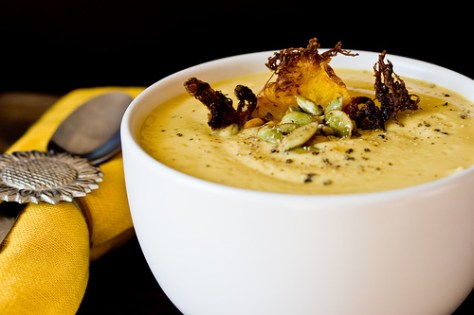
Rutabaga Cream.
On the other hand rutabaga is foing through a kind of boom in France where famous chefs have readily adopted them and given the vegetable its “lettre de noblesse”/nobility image!
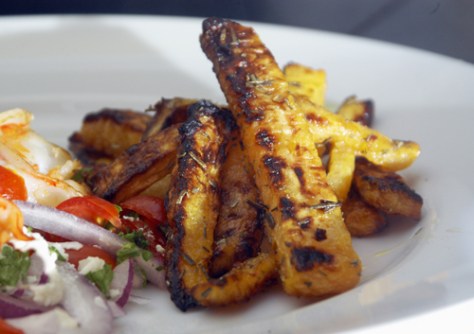
Rutabaga Fries!
Choose firm and well-rounded.
All the potato recipes can be applied to the rutabaga.
Its yeloow sweet flsh tastes something between turnip and cabbage.
Other preparations according to the countries:
Finns cook swede/rutabaga in a variety of ways; roasted to be served with meat dishes, as the major ingredient in the ever popular Christmas dish Swede casserole (“lanttulaatikko”), as a major flavor enhancer in soups, uncooked and thinly julienned as a side dish or in a salad, baked, or boiled. Finns use swede in most dishes that call for any root vegetable.
Swedes and Norwegians cook swede with potatoes and carrots and mash them with butter and cream or milk to create a puree called “rotmos” (root mash) and “kålrot/kålrabistappe” in Swedish and Norwegian, respectively. Onion is occasionally added. In Norway, kålrabistappe is an obligatory accompaniment to many festive dishes, including smalahove, pinnekjøtt, raspeball and salted herring.
In Wales, a similar dish produced using just potatoes and swede is known as “potch”.
In Scotland, swede and potatoes are boiled and mashed separately to produce “tatties and neeps” (“tatties” being the Scots word for potatoes), traditionally served with the Scottish national dish of haggis as the main course of a Burns supper. Neeps may also be mashed with potatoes to make clapshot. Regional variations include the addition of onions to clapshot in Orkney. Neeps are also extensively used in soups and stews.
In Yorkshire and Lincolnshire/England, swedes are often mashed together with carrots as part of the traditional Sunday roast.
In Canada rutabagas are used as filler in foods such as mincemeat and Christmas cake, or as a side dish with Sunday dinner in Atlantic Canada.
In the US rutabagas are mostly eaten as part of stews or casseroles, served mashed with carrots, or baked in a pasty.
RECOMMENDED RELATED SITES
Not-Just-Recipes
Bengal cuisine
Cooking Vegetarian
Please check the new postings at:
sake, shochu and sushi
—————————————-
日本語のブログ
—————————————-

 SHIZUOKA GOURMET