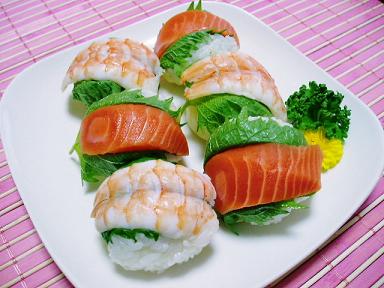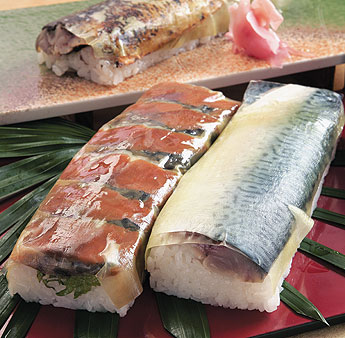
Tag Archives: Shizuoka

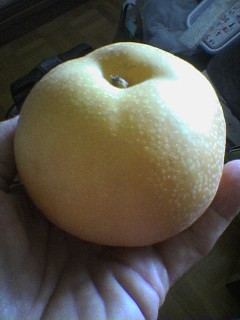
Japanese Fruits 1: Nashi/Asian Pear

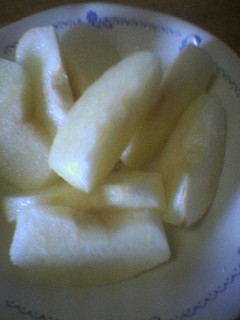
nashi1

Pyrus pyrifolia is a pear tree species native to China, Japan, and Korea. The tree’s edible fruit is known by many names, including: Asian pear, nashi or nashi pear, African pear, Japanese pear, Korean pear, Taiwan pear, sand pear, apple pear, bapple, papple, bae, li (Japanese: ナシ;Chinese: 梨; Korean: 배). In South Asia, the fruit is known as nashipati or nashpati.

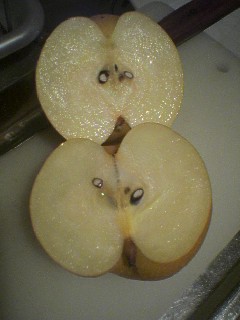
nashi2

Pyrus pyrifolia is cultivated throughout East Asia, as well as in Australia, India , New Zealand, and other countries. It was recently grown successfully in France and is also sold under the name pf Nashi.

nashi3

Nashi pears are widely grown for their sweet fruit, a popular food in East Asia. They are sweet on the tree and are eaten crisp.

nashi4

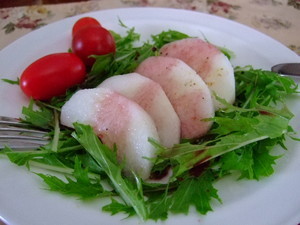
Healthy salad!

Nashi pears generally are not baked in pies or made into jams because they have a high water content and a crisp, grainy texture, very different from the buttery European varieties. Also, Nashi pears are not as intensely sweet, having a more refreshing, light taste.

They are grown in various areas in Japan under different cultivar and brand names.

nashi5

Great salads!

I have the luck to be offered every summer a full box of them coming from Yaizu City where their brand name is “Shinsui”/新水. They are the perfect fruit for a hot summer and have far more value than a whole bottle of soda!

RECOMMENDED RELATED SITES
Not-Just-Recipes
Bengal cuisine
Cooking Vegetarian
Frank Fariello
Gluten-free Vegan Family
Meatless Mama

Please check the new postings at:
sake, shochu and sushi

—————————————-
日本語のブログ
—————————————-

For Vegan and Vegetarians! “Forgotten” Vegetables 15: Capucine tubereuse-Maschua

capucine-tubereuse2

SYNOPSIS:
Organic agriculture and biodiversity have in recent years brought about a rediscovery of many “forgotten” vegetables that people especially in Europe and France conscientiously tried to forget as they reminded them of the privations suffered during WWII. The same people had then to make do with untraditional vegetables because potatoes, carrots and so on were confiscated by occupying forces or their own armies.
With sustainibility and bioagriculture made more important by the deficiencies of modern mass agriculture, those “forgotten” vegetables have suddenly come to the fore for the pleasure of all, and that of course of vegetarians and vegans!

This particular series of postings will introduce these vegetables one by one. I hope they will become useful for a long time to come to all my vegan and vegetarian friends!
1) Scorsonere/Oyster Plant
2)Potimarron
3) Vitelotte
4) Rutabaga
5) Cardon
6) Panais/Parsnips
7) Patisson
8) Topinambour
9) Crosne
10) Cerfeuil Tubereux
11) Poiree
12) Oca
13) Ulluque/Ulluco
14) Tigernuts

The Capucine tubereuse (French), Maschua (Inca) or Tropaeolum tuberosum (Latin) is a very old tuber originally grown on the high plateaux of Peru and around Titicaca Lake.

2m high, it is mainly used for its flowers as a decorative plant.
It blooms from July to Autumn. The seeds are formed at the same time.

capucine-tubereuse

It was already grown and eaten by the pre-Incas 5.500 years BC.
It gives out fairly good yields.

Maschua has recently become popular in France and Belgium for its tubers.
They can be eaten like potatoes.
Its peppery taste (it contains mustard oils) is not always appreciated.
This peppery taste disappears upon freezing or long boiling.
The taste is best when the tubers are harvested after the first frosts.
In Bolivia and Peru the tubers are also eaten with molasses and frozen as a dessert.

The young leaves can be eaten as a green vegetable, either raw or cooked.
The flowers can be eaten raw and have a sweet taste ending up on a peppery note.

RECOMMENDED RELATED SITES
Not-Just-Recipes
Bengal cuisine
Cooking Vegetarian
Frank Fariello
Gluten-free Vegan Family

Please check the new postings at:
sake, shochu and sushi

—————————————-
日本語のブログ
—————————————-

Today’s Lunch Box/Bento (’09/67)

BENTO-09-10-13a

After a long week-end (yesterday was a national holiday) spent cricket-umpiring and visiting all kinds of museums in Mishima City (where I found an organic restaurant), it was back to usual today.

BENTO-09-10-13b

A Japanese home-style bento with a few twists!

BENTO-09-10-13c

The rice itself is a Missus’ specialty. She had simmered finely cut mushrooms with thinly cut aburaage (fried tofu pouches) the night before. She heated them again in their soup before adding and mixing them (with some of the soup) with the freshly steamed rice.

BENTO-09-10-13d

The garnish came into two disntinct parts:

BENTO-09-10-13e

Pork belly sliced from a large block and fried with yuzu koshio. She fried okra, scallions and red soft piments in the juices.

BENTO-09-10-13f

Tamagoyaki/Japanese omelette, plum tomatoes and mitsuba/trefoil and sesame seeds salad.

BENTO-09-10-13g

For dessert Asian pear/Nashi and Square persimmons/Jirou Kaki (originally raised in Shizuoka Prefecture!)

Plentiful, tasty and healthy! I must say the Missus was in a fairly good mood today!LOL

RECOMMENDED RELATED SITES:
Warren Bobrow
Bread + Butter
5 Star Foodie
Think Twice
Frank Fariello
Mangantayon
Hapabento
Elinluv Tidbit Corner
Tokyo Terrace

Please check the new postings at:
sake, shochu and sushi

—————————————-
日本語のブログ
—————————————-

For Vegan and Vegetarians! “Forgotten” Vegetables 14: Tigernuts, Amande de Terre

AMANDE-DE-TERRE-1a

SYNOPSIS:
Organic agriculture and biodiversity have in recent years brought about a rediscovery of many “forgotten” vegetables that people especially in Europe and France conscientiously tried to forget as they reminded them of the privations suffered during WWII. The same people had then to make do with untraditional vegetables because potatoes, carrots and so on were confiscated by occupying forces or their own armies.
With sustainibility and bioagriculture made more important by the deficiencies of modern mass agriculture, those “forgotten” vegetables have suddenly come to the fore for the pleasure of all, and that of course of vegetarians and vegans!

This particular series of postings will introduce these vegetables one by one. I hope they will become useful for a long time to come to all my vegan and vegetarian friends!
1) Scorsonere/Oyster Plant
2)Potimarron
3) Vitelotte
4) Rutabaga
5) Cardon
6) Panais/Parsnips
7) Patisson
8) Topinambour
9) Crosne
10) Cerfeuil Tubereux
11) Poiree
12) Oca
13) Ulluque/Ulluco

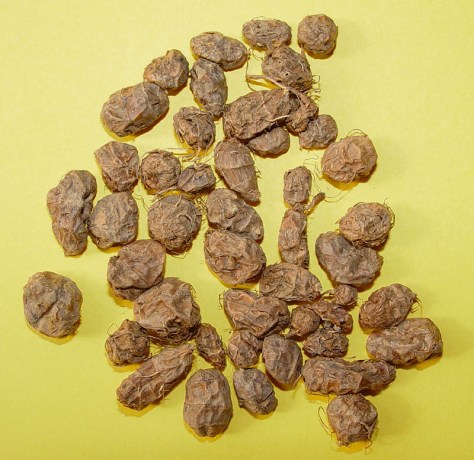
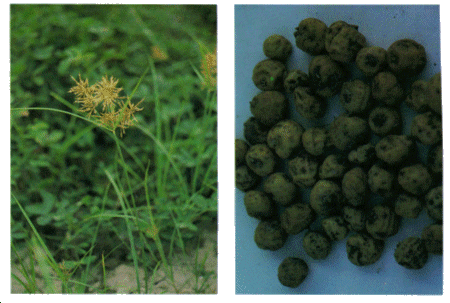
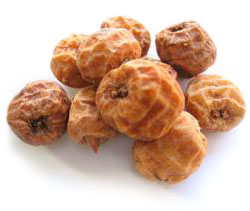
Tigernuts or chufa flatsedge in English, amande de terre (earth almond!), choufa, noix tigrée, souchet comestible in French, Chufa in Sapnish, Zigolo dolce in Italian or Yellow Nutsedge in the US, Cyperus esculentus does have many names!

AMNDE-DE-TERRE-1

Very popular in Spain, the plant is a cousin of the papyrus.
It produces small 2~3 cm tubers/rhyhomes in Autumn.
Once dried thay can be safely kept for years.

AMANDE-DE-TERRE

In Spain they are fermented into a celebrated drink with an almond taste called Hodchata!

Many people eat them raw as snacks or griilled or in salads with a drink, too!

Before re-planting them April~May, let them in lukewarm water for 48 hours. They need quite some watering, especially during dry seasons.

Harvest are conducted from end of Otober to the beginning of November by pulling out the whole plant.ue vous conserverez au frais.

Le saviez-vous ?
Le souchet sert à préparer une boisson Espagnole appelée “horchata de chufa”. Chufa est son nom en Espagne.

It is also used in place of almonds in cakes.

RECOMMENDED RELATED SITES
Not-Just-Recipes
Bengal cuisine
Cooking Vegetarian
Frank Fariello

Please check the new postings at:
sake, shochu and sushi

—————————————-
日本語のブログ
—————————————-

Today’s Lunch Box/Bento (’09/66):The Day After Bento

BENTO-09-10-10a

Today’s bento was definitely “The Day After Bento”!
Invited as I was lats night by a student of mine, I only managed cycling back home at 2 a.m. to wake up at 7 a.m. and go to work an hour later with a “slight” hangover….

BENTO-09-10-10b

A Working Man’s Lunch!

BENTO-09-10-10c

The double decker sandwiches were actually pretty big:
The first tier was mainly egg sandwich, a Missus’ favourite.
The second tier was a bit more sophisticated with home-made chicken ham, British chutney, French pickles and mustard.

BENTO-09-10-10d

Big salad, too, most it made with local ingredients: shreddedcabbage, leaf vegetables, plum tomatoes, green asparaguses and black olives.

Grapes for dessert. All in all, it proved lighter than it looked!

RECOMMENDED RELATED SITES:
Warren Bobrow
Bread + Butter
5 Star Foodie
Think Twice
Frank Fariello
Mangantayon
Hapabento
Elinluv Tidbit Corner
Tokyo Terrace

Please check the new postings at:
sake, shochu and sushi

—————————————-
日本語のブログ
—————————————-

Shizuoka Local Fish: Houbo/Blue Fin Robin

houbou.jpg

Many a time, my good friend Patrick Harrington has rightly pointed out on the importance to eat “local” as much as possible. Consequently, I have endeavoured whenever possible to introduce any vegetables, dairy products, meat and fish grown, made, raised or caught in Shizuoka Prefecture (and its waters)
As for today I would like to introduce again a fairly cheap and tasty fish: houbou. Its English name is quite poetic: blue fin robin (“Chelidonichthys spinosus” for the purists). The reason is its very wide round green-blue side fins.
Some call it grotesque, others beautiful.

Most of them are found in Niigata Prefecture from Autumn to Winter (30~50 cm), but they are caught in early Spring in Suruga Bay (the Shizuoka variety is smaller, up to 20 cm). But now and thenwe find them at dfferent times of the year.

It can be prepared in many ways:

-Sashimi and sushi if just caught.

-In “nabe/鍋” (soup pot) or as “nimono/煮物” (simmered) in Japanese-style cuisine.

-Steamed and served with a sweet and sour sauce in Chinese-style food.

My preferred way is Mediterranean style (one fish per person):
Cut the side fins and scrape the scales off. discard the insides and clean under clear cold running water. Make a couple of shallow incisions over each flank.
Fill the stomach with a mixture of finely chopped vegetables and herbs (leave your imagination go free!).
Put it on a large sheet of olive oil coated cooking foil paper, sprinkle it with a little salt and pepper. Place vegetables cut in long strings on both sides (plenty is fine), and one or two thin lemon slices on top. Coat it with some (not too much) extra virgin oil. As a last touch, I add some white wine and a little anise spirit (Pernod, Ricard or Absinthe).
Loosely wrap the fish with foil paper, close both ends by twisting them around.
Place the fish in its foil paper directly on the metal plate inside the oven preheated at 180 degrees Celsius and cook for about 15 minutes (longer for large fish).
If you do not have an oven, steam it the Chinese way!

RECOMMENDED RELATED SITES:
Warren Bobrow
Bread + Butter
5 Star Foodie
Frank Fariello
Mangantayon
Elinluv Tidbit Corner

Please check the new postings at:
sake, shochu and sushi

—————————————-
日本語のブログ
—————————————-

Sushi & Sashimi: The Basics 5 – Sashimi Presentations

SUSHIK-09-08-31-5
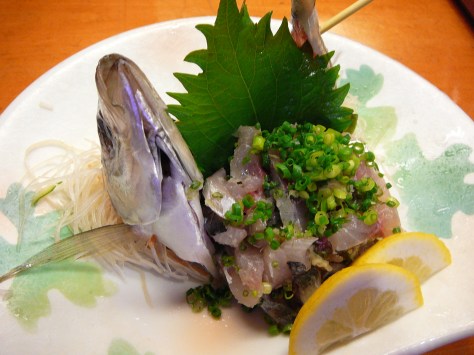
Aji Tataki/Horse mackerel Tartare served at Sushi Ko, Shizuoka City

SYNOPSIS:
I already have wrtitten a lot in bits and pieces on Sushi and Sashimi, including in my other blog, Shizuoka Sushi, but I felt it was time to post an article that could be used as general reference by my blogging friends.
The Basic 1: Definitions
The Basics 2: Questions & Answers
The Basics 3: Ingredients
The Basics 4/1: Sushi Presentations
The Basics 4/2: Sushi Presenations-Rolls
The Basics 4/3: Sushi Presentations-Donburi

Sashimi, as almost everyone knows means thin slices, whether it be fish, meat or vegetables. When raw fish, seafood or meat is not sashimi but served raw, it is usually called tsumami/side, snack.
Fish and other seafood van be presented solely as sashimi or as a combination of sashimi and tsumami.

The possibilities are infinite as there are many ways a chef can cut and present his food.

Below I propse a “small” selection of waht can be found in Japan.
here is a little challenge for you:
Can you recognize all ingredients?

011
Usu tsukuri style/Thin cut style

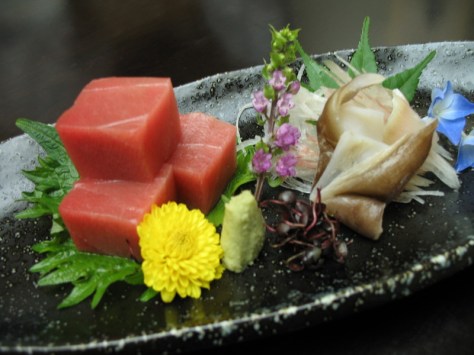
SASHIMI-PRESENTATIONS-1
Japanese Cuisine Sashimi O-Tsukuri/Plate

SASHIMI-PRESENTATIONS-2
Another Japanese Cuisine Sashimi O-Tsukuri/Plate

SASHIMI-PRESENTATIONS-3
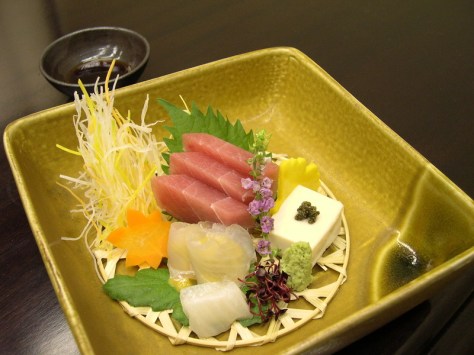
Japanese Cuisine Sashimi O-Tsukuri/Plate in Kado/Square style

SASHIMI-PRESENTATIONS-4
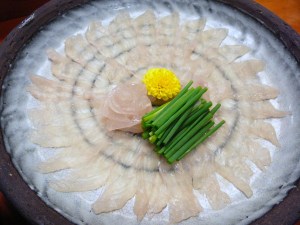
I suppose you recognize this single sashimi served in Somen/thin noodles style!

SASHIMI-PRESENTATIONS-5
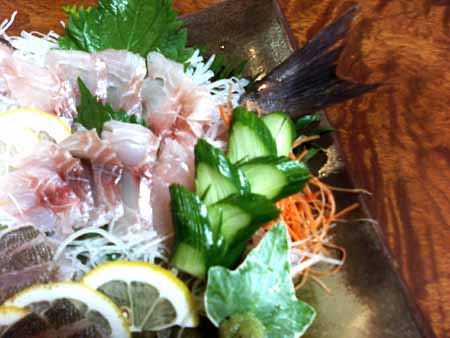
Another way to serve the whole fish

SASHIMI-PRESENTATIONS-6
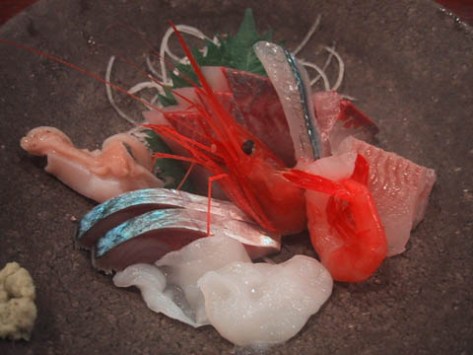
A simple individual plate of sashimi

SASHIMI-PRESENTATIONS-7
A more sophisiticated individual plate of sashimi and tsumami

SASHIMI-PRESENTATIONS-8
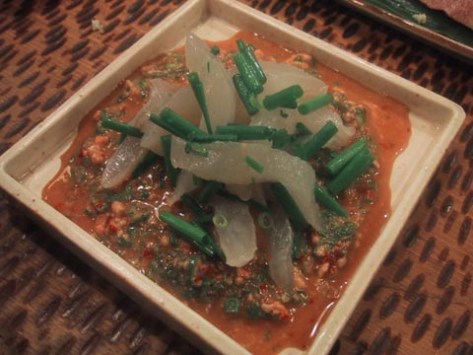
An individual Plate of sashimi served with the seasoning

SASHIMI-PRESENTATIONS-9
Elegant and simple individual plate of sashimi!

RECOMMENDED RELATED SITES:
Warren Bobrow
Bread + Butter
5 Star Foodie
Frank Fariello
Mangantayon
Tokyo Foodcast
Tokyo Through The Drinking Glass
Urban sake
Hapabento
Elinluv Tidbit Corner

Please check the new postings at:
sake, shochu and sushi

—————————————-
日本語のブログ
—————————————-

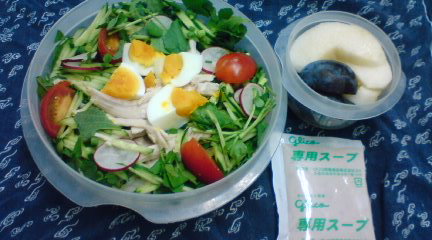
Today’s Lunch Box/Bento (’09/65): Typhoon No 18 Bento

BENTO-09-10-07a

A big typhoon being upon us, Number 18, I had no recourse but to give up on going back home for lunch and “ordered” the Missu to concoct me a quick and healthy bento.

BENTO-09-10-07b

It was very healthy indeed!
She boiled udon and cooled them under cold running clear water.
She topped it with home-made chicken ham, boiled eggs, cress, finely cut cucumber, sliced radish, pieces of shiso/perilla leaves and cut plum tomatoes.

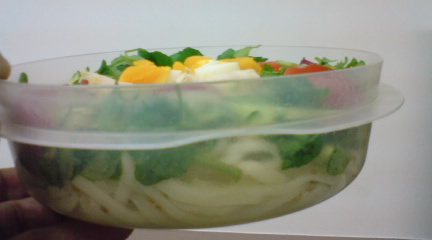
BENTO-09-10-07c

Side view of the bento!

BENTO-09-10-07d

Soup/dressing I added to the lot later at the office!

BENTO-09-10-07e

Asian pears/Nashi and plums are still in season!

RECOMMENDED RELATED SITES:
Warren Bobrow
Bread + Butter
5 Star Foodie
Think Twice
Frank Fariello
Mangantayon
Hapabento
Elinluv Tidbit Corner
Tokyo Terrace

Please check the new postings at:
sake, shochu and sushi

—————————————-
日本語のブログ
—————————————-

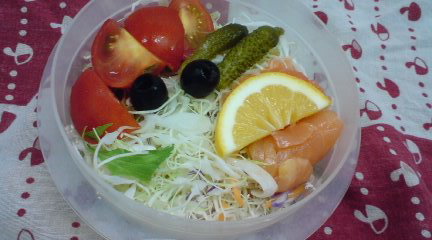
Today’s Lunch Box/Bento (’09/64)

BENTO-09-10-06a

Onecould call today’s bento “Another Typhoon Bento”, as after almost 12 weeks of drought the rain is back with a vengeance! The notion of typhoon notwithstanding, the weather pattern are absolutely identical to that of the rainy season/tsuyu in June/July!

BENTO-09-10-06b

The beno the Missus prepared his morning was a very classi one, reminiscent of what children and students can expect from their mothers.

BENTO-09-10-06d

After she had steamed the rice, she mixed still hot with rice vinegar and other ingredients including white sesame seeds to make it sushi rice.
She fried minced chicken with finely cut mushrooms in a comparitively sweet sauce before covering half the rice with it.
She covere the other other with Japanese-style scrambled eggs and separated both with some freshly cut mitubs/trefoil making for an appetizing and colourful dish.

BENTO-09-10-06c

The salad consisted of shredded vegetables, smoked salmon, plum tomatoes, French pickles and black olives. I seasoned the lot with dressing kept in my fridge at work.

For dessert grape jelly.
Very healthy indeed!

RECOMMENDED RELATED SITES:
Warren Bobrow
Bread + Butter
5 Star Foodie
Think Twice
Frank Fariello
Mangantayon
Hapabento
Elinluv Tidbit Corner
Tokyo Terrace

Please check the new postings at:
sake, shochu and sushi

—————————————-
日本語のブログ
—————————————-

Sushi & Sashimi: The Basics 4/3-Sushi Presentations-Donburi

donburi-09-02-13
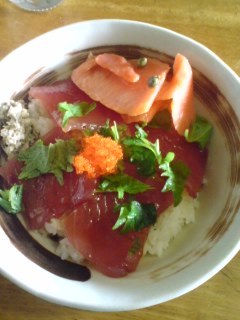
Donburi made by the Missus:
-She marinated thin slices of raw tuna in ponzu, sake and what else. The leftover marinade was poured over the rice to season it before she placed the pieces of tuna on top.
-Smoked salmon with capers.
-A spoon of “tobikko/flying fish roe”
-a generous portion of locally-made (up the Abe River in Shizuoka City) “Wasabi zuke/chopped wasabi stems and flowers fermented in “sake kasu/sake white lees” (all from Shizuoka Prefecture!)

SYNOPSIS:
I already have wrtitten a lot in bits and pieces on Sushi and Sashimi, including in my other blog, Shizuoka Sushi, but I felt it was time to post an article that could be used as general reference by my blogging friends.
The Basic 1: Definitions
The Basics 2: Questions & Answers
The Basics 3: Ingredients
The Basics 4/1: Sushi Presentations
The Basics 4/2: Sushi Presenations-Rolls

There is another form of sushi, partly similar to Chirashizushi called Donburi Sushi.
It is popular not only at sushi restaurants, especially in Hokkaido Island, but also in Japanese homes all over Japan!
The moment you know how to prepare sushi rice, it is great fun!
You can make donburi vegan, vegetarian, seafood or even meat.
It is entirely up to your imagination!

Here is another example by the Missus:

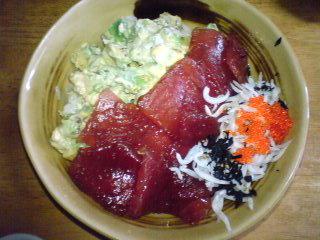
DONBURI-HOME
Plain steamed rice topped with slices of “akami”/ lean tuna part, avocado salad with mayonnaise and wasabi pickles (the latter provided a nice balance with a spicy touch), boiled sirasu/whitebait sprinkled with “hijiki” seaweed and “tobikko”/flying fish roe.
The tobikko added a nice colour finish touh. It is quite cheap down here in Shizuoka City.
I poured a little Shizuoka-made wasabi dressing on top. This dressing is a lot milder than pure grated wasabi with a little sweetness which combines well with the fish!

I go very often to Hokkaido and have collected quite a few samples of Donburi:

The following three were taken near Abashiri a short distance from Shiretoko, one of the Japanese World Nature Heritage in the far North:

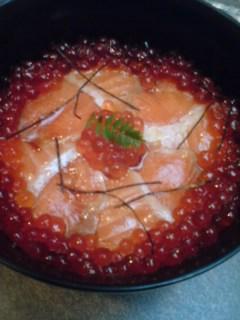
DONBURI-HOKKAIDO-1
“Oyako” Donburi/”Mother and Child”. In this case it means Salmon and Salmon Roe!

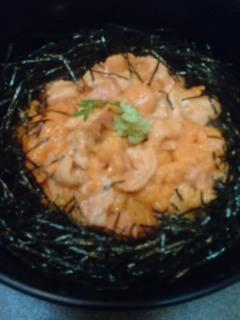
DONBURI-HOKKAIDO-2
“Uni” Donburi, Sea Urchin Donburi. Absolutely extravagant!

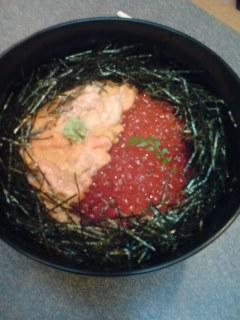
DONBURI-HOKKAIDO-3
Uni to Ikura Donburi, even more extravagant!

The next four were savoure in Sapporo City, the capital of Hokkaido:

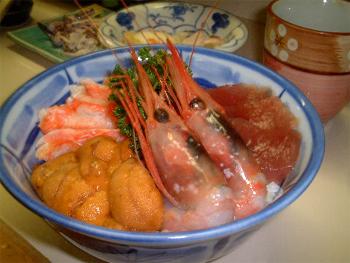
DONBURI-SAPPORO-1
From bottom, clockwise:
“Uni” (Sea Urchin), “Kani Tsume” (Crab legs), “Maguro” (Tuna), “Nanban Ebi” ( large prawn variety)

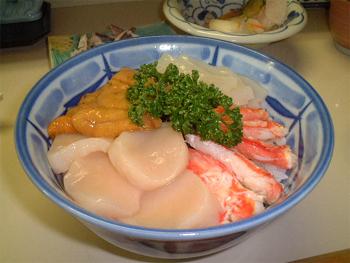
DONBURI-SAPPORO-2
From bottom, clockwise:
“Hotate” (Scallops), “Uni” (Sea urchin), “Ika” (Squid), “Kani Tsume” (Crab legs)

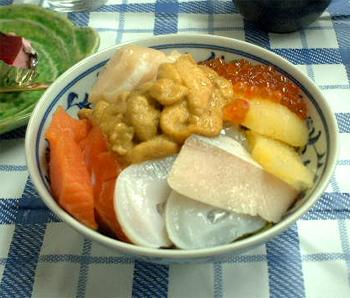
DONBURI-SAPPORO-3
From top middle clockwise:
“Ikura” (salmon roe), “Kazu no ko” (herring roe), “Kampachi” (Amberjack), “Tako” (octopus), “Sake” (raw salmon), “Hotate” (scallops), in the centre, “Uni” (sea urchin)

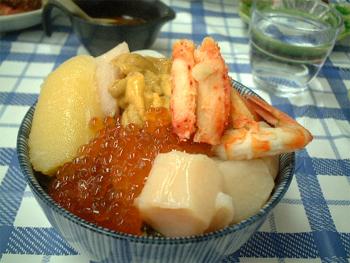
DONBURI-SAPPORO-4
From bottom, clockwise:
“Hotate” (Scallops), “Ikura” (Salmon roe), “Kazu no Ko” (Herring roe), “Kampachi” (Amberjack), “Uni” ( Sea Urchin), “Kani Tsume” (Crab leg), “Ebi” (Boiled prawn)

Next article will be about Sashimi Presentations!

RECOMMENDED RELATED SITES:
Warren Bobrow
Bread + Butter
5 Star Foodie
Frank Fariello
Mangantayon
Tokyo Foodcast
Tokyo Through The Drinking Glass
Urban sake
Hapabento
Elinluv Tidbit Corner

Please check the new postings at:
sake, shochu and sushi

—————————————-
日本語のブログ
—————————————-

Sashimi & Sushi: The Basics 4/2: Sushi Presentations/Rolls

SUSHI-ROLL-2-SIZES
Futo-Maki/Large sushi roll with normal size nori-maki for comparison

SYNOPSIS:
I already have wrtitten a lot in bits and pieces on Sushi and Sashimi, including in my other blog, Shizuoka Sushi, but I felt it was time to post an article that could be used as general reference by my blogging friends.
The Basic 1: Definitions
The Basics 2: Questions & Answers
The Basics 3: Ingredients
The Basics 4/1: Sushi Presentations

SUSHIKO-08-12-25-9
California Roll by Sushi Ko in Shizuoka City

I stopped counting the number of complaints I received about the so-called sushi rolls they serve in other countries. “Gross”, “Impossible to finish”, “Nothing to do with sushi”, and so forth.
This is like any “ethnic” food served outside its country of origin: some unscrupulous restaurateurs/businessmen catch on the fad and immediately serve “authentic” cuisine to gullible/unknowing customers.
But soon or later, thanks to better and faster global communications, the same customers will realize their mistake and stop patronizing such establishments.
The problem is that very often they are left with no decent sushi restaurant to visit.
About time to learn to make these famous rolls and enjoy them at home or parties until that great real sushi restaurant comes to town!
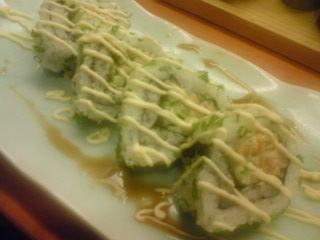
Here are some examples of sushi rolls to help you with your own crations!

-Sushi do not have all to be of the”California Roll” type.
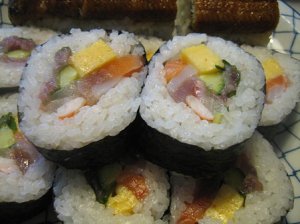
Below are typical examples of “futo maki/large maki” with the seaweed/nori outside.

SUSHI-ROLL-HOME-TYPE-1
Home-type futo-maki/large sushi roll 1

SUSHI-ROLL-HOME-TYPE-2
Home-type futo-maki/large sushi roll 2

They can be larger of course, but there is limit to size.
Below are great examples of what can be achieved with large types:

SUSHIK-09-08-31-1
Futo maki roll: (Large) Rainbow Roll at Sushi Ko, Shizuoka City

SUSHIKO-09-25-2
Pirikara Hotate Futo maki/large spicy scallops roll at Sushi Ko, Shizuoka City

SUSHI-ROLL-TONKATSU
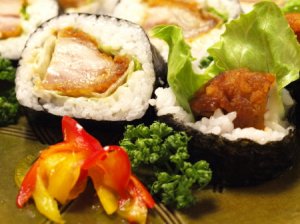
Tonkatsu sushi roll

Nori-maki style rolls are probably the easiest to make, serve and eat.
And there are so many possibilities as you can devise them with a single ingredient!

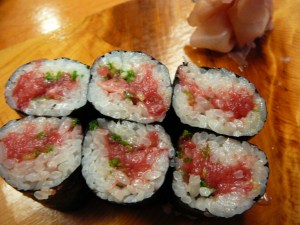
SUSHIK-09-08-31-19
Negi-toro nori maki sushi roll at Sushi Ko, Shizuoka City

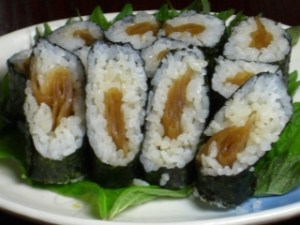
vegan-sushi3
Kanpyo maki/dried gourd shavings roll

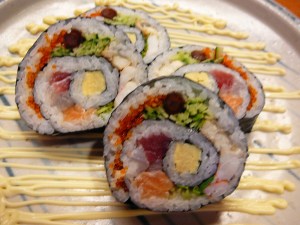
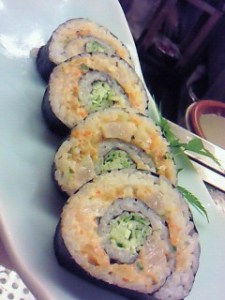
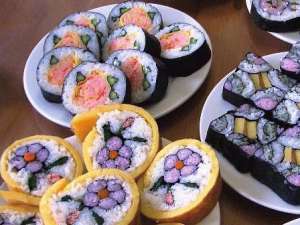
Making “decoration rolls2 for the family can be great fun!
Look below for some examples:

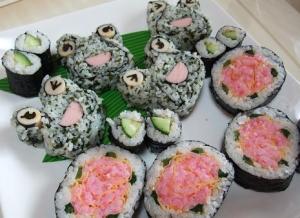
SUSHI-ROLL-DECORATION

SUSHI-ROLL-DECORATION-2

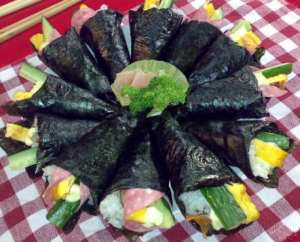
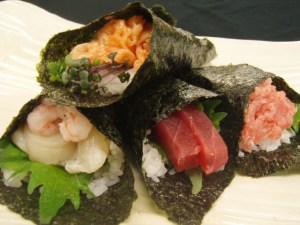
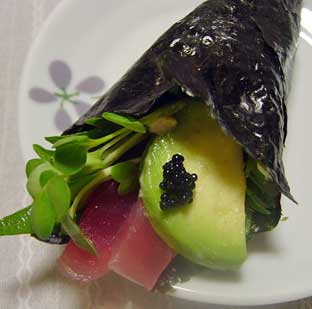
Another type of roll very popular in Japanese restaurants and homes is te-maki/手巻き, literally hand-roll.
They have the advantage that you can choose your own ingredients at will!

TE-MAKI-ZUSHI-HOMESTYLE
Home-style te-maki plate!

TE-MAKI-2
Te-maki set served at a sushi restaurant.
Can you recognize the ingredients?

TE-MAKI-3
How about this one, also served in a sushi restaurant! Looks very healthy!

TE-MAKI-1
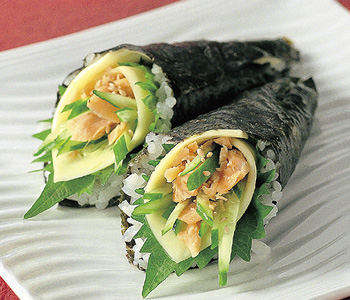
Japanese home-style te-maki made with cheese, shiso and canned tuna!

Next article is about sushi donburi!

RECOMMENDED RELATED SITES:
Warren Bobrow
Bread + Butter
5 Star Foodie
Frank Fariello
Mangantayon
Tokyo Foodcast
Tokyo Through The Drinking Glass
Urban sake
Hapabento
Elinluv Tidbit Corner

Please check the new postings at:
sake, shochu and sushi

—————————————-
日本語のブログ
—————————————-

Sashimi & Sushi: The Basics 4/1: Sushi Presentations

SUSHIK-09-08-31-7
Sushi Millefeuille at Sushi Ko, Shizuoka City

SYNOPSIS:
I already have wrtitten a lot in bits and pieces on Sushi and Sashimi, including in my other blog, Shizuoka Sushi, but I felt it was time to post an article that could be used as general reference by my blogging friends.
The Basic 1: Definitions
The Basics 2: Questions & Answers
The Basics 3: Ingredients

Sushi does come ito many guises and shapes (and colours).
Too many people think it is only all nigiri and rolls.
Any chef worthy of his/her name will prove you otherwise!

Alright, then. What do they have to offer?

SUSHIK-09-08-31-9
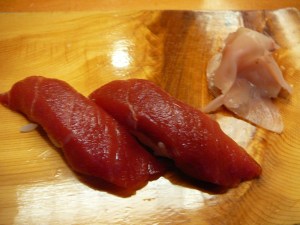
Magurozuke/Marinated tuna (Akami/lean part) Nigiri at Sushi Ko, Shizuoka City

NIGIRI/NIGIRIZUSHI:

Nigiri/握り literally means “grip/grasp/press” in Japanese.
The shari/シャリ is made by scooping the right amount of sushi rice in one hand (usually the left hand9 and making a “ball” of it. Actually it is more oblong than round. Size varies with the chef and restaurant, but an experienced chef is capable to reproducing such a ball to the same exact amount of grains. They say it takes seven years to become a master at making shari!
The next step, but not always, is to smear a little wasabi on top of the rice ball and then top it with an ingredient of your choice. Finally the chef will press it around the top of the shari before depositing it on a plate (or on a bamboo leaf) or on small wooden plate in front of the customer.
In some cases the wasabi will be placed in the from of a small ball on top of the neta/ネタ (topping) as on anago/アナゴ (conger eel).
All kinds of neta/toppings can wrapped around the top. (See The Basics 3: Ingredients).

SUSHIK-09-08-31-10
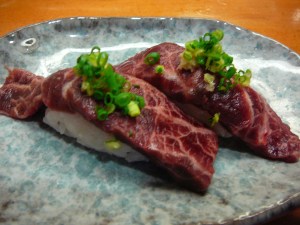
Sakura Nigiri/Horsemeat Nigiri at Sushi Ko in Shizuoka City

More ingredients will be added as seasoning on top of the topping such as grated ginger and chopped leeks (see above),

SUSHIK-09-08-31-14

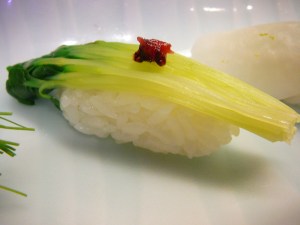
pickled Japanese plum/umeboshi/梅干 as above (on op of boiled mitsuba/trefoil at Sushi Ko in Shizuoka City)

SUSHIK-09-08-31-15

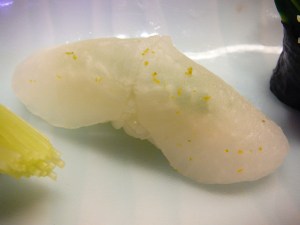
grated lime zest as above (on top of pickled/marinated daikon at Sushi Ko in Shizuoka City),

SUSHIK-09-08-31-17

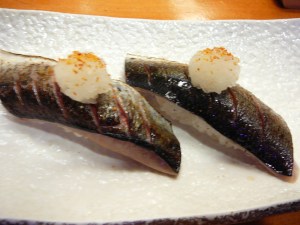
grated daikon and chili pepper as above (on top of aburi sanma/lightly grilled mackerel pike)

ANAGO-SUSHI

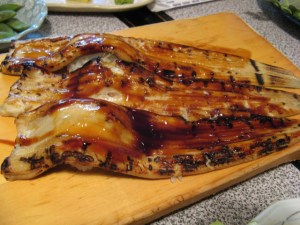
or tare/sauce as above(on top of anago/アナゴ)

TAMAGO-NIGIRI

A strip of dried seaweed/nori/海苔 can be used to secure the neta as with tamagoyaki/卵焼き above.

SUSHIK-09-08-31-8

The same strip of nori can circled around a really round shari as above (thinly cut ika/烏賊/squid arranged into a tsuru/鶴/crane shape)

SUSHIK-09-08-31-16
Boiled trefoil/Mitsuba and fresh cucmber/Kyuuri Gunkan at Sushi Ko in Shizuoka City

GUNKAN/GUNKAN SUSHI:

When a wider strip of nori is wrapped around a shari to prevent the topping to fall over, it is called a gunkan/軍艦/mothership.

UMIBUDOGUNKAN
Umibudo/Sea Grapes Gunkan

It is also useful to emphasize the neta as above,

SUSHIKO-08-12-25-12

or it can be designed as purposefully overflowing as above (ikura/salmon roe gunkan)!

ST-VALENTINE-SUSHI

What about this tiny St-Valentine Gunkan?

For more gunkan fun go HERE!

SUSHIKO-08-12-25-11

Chirashizushi served in Sushi Ko, Shizuoka City

CHIRASHIZUSHI:

Chirashizusi/散らし寿司 means “decoration Sushi”.
It is very popular in homes where large quantities can prepared for the family and still designed as to please the eye.

MILLEFEUILLE-EX
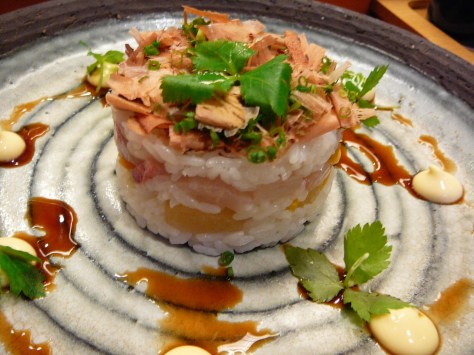
Millefeuille sushi served in Sushi Ko, Shizuoka City

Millefeuille is anaother typ of chirashizushi! Very easy to make and so impressive! (use a baking circle!)

TE-NARI-ZUSHI
Home Party Te-Mari Zushi

TEMARI ZUSHI:

Te-Mari Zushi/手まり寿司/Small ball-shaped sushi are very popular in Kyoto and at homes in many Japanese homes, especially on Girls’ day (March 3rd). Great for parties and easy to make!

INARI-ZUSHI

INARI-ZUSHI:

Inari Zusi/稲荷寿司/Fried tofu pouches filled sushi rice and other ingredients are basically home-type and bento-type sushi.
Very popular with vegans and vegetarians as they can control the contents. Very healthy!

Next Article will be on Sushi Roll Presentation!

RECOMMENDED RELATED SITES:
Warren Bobrow
Bread + Butter
5 Star Foodie
Frank Fariello
Mangantayon
Tokyo Foodcast
Tokyo Through The Drinking Glass
Urban sake
Hapabento
Elinluv Tidbit Corner

Please check the new postings at:
sake, shochu and sushi

—————————————-
日本語のブログ
—————————————-

Sushi & Sashimi: The Basics 3: Ingredients

SUSHIKO-08-12-25-3
Botan ebi/Botan Shrimp and its eggs at Sushi Ko, Shizuoka City

SYNOPSIS:
I already have wrtitten a lot in bits and pieces on Sushi and Sashimi, including in my other blog, Shizuoka Sushi, but I felt it was time to post an article that could be used as general reference by my blogging friends.
The Basic 1: Definitions
The Basics 2: Questions & Answers

One encounters the general misconception that sushi ingredients include only fish and pre-determined seafood as neta/topping.
Fortunately, sushi offers a greater variety to please everyone, even vegetarians and vegans!

The following description is not exhaustive as possibilities are almost limitless according to avaibility, country and geography, but I hope it will help gastronomes and good food lovers to gain access to a larger scope on which they can expand at will!

007
Katsuo/Bonito sashimi at Sushi Ko, Shizuoka City

FISH:

The Japanese traditionally differentiate fish into the following kinds:

a) White-flesh fish:
Hirame/Sole, Makogarei or Ishigarei/Turbot or Halibut or Flounder, Sayori/Japanese Half Beak, Shirogisu/Sillago, Suzuki/Seabass, Kawahagi/Leatherback, Tobiuo/Flying fish, Yagara/Trumpet Fish, Houbo/Bluefin Robin, Funa/Crucian Carp, Koi/Carp, Tara-Madara/Cod
Seabreams: Tai, Madai, Ishidai, Amadai, Hanadai

b) Red-fleshed fish:
Maguro/Tuna = Kuro Maguro or Hon Maguro/Bluefin Tuna, Mebachi/Big-eyed Tuna, Kihada/Yellowfin Tuna, Minmamimaguro/Southern Seas Tuna, Binnaga/Albacore Tuna, Mekajiki/Big-eye Marlin.
Buri/Yellowtail,Kampachi/Amberjack, Katsuo/Bonito, Sanma/mackerel Pike, sawara/Spanish Mackerel, Iwashi/Sardine, Shimaaji/Stripe Horsemackerel, Tobiuo/Flying fish

c) Other fish: Unagi/eel, Anago/Conger eel, Noresore/Conger Eel Whitebait, Shirasu/Sardine whitebait, Nishin/Herring, Sake-Shake/Salmon, Benimasu/Salmon Trout

d) Fish related ingredients: Ankimo/Monkfish/Frogfish liver, Ikura/salmon Roe, Kazu no Ko/herring Roe, Tobikko/Flying Fish Roe, Uroko/Scales (deep-fried)

shako3
Shako/Mantis Shrimp

CRUSTACEANS:

There are many indeed, and many found only around Japan:
Shiro Ebi,White Shrimp, Botan Ebi/Large Prawn, Shako/Squilla,Amaebi/Alaskan Pink Shrimp/Pink Shrimp、Kuruma Ebi/Japanese Imperial Prawn、Ise Ebi/Japanese Spiny Lobster, Sakuraebi/Cherry shrimp, Budoebi/”Grape shrimp”
Snow Crab/Zuwagani, Red King Crab/Tarabagani, Japanese Spider Crab/Takaashigani, Japanese Mitten Crab/Mokuzugani

Crustacean-related ingredients:
Ebiko: egss from mainly of Amaebi and Botan Ebi. The only blue-colour sea ingredient in sushi?
Kani Sarada: Crab salad
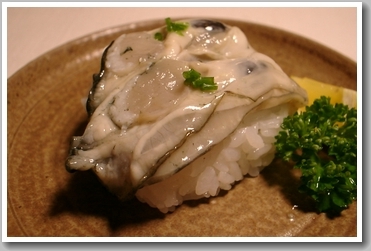
KAKI-NIGIRI
Kaki/Oyster

SHELLFISH:

Shellfish are very popular raw, cooked, grilled, marinated or salted:
Abalone/Awabi, Scallops/Hotategai, Oysters/Kaki, Surf Clam/Torigai, Gaper/Mirugai, Turbo Shells/Sazae, Clam/Hamaguri, Pen Shell/Tairagi, Round Clam-Hen Clam/Bakagai, Scallops/Hotate
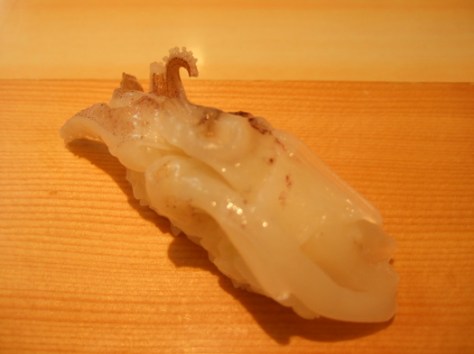
SQUID-LEGS
Ika Geso/ Squid legs

CEPHALOPODS

The Japanese are very fond of squids and octopus, be they raw, boiled, pickled or ciiked/grilled:
Aori Ika/Bigfin Reef Squid, Surume Ika/Japanese Common Squid-Pacific Flying Squid, Hotaru Ika/Firefly Squid-Sparkling Enope Squid, Common calamari/Yari Ika, Kensaki Ika
Madako/True Octopus, Mizudako/Shiodako/Oodako, Iidako/Komochhidako, Ishidako, Chihirodako

HOYA-1
Hoya/Common Sea Squirt

OTHER MARINE LIFE:

These include some creatures relatively unknown outside Japan!
-Sea slug/beche de mer/Sea cusumber or namako in Japanese, as well as its insides/innards called konowata in Japanese
-Common Sea Squirt: Hoya/mahoya in Japanese
-Sea Urchi/Uni
-Kurage/Jellyfish
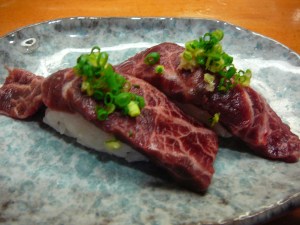
SUSHIK-09-08-31-10
Sakura/Horsemeat as served in Sushi Ko, Shizuoka City

MEAT:

Meat goes very well as sushi, completely raw, slightly grilled or completely cooked!
Basashi:Uma no Niku/Sakura: Horsemeat
Shika no Niku: Venison, deer meat
Gyuniku/Gyusashi: Beef
Kujira: Whalemeat
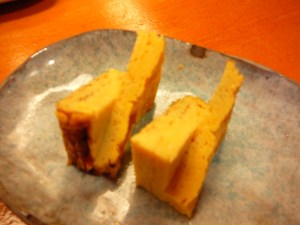
SUSHIK-09-08-31-18
Tamagoyaki served at Sushi Ko, Shizuoka City

EGGS

Chicken eggs are used for tamagoyaki,japab\nese omelette wihich is cut in various shapes according to volume and trend.
Uzura Tamago/Quail eggs are often used additionally
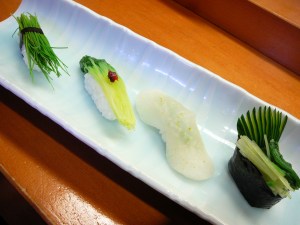
SUSHIK-09-08-31-12
Vegan Sushi at Sushi Ko, Shizuoka City

VEGETABLES:

Now, here is a really “open section”!
I might say it’s all up to you and your priorities.
I will just cite the most popular varieties encountered in Japan:
Kanpyo/gourd shavings first dried then marinated in rice vinegar, soy sauce and sugar.
Gobo/Burdock Root, Kooyaku/Devil’s Tongue tuber, Shiitake, Kyuuri/Cucumber, Mitsuba/Trefoil, Negi/Leek, Daikon, Radish, Shiso/Perilla, Natto, Tomato, Satsumaimo/Sweet potato, Kaiware daikon/Daikon shoots, Takenoko/Bamboo shoots, Myoga Ginger, Shooga/Ginger, Wasabi (chooped roots), Okra, Pimento, Nasu/Aubergine-Eg plant, Yamaimo/Glutinous Yam

To these you have to add the “sea vegetables”:
Konbu/Kaiso/Nori= Seaweed
Umibudo/Sea Grapes
Yuba/Tofu sheets

NOTE:

Fruit sushi has recently become popular abroad but has not caught yet in Japan!”
Foie gras (extravagant), tempura and tonkatsu may also be served as sushi!

Next article will be about Sushi Presentations!

RECOMMENDED RELATED SITES:
Warren Bobrow
Bread + Butter
5 Star Foodie
Frank Fariello
Mangantayon
Tokyo Foodcast
Tokyo Through The Drinking Glass
Urban sake
Hapabento
Elinluv Tidbit Corner

Please check the new postings at:
sake, shochu and sushi

—————————————-
日本語のブログ
—————————————-
Sushi & Sashimi: The Basics 2: Questions & Answers

015
Vegan Sushi at Sushi Ko in Shizuoka City

SYNOPSIS:
I already have wrtitten a lot in bits and pieces on Sushi and Sashimi, including in my other blog, Shizuoka Sushi, but I felt it was time to post an article that could be used as general reference by my blogging friends.
The Basic 1: Definitions

Many questions are asked about sushi as there are many misconceptions, which is absolutely normal if you do not live in Japan.
I hope the following will clear up the skies for everyone.
Naturally, if you have other questions, I’ll be glad to answer them!

018
Sushi set consisting only of seafood caught in Shizuoka Prefecture. Served at Ginta in Yui, Shizuoka City

Q: Are there “special seats” at a sushi restaurant?

A: The usual misconception is that sitting at the counter automatically proves more costly than sitting at a table or on a tatami floor. The price will vary accordingly to what you have ordered wherever you sit. The fact that customers sitting at tables usually order “sushi sets” will tend to demonstrate that it is cheaper, but you can order the same at the counter. On the other hand, sitting at the counter will entice you to order sushi piece by piece and venture into some exotic requests, hence a higher price. I myself always sit at the counter, especially around the “corner”, because I can enjoy the vital opportunity to converse with the chef, watch his technique and have a good look at the available ingredients of the day.

022
Sakura Ebi Gunkan/Cherry Shrimps (caught in Shizuoka Prefecture only) served at Sushi Ko in Shizuoka City

Q:”Nigiri Zushi” should be eaten at once?

A:Yes, for two reasons:
First, the carefully-made “nigiri zushi/握り寿司” will somehow collapse on itself after some time and will not look so appetizing.
Second, the “neta” will dry up and will lose some flavour, tenderness and freshness. That is why I have always strongly felt gainst the very popular “kaiten sushi/回転寿司” (conveyor belt) restaurants!
The trick is to order one “nigiri zushi” after the other and savour them individually, one more reason to choose a counter seat.

027
Mini Ikura Donburi served at Sushi Ko in Shizuoka City

Q: What are the prerequisites for a good “shari” (rice ball part of the sushi)?

A: As rice is actually the most important part, only high-quality rice such as “Akita Komachi” should be used.
I’m sorry to say so, but sushi made with Thai or Basmati rice abroad is not sushi. Full stop.
Next, the balance between the rice vinegar, sugar and salt is very important. Too much of any ingredient will leave an overwhelming taste inside the mouth to the detriment of the other ingredients. Not enough salt will also be detrimental. Only experience will dictate the right amounts!

024
Local sashimi served at Kansawagawa Sake Brewery in Yui, Shizuoka City

Q: Should you dip the “neta” or “shari” first into the soy sauce?

A: Do as you like!
I myself very often ask the chef to add soy sauce directly onto the sushi!
Actually some sushi don’t need any soy sauce.
One can enjoy sole/hirame/平目with a tiny pinch of salt and some lemon juice on top of the neta, or sakura/raw horsemeat is served with tare, grated ginger and chopped leeks, and so forth.

VEGETARIAN-SUSHI-2
Vegetarian sushi in Kyoto

Q: Is there a definite order in ordering and eating various kinds of sushi?

A: That is widely subject to personal taste. The best way is to finish with your special favourites.
I myself start with tuna sashimi (“akami” variety, my preferred part of the tuna) and finish with “natto/ume/shiso (fermented beans+pickled plum meat+green beefsteak leaf. Mind you, I would not order that in Osaka!) maki” with soup, preferably “kanijiru/蟹汁” (miso and crab soup).
In between I shall order all kinds of “nigiri zushi” according to availability. I also make a point to order “chyawan mushi/茶碗蒸し” (Japanese steamed custard) whenever possible.

UNI-GUNKAN
Uni-Gunkan

Q: Is sea urchin (“uni/海栗”) nice to eat as “nigiri”?

A: It should be. If the “gunkan/軍艦” (literally “mother ship”, term taken from the Navy) is properly made! A “gunkan”-style “nigiri zushi” is made with a strip of dry seaweed wrapping the rice ball leaving the top free and securing the topping (“neta”). Moreover I would ask the chef to season it with soy sauce to avoid dropping it into my soy saucer (sorry for the pun!)

SUSHIK-09-08-31-17
Aburi Sanma Nigiri/Slightly grilled Pike mackerel served at Sushi Ko in Shizuoka City

Q: Should all “neta” toppings be made from absolutely fresh fish only?

A: That is another misconception.
Long ago, sushi “neta” were exclusively made of boiled, pickled or salted fish.
As hygiene, refrigeration and preservation have greatly improved, we have access to better and better fresh fish. But in some cases, such as for “maguro” (tuna), it is best to leave the fish rest in a secure place for a while before eating it.
“Maguro” is at its best after a week left in a cold (not frozen) place.
Actually, Mr. Hara, the chef at Ginta in Yui, explained that he gets his fish (of the day only) from the boat the harbour, gut and dress it within a minute before leaving the fish fillets mature on a piece of cloth in the refrigerator for at least half a day!

KOHADA
Kohada Nigiri

Q:Especially in the case of “kohada” (gizzard shard fish or small sweet sardine) we can see at least 5 ways of cutting and presenting the fish: which is the best one?

A: Well. that probably depends both on the chef’s and the customer’s preferences. With a different cut or presentation, various parts of the fish will offer a different exposure to the eater’s palate with consequent different tastes and flavours.

vegan-sushi3
Kanpyo Maki

Q: “Kanpyo (dried gourd shavings) maki” is usually cut into 3 pieces and “tekka (tuna) maki” cut in 6. Is there a definite reason for that?

A: No. This is being dictated by two factors:
a) Easy-to-hold or to-eat portions.
b) Sometimes when the “maki” is shared so smaller portions (6) will be more practical and pleasing to the eye.

SUSHIK-09-08-31-8
Unusual round nigiri topped with ika/cuttlefish in the shape of a tsuru/crane served at Sushi Ko in Shizuoka City

Q: Which is better, a male fish or a female fish?

A: A male fish, because a female loses part of its own nutrients for egg (roe) production, especially in the case of salmon and white-fleshed fish.

The next article will be about Ingredients!

RECOMMENDED RELATED SITES:
Warren Bobrow
Bread + Butter
5 Star Foodie
Frank Fariello
Mangantayon
Tokyo Foodcast
Tokyo Through The Drinking Glass
Urban sake
Hapabento
Elinluv Tidbit Corner

Please check the new postings at:
sake, shochu and sushi

—————————————-
日本語のブログ
—————————————-
Sushi & Sashimi: The Basics 1: Definitions

SUSHIK-09-08-31-1

Rainbow Roll at Sushi Ko, Shizuoka City

I already have wrtitten a lot in bits and pieces on Sushi and Sashimi, including in my other blog, Shizuoka Sushi, but I felt it was time to post an article that could be used as general reference by my blogging friends.
This first article will describe the different kinds of sushi in a basic manner.

012

Kawahagi sashimi/Leatherback at Sushi Ko, Shizuoka City

Sashimi or thin slices of fish when put onto some rice could be called “sushi” as long as rice vinegar, salt and sugar have been added to season the rice beforehand.
On the other hand it does not have to be sashimi as almost anything could be used for making sushi: fish guts, roe, shellfish, meat, vegetables. etc.
Even the word “sashimi” does not actually apply to fish only as its meaning is “thin slices” (debatable).

SUSHIK-09-08-31-10

Sakura/Horsemeat Sushi at Sushi Ko, Shizuoka City

There are 3 basic kinds of sushi:
“Nare Zushi”, or pickled fish sushi.
“Nigiri Sushi” or “Edomae Zushi”,or sliced Fish et al onto small balls of rice.
“Oshi Zushi” or “Osaka Zushi”, or sliced fish et al pressed onto rice inside a wooden box or mould and then cut into equal-sized pieces.
Of course the three above kinds can be divided into numerous sub-varieties.

CHIRASHI-ZUSHI

Home-made Chirashi Zushi

One important variety is “Chirashi Zushi/散らし寿司”, basically all kinds of (available) ingredients, preferably small, strewn on a layer of rive inside a bowl or shallow Japanese dish. This last variety is commonly encountered at home meals when it is more practical for a housewife to serve to a whole family.

“NARE ZUSHI”

NAREZUSHI

Nare zushi in Wakayama Prefecture envelopped in Bamboo leaves

Nare Zushi (熟寿司, or 馴れ寿司 in Japanese) is the original form of sushi in Japan. One way to preserve fish was to gut it, slice the meat with or without the skin and pickle it (ferment it) in rice. The fish could then always be presented at meals after having taken it out of the pickle jar, cleaned it and served it on a dish as an accompaniment (or main dish) to the usual Japanese fare of rice, miso (fermented beans) soup and pickles.

FUNAZUSHI

Funa Zushi/鮒寿司

Funa Zushi is a typical example.

Then one day, somebody selling fish in Edo (old Tokyo) struck on the idea to serve it wrapped around balls of rice to which vinegar, salt and sugar had been added for preservation. These balls were 2 or 3 times as big as nowadays and
3 balls would be enough for a meal.
This form of sushi is rarely encountered or availabe these days. One modern extension of this technique is “Zuke” whereas tuna (“maguro”) or other fish has been first dipped in hot water for a while, then transfered into iced water to stop it cooking and finally marinated into a pickle brine (“tsuke shiru”) for a while. When cut, the surface is cooked and slightly harder while the inside is still soft and comparatively raw. If it is not dipped in brine it becomes “tataki”.
(Note: “Zuke/漬け” also means leaving the fish slices in a mixture of soy sauce, mirin ans sake for about a certain amount of time begore making any kind of sushi. Each restaurant has its own original secrets and recipes.)

“NIGIRI ZUSHI”/”EDOMAE ZUSHI”

SUSHI-KUJIRA

Kujira Nigiri/Whalemeat at Sushi Ko, Shizuoka City

“Nigiri Zushi/握り寿司”, arguably the most popular kind of sushi, consists of a small hand-formed ball of rice, or more commonly called “shari/シャリ”, seasoned with rice vinegar, salt and sugar covered with a slice of fish or other ingredients (defined as “neta/ネタ” in Japanese).
Moreover, before covering the “shari” with the “neta”, a small portion of grated Japanese green horseradish (“wasabi/山葵”) is applied on top of the “shari” to be in contact with both the the “shari” nad “neta”. But this is not always the rule. Grated ginger and chopped chives can be applied on top of the “neta” or the “neta” could be seasoned with sauce (“tare/タレ” or “tsume/ツメ”) or the horseradish could be applied on top of the “neta” (as in for “anago”=conger eel). In some cases, I myself like the “neta” sprinkled with a bit of salt and lemon juice as for “hirame” ( sole/flatfish).
The “nigiri zushi” can be then be dipped or not, according to your preference, into a small dish of soy sauce before eating it.
A “nigiri zushi” seasoned with “tare” or salt and lemon juice should not be dipped into soy sauce.

SUSHIK-09-08-31-19

Negi-toro Nori Maki/leeks and toro nori maki at Sushi Ko, Shizuoka City

“Edomae Zushi/江戸前寿司”, apart of “nigiri zushi” comprises “te-maki zushi/手巻き寿司” (a sushi made inside dry seaweed in the form of a cone served in one piece),”ha-maki/葉巻” (the same as “te-maki-zushi” but with lettuce instead of dry seaweed), “nori-maki/海苔巻き”
(a long thin roll usually wrapped in dry seaweed, then cut in 2, 3 or 6 portions), “futo-maki/太巻” ( a thick roll wrapped in seaweed cut into thin slices), “inari zushi/稲荷寿司” (plain or mixed with some finely-cut ingredients seasoned rice wrapped inside fried toofu pouch, also known as “0-inari San”) , or “chakin zushi/茶巾寿司” (seasoned rice plain or mixed with other ingredients inside a pouch made of thin omelette).
The possibilities for “edomae zushi” are almost limitless.

TE-MARI-ZUSHI

Te-mari zushi, kyoto style

TE-MARI-ZUSHI2

Te-mari zushi, home-style

Ome more variety made in Kyoto called “te-mari zushi” (small round “nigiri zushi”) ought to be mentioned as its shape is particularly beautiful and its size is popular with diet-conscious ladies!

“OSHI ZUSHI”/”OSAKA SUSHI”

OSI-ZUSHI-1

Oshi Zushi out of it press box

This type of sushi is made from rice (“shari”) seasoned as in “edomae zushi” and then stuffed inside small wooden boxes, smeared or not with horseradish (“wasabi”). Finally thin slices of fish or else are carefully arranged on top usually so as to form a pattern. A wooden lid will then be pushed on top of the sushi to press it evenly and firmly. The sushi will be then slid out out of the box and cut into regular rectangular portions to be served accordingly to the chef’s taste and skill.

Next to come: Sushi & Sashimi: The Basics 2: Questions and Answers

RECOMMENDED RELATED SITES:
Warren Bobrow
Bread + Butter
5 Star Foodie
Frank Fariello
Mangantayon
Tokyo Foodcast
Tokyo Through The Drinking Glass
Urban sake
Hapabento
Elinluv Tidbit Corner

Please check the new postings at:
sake, shochu and sushi

—————————————-
日本語のブログ
—————————————-