Category Archives: Uncategorized

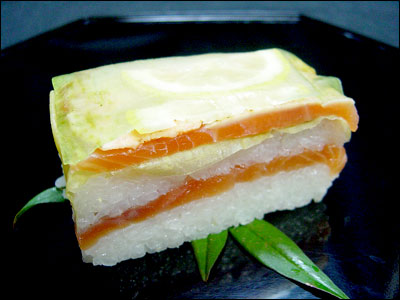
Oshizushi/Pressed Sushi Techniques 1: Salmon Marinated in Seaweed/Sake Sushi Konbushime

Sushi exists under many forms and guises.
It is not all nigiri and (more ubiquitous) sushi rolls!
Have you ever heard of Oshizushi?

Oshizushi (押し寿司, litterally pressed sushi), is a pressed sushi from the Kansai Region, a favourite and specialty of Osaka.
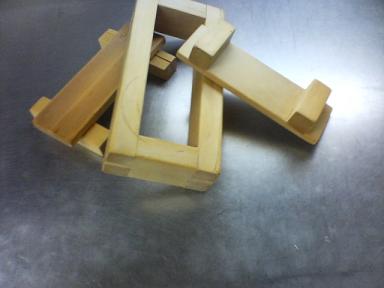
Oshibako unmounted

It is made with the help of a block-shaped piece formed using a wooden mold, called an oshibako/押し箱.
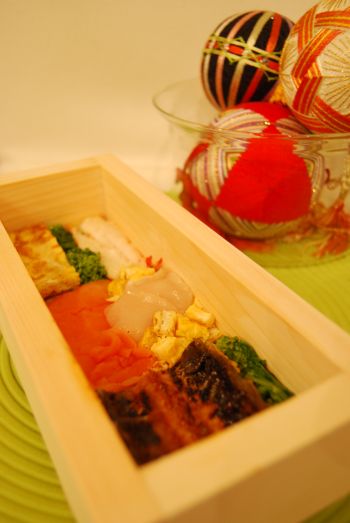
Oshibako lined with toppings

The chef lines the bottom of the oshibako with the toppings, covers them with sushi rice, and then presses the lid of the mold down to create a compact, rectilinear block.
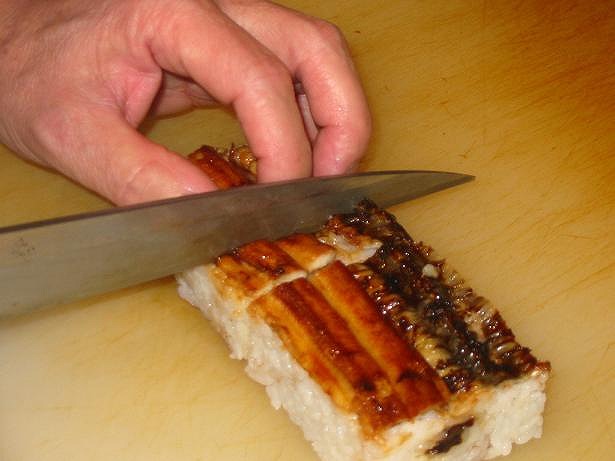
Cutting Grilled Eel Oshizushi

The block is then removed from the mold and then cut into bite-sized pieces.

It is great fun to experiment at home for large parties or the family as you can include almost anything.
Moreover, oshizuhi is easy to transport and include in bento!

The recipes and techniques I’m introducing here are professional, but with a little practice I’m sure you will become a specialist

——————————

Oshizushi/Pressed Sushi Techniques 1: Salmon Marinated in Seaweed/Sake Sushi Konbushime

For sushi rice preparation, check HERE for previous posting!
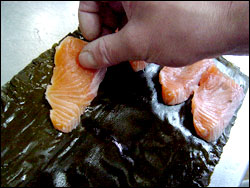
Konbushime/昆布〆means that the fish is “marinated with seaweed.
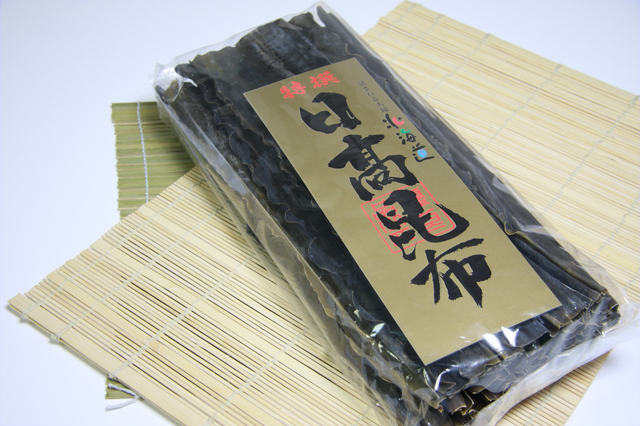
Konbu/Seaweed is now readily available on Japanese and Asian markets all over the world or on the internet.
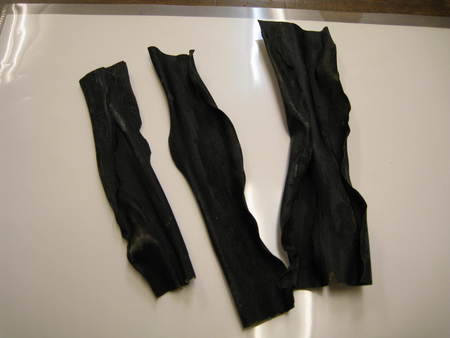
Two types of konbu/seaweed are used:
-Dark/black thick Konbu/Seaweed is bought dry and has to be softened in lukewarm water for a while. That particular step is very easy to learn.
Keep in mind it is edible, although after marination, it should be discarded.
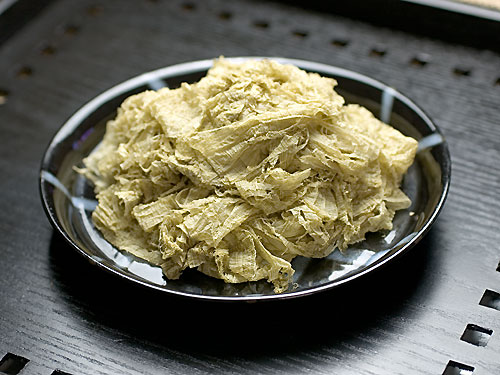
-Thin, light coloured (almost transparent) is used as an ingredient both for taste and the finishing touch. If not available, you may replace it with fine green leaves.
It is called “Kagome Konbu/かごめ昆布”.
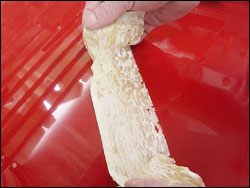
An even better light seaweed is called “Take Kawa Konbu/竹皮昆布/Bamboo Skin Saweed” and is widely used by professionals.

Both light coloured seaweeds have to be softened in lukewarm water, sponged off and spread into thin sheets first. But it is really worth the work!

After having softened the dark konbu, spread it over a clean working table and place the fresh (fresh, please!) salmon slices over one sheet and covering the lot with another sheet.
Wrap it in cellophane paper and leave it in the fridge for at least 30 minutes.
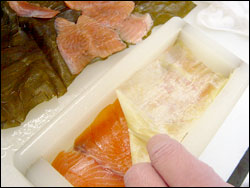
During that time soften light seaweed in lukewarm water and spread it over a clean cloth.

Line the bottom of the oshibako/box with one layer of salmon (no dark seaweed!). Spread light seaweed over the salmon and spread a first layer sushi rice.

Repeat the same operation once more and press.
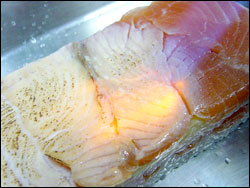
Unloose the sushi out of its box.
The fish should be on top.
Grill the top of the fish lightly with a hand burner just enough to change the colour.
That step will enable to savour two different tastes at the same time!
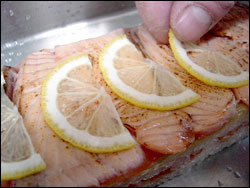
Place very thin slices of lemon (clean organic, please!) on top of the rice.
It will abate the “fishy smell/taste”.
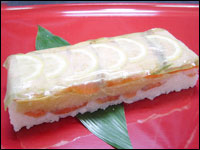
Lay another layer of fine light seaweed over the top.
Cut and serve!

RECOMMENDED RELATED SITES:
Warren Bobrow, Bread + Butter, Zoy Zhang, Hungry Neko, Think Twice, Frank Fariello, Mangantayon, Hapabento, Elinluv Tidbit Corner, Tokyo Terrace, Maison de Christina, Chrys Niles,Lexi, Culinary Musings, Wheeling Gourmet, Sushi Nomads, Oyster Culture

Please check the new postings at:
sake, shochu and sushi

—————————————-
日本語のブログ
—————————————-
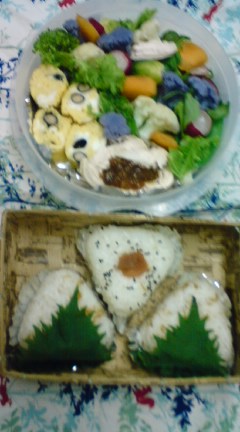
Today’s Lunch Box/Bento (’09/80)

This could be very well be the last bento of the year as it will be difficult to fool the Missus into making another one tomorrow as I shall not be working but “escaping to my office”! LOL
As we are going through a slimming phase (BIG business here in Jpaan!), today’s bento bento is definitely on the lean side. I’m not one to complain a I like my bento healthy and tasy!

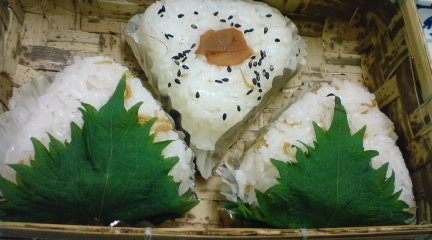
For the rice part, three simple triangular musubi/rice balls made with her new musubi gadget. Freshly steamed this morning one contains a umeboshi/Jpaanese pickled plum and seasoned with black sesame seeds and the other two tiny grilled shirasu/hard moth sardine whiting. The last two are wrapped in shiso/perilla leaves.

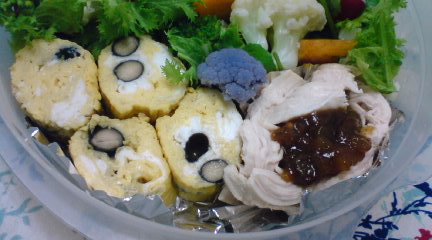
As for the garnish, it certainly was colourful!

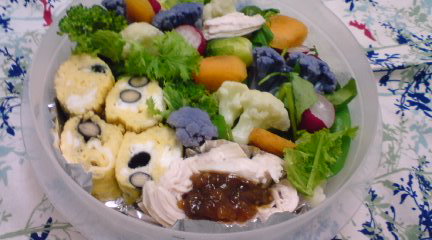
The tamagoyaki/Japanese omelette contained stewed black beans (look at their eyes!), and the home-made chicken ham wa seasoned with English chutney brought to me by Lojol.

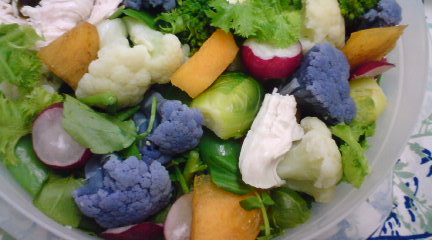
It was laid over a bed of cress and contained cress and wasabi lettuce (not relatied to wasabi), boiled broccoli, white cauliflower and violet (which turned blue!) cauliflower, Brussels sprouts, savoury peas in their pod, more chicken ham, sliced radishes and pieces of jirou kaki/squat persimmon.

The colours would qualify this bento for a health contest!

RECOMMENDED RELATED SITES:
Warren Bobrow, Bread + Butter, Zoy Zhang, Hungry Neko, Think Twice, Frank Fariello, Mangantayon, Hapabento, Elinluv Tidbit Corner, Tokyo Terrace, Maison de Christina, Chrys Niles,Lexi, Culinary Musings, Wheeling Gourmet

Please check the new postings at:
sake, shochu and sushi

—————————————-
日本語のブログ
—————————————-
Vegan Japanese Cuisine: Taro in Sweet and Sour Sauce/Sato Imo Ankake

I’ve found a whole bunch of simple and healthy recipes on taro, or sato imo/里芋 as they are called in Japan that should please my vegan and vegetarian friends!

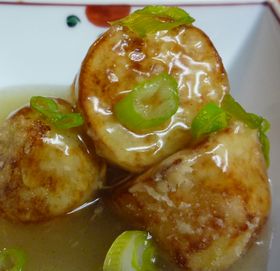
This one is called “satoimo nakake/里芋餡かけ” or taro in sweet and sour sauce.
It wiil make for an excellent snack to go with a drink!

INGREDIENTS: for 2 people

-Taro/sato imo: 4~5 small
-Dashi (use konbu dashi/seaweed soup stock): 125 cc/ml or 1/2 cup
-Japanese sake: 1 tablespoon
-Mirin/sweet sake: 1 tablespoon
-Fresh grated ginger: 1/8 teaspoon
-Cornstarh: 1 teaspoon
-Water: 1 tablespoon
-Salt: to taste
-Chopped leeks (for topping)

RECIPE:

-Soften the taro/sato imo inside a microwave oven.
Peel them and cut them in halves.

-In a pan, pour yhe dashi/soup stock, sake, mirin and grated ginger. Let simmer for a while. Add salt for taste.

-Mix the water with the cornstarch and add to soup sauce. Stir well until smooth.

-Roll taro/sato imo in cornstarch and deep-fry in 180 degrees Celsius oil until they are cooked to a saisfying colour.

-Place deep-fried taro/sato imo on a grill or kitchen paper to take off exces oil.

-Place taro/sato imo in a dish, pour the sweet and sour sauce all over it. Top with chopped leeks and serve!

RECOMMENDED RELATED SITES
Not-Just-Recipes, Bengal cuisine, Cooking Vegetarian, Frank Fariello, Gluten-free Vegan Family, Meatless MamaFrank Fariello, , Warren Bobrow, Wheeling Gourmet, Le Petit Cuisinier, Vegan Epicurean, Miss V’s Vegan Cookbook, Comestiblog

Please check the new postings at:
sake, shochu and sushi, To Cheese or not To Cheese

—————————————-
日本語のブログ
—————————————-
Vegetables Facts and Tips 15: Taro/Sato Imo

SYNOPSIS:

I started this series (14 articles so far) quite some time ago to help my vegan and vegetarian (I’m not!) friends and omnivores as well because of the obvious health benefits.
Since then, I’ve learned and discovered a lot more information that could not ignored.
Therefore I plan to amend and expand all 14 former articles before I can continue introducing a lot more vegetables!
Incidentally、 nothing, pictures included, is copyrighted in my food blogs, so please feel free to use anything!

Actually this particular posting is completely new and dedicated to my new veggie-crazy friend Kinzie!

1) POTATOES, 2) TOMATOES, 3) BROCCOLI, 4) CARROTS, 5) Sweet Potatoes

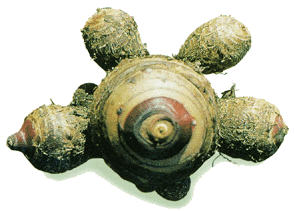
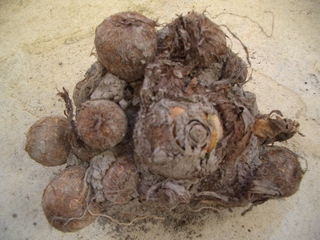
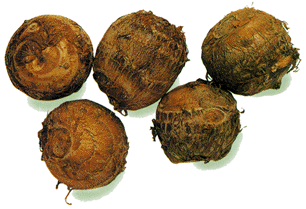
Taro, also called Dasheen, and one of several plants called Cocoyam ,is a tropical plant grown primarily as a vegetable food for its edible corm, and secondarily as a leaf vegetable. It is considered a staple in Oceanic cultures. It is believed to be one of the earliest cultivated plants. In its raw form the plant is toxic due to the presence of calcium oxalate, although the toxin is destroyed by cooking or can be removed by steeping taro roots in cold water overnight. Taro is closely related to Xanthosoma and Caladium, plants commonly grown as ornamentals, and like them it is sometimes loosely called elephant ear.

The name “taro” is from Tahitian or other Polynesian languages; the plant is also called kalo (from Hawaiian), gabi in The Philippines, dalo in Fiji, Alu (अळू) in Marathi, seppankizhangu in Tamil, chembu in Malayalam, Arvee, Arvi, or Arbi in Hindi, Kosu in Assamese, Kochu(কচু) in Bengali, and Karkalo in Nepali.

In Japan, it is called satoimo (サトイモ, satoimo), (kanji: 里芋) “village potato”. The “child” and “grandchild” corms which bud from the parent satoimo, are called imonoko (芋の子, imonoko). Satoimo has been propagated in Southeast Asia since the late Jōmon period. It was a regional staple food before rice became predominant.

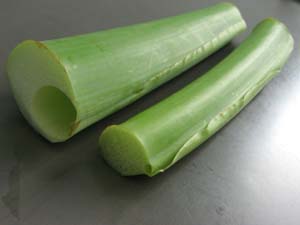
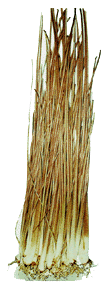
The tuber, satoimo, is often prepared through simmering, but occasionally grated and eaten raw or steamed. The stalk, zuiki, can also be prepared a number of ways, depending on its variety.

It is a very popular tuber in Japan and although the best season runs from September to November, it is very easy to conserve and is extensively used in many Japanese dishes.

It is of especially great value to vegetarians and vegans!

Here are some sample of cooking amenable to special priorities:

Sato Imo An/Taro in sweet and sour sauce

Taro wholly fried and seasoned with umeboshi/pickled Japanese plums

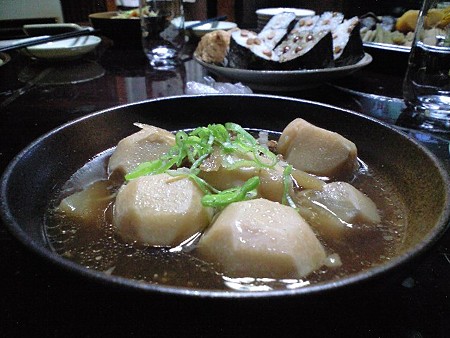
Sato Imo Nikome/Stewed Taro

TARO/SATO IMO VARIETIES:

Ishikawawase, very tender once steamed. Must be peeled before consumption.

Dodare, with strong stickiness, very soft, prevalent in Eastern Japan.

Kyo Imo, also called Take no Ko Imo, very popular for its long shape.

Chiba Maru, great and elegant taste.

Ebi Imo, although called Tou no Imo, quite sticky.

Yatsu Gashira, “Eight heads”, great stewed.

Serebesu, little stickiness, can be cooked as normal potato.

Hasu Imo, is not actually the tuber itself but the stems, eaten as green vegetables.

Yamato Wase, from Niigate and Toyama Prefectures, very white, sticky and fine-grained.

Yahata Imo, from Niigata Prefecture, great for stews.

Dentouji Sato Imo, sticky. Stems can be also eaten.

Zuiki Imo, are actually edible shoots of sato imo, mainly cooked in stews.

FACTS:

-Very rich in potassium and phosphorus!
-Vitamins B1, B2 and C.
-Rich in fibers.

TIPS:

-Best season: September~November.
-Prevent them from getting dry. Wrap them in newspaper with their attached mud/soil and keep in a well ventilated place away from the light.
-When cut, the best specimens are uniformly white without specks or blemishes.
-Very beneficial against obesity.

HEALTH FACTS:

-Combined with eggs, or chicken, or sardines, or bonito, helps brain activity and increases stamina.
-Combined with tofu, or dry bonito shavings, or skimmed milk, helps brain activity.
-Combined with mushrooms, or devil’s tongue tuber, or burdock root, helps lower blood cholesterol and cobat high blood pressure and cancer.
-Combined with seaweed, or miso, or onions, or chili peppers, helps with digestion and blood flow.

RECOMMENDED RELATED SITES
Not-Just-Recipes, Bengal cuisine, Cooking Vegetarian, Frank Fariello, Gluten-free Vegan Family, Meatless MamaFrank Fariello, , Warren Bobrow, Wheeling Gourmet, Le Petit Cuisinier, Vegan Epicurean, Miss V’s Vegan Cookbook, Comestiblog

Please check the new postings at:
sake, shochu and sushi, To Cheese or not To Cheese

—————————————-
日本語のブログ
—————————————-
Bryan Baird’s Newsletter (2009/12/26)

Baird Beer & Taproom Events Bulletin
bryan-sayuri.gif

Dear Taproom Friend & Baird Beer Enthusiast:

We will be ushering out 2009 and drinking in 2010 with New Year’s Eve Countdown festivities at all three of our Taproom pubs. Event details follow:

Numazu Fishmarket Taproom Countdown Party (5:00 pm – 1:00 am, Dec. 31):

All-You-Can-Eat Mexican Buffet @ 1,000 yen per person (5:00 – 10:00 pm)
500 yen Baird Beers throughout the evening
Midnight Debut of Hatsujozo 2010 Belgian Black Ale (Complimentary glass to all patrons for 2010 inaugural toast)
Reservations NOT required
Nakameguro Taproom Countdown Party (6:00 pm – 1:00 am, Dec. 31):

All-You-Can-Eat Buffet @ 1,500 yen per person
Baird Beer: 700 yen pints and 500 yen half-pints all evening
Midnight Debut of Hatsujozo 2010 Belgian Black Ale (Complimentary glass to all patrons for 2010 inaugural toast)
Reservations NOT required
HarajukuTaproom Countdown Evening (5:00 pm – 1:00 am, Dec. 31):

Food & Beer as normal (Great if you want to just chill at a yakitori pub on New Year’s Eve)
Special and exclusive tapping of 2-year conditioned high gravity winter Baird Beer
Midnight Debut of Hatsujozo 2010 Belgian Black Ale (Complimentary glass to all patrons for 2010 inaugural toast)
Reservations NOT required
Hatsujozo 2010 Belgian Black Ale (ABV 7%):

At Baird Beer we mark the transition to each new year with the release of a special “First-Brewed” commemorative ale in celebration of the fresh possibilities represented by the turning of the calendar. In years past, Hatsujozo always had been a Double IPA by style. This year, though, in consideration of the fact that Suruga Bay Imperial IPA is now a brand in our year-round portfolio, we decided it would be more interesting to change things up by brewing a different style of beer each year for the Hatsujozo series.

Hatsujozo 2010 is what you might consider a Belgian-style Black Ale. Brewed with a large percentage of Japanese dark sugar (kokuto) and Chocolate Wheat Malt, Hatsujozo 2010 is fermented warm with a Belgian saison yeast. At packaging, we chose to krausen with Angry Boy Brown Ale, thus adding a different non-Belgian yeast to the party. Post-package fermentation and maturation has lasted seven months. The result is a funky, complex, potent yet light-bodied black ale. We have never tasted anything quite like it!

Hatsujozo 2010 Belgian Black Ale is a small-batch, draught-only beer available exclusively at our own Taproom pubs. Stop in and join us for a complimentary glass when we toast the New Year at the stroke of midnight this upcoming Thursday.

Taproom O-Shogatsu Business Hours:

The Numazu Fishmarket Taproom will be closed on Friday, January 1. It will open for two special New Year sessions at noon on January 2 and 3 (Saturday & Sunday), closing both days at 8:00 pm. Sayuri and Chris will be preparing a special food menu for those two days. The Fishmarket Taproom will be closed on Monday and Tuesday (January 4-5) before resuming its normal business hours on Wednesday, January 6.
The Nakameguro Taproom will be closed January 1 – 3, re-opening for normal business in the New Year on Monday, January 4. A largely new staff will be running the show at Nakameguro beginning in January and they are excited for your business. We also have added four new taps at Nakameguro from which we will begin pouring a rotating lineup of world-class American craft beers imported to Japan with passion and professionalism by Andrew Balmuth and his team at Nagano Trading. Stop in on the 4th and see what’s pouring!
The Harajuku Taproom will be open from noon until Takeshita Dori is empty and lonely from Friday, January 1 through Sunday, January 3. A special O-sechi ryori plate will be served along with Baird Beer for these three inaugural business days. If you are planning a trip to nearby Meiji Jingu or Togo Jinja, stop on in and give warm New Year greetings to Naruoka-san, the indefatigable Harajuku Taproom chef and manager.
Happy Holidays!

Bryan Baird
Baird Brewing Company
Numazu, Japan
HOMEPAGE


The Japan Blog List

———————————
Must-see tasting websites:
-Sake: Tokyo Through The Drinking Glass, Tokyo Foodcast, Urban Sake, Sake World
-Wine: Palate To Pen, Warren Bobrow, Cellar Tours
-Beer: Good Beer & Country Boys, Another Pint, Please!
-Japanese Pottery to enjoy your favourite drinks: Yellin Yakimono Gallery
——————————–
Please check the new postings at:
sake, shochu and sushi

—————————————-
日本語のブログ
—————————————-
Sashimi Mini-Plate for Christmas at Tomii!

The agnostic I am have little to do with Christmas and the New Year, except wishing for great ones to all and sundry.
Actually I worked both on the 24th and 25th (and will on the 26th).
Last night on my way back from University I was really starving (diet consequence as I’m already 5 kg lighter than in September!) and I had to store something into that body of mine.
A quick trip to Tomii was in order.

I managed to keep my hunger in check and asked for a small plate (I mean, a really small one) of sashimi.
Tomii gladly obliged and served me the following (see above picture)*

In thebackground, Kan Buri/寒鰤 or Japanese Amberjack/Five-ray Yellowtail ona bed of leaf spouts and a sprig of shiso/紫蘇 perilla flowers.

In front Honmaguro/本鮪 orBlue Fin Tuna O-toro (Belly fat part) and Akami (lean part) and Hirame/平目 or Sole/Flounder.

The colours of the fish are very reminsicent of Santa Claus, don’t you think? LOL

TOMII
Shizuoka City, Aoi Ku, Tokiwa-cho, 1-2-7, Tomii Bldg, 1F
Tel.: 054-274-0666
Business hours: 17:00~22:00
Closed on Sundays
HOMEPAGE (Japanese)

RECOMMENDED RELATED SITES:
Bread + Butter, Comestilblog, Greedy Girl, Bouchon For 2, Zoy Zhang, Hungry Neko, Mangantayon, Elinluv Tidbit Corner, Maison de Christina, Chrys Niles, Lexi, Culinary Musings, Eats and Everything, Bite Me New England, Heather Sweet, Warren Bobrow, 5 Star Foodie, Frank Fariello, Oyster Culture, Ramendo, Alchemist Chef, Ochikeron, Mrs. Lavendula, The Gipsy Chef, Spirited Miu Flavor, Wheeling Gourmet

Please check the new postings at:
sake, shochu and sushi

—————————————-
日本語のブログ
—————————————-
Carrot & Almond Pound Cake

Did I say that Bazooka Gourmet is the reason behind all these carrot cakes? LOL
Well, this is the third one, and I will take a little break for them. That is if BG does not make the mistake in inciting me into more postings!

This is a very simple recipe. It has the merit to be healthy and can be served at any time of the day. Very handy with hungry kids (or hubby!)!

Carrot & Almong Pound Cake!

INGREDIENTS:

-Carrot (peeled9: 12o g
-Eggs: 2
-Salad Oil: 100 cc/ml (about 75 g)
-Sugar (brown, preferably): 110 g
-All-purpose flour: 110 g
-Almond powder: 85 g
-Baking powder: 1 yeaspoon
-Cinnamon: to taste
-Liqueur of your choice: 1~2 tablespoons (the alcohol will disppear, so no worries for the kids!)
-Salt: a pinch

-Sliced almonds for topping (according to preference. Plenty is great!)

RECIPE:

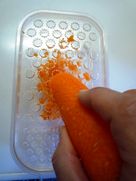
-Grate the carrot finely.

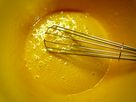
-In a bowl drop the salad oil, sugar and eggs. Mix well.

-Mix until the mixture whitens and get very smooth.

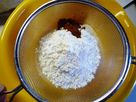
-Sieve in the flour, baking powder and cinnamon.

-Sieve in the almond powder.

-Take water out grated carrots. Add grated carrots, liqueur and salt. Mix well.

-If you can squeeze out about 50 cc/ml of carrot juice, perfect!
Keep it for something else.

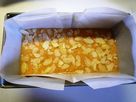
-Line a pound cake mold with baking paper.
Pour all the pound cake mixture in.
Decorate with plenty of sliced almonds.

-Bake for for 35~40 minutes at 170 degrees Celsius.
Check if is properly cooked by stabbing it with a thin wooden stick. It should come out clean.

-Let cool out completely.
Take ou and slice.
Serve and enjoy!

Easy again, isn’t it?

RECOMMENDED RELATED SITES:
Bread + Butter, Comestilblog, Greedy Girl, Bouchon For 2, Zoy Zhang, Hungry Neko, Mangantayon, Elinluv Tidbit Corner, Maison de Christina, Chrys Niles, Lexi, Culinary Musings, Eats and Everything, Bite Me New England, Heather Sweet, Warren Bobrow, 5 Star Foodie, Frank Fariello, Oyster Culture, Ramendo, Alchemist Chef, Ochikeron, Mrs. Lavendula, The Gipsy Chef, Dodol-Mochi, Wheeling GourmetLe Petit Cuisinier, Vegan Epicurean, Miss V’s Vegan Cookbook

——————————–
Please check the new postings at:
sake, shochu and sushi

—————————————-
日本語のブログ
—————————————-

Vegan Steamed Organic Vegetables at Uzu

Shizuoka Prefecture is increasingly becoming renown all over Japan for its organic (biological/macrobiotic) vegetables and it has become a mind-boggling business to keep track of them all!
To (pleasingly) compound the problem, Shizuoka is the mildest area in Japan after Okinawa, with the direct consequence of yearlong uninterrupted culture.
For example, Shizuoka Prefecture produces half of all celery and Chinese leaf vegetables grown in this country. It is also the first to put out delicious white or yellow winter onions on the markets.

Uzu Izakaya in Shizuoka City is always on the look-out for new vegetables (we are planning to visit an upriver market next month together!), especially organic ones.
This particular way of serving organic vegetables steamed for an unadulterated tasting is their trademark.

I’m no vegan or vegetarian, but I can assure you I won’t let such a dish away from me!

The picture above was taken last night during that memorable dinner at Uzu.
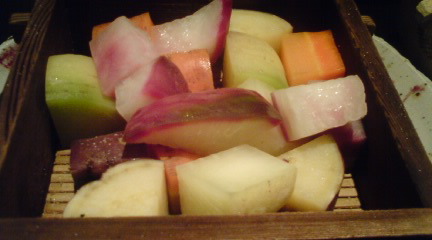
All vegetables are grown organically in Shizuoka Prefecture: carrot, white, red and green daikon, white-fleshed and purple-fleshed sweet potatoes. Don’t you think they look like fruits?

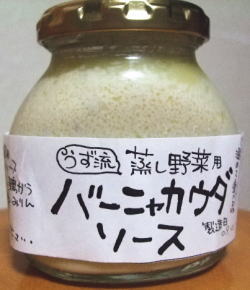
Barnyakauda Sauce

Uzu prepare and sell their own dressing/sauce for such steamed vegetables, although it is not vegan or vegetarian.
As an alternative, vegans and vegetarians could experiment with a sauce/dressing based on soy milk and curry seasoning!

UZU
Shizuoka City, Otowa-cho, 3-18
Tel.: 054-249-6262
Business hours: 17:00=23:00
Closed on Mondays and first Tuesday
Reservations recommended
Credit cards OK
HOMEPAGE (Japanese, but have a look at the pics!)

RECOMMENDED RELATED SITES:
Bread + Butter, Comestiblog, Greedy Girl, Bouchon For 2, Zoy Zhang, Hungry Neko, Mangantayon, Elinluv Tidbit Corner, Maison de Christina, Chrys Niles, Lexi, Culinary Musings, Eats and Everything, Bite Me New England, Heather Sweet, Warren Bobrow, 5 Star Foodie, Frank Fariello, Oyster Culture, Ramendo, Alchemist Chef, Ochikeron, Mrs. Lavendula, The Gipsy Chef, Dodol-Mochi, Wheeling GourmetLe Petit Cuisinier, Vegan Epicurean, Miss V’s Vegan Cookbook

——————————–
Please check the new postings at:
sake, shochu and sushi

—————————————-
日本語のブログ
—————————————-

Shizuoka Sashimi: Kinmedai/Splendid Alfonsino

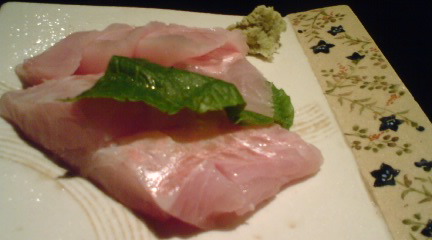
We had this fish yesterday at Uzu Izakaya in Shizuoka City as our second sashimi plate: Kinmedai/金目鯛.

Kinmedai/金目鯛 in Japanese means “Golden Eyes Seabream”.
It is a fish genus common all over the world, but with varying quality level.

This kinmedai was caught off the Izu Peninsula in the Western part of Shizuoka Prefecture.

Izu Peninsula is considered one of the best areas for that particular fish (it has different names in other regions!).

It was served cut in small rectangular pieces with a deep indent in the middle where you can insert the freshly grated wasabi (from along the Abe River in Shizuoka City) for better chopsticks manipulation and utmost appreciation.
The flesh is so tender it almost melts inside your mouth. The taste is sublime for a fish which is not considered as expensive here. (which shows you can enjoy sashimi and sushi at very reasonable prices! Jibe for people spending fortunes in Tokyo and abroad! LOL).
Generally speking fish is readily available and reasonble for all budgets in our Prefecture.

I feel like a lucky b…..d!

UZU
Shizuoka City, Otowa-cho, 3-18
Tel.: 054-249-6262
Business hours: 17:00=23:00
Closed on Mondays and first Tuesday
Reservations recommended
Credit cards OK
HOMEPAGE (Japanese, but have a look at the pics!)

RECOMMENDED RELATED SITES:
Bread + Butter, Comestilblog, Greedy Girl, Bouchon For 2, Zoy Zhang, Hungry Neko, Mangantayon, Elinluv Tidbit Corner, Maison de Christina, Chrys Niles, Lexi, Culinary Musings, Eats and Everything, Bite Me New England, Heather Sweet, Warren Bobrow, 5 Star Foodie, Frank Fariello, Oyster Culture, Ramendo, Alchemist Chef, Ochikeron, Mrs. Lavendula, The Gipsy Chef, Spirited Miu Flavor, Wheeling Gourmet

Please check the new postings at:
sake, shochu and sushi

—————————————-
日本語のブログ
—————————————-

Japanese Cuisine: Stewed Pork in Black Rice Balls

One more dish we had yesterday at Uzu Izakaya in Shizuoka City was a new creation:
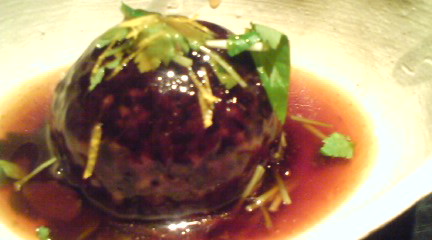
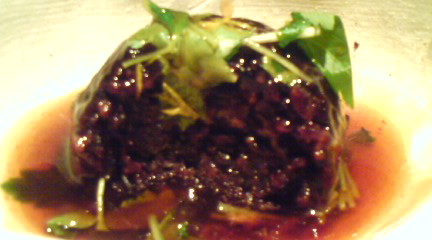
Kakuni Kuro Mai Dango/角煮黒米団子 or Stewed Pork in Black Rice Balls.

It did look a straightforward, but the first bite indicated the complexity of that dish.
Stewed Pork is first made in “Kakuni-style”, which takes quite some time to achieve.
The pork is then cut into tiny pieces and wrapped inside the rice ball.
Now the rice used is black rice. This is a bit of a misnomer a Japanese black rice has nothing to do with the “black rice” (which is not rice) used in Americas and Europe.
Actually it is a dark-red rice variety.
One part of the rice is first steamed into a glutinous paste. More black rice is added to the glutinous paste and the mixture is shaped into a ball with the kakuni inside.
It is steamed again with the result of solid/firm rice grains inside the glutinous rice ball, giving it a satisfying bite enhanced by the pork inside.
The balls (as big as a child fist) are served topped with sweet and sour sauce and fresh trefoil (for taste and colour).
A very satisfying, intriguing dish.

Another treat!

UZU
Shizuoka City, Otowa-cho, 3-18
Tel.: 054-249-6262
Business hours: 17:00=23:00
Closed on Mondays and first Tuesday
Reservations recommended
Credit cards OK
HOMEPAGE (Japanese, but have a look at the pics!)

RECOMMENDED RELATED SITES:
Bread + Butter, Comestilblog, Greedy Girl, Bouchon For 2, Zoy Zhang, Hungry Neko, Mangantayon, Elinluv Tidbit Corner, Maison de Christina, Chrys Niles, Lexi, Culinary Musings, Eats and Everything, Bite Me New England, Heather Sweet, Warren Bobrow, 5 Star Foodie, Frank Fariello, Oyster Culture, Ramendo, Alchemist Chef, Ochikeron, Mrs. Lavendula, The Gipsy Chef, Spirited Miu Flavor, Wheeling Gourmet

Please check the new postings at:
sake, shochu and sushi

—————————————-
日本語のブログ
—————————————-
Japanese Cuisine: Venison Sashimi/Shika Sashimi

Last night, for once the Missus and I quickly agreed to pay a visit to our favourite izakaya, Uzu, in Shizuoka City.
The place is renown all over the Prefecture for serving food prepared with ingredients coming almost exclusively from our Prefecture.
I thought it better to introduce the dishes in separate postings to make it easier for friends to choose which one to read according to their culinary, diet preferences!

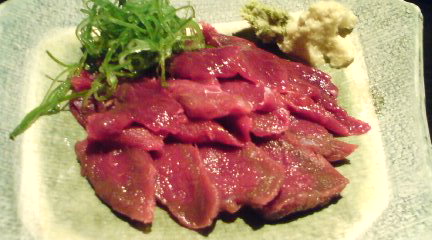
This sashimi/raw meat is venison, that is the meat of a deer.
That particular deer was culled up in the mountains near the Abe River in Umegashima, Shizuoka City. Their number have to be controlled as they tend to overreproduce too quickly to the detriment of the ecological and economic balance of the region.

The sashimi/carpaccio was served with freshly grated wasabi grown along the Abe River, freshly grated garlic and chopped leeks. The soy sauce served with it was of the sweet light kind.

As for the venison, it has a light gamey flavour to it. It was extremely tender and almost sweet,

A treat!

UZU
Shizuoka City, Otowa-cho, 3-18
Tel.: 054-249-6262
Business hours: 17:00=23:00
Closed on Mondays and first Tuesday
Reservations recommended
Credit cards OK
HOMEPAGE (Japanese, but have a look at the pics!)

RECOMMENDED RELATED SITES:
Bread + Butter, Comestilblog, Greedy Girl, Bouchon For 2, Zoy Zhang, Hungry Neko, Mangantayon, Elinluv Tidbit Corner, Maison de Christina, Chrys Niles, Lexi, Culinary Musings, Eats and Everything, Bite Me New England, Heather Sweet, Warren Bobrow, 5 Star Foodie, Frank Fariello, Oyster Culture, Ramendo, Alchemist Chef, Ochikeron, Mrs. Lavendula, The Gipsy Chef, Spirited Miu Flavor, Wheeling Gourmet

Please check the new postings at:
sake, shochu and sushi

—————————————-
日本語のブログ
—————————————-
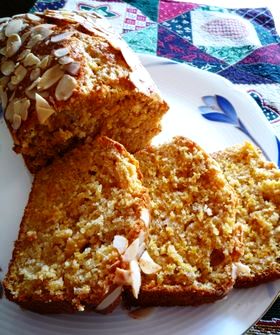
Vegan Soy Milk Carrot Pound Cake

Bazooka Gourmet made the mistake to suggest that I should post a carrot cake recipe (I’m laying it thick, LOL). Well, he’s getting more than he asked for as I found no less than three of them in my notes!

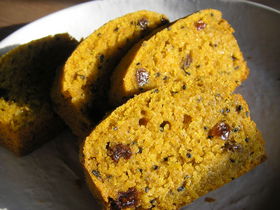
As for the second one, it is a very simple heathy pound cake fit for everyone, vegans included!

Vegan Soy Milk Carrot Pound Cake!

INGREDIENTS:

-Whole wheat flour: 100g
-All-purpose flour: 80g
-Brown sugar: 50 g
-Baking powder: 2 teaspoons
-Cinnamon: 1~2 teaspoons
-Salt: 1/2 teaspoon
-Carrot: 1
-Black sesame seeds: 1 tablespoon
-Raisins: 50 g
-Soy milk: 100 cc
-Olive or Sesame oil: 100 cc

RECIPE:

-Preheat oven to 180 degrees Cesius.
Mix flour and baking powder and sieve.
Grate the carrot.

-Drop all ingredients into a larg bowl and mix.
Mix until the flour lumps have disappeared (important).

-Bake for 35~40 minutes at 180 degrees Celsius.
Check if properly cooking by stabbing pound cake with a thin skewer. It should come out smooth and clean.
Let cool completely.
Could be served as it is or grilled.

NOTES:

-If sesame oil is available, it would be better than olive oil, altough experimentation would be welcome as half of each oil could be interesting indeed.
Salt is necesary to subdue the cloying taste of the brown sugar a little.

Easy again, isn’t it?

RECOMMENDED RELATED SITES:
Bread + Butter, Comestiblog, Greedy Girl, Bouchon For 2, Zoy Zhang, Hungry Neko, Mangantayon, Elinluv Tidbit Corner, Maison de Christina, Chrys Niles, Lexi, Culinary Musings, Eats and Everything, Bite Me New England, Heather Sweet, Warren Bobrow, 5 Star Foodie, Frank Fariello, Oyster Culture, Ramendo, Alchemist Chef, Ochikeron, Mrs. Lavendula, The Gipsy Chef, Dodol-Mochi, Wheeling GourmetLe Petit Cuisinier, Vegan Epicurean, Miss V’s Vegan Cookbook

——————————–
Please check the new postings at:
sake, shochu and sushi

—————————————-
日本語のブログ
—————————————-

Vegetables Facts and Tips 5: Sweet Potatoes (amended & expanded)

satsuma-1

SYNOPSIS:

I started this series (14 articles so far) quite some time ago to help my vegan and vegetarian (I’m not!) friends and omnivores as well because of the obvious health benefits.
Since then, I’ve learned and discovered a lot more information that could not ignored.
Therefore I plan to amend and expand all 14 former articles before I can continue introducing a lot more vegetables!
Incidentally、 nothing, pictures included, is copyrighted in my food blogs, so please feel free to use anything!
1) POTATOES, 2) TOMATOES, 3) BROCCOLI, 4) CARROTS

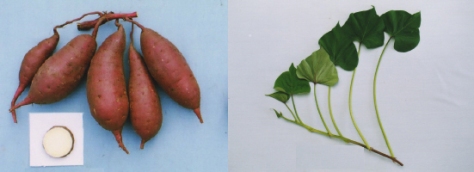
Sweet Potatoes or “Satsuma Imo” were first introduced to Japan in the Ryukyu Islands (Okinawa) in 1604 by the Chinese. It was then introduced in Kyushu in 1609, an area that grows 80% of the total Japanese production.
As rightly pointed out by Comestiblog, sweet potatoes should not be confused with yams or yama imo/山芋 in Japanese.
Sorry for making this basic mistake myself in spite of 33 years in this country!

It has been recognized in this country fおr a long time for both its nutritional and pharmaceutical qualities.

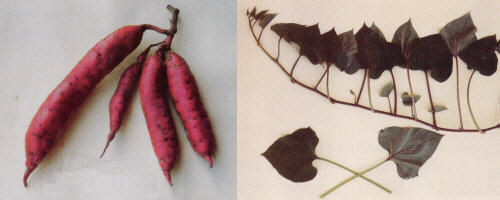
satsumabeni_haruka

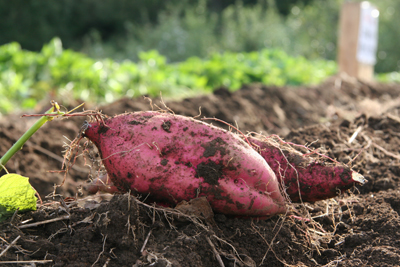
There are over a hundred species in Japan, but the most popular edible ones (not the ones exclusively used for making shochu) have red skins and light yellow flesh.

Beni Azuma, mostly eaten in Eastern Japan. Turns very sweet upon cooking.

Naruto Kintoki, popular in Western Japan. Considered elegant and sweet.

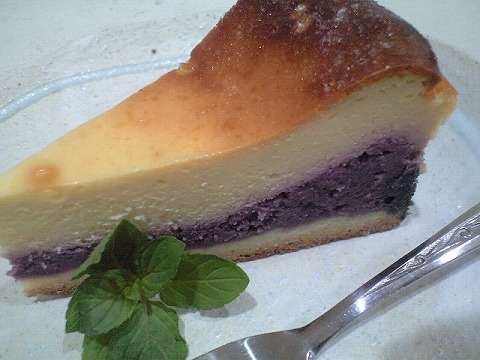
Tosabeni, also attributed “No 14 value (top)”, is very sweet and is a “brand name” sweet potato.

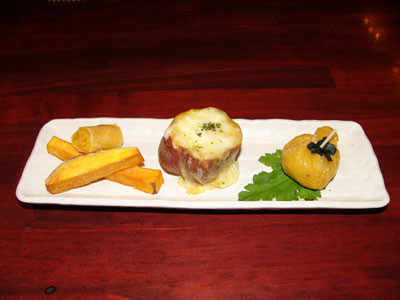
Cheese cake combination with Tosabeni Sweet Potato!

Manamusume, another “No 14 value” brand sweet potato.

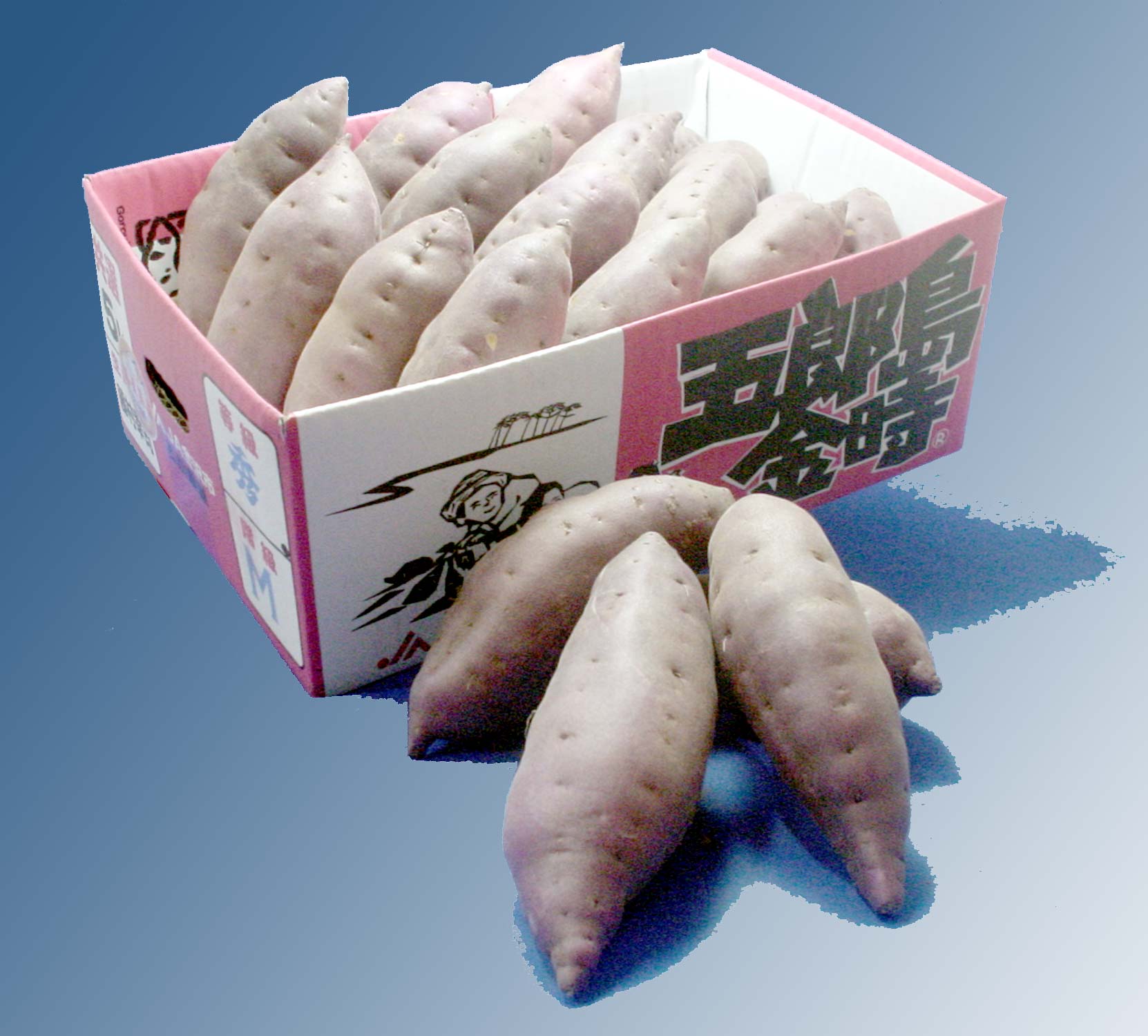
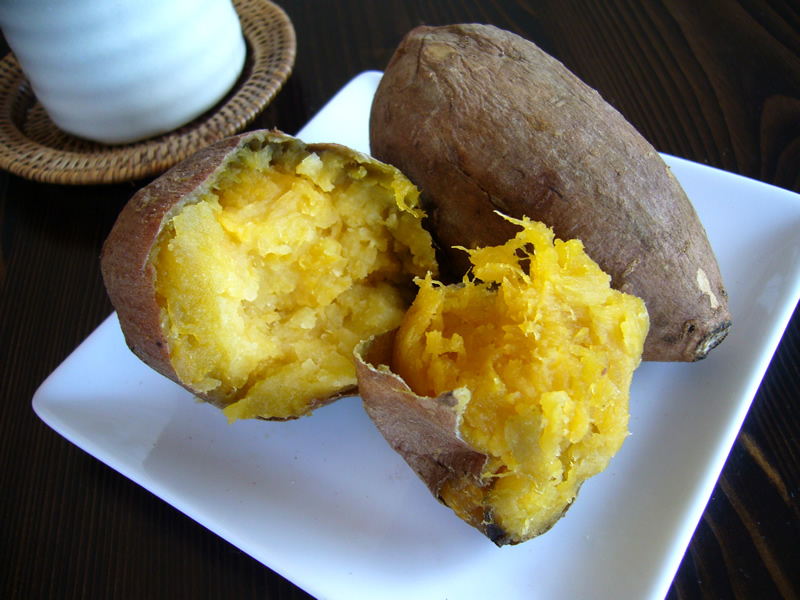
Gorou Shima Kintoki, particularly popular as baked sweet potato.

Kogane Sengan, considered as the top shochu sweet potato.

Tanegashima Mukashi Mitsu, a sweet potato with a beautiful orange colour and elegant taste.

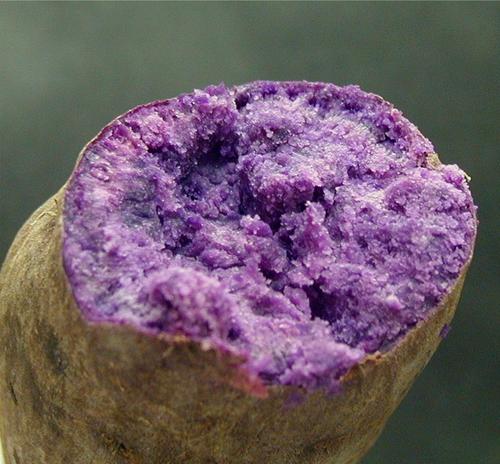
Tanegashima Murasaki Imo, as above, but with a beautiful purple colour.

Annou Imo, rich in carotens, with a beautiful orange colour and very sweet.

Annou Imo cuisine!

Purple Sweet Road, an interesting name for a sweet tasty hybrid.

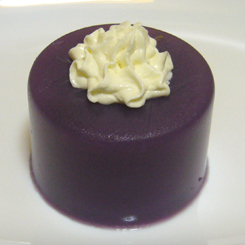
The same as above as hyokan Japanese jelly!

satsumatanegashima

My personal favorite is the “Tanegashima Gold Imo” grown in Taneko Island south of Kyushu. It has the particularity of being red when raw before chaning to a rich golden color when cooked. Among other varieties, the violet yams are getting increasingly popular.

yummy
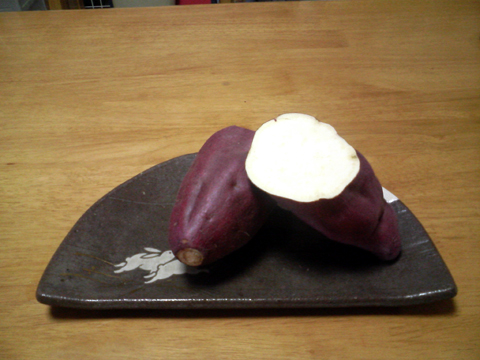
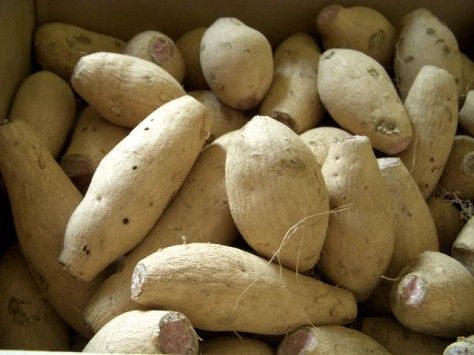
Tanekoshima yam (deep yellow), “common yam” (light yellow) and Murasaki/Violet yam.

The Missus particularly likes to mix the three above as a cold salad with mayonnaise or cream-based dressing.

FACTS:
-Season: September to November
-Main elements: Carbohydrates, Carotene, Vitamin B, C, E. Potassium, Calcium, Magnesium, vegetal fibers.
-Beneficial to digestion. Good for the skin!
-Lose very little of its beneficial elements even after a long cooking.

TIPS:
-Choose specimens with nice color and a “fat/roundish” aspect!
-Plunge yam in cold water as soon as you have cut them. They will not lose their color!
-Boil, bake or steam long enough before taking skin off. Discard skin!
-Leaves can be eaten!

HEALTH FACTS:

-Combined with burdock root, or shiitake, or carrot, or spinach, helps combat colds, helps enhance skin health, helps combat llung and intestine cancer.
-Combined with devil’s tongue tuber, or hijiki sweet seaweeed, or beansprouts, or apple, helps combat cancer, constipation, obesity, and artery hardening.
-Combined with Judas ear mushroom, or shiitake, or seaweed, or hijiki sweet seaweed, helps lower blood cholesterol, helps combat obesity and diabetes.
-Combined with strawberries, or lemon, or pimentoes, helps combat stress, helps skin rejuvenation and intensifies appetite.

RECOMMENDED RELATED SITES
Not-Just-Recipes, Bengal cuisine, Cooking Vegetarian, Frank Fariello, Gluten-free Vegan Family, Meatless MamaFrank Fariello, , Warren Bobrow, Wheeling Gourmet, Le Petit Cuisinier, Vegan Epicurean, Miss V’s Vegan Cookbook, Comestiblog

Please check the new postings at:
sake, shochu and sushi

—————————————-
日本語のブログ
—————————————-

Non-Wheat Flour Carrot Cupcakes

Bazooka Gourmet made the mistake to suggest that I should post a carrot cake recipe. Well, he’s getting more than he asked for as I found no less than three of them in my notes!

As for the first one, it is dedicated to wheat flour allergics!

Non-Wheat Flour Carrot Cupcakes!

INGREDIENTS: For 6 cupcakes

-Unsalted Butter: 100 g
-Brown sugar: 50 g
-Eggs: 2
-Honey (liquid): 1 tablespoon
-Gated carrots: 100 g
-Rice powder: 130 g
-Baking powder: half a teaspoon

-Egg wites: 2
-Sugar: 50 g

RECIPE:

-Bring butter to room temperature.
-Add brown sugar and mix well, incorparating a much air inside as possible.

-Add eggs and mix well.
Add grated carrot, honey, rice flour and baking powder. Mix well.

-Beat the egg whites with sugar into a solid meringue.
Mix the meringue into the cupcake mixture in two equal steps by folding them in with a spatula.
Pour mixture into cups.
Leave inside the fridge for 30 minutes to allow the rice powder to fully absorb the mixture humidity.

-Bake for 20~25 minutes at 180 degrees Celsius.

Simple, isn’t it?

RECOMMENDED RELATED SITES:
Bread + Butter, Comestilblog, Greedy Girl, Bouchon For 2, Zoy Zhang, Hungry Neko, Mangantayon, Elinluv Tidbit Corner, Maison de Christina, Chrys Niles, Lexi, Culinary Musings, Eats and Everything, Bite Me New England, Heather Sweet, Warren Bobrow, 5 Star Foodie, Frank Fariello, Oyster Culture, Ramendo, Alchemist Chef, Ochikeron, Mrs. Lavendula, The Gipsy Chef, Dodol-Mochi, Wheeling GourmetLe Petit Cuisinier, Vegan Epicurean, Miss V’s Vegan Cookbook

——————————–
Please check the new postings at:
sake, shochu and sushi

—————————————-
日本語のブログ
—————————————-

Today’s Lunch Box/Bento (’09/79)

It has taken a long time, but I’m slowly convincing the Missus to work on her bentoes and take her own photoes for reference (posterity?). It is a battle (“what about my privacy, blah, blah…?), but I’m bent on winning it! LOL

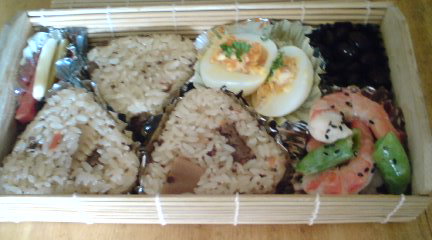
She’s recently bought all kinds of contraptions/artifcts for the kitchen and cooking. Among those she has acquired these boxes to shape musubi/rice balls into perfect tringular shapes forbeeter arrangement.
The present musubi are “maze gohan/mixed rice”. The rice was steamed together with “tsukudani/Japanese- style stewed food” made up of bee, bamboo shoots, carrots and others.
She added home-made pickles for vinegary garnish.

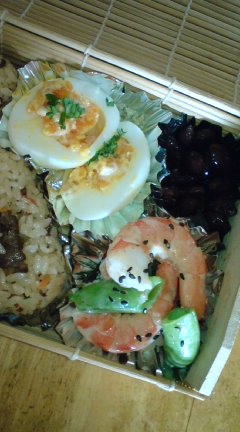
The rest of the garnish included her own style of oeufs mimosa/boiled eggs with their yolks manipulated, shrimps and snack pea pods salad seasoned with black sesame seeds and stewd black beans.

The salad was composed of hand broken lettuce, cress and other greens, plum tomatoes, sliced radishes and black olives, the whole topped with cold marinated mushrooms (done in Greek style with olive oil and spices).

Vey simple dessert of grenadine seasoned compoteed apples.

I think I’m right to egg on the Missus! LOL

RECOMMENDED RELATED SITES:
Warren Bobrow, Bread + Butter, Zoy Zhang, Hungry Neko, Think Twice, Frank Fariello, Mangantayon, Hapabento, Elinluv Tidbit Corner, Tokyo Terrace, Maison de Christina, Chrys Niles,Lexi, Culinary Musings, Wheeling Gourmet

Please check the new postings at:
sake, shochu and sushi

—————————————-
日本語のブログ
—————————————-