Tag Archives: レシピ

Seafood Spaghetti Salad

Please check the new postings at:
sake, shochu and sushi
Shizuoka Pics

—————————————-
日本語のブログ
—————————————-

seafood-spaghetti-salad.jpg

I often cook for my better (worse?) half on Friday Nights (sometimes) Sunday nights (often) as her job keeps her busy on weekends. As she is a pasta addict, I end up preparing some one every two meals. After a hard day’s work she is pretty happy with this recipe as it leaves me with plenty of improvisation according to the season and the market!

As for measures and proportions, I will leave it to your imagination, although a good observation of the picture should be a good enough guide for you! The plate pictured above was one serving.

Prepare or choose a dressing for the spaghetti. I usually use soft Dijon Mustard (with or without the seeds), Xeres vinegar, hazelnut oil (or walnut oil), salt, pepper and a few baies roses/dry pink peppercorns. Naturally, olive oil, wine vinegar, soft mustard, salt and pepper is fine, too.
Boil the spaghetti to the consistency you prefer, drain them and hold them under running cold water for 30 seconds, shaking them well to prevent them from cooking any longer.
Drain the water energically and stir in some dressing for taste and to prevent them from sticking to each other. Leave them in a all-purpose bowl.

At the top of the picture are slightly sauteed scallops with onion confit.
To make the onion confit (can be done the day before or a few hours in advance), peel and cut 2 large onions in thin slices. Discard the “foot” (bottom core) as it is indigestible. Fry them in a pot with 100g of white butter on a medium fire. When the onion slices have become soft and translucent, add a large tablespoon of honey, a cup of red wine, a tablespoon each of Xeres vinegar and Port wine. Season with salt and white pepper (thin powder if possible). Simmer until most of the liquid has reduced. Check and add more honey if not sweet enough. A little tomato puree might help,too. Let it cool and keep it away from any heat and light source (do not leave it in the fridge as it might congeal).
Sautee the scallops with a little salt and lemon juice on a small amount of olive oil. As soon as they have reached a very light brown colour, take them off the fire and let them rest on a grill to get rid of excess liquids.

At the bottom of the picture are small prawns.
Take off the shell, tail and heads (discard or use them for making broth).
Make a shallow incision all along the middle of their back. Pick off the innards.
Sautee them like the scallops with a little salt and lemon juice on a small amount of olive oil. As soon as they have changed colour, put them to rest with the scallops.

Keeping in mind you are making two servings, cut a tablespoon each of red, yellow and orange sweet pimentos in small cubes. Fry them in olive oil without any seasoning. When soft, drop them in all-purpose bowl. Do the same with a little assortment of scallops, small shrimps and cockles (can be easily bought frozen at large supermarkets), or whatever seafood you can put your hands on. Keep in mind they ought to be of all the same approximate size (that’s a lot of “keep in mind”, isn’t it?)

When all ingredients have cooled down to room temperature and this just before you are going to serve them, toss in some finely cut fresh tomatoes (if you add them too early they leave out too much water in contact with salt!) add the pimentos and seafood in the same bowl and mix in a reasonable amount of dressing. Take half out and mix it with the spaghetti.
Place the spaghetti in the middle.

Arrange scallops interspaced with some onion confit above the spaghetti as in the picture.
Arrange sauteed prawns below as in the picture.

Add a good quantity of “baby leaves” (young leaves mixture) of your choice with rest of the veg and seafood salad and arrange on both side of the spaghetti.

Of course this is open to any kind of variations. I just hope I stimulated you into your own recipes!

Bon appetit!

Cheese Souffle

Please check the new postings at:
sake, shochu and sushi

—————————————-
日本語のブログ
—————————————-

cheesesouffle.jpg

When you mention the word “Souffle”, the first reaction you get is: “Too difficult”. It is actually dead easy, and I can tell you that some restaurants make an enormous profit from them!
And it is great food for vegetarians, too!

Ingredients (4 people):
Eggs: 4
Flour: 50g
Butter: 50g
Milk: 300cc
Shredded cheese: 100g
Salt
White Pepper
Nutmeg
Thyme
Laurel

Recipe:

Preheat oven to 180 degrees Celsius.
Butter well the inside of a (possibly round) deep oven dish (about 18cm x 8cm). This will help the souffle rise and prevent it fom sticking.

Separate egg yolks from egg whites.
In a large bowl add a little salt to whites and beat until solid.

On a small fire, prepare a Bechamel sauce (white sauce):
Melt butter completely, pour in flour and mix well with spatula until smooth. Pour in milk and mix well (diffferent people have different techniques, but I found that the best technique is to mix half of the milk little by little first, then pour in the rest and use a whisker to make a smooth sauce). Add salt, pepper and spices. Keep stirring gently.

Once the sauce has thickened to the point of almost solid, take off the fire (or switch off the fire).
Mix in the egg yolks with a spatula until colour is even. Then do the same with the cheese little by little until mixture comes smooth off the spatula.

Check that the whites have not gone back to liquid (That happened to me quite a few times, so make sure to check! In such a case, just beat them again. They will go back to a satisfactory state quite fast.). Mix in half first as delicately as possible with a spatula (not a whisker, or you will break the air bubbles in the whites and the souffle will not rise!). Then do the same with the second half. Pour in the mixture in the dish and put in the oven to bake for 45 minutes (although that depends with every oven). To check whether the souffle is properly cooked, insert a thin wooden stick or knife deep into the souffle. It should come out smooth.

Before serving, make sure that everybody is at the table before serving. ” The guests wait for a Souffle, a Souffle does not wait for the guests!”

NOTES:1) This souffle can be cooked in individual dishes. In that case the cooking time shall be about 30~35 minutes.
2) Instead of cheese you could use tinned tuna (2 x cans), or fresh spinach (one bunch; boil it a couple of minutes in salted water first, then drain thouroughly, and mince it as thinly as possible), or crab (add a little brandy and mix beforehand), or thin short narrow strips of ham, or even ham & cheese. The variations are endless.

Today’s Lunch Box/ Bento (41)

Please check the new postings at:
sake, shochu and sushi
Shizuoka Pics

—————————————-
日本語のブログ
—————————————-

bento-2008-11-18a

The Missus had my health in mind when she devised today’s bento!
The doctor having warned me on my rising blood pressure, she is cutting on salt. Which is perfect with me, as I do not favor over salty foods very much!

bento-2008-11-18b

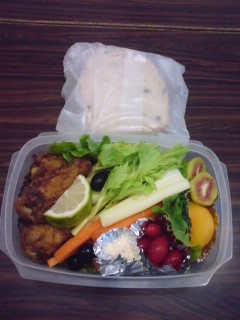
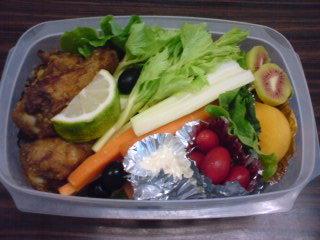
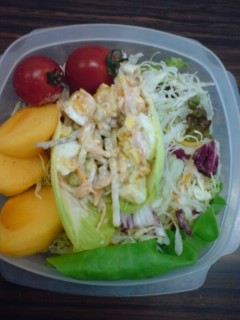
Accordingly, I discovered many vegetables in the main dish:
celery (Shizuoka produces 50% of all celery in Japan!), endive/chickory leaves, carrot sticks, lettuce and olives. Some tartare mayonnaise was included.

bento-2008-11-18c

The minuscule tomatoes are called “Ameera Rubbins”. They are very sweet. Only two farmers in Iwata City, Western Shizuoka, produce them in the whole of Japan!

bento-2008-11-18e

The Missus had marinated the chicken legs all night long before deep-frying (actually shally-frying) them this morning. A piece of lemon was provided for extra seasoning.

bento-2008-11-18f

As for dessert she included persimmon wedges and mini-kiwi fruit (above pic) grown in Shizuoka Prefecture.

bento-2008-11-18d

The bread had been baked the night before and toasted this morning. It includes black olives, chopped mint leaves and processed cheese.

Now, to answer Barbara‘s question whether the Missus shared her bread recipes, unfortunately, my other half (Rowena might have a few things to say about that! But she also knows I had a hard time “stealing” the Missus’ fried chicken recipe!), like most Japanese wives, is very cagey and possessive about her recipes.
As a rule I’m not allowed inside the kitchen, except when I wash the dishes (sometimes) and when I cook for her!
As for bread, she uses a bread baker gadget (more than 200 US$) which does absolutely everything from fermenting to baking!
Now, I know that she used rye flour and wheat flour at a 1 to 9 ratio and always adds a lttle olive oil with the water.
Once the dough has been completely leavened, fermented, raised and kneaded, the gadget will “call her”. Only then, will she add things like cheese, herbs and so on!
And then the gadget will take over again!

Local Food: green, healthy and social.

Please check the new postings at:
sake, shochu and sushi
Shizuoka Pics

—————————————-
日本語のブログ
—————————————-

lojol1
By Patrick Harrington

local-food.jpg

As this article appears more current by the day I decided to post it again for the attention of all my new friends at Foodbuzz!

From all the excellent articles in the Shizuoka Gourmet blog the one which had most impact on me was the shortest one, with a quirky title that hid a very serious issue: ‘Shimizu goes bananas’, in March 2007.

As we all know our use of the earth’s resources is exceeding the earth’s ability to sustain itself. It is calculated that we would need an earth almost twice the size to sustain our thirst for resources.

It may seem obvious but one way of significantly reducing our over-use of resources is by consuming local food.

We can massively reduce the amount of transportation. Can you imagine how far strawberries must travel to keep the supermarkets of Northern Europe stocked year-round?.
And we can also reduce or eliminate the the processing and packaging, not to mention the advertising. Plus there is reduction in the need for chemical preservatives and irradiation.
Growing local food also results in a tendency toward multiple cropping and better crop rotation. This can lead to reduced pesticide use, minimization of crop failure and better preservation of indigenous biodiversity.
In addition the by-products, eg manure and silage, may be used productively rather than be viewed as nuisance waste.
However multiple cropping requires multiple skills and a wide range of tools and machinery, but it utilizes human labour more efficiently as each crop will have a different cycle.
The green dimension of local food is something we can all probably agree upon.

Secondly there is also the health dimension. As mentioned above the amount of processing and the need for pesticides and chemicals can be reduced by using local food, but it is also thought that better nutrition also results.
Regional and seasonal conditions affect the compostion of plants and animals and consuming local food provides an optimal nutritional fit.
Having said this, science has been unable to prove nor disprove this idea, but anecdotal evidence abounds. A simple example is the consumption of oranges in Shizuoka in the winter months. The vitamin C from the oranges helps combat the increased risk of catching colds at this time of year. A more radical example would be the traditional Japanese diet of rice, fish and green tea, which surely provides a better nutritional fit for the people of Japan than a diet of burgers, french fries and cola.

Thirdly is the social dimension. Local food can help protect local jobs and shops, and increase food security. Support for local food may also result in the continuation (or re-discovery) of community structures and values. And local food often carries inherent traditional and cultural symbols for a community, something which is perhaps undervalued in today’s global society.
Though it may be counter-argued that international trade is a method of wealth redistribution, this is a highly complex issue, and evidence suggests that the wealth divide is actually widening rather than narrowing.

So the argument for local food appears to be a compelling one. But don’t get me wrong! I’m not advocating that we forsake all food from outside our local community. In fact it is ludicrous to imagine every region being self-sufficient in food. What would happen to Tokyo, or Finland, or Singapore?
And why shouldn’t Robert eat cheese, and why shouldn’t I eat bananas?

But cheese is now made in Fujinomiya, and bananas are now grown in Shimizu, which make them local (to Robert and me).

Admittedly there aren’t many places which can boast Shizuoka’s capability to produce such diverse foods, but I would urge a greater balance toward local food in the diet. There are significant green, healthy and social benefits to be gained. And local food tastes better too!

Simple Recipes: Potato Pizza

Please check the new postings at:
sake, shochu and sushi

—————————————-
日本語のブログ
—————————————-

potato-pizza.jpg

Have you ever wondered how to make a pizza when you do not have the bread dough or the ready-made bread? Have you ever thought that for once you could bypass the bread and it its soggy appearance as soon as it has cooled down/

The solution is cheap, easy to prepare, tasty (I can hear the fried potato addicts lick their lips in anticipation…) and open to infinite variations!

Now, how do you prepare that?

For the pizza above, I used 3 large potatoes (enough for 4 persons). If you plan to make a very large one, say use 5 or 6 potatoes, but the it will become pretty thick. Better experiment first!

Peel the potatoes and shred them as thin as possible. Wash them under running water, drain them thoroughly and take as much moisture off in cloth or kitchen paper towel. Put them in a large bowl and add salt, pepper according to your need. I always add a generous amount of nutmeg. Mix well.
In a large non-stick frying pan of the size wanted for the pizza, pour two tablespoons of olive oil and heat sufficiently. Put all the potatoes in the frying pan and spread them evenly. Press the whole upper surface with a spoon, spatula or flat piece of metal to help potatoes to adhere quickly. Fry on middle fire until the potatoes have become translucent on the whole upper surface. Check how cooked the lower surface then. Wait until it has become a deep brown colour. Only then, should you be able to turn it over without breaking it. When both sides have cooked to a crispy dark brown colour slide onto an oven plate covered with baking paper. Let it cool a bit.
Preheat the oven to 180 degrees Celsius.
As for the garnish, it is entirely up to your imagination!
Usually I first brush the “potato bread” with tomato ketchup or puree and Thai sweet chili sauce. Then I had bacon (raw or fried/skip them if you are vegetarian!), thin slices of onion or Belgian shallots, at least three types of thinly slices pimentoes and plenty of cheese.
As for the one in the picture above, I utilized left overs of that particular day:
bacon fried to a crisp, smoked salmon marinated in Thai sweet chili sauce, previously sauteed mushrooms and pimento slices, the whole with a generous helping of grated cheese, some seasoning and fresh herbs, including basil and Italian flat parsley.

Enjoy!

Today’s Lunch Box/Bento (40)


The Japan Blog List

Please check the new postings at:
sake, shochu and sushi

—————————————-
日本語のブログ
—————————————-

bento-2008-11-14a

I do not usually publish The Missus’ bento on Friday when I have to take the train to University as they are very simple sandwich affairs.
But for once, she decided to bring some variety, which meant extra things to carry!

bento-2008-11-14b
Rice balls contained umeboshi/pickled Japanese plum and o-kaka/fine bonito shavings.

bento-2008-11-14c bento-2008-11-14e
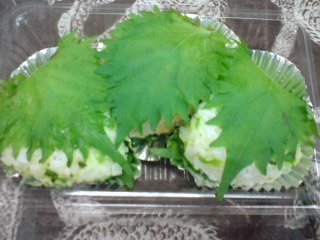
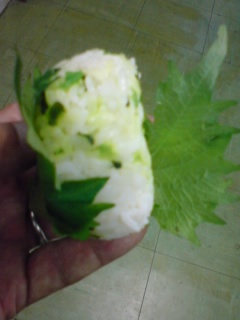
The nigiri/rice balls were “wrapped” in two shiso/perilla leaves each, as nori/seaweed would get soggy before I could eat them. Very tasty and healthy!

bento-2008-11-14f
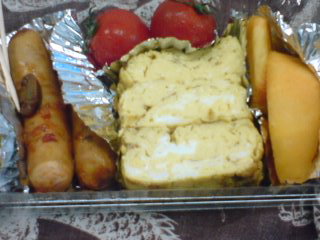
The “main dish” consisted of (from left): home-made pickles (not really visible, sorry!), fried sausages, plum tomatoes, “tamagoyaki”/Japanese omelette (she sweetend it honey on purpose) and wedges of “kaki”/persimmon for dessert.
I had a pack of vegetable juice to help it down.

bento-2008-11-14g
Now, Japanese trains everywhere in the world are not very clean places for obvious reasons.
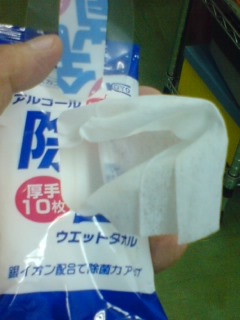
The Missus, like most Japanese ladies is very cleanliness-conscious. She makes a point to ensure that I carry “wet tissues” with me all the time. I certainly cannot fault her for that as I did have to eat with my fingers!
These are very common in Japan, and I always carry a couple. I wonder if my European/Asian/African/American friends know or use them!

Today’s Lunch Box/Bento (39)


The Japan Blog List

Please check the new postings at:
sake, shochu and sushi

—————————————-
日本語のブログ
—————————————-

bento-2008-11-11a

Today’s bento was a “rice bento” as it is Tuesday!
It was a return to basics!

bento-2008-11-11c
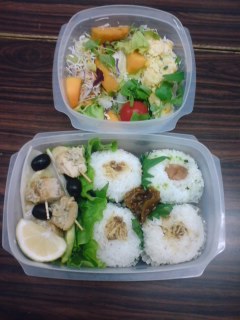
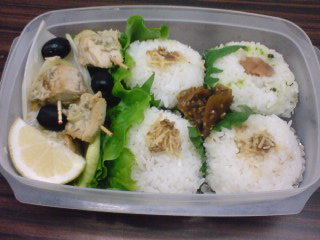
The “main dish” nigiri/rice balls, all wrapped in fresh “shiso”/perilla leaves were of two kinds:
one with ume/Japanese pickled plum,
bento-2008-11-11e
the other three contained “o kaka”/very fine bonito dry shavings and processed cheese. The combination might sound a bit outlandish, but it is very popular in Japan!
bento-2008-11-11d
The brochettes/”kushiyaki” you see on chickory/endive leaves are “negima”/ “negi” for leeks and “ma” for maguro/tuna. The Missus put some “wasabizuke” on them for extra seasoning. This “wasabizuke” is wasabi leaves and stems pickled in “sake kasu”/sake white lees. Extravagant! A piece of lemon was added for more seasoning.
In the middle are home-made sweet ginger pickles.

bento-2008-11-11b
The Missus has got this habit to put my dessert (fruit in this case) in/on the salad. Not a bad idea actually. Finely chopped greens, plum tomato, fresh cress from Shizuoka, potato and tobikko/Flying fish roe salad leftover from yesterday inside chickory/endive leaf and pesimmon/”kaki” wedges.

Now, did you know that persimmons have the property to prevent bad/strong breath?

Today’s Lunch Box/ Bento (38)


The Japan Blog List

Please check the new postings at:
sake, shochu and sushi

—————————————-
日本語のブログ
—————————————-

bento-2008-11-10a

Since the Missus has started baking her own bread again, the “Monday Bento” has followed the same pattern: “Open sandwich bento”, which actually I eat with a fork at the office, breaking bread in pieces along!

bento-2008-11-10b

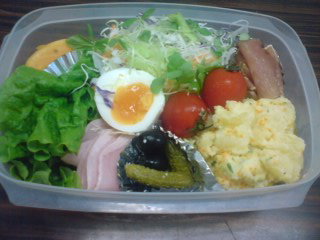
The “main bento” consisted of left to right, top to bottom:
Kaki/Persimmons wedges for dessert, finely chopped veg salad, smoked ham.
Lettuce (supposed to go go between bread slices), halved boiled egg (I wonder how I can put it between dlices of bread, lol), plum tomatoes.
Ham slices, cornichond and black olives, salad of potatoes, corn and tobikko/flying fish roe.

bento-2008-11-10a_0001
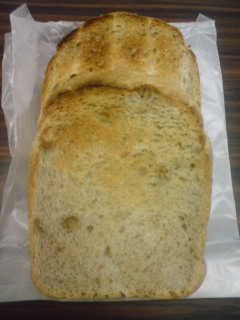
Freshly baked bread (and toasted again) including ham and cheese (melted away inside) and waknuts.
I don’t mind lying to the Missus and tell I loved her “sandwiches” as long as she bakes such bread!

Today’s Lunch Box/Bento (37)


The Japan Blog List

Please check the new postings at:
sake, shochu and sushi

—————————————-
日本語のブログ
—————————————-

bento-2008-11-04a

Today’s lunch box is a bit of a repeat, considering it is more a combination of what I had before.
But I’m not one to complain!

bento-2008-11-04b

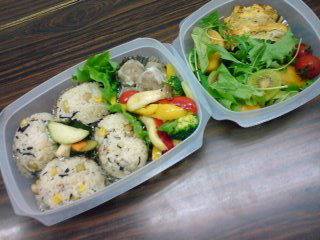
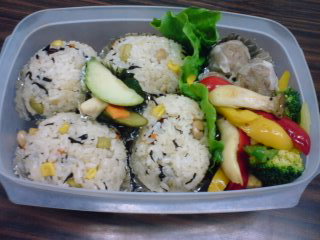
The nigiri/rice balls contain beans and hijiki seaweed.
The Missus put the beans and hijiki seaweed on top of the rice before closing the lid and steaming the whole lot. Once ready, she will stir all ingredients before shaping the balls.
Home-made light rice vinegar pickles can be seen in the middle of the nigiri.
On a bed of lettuce she laid some fried veg including soft pimentoes, bricolo and Eringe mushrooms. She added some mini steamed “syuumai” (not home-made!)

bento-2008-11-04c

The salad consisted of luccola and other light greens topped with plum tomatoes, yakitamago/Japanese omelette and presimmon wedges and mini-kiwi (with a red heart) slices for dessert!

Pretty full, I can assure you!

Today’s Lunch Box/Bento (36)


The Japan Blog List

Please check the new postings at:
sake, shochu and sushi

—————————————-
日本語のブログ
—————————————-

As I need bento on Mondays and Tuesdays, the Missus has began a new pattern withrice on Mondays and home-made bread on Tuesdays. Incidentally bento is always sandwiches on Fridays when I go and teach at university.

Today’s main dish was chicken “sasami/breast fillets” she fried with ktechup, basil and what else (she would never say anything!) served with cornichons, boiled egg on a bed of chopped greens with lettuce and chikory leaves and a few plum tomatoes.
I used dressing stored in the fridge at work.

The bread she made last night waswalnuts bread.
She calls it an open-sandwich bento, but she would be surprised to find out I just break the bread and eat a piece at a time with the main dish.
As for dessert I had “mikan/mandarine oranges” from her family’s garden.

Today’s Lunch Box/Bento (35)


The Japan Blog List

Please check the new postings at:
sake, shochu and sushi

—————————————-
日本語のブログ
—————————————-

Today the Missus definitely combined East and West!

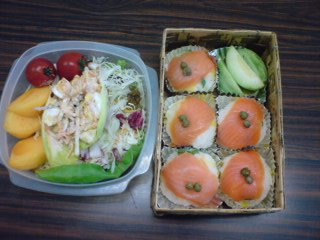
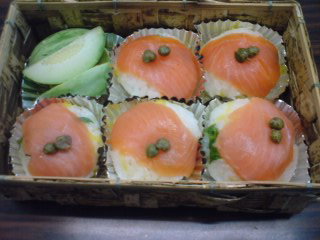
She made “temari zushi”. S
The rice balls are called as such they mean “balls made by hand”. Which does not help!
The balls are smaller and round with their top covered as “nigiri”.
She steamed the rice with knobu/seaweed fro Rishiri Island (Hokkaidou). She made balls and covered them with smoked salmon topped with capers. The home-made pickles are mini-melons.

As for the salad, on a bed of finely chopped greens she put two chicory/endive leaves filled with eggs and vegetables salad, a couple of plum tomatoes and a few wedges of persimmon for dessert.

Just enough to last the day!

Today’s Lunch Box/Bento (35)


The Japan Blog List

Please check the new postings at:
sake, shochu and sushi

—————————————-
日本語のブログ
—————————————-

My other half said this morning: “Today I’ll make an open sandwich bento!”
“Great and thanks!” (and a wet kiss…)

Actually it turned into a bit of an extravagant “open bento”!

The “main sandwich ingredients” included a almost soft-boiled egg (impossible to eat between two slices of bread!), a lot of cress, a few fresh endive/chicory leaves containing lightly boiled crispy/crunchy mini-asparaguses, plum tomatoes, cornichons, duck confit (she took it out the freeze and fried it until the skin was crispy light brown), and fried potatoes (not French, please) she had suteed/fried in the confit fat. Now, I gave up making up sandwiches!

“Haddock in the Kitchen” might be interested to know that the Missus baked the bread yesterday.
The bread contained shredded carrots, chopped mint leaves and crumbled walnuts. I have to admit that it was a beauty. Therefore I ate it bit by bit as I consumed my bento along!

Now, I will this opportunity to introduce the dressings I usually keep in the fridge at work:
The “white” one is a Japanese Kewpie Caesar Salad Dressing (Gold Type).
The “orange” one is a Soken non-oil dressing containing green shiso, herbs and lemon.
Both are light and tasty enough and all ingredients are described on the back!

Well, this time I had plenty of dessert! (I suspect the Missus was emptying the fridge…)
Kiwi fruit, Kaki/Persimmon and Nashi/Japanese pear and asome walnut!

Alright, I know I’m spoiled!

Today’s Lunch Box/Bento (34)


The Japan Blog List

Please check the new postings at:
sake, shochu and sushi

—————————————-
日本語のブログ
—————————————-

Due to National Holidays falling on my usual “bento days”, it’s been some time since I could extoll the virtues of my (?) half’s bentoes (lol).
Today’s prepartions witnessed a few variations according to seasonal and unseasonal produces.

The “nigiri”/rice balls had been steamed together with tinned beans and “hijiki” seaweed, to which the Missus added a dash of shoyu before making the rice balls. As the rice was still very hot she used the “kitchen vinyl wrap” technique. Cutting a large enough piece of “Sun Wrap” (Japanese name) and holding it inside the palm of her hand, she put the proper amount of rice in the middle, close the “paper” around it and shaped it into a ball before releasing it onto a plate. The balls were later half-wrapped in shiso leaves. Incidentally I would like to thank here all the friends who left so many kind messages about the shiso posting!
In the centre she placed freshly sauteed “sasami”/chicken greast fillets on a bed of cress.
The pickles are green baby melon (home-made), tomatoes marinated in mirin (home-made) and shredded “takuan”/pickled daikon.

The “salad” consisted of a soft-boiled egg on a green leaves bed with “ameera rubbins”/the smallest sweet tomatoes in the world, exclusively grown by only two farmers in Shizuoka Prefecture.
Dessert consisted of small slices of nashi (white), or Japanese pear, and kaki (orange), a square variety of persimmon created some time ago in Shizuoka Prefecture. Nashi are almost at the end of their season whereas kaki have just apeared on the supermarket shelves.

Now did you know that persimmons contain five times as many Vitamin C in a lemon, weight for weight?

Today’s Lunch Box/Bento (33)


The Japan Blog List

Please check the new postings at:
sake, shochu and sushi

—————————————-
日本語のブログ
—————————————-

Today the Missus made good use of yesterday’s leftovers and home-preserved vegetables.

There are always two or three boiled eggs in the fridge, so one of them found its way in today’s lunch. The Missus had kept aside some of the edamame served last night for my evening drink, took them out of their pods and also kept them overnight in the fridge.
Yesterday my Monday’s lunch consisted of deep-fried pork/tonkatsu muffin sandwiches. She seasoned the pork leftovers with home-made sweet pickled ginger and ponzu vinegar. The vegetables accompanying the meat in its little box are okura and aubergines/egg plants she had first fried, cooled down and then marinated overnight. The little tomato had been pickled/marinated separately.
The white-green thing in its foil paper is “wasabi zuke/wasabi stems and leaves pickled in sake white lees”, a very Japanese condiment. Most of the total national production is made in Shizuoka Prefecture!
As for the rice, she steamed it with fresh mushrooms, soy sauce and I don’t know what (she wouldn’t tell me…). All I can is that I loved it!

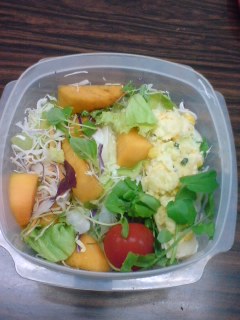
For once she did not omit dessert as mini apple slices were included in the salad!

Today’s Lunch Box/Bento (32)


The Japan Blog List

Please check the new postings at:
sake, shochu and sushi

—————————————-
日本語のブログ
—————————————-

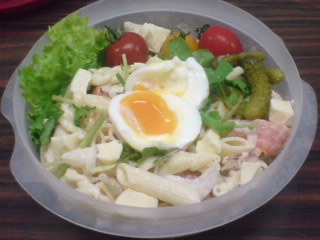
Yesterday’s bento was a quick fix, but I must admit it was pretty satisfying!
She just boiled an assortment of pasta, cooled them under cold water, drain them and mixed them with smoked salmon, mayonnaise, capers and some spices.
She added the usual plum tomatoes, cress, bits of processed cheese, French cornichons and lettuce.
She topped the whole with some very soft-boiled egg halves.
Actually, most of the yolk of the upper half flowed into the pasta salad contributed for more taste!

But she forgt the dessert again!