Tag Archives: 美食

For Vegan and Vegetarians! “Forgotten” Vegetables 19: Concombre Apple Sikkim/Sikkim Cucumber

SYNOPSIS:
Organic agriculture and biodiversity have in recent years brought about a rediscovery of many “forgotten” vegetables that people especially in Europe and France conscientiously tried to forget as they reminded them of the privations suffered during WWII. The same people had then to make do with untraditional vegetables because potatoes, carrots and so on were confiscated by occupying forces or their own armies.
With sustainibility and bioagriculture made more important by the deficiencies of modern mass agriculture, those “forgotten” vegetables have suddenly come to the fore for the pleasure of all, and that of course of vegetarians and vegans!

This particular series of postings will introduce these vegetables one by one. I hope they will become useful for a long time to come to all my vegan and vegetarian friends!
1)
Scorsonere/Oyster Plant
2)Potimarron
3) Vitelotte
4) Rutabaga
5) Cardon
6) Panais/Parsnips
7) Patisson
8) Topinambour
9) Crosne
10) Cerfeuil Tubereux
11) Poiree
12) Oca
13) Ulluque/Ulluco
14) Tigernuts
15) Capucine tubereuse-Maschua
16) Chataigne de Terre-Great Pignut
17) Yacon

18) Balsamite/Costmary

Did you know that all cucumbers originated in the wild in India?
Well, I didn’t know until I did some rearch on that particular variety!
Large genetic varieties of cucumber have been observed in different parts of India. It has been cultivated for at least 3,000 years in Western Asia, and was probably introduced to other parts of Europe by the Romans. Records of cucumber cultivation appear in France in the 9th century, England in the 14th century, and in North America by the mid-16th century.
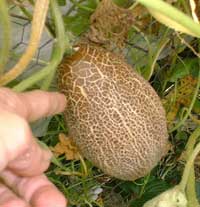
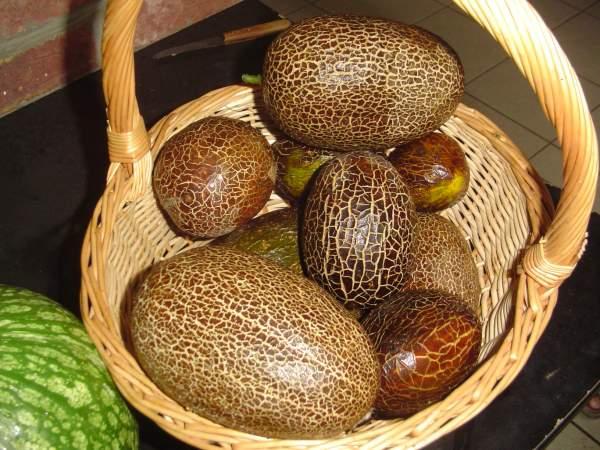
Sikkim Cucumber is not an hybrid, but an ancient variety which grows in Sikkim State in India.
Protected by a hard skin, it can easily stored safely for months!
It is comparatively small, never reaching more that 10 cm/4 inches.
Its skin makes for a beautiful design and a popular ornamental plant in Europe.

But it is edible. Its taste is soft and void of acidity.
It can be eaten raw or cooked.
It certainly seems very populat inthe Indian Himalayas.
It can actually be prepared in as many dishes as usual green cucumbers.

RECOMMENDED RELATED SITES
Not-Just-Recipes, Bengal cuisine, Cooking Vegetarian, Frank Fariello, Gluten-free Vegan Family, Meatless MamaFrank Fariello, , Warren Bobrow

Please check the new postings at:
sake, shochu and sushi

—————————————-
日本語のブログ
—————————————-
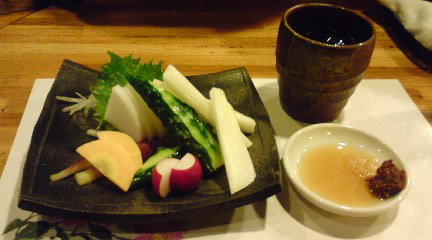
Vegan sashimi at Yasaitei (’09/12/02)

Service: excellent and very friendly
Facilities: great cleanliness overall
Prices: reasonable, good value.
Strong points: Very fresh local ingredients extensively used. Seasonal ingredients only. All-ladies staff.

Last night, having a long break in the evening and being ravenous, I just couldn’t wait until dinner at home. So, I veisited my favourite izakaya, namely Yasaitei, where I knew I could have a quick and delicious fix without worrying about my wasitline!

In Japan it is usual to be served a small snack (which will be charged at a nominal but reasonable price) with the first drink order.

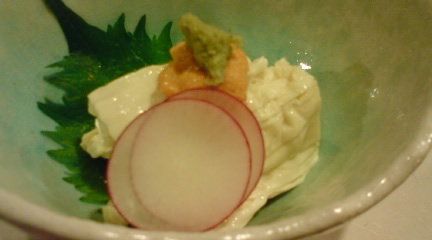
For a closer view!

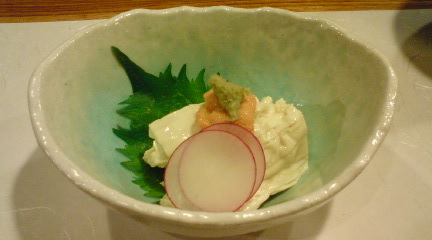
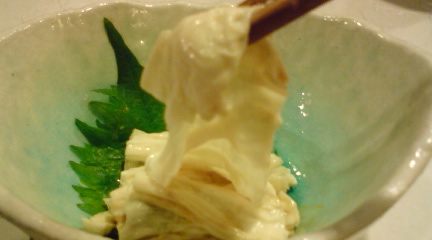
The snack was “yuba”/tofu sheets with uni/sea urchin (vegans or vegetarians only need to point out their priorities and they will be served only according to them, so no worries!) and Shizuoka wasabi (and slices of radish).

With a little soy sauce,so simple but so refined at the same time!

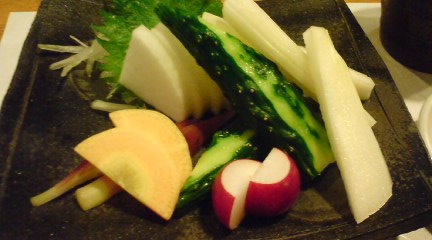
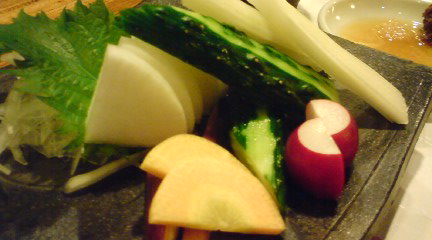
The vegetables were basically the same as my last visit, which I don’t mind at all, but the plate and the presentation were different, which I appreciate no end!:
-Yellow carrot
-Myoga/myoga ginger shoots
-Cucumber (so crispy!)
-Celery
Daikon
-Shiso on a bed of thinly cut onions.

For a side view!

Served with sesame oil, miso and salt seasoning and a glass of Doman Shochu by Hamamatsi-Tenjigura Brewery, perfect!

YASAITEI
Shizuoka City, Aoi Ku, Tokiwa-Cho, 1-6-2 Green Heights Wamon 1-C
Tel.: 054-2543277
Business hours: 17:30~22:00
Closed on Sundays
Reservations highly recommended
Seating: 6 at counter + 20 at tables
Set Courses: 3,000, 4,000, 5,000 yen
HOMEPAGE (Japanese)

RECOMMENDED RELATED SITES
Not-Just-Recipes, Bengal cuisine, Cooking Vegetarian, Frank Fariello, Gluten-free Vegan Family, Meatless MamaFrank Fariello, , Warren Bobrow

Please check the new postings at:
sake, shochu and sushi

—————————————-
日本語のブログ
—————————————-
For Vegan and Vegetarians! “Forgotten” Vegetables 18: Balsamite/Balsamita/Costmary

Courtesy of Jean-Luc Muselle

SYNOPSIS:
Organic agriculture and biodiversity have in recent years brought about a rediscovery of many “forgotten” vegetables that people especially in Europe and France conscientiously tried to forget as they reminded them of the privations suffered during WWII. The same people had then to make do with untraditional vegetables because potatoes, carrots and so on were confiscated by occupying forces or their own armies.
With sustainibility and bioagriculture made more important by the deficiencies of modern mass agriculture, those “forgotten” vegetables have suddenly come to the fore for the pleasure of all, and that of course of vegetarians and vegans!

This particular series of postings will introduce these vegetables one by one. I hope they will become useful for a long time to come to all my vegan and vegetarian friends!
1) Scorsonere/Oyster Plant
2)Potimarron
3) Vitelotte
4) Rutabaga
5) Cardon
6) Panais/Parsnips
7) Patisson
8) Topinambour
9) Crosne
10) Cerfeuil Tubereux
11) Poiree
12) Oca
13) Ulluque/Ulluco
14) Tigernuts
15) Capucine tubereuse-Maschua
16) Chataigne de Terre-Great Pignut
17) Yacon

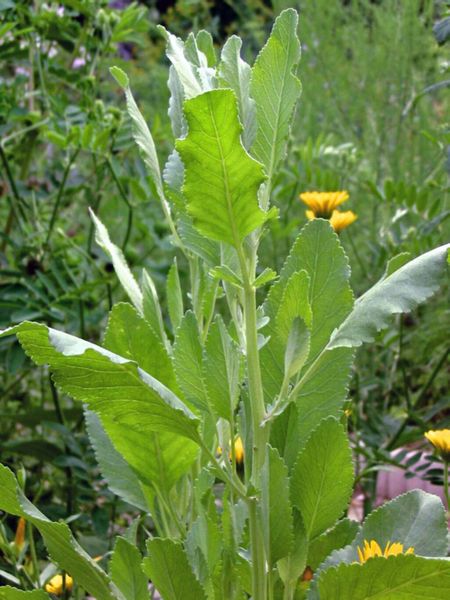
Balsamite (French) or Costmary (English) is an aromatic plant that has been cultivated for a long time as an ornamental and medicinal plant.

Its Latin name is Balsamita major Desf. (synonym : Tanacetum balsamita L. subsp. balsamita).

It is known under many names: Grande balsamite, menthe-coq, menthe de Notre Dame, tanaisie des jardins, baume-coq, Chartreuse, (French), Balsamkraut (German), costmary (English), erba-amara balsamica, erba buona (Italian)

It has been grown for many centuries for its pleasant, slightly medicinal or balsamic smell. It was used in medieval times as a place marker in bibles.
Moreover, the plant is known from ancient herbals and was widely grown in Elizabethan knot gardens.

It is a strong plant, quite tall, 1,2 metres/4 feet giving out a pleasant aroma similar to mint with beautiful yellow flowers.

It originated in Western Asia and the Caucasus. It strives in temperate climates and has been succefully grown in Europe, North Africa and North America.

The leaves, slightly sour, can be used to season salads and liqueurs.
Good Beer and Country Boys will be gld to hear that a long time ago, they were used to contribute aroma to ale beer in England!

Liqueur fans, try this:
Macerate 9 leaves with 9 pieces of sugar in fruit alcohol for 2 or 3 months!

RECOMMENDED RELATED SITES
Not-Just-Recipes, Bengal cuisine, Cooking Vegetarian, Frank Fariello, Gluten-free Vegan Family, Meatless MamaFrank Fariello, , Warren Bobrow

Please check the new postings at:
sake, shochu and sushi

—————————————-
日本語のブログ
—————————————-
Tempura: The Professional Basic Recipe

Tempura is not difficult to make. If you keep to the basics and good ingredients, you will be able to make a lot of people happy with healthy and beautiful food.

The following instructions should be amply enough to succeed with this celebarted Japanese gastronomic marvel:

INGREDIENTS:

What can you fry as tempura?
-Any green or not vegetable as long as they are cut to the appropriate size. Avocado and pumpkin can be made as tempura!
Important: try to keep all vegetables cut to the same size.
If consistency and thickness varies, sort them out accordingly in compatible batches. The frying will be more even, avoiding disappointing discrepancies.
Wash and dry vegetables.
-Any white-fleshed fish, crustaceans and shellfish. Clean and wipe off excessive humidity. Fry them separately from the vegetables. Some red-fleshed fish can be made as tempura, but they are a bit of an acquired taste.

In short, don’ be afraid of experimenting!

Vegans and Vegetarians

Before we go any further, vegans and vegetarians can make tempura. Replace the egg white with cornstarch. Wheat flour allergics can use other flour types, keeping in mind they have to be of the kight-weight and fine sort.

-If you use frozen ingredients, make sure to thaw them completely and wipe off all excess water!

The batter:
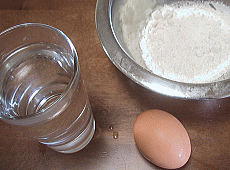
-Use an equal amount of fine light flour and pure water.
1 cup of water for 1 cup of flour and 1 egg white are the right proportions.

Important!
-Flour, water and egg, not only must be at the same temperature, but must be chilled! leave them together in the fridge before using!
The batter should be prepared at the last moment after all the ingredients have been cut and laid on the table, the oil brought to the right temperature and the sauces or spices prepared and laid on the table!

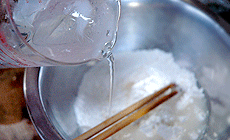
-First mix water and egg white (or cornstarch/not too much with that one!). Then pour on the flour and mix lightly.
Do not overmix! Flour blobs should still be there! This is the secret for fluffy, light tempura!

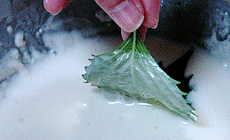
Fish, crustaceans and shellfish may be completely dipped in the batter as well as rounded or stick-shaped vegetables including slices of onions, kabocha or avocado.
But in the case of large leafy vegetables such as shiso/perilla or large flat mushrooms such as shiitake, dipping only one side (back side for leaves!) in batter is preferable, otherwise you will end up with masses of fried batter!
Actually, in the case of fish, it is better to dip only the skin side in the batter.

Oil:
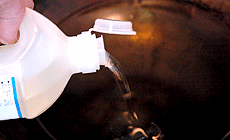
-Use plenty.
Use clean fresh oil!
Use salad oil of your preference and sesame oil in a 6:4 ratio.
Bad oil or old oil is bad for your health.
If the oil keep bubbling on upon being heated, change it!

Frying:
-The usual temperature is 180 degrees Celsius, but the ideal is 170 degrees Celsius.
Note: 160 degrees Celsius is not hot enough!
-Use a relatively thin pan for frying as the temperature of the oil will fall down by 4 degrees Celsius when food is plunged into the oil. The oil has to reach its former temperature back as soon as possible.

-Fry vegetables before fish or seafood as the latter’s proteins will change the character of the oil.
-Do not crowd the oil. Drop everything in the middle in small batches.
-Do not overfry. Experience will tell you when to take ingredients out.
-Do not fry twice! Full stop!

Serve on a piece of kitchen paper after having put the ingredients on a grill for a few seconds to get rid of the excess oil.

Seasoning:
-Personally I eat tempura as it is without anything, but if I use seasoning I like the following:
Matcha powder
Rock salt
Curry mixture powder

Now,if you want to dip your tempura in soup/tsuyu, you can prepare it as follows:
Dashi (konbu/seweed dashi for veganas and vegetarians!): 5 (or 4)
Soy sauce: 1 (or 2)
Mirin/sweet sake: 1
Heat the whole a little before serving.

NOTE:
-You may use freshly grated daikon, lemon juice or a light dressing of your choice for further seasoning.

RECOMMENDED RELATED SITES:
Bread + Butter, Comestilblog, Greedy Girl, Bouchon For 2, Zoy Zhang, Hungry Neko, Mangantayon, Elinluv Tidbit Corner, Maison de Christina, Chrys Niles, Lexi, Culinary Musings, Eats and Everything, Bite Me New England, Heather Sweet, Warren Bobrow, 5 Star Foodie, Frank Fariello, Oyster Culture, Ramendo, Alchemist Chef, Ochikeron, Mrs. Lavendula, The Gipsy Chef, Spirited Miu Flavor

Please check the new postings at:
sake, shochu and sushi

—————————————-
日本語のブログ
—————————————-
Japanese Cuisine: Himono-Dried Fish

How many people outside Shizuoka Prefecture know that half (yes, half!) of all dried fish are caught and processed in our Prefecture, notably along the shores of the Izu Peninsula?
When will i convince everyone that Shizuoka Prefecture is THE true gastronomic region of Japan? LOL
To those guys living in Tokyo, may I remind them that Mount Fuji, Izu Peninsula and wasabi are all in Shizuoka Prefecture? Please someone stop me!

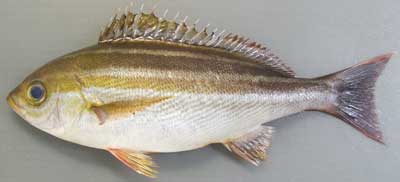
I chose a fish called “isaki” or “Chicken Grunt” (who came up with that English name?) that is quite common on our shores.
The recipe naturally applies to loadsof fish!

CLEANING THE FISH:

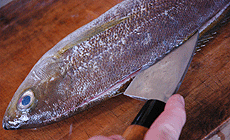
Using a strong short sharp knife (the japanese use the same knife to cut and gut medium size fish), first get rid of the scales as much as possible.
Wash once under running clear cold water.
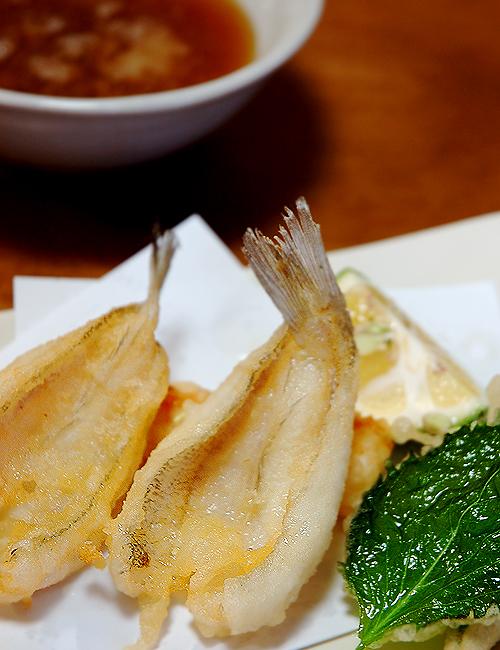
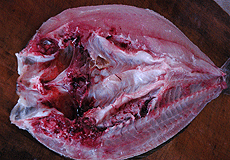
Cut along the back (not the belly! very important) from the tail to the head as shown on above picture deeply enough to reach the main bone.

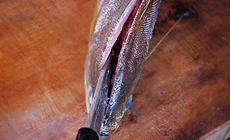
Oncethe knife has cut all along the back and reached the head, cut the head in half along the same cutting line.
The head of a isaki being small it is quite easy. It might requires some strength for bigger head fish like seabreams. Call the MOTH then! (not the moths, the “Man”! LOL).

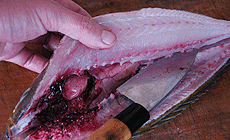
Open the fish and continue cutting in half all the way through.

Take out innards carefully so as not having them getting in contact with the flesh!
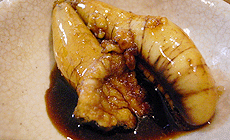
Depending upon the season, you might be lucky to get male sperm sacks (shirako). Don’t throw that away. They are great simmered with soy sauce, mirin/sweet sake, japanese sake and chili pepper! (see pic below).

Open the fish and clean it under running clear cold water.
Take water off with some kitchen paper or a clean piece of cloth.
Sprinkle with salt and dry outside under the sun until it has reached a nice aspect. You could also smoke it.
It can be preserved insde an airtight plastic bag and frozen, although eaten quickly it will taste so much better!

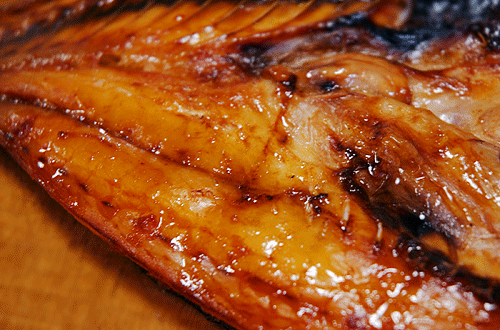
The Japanese grill their himono/dried fish pasted with a liuttel soy sauce or tare. Beautiful with beer, Good Beer and Country Boys!

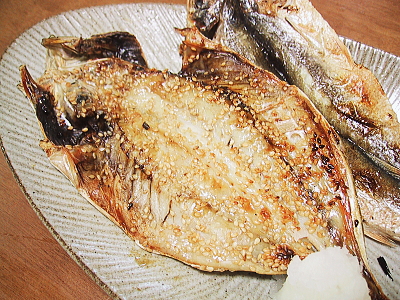
Great also grilled with a little salt!

If grilled with salt don’t forget the freshly grated daikon (and lemon juice, and soy sauce…)

The male sperm sacs (shirako) make for a great snack with your beer or sake once simmered in soy sauce, mirin/sweet sake and Japanese sake (and a little chili pepper)!

RECOMMENDED RELATED SITES:
Bread + Butter, Comestilblog, Greedy Girl, Bouchon For 2, Zoy Zhang, Hungry Neko, Mangantayon, Elinluv Tidbit Corner, Maison de Christina, Chrys Niles, Lexi, Culinary Musings, Eats and Everything, Bite Me New England, Heather Sweet, Warren Bobrow, 5 Star Foodie, Frank Fariello, Oyster Culture, Ramendo, Alchemist Chef, Ochikeron, Mrs. Lavendula, The Gipsy Chef

Please check the new postings at:
sake, shochu and sushi

—————————————-
日本語のブログ
—————————————-
Cheese Cake at Il Cuore

Altough cheese cakes originally came from reece, the Japanese have simply turned into an art of their own!

This very Sunday, as we had finished our cricket session very early, I still had time for a quick lunch/snack as I cycled across town on my way back for a quick visit to my office and laptop.

Il Cuore is my favourite Italian Caffeteria in Shizuoka City, a locality replete with Italian establishements. It is unpretentious, but authentic (although all the staff is Japanese) and very convivial.
I ordered a plate of Parma Ham and a smaller one of Italian cheese with home-made bread and a couple of glasses of red Italian wine.
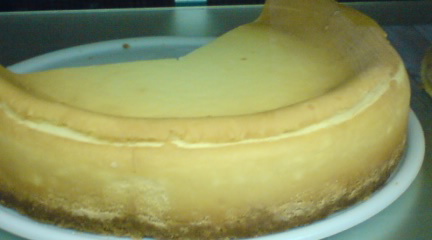
I was about to call it quits when my eyes spotted the enormous cheese cake in the display fridge. It was 30 cm (1 foot!) wide and at least 5 cm ( at least 2 inches) thick! Officiallyit made for 12 portions, although I suspect it could make for far more!LOL
I just had to have it, regardless of my waistline!

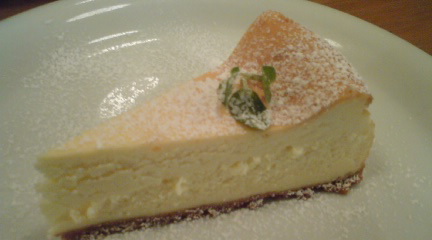
Served with some icing sugar and a sprig of fresh mint, it had the perfect balance (nothing to do with the cloying sweetness of some cakes bought over the counter!).
Made by the young chef, Seiya Maejima, It was fullfilling but light and very easy to eat (wolf down!). I didn’t ask for his secrets, but I know it took 1 kg of cream cheese to make.

As for the biscuit base, I only know they are Italian.
A cake to emulate!

CAFFETERIA IL CUORE
420-0035 Shizuoka City, Aoi Ku, Shichiken-cho, 13-20, Ishiwata Bldg. 1F
Tel. & fax: 054-2723737
Business hours: 11:30~23:00 (closed on Tuesday)
Credit Cards OK

RECOMMENDED RELATED SITES:
Bread + Butter, Comestilblog, Greedy Girl, Bouchon For 2, Zoy Zhang, Hungry Neko, Mangantayon, Elinluv Tidbit Corner, Maison de Christina, Chrys Niles, Lexi, Culinary Musings, Eats and Everything, Bite Me New England, Heather Sweet, Warren Bobrow, 5 Star Foodie, Frank Fariello, Oyster Culture, Ramendo, Alchemist Chef, Ochikeron, Mrs. Lavendula, The Gipsy Chef, Dodol-Mochi

——————————–
Please check the new postings at:
sake, shochu and sushi

—————————————-
日本語のブログ
—————————————-
Vegan Tofu Cuisine: Agedashidofu

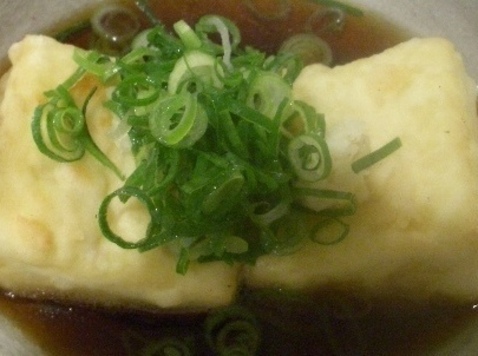
“Agedashidofu” or (Tofu first deep-fried, then served with dashi soup” is a very popular Japanese dish that can easily be adapted to fit vegetarian and vegan priorities!
Moreover, whatever dashi/soup is left can be poured onto a bowl of freshly staemed rice for a fillingand healthy suppelementary dish!

Veagn Agedashidofu!

INGREDIENTS: For 2 people

-Tofu (momen tofu) 1/2 a large piece (can of course be increased!)
-flour: 1 tablespoon (whatever flour as this could add an interesting variation!)
-Cornstarch: 1 tablespoon
-Oil for deep-frying
-Freshly grated daikon (to taste)
-Thinly chopped leek (to taste)

-Dashi (konbu/seawed dashi): 100 ml
-Soy sauce: 2 tablespoons
-Mirin/sweet sake:2 tablepoons

-You may add spices of your choice, especially grated ginger and hot chili powder!

RECIPE:

1. Pressas much water out the tofu as possible.
Cut the tofu into large pieces. Take as much as humidity off their surface by wrapping inside a clean cloth for a while.
Mix the flour and cornstarch.
Roll the tofu pieces into the flour and cornstarch so as to cover all sides.
If you don’t have enough flour/cornstarch, prepare more.

Drop in deep-frying oil at 170 degrees.

2. Prepare the dashi soup by heating the konbu dashi with the soy sauce and mirin (and extra spices if wanted).

3. Pour the dashi in individaul dishes.
Place fried tofu in the middle.
Top tofu with freshly grated daikon and chopped leek.

SUGGESTION:

Boil some cut mushrooms in the dashi before serving them together with the tofu!

Easy and healthy, isn’t it?

RECOMMENDED RELATED SITES:
Bread + Butter, Zoy Zhang, Hungry Neko, Mangantayon, Elinluv Tidbit Corner, Maison de Christina, Chrys Niles, Lexi, Culinary Musings, Eats and Everything, One Frugal Foodie, Bite Me New England, Heather Sweet, Dodol-Mochi

——————————–
Please check the new postings at:
sake, shochu and sushi

—————————————-
日本語のブログ
—————————————-

Tamagoyaki with Spinach & Corn

I have always been surprised to find out how Japanese Omelette or Tamagoyaki is so popular abroad.

Here is a simple recipe that adults and children alike will love to eat either as a main dish or as a snack!

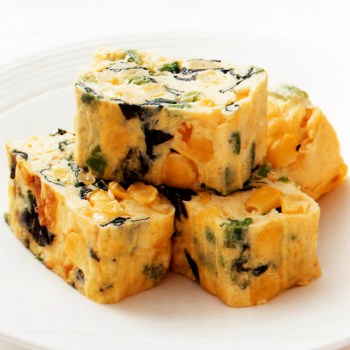
Tamagoyaki with Spinach & Corn!

INGREDIENTS: For 2~3 people

-Eggs: 3
-Dashi/soup stock (konbu/seaweed or chicken): 3 tablespoons
-Japanese Sake: 1 teaspoon.
-Sugar:: 1 tablespoon
-Salt: 1/4 teaspoon
-Spinach: 50 g (boiled and drained completely)
-Soy sauce: 1/2 teaspoon
-Corn: 4 tablespoons (already boiled/canned)
-Vegetal oil: 1/2 teaspoon

RECIPE:

1 Boil the spinach for a minute or two maximum. Let cool completely and press hard to drain all water out. Chop finely.

2Boil the corn if necessary and drain completely. (If canned, drain thoroughly)

3 Beat the eggs in a bowl. Add dashi, Japanese sake, sugar, and salt. Mix well. Add spinach and corn and mix well.

4 Heat frypan and cook as described in Tamagoyaki Basic Recipe.

5 Cut and serve!

RECOMMENDED RELATED SITES:
Bread + Butter, Zoy Zhang, Hungry Neko, Mangantayon, Elinluv Tidbit Corner, Maison de Christina, Chrys Niles, Lexi, Culinary Musings, Eats and Everything, One Frugal Foodie, Bite Me New England, Heather Sweet, Dodol-Mochi

——————————–
Please check the new postings at:
sake, shochu and sushi

—————————————-
日本語のブログ
—————————————-
Tofu Chocolate Cake

As I said before, tofu has the great quality that it makes all things lighter, especially cakes.
have you ever thought of combining it with Chocolate?

Tofu Chocolate Cake!

INGREDIENTS:

-Light flour: 80 g
-Baking powder: 10 g
-Cooking chocolate or normal chocolate (the higher percentage in cocoa, the better!): 1 standard tablet/bar
-Eggs: 2
-Margarine or butter: 1 tablespoon
-Cocoa powder: 20 g
-Rum: to taste
-Tofu (light/kinu tofu): 300 g
-Sugar: to taste (depends on people!)

-Fresh cream: 100 ml
-Jam: 1 tablespoon

RECIPE:

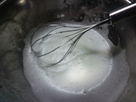
-Whip the tofu until smooth. Pass it through a fine mesh sieve.

In a separate bowl pass the flour and baking powder through a fine mesh sieve.

-Melt margarine/butter and chocolate on a bain-marie (put the bowl inside a larger one over a fire.
Add 50 ml of hot water and the coca powder. Keep mixing until misture thickens.

-Separate egg yolks and whites.
Beat the whites in to solid meringue.

-Add flour and baking powder, egg yolks, rum and sugar to chocolate mixture. Mix well. Fold in the egg whites in.

-Check taste. Add flour and cocoa powder if necessary. mix in quickly.

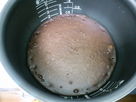
-Line your rice-cooker with a little oil. Pour in the whole mix and switch on the rice-cooker.
If you do not have a rice cooker, pour the mixture inside a mold and bake for about 20~25 minutes at 180 degrees Celsius (check from time to time.

-Wait until cooled down completely before taking out.
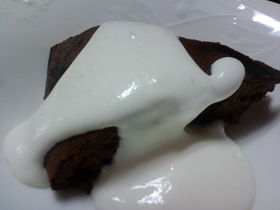
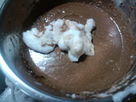
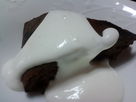
Serve with whiiped cream mixed wit a little jam of your choice.

Plenty of variations possible!

RECOMMENDED RELATED SITES:
Bread + Butter, Zoy Zhang, Hungry Neko, Mangantayon, Elinluv Tidbit Corner, Maison de Christina, Chrys Niles, Lexi, Culinary Musings, Eats and Everything, One Frugal Foodie, Bite Me New England, Heather Sweet, Dodol-Mochi

——————————–
Please check the new postings at:
sake, shochu and sushi

—————————————-
日本語のブログ
—————————————-
Japanese Cuisine: Cabbage Rolls

Cabbage Rolls or stuffed cabbage have a long history and have become one almost universal dish.
The concept comes from the “dorma” in Anatolia (turkey) during the first Century A.D. which were conceived with grape leaves.
Cabbage being a prominent vegetable in Europe, it was only a question of time before cabbage leaves replaced the grape leaves!
The first mention in Japanese history dates back to 1895 when they were called “Rooru Kabetsu/Roll Cabbage” (the other way round!).
They can found in most homes, at oden restaurants and in many other establishments. They are particularly popular in winter when cabbages are everywhere in supermarkets.

The recipe below is the basic one. I will leave to you how to experiment on quantities!
Keep in mind that meat can replaced with tofu, but you will probably needs konbu dashi/seaweed stock.

Choose cabbage leaves of the same size (number depending on servings).
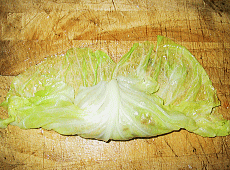
Bring lightly salted water to boil and dip cabbage leaves in water long enough to soften them. Lay the cabbage leaves on a piece of kitchen paper or clean cloth to take off excess water.
Put aside.

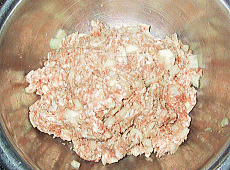
Chop some onion very fine and mix it with minced meat of your choice (pork, beef, lamb). Season with salt, pepper, nutmeg, clove and pther spices of your liking. Mix well.
Note: I personally add some chopped garlic and tiny cubes of lotus root.

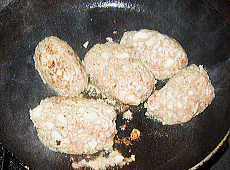
Shape minced meat mixture into elongated balls of the size you wish for stuffing the cabbage. Their length should be equal to the width of your hand (that is, if you are not 7 feet tall!).
Fry them in olive oil until their surface is well cooked (this will prevent unwanted breaking off later). Sprinkle them with a little white wine or Japanese sake for more seasoning.
Place them on a plate and let them cool off completely.

Roll a meat ball in each cabbage leaf.

Bring the ends of the cabbage leaves under the roll and place each roll in the pot as shown on picture above to prevent rolls from moving away (around). If you are not confident, tie some kitchen thread around or secure them with a wooden toothpick, altough this can become very bothersome upon serving and eating.

Fill the pot with a soup made with chicken stock.
This is when you can add a few more spices, but don’t overdo it!
Of course you could could cook it with kimchi for example.
Simmer for about 30 minutes over a medium high fire.
Only then can you scoop the cabbage rolls out.
Keep in mind the soup is great, too!

Here you are! Enjoy!

NOTES:
-If served to children, careful on the spices and garlic!
-Instead of the chicken stock, you may use tonkotsu ramen soup!

RECOMMENDED RELATED SITES:
Bread + Butter, Comestilblog, Greedy Girl, Bouchon For 2, Zoy Zhang, Hungry Neko, Mangantayon, Elinluv Tidbit Corner, Maison de Christina, Chrys Niles, Lexi, Culinary Musings, Eats and Everything, Bite Me New England, Heather Sweet, Warren Bobrow, 5 Star Foodie, Frank Fariello, Oyster Culture, Ramendo, Alchemist Chef, Ochikeron, Mrs. Lavendula, The Gipsy Chef

Please check the new postings at:
sake, shochu and sushi

—————————————-
日本語のブログ
—————————————-
Japanese Gratin: Doria

The Japanese have their own version for Gratin called Doria which is prepared with rice, especially leftover rice.
It is said it was first invented by an Italian family with the name of Doria who tried to represent the Italian flag (with tomatoes, cucumbers and chicken) in this recipe they first cooked in Paris.
It was first prepared in Japan in Yokohoma by a French cuisine chef from Switzerland at the New Grand Hotel in 1925!

It has become a mainstay in Japan in homes and restaurants.
The variations are endless, but here is the basic recipe:

Japanese Gratin: Doria

RECIPE:
I leave the kinds and weights for the ingredients to your creative imagination!

First make a bechamel sauce:
Use the smae volume of flour and butter.
Melt butter in a large saucepan.
Once the butter is melted, add flour and stir until you obtain a smooth mixture.
Add milk (warm will make things easier) cup by cup and stir well. make as much as you want. Keep stirring until you obtain a thick (the thicker, the better) bechamel sauce. Season with salt (easy on that!), pepper and nutmeg.
Set aside and let cool completely.

Slice onion thin and fry in a little oil until soft and just before colouring.
Scoop out and set aside.
You may of course add such vegetables as sweet pimentoes, etc.

The Japanese make their doria with chicken usually, but you may of course replace it any white meat, fish or seafood.
Cut the chicken into small pieces and fry them in same oil until crispy.
Scoop out and set aside.

Use leftover steamed rice.
Fry it with salt (careful on that one again!), pepper and tomato sauce (ketchup is fine, tomato puree is even better).
Season with other spices if you wish to.
Add onions and chicken and stir fry until all ingredients are well mixed.

Butter the inside of an oven dish.
Pour the whole fried rice inside.

Cover the rice with as much as bechamel sauce as you wish.
Add a generous layer of cheese of your choice.
The original recipe called for parmegiano, but cheaper cheese did not exist then!

Bake inside oven as you would do for any other gratin.
Keep in mind the colour you wish to attain.
It might be a good idea to serve them in individual dishes as they come out very hot!
Can be frozen until cooking them in an oven!

The same recipe with boiled macaroni!

RECOMMENDED RELATED SITES:
Bread + Butter, Comestilblog, Greedy Girl, Bouchon For 2, Zoy Zhang, Hungry Neko, Mangantayon, Elinluv Tidbit Corner, Maison de Christina, Chrys Niles, Lexi, Culinary Musings, Eats and Everything, Bite Me New England, Heather Sweet, Warren Bobrow, 5 Star Foodie, Frank Fariello, Oyster Culture, Ramendo, Alchemist Chef, Ochikeron, Mrs. Lavendula, The Gipsy Chef

Please check the new postings at:
sake, shochu and sushi

—————————————-
日本語のブログ
—————————————-
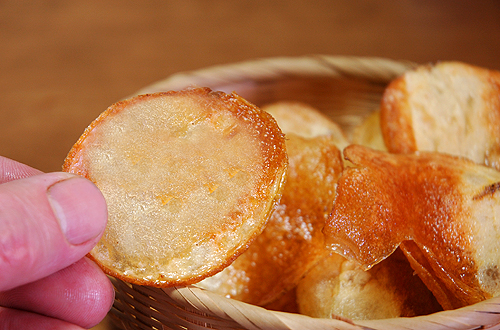
Real Potato Chips

Now, what are real potato chips?

Not the French fries, which are actually Belgian fries.

And not the poor imitations you wolf down with untold amounts of salt and preservatives!

Real potato chips, as known in Great Britain or France (!) are made with potatoes, real ones I mean, and they are easy to make and much, much healthier!

Now, what do you need?
Potatoes, of course, a (very) little salt and good oil.

How do you prepare them?

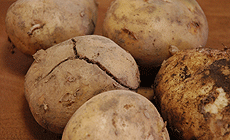
Your potatoes, being old or not, can be used with a simple technique.

If they are old, no problem.
If you brush them (with a real hard brush) under clear water, you will be able to reduce their outer layer to a very thin skin that is edible (actually most of the really beneficient matters are contained in their skin!).

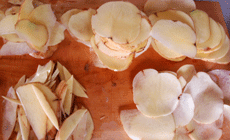
Cut them as thin as possible (with their skin!).

Important: slices of different thickness should not be fried together.
Try to separate them as shown on above pic and fry them separately.
Great fun if you have the kids around!

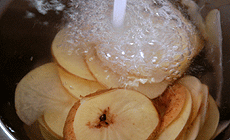
Clean potato slices in cold running water. This is an important step unless you want them to stick together, turn black and make a mess!
Dry them thoroughly inside a large clean cloth (or the water will fly upon frying!).

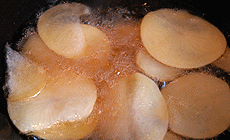
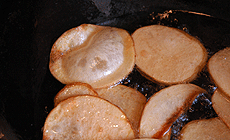
Heat frying oil to 170 degrees Celsius.

This is how your chips should look just before frying!

Use long wooden chopsticks to prevent chips from sticking to each other.

Your chips will change colour and if the oil is at proper temperature swell nicely!

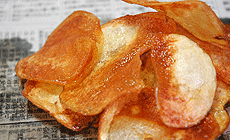
Once you are satisfied with their colour, take them out of the oil and let them rest for a very short while over a fine mesh to get rid of excess oil. Sprinkle a (very) little salt for taste. I personally like some parmegiano and pepper instead of the salt!

Don’t forget the “wrong shapes”! They make for great chips, too, especially with the kids!

I susally serve the round chips with oven-baked chicken or guinea fowl!

Did I mention vegans can eat these?

RECOMMENDED RELATED SITES:
Warren Bobrow
Bread + Butter
5 Star Foodie
Frank Fariello
Elinluv Tidbit Corner
Tokyo Terrace
Maison de Christina
Chrys Niles
Comestilblog
Greedy Girl
Bouchon For 2

Please check the new postings at:
sake, shochu and sushi

—————————————-
日本語のブログ
—————————————-
Vegan Smoked Tofu

It is sometimes a hard world for vegans when it comes to find new ideas and recipes, even you love tofu!
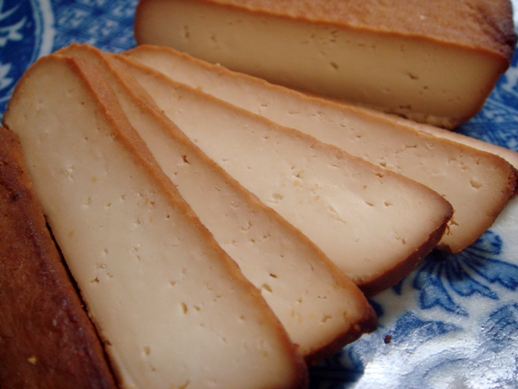
Here is a simple way to prepare and enjoy tofu as it was a big piece of cheese!

Vegan Smoked Tofu!

INGREDIENTS: for ? People

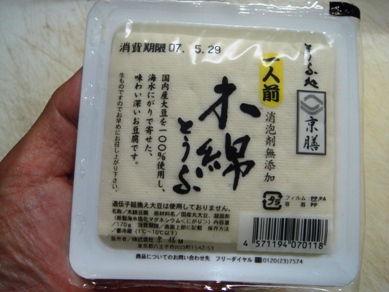
-Tofu: a large piece 300~400g or more
-Miso of your liking, as much as you wish
-Soy sauce, not too much (beware the salt)
-Sake or mirin, a little just for the taste
-Spices, if you wish!

RECIPE:

-As the tofu shouldn’t be too soft, choose “momendofu”, or slightly solid.

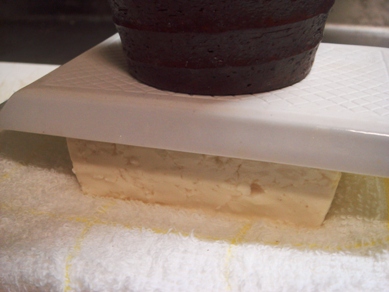
-Place the tofu on a clean cloth.
-Top it with a clean plate or board.
-Put a heavy weight on top.
-Leave it like this for half a day. The tofu will reduce to half.

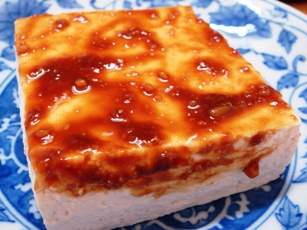
-Smear the whole tofu on every face with plenty of a mixture of miso, soy sauce and other ingredients of your choice. The more, the better.

-Wrap it carefully in cellophane paper and leave it in the fridge overnight.

-Take it out of the fridge and take off the cellophane paper.
-Let it dry for 2 hours at room temperature over a piece of kitchen paper.

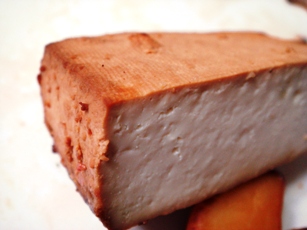
-Smoke inside a Chinese smoking set for 1 hour.

-Very practical for smoking small quantities!

-Here you are! Enjoy!

RECOMMENDED RELATED SITES:
Warren Bobrow
Bread + Butter
5 Star Foodie
Frank Fariello
Elinluv Tidbit Corner
Tokyo Terrace
Maison de Christina
Chrys Niles
Comestilblog
Greedy Girl
Bouchon For 2

Please check the new postings at:
sake, shochu and sushi

—————————————-
日本語のブログ
—————————————-
Cream Cheese Brownies

The Japanese have become extremely efficient at reproducing and improving on European/American (I mean the continents!) recipes when it comes to cakes and desserts.
Here is an example I found in my notes:

Crema Cheese Brownies!

INGREDIENTS: 20×20 cm square mold or a 23cm diameter round mold.

Cream Cheese Topping:
-Beaten egg: 1
-Cream cheese: 225 g
-Sugar: 50g
-Vanilla essence: 1 teaspoon

-Brownies
-Chocolate (for cakes and baking): 115 g
-Unsalted butter: 115 g
-Brown sugar: 150 g
-Beaten eggs: 2
-Light cake flour: 75 g
-Baking powder: 1 teaspoon

RECIPE:

-Butter/oil the inside of the mold and sprinkle with flour/line the mold with baking paper.
Sift and mix flour and baking powder together.
Pre-heat oven to 160 degrees Celsius (3725F)

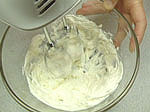
-Soften cream cheese inside microwave oven for 10 seconds and beat it just long enough as to obtain a smooth cream.

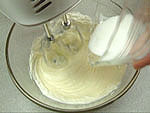
-Mix in te beaten egg, sugar and vanilla essence.
Set apart.

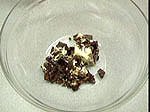
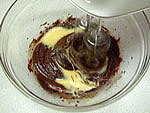
-In a separate bowl, drop the chocolate and butter and soften for 10 seconds inside a microwave oven. Take care not heat it too long, otherwise the chocolate will solidify.
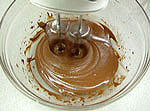
Mix well with a spatula.

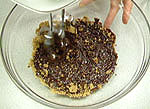
-Add brown sugar and mix well with electric mixer. Ad the 2 beaten eggs little by little and mix well.

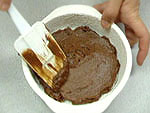
-With a spatula (no mixer, please!) fold in the flour and baking powder in three equal steps.

-Pour in the brownies mixture inside the mold (about 4 fifths of its depths) and smoothen surface with spatula.

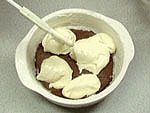
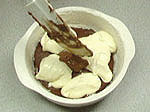
-First place the cream cheese into 4 parts on top as in picture.

-Spread each cheese cream “ball” around with the spatula.

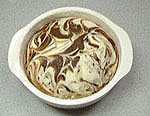
-Make “patterns” with a stick.

-Bake at 160 degrees Celsius (325F) for 25~30 minutes.
Let cool completely before taking out the cake.

RECOMMENDED RELATED SITES:
Bread + Butter, Zoy Zhang, Hungry Neko, Mangantayon, Elinluv Tidbit Corner, Maison de Christina, Chrys Niles, Lexi, Culinary Musings, Eats and Everything, One Frugal Foodie, Bite Me New England, Heather Sweet

——————————–
Please check the new postings at:
sake, shochu and sushi

—————————————-
日本語のブログ
—————————————-
Ramen: Tonkotsu Ramen-Professional Recipe

Here is the “professional Recipe for Tonkotsu Ramen as promised!

INGREDIENTS: (will provide 3.5 litres of soup, enough for quite a few servings!

-Pork bones: 5 (2500 g)
-Water: 13 litres

RECIPE:

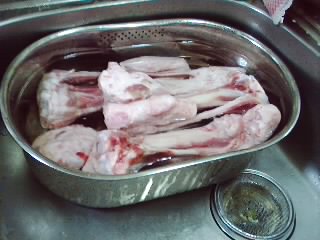
Bring frozen bones to room temperature in plenty of water.
It should take about 2 hours. If you cook frozen bones directly, the blood will solidify and will be very difficult to get rid of.
If you can get fresh bones, skip this step.

Fill a very large cooking pot with water and bring to boil.

Switch off fire as soon as the water boils. Drop in the bones and let cool. This process will help you get rid of the blood and blood vessels easily.

Leave it to cool down for 30~40 minutes.

Drain the water off the bones in a large strainer.
Throw off the water.
Check and take off any blood or blood vessels for the bones.
Don’t forget to clean the pot!
Break all the bones in two with a hammer.

Fill the pot again with clear water and bring to boil.
Drop the bones inside.

Keep cooking over a strong fire and scoop out foam and unwanted matters coming up on the surface (this should take 20 minutes at the most).
As the bottom might get hooter than near surface, stir with a large ladle from time to time.
If the inside of the pot over the water surface gets clogged with matter or gets dark, switch off fire, clean with a clean cloth and switch fire on again.

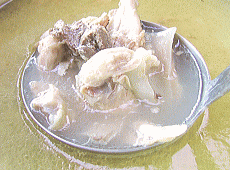
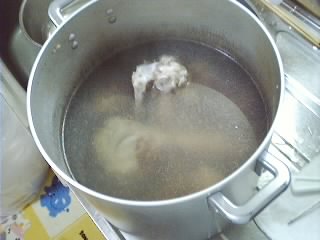
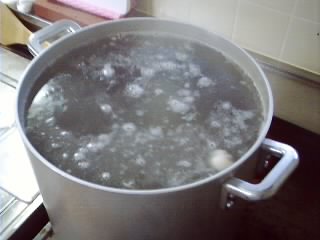
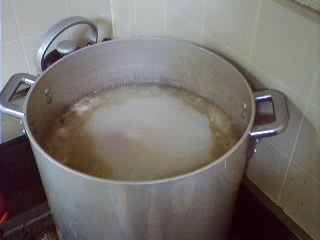
Above picture shows the soup after all unwanted matters have stopped coming up.

Cover with a lid and a weight to prevent steam coming out from under the lid. Keep simmering on a low fire.

That’s how it looks after 1 hour.
Keep cooking.

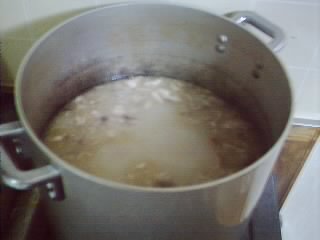
That’s how it looks after 3 hours.

That’s how it looks after 6 hours.

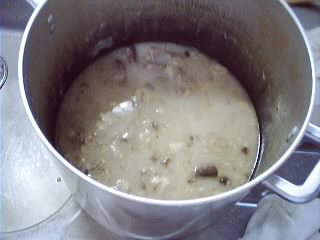
That’s how it looks after 10 hours.

And after 12 hours (start early in the morning!)!

Keep cooking. Remember you are aiming at 3.5 litres of soup.
After 12 hours you may raise the fire to accelerate the cooking.
Keep the lid on!

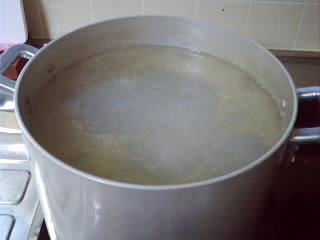
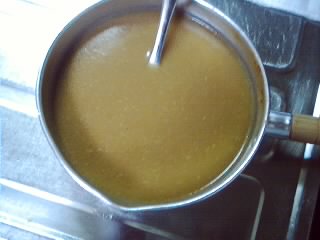
This is what you are looking for!

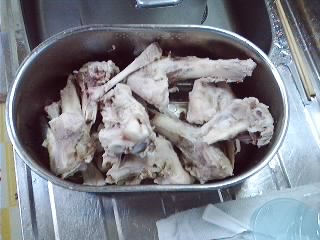
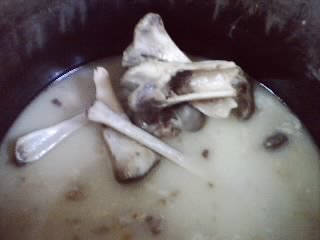
This is how the bones will look after 15 hours of cooking!
Cooked at last!

Filter the soup and here you have your tonkotsu base soup ready!
After that it is up to you and your preferences: add miso, tofu, salt, sesame oil, garlic chips and your little secrets!

Now what secret ingredients have I thrown in? LOL

RECOMMENDED RELATED SITES:
Bread + Butter, Comestilblog, Greedy Girl, Bouchon For 2, Zoy Zhang, Hungry Neko, Mangantayon, Elinluv Tidbit Corner, Maison de Christina, Chrys Niles, Lexi, Culinary Musings, Eats and Everything, Bite Me New England, Heather Sweet, Warren Bobrow, 5 Star Foodie, Frank Fariello, Oyster Culture, Ramendo, Alchemist Chef, Ochikeron, Mrs. Lavendula, The Gipsy Chef

Please check the new postings at:
sake, shochu and sushi

—————————————-
日本語のブログ
—————————————-