Tag Archives: 静岡

Vegan Japanese Cuisine: Aburaage & Spring Cabbage Rolls with Wasabi Sweet & Sour Dressing

Spring in Japan sees frsh and almost cabbages on the markets. These cabbages are so tender that they can eaten raw in many fashions!
Rolling them in aburaage/deep-fried tofu pouches is an excellent recipe for vegans and any priorities!
Wasabi is a local product in Shizuoka (80% of the total Japanese production) and is so valuable both for the extra zip and medicinal values!

Aburaage & Spring Cabbage Rolls with Wasabi Sweet & Sour Dressing

INGREDIENTS: For 4 rolls

-New (Spring) cabbage: 4 leaves
-Aburaage: 2
-Carrot: 70 g
-Water: 250 cc/ml
-Soy sauce: 1 tablespoon
-Japanese sake 1 tablespoon
-Mirin/Sweet sake: 1/2 tablespoon
-Dashi: 1/2 tablespoon (Check Vegan Dashi Recipe)
-Cornstarch: a little dissolved in water
-Wasabi: 1/2 teaspoon (grated)

RECIPE:

-Cut out the middle stringy core off the cabbage leaves. Wash them in clear cold water, taking care not to break them. Lay on a tray and cover with cellophane paper. Cook in a microwave oven for 3~4 minutes.

-Cut the carrot into thin 6 sticks in a length equal to that of the aburaage and 1 cm square thick. Lay on a tray, sprinkle with a little water and cook in icrowave oven for 2 minutes.

-Cut the aburaage in halves along their length and open.

-Drain the cabbage well and sponge off any water with kitchen paper.
Put two leaves each on top of each other and cut edges as to leave enough cabbage surface to be slightly wider than the aburaage.

-Lay the open aburaage on top of the cabbage leaves. Lay the carrot sticks on top of the aburaage from the inside edge. Roll the lot away from you with a firm hand. Keep aside.

-In a pan just large enough to contain two cabbage rolls drop in the water, Japanese sake, mirin and dashi. Heat and place the rolls inside “heads up”.

-Cover the whole with foil paper. Put the lid on top and food on a low fire for 10 minutes.

-Turn the cabbage rolls over and cook for 10 more minutes.

-Take the two rolls out and cut each into two equal halves. Place on a serving dish.

-Heat and check the taste of the soup and adjust if necessary. Add the wasabi and mix well.

-Add some cornstarch dissolved in water and stir until syrupy. Pour the sweet and sour wasabi dressing on the rolls. Topp with some chopped green leaves and serve.

RECOMMENDED RELATED SITES:
Warren Bobrow, Bread + Butter, Zoy Zhang, Hungry Neko, Think Twice, Frank Fariello, Mangantayon, Hapabento, Elinluv Tidbit Corner, Tokyo Terrace, Maison de Christina, Chrys Niles,Lexi, Culinary Musings, Wheeling Gourmet, Comestiblog, Chronicles Of A Curious Cook, Tokyo Through The Drinking Glass, Tokyo Foodcast, Palate To Pen, Yellin Yakimono Gallery, Tokyo Terrace, Hilah Cooking, More than a Mount Full, Arkonite Bento, Happy Little Bento; 5 Star Foodie; Jefferson’s Table; Oyster Culture; Gourmet Fury; Island Vittles; Good Beer & Country Boys; Rubber Slippers In Italy; Color Food Daidokoro/Osaka;; The Witchy Kitchen; Citron Et Vanille, Lunsj Med Buffet/Estonian Gastronomy (English), Cook, Eat, Play, Repeat

Please check the new postings at:
sake, shochu and sushi

Bryan Baird’s Newsletter (2010/06/11)

Baird Beer & Taproom Events Bulletin
bryan-sayuri.gif

Rainy Season Black Ale; World Cup Soccer; Fish Tap 10-Year Extravaganza

Dear Taproom Friend & Baird Beer Enthusiast:

The 2010 rainy season is right upon us. Given the amount of rainy weather we experienced this spring, though — particularly in the early stages, I am not anticipating an overly downcast season. I am a brewer and not a weather forecaster, of course, and the rainy season means just one thing to me as a professional — the annual brewing and release of a very hoppy dark ale: Rainy Season Black Ale.

New Seasonal Baird Beer Releases:
*Rainy Season Black Ale 2010 (ABV 6.1%):

A torrential down-pouring of hops define this otherwise roasty, toasty, espresso-like powerful black ale. 55 BUs of clean American (Warrior, Magnum, Horizon, Glacier, Santiam) lupulin as well as dry-hopped character from the spicy-peppery combination of Glacier and Santiam coat the tongue with a resinous stickiness that is pungently pleasurable. This is the Baird Beer antidote to the rainy season funk.

Rainy Season Black Ale 2010 will be available in both draught and bottle (633 ml) form throughout Japan at pubs, restaurants and liquor shops that constitute our wonderful and growing network of Baird Beer retailers. Check out the expanding list of Baird Beer retailers on the retailer’s page of our website: http://bairdbeer.com/en/bairdbeer/retailers. Of course, Each of our own Taproom pubs will be pouring Rainy Season Black Ale also, and individual consumers can order online direct from the brewery via our website E-Shop: http://bairdbeer.com/en/shop/.

*Setting Sun ESB (ABV 5.2%):

In case of much sun and fair skies this rainy season, we have prepared a beery complement to that also in the form of and English-style Extra Special Bitter (ESB). We concoct this quintessentially English style ale, however, with our own irreverent twists: addition of German base malt (Munich), hopping with a combination of American (Cascade) and New Zealand (Hallertau Aroma) varieties, and fermentation with an American ale yeast. If you want to ponder a beautiful early summer sunset with contemplative bliss, this ale will get you there.

Setting Sun ESB will be pouring exclusively in Real Ale form from the hand pumps of our three Taproom pubs. Please stop in for a pint while quantities last.

World Cup Soccer Kicks Off at the Taproom Pubs:
The soccer World Cup is about to kick off and we will be showing games live and with sound at each of our Taproom pubs. Just as beer is best imbibed in a socially convivial setting, so too is soccer best viewed. Our Numazu Fishmarket Taproom will be staying open late to show 11:00 pm kick-off matches in their entirety. Please feel free to contact any one of our Taproom pubs regarding the World Cup viewing schedule or to make special group reservations and/or requests.

-Numazu Fishmarket Taproom: fishmarket-tap@bairdbeer.com

-Nakameguro Taproom: nakameguro-tap@bairdbeer.com

-Harajuku Taproom: harajuku-tap@bairdbeer.com

Numazu Fishmarket Taproom 10-Year Anniversary Extravaganza:
Sayuri and I opened the doors of our Numazu Fishmarket Taproom on Saturday, July 20, 2000. This July, then, is our 10-year birthday and we intend to celebrate in vigorous style. Please mark your calendar for the three-day holiday weekend of July 17-19 (Saturday – Monday). This 3-day anniversary celebration will feature the following (with the Fishmarket Taproom opening each of these days at noon sharp):

Debut Release of a special commemorative Baird Beer: Tap 10.
Delicious 1,500 yen all-you-can-eat Taproom buffet (Sat & Sun: noon – 9:00 pm; Mon: noon – 7:00 pm)
500 yen Baird Beer bura bura cups for all beer styles sold at each venue
Brewery BBQ & Open House (1:00 – 6:00 pm Sat & Sun at the brewery — 500 meters from the Taproom)
Taproom sidewalk BBQ (3:00 – 8:00 pm Sat & Sun; 1:00 – 5:00 pm Mon)
Guided Brewery tours on Monday (1:00 pm and 4:00 pm)
Live Taproom music (Sat 9:00 – 11:00 pm; Mon 7:00 – 9:00 pm)
Open Mic Night performances (Sun 8:00 – 10:00 pm)
Numazu is at its best in the summer months. The surrounding beaches are lovely; fishing, hiking and other activities are aplenty; and fresh fish market sushi beckons. Most compelling of all, though, will be the extraordinary gathering of an eclectic mix of wonderful beer enthusiasts who have made the 10-year journey of the Fishmarket Taproom and Baird Beer possible. The Baird Beer won’t be bad either!

Cheers,

Bryan Baird

Baird Brewing Company
Numazu, Japan
HOMEPAGE


The Japan Blog List

———————————
Must-see tasting websites:
-Sake: Tokyo Through The Drinking Glass, Tokyo Foodcast, Urban Sake, Sake World
-Wine: Palate To Pen, Warren Bobrow, Cellar Tours, Ancient Fire Wines Blog
-Beer: Good Beer & Country Boys, Another Pint, Please!
-Japanese Pottery to enjoy your favourite drinks: Yellin Yakimono Gallery
——————————–
Please check the new postings at:
sake, shochu and sushi

—————————————-
日本語のブログ
—————————————-

Tofu Recipes Compilation

PREPARATION

zarudofu
“Zarudofu”, my favourite variety of tofu just filtered out in a “zaru/basket”. You just eat it with a spoon on its own. No seasoning needed!

As promised, here is the first posting about tofu.
This article concerns the home-making of it.
The next article will introduce different kinds of tofu and recipes!

Ingredients (for one large piece, one cho/丁in Japanese)

Soy beans: 2 cups (360cc)
Nigari: 2 large tablespoons
(Magnesium chloride is an important coagulant used in the preparation of tofu from soy milk. In Japan it is sold as nigari (the term is derived from the Japanese word for “bitter”), a white powder produced from seawater after the sodium chloride has been removed, and the water evaporated. In China it is called “lushui”.. Nigari or Lushui consists mostly of magnesium chloride, with some magnesium sulfate and other trace elements. It is also an ingredient in baby formula milk).
Water: 5 cups (twice and a half the volume of soy beans)

Utensils:
One large pot
One large clean cloth pouch to press tofu through
One bowl
One mixer
One thermometer
One large piece of gauze to filter water off shaped tofu
One large wooden spoon
One wooden tofu-shaper case

RECIPE:
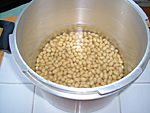
toofu-1
1) Preparation: soak soy beans in water overnight

toofu2
2) Preparation: Mix nigari with 1 cup of water and set aside
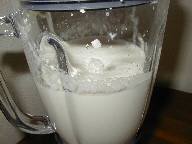
toofu-3
3) According to its size, Pour the whole or part by part soy beans and water (1) and make paste as fine as possible. If mixer runs at an even pace without crushing beans into paste, add more water. The paste obtained is called “namago” (生呉)

toofu-4
4) Pour the bean paste into a large pot with an equal amount of water. Heat stirring all the time. The paste will come to a boil suddenly. Switch off fire. Switch on low once the paste has settled for 10 minutes and take off fire.
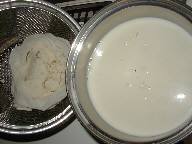
toofu-5
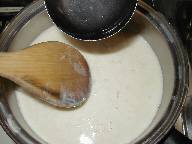
5) Pour paste into the cloth pouch and press. Right of the picture is tofu paste before pressing. Left is pressed out tofu
toofu-6
6) Solidifying (coagulating) with nigari.
Stir tofu over light fire. When the temperature has reached 75~80 degrees Celsius pour in nigari slowly and stir all the time. The solid matter will sink to the bottom and accumulate. The coagulation will be complete when liquid above tofu has become transparent. Stop the operation and let rest for 15 minutes.

toofu-7
7) Arrange the gauze inside tofu a tofu shaper case which should have small holes to let excess water run out.

toofu-8
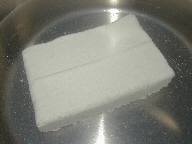
8) Cover with lid with a weight (or glass of water) of about 250 g and further press out water for 15 minutes
toofu-9
9) Delicately empty tofu in basin filled with called water and leave it there for an hour to take out excess nigari. Store in refrigerator.

————————

VARIETIES

zarudofu
“Zarudofu”, my favourite variety of tofu just filtered out in a “zaru/basket”. You just eat it with a spoon on its own. No seasoning needed!

This is the second article dedicated to some of the many varieties of that celebrated food, tofu. A third article is in preparation as for recipes!
tofu-kinds-10
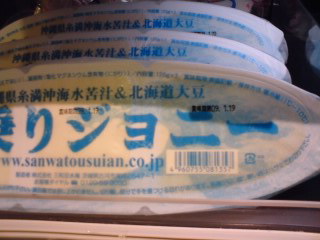
Okinawa Tofu

Tofu comes in various degrees of firmness.
The softest are “Zaru dofu” (see pic above) and Okinawa-style tofu.
tofu-kinds-7
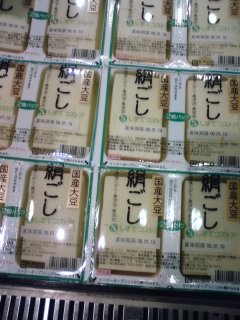
“Kinu Goshi Tofu”

Next come “Kinu Tofu/Kinu Goshi Tofu”/Silk-sieved tofu. It can be used for almost any recipe, although you might have to press it as it contains a lot of water.

tofu-kinds-9
“On Tofu”

“On Tofu” is similar to “Kinu tofu”, but it has been conceived as it its name indicates for being eaten hot or warm instead of cold.
tofu-kinds-6
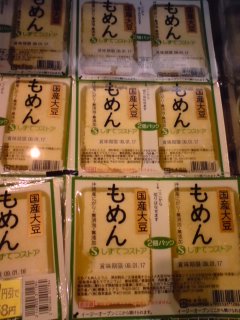
“Momen Tofu”

“Momen Tofu”/”Wool Tofu” contains less water, is firmer and is perfect for “Nabe/Japanese Pot-au-feu”.

tofu-kinds-8
“Yaki Tofu”

“Yaki Tofu/Grilled tofu” (not to be confused with deep-fried tofu) is usually “Momen tofu” grilled to give it the “gratine” look. Tasty, it is particularly interesting when sauteed with vegetables and so forth in Japanese, Chinese, Korean or Thai food.
tofu-kinds-1
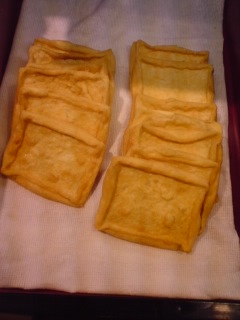
“Yawarakaage or Yawarakai Aburaage”

Tofu can be bought cooked/deep-fried in many manners.
“Yawarakaage” is tofu deep-fried into a thin sheet which can be opened as a pouch like in:
inari-tofu
“Inari”

“Inari” is “Yawarakaage”, which has been first marinated in mirin, soy Sauce and sugar. Do ask about its preparation as some companies or individuals add dashi, which is usually not vegan or vegetarian!

tofu-kinds-2
“Namaage”

“Karaage Tofu/Deep-fried Tofu” comes in many forms.
The above “Namaage/Deep-fried raw” is the most common.
tofu-kinds-3
“Kinu Namaage”

“Kinu namaage” is great for the contrast between a solid outside and vey soft inside.
tofu-kinds-4
“Ganmo” and “Kyo-Ganmo”

“Ganmo” is Tofu that has pressed to almost dry, then broken into very small lumps to which one added cooked carrots, Hijiki sweet seaweed, grated yam, a little sugar (not always), shaped into a ball and lightly deep-fried. Great, heated again with vegetables and a swet and sour sauce, or in whatever recipe you might imagine. “Kyo-Ganmo” is the smaller Kyoto-Style variety. Ganmo should be made exclusively with vegetal matter, but do ask if you are not sure!

tofu-kinds-5
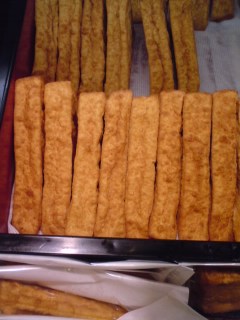
“Tofu Doughnuts”

Yes, you have read it, “Tofu Doughnuts”, very popular with kids!

Other varieties:
-“Okara” is hard-pressed, almost dry tofu sold broken into very small lumps.
-“Yuba” is the “skin” appearing on top of the pan when tofu is being prepared. Very popular served cold with all kinds of ingredients.
-“Koya” is hard-pressed tofu sold marinated. Now, as it contains fish stock dashi, it is not suitable to vegans or vegetarians.
-“Kuro goma tofu” or “Shiro goma tofu” (Black and white sesame curd) are not made with soy beans but sesame, although they make for great food for vegans and vegetarians.

There are many other “fancy” varieties, but I cannot guarantee their suitability to vegans or vegetarians!

Enjoy!
—————————–
Koyadofu/Pressed Tofu Recipe
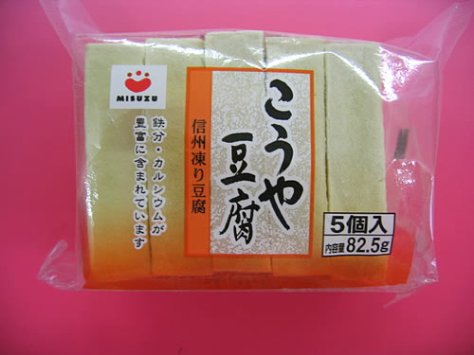
As promised here is the basic recipe to make Koyadofu/高野豆腐 or pressed tofu.
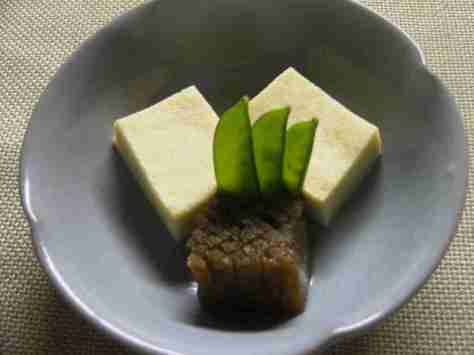
Koyadofu is extensively used in veganand vegetarian food in Japan.
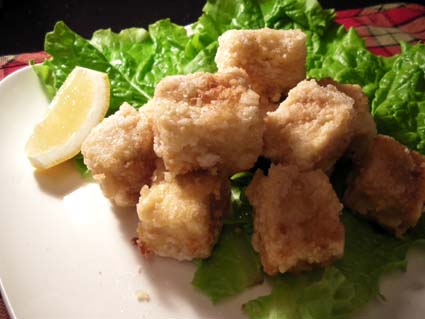
It can also be deep-fried into great crunchy morsels!

INGREDIENTS:

-Tofu: 1 block/400 g (actually it is up to you!)

RECIPE:
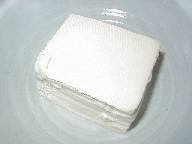
-Place the tofu in a plate/bowl and let rest there for 10 minutes.  Throw away the water that comes out naturally. Cut the tofu into 3 “slices” across the width. You may skip that step and proceed with whole block.
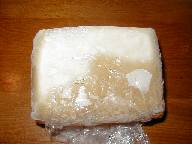
-Wrap the tofu into cellophane paper and freeze the tofu inside the freezer of your refrigerator.
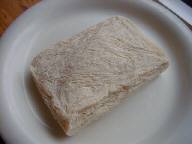
-Will be ready once completely frozen.
The trick is to press water out of the tofu once you have thawn it.
The tofu will have taken its colour and consistency naturally.
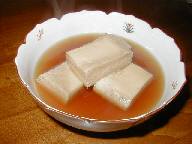
Recipe suggestion:

Prepare a stock soup with 1 cup of seaweed dashi/soup stock, 2 tablespoons of sugar, a little salt, 1 and a half teaspoons of mirin/sweet sake, and 1 and a half teaspoons of soy sauce.
Cook the koyadofu in it and serve once soft enough.
————————–
Natto Mabodofu!
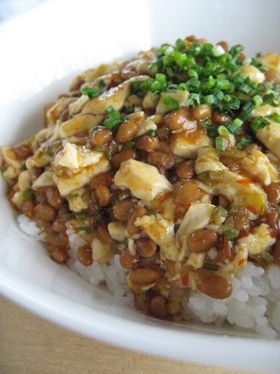
Mabodofu in Japanese or Mapo Doufu in Chinese Mapo doufu, is a popular Chinese dish from the Sichuan (Szechuan) province. It is a combination of tofu (bean curd) set in a spicy chili- and bean-based sauce, typically a thin, oily, and bright red suspension, and often topped with minced meat, usually pork or beef. Variations exist with other ingredients such as water chestnuts, onions, other vegetables, or wood ear fungus, but these are rarely considered authentic Sichuanese.

The Japanese sometimes combine it with natto to create a vegan recipe!

Natto Mabodoofu!

INGREDIENTS: For 2~ people

-Natto: 2 standard packs
-Tofu (silk to fu): 1 standard block/300~400 g
-Leek: 1/2 finely chpped
-Fresh ginger: 3×3 cm cube, finely chopped
-Garlic: 1 clove, finely chopped
-Salad oil or seasme oil: as appropriate
-Soy sauce: 1 tablespoon
-Mirin/Sweet sake: 1 tablespoon
-Japanese sake: 1 tablespoon
-Doubanjiang/豆板醤: 1 tablespoon
-Shichuan pepper (if a vailable): a little

RECIPE:

-Mix the natto with its tare/sauce. If tare is not provided, mix it with 2 tablespoons of soy sauce. Press water out of tofu. Cut tofu into small pieces (size of the pieces is up to your preference actually!).

-In a bowl mix soy sauce, Japanese, mirin and Doubanjiang into seasoning sauce. Set apart.

-Heat oil in a frypan. Throw in the chopped leek, ginger and garlic. Stir fry for a while.

-Once the leek have become half transparent throw in natto and the seasoning sauce. Mix and heat quickly for a short while.

-Add tofu, Fry until natto has mixed with tofu.

-If there is not enough water to your preference, add some hot (not cold!) water. Sprinkle with Shichuan pepper and serve atop freshly steamed plain rice!
————————-
Vegan Natto & Aburage Tofu

Tofu and natto are both made from soy beans and can be easily combined into vegan recipes!

Natto & Aburage Tofu!
If you have any problems with quantities, look at pics or experiment!

INGREDIENTS: For 2 people

-Abrage/deep-fried tofu: 1 standard pack/2 blocks
-Natto: 1/2 standard pack
-Natto tare/sauce/dresing (sold with pack): as appropriate
-Miso: 2 tablespoons
-Leek: 1/2 chopped
-Soy sauce: as appropriate

RECIPE:
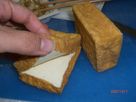
-Sponge water the oil and humidity off the aburage with some kitchen apaper. Cut through as to be able to open and stuff the tofu. The best method is to cut at an angle as shown in above picture, leaving half closed. Actually, you had better experiment, although you must keep in mind that the tofu should not be completely cut!
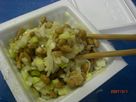
-Add some chopped leeks and the tare/sauce to the natto and stir until sticky. Add remaing chopped leeks and stir well.
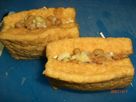
-Paste the inside of the tofu with miso. Use a spoon. Stuff each tofu block with half of the natto. Secure with a toothpick.
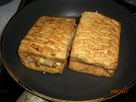
-Fry until tofu attains a nice toast colour. No need to use oil!
You can also grill inthe toaster!
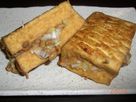
-Cut to size of your preference or serve it whole. Provide soy sauce for more seasoning if needed.
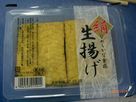
-Aburage as sold packed in Japan, although you will find them freshly made at any good large supermarket here!
——————–
Vegan Edamame Tofu
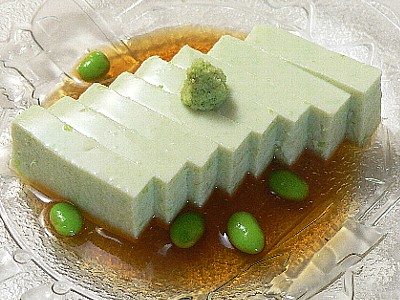
This is the season for fresh edamame and there are so many ways to accomodate them!
Have you ever thought of creating a vegan recipe with them and tofu.
Here is a simple way to please everyone!

Vegan Edamame Tofu!

INGREDIENTS: For about 6 people, unless you have a big appetite!

-Kinu Tofu/Silk Tofu: 400 g
-Edamame: 1 cup (boiled in salted water and extracted from their pods)
-Agar agar: 8g
-Water: 385 CC/about 2 cups
-Salt: 1/2 teaspoon
-Mirin/sweet sake: 1 tablespoon

-Vegan konbu dashi/seaweed soupstock: Check RECIPE: 1 cup/200 cc/ml
-Mirin/sweet sake: 3 tablespoons
-Soy sauce: 3 tablespoons
-Grated wasabi: as appropriate

RECIPE:
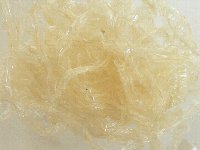
-Soak the agar agar in the water for at least two hours or overnight.
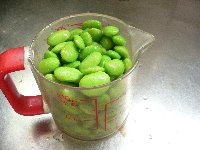
-Peel off the thin skin of each edamame. Borin work, I must admit, but worth it!

-Place the tofu over a bamboo strainer/zaru to take as much water off as possible.
Press the agar agar strongly to drain it of any water.
Drop the agar agra in 400 cc of water and simmer on a weak fire until completely dissolved.
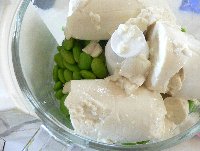
-Drop the edamame, tofu, salt and mirin in a mixer/food processor.
Turn until you attain a smooth paste.
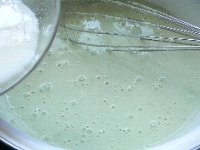
-In a large bowl pour the tofu mixture and add the dissolved agar agar a lttle at a time and mix well until all has been incorporated.
Pour the whole into a rectangular mold you will have wetted beforehand.

-Smooth the surface flat with a gum spatula. Knock down the mold on the working table a few times to ensure homogeneousity.
Let cool and place inside refrigerator.
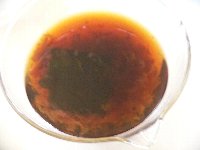
-Mix the dashi, soy sauce and mirin/sweet sake.
Heat to just before boiling point. Switch off fire and let cool completely.
Keep in thefridge.
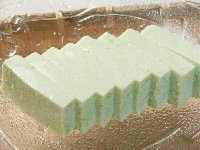
-Turn the edamame to fu over a cutting board.
Cut into 8 pieces and place them on serving dish as shown above.
Pour dashi drssing around it.
Decorate with a few edamame and some grated wasabi.

Enjoy!
———————-
Tofu & Vegetable Juice Cake
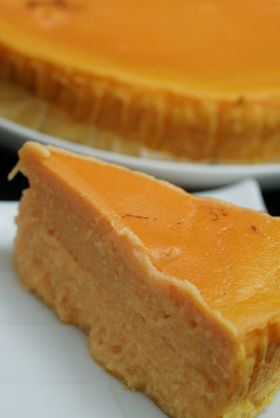
The great thing about tofu is that you can devise simple and yummy food with few ingredients and little money!

Here is a simple recipe for a healthy cake for adults and children”

Tofu & Vegetable Juice Cake!

INGREDIENTS: For an 18 cm wide mold

-Real 100% vegetable juice: 400 g
-Tofu (Silk tofu): 300 g
-Sugar: 50~80 g
-All-purpose flour: 100 g
-Eggs: 2

RECIPE:
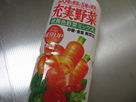
-Pre-heat oven to 180 degrees Celsius
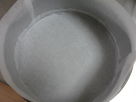
-Line the mold with an oven baking paper sheet.

-Drop the vegetable juice, tofu, sugar and eggs in a food processor. Mix until smooth.
Add flower and mix again until smooth.
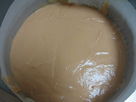
-Pour the lot into the oven mold and bake at 180 degrees Celsius for 30~40 minutes.
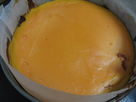
-Let cool completely.

-Take out the mold and place on a serving dish. Chill it properly inside the refrigerator.
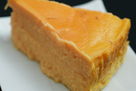
-Cut to size and serve.

-Decorate it with chatilly (beaten cream) cream.

-You can experiment with the taste with liqueurs and so on!

Easy, ain’t it?
————————-
Vegan Japanese Cuisine: Yuki Nabe/Tofu Pot au feu
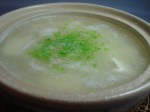
The Japanese have a very simple and healthy tofu recipe called Yuki Nabe/雪鍋 (“Snow Pot) which can be loosely translated as Tofu Pot Au Feu.
By just adapting the dashi soupstock to a vegan seaweed dashi, vegans and vegetarian can enjoy it!

Before reading the ingredients, check:
Vegan Japanese dashi soupstock recipe

INGREDIENTS: For 5 people

Tofu/Kinudofu/Silk tofu: count 1 block per person (1 block is about 300~400 g)
-Freshly grated daikon: 2 cups/400 cc
-Salt: 2 teaspoons
-Dashi: 5 cups/1000 cc
-Mitsuba/Trefoil/Japanese Honeywort: 1/2 cup/100 cc (Chopped). (if unavailable use fresh coriander or thin leeks, although the taste will be a lot stronger. Chopped shiso is fine, too)

RECIPE:

-Lightly press grated daikon to take out excess water.

-In a large Japanese nabe/pot (earthenware pot) pour the dashi/soupstock.

-Heat over a medium fire. Once the dashi starts boiling add the freshly garted daikon. Once it starts boiling again add the tofu cut into fairly bite-sized pieces.

-When it starts boiling again, lower the fire to very low and add the mitsuba and salt (if needed).

-Ask the guests to seve themselves with a ladle into individual bowls. Eat with a Chinese soup spoon (“renge” in Japanese).

-Have some grated lime skin, grated fresh ginger and even grated wasabi ready in small dishes for adults wishing for some more zip!

———————-
VEGAN TOFU CURRY

As I said before, Koyadofu is one kind of tofu that can beasily arranged into all kinds of interesting appetizers in Japanese Homes’ Gastronomy!
Here is a simple suggestsion for a yummy lunch to be eaten by all, vegans, vegetarians aor omnivores:

Vegan (Japanese) Tofu Curry!

INGREDIENTS: For 4 people

-Koyadofu: 5 sheets/85 g
-Carrot: 1 medium
-Onion: 1 medium
-Potato: 1 medium
-Shiitake mushrooms: 10 small
-Green peas: the equivalent of 1 small can/60 g
-Curyr powder (of your preference): 1~ tablespoon (I would use 2)
-Soy sauce: 2/3 tablepsoon
-Garan masala powder: 1/2 teaspoon

-Salad oil

-Steamed rice: count a large bowl per person

RECIPE:

-Cut the koyadofu into small bits and let them (if dry) soak in lukewram water until they get soft. Press the water out of them and keep in separate bowl. Finely chop the carrot, onion, potato, and shiitake mushroom. Keep in separate bowl. boil the green peas beforehand if necessary.

-Fry all choped vegetables in salad oil for a while until the onions become translucent.

-Add some water and bring to boil. Remove any unwanted matter if necessary. Add chopped koyadofu. Cook until carrot are sufficently soft. Switch off fire. Add curry powder and mix quickly. Add soy sauce and garam masala and mix quickly. Switch on the fire and cook over small fire until you are satisfied withe the consistency of the whole.

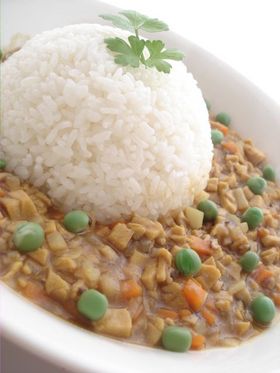
On a dish turn over a bowl of rice and surround it like in the toppicture with curry to which you add the green peas at the last second (on directly “seeded” over it) for good effect.

————————-
Koyadofu Cheese & Bacon Rolls
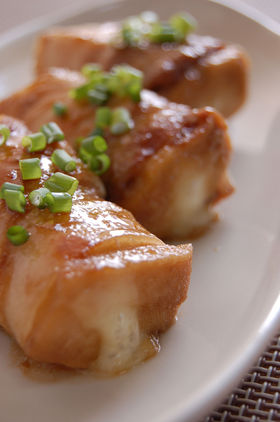
Koyadofu is one kind of tofu that can beasily arranged into all kinds of interesting appetizers in Japanese Homes’ Gastronomy!
Here is a simple suggetsion for yummy snack to be eaten by all, and with a good beer for adults!

Koyadofu Cheese & Bacon Rolls

INGREDIENTS: For 8 rolls

-Koyadofu: 4 sheets or 80 g
-Sliced cheese: 2
-Flour: as appropriate
-Thin pork belly slices: 8
-Salad oil a little

SAUCE:
-Dashi/Japanese soup stock (if unavailable use bouillon of your choice): 1 cup/200ml/cc
-Soy sauce: 2 tablespoons
-Mirin/sweet Japanese sake: 2 tablespoons
-Sugar: 1 tablespoon

RECIPE:
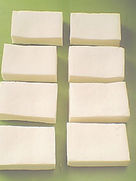
-Soften the koyadofu into lukewarm water. Press water out firmly.
Cut each “sheet” into identical halves
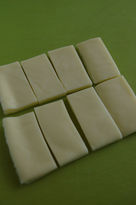
-Cut the sliced cheese into 4 identical parts.
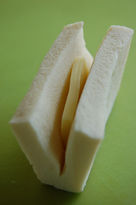
-Cut the koyadofu as shown in picture through 4 fifths of it depth. Insert a pice of sliced cheese inside the cut.
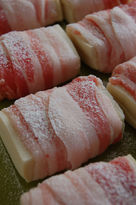
-Roll the koyadofu “sandwich” inside a slice of pork belly and sprinkle with flour.

-Heat some oil in frying pan. Place the rolls together with their “tails” down. Cover with glass lid and cook over medium fire until the meat is conpletely cooked and attained a nice colour.
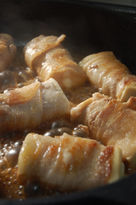
-Add the sauce ingredients and cook turning the rolls 2 or 3 times until the juices have practically disappeare/evaporated.

-Serve on a plate with some chopped thin leeks and if desired sprinkle with a little chili pepper!

———————–
TOFU CHAWAN MUSHI

Here is another simple tofu recipe you can either serve hot (great in winter) or chilled, although I would go for the former.
Chawan Mushi/Chyawanmushi/茶碗蒸し is a Japanese way to steam a flan/pudding that is not sweet. It makes for great appetizers or full meals if served aplenty.
Great for kids and waistline-conscious people!

Tofu Chawan Mushi!

INGREDIENTS: For 4 ramequins/cups

-Tofu: 1 cup:200 cc/ml (untreated, light type)
-Eggs: 3 medium-sized ones
-Egg yolk: 1
-Dashi (fish or seaweed): 1/2 cup/100cc/ml
-Salt: 1/2 teaspoon
-Soy sauce: 1 teaspoon
-Mirin/sweet sake: 2 teaspoons
-Chicken soup stock: 50 cc/ml
-Water or dashi: 150 cc/ml
-Cornstarch: 1/2 tablespoon
-Water: 1 tablespoon
-Grated fresh ginger (or yuzu kosho): enough for decoration and taste

RECIPE:
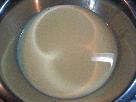
In a bowl beat the eggs and egg yolk. Add tofu, dashi, salt, soy sauce and mirin. Mix well with an electric whisker. Pass through a thin sieve/chinois. Pour mixture inside ramequins/cups.
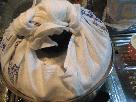
You can either steam it in a steamer or cook in a bain-marie. Or proceed as shown in picture above. Once the water has ben brought to boil, switch down heat to low and steam for 12~15 minutes.
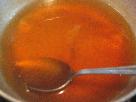
While you are steamig the tofu chawan prepare the topping sauce. In a pan pour the soup stock and water/dashi. Bring to boil. Mix cornstarch and water, and add it little by little to soup until you have reache da satisfying consistency.

Check if the tofu chawan mushi is well cooked. Pour sauce over each cup. Serve with a little lump of grated fresh ginger. Serving with chopped thin leeks also makes for good combination in looks and taste. One can also season the sauce according to one’s taste and priorities!
——————————
VEGAN TOFU CUISINE: AGEDASHI TOFU
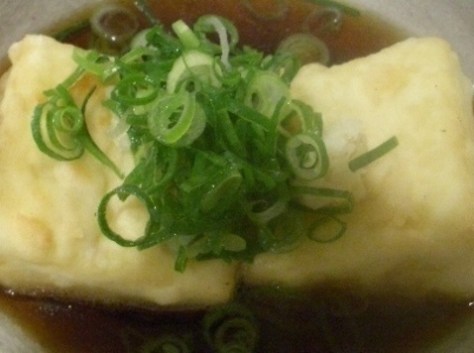
“Agedashidofu” or (Tofu first deep-fried, then served with dashi soup” is a very popular Japanese dish that can easily be adapted to fit vegetarian and vegan priorities!
Moreover, whatever dashi/soup is left can be poured onto a bowl of freshly staemed rice for a fillingand healthy suppelementary dish!

Vegan Agedashidofu!

INGREDIENTS: For 2 people

-Tofu (momen tofu) 1/2 a large piece (can of course be increased!)
-flour: 1 tablespoon (whatever flour as this could add an interesting variation!)
-Cornstarch: 1 tablespoon
-Oil for deep-frying
-Freshly grated daikon (to taste)
-Thinly chopped leek (to taste)

-Dashi (konbu/seawed dashi): 100 ml
-Soy sauce: 2 tablespoons
-Mirin/sweet sake:2 tablepoons

-You may add spices of your choice, especially grated ginger and hot chili powder!

RECIPE:

1. Press as much water out the tofu as possible. Cut the tofu into large pieces. Take as much as humidity off their surface by wrapping inside a clean cloth for a while. Mix the flour and cornstarch.
Roll the tofu pieces into the flour and cornstarch so as to cover all sides. If you don’t have enough flour/cornstarch, prepare more.

Drop in deep-frying oil at 170 degrees.

2. Prepare the dashi soup by heating the konbu dashi with the soy sauce and mirin (and extra spices if wanted).

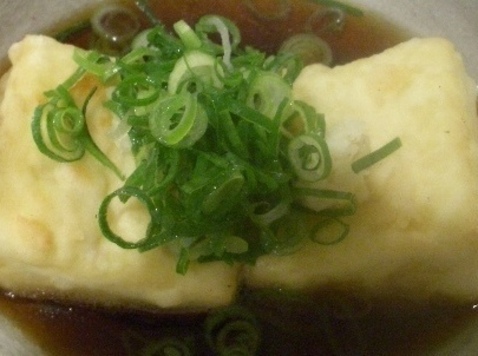
3. Pour the dashi in individaul dishes. Place fried tofu in the middle. Top tofu with freshly grated daikon and chopped leek.

SUGGESTION:

Boil some cut mushrooms in the dashi before serving them together with the tofu!

Easy and healthy, isn’t it?
————
TOFU CHOCOLATE CAKE
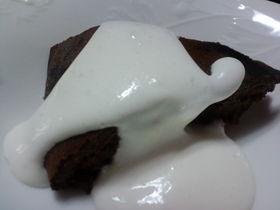
As I said before, tofu has the great quality that it makes all things lighter, especially cakes.
have you ever thought of combining it with Chocolate?

Tofu Chocolate Cake!

INGREDIENTS:

-Light flour: 80 g
-Baking powder: 10 g
-Cooking chocolate or normal chocolate (the higher percentage in cocoa, the better!): 1 standard tablet/bar
-Eggs: 2
-Margarine or butter: 1 tablespoon
-Cocoa powder: 20 g
-Rum: to taste
-Tofu (light/kinu tofu): 300 g
-Sugar: to taste (depends on people!)

-Fresh cream: 100 ml
-Jam: 1 tablespoon

RECIPE:
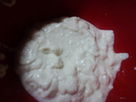
-Whip the tofu until smooth. Pass it through a fine mesh sieve.
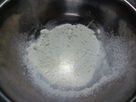
In a separate bowl pass the flour and baking powder through a fine mesh sieve.
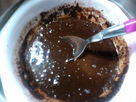
-Melt margarine/butter and chocolate on a bain-marie (put the bowl inside a larger one over a fire. Add 50 ml of hot water and the coca powder. Keep mixing until misture thickens.

-Separate egg yolks and whites. Beat the whites in to solid meringue.
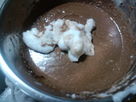
-Add flour and baking powder, egg yolks, rum and sugar to chocolate mixture. Mix well. Fold in the egg whites in.
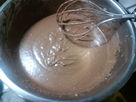
-Check taste. Add flour and cocoa powder if necessary. mix in quickly.

-Line your rice-cooker with a little oil. Pour in the whole mix and switch on the rice-cooker. If you do not have a rice cooker, pour the mixture inside a mold and bake for about 20~25 minutes at 180 degrees Celsius (check from time to time).

-Wait until cooled down completely before taking out.Serve with whiiped cream mixed wit a little jam of your choice. Plenty of variations possible!
———————–
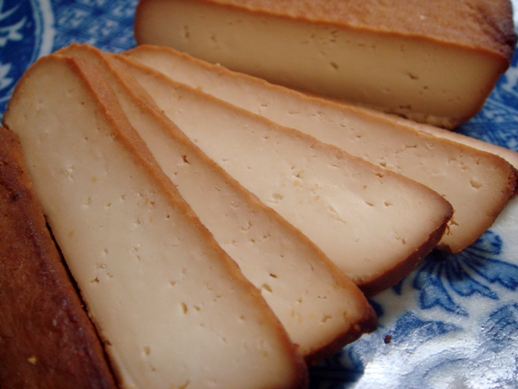
VEGAN SMOKED TOFU

It is sometimes a hard world for vegans when it comes to find new ideas and recipes, even you love tofu!
Here is a simple way to prepare and enjoy tofu as it was a big piece of cheese!

Vegan Smoked Tofu!

INGREDIENTS: for ? People

-Tofu: a large piece 300~400g or more
-Miso of your liking, as much as you wish
-Soy sauce, not too much (beware the salt)
-Sake or mirin, a little just for the taste
-Spices, if you wish!

RECIPE:

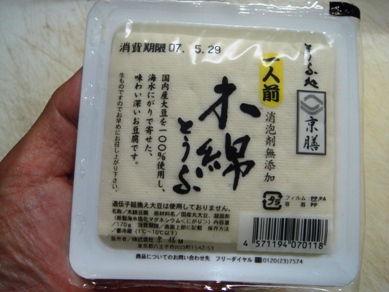
-As the tofu shouldn’t be too soft, choose “momendofu”, or slightly solid.
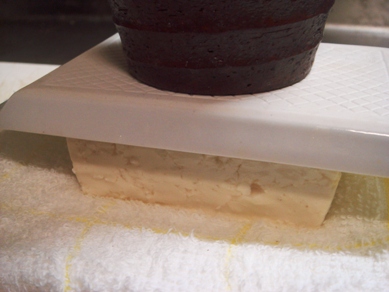
-Place the tofu on a clean cloth.
-Top it with a clean plate or board.
-Put a heavy weight on top.
-Leave it like this for half a day. The tofu will reduce to half.
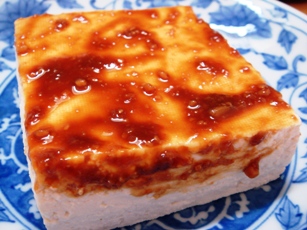
-Smear the whole tofu on every face with plenty of a mixture of miso, soy sauce and other ingredients of your choice. The more, the better.
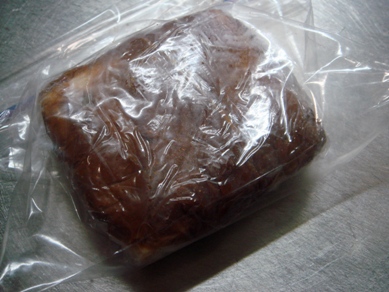
-Wrap it carefully in cellophane paper and leave it in the fridge overnight.

-Take it out of the fridge and take off the cellophane paper.
-Let it dry for 2 hours at room temperature over a piece of kitchen paper.

-Smoke inside a Chinese smoking set for 1 hour.

-Very practical for smoking small quantities!
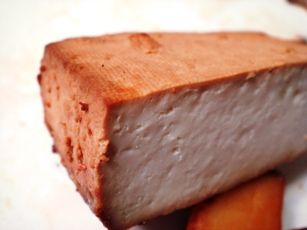
-Here you are! Enjoy!
———————–
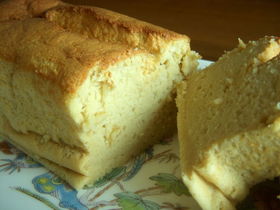
TOFU POUND CAKE

Tofu has the great quality that it makes all things lighter, especially cakes.
Have you ever thought of making a pound cake with it (with a twist added!)?

Tofu Pound Cake!

INGREDIENTS: For a cake 16.5 cm long and a square cut of 7 cm sides

-Egg whites: 2
-Egg yolks: 2
-Sugar: 30 g
-Tofu (after taking some of its water off): 120 g
-Honey (liquid): 2 tablespoons
-All-purpose flour: 50 g
-Baking powder: half a teaspoon
-Soy sauce: 1 teaspoon
-Mirin/sweet sake: 1 tablespoon
-Milk: 2 tablespoons

RECIPE:

-Mix flour and baking powder well.
-Preheat oven to 180 degrees Celsius
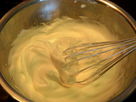
-In a bowl drop the egg whites with half of the sugar. Beat until solid. Beat 30 more times with a whisk.

-In a separate bowl drop in the tofu, rest of the sugar and egg yolks. Beat with a whisker until smooth. Do not mix too much!

-Add honey, soy sauce, mirin and milk in that order to the egg yols mixture and mix in one each at a time.
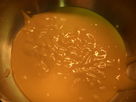
-Add and mix in the flour and baking powder mixture little by little with a spatula.
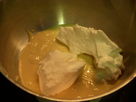
-Add the meringue (beaten egg whites) by folding them in with a spatula in 2 or three sessions.

-Line the mold with baking paper and pour in the whole mixture.
Bake for 40 minutes (the picture above shows the cake baked after 10 minutes)

-Leave the cake inside the oven for 10 more minutes after the oven has switched off after the 40 minutes of cooking. Open the oven, but leave the cake inside for an extra 10 minutes before taking it out.

-Let cool down completely.
Leave inside the fridge for half a day before serving.

NOTE:

You can replace the soy sauce and mirin with cocoa powder (1 tablespoon)!
————————-
TOFU YOGHURT CAKE
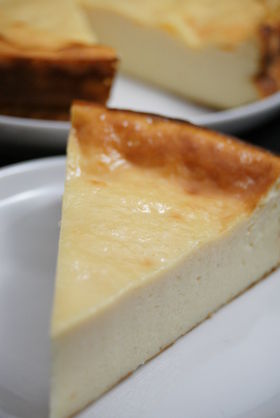
TOFU-YOGHURT-CAKE-1

Tofu and yoghurt are two very healthy ingredients that can be easily magicked into a cake for the delight o children and calories conscious adults:

Tofu Yoghurt Cake!

INGREDIENTS: For an 18cm-diameter mold

-Plain yoghurst:500g
-Tofu (kinu tofu or soft tofu): 300 g
-Eggs: 2
-Sugar: 80 g
-Flour: 30 g
-Lemon juice: 1 tablespoon

RECIPE:
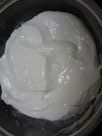
TOFU-YOGHURT-CAKE-2

-Place a sieve over a bowl. Pour the yoghurt in. Let it drain naturally in the refrigerator for a day.
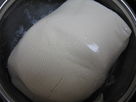
TOFU-YOGHURT-CAKE-3

-Place the tofu in a bowl (no need to cover it). Leave it in a microwave oven (500 W) for 3 minutes.
Place a sieve over a bowl. Pour the tofu inside the sieve. Let it drain naturally in the refrigerator for a day.
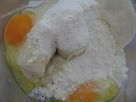
TOFU-YOGHURT-CAKE-4

-Next day, pre-heat oven to to 180 degrees Ceslius.
Throw the yoghurt and tofu water away.
Drop all the ingredients inside a food processor.
TOFU-YOGHURT-CAKE-5

-Blend until smooth. Switch off halfway and stir with a spatula to even up the mixture.
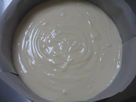
TOFU-YOGHURT-CAKE-6

-Pour the mixture inside a mold lined upwith cooking paper. Bake at 180 degrees Celsius for 30 minutes.

TOFU-YOGHURT-CAKE-7

-Take mold and cake out. Let it cool completely. Chill it inside the refrigerator together.

TOFU-YOGHURT-CAKE-8

-Take the cake out of of its mold only when it has chilled well.

TOFU-YOGHURT-CAKE-9

-Cut, serve and enjoy!
You can of course serve it with jam and other toppings.
You can also add liqueurs, fruits and so on to the recipe!
——————-
TOFU LEMON CUPCAKES

TOFU-LEMON-CUPCAKE

Here is another simple Japanese style cupcake recipe made with tofu!

Tofu lemon Cupcakes!

INGREDIENTS: For about 16

-Tofu (kinu tofu or soft tofu): 100 g
-Sugar: 70 g
-Egg: 1
-Grated lemon pel: 1 lemon
-Flour: 160 g
-Baking powder: 1 and a half teaspoons
-Milk (or soy milk): 3 tablespoons
-Lemon juice: 1 tablespoon
-Olive oil: 2 tablespoons

RECIPE:

-Mix flour with baking powder. Mix grated lemon juice and milk in a separate bowl.

-In another bowl drop tofu and sugar. Mix thoroughly into a smooth paste. Add egg and mix well with a wisker.

-Add lemon juice and milk and mix well until smooth. But don’t mix too long!

-Mix in flour and baking powder with a spatula until the floury look has disappeared but don’t overmix.

-Fill cups (previously oiled) and bake at 190 degrees Celsius for 16 minutes. If the cups are really small 12 minutes should be enough.
——————————
TOFU TERRINE

TOFU-TERRINE

Tofu does have to be food exclusively for vegans, vegetarians and people with special priorities.
I can assure you that monivores like I are very fond of any any combination including tofu!

Here is a simple recipe that will impress your friends:
Tofu Terrine!

INGREDIENTS: For 4 servings

-Tofu (momen tofu, a bit mopre solid than kinu tofu): 300 g
-Wakame seaweed (salted preserves): 15 g
-Carrots: 30 g
-Sugar peas in their pods (or their equivalent. They are called pois gourmands in French, or kinu saya ingen in Japanese): 8
-Salt: a pinch (for boiling the veg)
-Mushrooms (white agarics): 3
-Broad beans (boiled or steamed) for decoration: 4

-Eggs: 2
-Soup stock: 2 tablespoons
-White wine: One and half tablespoons
-Salt: 1/3 teaspoon
-Pepper: to taste
-Salad oil for brushing

RECIPE:

-Break the tofu in large pieces. Boil lightly. Transfer into a large clean cloth and press as much water out as possible.

-Wash the wakame in clear cold water. Boil for a little while. Take out and press water out. Put it inside a clean cloth and press out as much water as possible.

-Chop the carrot fine. Boil a little and take water off as above.

-Take the “thread” off the sugar peas, boil in salted water. Let cool completely. Take off water and chop finely.

-Cut the mushrooms very fine (you may fry or boil them a bit if you wish to).

-Work the tofu in a suribachi (mortar and pestle) to obtain a smooth paste. Add eggs and mix with the pestle (food processing is fine, too). Add wakame seaweed, carrot, sugar peas, mushrooms, soup stock, slat and pepper, and mix.

-Coat the insides of 4 ramequins/oven cups with a very thin layer of salad oil and pour 1/4 of the mixture in each. Flatten the surface with a spatula.

-Place ramequins inside a steamer. Steam on a medium fire for 5 minutes, then 10 more minutes over a low fire.
Let cool down completely.
Wrap them in cellophane and keep in refrigerator until you serve them
Decorate with broad beans.

NOTE:

This is the basic recipe. It is open to all inds of variations!
—————————-
VEGAN TOFU LEMON CUPCAKES

VEGAN-TOFU-LEMON-CUPCAKE

This is a slightly different version of the Japanese style vegan tofu cupcake I introduced a couple of days ago. It will give you an idea of how to play on that idea!

INGREDIENTS: For about 16 cakes

-Tofu (kinu tofu): 180 g
-Sugar (of your choice): 0 g
-Soy milk: 3 tablespoons
-Lemon juice: 1 tablespoon
-Olive oil: 2 tablespoons

-Flour (use chestnut flour if you are wheat allergic): 160 g
-Baking powder: 2 teaspoons

-Grated lemon skin: 1 whole lemon
-Dried English tea leaves, finely chopped ( the contents of 1 tea bag is adequate)

RECIPE:

-Mix flour and baking powder well.
Mix soy milk and lemon juice separately and and set apart.

-In a large bowl drop in the tofu and sugar. Mix well until you obtain a smooth paste. Add the soy milk, lemon juice and olive oil. Mix the lot thoroughly with a whisker.

-Add the all flour and baking powder mixture and mix in with a spatula until floury lumps have disappeared, but don’t mix too much!

-Pour mixture into cups and sprinkle them with grated lemon skin and dried tea.

-Bake inside oven for 16 minutes at 190 degrees Celsius.
If you make mini cupcakes, 12 minutes should sufficient.
keep looking at the colour of your cupcakes!
——————
VEGAN TOFU CUPCAKES

VEGAN-TOFU-CUPCAKE-1

Cupcakes are the norm all over the world when it comes to bakery and tofu is a must for vegans.
Now, it is possible to make very simple cupcakes for vegans!
Wheat flour allergics can replace the wheat flour with chestnut flour like the Corsicans and Portguese do in their traditional food!
This is only the basic recipe to which you can add fruits and vegetables!

Vegan Tofu Cupcakes!

INGREDIENTS: For 5~6 cupcakes

-Tofu (kinu toufu): 300 g
-All-purpose flour (for substitutes, read above): 100 g
-Sugar (white, cane, or even honey): 30 g

RECIPE:

VEGAN-TOFU-CUPCAKE-2

-Get ingrediens ready and pre-heat oven to 200 degrees Celsius.

VEGAN-TOFU-CUPCAKE-3

-Mix tofu and sugar. Mix well.

VEGAN-TOFU-CUPCAKE-4

-Sprinkle flour over tofu and mix roughly so as to leave a little flour on the surface.

VEGAN-TOFU-CUPCAKE-5

-Bake for 25~30 minutes at 200 degrees Celsius or until desired colour.

VEGAN-TOFU-CUPCAKE-6

-Dead simple, aren’t they?
Now your skills will reside in what you add!
——————–
Tofu & Chicken stuffed Green Peppers
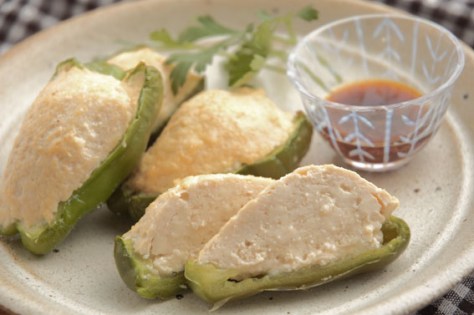
TOOFU-CHICKEN-PIMAN

Tofu when mixed with other ingredients opens a door on an infinite number of easy recipes!

Here is a very simple Japanes-style snack:
Tofu & Chicken stuffed Green Peppers!

INGREDIENTS: For 4 people

-Green peppers: 6
-Kinu tofu: 400 g
-Minced chicken: 175 g
-Japanese Sake: 1 tablespoon
-Soy sauce: 2 teaspoons
-Cheese powder: 1 tablespoon
-Salt: 1/2 teaspoon
-Black or white pepper: to taste
-Cornstarch: a small amount according to preferences

RECIPE:

-Leave a weight on top of the tofu to drain water and reduce it about two thirds of its volume.
-Wash the green peppers, cut in halves and wipe off humidity.
-In a bowl drop the tofu and minced chicken. Mix well by hand until you obtain a soft smooth paste.
-Add Japanese sake, cheese powder, salt and pepper and mix well.
Sprinkle insides of peppers with cornstach and fill each pepper half with tofu/chicken mixture.
-Place on oven plate and cook at 200 degrees Celsius for 15 minutes.
Serve with a little salt or soy sauce.
——————
VEGAN TOFU CARPACCIO

TOFU-CARPACCIO

I’ve been in tofu recipe search mode for quite a while, and I finally found one to please my vegan friends who can’t boast a carpaccio of their own!
It is ridiculously easy, but it makes for great impression!
Choose the best ingredients!

Vegan Tofu Carpaccio!

INGREDIENTS:

-Tofu (kinu tofu/silk tofu): as much as you like?
-Salt (Guerande for example): to taste
-Black pepper (freshly ground only, please!): to taste
-Lemon juice (organic lemon, please!): to taste
-Olive oil (EVO): to taste
-Pink pepper/baies roses: to taste

As you can see, it is basically up to you!

Look for some great organic green leaf vegetables to make a “bed” for the tofu.

RECIPE:

-Wrap tofu inside a large piece of kitchen paper.
Put the wrapped tofu inside a tupperware box (no lid, please) and top the tofu with a light weight.
Leave overnight (a full day, if you can) inside the refrigerator.

-Take out the tofu (discard the water).
-Cut it slices and plave it on a bed of leaf vegetables.
-Sprinkle in that order with salt, pepper, lemon juice and olive oil.
-Srop a few pink pepper grains for decoration and taste.

Simple, ain’t it?
————————
VEGAN ITALIAN TOFU SALAD
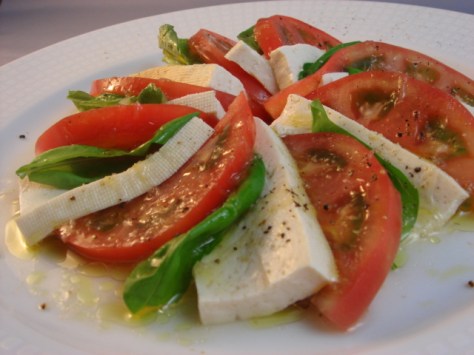
TOFU-VEGAN-SALAD

The Japanese come with some simple and tasty new ideas for Vegans and Vegetarians!
I just discovered this recipe. It is basically a Cabrese-style salad.
The twist is that the cheese is replaced by tofu!

Vegan Italian Tofu Salad:

INGREDIENTS:

-Tofu (kinu dofu): half/200g
-Tomato: 1 large
-Sweet basil: 10 leaves

-Dressing:
Wine vinegar (white): 1/4 cup
White wine: 1/4 cup
Salt: 1/3 teaspoon
Whole black pepper: 3 grains, crushed
Garlic: 1/2 clove
Fresh red chili: 1/2

Olive oil (EVO): 1.1/4~ tablespoon
Onion: 15 g, grated

RECIPE:

-Cut tofu into 1 cm thick slices.
-After taking out the stem part, cut tomatoes into half moons.
-Leave tofu tomatoes in a bowl full of iced water.
-Crush and mince garlic. Mix it with the wine vinefar, white wine, salt, pepper and chili. Cook in a pan until the lot has reduced to half. Let cool.
-Take tomatoes and tofu out the iced water (drain as much water as possible) and drop them in a large bowl. Add onion and olive oil. Mix well.
-Place tomatoes, tofu and basil alternately as shown in picture on a srving dish. Pour dressing all over.

NOTE:

-For calorie conscious vegetarians, tofu has almost none while chesse has loads of them!
———————–
Tofu and Egg Dumplings in Sweet and Sour sauce

TOFU-EGG-1

Here is another very easy tofu recipe for the “Tofu Tribe” (Terecita, Elin, Jenn and Jennifer and all tofu lovers!

INGREDIENTS: For 4 people
-Tofu: 350~400 g
-Eggs: 2
-Soy sauce: 1 large tablespoon
-Dashi/Japanese stock soup. Add a little sy sauce and mirin/sweet sake for taste
-Cornstarch: 1 large Tablespoon
-Trefoil (mitsuba) or available leaves: enough for decoration and taste

RECIPE:

-Drain water from tofu. Put in a bowl and break it up. Break eggs in and add soy sauce. Mix well.

TOFU-EGG-2

-Divide into 4 bowls. Cob\ver ach bowl with kitchen cellophane paper (30 cm wide square).

TOFU-EGG-3

-Turn over bowl and wrap tofu inside cellophane paper. Secure with a rubber band.

-Bring water to boil inside a lare dep pan. Drop tofu dumplings in boiling water and cook for 15 minutes to make sure they properly coked inside.

-Place each dumpling inside its cellophan paper in a serving dish. Cut top of the cellophane paper and carefully pull out the cellophane paper or turn over (whatever way you feel comfortable with.

-In a separate pan prpare the sweet and sour sauce.
Pour in dashi to which you would have added soy sauce and mirin (Taste varies with individuals. Need for a lttle experimentation!).
Heat sauce.
Mix cornstarch in some water and then add to sauce.
Once ready pour over dumpling and serve it decorated with trefoil cut to size.

NOTE:
Take care that cellphane paper does not get in contact with bare parts of the pan as the cellophane paper might melt on contact!
—————————
TOFU AND WAKAME SALAD
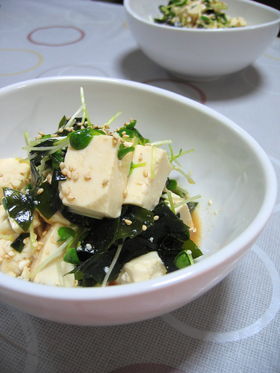
TOFU-WAKAME-SALAD-1

Here is another very easy recipe to help you and the “Tofu Tribe” (Terecita, Elin, Jenn and Jennifer modify and preserve tofu for all kinds of usages!
I’d like to take the opportunity to apologize to Tinako for my past mistake!
Tofu and Wakame Salad!

INGREDIENTS: For 2~3 people
-Tofu: 300 g
-Salt-preserved wakame: 20 g
If bought dried, let it “come back” in lukewarm water first.
If you are worried about the salt, let them rest in water for a while first and drain.
-Kawaire daikon, or any fresh sprouts available: To taste.
-Ponzu: 2 large tablespoons
-Sesame oil: half a large tablespoon
-White sesame seeds: to taste

RECIPE:
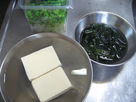
TOFU-WAKAME-SALAD-2

Leave tofu in clean cold water for 30 minutes. Wash and clean wakame seaweed and cut in bite-sized pieces. Cut sprouts in thirds.

TOFU-WAKAME-SALAD-3

In bowl mix seaweed, sprouts, ponzu and sesame oil.

TOFU-WAKAME-SALAD-4

Drain tofu and cut in bite-sized pieces. Mix in.
Place salad in serving bowls and sprinkle white sesame seeds.

Note: You can use either kinu tofu or momen tofu.
You may use green shiso/perilla leaves vinaigrette instead of ponzu.
In summer add cut plum tomatoes.
I personally like to add a little sweet umeboshi/pickled Japanese plums!
—————————
TOFU SHIOZUKE/SALT-PRESERVED TOFU
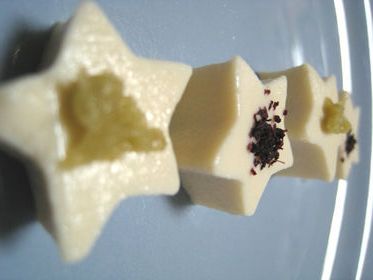
TOFU-SALT-1

Here is an easy recipe to help you and the “Tofu Tribe” (Terecita, Elin, Jenn and Jennifer modify and preserve tofu for all kind of usages!
Tofu Shiozuke/Salt-preserved Tofu!

INGREDIENTS:
-Tofu: 1 “cho”/200 g (Kinu or Momen type)
-Salt: 2g

RECIPE:
TOFU-SALT-2

Take tofu block out of its package and put it kitchen working plank. Sprinkle it with 1 g of salt.
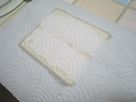
TOFU-SALT-3

Cover with a sheet of kitchen paper.

TOFU-SALT-4

Cover the tofu and its kitchen paper with a plastic Tupperware-type box.

TOFU-SALT-5

Turn box and plank over holding them together.
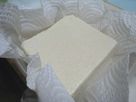
TOFU-SALT-6

Take off plank and sprinkle the tofu bottom face with 1 g of salt.
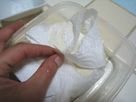
TOFU-SALT-7

Close paper kitchen over tofu.

TOFU-SALT-8

Close the box and leave inside refrigerator in the evening.
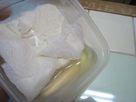
TOFU-SALT-11

Next morning there should be about 20cc of water having seeped through the kitchen paper. Discard water.

TOFU-SALT-12

Wrap again in new clean kitchen paper. Put back into dry Tupperware-type plastic box and close. Put back into fridge until the next morning.
The tofu will have reduced size by half by then.
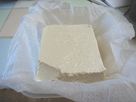
TOFU-SALT-13

That’s how it would look. Smaller and firmer. More water should have seeped out. Discard it.

USE SAMPLES:

TOFU-SALT-14

On a bowl of freshly steamed rice serve with with thinly sliced raw okra, preserved chrysanthemum leaves. Then pour hot tea on top!
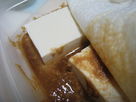
TOFU-SALT-15

Pickle it with fresh miso for one night and eat it as a snack!

TOFU-SALT-16

Beautiful in salad with avocado slices!
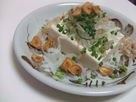
TOFU-SALT-17

Served with chopped vegetables and garlic chips!

TOFU-SALT-18

Stuffed inside Aburaage with boiled beans then grilled and seasoned with seaweed dashi/stock and ponzu!
——————————
TIPS FOR EASY SNACKS

TOFU-OIL

I was thinking of the “Tofu Tribe” (Terecita, Elin, Jenn and Jennifer) when riding the bu to work this morning. No bicycle these days as we are in the midlle of the rainy season!

The day before the Missus had served a quick snack (see pic above) consisting of tofu on which she poured extra virgin olive oil, coarsely ground black pepper and a little salt.
Very simple. Not very artistic, I admit, but the idea was there.

Now, many vegans and vegetarians like their tofu, but are running out of ideas…

How about, for example, creating a plate (use a large one with “compartments” for better effect!) with an assortment of tofu pieces seasoned with different varieties of oils, ground peppers and other spices, finely chopped vegetables such as carrots, cucumbers for good colouring. I love my tofu mounted with chopped shiso/perilla leaves, umeboshi/Japanese pickled plums meat and a dash of ponzu!
And what about natto/fermented beans with chopped shiso leaves and grated fresh ginger?

You could do the same thing with fried tofu, deep-fried tofu and aburaage.
How about a piece of fsh tofu mounted with freshly cut and fried aburaage, wasabi, grated fresh ginger and ponzu?

Endless bliss!

Will be introducing oils in my next posting!
————————-
Tofu recipe: Tofu Manju with Ankake Sauce/Tofu Dumplings in Sweet and Sour Sauce
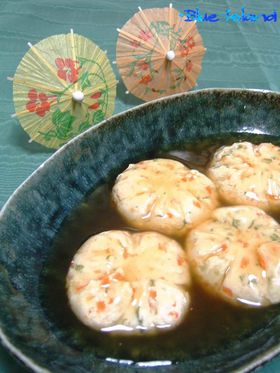
TOFU-MANJU-1

Here is another simple tofu recipe dedicated to Elin, all tofu lovers, vegans and vegetarians:
Tofu Manju with Ankake Sauce/Tofu Dumplings in Sweet and Sour Sauce!

INGREDIENTS:
-Tofu (momen tofu style9: 1 “Cho”/200 g
-Carrot: one fifth
-String beans: 2~3
cornstarch: 1 large tablespoon
-salt: a pinch

For sweet and sour sauce:
-Dashi (Konbu dashi/seaweeed stock): half a cup/100 ml
-Soy sauce: half a large tablespoon
-Sugar:2 large tablespoons
-Rice vinegar: 1 large tablespoon
-Cornstarch dissolved in water: to one’s personal liking

RECIPE: For 2 people

TOFU-MANJU-2

Press water out of tofu. Sift it completely. Boil finely cut carrots and string beans until soft enough. Drain all water.
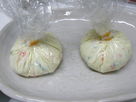
TOFU-MANJU-3

drop tofu and vegetables in a mixing bowl. Mix in cornstarch and salt. Divisde in 4 and make balls. Wrap each individually in cellophane paper. Twist cellophane warap and secure with rubber band or string.
Steam for at least 4 minutes.

Sweet and sour sauce:
Heat dashi stock, soy sauce, rice vinegar and sugar, stirring all the time. Mix in cornstarch dissolved in water.
The sauce is ready.

Serve dumplings on plate and cover them with the sauce!
Enjoy!
————————
ABURAAGE RECIPE
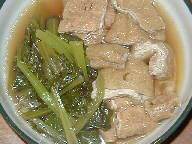
ABURAAGE-1
(Aburarage Soup)

Aburaage is basically a deep-fried thin slice of tofu.
It does offer a very versatile option as it can be used as it is, or open as a pouch it becomes the base for inari sushi and many other variations!

Here is a simple recipe:

INGREDIENTS:
Tofu (firm Momen tofu type): 1 large piece/block (Icho in Japanese)
Thick Towel
Cellophane paper
Long wooden disposable chopsticks (wari-bashi)
“Piano string”, or the equivalent
Water drainer
Oil
Oil thermometer (up to 200 degrees Celsius)

RECIPE:
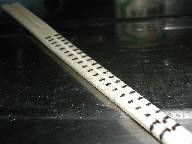
ABURAAGE-2
Make identations or marks on the chopsticks every 5 mm up to the height of the tofu block.
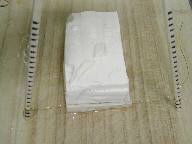
ABURAAGE-3
Tie “piano string” around chopsticks as shown on pic first at 10 mm height (or higher up to 15 mm if you wish), and cut tofu by sliding chopsticks along the cutting table (it should easy, but make sure you cut tofu evenly!)
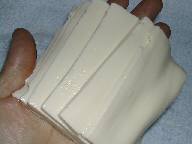
ABURAAGE-4
Tofu being soft, it is not easy to manipulate.
Later, when you will manipulate it, the best way is to first turn over the whole onto your open palm and have each slice slide away.
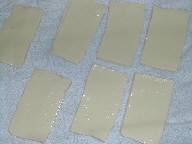
ABURAAGE-6
Before manipulating the tofu, first put a 500g weight (anything over a thin wodden plank if you don’t have asushi weight) on top of the tofu for 2 hours to get as much water off as possible.
Transfer slices onto thick towel and leave them there for an hour.

ABURAAGE-7
First frying step: fry tofu slice at 130 degrees Celsius (make sure to keep the temperature constant!) for 6 minutes. This will allow for a uniform heating.
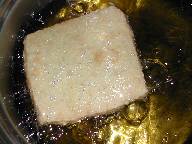
ABURAAGE-8
Second frying step: bring oil temperature to 160 degrees Celsius.
If tofu contains too much water or if you fry in a single step, it will fail to achieve the right shape and quality.
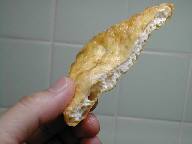
ABURAAGE-9
Aburaage will usually be a bit hard upon frying.
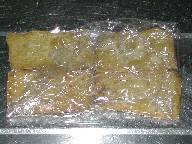
ABURAAGE-10
To make it soft, wrap it in xellophane paper and and heat inside electric oven. As soon as water comes out of aburaage inside the cellopahne paper, take the whole out and unwrap aburaage.

ABURAAGE-11
The aburaage should be soft by then.

ABURAAGE-12
Check if the aburaage needs a second frying (according to your liking).
if you fry it at 130 degrees, it will reduce as the one on the right in the picture.
If you fry it at 160 degrees you will obtain an aburaage like the left one on the picture (longer one).

ABURAAGE-13
To properly open it, cut in half, and then cut inside to form a pouch!
——————————
Vegetarian Japanese Cuisine: Fried Tofu and Vegetables
tofu-recipes-home

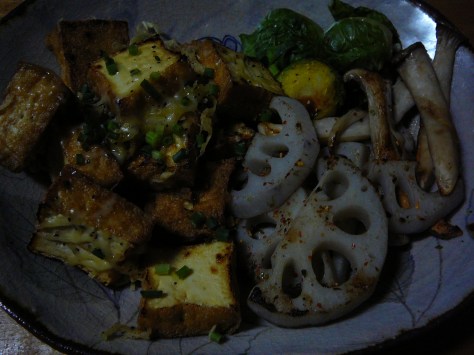
The other night, the Missus thought that some healthy food was in order, that is as much for herself as for me, what with her drinking wine and me savouring my Japanese sake!

She used already deep-fried tofu cubes called “nama-age” bought at the nearby supermarket, cut them to bite-size, saute them on a non-stick frypan as they were (no need for oil) with a liberal amount of pizza cheese and served them with a good measure of freshly chopped thin leeks. All the while on another pan she fried slightly boiled renkon/lotus roots slices with eringi mushrooms cut lengthwise and half-cut Brussels sprouts with some olive oil, a litle salt, pepper and a spicy seasoning mix.
Once ready she added themhot on the same plate.

So simple and tasty!
————————–
1): Fried Namaage with Cheese and Ponzu
toofu-recipe-1

This is I hope the first installment of a long series of simple recipes with tofu. Some will be vegan and vegetarian, some vegetarian like this one, others for omnivores!

tofu-kinds-21

This particular one is one one of the Missus’ favorites.
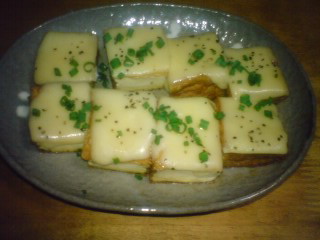
She uses on full “namaage tofu”, tofu that was deep-fried whole and that you can buy either fresh at a Japanese market or packaged.

She cuts the tofu in equal-sized bite pieces about 1 cm thick and fry them in a non-stick pan. No real need for any oil as what is contained in the surface of the tofu will be sufficient.
The point is that she fries them only on side. While they cook she lay a thin piece of mild/processed cheese over each tofu piece, add some black pepper, and cover with a glass lid. When the cheese has nicely melted over the tofu, she takes off the lid, sprinkles the whole with ponzu and fries for another minute. She serves on a dish with the sauce and liberally sprinkles the lot with chopped thin leeks!

Great snack with Japanese sake or beer!
———————
Koyadofu/Pressed Tofu Recipe

As promised here is the basic recipe to make Koyadofu/高野豆腐 or pressed tofu.

Koyadofu is extensively used in veganand vegetarian food in Japan.

It can also be deep-fried into great crunchy morsels!

INGREDIENTS:

-Tofu: 1 block/400 g (actually it is up to you!)

RECIPE:

-Place the tofu in a plate/bowl and let rest there for 10 minutes.  Throw away the water that comes out naturally. Cut the tofu into 3 “slices” across the width. You may skip that step and proceed with whole block.

-Wrap the tofu into cellophane paper and freeze the tofu inside the freezer of your refrigerator.

-Will be ready once completely frozen.
The trick is to press water out of the tofu once you have thawn it.
The tofu will have taken its colour and consistency naturally.

Recipe suggestion:

Prepare a stock soup with 1 cup of seaweed dashi/soup stock, 2 tablespoons of sugar, a little salt, 1 and a half teaspoons of mirin/sweet sake, and 1 and a half teaspoons of soy sauce.
Cook the koyadofu in it and serve once soft enough.
————————–
Koyadofu/Pressed Tofu Recipe

As promised here is the basic recipe to make Koyadofu/高野豆腐 or pressed tofu.

Koyadofu is extensively used in veganand vegetarian food in Japan.

It can also be deep-fried into great crunchy morsels!

INGREDIENTS:

-Tofu: 1 block/400 g (actually it is up to you!)

RECIPE:

-Place the tofu in a plate/bowl and let rest there for 10 minutes.  Throw away the water that comes out naturally. Cut the tofu into 3 “slices” across the width. You may skip that step and proceed with whole block.

-Wrap the tofu into cellophane paper and freeze the tofu inside the freezer of your refrigerator.

-Will be ready once completely frozen.
The trick is to press water out of the tofu once you have thawn it.
The tofu will have taken its colour and consistency naturally.

Recipe suggestion:

Prepare a stock soup with 1 cup of seaweed dashi/soup stock, 2 tablespoons of sugar, a little salt, 1 and a half teaspoons of mirin/sweet sake, and 1 and a half teaspoons of soy sauce.
Cook the koyadofu in it and serve once soft enough.
————————–
Koyadofu/Pressed Tofu Recipe

As promised here is the basic recipe to make Koyadofu/高野豆腐 or pressed tofu.

Koyadofu is extensively used in veganand vegetarian food in Japan.

It can also be deep-fried into great crunchy morsels!

INGREDIENTS:

-Tofu: 1 block/400 g (actually it is up to you!)

RECIPE:

-Place the tofu in a plate/bowl and let rest there for 10 minutes.  Throw away the water that comes out naturally. Cut the tofu into 3 “slices” across the width. You may skip that step and proceed with whole block.

-Wrap the tofu into cellophane paper and freeze the tofu inside the freezer of your refrigerator.

-Will be ready once completely frozen.
The trick is to press water out of the tofu once you have thawn it.
The tofu will have taken its colour and consistency naturally.

Recipe suggestion:

Prepare a stock soup with 1 cup of seaweed dashi/soup stock, 2 tablespoons of sugar, a little salt, 1 and a half teaspoons of mirin/sweet sake, and 1 and a half teaspoons of soy sauce.
Cook the koyadofu in it and serve once soft enough.
————————–

As promised here is the basic recipe to make Koyadofu/高野豆腐 or pressed tofu.

Koyadofu is extensively used in veganand vegetarian food in Japan.

It can also be deep-fried into great crunchy morsels!

INGREDIENTS:

-Tofu: 1 block/400 g (actually it is up to you!)

RECIPE:

-Place the tofu in a plate/bowl and let rest there for 10 minutes.  Throw away the water that comes out naturally. Cut the tofu into 3 “slices” across the width. You may skip that step and proceed with whole block.

-Wrap the tofu into cellophane paper and freeze the tofu inside the freezer of your refrigerator.

-Will be ready once completely frozen.
The trick is to press water out of the tofu once you have thawn it.
The tofu will have taken its colour and consistency naturally.

Recipe suggestion:

Prepare a stock soup with 1 cup of seaweed dashi/soup stock, 2 tablespoons of sugar, a little salt, 1 and a half teaspoons of mirin/sweet sake, and 1 and a half teaspoons of soy sauce.
Cook the koyadofu in it and serve once soft enough.

RECOMMENDED RELATED SITES:
Warren Bobrow, Bread + Butter, Zoy Zhang, Hungry Neko, Think Twice, Frank Fariello, Mangantayon, Hapabento, Elinluv Tidbit Corner, Tokyo Terrace, Maison de Christina, Chrys Niles,Lexi, Culinary Musings, Wheeling Gourmet, Comestiblog, Chronicles Of A Curious Cook, Tokyo Through The Drinking Glass, Tokyo Foodcast, Palate To Pen, Yellin Yakimono Gallery, Tokyo Terrace, Hilah Cooking, More than a Mount Full, Arkonite Bento, Happy Little Bento; 5 Star Foodie; Jefferson’s Table; Oyster Culture; Gourmet Fury; Island Vittles; Good Beer & Country Boys; Rubber Slippers In Italy; Color Food Daidokoro/Osaka;; The Witchy Kitchen; Citron Et Vanille, Lunsj Med Buffet/Estonian Gastronomy (English), Cook, Eat, Play, Repeat

Please check the new postings at:
sake, shochu and sushi

Natto Recipes Compilation

Natto: Make-It-Yourself Recipe

Vegans and Vegetarians (and omnivores!) rejoice! Here is a simple way to make your own natto!
It does require a little sneaky trick for the first batch (like for yoghurt) but from the second batch it will all yours and only yours!
As usual, as this is a basic recipe, I willl explain step by step, and mentioning the quantities on the way!

Firts the soy beans (daizu/大豆 in Japanese).
Use a large vessel as you will need 2 to 3 times as much water: 1 volume of soy beans + 2~3 volumes of water.
Make an effort touse clean cold water!
Let the the soy beans soak overnight.

You will discover that after a night of soaking the soy beans will have changes in shape from round to elongated!

Next you must steam the soy beans (preferably the slow way) for three hours to get them soft, otherwise they will not ferment. You may use a pressure cooker, but you will have to expperiment!

Important point: From now on, especially, make sure that all vessels and utensils you use are properly boiled in hot water first to kill all germs, or you will end with a yeast/germ/mold battlefield!
Use a large metal shallow vessel for even wieght and spread.
Transfer the steamed soybeans on eat as shown in above picture.
Be aware that the smell will be strong, so choose your room!

Now, for the all-important “sneaky” trick!
The beauty of it is that from the second batch you will use your own batto! Friends with some knowledge in yoghurt or Japanese sake fermentation will easily understand!
Drop a few grains of natto bought at the market in half a cup of water/ 100~cc/ml. (use high quality non-gaseous mineral water!)
After stirring 2 or 3 times, the water should start turning whitish. This is your yeast/fermentation starter!

Carefully pour the fermentation starter (with the natto beans) evenly all over the steamed soy beans.

Cover/wrap the whole with cellophane paper. Punch small holes (about 20) with a toothpick to allow ventilation.

Tap the cellophane paper so as to keep it close in contact with the soybeans. Do not press.

Now, the whole important thing: the temperature!
Like for Japanese Rice fermentation, it must stay between 30 and 40 degrees Celsius. There are many ways to do it if you do not have the right room for it: use a hot water bottle (above) put nearby and cover it with a blanket, or put it under a heated blanket….

keep checking the temperature!

Let ferment for 20 hours.
Upon lifting the cellophane paper, the natto should show white filaments.

Here is the finished product!
True to tell, home-made natto might not as “sticky” as natto bought in markets, but this is still true natto.
Actually, the lack of “stickiness” might be be a blessing for some!

Keep in mind this is a true food, especially for vegans and vegetarians who are in more need of nutrients than omnivores!
————————–
Natto Miso Soup/Natto Jiru: Basic Recipe

Natto is a great condiment to add to your miso soup!
It is not only healthy, but also so comforting!
Here is the basic recipe, which is open to so many variations.
I did not bother with quantities as it is the basic recipe!
I made it vegan to please everyone!

(Vegan) Natto Miso Soup/Natto Jiru!

First of all, you need dashi/Japanese soupstock.
Check the Vegan Dashi Recipe!
It will make for at least 60% of the whole soup.
Heat the dashi but do not bring it to boil!

Next you need miso paste.
Check Miso, The Basics.
I personally prefer white miso in this case, but it’s open to all varieties. Bear in mind that usually the darker, the more salt miso will contain.
Mix the amount of your preference (experiment) and and mix.
The Japanese first put the miso in a large ladle and will mix it with a small amount iof the same dashi to attain a smooth mixture.

Add a few small pieces of tofu!

Now, the natto!
The amount is up to your liking!
But first stir it well until it has attained a sticky paste state.
Add to the dashi and cook gently, stirring from time to time if necessary until the natto has “spread” into the soup, losing its stickiness at the same time.

Next, mushrooms!
My favourite are nameko, a small mushroom with a lot of “stickiness”.
(Wikipedia: Nameko (Pholiota nameko) is a small, amber-brown mushroom with a slightly gelatinous coating ).
You can buy them at Asian markets in sealed packs.
Naturally you can always experiment with other mushrooms!

No need to overcook, and please do not bring it to boil.
Serve with a good amount of finely chopped leeks!

Simple, isn’t it?

——————
Vegan Japanese Cuisine: Natto no Age Yaki

My French Friend in Osaka has already extensively written about such recipes, so the present recipe is more a confirmation than an innovation!
It is very popular in Japan, probably more in my region, Shizuoka and Kanto, than in the western part of Japan including Osaka!

First of all, choose some good fresh thin leeks and use a lot for your Vitamin C, fibers and other useful nutrients. Chop them fine and drop them in a bowl.

Add the natto to the leeks. I also add a little light taste soy sauce, a little sesame oil, a little mustard and some chili pepper for additional zip. But this seasoning is entirely up to your preferences and priorities.
Mix well! It must form a really sticky mass.

Aburaage: deep-fried tofu pouches.
If you make them yourself, great!
If you van buy them freshly made at the market, great again!
Now, if you buy them packed, they either come as they are or in brine.
If in brine, throw the brine away and sponge the aburaage of between sheets of kitchen paper.

Cut each aburaage in half, or cut off one “tail” only to form a larger pouch.
With a sharp knife, “open” the aburaage so as to form a pouch.
Fill the pouch with the natto nixture.

“Lock” the pouch with a wooden toothpick as shown on the picture.

Fry on a frypan without any oil (plenty left inside the pouch), unless you are using aburaage preserved in brine.
Fry to a crispy broan colour.
Cut or serve as it is (look at top picture!) with some freshly grated ginger and some ponzu!
—————————
Vegan Japanese Cuisine: Lotus Root and Natto Sandwiches

I still have plenty of recipes with natto to publish!
This time I would like to introduce a very simple idea for a cruchy snack (Bazooka Gourmet will certainly have a comment for that! LOL):
Lotus Root and Natto Sandwiches!

INGREDIENTS: For 4 people

-Lotus root/Renkon: 20 cm long piece or the equivalent in 2 or 3 roots
-Natto: 1 standard pack
-Ooba/large shiso leaves/perilla leaves: 1 for each sandwich!
-Leek: as appropriate (chopped)
-Cornstarch: as appropriate
-Soy sauce: as appropriate

RECIPE:

-Cut the lotus root into 5 mm/1/2 cm thick slices. Wash in clear cold water.
Mix the natto with the chopped leeks and the tare/sauce and mustard provided in usual packs (if unavailable add some soy sauce, sesame oil and mustard).
Wash the large perilla leaves in clear cold water.

-Take water off both sides of lotus root slices with kitchen paper. Do the same with perilla leaves. Sprinkle lotus root slices with cornstarch on one side only, that is the side which will come in contact with frypan and oil.
Make sandwiches with one slice of lotus root + one perilla leaf + natto mix + one more lotus root slice.
Pour a little oil of your liking in a frypan and fry snadwiches on both sides until the lotus root is cooked and has attained a nice colour.

-Serve with a light soy sauce and yuzu kosho/lime and pepper paste for extra seasoning!

-Enjoy with a beer!
————————–
Vegan Japanese Cuisine: Natto Mabodofu

Mabodofu in Japanese or Mapo Doufu in Chinese Mapo doufu, is a popular Chinese dish from the Sichuan (Szechuan) province. It is a combination of tofu (bean curd) set in a spicy chili- and bean-based sauce, typically a thin, oily, and bright red suspension, and often topped with minced meat, usually pork or beef. Variations exist with other ingredients such as water chestnuts, onions, other vegetables, or wood ear fungus, but these are rarely considered authentic Sichuanese.

The Japanese sometimes combine it with natto to create a vegan recipe!

Natto Manofu!

INGREDIENTS: For 2~ people

-Natto: 2 standard packs
-Tofu (silk to fu): 1 standard block/300~400 g
-Leek: 1/2 finely chpped
-Fresh ginger: 3×3 cm cube, finely chopped
-Garlic: 1 clove, finely chopped
-Salad oil or seasme oil: as appropriate
-Soy sauce: 1 tablespoon
-Mirin/Sweet sake: 1 tablespoon
-Japanese sake: 1 tablespoon
-Doubanjiang/豆板醤: 1 tablespoon
-Shichuan pepper (if a vailable): a little

RECIPE:

-Mix the natto with its tare/sauce. If tare is not provided, mix it with 2 tablespoons of soy sauce. Press water out of tofu. Cut tofu into small pieces (size of the pieces is up to your preference actually!).

-In a bowl mix soy sauce, Japanese, mirin and Doubanjiang into seasoning sauce. Set apart.

-Heat oil in a frypan. Throw in the chopped leek, ginger and garlic. Stir fry for a while.

-Once the leek have become half transparent throw in natto and the seasoning sauce. Mix and heat quickly for a short while.

-Add tofu, Fry until natto has mixed with tofu.

-If there is not enough water to your preference, add some hot (not cold!) water. Sprinkle with Shichuan pepper and serve atop freshly steamed plain rice!
—————————
Fried Spicy Natto & Daikon

Since I started this series on natto, (Lou Ann; , keep your eyes open!), I seem to have found more vegan recipes for it!

Fried Spicy Natto & Daikon:

INGREDIENTS: For 2~3 people

-Daikon: 10 cm long piece (peeled, bear in mind that the bottom tip is hotter!)

-Natto: 2 standard packs
-Soy sauce: 2 tablespoons
-Mirin/Sweet sake: 1 tablespoon

-Seven Flavor Chili Pepper/Shichimi Togarashi (Shichimi)/七味唐辛子/: as much as you like!

RECIPE:

-Cut the daikon into 1~2 cm square pieces.
Mix the natto with the tare and other condiments provided in a bowl. Put aside.

-Pour some oil in a frypan. Fry the daikon pieces over a medium fire until they become half transaprent.

-Lower the fire. Add the natto to the daikon and mix well while cooking until the natto has become less sticky.

-Add soy sauce and mirin. Stir. Check taste and add seasoning if needed.
Last add Shichimi and mix.
Serve with beer or Japanese sake!
———————-
Natto & Sesame Seeds Sushi Roll!

Some time ago, I did come with some Vegan Sushi suggestions.
Since I have started postings on natto (Lou Ann; , keep your eyes open!), combining it with vegan is only natural!

Natto & Sesame Seeds Sushi Roll!

INGREDIENTS:

-Natto: 1 standard pack
-Dry seaweed/nori: 1 standard sheet
-White (actually yellow!) sesame seeds: 8 tablespoons
-Rice: 1 “go” (180 cc/ml
-Konbu/seaweed (hard type for cooking): 3×3 cm piece

●Salt: 1/3 teaspoon
●Sesame oil: 1 teaspoon
●Japanese mustard: as appropriate
◎Rice vinegar: tablepsoons
◎Sugar: 1 teaspoon
◎Salt: 1/3 teaspoon

RECIPE:

-Wash the recipe and steam until still a little firmer than usual.

-Drop “◎” ingredients in a small and gently heat until all is dissolved. Try to keep it lukewarm.

-Add “●” ingredients to natto and mix.

-Mix in “◎” liquid with rice by “cutting ” it in.

-Line a sushi roll mat with cellophane paper and sprinkle the whole surface with sesame seeds.

-Spread the sushi rice evenely over the sesame seeds covered cellophane paper. Cover with the dry seaweed sheet.

-Spread the natto mix along one side of the sushi rice and on the seaweed.

-Roll in carefully by lifting the cellophane paper at the same time.

-If you think that the roll is not round enough to your taste, pinch each cellophane paper extremity shut and press into shape.
When cutting the sushi roll, you can do it across the cellophane paper with a sharp knife and then delicately unwrap it.
Wipe your knife clean after each cut!
—————————
Vegan Natto & Aburage Tofu

Tofu and natto are both made from soy beans and can be easily combined into vegan recipes!

Natto & Aburage Tofu!
If you have any problems with quantities, look at pics or experiment!

INGREDIENTS: For 2 people

-Abrage/deep-fried tofu: 1 standard pack/2 blocks
-Natto: 1/2 standard pack
-Natto tare/sauce/dresing (sold with pack): as appropriate
-Miso: 2 tablespoons
-Leek: 1/2 chopped
-Soy sauce: as appropriate

RECIPE:

-Sponge water the oil and humidity off the aburage with some kitchen apaper. Cut through as to be able to open and stuff the tofu. The best method is to cut at an angle as shown in above picture, leaving half closed. Actually, you had better experiment, although you must keep in mind that the tofu should not be completely cut!

-Add some chopped leeks and the tare/sauce to the natto and stir until sticky. Add remaing chopped leeks and stir well.

-Paste the inside of the tofu with miso. Use a spoon. Stuff each tofu block with half of the natto. Secure with a toothpick.

-Fry until tofu attains a nice toast colour. No need to use oil!
You can also grill inthe toaster!

-Cut to size of your preference or serve it whole. Provide soy sauce for more seasoning if needed.

-Aburage as sold packed in Japan, although you will find them freshly made at any good large supermarket here!

———————–
Natto, Tofu & Yam Fritters

Since Lou-ann has decided to run an article on natto (Japanese fermented beans), I thought that some recipes were in order!
Sorry for the small picture.

Here is a very simple recipe that vegans and vegeatarinas can re-arrange by replacing the egg!

Natto, tofu and yam fritters!

INGREDIENTS: For 2 people

-Tofu (solk tofu): 1 block/300~400 g
-Natto: 1 standar pack (more or less according to taste-Natto tare/natto dressing (usually sold together)
-Soy sauce: according to taste (experiment!)
-Yam/Yama imo: 5cm long piece/grated
-Egg: 1
-Leek (chopped): as much as you like!
-Rice powder or cornstarch: 3 tablespoons
-Salt, pepper, spices: according to preferences

RECIPE:

-Wrap the tofu in cellophane paper and heat in microwave oven for 2 minutes.
-In a large mortar, drop all ingredients and mix well.

-Add natto tare/natto dressing and soy sauce. Mix well.

-Heat deep-fry oil to 170 degrees Celsius.
Drop the fritter batter a large spoon at a time.

-Once it has reached a nice “fox” colour, take out of the oil. Serve on a dish lined with kitchen paper.

Serve with a sauce/dressing made with soy sauce, mustard and ponzu, or mustard, rice vinagar and ponzu.

Note that there endless possibilities with the recipe ingredients:
you can add or replace with shiso/perilla leaves, sesame seeds, hijiki/sweet seaweed, grated carrot and so on!
——————————-
NATTO MISO SOUP/NATTO JIRU- THE BASIC RECIPE

Natto is a great condiment to add to your miso soup!
It is not only healthy, but also so comforting!
Here is the basic recipe, which is open to so many variations.
I did not bother with quantities as it is the basic recipe!
I made it vegan to please everyone!

(Vegan) Natto Miso Soup/Natto Jiru!

First of all, you need dashi/Japanese soupstock.
Check the Vegan Dashi Recipe!
It will make for at least 60% of the whole soup.
Heat the dashi but do not bring it to boil!

Next you need miso paste.
Check Miso, The Basics.
I personally prefer white miso in this case, but it’s open to all varieties. Bear in mind that usually the darker, the more salt miso will contain.
Mix the amount of your preference (experiment) and and mix.
The Japanese first put the miso in a large ladle and will mix it with a small amount iof the same dashi to attain a smooth mixture.

Add a few small pieces of tofu!

Now, the natto!
The amount is up to your liking!
But first stir it well until it has attained a sticky paste state.
Add to the dashi and cook gently, stirring from time to time if necessary until the natto has “spread” into the soup, losing its stickiness at the same time.

Next, mushrooms!
My favourite are nameko, a small mushroom with a lot of “stickiness”.
(Wikipedia: Nameko (Pholiota nameko) is a small, amber-brown mushroom with a slightly gelatinous coating ).
You can buy them at Asian markets in sealed packs.
Naturally you can always experiment with other mushrooms!

No need to overcook, and please do not bring it to boil.
Serve with a good amount of finely chopped leeks!

Simple, isn’t it?

RECOMMENDED RELATED SITES:
Warren Bobrow, Bread + Butter, Zoy Zhang, Hungry Neko, Think Twice, Frank Fariello, Mangantayon, Hapabento, Elinluv Tidbit Corner, Tokyo Terrace, Maison de Christina, Chrys Niles,Lexi, Culinary Musings, Wheeling Gourmet, Comestiblog, Chronicles Of A Curious Cook, Tokyo Through The Drinking Glass, Tokyo Foodcast, Palate To Pen, Yellin Yakimono Gallery, Tokyo Terrace, Hilah Cooking, More than a Mount Full, Arkonite Bento, Happy Little Bento; 5 Star Foodie; Jefferson’s Table; Oyster Culture; Gourmet Fury; Island Vittles; Good Beer & Country Boys; Rubber Slippers In Italy; Color Food Daidokoro/Osaka;; The Witchy Kitchen; Citron Et Vanille, Lunsj Med Buffet/Estonian Gastronomy (English), Cook, Eat, Play, Repeat

Please check the new postings at:
sake, shochu and sushi

A Dragons’ Banquet 2: Dwarven Tableware at an Elves’ Table

This is a series of exerpts taken from The Life Of A Dragon to prove that gastronomy can be discreetly introduced in any story or novel, be it fiction or not!

The Elf Forest was in an uproar.
Wilfred had arrived the previous day with a group of the eleven of the strangest creatures Elves had ever met in their Realm, or so to speak outside. Creatures of legend they were. The tall people of the woods had a lot of prejudices against the other races, but the Dwarves evidently provoked extreme reactions with their short stocky bodies, their beards and their enormous feet that could be heard trample the soft forest soil from miles away.
Queen Ellana had sternly warned her subjects to behave in the most respectful and welcoming manner, but some individuals were sorely tried in their personal feelings. On the other hand, their Queen had proved the perfect host.
Her grace, gentility and deference had left the Dwarves dazzled and speechless. Fortunately, Numnir had smoothly assumed the role of the guests on their behalf, or the Elves would have thought his companions mute or dumb. The Court had a fair knowledge of the common language, so communication had not become much of a problem when tongues started to loose later.
The Dwarves had retired early as they certainly needed rest after having crossed half the Forest before reaching Queen Ellana’s Court.
Tents had been prepared for them, but it would take a long time for the inhabitants of the mountains to get comfortable under such flimsy protection in spite of the very clement climate.
The following day witnessed unusual activity. Queen Ellana had ordered a large tent to be erected to house all the guests at the banquet offered in the honor of their special visitors. The occasion in itself was not of great import as Elves were fond of revelry and never missed an opportunity to celebrate. What started to rouse the interest of the denizens of the Forest was that everybody had been firmly asked out of the tent just before the festivities were supposed to begin. Ellana’s subjects’ curiosity was further exacerbated when the Dwarves appeared, carrying boxes of all kinds and sizes out of their own abodes into the banquet tent.
Questions flew but no answers came. Everybody understood they would have to wait until the feast began and the usually staid Elves were openly fidgeting.

Their plight was mercifully ended just as the sun started sinking behind the trees when a herald announced the banquet was ready. Even so, proper decorum forced everyone to enter the cloth hall in a single file and in the order of his status. The Queen, Dargelblad and Numnir, as well the Prince Consort and the Dwarves were already seated, clearly demonstrating the importance accorded to the guests to the detriment and chagrin of the Elf nobility. The latter, to the last man and woman, had to walk to the Royal Seat to salute their sovereign before proceeding to his and her predetermined place along the banquet table. But once seated, every Elf could not help but observe and become further intrigued by a white silk cloth covering their dinner set, whereas Ellana, Aerdhel, the Dragons and the Dwarves were facing an uncovered set of elven-made plate, fork, knife, chopsticks, spoon and glasses. The Dwarves did not show any curiosity at their outlandish dining set as they had had plenty of time to examine and train with such unusual utensils before coming to the Elf Forest.
When at last all the guests had been seated, Queen Ellana rose up and addressed the assembly:
“Honored guests, faithful servants of the Forest! As I may presume you all know, we are here assembled today to welcome the vanguard and illustrious ambassadors of a great Race whose very existence we had all forgotten in our ignorance and self-centered pride! When I say vanguard, it is my sincere belief we are witnessing the advent of a very long and fruitful relation between our two people. By illustrious, this is how you shall call our guests once you have seen what they had brought us, in spite of what some of you might have thought or said, for which I wish to offer my heartfelt apologies!”
The Queen was not known to apologize or reckon her faults if she ever had any, and her words put a few of her courtiers to shame on that day. Some could feel her displeasure and discovered they would be accounted for.
“But I am quite certain that all who had doubted our guests’ intentions and abilities will be the first to offer their thanks and friendship!”
The sarcasm was not lost. What was supposed to be a source of festivities was quickly turning into a masterly remonstrance of her subjects.
“I know Dwarves are people of few words but of great deeds. Why do you not lift the napkin in front of you to discover what presents they have brought all the way from the Iron Crags for your sole pleasure!”

Every courtier, with as much grace and restraint they could muster, obeyed their Queen to unveil what was under their napkins.
Few people in Alymndes could boast they had ever seen a truly astonished Elf in their life. But what the Dwarves were witnessing was the whole of the Forest nobility and authority gaping in mute surprise and wonder.
The knife, the fork and spoon were lying in their normal place, but each plate was of enameled pottery with patterns, motifs and colors of their own. The Dwarves had chosen subjects drawn and submitted to their skills by Numnir, as the Dwarves knew so little about the outside world before they began to heat their kilns. Some nobles were lovingly tracing their fingers along the leaves, fruit and plants so dear to them. Next, as their eyes went beyond their plates, they discovered a pair of chopsticks made of a substance they had never seen. Pottery they knew, although enamel was a discovery, but glass intrigued them endlessly. Each set of chopsticks was made of that substance in many colors interlacing each other as if they were flowing through and away. Next as each napkin was completely lifted, a drinking glass appeared to further heighten the astonishment of his recipient. Each drinking vessel had been manufactured with flash glass of two different tinted layers over a transparent one. Motifs had been cut and carved out the glass at varying depths to make them appear in rich lights and shades. Every Elf was holding his glass in front of his eyes, unendingly twirling it in the light of the fire globes hung to the roof of the tent which soon resonated with the amazed exclamations of joy of the happy Elves.

Those, who just a short while ago had come to sneer at their visitors or worse mock them, were presently unashamedly vying for their attentions, full of praise and questions, although Court rules prevented them to leave their seats and join the beaming Dwarves.
Ellana raised her hands to command silence.
“Gentlemen, Ladies! Are you forgetting your station and manners?”
She continued in a thinly veiled mocking tone:
“Behold! Long have I waited to witness the flower of the servants of the Forest throw their reserve and pride to the winds and at last show some true admiration and modesty for something not of their own making! I shall cherish this precious moment for the rest of my life! I hereby pray the Kingdom Under The Mountain to accept my humble thanks and proclaim all Dwarves Elf-friends!”
Turning to Numnir:
“But words are only words. Dear Flint Ironfoot, Ambassador of Drumbeat Hammerblow, King of all Dwarven Races, would you be as kind to repeat for the benefit of our audience what you so eloquently advocated to us last night?”
Numnir stood up and bowed to the Queen.
“Your Majesty is too kind when she praises the Dwarves for something they have done all their lives. We have come to your Forest, not only to offer you our crafts, but also to discover your arts and culture and propose an exchange of skills as well as combine our efforts into the creation of new artworks.”
The assembly went silent for real. Numnir had the satisfaction to discover he had struck a chord in the Elves’ hearts. He had their attention riveted to his words of art and crafts. However, there were other aspects he wished to discuss.
“I sense that my speech is of some appeal to you, so if you would allow me to continue in spite of all the great food and drink waiting for us, I shall make an outline of what we would like to submit to your judgment. The material used to manufacture the chopsticks and wine cups is called glass. The technique, as for enamel, the material covering your plates, is not too hard to replicate. The problem resides in the forges, ovens and intense heat needed for long periods to achieve perfection. As far as I know, only Dwarves can endure long exposure to such extremes in temperature. Natural crystals holds few secrets for you, but they are brittle and hard to fashion, whereas glass, although breakable, can be molded into any shape and tinted in any color. It is easy to polish, cut or carve. We dwarves are proficient with knives, chisels and hammers, but when it comes to minute details or treating silver or other soft metals, our big hands are too clumsy. Now for a start, if we could for example fashion chopsticks, wine glasses and mirrors with silver or copper holds and frames, we would create an unequaled product to sell or barter. We have already seen how quickly our crafts have become popular and in demand in Dunlago and Beaucastel, and our kin there have standing orders for at least a year. I know your love of the wines of Beaulieu, the spices of Dunlago and the soft skins of the Steppes. Shall I continue? As a last word, I have to confess trade is the main reason why we Dwarves have decided to come out of our mountains!”
The Elves were gaping at the Flint Dragon’s words. Rarely had anybody brought them to think and reevaluate so suddenly that they had great difficulties to organize their thoughts and to formulate the questions that crowded their heads. Their Queen saved them from more confusion
“Flint Ironfoot, Ambassador of the Kingdom Under The Mountain, many of us, if not all, will remember this day when somebody had to come among us from so far to provide our Forest with some greatly needed challenge and mettle! Why do we not start celebrating our good fortune? Gentle servants, bring us drink and food! Musicians, to your instruments!”

RECOMMENDED RELATED SITES:
Warren Bobrow, Bread + Butter, Zoy Zhang, Hungry Neko, Think Twice, Frank Fariello, Mangantayon, Hapabento, Elinluv Tidbit Corner, Tokyo Terrace, Maison de Christina, Chrys Niles,Lexi, Culinary Musings, Wheeling Gourmet, Comestiblog, Chronicles Of A Curious Cook, Tokyo Through The Drinking Glass, Tokyo Foodcast, Palate To Pen, Yellin Yakimono Gallery, Tokyo Terrace, Hilah Cooking, More than a Mount Full, Arkonite Bento, Happy Little Bento; 5 Star Foodie; Jefferson’s Table; Oyster Culture; Gourmet Fury; Island Vittles; Good Beer & Country Boys; Rubber Slippers In Italy; Color Food daidokoro/Osaka;/a; The Witchy Kitchen; Citron Et Vanille, Lunsj Med Buffet/Estonian Gastronomy (English), Cook, Eat, Play, Repeat, Chrisoscope

Please check the new postings at:
sake, shochu and sushi

Vegan Japanese Cuisine: Natto no Age Yaki

My French Friend in Osaka has already extensively written about such recipes, so the present recipe is more a confirmation than an innovation!
It is very popular in Japan, probably more in my region, Shizuoka and Kanto, than in the western part of Japan including Osaka!

First of all, choose some good fresh thin leeks and use a lot for your Vitamin C, fibers and other useful nutrients. Chop them fine and drop them in a bowl.

Add the natto to the leeks. I also add a little light taste soy sauce, a little sesame oil, a little mustard and some chili pepper for additional zip. But this seasoning is entirely up to your preferences and priorities.
Mix well! It must form a really sticky mass.

Aburaage: deep-fried tofu pouches.
If you make them yourself, great!
If you van buy them freshly made at the market, great again!
Now, if you buy them packed, they either come as they are or in brine.
If in brine, throw the brine away and sponge the aburaage of between sheets of kitchen paper.

Cut each aburaage in half, or cut off one “tail” only to form a larger pouch.
With a sharp knife, “open” the aburaage so as to form a pouch.
Fill the pouch with the natto nixture.

“Lock” the pouch with a wooden toothpick as shown on the picture.

Fry on a frypan without any oil (plenty left inside the pouch), unless you are using aburaage preserved in brine.
Fry to a crispy broan colour.
Cut or serve as it is (look at top picture!) with some freshly grated ginger and some ponzu!

RECOMMENDED RELATED SITES:
Warren Bobrow, Bread + Butter, Zoy Zhang, Hungry Neko, Think Twice, Frank Fariello, Mangantayon, Hapabento, Elinluv Tidbit Corner, Tokyo Terrace, Maison de Christina, Chrys Niles,Lexi, Culinary Musings, Wheeling Gourmet, Comestiblog, Chronicles Of A Curious Cook, Tokyo Through The Drinking Glass, Tokyo Foodcast, Palate To Pen, Yellin Yakimono Gallery, Tokyo Terrace, Hilah Cooking, More than a Mount Full, Arkonite Bento, Happy Little Bento; 5 Star Foodie; Jefferson’s Table; Oyster Culture; Gourmet Fury; Island Vittles; Good Beer & Country Boys; Rubber Slippers In Italy; Color Food Daidokoro/Osaka;; The Witchy Kitchen; Citron Et Vanille, Lunsj Med Buffet/Estonian Gastronomy (English), Cook, Eat, Play, Repeat

Please check the new postings at:
sake, shochu and sushi

A Dragons’ Banquet 1: Sea Ears

This is a series of exerpts taken from The Life Of A Dragon to prove that gastronomy can be discreetly introduced in any story or novel, be it fiction or not!

Incidentally “Sea Ears” are Abalones in English, or “Oreilles de Mer” in vernacular French

PART 1: SEA EARS

But for the moment, dragon or not, he had more work than he cared for.
He was interrupted in his ruminations by a young man’s voice from the kitchen door.
“Jonas! Greetings! Look at what I’m bringing!” shouted a genial Naeem carrying a large wooden box. Jonas hurried to see the contents. The young man was such a great source of information on what dwelt in the sea. Ekan had never lost his passion for those great expanses of water and the mysterious teeming lives below the surface.
There were no different fish from the day before and their quality was irreproachable as ever. But in a corner he found half a dozen large slightly round dark shells dotted with small holes. He took one of them, turned it over and saw a kind of large foot under it. He scratched his shaved head in wonder.
“What are these?”
“Abalones. We also call them “sea ears”. Divers have to go down quite deep to collect them. But I can tell you they are worth the effort!”
“I believe you, but how do you cook them?”
-Shall I show you?”
“Sure! All of you, make some room! Time for some learning!” laughed the black giant, quite happy to discover another culinary experience.
Demonstrating at the same time, Naeem, thoroughly enjoying himself, explained:
“First, you clean the shell and the shellfish by rubbing the whole with salt and then rinse it with water. Sponge the water off with a clean cloth. Next, heat some oil in a frying pan until very hot. Put the abalone shell up onto the frying pan. Let it cook for a while, then cover it and let it steam inside its own juices for about the same time again. Take out the abalone and put it shell down onto a wooden cutting board. Insert a spatula between the shell and the meat. It should come off easily. Now turn the shellfish over, innards on top. Take off the innards. Throw them away or use them to make broth. Cut out the top of the shellfish, as the meat there is a bit tough to eat. Last, cut it in very thin slices from top to bottom and at a slant. You can eat the slices hot or cold as they are, with spices or sauce.”
He proceeded to cut the cooked abalone as indicated and offered a slice to everyone present. Ekan brought the slice to his mouth. The meat was very tender and succulent, as the shellfish was very fresh. A look at his staff was sufficient to convince him they had found a new choice food.
“Tell me, Naeem, do you usually cook your shellfish in oil or butter?”
“Well, either would do. Butter would be best, but it darkens quickly. Oil is a bit heavy. Mixing the two might be a better idea. But butter does not come cheap”

“I see. I’d like to show you something. Come outside with me!”
The young fisherman and the kitchen staff looked askance at Jonas. The Black Dragon beckoned them all to follow him outside. He guided them through the back garden to the very edge of the property. Quite a few trees with a height varying between that of one and two adult men stood there laden with small oval fruits. He pointed at the trees.
“Naeem, what do you call those trees? I’ve seen many of them around. I’ve been meaning to ask somebody for a while.”
“They are called oliva trees. They’ve been there for as long as I remember. I’m sure those trees have been growing here for generations. As far as I know, apart from their shade, they are pretty useless.”
“Really?” answered Jonas.
He picked a handful of the small fruits.
“People have never used them for food or else?” he continued looking at everybody. Negative nods were the only reply.
Holding the berries in his right hand over his open left hand, he proceeded to squeeze and crush them in his enormous grip. A yellow green liquid started sipping out of his clenched fist into his left palm. Throwing away the crushed fruit, he dipped a finger into the oily substance and tasted it.
“Well, well. I’ll be damned! And thinking that all the time we had the solution for something better than that terrible bean oil of yours next to our door! Taste it and tell me what you think!”
Each member of the kitchen staff and Naeem dipped a finger into Ekan’s palm and tasted the oil. Some came a second time for a bigger dip. All showed surprised faces, eyes round and lips smacking.
“What do you think, Grazel? Would your people and our customers appreciate such a taste?”
“I’ll be damned, too!” exclaimed the senior kitchen maid. “So that’s what those trees have been there for all the time! Why did our ancestors forget such a treasure?”
“We’ll probably never know.” answered a pensive Jonas. “Alright ladies, back to work! I’m going to ask the Dwarves if they can come up with some kind of press. Naeem, come with me!”
“But, I have to…” started the young man.
“Don’t worry! I’ll talk to your father. But before that, I’d like to have a word with you. Let’s pick up a couple of baskets first!”
They went back to the kitchen to take the baskets and back again to the oliva trees where they proceeded to harvest the berries. While they were doing that, Ekan addressed Naeem.
“We shall have to find a more efficient way to harvest those fruit. Picking them up one by one will be too much time consuming and backbreaking!”
“Why don’t we do like for chestnuts? Just put a cloth under the tree and beat the branches with long sticks.”
Ekan stopped his work to look at the young man’s face.
”Naeem, for all your knowledge of the sea and the fish, you ought to use your brains and skills for a land job. I understand your father needs you. But that is only in the mornings. Meaning no disrespect, but that leg of yours will never allow you to follow your sire’s steps.”
Seeing the young man’s face darken, the Black Dragon raised a hand in appeasement.
“What I mean is that I see a better alternative for you that won’t prevent you from helping your father and provide you with a decent respected life.”
“What kind of alternative could it be, then?” asked a still miffed Naeem.
“Naeem, you have an inborn sense for cooking and choosing the best quality ingredients. Why don’t you become a cook? How about starting as my apprentice?”
“At my age? And what about the kitchen maids? Won’t they think I’m intruding?”
Ekan laughed Naeem’s reservations away.
“There is no age for becoming a cook! Good food is good food. That is all! As far as Grazel and her maids are concerned, they are overloaded with work, what with serving the guests and all that cleaning. If you show them respect, they will be only too happy to share all their little secrets! A kitchen is all teamwork, nothing else! You can help your father in the mornings. Work in the kitchen will become a natural continuation of your everyday life. I’m pretty sure I can convince your father! So, what do you say?”
Ekan held out his hand. Naeem hesitated a moment but finally shook it.
“As long as my father agrees, I shall be honored to serve you!”
“You are a good son and I’m sure your father will be proud of you! But know you are not serving me, you are helping me! Now let’s take those oliva to the Dwarves, shall we?”

RECOMMENDED RELATED SITES:
Warren Bobrow, Bread + Butter, Zoy Zhang, Hungry Neko, Think Twice, Frank Fariello, Mangantayon, Hapabento, Elinluv Tidbit Corner, Tokyo Terrace, Maison de Christina, Chrys Niles,Lexi, Culinary Musings, Wheeling Gourmet, Comestiblog, Chronicles Of A Curious Cook, Tokyo Through The Drinking Glass, Tokyo Foodcast, Palate To Pen, Yellin Yakimono Gallery, Tokyo Terrace, Hilah Cooking, More than a Mount Full, Arkonite Bento, Happy Little Bento; 5 Star Foodie; Jefferson’s Table; Oyster Culture; Gourmet Fury; Island Vittles; Good Beer & Country Boys; Rubber Slippers In Italy; Color Food daidokoro/Osaka;/a; The Witchy Kitchen; Citron Et Vanille, Lunsj Med Buffet/Estonian Gastronomy (English), Cook, Eat, Play, Repeat, Chrisoscope

Please check the new postings at:
sake, shochu and sushi

Taiwan Hamburger at Gonta Chaya: Head & Shoulders Above McDonald’s!

Service: easy-goin, smiling and very friendly
Facilities: old but clean
Prices: very reasonable, extremely good value.
Strong points: Enormous portions but very healthy slow food on the whole
no-smoking-logoentirely non-smoking!

Gonta Chaya (notice the no-smoking sign!)

This all started with an article posted by my new foodie friend at Local Lemons who wrote an article about the trouble she bumped into thanks to MacDonald’s who threatened to sue her for using the word “Mac” in the name of her new restaurant in SanFrancisco:
Read the article: The Restaurant Formerly Known as Little Mac (Subtitle: Eat mac and cheese. Screw McDonald’s. Get famous.)
She is looking for a new name, so please help her!
I proposed “Macadam Burgers”!

To state the obvious, the notorious diner, thanks to its untold wealth, is not only making a profit out of its dubious junk food, but is also suing (for money!) everyone in sight at the mere mention of the word “mac”. I wonder if all these friends of mine with a surname starting with mac or Mc will be one day forced to change it!

I do not like the burgers of that company for the simple reason that they are unworthy when it comes to nutritious value and health damage!

Unpretentious decor in Gonta Chaya. Keep to the taste!

Alright, let’s stop babbling about the horned liars and talk about real food, and slow at that!

Gonta Chaya (Manki Neko) was opened on April 15th, 2008 in Sengen Street, the thoroughfare leading to Sengen Shrine, the major Shinto Shrine in Shizuoka City. Husband and wife were originally born in Yamaguchi and Aichi Prefecture but moved to Shizuoka about 12 years ago.
They always had wanted to offer slow (and real) food and finally got their wish when they open Gonta Chaya in our city.
Not only they do greatly acre for good food, but also for their environment as they uncompromisingly banned smoking from their premices!

Have you heard of maneki Neko?

They started as a Taiwanese-Nagoya-style ramen restaurant but heir love for good meat and hamburgers incited them to add the American delicacy to their menu.
And they certainly haven’t achieved half-measures, and that with ridiculously cheap prices (count 90~95 yen for 1 US $/io% reduction for people over 60!):
Burger menu (ramen and others is another long and yummy propostion!):
Sengen Junior Burger: 350 yen
Sengen Burger: 500 yen
Sengen Double Burger: 700 yen
Sengen Triple Burger: 999 yen
Super Sengen Burger: 750 yen (drink included)
Super Sengen Burger Double: 1,100 yen ( ” )
Sengen Oyako Burger: 300 yen
Sengen Burger Set (Lunch only)

What did I choose!
The Super Sengen Burger!
An incredible half-pounder of Australian beef, not overcooked but slow-cooked (be patient!) to the perfect cripsy outside and juicy inside!
It is further enhanced with a crispy fried piece of bacon!

As for the Super Sengen, the buns are mercifully thinner but still home-made and toasted to a crisp bite.
You are going through a real maze of tastes thanks to sauces and dressings added in the right proportion.
Open/lift the bun, and you will discover a full meal with a load of fesh vegetables!

The cheese is real sliced cheese and the egg is fried to a juicy peak!
It is a full meal, I can’t guarantee you!
I forgot to to mention it was the first time I ate a hamburger in a restaurant for 15 years!

The place is open for lunch every day, but for dinner only on Tuesdays and Thursdays.
They offer plenty to drink from Shizuoka Sake, Shizuoka Tea Shochu, Shochu, German and japanese beer, wine and soft drinks.

They also can lodge foreign backpackers for a good price in their home above the restaurant! Will write an article about that son!

Are you convinced?

(Maneki Neko) Gota Chaya
Shizuoka City, Aoi Ku, Baban-cho, 117-1 (just past the big red Torii Gate at the entrance of Sengen Street
Tel.: 054-254-2701
Business hours: 11:00~14:30, and dinner on Tuesdays and Thursdays

RECOMMENDED RELATED SITES:
Warren Bobrow, Bread + Butter, Zoy Zhang, Hungry Neko, Think Twice, Frank Fariello, Mangantayon, Hapabento, Elinluv Tidbit Corner, Tokyo Terrace, Maison de Christina, Chrys Niles,Lexi, Culinary Musings, Wheeling Gourmet, Comestiblog, Chronicles Of A Curious Cook, Tokyo Through The Drinking Glass, Tokyo Foodcast, Palate To Pen, Yellin Yakimono Gallery, Tokyo Terrace, Hilah Cooking, More than a Mount Full, Arkonite Bento, Happy Little Bento; 5 Star Foodie; Jefferson’s Table; Oyster Culture; Gourmet Fury; Island Vittles; Good Beer & Country Boys; Rubber Slippers In Italy; Color Food daidokoro/Osaka;/a; The Witchy Kitchen; Citron Et Vanille, Lunsj Med Buffet/Estonian Gastronomy (English), Cook, Eat, Play, Repeat, Chrisoscope

Please check the new postings at:
sake, shochu and sushi

Robert Yellin’s Newsletter: The Kanzaki Shiho Exhibition

Summer Greetings from Mishima,

It’s been an unusually cool beginning of summer here in Japan; even Mt.Fuji still has a full topping of snow, the likes I’ve not seen before. All in all, a glorious time of year here in Japan and we hope the same to all our gallery followers the world over.

Our Newly Redesigned Website

As many know, we’ve launched a new web gallery with a marvelous new design and format. Part of this newly designed layout is a stand-alone exhibition page and we have our first exhibition all uploaded and ready for viewing!
View the site>

The Kanzaki Shiho Exhibition

Kanzaki Shiho (b.1942) is a living legend for Shigaraki- Iga and he’s known around the world with works in major museums. He’s been featured on the covers of many ceramic magazines (Ceramic Art and Perception #32, Ceramics Monthly Summer ’97, among others) as well as having a recent documentary made about his life.

What is unique about Kanzaki is his firings and the results he gets from a long firing of his anagama; his Buddhist nature also plays a deep part in his works—his home is also a Buddhist Temple. He keeps his forms ‘simple’ to allow the brilliance of the shizen-yu (natural ash-glazes) to dazzle the senses, and that they do! Matched with the richness of the tsuchi-aji (‘clay flavor’) Kanzaki’s works are truly in a class alone for anagama firings.

I visited Kanzaki in late May and selected 20 works, we hope they brighten your day with the brilliance of Kanzaki’s shining shizen-yu.
View Exhibition>

Our Former Online Gallery

Our former online gallery is still alive online and works offered there will slowly make their way to the new gallery, please do bookmark the site at http://www.trocadero.com/japanesepottery/catalog.html . Before they do make the switch I’m taking offers on most works to ease my work load, please email me directly at robert@e-yakimono.net with any queries.

What’s Coming Up

On tap we have a Shimura Noriyuki ‘Power of Myth’ exhibition later in June, and other exhibitions to be announced for the fall. As always new works are listed on the gallery almost each weekday, even I’m not sure what those are each week and that surely keeps things interesting and magical. Newly listed highlight are a huge jar by Uchida Koichi, a tall red painted jar by Wakao Toshidada and a new form from Tanoue Shinya; we hope you enjoy viewing these works along with the Kanzaki Shiho exhibition.

If you have any comments, suggestions, or constructive criticism on the new gallery—of this nifty new e-letter format—please do email me at the email address noted above.

With deep thanks and appreciation for all your interest and support; my staff and I send our best regards from Japan.

Cordially,
Robert Yellin

Yakimono Gallery
3-2-18 Omiya-cho, Mishima-shi, Shizuoka, Japan,411-0035
Google Map

RECOMMENDED RELATED SITES:
Warren Bobrow, Bread + Butter, Zoy Zhang, Hungry Neko, Think Twice, Frank Fariello, Mangantayon, Hapabento, Elinluv Tidbit Corner, Tokyo Terrace, Maison de Christina, Chrys Niles,Lexi, Culinary Musings, Wheeling Gourmet, Comestiblog, Chronicles Of A Curious Cook, Tokyo Through The Drinking Glass, Tokyo Foodcast, Palate To Pen, Yellin Yakimono Gallery, Tokyo Terrace, Hilah Cooking, More than a Mount Full, Arkonite Bento, Happy Little Bento; 5 Star Foodie; Jefferson’s Table; Oyster Culture; Gourmet Fury; Island Vittles; Good Beer & Country Boys; Rubber Slippers In Italy; Color Food daidokoro/Osaka;/a; The Witchy Kitchen; Citron Et Vanille, Lunsj Med Buffet/Estonian Gastronomy (English), Cook, Eat, Play, Repeat, Ideal Party

Please check the new postings at:
sake, shochu and sushi

Shizuoka Hotsprings: Sumatakyo-Part 2

Check the Hotel Homepage for more information (Japanese)!

Now, how much did we pay for one night at Suikoen Hotel, thebest one in Sumatakyo, lost in the southern Japan Alps with full dinner, breakfast and onsen bath/hotsprings bath?
130 US $ each, not bad!

Meals are taken early in Japanese hotsprings hotels.
Ours was launched at 6:00 p.m.!
A plate of zensai/appetizers was waiting for us. I can’t remember all the descriptions as I had no time to jot down anything, waht with being busy the pics (with a mobile phone, which is not the perfect way! Sorry) and the Missus waiting impatiently!

Bamboo Shoot

Vegetarian sushi with rice steamed in green tea.

Stewed mushrooms and pickled ginger.

Kogomi/fern, moutain vegetable.

Tea leaves tempura.

Fuki, mountain vegetable

And the procession of appetizers continued with stewed cold chicken and boiled vegetables,

yam, pickled wasabi and myoga ginger,

grilled yamame, you can eat the whole!

Japanese-style bbq with pork and vegetables and miso paste,

20 minutes later!

Shika tataki/Seared venison sashimi (the venison comes from wild deer in the nearvy mountains!),

an interesting “sashimi plate”: gomadofu/sesame tofu, salmon and konnyaku/devil’s tongue tuber jelly mixed with local green tea!

I don’t know too much baout this one. All I know is that it was made with azuki beans, yam and tofu. Very hearty!

Chinese-style fried salmon with sweet and sour sauce,

tsukemono, Japanese pickles,

Yamasemi (Mountain Kingfisher) white wine from Nagano Precture (extra fee!),

Freshly steamed rice is brought inside a double-lid pot,

so simple and delicious!

Miso soup, naturally,

Kawane Green Tea (did I tell you that Shizuoka Prefecture produces more than 45% of all green tea in Japan?)!

And Kawane green tea jelly for dessert!

before taking our first bath of the day, we took time to admire the carps in the garden pond!

The entrance of the hot baths…

The noren/curtain barring the view of the hot baths for men.
”男” means “men”. Don’t make a mistake!

The noren/curtain barring the view of the hot baths for women/ladies.
”女” means “women”. Don’t make a mistake again!

The “venues are switched every 12 hours. Do be careful and check! LOL

A view of the “make-up” room.

The indoor bath.

Scrub yourself before entering any bath!

Rotenburo/露天風呂/outdoors bath. A bit small, I must admit!

The relaxation room by the outdoors bath.
Do not trust the scales!

We did dip in the baths the next day before and after breakfast.
The breakfast was the all you can eat self-service style, both European and Japanese style. Above was my first helping (European).

I was really hungry after allthe walking the day before (and more coming on taht day!), I couldn’t help wolfing down another, Japanese-style, breakfast!

All considered, a good enough hotel, good steady food and very reasonable. Definitely recommended!

RECOMMENDED RELATED SITES:
Warren Bobrow, Bread + Butter, Zoy Zhang, Hungry Neko, Think Twice, Frank Fariello, Mangantayon, Hapabento, Elinluv Tidbit Corner, Tokyo Terrace, Maison de Christina, Chrys Niles,Lexi, Culinary Musings, Wheeling Gourmet, Comestiblog, Chronicles Of A Curious Cook, Tokyo Through The Drinking Glass, Tokyo Foodcast, Palate To Pen, Yellin Yakimono Gallery, Tokyo Terrace, Hilah Cooking, More than a Mount Full, Arkonite Bento, Happy Little Bento; 5 Star Foodie; Jefferson’s Table; Oyster Culture; Gourmet Fury; Island Vittles; Good Beer & Country Boys; Rubber Slippers In Italy; Color Food daidokoro/Osaka;/a; The Witchy Kitchen; Citron Et Vanille, Lunsj Med Buffet/Estonian Gastronomy (English), Cook, Eat, Play, Repeat, Ideal Party

Please check the new postings at:
sake, shochu and sushi

Natto: Make-It-Yourself Recipe

Vegans and Vegetarians (and omnivores!) rejoice! Here is a simple way to make your own natto!
It does require a little sneaky trick for the first batch (like for yoghurt) but from the second batch it will all yours and only yours!
As usual, as this is a basic recipe, I willl explain step by step, and mentioning the quantities on the way!

Firts the soy beans (daizu/大豆 in Japanese).
Use a large vessel as you will need 2 to 3 times as much water: 1 volume of soy beans + 2~3 volumes of water.
Make an effort touse clean cold water!
Let the the soy beans soak overnight.

You will discover that after a night of soaking the soy beans will have changes in shape from round to elongated!

Next you must steam the soy beans (preferably the slow way) for three hours to get them soft, otherwise they will not ferment. You may use a pressure cooker, but you will have to expperiment!

Important point: From now on, especially, make sure that all vessels and utensils you use are properly boiled in hot water first to kill all germs, or you will end with a yeast/germ/mold battlefield!
Use a large metal shallow vessel for even wieght and spread.
Transfer the steamed soybeans on eat as shown in above picture.
Be aware that the smell will be strong, so choose your room!

Now, for the all-important “sneaky” trick!
The beauty of it is that from the second batch you will use your own batto! Friends with some knowledge in yoghurt or Japanese sake fermentation will easily understand!
Drop a few grains of natto bought at the market in half a cup of water/ 100~cc/ml. (use high quality non-gaseous mineral water!)
After stirring 2 or 3 times, the water should start turning whitish. This is your yeast/fermentation starter!

Carefully pour the fermentation starter (with the natto beans) evenly all over the steamed soy beans.

Cover/wrap the whole with cellophane paper. Punch small holes (about 20) with a toothpick to allow ventilation.

Tap the cellophane paper so as to keep it close in contact with the soybeans. Do not press.

Now, the whole important thing: the temperature!
Like for Japanese Rice fermentation, it must stay between 30 and 40 degrees Celsius. There are many ways to do it if you do not have the right room for it: use a hot water bottle (above) put nearby and cover it with a blanket, or put it under a heated blanket….

keep checking the temperature!

Let ferment for 20 hours.
Upon lifting the cellophane paper, the natto should show white filaments.

Here is the finished product!
True to tell, home-made natto might not as “sticky” as natto bought in markets, but this is still true natto.
Actually, the lack of “stickiness” might be be a blessing for some!

Keep in mind this is a true food, especially for vegans and vegetarians who are in more need of nutrients than omnivores!

RECOMMENDED RELATED SITES:
Warren Bobrow, Bread + Butter, Zoy Zhang, Hungry Neko, Think Twice, Frank Fariello, Mangantayon, Hapabento, Elinluv Tidbit Corner, Tokyo Terrace, Maison de Christina, Chrys Niles,Lexi, Culinary Musings, Wheeling Gourmet, Comestiblog, Chronicles Of A Curious Cook, Tokyo Through The Drinking Glass, Tokyo Foodcast, Palate To Pen, Yellin Yakimono Gallery, Tokyo Terrace, Hilah Cooking, More than a Mount Full, Arkonite Bento, Happy Little Bento; 5 Star Foodie; Jefferson’s Table; Oyster Culture; Gourmet Fury; Island Vittles; Good Beer & Country Boys; Rubber Slippers In Italy; Color Food daidokoro/Osaka;/a; The Witchy Kitchen; Citron Et Vanille, Lunsj Med Buffet/Estonian Gastronomy (English), Cook, Eat, Play, Repeat

Please check the new postings at:
sake, shochu and sushi

Today’s Lunch Box/Bento (’10/41): Rainy Season Bento

I did have to pedal fast to work this morning as I had decided to go to work by bicycle in spite of the threatening weather. After a hot and dry week-end, the weather has turned to the typically unpredictable rainy season, meaning cold and grotty days alternating with blasting hot clear skies.
At least my bento had enough colours to brighten the day!

Tuesday has become sushi bento day.
Today’s style was “chirashizushi/散らし寿司/loosely translated as “decoration sushi”. Actually it is impossible to translate as it sushi rice topped with all kinds of ingredients!

The Missus mixed the sushi rice with finely chopped home-pickled myoga ginger and sesame seeds, before topping it with finely shredded shiso/perilla leaves and a few sansho/山椒/Japanese pepper that she had pickled two days ago.

The main dish was very colourful and nutritious in concept once again.

The Missus fried some chicken breast after having dipped the pieces in a concoction of hers (she wouldn’t tell me, although I do have an inkling) and coated them with sesame seeds.
The green are wasabi na/a letuce named so for its taste reminiscent of wasabi. The sweet plum tomatoes provide the vitamin C!

As for the salad, the Missus’ specialty: yam (yamaimo) and pimentoes, fresh ginger all sliced and complemented with konbu seaweed.

No dessert, but the Missus said that the sweet tomatoes sufficiently made for it!

Adventures in Bento Making, American Bento, Beanbento, Bento No1, Bento Wo Tsukurimashou, Cooking Cute, Eula, Hapabento , Happy Bento, Jacki’s Bento Blog, Kitchen Cow, Leggo My Obento, Le Petit Journal Bento & CO (French), Lunch In A Box, My Bento Box, Vegan Lunch Box; Tokyo Tom Baker, Daily Food Porn/Osaka, Only Nature Food Porn, Happy Little Bento, The Herbed Kitchen, J-Mama’s Kitchen, Cook, Eat, Play, Repeat

Please check the new postings at:
sake, shochu and sushi

—————————————-
日本語のブログ
—————————————-

Natto Miso Soup/Natto Jiru: Basic Recipe

Natto is a great condiment to add to your miso soup!
It is not only healthy, but also so comforting!
Here is the basic recipe, which is open to so many variations.
I did not bother with quantities as it is the basic recipe!
I made it vegan to please everyone!

(Vegan) Natto Miso Soup/Natto Jiru!

First of all, you need dashi/Japanese soupstock.
Check the Vegan Dashi Recipe!
It will make for at least 60% of the whole soup.
Heat the dashi but do not bring it to boil!

Next you need miso paste.
Check Miso, The Basics.
I personally prefer white miso in this case, but it’s open to all varieties. Bear in mind that usually the darker, the more salt miso will contain.
Mix the amount of your preference (experiment) and and mix.
The Japanese first put the miso in a large ladle and will mix it with a small amount iof the same dashi to attain a smooth mixture.

Add a few small pieces of tofu!

Now, the natto!
The amount is up to your liking!
But first stir it well until it has attained a sticky paste state.
Add to the dashi and cook gently, stirring from time to time if necessary until the natto has “spread” into the soup, losing its stickiness at the same time.

Next, mushrooms!
My favourite are nameko, a small mushroom with a lot of “stickiness”.
(Wikipedia: Nameko (Pholiota nameko) is a small, amber-brown mushroom with a slightly gelatinous coating ).
You can buy them at Asian markets in sealed packs.
Naturally you can always experiment with other mushrooms!

No need to overcook, and please do not bring it to boil.
Serve with a good amount of finely chopped leeks!

Simple, isn’t it?

RECOMMENDED RELATED SITES:
Warren Bobrow, Bread + Butter, Zoy Zhang, Hungry Neko, Think Twice, Frank Fariello, Mangantayon, Hapabento, Elinluv Tidbit Corner, Tokyo Terrace, Maison de Christina, Chrys Niles,Lexi, Culinary Musings, Wheeling Gourmet, Comestiblog, Chronicles Of A Curious Cook, Tokyo Through The Drinking Glass, Tokyo Foodcast, Palate To Pen, Yellin Yakimono Gallery, Tokyo Terrace, Hilah Cooking, More than a Mount Full, Arkonite Bento, Happy Little Bento; 5 Star Foodie; Jefferson’s Table; Oyster Culture; Gourmet Fury; Island Vittles; Good Beer & Country Boys; Rubber Slippers In Italy; Color Food daidokoro/Osaka;/a; The Witchy Kitchen; Citron Et Vanille, Lunsj Med Buffet/Estonian Gastronomy (English), Cook, Eat, Play, Repeat

Please check the new postings at:
sake, shochu and sushi

Health & Nutrition Facts in Japanese Food 9: Chestnuts

As demonstrated by many food bloggers, cooking and creating great foods and drinks have become incomplete and unsatisfying when not considering the benefits or adverse effects of the same foods and drinks regardless of their taste.
I do not intend to delve into counselling or consulting, but only to offer some knowledge about the good sides of Japanese foods and drinks. I will not extoll on its possible lacks and negative aspects. After all, the Japanese are not the longest-living people in the world for no reason!
I will also offr at least one nutritious or healthy recipe at the end of each posting.

Health & Nutrition Facts in Japanese Food 9: Chestnuts/Kuri/栗

Chestnuts, since immemorial have been considered as a vital source of nutrients by the Japanese who love to steam it to gether witheir rice.
Not so long ago, it was even a staple food in mountainous regions when rice was scarce.

It is of course extensively used in Japanese Wagashi confection, a great news for vegans all over the world!
Rich in carbohydrates, it provides for healthy and useful calories.
Chestnuts can be reduced into flour, a great component in bread for wheat flour allergics!

For each 100g (edible parts) it contains:
-Energy: 164 kcal
-Water: 58.8 g
-Proteins: 2.8 g
-Carbohydrates: 36.9 g
-Potassium: 420 mg
-Calcium: 23 mg
-Magnesium: 40 mg
-Phosphorous: 70 mg
-Manganese: 3.27 mg
-Nyacin: 1.0 mg
-Vitamin B1: 0.21 mg
-Vitamin B2: 0.07 mg
-Vitamin B6: 0.27 mg
-Vitamin C: 33 mg
-Dietary (roughage) fibre: 4.2 g

HEALTH FACTS & TIPS:

-Combined with asparaguses, or with aloe, or with yam/yamaimo/ or with natto, will help prevent aging and re-inforce the digestive system.

-Combined with spinach, or with string beans, or orange, or with mandarines/tangerines, will help with skin rejuvenation, will help prevent cancer and loss of memory.

-Combined with bamboo shoots, or with chickory, or with lettuce, or with string beans, will will help combat insomnia, will help prevent aging and help with mental faculties.

-Combined with sweet potato/satsuma imo, or with taro/satoimo, or with eel, or with cuttlefish/squid, will will help re-inforce feet and hips, increase stamina and help the liver.

RECIPE:

Here is a simple recipe to help recovery, improve memory, and work as an antioxydant:

Chestnuts: 10
Chicken Breast: 1 (meaning one half of the breats meat)
Pimentoes: 2
Carrot: 1/3
Garlic: 1 clove, finely chopped
Chinese soup: 2/3 of a cup/130 cc/ml
Oyster sauce: 1+1/2 tablepoons
Salt and pepper: a little
Cornstarch: as appropriate
Salad oil: as appropriate

Cut the chicken into bite-sized pieces. Season with salt and pepper. Sprinkle with cornstarch.

Boil the chestnuts and peel them thoroughly.

Cut the pimentoes and carrot to your preferred size.

Pour some oil in a large frypan. Trow in the finely chopped garlic. When the aroma of the garlic comes out add the chicken.

When chicken is cooked on all sides, add Chinese soup. When the soup starts boiling ad the oyster sauce, chestnuts, carrot and pimentoes..

Cook long enough to allow all vegetables to reach the desired softness/crispness.

Enjoy!

RECOMMENDED RELATED SITES:
Warren Bobrow, Bread + Butter, Zoy Zhang, Hungry Neko, Think Twice, Frank Fariello, Mangantayon, Hapabento, Elinluv Tidbit Corner, Tokyo Terrace, Maison de Christina, Chrys Niles,Lexi, Culinary Musings, Wheeling Gourmet, Comestiblog, Chronicles Of A Curious Cook, Tokyo Through The Drinking Glass, Tokyo Foodcast, Palate To Pen, Yellin Yakimono Gallery, Tokyo Terrace, Hilah Cooking, More than a Mount Full, Arkonite Bento, Happy Little Bento; 5 Star Foodie; Jefferson’s Table; Oyster Culture; Gourmet Fury; Island Vittles; Good Beer & Country Boys; Rubber Slippers In Italy; Color Food daidokoro/Osaka;/a; The Witchy Kitchen; Citron Et Vanille, Lunsj Med Buffet/Estonian Gastronomy (English), Cook, Eat, Play, Repeat

Please check the new postings at:
sake, shochu and sushi

Today’s Lunch Box/Bento (’10/40)

The weather has suddenly turned very hot and dry, making the absorption of liquids vital. However it seems that I Have taken it a bit too litterally recently as a hangover seemed to have chased me around for the past 4 days! LOL

The whole bento was classic and striving for balance and fewer calories as the Missus put it.
Three musubi/rice balls, two containing shredded umeboshi/Japanese pickled plum and wrapped in egomama/large perilla leaves, and one containing boiled edamame.

The Missus added home-pickled myoga ginger for extra taste and healthy nutrients.

Now, what’s inside those rolls?

The rolls came in two types: both were made of thin pork slices wrapped around yam/yamaimo and home-pickled fresh ginger root (the ginger roots are freshly taken out of the earth, as opposite to the somewhat dried samples found all over the world).
The greens are wasabi-na, a kind of lettuce with a taste reminiscent to wasabi without the ping, ameera rubbins mini very sweet tomatoes from Shizuoka.

The tamagoyaki/Japanese Omelette was plain and the supplementary salad consisted of fresh okra seasoned with katsuobushi/dry bonito shavings.

Shizuoka-grown Benihoppe/Red Cheeks strawberries for dessert!

Plenty of vitamins and nutrients! And ver tasty at that! LOL

Adventures in Bento Making, American Bento, Beanbento, Bento No1, Bento Wo Tsukurimashou, Cooking Cute, Eula, Hapabento , Happy Bento, Jacki’s Bento Blog, Kitchen Cow, Leggo My Obento, Le Petit Journal Bento & CO (French), Lunch In A Box, My Bento Box, Vegan Lunch Box; Tokyo Tom Baker, Daily Food Porn/Osaka, Only Nature Food Porn, Happy Little Bento, The Herbed Kitchen, J-Mama’s Kitchen, Cook, Eat, Play, Repeat

Please check the new postings at:
sake, shochu and sushi

—————————————-
日本語のブログ
—————————————-