Tag Archives: French cuisine

French Cuisine: Croustillants a la Feta

Cheese is a staple in most European Cuisines.
Traditional Feta is a Greek cheese that should only include sheep and goat’s milk, although modern feta might also consist of cow’s milk.
As Feta is an aged cheese, commonly produced in blocks, and has a slightly grainy texture, it is easy to cook/use in all kind of pastries.
Here is a simple French-inspired recipe of this Greek delicacy:
Croustillants a la Feta/Feta Croustilla g
nts

INGREDIENTS: For 8 pieces

-Feta: 200 g (try and use real Greek feta!)
-Brick/filo sheets (thin pastry brick or filo/fillo): 4
-Young fresh spinach: 100 g
-Egg: 1
-Butter: 20 g
-Freshly grated Parmegiano: 30 g
-Pine seeds: 40 g
-Oil: 200cc/ml
-White pepper: to taste

RECIPE:

-Clean the spinach in running cold water. Drain them thoroughly and fry them in the butter for 5 minutes on a medium fire.
Dry fry the pine seeds for 3 minutes in an teflon pan.

-In a bowl mash the feta with a fork. Add the egg, parmegiano, spinach and pine seeds. Keep a fine pine seeds for decoration. Mix well and add white pepper.
Do not add salt as the feta is already salted!

-Cut the filo/brick sheets in four portions lengthwise. You should have 16 strips. Place one strip each on another one to form 8 double strips. If the brick is round, fold the thr curving part inside.
Place some feta mixture in one corner of the double strip and fold the rest of the strip over it so as to obtain a triangular-shaped pastry (see above picture).
Repeat with the other 7 double strips.

-Heat the oil in a deep enough pan or deep-fry pan. Deep-fry each the pastry 2 minutes for each side until you obtained a nice dark golden colour.

-Serve them immediately decorated with a few roasted pine seeds.

NOTE:

-Instead of deep-frying them, you can brush the pastries lightly with oil and cook them in the oven (over a baking sheet) for 7~8 minutes at 210 degrees Celsius. Turn them over halfway in that case.

Drink a solid dry white wine with it!

RECOMMENDED RELATED SITES:
Warren Bobrow, Bread + Butter, Zoy Zhang, Hungry Neko, Think Twice, Frank Fariello, Mangantayon, Hapabento, Elinluv Tidbit Corner, Tokyo Terrace, Maison de Christina, Chrys Niles,Lexi, Culinary Musings, Wheeling Gourmet

Please check the new postings at:
sake, shochu and sushi

—————————————-
日本語のブログ
—————————————-

French Restaurant: Vegetarian Lunch at Tetsuya Sugimoto

Service: excellent and very friendly
Facilities: great washroom, great cleanliness overall
Prices: reasonable, good value.
Strong points: Very fresh local ingredients extensively used. Seasonal ingredients only.

Today is Sunday.
As the Missus has to work (for an orthondontist! You can imagine what I’m going though about to\eeth hygiene!LOL) and that I didn’t any have sports event to worry about, I just went to my office for some “work”.
I was not that hungry when an idea burst into the back of my head: why not check on my good friend Tetsuya Sugimoto? I knew he was getting all kind of supremley delicious vegatables for all over the Prefecture and beyond.
My hunch had been the right one when I saw the vegetables advertized on their blackboard outside!

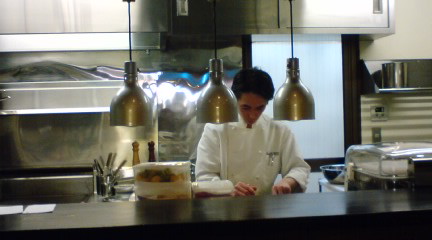
Apart of very comfortable tables and chairs, the restaurant has a beautiful counter where loners (and couples!) can enjoy thir meal almost in semi privacy while ogling at the chef working in his kitchen.

The view from the counter towards the entrance!

The other from the counter looking at Tetsya Sugimoto at work!

Testuya Sugimoto has a wine list all the more remarkable for its very reasonable prices when you consider the taste and combination of the available nectars.
As there was little chance of my guzzling down a full bottle, I just asked for a couple of glass of red wine.

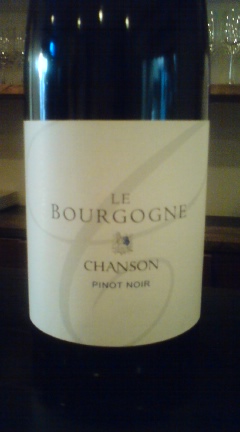
I was served a Bourgogne Pinot Noir 2007 by Chanson et Freres.
A bit young and tannic, but just what I needed!

Now, I didn’t even bother looking at the Sunday Lunch menu and set Courses. I had made sure to come late enough not to interfere with the restaurant’s business and asked Tetsuya in person (if you know him, he is very amenable and will accomodate all your priorities) what he could do with allthe vegetables he had on hand.
“OK!” was the terse reply, but he had realized that I had seen what vegetables were on offer!

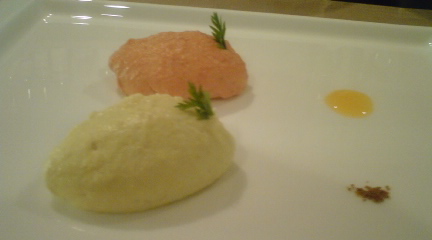
The little appetizer above is a combination of two different carrot mousses, red Kyo ninjin and yellow Kyo ninjin (Kyo stands for Kyoto-style, Ninjin for carrots) grown in Hamamatsu city. A dessert if there was one!

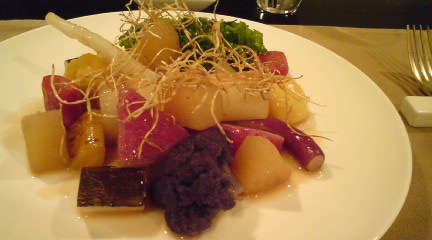
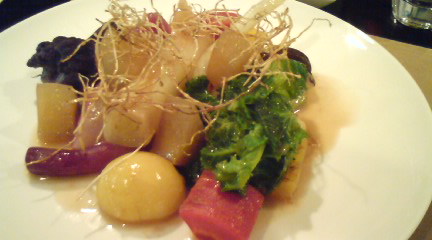
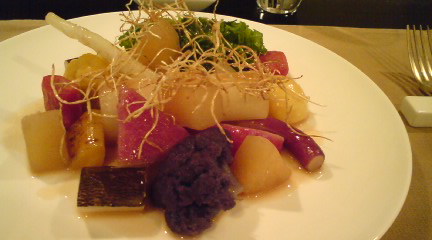
And then came the “platter” of sauteed vegetables!

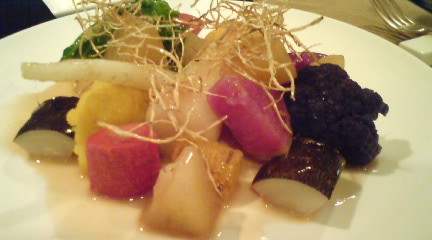
Viewed at a different angle!

And viewed form another angle again!

Testuya explained to me that all the vegetables were sauteed with a little oil, salt and pepper only. The sauce was formed nturally with water and the vegetables juices! Vegans, rejoice!

Now the vegetables were:
Yacon, Kuro Daikon (black-skinned daikon), Yellow and Violet Cauliflower, Aka Kyoninjin (red Kyoto-style carrots), Kiiro Kyoninjin (yellow Kyoto-style carrots), Hina no Kabu/long thin red and white turnip, Petit Vert Lettuce, Shiroi Kabu/White round turnips, andLeek/Poireau from Mr. Matsuki’s Biofarm in Shibakawa-Cho at the foot of Mount Fuji (the other vegetables are from Hamamatsu City).

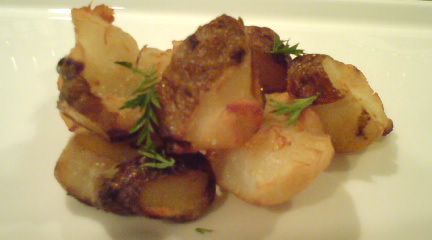
Testyya belatedly he had forgotten to include the topinambours from Hokkaido Island! He then prepared a small plate of sauteed topinambour in olive oil. Absolutely gorgeous!

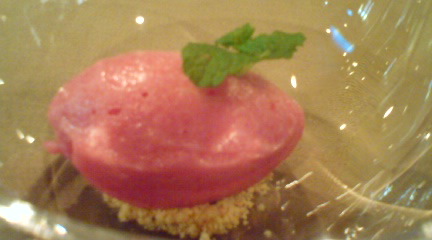
The deseert was a beautiful sorbet made with late-ripening apples from Hokkaido. The texture was reminiscent of apple compote. Delicious!

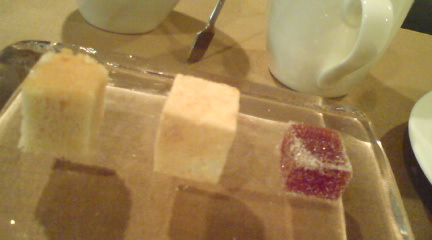
Coffee and mignardises!

For a better view of the mignardises!

My, my, now how much did you pay for that? You might ask.
40 US $, wine, coffe, bread and butter included!
I was so embarrassed I left a 10 US $ tip!

Tetsuya SUGIMOTO
420-0038 Shizuoka Shi, Aoi Ku, Umeya, 2-13, 1F
Tel./Fax: 054-251-3051
Open for lunch and dinner
Vegetarian and Vegan courses on order
Closed on Wednesdays
Credit Cards OK

RECOMMENDED RELATED SITES:
Bread + Butter, Comestilblog, Greedy Girl, Bouchon For 2, Zoy Zhang, Hungry Neko, Mangantayon, Elinluv Tidbit Corner, Maison de Christina, Chrys Niles, Lexi, Culinary Musings, Eats and Everything, Bite Me New England, Heather Sweet, Warren Bobrow, 5 Star Foodie, Frank Fariello, Oyster Culture, Ramendo, Alchemist Chef, Ochikeron, Mrs. Lavendula, The Gipsy Chef, Spirited Miu Flavor, Wheeling Gourmet, Chef de Plunge, Sushi Nomads, Chuckeats, Not-Just-Recipes, Bengal cuisine, Cooking Vegetarian, Gluten-free Vegan Family, Meatless Mama, Le Petit Cuisinier, Vegan Epicurean, Miss V’s Vegan Cookbook, To Cheese or not To Cheese, The Lacquer Spoon, Russell 3, Octopuspie, Pegasus Legend, Gourmet Fury

Please check the new postings at:
sake, shochu and sushi

—————————————-
日本語のブログ
—————————————-

French Cuisine: New Year Lunch at Pissenlit

Last Monday (I mean the 4th of July), we belatedly visited that favourite French restaurant of ours in Shizuoka City for the lunch out of the year.
I’ve already introduced that particular restaurant and his chef, Mr. Arima.
The prices are not only reasonable but the ingredients are simply extravagant.Moreover they are exclusively seasonal, be they from Shizuoka, Japan or abroad. A great emphasis is done on local bio bvegetables and one can expect a feast of colors!

Here what we enjoyed on tha particular day:

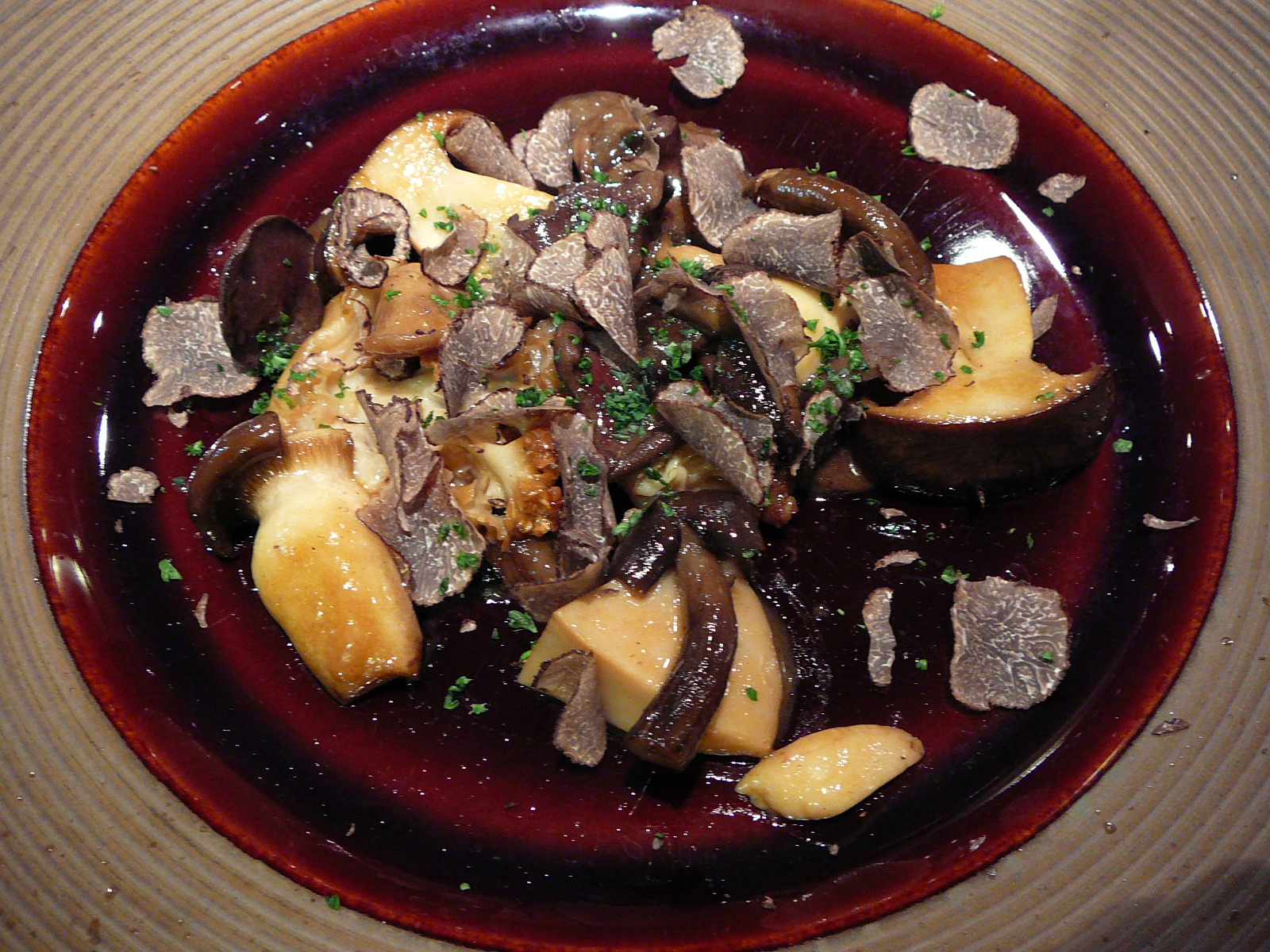
The Missus chose that beautiful plate of sauteed mushrooms topped with fresh truffles!

When I eat French food, I tend to a bit rustic. LOL.
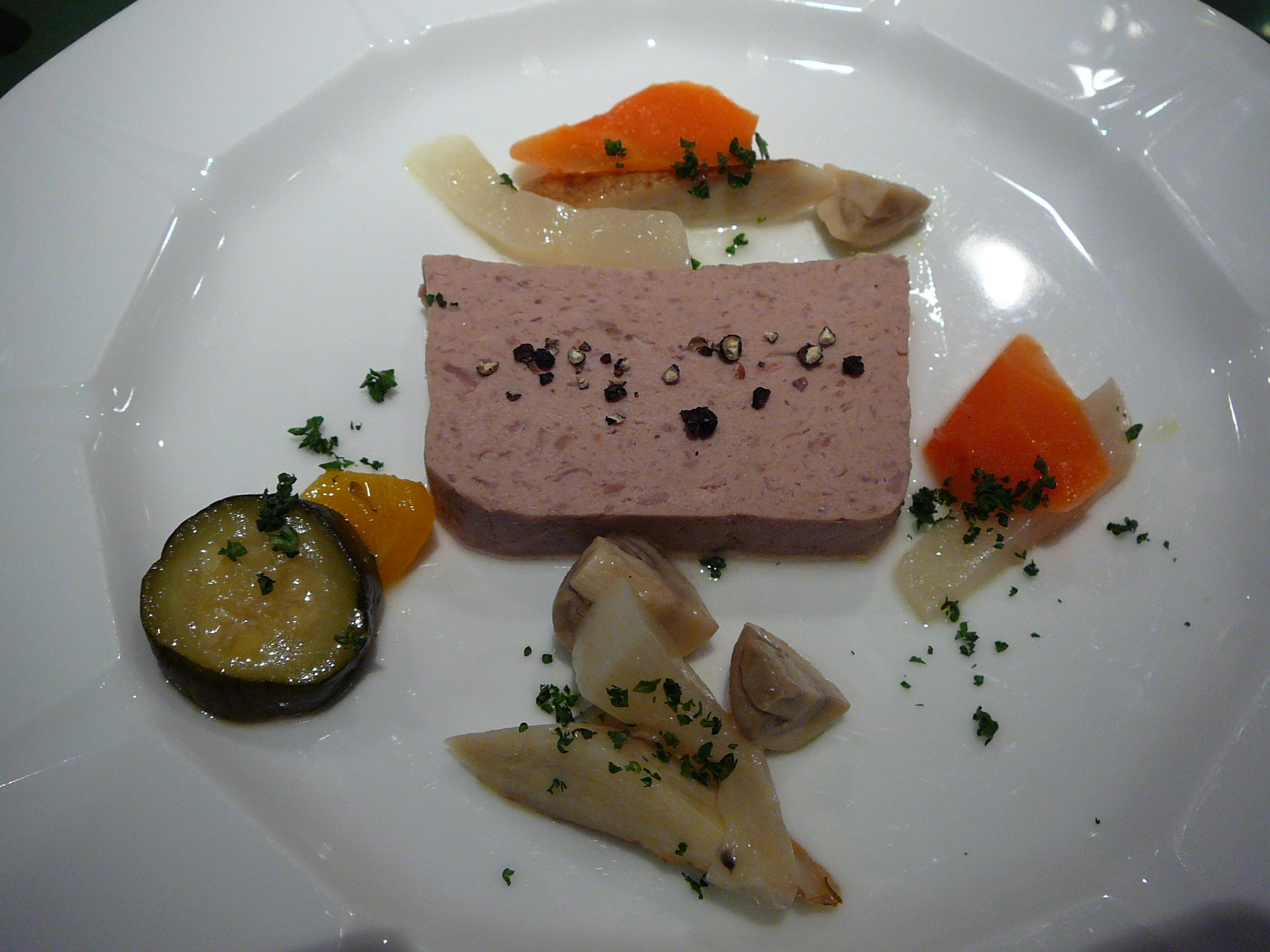
Simple but elegant and perfect chicken liver terrine!

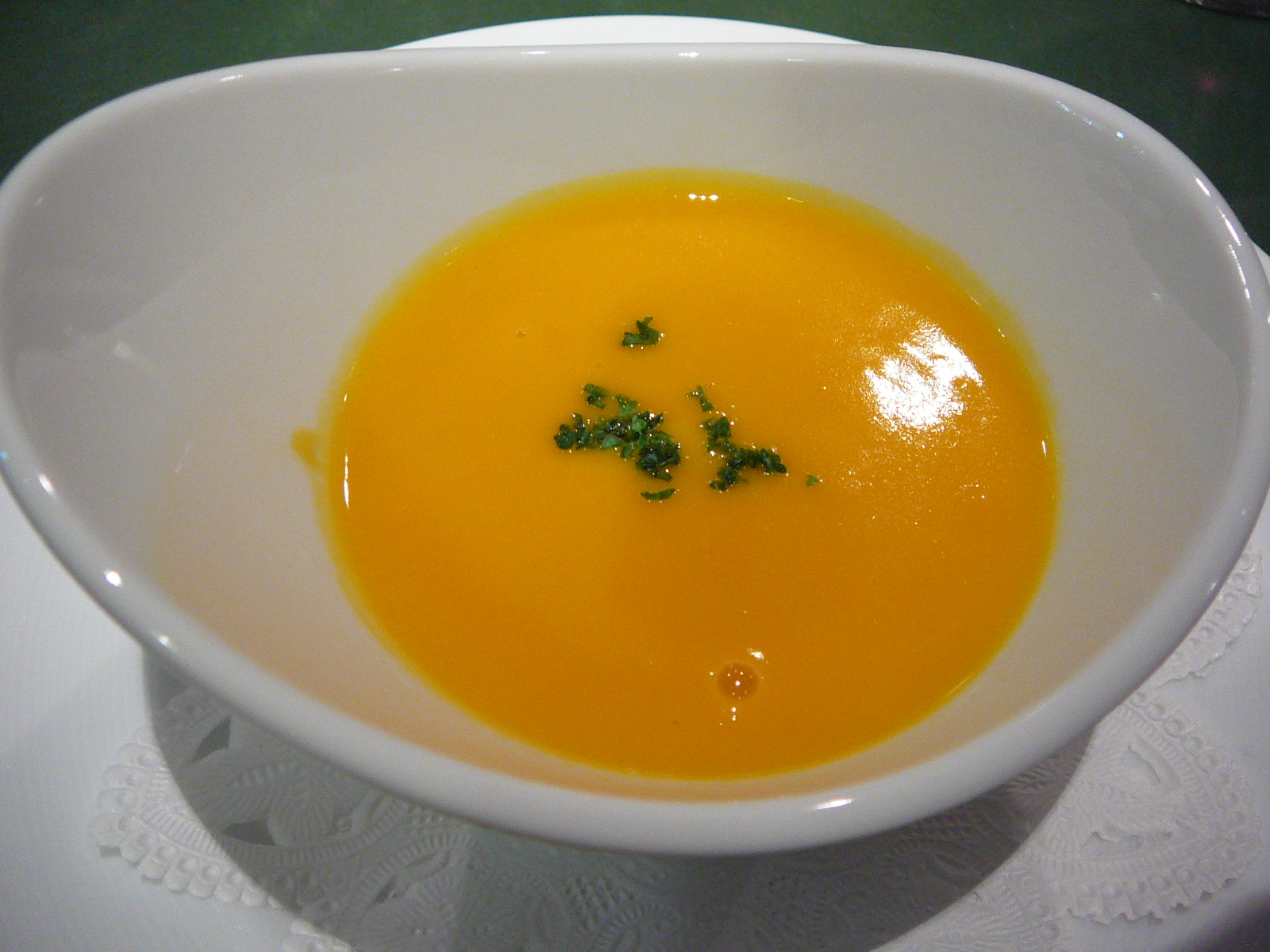
A beautiful kabocha cream for both of us before the main dish.

For once, we both opted for fish.
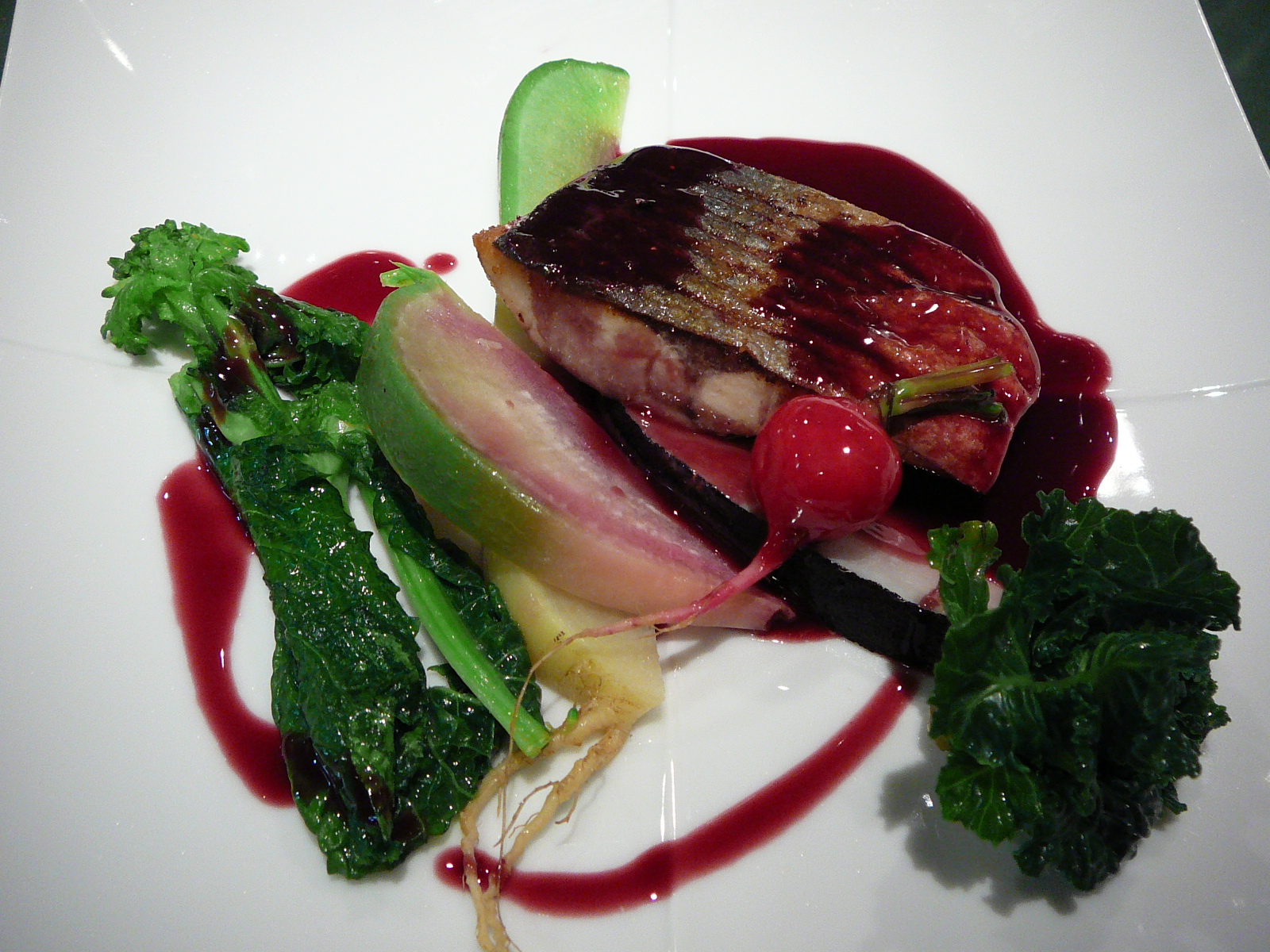
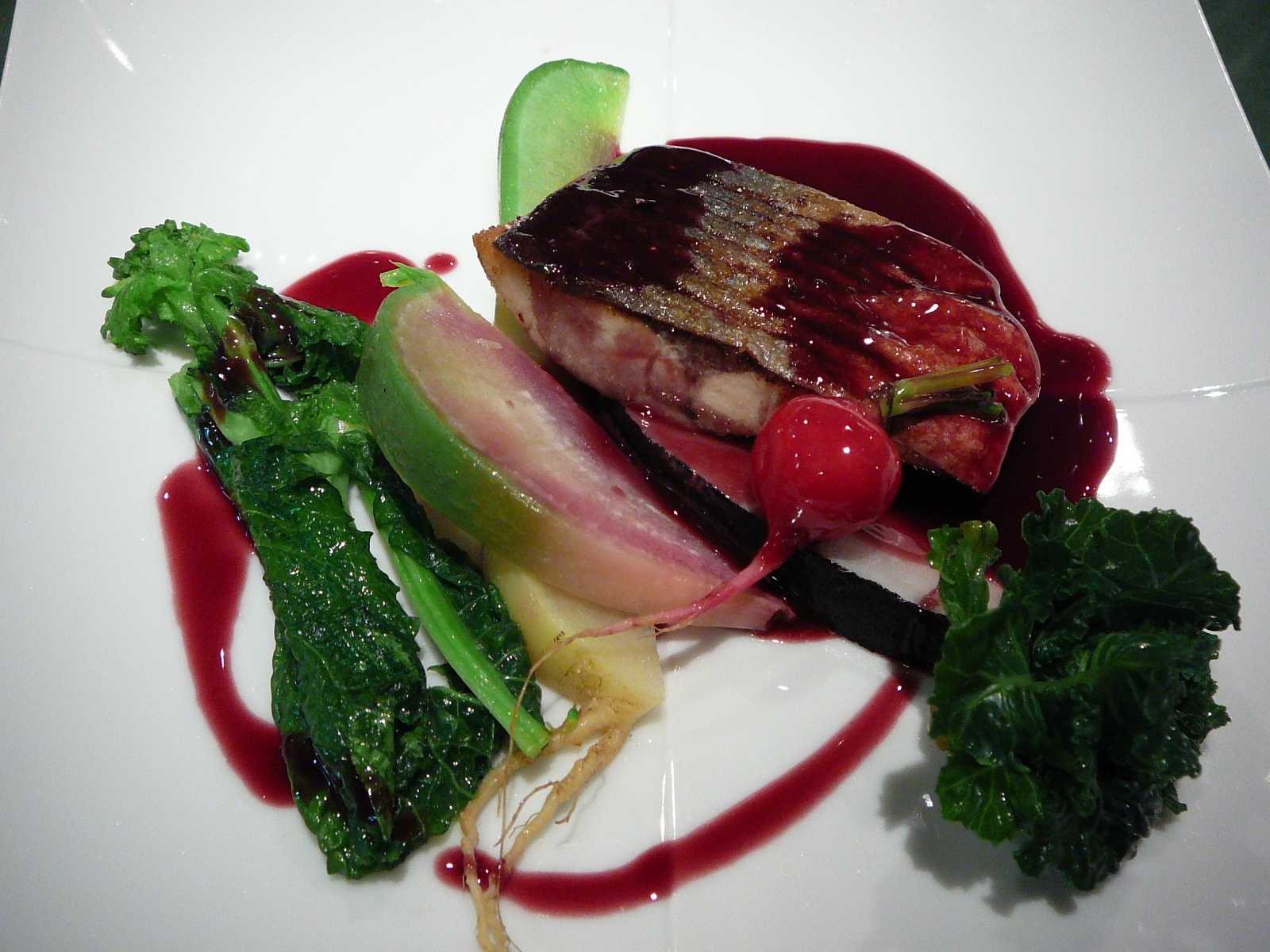
The Missus ordered sauteed “Sawara/Spanish Mackerel” with cassis sauce. Look at those veg!

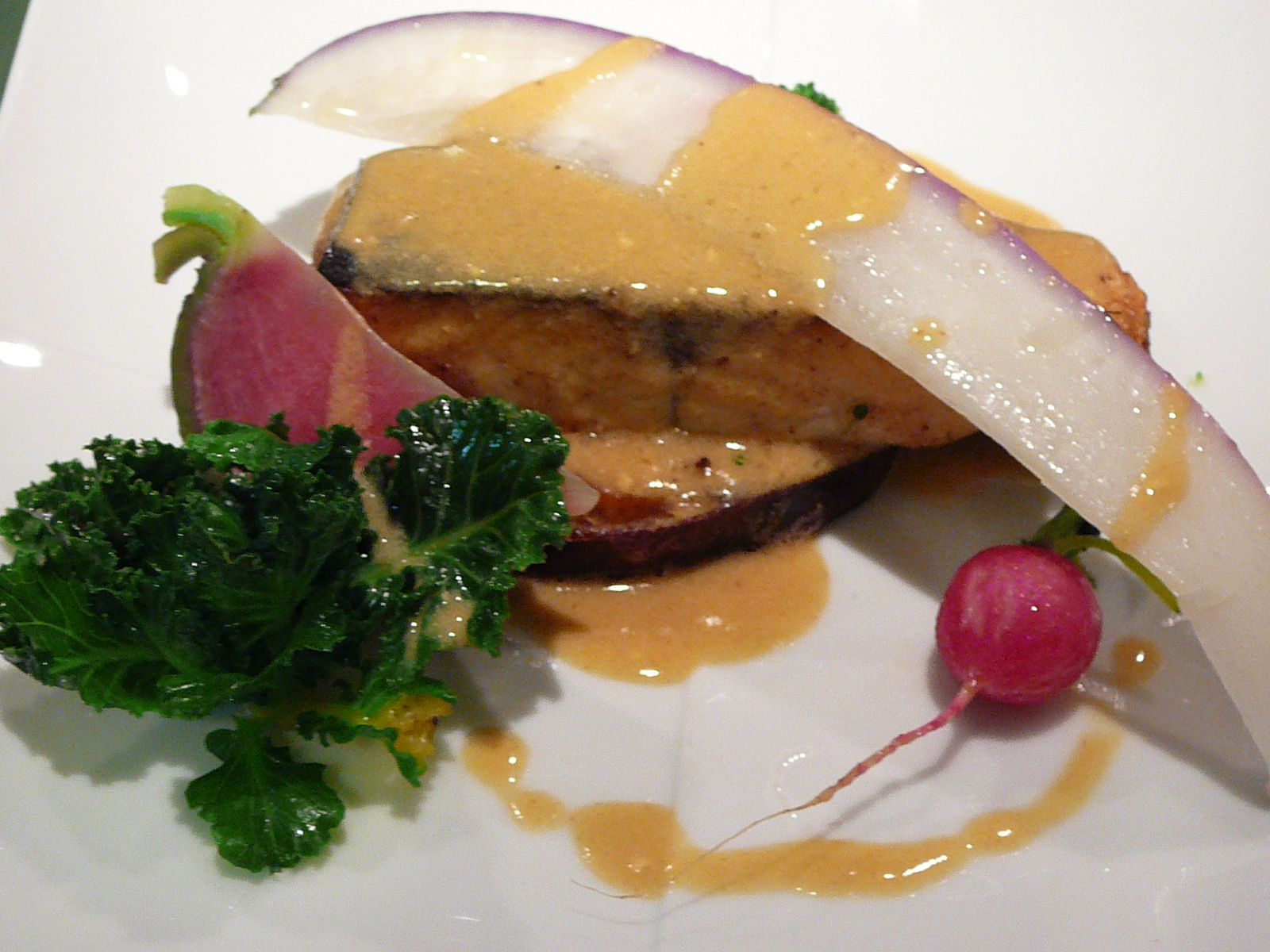
As for me, I devoured “Inada or young buri/yellowtail” sauteed and served with a dijon mustard cream sauce. Look at those veg again!

And it was time for dessert:
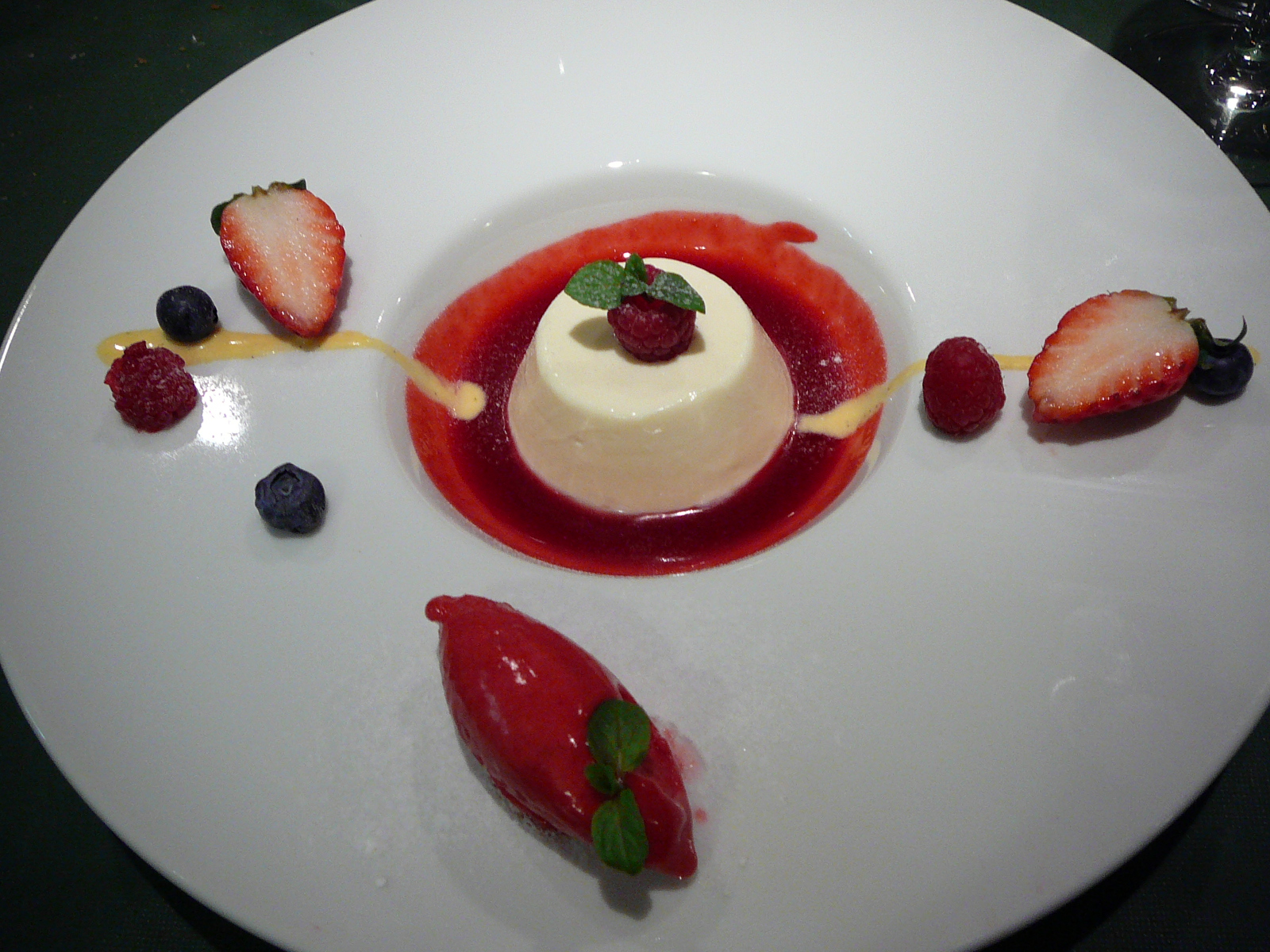
The Missus delved into Panacotta and raspberry sorbet.

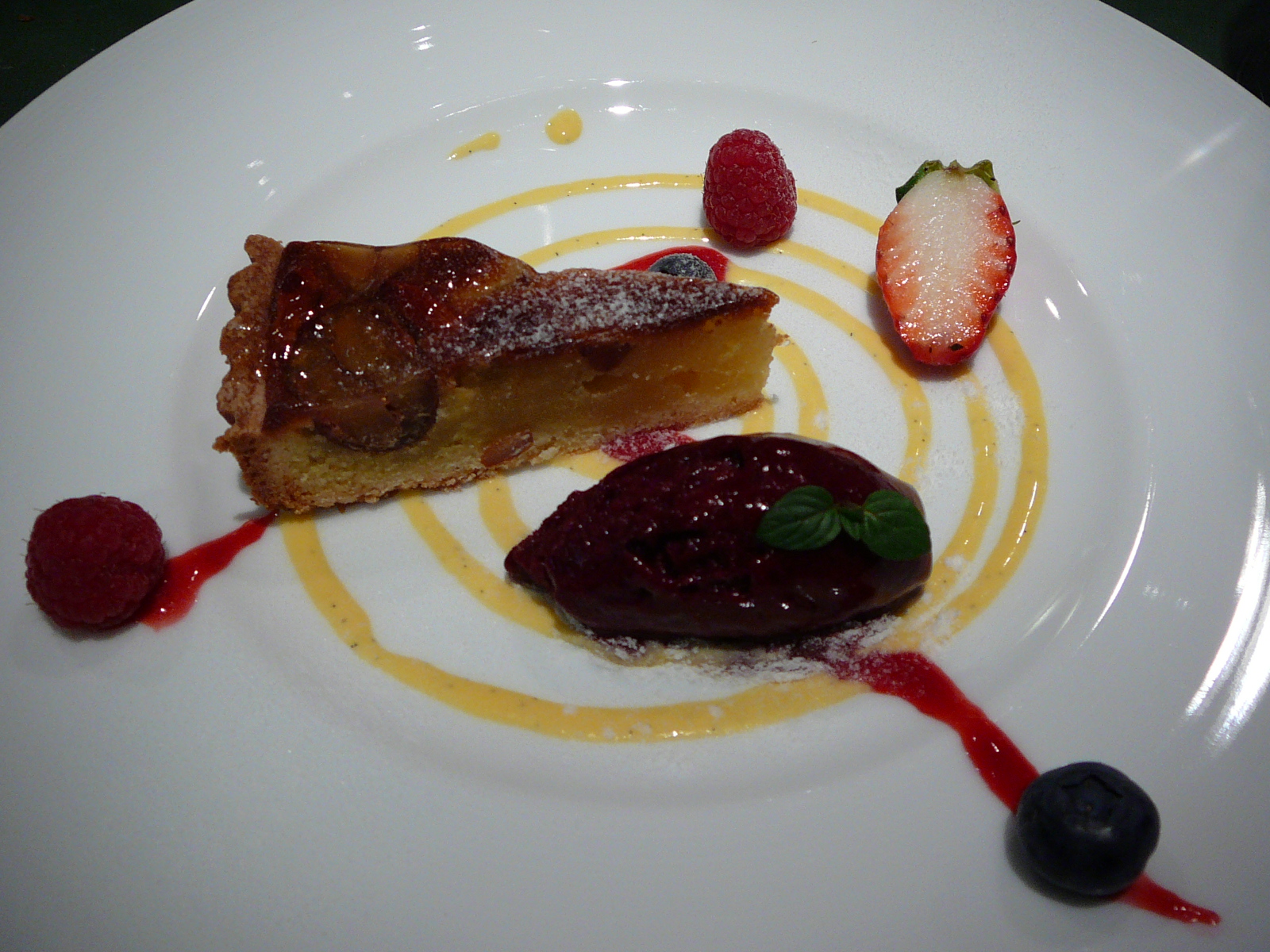
As for me, marrons and almonds tart with cassis sorbet.

Alright, alright, you want to know how much we paid for that?
30 US$ per person, bread, butter and coffee included.
We had 3 glasses of wine each. The total bill was 110 US$.
Worth it, wasn’t it?

PISSENLIT
420-0839 Shizuoka City, Aoi Ku, Takajo, 2-3-4
Tel.: 054-270-8768
Fax: 054-627-3868
Business hours: 11:30~14:30; 17:00~22:00
Closed on Tuesdays and Sunday evening
Homepage (Japanese)
Credit Cards OK

RECOMMENDED RELATED SITES:
Bread + Butter, Comestilblog, Greedy Girl, Bouchon For 2, Zoy Zhang, Hungry Neko, Mangantayon, Elinluv Tidbit Corner, Maison de Christina, Chrys Niles, Lexi, Culinary Musings, Eats and Everything, Bite Me New England, Heather Sweet, Warren Bobrow, 5 Star Foodie, Frank Fariello, Oyster Culture, Ramendo, Alchemist Chef, Ochikeron, Mrs. Lavendula, The Gipsy Chef, Spirited Miu Flavor, Wheeling Gourmet

Please check the new postings at:
sake, shochu and sushi

—————————————-
日本語のブログ
—————————————-

Korean Cuisine: Yakiniku Tare/Korean BBQ Sauce-Basic Recipes

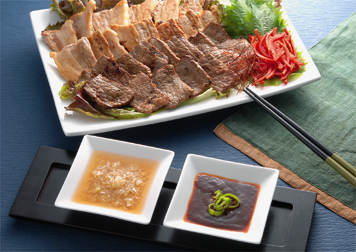
Choris Dow asked me for a recipe to prepare Yakiniku/Korean BBQ Sauce and I’m glad to oblige.
There are many styles, and I hope you will be able to expand on the below suggestions:

RECIPE 1 (left of above pic) :

-Salt: 4 teaspoons
-Water: 2 tablespoons
-Finely chopped thin leeks: 8 tablespoons
-Sesame oil: 8 tablespoons

Mix well. Can be used at once

RECIPE 2 (Right of above pic):

-Red miso paste: 4 tablespoons
-Gochujang: 4 tablespoons
-Sugar: 2 teaspoons
Sesame oil: 5 tablespoons

Mix well. Can be used at once.

RECIPE 3:

-Soy sauce: 3 tablespoons
-Sugar: 1 tablespoon
-Japanese sake: 1.5 tablespoons
-Grated fresh garlic: 1 tablespoon
-Finely chopped thin leeks: 3 tablespoons
-Ground sesame seeds: 1 teaspoon
-Sesame oil: 1 tablespoon

Let marinate for 20 minutes.

RECIPE 4:

-Soy sauce: 50 ml
-Mirin/Sweet sake: 1 tablespoon
-Sugar: 1 pinch
-Seasme oil: 1 tablespoon
-Chili powder: 1 teaspoon
-Freshly grated ginger: 2 cloves.

Mix well and let marimate a little.

RECIPE 5:

– Soy sauce: 50 ml
-Sugar: half a tablespoon~1 tablespoon
-Japanese sake: 3 tablespoons
-Sesame oil: 3 tablespoons
-Mirin/sweet sake: 2 tablespoons
-Freshly grated garlice: 2~3 cloves
-Finely chopped onion: 1/4
-Black pepper: a pinch

RECOMMENDED RELATED SITES:
Bread + Butter, Comestilblog, Greedy Girl, Bouchon For 2, Zoy Zhang, Hungry Neko, Mangantayon, Elinluv Tidbit Corner, Maison de Christina, Chrys Niles, Lexi, Culinary Musings, Eats and Everything, Bite Me New England, Heather Sweet, Warren Bobrow, 5 Star Foodie, Frank Fariello, Oyster Culture, Ramendo, Alchemist Chef, Ochikeron, Mrs. Lavendula, The Gipsy Chef, Spirited Miu Flavor

Please check the new postings at:
sake, shochu and sushi

—————————————-
日本語のブログ
—————————————-

Duck Breast: Basic Recipe & Presentation

duck-magret.jpg

Small picture, sorry!

Some people make a big story of cooking duck. It is quite simple, actually, especially with a minimum of preparation. It has the other advantage to be open to an infinite array of variations!

The pic above was for one person. As I cooked it for both of us, just imagine that there was another identical plate.
Here is how I proceded:

INGREDIENTS:

-1 large duck breast (can be ordered easily over the Internet)
-Olive oil 3 tablespoons
-Whisky 3 “caps” (I use the bottle cap)
-Port wine (or any sweeet red wine) half a cup (100cc)
-Cold butter 2 large tablespoons
-Salt and pepper to taste

-6 small potatoes cut in “wedges”
-1 large tablespoon of olive oil

-Half a cup (100cc) of green “flageolet” beans (fine green beans)
-1 tablespoon of baby onions (frozen ar fine)
-1 rasher of bacon cut to the size of your largest nail (LOL)
-Salt, pepper, thyme to taste (careful with the salt as I mixed the veg with a little gravy from the duck!)

-Fine greens (small leaves: you can buy them already mixed and packed
-Dressing of your choice (easy on it, or it will spill onto the duck!)

RECIPE:

-Take skin off duck breast and discard. For people who cannot without it, make shallow incisions all over it, sprinkle with a little salt and pepper, brush it lightly and fry it skin facing down for 80% of the cooking time!)

-Sponge off humidity with kitchen paper towel and put it aside.

-Boil potatoes to about “80% cooked” (their core should be still solid), cool immediately under cold water, peel and cut in wedges (not stiks of fries!)

-In small deep pan fry bacon with no oil until the pieces are crispy. Put aside on small plate. Don’t wash the pan. Pour in half a cup (100cc) of water and boil beans. When beans are ready, there should be little water left. Mix in thawed baby onions and bacon. Do Not season yet.
Keep of fire and cover

-Now you will work with two frypans at the same time. Be careful and keep in mind that if the oil becomes too hot, it might ignite, so keep a large towel handy (last time I almost started a fire. Luckily I had the reflex to cover the frypan with the towel. The fire extinguished immediately. NEVER try to extinguish with water as it will explode in your face!).
On your right (unless you are left-handed), pour the oil for the fried potatoes. It does need to be too hot. Throw potatoes in and let fry, shaking them around from time to time. Fry them until they are golden (use a non-stick pan and the results will delight you!)
On your left, heat the oil for the duck. It needs to be quite hot. Place duck breast in middle. Sprinkle salt and pepper all over it according to your preference. Fry both sides for 30 seconds. Turn down the fire to medium and carefully pour in the whisky (not cap by cap but with a small glass you would have filled before hand). Let the whisky ignite and shake the duck breast around until the flames have extinguished. Lower the fire a bit more and cover with lid.
How do you know the duck is cooked. When you press it with a finger, it should pop back easily with a little gravy/juice seeping out. Experience helping your eyes will be enough to judge when the time is right. Do not worry if you find out that some of the middle of the duck breast does not seem cooked enough. Some people like it well cooked while others like it rare. You can always choose the slices according to taste. Purist like it almost raw in its centre, though.
When the breast is cooked, put it on a cutting board. You will cut it at the llast minute.

-Add some of the gravy to the beans and reheat to your preference.

-On two large plates decorate the top third with greens (see pic above). You will add the dressing on top just before serving.

-Pour the Port wine into the frying pan and stir it with the gravy. reduce it on small fire.

-The fried potatoes should be ready by now. While the sauce is reducing, place the potatoes side by side in half a circle. As you will place the duck slices over it, there is no need to season them.

-Once the gravy has reduced enough, mix in the cold butter until smooth. it will prevent the sauce from “separating). Taste and season it if needed.
-Cut the duck breast into thin slices and place them side by side on top of the fried potatoes (see pic)

-With a tablespoon, place beans like on the pic.

-Pour gravy onto the duck slices.

-Sprinkle greens with dressing and serve.
If you are a wine fan, serve this dish with a full bodied red.

VARIATIONS:

I add some some finely cut parsley and basil to the beans at the last time. some finely cut thin leeks sprinkled over the duck slices look good. You can add some red colour with thinly cut tomatoes on both sides of or around the beans.

duckbreast

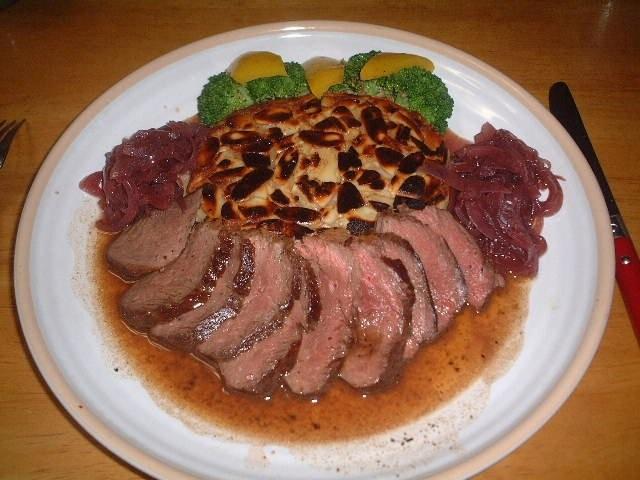
Here is another presentation: Potato Gratin in the middle and onions confit on the sides.
I made the sauce lighter for this particular one!

p1010542

Another one again!
The potato wedges were cooked separately as well as the eringe mushroms slices in the middle with cauliflower first boiled, then sauteed.

Enjoy!

RECOMMENDED RELATED SITES:
Bread + Butter, Comestilblog, Greedy Girl, Bouchon For 2, Zoy Zhang, Hungry Neko, Mangantayon, Elinluv Tidbit Corner, Maison de Christina, Chrys Niles, Lexi, Culinary Musings, Eats and Everything, Bite Me New England, Heather Sweet, Warren Bobrow, 5 Star Foodie, Frank Fariello, Oyster Culture, Ramendo, Alchemist Chef, Ochikeron, Mrs. Lavendula, The Gipsy Chef, Spirited Miu Flavor

Please check the new postings at:
sake, shochu and sushi

—————————————-
日本語のブログ
—————————————-

Vegetarian French Cuisine: Dad’s Cream Mushrooms

cream-mushrooms.gif

We are still in mushrooms season, wild ones or cultivated species, fresh, dehydrated or frozen. Mushrooms are low in calories, but high in quality, whether it concerns taste or nutrients.
Some people have told me that mushrooms cannot be frozen. This is a fallacy. Full stop.
I personally receive frozen chanterelles, trompettes and what else from the internet and I can assure they are delicious.

Here is the recipe of a dish my father (85) cooked for us last time I came back home in Burgogne, France. It was made with exclusively frozen mushrooms! It can accompany any meat, especially white-flesh meat, or can be appreciated on its own paired with a solid white wine or heady Japanese sake.
Great for vegetarians! Vegans can accomodate it witheir own substitutes, too.

INGREDIENTS: For 3~4 people

-Mixed mushrooms of your choice, fresh or frozen (if frozen, let them thaw slowly inside refrigerator for a few hours and get rid of excess water, although the same water can be used with the sauce!): 500g
-Shallots (echalottes): 2 finely chopped
-Garlic: 2~3 cloves finely chopped (crush garlic before chopping it. Do not forget to discard core!)
-Parsley or Italian flat parsley: half a cup finely chopped
-Fresh cream: 200cc/1 cup
-Madeira wine: 50cc (yellow port is fine, too, as well as sweet sherry)
-Olive oil and unsalted butter: about 2 large spoons of each
-Salt, pepper, nutmeg (to taste)

RECIPE:

-On a medium fire in large frypan melt an equal quantity of olive oil and unsalted butter (some people prefer more, some less. Experiment!).
Throw in the shallots and garlic and slowly fry until shallots turn transparent. Throw in all the mushrooms and fry until they give back enough water.
Add Madeira wine. Stir well.
Next add fresh cream and stir until cream is perfectly blended.
Add salt, peeper and nutmeg last, stir.
Check taste and add more spices if needed.

Pour the whole in a large dish and sprinkle parsley over the mushrooms before serving.

Eat hot.

RECOMMENDED RELATED SITES:
Bread + Butter, Comestilblog, Greedy Girl, Bouchon For 2, Zoy Zhang, Hungry Neko, Mangantayon, Elinluv Tidbit Corner, Maison de Christina, Chrys Niles, Lexi, Culinary Musings, Eats and Everything, Bite Me New England, Heather Sweet, Warren Bobrow, 5 Star Foodie, Frank Fariello, Oyster Culture, Ramendo, Alchemist Chef, Ochikeron, Mrs. Lavendula, The Gipsy Chef, Spirited Miu Flavor

Please check the new postings at:
sake, shochu and sushi

—————————————-
日本語のブログ
—————————————-

For Vegan and Vegetarians! “Forgotten” Vegetables 24: Pepino/Poire-Melon

SYNOPSIS:
Organic agriculture and biodiversity have in recent years brought about a rediscovery of many “forgotten” vegetables that people especially in Europe and France conscientiously tried to forget as they reminded them of the privations suffered during WWII. The same people had then to make do with untraditional vegetables because potatoes, carrots and so on were confiscated by occupying forces or their own armies.
With sustainibility and bioagriculture made more important by the deficiencies of modern mass agriculture, those “forgotten” vegetables have suddenly come to the fore for the pleasure of all, and that of course of vegetarians and vegans!

This particular series of postings will introduce these vegetables one by one. I hope they will become useful for a long time to come to all my vegan and vegetarian friends!
1) Scorsonere/Oyster Plant, 2)Potimarron, 3) Vitelotte, 4) Rutabaga, 5) Cardon, 6) Panais/Parsnips , 7) Patisson, 8) Topinambour, 9) Crosne, 10) Cerfeuil Tubereux, 11) Poiree, 12) Oca, 13) Ulluque/Ulluco, 14) Tigernuts, 15) Capucine tubereuse-Maschua, 16) Chataigne de Terre-Great Pignut, 17) Yacon, 18) Balsamite/Costmary, 19) Sikkim Cucumber, 20) Tree Spinach, 21) Chayote, 22) Strawberry Blite, 23) Purslane

Here is a palnt that can be considered both as a vegetable and a fruit depending upon its maturity.
Also considered as a great ornamental plant!

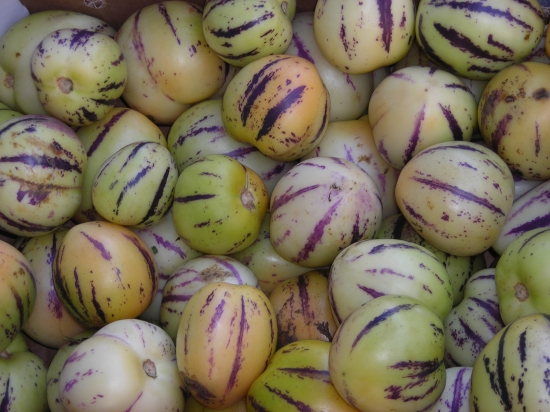
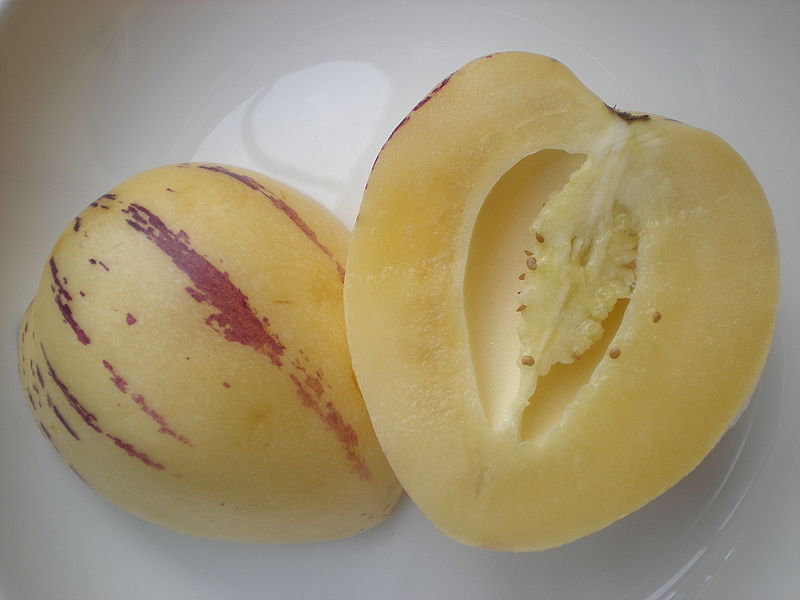
Pepino (Spanish/English) or Poire-melon (pear-melon in French) or Solanum muricatum in Latin is a species of evergreen shrub native to South America and grown for its sweet edible fruit. It is known as pepino dulce (“sweet pepino”) or simply pepino.
The pepino dulce fruit resembles a melon (Cucumis melo) in color and flavor and thus it is also called pepino melon or melon pear, but pepinos are only distantly related to melons and pears.
Another common name, “tree melon”, is more often used for the Papaya (Carica papaya) and the pepino dulce plant does generally not look much like a tree.
The fruit is common in markets in Colombia, Ecuador, Bolivia, Peru and Chile, but less often overseas because it is quite sensitive to handling and does not travel well. Attempts to produce commercial cultivars and to export the fruit have been made in New Zealand and Chile.
They are being increasingly grown in Europe, France and Belgium in particular, where they can be found in all kinds of dishes.
Moreover, in the United States the fruit is known to have been grown in San Diego before 1889 and in Santa Barbara by 1897.

The plant is grown primarily in Chile, New Zealand and Western Australia. In Chile, more than 400 hectares are planted in the Longotoma Valley with an increasing proportion of the harvest being exported. Colombia, Peru, and Ecuador also grow the plant, but on a more local scale. Outside of the Andean region, it been grown in various countries of Central America, Morocco, Spain, Israel, and the highlands of Kenya. In the United States several hundred hectares of the fruit are grown on a small scale in Hawaii and California. More commercially viable cultivars have been introduced from New Zealand and elsewhere in more recent times. As a result, the fruit has been introduced into up-scale markets in Japan, Europe and North America and it is slowly becoming less obscure outside of South America.

Pepino and kiwano salad

It is a vegetable/fruit valuable for its vitamin C as it contains 29 mg per 100 g.
Depending on its maturity, its taste varies from a slightly sweet cucumber to that of a pear or melon.
Most adapted to salads, although can be cooked when immature.

RECOMMENDED RELATED SITES
Not-Just-Recipes, Bengal cuisine, Cooking Vegetarian, Frank Fariello, Gluten-free Vegan Family, Meatless Mama, Warren BobrowBreakfast, Lunch, Dinner and Punch, Kirsten’s Kitchen, Vegan Epicurean

——————————–
Please check the new postings at:
sake, shochu and sushi

—————————————-
日本語のブログ
—————————————-

For Vegan and Vegetarians! “Forgotten” Vegetables 23: Purslane

SYNOPSIS:
Organic agriculture and biodiversity have in recent years brought about a rediscovery of many “forgotten” vegetables that people especially in Europe and France conscientiously tried to forget as they reminded them of the privations suffered during WWII. The same people had then to make do with untraditional vegetables because potatoes, carrots and so on were confiscated by occupying forces or their own armies.
With sustainibility and bioagriculture made more important by the deficiencies of modern mass agriculture, those “forgotten” vegetables have suddenly come to the fore for the pleasure of all, and that of course of vegetarians and vegans!

This particular series of postings will introduce these vegetables one by one. I hope they will become useful for a long time to come to all my vegan and vegetarian friends!
1) Scorsonere/Oyster Plant, 2)Potimarron, 3) Vitelotte, 4) Rutabaga, 5) Cardon, 6) Panais/Parsnips , 7) Patisson, 8) Topinambour, 9) Crosne, 10) Cerfeuil Tubereux, 11) Poiree, 12) Oca, 13) Ulluque/Ulluco, 14) Tigernuts, 15) Capucine tubereuse-Maschua, 16) Chataigne de Terre-Great Pignut, 17) Yacon, 18) Balsamite/Costmary, 19) Sikkim Cucumber, 20) Tree Spinach, 21) Chayote, 22) Strawberry Blite

It is my new Foodbluzz Friend, Wizzy, who attracted my attention on this vegetable, being notably forgotten in the States but entertaining a groeing popularity elsewhere.
I decided to investigate further as I recently had the opportunity to taste recently in Japan!

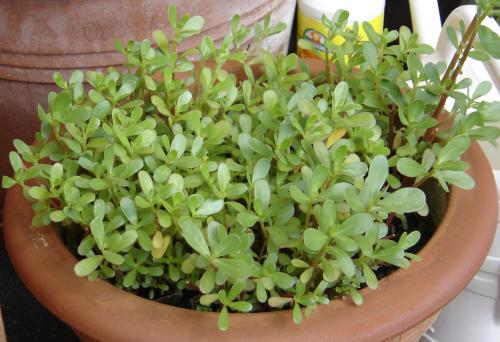
Purslane cultivation

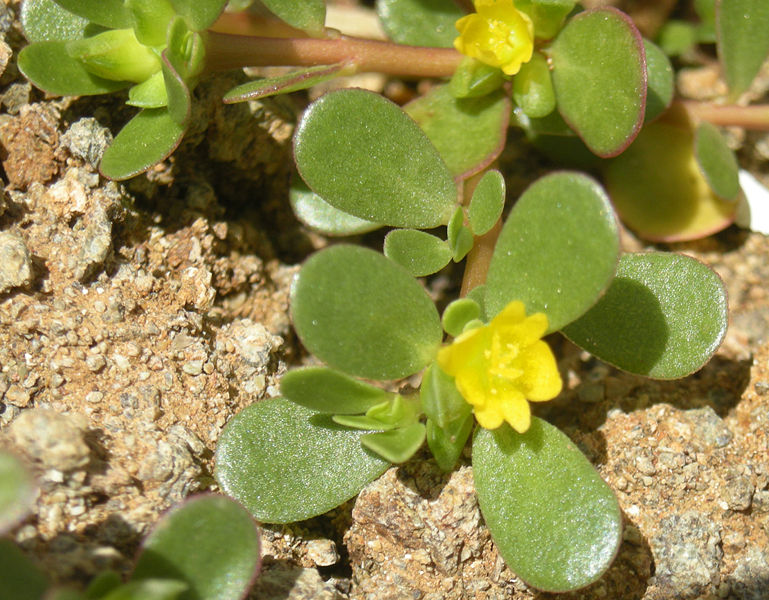
Portulaca oleracea (Common Purslane, also known as Verdolaga, Pigweed, Little Hogweed or Pusley), is an annual succulent in the family Portulacaceae, which can reach 40 cm in height. About 40 varieties are currently cultivated. It has an extensive old-world distribution extending from North Africa through the Middle East and the Indian Subcontinent to Malesia and Australasia. The species status in the New World is uncertain: it is generally considered an exotic weed; however, there is evidence that the species was in Crawford Lake deposits (Ontario) in 1430-89, suggesting that it reached North America in the pre-Columbian era. It is naturalised elsewhere and in some regions is considered an invasive weed. It has smooth, reddish, mostly prostrate stems and alternate leaves clustered at stem joints and ends. The yellow flowers have five regular parts and are up to 6 mm wide. The flowers appear depending upon rainfall and may occur year round. The flowers open singly at the center of the leaf cluster for only a few hours on sunny mornings. Seeds are formed in a tiny pod, which opens when the seeds are ready. Purslane has a taproot with fibrous secondary roots and is able to tolerate poor, compacted soils and drought.

Although purslane is considered a weed in the United States, it can be eaten as a leaf vegetable, providing sources can be found which have not been poisoned deliberately. It has a slightly sour and salty taste and is eaten throughout much of Europe, Asia and Mexico. The stems, leaves and flower buds are all good to eat. Purslane can be used fresh as a salad, stir-fried, or cooked like spinach, and because of its mucilaginous quality it is also suitable for soups and stews. Australian Aborigines used to use the seeds to make seedcakes.

Purslane contains more Omega-3 fatty acids (alpha-linolenic acid in particular) than any other leafy vegetable plant. It also contains vitamins (mainly vitamin A, vitamin C, and some vitamin B and carotenoids), as well as dietary minerals, such as magnesium, calcium, potassium and iron.
It also helps combat ageing as containing antioxydants.

In Greek popular medicine, purslane is used as a remedy for constipation and inflammation of the urinary system.

A common plant in parts of India, purslane is known as “Sanhti”, “Punarva”, or “Kulfa”. In North India it is known to act as a liver tonic and is used in diseases of the liver.

YASAITEI-VEGAN4

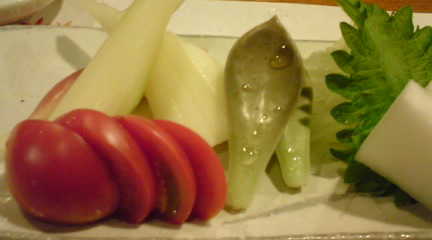
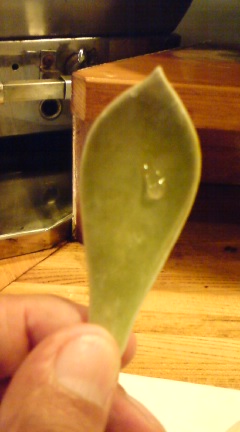
I n japan they are called Grapara leaves (grapara/グラパラ)
Can you see them in the middle of this vegetable sashimi served at yasaitei?

YASAITEI-VEGAN6

These grapara leaves are grown in Chiba Prefecture, north of Tokyo.
For people who can read Japanese, check their homepage!

YASAITEI-VEGAN7

Crunchy but with a juicy and tender inside, they are sweet and taste somewhat like pineapple!

YASAITEI
Shizuoka City, Aoi Ku, Tokiwa-Cho, 1-6-2 Green Heights Wamon 1-C
Tel.: 054-2543277
Business hours: 17:30~22:00
Closed on Sundays
Reservations highly recommended
Seating: 6 at counter + 20 at tables
Set Courses: 3,000, 4,000, 5,000 yen
HOMEPAGE (Japanese)

RECOMMENDED RELATED SITES
Not-Just-Recipes, Bengal cuisine, Cooking Vegetarian, Frank Fariello, Gluten-free Vegan Family, Meatless Mama, Warren BobrowBreakfast, Lunch, Dinner and Punch, Kirsten’s Kitchen, Vegan Epicurean

——————————–
Please check the new postings at:
sake, shochu and sushi

—————————————-
日本語のブログ
—————————————-

For Vegan and Vegetarians! “Forgotten” Vegetables 22: Epinard-Fraise/Strawberry Blite

SYNOPSIS:
Organic agriculture and biodiversity have in recent years brought about a rediscovery of many “forgotten” vegetables that people especially in Europe and France conscientiously tried to forget as they reminded them of the privations suffered during WWII. The same people had then to make do with untraditional vegetables because potatoes, carrots and so on were confiscated by occupying forces or their own armies.
With sustainibility and bioagriculture made more important by the deficiencies of modern mass agriculture, those “forgotten” vegetables have suddenly come to the fore for the pleasure of all, and that of course of vegetarians and vegans!

This particular series of postings will introduce these vegetables one by one. I hope they will become useful for a long time to come to all my vegan and vegetarian friends!
1) Scorsonere/Oyster Plant
2)Potimarron
3) Vitelotte
4) Rutabaga
5) Cardon
6) Panais/Parsnips
7) Patisson
8) Topinambour
9) Crosne
10) Cerfeuil Tubereux
11) Poiree
12) Oca
13) Ulluque/Ulluco
14) Tigernuts
15) Capucine tubereuse-Maschua
16) Chataigne de Terre-Great Pignut
17) Yacon

18) Balsamite/Costmary
19) Sikkim Cucumber
20) Tree Spinach
21) Chayote

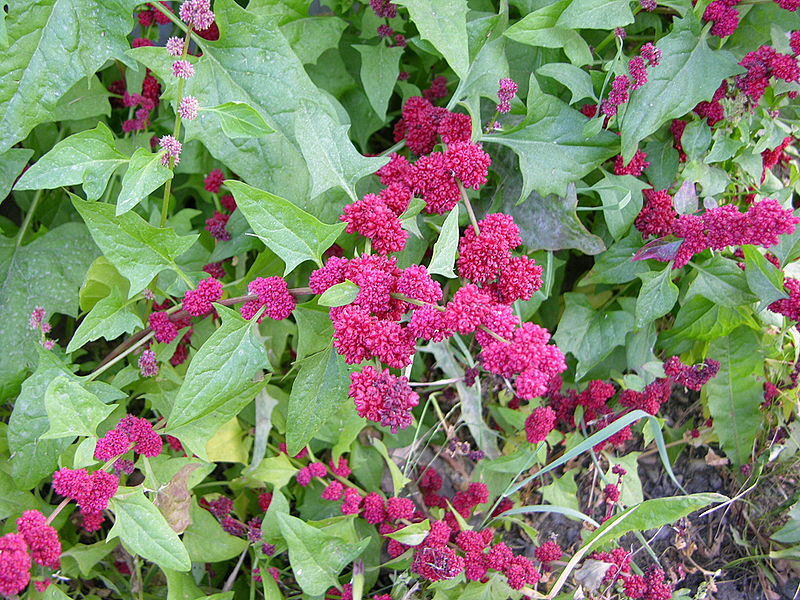
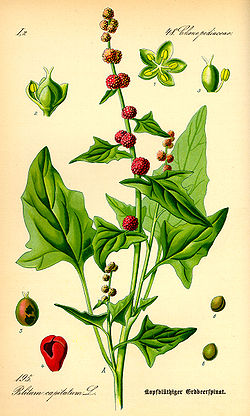
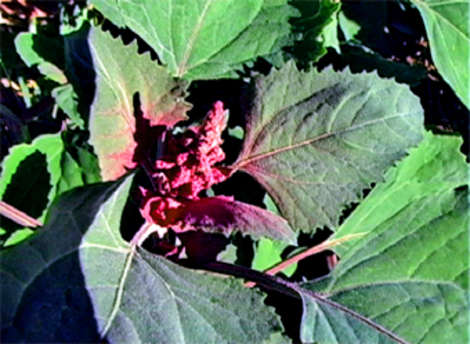
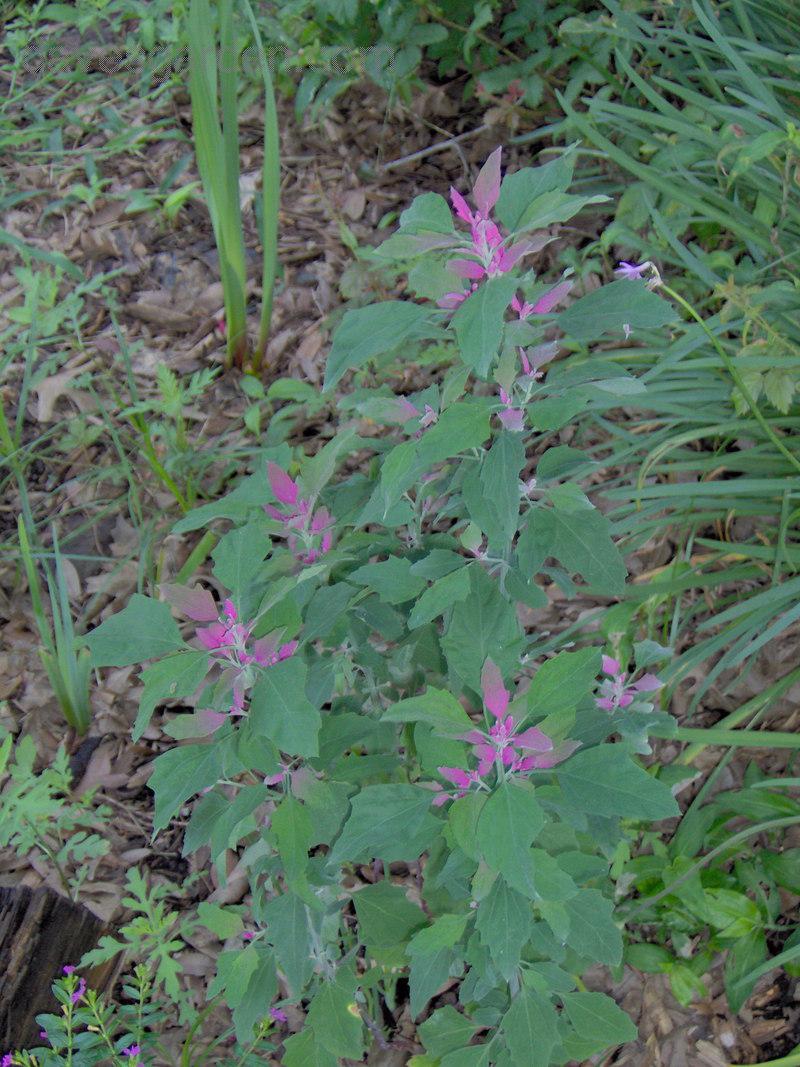
Strawberry Blite (Chenopodium capitatum, Blitum capitatum), or Epinard-Fraise in French (Spinach Strawberry) is an edible annual plant, also known as Blite Goosefoot, Strawberry Goosefoot, Strawberry Spinach, Indian Paint, and Indian Ink.

It is native to most of North America throughout the United States and Canada, including northern areas.
It is also found in parts of Europe and New Zealand.
Strawberry Blite is found in moist mountain valleys.
Some farmers and hobbyists are growing them in France.

Flowers are small, pulpy, bright red and edible, resembling strawberries. The juice from the flowers was also used as a red dye by natives.
The fruits contain small, black, lens-shaped seeds that are 0.7-1.2 mm long.
The Plant is small (30 cm=1 foot) and leaves are small too, but can be eaten like spinach. The harvest lasts all Autumn.
Probably best with the fruit added to salads!
Can also be adapted as sauce or coulis.

RECOMMENDED RELATED SITES
Not-Just-Recipes, Bengal cuisine, Cooking Vegetarian, Frank Fariello, Gluten-free Vegan Family, Meatless MamaFrank Fariello, , Warren Bobrow

Please check the new postings at:
sake, shochu and sushi

—————————————-
日本語のブログ
—————————————-

Fried Potatoes, the healthier and tastier way!

fried-potatoes

Fried potatoes have been temptying us since the 17th Century when the Belgians first experimented cooking them in oil. At the time, deep-frying, imported by Crusaders from the Middle East, was the only absolutely safe way to cook, especially in the “flat countries” as Belgium and Holland were called at the time, because water was a bed for all kinds of diseases.

Now, eveyone knows that boiled potatoes are healthy, if somewhat bland in taste, whereas fried potatoes are tasty but hideously high in unwanted calories.
Time and again I use a simple method half way which will enable you to enjoy your favourite snack/main dish with a lighter heart (and midriff) and at the same time allow you to serve a savoury dish to your ravenous friends or family! (But don’t overeat them!)

INGREDIENTS
(for 2 to 4, depending whether it is an accompaniment or full dish):

-4 large potatoes
-1 large echalotte/shallot (if unavailable, half a red onion is great!), finely chopped
-3 cloves of garlic, finely chopped
-Bacon (vegan and vegetarians, please skip this but keep in mind you will have to add a little salt)-1 large rasher cut in small pieces (half a cm square or half the size of your little finger nail, cut short!)
-Parmesan/Parmiggiano Cheese (vegans, please skip this or use alternative), freshly grated, 3 large tablespoons.
-Salt (for the potatoes boiling water, otherwise as little as possible, as bacon and cheese will contain enough!)
-Pepper, nutmeg. Foodies who like their food Indian-style may add a little powdered curry mix and chili pepper.
-Olive oil: 2 large tablespoons

RECIPE:

-Boil potatoes in plenty of salted water. If you do not add salt to the water, the potatoes will end up very bland in taste.

-Once the potates are boiled at about 80%, plunge them into cold water. This little trick will prevent them from breaking up later.

-When potatoes are cold enough, peel and cut them in wedges (the size is up to you). If the potatoes are new,leave the skin on.

-In deep enough frying pan dry-fry (no oil added) the chopped bacon until it becomes a nice crisp and dark. Put aside on a small dish. For non-vegan/vegetarians, do not wipe the pan, or you will miss a lot of taste!

-Pour two large tablespoons of olive oil in the same frying pan. That is enough, and the oil will be “sucked in” by the potatoes with the result that the potatoes will not be “greasy”. Use olive oil, extra virgin, as this is best, not only for taste, but for health (the vitamin C contained in olive oil do not disappear even cooked for a long time).

-When potatoes have almost reached the wanted colour, drop in shallots, garlic, fried bacon, pepper, nutmeg (and salt if you absolutely must use some!). Toss-fry until shallots have turned transparent.

-Pour the lot into a serving dish and sprinkle parmesan over it.

Enjoy at once!

Sometimes, simple is best!

RECOMMENDED RELATED SITES:
Bread + Butter, Comestilblog, Greedy Girl, Bouchon For 2, Zoy Zhang, Hungry Neko, Mangantayon, Elinluv Tidbit Corner, Maison de Christina, Chrys Niles, Lexi, Culinary Musings, Eats and Everything, Bite Me New England, Heather Sweet, Warren Bobrow, 5 Star Foodie, Frank Fariello, Oyster Culture, Ramendo, Alchemist Chef, Ochikeron, Mrs. Lavendula, The Gipsy Chef

Please check the new postings at:
sake, shochu and sushi

—————————————-
日本語のブログ
—————————————-

For Vegan and Vegetarians! “Forgotten” Vegetables 21: Chayote

SYNOPSIS:
Organic agriculture and biodiversity have in recent years brought about a rediscovery of many “forgotten” vegetables that people especially in Europe and France conscientiously tried to forget as they reminded them of the privations suffered during WWII. The same people had then to make do with untraditional vegetables because potatoes, carrots and so on were confiscated by occupying forces or their own armies.
With sustainibility and bioagriculture made more important by the deficiencies of modern mass agriculture, those “forgotten” vegetables have suddenly come to the fore for the pleasure of all, and that of course of vegetarians and vegans!

This particular series of postings will introduce these vegetables one by one. I hope they will become useful for a long time to come to all my vegan and vegetarian friends!
1) Scorsonere/Oyster Plant
2)Potimarron
3) Vitelotte
4) Rutabaga
5) Cardon
6) Panais/Parsnips
7) Patisson
8) Topinambour
9) Crosne
10) Cerfeuil Tubereux
11) Poiree
12) Oca
13) Ulluque/Ulluco
14) Tigernuts
15) Capucine tubereuse-Maschua
16) Chataigne de Terre-Great Pignut
17) Yacon

18) Balsamite/Costmary
19) Sikkim Cucumber
20) Tree Spinach

The chayote (Sechium edule), also known as sayote, tayota, choko, chocho, chow-chow, christophene, mirliton, alligator pear, and vegetable pear, Hayatouri/はやとうり (Japanese) is an edible plant that belongs to the gourd family Cucurbitaceae along with melons, cucumbers and squash.

The plant has large leaves that form a canopy over the fruit. The vine is grown on the ground or more commonly on trellises.

Chayote was first domesticated in Mexico, where the fruit is used in both raw and cooked forms. When cooked, chayote is usually handled like summer squash, and it is generally lightly cooked to retain the crisp flavor. Raw chayote may be added to salads or salsas, and it is often marinated with lemon or lime juice. Whether raw or cooked, chayote is a good source of amino acids and vitamin C.

Sauteed Chayote

The tubers of the plant are eaten like potatoes and other root vegetables. In addition, the shoots and leaves can be consumed, and they are often used in salads and stir fries, especially in Asia.

The word for chayote is Spanish, borrowed from the Nahuatl word chayotli. Chayote was one of the many foods introduced to Europe by early explorers, who brought back a wide assortment of botanical samples. The age of conquest also spread the plant south from Mexico, ultimately causing it to be integrated into the cuisine of many other Latin American nations.

Chayote Tatin

Chayote is native to Central America where it is a very important ingredient to the diet. Other warm regions around the globe have been successful in cultivating it as well. Main growing regions are Costa Rica and Veracruz, Mexico. Costa Rican chayotes are predominantly exported to the European Union whereas Veracruz is the main exporter of chayotes to the United States.

France “imports” its chayote, also called Josephines from its islands in the Wets Indies and near Africa (Reunion), although moreand more people grow them in Europe.

THey were introduced inJapan in 1917 and have become increasingly popular as the Japanese like all kinds of gourds. The Japanese eat them pickle, in salads, cooked or in soups.
The shoots are also edible!

RECOMMENDED RELATED SITES
Not-Just-Recipes, Bengal cuisine, Cooking Vegetarian, Frank Fariello, Gluten-free Vegan Family, Meatless MamaFrank Fariello, , Warren Bobrow

Please check the new postings at:
sake, shochu and sushi

—————————————-
日本語のブログ
—————————————-

French Cakes: Bernard Heberle-2009 Anthology

Bernard Heberle is an extremely talented French patissier who after teaching patisserie in Japan for many years, decided to show and market his own creations in Hamamatsu City and Shizuoka Prefecture, rapidly proving he was the undisputed master of French Patisserie to the 4 million souls gracing our Prefecture.

Below is a short anthology of cakes he created during the past year!

4810

4810

4810!
Yes, you read well, this cake’s name is a number!
Can you guess?

In his own words:
“En cette période des Kinmokusei , je te présente ce gâteau bien connu des japonais et peut être leur favori avec les short cake.
Son nom 4810 ( Non , ce n’est pas son prix , seulement l’altitude de notre Mont Blanc )
Celui ci , le notre est une base de meringue au lait avec une crème de marron et une génoise a la vanille , crème pâtissière et crème montée, nous utilisons des marrons italien du Piémont.”

“In the Kinmokusei (fragrant orange-colored olive, the tree of Shizuoka Prefecture. Look below for picture) season, I would like to introduce a cake well known to the Japanese and perhaps their favourite with short cake.
Its name is 4810 (No, it’s not its price, only the height of Mont-Blanc!).
This particular creation rests on a milk meringue, then a marron cream and vanilla genoise. Next a creme patissier and a creme montee.
We use Italian marrons from Piemonte.”

TARTE AUX FIGUES

FIGUES-HEBERLE

Tarte aux Figues/Fig Tart!

In his own words:
“Voici une tarte de saison , la combinaison de figue et de framboise sur un fond de pâte sucrée a l’amande régulée par une douce crème pâtissière , un vrai mélange de saveur et de parfum avec une sensation croustillante et mielleuse a la fois.”

“Here is a seasonal tart. The fig and raspberry combination on an almond pâte sucrée is enhanced by a soft crème pâtissière/custard. A true mixture of savours and perfume with a crusty and honey sensation.”

CASSIS EVOLUTION

CASSIS-EVOLUTION

Cassis-Evolution!

In his own words:
“Une nouvelle création … ” Évolution Cassis ”
C’est un gateau a base de mascarpone avec une douceur myrtille au chocolat blanc sur un pain de Genes et une touche de gelée de cassis. Très frais et de saison, les myrtilles sont excellentes cet été , malgré la pluie incessante. ”

“A new creation…”Evolution Cassis”
It is a cake with a mascarpone base qith a sweet blueberry and white chocolate layer on a Genes bread/short cake and a touch of cassis jelly.
Very fresh and seasonal. The blueberries are excellent this summer, in spite of the unceasing rain.”

TISANE

TISANE

“Tisane”, or herb tea infusion.

In his own words:
“Voici un gâteau au nom de ” Tisane ” et pour cause il est a base d’herbe fraîche et plus spécialement de Verveine.
La combinaison Verveine, crème, oeuf, lait et amour se marie très bien surtout en approche de la saison chaude et humide.”

“Here is a caked I called “Tisane” because it is prepared with a fresh herb base, especially Verveine.
The combination of Verveine, cream, egg, milk and love is just perfect as we approach the hot sultry season!”

ELEGANCE

ELEGANCE2

“Elegance”/Elegance

My Good French friend in Hamamatsu City is very busy: His message was very laconic this time. LOL

“Robert
Voici ” Élégance” un gâteau au chocolat , lait et noir 70% avec un biscuit chocolat sans farine…très léger et plein de saveur.
Au plaisir…
Bernard”

“Here is “Elegance”, a chocolate cake, milk, and a 70% black cocolate.
On top of a biscuit. No flour used. Very light and full of flavour”.

He forgot to mention the small macarons!

NOISETTE/HAZELNUT

noisette

“Noisette”, hazlenut

In his own words:
“Voici le gâteau du mois ” Noisette” tout simplement un mélange de chocolat noir et de lait avec une dacquoise aux noisettes torréfiées ainsi que base croustillante le tout surmonte d’une chantilly légèrement chocolatée. Très agréable en bouche , un mélange de saveurs et de texture façon criollo.”

noisette-2 noisette-3

“Here is this month cake, “Noisette/Hazelnut”.
It consists of a simple mixture of milk and black chocolate with a roasted hazelnuts Dacquoise as a crusty base. The whole is topped with slightly chocolate -flavoured Chatilly cream and black chocolate.
Very soft on the tongue. A combination of savours and texture in criollo fashion.

As usual, I doubt I need to add any comment!

TARTE SICILIENNE/SICILIAN TART

tarte-sicilienne

“Tarte sicilienne”/Sicilian Tart

In his own words:
“Voici le gâteau que je te propose ce mois ” Tarte Sicilienne ” qui est une tarte a base de Mascarpone et de pistache avec des Fraises de notre belle région ” 紅ほっぺ” sur un fond de pâte sucrée a la crème d’amande et coulis de fraise. Toute la Sicile dans l’assiette.”

“Here is the cake I would like to propose you this month, Sicilian Tart”, which a tart based on Mascarpone and pistachio with strawberries from our beautiful region called “Behi-Hoppe”/”Red Cheeks” on a bed of pate sucree with almond cream and strawberry coulis/sauce. All Sicilia in the plate!”

Need I comment? LOL

TENDRESSE/TENDERNESS

abondance-tendresse

This particular creation is named “Tendresse” in French, meaning tenderness in English.
In Bernard’s French words:

-“Voici le gâteau que je te propose ce mois ” Tendresse ” qui est un gâteau a base de Fromage blanc et de pâte a bombe , très léger et même ceux qui n’aime pas le fromage y trouverons leurs plaisir. Léger et onctueux décoré avec des macarons a la Framboise.”

-“Here is the cake I would like to introduce your friends to this month. It is called “Tenderness” and is made with a very light combination of Fromage Blanc/White cheese and Pate a bombe/very fine sponge cake variety. Even people who do not like cheese will appreciate it. Light and soft, it is decorated with raspberry macarons”.

I’m ready to take the 30-minute bullet train to Hamamatsu to savour it!

Abondance
Address: Hamamatsu Shi, Sumiyoshi, 2-14-27 (in front of Seirei Hospital)
Tel.: 053-4738400
Fax: 053-4738401
Opening hours: 10:00~20:00. Closed on Tuesdays.
Homepage

RECOMMENDED RELATED SITES:
Bread + Butter, Comestilblog, Greedy Girl, Bouchon For 2, Zoy Zhang, Hungry Neko, Mangantayon, Elinluv Tidbit Corner, Maison de Christina, Chrys Niles, Lexi, Culinary Musings, Eats and Everything, Bite Me New England, Heather Sweet, Warren Bobrow, 5 Star Foodie, Frank Fariello, Oyster Culture, Ramendo, Alchemist Chef, Ochikeron, Mrs. Lavendula, The Gipsy Chef, Dodol-Mochi

——————————–
Please check the new postings at:
sake, shochu and sushi

—————————————-
日本語のブログ
—————————————-

For Vegan and Vegetarians! “Forgotten” Vegetables 20: Chenopodium/Tree Spinach

SYNOPSIS:
Organic agriculture and biodiversity have in recent years brought about a rediscovery of many “forgotten” vegetables that people especially in Europe and France conscientiously tried to forget as they reminded them of the privations suffered during WWII. The same people had then to make do with untraditional vegetables because potatoes, carrots and so on were confiscated by occupying forces or their own armies.
With sustainibility and bioagriculture made more important by the deficiencies of modern mass agriculture, those “forgotten” vegetables have suddenly come to the fore for the pleasure of all, and that of course of vegetarians and vegans!

This particular series of postings will introduce these vegetables one by one. I hope they will become useful for a long time to come to all my vegan and vegetarian friends!
1) Scorsonere/Oyster Plant
2)Potimarron
3) Vitelotte
4) Rutabaga
5) Cardon
6) Panais/Parsnips
7) Patisson
8) Topinambour
9) Crosne
10) Cerfeuil Tubereux
11) Poiree
12) Oca
13) Ulluque/Ulluco
14) Tigernuts
15) Capucine tubereuse-Maschua
16) Chataigne de Terre-Great Pignut
17) Yacon

18) Balsamite/Costmary
19) Sikkim Cucumber

Chenopodium, or more precisely Chenopodium Giganteum , also called Tree Spinach or Magenta Spree, is a plant originally found in Northern and Eastren India, but has been naturalized in France and some other countries.

The leaves and seeds of all members of this genus are more or less edible. However, many of the species in this genus contain saponins, though usually in quantities too small to do any harm. Although toxic, saponins are poorly absorbed by the body and most pass straight through without any problem. They are also broken down to a large extent in the cooking process. Saponins are found in many foods, such as some beans.
The plants also contain some oxalic acid, which in large quantities can lock up some of the nutrients in the food. However, even considering this, they are very nutritious vegetables in reasonable quantities. Cooking the plants will reduce their content of oxalic acid. People with a tendency to rheumatism, arthritis, gout, kidney stones or hyperacidity should take especial caution if including this plant in their diet since it can aggravate their condition.

It is in flower from July to September, and the seeds ripen from August to October. The flowers are hermaphrodite (have both male and female organs) and are pollinated by Wind.
The plant prefers light (sandy), medium (loamy) and heavy (clay) soils. The plant prefers acid, neutral and basic (alkaline) soils. It cannot grow in the shade. It requires moist soil.

Edible Parts: Leaves; Seed.

Leaves can be cooked. Of excellent quality, they are a spinach substitute. The raw leaves should only be eaten in small.
Seed can also be cooked. Ground into a powder and used with wheat or other cereals in making bread etc. The seed is small and fiddly, about 1.5mm in diameter. It should be soaked in water overnight and thoroughly rinsed before it is used in order to remove any saponins.

An easily grown plant, succeeding in most soils but disliking shade. It prefers a moderately fertile soil.
The tree spinach is sometimes cultivated for its edible leaves. There are some named varieties like ‘Magentaspreen’, which is a vigorous plant growing 1.5 metres tall. It has large leaves, the new growth is a brilliant magenta colour. Tastiest when young, the leaves are eaten raw or cooked like spinach. A warm climate is required in order to ripen the seed.

Try them in salads for a taste of “wilderness”!

RECOMMENDED RELATED SITES
Not-Just-Recipes, Bengal cuisine, Cooking Vegetarian, Frank Fariello, Gluten-free Vegan Family, Meatless MamaFrank Fariello, , Warren Bobrow

Please check the new postings at:
sake, shochu and sushi

—————————————-
日本語のブログ
—————————————-
For Vegan and Vegetarians! “Forgotten” Vegetables 19: Concombre Apple Sikkim/Sikkim Cucumber

SYNOPSIS:
Organic agriculture and biodiversity have in recent years brought about a rediscovery of many “forgotten” vegetables that people especially in Europe and France conscientiously tried to forget as they reminded them of the privations suffered during WWII. The same people had then to make do with untraditional vegetables because potatoes, carrots and so on were confiscated by occupying forces or their own armies.
With sustainibility and bioagriculture made more important by the deficiencies of modern mass agriculture, those “forgotten” vegetables have suddenly come to the fore for the pleasure of all, and that of course of vegetarians and vegans!

This particular series of postings will introduce these vegetables one by one. I hope they will become useful for a long time to come to all my vegan and vegetarian friends!
1)
Scorsonere/Oyster Plant
2)Potimarron
3) Vitelotte
4) Rutabaga
5) Cardon
6) Panais/Parsnips
7) Patisson
8) Topinambour
9) Crosne
10) Cerfeuil Tubereux
11) Poiree
12) Oca
13) Ulluque/Ulluco
14) Tigernuts
15) Capucine tubereuse-Maschua
16) Chataigne de Terre-Great Pignut
17) Yacon

18) Balsamite/Costmary

Did you know that all cucumbers originated in the wild in India?
Well, I didn’t know until I did some rearch on that particular variety!
Large genetic varieties of cucumber have been observed in different parts of India. It has been cultivated for at least 3,000 years in Western Asia, and was probably introduced to other parts of Europe by the Romans. Records of cucumber cultivation appear in France in the 9th century, England in the 14th century, and in North America by the mid-16th century.

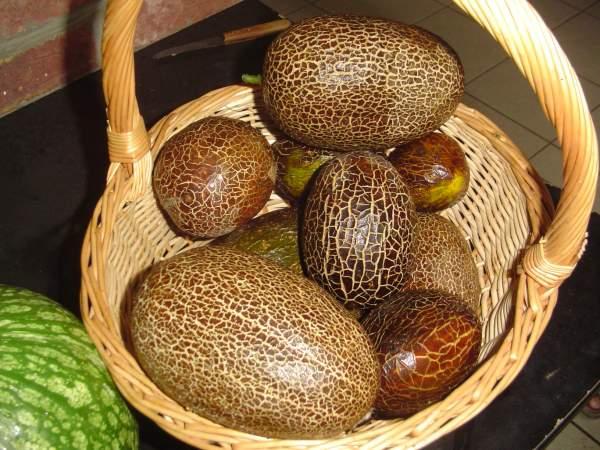
Sikkim Cucumber is not an hybrid, but an ancient variety which grows in Sikkim State in India.
Protected by a hard skin, it can easily stored safely for months!
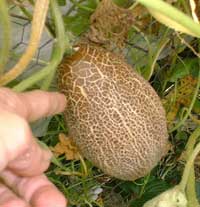
It is comparatively small, never reaching more that 10 cm/4 inches.
Its skin makes for a beautiful design and a popular ornamental plant in Europe.

But it is edible. Its taste is soft and void of acidity.
It can be eaten raw or cooked.
It certainly seems very populat inthe Indian Himalayas.
It can actually be prepared in as many dishes as usual green cucumbers.

RECOMMENDED RELATED SITES
Not-Just-Recipes, Bengal cuisine, Cooking Vegetarian, Frank Fariello, Gluten-free Vegan Family, Meatless MamaFrank Fariello, , Warren Bobrow

Please check the new postings at:
sake, shochu and sushi

—————————————-
日本語のブログ
—————————————-

For Vegan and Vegetarians! “Forgotten” Vegetables 18: Balsamite/Balsamita/Costmary

Courtesy of Jean-Luc Muselle

SYNOPSIS:
Organic agriculture and biodiversity have in recent years brought about a rediscovery of many “forgotten” vegetables that people especially in Europe and France conscientiously tried to forget as they reminded them of the privations suffered during WWII. The same people had then to make do with untraditional vegetables because potatoes, carrots and so on were confiscated by occupying forces or their own armies.
With sustainibility and bioagriculture made more important by the deficiencies of modern mass agriculture, those “forgotten” vegetables have suddenly come to the fore for the pleasure of all, and that of course of vegetarians and vegans!

This particular series of postings will introduce these vegetables one by one. I hope they will become useful for a long time to come to all my vegan and vegetarian friends!
1) Scorsonere/Oyster Plant
2)Potimarron
3) Vitelotte
4) Rutabaga
5) Cardon
6) Panais/Parsnips
7) Patisson
8) Topinambour
9) Crosne
10) Cerfeuil Tubereux
11) Poiree
12) Oca
13) Ulluque/Ulluco
14) Tigernuts
15) Capucine tubereuse-Maschua
16) Chataigne de Terre-Great Pignut
17) Yacon

Balsamite (French) or Costmary (English) is an aromatic plant that has been cultivated for a long time as an ornamental and medicinal plant.

Its Latin name is Balsamita major Desf. (synonym : Tanacetum balsamita L. subsp. balsamita).

It is known under many names: Grande balsamite, menthe-coq, menthe de Notre Dame, tanaisie des jardins, baume-coq, Chartreuse, (French), Balsamkraut (German), costmary (English), erba-amara balsamica, erba buona (Italian)

It has been grown for many centuries for its pleasant, slightly medicinal or balsamic smell. It was used in medieval times as a place marker in bibles.
Moreover, the plant is known from ancient herbals and was widely grown in Elizabethan knot gardens.

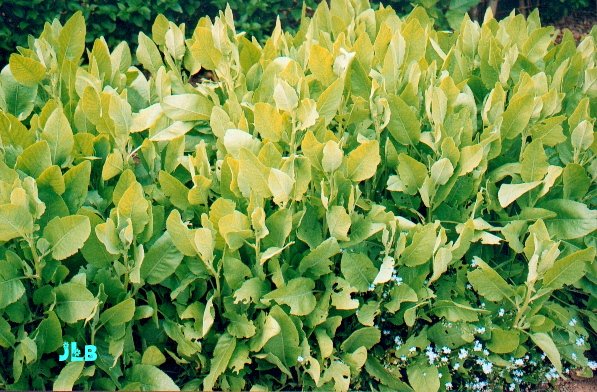
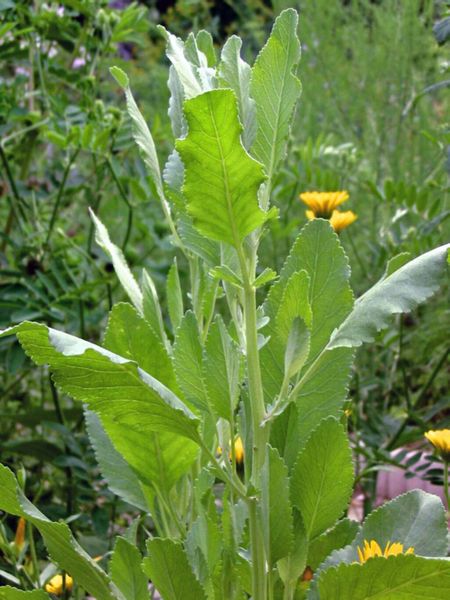
It is a strong plant, quite tall, 1,2 metres/4 feet giving out a pleasant aroma similar to mint with beautiful yellow flowers.

It originated in Western Asia and the Caucasus. It strives in temperate climates and has been succefully grown in Europe, North Africa and North America.

The leaves, slightly sour, can be used to season salads and liqueurs.
Good Beer and Country Boys will be gld to hear that a long time ago, they were used to contribute aroma to ale beer in England!

Liqueur fans, try this:
Macerate 9 leaves with 9 pieces of sugar in fruit alcohol for 2 or 3 months!

RECOMMENDED RELATED SITES
Not-Just-Recipes, Bengal cuisine, Cooking Vegetarian, Frank Fariello, Gluten-free Vegan Family, Meatless MamaFrank Fariello, , Warren Bobrow

Please check the new postings at:
sake, shochu and sushi

—————————————-
日本語のブログ
—————————————-