Tag Archives: seafood

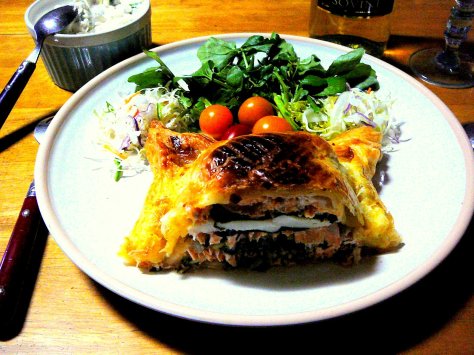
Salmon Trout Pie


The Japan Blog List

Please check the new postings at:
sake, shochu and sushi

—————————————-
salmon-pie-1

With cold weather prevailing, one expects a hearty hot meal back home from a long work day.
I personally cook dinner twice or three times a week at the most, but I can guarantee you that the Missus does expect a proper meal if I happen to be back home for her!
The problem is that I tend to cook too much, and I consequently end up finishing both plate to the detriment of my waistline! LOL.
In winter reasonably-priced salmon trout is readily available, and taking in account my partner’s inordinate love for salon, it is easy enough to please her!
Here is what I concocted for her last week Friday:

INGREDIENTS (for 2 to 4 persons depending on your appetite!)
-Salmon trout: a large (~15 cm long) piece/filet. Cut the ends square if needed. The small bits can be put on top wherever to adjust the level of the contents. Pare off all the excess fat as it tends to sog the pie. In any case cooked fish fat is not appealing either in shape or taste!
-Frozen pie sheets: 2 large enugh to leave necessary margin around the fish.
-Lemon juice: 1 large lemon juice squeezed into a small glass.
-Fresh basil: 20 leaves, finely chopped/cut.
-Fresh Italian parsley: 10 sprigs, finely chopped/cut.
-White mushrooms (other varieties are fine),: 4 large, finely chopped.
-Fresh shiso/perilla leaves: 12 large. If not available, use 24 salad spinach leaves. Boil them in salted water for 15 seconds. Spread on kitchen paper to suck off as much water as possible.
-Scallops: 4 large, sliced in two.
-Egg: 1 large, beaten.
-Shallot/Echalotte: 1, large, finely chopped.
-Garlic: 2 cloves, finely chopped.
-White wine: 50cc/one quarter cup.
-Olive oil: 2 large tablespoons.
-Salt, pepper, nutmeg to taste. You may add (or do without) spices according to taste and tradition.

RECIPE:
-Pour oil in a non-stick fryig pan. Drop in chopped shallots and garlic. On a medium fire, when shallts are becoming transparent, add half of the lemon juice and all the wine. Stir. Lower the fire to gentle, drop in chpped mushrooms, a little sale, pepper, nutmeg and spices. Slowly fry until there is almost no juices left. Take off fire, pour the lot on a flat plate and let cool off.
-Preheat oven to 210 degrees C. (about 420 Degrees F)
-Spread one pie sheet onto a large piece of cooking paper laid over the oven plate.
-Cut salmon trout into 3 equal “sheets/layers” with a large sharp knife. Spread bottom slice on pie sheet. Brush it lightly with lemon juice. Sprinkle a little salt and pepper.
salmon-pie-2
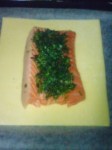
-Spread chopped basil and Italian parsley on top. Then spread fried vegetables, taking care to include as little juice as possible.
salmon-pie-3
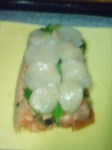
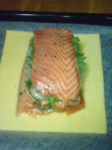
-Spread second slice of salmon trout on top. Brush with a little lemon juice and sprinkle a little salt and pepper. Spread half of the perilla leaves (or spinach) on top. Spread the sliced scallops on top. Brush with a little lemon juice. Spread the remaining leaves over the scallops.
salmon-pie-4
-Spread the last slice of salmon trout over the top. Brush with a little lemon juice and sprinkle a littlle salt and pepper.
salmon-pie-5
-Brush beaten egg over th uncovered parts of the pie sheet.
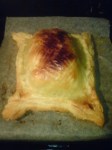
Spread the second pie sheet over the whole, strching it carefully as to fall eaqually onto the bottom pie sheet. Press “margins” (I do it with a fork) and roll them so as to “close” the pie.
Brush the whole surface with beaten egg (the more, the better!).
salmon-pie-5_0001
Cook at 210 degrees for 15minutes, then lower to 160 degrees (about 290 degrees F) for 15 more minutes. Cook a little while longer if you are not satisfied with the colour of the pie.

Served with cream dressing and a tossed salad, it should satisfy any appetite.
Serve with white wine or sparkling wine!
Enjoy!

Mussles in Curry Cream Sauce


The Japan Blog List

Please check the new postings at:
sake, shochu and sushi

—————————————-
日本語のブログ
—————————————-

Mussles are ever becoming popular all over the World and become more acaailable, fresh or frozen.
Last Friday night, my usual night out (alone) which had to be postponed because of my numerous commitments the week after, ended in my cooking dinner for the Missus. As soon as I reached Shizuoka JR Station back from University I visited JR Station Parche Big Supermarket in search for fresh oysters. Apparently they were sold out and had to rethink our dinner, when I found some Japanese grown fresh mussles which gave me a good idea.

Incidentally, keep in mind that contrary to oysters, wild mussles should be avoided!

Mussles in Curry Cream Sauce

Ingredients:

-Mussles: 3~4 dozens (wash and brush them first under running water and pull “roots” out)

-Shallot (echalotte): 1, finely chopped
-Garlic: 3~5 cloves, finely chopped
-Ciboulette (very thin chives): a “bunch (see above pic)
-Basil: a “fistful”
-Lean Bacon: a slice, cut into small pieces

-Sour cream: a glass (Half a cup), 120g

-Noilly: a glass (half a cup). If unavailable, any sweet wine will do.

-Curry paste (possibly Garam Masala): 1 large tablespoon
-Olive oil: 2 large tablespoons
-Pepper: to taste.

N.B.: No need for salt as there is already plenty in the bacon and curry paste!

Recipe:

In a deep large deep pan pour the oil and heat over medium fire. Drop in shallots and garlic and fry until shallots turn transparent. Pour in Noilly, curry past and pepper. Mix well. Drop in all the mussles. Cover with a glass lid.
When all the mussles have opened (discard the ones that haven’t later), drop in the sour cream and mix well. Let cook for a minute, then add ciboulette and basil. Stir. Serve at once.

Make sure you have prepared a dish for the dicarded shells. They are more easily eaten with your fingers, so keep a finger bowl or wet towel handy.

Now, you will be left with a lot of good sauce which would be a shame to throw away. Last Friday I prepared spaghetti for my pasta-crazy Missus and mixed them into the sauce with a little olive oil. My personal choice would have been the sauce poured over boiled potatoes (instead of fried potatoes usually served back home). Otherwise it could become the base for a soup. If you find the sauce a bit too strong, mix in some yoghurt.

Bon appetit!

Seafood Souffle


The Japan Blog List

Please check the new postings at:
sake, shochu and sushi

—————————————-
日本語のブログ
—————————————-

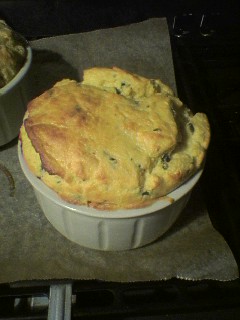
I decided to re-post this particular recipe as it appears that souffle are so popular with friends at Foodbuzz!

As explained before, souffle is not that complicated.
There are simple rules to follow though:
-Get all your ingredients ready within reach first.
-Souffle must be savoured as soon as it comes out of the oven. As the adage says, “The guests wait for the souffle; the souffle does not wait for the guests!”.
It is another way to eat seafod in season and it’s a favourite when Spring and Autumn nights are still cool or cold. Of course it is a great dish in winter as it will warm up your guests or family!
Ingredients can be easy replaced according to season or supply. The spices indicated are basic and also open to imagination!

Ingredients (large portions for 2 persons)
-Eggs:5
Separate yolks from whites. Keep yolks in a small dish. Pour the whites into a large bowl with a pinch of salt.
-Milk: 1 cup/200 cc
-Butter: 50 grams
-Flour: 70 grams/2 large tablespoons
-Salt, pepper, nutmeg, thyme (powder) to taste.
-Olive oil: 1 large tablespoon
-Oysters: 12 out of their shells in a small strainer to allow excess water out.
-Mussles: 24 large shells bushed and cleaned under running water.
-Crab: 1 small tin. If fresh, a “fistful” slightly boiled or steamed).
-Shallots: 1 large, thinly chopped
-Garlic: 1 clove, thinly chopped
-Noilly or sweet white wine: 1 glass/50cc/a quarter cup
-Thinly chopped fresh herbs (Italian parsley, basil, etc.): 1 “fistful”.

Recipe:
1) Pour oil into a deep non-stick frypan over a medium high fire. Cook shallots and garic until shallots turn transparent. Take care that garlic does not darken.
2) Drop the mussles in. Close with glass lid.
3) When mussles are all open switch off fire and take them out shaking all vegetables and juice out. Delicately separate mussles from their shells. Put aside in a small dish. Discard shells.
4) Switch on ffire again to medium and drop oysters in.
Cook them just long enough for them to stay tender. Switch off fire and take oysters out delicately. Put aside in a small dish.
5) Take crab out of the tin and squeeze out juices into the frying pan.
Put aside in a small dish.
6) Switch on fire again and reduce sauce at least to half. Switch off fire and strain the sauce into a cup. Put aside for white sauce.
7) White sauce:
On a medium fire, in a large deep pot melt butter completely. Drop in all the flour and whisk until smooth. Pour in milk little by little, whiking all the time to attain a smooth sauce. Add salt, pepper, nutmeg and thyme, and cup of reduced juices. Mix. Keep stirring gently until sauce is very thick and adheres to the whisker.
8) Switch off fire. Mix in the yolks with whisker until smooth. Drop in fresh herbs and mix well.
Beat the egg whites until very firm
Fold whites into sauce one third at a time with a spatula (if you mix with a whisker, the souffle will not rise. If you pour all the whites at once you will end up with white “blobs” and uncooked liquid yellow sauce).

9) Butter the inside of 2 (or more, reducing the size of each) oven dishes/ramequins about 12 cm across and 7 cm high.
Pour in one layer of sauce on the bottom of each dish.
Place half of the oysters in each dish and cover with one more layer of sauce.
Place half of the mussles on top and cover with one more layer of sauce.
Spread half of the crab in each dish on top of the last layer of sauce and cover the lot with the rest of the sauce.

Preheat the oven to 180 degrees.
Cook for 35~45 minutes depending on your oven.
Check if souffle is ready with a thin stick. It should come out with no sauce attached to it.
Serve immediately!

Accompany it with a solid white wine!

Healthy Hamburger: Tuna Burger!

Please check the new postings at:
sake, shochu and sushi

—————————————-
日本語のブログ
—————————————-

magburger.jpg

Somew time ago I had the occasion to taste again Maguroya Izakaya’s fine Tuna Burger in spite of my worse half’s interference!

It is actually an original creation of their Izakaya, in downtown Shizuoka City, which specializes in anything about Tuna/Maguro.
Americans and all expats ought to try it. The price is ridiculous when you compare to some notorious chain junk food restaurants. And the taste is simply an experience. I’m sure you will get hooked!
For people who prefer to make them at home, it is pretty simple:
Buy some tuna already ground for “negitoro”, make a ball of the wanted size, dip in flour and then beaten egg and very fine breadcrums or “karaagekona”/powder for deep-fried food and deep-fry!
Of course you will be responsible for a perfectly grilled bread, nice vegetables and tartare sauce!

Maguroya
420-0839 Shizuoka City, Aoi Ku, Takajo, 1-11-9, 2F
Tel.: 054-2514101
Open: 17:30~24:00
Closed on Sundays

Tuna Trio Hors d’oeuvre

Please check the new postings at:
sake, shochu and sushi
Shizuoka Pics

—————————————-
日本語のブログ
—————————————-

tuna-trio.jpg

Here what my better (worse?) half came up last night as a starter after she found a good bargain at our nearby Coop Supermarket. Plenty for two, the fish costing only 440 yen (US$ 4.50)!

From top left around the clock:

-Maguro akami (lean part of the tuna) thin sashimi topped with homemade pickled wasabi plant and Shizauok wasabi dressing.
-Maguro akami/maguro zuke (lean part of the tuna marinated Japanese style) topped with “shigeki rayu” (Chinese style hot sesame oil) dressing from Ishigaki Island, Okinawa.
-Negitoro (minced tuna semi-fat part, but without the usual chopped leeks) topped with “kizami tamanegi” (onion cream) dressing

The whole on a bed of fresh cress grown in our Prefecture. The perfect starter for her wine and my sake (I mean the drink!)

Shrimp Snack

Please check the new postings at:
sake, shochu and sushi

—————————————-
日本語のブログ
—————————————-

shrimp-snack.gif

Here is a simple snack recipe which my better (worse half?) came up with the other night:

Ingredients (2 people):
20 small shrimps
10 chickory/endive leaves
Mayonnaise
Thai Chili Sauce
Spices to taste
Deep fry powder
Oil (for frying/deep frying)

Use frozen or fresh shrimps. Take off any water by laying the shrimps between two sheets of kitchen absorbing paper.
In a bowl prepare a mixture of mayonnaise, Thai chili sauce, pepper and any spices you wish to add. Taste before using.
Drop all the shrimps in the bowl and mix with hot mayonnaise mixture.
Heat oil to 180 degrees Celsius.
Place chickory/endive leaves in two long dishes as in picture above.
Take two shrimps at a time and roll them together quickly in deep fry powder and drop them in deepfry oil.
Deep-fry for a minute and leave shrimps on an oil absorbing paper to take excess oil off.
Place them inside chickory leaves (see pic) and serve at once.

Dead simple and great with beer any time of the year!
I’m sure the Good Beer and Country Boys will agree with me!

Oven-baked Stuffed Mussles

Please check the new postings at:
sake, shochu and sushi

—————————————-
日本語のブログ
—————————————-

stuffedmussles.jpg
Mussles are plentiful at the big supermarkets in Shizuoka Prefecture, where thay can be bough fresh.
Here a great simple appetizer you can offer any time of the year.
Remember this is only the basic recipe to which you can add your own spices, herbs and vegetables!

INGREDIENTS (for 2 people)
24 large mussles
1 medium-size onion
2 shallots
2 large garlic cloves
a small length of celery
a fistful of fresh basil leaves
hal f a cup (100cc) of tomato puree
Olive oil
1 cup of white wine
Salt, pepper, clove, nutmeg to taste
Breadcrumbs

RECIPE:
1) Clean and brush mussles

2) Pour the wine in a large deep pan and heat over medium fire

3) Cook mussles inside the pot until all mussles are open (discard theones you can’t open)

4) Take mussles out of the pot, drain and extract shellfish. Keep the 8 largest half shells

5) In a fry pan pour some olive oil and cook over medium fire the onions, shallots, celery, garlic and basil, all finely chopped (add any fresh herbs available and of your liking)

6) Stop fire when onions and shallots have become soft and transparent. Pour the lot into a mixing bowl. Add tomato puree, salt, pepper, nutmeg and clove. Mix well. Check taste and adjust.

7) Place 3 mussles in each shell. Cover with with above mixture (the more, the better!) and sprinkle breadcrumbs all over.

8) Cook in oven at 180 degrees Celsius for 10 minutes at the last moment.

9) On individual plates, cut and place tomatoes and cucumbers (or let you imagination run!) as shown on photograph. Sprinkle with dressing of your choice.
Take mussles out of the oven and place them on plates.

Eat at once!

Seafood Spaghetti Salad

Please check the new postings at:
sake, shochu and sushi
Shizuoka Pics

—————————————-
日本語のブログ
—————————————-

seafood-spaghetti-salad.jpg

I often cook for my better (worse?) half on Friday Nights (sometimes) Sunday nights (often) as her job keeps her busy on weekends. As she is a pasta addict, I end up preparing some one every two meals. After a hard day’s work she is pretty happy with this recipe as it leaves me with plenty of improvisation according to the season and the market!

As for measures and proportions, I will leave it to your imagination, although a good observation of the picture should be a good enough guide for you! The plate pictured above was one serving.

Prepare or choose a dressing for the spaghetti. I usually use soft Dijon Mustard (with or without the seeds), Xeres vinegar, hazelnut oil (or walnut oil), salt, pepper and a few baies roses/dry pink peppercorns. Naturally, olive oil, wine vinegar, soft mustard, salt and pepper is fine, too.
Boil the spaghetti to the consistency you prefer, drain them and hold them under running cold water for 30 seconds, shaking them well to prevent them from cooking any longer.
Drain the water energically and stir in some dressing for taste and to prevent them from sticking to each other. Leave them in a all-purpose bowl.

At the top of the picture are slightly sauteed scallops with onion confit.
To make the onion confit (can be done the day before or a few hours in advance), peel and cut 2 large onions in thin slices. Discard the “foot” (bottom core) as it is indigestible. Fry them in a pot with 100g of white butter on a medium fire. When the onion slices have become soft and translucent, add a large tablespoon of honey, a cup of red wine, a tablespoon each of Xeres vinegar and Port wine. Season with salt and white pepper (thin powder if possible). Simmer until most of the liquid has reduced. Check and add more honey if not sweet enough. A little tomato puree might help,too. Let it cool and keep it away from any heat and light source (do not leave it in the fridge as it might congeal).
Sautee the scallops with a little salt and lemon juice on a small amount of olive oil. As soon as they have reached a very light brown colour, take them off the fire and let them rest on a grill to get rid of excess liquids.

At the bottom of the picture are small prawns.
Take off the shell, tail and heads (discard or use them for making broth).
Make a shallow incision all along the middle of their back. Pick off the innards.
Sautee them like the scallops with a little salt and lemon juice on a small amount of olive oil. As soon as they have changed colour, put them to rest with the scallops.

Keeping in mind you are making two servings, cut a tablespoon each of red, yellow and orange sweet pimentos in small cubes. Fry them in olive oil without any seasoning. When soft, drop them in all-purpose bowl. Do the same with a little assortment of scallops, small shrimps and cockles (can be easily bought frozen at large supermarkets), or whatever seafood you can put your hands on. Keep in mind they ought to be of all the same approximate size (that’s a lot of “keep in mind”, isn’t it?)

When all ingredients have cooled down to room temperature and this just before you are going to serve them, toss in some finely cut fresh tomatoes (if you add them too early they leave out too much water in contact with salt!) add the pimentos and seafood in the same bowl and mix in a reasonable amount of dressing. Take half out and mix it with the spaghetti.
Place the spaghetti in the middle.

Arrange scallops interspaced with some onion confit above the spaghetti as in the picture.
Arrange sauteed prawns below as in the picture.

Add a good quantity of “baby leaves” (young leaves mixture) of your choice with rest of the veg and seafood salad and arrange on both side of the spaghetti.

Of course this is open to any kind of variations. I just hope I stimulated you into your own recipes!

Bon appetit!

Local Food: green, healthy and social.

Please check the new postings at:
sake, shochu and sushi
Shizuoka Pics

—————————————-
日本語のブログ
—————————————-

lojol1
By Patrick Harrington

local-food.jpg

As this article appears more current by the day I decided to post it again for the attention of all my new friends at Foodbuzz!

From all the excellent articles in the Shizuoka Gourmet blog the one which had most impact on me was the shortest one, with a quirky title that hid a very serious issue: ‘Shimizu goes bananas’, in March 2007.

As we all know our use of the earth’s resources is exceeding the earth’s ability to sustain itself. It is calculated that we would need an earth almost twice the size to sustain our thirst for resources.

It may seem obvious but one way of significantly reducing our over-use of resources is by consuming local food.

We can massively reduce the amount of transportation. Can you imagine how far strawberries must travel to keep the supermarkets of Northern Europe stocked year-round?.
And we can also reduce or eliminate the the processing and packaging, not to mention the advertising. Plus there is reduction in the need for chemical preservatives and irradiation.
Growing local food also results in a tendency toward multiple cropping and better crop rotation. This can lead to reduced pesticide use, minimization of crop failure and better preservation of indigenous biodiversity.
In addition the by-products, eg manure and silage, may be used productively rather than be viewed as nuisance waste.
However multiple cropping requires multiple skills and a wide range of tools and machinery, but it utilizes human labour more efficiently as each crop will have a different cycle.
The green dimension of local food is something we can all probably agree upon.

Secondly there is also the health dimension. As mentioned above the amount of processing and the need for pesticides and chemicals can be reduced by using local food, but it is also thought that better nutrition also results.
Regional and seasonal conditions affect the compostion of plants and animals and consuming local food provides an optimal nutritional fit.
Having said this, science has been unable to prove nor disprove this idea, but anecdotal evidence abounds. A simple example is the consumption of oranges in Shizuoka in the winter months. The vitamin C from the oranges helps combat the increased risk of catching colds at this time of year. A more radical example would be the traditional Japanese diet of rice, fish and green tea, which surely provides a better nutritional fit for the people of Japan than a diet of burgers, french fries and cola.

Thirdly is the social dimension. Local food can help protect local jobs and shops, and increase food security. Support for local food may also result in the continuation (or re-discovery) of community structures and values. And local food often carries inherent traditional and cultural symbols for a community, something which is perhaps undervalued in today’s global society.
Though it may be counter-argued that international trade is a method of wealth redistribution, this is a highly complex issue, and evidence suggests that the wealth divide is actually widening rather than narrowing.

So the argument for local food appears to be a compelling one. But don’t get me wrong! I’m not advocating that we forsake all food from outside our local community. In fact it is ludicrous to imagine every region being self-sufficient in food. What would happen to Tokyo, or Finland, or Singapore?
And why shouldn’t Robert eat cheese, and why shouldn’t I eat bananas?

But cheese is now made in Fujinomiya, and bananas are now grown in Shimizu, which make them local (to Robert and me).

Admittedly there aren’t many places which can boast Shizuoka’s capability to produce such diverse foods, but I would urge a greater balance toward local food in the diet. There are significant green, healthy and social benefits to be gained. And local food tastes better too!

Simple Recipe: Seafood Pasta Salad


The Japan Blog List

Please check the new postings at:
sake, shochu and sushi

—————————————-
日本語のブログ
—————————————-

Last Friday, which should have been “my” weekly night out, saw a sudden change of schedule forced by the venue of cricket friends over the week-end asking me to “guide” them around Shizuoka City the next night.
To appease the Missus I offered to cook dinner as I would be back home from work before her.
She gracefully agreed provided I prepared pasta…
Like many women in Japan my (?) half is a pasta addict. I love it, but there is a limit as to how often I’m willing to repast on them.
I could have done it the easy way and prepare a “sauce” to be spread over it all, but keeping aware of the tastes of my partner in life, I opted for a dish more adapted to the increasingly hot season: Cold Seafood Pasta Salad.
You ladies ought to note the recipe below if you want to convince your men that pasta is great, or encourage them into some originality! This particularly concerns Rowena, Jesse, Melinda, Etsuko, The Leftover Queen and Taste memory Girl (take a break from those cakes, LOL).

For 2 persons:
Ingredients:
Spaghetti (thickness to taste, but neither too thin, nor too thick): “Enough” for 2 persons
Scallops (raw): 4, each cut into 3 thin slices
Mini-tomato (as small as possible): 6, each cut into halves
Avocado: 1, cut into 12 slices lengthwise
Smoked salmon: 8 thick slices
Lemon juice ( for the salmon)
Capers: up to taste
Small leaves (luccola, etc.): one “pack”. This can be replaced by herbs or small lettuce
Boiled Crab: 1 tin. Squeeze all liquid out

For the dressing:
Fresh herbs: Basil, Italian parsley, dill. All chopped very fine. Quantity to taste.
Basil mustard (Maille, etc.): one very large tablespoon. If not available use soft mustard and increase basil amount above
White vinegar, taragon leaves flavoured if possible: one large tablespoon (can be easily rectified later). Any vinegar of your liking will actually do.
Walnut oil (very tasty, light and healthy! Hazelnut oil is great, too): as much as will be needed.
Black and green pitted olives cut in small slices: up to taste
Salt, white pepper and soft spices: to taste

Preparation:
Heat a large pan full of water with a large pinch of salt for the spaghetti.
While the water, and later the pasta are being taken care of, prepare the dressing.
In a large bowl drop a vey large tablespoon of basil mustard, a large tablespoon of taragon-flavoured vinegar, a little salt, pepper and soft spices (to be rectified later if needed).
Mix well with a whisker. Pour a little walnut oil and mix until smooth. Add more oil in small quantities and repeat the same operation until you have enough dressing. Drop in all the chopped herbs in and mix well. Check and rectify taste with vinegar, salt, pepper and soft spices if necessary. Keep aside.
Once the spaghetti are sufficiently cooked, drain them immediately in a sieve and run cold water over them until they have completely cooled down. Drain as much water as possible. Drop them into a large bowl with half of the dressing and the olives. Mix in well.

On two large flat plates arrange the sapghetti in the middle so as to form a “little mountain”.
Lightly dip the avocado slices into the dressing (use your fingers, it will be easier and faster!) and place them around the spaghetti so as to form a “hedge” to prevent them to spread all over the place.
Lightly dip sliced scallops in dressing and place around the avocado with one tomato half on each.
Mix in the small leaves (or greens) in dressing and place them on top of the spaghetti as to cover them.
Season the crab meat with wahtever dressing is left and place it on top of leaves.
Dip the smoked salmon slices into lemon juice, place them around so as to have their tips just under the crab. Place capers on each slice.
Serve at once and enjoy!

Tip: do everything at the last moment (when the Missus or the MOTH is having a shower back from work or enjoying aperitif). Otherwise, the dressing will “cook” the salad!

Gastronomic Destinations: New Caledonia (2)


The Japan Blog List

Please check the new postings at:
sake, shochu and sushi

—————————————-
Noumea’s Morning Market

noumea-market1.jpg
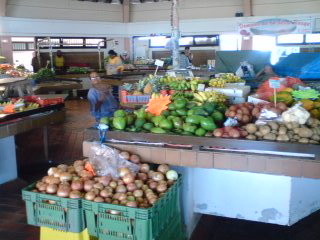
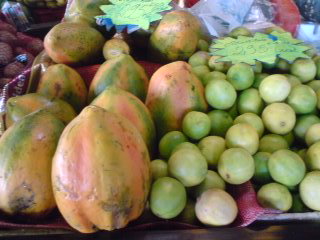
One great way to enjoy and experience the truly local life in New Caledonia and especially in Noumea is to wake up early, skip breakfast and visit tne Morning Market near Port de Plaisance. Almost all buses go there, so there is little chance to get lost.
noumea-market2.jpg
Not only will you find all locally grown vegetables and fruit (plus some imported ones, notably potatoes, altough locals eat yams), but you can buy cooked food at stands offering bread, pastries, Vietnamese food such as all kinds of nems, all these at extremely reasonable prices. There is also a large indoors Cafe Stand where you can drink great New caledonian coffee, soft drinks and what else.
You can also take advantage of other stands offering crafts and Kanak clothing, paleos and so forth.
noumea-market4.jpg
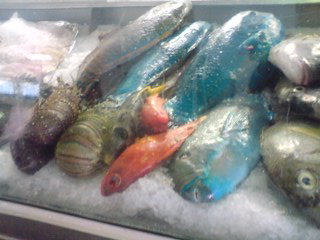
But the must-see are the fish stands displaying sea food caught the day or night before. If you happen to live or stay in a place equipped with its own kitchen, this a great opportunity to choose your fish and shellfish for sashimi, steamed, fried, simmered fish, some of which can be found in the sea surrounding Okinawa.
noumea-market3.jpg
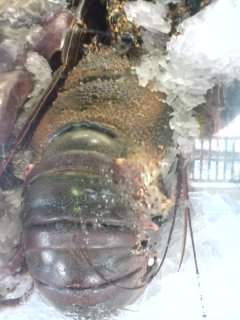
Now if it is crustaceans you are looking for, you might be in for a great surprise or shock depending on your tastes as you will not find spiny lobsters weighing under 2 kg! (Just boil them, then cool them and eat with mayonnaise or grilled in the oven!)

Wishing you a happy shopping!

Karasumi

Please check the new postings at:
sake, shochu and sushi

—————————————-
日本語のブログ
—————————————-

karasumi.gif

Karasumi, known as “boutargue” in French, or as “btarga” in Italian, is the dried roe pouches of the mullet.
It is a quite expensive morsel in Japanese cuisine as well as in Europe (that is the real one!).

Numazu City is quite renown for its karasumi, and fishermen have just started drying them under the sun, after getting rid of blood vesels, carefully cleaned them and sprinkled them with salt.

karasumi2.jpg
They are served thinly cut as they are in Japanese restaurants, or used in Italian and French restaurants, especially with pasta.

This year’s catch was only one fourth of the usual expectation, so brace yourselves when you open your purse!