Tag Archives: sushi

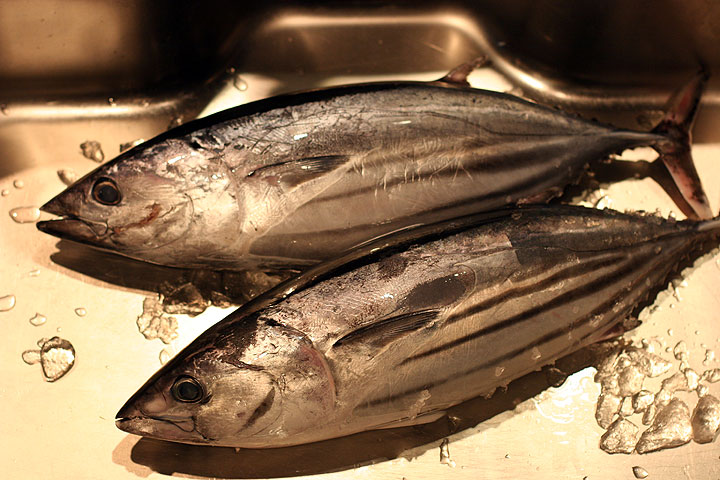
Japanese Seasonal Fish: Katsuo/Bonito

Bonito or “katsuo” in Japanese are extensively caught by fishermen from Numazu, Shimizu, Yaizu and Omaezaki Harbours (all Shizuoka Prefecture). The main fishing areas are Shizuoka, Mie, Kochi & Miyazaki Prefectures.
It is also called “katsu” (Tohoku Region), “Honkatsuo” (Kyushu Island), “Magatsuo” (Shikoku and Kyushu Islands. N.B.: the same name designates another fish in other parts of Japan!), “Suji” (Yamaguchi & Wakayam Pref.).
It appears on the markets early Spring~Autumn as “sho gatsuo” (first bonito in Spring) and “modori gatsuo” (return bonito end of Autumn).
They are traditionally line-caught but nets have been used extensively in recent years.
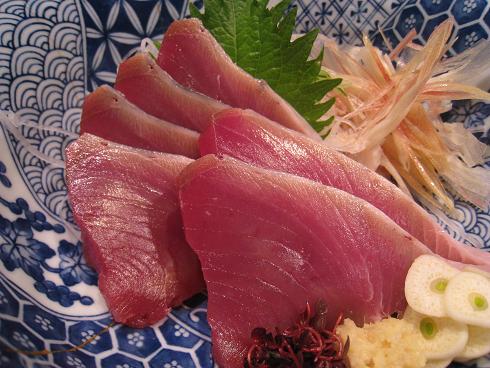
It can be appreciated raw, as sashimi with its skin or without it, preferably served with a saucer of soy sauce (shoyu) mixed with thin slices of fresh garlic, or with wasabi, a touch of lemon and shoyu,
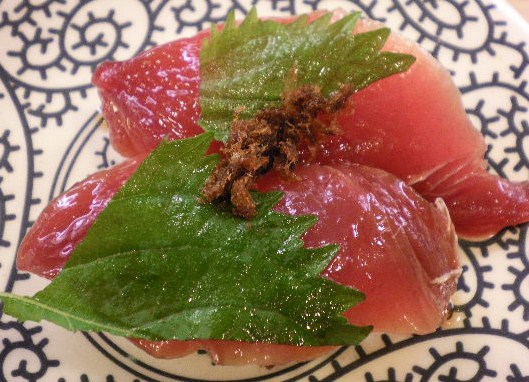
or as nigiri topped with grated fresh ginger a thin slice of garlic, unless you prefer grated fresh ginger with chopped thin leeks.
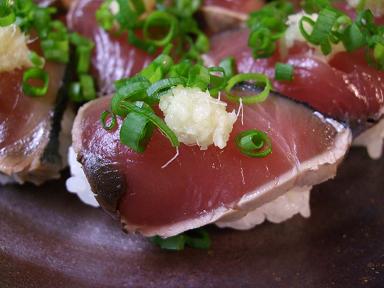
The same is done with lightly grilled/aburi (or tataki) bonito as sushi nigiri.
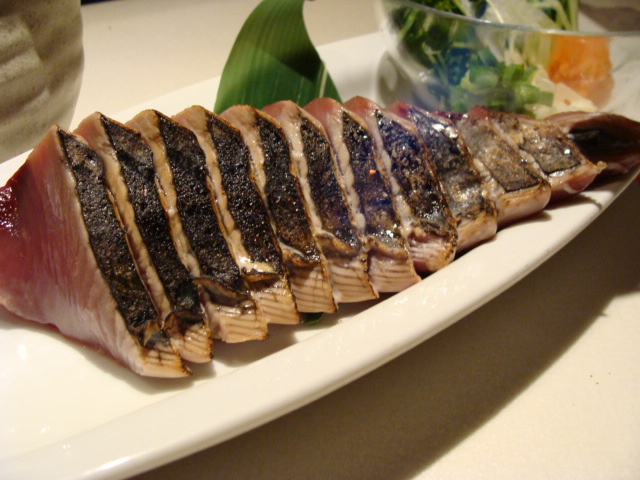
Another very popular way to eat it that will please Europeans and North Americans alike, is “tataki”.
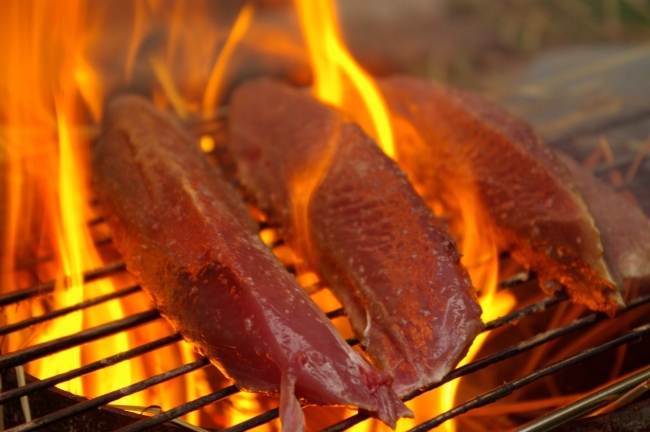
The fish is first seared/grilled over charcoal until it is lightly cooked on the whole outside then plunged into iced water to stop it from cooking any longer. It is then cut into large slices and served with freshly chopped garlic and thin leeks, “shiso” leaves (perilla/beefsteak plant) and wasabi.

Note 1: in restaurants specify whether you want the skin or not when ordering sashimi.

Note 2: the same fish is a staple food in Sri Lanka where it is first smoked and then prepared as soup or curry!
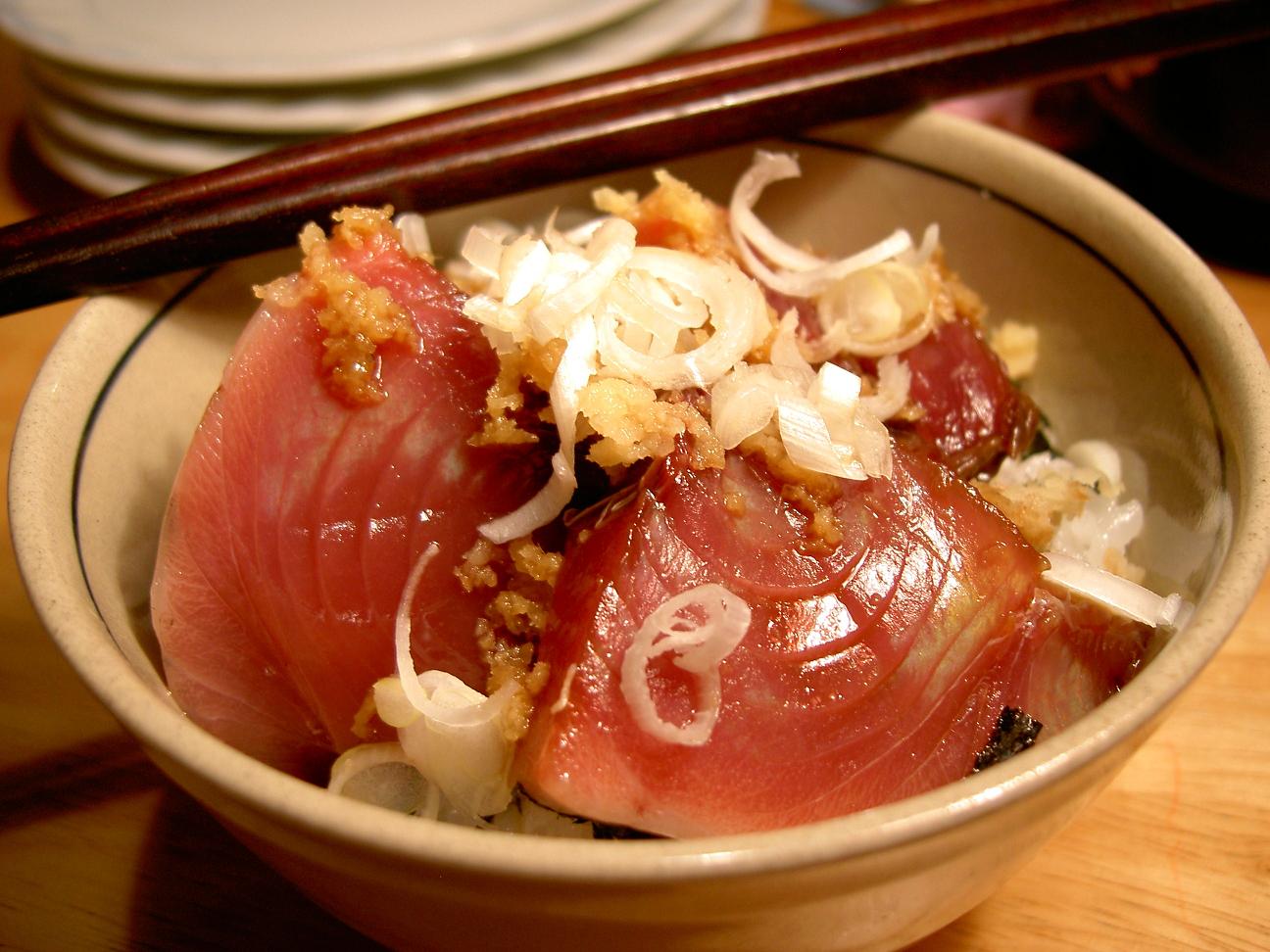
It is one of the most versatile fish in Japan.
It can be appreciated in many ways:
As a simple donburi/on a bowl or rice at home (see above picture),
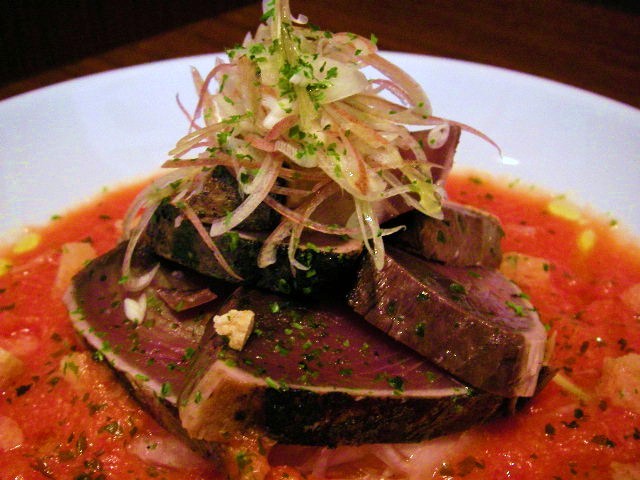
Lightly seared and served as carpaccio,
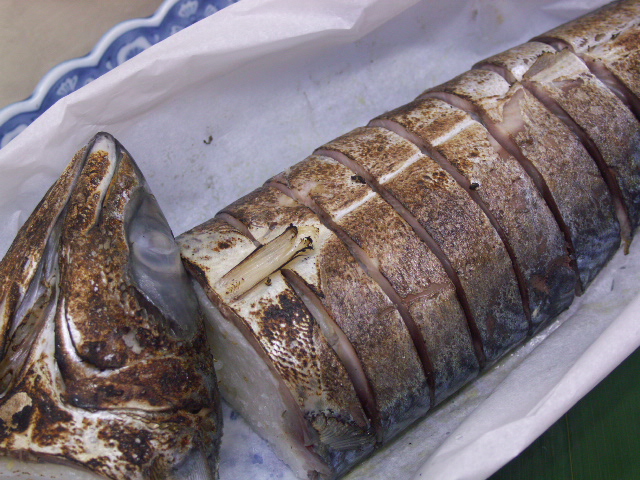
as bogata sushi/whole fish stuffed with sushi rice,
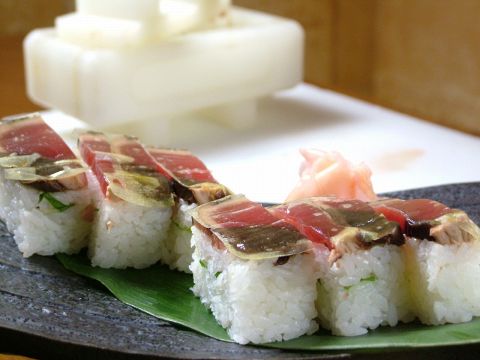
as oshizushi/pressed sushi,
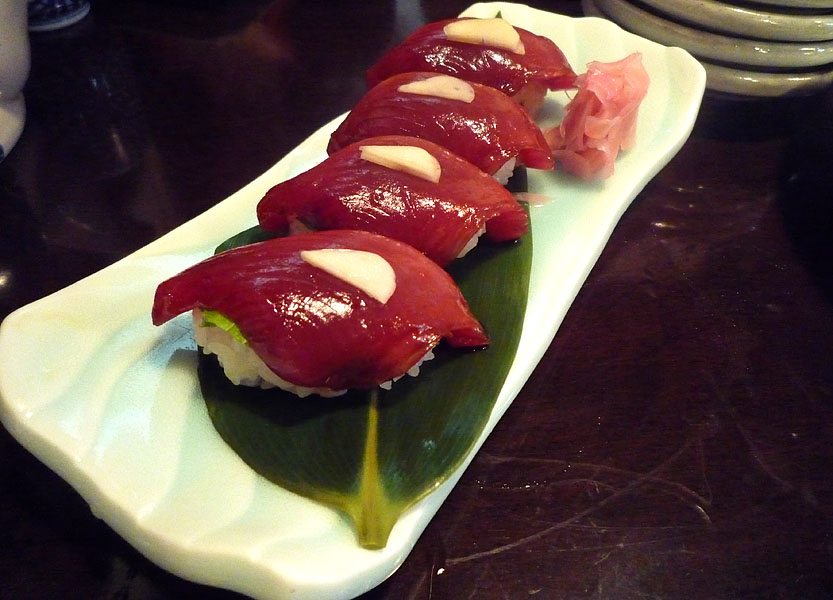
but my favourite is probably as zuke/marinated in soy sauce, mirin, sake, etc. before being served with a slice of garlic!

RECOMMENDED RELATED SITES:
Bread + Butter, Comestilblog, Greedy Girl, Bouchon For 2, Zoy Zhang, Hungry Neko, Mangantayon, Elinluv Tidbit Corner, Maison de Christina, Chrys Niles, Lexi, Culinary Musings, Eats and Everything, Bite Me New England, Heather Sweet, Warren Bobrow, 5 Star Foodie, Frank Fariello, Oyster Culture, Ramendo, Alchemist Chef, Ochikeron, Mrs. Lavendula, The Gipsy Chef, Spirited Miu Flavor, Wheeling Gourmet, Chef de Plunge, Sushi Nomads, Island Vittles

Please check the new postings at:
sake, shochu and sushi,
—————————————-
日本語のブログ
—————————————-

Japanese Seasonal Fish: Hirame/Olive Flounder, Bastard Halibut, Tonguefish, Sole

Hirame/平目

“Hirame” could be translated in many ways depending of your country of origin: Flat Fish, Sole, Turbot (although the latter should define “karei”) and what else. There are many varieties, wild or humanーfed. In Japanese, the names are numerous: Hirame, Shitabirame, Ooguchikarei, Oyanirami, etc.

Actually they can be divided into two main groups:

1)The Olive flounder or Bastard halibut (Paralichthys olivaceus; Japanese: ヒラメ/平目) is a species of large-tooth flounder native to the north-western Pacific Ocean.
It is often referred to as the Japanese flatfish or Korea(n) flatfish (광어) when mentioned in the context of those countries.
It is the most common flatfish species raised in aquaculture in Korea. They are raised in Japan and China as well.

Shitabirame/舌平目

2) Tonguefishes (shitabirame/舌平目in Japanese) are a family, Cynoglossidae, of flatfishes. They are distinguished by the presence of a long hook on the snout overhanging the mouth, and the absence of pectoral fins. Their eyes are both on the left side of their body, which also lacks a pelvic fin.

The best season is Autumn to Winter. They are still available until Spring in Shizuoka Prefecture. Wild ones come from Hokkaido and Aomori. Human-fed ones mainly hail from Oita, Ehime, Mie, and Kagoshima Prefectures.

Hirame Sashimi

The domestic wild catch is around 7600 tonnes a year, while human-fed fish amount to around 7100 tonnes a year. A recent increase has been observed in recent years, though. A lot are imported from Korea through Fukuoka and Shimoseki.
They are found in tropical and subtropical oceans, mainly in shallow waters and estuaries, though a few species found in deep sea floors, and a few in rivers.

Hirame can be enjoyed in many ways:
As sashimi, cut in various thickness, according to the chef’s preference and presented artfully.

It can be enjoyed cut in small dices, as tartare, especially shitabirame/tonguefish with tomato and strawberry!

Of course, hiirame is great as sushi nigiri with all kinds of seasoning I prefer it just seasoned with a little lemon juice or yuzu (if available) and salt (preferably “snow salt” from Okinawa!

The Japanese have a fondness for “engawa”, that is the frilled border along the fillets which are usually thrown away in other countries. The texture is different, almost crunchy.

Hirame is great marinated with konbu/seaweed as konbujime/seaweed marinated.

The same konbujime hirame can be served as oshizushi/pressed sushi topped with more seaweed!

An interesting oshizusshi combination is hirame topped with kabu/turnip and seasoned with yuzu juice and zest!

It is also very popular dried as himono/干物, especially shitabirame/tonguefish.

Naturally the Japanese all kinds of hirame cooked in the French way in a simple and succulent manner as above,

or as a beautiful gratin!

Last, but not least, how about grilled hirame with uni/sea urchin sauce?

RECOMMENDED RELATED SITES:
Bread + Butter, Comestilblog, Greedy Girl, Bouchon For 2, Zoy Zhang, Hungry Neko, Mangantayon, Elinluv Tidbit Corner, Maison de Christina, Chrys Niles, Lexi, Culinary Musings, Eats and Everything, Bite Me New England, Heather Sweet, Warren Bobrow, 5 Star Foodie, Frank Fariello, Oyster Culture, Ramendo, Alchemist Chef, Ochikeron, Mrs. Lavendula, The Gipsy Chef, Spirited Miu Flavor, Wheeling Gourmet, Chef de Plunge, Sushi Nomads, Island Vittles

Please check the new postings at:
sake, shochu and sushi,
—————————————-
日本語のブログ
—————————————-

Sushi Millefeuille: The Recipe (with Vegan Option)

Following the kind comments of the creators of such beautiful blogs as Gourmet Fury, Bread + Butter, Dhaleb, Reg And Mitzi, Island Vittles and many other friends, I thought the time was ripe to post a couple of simple but colorful sushi recipes than can be easily expanded for home parties and impress your guests!

My vegan and vegetarian friends should not worry as I have explained possible adaptations according to their priorities at the end of such postings!

Here is the second one:
Sushi Millefeuille!

INGREDIENTS (& ADVICE):

Once again need to be too precise about exact quantities here as personal tastes can (and ought to) be different!

First combination (see above picture):

-Sushi rice: as much as you will need (freshly made. See sushi rice recipe HERE)

-Fish: tuna for the red part
-Cucumbers: sliced very thin for the first green part under the tuna.
-Avocado: for the second green part under the tuna (choose ripe avocad)
-Tobikko: Flying fish roe for the topping (if unavailable, can be replaced with salmon roe or finely chopped sweet red pimento.
-Mayonnaise.
Now, if you don’t like it, make a thick dressing. The trick is to make a simple vinaigrette with a lot of soft Dijon mustrd which will give it consistency.
Mayonnaise sold over the counter can be cloying sweet. I would make my own, which is not difficult at all: one egg yolk + salt + pepper + vinegar.
Whisk them all until smooth. Add and whisk in olive oil little by little until you have enough. Point: all ingredients must be at room temperature!
I add some wasabi to it for extra taste!
-Thin leeks for decoration.

RECIPE:

-On a large enough individual serving plate place a large enough cake circle in the middle.

-Fill one quarter/third with sushi rice.

-Lay one layer of fine cucumber slices.

-Lay one layer of sliced ripe avocado.

-Lay one layer of sliced tuna.

-Fill to the brim with another layer of sushi rice and press.

-Top with a layer of tobikko/flying fish roe.

-Decorate with a couple of thin leeks, mayonnaise around the millefeuille and some tomatoes.

Second combination (see above picture):

-Sushi rice.

-Kanpachi/Amberjack (if not available use white fleshed raw fish such as sole, halibut, seabream, etc.)

-Herring roe/Kazu no Ko

-Cucumbers: sliced

-Dry bonito shavings/katsuo bushi

-Thin leeks: finely chopped.

-Mayonnaise

-Tobikko/Flying Fish roe or salmon roe

RECIPE:

-On a large enough individual serving plate place a large enough cake circle in the middle.

-Fill one quarter/third with sushi rice.

-Lay one layer of Kanpachi/Japanese Amberjack or white-fleshed fish.

-Lay one layer of kazu no Ko/herring roe.

-Lay one layer of sliced cucumbers.

-Fill to the brim with another layer of sushi rice and press.

-Top with a layer of Katsuo bushi/Dry bonito shavings and plenty of chopped leeks.

-Decorate with mayonnaise and tobikko around the millefeuille.

There are of course plenty of scope left for improvisation!

VEGAN OPTION:

-Skip the Tobikko/Flying Fish roe. Replace with very finely chopped sweet red pimento.

-As for the mayonnaise, use a vegan subsititute or make a dressing like I suggested above.

-Instead of fish use layers made of cooked carrot or kabocha.
Grilled, peeled and cooled down sweet red pimento also make for great taste and colourful grading.

Naturally boiled and cut to practicality brocoli, asparaguses, violet sweet potatoes and so forth can be combined into a colourful creation!

RECOMMENDED RELATED SITES:
Bread + Butter, Comestilblog, Greedy Girl, Bouchon For 2, Zoy Zhang, Hungry Neko, Mangantayon, Elinluv Tidbit Corner, Maison de Christina, Chrys Niles, Lexi, Culinary Musings, Eats and Everything, Bite Me New England, Heather Sweet, Warren Bobrow, 5 Star Foodie, Frank Fariello, Oyster Culture, Ramendo, Alchemist Chef, Ochikeron, Mrs. Lavendula, The Gipsy Chef, Spirited Miu Flavor, Wheeling Gourmet, Chef de Plunge, The Lacquer Spoon, Octopuspie, Pegasus Legend, Gourmet Fury, Chef de Plunge, Island Vittles, Beffuddled Canuck

Please check the new postings at:
sake, shochu and sushi

—————————————-
日本語のブログ
—————————————-

Vegan Sushi Plate at Sushi Ko, Shizuoka (’10/01/14)

The Missus and I visited our favourite Sushi Restaurant last night, Sushi Ko. it might not be the most expensive or sophisticated sushi restaurant in our Prefecture but you get the best food at the best price.
It certainly makes for far better value than some vaunted establishments in Tokyo or New York where you pay ridiculous prices for tiny pieces of art in outrageously expensive surroundings!
Moreover, Mr. Oda is one of those very few true chefs who take pleasure in tackling any challenge thrown at him by customers.
He knows that I will always ask him to come with a vegan sushi plate not only to demonstrate that such gastronomy exists, but also to lure more customers to his business, which is quite flourishing.

Here what he concocted for us. Sorry for the slightly fuzzy pictures, but I had to contend with an impatient Missus!

These rolls were made with thin wide strips of daikon that mr. Oda quickly marinated in lemon water instead of using dry nori/seaweed.
Inside he rolled sushi rice (shari) with trefoil stems, umeboshi/pickled Japanese plum meat and shiso/perilla leaves!

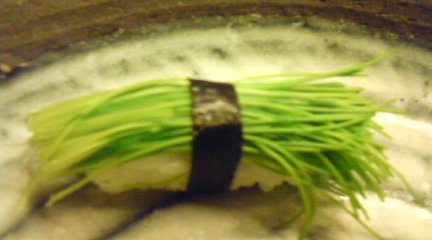
Buckwheat sprouts/Hime Soba Me/姫蕎麦芽 Nigiri!

Thin leek sprouts/Me Negi/芽葱 Nigiri!

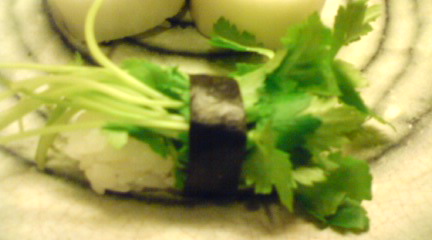
Trefoil/Mitsuba/三つ葉 Nigiri!

What is Mr. Oda going to come up with next time? LOL

Sushi Ko
shizuoka City, Aoi Ku, Ryogae-cho. 2-3-1 (Aoba Koen)
Tel.: 054-2512898
Business Hours: 17:00~25:00. 17:00~23:00 (Sundays)
Closed on Wednesdays
Reservations recommended
Credit cards OK
HOMEPAGE (Japanese)

RECOMMENDED RELATED SITES
Not-Just-Recipes, Bengal cuisine, Cooking Vegetarian, Frank Fariello, Gluten-free Vegan Family, Meatless MamaFrank Fariello, , Warren Bobrow, Wheeling Gourmet, Le Petit Cuisinier, Vegan Epicurean, Miss V’s Vegan Cookbook, Comestiblog, To Cheese or not To Cheese, The Lacquer Spoon, Russell 3, Octopuspie, Bread + Butter, Pegasus Legend, Think Twice

Please check the new postings at:
sake, shochu and sushi, Island Vittles

—————————————-
日本語のブログ
—————————————-

Spicy Scallops Sushi Roll: The Recipe (with Vegan Option)

Following the kind comments of the creators of such beautiful blogs as Gourmet Fury, Bread + Butter, Dhaleb, Reg And Mitzi, and many other friends, I thought the time was ripe to post a couple of simple but colorful sushi recipes than can be easily expanded for home parties and impress your guests!

My vegan and vegetarian friends should not worry as I have explained possible adaptations according to their priorities at the end of such postings!

Here is the first one:
Spicy Scallops Sushi Roll!

INGREDIENTS (& ADVICE):

No need to be too precise about exact quantities here as personal tastes can (and ought to) be different!

-Sushi rice: as much as you will need (freshly made. See sushi rice recipe HERE)

-Nori/dry seaweed: use large sheets (maximum size)

-Scallops: Only fresh, please.

-Tobikko (Flying Fish roe): as fresh as possible.

-Tempura kasu: these are the pieces of batter found in the oil after frying tenpura. The Japanese do not throw them away! Scoop them out as early as possible and lay them on a piece of paper kitchen to take off excess oil. Let them cool completely. If you do use them immediately, store them by dee-freezing them inside an airtight vinyl pouch!

-Coarsely cruched peanuts. These with the tenpura kasu will add a welcome crunchiness.

-Mayonnaise.
Now, if you don’t like it, make a thick dressing. The trick is to make a simple vinaigrette with a lot of soft Dijon mustrd which will give it consistency.
Mayonnaise sold over the counter can be cloying sweet. I would make my own, which is not difficult at all: one egg yolk + salt + pepper + vinegar.
Whisk them all until smooth. Add and whisk in olive oil little by little until you have enough. Point: all ingredients must be at room temperature!
I add some wasabi to it for extra taste!

-Chili pepper powder.

-Cucumber: finely chopped. Cut the cucumber in 5 cm, 2-inch long pieces. Cut each piece into thin slices. Cut the slices again into very fine strips.

RECIPE:

-In a bowl drop the scallops cut into small pieces. Add the tobikko/Flyiing Fish roe, tempura kasu, crushed peanuts, mayonnaise and chili pepper. Mix well. Taste and rectify the seasoning if needed.

-Spread a large sushi roll mat out and cover it with a sheet of nori/dry seaweed.

-Spread a layer of sushi rice over the whole nori/dry seaweed as equally as possible. Careful with the quantity. Too much and you won’t be able to roll it!

-Leave a small strip space at one extremity. Line with the cucumber in a half centimetre/less than half an inch wide strip.

-Leave a space between the cucumber and scallops mixture to obtain the same pattern as shown in above picture. Spread the scallops evenly. Leave a space at the other extremity to allow for a tight closing of the roll.

-Carefully roll the sushi from the cucmber end. Once completely rolled, pressed gently and evenly so as to allow the nori/seaweed to seal the roll.

-Unroll the mat. Cut the roll and serve at once.

-There is no real need for extra soy sauce or whatever dessing, but this a personal taste.

VEGAN OPTION:

-Skip the Tobikko/Flying Fish roe. Replace with very finely chopped sweet red pimento.

-Instead of using scallops, use mushrooms. White coloured and soft varieties such as button mushrooms, shimeji or even eringi are best.
Cut the mushrooms and sprinkle with lemon juice to prevent them from darkening.
Fry them in olive oil until they are soft.
Let them cool completely and drain them thoroughly.
Do not throw the juices away as they can be used in delicious sauces or soups.

-As for the mayonnaise, use a vegan subsititute or make a dressing like I suggested above.

NOTES:

Do not be afraid of varying that recipe. It is very simple!

RECOMMENDED RELATED SITES:
Bread + Butter, Comestilblog, Greedy Girl, Bouchon For 2, Zoy Zhang, Hungry Neko, Mangantayon, Elinluv Tidbit Corner, Maison de Christina, Chrys Niles, Lexi, Culinary Musings, Eats and Everything, Bite Me New England, Heather Sweet, Warren Bobrow, 5 Star Foodie, Frank Fariello, Oyster Culture, Ramendo, Alchemist Chef, Ochikeron, Mrs. Lavendula, The Gipsy Chef, Spirited Miu Flavor, Wheeling Gourmet, Chef de Plunge, The Lacquer Spoon, Octopuspie, Pegasus Legend, Gourmet Fury

Please check the new postings at:
sake, shochu and sushi

—————————————-
日本語のブログ
—————————————-

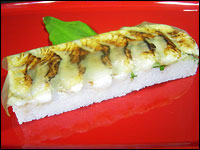
Oshizushi/Pressed Sushi Techniques 4: Seared Seabream/Tai no Aburi

SYNOPSIS:

Sushi exists under many forms and guises.
It is not all nigiri and (more ubiquitous) sushi rolls!
Have you ever heard of Oshizushi?

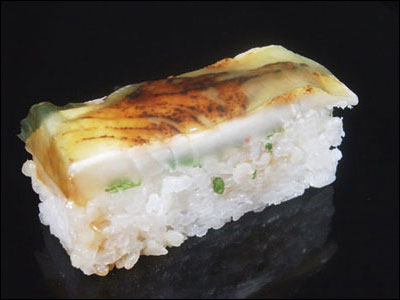
Oshizushi (押し寿司, litterally pressed sushi), is a pressed sushi from the Kansai Region, a favourite and specialty of Osaka.

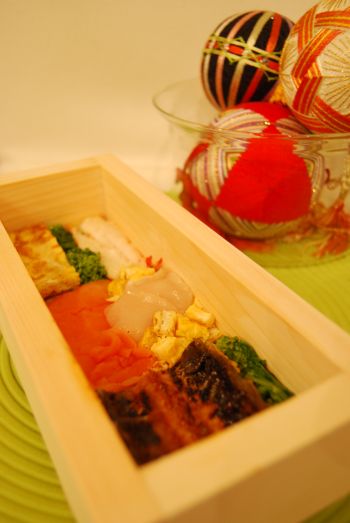
Oshibako unmounted

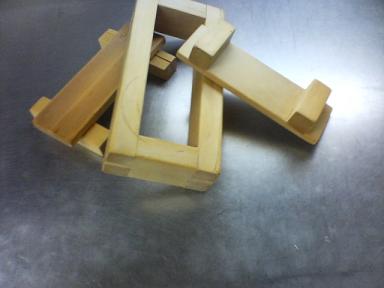
It is made with the help of a block-shaped piece formed using a wooden mold, called an oshibako/押し箱.

Oshibako lined with toppings

The chef lines the bottom of the oshibako with the toppings, covers them with sushi rice, and then presses the lid of the mold down to create a compact, rectilinear block.

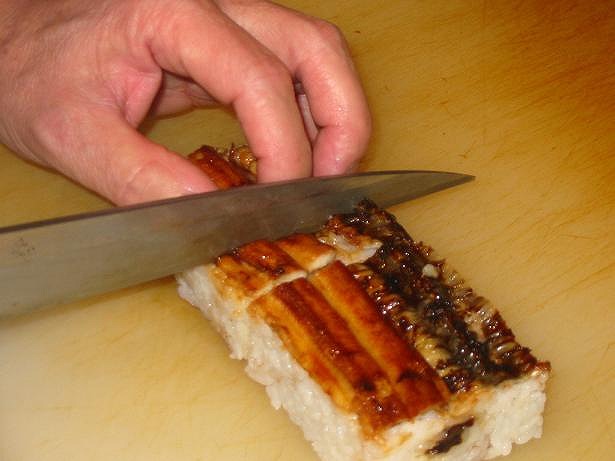
Cutting Grilled Eel Oshizushi

The block is then removed from the mold and then cut into bite-sized pieces.

It is great fun to experiment at home for large parties or the family as you can include almost anything.
Moreover, oshizuhi is easy to transport and include in bento!

The recipes and techniques I’m introducing here are professional, but with a little practice I’m sure you will become a specialist

1)Salmon Marinated in Seaweed/Sake Sushi Konbushime, 2) Seared Prime Beef/Gyuniku Aburi, 3) Egg Bearing Snow Crab/Seikogani

———————————-

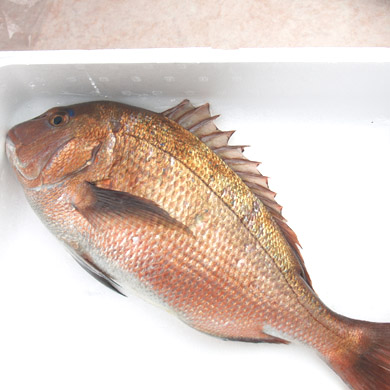
Seabreams or Snappers come in so many varieties all over thw orld that it becomes quite easy to find and adapt to various cuisines.
The Japanese are extremely fond of it either raw or steamed with rice.
When using it as sashimi or sushi, choose a fresh fis. Look at their eyes and press with fingers. And use your nose!

Madai/真鯛 or “True Seabream”, the most commonly used type of seabream in Japan.

For an extra finishing touch for the taste, use fresh leaves of sansho/山椒 or Japanese pepper (also called ki no me/木の芽).
The English name is Shichuan Pepper, although we are talking of the fresh plant here.

In Japan the dried and powdered leaves of Zanthoxylum sancho are used to make noodle dishes and soups mildly hot and fragrant. The whole fresh leaves, 木の芽 kinome, are used to flavour vegetables, especially bamboo shoots, and to decorate soups. Typically the young shoots are used in this way giving an aromatic lemony flavour to food. They are used to denote spring seasonality in food. The buds, seeds, flowers, and hulls are also used.

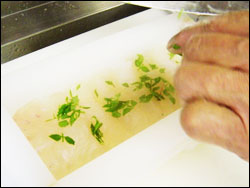
Chop some leaves finely enough to use with sushi, but not to fine. Cut them as short as shown in picture.

Soften light seaweed in lukewarm water and spread it over a clean cloth.

Line the bottom of the oshibako/box with slices of seabream fillet as tightly to each other as possible.
Sprinkle with chopped sansho leaves.
Fill with sushi rice and press.

Unloose oshizushi out of the box.
Brush the surface lightly with some soy sauce (I sweeten it a bit by mixing it with a little mirin/sweet sake).
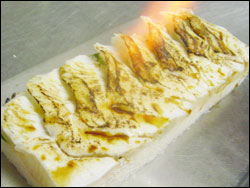
Sear the fish lightly.
Repeat the same process twice more so as to cook only the surface and make it take a nice colour.
This way you will be able to taste the fish in two different ways inside your mouth!

Spread the light seaweed over the top.
Cut to size and serve immediately for maximum enjoyment!

RECOMMENDED RELATED SITES:
Warren Bobrow, Bread + Butter, Zoy Zhang, Hungry Neko, Think Twice, Frank Fariello, Mangantayon, Hapabento, Elinluv Tidbit Corner, Tokyo Terrace, Maison de Christina, Chrys Niles,Lexi, Culinary Musings, Wheeling Gourmet, Sushi Nomads, Oyster Culture, Ravenous Couple

Please check the new postings at:
sake, shochu and sushi

—————————————-
日本語のブログ
—————————————-

Oshizushi/Pressed Sushi Techniques 3: Egg Bearing Snow Crab/Seikogani

SYNOPSIS:

Sushi exists under many forms and guises.
It is not all nigiri and (more ubiquitous) sushi rolls!
Have you ever heard of Oshizushi?

Oshizushi (押し寿司, litterally pressed sushi), is a pressed sushi from the Kansai Region, a favourite and specialty of Osaka.

Oshibako unmounted

It is made with the help of a block-shaped piece formed using a wooden mold, called an oshibako/押し箱.

Oshibako lined with toppings

The chef lines the bottom of the oshibako with the toppings, covers them with sushi rice, and then presses the lid of the mold down to create a compact, rectilinear block.

Cutting Grilled Eel Oshizushi

The block is then removed from the mold and then cut into bite-sized pieces.

It is great fun to experiment at home for large parties or the family as you can include almost anything.
Moreover, oshizuhi is easy to transport and include in bento!

The recipes and techniques I’m introducing here are professional, but with a little practice I’m sure you will become a specialist

1)Salmon Marinated in Seaweed/Sake Sushi Konbushime, 2) Seared Prime Beef/Gyuniku Aburi

———————————-

Egg Bearing Snow Crab/Seikogani

Snow Crab/Zuwagani

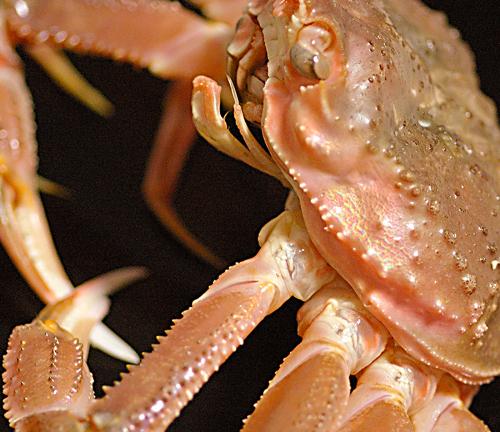
Seikogani is the Japanese name for the female Snow Crab or Zuwagani, when she is bearing her eggs.
Contrary to many other kinds of crabs, the female snow crabs, even when bearing eggs, lose little of their food and taste quality with the added advantage of an extra delicacy and taste. On the other hand the main food is found inside the shell instead of the legs and pincers for the males.
Therefore, if you get your hands on such a specimen, do not ignore it, even if they are noticeably smaller than their male counterparts!

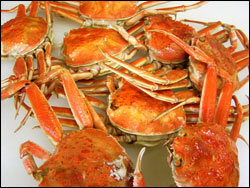
Boiled snow crabs.

The best is actually to combine both male and female into a combination sushi.

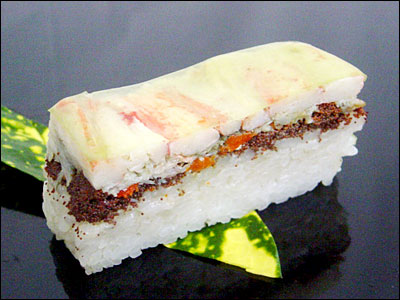
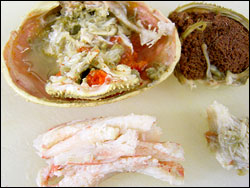
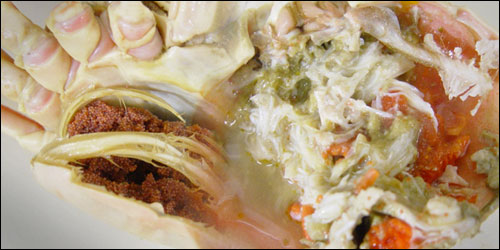
Above are the shells of two snow crabs, the large male one containing white flesh and red brains from both male and female, the smaller female one containing the eggs, and the flesh taken out of the male legs after boiling and cooling.

See above picture for better view of the edible morsels: white flesh, red brains (don’t forget these!) and eggs.

As there is a danger of a general crumbling out of the ingredients, line the bottom of the oshibako/box with a good layer of light seaweed first instead of doing it after you have unloose the sushi out ofits box.
Then place legs flesh tightly parallel to each other to form as compact as possible layer. Cover the leg flesh with the eggs and red brains into a pleasing design.
Finally fill with sushi rice and press.

Unloose sushi from its box and cut to size before serving!

RECOMMENDED RELATED SITES:
Warren Bobrow, Bread + Butter, Zoy Zhang, Hungry Neko, Think Twice, Frank Fariello, Mangantayon, Hapabento, Elinluv Tidbit Corner, Tokyo Terrace, Maison de Christina, Chrys Niles,Lexi, Culinary Musings, Wheeling Gourmet, Sushi Nomads, Oyster Culture

Please check the new postings at:
sake, shochu and sushi

—————————————-
日本語のブログ
—————————————-

Oshizushi/Pressed Sushi Techniques 2: Seared Prime Beef/Gyuniku Aburi

SYNOPSIS:

Sushi exists under many forms and guises.
It is not all nigiri and (more ubiquitous) sushi rolls!
Have you ever heard of Oshizushi?

Oshizushi (押し寿司, litterally pressed sushi), is a pressed sushi from the Kansai Region, a favourite and specialty of Osaka.

Oshibako unmounted

It is made with the help of a block-shaped piece formed using a wooden mold, called an oshibako/押し箱.

Oshibako lined with toppings

The chef lines the bottom of the oshibako with the toppings, covers them with sushi rice, and then presses the lid of the mold down to create a compact, rectilinear block.

Cutting Grilled Eel Oshizushi

The block is then removed from the mold and then cut into bite-sized pieces.

It is great fun to experiment at home for large parties or the family as you can include almost anything.
Moreover, oshizuhi is easy to transport and include in bento!

The recipes and techniques I’m introducing here are professional, but with a little practice I’m sure you will become a specialist

1)Salmon Marinated in Seaweed/Sake Sushi Konbushime

———————————-

Japanese prime beef has become a registered trademark all over the world be it from Kobe or other regions.
The present sushi was made with “Kuroge Gyuniku/黒毛牛肉/Black Hair Beef from animals raised to the age of 12 months in Fukui Prefecture.
Do check the origin of your beef!

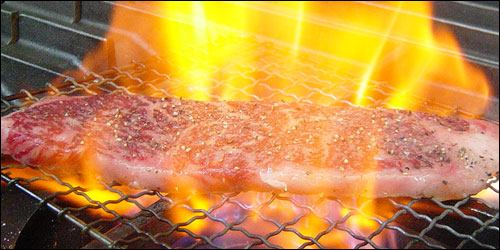
When preparing this slightly extravagant sushi, choose a large slice of prime beef with plenty of “fat veins” as shown on the above picture.
Don’t choose too thick or too thin, either. Think of the proportion of the beef and rice. Bear in mind that the the seared beef will also loose some of its thickness.

Sprinkle the beef with quality ground balck pepper and salt.
Sear it or grill it lightly on both sides quickly.
This process will enhance the sweetness of the meat.

-Slice the meat into bite-sized portions as shown in above picture at a slant after having cut off the fatty extremity.

Lay the bottom of the oshibako/box with slices of beef as shown in above picture in a “staggering” fashion. If you don’t, the slices will slideaway from each other.
Cover with shiso/perilla leaves.
Cover with sushi rice and press.

Soften light seaweed in lukewarm water and spread it over a clean cloth.
Unloose the sushi out of its box.
The beef should be on top.
Spread the light seaweed over the top.
Cut to size and serve immediately for maximum enjoyment!

RECOMMENDED RELATED SITES:
Warren Bobrow, Bread + Butter, Zoy Zhang, Hungry Neko, Think Twice, Frank Fariello, Mangantayon, Hapabento, Elinluv Tidbit Corner, Tokyo Terrace, Maison de Christina, Chrys Niles,Lexi, Culinary Musings, Wheeling Gourmet, Sushi Nomads, Oyster Culture

Please check the new postings at:
sake, shochu and sushi

—————————————-
日本語のブログ
—————————————-

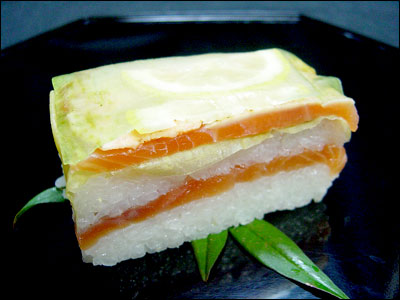
Oshizushi/Pressed Sushi Techniques 1: Salmon Marinated in Seaweed/Sake Sushi Konbushime

Sushi exists under many forms and guises.
It is not all nigiri and (more ubiquitous) sushi rolls!
Have you ever heard of Oshizushi?

Oshizushi (押し寿司, litterally pressed sushi), is a pressed sushi from the Kansai Region, a favourite and specialty of Osaka.

Oshibako unmounted

It is made with the help of a block-shaped piece formed using a wooden mold, called an oshibako/押し箱.

Oshibako lined with toppings

The chef lines the bottom of the oshibako with the toppings, covers them with sushi rice, and then presses the lid of the mold down to create a compact, rectilinear block.

Cutting Grilled Eel Oshizushi

The block is then removed from the mold and then cut into bite-sized pieces.

It is great fun to experiment at home for large parties or the family as you can include almost anything.
Moreover, oshizuhi is easy to transport and include in bento!

The recipes and techniques I’m introducing here are professional, but with a little practice I’m sure you will become a specialist

——————————

Oshizushi/Pressed Sushi Techniques 1: Salmon Marinated in Seaweed/Sake Sushi Konbushime

For sushi rice preparation, check HERE for previous posting!

Konbushime/昆布〆means that the fish is “marinated with seaweed.

Konbu/Seaweed is now readily available on Japanese and Asian markets all over the world or on the internet.

Two types of konbu/seaweed are used:
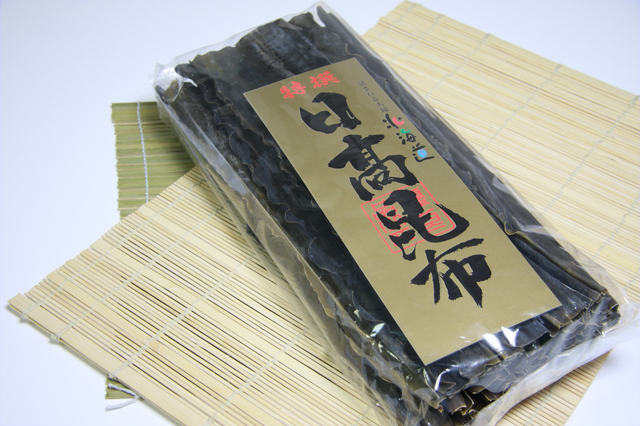
-Dark/black thick Konbu/Seaweed is bought dry and has to be softened in lukewarm water for a while. That particular step is very easy to learn.
Keep in mind it is edible, although after marination, it should be discarded.

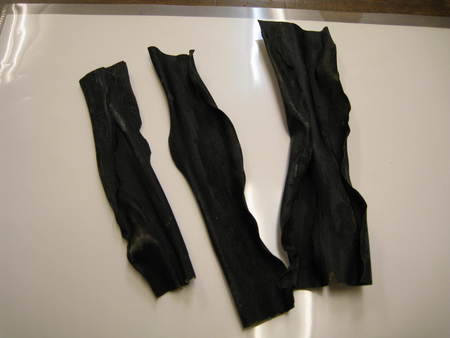
-Thin, light coloured (almost transparent) is used as an ingredient both for taste and the finishing touch. If not available, you may replace it with fine green leaves.
It is called “Kagome Konbu/かごめ昆布”.

An even better light seaweed is called “Take Kawa Konbu/竹皮昆布/Bamboo Skin Saweed” and is widely used by professionals.

Both light coloured seaweeds have to be softened in lukewarm water, sponged off and spread into thin sheets first. But it is really worth the work!

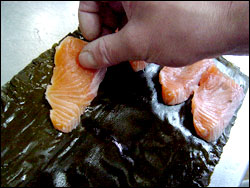
After having softened the dark konbu, spread it over a clean working table and place the fresh (fresh, please!) salmon slices over one sheet and covering the lot with another sheet.
Wrap it in cellophane paper and leave it in the fridge for at least 30 minutes.

During that time soften light seaweed in lukewarm water and spread it over a clean cloth.

Line the bottom of the oshibako/box with one layer of salmon (no dark seaweed!). Spread light seaweed over the salmon and spread a first layer sushi rice.

Repeat the same operation once more and press.

Unloose the sushi out of its box.
The fish should be on top.
Grill the top of the fish lightly with a hand burner just enough to change the colour.
That step will enable to savour two different tastes at the same time!

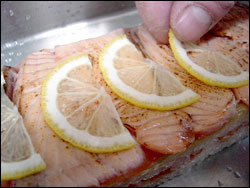
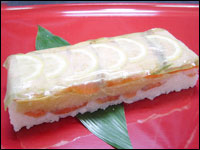
Place very thin slices of lemon (clean organic, please!) on top of the rice.
It will abate the “fishy smell/taste”.

Lay another layer of fine light seaweed over the top.
Cut and serve!

RECOMMENDED RELATED SITES:
Warren Bobrow, Bread + Butter, Zoy Zhang, Hungry Neko, Think Twice, Frank Fariello, Mangantayon, Hapabento, Elinluv Tidbit Corner, Tokyo Terrace, Maison de Christina, Chrys Niles,Lexi, Culinary Musings, Wheeling Gourmet, Sushi Nomads, Oyster Culture

Please check the new postings at:
sake, shochu and sushi

—————————————-
日本語のブログ
—————————————-

Sushi Restaurant: Sushi Ko (’09/12/10)

When I go for sushi with the Missus, we invariably visit Sushi Ko in Sushi Ko.
I just can’t enumerate all the good reasons for visiting this sushi restaurant.
It is the best deal in town when it comes to quality, freshness, prices and service. Full stop.

We were served ankimo/アンキモ or monkfish liver (I call it Japanese foir gras!) with the first drink.
That helped us consider which sashimi to start with.
Here is what we ordered on that particular day (the fish served is only seasonal at Sushi Ko, so choosing sashimiis a great venture!):

-Bottom left: “honmaguro/本鮪”, blue fin tuna from Oma (Aomori Prefecture), chu-toro/semi-fat part.
-Top left: O-toro/belly fat part of same fish
-Bottom centre: “Aori Ika/あおり烏賊, Great Fin Reef Squid from Suruga Bay in Shizuoka Prefecture.
-Bottom right: Akami/lean part rom same tuna.

Notice the “shiso/紫蘇”, perilla flowers, grated “wasabi/山葵” from Shizuoka and “wakame/若布” seaweed at the back!

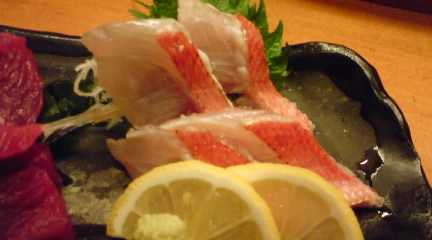
“Kinmeidai/金目鯛”, gold eye seabream from Izu penisula in Shizuoka Prefecture resting on a shiso/perilla leaf.

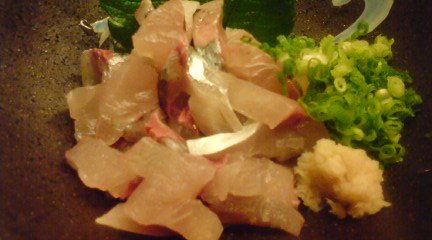
As we were not ready yet for the sushi (rice) we ordered one more sashimi: “aji tataki/鯵たたき”, or saurel/mackerel pike tartare Caught off Shizuoka shores).
Very fresh and enjoyable as you little bits at a time.

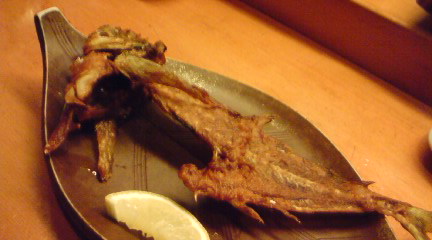
Just to prove how fresh the fish was (it was caught live from the tank), we were served its head and bones dep-fried. This is actually the traditional Japanese way to get their calcium for their bodies!

Sushi is not only superlative at sashimi and sushi, but they also provide a great array of excellent cooked dishes.
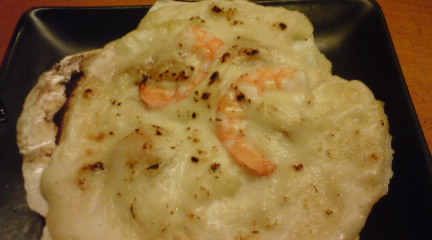
The Missus being ravenous, she couldn’t help asking for the “hotate gratin/帆立グラタン, scallops gratin! French cuisine at a sushi restaurant! Why not!

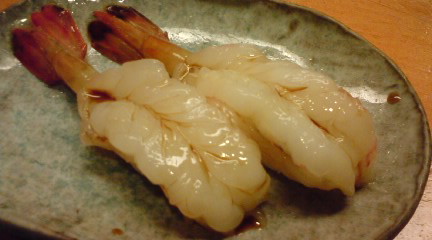
On the other I couldn’t help ogling at the “botan ebi/牡丹蝦, large prawns” from Hokkaido. I opted for them as sushi nigiri. These large prawns are very sweet and are exclusively eaten raw.

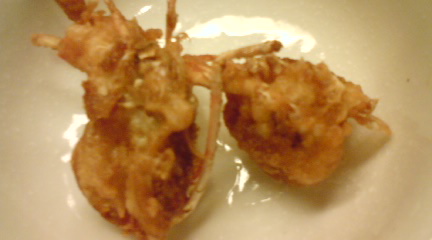
Once again, to prove their freshness, we were served the heads deep-fried!

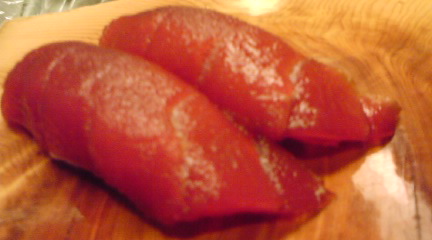
“Maguro Zuke/鮪付け”, marinated tuna is another morsel that we must have. The tuna, akami/lean part usually is marinated for 10~20 minutes in a mixture of soy sauce, sake and mirin (and other “secret” ingredients) before being placed on the shari/rice ball. Almost makes for a dessert.

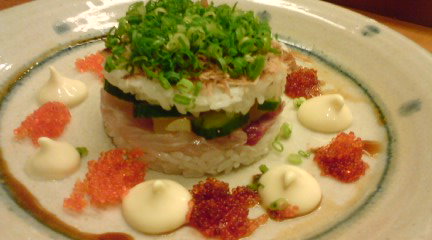
One particular creation by Sushi Ko is their Sushi Millefeuille (another French concept?)
They offer two kinds, one international style, the other Japanese style.
For once, we chose the Japanese style:
“kanpachi/間八” or greater Amberjack, “Kazu no Ko/数の子”, or herring roe and cucumber on the first tier, “Katsuo Bushi/鰹節” or dry bonito shavings and chopped thin leeks, the whole surrounded with dressing and “Tobikko/飛び子” or flying fish roe!

From then it was ordering morsels, one set of two/”nikan-二冠” at a time:
“hotate/帆立”, raw scallops muscle part.

“HIrame/平目”, or sole, served pre-seasoned with a little salt and lemon juice. Perfect as it is. No need for soy sauce!

“Me-negi/芽葱”, or leek sprouts for the vegans!

The Missus couldn’t stop and ordered Japanese-style deep-fried oysters!

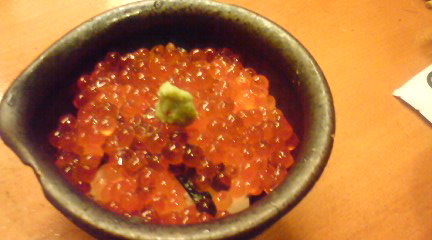
And the ubiquitous “Ikura mini don/いくらミニ丼”, or mini bowl of rice topped with salmon roe and freshly grated wasabi (from Shizuoka, of course!).

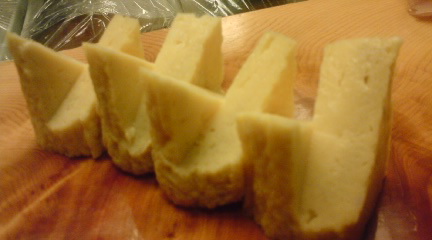
As for me, I will not leave the place without the “Tamagoyaki/卵焼き” or Japanese omellette. Home-made (not all sushi restaurants go through the pain of cooking their own tamagoyaki!”) and artfully cut!

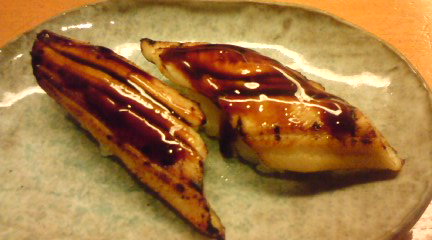
And the extravagant dessert: “Anago/穴子”, conger eel first grilled to a soft texture and topped with tare/sauce (always original at Sushi Ko!)!

We did have a lot of drink, I can assure you, but we remembered what we savoured!
Next time? Very soon, I’m sure!

Sushi Ko
shizuoka City, Aoi Ku, Ryogae-cho. 2-3-1 (Aoba Koen)
Tel.: 054-2512898
Business Hours: 17:00~25:00. 17:00~23:00 (Sundays)
Closed on Wednesdays
Reservations recommended
Credit cards OK
HOMEPAGE (Japanese)

RECOMMENDED RELATED SITES:
Bread + Butter, Comestilblog, Greedy Girl, Bouchon For 2, Zoy Zhang, Hungry Neko, Mangantayon, Elinluv Tidbit Corner, Maison de Christina, Chrys Niles, Lexi, Culinary Musings, Eats and Everything, Bite Me New England, Heather Sweet, Warren Bobrow, 5 Star Foodie, Frank Fariello, Oyster Culture, Ramendo, Alchemist Chef, Ochikeron, Mrs. Lavendula, The Gipsy Chef, Spirited Miu Flavor,
-Sake: Tokyo Through The Drinking Glass, Tokyo Foodcast, Urban Sake, Sake World
-Wine: Palate To Pen
-Beer: Good Beer & Country Boys, Another Pint, Please!
-Japanese Pottery to enjoy your favourite drinks: Yellin Yakimono Gallery

Please check the new postings at:
sake, shochu and sushi

—————————————-
日本語のブログ
—————————————-

Sashimi Plate at Sushi-Ko (’09/12/12)

When I go for sushi with the Missus, we invariably visit Sushi Ko in Sushi Ko.
I just can’t enumerate all the good reasons for visiting this sushi restaurant.
It is the best deal in town when it comes to quality, freshness, prices and service. Full stop.

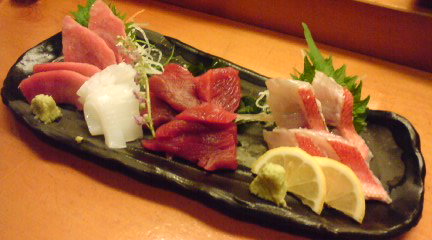
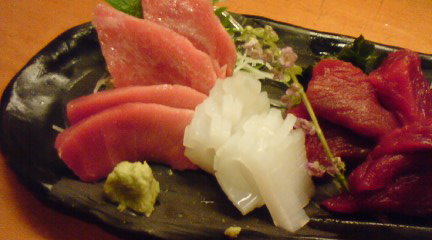
To cut a long story short (no pun intended) here what we ordered as sashimi to start our meal:

-Bottom left: honmaguro/blue fin tuna from Oma (Aomori Prefecture), chu-toro/semi-fat part.
-Top left: O-toro/belly fat part of same fish
-Bottom rcentre: Aori Ika/Great FinReef Squid from Suruga Bay in Shizuoka Prefecture.
-Bottom right: Akami/lean part rom same tuna.

Notice the shiso/perilla flowers, grated wasabi from Shizuoka and wakame seaweed at the back!

Kinmeidai/gold eye seabream from Izu penisula in Shizuoka Prefecture.

For what we had for the rest of the meal (a large one!) check Shizuoka Sushi Blog!

Sushi Ko
shizuoka City, Aoi Ku, Ryogae-cho. 2-3-1 (Aoba Koen)
Tel.: 054-2512898
Business Hours: 17:00~25:00. 17:00~23:00 (Sundays)
Closed on Wednesdays
Reservations recommended
Credit cards OK
HOMEPAGE (Japanese)

RECOMMENDED RELATED SITES:
Bread + Butter, Comestilblog, Greedy Girl, Bouchon For 2, Zoy Zhang, Hungry Neko, Mangantayon, Elinluv Tidbit Corner, Maison de Christina, Chrys Niles, Lexi, Culinary Musings, Eats and Everything, Bite Me New England, Heather Sweet, Warren Bobrow, 5 Star Foodie, Frank Fariello, Oyster Culture, Ramendo, Alchemist Chef, Ochikeron, Mrs. Lavendula, The Gipsy Chef, Spirited Miu Flavor,
-Sake: Tokyo Through The Drinking Glass, Tokyo Foodcast, Urban Sake, Sake World
-Wine: Palate To Pen
-Beer: Good Beer & Country Boys, Another Pint, Please!
-Japanese Pottery to enjoy your favourite drinks: Yellin Yakimono Gallery

Please check the new postings at:
sake, shochu and sushi

—————————————-
日本語のブログ
—————————————-

Japanese Seasonal Fish: Kawahagi/Thread-sail Filefish

kawahagi1.jpg

Kawahagi or Thread-sail Filefish (or simply Filefish) is an angler’s favourite in summer.
Like any other fishes, it has other names such as “Gihagi, “Hagi”, “Gyuu”, “Subuta” or “bakuchiuchi”.
It is fairly common in Central and South Japan.
It is called Leatherjacket down in Australia where it is considered a pest!

In Kansai area, it replaces Fugu/Globefish when it is out of season for its similarity as sashimi

012

The skin should be rough like that of a shark and brightly coloured.
Avoid sticky skin fish.
The bigger the size, the greater the taste (anglers, enjoy!)

Savouring the full Filfish meal at Sushi Ko, Shizuoka City:

Back in June, as I had to atone for some somewhat egoistical pleasure-seeking, I took the Missus to our favourite Sushi Restaurant in Shizuoka City, namely Sushi Ko,located along Aoba Park.

Although we did order the inevitable favourites, “katsuo/bonito” sashimi, “Shirako to Ankimo/Combination of Cod Sperm sacs and Frogfish/Monkfish liver”, “Pon Kara Maguro/Deep-fried tuna cubes”, “Shishamo/Spirinchus lanceolatus”, “Hotate/Scallops”, “Maguro Zuke/Marinated Tuna sushi”, and “Amaebi nigiri to Shiraebi Gunkan/Sweet shrimp and white shrimp sushi”, the star of the day was “Kawahagi/Filefish”!

The chef took a splendid live specimen (see top pic) just caught off Mochimune coast in Shizuoka City out of the “aquarium” and proceeded to serve the complete fish in three different manners:


“O-Tsukuri”:
After having taken away the inedible skin, the chef first cut the fillets into very thin slices to be served with thin leeks and dip sauce made of ponzu mixed with the fresh liver of the same fish. As now is the best season, those comparatively thin fish come up with enormous livers!


“O nigiri”:
The chef managed to keep four slices aside to prepare nigiri with the fish flesh topped with a piece of its liver, some “momiji oroshi/grated daikon with chili pepper” and seasoned with ponzu!

SUSHI-KO-2008-10-11“Kara age”:
The “cheeks bones” with their meat were last deep-fried and served as they are with some lemon. Simple and great!
All this with one single fish!

Sushi Ko
shizuoka City, Aoi Ku, Ryogae-cho. 2-3-1 (Aoba Koen)
Tel.: 054-2512898
Business Hours: 17:00~25:00. 17:00~23:00 (Sundays)
Closed on Wednesdays
Reservations recommended
Credit cards OK
HOMEPAGE (Japanese)

RECOMMENDED RELATED SITES:
Warren Bobrow
Bread + Butter
5 Star Foodie
Frank Fariello
Elinluv Tidbit Corner
Tokyo Terrace
Maison de Christina
Chrys Niles
Comestilblog
Greedy Girl
Bouchon For 2

Please check the new postings at:
sake, shochu and sushi

—————————————-
日本語のブログ
—————————————-

Ankimo Presentations 2

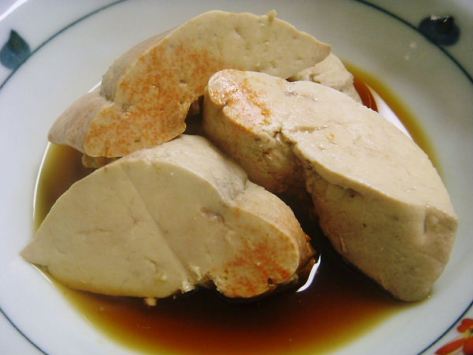
ANKIMO-STEAMED
Plain steamed ankimo served with simple cold ponzu sauce

I have already introduced the recipe for preparing Ankimo/Frogfish Liver (Japanese Foie Gras) in a precedent article as well an article on various presentations.
This posting will show you other possibilities!

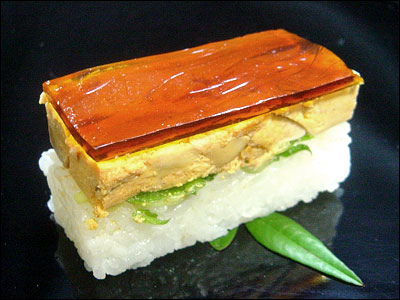
ANKIMO-SUSH-1

The oshizushi/pressed sushi above is a beauty with fish jelly on top!

—————–

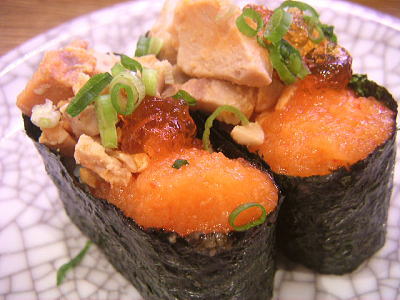
Ankimo Gunkan Mini Seriies!

ANKIMO-SUSHI-2

ANKIMO-SUSHI-3

ANKIMO-SUSHI-4

ANKIMO-SUSHI-5

————————–

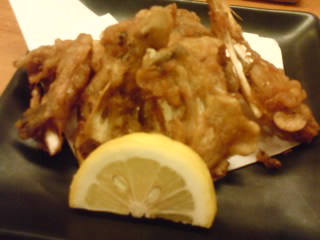
ANKIMO-FRIED

Ankimo does not have to be on sushi.
It can be cooked for its own sake such as in Japanese style above or:

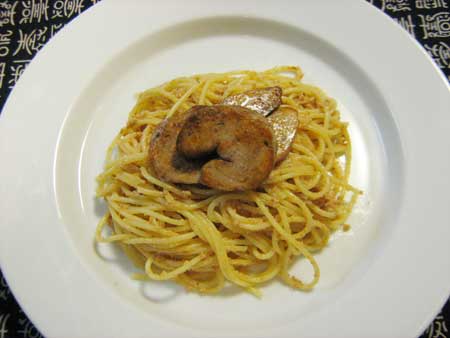
ANKIMO-PASTA

Ankimo Pasta. Japanese foie gras instead of duck/goose foie gras!

RECOMMENDED RELATED SITES:
Warren Bobrow
Bread + Butter
5 Star Foodie
Frank Fariello
Mangantayon
Hapabento
Elinluv Tidbit Corner
Tokyo Terrace
Maison de Christina
Chrys Niles
Comestilblog

Please check the new postings at:
sake, shochu and sushi

—————————————-
日本語のブログ
—————————————-
Japanese Seasonal Fish: Salmon-Sake

SAKE-1

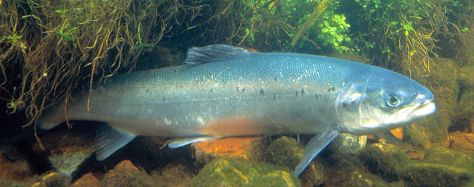
Salmon is a favourite almost everywhere on the Globe, but it is in Japan that you can enjoy in the most numerous manners!

Like every other fish it has many names according to season and place:
Shirozake/White Salmon, Akiaji or Akizake for Autumn Salmon, Shake in Tokyo.
In Spring it is called Tokishirazu.
I don’t have to tell you there are many, many names for it all over the world!

SAKE-SUJIKO

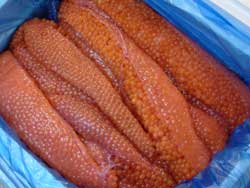
Its roe, before processing, is called Sujiko in Japanese, whereas the salmon roe, once treated, is called Ikura.

SAKE-ROE-SUSHI

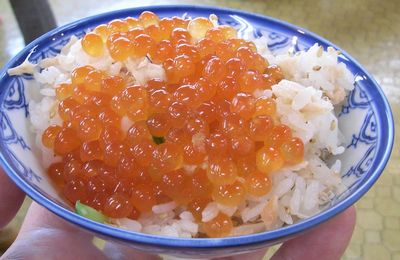
Many Japanese appreciate the roe untreated, but more people enjoy it on top of rice as it is with some soy sauce and grated wasabi.

SAKE-SUSHI

It also makes for some splendid colourful creation on a plate of sushi!

SAKE-SUSHI-2

As oshizushi/pressed sushi, it can make some very interesting combinations with the salmon flesh and roe.

SAKE-GOHAN

Have you ever tasted Sake Gohan/Salmon Rice?

SAKE-OSHIZUSHI

Slightly smoked the Japanese way, It is extensively used in the making of bentoes!

RECOMMENDED RELATED SITES:
Warren Bobrow
Bread + Butter
5 Star Foodie
Frank Fariello
Mangantayon
Tokyo Foodcast
Tokyo Through The Drinking Glass
Urban sake
Hapabento
Elinluv Tidbit Corner

Please check the new postings at:
sake, shochu and sushi

—————————————-
日本語のブログ
—————————————-

Shizuoka Local Fish: Houbo/Blue Fin Robin

houbou.jpg

Many a time, my good friend Patrick Harrington has rightly pointed out on the importance to eat “local” as much as possible. Consequently, I have endeavoured whenever possible to introduce any vegetables, dairy products, meat and fish grown, made, raised or caught in Shizuoka Prefecture (and its waters)
As for today I would like to introduce again a fairly cheap and tasty fish: houbou. Its English name is quite poetic: blue fin robin (“Chelidonichthys spinosus” for the purists). The reason is its very wide round green-blue side fins.
Some call it grotesque, others beautiful.

Most of them are found in Niigata Prefecture from Autumn to Winter (30~50 cm), but they are caught in early Spring in Suruga Bay (the Shizuoka variety is smaller, up to 20 cm). But now and thenwe find them at dfferent times of the year.

It can be prepared in many ways:

-Sashimi and sushi if just caught.

-In “nabe/鍋” (soup pot) or as “nimono/煮物” (simmered) in Japanese-style cuisine.

-Steamed and served with a sweet and sour sauce in Chinese-style food.

My preferred way is Mediterranean style (one fish per person):
Cut the side fins and scrape the scales off. discard the insides and clean under clear cold running water. Make a couple of shallow incisions over each flank.
Fill the stomach with a mixture of finely chopped vegetables and herbs (leave your imagination go free!).
Put it on a large sheet of olive oil coated cooking foil paper, sprinkle it with a little salt and pepper. Place vegetables cut in long strings on both sides (plenty is fine), and one or two thin lemon slices on top. Coat it with some (not too much) extra virgin oil. As a last touch, I add some white wine and a little anise spirit (Pernod, Ricard or Absinthe).
Loosely wrap the fish with foil paper, close both ends by twisting them around.
Place the fish in its foil paper directly on the metal plate inside the oven preheated at 180 degrees Celsius and cook for about 15 minutes (longer for large fish).
If you do not have an oven, steam it the Chinese way!

RECOMMENDED RELATED SITES:
Warren Bobrow
Bread + Butter
5 Star Foodie
Frank Fariello
Mangantayon
Elinluv Tidbit Corner

Please check the new postings at:
sake, shochu and sushi

—————————————-
日本語のブログ
—————————————-