Category Archives: Japan

Japan Earthquake and Tsunami (March 2011):Collecting Money at Beer No Yokota Bar!

Service: very friendly
Facilities: very clean
no-smoking-logoNon-smoking!
Strong points: The beer!

Shizuoka People know what it is like to suffer from earthquakes and other seisms and they do take it with a bit of fatality and a pinch of wisdom.
But they certainly don’t forget their compatriots in need in other regions of Japan.
All kinds of spontaneous money collections are occuring, small or big.

One of them has been going on since the very beginning at Yokota No Beer Bar!

No frills, no fanfare, just a cut whisky box with a hand-written sign appealing for charity!
Anyone can have a look at the money inside.
No worry, nobody will steal it!
The money will go regularly to the Red Cross.
That’s all!

Wisdom, fortitude, concern? Take your pick!

Beer No Yokota
Shizuoka Shi, Aoi Ku, Gofuku-Cho, 2-5-22, Social Kadode bldg 2F (behind the City Hall)
Tel.: 054-255-3683
Opening hours: 17:00~24:00 (15:00~24:00 on Saturdays)
Closed on Thursdays
HOMEPAGE

RECOMMENDED RELATED SITES:
Warren Bobrow, Bread + Butter, Zoy Zhang, Hungry Neko, Think Twice, Frank Fariello, Mangantayon, Hapabento, Elinluv Tidbit Corner, Tokyo Terrace, Maison de Christina, Chrys Niles,Lexi, Culinary Musings, Wheeling Gourmet, Comestiblog, Chronicles Of A Curious Cook, Tokyo Through The Drinking Glass, Tokyo Foodcast, Palate To Pen, Yellin Yakimono Gallery, Tokyo Terrace, Hilah Cooking, More than a Mount Full, Arkonite Bento, Happy Little Bento; 5 Star Foodie; Jefferson’s Table; Oyster Culture; Gourmet Fury; Island Vittles; Good Beer & Country Boys; Rubber Slippers In Italy; Color Food daidokoro/Osaka;/a; The Witchy Kitchen; Citron Et Vanille, Lunsj Med Buffet/Estonian Gastronomy (English), Cook, Eat, Play, Repeat, Chrisoscope, Agrigraph, The Agriculture Portal to shizuoka!

Please check the new postings at:
sake, shochu and sushi

Japan Earthquake and Tsunami (March 2011) Panic-buying abating in Shizuoka

(Cheap brand) bread gone…

The past week has been marked by some panic-buying, especially in Tokyo, but here in Shizuokka people are slowly becoming more reasonable in spite of the fears provoked mainly by foreign media and alarmist Embassies who haven’t realized that their apocalypse announcements have been closely watched by Japanese viewers.

No so many instant noodles gone yet.

Shizuoka is nonetheless the most earthquake-prone area in Japan, but its citizens are gradually accepting the situation with a lot of calm in spite of their private concerns.

Still more than half of the larger instant noodle meals left.

I paid a visit to the nearest Shizutetsu store, part of a local mega supermarket chain to have an idea for myself of the situation.

Half of the protein biscuits gone. They are French…

Interestingly enough only 3 types of merchandise were sought after:
Toilet paper, Fresh bread and instant noodles.

Breads and cakes almost gone…

I understand the buying of toilet paper and instant noodles, but fresh bread? How long can you keep it?

Plenty of juice, milk and yoghurt left.

No panic for fruit and vegetables!

Maybe bananas are going faster…

Stacke of meat and fish.

I hope that my friends abroad will understand that the Japanese are markedly wiser in the event of a major catastrophe!

RECOMMENDED RELATED SITES:
Warren Bobrow, Bread + Butter, Zoy Zhang, Hungry Neko, Think Twice, Frank Fariello, Mangantayon, Hapabento, Elinluv Tidbit Corner, Tokyo Terrace, Maison de Christina, Chrys Niles,Lexi, Culinary Musings, Wheeling Gourmet, Comestiblog, Chronicles Of A Curious Cook, Tokyo Through The Drinking Glass, Tokyo Foodcast, Palate To Pen, Yellin Yakimono Gallery, Tokyo Terrace, Hilah Cooking, More than a Mount Full, Arkonite Bento, Happy Little Bento; 5 Star Foodie; Jefferson’s Table; Oyster Culture; Gourmet Fury; Island Vittles; Good Beer & Country Boys; Rubber Slippers In Italy; Color Food daidokoro/Osaka;/a; The Witchy Kitchen; Citron Et Vanille, Lunsj Med Buffet/Estonian Gastronomy (English), Cook, Eat, Play, Repeat, Chrisoscope, Agrigraph, The Agriculture Portal to shizuoka!

Please check the new postings at:
sake, shochu and sushi

Japan Earthquake and Tsunami (March 2011) News

To all the friends who got worried about my dear ones and me during the last past few days, I would like to extend my grateful thanks and recognition!

It does look bad to unaccustomed people/viewers, and it is bad, but not as much as some people would like to announce.
True to say, nearly 12,000 citizens are dead or missing and more than 100,000 people have been displaced in a catastrophe of unseen proportions in modern Japan (although it suffered even more greatly in the unrecorded past).
To compound misery, there have been accidents at a few thermonuclear electicity plants.

Now, I would like to reassure everyone about the latter in spite of the hysterics shown by the German and French Embassies in particular: the radiation is not enough to be harmful to humans, and I hope it will stay so.

Moreover, one has to keep his/her perspective: what would have happened if Japan were not the most sophisticated country in the world when it comes to earthquake disaster prevention? Most of the victims disappeared in the incredible tsunami, not so many during the earthquake itself.

On the other hand, there was no rise in crimes, no looting, no riot, but a great patience and wisdom in spite of the overwhelming worries. Restaurants offered free meals in affected areas, small town mayors are working their hearts out for their citizens (“We will fight! Gambaru!”), and everyone is starting cooperating and gathering food and commodities all over Japan.

Japan will survive and become once again a model to emulate.
Mark my work, Japan and the Japanese will come out the stronger out of this ordeal!
Yes, they can!

RECOMMENDED RELATED SITES:
Warren Bobrow, Bread + Butter, Zoy Zhang, Hungry Neko, Think Twice, Frank Fariello, Mangantayon, Hapabento, Elinluv Tidbit Corner, Tokyo Terrace, Maison de Christina, Chrys Niles,Lexi, Culinary Musings, Wheeling Gourmet, Comestiblog, Chronicles Of A Curious Cook, Tokyo Through The Drinking Glass, Tokyo Foodcast, Palate To Pen, Yellin Yakimono Gallery, Tokyo Terrace, Hilah Cooking, More than a Mount Full, Arkonite Bento, Happy Little Bento; 5 Star Foodie; Jefferson’s Table; Oyster Culture; Gourmet Fury; Island Vittles; Good Beer & Country Boys; Rubber Slippers In Italy; Color Food daidokoro/Osaka;/a; The Witchy Kitchen; Citron Et Vanille, Lunsj Med Buffet/Estonian Gastronomy (English), Cook, Eat, Play, Repeat, Chrisoscope, Agrigraph, The Agriculture Portal to shizuoka!

Please check the new postings at:
sake, shochu and sushi

Wasabi: A Visit to Its Birthplace in Utogi at Maru Ichi Farm, Shizuoka!

Mr. Yoshihiro Mochizuki望月義弘

The other day I received a phone call from my good friend, Dominique Corby, the Chef/Owner of French Kappo Dominique Corby in Tokyo.
He told me that the French/German ARTE TV Channel was coming to Shizuoka City to make a long report on green tea (Shizuoka produces 45% of all green tea in Japan), wasabi (Shizuoka produces 80% of all organically-grown  wasabi in Japan) and the fishing industry in our Prefecture (they will visit the Fishing Harbor of Yaizu City)!
He wished to enroll my help to “prepare the ground” for the TV crew as I was not only living in Shizuoka City, but knew my wasabi well! He didn’t have to ask twice!
So on Thursday and Friday 12th and 13th, a third Musketeer, Stephane Danton of Ocharaka, a French specialist of green tea in Kanagawa Prefecture who exports green tea from Kawane Honcho in Shizuoka, joined us in a rented car and we left on a grand mission!

Utogi is also the starting point of some great treks!

We did spend the whole previous day following Stephane in tea growing farming homes and communities as the rain just made it impossible to visit the wasabi fields in altitude!
So we left early in the morning on Friday from Shizuoka City in blistering heat.
The ride is not that hard, 18 km along the Abe River and 3 more km up in altitude, what with the beautiful vistas between high steep forested mountains.
We reached Utogi at around 11:00 a.am. where Mr. Yuma Mochizuki was already waiting for us.

One of Mr. Yuma Mochizuki’s wasabi fields.

Mr. Yuma Mochizuki is the 10th generation of a celebrated wasabi growing family.
He presently owns 5 fields dispersed on in the Utogi Mountains, and is trying to buy more land in Fujinomiya City as the demand is growing and that there is simply no space left in Utogi!
Wasabi grows in the wild and its stems and leaves have been consumed as a vegetable and a natural medicinal herb for eons.
It is only in the beginning of the 17th Century that a farmer in Utogi succeeded in growing the root that is so appreciated in the world.
Roots of a small size will develop in the wild after 2 or 3 years, but they are too sour and “green” to be consumed at all. Although its cultivation is purely organic/macrobiotic in Shizuoka Prefecture it does need the help of a human hand.
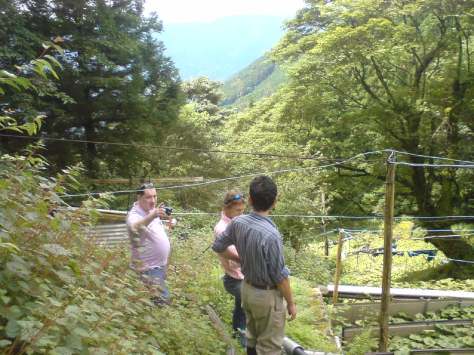
Mr. Mochizuki first took us to his highest field at almost 1,000 metres (well over 300 feet) to an almost inaccessible locale among trees, steep slopes and up impossibly narrow and slippery “stairs”. But it was certainly worth it, although the TV crew will not have to climb so high.
He then took us (all the time by car as walking was not much of an option what with the heat and the distance between fields) to the field that would appear on TV.
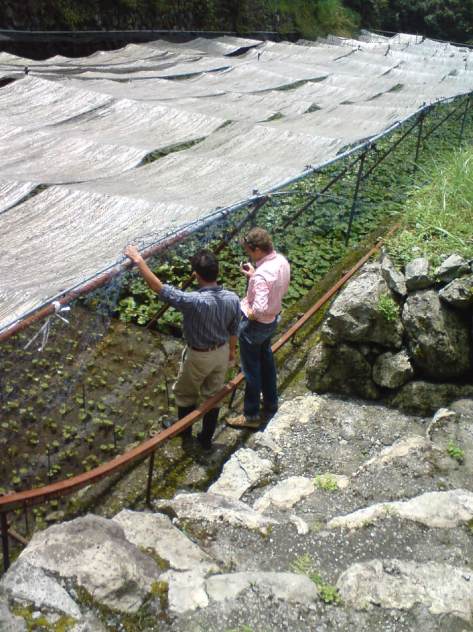
The whole field is covered with a black mesh net to protect it from too much exposure to the sun. These nets are stretched over the field only when it is directly under the path of the sun. Some fields aren’t.
But all fields have to be protected with supplementary solid side nets to keep wild monkeys, wild boars and wild  deer away as they would leave nothing of the stems and leaves!

Wasabi seedlings have to be regularly replanted every one or two years depending upon the variety. There are axtually more than 100 varieties of them. Mr. Mochizuki grows ten of them.
The seedlings above had been replanted only one month ago.
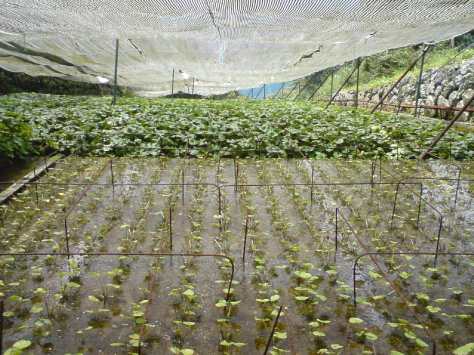
Here is a “view” (from under the nets) of the upper part of that particular field with about one-year old wasabi plants in the background.

After 1 or 2 years the wasabi plant matures to almost one metre in height, root, stems and leaves included. Subsidiary plants will grow from the bottom of the main large root. These will be cut out to be replanted as seedlings.
The large root will be harvested for the wasabi paste. The stems will be pickled in Japanese sake white lees to become “Wasabi Tsuke”, a delicacy one can use to season his/her bowl of freshly steamed rice with or with fish and fish paste. The leaves can be pickled too, although they are eminently edible raw, steamed or cooked. Shizuoka people use them as “vessels” to taste miso paste!
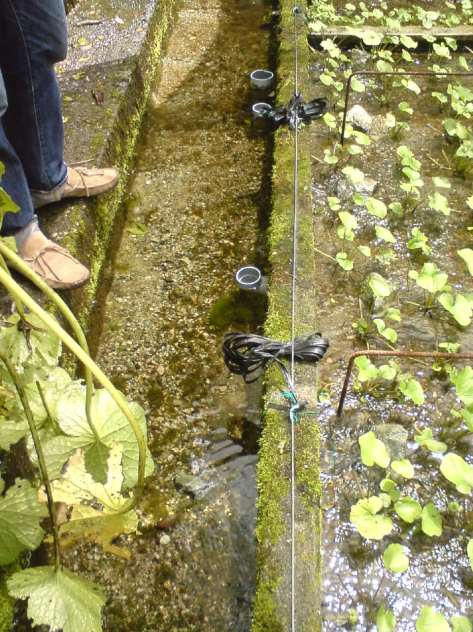
Only pure mountain water flowing at a constant temperature may be used in the culture of wasabi, that is “sawa wasabi” which grown in water as opposed to “hatake wasabi”, of a very inferior variety, usually not grown in Shizuoka Prefecture. Stagnant water is out of question.
Moreover, and this is a little known fact, individual field sections and fields in general do not communicate with each other. Water comes through pipes directly connected to mountain streams to bring water to each field section. It is then diverted to side funnels which prevent any water to go back into another field!
True envirnomental/ecological and organic culture!
Apart of the bed sand and water, nothing else goes into those fields. Full stop!
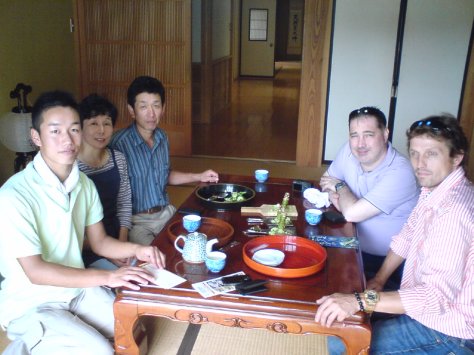
Although Mr. Mochizuki was very busy preparing the big Festival to be held on Saturday and Sunday with the whole community, he kindly took the time to invite us to his enormous Japanese house (all sitting on tatami there) to share tea and sample his wasabi crop. We had the pleasure to meet his very gentle spouse and the energetic 11th generation Yuma Mochizuki/望月佑真!

Here are the best samples of 3 of the best out of the 10 varieties the Mochizuki family grows. Can you guess which is the best one?…
The one in the middle with the dark stems!

It was actually elected twice “Best wasabi in Japan”!
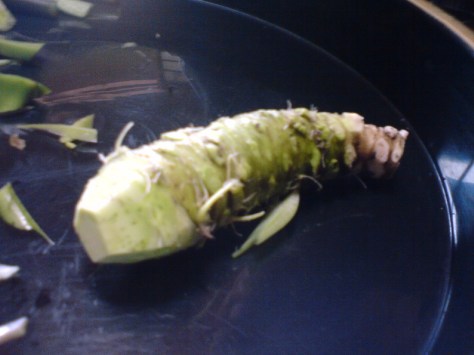
Now, where do you grate the stem from? The pointed end or the stem end?
Well, this is according to priorities, but usually after chopping the stems away from the root is first grated from the top as it will hotter as you come closer to its pointed extremity. This way you can control the “heat” of the root (or mix the whole later!).
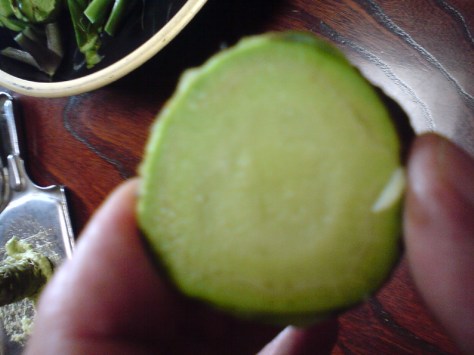
Have you ever seen the cross section of a healthy root?
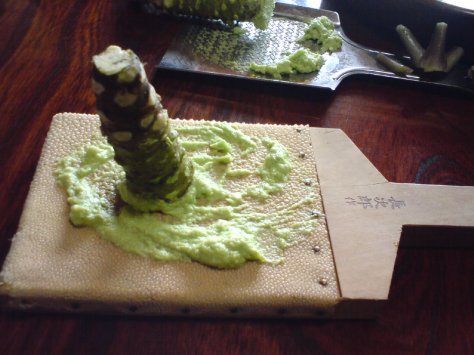
The traditional way to grate the wasabi root is on a wooden slat covered with shark skin.
Mr. Mochizuki explained this is now done only for the sake of tradition. Sushi and soba chefs will grate (away for the clients’ eyes) on a new and very efficient metal grater (in the background).
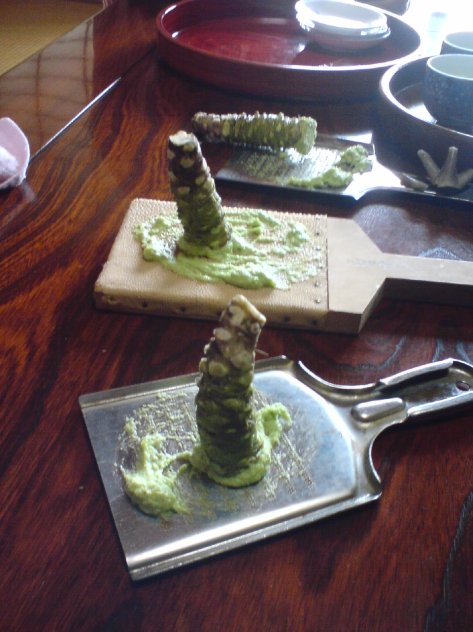
Look at that for extravagance!
Mr. Mochizuki was indeed so generous in his demonstration.
The TV crew will have a “field day”! LOL

MARU ICHI NOUEN/丸一置農園
(Yutogi Kodawari Club/有東木こだわり倶楽部)
Director: Yoshihiro Mochizuki/望月義弘
421-2303 Shizuoka Prefecture, Shizuoka City, Aoi Ku, Yutogi, 602
Tel./Fax: (81) (0)54-298-2077
E–mail: wasabiya-maruichi@vivid.ne.jp
Direct mail orders possible

RECOMMENDED RELATED SITES:
Warren Bobrow, Bread + Butter, Zoy Zhang, Hungry Neko, Think Twice, Frank Fariello, Mangantayon, Hapabento, Elinluv Tidbit Corner, Tokyo Terrace, Maison de Christina, Chrys Niles,Lexi, Culinary Musings, Wheeling Gourmet, Comestiblog, Chronicles Of A Curious Cook, Tokyo Through The Drinking Glass, Tokyo Foodcast, Palate To Pen, Yellin Yakimono Gallery, Tokyo Terrace, Hilah Cooking, More than a Mount Full, Arkonite Bento, Happy Little Bento; 5 Star Foodie; Jefferson’s Table; Oyster Culture; Gourmet Fury; Island Vittles; Good Beer & Country Boys; Rubber Slippers In Italy; Color Food daidokoro/Osaka;/a; The Witchy Kitchen; Citron Et Vanille, Lunsj Med Buffet/Estonian Gastronomy (English), Cook, Eat, Play, Repeat, Chrisoscope; Jacqueline Church; The Foodonymph (in Dubai!); Alchemy, Simple Ingredients, magical Food (in Ireland!)

Please check the new postings at:
sake, shochu and sushi

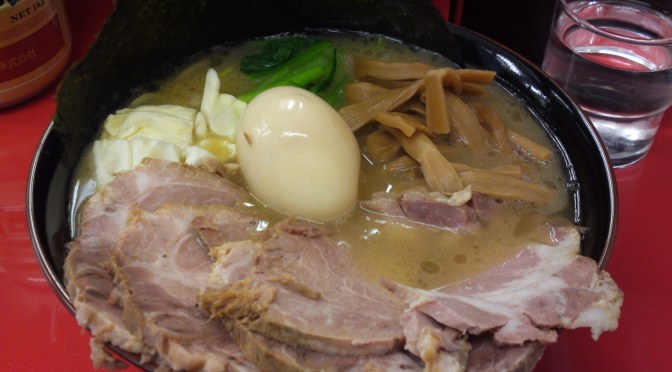
Ramen: Tonkotsu Ramen-Professional Recipe

Here is the “professional Recipe for Tonkotsu Ramen as promised!

INGREDIENTS: (will provide 3.5 litres of soup, enough for quite a few servings!

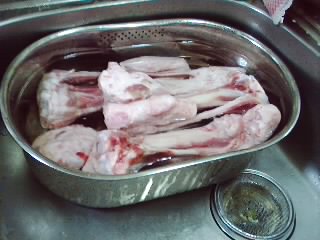
-Pork bones: 5 (2500 g)
-Water: 13 litres

RECIPE:

Bring frozen bones to room temperature in plenty of water.
It should take about 2 hours. If you cook frozen bones directly, the blood will solidify and will be very difficult to get rid of.
If you can get fresh bones, skip this step.

Fill a very large cooking pot with water and bring to boil.

Switch off fire as soon as the water boils. Drop in the bones and let cool. This process will help you get rid of the blood and blood vessels easily.

Leave it to cool down for 30~40 minutes.

Drain the water off the bones in a large strainer.
Throw off the water.
Check and take off any blood or blood vessels for the bones.
Don’t forget to clean the pot!
Break all the bones in two with a hammer.

Fill the pot again with clear water and bring to boil.
Drop the bones inside.

Keep cooking over a strong fire and scoop out foam and unwanted matters coming up on the surface (this should take 20 minutes at the most).
As the bottom might get hooter than near surface, stir with a large ladle from time to time.
If the inside of the pot over the water surface gets clogged with matter or gets dark, switch off fire, clean with a clean cloth and switch fire on again.

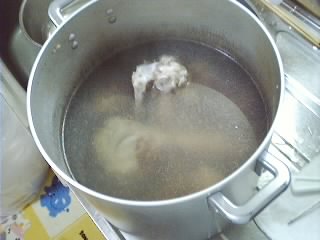
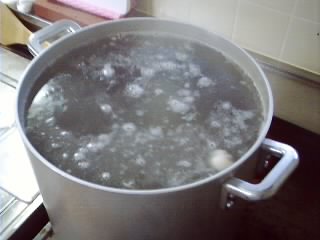
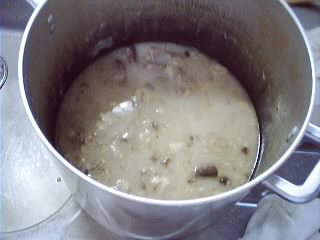
Above picture shows the soup after all unwanted matters have stopped coming up.

Cover with a lid and a weight to prevent steam coming out from under the lid. Keep simmering on a low fire.

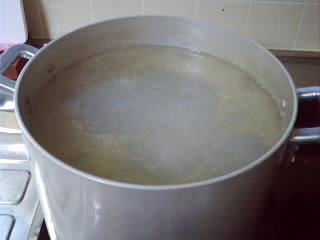
That’s how it looks after 1 hour.
Keep cooking.

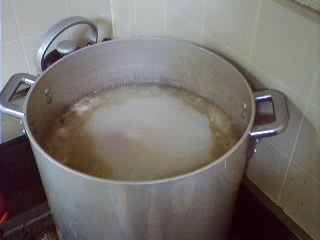
That’s how it looks after 3 hours.

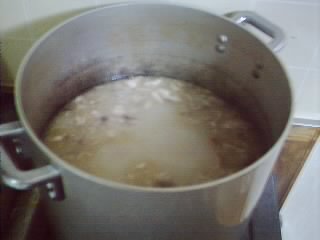
That’s how it looks after 6 hours.

That’s how it looks after 10 hours.

And after 12 hours (start early in the morning!)!

Keep cooking. Remember you are aiming at 3.5 litres of soup.
After 12 hours you may raise the fire to accelerate the cooking.
Keep the lid on!

This is what you are looking for!

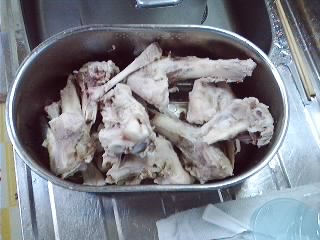
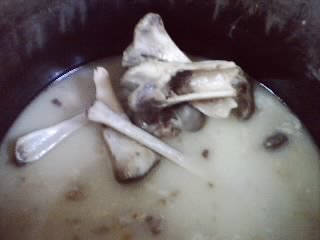
This is how the bones will look after 15 hours of cooking!
Cooked at last!

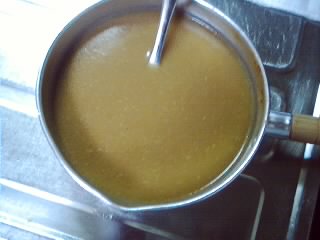
Filter the soup and here you have your tonkotsu base soup ready!
After that it is up to you and your preferences: add miso, tofu, salt, sesame oil, garlic chips and your little secrets!

Now what secret ingredients have I thrown in? LOL

RECOMMENDED RELATED SITES:
Bread + Butter, Comestilblog, Greedy Girl, Bouchon For 2, Zoy Zhang, Hungry Neko, Mangantayon, Elinluv Tidbit Corner, Maison de Christina, Chrys Niles, Lexi, Culinary Musings, Eats and Everything, Bite Me New England, Heather Sweet, Warren Bobrow, 5 Star Foodie, Frank Fariello, Oyster Culture, Ramendo, Alchemist Chef, Ochikeron, Mrs. Lavendula, The Gipsy Chef

Please check the new postings at:
sake, shochu and sushi

—————————————-
日本語のブログ
—————————————-