Tag Archives: 日本

Tofu Donuts: Recipe

tofu-kinds-5
“Tofu Doughnuts” at Shizutetsu Supermarket in Shizuoka City

Following a kind message from Dawn Figueroa who after returning from Japan could not find the tofu donuts back home, nor their recipes.

There are many recipes indeed, most of them including eggs, milk, wheat flour, pancake mix and what not.
Moreover I discovered that the stores in Japan use wheat flour, too.
Although this would be enough for vegans and vegetarians (I’M not), I decided to introduce an easy recipe which non-gluten, nor containing wheat flour.

For people who want to start from scratch, check tofu preparation recipe below!

HOME-MADE TOFU DONUTS
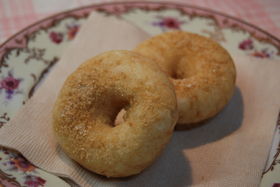
TOFU-DONUTS-1

Ingredients: For 3 donuts (multiply accordingly!)

-Rice powder (riz blanc in French): 45 g
-Cornstarch: 15 g
-Baking powder (non-gluten): half a teaspoon
Sugar beet: 10 g (optional/use a little salt if you want to prepare appetizer donuts)
-(Kinu tofu) Silk Tofu: 60 g
-Deepfry oil

Recipe:

TOFU-DONUTS-2

-In a large bowl, mash/crush the tofu
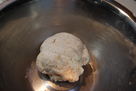
TOFU-DONUTS-3

-Add rice powder, cornstarch, baking powder and sugar beet. Mix well.Form a ball.

TOFU-DONUTS-4

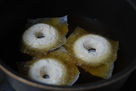
-Shape three donuts by hand and place them atop pieces of cooking paper. Shape the central hole large enough.
TOFU-DONUTS-5

-Preheat oil to 160 degrees Celsius.
Drop the doughnuts into the oil with their cooking paper.
Take paper out with tongs as soon as the oil “boil”around the donuts.
Fry the donuts until they attain a nice “fox”/brown colour.
Turn the donuts over halfway for an even cooking and colour.

NOTES:

-If you use too much tofu in the recipe the donuts will be difficult to shape.
-Proportion between rice powder, beet sugar and baking pwder is based on the following:
Rice powder: 100 g
Beet sugar: 10 g
Baking powder: 3 g
-You can add taste to the donuts according to your preferences.

————————

TOFU PREPARATION

zarudofu
“Zarudofu”, my favourite variety of tofu just filtered out in a “zaru/basket”. You just eat it with a spoon on its own. No seasoning needed!

Ingredients (for one large piece, one cho/丁in Japanese)

Soy beans: 2 cups (360cc)
Nigari: 2 large tablespoons
(Magnesium chloride is an important coagulant used in the preparation of tofu from soy milk. In Japan it is sold as nigari (the term is derived from the Japanese word for “bitter”), a white powder produced from seawater after the sodium chloride has been removed, and the water evaporated. In China it is called “lushui”.. Nigari or Lushui consists mostly of magnesium chloride, with some magnesium sulfate and other trace elements. It is also an ingredient in baby formula milk).
Water: 5 cups (twice and a half the volume of soy beans)

Utensils:
One large pot
One large clean cloth pouch to press tofu through
One bowl
One mixer
One thermometer
One large piece of gauze to filter water off shaped tofu
One large wooden spoon
One wooden tofu-shaper case

RECIPE:
toofu-1
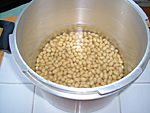
1) Preparation: soak soy beans in water overnight

toofu2
2) Preparation: Mix nigari with 1 cup of water and set aside

toofu-3
3) According to its size, Pour the whole or part by part soy beans and water (1) and make paste as fine as possible. If mixer runs at an even pace without crushing beans into paste, add more water. The paste obtained is called “namago” (生呉)

toofu-4
4) Pour the bean paste into a large pot with an equal amount of water. Heat stirring all the time. The paste will come to a boil suddenly. Switch off fire. Switch on low once the paste has settled for 10 minutes and take off fire.
toofu-5
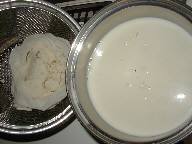
5) Pour paste into the cloth pouch and press. Right of the picture is tofu paste before pressing. Left is pressed out tofu
toofu-6
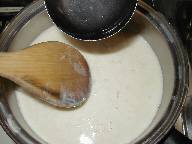
6) Solidifying (coagulating) with nigari.
Stir tofu over light fire. When the temperature has reached 75~80 degrees Celsius pour in nigari slowly and stir all the time. The solid matter will sink to the bottom and accumulate. The coagulation will be complete when liquid above tofu has become transparent. Stop the operation and let rest for 15 minutes.

toofu-7
7) Arrange the gauze inside tofu a tofu shaper case which should have small holes to let excess water run out.

toofu-8
8) Cover with lid with a weight (or glass of water) of about 250 g and further press out water for 15 minutes
toofu-9
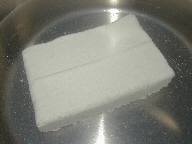
9) Delicately empty tofu in basin filled with called water and leave it there for an hour to take out excess nigari. Store in refrigerator.

RECOMMENDED RELATED SITES
Not-Just-Recipes
Bengal cuisine
Cooking Vegetarian
Frank Fariello
Gluten-free Vegan Family
Meatless Mama

Please check the new postings at:
sake, shochu and sushi

—————————————-
日本語のブログ
—————————————-
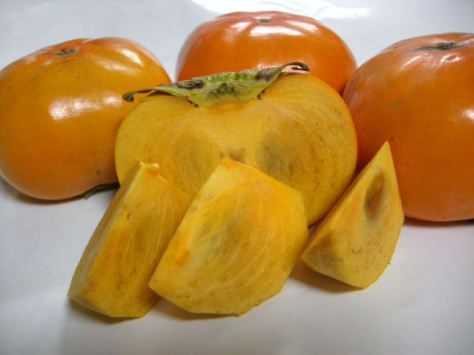
Japanese Fruits 2: Jirou Kaki-Jirou Persimmon

JIRO-KAKI1

SYNOPSIS:
There are a lot of fruit which either originated or grew to be characteristic of Japan.
I’m trying to introduce into this new series to help my vegan and vegetarian (I’m no) friends in particular as fruit can be adapted into so many ways!

1) Nashi/Asian Pear

Jirou kaki or Jirou Persimmons are not to be confused with “normal persimmons”, or heart-shaped Hachiya which is the most common variety of astringent persimmon. Astringent persimmons contain very high levels of soluble tannins and are unpalatable if eaten before softening.

JIRO-KAKI-FALSE

Hachiya Persimmons

The astringency of tannins is removed through ripening by exposure to light over several days, wrapping the fruit in paper for heating it, and/or artificially with chemicals such as alcohol and carbon dioxide which change tannin into the insoluble form. This bletting process is sometimes jumpstarted by exposing the fruit to cold or frost which hastens cellular wall breakdown. These astringent persimmons can also be prepared for commercial purposes by drying.

JIRO-KAKI-TREE

The non-astringent persimmon, or Jirou kaki, is squat like a tomato and is most commonly sold as fuyu. Non-astringent persimmons are not actually free of tannins as the term suggests, but rather are far less astringent before ripening, and lose more of their tannic quality sooner. Non-astringent persimmons may be consumed when still very firm to very very soft.

JIRO-KAKI-DRIED

Dried Jirou Persimmon

Actually, Jirou Kaki/Jirou Persimmons are the pride of our Prefecture, Shizuoka Prefecture, as they were first grown in 1844 by a farmer called Jiroushi Matsumoto in Mori-Cho, Western Shizuoka Prefecture!
Their trees were finally successfully raised in 1869.

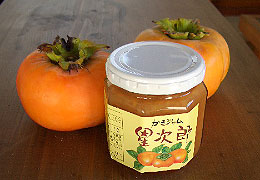
JIRO-KAKI-JAM

Jirou Persimmon Jam

The persimmons were finally given their name, Jirou Kaki, by the Emperor of Japan upon his meeting with Fujitarou Suzuki (the grower of that time) in Mori-Cho where a Shinto Temple is still dedicated to the Emperor of Japan.

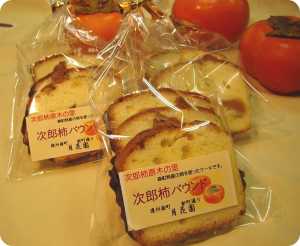
JIRO-KAKI-CAKES

In Shizuoka Prefecture, Jirou Persimmon are found under many guises such as cakes (above)

JIRO-KAKI-WINE

Jirou Persimmon wine!

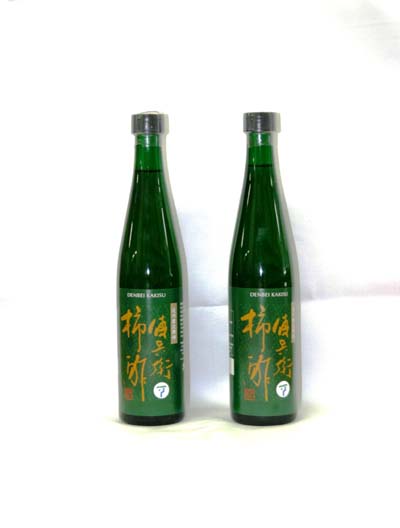
JIRO-KAKI-VINEGAR

Jirou Persimmon vinegar, a rarity created by Bembei Kawamura, the Father of Shizuoka Sake!
It can drunk as a health drink mixed with with good wateror used as a finish on many dishes!

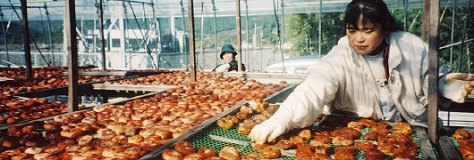
JIRO-KAKI-DRYING

Although I personally like them fresh either as dessert or in salads with vegetables, my favourite is dried persimmons, a big business in Shizuoka Prefecture!

RECOMMENDED RELATED SITES
Not-Just-Recipes
Bengal cuisine
Cooking Vegetarian
Frank Fariello
Gluten-free Vegan Family
Meatless Mama
Think Twice

Please check the new postings at:
sake, shochu and sushi

—————————————-
日本語のブログ
—————————————-

For Vegan and Vegetarians! “Forgotten” Vegetables 16: Chataigne de Terre-Great Pignut

CHATAIGNE-DE-TERRE
(Courtesy: Jean-Luc de Belgique)

SYNOPSIS:
Organic agriculture and biodiversity have in recent years brought about a rediscovery of many “forgotten” vegetables that people especially in Europe and France conscientiously tried to forget as they reminded them of the privations suffered during WWII. The same people had then to make do with untraditional vegetables because potatoes, carrots and so on were confiscated by occupying forces or their own armies.
With sustainibility and bioagriculture made more important by the deficiencies of modern mass agriculture, those “forgotten” vegetables have suddenly come to the fore for the pleasure of all, and that of course of vegetarians and vegans!

This particular series of postings will introduce these vegetables one by one. I hope they will become useful for a long time to come to all my vegan and vegetarian friends!
1) Scorsonere/Oyster Plant
2)Potimarron
3) Vitelotte
4) Rutabaga
5) Cardon
6) Panais/Parsnips
7) Patisson
8) Topinambour
9) Crosne
10) Cerfeuil Tubereux
11) Poiree
12) Oca
13) Ulluque/Ulluco
14) Tigernuts
15) Capucine tubereuse-Maschua

The Chataigne de Terre (Earth Chestnut in French) or Bunium bulbocastanum in latin is a truly rare vegetable, even in Europe where gardeners, more than farmers, grow it in France and Belgium notably.

Its other names include: terre noix, marron de terre, gland de terre, moinson (French), Erdkastanie (German) ; bulbo castaño (Spanish) ; bulbocastano comune (Portuguese) great pignut (English) and aardkastanje (Dutch).

CHATAIGNE-DE-TERRE.1jpg

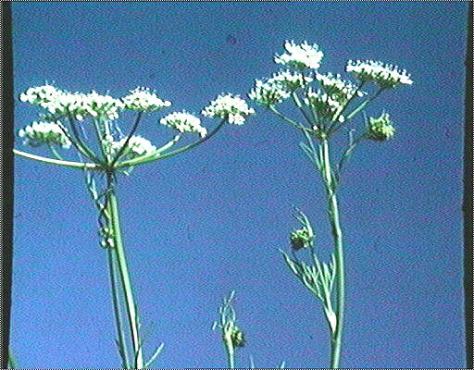
It is an ombrelliferea and is also cultivated as a decoration garden plant.

The plant, wit comparatively few leaves can reach a height of 30~70 cm (1~2 feet).
It blossoms in Autumn with beautiful white flowers.
After seeds have been formed, the arial part of the plant will dry out.
It is then than one can find many tuber-like (they are not true tubers) nodules coming out of the roots when the whole plant is pulled out the earth.

These can be eaten raw after being washed in clear cold running water.
They have a distinctive chestnut taste and are greatly appreciated as a snack (for aperitif!)

They also become an ingredient for the German Liqueur called Kummel!

RECOMMENDED RELATED SITES
Not-Just-Recipes
Bengal cuisine
Cooking Vegetarian
Frank Fariello
Gluten-free Vegan Family
Meatless Mama

Please check the new postings at:
sake, shochu and sushi

—————————————-
日本語のブログ
—————————————-

Japanese Fruits 1: Nashi/Asian Pear

nashi1

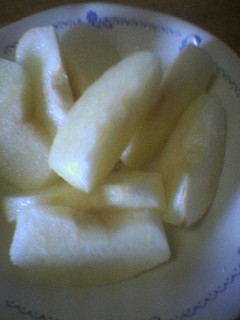
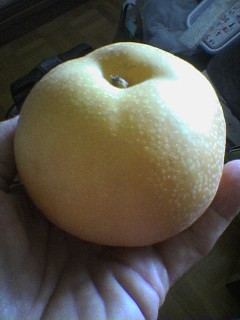
Pyrus pyrifolia is a pear tree species native to China, Japan, and Korea. The tree’s edible fruit is known by many names, including: Asian pear, nashi or nashi pear, African pear, Japanese pear, Korean pear, Taiwan pear, sand pear, apple pear, bapple, papple, bae, li (Japanese: ナシ;Chinese: 梨; Korean: 배). In South Asia, the fruit is known as nashipati or nashpati.

nashi2

Pyrus pyrifolia is cultivated throughout East Asia, as well as in Australia, India , New Zealand, and other countries. It was recently grown successfully in France and is also sold under the name pf Nashi.

nashi3

Nashi pears are widely grown for their sweet fruit, a popular food in East Asia. They are sweet on the tree and are eaten crisp.

nashi4

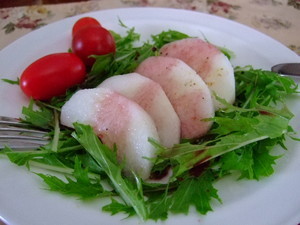
Healthy salad!

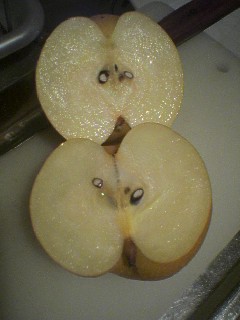
Nashi pears generally are not baked in pies or made into jams because they have a high water content and a crisp, grainy texture, very different from the buttery European varieties. Also, Nashi pears are not as intensely sweet, having a more refreshing, light taste.

They are grown in various areas in Japan under different cultivar and brand names.

nashi5

Great salads!

I have the luck to be offered every summer a full box of them coming from Yaizu City where their brand name is “Shinsui”/新水. They are the perfect fruit for a hot summer and have far more value than a whole bottle of soda!

RECOMMENDED RELATED SITES
Not-Just-Recipes
Bengal cuisine
Cooking Vegetarian
Frank Fariello
Gluten-free Vegan Family
Meatless Mama

Please check the new postings at:
sake, shochu and sushi

—————————————-
日本語のブログ
—————————————-
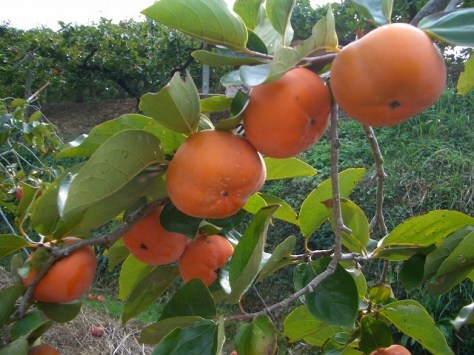
For Vegan and Vegetarians! “Forgotten” Vegetables 15: Capucine tubereuse-Maschua

capucine-tubereuse2

SYNOPSIS:
Organic agriculture and biodiversity have in recent years brought about a rediscovery of many “forgotten” vegetables that people especially in Europe and France conscientiously tried to forget as they reminded them of the privations suffered during WWII. The same people had then to make do with untraditional vegetables because potatoes, carrots and so on were confiscated by occupying forces or their own armies.
With sustainibility and bioagriculture made more important by the deficiencies of modern mass agriculture, those “forgotten” vegetables have suddenly come to the fore for the pleasure of all, and that of course of vegetarians and vegans!

This particular series of postings will introduce these vegetables one by one. I hope they will become useful for a long time to come to all my vegan and vegetarian friends!
1) Scorsonere/Oyster Plant
2)Potimarron
3) Vitelotte
4) Rutabaga
5) Cardon
6) Panais/Parsnips
7) Patisson
8) Topinambour
9) Crosne
10) Cerfeuil Tubereux
11) Poiree
12) Oca
13) Ulluque/Ulluco
14) Tigernuts

The Capucine tubereuse (French), Maschua (Inca) or Tropaeolum tuberosum (Latin) is a very old tuber originally grown on the high plateaux of Peru and around Titicaca Lake.

2m high, it is mainly used for its flowers as a decorative plant.
It blooms from July to Autumn. The seeds are formed at the same time.

capucine-tubereuse

It was already grown and eaten by the pre-Incas 5.500 years BC.
It gives out fairly good yields.

Maschua has recently become popular in France and Belgium for its tubers.
They can be eaten like potatoes.
Its peppery taste (it contains mustard oils) is not always appreciated.
This peppery taste disappears upon freezing or long boiling.
The taste is best when the tubers are harvested after the first frosts.
In Bolivia and Peru the tubers are also eaten with molasses and frozen as a dessert.

The young leaves can be eaten as a green vegetable, either raw or cooked.
The flowers can be eaten raw and have a sweet taste ending up on a peppery note.

RECOMMENDED RELATED SITES
Not-Just-Recipes
Bengal cuisine
Cooking Vegetarian
Frank Fariello
Gluten-free Vegan Family

Please check the new postings at:
sake, shochu and sushi

—————————————-
日本語のブログ
—————————————-
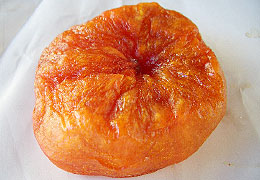
Today’s Lunch Box/Bento (’09/67)

BENTO-09-10-13a

After a long week-end (yesterday was a national holiday) spent cricket-umpiring and visiting all kinds of museums in Mishima City (where I found an organic restaurant), it was back to usual today.

BENTO-09-10-13b

A Japanese home-style bento with a few twists!

BENTO-09-10-13c

The rice itself is a Missus’ specialty. She had simmered finely cut mushrooms with thinly cut aburaage (fried tofu pouches) the night before. She heated them again in their soup before adding and mixing them (with some of the soup) with the freshly steamed rice.

BENTO-09-10-13d

The garnish came into two disntinct parts:

BENTO-09-10-13e

Pork belly sliced from a large block and fried with yuzu koshio. She fried okra, scallions and red soft piments in the juices.

BENTO-09-10-13f

Tamagoyaki/Japanese omelette, plum tomatoes and mitsuba/trefoil and sesame seeds salad.

BENTO-09-10-13g

For dessert Asian pear/Nashi and Square persimmons/Jirou Kaki (originally raised in Shizuoka Prefecture!)

Plentiful, tasty and healthy! I must say the Missus was in a fairly good mood today!LOL

RECOMMENDED RELATED SITES:
Warren Bobrow
Bread + Butter
5 Star Foodie
Think Twice
Frank Fariello
Mangantayon
Hapabento
Elinluv Tidbit Corner
Tokyo Terrace

Please check the new postings at:
sake, shochu and sushi

—————————————-
日本語のブログ
—————————————-
For Vegan and Vegetarians! “Forgotten” Vegetables 14: Tigernuts, Amande de Terre

AMANDE-DE-TERRE-1a

SYNOPSIS:
Organic agriculture and biodiversity have in recent years brought about a rediscovery of many “forgotten” vegetables that people especially in Europe and France conscientiously tried to forget as they reminded them of the privations suffered during WWII. The same people had then to make do with untraditional vegetables because potatoes, carrots and so on were confiscated by occupying forces or their own armies.
With sustainibility and bioagriculture made more important by the deficiencies of modern mass agriculture, those “forgotten” vegetables have suddenly come to the fore for the pleasure of all, and that of course of vegetarians and vegans!

This particular series of postings will introduce these vegetables one by one. I hope they will become useful for a long time to come to all my vegan and vegetarian friends!
1) Scorsonere/Oyster Plant
2)Potimarron
3) Vitelotte
4) Rutabaga
5) Cardon
6) Panais/Parsnips
7) Patisson
8) Topinambour
9) Crosne
10) Cerfeuil Tubereux
11) Poiree
12) Oca
13) Ulluque/Ulluco

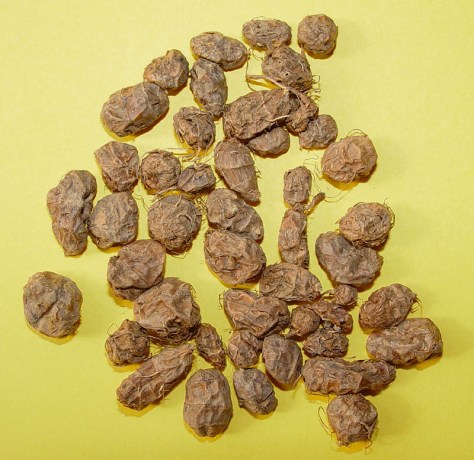
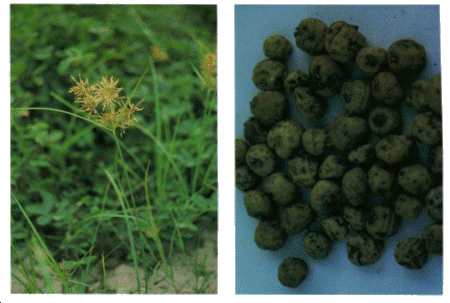
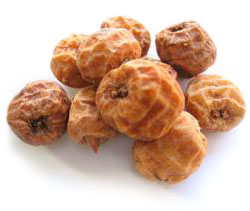
Tigernuts or chufa flatsedge in English, amande de terre (earth almond!), choufa, noix tigrée, souchet comestible in French, Chufa in Sapnish, Zigolo dolce in Italian or Yellow Nutsedge in the US, Cyperus esculentus does have many names!

AMNDE-DE-TERRE-1

Very popular in Spain, the plant is a cousin of the papyrus.
It produces small 2~3 cm tubers/rhyhomes in Autumn.
Once dried thay can be safely kept for years.

AMANDE-DE-TERRE

In Spain they are fermented into a celebrated drink with an almond taste called Hodchata!

Many people eat them raw as snacks or griilled or in salads with a drink, too!

Before re-planting them April~May, let them in lukewarm water for 48 hours. They need quite some watering, especially during dry seasons.

Harvest are conducted from end of Otober to the beginning of November by pulling out the whole plant.ue vous conserverez au frais.

Le saviez-vous ?
Le souchet sert à préparer une boisson Espagnole appelée “horchata de chufa”. Chufa est son nom en Espagne.

It is also used in place of almonds in cakes.

RECOMMENDED RELATED SITES
Not-Just-Recipes
Bengal cuisine
Cooking Vegetarian
Frank Fariello

Please check the new postings at:
sake, shochu and sushi

—————————————-
日本語のブログ
—————————————-
Today’s Lunch Box/Bento (’09/66):The Day After Bento

BENTO-09-10-10a

Today’s bento was definitely “The Day After Bento”!
Invited as I was lats night by a student of mine, I only managed cycling back home at 2 a.m. to wake up at 7 a.m. and go to work an hour later with a “slight” hangover….

BENTO-09-10-10b

A Working Man’s Lunch!

BENTO-09-10-10c

The double decker sandwiches were actually pretty big:
The first tier was mainly egg sandwich, a Missus’ favourite.
The second tier was a bit more sophisticated with home-made chicken ham, British chutney, French pickles and mustard.

BENTO-09-10-10d

Big salad, too, most it made with local ingredients: shreddedcabbage, leaf vegetables, plum tomatoes, green asparaguses and black olives.

Grapes for dessert. All in all, it proved lighter than it looked!

RECOMMENDED RELATED SITES:
Warren Bobrow
Bread + Butter
5 Star Foodie
Think Twice
Frank Fariello
Mangantayon
Hapabento
Elinluv Tidbit Corner
Tokyo Terrace

Please check the new postings at:
sake, shochu and sushi

—————————————-
日本語のブログ
—————————————-

Shizuoka Local Fish: Houbo/Blue Fin Robin

houbou.jpg

Many a time, my good friend Patrick Harrington has rightly pointed out on the importance to eat “local” as much as possible. Consequently, I have endeavoured whenever possible to introduce any vegetables, dairy products, meat and fish grown, made, raised or caught in Shizuoka Prefecture (and its waters)
As for today I would like to introduce again a fairly cheap and tasty fish: houbou. Its English name is quite poetic: blue fin robin (“Chelidonichthys spinosus” for the purists). The reason is its very wide round green-blue side fins.
Some call it grotesque, others beautiful.

Most of them are found in Niigata Prefecture from Autumn to Winter (30~50 cm), but they are caught in early Spring in Suruga Bay (the Shizuoka variety is smaller, up to 20 cm). But now and thenwe find them at dfferent times of the year.

It can be prepared in many ways:

-Sashimi and sushi if just caught.

-In “nabe/鍋” (soup pot) or as “nimono/煮物” (simmered) in Japanese-style cuisine.

-Steamed and served with a sweet and sour sauce in Chinese-style food.

My preferred way is Mediterranean style (one fish per person):
Cut the side fins and scrape the scales off. discard the insides and clean under clear cold running water. Make a couple of shallow incisions over each flank.
Fill the stomach with a mixture of finely chopped vegetables and herbs (leave your imagination go free!).
Put it on a large sheet of olive oil coated cooking foil paper, sprinkle it with a little salt and pepper. Place vegetables cut in long strings on both sides (plenty is fine), and one or two thin lemon slices on top. Coat it with some (not too much) extra virgin oil. As a last touch, I add some white wine and a little anise spirit (Pernod, Ricard or Absinthe).
Loosely wrap the fish with foil paper, close both ends by twisting them around.
Place the fish in its foil paper directly on the metal plate inside the oven preheated at 180 degrees Celsius and cook for about 15 minutes (longer for large fish).
If you do not have an oven, steam it the Chinese way!

RECOMMENDED RELATED SITES:
Warren Bobrow
Bread + Butter
5 Star Foodie
Frank Fariello
Mangantayon
Elinluv Tidbit Corner

Please check the new postings at:
sake, shochu and sushi

—————————————-
日本語のブログ
—————————————-
Sushi & Sashimi: The Basics 5 – Sashimi Presentations

SUSHIK-09-08-31-5
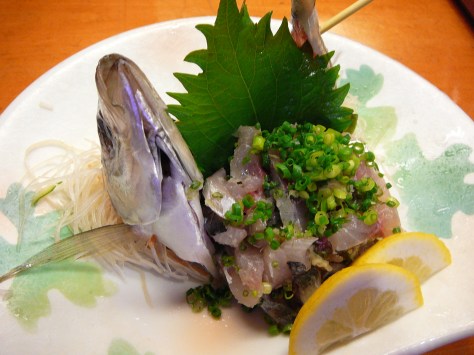
Aji Tataki/Horse mackerel Tartare served at Sushi Ko, Shizuoka City

SYNOPSIS:
I already have wrtitten a lot in bits and pieces on Sushi and Sashimi, including in my other blog, Shizuoka Sushi, but I felt it was time to post an article that could be used as general reference by my blogging friends.
The Basic 1: Definitions
The Basics 2: Questions & Answers
The Basics 3: Ingredients
The Basics 4/1: Sushi Presentations
The Basics 4/2: Sushi Presenations-Rolls
The Basics 4/3: Sushi Presentations-Donburi

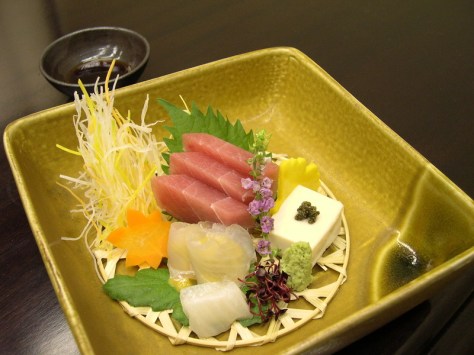
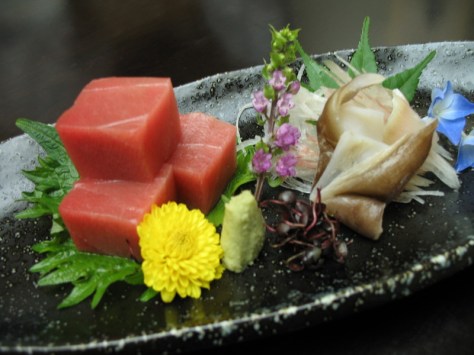
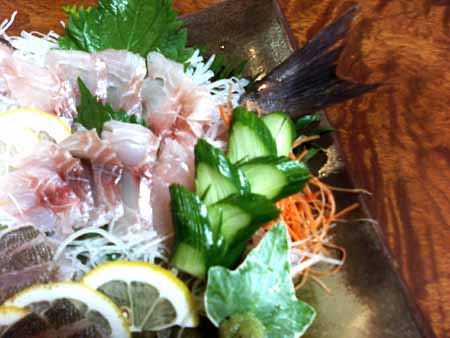
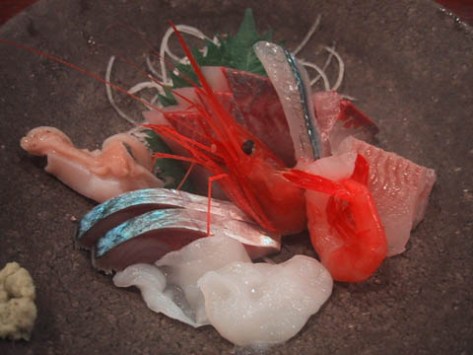
Sashimi, as almost everyone knows means thin slices, whether it be fish, meat or vegetables. When raw fish, seafood or meat is not sashimi but served raw, it is usually called tsumami/side, snack.
Fish and other seafood van be presented solely as sashimi or as a combination of sashimi and tsumami.

The possibilities are infinite as there are many ways a chef can cut and present his food.

Below I propse a “small” selection of waht can be found in Japan.
here is a little challenge for you:
Can you recognize all ingredients?

011
Usu tsukuri style/Thin cut style

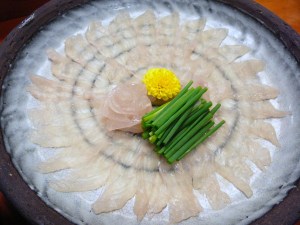
SASHIMI-PRESENTATIONS-1
Japanese Cuisine Sashimi O-Tsukuri/Plate

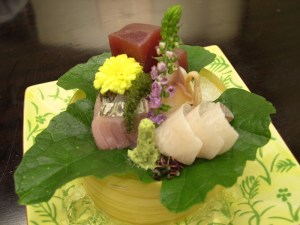
SASHIMI-PRESENTATIONS-2
Another Japanese Cuisine Sashimi O-Tsukuri/Plate

SASHIMI-PRESENTATIONS-3
Japanese Cuisine Sashimi O-Tsukuri/Plate in Kado/Square style

SASHIMI-PRESENTATIONS-4
I suppose you recognize this single sashimi served in Somen/thin noodles style!

SASHIMI-PRESENTATIONS-5
Another way to serve the whole fish

SASHIMI-PRESENTATIONS-6
A simple individual plate of sashimi

SASHIMI-PRESENTATIONS-7
A more sophisiticated individual plate of sashimi and tsumami

SASHIMI-PRESENTATIONS-8
An individual Plate of sashimi served with the seasoning

SASHIMI-PRESENTATIONS-9
Elegant and simple individual plate of sashimi!

RECOMMENDED RELATED SITES:
Warren Bobrow
Bread + Butter
5 Star Foodie
Frank Fariello
Mangantayon
Tokyo Foodcast
Tokyo Through The Drinking Glass
Urban sake
Hapabento
Elinluv Tidbit Corner

Please check the new postings at:
sake, shochu and sushi

—————————————-
日本語のブログ
—————————————-
Today’s Lunch Box/Bento (’09/65): Typhoon No 18 Bento

BENTO-09-10-07a

A big typhoon being upon us, Number 18, I had no recourse but to give up on going back home for lunch and “ordered” the Missu to concoct me a quick and healthy bento.

BENTO-09-10-07b

It was very healthy indeed!
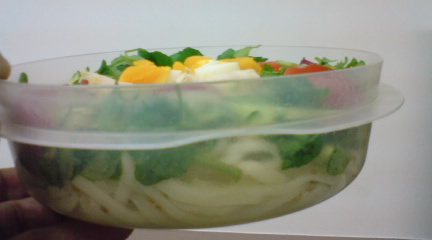
She boiled udon and cooled them under cold running clear water.
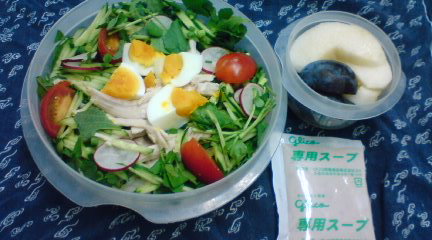
She topped it with home-made chicken ham, boiled eggs, cress, finely cut cucumber, sliced radish, pieces of shiso/perilla leaves and cut plum tomatoes.

BENTO-09-10-07c

Side view of the bento!

BENTO-09-10-07d

Soup/dressing I added to the lot later at the office!

BENTO-09-10-07e

Asian pears/Nashi and plums are still in season!

RECOMMENDED RELATED SITES:
Warren Bobrow
Bread + Butter
5 Star Foodie
Think Twice
Frank Fariello
Mangantayon
Hapabento
Elinluv Tidbit Corner
Tokyo Terrace

Please check the new postings at:
sake, shochu and sushi

—————————————-
日本語のブログ
—————————————-

Wine Tasting in Shizuoka 1: Domaine Dupont-Fahn

OC-1

For all my love of Japanese sake, I’m not ready yet to completely forget my roots. When there is good wine around, I see no reason to ignore it.
I thought it might be a good idea to taste the wines (within reasonability) available in this part of Japan!

A great place to that is Lavigne in Shizuoka City, an off-the-track establishment which combines a shop and standing bar offerring exclusively French wines they have discovered and imported themselves. As I visit the place at least once a week for a quick glass, I fially took my pen and notes yesterday!

OC-3

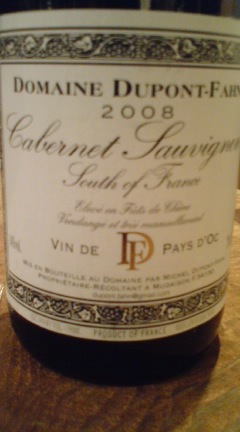
Michel Dupont-Fahn is not an obscure wine maker in France and has incrasingly been praised for his somewhat extravagant single cepage Vins de Pays.
The wine I tasted last night reads as follows:
Vin Du Pays d’Oc
Domaine Dupont-Fahn, 2008, red
Cabernet-Sauvignon, 100%
Alcohol: 14 degrees proof
Vandange et trie manuellement/hand-picked and chosen

OC-2

Colour: very deep, rich red
Aroma: Clean, powerful. Dry cassis/red fruit
Taste: Dry, strongish attack.
Good body
Dry red fruit
Shortish tail
Sharpish and short tannic note
Strong dry finish

Solid in spite of its youth. Surprisingly well-balanced. Soft on the palate with food.
A wine for all seasons.
Needs a little aging.
Retailed at 2,780 yen, 30 US$ (quite steep for a Vin de Pays!)

LAVIGNE
420-0852, Shizuoka City, Aoi-Ku, Kutsunoya Cho, 17-2, 1F (2 minutes walk from JR Station)
Tel/fax: 054-205-4181
Opening hours: 11:00~22:00
HOMEPAGE (Japanese)

RECOMMENDED RELATED SITES:
Warren Bobrow
5 Star Foodie
Frank Fariello
Mangantayon
Cheese Monger
Rubber Slippers in Italy
Palate To Pen
Tokyo Foodcast
Urban Sake
Tokyo Through The Drinking Glass

Please check the new postings at:
sake, shochu and sushi

—————————————-
日本語のブログ
—————————————-
French Cuisine: Young Cod and Lentils

CABILLAUD-LENTILS

Young cod or “Cabillaud” in French is one of those white-fleshed fish which are so easy to prepare and do not require complicated recipes!

Here is a recipe which will make you sound like an accomplished chef:
Paves de Cabillaud aux Lentilles/Young Cod Steaks and Lentils!

INGREDIENTS: for 6 persons

-6 large pieces of cod fillets, 150 g each
-Puy green lentils: 500 g
-Bacon or Pancetta: 6 very thin slices
-Carrot: 1
-Onion: 1
-Olive oil (EVO): 4 tablespoons
-Xeres vinegar: 1 tablespoon
-Bouquet garni (if unavailable, make your own with fresh of dried rosemary, thyme, sage, etc)
-Salt: to taste
-Black pepper, freshly groungd: to taste

RECIPE:

-Peel the carrot and onion. Slice the onion very thin and cut the carrot into small dices. Drop the sliced onion and carrot dices and lentils into a large pan and cover (a little higher than the whole level) with cold water (containing as little calcium as possible=soft water). Add the bouquet garni. Bring to boil. Set the heat as to simmer the vegetables for 45 minutes.

-10 minutes before the vegetables are cooked fry the bacon slices on a large non-stick frypan until golden. Take excess fat off by laying them on a kitchen paper sheet.
In the same frypan heat a tablespoon of olive oil. Lay the cod on the rypan and fry on high fire for 2 minutes on each side. Turn the heat low. Sprinkle the fish with salt and pepper and let cook for 5 more minutes on a low fire.

-Drain the lentils. Pour them on a serving dish.
Prepare a vinaigrette with salt, pepper, Xeres vinegar and the remaining olive oil. Pour it onto the lentils. Mix. Place the the bacon slices and cod onto the lentils and serve at once.

-If you serve them individually, keep six plates warm. Place each cod fillet on a bed of lentils and a slice of bacon. Sprinkle the fish with a little freshly chopped Italian parsley and just a little olive oil. Place a sprig of Italian parsley on the whole for the fnal touch.

Serve a good Beaujolais with it (not Beaujolais Nouveau, for people’s sake! LOL)

RECOMMENDED RELATED SITES:
Warren Bobrow
Bread + Butter
5 Star Foodie
Frank Fariello
Mangantayon
Elinluv Tidbit Corner

Please check the new postings at:
sake, shochu and sushi

—————————————-
日本語のブログ
—————————————-
Japanese Cheese: Kyodo Gakui Shintoku Nojyo

CHEESE-JAPAN-2

This is the second set of cheese made by Kyodo Gakui Tokunojyou in Hokkaido Island I found In Lavigne, Shizuoka City.

hok-cheese-2

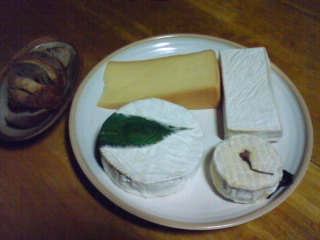
I have already introduced other cheeses from the same company (see above picturse).
They iincluded Sasa no Yuki, a Camembert style wrapped in a small bamboo leaf, Koban, Sakura and Raclette

CHEESE-JAPAN-1

These two cheeses seem to complete the whole series from that particular company.

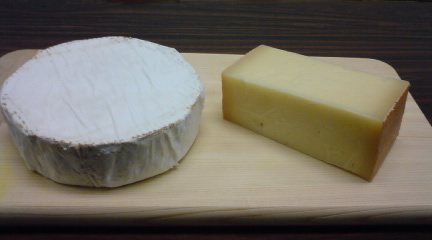
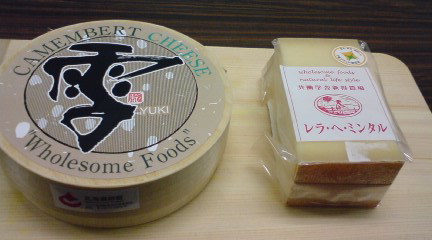
CHEESE-JAPAN-3

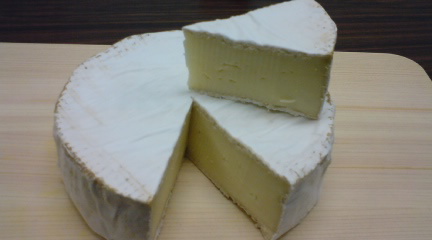
This one is simply called “Camembert-type”, and it is very near the French product, the more for it that it ismade with raw cow’s milk.
Actually it is the Sasa no Yuki minus the bamboo leaf!
Well-matured and soft, it can be matured a longer time.

CHEESE-JAPAN-4

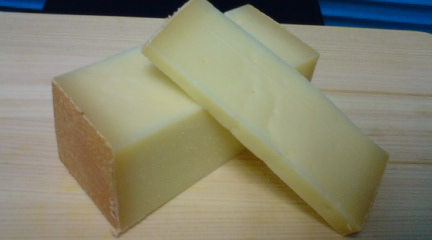
The last one, a hard type cheese also made with raw cow’s milk is called “Lera He Mental”, obviously inspired by Emmental and Comte cheeses. Surprisingly strong in characteristic, it makes for a great snack with wine and bread. Can definitely be used in somewhat extravagant cooking!

Another discovery!

Kyodo Gakui Shintoku Nojyo
081-0038 Hokkaido, Kamikawa Gun, Shintoku Machi, Jishintoku, 9-1
(081-0038 北海道上川郡新得町字新得9-1)
Tel.: (81)(0)156-69-5600

RECOMMENDED RELATED SITES:
Warren Bobrow
Bread + Butter
5 Star Foodie
Frank Fariello
Mangantayon
Cheese Sommelier
Rubber Slippers in Italy

Please check the new postings at:
sake, shochu and sushi

—————————————-
日本語のブログ
—————————————-
Today’s Lunch Box/Bento (’09/64)

BENTO-09-10-06a

Onecould call today’s bento “Another Typhoon Bento”, as after almost 12 weeks of drought the rain is back with a vengeance! The notion of typhoon notwithstanding, the weather pattern are absolutely identical to that of the rainy season/tsuyu in June/July!

BENTO-09-10-06b

The beno the Missus prepared his morning was a very classi one, reminiscent of what children and students can expect from their mothers.

BENTO-09-10-06d

After she had steamed the rice, she mixed still hot with rice vinegar and other ingredients including white sesame seeds to make it sushi rice.
She fried minced chicken with finely cut mushrooms in a comparitively sweet sauce before covering half the rice with it.
She covere the other other with Japanese-style scrambled eggs and separated both with some freshly cut mitubs/trefoil making for an appetizing and colourful dish.

BENTO-09-10-06c

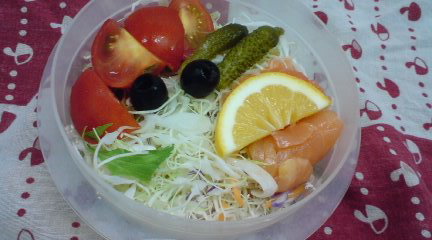
The salad consisted of shredded vegetables, smoked salmon, plum tomatoes, French pickles and black olives. I seasoned the lot with dressing kept in my fridge at work.

For dessert grape jelly.
Very healthy indeed!

RECOMMENDED RELATED SITES:
Warren Bobrow
Bread + Butter
5 Star Foodie
Think Twice
Frank Fariello
Mangantayon
Hapabento
Elinluv Tidbit Corner
Tokyo Terrace

Please check the new postings at:
sake, shochu and sushi

—————————————-
日本語のブログ
—————————————-