Tag Archives: Cakes

Japanese Cake: Dorayaki-Basic Recipe

Dorayaki (どら焼き, どらやき, 銅鑼焼き, ドラ焼き) is a type of Japanese confection which consists of two small pancake-like patties made from castella wrapped around a filling of sweet red bean paste.

It has been made popular by the famous manga character, Doraemon.

Here is a simple recipe that will please children and adults alike!

Japanese Cake: Dorayaki!

INGREDIENTS: For 6

-Pancakes:
Eggs: 2
Sugar: 100 g
Honey: 1+1/2 tablespoons
Salad oil: 1 tablespoon
Mirin/sweet sake: 1 tablespoon
Sodium bicarbonate: 1/3 teaspoon
Flour: 150 g
Water: 40~60 cc/ml

-Salad oil for cooking

-Sweetmeats/Anko/Bean jam:
300 g: (50 g per dorayaki)Look HERE for basic recipe!

RECIPE:

-Use a hand whisker instead of an electric whisker/blender as overmixing will achieve poor results!
Respect the order of the ingredients!
Beat the eggs and add the sugar. Mix until the mixture whitens.
Add the honey and mix until it has completely nblended in.
Add oil and mix.
Add bicarbonate sodium and mix.
Add mirin and mix.

-Add half of flour and mix well.
Add other half and mix well.

-Add water and mix. The amount of water might vary with the kind of flour.
Experiment!

-Heat a frypan over a medium fire first.
take frypan off fire.
Lower fire.
Once the frypan has cooled down bring over the fire again.
Wipe it with a kitchen paper soaked with salad oil.
Wipe off excess oil if necessary.

-Pour pancake mixture. Bear in mind that the size of the panckes must be the same. The amount, whatever it is must be the same. Choose your ladle/spoon well beforehand!

-Cover with lid.

-When bubbles have appeared across the surface turn the pancake over.

-The very minimum of oil will garantee an even cooking!

-Too much oil and your pancake will have that look!

Sandwich sweetmeats/anko between two pancakes and serve hot.

Once cooled down you may deep-freeze them wrapped in cellophane paper.

A perfect look!

RECOMMENDED RELATED SITES
Not-Just-Recipes, Bengal cuisine, Cooking Vegetarian, Frank Fariello, Gluten-free Vegan Family, Meatless Mama, Warren Bobrow, Wheeling Gourmet, Le Petit Cuisinier, Vegan Epicurean, Miss V’s Vegan Cookbook, Comestiblog, To Cheese or not To Cheese, The Lacquer Spoon, Russell 3, Octopuspie, Bread + Butter, Pegasus Legend, Think Twice, The French Market Maven

Please check the new postings at:
sake, shochu and sushi

—————————————-
日本語のブログ
—————————————-

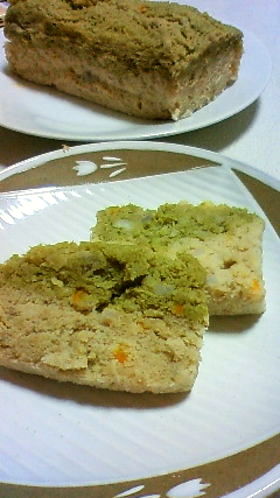
Taro & Macha Steamed Pound Cake

Still in my Taro/Sato Imo mood, aren’t I?
Today I would like to introduce a really simple pound cake recipe which includes taro and macha tea powder!

Taro & Macha Steamed Pound Cake!

INGREDIENTS:

-Taro/Sato imo: 200 g (peeled)
-Egg white: 1
-Sugar: 60 g
-Salt: 1/2 teaspoon
-Egg yolk: 1
-Flour: 2 teaspoons
-Water (as much as needed)
-Macha tea powder: 1/2 teaspoon
-Lime peel/zest: half a lime (finely chopped)

RECIPE:

1-Cut the taro into practical-sized pieces and boil.
Drain them thoroughly and mash into a smooth paste.

2-Beat into solid meringue the egg white, 2/3 of the sugar and the salt.

3-Add the rest (1/3) of the sugar to the mashed taro/sato imo, egg yolk and flour. Mix well. If the mixture proves a bit hard to mix, add water little by little until staifaction.

4-Add the meringue to the taro/satoimo and mix well.

5-Add the finely chopped lime zest and mix.
Pour one half into a pound cake mold lined with kitchen paper.
Add macha tea powder to the rest, mix and pour on top of the bottom layer.

6-Steam over a strong fire for 25 minutes.
Check if cooked properly by stabbing the cake with a thin wooden skewer. It should come out clean. Switch off fire and let cool down completely

Makes for a very light and healthy dessert!

RECOMMENDED RELATED SITES:
Warren Bobrow, Bread + Butter, Zoy Zhang, Hungry Neko, Think Twice, Frank Fariello, Mangantayon, Hapabento, Elinluv Tidbit Corner, Tokyo Terrace, Maison de Christina, Chrys Niles,Lexi, Culinary Musings, Wheeling Gourmet, To Cheese or not To Cheese, The Lacquer Spoon

Please check the new postings at:
sake, shochu and sushi

—————————————-
日本語のブログ
—————————————-

Macha & Tofu Tiramisu Cupcake

There is little need to say that cupcakes are universally popular.
Now if you can add or combine macha and tofu into them and come up with a tiramisu concept as a whole you are bound to please a lot of people! LOL

Macha & Tofu Tiramisu Cupcakes!

INGREDIENTS: For cakes

■ Sponge Cake:
-Eggs: 2
-Sugar: 40 g
-Tofu or soy milk: 1 tablespoon
-All-purpose flour: 40 g
-macha: 2 teaspoons (6 g)

■Syrup
◆Sugar: 15g(10g)
◆Water: 2 tablespoons
◆Macha liqueur (if available): 1 teaspoon

■Cheese Cream

-Cream cheese: 200g
-Anko/sweet bean paste powder: 100g
-Tofu or soy milk: 50 cc/ml
-Preserved cherry blossom (for decoration): 15
-Sugar (optional): 20~30 g)

■ Macha powder (for the finishing touch)

RECIPE:

-Soak preserved cherry blossoms in water to soften and then soak water off between two sheets of kitchen paper. Choose the best 6 of them and heat inside the microwave oven for 1 minute to ope/”bloom” them. Keep the rest aside.

-Take cream cheese out of the fridge.
Mix the flour and macha powder.
Line the oven plate with baking paper.

-Preheat oven to 170 degrees Celsius.
-In a bowl beat the eggs and sugar together until mixture whitens.

-Add tofu (or soy milk). Mix in with a spatula. Add macha and flour mix and mix in with the spatula.

-Bake for 15 minutes at 170 degrees Celsius.

-While it is baking, mix all the syrup ingredients in a small bowl.

-Take the sponge cake out of the oven and let it cool down completely.

-With a spatula, mix cream cheese, sweet bean paste powder, tofu and non-heated cherry blossoms. If not sweet enough, mix in more sugar.

-Divide sponge cake into 12 portions to fit inside cups.
-Line each cup with with one portion of sponge cake. Brush plenty of syrup on each.

-Fill with cheese cream up to half. Place one more layer of sponge cake. Brush plenty of syrup on the sponge cake again. Fill up each cup completely with cheese cream.
Leave inside fridge to chill them properly (one hour is enough, or it would harden too much).

-Before serving sprinkle macha powder all the surface and decorate with a cherry blossom.

RECOMMENDED RELATED SITES:
Bread + Butter, Comestilblog, Greedy Girl, Bouchon For 2, Zoy Zhang, Hungry Neko, Mangantayon, Elinluv Tidbit Corner, Maison de Christina, Chrys Niles, Lexi, Culinary Musings, Eats and Everything, Bite Me New England, Heather Sweet, Warren Bobrow, 5 Star Foodie, Frank Fariello, Oyster Culture, Ramendo, Alchemist Chef, Ochikeron, Mrs. Lavendula, The Gipsy Chef, Dodol-Mochi, Wheeling Gourmet

——————————–
Please check the new postings at:
sake, shochu and sushi

—————————————-
日本語のブログ
—————————————-

French Cakes: Bernard Heberle-2009 Anthology

Bernard Heberle is an extremely talented French patissier who after teaching patisserie in Japan for many years, decided to show and market his own creations in Hamamatsu City and Shizuoka Prefecture, rapidly proving he was the undisputed master of French Patisserie to the 4 million souls gracing our Prefecture.

Below is a short anthology of cakes he created during the past year!

4810

4810

4810!
Yes, you read well, this cake’s name is a number!
Can you guess?

In his own words:
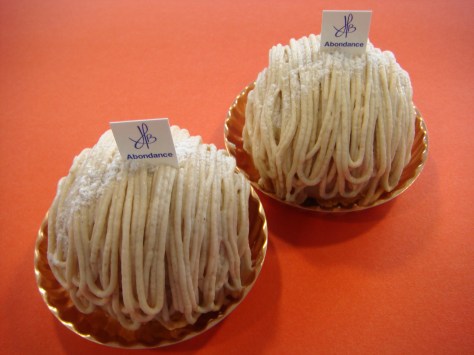
“En cette période des Kinmokusei , je te présente ce gâteau bien connu des japonais et peut être leur favori avec les short cake.
Son nom 4810 ( Non , ce n’est pas son prix , seulement l’altitude de notre Mont Blanc )
Celui ci , le notre est une base de meringue au lait avec une crème de marron et une génoise a la vanille , crème pâtissière et crème montée, nous utilisons des marrons italien du Piémont.”

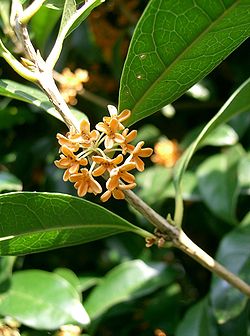
“In the Kinmokusei (fragrant orange-colored olive, the tree of Shizuoka Prefecture. Look below for picture) season, I would like to introduce a cake well known to the Japanese and perhaps their favourite with short cake.
Its name is 4810 (No, it’s not its price, only the height of Mont-Blanc!).
This particular creation rests on a milk meringue, then a marron cream and vanilla genoise. Next a creme patissier and a creme montee.
We use Italian marrons from Piemonte.”

TARTE AUX FIGUES

FIGUES-HEBERLE

Tarte aux Figues/Fig Tart!

In his own words:
“Voici une tarte de saison , la combinaison de figue et de framboise sur un fond de pâte sucrée a l’amande régulée par une douce crème pâtissière , un vrai mélange de saveur et de parfum avec une sensation croustillante et mielleuse a la fois.”

“Here is a seasonal tart. The fig and raspberry combination on an almond pâte sucrée is enhanced by a soft crème pâtissière/custard. A true mixture of savours and perfume with a crusty and honey sensation.”

CASSIS EVOLUTION

CASSIS-EVOLUTION

Cassis-Evolution!

In his own words:
“Une nouvelle création … ” Évolution Cassis ”
C’est un gateau a base de mascarpone avec une douceur myrtille au chocolat blanc sur un pain de Genes et une touche de gelée de cassis. Très frais et de saison, les myrtilles sont excellentes cet été , malgré la pluie incessante. ”

“A new creation…”Evolution Cassis”
It is a cake with a mascarpone base qith a sweet blueberry and white chocolate layer on a Genes bread/short cake and a touch of cassis jelly.
Very fresh and seasonal. The blueberries are excellent this summer, in spite of the unceasing rain.”

TISANE
TISANE

“Tisane”, or herb tea infusion.

In his own words:
“Voici un gâteau au nom de ” Tisane ” et pour cause il est a base d’herbe fraîche et plus spécialement de Verveine.
La combinaison Verveine, crème, oeuf, lait et amour se marie très bien surtout en approche de la saison chaude et humide.”

“Here is a caked I called “Tisane” because it is prepared with a fresh herb base, especially Verveine.
The combination of Verveine, cream, egg, milk and love is just perfect as we approach the hot sultry season!”

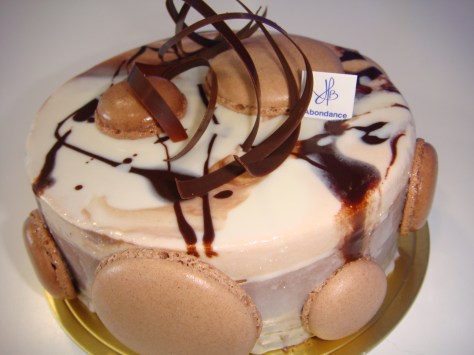
ELEGANCE
ELEGANCE2

“Elegance”/Elegance

My Good French friend in Hamamatsu City is very busy: His message was very laconic this time. LOL

“Robert
Voici ” Élégance” un gâteau au chocolat , lait et noir 70% avec un biscuit chocolat sans farine…très léger et plein de saveur.
Au plaisir…
Bernard”

“Here is “Elegance”, a chocolate cake, milk, and a 70% black cocolate.
On top of a biscuit. No flour used. Very light and full of flavour”.

He forgot to mention the small macarons!

NOISETTE/HAZELNUT

noisette

“Noisette”, hazlenut

In his own words:
“Voici le gâteau du mois ” Noisette” tout simplement un mélange de chocolat noir et de lait avec une dacquoise aux noisettes torréfiées ainsi que base croustillante le tout surmonte d’une chantilly légèrement chocolatée. Très agréable en bouche , un mélange de saveurs et de texture façon criollo.”
noisette-2 noisette-3

“Here is this month cake, “Noisette/Hazelnut”.
It consists of a simple mixture of milk and black chocolate with a roasted hazelnuts Dacquoise as a crusty base. The whole is topped with slightly chocolate -flavoured Chatilly cream and black chocolate.
Very soft on the tongue. A combination of savours and texture in criollo fashion.

As usual, I doubt I need to add any comment!

TARTE SICILIENNE/SICILIAN TART

tarte-sicilienne

“Tarte sicilienne”/Sicilian Tart

In his own words:
“Voici le gâteau que je te propose ce mois ” Tarte Sicilienne ” qui est une tarte a base de Mascarpone et de pistache avec des Fraises de notre belle région ” 紅ほっぺ” sur un fond de pâte sucrée a la crème d’amande et coulis de fraise. Toute la Sicile dans l’assiette.”

“Here is the cake I would like to propose you this month, Sicilian Tart”, which a tart based on Mascarpone and pistachio with strawberries from our beautiful region called “Behi-Hoppe”/”Red Cheeks” on a bed of pate sucree with almond cream and strawberry coulis/sauce. All Sicilia in the plate!”

Need I comment? LOL

TENDRESSE/TENDERNESS
abondance-tendresse

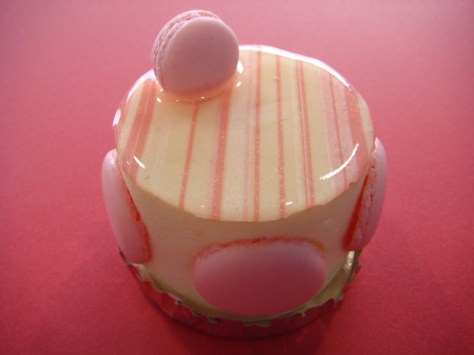
This particular creation is named “Tendresse” in French, meaning tenderness in English.
In Bernard’s French words:

-“Voici le gâteau que je te propose ce mois ” Tendresse ” qui est un gâteau a base de Fromage blanc et de pâte a bombe , très léger et même ceux qui n’aime pas le fromage y trouverons leurs plaisir. Léger et onctueux décoré avec des macarons a la Framboise.”

-“Here is the cake I would like to introduce your friends to this month. It is called “Tenderness” and is made with a very light combination of Fromage Blanc/White cheese and Pate a bombe/very fine sponge cake variety. Even people who do not like cheese will appreciate it. Light and soft, it is decorated with raspberry macarons”.

I’m ready to take the 30-minute bullet train to Hamamatsu to savour it!

Abondance
Address: Hamamatsu Shi, Sumiyoshi, 2-14-27 (in front of Seirei Hospital)
Tel.: 053-4738400
Fax: 053-4738401
Opening hours: 10:00~20:00. Closed on Tuesdays.
Homepage

RECOMMENDED RELATED SITES:
Bread + Butter, Comestilblog, Greedy Girl, Bouchon For 2, Zoy Zhang, Hungry Neko, Mangantayon, Elinluv Tidbit Corner, Maison de Christina, Chrys Niles, Lexi, Culinary Musings, Eats and Everything, Bite Me New England, Heather Sweet, Warren Bobrow, 5 Star Foodie, Frank Fariello, Oyster Culture, Ramendo, Alchemist Chef, Ochikeron, Mrs. Lavendula, The Gipsy Chef, Dodol-Mochi

——————————–
Please check the new postings at:
sake, shochu and sushi

—————————————-
日本語のブログ
—————————————-

French Cake by Bernard Heberle: 4810 (Mont-Blanc)

4810

My good French friend, Bernard Heberle, a native from Alsace in France and plying his trade as a patissier in Hamamatsu City, has just sent me his last creation:

4810!
Yes, you read well, this cake’s name is a number!
Can you guess?

In his own words:
“En cette période des Kinmokusei , je te présente ce gâteau bien connu des japonais et peut être leur favori avec les short cake.
Son nom 4810 ( Non , ce n’est pas son prix , seulement l’altitude de notre Mont Blanc )
Celui ci , le notre est une base de meringue au lait avec une crème de marron et une génoise a la vanille , crème pâtissière et crème montée, nous utilisons des marrons italien du Piémont.”

“In the Kinmokusei (fragrant orange-colored olive, the tree of Shizuoka Prefecture. Look below for picture) season, I would like to introduce a cake well known to the Japanese and perhaps their favourite with short cake.
Its name is 4810 (No, it’s not its price, only the height of Mont-Blanc!).
This particular creation rests on a milk meringue, then a marron cream and vanilla genoise. Next a creme patissier and a creme montee.
We use Itlian marrons from Piemonte.”

Kinmokusei
Kinmokusei (fragrant orange-colored olive, the tree of Shizuoka Prefecture)

Abondance
Address: Hamamatsu Shi, Sumiyoshi, 2-14-27 (in front of Seirei Hospital)
Tel.: 053-4738400
Fax: 053-4738401
Opening hours: 10:00~20:00. Closed on Tuesdays.
Homepage

RECOMMENDED RELATED SITES:
Warren Bobrow
Bread + Butter
5 Star Foodie
Frank Fariello
Mangantayon
Elinluv Tidbit Corner
Oyster Culture
Meatless Mama
Think Twice

Please check the new postings at:
sake, shochu and sushi

—————————————-
日本語のブログ
—————————————-
French Dessert: Apple Crumble Tiramisu

CRUMBLE-TIRAMISU

Apples are still very much in season, but contrary to here in Japan, the cold days are around the corner back home and people are expecting slightly heartier if still smaller desserts!

Here is a simple recipe marrying English, French and Italian cuisines all at the same time:
Apple Crumble Tiramisu!

INGREDIENTS: for 6 persons

-Apples: 2 (Canada, golden, …)
-Semi-salted butter: 50 g
-Sugar: 2 tablespoons
-Mascarpone: 150 g
-Egg: 1
-Flemish speculoos (French spéculoos) or shortcrust biscuit (cookies)

RECIPE:

-Peel the apples and cut them into small pieces.

-Put them on a frypan with butter and sugar.

-Fry them slowly on a small fire for 10 minutes. Then turn fire higher and cook, stirring all the time, fro 2~3 minutes. Let them cool and pour them at the bottom of six smallindividual ramequins or cupcake cups.

-Separate the yolk and white of the egg.
Mix the mascarpone with the yolk.
Beat the white into meringue with a pinch of salt.

-Mix the meringue delicately into the mascarpone cream so as not to break the air bubbles inside the meringue. Pour over the apples.
Leave inside of the fridge for a minimum of 3 hours or up to a mximum of 12 hours.

-Just before sercing top with a thin layer of crushed speculoos cookies.

-Drink an apple wine such as pineau or pommeau with it!

Please check the new postings at:
sake, shochu and sushi

—————————————-
日本語のブログ
—————————————-

French Cupcakes: Lemon & Ricotta Cupcakes

CUPCAKES

I finally succumbed to the temptation of posting a cupcake recipe!
Mind you, this one is very French in spite of its name, and I7m afraid it’s a first and last!LOL

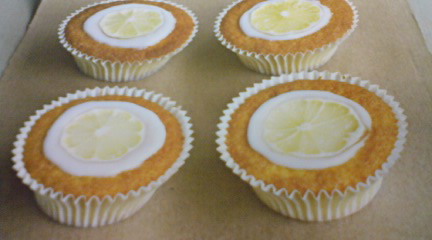
Lemon & Ricotta Cupcakes!

INGREDIENTS: for 6~9 people

-2 lemons (organic, please!)
-Ricotta Cheese: 100 g
-Eggs: 2
-Slightly salted (demi-sel) butter: 110 g (softened)
-Sugar: 110 g
-Sieved flour: 110 g
-Baking powder: 1 small packet
-Icing sugar: 4 tabespoons

RECIPE:

-Preheat oven to 180 degrees Celsius

-Mix softened butter with sugar so as to obtain a creamy mixture.

-Lightly beta the 2 eggs. Mix them with the butter cream little by little.

-Add the finely chopped zest of 1 lemon, 1 tablespoon of lemon juice, the sieved flour, and the baking powder.. Mix well.

-Fill one fourth of each cup with that cupcake mixture.
Add a “large” teaspoon of ricotta.
Cover the ricotta with more cupcake mixture. Make sure to fill only three fourths of each cup.

-Bake at 180 degrees Celsius for 15 minutes.

-Prepare the icing/glacage:
In a bowl pour the icing sugar with a few drops of hot water and mix. Cover with cellophane paper and keep aside (you can use it until the cakes have completely cooled down.

-Cut 6~9 slices of the second lemon. Take off the outer skin.

-As soon as the cakes have completely cooled down, Top with one teaspoon of icing. Spread to make a small circle as in picture above. Top with one slice of lemon.

As this is a cupcake designed for adults, drink a dry white wine with them!

Please check the new postings at:
sake, shochu and sushi

—————————————-
日本語のブログ
—————————————-

French Cake by Bernard Heberle: Tarte aux Figues/Fig Tart

FIGUES-HEBERLE

My good French friend, Bernard Heberle, a native from Alsace in France and plying his trade as a patissier in Hamamatsu City, has just sent me his last creation:

Tart aux Figues/Fig Tart!

In his own words:
“Voici une tarte de saison , la combinaison de figue et de framboise sur un fond de pâte sucrée a l’amande régulée par une douce crème pâtissière , un vrai mélange de saveur et de parfum avec une sensation croustillante et mielleuse a la fois.”

“Here is a seasonal tart. The fig and raspberry combination on an almond pâte sucrée is enhanced by a soft crème pâtissière/custard. A true mixture of savours and perfume with a crusty and honey sensation.”

Abondance
Address: Hamamatsu Shi, Sumiyoshi, 2-14-27 (in front of Seirei Hospital)
Tel.: 053-4738400
Fax: 053-4738401
Opening hours: 10:00~20:00. Closed on Tuesdays.
Homepage

Please check the new postings at:
sake, shochu and sushi

—————————————-
日本語のブログ
—————————————-

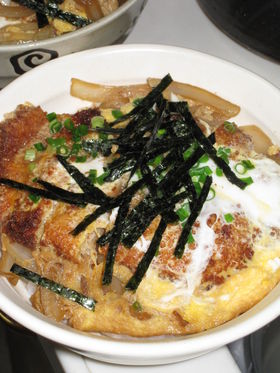
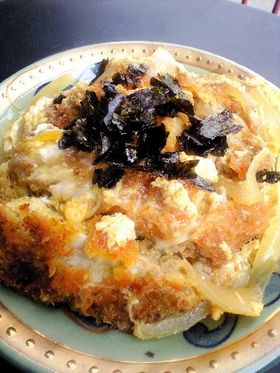
Tonkatsu Recipes 2: Katsudon

TONKATSU-KATSUDON-3

Katsudon is the favorite dish of famous Japanese baseball players such as the Yankees’ Hideki Matsui. In hard-boiled Japanese films, it is a dish served to villains under police interrogation!

If you have grasped the recipe for tonkatsu and oyakodon, it is pretty easy to make.

Here is a variation very popular in Japanese homesteads:

INGREDIENTS: For 4 people

-Tonkatsu:
Pork cuts: 4
Black pepper: to taste
Flour: 2~3 tablespoons
Egg: 1
Breadcrumbs/Panko: 1~2 cups
Frying oil

-Soup Stock:
Sugar: 1 tablespoon
Jaoanese sake: 50 ml
Sweet sake/Mirin: 50 ml
Soy sauce: 50 ml
Dashi (or soup stock): 100 ml

-Others:
Onion: 1 large
Sesame oil: 1 tablespoon
Steamed rice: enough for 4 servings
Eggs: 4~5
Trefoil or other leaf vegetables (including thin leeks,…): chopped, to taste
Dry seaweed/Nori: Finely cut, to taste

RECIPE:

KATSUDON-RECIPE-1

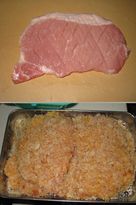
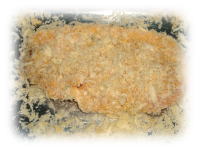
Make shallow cuts every 3~4 cm along the rim of the pork cuts (to prevent thme from bending or contracting). Sprinkle with black pepper, Roll in flour, then egg and last in breadcrumbs like in normal tonkatsu recipe.

KATSUDON-RECIPE-2

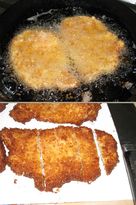
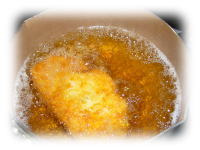
Deep-fry at 170~180 degrees Celsius.
Fry until breadcrumbs have become solid. Only then you may manipulate the tonkarsu and turn it over inside the oil.
Once cooked, cut it in serving size slices when still hot.

KATSUDON-RECIPE-3

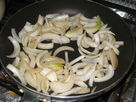
Cut the onion in half first, then into about 5 mm thick slices. Fry in sesame oil until they become translucent.
During that time, pour sake and mirin in a small pan and bring to boil. Add sugar, soy sauce and dashi. Bring to boil.

KATSUDON-RECIPE-4

Pour soup on onion and bring to boil.
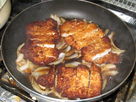
Drop in allthe cut tonkatsu and cook for a couple of minutes.

KATSUDON-RECIPE-5

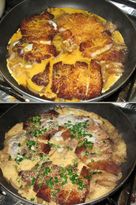
Lower fire a little so that the soup does not boil. Pour the eggs well-beaten and add trefoil. Cover and cook on a medium fire for about a minute.
Eggs should be cooked on top but still half-cooked under. Make sure the eggs fill the spaces betwen the pork cuts.

KATSUDON-RECIPE-6

Fill each bowl with steamed rice and cover each with tonkatsu and omelette. Pour the left over soup over the top. Add dry seaweed on top and serve!

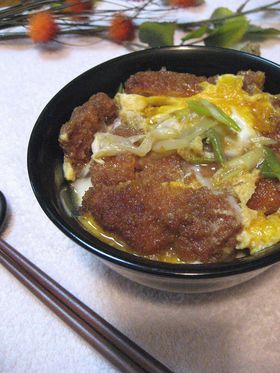
OTHER KATSUDON SAMPLES:

TONKATSU-KATSUDON-1

TONKATSU-KATSUDON-2

Please check the new postings at:
sake, shochu and sushi

—————————————-
日本語のブログ
—————————————-

Tonkatsu Recipes 1: Basic Recipe

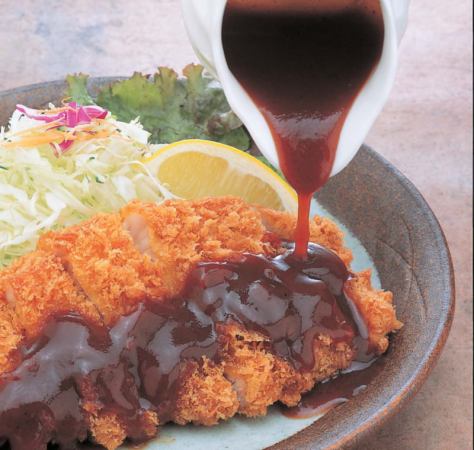
TONKATSU-PH

Tonkatsu, if properly organized, is not difficult to cook or prepare.
Here is the first of a series of recipes you easily accomodate to your taste and preferences:

Tonkatsu Basic Recipe:

INGREDIENTS: For one person

-Pork cutlet: one large, 1~2 cm thick. Choose good quality with as little fat as possible, although some around the rim is welcome.
-Flour: 2 tablespoons
-Black pepper: to taste:
-Salt: to taste
-Nutmeg: a pinch (you may use other spices of course, including chili pepper!)
-Egg: 1 large
-Fresh breadcrumbs (if unavailable, use dry breadcrumbs or panko): half a cup
-Deep-fry oil (as fresh as possible!)
-Cabbage (as much as you want, finley shredded)
-Sesame powder/ground sesame seeds: 1 tablespoon
-Tonkatsu sauce: 2 large tablespoons (easily found in markets. You can of course make your own with worcestershire sauce, ketchup, mustard and so on!)

RECIPE:

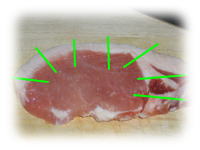
TONKATSU-RECIPE-1

-Make a shallow incision across the rim every 3~4 cm. It is an important step as it will prevent the meat from contracting or bending!

TONKATSU-RECIPE-2

-In a bowl mix flour, pepper, salt and spices. One can add curry mix powder there, too!

TONKATSU-RECIPE-3

-Cover both side of the pork cut with the flour mixture. Take care not to form lumps of flour.
Trick: Try to use only one hand to come in contact with the food, while the other hand stays dry and can manipulate utensils!

TONKATSU-RECIPE-4

-In a different bowl beat the egg. Preferably do this ahead of everything.
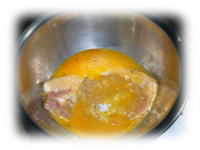
Dip the floured pork cut into the beaten egg.

TONKATSU-RECIPE-5

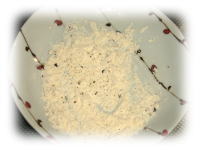
-Pour the breadcrumbs on a plate and spread it evenly. Thisis also better done before you start anything!
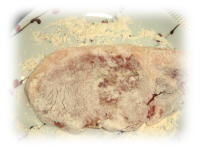
Lay the pork cut on the breadcrumbs and gently press. Cover the top side with breadcrumbs, too and pat gently to help the breadcrumbs adhere. Don’t be afraid of coating with a lot of breadcrumbs!

TONKATSU-RECIPE-6

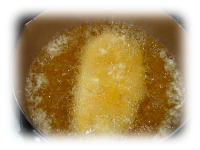
-Heta the oil to 170 degrees Celsius. Drop a little breadcrumb in the oil to check if it’s hot enough. It should start frying with bubbles right away. Drop the pork cut gently into the oil to avoid any accident.

TONKATSU-RECIPE-7

-Turn the pork cut over for even frying as it will rise to the surface. Do it as gently as possible either with long wooden chopsticks of frying tongs.

TONKATSU-RECIPE-8

-On a serving plate lay a bed of shredded cabbage decorated with a little parsley and a few lemon slices. Provide some strong mustard if wanted.
Take pork cut out of the oil and lay on a grill for a few seconds to take off excess oil. Transfer onto a working table and cut into strips.
Place it above or beside shredded cabbage in the right order so as to remind you of the original shape.

Please check the new postings at:
sake, shochu and sushi

—————————————-
日本語のブログ
—————————————-
Japanese Cakes-Wagashi 15: Daifuku

DAIFUKU-1

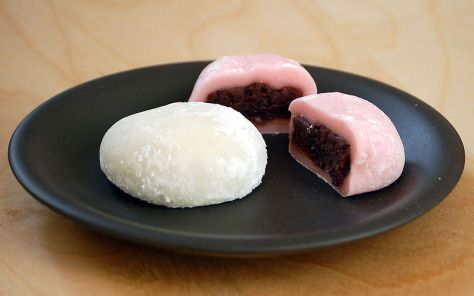
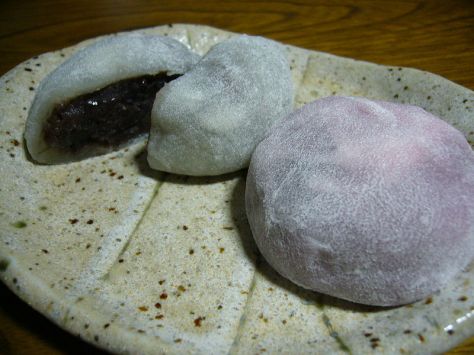
Daifukumochi (大福餅), or Daifuku (大福) (literally “great luck”), is a Japanese confection consisting of a small round mochi (glutinous rice cake) stuffed with sweet filling, most commonly anko, sweetened red bean paste made from azuki beans.

The traditional daifuku, like all Wagashi are vegan in concept.

But Daifuku comes in many varieties.
The most common is white, pale green or pale pink colored mochi filled with anko.
These come in two sizes, one approximately the diameter of a half-dollar coin, the other palm-sized.
Some versions contain whole pieces of fruit, mixtures of fruit and anko or crushed melon paste.
Nearly all daifuku are covered in a fine layer of corn or taro starch to keep them from sticking to each other, or to the fingers. Some are covered with confectioner’s sugar or cocoa.

DAIFUKU-2

HISTORY:
Daifuku were originally called Harabuto mochi (腹太餅) (belly thick rice cake) because of its filling nature. Later the name was changed to Daifuku mochi (大腹餅) (big belly rice cake). Since the pronunciation of Fuku (腹) (belly) and Fuku (福) (luck) is the same in Japanese, the name was further changed to Daifuku mochi (大福餅) (great luck rice cake), a bringer of good luck. By the end of the 18th century, Daifuku were gaining popularity and people began eating them toasted. They were also used for gifts in ceremonial occasions

VATIETIES:

DAIFUKU-3
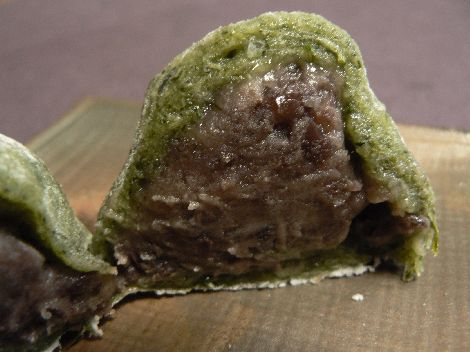
Yomogi daifuku (蓬大福)
A version made with kusa mochi (草餅), which is mochi flavored with mugwort.

DAIFUKU-4
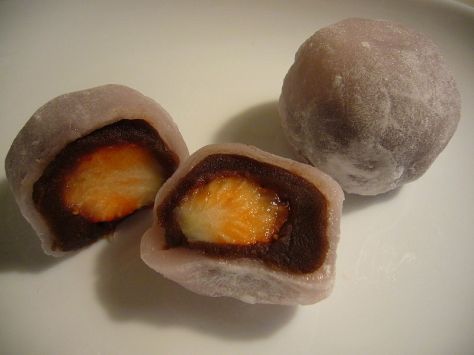
Ichigo daifuku (イチゴ大福)
A variation containing strawberry and sweet filling, most commonly anko, inside a small round mochi. Creams are sometimes used for sweet filling. Because it contains strawberry, it is usually eaten during the spring time. It was invented in the 1980s. Many patisseries claim to have invented the confection, so its exact origin is vague.

DAIFUKU-5
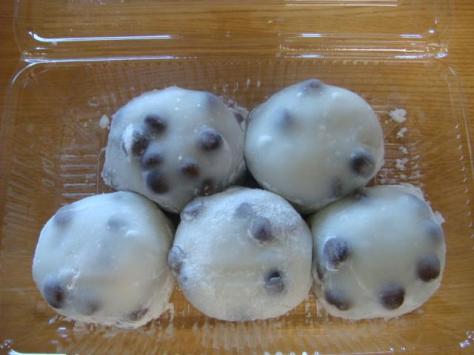
Mame daifuku (豆大福)
Another variation made of mochi mixed with red peas or soy beans.

Please check the new postings at:
sake, shochu and sushi

—————————————-
日本語のブログ
—————————————-

Japanese Cake: Taiyaki/”Baked Seabream”

TAIYAKI-1

There are may Japanese traditional cakes making their way abroad these days.
But have ever heard of “Taiyaki”?

Frst of all, do not confuse it “Takoyaki”!

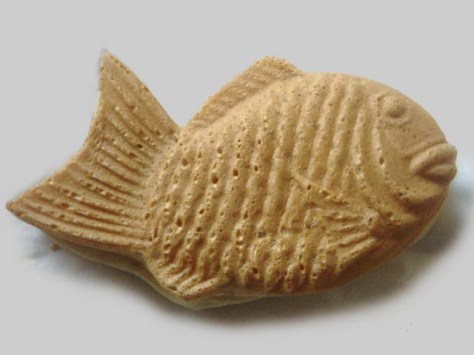
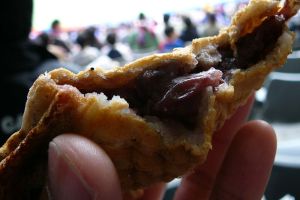
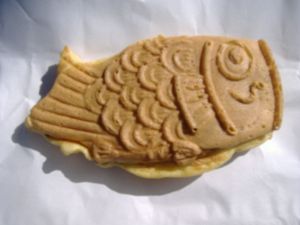
Taiyaki (たい焼き, , literally “baked seabream”) is a Japanese fish-shaped cake. The most common filling is red bean paste that is made from sweetened azuki beans.
Other common fillings may be custard, chocolate, or cheese. Some shops even sell taiyaki with okonomiyaki, gyoza filling, or a sausage inside.

TAIYAKI-2

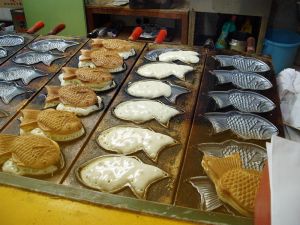
Taiyaki is made using regular pancake or waffle batter. The batter is poured into a fish-shaped mold for each side. The filling is then put on one side and the mold is closed. It is then cooked on both sides until golden brown.

TAIYAKI-3

Taiyaki was first baked by a sweet shop Naniwaya in Azabu, Tokyo in 1909, and now can be found all over Japan, especially at food courts of supermarkets and Japanese festivals (祭, matsuri) and other Asian countries (for example Korea, but they call it buunga baang).

They are similar to imagawayaki (今川焼き?, which are thick round cakes also filled with sweet azuki bean paste or custard.

They come in different shapes according to the occasion or/and area:

TAIYAKI-4

In Fukushima Prefecture where the Aquamarine Fukushima is located they sell taiyaki made from a mold reminscent of the famed coelacanth!

TAIYAKI-5

In some areas they make a taiyaki in the shape of a carp floater to commemorate Boys Day on May 5th!

TAIYAKI-6

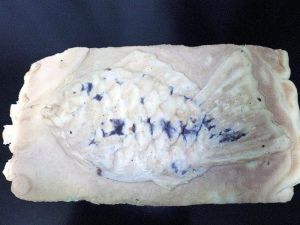
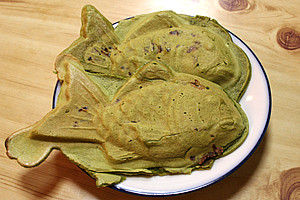
As for Shizuoka Prefecture, people in Ieyama along the Oigawa Railway make a taiyaki with matcha tea!

Please check the new postings at:
sake, shochu and sushi

—————————————-
日本語のブログ
—————————————-

Japanese Cuisine: Ankake Tofu Kani Chawanmushi-Tofu & Crab Chawanmushi with Sweet & Sour Sauce

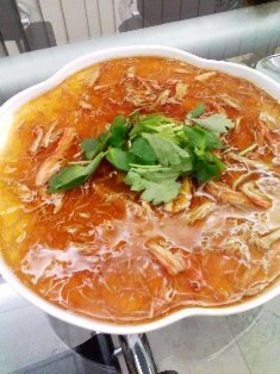
TOFU-CHAWANMUSHI

Another easy recipe for the Tofu Tribe, (Terecita, Elin, Jenn and Jennifer !
This time is a tofu accomodated as Chawanmushi, a very popular dish in Japan!

INGREDIENTS: For 4 people

1)
Tofu: 450 g (fine texture/kinu dofu)
Eggs: 2
Crab: 1 small can/shredded

2) For the chawanmushi
Dashi: 2 cups (konbu dashi or fish dashi)
Salt: 1 quarter of a teaspoon
Japanese sake: 1 tablespoon

3) For the sweet & sour sauce
Dashi: half a cup
Soy sauce: 1 tablespoon
Mirin/sweet sake: 1 tablespoon
Japanese sake: 1 tablespoon
Cornstarch dissolved in water: according to preferences
Trefoil (or other leaves) for decoration: according to preferences

RECIPE:

-Chill the dashi. Beat eggs into fine omelette. Add dashi, salt and Japanese sake. Mix well.

-Use a steamer for the chawanmushi. Chawan means tea bowl/cup and mushi means steaming!

-Fill four cups with one fourth of the tofu, pouring it into the cups little by little with a spoon. Pour one fourth of the egss dashi mixture on top.
Cover each cup with a piece of cellophane paper. Steam for 2 minutes on strong fire, then 20 minutes on a low fire.

-While the chawanmushi is steaming, prepare the sweet and sour sauce.
In a small pan, pour the dashi, soy sauce, mirin, Japanese sake and bring to boil.
Shred the crab and add to sauce.
Add cornstarch and mix well until sauce is smooth. Take off fire.
Bear in mind that the sauce must be ready at the moment the chawanmushi is completely steamed, not before!

-Pour an equal amount of sauce on each chawanmushi. Decorate with trefoil and serve!

NOTE:
The chawanmushi taste is a bit weak, while the taste of the sweet and sour taste is trong, thus attaining the right balance!

Please check the new postings at:
sake, shochu and sushi

—————————————-
日本語のブログ
—————————————-

Japanese Cuisine: Korokke-Croquettes

KOROKKE-1

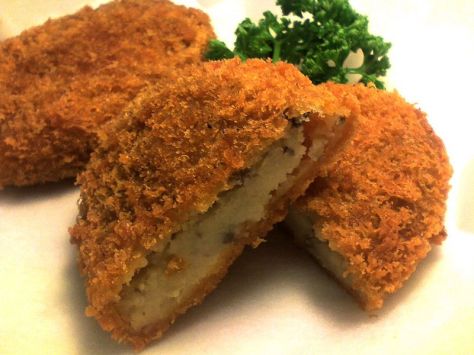
Korokke (Japanese: コロッケ) is the Japanese name for a deep fried dish originally related to a French dish, the croquette. It is also said thai it comes from the Dutch, Kroket.
It was introduced in the early 1900s. This dish is also popular in South Korea where it is typically sold in bakeries.

Korokke is made by mixing cooked chopped meat or seafood, vegetables with mashed potato or white sauce, or both, rolling it in wheat flour, eggs, and breadcrumbs/panko, then deep frying this until brown (fox colour in Japanese!) on the outside.
Korokke are usually shaped like flat patties. They are generally called ingredient + Korokke. For example, those using beef would be called beef (gyu) korokke, those using shrimp, ebi korokke, etc.. Those using white sauce may also be called Cream Korokke.

KOROKKE-2

Korokke are often served with worcestershire sauce and shredded cabbage.

Korokke can be eaten as is, and are sometimes sold wrapped in paper at stalls. They may also be used as a topping for other dishes. When sandwiched between a piece of bread, they are be called “Korokke pan” (pan being bread in Japanese).

Korrokke was the most sold single frozen food in 2007 and has been among the top three ever since.

Please check the new postings at:
sake, shochu and sushi

—————————————-
日本語のブログ
—————————————-

Japanese Cuisine: Tonkatsu-The Basics

TONKATSU-1

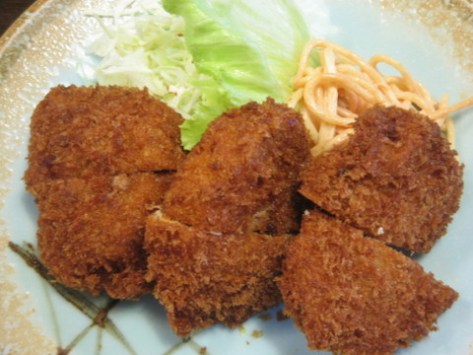
Tonkatsu (豚カツ, とんかつ, or トンカツ, pork cutlet), invented in the late 19th century, is a popular dish in Japan. It consists of a breaded (breadcrums/panko), pork cutlet one to two centimeters thick first deep-fried whole then sliced into bite-sized pieces, generally served with shredded cabbage and/or miso soup. Either a pork fillet (ヒレ, hire) or pork loin (ロース, rōsu) cut may be used; the meat is usually salted, peppered and dipped in a mixture of flour, beaten egg and panko (Japanese breadcrumbs) before being deep fried.

TONKATSU-HIREKATSU
Hire Katsu or high quality pork fillet served and cut into one bite size.

It was originally considered a type of yōshoku/洋食—Japanese versions of European schnitzel invented in the late 1800s and early 1900s—and was called katsu-retto (“cutlet”) or simply katsu. Early katsu-retsu was usually beef; the pork version, similar to today’s tonkatsu, is said to have been first served in 1890 in a western food restaurant in Ginza, Tokyo. The term “tonkatsu” (“pork katsu”) was coined in the 1930s.

In Korea, this dish is known as donkkaseu (돈까스), a simple transliteration of the Japanese word to Korean.

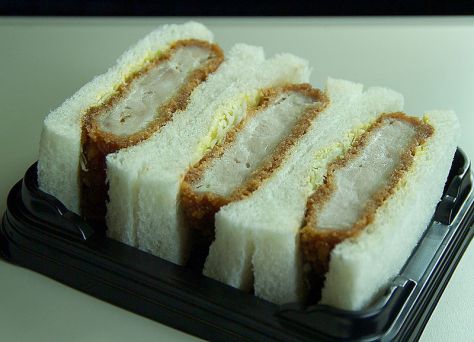
TONKATSU-KATSUSANDO
“Katsu sando/Tonkatsu Sandwich” as served in Okinawa

Variations
Tonkatsu has Japanized over the years more so than other yōshoku and is today usually served with rice, miso soup and tsukemono/pickles in the style of washoku/和食 (traditional Japanese food) and eaten with chopsticks. Recently, some establishments have taken to serving tonkatsu with the more traditional Japanese grated daikon and ponzu instead of tonkatsu sauce.

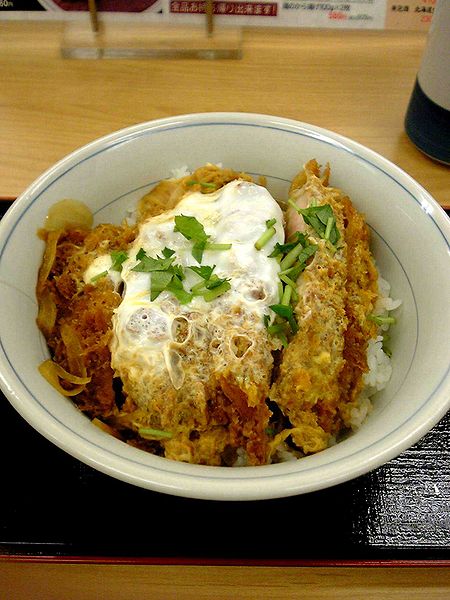
TONKATSU-KATSUDON
Katsudon

Tonkatsu is also popular as a sandwich filling (katsu sando) or served on Japanese curry (katsu karē). It is sometimes served with egg on a big bowl of rice as katsudon—an informal one-bowl lunchtime dish.

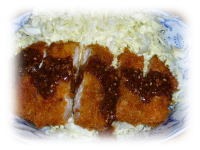
Regardless of presentation, tonkatsu is most commonly eaten with a type of thick Japanese Worcestershire sauce that uses pureed apples as a principal ingredient and is called tonkatsu sauce (tonkatsu sōsu) (トンカツソース), often simply known as sōsu (“sauce”), and often with a bit of spicy yellow karashi (Japanese mustard) and perhaps a slice of lemon. Some people like to use soy sauce instead. In Nagoya and surrounding areas, miso katsu—tonkatsu eaten with a miso-based sauce—is a specialty.

Variations on tonkatsu may be made by sandwiching an ingredient like cheese or shiso leaf between the meat, and then breading and frying. For the calorie conscious, konnyaku is sometimes sandwiched between the meat. And in Waseda, Tokyo, a restaurant serves a tonkatsu with a bar of chocolate sandwiched inside, sometimes compared to a Western creation: the deep-fried Mars Bar.

There are several variations to tonkatsu that use alternatives to pork:

Chicken katsu (チキンカツ) is a similar dish, using chicken instead of pork. This variant often appears in Hawaiian plate lunches.
Menchi katsu is a minced meat patty, breaded and deep fried.
Hamu katsu (ハムカツ “ham katsu”), a similar dish made from ham, is usually considered a budget alternative to tonkatsu.
Gyū katsu (牛カツ “beef katsu”), also known as bīfu katsu, is popular in the Kansai region around Osaka and Kobe.
Saengseonkkaseu (생선까스 “fish katsu”) is a Korean fish-cutlet modelled on the Japanese fry[citation needed].
Prices for a tonkatsu vary from 198 yen for a pre-cooked tonkatsu from a supermarket to over 5,000 yen in an expensive restaurant. The finest tonkatsu is said[citation needed] to be made from kurobuta (black pig) from Kagoshima Prefecture in southern Japan

Please check the new postings at:
sake, shochu and sushi

—————————————-
日本語のブログ
—————————————-