Tag Archives: Fish

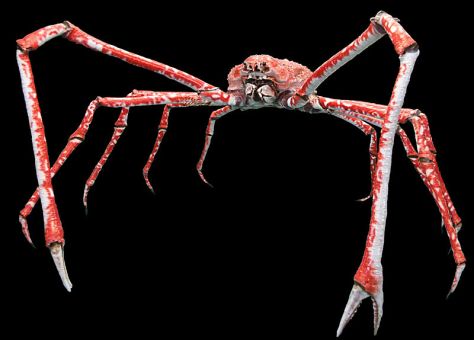
Crab Species 3: Japanese Spider Crab/Takaashigani

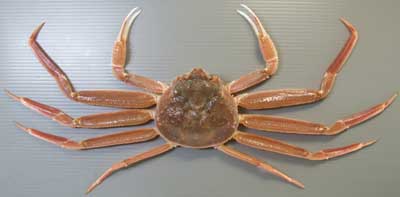
TAKAASHIGANI-1

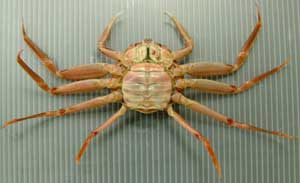
Takaashigani/高足が二, literally meaning “Tall Legs Crab” is the largest crab in the world and is caught almost only around Japan especially in the Suruga Bay In Shizuoka Prefecture and Izu Islands, but numbers of the crab have diminished over recent years, and there are many efforts to protect them. In Shizuoka Prefecture, people even help them grow from the eggs before returning them to the sea!

Fully grown it can reach a leg span of almost 4 m (13 ft), a body size of up to 37 cm (15 inches) and a weight of up to 20 kg (44 lb). The crab’s natural habitat is on the bottom of the Pacific Ocean (some 300 to 400 m deep) around Japan, where it feeds on dead animals and shellfish. It is believed to have a life expectancy of up to 100 years.

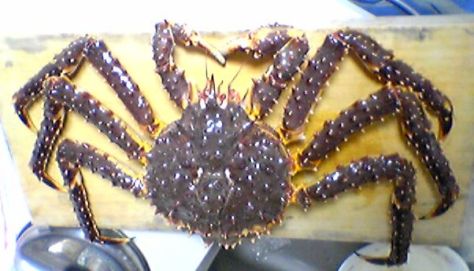
The Japanese spider crab has 10 legs. The front two legs have been adapted into claws. It has an orange body with white spots on its thin legs. In males, the limbs on which the claws are located become longer than its other limbs, and a large male can widen them to more than 3 m. The oval-shaped and vertically rounded shell can reach 30 cm in width and can be up to 40 cm long. The compound eyes are situated on the front, and two thorns stick out between them. Younger specimens feature hair and thorns on the shell, and their frontal horns are longer, but these gradually atrophy as the crab ages.

In Japan it is considered a delicacy and prices can easily jump!
The Japanese spider crab is caught using small trawling nets, and is often eaten salted and steamed.

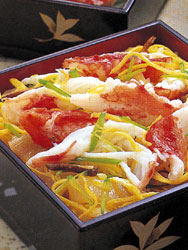
TAKAASHIGANI-BOILED

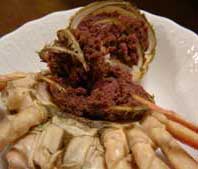
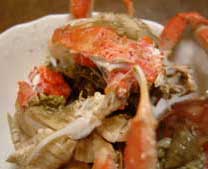
Interestingly enough, when bolied/steamed, not only the shell but also the flesh turns red.

TAKAASHIGANI-SUSHI

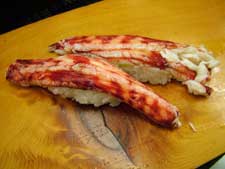
They do make for impressive sushi!

Please check the new postings at:
sake, shochu and sushi

—————————————-
日本語のブログ
—————————————-

Crab Species 2: Red King Crab/Tarabagani

TARAGANI-KINGCRAB-1

Tarabagani or Red King Crab is caught in Autumn and Winter.
It is the most coveted of the commercially sold king crab species, and is the most expensive per unit weight. It was named after the colour it turns when it is cooked rather than the colour of a living animal, which tends to be more burgundy.

Red king crabs can be very large, sometimes reaching a carapace width of 11 in (28 cm) and a leg span of 6 ft (1.8 m) [2]. It is most commonly caught in the Bering Sea and Norton Sound, Alaska, and is particularly difficult to catch, but is nonetheless one of the most preferred crabs for consumption.

The King Crab is native to the Bering Sea, north Pacific Ocean, around the Kamchatka Peninsula and neighbouring Alaskan waters.
In Japan it is caught in the Japan Sea and neighbouring Okhotsk Sea.

In Japan 100 tonnes are caught every year, whereas 40,000 tonnes are imported, mainly from Russia!

There are so many way to enjoy this great crab!
Here are a few examples:

TARAGANI-KINGCRAB-SUSHI

Boiled as Sushi Nigiri of course!

TARAGANI-KINGCRAB-SUSHI-RAW

Even more extravagant, raw as sushi nigiri!

TARAGANI-KINGCRAB-CHIRASHIZUSHI-2

Just plain boiled on a bowl of freshly steamed rice. My favourite for its extravagant simplicity!

TARAGANI-KINGCRAB-CHIRASHIZUSHI

As Chirashizushi should please anyone!

TRABAGANI-SOUP

And how about a great soup with miso!

Naturally, there are more ways, including grilling!
I will leave it to your imagination! LOL

Please check the new postings at:
sake, shochu and sushi

—————————————-
日本語のブログ
—————————————-

Crab Species 1: Snow Crab/Zuwagani

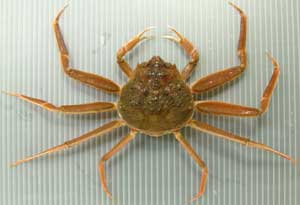
ZUWAGANI-MALE-1
(Male Snow Crab)

Snow Crabs, or Zuwagani in Japanese are very popular not only in Japan, but also in Russia, Canada and many other countries.

In Japan, they are also known under the following names: Matsubagani, Echizengani and Yoshigani.
The females are also called Seikogani, Megani or Koubakogani.
They are caught mainly in Autumn and Winter.
Their number have decreased in the Japan seas down to a yearly catch of 5,000 tonnes while 60,000 tonnes are imported from Russia and Canada.

ZUWAGANI-FEMALE-1
(Female snow Crab)

Male and female snow crabs are equally succulent, but the males contain more flesh and are accordingly more expensive.

ZUWAGANI-MALE-2
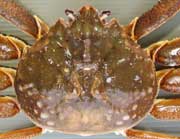
The “thorns” of a male snow crab are bigger.

ZUWAGANI-MALE-3
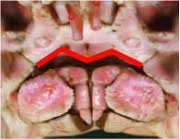
The “teeth” of a male snow crab are triangular in a seesaw shape.
The female “teeth” are in a straight line.

ZUWAGANI-FEMALE-2
The underbelly of a female snow crabis flatish.

ZUWAGANI-FEMALE-3

When buying a female (10 tmes as cheap) snow crab, choose a specimen with as few eggs as possible. Above speciman just has too many!

ZUWAGANI-FEMALE-4

A female snow crab should contain plenty of succulent orange egg sacs (the eggs not yet “born”). Otherwise, there is very little reason to buy any!

Crabs can be eaten in many ways, even raw, but my favourites are on sushi!

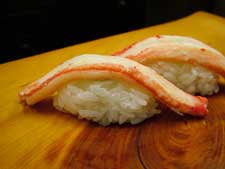
ZUWAGANI-SUSHI

Male Snow crab leg Sushi Nigiri.

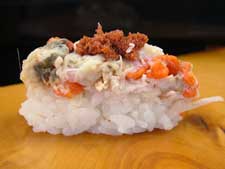
ZUWAGANI-FEMALE-SUSHI

Female snow crab Sushi Nigiri and its egg sacs!

Please check the new postings at:
sake, shochu and sushi

—————————————-
日本語のブログ
—————————————-

Japanese Seasonal Fish: Sawara/Spanish Mackerel

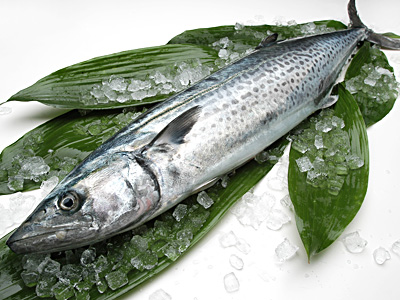
SAWARA-1

Sawara or Spanish Mackerel is considered as the best kind of Mackerel in Japan. Not only it is a big variety, but its comparatively white flesh is succulent in almost any kind of cooking!

It is known under different names such as Sagoshi and Sagochi when young and Yanagi when mature.
It is basically caught by trawling, but can be fished by line. It is, unlike other mackerels, a pretty solitary fish.

It is caught widely around Japan, off Russia, China and Korea.
The total catch has varied in recent years, but thanks to import, including 21.000 tonnes from China, it has become a feature in season from late Autumn to end of Spring.

UZU-2
(Kan-Sawara at Uzu, Shizuoka City)

In Winter, it is called Kan Sawara/寒鰆 (寒stands for cold, 鰆 stands for Sawara/Spring Fish) and is a sought after morsel. In Shizuoka it is sometimes caught then in Sagara bay, and I can tell you it disappears quickly form the table.

UZU-09-05-29-5
(Sawara at Uzu, Shizuoka City)

Later in Spring, it is just called Sawara and is leaner.

SAWARA-2

It can be cooked in many ways: broiled as above.

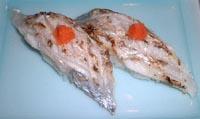
SAWARA-4

Or grilled.

SAWARA-3
(Small pic, sorry!)

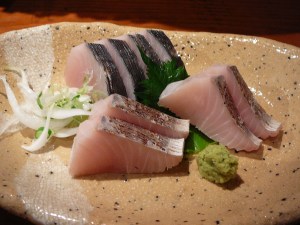
Of Course, as sushi nigiri! Especially Kan Sawara!

Please check the new postings at:
sake, shochu and sushi

—————————————-
日本語のブログ
—————————————-

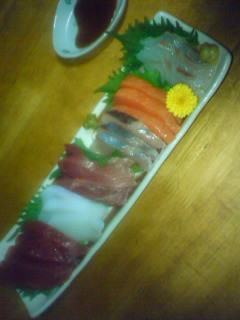
Sashimi Set at Tomii (’09-04)

tomii-09-04

For all my regular visits at Tomii, my favourite Japanese Cuisine Restaurant in Shizuoka City, It had been some time since I last introduced one of their seasonal sashimi plates!

I need little to say anything about the quality and presentation as they are perect as usual, so I’ll just describe the assortment:

Front row, left to right:
Sakuradai Seabream with a sllice of yellow carrot, Grated wasabi, Yari Ika/Calamari variety/Squid, Torigai/Surf Clam with fresh seaweed in front.

Second row:
Behind the shiso/perilla leaf, Aji/Horsemackerel-saurl from Kogawa, Shizuoka, Amaebi/Sweet Prawn, Ishidai Seabream with Shiao/Perilla flowers.

Third row:
Aka daikon/ red Daikon and various herbs, Honmaguro/Blue fin tuna.
Hoped you enjoyed the explanation as much as I enjoyed the taste! LOL

TOMII
Shizuoka City, Aoi Ku, Tokiwa-cho, 1-2-7, Tomii Bldg, 1F
Tel.: 054-274-0666
Business hours: 17:00~22:00
Closed on Sundays
HOMEPAGE (Japanese)

———————————————–
Please check the new postings at:
sake, shochu and sushi

—————————————-
日本語のブログ
—————————————-

Japanese Seasonal Fish: Striped Horse mackerel/Shimaaji

shimaaji-1

Shimaaji, or Striped Horsemackerel is one variety of Aji/Horsemackerel-Saurel.
Although the season is said to be in Summer, the taste varies little with the time of the year.
Striped Horsemackerel caught by anglers off the Izu Peninsula, Shizuoka Prefecture, are said to be the best in Japan.
It is known under the other names of Ookami, Kose and Katsuoaji.
It is very popular as sashimi:

shimaaji-2

or as tataki (tartare), my favourite, with a dash of fresh grated ginger:
<a

shimaaji-3 shimaaji-3a

Of course, as a sushi, it has many lovers:

shimaaji-4

The best sushi restaurants will prepare the sashimi or sushi from live specimen swimming in their tanks and later serve the bones and head deep-fried. They will serve the whole fish deep-fried for the guests who are so keen on eating raw fish!

shimaaji-5

Recently, breeding the fish from their eggs off Chichijima Island has been successful, meaning more on our plates in the future!

Please check the new postings at:
sake, shochu and sushi

—————————————-
日本語のブログ
—————————————-

Tuna Species: Kindai Tuna/Kindai Maguro

kuromaguro.jpg

Following a kind request by my good Foodbuzz friend, Elizabeth, I decided to re-post an article on this particular tuna species to clear some misunderstandings and add new information!

“Kuromaguro” or Blue Fin Tuna has become almost a mythical fish all over the world to the point that non-Japanese refer to it by its Japanese name.

“Kuromaguro”, or Blue Fin Tuna (or Tunny) has many other names in Japanese: Honmaguro, Maguto,Meji,Yokowa, Shibi, Imoshii, Shibimaguro, Kuroshibi, and Hatsu!

The best are caught in Winter mainly in the seas off Kochi (Shikoku Island), Miyagi and Hokkaido Prefectures.
This variety is the most expensive and can reach astronomical prices, especially caught in Winter off Hokkaido.
Imported Kuromaguro usually reaches Japan frozen, but in recent years the fish has been successfully raised in semi-wild environments in Spain, Australia and Croatia and arrives in Japan fresh by plane.
Imports and sales of Kuromaguro are monopolised by Japanese trade associations, unless you are lucky enough to catch one (careful here, as poaching is a major offense in Japan!).
Between you and me, if you want to eat Kuromaguro sashimi, it might come cheaper if you do it while travelling in Spain!
Did you know that Japanese importers will fly to Spain and other countries just to check that the fish are bled properly?

Now “Kindai Maguro” (近/kin for “near/nearby” and 大/dai for “big”) is the name given Kuromaguro/Blue Fin Tuna entirely human-fed (I mean fed by humans, not fed with humans!LOL).
There is big “but”, though! Huma-fed does not mean human-raised.
Young tuna have first to be located, encircled with large nets, guided near a shore and then provided with food. What people forget is that the tuna gills are hard. If the fish cannot swim freely enough it will wither and eventually die. So Kindai Tuna is nothing less than wild tuna caught into a trap and raised inside it!

BUT GOOD NEWS!

Only last week, the Tokai Marine Studies University in Shimizu Ku, Shizuoka City (Shizuoka, Banzai!) has just announced that they have succeeded in raising Kuromaguro from the eggs! What is with the recent success by fish farmers in raising another variety of Kuromaguro in Kyushu, Specialist are confident that Japan will be able to actually export completely human-raised tuna in the foreseeable future!

———————
Related terms:

kuromaguro-otoro
Kuromaguro Otoro (fat part)

kuromaguro-chutoro
Kuromaguro Chutoro (semi-fat part)

kuromaguro-akami
Kuromaguro Akami (lean part)

Please check the new postings at:
sake, shochu and sushi

—————————————-
日本語のブログ
—————————————-

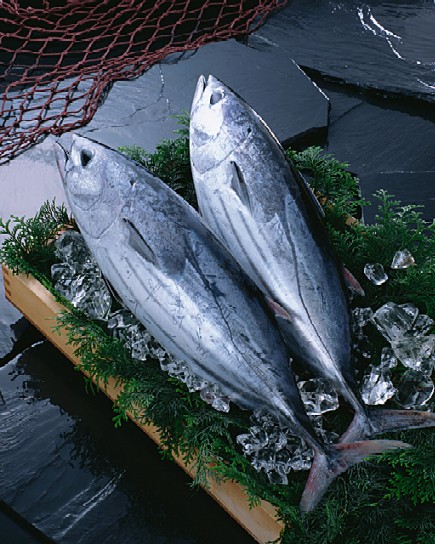
Japanese Fish Species: Bonito/Katsuo

bonito-pic

Bonito or “katsuo” in Japanese are extensively caught by fishermen from Numazu, Shimizu, Yaizu and Omaezaki Harbours. The main fishing areas are Shizuoka, Mie, Kochi & Miyazaki Prefectures.
It is also called “katsu” (Tohoku Region), “Honkatsuo” (Kyushu Island), “Magatsuo” (Shikoku and Kyushu Islands. N.B.: the same name designates another fish in other parts of Japan!), “Suji” (Yamaguchi & Wakayam Pref>).
It appears on the markets early Spring~Autumn as “sho gatsuo” (first bonito in Spring) and “modori gatsuo” (return bonito end of Autumn).
They are traditionally line-caught but nets have been used extensively in recent years.

bonito-sashimi

It can be appreciated raw, as sashimi with its skin or without it, preferably served with a saucer of soy sauce (shoyu) mixed with thin slices of fresh garlic, or with wasabi, a touch of lemon and shoyu,

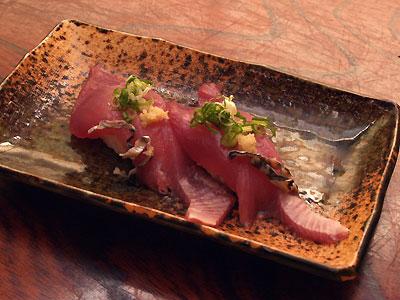
bonito-3

or as nigiri topped with grated fresh ginger a thin slice of garlic, unless you prefer grated fresh ginger with chopped thin leeks.

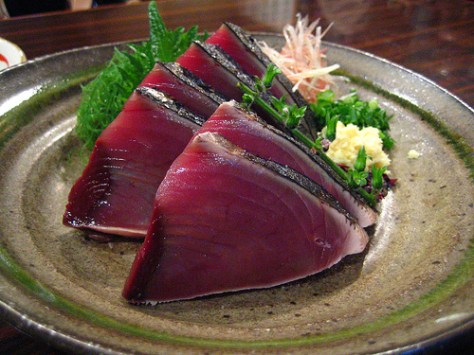
bonito-tataki

Another very popular way to eat it that will please Europeans and North Americans alike, is “tataki”.

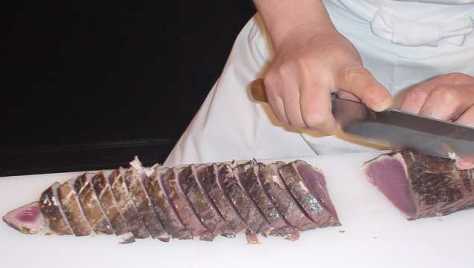
bonito-tataki-cut

The fish is first seared/grilled over charcoal until it is lightly cooked on the whole outside then plunged into ice water to stop it from cooking any longer. It is then cut into large slices and served with freshly chopped garlic and thin leeks, “shiso” leaves (perilla/beefsteak plant) and wasabi.

Note 1: in restaurants specify whether you want the skin or not when ordering sashimi.

Note 2: the same fish is a staple food in Sri LAnka where it is first smoked and then prepared as soup or curry!

Please check the new postings at:
sake, shochu and sushi

—————————————-
日本語のブログ
—————————————-

Foodbuzz Research (for a): Fish Stocks Preservation & Repleneshing in Japan

research-fishingship

First of all, let me say that Foodbuzz never asked me for such an article. I just wrote it out of concern for some of my Foodbuzz Friends!

It was Lou-Ann‘s surprise in particular which prompted me into more investigation to back up knowledge acquired trhough many years spent in this great country, Japan.

I use the word “great” for a simple reason:
Japan is the one country which most extensively conducts and sponsors research and development of fish stocks.
This country has also come up with some momentous discoveries related to the fishing environment:
-Japanese fishermen south of Kyushu Island discovered that planting trees on small islands increased manifold the amount of vegetal plankton carried into the surrounding sea resulting in an immediate increase of the fish population.
-Japanese researchers found out that building small pyramids on the sea floor with concrete or plastic (a beneficial dumping at last?) blocks attracted corals, sea anemones, seaweed and shellfish, thus creating a food chain for fish. Such pyramids will surely prove more beneficial to mankind than all the Egyptian pyramids put together!

The Japanese have been (unjustly) accused of emptying the seas. Actually Spain holds the world record for fish catch and consumption.
I already have written an article on whale meat. I find it galling that Japan is still villified for eating whale meat by the very countries which depopulated the globe of sea-mammals in the 19th Century: US, Canada, Russia, Australia and New Zealand (alright, Great Britain for the last two maybe!) in the Pacific Ocean. Us, Canada, Norway, Great Britain, France (my own country!), Spain and Russia in the Atlantic Ocean. And most of them again in the Arctic and Antarctic Oceans. What do you think Commodore Perry was before he was delegated to order Japan to “open its doors”?
This country is repeatedly thrown into the same basket of evils. I was recently “told off” because the Japanese kill sharks for their fins before throwing the dead fish back into the sea. Sorry, mate, but you will have to ask the Chinese! The Japanese eat the whole fish when they catch it.

It could go on and on, but this is not the real purpose of this article.

Now, to illustrate and justify the heading of this posting, here is a list of the fish and seafood raised in Japan as opposed to being caught in the wild:
research-honmaguro
Blue Fin Tuna/Honmaguro

Yes, you read it, Blue Fin Tuna! After 23 years of experimentation, a Kyushu fishmonger has finally succeeded in producing the fish from natural mating inside giant offshore sea parks. The fish is already sold over the counter at supermarkets.
With a ban on tuna fishing in the Mediterranean Sea being pushed through legislation by the EU, Japan will find itself one day in the rich position of actually exporting tuna!
research-mebachi
Big-eyed Tuna/Mebachi Maguro

Human-raising Research is being conducted.
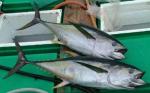
research-kihada
Albacore Tuna: Kihada Maguro

Human-raising Research is being conducted.

Note:
Indian Ocean Tuna/Indo Maguro: Human-raising Research is conducted abroad and such fish are imported to Japan.
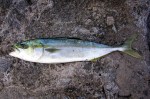
research-buri
Yellowtail/Buri

Over 62,000 tons of human-raised fish consumed last year.
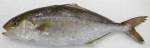
research-kanpachi
Amberjack/Kanpachi

Over 49,000 tons of human-raised fish consumed last year.
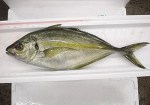
research-shimaaji
Striped Jack/Shima Aji

Over 3,000 tons of human-raised fish consumed last year.
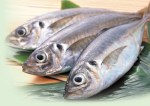
research-maaaji
Horse Mackerel/Ma Aji

Over 3,500 tons of human-raised fish consumed last year.
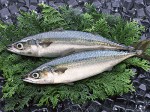
research-masaba
True Mackerel-Japanese Mackerel/Ma Saba

Human-raising succeeded and fish are already sold over the counter.
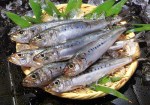
research-maiwashi
True Sardine-Pilchard/Ma Iwashi

Human-raising Research is being conducted.
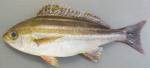
research-isaki
Isaki/Grouper variety-Parapristipona Trilinoatum

9 tons of human-raised fish consumed in Nagasaki Prefecture alone last year.
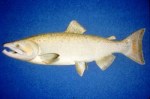
research-silversalmon
Silver Salmon/Gin Sake

Over 8,000 tons of human-raised fish consumed last year.
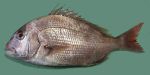
research-madai
Porgy/Madai

Over 71,000 tons of human-raised fish consumed last year as opposed to 15,000 tons caught at sea.
research-suzuki
Seabass/Suzuki

382 tons tons of human-raised fish consumed in Kagawa Prefecture alone last year.
research-kisu
Sand Borer-Sillago/Kisu

Human-raising Research is being conducted.
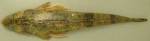
research-kochi
Bar-tailed Flathead/Kochi

Human-raising Research is being conducted.
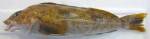
research-ainame
Ainame/Alexagrammos otakii

Human-raising has succeeded and some fish are already sold over the counter.
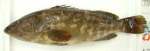
research-kue
Kelp Bass/Kue

A success story in Shizuoka and Nagasaki Prefectures where human-raised fish (one of the most expensive until then) are already sold over the counter.
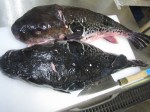
research-torafugu
Globefish-Tiger Globefish/Tora Fugu

Over 5,000 tons of human-raised fish consumed last year.
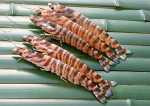
research-kurumaebi
Large Prawn/Kuruma Ebi

Over 1,700 tons of human-raised prawns consumed last year.
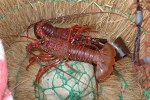
research-iseebi
Spiny Lobster/Ise Ebi

Human-raising Research is being conducted.
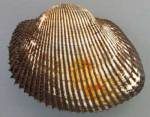
research-akagai
Ark Sheel-Bloody Clam/Akagai

Human-raising Research is being conducted.
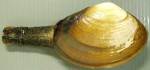
research-mirugai
Gaper/Mirugai

Human-raising Research is being conducted
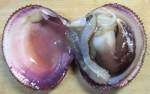
research-torigai
Large Cockle/Torigai

Human-raising Research is being conducted
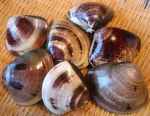
research-hamaguri
Hard Clam/Hamaguri

Very large amounts of half human-raised shellfish consumed last year.
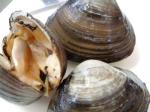
research-hokkigai
Surf Clam/Hokkigai

Human-raising Research being conducted
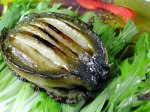
research-awabi
Abalone/ Awabi

32 tons tons of human-raised abalones consumed in Hokkaido and Nagasaki Prefectures alone last year.
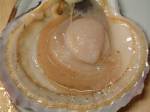
research-hotate1
Scallops/Hotate

Over 270,000 tons of human-raised scallops consumed last year.
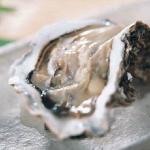
research-kaki
Oysters/Kaki

Over 220,000 tons of human-raised oysters + over 35,000 tons of the same out of the shell consumed last year as opposed to 1,600 tons of wild oysters.
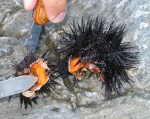
research-uni
Sea Urchin/Uni

7 tons tons of human-raised sea urchin consumed in Hokkaido Prefecture alone last year.

research-maanago
Conger Eel/ Ma Anago

Human-raising Research is being conducted

research-unagi
Common Eel/Unagi

Over 21,000 tons of human-raised fish consumed last year as opposed to 610 tons caught in the wild.

research-hamo
Oike Conger eel/Hamo

Human-raising Research is being conducted.

The Japanes have also starting research on different varieties of octopus/tako and squids/ika.

That is all for the moment! LOL

Please check the new postings at:
sake, shochu and sushi

—————————————-
日本語のブログ
—————————————-
Japanese Seasonal Fish: Seabass/Suzuki

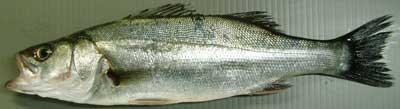
seabass-1

Suzuki or seabass is a fish so popular with anglers all over the world that a lot of people forget it is an extremely popular fish for sashimi and sushi in Japan.

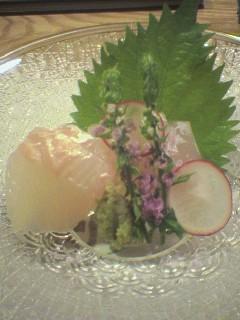
seabass-2
(Pic taken at Tomii Restaurant in Shizuoka City)

Like any other fish, it bears many names: Madaka, Hakura, Shiibasu.
In the Kanto area, including Shizuoka Prefecture, it is called Seigo when under 25cm. At 3 years of age, when it has attained a length of near 60cm, it is called Fukko or Suzuki.
In Kansai it is called Seigo, Hane, and Suzuki.

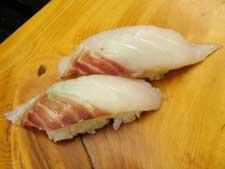
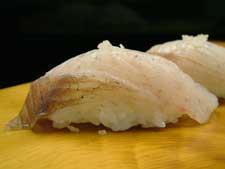
seabass-3seabass-4

As you can see above the colour and texture are slightly different (Fukko is on the right)

It is indeed a bit early to introduce this fish, but I can’t help thonking about it!
A summer fish par excellence, it is caught mainly in Central and western japan.
The bigger and the older the fish, the better it is considered. After a decline in the 1980’s, catches have increased recently, reaching more than 9,300 tonnes after 2000.

Of course it is a fish you can appreciate cooked or simmered, or grilled, although it becomes fragile and breaks up easily upon being cooked.


The Japan Blog List

Please check the new postings at:
sake, shochu and sushi

—————————————-
日本語のブログ
—————————————-

7 US$ Sashimi Plate!

7-sashimi-1

The Missus welcomed me back home last night with her “triumphant smile”. By this, I knew she had made a good bargain at one of the nearby supermarkets.
Good, I will be able to humor her more easily, I thought (sly macho reaction,…)
Anyway, she had noticed a good sashimi set being sold for 1,000 yen (about 11 US$) at Coop Supermarket but could not decide whether to buy it or not (it was about 5:00 p.m.) and proceeded forward. But her feminine (sorry!) instincts called her back as this was just the time when bargains start at this good (and very reasonable) big supermarket chain. The price had gone down to 600 yen (about 7 US$)!

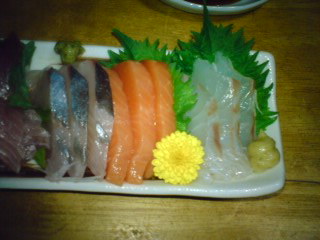
7-sashimi-2
(from right to left: “Tai/Seabream”, “Shake or sake/Salmon” and “Kanpachi/Amberjack)

I don’t have to tell you with what relish she grabbed it!
She had the sashimi already seved on a plate on the dining room table for me to admire. I decided to take a pic, but she said that the dsiplay was not good enough for a pic!
I waited for her to go back to the kitchen and took my mobile phone out to take a few pics in a hurry!
The pics are of poor quality, I must admit, but I hope it will give some ideas to my friends!

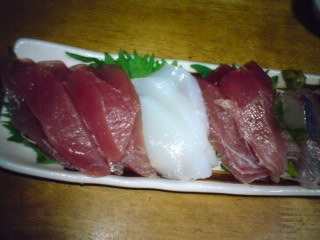
7-sashimi-3
(from right to left: “Tonbo maguro/Tuna Variety, “Ika/Squid” and “Mebachi maguro/Big-eyed tuna”)

All seafood, except for the salmon are apparently from Shizuoka Prefecture. No wonder it is so cheap (even in Japan)

Please check the new postings at:
sake, shochu and sushi

—————————————-
日本語のブログ
—————————————-
Japanese Seasonal Fish: Turbot/Makogarei

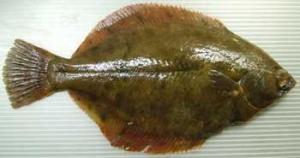
makogarei

“Makogarei” or Pleuronectes yokohamae Gunther for the specialists is one of the many kinds of turbot indigeneous to Japan.
You will find it on the markets between June and August.
Depending where you live, you might do well to know its other names: “Aome” (Sendai), “Mushibirama” (Konahama), “Mako” (Tokyo) or “Amakarei” among many.
It is net-caught all around Japan.
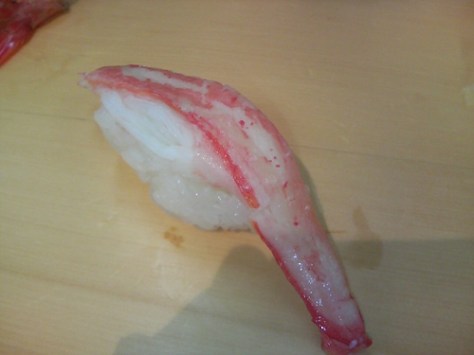
It has comparatively a lot of flesh for a turbot, making it a choice morsel for nigiri or sashimi.

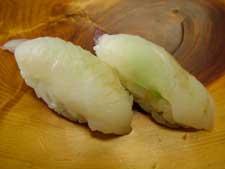
makogare-sushi

It can reach a length of 30 cm. Contrary to many other fish, the size will bear no incidence on the taste, but if you wish for extra taste, avoid female specimen bearing eggs/roe, and if possible, although a bit extravagant, choose a live fish (possible at Parche, Shizuoka JR Station!).
A good sushi or Japanese restaurant will deep-fry the bones and head for you, making for a great snack with great ale!

Please check the new postings at:
sake, shochu and sushi

—————————————-
日本語のブログ
—————————————-
Japanese Fish Species: Scabbard Fish/Tachiuo

scabbard-fish-a1
(Sorry, but that fish is just too long for the screen!)

Scabbard Fish or “Tachiuo” (太刀魚/Great Sword Fish in Japanese), a very popular in Japan in spite of its great length is usually caught in Summer in Japan but also appears in Winter in Shizuoka Prefcture.
As other fish it owns other names: Tachi (not in Hokkaido, where the word means “whiting”!), Shirada and Tachinouo.
It is mainly caught off Wakayama, Ehime and Oita Prefectures, although it is also caught in Suruga Bay off Shizuoka Prefecture
It is both caught by line or net.
In 1999, 37,000 tonnes were caught, but it fell to 23,000 tonnes in 2000.
It is also imported from Kore and China, although their fish is slightly different from the Japanese variety. More than half of imported fish are eaten west of Kansai.

scabbard-fish-c

It is fish than can be eaten raw as nigiri.

scbbard-fish-b1

I personally prefer it “aburi” (slightly grilled) with a dash of ponzu and some momijioroshi (grated daikon with chili pepper) as above served at Sushi Ko Restaurant.

scabbard-fish-d

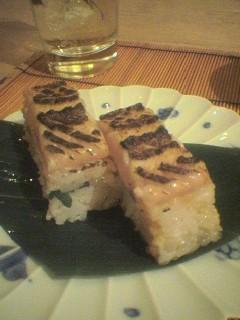
Some time ago I ate it at Oboro No Tsuki Restaurant (now defunct) as above:
They first put a double layer of sushi rice interspaced with shiso leaves (perilla) in a box for “oshi zushi” (pressed sushi), then top it with thick fillets (the fish is actually quite thin) and press the whole.
Next they slightly grill the top (“aburi”), take it out of the box and cut it to size.
Quite tasty and appetizing-looking!


The Japan Blog List

Please check the new postings at:
sake, shochu and sushi

—————————————-
日本語のブログ
—————————————-
Shizuoka Fish: Red Trumpet Fish/”Aka Yagara”


The Japan Blog List

Please check the new postings at:
sake, shochu and sushi

—————————————-
日本語のブログ
—————————————-

yagara-1

This evening, on my way back from University in Fukuroi City, I ventured inside the great Supermarket inside Shizuoka City JR Station as they are bound, especially in the seafood department, to exhibit some interesting specimens.
I certainly was not disappointed!

yagara-2

Here is another picture to give you an idea of the size!

Trumpet Fishes come in “blue” and “red” varieties.
This one is a red (“aka”) Trumpet Fish.
A bit of a monster, it was a good 1,5 meter (five feet) long and weighed over 5 kg.
I was told 3 meters (10 feet) long specimens are regularly caught in Suruga Bay, the main Bay of Shizuoka Prefecture!

I knew that my friends at Tomii Restaurant would be interested.
I called them on my mobile.
They replied they definitely were!
I bought the fish on their behalf. At 130 US$, it was cheap (I actually bargained a bit!), considering what customers would pay for this delicate fish, either as sublime sashimi or delicious “nabe”!