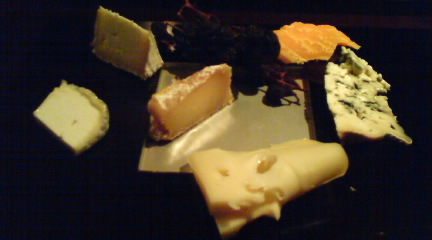
Cheese Plate at Gentil (7)

GENTIL-09-08-04

This article is again dedicated to Cheese Monger as he is interested in what we can expect here in Japan!

I don’t need to introduce Gentil and Ms. Keiko Kubota in Japan who is THE authority on cheese in Japan!

Look at picture above to find out what I sampled last Wednesday:

Left top: Chaource (Cow, France)
Left bottom: Bon de Sologne (Cow, France)

Centre under muscat raisins: Merois (Goat, France)
Centre bittom: Tsuki no Monogatari/Moon Story (Raw Cow milk, Japan, Hokkaido)

Right top: Mimolette, 2 months old (Cow, France)
Right bottom: Bleu d’Auvergne (Cow, France)

Another great plate, I can assure you!

Restaurant Gentil
Address:420-0031 Shizuoka Shi, Gofuku-cho, 2-9-1, Gennan Kairaku building, 2F
Tel.: 054-2547655 (Reservations advisable)
Fax: 054-2210509
Opening hours: 12:00~14:00, 18:00~last orders for meals at 21:30. Bar time 18:00~23:30. Closed on Mondays.
Credit cards OK
Homepage (Japanese)

Please check the new postings at:
sake, shochu and sushi

—————————————-
日本語のブログ
—————————————-

Scottish Cuisine: Green Peas and Mint Soup

PEAS-MINT

I have nurtured a special fondness for Scotland where I stayed many times as far back as in the 1970’s. I’m still an ardent fan of Hamilton Academics, better known as the “Accies”, Football Club (Soccer)!

Scotland has more to offer than whisky and haggis, and its gastronomy is slowly but steadily getting better attention thanks to the thousands of tourists visiting this beautiful and still wild country.

It is a very cold country in winter, and a good soup is always much appreciated there!

Green Peas and Mint Soup!

INGREDIENTS: For 4 people

-Fresh or frozen green peas: 500 g
-Lettuce leaves: 150 g
-Onions: 250 g
-Chopped fresh mint: 3 large tablespoons
-Butter: 50 g
-Fresh cream: 100 ml
-Salt and pepper to taste

RECIPE:

-Peel the onions and chop finely. Wash the lettuce leaves and cut/chop finely.

-Melt the butter in large deep pan and cook the onions slowly over a low fire. They must melt but not change colour. Add the lettuce first and after a minute or two add 1 litre of water. Cook over a very low fire for 20 minutes.

-Add the green peas and bring to boil. Take off fire.

-Add the mint and mix for a long time with an electric whisker. Season with salt and pepper. Sieve the soup through a very fine mesh and pour again into the pan.

-Add the fresh cream and re-heat the soup over a low fire, taking care not to boil it.

-Serve hot with a few green peas and mint leaves.

NOTE:
You may also serve this soup with whisked fresh cream to which you have added plenty of pepper!

Please check the new postings at:
sake, shochu and sushi

—————————————-
日本語のブログ
—————————————-

Japanese Cakes/Wagashi 14: Satsuma Imo/Sweet Potato

SATSUMA-WAGASHI-1

Satsuma Imo or Sweet Potatoes are often used in Japanese cakes/Wagashi.
The great advantage is that it makes for completely vegan cakes with an almost endless source of variations.

Here is the basice recipe from you will be able to improvise!

INGREDIENTS:

-Satsuma/Sweet Potato: 400g (peeled)
-Sugar: 75 g
-Agar agar powder: 3 g
-Salt: a pinch
-Water: 20 ml

RECIPE:

SATSUMA-WAGASHI-2
-Cut the sweet potato into small pieces and wash under clear cold water to take off astringency.
Boil in a pan with 20 ml of water until soft.

-Just before the potatoes are completely cooked, add sugar agar agar and salt. Bring to boil and swith off fire. Bear in mind there will is very little water. Do not burn the poatoes!

-Transfer potatoes into a frying pan and fry until they get smooth..

-Return to boiling pan and heat to get all excess water out.

-Pass through a sieve, or process.

-Wet the inside of a refrigerator recipient before spreading cellophane paper inside. Pour the potato puree into the recipient and fold the cellophane paer on top, leaving no air between cellophane paper and potato. Chill inside refrigerator.

SATSUMA-WAGASHI-3

Before eating unwrap cellophane paper and cut into preferred shape.
This is where the fun begins!

Please check the new postings at:
sake, shochu and sushi

—————————————-
日本語のブログ
—————————————-

French Cuisine: Beignets de Sole au Parmesan & Mayonnaise verte/Sole fritters with Parmegiano and Green Mayonnaise

SOLE-VERTE

A lot of people have this cringe/hate about mayonnaise.
Why?
Because they usually eat redy-made, meaning a sweet and cloy product akin to fast/junk food.
Make it yourself then! I can assure you your world will change (alright, I’m exagerating!LOL)!
Sole is in season. Parmegiano is a favourite. Why not indulge in the following dish (long title, sorry!):
French Cusine: Beignets de Sole au Parmesan & Mayonnaise verte/Sole fritters with Parmegiano and Green Mayonnaise!

INGREDIENTS: For 4 persons

-Sole filets: 500 g
-Bredcrumbs: 100 g
-Grated Parmegiano: 50 g
-Flour: 50 g
-Eggs: 2 (beaten in omelette)

Oil for deep-frying

-Mayonnaise:
Sunflower oil: 300 ml
Spinach: 25 g
Egg: 1
White wine vinegar: 2 teaspoons
Mixed fresh herbs (Chervil, Tarragon, ciboulette): 25 g
Salt and Pepper to taste

RECIPE:

-Prepare the mayonnaise:
First drop the spinach in boiling water. Let cook for a few seconds only. Take out. Drain well and process with herbs into a puree.
Put aside.
In a food processor drop the whole egg with the vinegar and salt.
Mix at slow speed.
Then pour the oil slowly incresing the mixer/processor’s speed along.
When the mayonnaise is ready, Drop the spinach and herbs puree in andmix quickly. Keep in a cool place

-Heat the dep-fry oil.
Cut the sole fillets in 2cm long pieces.
In three separate dishes place 1) the flour, 2) the beaten eggs, 3) the parmegiano and bredcrumbs mixed together.
Rool the fish in 1) the folur, 2) the beaten eggs and 39 into the Pamegiano/breadcrumbs mixture.

-Drop the fish into the oil and lt fry for 1 minute.
Take out and place on kitchen paper to take off excess oil.

-Serve hot with the green mayonnaise.

What wine with it: dry solid white wine!

Please check the new postings at:
sake, shochu and sushi

—————————————-
日本語のブログ
—————————————-

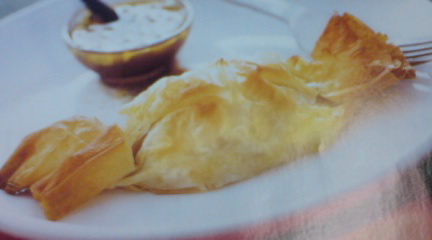
French Cake: Croustillant Banane Mangue/Banana & Mango Pie

BANANA-MANGO

Still delving into my notes for more French desserts!
Bananas and mangoes are practically everywhere, so it should be a problem to realize this simple recipe:
Croustillant Banane Mangue/Banana & Mango Pie!

INGREDIENTS: For 4 persons

-Brick/Filo sheets: 4
-Banana: 1
-Mango: 1
-Butter: 25 g
-For the syrup:
Water: 250 ml
Sugarcane sugar/brown sugar: 3 tablespoons
Vanilla: 1 whol pod cut along its lengt
Juice of 1 orange
Juice of 1 gree lemon

-Pulp of 1 guava

RECIPE:

-In a small pan, drop all the ingredients for the syrup (Do not include the guava!) and cook on a medium fire for 10 minutes. Let cool completely and leave in a cool place.

-Peel the banana and mango and cut them in big pieces first.

-Put the banana and mango pieces into the syrup and let marinate for 30 minutes.

-Take the fruit pieces out of the syrup with a holed ladle to drain as much of the syrup as possible. Put the fruit on a piece of kitchen paper.

-Cut the fruit into small pieces.

-On a kitchen board, place a filo sheet and fold it once (double).
Put a large tablespoon of the cut fruit in the middle of the filo sheet.

-Melt the butter i a small pan.

-Fold the right third of the filo sheet onto the fruit, and fold the left third of the filo sheet on top. Delicately turn or twist each end so as to form a “papillote” (sweet wrapper) as in picture above.
Brush melted butter over the whole papillote.

-Bake at 180 degrees Celsius for 10~15 minutes.

-Serve hot with the syrup in a small pot to you have added guava pulp.

if you want to taste a wine with it, a port or banyuls or a sweet wine is best!

Please check the new postings at:
sake, shochu and sushi

—————————————-
日本語のブログ
—————————————-

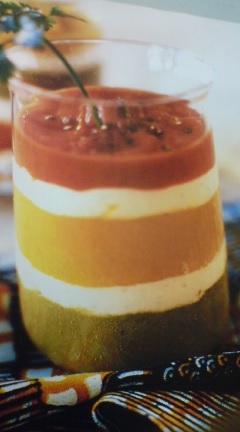
Vegetarian French Cuisine: Terrine Bayadere de Poivrons/Pimento and Cheese Terrine

POIVRONS

Soft Pimentoes or Poivrons in France are eaten from Spring to Fall, especially in the South.
Incidentally it is the vegetable richest in Vitamin C.
Bear in mind that the skin and seeds are difficult to digest.

Here is a fairly simple recipe for vegetarians I just found in my books:
Terrine Bayadere de Poivrons/Pimento and Cheese Terrine!

INGREDIENTS: For 4 persons

-Green pimentoes: 2 large ones
-Red pimentoes: 2 large ones
-Yellow Pimentoes: 3 large ones
-Fresh Goat Cottage Cheese (Petit Billy style)/ You may replace with any soft fresh cheese of your choice
Balsamico Vinegar: 3 tablespoons
-Herb-scented (taragon, etc…) olive oil (EV): 80 ml
-Red Chili Pepper (Espelette in France): 1 teaspoon
-Garlic: half a clove
-Ciboulette (or very thin leeks. If unavailable, flat parsley or fresh coriander): a few sprigs
-Fine salt: to taste

UTENSILS:
4 deep transparent glasses as shown on picture above.

RECIPE:

-Wash the pimentoes and grill, one colour at a time, inside a plate under the grill of an oven.

-Take out the pimentoes, once their skin has “cracked away” and wrap (colour separated!) inside foil paper or inside plastic pouches for 15 minutes
Use three plates for grilling. Deglaze each plate with one tablespoon of balsamico vinegar. Sieve the juice one by one into three small bowls or back into their plates, and keep for later process.

-Mix the cheese with half of the red chili pepper, fine salt and crushed/finely chopped garlic and 30 ml of olive oil.

-Peel and take seeds off pimentoes by colour.
Process (three different times) into puree with their deglazed juice and some olive oil. Season with red chili pepper and salt each of the purees.

-In each glass pour one pimento puree of your choice. Add one layer of cheese, then one layer of another pimento pure, and again one layer of cheese and the final layerof pimento puree.
Wrap with cellophane paper and leave in the refrigrerator for 6 hours.

-Before serving add chopped leeks or herbs.
Serve with a spoon and small toasts of your favourite bread!

Dry white wine is best with such a dish!

Please check the new postings at:
sake, shochu and sushi

—————————————-
日本語のブログ
—————————————-

French Cake by Bernard Heberle: Cassis Evolution

CASSIS-EVOLUTION

My good French friend, Bernard Heberle, a native from Alsace in France and plying his trade as a patissier in Hamamatsu City, has just sent me his last creation:

Cassis-Evolution!

In his own words:
“Une nouvelle création … ” Évolution Cassis ”
C’est un gateau a base de mascarpone avec une douceur myrtille au chocolat blanc sur un pain de Genes et une touche de gelée de cassis. Très frais et de saison, les myrtilles sont excellentes cet été , malgré la pluie incessante. ”

“A new creation…”Evolution Cassis”
It is a cake with a mascarpone base qith a sweet blueberry and white chocolate layer on a Genes bread/short cake and a touch of cassis jelly.
Very fresh and seasonal. The blueberries are excellent this summer, in spite of the unceasing rain.”

Abondance
Address: Hamamatsu Shi, Sumiyoshi, 2-14-27 (in front of Seirei Hospital)
Tel.: 053-4738400
Fax: 053-4738401
Opening hours: 10:00~20:00. Closed on Tuesdays.
Homepage

Please check the new postings at:
sake, shochu and sushi

—————————————-
日本語のブログ
—————————————-

Bryan Baird’s Newsletter (2009/19)

Baird Beer & Taproom Events Bulletin 2009 #19

bryan-sayuri.gif

Dear Taproom Friend & Baird Beer Enthusiast:

The grand opening of our new taproom in Harajuku (Harajuku Taproom) is just around the corner. We open for business at noon on Saturday, August 8.

The Harajuku Taproom is a yakitori-izakaya style beer pub inspired by our love of the casual Japanese dining and drinking (and they always go together) experience. The decor is the simple and natural one of wood and stone which has been rendered even more magnificent by the craftsmanship of our world-class carpenter, Mitsuo Nagakura (everything is hand-made by him, including the furniture!). The food too is simple and natural, and fresh! Chef-manager, Tetsuya Naruoka, will be manning the grill with skill and his consummate enthusiasm. The beer will be Baird and it will be served impeccably. The house Harajuku Ale will be a real ale poured from a handpump and is a slight variation of the European Summer Ale we released earlier in the year. The Harajuku Taproom Celebration Ale is a kind of American-style IPA hopped to the heavens and frothing at the prospect of being enjoyed in the company of a plate of perfectly grilled Japanese skewers. As for the location, it is both convenient and fun (from Harajuku JR station walk down Takeshita-dori about 100 meters and turn left at the first intersecting road; walk 30 meters to the end of that road and the Harajuku Taproom will be staring at you from the right). Harajuku Taproom details are below:

Harajuku Taproom
1-20-13 Jingumae, Shibuya-ku
Tokyo 150-0001
Tel/Fax: 03-6438-0450
email: harajuku-tap@bairdbeer.com
Business Hours: Monday-Friday (5:00 pm – Midnight), Saturday, Sunday, National Holidays (Noon – Midnight)

The beer fun is not limited to the Harajuku Taproom, however. Bottles (633 ml) of Harajuku Taproom Celebration Ale will be available through the fine family of Baird Beer retailing liquor shops in Japan beginning Friday, August 7.

Harajuku Taproom Celebration Ale (ABV 6.5%):

This bold and pungently American-style IPA is for hop lovers only. Loads of BUs lend a boastful bitterness exceeded in arrogance only by the aromatics of what can best be described as a hop oil orgy. Cheers to Harajuku!

Lastly, the Baird Brewery is pleased to announce today’s release of yet another unique annual summer seasonal beer: Asian Beauty Biwa Ale.

Asian Beauty Biwa Ale 2009 (ABV 6.0%):

Biwa is “the small, yellow, edible, plum-like fruit of the loquat tree.” We had no idea what is was until our partner-friend-carpenter-farmer, Nagakura-san, brought some in two years ago for us to taste and then brew with. It is an extremely subtle fruit that harmonizes sweetness with tartness. Asian Beauty Biwa Ale is coyly fruity, spritely effervescent and yet delicately firm — like a true Asian Beauty! It promises to be a superb August heat and humidity tamer.

Asian Beauty Biwa Ale 2009 is being sold in 633 ml bottles by fine Japanese liquor stores and is available on draught, beginning Friday, August 7, at our Taproom pubs as well as at other Baird Beer retailing pubs and restaurants in Japan.

Looking forward to seeing you either this weekend or soon thereafter at the Harajuku Taproom.

Cheers,
Bryan Baird

Baird Brewing Company
Numazu, Japan
HOMEPAGE


The Japan Blog List

———————————
Must-see tasting websites:
-Sake: Tokyo Through The Drinking Glass, Tokyo Foodcast, Urban Sake, Sake World
-Wine: Palate To Pen
-Beer: Good Beer & Country Boys, Another Pint, Please!
-Japanese Pottery to enjoy your favourite drinks: Yellin Yakimono Gallery
——————————–
Please check the new postings at:
sake, shochu and sushi

—————————————-
日本語のブログ
—————————————-
French Dessert: Tourtelettes a la Creme d’Orange/Small Orange Cream Pies

ORANGE-CREAM

I continue with the series of desserts found in my old notes!
Oranges are coming thick and fast on the markets.
Toutelettes in French mean small covered tarts/pies
French Dessert: Toutrtelettes a la Creme d’Orange/Small Orange Cream Pies!

INGREDIENTS: For 4 persons

-Pastry:
Flour: 400 g
Softened butter: 200 g
Sugar: 2 tablespoons
Grated orange skin: 1 whole (organic if possible)
egg: 1 + 1 yolk
Salt: a pinch

-Orange Cream:
Organic oranges: 4
Hazlenuts: 10
Orange, Citrus and Grapefruit Jam (in unavailable, orange jam is fine): 1 tablespoon
Sugar: 1 tablespoon
Eggs: 3
Fresh cream: 2 tablespoons
Thickening agent (arrow root is best. If unavailable high quality cornstarch): 1 tablespoon

RECIPE:

-The evening before, prepare the pastry:
Mix flour, 1 tablespoon of sugar, salt and grated orange skin. Add butter and mix. Beat the egg and add, kneading it in as quickly as possible. If needed add a little water. Make a bowl, wrap it in cellophane paper and leave inside refrigerator.

-Next day:
Take wedges out of the oranges. Take off thin skins and discard. Drain. Chop the hazlenuts finely.
In a bowl, mix eggs and thickening agent, sugar, fresh cream, jam and hazlenuts. Carefully add the the orange wedges. Leave inside refrigerator.

Divide the pastry into two parts, one made up of two thirds, the other one of one third.
Let rest at room temperature for 1 hour.
Pre-heat oven to 180 degrees Celsius.
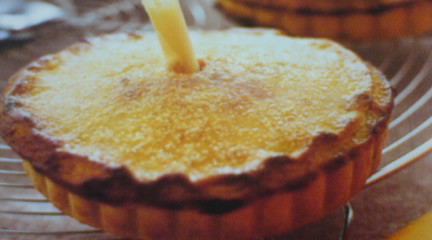
Make 4 circles with the first two thirds about 5 mm thick and spread them inside tart molds leaving the pastry coming over the brim.
Stab pastry with a fork.
Keep inside refrigerator for 30 more minutes.
Take out of refrigerator. Fill tarts with the orange cream up to two thirds of its depth.
Make 4 circles with other third of pastry wide enough to be slightly wider than the molds. Place one circle on top of each tart/pie and secure it by pinching both pastries together.
Make a small hole in the middle and insert a small cone of baking paper inside.
Bake for 20 minutes.
Take out of oven.
Beat the egg yolk with 2 tablespoons of water and brush the whole top of the pie. Sprinkle with a little sugar and bake again for 10 minutes.

Serve lukewarm.

To be enjoyed with a sparkling white wine or lemonade!

Please check the new postings at:
sake, shochu and sushi

—————————————-
日本語のブログ
—————————————-

French Dessert: Creme Brulee aux Myrtilles/Blueberries Creme Brulee

BLUEBERRY-BRULEE

I found a whole series of desserts in my old notes!
Blueberries are still in season.
Here is an easy and very tasty variation of a classice French dessert:
French Dessert: Creme brulee aux Myrtilles/Blueberries Creme Brulee!

INGREDIENTS: For 4 persons

-Egg yolks: 8
-Blueberries: 350 g
-Unskimmed milk: 300 ml
-Thick fresh ceam: 700 ml
-White sugar: 200 g
-Vanilla: 1 whole pod
-Sucre cassonade/brown sugar: 2 tablespoons

RECIPE:

-Pre-heat oven to 150 dgrees Celsius with a large deep oven plate filled with water up to a third of its depth.

-Make a cut along the vanilla pod and mix the inside with the milk in a deep pan. Bring slowly to boil.

-Beat the egg yolk and white sugar together in a separate bowl.

-Add the fresh cream. Mix. Add the vanilla milk and mix.

-Place the blueberries inside dessert dishes. Cover with the hot cream. Place the dishes in the bain-marie and cook for 20 minutes inside oven.

-Last and just before eating, sprinkle each dish with brown sugar and caramelize the cream under the grill.

-Serve lukewarm or cold.

If you wish to taste it with wine, a sparkling white wine would be great!

Please check the new postings at:
sake, shochu and sushi

—————————————-
日本語のブログ
—————————————-

Gyudon: Basic Recipe

GYUUDON

Gyūdon (牛丼) can be literally translated into English as (Japanese-style) beef bowl. It is a typical Japanese comfort food consisting of a bowl of rice topped with beef and onion simmered in a mildly sweet sauce flavored with dashi, soy sauce and mirin. It also often includes shirataki/translucent konyaku noodles. It is commonly served with beni shōga (pickled ginger), shichimi/seven flavor chili pepper, and a side dish of miso soup. Mixing in a raw egg is also very popular.

Here is the basic recipe:

INGREDIENTS: For 2 persons
-Two bowls of freshly steamed rice
-Beef, thinly sliced: 200 g
-Onion: 1
-Ito konyaku/shirataki/translucent konyaku noodles, 1 pack/180 g
-Fresh ginger: 1 medium-sized piece.
-Dashi (seaweed dashi): 2 cups/400 ml
-Soy sauce: 4 tablespoons
-Mirin/sweet Japanese sake: 4 tablespoons
-Beni shoga/red pickled ginger: to taste

RECIPE:

-If you have bought the beef in one block, cut in very thin slices.

-Cut the onion in halves first, then in slices about 5 mm thin slices.

-drain ito konyaku. Cut into 5 cm long strands. Wash well with cold clear water and leave in water for a while. Drain well.

-Cut the frsh ginger in thin slices.

-Bting dashi to boil and add soy sauce and mirin. Stir. Drop in beef, sliced onion, ito konyaku and sliced ginger all at the same tome. Let simmer on strog fire until onion has become translucent. Switch off fire.
Pour on top of a bowl filled with freshly steamed rice. Add some beni shoga and serve with a raw egg in a separate dish.

NOTE:

If you have the time, cook the beef beforehand. Let cool completely.
Re-heat quickly on a hot fire just before serving. It will taste even better!

Please check the new postings at:
sake, shochu and sushi

—————————————-
日本語のブログ
—————————————-

Oyakodon: Basic Recipe

OYAKODON

Oyakodon must count as one of the top 5 as far as poplular food comes in Japan.
It is easy to prepare and improvise with.
Bear in mind that depending upon the region you are in Japan, the ingredients are totally different. For example, in Hokkaido you will be served salmon sashimi and salmon roe!
After all, “oyakodon” means “parent and child bowl” (ingredients!)!
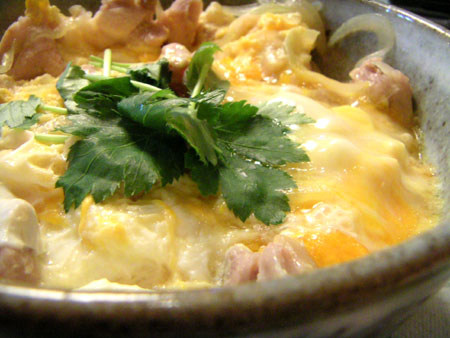
Being asked about a recipe, I decided to introduce the main lines of a basic one here made with chicken and eggs, not bothering about quantities but concentrating on the method.

-Rice
Steam rice beforehand.
Oyakodon prepared with freshly steamed rice is miles ahead of reheated rice as far as taste is concerned!

-Chicken
Choose breast or thigh chicken. It is up to you to use or discard the skin. I prefer to discard it, unless I deep-fry the chicken first.

-Eggs
Choose the freshest ones as possible with large deep-coloured yolks.

-Vegetables:
Thinly sliced onion to be cooked together with the oyakodon.
A lot of people feel like adding other vegetables. Keep in mind they have to be cut thin and need to be fried.
Fresh leaved greens for the final and important touch. My favourite is fresh trefoil. If not available, I use flat parsley or chopped leeks.
In many regions they also add chopped dry seaweed for the final touch.

-Stock soup/sauce:
You may use water, but dashi is a lot better. I pesonally use seaweed dashi. One might use chicken stock, too.
I add a little soy sauce, sugar, Japanese sake and sweet Japanese sake/mirin.
That is where improvisation and personal taste come in!
You may season with salt and pepper, but bear in mind that soy sauce already contains salt, so easy on that one!

METHOD:

-Cut chicken in small enough pieces. Fry or deep-fry them first. If you fry/sautee them, just season chicken with a little salt and pepper. If you dep-fry them, season them with salt and pepper and cover them with plenty of cornstarch, unless you prefer the flour, egg and breadcrumbs method.
Once the chicken has been fried to 90%, take out and leave in another plate or on a metallic grill to get rid of excess oil.

-Using only a little oil (that left by the chicken is fine), fry the onion (and other vegetables) until almost properly cooked.
Add soup/stock. bring slowly to boil on a small fire. Add chicken and boil for a minute just to let the taste penetrate the chicken.
During that time, beat eggs (quantity is up to you!) with chopsticks to leave some parts white (some people like well beaten).
As soon as the chicken has completely cooked, dicard some soup if too much of it, and add the eggs.

Point 1: the chicken should be tender, not overcooked.
Point 2: Too much soup/stock will prevent the eggs from cooking fast, or you might end up with scrambled eggs
Point 3: the “real” (debatable) recipe calls for the eggs to be only half cooked before transferring the lot onto the rice.
In Kyoto, for example the eggs are most of the time well cooked and topped with a raw egg yolk.

-As soon as you are satisfied with the eggs, transfer the lot on top of a bowl filled with steamed rice.
Decorate with trefoil and serve.

Please check the new postings at:
sake, shochu and sushi

—————————————-
日本語のブログ
—————————————-

Please check the new postings at:
sake, shochu and sushi

—————————————-
日本語のブログ
—————————————-

Today’s Lunch Box/Bento (’09/53)

BENTO-09-08-04a

Today was clear and bleeding hot, but contrary to Jenn might think, the Missus came up with the comment this morning: “Kyo wa, te-nuki bento da!/Today, lazy bento!”
I know better than to argue. It is the best way to provoke the Missus into a little more work she had intended first!

BENTO-09-08-04b

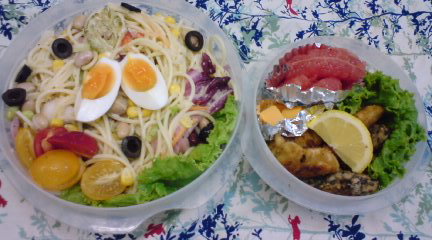
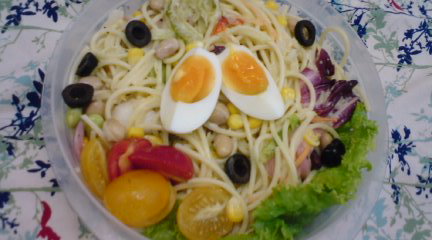
She boiled potatoes, cool then under running cold water and drained them before adding dressing, beans salad and choppes veg to them.
She added red and yellow mini tomatoes from Shizuoka, soft boiled egg, lettuce and olives before closing the box.

BENTO-09-08-04c

For extra garnish, she deep-fried chicken, one plain and the other with black sesame seeds. Lemon for extra seasoning and lettuce to wrap them in.
Red cheddar cheese and red grapefruit for dessert.

Not bad for a lazy bento!

Please check the new postings at:
sake, shochu and sushi

—————————————-
日本語のブログ
—————————————-
Greek Dessert: Fig & Pistachio Tarts!

GREEK-CAKE

When I found this Greek dessert in my old notes I immediately thought of Dorian at Foodbuzz!
The fact I’m French does not mean I’m averse to other countries’ gastronomy. On the very contrary, as proven by my love for Japanese food! In any case, in these ages of fusion one might be considered slightly backward if not open to all gastronomies! LOL

Here is a recipe than can be enjoyed when figs are in season (very soon!)
Figs and Pistachio tarts!

INGREDIENTS: For 6 small tarts (tartelettes)

-Pastry:
Flour: 250 g
Almond powder: 50 g
Sugar: 4 tablespoons
Egg yolk: 1
Butter: 160 g + a little for the molds
Salt: 1 pinch

-Filling:
Fresh figs: 12
Cinnamon: 1 teaspoon
Butter: 50 g
Unsalted pisachio out of teir shells: 250 g
Honey: 100 g

RECIPE:

-Preparing the pastry:
Pour the flour and almond powder into a large bowl. Add the salt and sugar. Mix. dig a well in the middle and drop the egg yolk in. Mix with the tips of your fingers. Add the butter brokeninto small pieces and 1 or 2 tablespoons of iced water. Knead until you obtain an homogeneous paste. Let rest for 30 minutes.

-Spread the pastry. Cut out six discs (you may divide the pastry into 6 equal parts and spread them into circles individually). Butter the inside of 6 small tart molds. Place pastry inside molds. Put aside.

-Filling:
Pre-heat oven to 180 degrees Celsius.
Wash the figs and cut in slices. Put them inside the tarts. Add some pieces of butter on them. Sprinkle them with the cinnamon first and then with half of of the honey.

-Bake tarts inside oven for 20 minutes.
Cover them with the pistachio and cook for 5 minutes.

-Heat the remaining honey to liquefy it.
Pour honey over tarts.
Let cool completely.

For Greek wine lovers try a mellow wine called Mavrodaphne from Patras with it!

Please check the new postings at:
sake, shochu and sushi

—————————————-
日本語のブログ
—————————————-
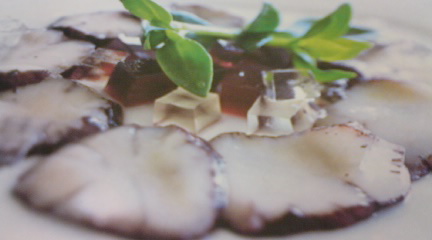
Wine-marinated Scallops and their Red and White Wine Jelly

SCALLOPS-WINE_0001

It’s Summer.
That is when French and Japanese cuisines tend to fuse in a new natural dimension with the need for lighter gastronomic ventures.

here is a simple recipe that will impress your friends:
Wine-marinated Scallops and its Red and White Wine Jelly!

INGREDIENTS: For 4 persons

-Scallops: 12 large
-Red wine (Chinon, or a wine both spicy and solid, but not too heavy): 450 ml
-White wine (Loire or Vouvray, or a slightly sweet white wine): 200 ml
-Gelatin: 6 sheets
-Olive oil (EV): 2 large tablespoons
-Green leaves of your choice: ~250 g
-Salt & pepper to taste

RECIPE:

-Marinate the scallops in 250 ml of red wine for 2 hours.

-Drop the gelatin sheets in a bowl filled with cold water.
Separately heat both wines slowly to lukewarm in two pans.
Take gelatin sheets out of cold water bowl, drain them and add 3 of each to each wine pan.
Wait until gelatin has dissolved.
Pour the wine jelly into two deep plates or molds.
Put in refrigerator until jelly has completely solidified.

-ake the scallops out of their marinade.
Cut them into thin slices.
heat and reduce the marinade down to one third. Add olive oil, salt and pepper to marinade.
Let cool completely.

-Clean the vegetable leaves and place at the centre of plates.
Make a rondo/circle of slices callops. Cut the jelly into small cubes and place them over or with the salad.
Pour a spoon of the sauce over the salad.

Enjoy the rest of the wine with it!

Please check the new postings at:
sake, shochu and sushi

—————————————-
日本語のブログ
—————————————-