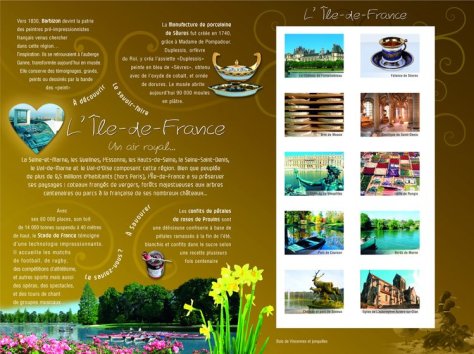
French Gastronomy on Stamps (12): Ile de France

timbres-gastronomie-iledefrance

France has issued many stamps on food (not foodstamps!) on her own gastronomy for quite some time.
A new series will be issued on April 25th and wil be printed in the form of mini-sheets dedicated to a particular region with stamps, pics and explanations.
With the twelfth of these sheets I’d like to introduce is Ile de France.

Ile de France, as its name indicates, “started” with islands in the middle of the Seine River inhabited by the Parisii Celtic tribe, and slowly expanded to become France. It certainly took a long time against many odds!

Limited in area as it is, it nevertheless accounts for some specialties.

-Brie Cheese is assuredly the most famed local product.
-Confits de petales de Provins/flower petals jams are one of its hidden culinary treasures!
-Numerous orchards used to feed the Kings.

But it is a region probably more noted for culinary utensils (Sevres porcelain) and its art de vivre/lifestyle!

————————-
Please check the new postings at:
sake, shochu and sushi

—————————————-
日本語のブログ
—————————————-

Today’s Lunch Box/Bento (’09/24)

bento-09-04-19a

The Missus has this peculiar habit of teasing me (very) early in the morning by asking me:
-How would you like your rice for your bento today?
-Well,…
-You should have answered at once, since you know I was going to cook rice since last night!
-???…

Then, as I was finishing my coffee:
-How big do you want it?
-Just the usual!
-All right,…

I should have known better, because she did come with a big one!

bento-09-04-19b

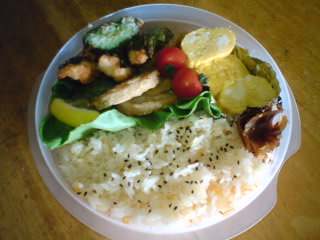
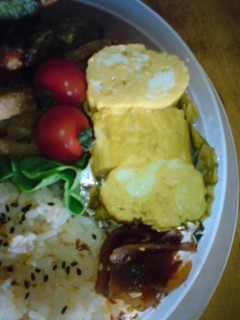
She steamed the rice with shredded carrots and served it with black sesame seeds and some home-made sweet ginger pickles.

bento-09-04-19c

She has just bought a new large tamagoyaki fry pan, so I know she will cook my favourite bento item for some time. A couple of Shizuoka-grown mini-tomatoes were added.

bento-09-04-19d

Then she came up with deep-fried renkon/lotus roots, Chicken sasami/breast fillets deep-fried with shiso/perilla leaves dry seaweed.. Some lettuce and lemon finished the lot.

bento-09-04-19e

As for the salad (-eat it before the rice!, she ordered):
On lettuce leaves, cucumber, boiled brocoli, Japanese processed cheese, walnuts and strawberries!

Please check the new postings at:
sake, shochu and sushi

—————————————-
日本語のブログ
—————————————-

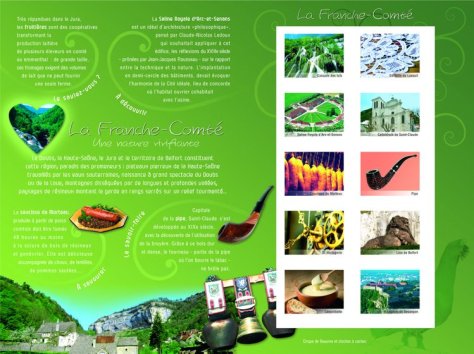
French Gastronomy on Stamps (11): Franche Comte

timbres-gastronomie-franchecomte

France has issued many stamps on food (not foodstamps!) on her own gastronomy for quite some time.
A new series will be issued on April 25th and wil be printed in the form of mini-sheets dedicated to a particular region with stamps, pics and explanations.
With the eleventh of these sheets I’d like to introduce is Franche-Comte.

Franche-Comte is a rich land bordering Switzerland and has acted as a military buffer zone for ages. It exchanged hands numerous times over the ages but has somewhat preserved its originality thanks to hard winters and sometimes difficulty in access.

On this sheet you can se two of its main products:
-Saucisse de Morteau whose recipe is lost in the times. It needs at leat 48 hours to smoke and makes for a great dish with cabbage or lentils!
-It cows produce great milk for superlative cheeses of all kinds.

It shares a lot with Switzerland as shown by its precision industries, lace-making and beautiful mountain vistas!

————————-
Please check the new postings at:
sake, shochu and sushi

—————————————-
日本語のブログ
—————————————-

English Sake Brewer Master in Japan: Phillip Harper (3)

tetsukezu

A lot has been written and will be written both here in Japan and abroad on Phillip Harper as he has, with the likes of John Gauntner, Timothy Sullivan and Melinda Joe, established himself as one of the references proving once for all that Japanese sake has at last expanded beyond the confines of this island for the good of all.
It is only a question of time when sake breweries will become a part of life like wine and beer abroad as demonstrated by the five existing branches of large Japanese breweries in the United States employing a full American staff and Moto I, the entirely owned and run American Sake Brewery.

harper-1

What makes the difference is that Phillip has gone as far as becoming the only foreign sake “toji”/master brewer in a Japanese brewery, namely Ki no Shita Brewery in Kyoto Prefecture!
An Oxford graduate hailing from Cornwall, it took him 18 years of sheer courage and guts to break into the closely guarded world of Japanese sake to gain recognition and earn his master brewer status in 2001.
The media (including The Los Angeles Times) finally take good note of his achievements when he was formally asked by Owner Yoshito Kinoshita to become his new Master Brewer (incidentally Phillip had already held that position in Osaka for two years).

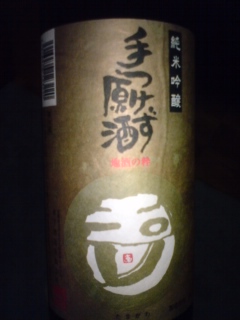
This the third of the three bottles I received from his fans in Tokyo. That particular one was sent to me by Melinda Joe.

Kinoshita Brewery, Tamagawa, Tetsukezu Genshu Junmai Ginjo
Rice: Gohyakumangiku
Rice milled down to: 60%
Alcohol: 18~19 degrees (high as it is a genshu/unaltered alcohol contents)

Clarity: Very clear
Colour: Transparent
Aroma: Fruity, elegant. Strawberries, apricot.
Body: Velvety
Taste: Strong attack backed by alcohol.
Shortish tail. Warms up back of the palate.
Complex. Junmai tingle.
Fruity and dryish: apricots with hints of strawberries, almonds and macadamia nuts.
Elegant.
Dry almonds making a regular comeback.
Holds its own well with food, but revealing different facets, especially strawberries with a dry finish.

Overall: Elegant and easy to drink in spite of high alcohol contents.
For once, similar to Shizuoka-brewed sake.
Combines fruitiness and dryness into a remarkably palatable (eminently drinkable) creation!

PHILLIP’S COMMENTS:

The specs for that sake are:

SMV +4, Acidity 1.7, Amino Acids 1.5, Alcohol 18.7.

It was brewed with the same organic rice used to make the Konotori kimoto you reviewed the other day – at 60% polish this time.
Though it doesn’t seem to have made an impression on you, that sake isslightly effervescent. Bubbly sake is usually made either by refermenting in the bottle (like Champagne…), or injecting gas into the sake itself. Oh,and a few people do a kind of sparkling wine thing with secondary fermentationin tanks. Tetsukezu bubbles are different, because they derive from the originalfermentation in the mash itself. We trap them in by a secret method that I can’t
reveal, except to say that it is as high-tech as all the other stuff we do at Tamagawa.

Regards, Philip

———————————
Must-see tasting websites:
-Sake: Tokyo Through The Drinking Glass, Tokyo Foodcast, Urban Sake, Sake World
-Wine: Palate To Pen
-Beer: Good Beer & Country Boys, Another Pint, Please!
-Japanese Pottery to enjoy your favourite drinks: Yellin Yakimono Gallery
———————————————–
Please check the new postings at:
sake, shochu and sushi

—————————————-
日本語のブログ
—————————————-

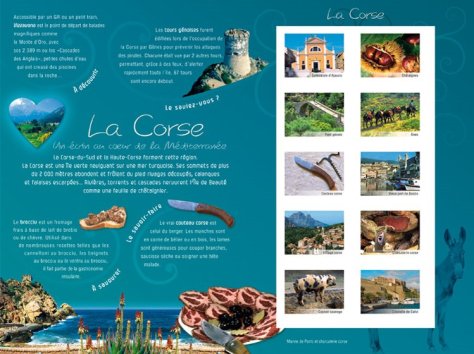
French Gastronomy on Stamps (10): Corse/Corsica

timbres-gastronomie-corse

France has issued many stamps on food (not foodstamps!) on her own gastronomy for quite some time.
A new series will be issued on April 25th and wil be printed in the form of mini-sheets dedicated to a particular region with stamps, pics and explanations.
With the tenth of these sheets I’d like to introduce is Corse.
Corse or Corsica has a long has long, rich and extremely agitated history. Even now, it “refuses” to go along any centralized authority.
It had been a haven for Moorish pirates before being possessed by various families and states from Italy. It was subsequently sold to France in the 18th Century with the remarkable consequence that its most famous/notorious son, Louis-Napoleon Bonaparte became French for the sorrow of many a family or country almost all over Europe.
Corsicans have always been resilient and self-sufficient.
On this sheet you will discover:
-Chestnuts, the bread of Corsica as islanders have always eaten more bread made from chestnut flour than wheat flour.
-Pork: sausages, of all kinds, have been a food staple.
-Donkeys who found their way onto plates in the form of succulent salamis!
-Brocchu Cheese (Goat milk), a superlative cheese served fresh or matured to various degrees.

Corse also has many a wine worth the voyage whileit seas are renown for its lobsters and Mediterranean fish!
Do you know that a railway crosses the whole island, giving access to some unforgettable views and hidden old towns?

Please check the new postings at:
sake, shochu and sushi

—————————————-
日本語のブログ
—————————————-

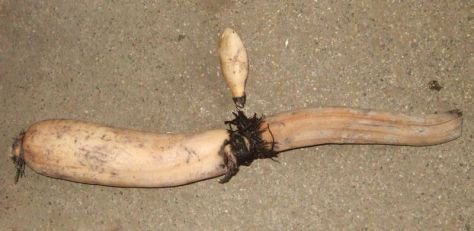
Vegetables Facts and Tips (11): Lotus Roots/Renkon

lotus-root1

In Japan we are at the end of Lotus Roots season, but eat them all year round!
Lotus roots come from a plant called Nelumbo nucifera, also known by a number of names including Indian lotus, sacred lotus, bean of India, or simply lotus. This plant is an aquatic perennial. Under favorable circumstances its seeds may remain viable for many years.
A common misconception is referring to the lotus as a water-lily (Nymphaea), an entirely different plant.

Native to Greater India and commonly cultivated in water gardens, the lotus is the national flower of India and Vietnam.

The flowers, seeds, young leaves, and “roots” (rhizomes) are all edible. In Asia, the petals are used sometimes for garnish, while the large leaves are used as a wrap for food. In Korea, the leaves and petals are used as a tisane. Yeonkkotcha (연꽃차) is made with dried petals of white lotus and yeonipcha (연잎차) is made with the leaves. The rhizome (called ǒu (藕) in pinyin Chinese, ngau in Cantonese, bhe in Hindi, renkon (レンコン, 蓮根 in Japanese), yeongeun (연근) in Korean is used as a vegetable in soups, deep-fried, stir-fried and braised dishes. Petals, leaves, and rhizome can also all be eaten raw, but there is a risk of parasite transmission (e.g., Fasciolopsis buski): it is therefore recommended that they be cooked before eating.

FACTS:
-Season: September~December in Japan.
-Beneficial elements:
Lotus roots have been found to be rich in dietary fiber, vitamin C, potassium, thiamin, riboflavin, vitamin B6, phosphorus, copper, iron and manganese, while very low in saturated fat.
Various parts of the lotus are also used in traditional Asian herbal medicine.

TIPS:

-Choose specimens with a clear white cut section. There should not be any black spots.
-Use large specimen as they are easier to cut and use.
-To prevent oxydising, warp cut specimen into wet kitchen paper.
-Add vinegar to water when bolingthem to keep them white.
-The easiest way to peel them is to use a potato peeler!

COOKING:

The stamens can be dried and made into a fragrant herbal tea called liánhuā cha (蓮花茶) in Chinese, or (particularly in Vietnam) used to impart a scent to tea leaves. The lotus seeds or nuts (called liánzĭ, 蓮子; or xian liánzĭ, 鲜莲子, in Chinese) are quite versatile, and can be eaten raw or dried and popped like popcorn, phool makhana. They can also be boiled until soft and made into a paste, or boiled with dried longans and rock sugar to make a tong sui (sweet soup). Combined with sugar, lotus seed paste becomes one of the most common ingredient used in pastries such as mooncakes, daifuku, and rice flour pudding.

Japanese popular Renkon dishes:

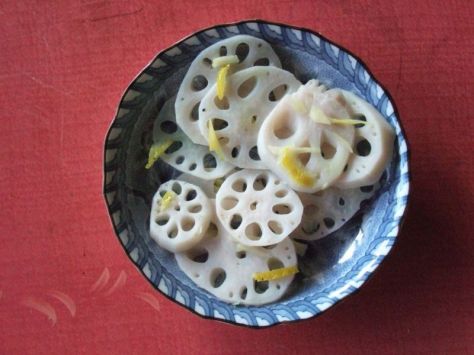
lotus-root-nimono

“NIMONO”

lotus-root-sumono

“SUMONO”

lotus-root-kimpira

“KIMPIRA”

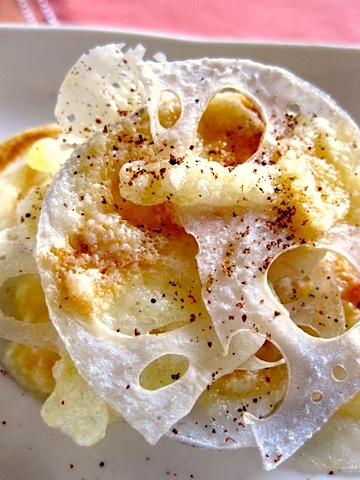
lotus-roots-chips

“CHIPS”

Please check the new postings at:
sake, shochu and sushi

—————————————-
日本語のブログ
—————————————-
French Gastronomy on Stamps (9): Champagne Ardennes

timbres-gastronomie-champagneardennes

France has issued many stamps on food (not foodstamps!) on her own gastronomy for quite some time.
A new series will be issued on April 25th and wil be printed in the form of mini-sheets dedicated to a particular region with stamps, pics and explanations.
With the ninth of these sheets I’d like to introduce is Champagne Ardennes.
Champagne and Ardennes is a combination of two vastly but very rich regions of France.
“South” Champagne first made ist place in history for the City of Rheims where French Kings had to be crowned to get official recognition. It later became famous for its Champagne sparkling wines. Contrary to many other viniferous regions, Champagne Houses do not conduct cultivation but buy their grapes before processing them. As for the claims of some that Dom Perignon was a blind monk who invented sparkling wines, they have never been proved. At least one sparkling wine, Blanquette de Limoux, saw its birth before the emblematic monk was born!
Champagne count other gastonomic specialties such as:
-Chaource cheese, a creamy white mold cheese reminiscent of Camembert but with a vastly different taste and aroma. Created in the Middle Ages, Marguerite de Bourgogne made it her staple food!
-Biscuit rose de Reims is a must-buy souvenir!

Ardennes is renown for its great forests providing noble families with abundant game.
You can see samples on the sheet:
-Wild boar is still widely hunted there for its meat.
-Andouillette/Chitterlings in Troyes is probably my favourite dish there. Great cooked in beer with apples!

Both rich lands, which unfortunately saw innumerous wars until the very XXth Century!

Please check the new postings at:
sake, shochu and sushi

—————————————-
日本語のブログ
—————————————-

BOUQUET’s Classic Cakes (2): Caramel Mousse

bouquet-car1

Bouwuet has long been a favourite of mine and one of the oldest cake-shops stiil alive in Shizuoka City. It could actually be called an institution here!
The only place willng to bake Gateau Basque, it regularly comes up with classics and novelties.
Since I had to find a cke for a student of mine I chose this particular cake.
The name is a bit of a misnomer as it is far more sophisticated than it sounds.

bouquet-car2

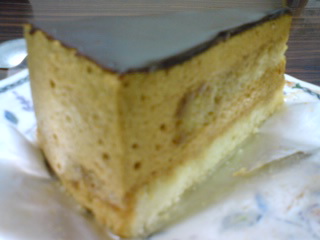
A thin layer of sponge made for the base on which was spread a frist layer of Caramel Mousse. A second round and smaller spong circle was then laid in the middle and imbibed with a syrup cotaining pear liqueur.
It was then “filled up” with Caramel Mousse. A thun layer of chocolate sauce was added for the last colour finish and protect the Mousse!

To savour with a great coffee!

Bouquet
420-0839 Shizuoka City, Aoi Ku, Takajo machi, 1-8-6
Tel. & fax: 054-2530349
Open: 11:00~20:00
11:00~19:00 (Sundays & National Holidays)
Closed on Wednesdays

Please check the new postings at:
sake, shochu and sushi

—————————————-
日本語のブログ
—————————————-
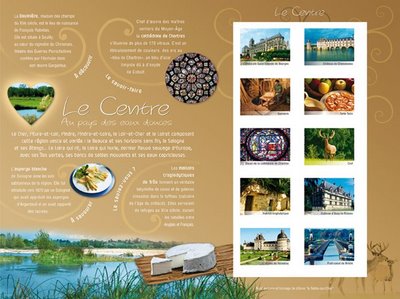
French Gastronomy on Stamps (8): Centre

timbres-gastronomie-centre

France has issued many stamps on food (not foodstamps!) on her own gastronomy for quite some time.
A new series will be issued on April 25th and wil be printed in the form of mini-sheets dedicated to a particular region with stamps, pics and explanations.
With the eighth of these sheets I’d like to introduce is Centre.
Centre is actually a vague term to describe a region that covers land between Paris and Auvergne and the western shores. It has a rich history and shares many castles with Pays de La loire. In the Renaissance French Kings had extravagant castles built there to escape dirty and noisy Paris in Blois (my own father’s hometown), Chambord, Chenoncy and many others across the River Loire.
You might just be able to discern the following on the sheet:
-Cheese. This region has innumerable splendid goat cheeses!
-Fruit and fruit cakes
-Vegetables.
-Venison. As it includes the vast Forest of Sologne, venison, wild boar and other game are plentiful!
Like the rest of the Loire area its climate is the mildest in France making a great place to visit any time of the year!

Please check the new postings at:
sake, shochu and sushi

—————————————-
日本語のブログ
—————————————-
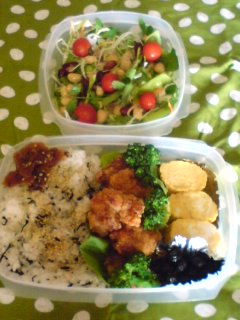
Today’s Lunch Box/Bento (’09/23)

bento-09-04-16-a

Today Missus was still recovering from a bad fit of viral flu and it was her day-off from work. Moreover I was having a busy day. We agreed that a lunch box was on order, the more for it that it would become part of the Missus’ lunc, too!

bento-09-04-16-b

I hadn’t been eating much for the last three day, so she made quite a big bento!

bento-09-04-16-c1

The “main dish” consisted of some of my favourites: Deep-fried garlic chicken (thigh parts off the bone) and tamagoyaki/Japanese omelette with boild brocoli, lettuce and home-stewed sweet blak beans.

bento-09-04-16-d

The steamed rice had been mixed with “hijiki/sweet seawedd” after cooking and sprinkled with plenty of white sesame seeds. The Missus added some pickled ginger as well.

bento-09-04-16-e

As for the salad, on a bed of chopped veg, canned beans, mini tomatoes, fresh cress and boiled pois gourmands/green peas in their pod.

It did take me some time to eat it all, but who am I to complain! LOL

Please check the new postings at:
sake, shochu and sushi

—————————————-
日本語のブログ
—————————————-

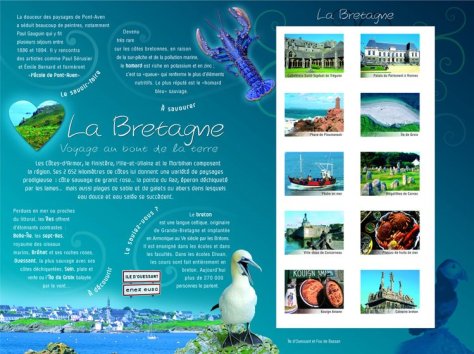
French Gastronomy on Stamps (7): Bretagne

timbres-gastronomie-bretagne

France has issued many stamps on food (not foodstamps!) on her own gastronomy for quite some time.
A new series will be issued on April 25th and wil be printed in the form of mini-sheets dedicated to a particular region with stamps, pics and explanations.
With the seventh of these sheets I’d like to introduce is Bretagne.
This is most Cetic region of France and Celtic language is taught at all levels from kindergarten to university. It is a land battered by the seas and the winds and its people are among the hardiest in France.
A land with many legends (Lancelot, witches and so on), it was an independent until in the late Middle Ages.
It is renown for some of the best butter in France, but also for, as seen on this particular sheet:
-Lobsters, especially the “blue tail/Queue bleue” and all kinds of seafood.
-Galettes and Crepes.
-Kouig Anan.

It is a region worth visiting with its many islands still retaining their original wilderness and magnificent natural environments! Ask the British!

Please check the new postings at:
sake, shochu and sushi

—————————————-
日本語のブログ
—————————————-

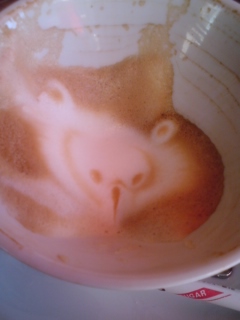
CAPPUCINO FUN: IL Cuore

cappucino-fun-1

Since the Missus was down with a virus, I went for lunch at Il Cuore in Shiuzoka City.
A friend just happened to pass by when I was about to order coffee. I invited to join me and we had some fun together with Cappuccinos.
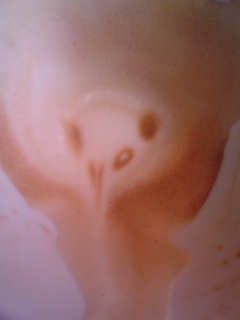
Mine (see above picture) was cute, I mus admit.

cappucino-fun-3

But my friend’s was cute, too!

cappucino-fun-2

The fun didn’t stop there as we found later when the character refused to vanish (mine above!)

cappucino-fun-4

Same for my friend’s!

CAFFETERIA IL CUORE
420-0035 Shizuoka City, Aoi Ku, Shichiken-cho, 13-20, Ishiwata Bldg. 1F
Tel. & fax: 054-2723737
Business hours: 11:30~23:00 (open every day)
Credit Cards OK

Please check the new postings at:
sake, shochu and sushi

—————————————-
日本語のブログ
—————————————-
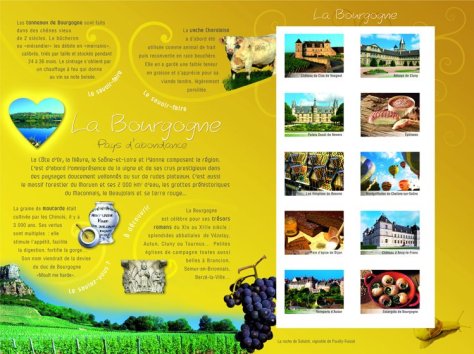
French Gastronomy on Stamps (6): Bourgogne

timbres-gastronomie-bourgogne

France has issued many stamps on food (not foodstamps!) on her own gastronomy for quite some time.
A new series will be issued on April 25th and wil be printed in the form of mini-sheets dedicated to a particular region with stamps, pics and explanations.
With the sixth of these sheets I’d like to introduce is Bourgogne.
In a sense Lou Ann might say it is not fair to introduce this region so early (I do them in alphabetical order!) because this is my “home region”!
This is an enormously rich land, in history, industry and gastronomy.
It is renown for its superlative gastronomy, but many forget that photography was invented there (Nicephore Niepce in Chalon sur Saone), that it counts major companies (Areva, which produces 74% of all electricity in France), a traditional first-class Carnaval and an International Air Ballon Meeting (Chalon sur Saone again! My “hometown”!), and that it used to be a Dukedom in the Middle Ages more powerful than France!

On this particular sheet you can discover:
-Charolais beef.
-Cheese: Epoisses
-Wine: Clos de Vougeot
-Ginger bread/Pain d’epices
-Mustard (of course! Dijon where I was born!)
-Escargots/Snails

I can guarantee there are plenty more!

Please check the new postings at:
sake, shochu and sushi

—————————————-
日本語のブログ
—————————————-
Shizuoka Shochu Tasting: Kogane-Danshaku by Sugii Brewery

kogane-danshaku

As a general rule I keep Shochu tasting postings to my other blog, Shizuoka Shochu, but for once I thought these tasting notes could help non-Japanese shochu lovers how to report on their favourite drink.
Please note that my style is very dry. Some will have have a more lyrical manner, and the better for it! LOL

Sugii Brewery in Fujieda City has come up with yet another creation of theirs! But once again, it is a “limited edition”. You do have to keep all your senses alert to discover these bottles.
Unlike Kagoshima Prefecture in Kyushu Island, Shizuoka-made shochu are not only exotic and extravagant, but rare and slightly more expensive. The labels certainly become collectors’ items!

Sugii Brewery: Kogane-Danshaku Shochu

Ingredients:
Kogane (Satsuma potato variety) and Danshaku (normal potato variety), both grown in Shizuoka Prefecture
Yeast: Shizuoka NEW-5 (Shizuoka Sake Yeast)
Fermented rice
Contents: 500 ml

Clarity: Very clear
Colour: Transparent
Aroma: Clean, strong, nutty
Taste: Sweetish, clean attack.
Deep roasted nuts.
Shortish tail with a dry finish.
Memory of coffee beans.

Overall: Unusual, clean, elegant shochu with lots of character and facets.
Combination of Satsuma yams and potatoes out of the ordinary! The use of Shizuoka Sake Yeast gives it a very regional flavour!
Best appreciated straight with plenty of ice!

Must-see tasting websites:
-Sake: Tokyo Through The Drinking Glass, Tokyo Foodcast, Urban Sake, Sake World
-Wine: Palate To Pen
-Beer: Good Beer & Country Boys, Another Pint, Please!
Chewy
-Japanese Pottery to enjoy your favourite drinks: Yellin Yakimono Gallery

Please check the new postings at:
sake, shochu and sushi

—————————————-
日本語のブログ
—————————————-

Foodbuzz Members, unite to help Italian Quake Victims!

cellartours

Simona of Cellar Tours is asking for a little help from Foodbuzz Friends!

“I am sure you guys all know about this tragic event, made more tragic by the fact that many of the deaths could have been avoided (corrupt construction companies, useless government officials).

Anyway, in case anyone is interested, here is a list of charities accepting donations for the victims. There are over 55,000 Italians who are now homeless after this earthquake!

For any of you with blogs, you can also put up this info. And you can send to your friends.”

Donations can be made to:

in English- http://www.redcross.ca/article.asp?id=31246&tid=001

In Italian-

hana-oto8

Bank transfers to:

CIA:
BAnk: Ugf Banca Ag.12 Via Saturnia 21 Roma
Iban: IT 56 I 03127 03200 CC 0120005581
Bic: Baecit2b
cause: “La Cia per l’Abruzzo”.

Centro Servizio del Volontariato della Provincia dell’Aquila
Bank: Banca Popolare Etica, sede di Padova, via Tommaseo 7
IBAN: IT 27 N 05018 12100 000000404404
cause: “Emergenza Terremoto Abruzzo”

Caritas Italiana tramite
Bank:UNICREDIT BANCA DI ROMA S.P.A.
IBAN IT38 K03002 05206 000401120727
cause:TERREMOTO ABRUZZO