Today’s Lunch Box/Bento (‘9/1)


The Japan Blog List

Please check the new postings at:
sake, shochu and sushi

—————————————-
日本語のブログ
—————————————-
bento-2009-01-06b

Yesterday’s bento did not qualify as this year’s first as the Missus refused to let me take a picture of the sandwich she had made!
Today, she came back with a vengeance, concocting a lunch fit for a man’s (or big teenager’s) solid appetite!

bento-2009-01-06a

She also used a wooden box with a bamboo “curtain” lid for the “maki”/rolls.

bento-2009-01-06d

I can already hear Rick moaning at the look of those rolls! LOL

bento-2009-01-06e

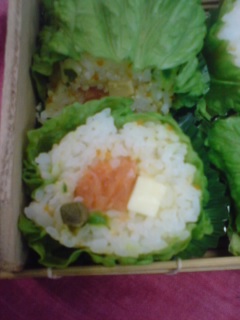
The rolls were wrapped in lettuce instead of “nori”/dry seaweed.
The “shari”/sushi rice was mixed with “tobikko”/flying fish roe.
The filling consisted of smoked slamon and Japanese processed cheese with capers for decoration. These rolls were definitely American-sized!

bento-2009-01-06c

As for the accompaniment the Missus worked hard (she actually threw me out of the kitchen!):
Boiled egg seasoned by leaving it overnight in the coca cola sauce of simmered pork she had made the day before, boiled Brussels sprouts, black olives, cornichons, carrot sticks, chickory/endive leaves, celery sticks (with leaves), Ameera Rubbins tomatoes (as sweet as strawberries!), and mayonnaise/black olives dip.

For dessert, winter mandarine (“mikan”) from her family’s garden!
Pretty full for the whole day, I can guarantee you!

Chocolat Fin’s Classic Cakes (4): B-Cafe


The Japan Blog List

Please check the new postings at:
sake, shochu and sushi

—————————————-
日本語のブログ
—————————————-

b-cafe-1

American friends will be amused by the fact that this latest Chocolat Fin’s creation ‘s name B-Cafe stands for Baghdad Cafe, the great film!

b-cafe-2

A typical cake by Chocolat Fin where cakes are concocted with a view to please adults first:
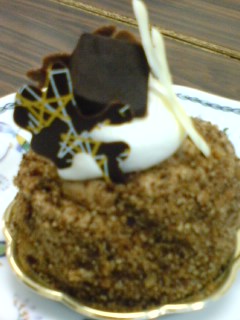
On a thin base of dark chocolate sponge cake stays a ball of Mocha mousse surrounded by light Chocolat sponge containing very fine orange peels.
The whole is topped with Chantilly cream, chocolate decoration chips and a cube of softened dark chocolate.
Simple in looks, complex in taste.
To savour with a strong coffee or tea!

Chocolat Fin
Shizuoka City, Aoi Ku, Takajo Machi, 1-3-7 (2 minutes walk from Shin Shizuoka Center)
Tel. & fax: 054-2516321
Business hours: 10:00~20:00

Also: Shizuoka City, Aoi Ku, Shin Shizuoka Center, Basement 1F
Tel.: 054-2215878

Shizuoka Beer 8/4: Usami Brewery


The Japan Blog List

Please check the new postings at:
sake, shochu and sushi

—————————————-
日本語のブログ
—————————————-

izu-beer-rhein

This is the last (for the moment) of the Usami Brewery series:

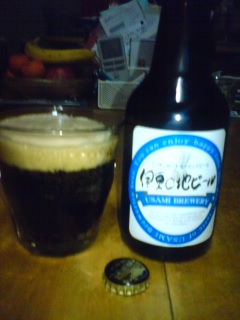
Usami Brewery “Rhein” (German Type)

Ingredients: Grain Malt, Hops
Alcohol: 5%
Contents: 300ml
Live yeast, unfiltered, unpasteurized.

Clarity: Very clear
Colour: Dark brown, neat colour
Foam: Long head, fine bubbles
Aroma: Dry, caramel, Welcome acidity
Taste: Well-rounded. Refreshing. Solid. Complex.
Apples, oranges, light caramel. A little acidity. Sweetish finish.
Lingers in back of the mouth

Overall: Sweetish for a Japanese palate, just right for a European/North American one.
Lighter than expected. Wel-rounded as for taste.
Very satisfying with food.

Usami Brewery
European Ji Beer Company
Ito City, Usami, 3504-1
Tel.: 0557-33-0333
HOMEPAGE (Japanese)

Must-see beer Blogs/Websites:

Good Beer and Country Boys, Beer Haiku Daily, Bair Beer, Another Pint, Please!

Vegetables Facts and Tips (2): Tomatoes


The Japan Blog List

Please check the new postings at:
sake, shochu and sushi

—————————————-
日本語のブログ
—————————————-

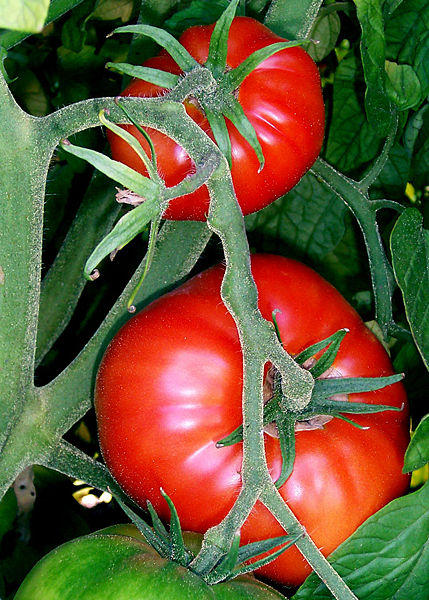
tomato1

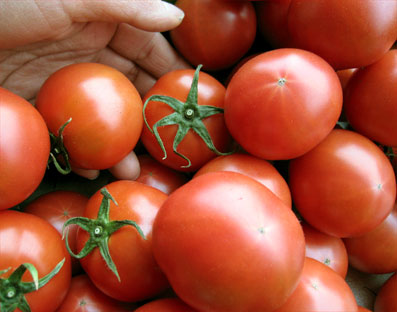
Tomatoes have laid on our tables for so long that we have almost forgotten they came from South America. The Spanish and the Portuguese ignored them. The British studied them. The French brought them to Europe under the name of “Love Apple”, a name still existing in Italy. So it is said,…
tomato-fruit
“Fruit Tomatoes”

This summer-maturing fruit can be bought all year round with the interesting consequence that tomatoes ripened in winter are sweeter than their summer cousins as they contain less water, earning themselves the name of “fruit tomatoes”, a great oxymoron, if there was one!

Thanks to consumers’ insatiable appetite for novelty, tomatoes are grown into all kinds of size, shape and colour.
Just to cite a few, the following are the most popular in Japan:

tomato-momotaro
“Momotaro Tomatoes”

-Momotaro (after the Japanese “Peach Boy” tale), which becomes “Fruit tomato” in winter.
tomato-midi
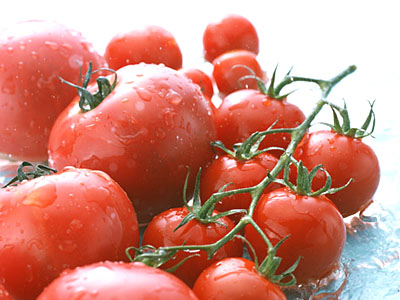
“Midi Tomatoes”

-Midi Tomato (sometimes called “Plum tomatoes”), a larger cousin of the “Mini tomato”, is very sweet and very high in nutrients. Its aroma has a particularly long life.

tomato-italian
“Italian tomatoes”

-Italian Tomato: mainly used for cooking, it may often come in a comparatively elongated shape.
It contains less water and reveals both large amounts of sweetness and acidity, making it very conducive to long cooking with the extra bonus of actually improving in taste upon heating.
tomato-mini
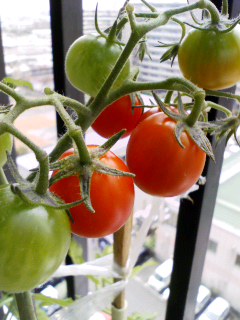
“Mini Tomatoes”

-Mini Tomato: one-bite sized, it is also called “Petit tomato”. It contains twice as many Vitamin C, and it is very rich in beneficient ingredients.

tomato-yellow-mini
“Yellow Mini Tomatoes”

-Yellow Mini Tomato: characteristic for a lot of sweetness and very little acidity. Very handy for children who dislike vegetables!
rubbins
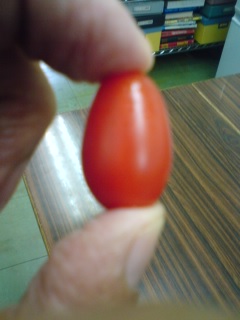
“Ameera Rubbins”

-Ameera Rubbins: with its larger Ammeera tomato, it is grown exclusively (until now, but they are bound to expand beyond our borders!) in Shizuoka Prefecture. They are the sweetest of all, tasting like strawberries, and very firm, making them ideal for decoration, notwithstanding their nutrient value. The smallest variety called “Rubbins” is grown by only two farmers near Iwata City!

tomato-micromini
“Micro Mini Tomatoes”

-Micro Mini Tomatoes: increasingly popular, they are only 8~10 mm and look somewhat like redcurrants. Very tasty with a beautiful acidity, the Japanese use them not only in salads, but also as the final touch on a plate of sashimi!

FACTS:

-Season: All year round
-Main elements: Licopin (Ricopin), Vitamin C, B Vitamins, Potassium, Pectin, Luchin (Ruchin).
Licopin is a carotene variety particularly beneficial in fights against allergies and ageing. The Potassium and Vitamin C and Pectin help control cholesterol in blood.
Luchin reinforces capillary veins and arteries.
Recent researches in Germany and China have proven that tomatoes help control high blood pressure.
Who said that the Italians look healthier than everybody else? LOL

TIPS:

-Choose tomatoes with a deep colour and healthy strong skin!
-Preservation: before storing them into the vegetable compartment of your fridge, wrap themin newspaper or put them inside a vinyl bag, or even better, inside a rigid plastic sealed box.
-Peeling: better than boiling water, direct contact with a flame! Make a very shallow cut near the stem area, firmly stick a fork or thin skewer into the stem area, hold the tomato directly over the gas flame for a few seconds, then plunge it into cold water. Skin should come off very easily.

Foodbuzz Friends Ethics


The Japan Blog List

Please check the new postings at:
sake, shochu and sushi

—————————————-

1-sake

Greetings, everyone!

Foodbuzz has been in official existence for two years now, and it is improving all the time for the benefit of all.
But this is not a message aimed at complimenting or extolling the virtues of our community.

I already have written an article explaining why and how Foodbuzz had been made more secure.
Unfortunately there are still a few people who misunderstand the real purpose of the venture.
Internet has gown through a number of bubbles, and the last thing we want is another one! The problem caused by “posting anything to Friends” with the consequent mail boxes saturation has already been rightly pointed out and dealt with.
I visit many chalkboards every day, and I have repeatedly come across “recruiting” messages and “invitations” to visit blogs. Although legitimate in intention, such postings can become quite offensive when they lack a minimum of civilty.
Let’s call a spade a spade: if a member thinks he/she is here for a quick buck, he/she will have to think again. One will have to wait at least a couple of years and work a minimum of two hours at it every day before making any significant eearnings.
Companies and business-oriented blog owners also have a right to belong to the Foodbuzz community, but I would kindly ask them to first offer their services as Featured Sponsors instead of leaving one-mile long advertizing messages on chalkboards.
All these occurences are a bore at best and an eyesore at worst.

I personally have over 2,000 “Friends”, but I’m pretty happy with my daily 150-odd hits.
Actually, I do harbor doubts as to the need to display numbers in brackets, which tends to encourage unhealthy competitions between members and does not reflect the true picture anyway.

I do not wish to pose as a paragon, but I have a simple method, which brings me plenty of satisfaction:
-1) I make a point to request friendshp with all new foodies.
-2) If my request is accepted, I write a greetings message on my new Friend’s chalkboard with a personal comment or two whenever feasible.
-3) If this message is answered, a new relationship has begun!
If someone requests my friendship, I make a point to accept it, write a thanks message, and visit the website if advertized.

Now this said, no one is perfect, but a little comprehension would certainly come in handy!

Sincerely hoping this old geezer has not unintentionally offended anyone in any manner,
Kanpai!

Robert-Gilles Martineau

Vegetables Facts and Tips (1): Potatoes


The Japan Blog List

Please check the new postings at:
sake, shochu and sushi

—————————————-
日本語のブログ
—————————————-

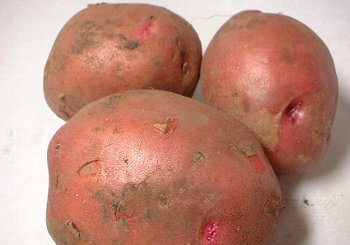
potatoes

This is the first of a series of articles on vegetables, which I hope will help my vegan and vegetarian (I’m not!) friends.
Incidentally、 nothing, pictures included, is copyrighted in my food blogs, so please feel free to use anything!

POTATOES

danshaku-potato
“Danshaku”

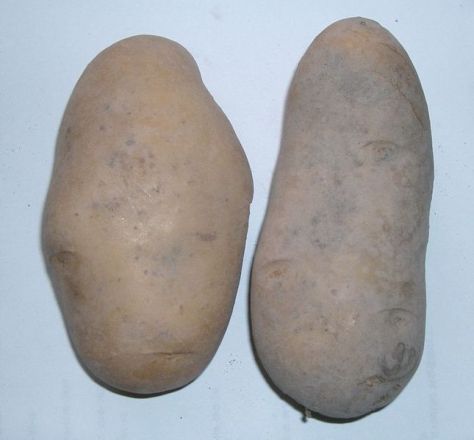
Potatoes were first introduced to Japan in 1910 by Baron Kawata from Great Britain/Ireland giving the name of “Danshaku/Baron” to the most commonly used potato in Japan, especially in croquettes and salads.

The biggest potato exporters to Japan are China and India, although more and more grown locally.
The varieties found in supermarkets are:

kitaakari-potato
“Kita Akari” used for mashed potatoes and croquettes,

mayqueen-potato
“May Queen” used in stews,

toyoshiro-potato
“Toyoshishiro” used for fried potatoes,

redandespotato
“Red Andes” used for croquettes and Pot au feu,

incanomezame-potato
“Inca No Mezame” used for stews.

Potatoes are available all year round, but are at their peak from February to May when new potatoes can be eaten whole!

FACT CARD:

-Season: All year round
-Main elements: carbohydrates (high energy), Vitamin C1, B1 (thanks to a large amount of natural starch in potatoes, the vitamin C will resist heating!), Potassium
-Preservation: Wrap potatoes inside newspaper and keep them in a dark, well-ventilated place away from the sunlight.

TIPS:

-Choose specimens well-rounded and with healthy skin. Avoid specimens with buds or of greenish colour (risks of diarrhea). Cut out all “dark spots”!
-To avoid a change of colour, wash potatoes in water after peeling or cutting.
-If you want to keep your potatoes for a while after boiling them, plunge them in (change it as many times as necessary) cold water until completely cooled down. They will not break or crumble when used later.
-After boiling cut potatoes, throw away water and keep heating them until they have lost a great part of their moisture. They will attain a crispy enough nature without resorting to deep-frying!

Avocado and Crab Gratin/Gratin d’Avocat et de Crabe


The Japan Blog List

Please check the new postings at:
sake, shochu and sushi

—————————————-
日本語のブログ
—————————————-

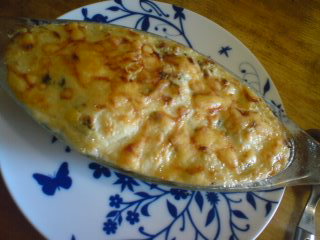
avo-crab-6

Today is the second of January, and as I generally cook on holidays, I proposed the following to the Missus:

avo-crab-8

As my other half loves gratinsin any form, it was not difficult to convince her!
I’m not going to burden you with numbers, so here is the recipe, which I tried to keep simple and calorie-light!

avo-crab-1

I used bout a quarter of a yellow (yes, you heard it!) cauliflower grown locally in Asabata, Shizuoka City, cut it small enough pieces and cooked them the Missus’ way, that is, I put them in a non-stick frypan with half a centimetre of water and cocered it with a glass lid. I switched on the fire to medium and waited the water to boil. As soon as it started boiling I turned the fire to minimum, cooked the cauliflower for one minute, switched off and let it covered for one more minute. I then drained completely and held it under running cold water for a few seconds to cool down, then put them aside in a strainer.

avo-crab-21

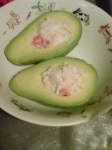
I used a medium-sized avocado, cut it into two halves, took off the large seed by stabbing it with the “talon” of a kitchen knife and twisting it out.

avo-crab-3

I peeled the avocado and brushed both halves with lemon juice.
Next I used the equivalent of a small tin of crab meat, added some lemon juice and some sweet wine wine to it. I mixed the lot and quickly pressed the juices out. I filled both halves of the avocado with some crab meat. I kept the juices for the bechamel sauce.
I chopped a good quantity of Italian parsley and put it aside.

avo-crab-4

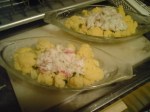
I buttered the inside of two glass oven dishes, put the avocado halves in the middle upside down, arranged the cauliflower around it and garnished the top of the avocado halves with the remaining crab.

avo-crab-5

I prepared the bechamel (white) sauce by making a roux with 50 g. of butter, two large spoons of flour, then added the crab juices, 200cc (one cup) of milk, 80 cc of sour cream. When the bechamel had “caught”, I added salt, pepper, theme, nutmeg and four spices and dropped in the chopped Italian parsley.
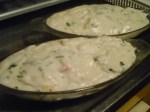
I spread the bechamel sauce allover the dishes and let it cool completely. This way the bechamel sauce will not “run out” inside the oven. I sprinkled the lot with cheese and baked it the oven at 180 degrees for about 25 minutes (or until it attains the colour needed).

avo-crab-7

We ate it with a salad just out of the oven.
I chose a fairly firm avocado on purpose for better effect when cutting it out with my spoon, but it’s up to your taste.
I’m sure anyone can improvise and improve on that!

Japanese Crustacean Species 3: Squilla/Shako


The Japan Blog List

Please check the new postings at:
sake, shochu and sushi

—————————————-
日本語のブログ
—————————————-

shako1.jpg

The Squilla or “Shako” (蝦蛄in Japanese) is a delicacy that appears on the sushi bar counters from April to Summer, although different varieties can be found in Hokkaido markets (Otaru City in particular) almost all year round.
You will discover it under names such as “shaku” and “Gazaebi”.
They are actually caught in almost all Japanese seas, but the best are supposed to originate from Hokkaido.

shako2

Like any crustaceans, they can be eaten in many ways.
The Japanese favour the small kind with a violet back. I had the pportunity to buy some very large specimen in Otaru, and eat them just boiled andserved with rice vinegar mixed with a little Japanese mustard, or in salad.
They almost disappeared from Tokyo Bay in the 1960’s but reappeared in the 1970’s. Most fishermen in the Kanto area will place them in boxes themselves to sell them directly at fish markets. The market value can vary wildly, but look for the genuine harbour markets and buy them yourself.

shako3

Naturally, they are most popular as nigiri sushi. Customers jokingly ask for “garage” (in English) as “shako” also means (different kanji, of course) “garage”!

Japanese Crustacean Species 2: Large Prawn/”Botan ebi”


The Japan Blog List

Please check the new postings at:
sake, shochu and sushi

—————————————-
日本語のブログ
—————————————-

botanebi1.jpg

Botanebi/”Botan” Prawn, or “Pandalus nipponesis” for the specialists, is a large prawn found in all seas of Japan at depths varying from 300 to 500 metres. They are caught at 200~300 metres depth in Suruga Bay and along the WEstern coast of Izu Peninsula In Shizuoka Prefecture. Once abundant, they have become scarce and only small specimen are found whereas Hokkaido produces up to 20cm-long prawns.

sushiko-08-12-25-31

They are known under different names: toyamaebi and Kijiebi.
It is not a cheap morsel in Sushi bars. But it is interesting to note they are essentially eaten raw as like “amaebi”, they become very sweet after some time in the refrigerator.

oda-4.jpg

Now, if you are lucky enough to find them fresh with their eggs, ask your chef to dress them as above, or even better, put the eggs on top of a “gunkan nigiri”!

sushiko-08-12-25-5

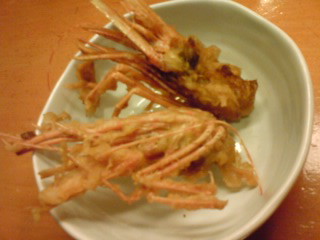
And one more thing, if they are fresh again, don’t forget to ask for the heads deep-fried!

Incidentally, botanebi change sex (gender) with age to end up as big juicy females!

Vegan Farandole for the New Year!


The Japan Blog List

Please check the new postings at:
sake, shochu and sushi

—————————————-
日本語のブログ
—————————————-

p1010612

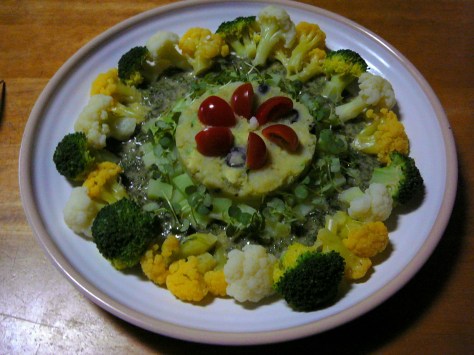
Last Sunday, not the New Year I must admit, I had to cook dinner for my other half, and I just happened to be litterally submerged with vegetables.
Why not create something vegeterian, or even better, something vegan, at least to justify my omnivorous preferences? I thought.
Well, I came with a simple idea that can expanded at infinitum. It has the merit of making use of very healthy ingredients and help the system take a much needed rest! LOL

farandole-oil-22 farandole-oil-3 farandole-oil-1

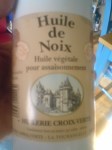
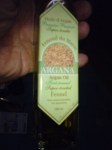
I utilized three different oils from three different countries to add a little inernationalization: Olive oil from Italy, Walnut oil from France and Argan oil from Morocco!

In the centre of the plate I arranged a “circle” of boiled potatoes mixed in “brandade style” with plenty of olive oil, avocado, black olives, lemon juice, a minimum of salt, chopped fresh garlic, pepper, nutmeg, thyme and yuzu chili pepper. Indian friends would probably add plenty more spices.
I surrounded it with a thin crown of boiled diced brocoli stems and shiso/perilla shoots/mini leaves.

farandole-2

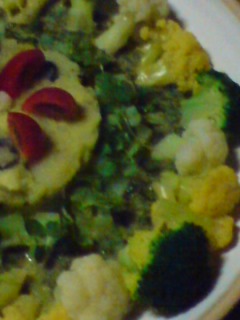
I then added plenty of dressing around the lot. The dressing was made with walnut oil, taragon white wine vinegar, soft Dijon mustard (with seeds), lemon juice, a little salt, pepper and a large amount of very finely chopped fresh parsley and basil. It was very consistent and easy to spread without “leaking” everywhere.
Around the whole, I arranged boiled green brocoli, white cauliflower and yellow cauliflower (beautiful and very tasty) all grown in Shizuoka Prefecture.
I decorated the potato core with plum tomato wedges, and sprinkled both the cauliflower(s) and tomatoes with a little dash of argan oil (take it easy with this particular oil as it is particularly fragrant!).

I hope this will give ideas to my vegan and vegetarian friends for the New Year repast! By the way, “Farandole is a dance!

Today’s Lunch Box/Bento (50)


The Japan Blog List

Please check the new postings at:
sake, shochu and sushi

—————————————-
日本語のブログ
—————————————-

bento-2008-12-29a

If I’m not sorely mistaken, this is the last bento concocted by the Missus in 2008.
The next one should be onlie on January 5th!
A “classical” bento by my other half’s standards making use of whatever was in the fridge!

bento-2008-12-29c

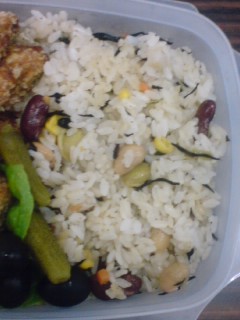
The rice has been the same for some time: white rice steamed with beans (and their juice) and “hijiki/sweet seaweed”. A very lealthy and hearty fare with plenty of calories!

bento-2008-12-29b

As for the “o-yatsu/accompaniment”, deep-fried “sanma/mackerel pike” that was seasoned with sauce beforehand and complemented with plentyof lemon, cornichons and black olives, plum tomatoes, and on a bed of finely chopped vegetables, boiled brocoli and cauliflower. Very healthy, again!

I had dressing for the salad and mandarine oranges at the office to make it complete!

Bryan Baird’s Newsletter


The Japan Blog List

Please check the new postings at:
sake, shochu and sushi

—————————————-
日本語のブログ
—————————————-

Baird Beer & Taproom Events Bulletin 2008 #27
bryan-sayuri.gif

Dear Taproom Friend & Baird Beer Enthusiast:

We will be ushering out 2008 and drinking in 2009 with New Year’s Eve Countdown parties at both the Fishmarket and Nakameguro Taprooms. Event details are listed below.

Fishmarket Taproom Countdown Party (Wednesday, December 31, 5:00 pm start)

*All-you-can-eat Mexican buffet @ 1,000 yen per person (5:00 – 11:00 pm)
*500 yen Baird Beers throughout the evening
*Midnight debut of Hatsujozo 2009 Double IPA (complimentary glass to all patrons for 2009 inaugural toast)
*Reservations NOT required

Nakameguro Taproom Countdown Party (Wednesday, December 31, 7:00 pm start)

*All-you-can-eat buffet and All-you-can-drink Baird Beer @ 5,000 yen per person
*Midnight debut of Hatsujozo 2009 Double IPA (complimentary glass to all patrons for 2009 inaugural toast)
*Reservations NOT required

At Baird Beer we mark the transition to each new year with the release of a special Double IPA brewed uniquely in celebration of the fresh possibilities represented by the turning of the calendar. We kick off beer year 2009 with the midnight hour release of Hatsujozo 2009 Double IPA

Hatsujozo 2009 Double IPA (ABV 8.1%):

The wort produced for Hatsujozo 2009 is strong (21.5 Plato) but simple (two primary ingredients: Maris Otter malt and sudakito sugar). The hopping is equally strong (85 IBU) but more complex with four varieties of American hops (Warrior, Columbus, Centennial, Amarillo). Dry-hopping in the conditioning tank takes place with equal amounts of Columbus, Centennial and Amarillo. We kraeusen at packaging with wort from a different IPA in order to achieve secondary fermentation and natural carbonation. If Hatsujozo 2009 Double IPA is any indication, the Japan beer enthusiast is in for a fantastic year in 2009.

Hatsujozo 2009 Double IPA will be available on draught beginning January 1 at select Baird Beer retailing pubs and restaurants throughout Japan (including our own Taprooms). A limited number of 633 ml bottles also will be available for purchase at Baird Beer retailing liquor stores in Japan.

Taproom O-shogatsu Business Hours

*Fishmarket Taproom will be closed on January 1 and 2. It will re-open for business on Saturday, January 3 at noon. January 3 and 4 will feature several O-shogatsu dishes (prices ranging from 300 to 600 yen) cooked up by Takanaka Tencho and Sayuri to celebrate the New Year.

*Nakameguro Taproom will be closed on January 1. It will re-open for business on Friday, January 2 at 2:00 pm. Business hours from January 2 – 5 will be 2:00 pm to 10:00 pm before returning to normal on January 6.

Happy New Year!

Bryan Baird

Baird Brewing Company
Numazu, Japan
HOMEPAGE

Open Quiche (with Leek, Bacon and Potato)


The Japan Blog List

Please check the new postings at:
sake, shochu and sushi

—————————————-
日本語のブログ
—————————————-

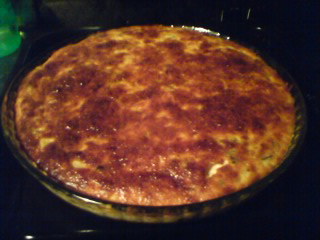
quiche-1

Some people, sometimes rightly, complain that quiches, for all their quality, are a bit heavy because of the pastry. I sometimes cook them without pastry, calling them “open Quiche”. They are simple to make and are welcome by foodies with an allergy to flour.

Here is the simple one I made for the Missus last night a very cold night!)

Ingredients (for 2 to 4 people):
-Eggs: 3 large
-Fresh Cream: 400 cc (2 cups)
-Fresh leek: one large, chopped.
-Potato: 1 medium-large
-Bacon: 2 large rashers, cut in 1 cm-thin strips
-Lemon juice: 1 teaspoon
-Grated parmesan cheese: 1 large tablespoon
-Butter: 50 g for frying vegetables + enough to coat inside of oven dish
-Salt ( as little as possible), pepper, nutmeg, thyme, laurel and anything else you wish according to your preferences.

Recipe:
-Bring a pan full of salted water to boil, drop all the chopped leek in and boil for a couple of minutes. Take out and plunge the leek into cold water. Let cool, then drain, and put them aside in draining dish to allow any excess water to go away. This will take care of the leek’s astringency and make it softer. If too wet, press water out before adding them to the quiche.
-Boil potato to 80%, plunge in cold water (this way, it will not break or disappear inside the quiche), peel and cut into 1 cm square cubes. Put aside.
-Dry-fry (that is, do not add any oil) bacon until the colour has changed. Put aside.
-In same fry-pan, to preserve the juices left by the bacon, drop 50 g of butter and lightly sautee the leeks and potato for a couple of minutes. Put aside.
-Pre-heat oven to 180 degrees Celsius (about 360 degrees F).
-In a bowl drop the leek, bacon and potato, season with lemon juice, a little salt, plenty of pepper and spices and mix well.
-In another bowl break the eggs and beat them into an omelette. Add fresh cream and mix well. Add a little salt, pepper and spices according to taste. Last parmesan cheese. Mix and check taste.
-Butter the inside of a large shallow oven dish (glass is best as you can see the inside cooking). Spread the bacon, potato and leek mix over the bottom. Pour in the omelette over the whole. Check and arrange the heavier food inside the omelette with a fork for more evenness.
-Cook for about 40 minutes

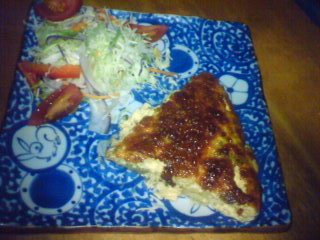
quiche-2

Serve hot. You should be able to cut it and transfer it easily if you have buttered the dish properly. Serve with a fresh salad and a light red wine or real ale!
Enjoy!

Today’s Lunch Box/Bento (49)


The Japan Blog List

Please check the new postings at:
sake, shochu and sushi

—————————————-
日本語のブログ
—————————————-

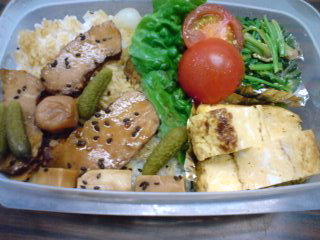
bento-2008-12-261

The end of the year is always a very hectic time in Japan.
The two of us busy in spite of no university holiday, the Missus prepared a typical, if very simple bento:
On a bed of freshly steamed rice she spread some slices of soft “sha shu/Chinese-style braised pork” she quickly heated again in sweet soy sauce with a few pieces of processed cheese and sprinkled with black sesame. The sauce added welcome tatse to the rice.
One “umeboshi/pikled Japanese plum” and a few cornichons provided the saour balance to the sweetness of the meat.
For greens she included lettuce leaves and plum tomatoes and boiled spinach salad.
The dessert was providedwith plenty of “tamagoyaki/Japanese omelette”
Quite filling actually! And tasty!

One more bento on Monday and then I will post 2008 bento compilation!

Sashimi Set: Sushi Ko Restaurant


The Japan Blog List

Please check the new postings at:
sake, shochu and sushi

—————————————-
日本語のブログ
—————————————-

sushiko-08-12-25-1

Last night, the Missus and I went out to celebrate Christmas our own way by having dinner at Sushi Ko, our favourite sushi restaurant in Shizuoka City!
This was our first order, a “sashimi no moriawase/sashimi plate”.
All seafood came from Shizuoka Prefecture!
For the rest of our dinner, please check Shizuoka Sushi!

From left to right:
“Mebachi Maguro/Big-eyed Tuna” on a “shiso/perilla” leaf and finely cut daikon, fresh “Sakura Ebi/Cherry Blossom Shrimp” from Yui with grated ginger and cucumber, “Aburi Kinmeidai/slightly grilled Golden Eyes Snapper/Seabream”, lemon, “Shiso no Hana/Perilla Flowers, “Ishidai/Parrot bass, Stone Flounder, Striped Knifejaw” and freshly grated wasabi!

Sushi Ko
shizuoka City, Aoi Ku, Ryogae-cho. 2-3-1 (Aoba Koen)
Tel.: 054-2512898
Business Hours: 17:00~25:00. 17:00~23:00 (Sundays)
Closed on Wednesdays
Reservations recommended
Credit cards OK
HOMEPAGE (Japanese)