Tag Archives: 刺身

Shizuoka Local Fish: Houbo/Blue Fin Robin

houbou.jpg

Many a time, my good friend Patrick Harrington has rightly pointed out on the importance to eat “local” as much as possible. Consequently, I have endeavoured whenever possible to introduce any vegetables, dairy products, meat and fish grown, made, raised or caught in Shizuoka Prefecture (and its waters)
As for today I would like to introduce again a fairly cheap and tasty fish: houbou. Its English name is quite poetic: blue fin robin (“Chelidonichthys spinosus” for the purists). The reason is its very wide round green-blue side fins.
Some call it grotesque, others beautiful.

Most of them are found in Niigata Prefecture from Autumn to Winter (30~50 cm), but they are caught in early Spring in Suruga Bay (the Shizuoka variety is smaller, up to 20 cm). But now and thenwe find them at dfferent times of the year.

It can be prepared in many ways:

-Sashimi and sushi if just caught.

-In “nabe/鍋” (soup pot) or as “nimono/煮物” (simmered) in Japanese-style cuisine.

-Steamed and served with a sweet and sour sauce in Chinese-style food.

My preferred way is Mediterranean style (one fish per person):
Cut the side fins and scrape the scales off. discard the insides and clean under clear cold running water. Make a couple of shallow incisions over each flank.
Fill the stomach with a mixture of finely chopped vegetables and herbs (leave your imagination go free!).
Put it on a large sheet of olive oil coated cooking foil paper, sprinkle it with a little salt and pepper. Place vegetables cut in long strings on both sides (plenty is fine), and one or two thin lemon slices on top. Coat it with some (not too much) extra virgin oil. As a last touch, I add some white wine and a little anise spirit (Pernod, Ricard or Absinthe).
Loosely wrap the fish with foil paper, close both ends by twisting them around.
Place the fish in its foil paper directly on the metal plate inside the oven preheated at 180 degrees Celsius and cook for about 15 minutes (longer for large fish).
If you do not have an oven, steam it the Chinese way!

RECOMMENDED RELATED SITES:
Warren Bobrow
Bread + Butter
5 Star Foodie
Frank Fariello
Mangantayon
Elinluv Tidbit Corner

Please check the new postings at:
sake, shochu and sushi

—————————————-
日本語のブログ
—————————————-

Local Sushi & Sashimi only at Ginta!

GINTA-LOCAL-1

The particularity of Ginta, a minuscule sushi restaurant located near the harbour of Yui in the eastern part of Shizuoka City is that it proposes sushi and sashimi plates from fish exclusively caught in Suruga Bay only a few miles and fathoms from the very shore!

The other day I convinced the Missus to pay Ginta a belated (for me as it was a first for her) visit and sample the fish of the moment.

Iforgot to say that the prices are ridiculously low when taking the quality and rarity in consideration!

The “Jizakana/Local Fish” set of 8 above is priced at 1,800 yen/ 19 US $!

Here is a description of the sushi (Picture above):

Above, from left to right:
-Tora Fugu/a popular species of globefish, served pre-seasoned (no need to dip it in the soy sauce)
-Hanadai/A kind of grouper, served pre-seasoned
Mr. Hara actually deep-fries the scales of that particular fish before inserting them under the slice of raw fish!
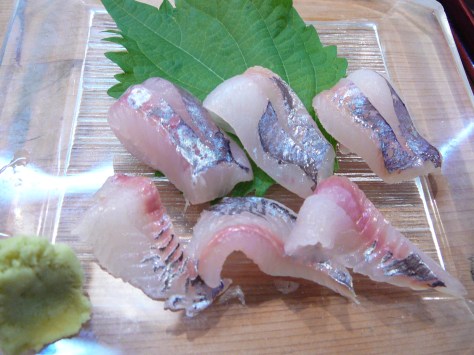
-Tachiuo/Scabbard Fish, v
-Sakura Ebi/Cherry Shrimps, served in “gunkan” style.

Bottom, from left to right:
-Kanpachi/Albacore
-Kurodai/another kind of grouper
-Kurozawa Aji/Saurel caught in Kurozawa area, next to Yui.
-Kose/a purely local fish also called “kushikinme or goso (in Numazu City). It is apparently a local variety of grouper.

GINTA-LOCAL-2

Having enjoyed kose for the first time, we decided to order it as a full sashimi plate.
A real beauty: firm, almost crisp, not a hint of “fishy taste” and absloutely delicious!

No wonder customers come all the way from Tokyo!
Now, the advantage I have on such customers is that Mr. Hara is so enthusiastic sharing his knowledge with local patrons!

GINTA
421-3111 Shizuoka Shi, Shimizu Ku, Yui cho, Imajuku, 165. (get off at Yui Station and walk to your right. Only a few minutes away)
Tel.: 0543-75-3004
Opening hours: 11:00~23:00
Closed on Tuesdays
Reservations on the telephone recommended!

Please check the new postings at:
sake, shochu and sushi

—————————————-
日本語のブログ
—————————————-
Sashimi Plate at Tomii (’09/07/31)

TOMII-09-07-31

Visited Tomii last night for the first time in three weeks. It was about time I sampled one of their sashimi plates!

No fussing needed, will just explain:

Top: Amaebi/sweet shrimps

Center: Hirame/Sole. Kanpachi/Amberjack, Toro/Tuna fatty part

Bottom: Akami/Tuna lean part, Hirame engawa/Sole “verandah” (actually this is the border flesh that is usually thrown away abroad!), Aka Ika/Red squid, Sanma/Mackerle pik-Saury

Notice the shiso/perilla flowers!

What did I drink with that?
Hakuin Masamune Yamahai by Takashima Shuzo in Numazu City, a sake getting national recognition these days!

Please check the new postings at:
sake, shochu and sushi

—————————————-
日本語のブログ
—————————————-

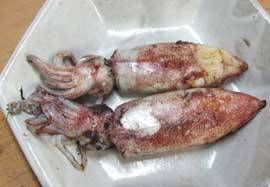
Cuttlefish/Squid Species 6: “Japanese lesser” Varieties

IKA-MONSTER
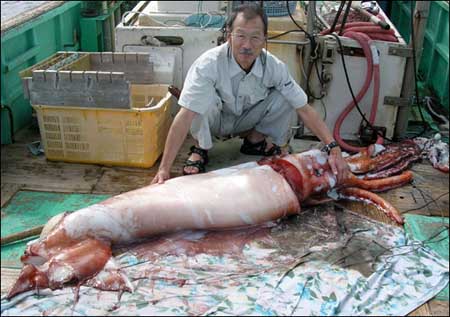
Inedible Lesser Variety!: Giant Squid

Here is the last article on this series called “The Jacques Cousteau” upon suggestion by Jaded Fork and forBread + Butter, and Elin who don’t mind being on a long haul! LOL

By “Japanese lesser” I mean species both more difficult to find on markets, more local and not as appreciated as the former five varieties.
Howeve these should looked over as they are still good enough for the finnicky Japanese and appreciated as rarities!

BOZU IKA
IKA-BOUZUIKA-1

IKA-BOUZUIKA-2

IKA-BOUZUIKA-3

IKA-BOUZUIKA-4

EZOHARI IKA
IKA-EZOHARIIKA-1

IKA-EZOHARIIKA-2

HAKUTENKOU IKA
IKA-HAKUTENKOUIKA-1

IKA-HAKUTENKOUIKA-2

HIMEKOU IKA
IKA-HIMEKOUIKA-1

IKA-HIMEKOUIKA-2

KAMINARI IKA
IKA-KAMINARIIKA-1

IKA-KAMINARIIKA-2

KO IKA
IKA-KOIKA-1

IKA-KOIKA-2

IKA-KOIKA-3

IKA-KOIKA-4

SHINDO IKA
IKA-SHINDOIKA-1

IKA-SHINDOIKA-2

IKA-SHINDOIKA-3-SHIOYAKI

IKA-SHINDOIKA-4

SHIRIYAKE IKA
IKA-SHIRIYAKEIKA-1

IKA-SHIRIYAKEIKA-2

IKA-SHIRIYAKEIKA-3

SODE IKA
IKA-SODEIKA-1

IKA-SODEIKA-2

SUJI IKA
IKA-SUJIIKA-1

IKA-SUJIIKA-2

USUBENI IKA
IKA-USUBENIIKA-1

IKA-USUBENIIKA-2

If you have any questions, don’t hesitate!

Please check the new postings at:
sake, shochu and sushi

—————————————-
日本語のブログ
—————————————-
Sashimi Plate at Tomii (’09/06/22)

TOMII-09-06-22

Just came from a “quick fix” at Tomii as I was too hungry to continue work! (I’m back at the office right now!)

Just ordered “o-tsukuri/Sashimi plate” as the calories are non-existent (the Missus is preparing dinner!).

From top clockwise:
-Madai/Japanese Snapper species
-Aburi Tachiuo/lightly grilled Scabbard Fish
Note the shiso/perilla flowers in between!
-Hata/Grouper
-Murasaki Uni/Violet Sea Urchin from Aomori Prefecture
-Hamo/Pike Conger Eel, lightly boiled
-Aka Ika-Kensaki Ika/Red cuttlefish-Squid
In the middle:
-Mebachi-maguro/big-eyed Tuna Akami/lean part

I honestly wish you were all here!

Please check the new postings at:
sake, shochu and sushi

—————————————-
日本語のブログ
—————————————-
Crustacean Species 6: Kuruma Ebi/Japanese Imperial Prawn

KURUMA-EBI-1

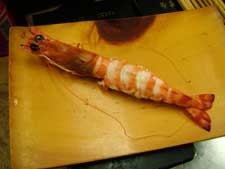
Kuruma Ebi, or Japanese Imperial Prwan, is probably the most popular prawn in Japan!
It has different names depending on its size: Saimaki (up to 5 cm), Maki (up to 10cm)

Its season lasts from late Autumn to the end of Winter.
It is found south of Hokkaido Island down to the Indian Ocean until depths of 50 metres.
It had been successfully artificially grown for some time until diseases put a momentary stop.
The prawn has steadily become a rare morsel. Altogether, natural and human raised specimen, the annual catch amounts only to 2,000 tonnes.

KURUMA-EBI-1a

Raw, or

KURUMA-EBI-2

boiled, they make for great decoration on top of suucculent taste!

KURUMA-EBI-4

They are very much appreciated a sashimi, especially after having been made to “dance” in Japanese sake!

KURUMA-EBI-5

Grilled on the stick would tempt many an officionado!

KURUMA-EBI-6

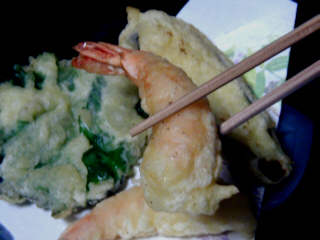
They make for extravagant tempura!

KURUMA-EBI-7

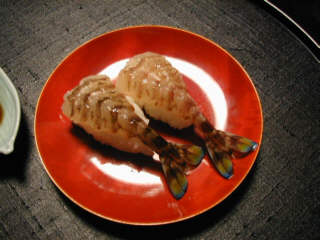
As sushi Nigiri, they are equally popular raw, or

KURUMA-EBI-3

boiled!

If you the chance to buy tem alive (In shizuoka, we do have them kicking), put them in a pan with Japanese sake under a lid. Wait until they have grown “quiet”, and prepare them right away!

Please check the new postings at:
sake, shochu and sushi

—————————————-
日本語のブログ
—————————————-
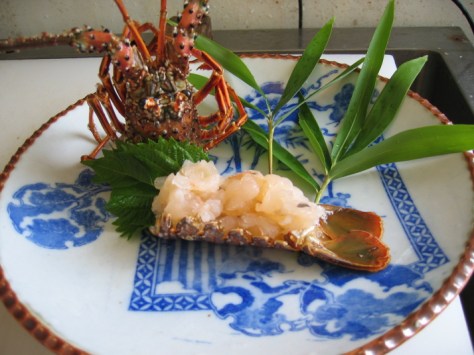
Crustacean Species 5: Ise Ebi/Japanese Spiny Lobster

ISE-EBI-1

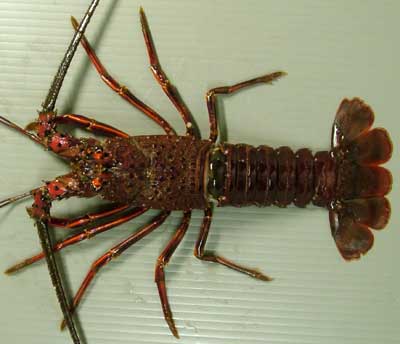
Ise Ebi, or Japanese Spiny Lobster is one the Spiny lobster varieties so popular all over the World.
The Japanese variety is smaller, or more precisely is more popular under a certain size.

Also called Kamakura Ebi, it is caught off the shores of Chiba, Wakayama, Mie and Shizuoka Prefectures.

The best specimens are aught in Winter, although imported lobsters can be found at other seasons.

The annual catch is fairly stable at 1,000 tonnes a year.
Imprted specimens account for 10,000 tonnes, mainly from Australia, New Zealand and New Caledonia.
In the case they are also called Minami/South Ebi.

The Japanese appreciate their lobsters raw.

ISE-EBI-SASHIMI

As o-tsukuri/sashimi plate they are quite spectacular!

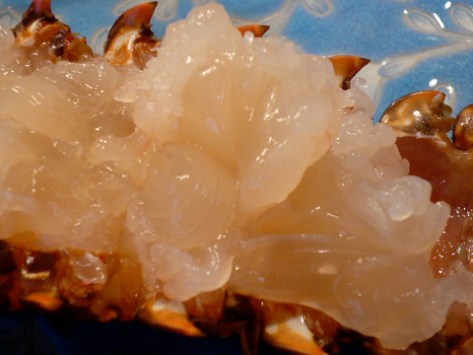
ISE-EBI-SASHIMI2

For a closer look!

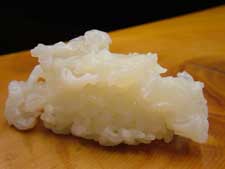
ISE-EBI-SUSHI

And of course as sushi nigiri!

Please check the new postings at:
sake, shochu and sushi

—————————————-
日本語のブログ
—————————————-
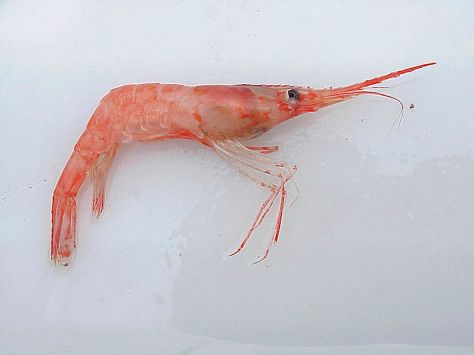
Crustacean Species 4: Amaebi/Alaskan Pink Shrimp-Pink Shrimp

AMAEBI-1

Amaebi (in Japanese) or by its Latin name Pandalus borealis (also called Pandalus eous) is a species of shrimp found in cold parts of the Atlantic and Pacific Oceans. Many different English names are used, with little consensus (deep-water shrimp, cold-water shrimp, northern shrimp, Alaskan pink shrimp, pink shrimp, northern red shrimp, Greenland prawn (UK)). Often the word shrimp is replaced by prawn, albeit incorrectly.

In Japan, it is also known as Hokkoku Akaebi/North Country Red Shrimp, Nanban Ebi or Tongarasahi.

The season in Japan is Winter, although it can be found all year round thanks to large imports from Greenland and Canada. Yearly domestic catch amount to 2,000 tonnes in Hokkaido and 800 tonnes in Ishikawa Prefecture.

It is a species famous for its sexual properties: the shrimps are hermaphroditic. They start out male, but after year or two, their testicles turn to ovaries and they complete their lives as females. However, if there is a predominance of female Pandalus shrimp, the males will delay their transformation. Likewise should there be a shortage of females, the male shrimp will begin their transformation earlier, all for the sake of maintaining balance for procreational purposes.

They are called “Ama Ebi/Sweet Shrimp” in Japanese as they will turn very sweet after a couple of days in the refrigerator, whereas they will show no sweetness at all when fresh!

AMAEBI-2

They are great as sashimi on their own, in salads or as part of a larger sashimi plate such as served i Tomii in Shizuoka:

TOMII-09-05-20b

Of course, as sushi, they are a superb morsel!

AMAEBI-3

Please check the new postings at:
sake, shochu and sushi

—————————————-
日本語のブログ
—————————————-
Crustacean Species 3: Shako-Squilla

shako1.jpg

The Squilla or “Shako” (蝦蛄in Japanese) is a delicacy that appears on the sushi bar counters from April to Summer, although different varieties can be found in Hokkaido markets (Otaru City in particular) almost all year round.
You will discover it under names such as “Shaku” and “Gazaebi”.
They are actually caught in almost all Japanese seas, but the best are supposed to originate from Hokkaido.

shako2

Like any crustaceans, they can be eaten in many ways.
The Japanese favour the small kind with a violet back. I had the opportunity to buy some very large specimen in Otaru, and eat them just boiled and served with rice vinegar mixed with a little Japanese mustard, or in salads.
They almost disappeared from Tokyo Bay in the 1960’s but reappeared in the 1970’s. Most fishermen in the Kanto area will place them in boxes themselves to sell them directly at fish markets. The market value can vary wildly, but look for the genuine harbour markets and buy them yourself.

shako3

Naturally, they are most popular as nigiri sushi. Customers jokingly ask for “garage” (in English) as “shako” also means (different kanji, of course) “garage”!

Please check the new postings at:
sake, shochu and sushi

—————————————-
日本語のブログ
—————————————-
Crustacean Species 2: Botan Ebi-Large Prawn

botanebi1.jpg

Botanebi/”Botan” Prawn, or “Pandalus nipponesis” for the specialists, is a large prawn found in all seas of Japan at depths varying from 300 to 500 metres. They are caught at 200~300 metres depth in Suruga Bay and along the Western coast of Izu Peninsula In Shizuoka Prefecture. Once abundant, they have become scarce and only small specimens are found, whereas Hokkaido produces up to 20cm-long prawns.

sushiko-08-12-25-31

They are known under different names: “Toyamaebi and Kijiebi”.
It is not a cheap morsel in Sushi bars. But it is interesting to note they are essentially eaten raw as like “Amaebi”. They become very sweet after some time in the refrigerator.

oda-4.jpg

Now, if you are lucky enough to find them fresh with their eggs, ask your chef to dress them as above, or even better, put the eggs on top of a “gunkan nigiri”!

sushiko-08-12-25-5

And one more thing, if they are fresh again, don’t forget to ask for the heads deep-fried!

Incidentally, botanebi change sex (gender) with age to end up as big juicy females!

Please check the new postings at:
sake, shochu and sushi

—————————————-
日本語のブログ
—————————————-
Crustacean Species 1: Shiro Ebi-White Shrimp

shiroebi1.jpg

Having obtained more information and species, I decided to restart the Series on Crustaceans for the sake of secure information!

Shiroebi or White Shrimp is not as known as other shrimp/prawn varieties. However, it is a very popular crustacean in Japanese cuisine.
Also known under the the names of “Shiraebi, Hirataebi and Bekkoebi”, it is mainly caught between depths of 40 and 200 metres off the coasts of Toyama Bay on the other side of Japan and Suruga Bay in Shizuoka Prefecture.

shiraebi-22

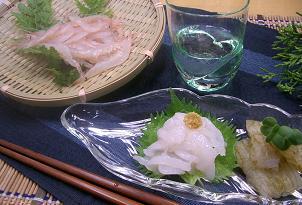
It is mainlly served as sashimi with some ponzu and grated fresh ginger

shiraebi-3

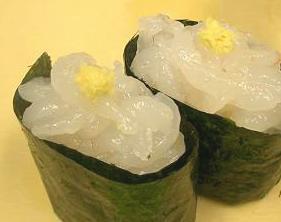
as “gunkan” topped with a dash of grated fresh ginger.

It is possible to serve it as “nigiri”, although one would need large specimen, as the usual length is only 7 cm.
Shiroebi appears on our tables between April and November in many guises:

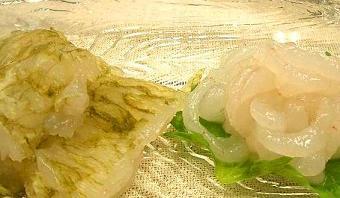
shirebi-4

The picture above shows on the right the shiroebi in its natural flesh whereas on the left it has been kept between two sheets of wetted seaweed for a while as “kombu-jime”, another very popular way to prepare all kinds of sashimi/sushi.

White Shrimps also enter in the preparation of a kind of “Tamagoyaki”/Japanese Omelette when they are first processed into a paste and mixed thoroughly with beaten eggs, sieved and then cooked.
The Japanese also love them as soft sembei/rice crackers.

The annual catch has exceeded 600 tonnes in recent years, half of them in Toyama.
They are also exported whole.

Please check the new postings at:
sake, shochu and sushi

—————————————-
日本語のブログ
—————————————-
Cuttlefish/Squid Species 5: Hotaru Ika/Firefly Squid-Sparkling Enope Squid

IKA-HOTARUIKA-1

Here we go again with this series called “The Jacques Cousteau” upon suggestion by Jaded Fork and forBread + Butter, and Elin who don’t mind being on a long haul! LOL

Sparkling Enope Squid is a name difficult to remember and the translation of the Japanese name, Hotaru Ika/蛍烏賊 or Firefly Squid, certainly holds a better sound and is more adapted to reality.
It is also known as Matsui Ika in Toyama Prefecture.

The Sparkling Enope Squid is found in the Western Pacific ocean at depths of 600 to 1200 feet and exhibits bioluminescence. Each tentacle has an organ called a photophore, which produces light. By flashing these lights, the Sparkling Enope Squid can attract small fish to feed upon.

The Sparkling Enope Squid is the only species of cephalopod in which evidence of color vision has been found. While most cephalopods have only one visual pigment, firefly squid have three, along with a double-layered retina. These adaptations for color vision may have evolved to enable firefly squid to distinguish between ambient light and bioluminescence.

The Sparkling Enope Squid measures about 3 inches long at maturity and dies after one year of life.
The Sparkling Enope Squid can also light up its whole body to attract a mate. The mating season of the Sparkling Enope Squid lasts from March to June.

The fishing season lasts from Spring to Summer. The annual catch varies between 4,500 and 6,500 tonnes.

IKA-HOTARUIKA-2

They are very popular boiled as a snack or cooked in soy sauce and sake. You can of course cook them in wine or tomato sauce, European-style.

IKA-HOTARUIKA-3

They are very much much appreciated raw and whole as sashimi or lightly boiled as sushi on nigiri!

Please check the new postings at:
sake, shochu and sushi

—————————————-
日本語のブログ
—————————————-
Shellfish species 12: Japanese Ivory Shell-Japanese Babylon Shell/Baigai

BAIGAI-1

Japanese Ivory Shell/Japanese Babylon Shell are known as Bai, Baigai, Isobai in Japanese.
They are just in season now as we see them over the counters from Spring to Summer.
They used to very common and found all over Japan, but unfortuantely too many have been caught or killed by pollution in recent years.
The biggest specimens are caught off Toyama fairly deep where they can attain 15cm length and weigh as much as 300g.

BAIGAI-2

The most popular way of eating them is to first boil them in water and soy sauce and serve them cold.

BAIGAI-SASHIMI

But the Japanese apprecaite them very much raw as sashimi and

BAIGAI-SUSHI

sushi!

There must be a good reason for the Japanese to call them “Kai no Oosama/King of Shelfish”!

Please check the new postings at:
sake, shochu and sushi

—————————————-
日本語のブログ
—————————————-
Crab Species 4: Japanese Mitten Crab/Mokuzugani

MOKUZUGANI-1

Japanese Mitten Crab or Mokuzugani i Japanese is also called Mokuzou, Zugani, Tsugani or Kegani.
It caught alsmost everywhere in Japan in Autumn and Winter.
In Autumn the females come to lay their eggs at river mouths.
Plenty are found along the Izu Peninsula in Shizuoka Prefecture.
They are caught in boxes baited with fish.

As for food, they can be eaten boiled in soups or crushed with their shell and cooked with miso. They could even be prepared as French bisque.

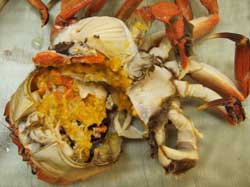
MOKUZUGANI-FEMALE

The female specimens are particularly appreciated for their egg sacs.

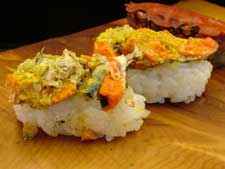
MOKUZUGANI-SUSHI

These boiled egg sacs with the meat make for delicious sushi nigiri or gunkan!

Please check the new postings at:
sake, shochu and sushi

—————————————-
日本語のブログ
—————————————-
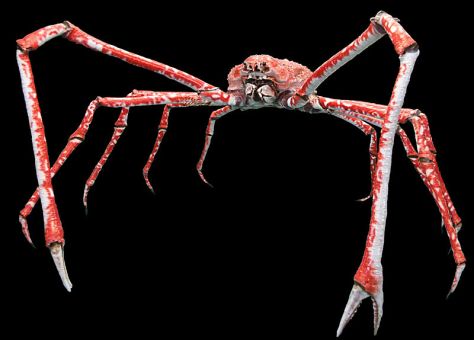
Crab Species 3: Japanese Spider Crab/Takaashigani

TAKAASHIGANI-1

Takaashigani/高足が二, literally meaning “Tall Legs Crab” is the largest crab in the world and is caught almost only around Japan especially in the Suruga Bay In Shizuoka Prefecture and Izu Islands, but numbers of the crab have diminished over recent years, and there are many efforts to protect them. In Shizuoka Prefecture, people even help them grow from the eggs before returning them to the sea!

Fully grown it can reach a leg span of almost 4 m (13 ft), a body size of up to 37 cm (15 inches) and a weight of up to 20 kg (44 lb). The crab’s natural habitat is on the bottom of the Pacific Ocean (some 300 to 400 m deep) around Japan, where it feeds on dead animals and shellfish. It is believed to have a life expectancy of up to 100 years.

The Japanese spider crab has 10 legs. The front two legs have been adapted into claws. It has an orange body with white spots on its thin legs. In males, the limbs on which the claws are located become longer than its other limbs, and a large male can widen them to more than 3 m. The oval-shaped and vertically rounded shell can reach 30 cm in width and can be up to 40 cm long. The compound eyes are situated on the front, and two thorns stick out between them. Younger specimens feature hair and thorns on the shell, and their frontal horns are longer, but these gradually atrophy as the crab ages.

In Japan it is considered a delicacy and prices can easily jump!
The Japanese spider crab is caught using small trawling nets, and is often eaten salted and steamed.

TAKAASHIGANI-BOILED

Interestingly enough, when bolied/steamed, not only the shell but also the flesh turns red.

TAKAASHIGANI-SUSHI

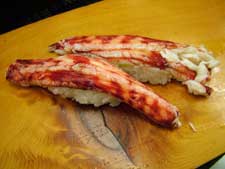
They do make for impressive sushi!

Please check the new postings at:
sake, shochu and sushi

—————————————-
日本語のブログ
—————————————-