Tag Archives: 日本料理

Tofu Recipes (1): Fried Namaage with Cheese and Ponzu


The Japan Blog List

Please check the new postings at:
sake, shochu and sushi

—————————————-
日本語のブログ
—————————————-

toofu-recipe-1

This is I hope the first installment of a long series of simple recipes with tofu. Some will be vegan and vegetarian, some vegetarian like this one, others for omnivores!

tofu-kinds-21

This particular one is one one of the Missus’ favorites.
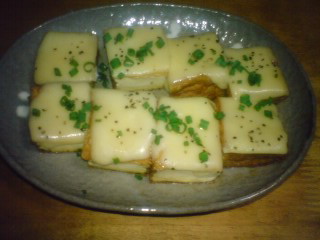
She uses on full “namaage tofu”, tofu that was deep-fried whole and that you can buy either fresh at a Japanese market or packaged.

She cuts the tofu in equal-sized bite pieces about 1 cm thick and fry them in a non-stick pan. No real need for any oil as what is contained in the surface of the tofu will be sufficient.
The point is that she fries them only on side. While they cook she lay a thin piece of mild/processed cheese over each tofu piece, add some black pepper, and cover with a glass lid. When the cheese has nicely melted over the tofu, she takes off the lid, sprinkles the whole with ponzu and fries for another minute. She serves on a dish with the sauce and liberally sprinkles the lot with chopped thin leeks!

Great snack with Japanese sake or beer!

Shizuoka Fish: Red Trumpet Fish/”Aka Yagara”


The Japan Blog List

Please check the new postings at:
sake, shochu and sushi

—————————————-
日本語のブログ
—————————————-

yagara-1

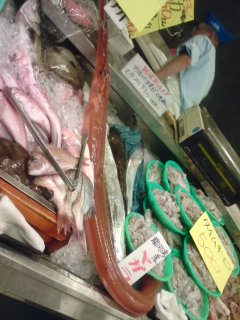
This evening, on my way back from University in Fukuroi City, I ventured inside the great Supermarket inside Shizuoka City JR Station as they are bound, especially in the seafood department, to exhibit some interesting specimens.
I certainly was not disappointed!

yagara-2

Here is another picture to give you an idea of the size!

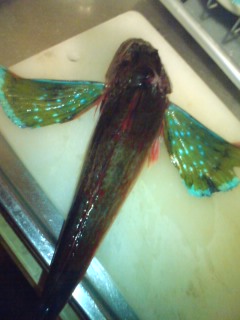
Trumpet Fishes come in “blue” and “red” varieties.
This one is a red (“aka”) Trumpet Fish.
A bit of a monster, it was a good 1,5 meter (five feet) long and weighed over 5 kg.
I was told 3 meters (10 feet) long specimens are regularly caught in Suruga Bay, the main Bay of Shizuoka Prefecture!

I knew that my friends at Tomii Restaurant would be interested.
I called them on my mobile.
They replied they definitely were!
I bought the fish on their behalf. At 130 US$, it was cheap (I actually bargained a bit!), considering what customers would pay for this delicate fish, either as sublime sashimi or delicious “nabe”!

Vegan and Vegetarian Japanese Cuisine: Tofu (2)-Varieties


The Japan Blog List

Please check the new postings at:
sake, shochu and sushi

—————————————-
日本語のブログ
—————————————-

zarudofu
“Zarudofu”, my favourite variety of tofu just filtered out in a “zaru/basket”. You just eat it with a spoon on its own. No seasoning needed!

This is the second article dedicated to some of the many varieties of that celebrated food, tofu. A third article is in preparation as for recipes!
tofu-kinds-10
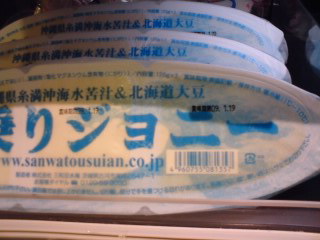
Okinawa Tofu

Tofu comes in various degrees of firmness.
The softest are “Zaru dofu” (see pic above) and Okinawa-style tofu.
tofu-kinds-7
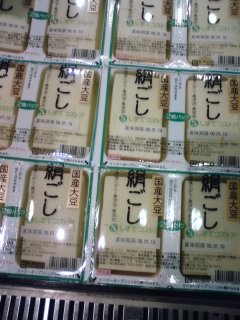
“Kinu Goshi Tofu”

Next come “Kinu Tofu/Kinu Goshi Tofu”/Silk-sieved tofu. It can be used for almost any recipe, although you might have to press it as it contains a lot of water.

tofu-kinds-9
“On Tofu”

“On Tofu” is similar to “Kinu tofu”, but it has been conceived as it its name indicates for being eaten hot or warm instead of cold.
tofu-kinds-6
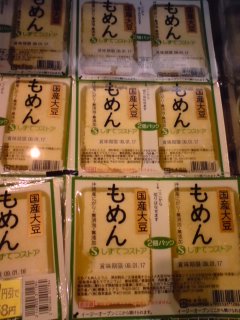
“Momen Tofu”

“Momen Tofu”/”Wool Tofu” contains less water, is firmer and is perfect for “Nabe/Japanese Pot-au-feu”.

tofu-kinds-8
“Yaki Tofu”

“Yaki Tofu/Grilled tofu” (not to be confused with deep-fried tofu) is usually “Momen tofu” grilled to give it the “gratine” look. Tasty, it is particularly interesting when sauteed with vegetables and so forth in Japanese, Chinese, Korean or Thai food.
tofu-kinds-1
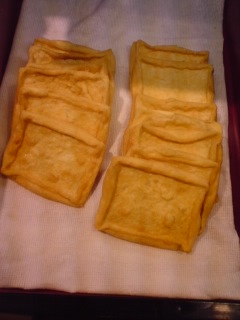
“Yawarakaage or Yawarakai Aburaage”

Tofu can be bought cooked/deep-fried in many manners.
“Yawarakaage” is tofu deep-fried into a thin sheet which can be opened as a pouch like in:
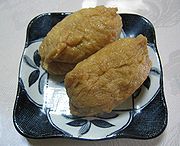
inari-tofu
“Inari”

“Inari” is “Yawarakaage”, which has been first marinated in mirin, soy Sauce and sugar. Do ask about its preparation as some companies or individuals add dashi, which is usually not vegan or vegetarian!

tofu-kinds-2
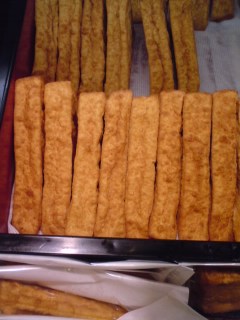
“Namaage”

“Karaage Tofu/Deep-fried Tofu” comes in many forms.
The above “Namaage/Deep-fried raw” is the most common.
tofu-kinds-3
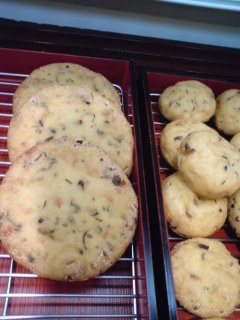
“Kinu Namaage”

“Kinu namaage” is great for the contrast between a solid outside and vey soft inside.
tofu-kinds-4
“Ganmo” and “Kyo-Ganmo”

“Ganmo” is Tofu that has pressed to almost dry, then broken into very small lumps to which one added cooked carrots, Hijiki sweet seaweed, grated yam, a little sugar (not always), shaped into a ball and lightly deep-fried. Great, heated again with vegetables and a swet and sour sauce, or in whatever recipe you might imagine. “Kyo-Ganmo” is the smaller Kyoto-Style variety. Ganmo should be made exclusively with vegetal matter, but do ask if you are not sure!

tofu-kinds-5
“Tofu Doughnuts”

Yes, you have read it, “Tofu Doughnuts”, very popular with kids!

Other varieties:
-“Okara” is hard-pressed, almost dry tofu sold broken into very small lumps.
-“Yuba” is the “skin” appearing on top of the pan when tofu is being prepared. Very popular served cold with all kinds of ingredients.
-“Koya” is hard-pressed tofu sold marinated. Now, as it contains fish stock dashi, it is not suitable to vegans or vegetarians.
-“Kuro goma tofu” or “Shiro goma tofu” (Black and white sesame curd) are not made with soy beans but sesame, although they make for great food for vegans and vegetarians.

There are many other “fancy” varieties, but I cannot guarantee their suitability to vegans or vegetarians!

Enjoy!
Blue-Fin Robin and Scampi baked in Foil Paper


The Japan Blog List

Please check the new postings at:
sake, shochu and sushi

—————————————-
日本語のブログ
—————————————-

blue-fin2
Pic kindly upgraded by Jay Gustafson!

Last Friday, on my way back from University, I visited the big Parche Supermarket inside Shizuoka City JR Station as I wanted to cook some seafood for the Missus that night!

houbou2

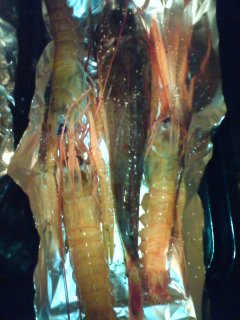
I was lucky to find a couple of medium-sized “Houbou/Blue-Fin Robin” for a little over 4 US$. This fish was caught off the western part of Shizuoka shore. I also discovered a few great value fresh “Te-naga Ebi/Scampi” caught in Suruga Bay (Shizuoka Prefecture). I only needed to check with the vegetables stand nearby and I was back home!

houbou3

Things are (most of the time) best when kept simple.
I had had the fishmonger dress the fish beforehand, so I needed only to make a couple of shallow cuts across the skin.
In two separate large sheets of foil paper, I place one fish (seasoned with salt and pepper) in the middle, flanked it with two (on the the left) and one scampi (on the right), filled the upper right corner with plenty of fresh basil and dill. I placed mini asparaguses and large fresh broad beans along them, added a good portion of white wine, a little olive oil, some freshly pressed lime juice and a good measure of sweet and hot Thai sauce.
I closed the foil tightly around the whole and baked it on grill at 250 degrees Celsius for 25 minutes.
Served at once, they made for a great and light dinner enjoyed with white wine (for the Missus) and Japanese sake (for me!)

First Sashimi Set of the Year at Tomii!


The Japan Blog List

Please check the new postings at:
sake, shochu and sushi

—————————————-
日本語のブログ
—————————————-

tomii-09-06

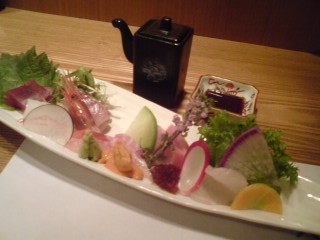
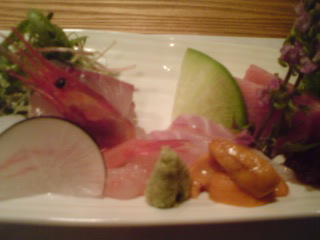
Yesterday evening, being hungry late at work, I just took a “break” and went for a (slightly extravagant!) quick fix at my favourite Japanese restaurant in Shizuoka City.

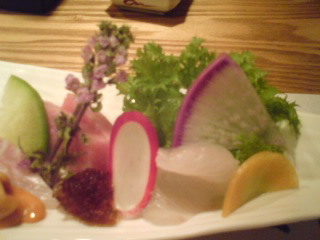
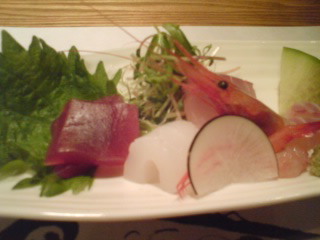
Apart of the usual appetizer, I was served the following “O-Tsukuri/Sashimi set” (See above picture, from left to right, top first):

-“Buri/Japanese Amberjack” on a cushion of fresh sprouts
-“Hon-maguro no Akami/Bluefin tuna lean part” with “Shiso no Hana/Perilla Flowers”
-“Inada/young Japanese Amberjack”. The difference with Buri is that the flesh is still white. On a “Shiso no Happa/Perilla Leaf” and a radish slice
-“Madai/True Snapper-Seabream”
-“Amaebi/Sweet Shrimp)
-“Uni/Sea Urchin)
-Freshly grated “Wasabi/Green Japanese Horseradish”
-“Kou-Ika/wide-bodied cuttlefish variety

Heavens!

TOMII
Shizuoka City, Aoi Ku, Tokiwa-cho, 1-2-7, Tomii Bldg, 1F
Tel.: 054-274-0666
Business hours: 17:00~22:00
Closed on Sundays
HOMEPAGE (Japanese)

Vegan & Vegetarian Japanese delicacy: “Sea Grapes/Umibudou”


The Japan Blog List

Please check the new postings at:
sake, shochu and sushi

—————————————-
日本語のブログ
—————————————-

umibudou-11

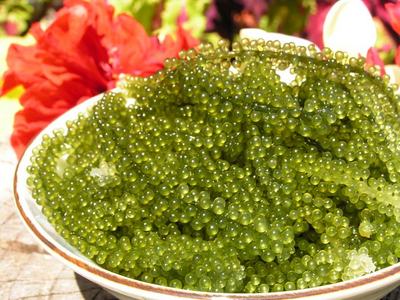
Although not from Shizuoka, this Okinawa delicacy regularly appears in good supermarkets such as Shizuoka JR Station Supermarket and in good Japanese restaurants.

Although called Sea Grapes (Umibudou) for their shape, it is a saweed variety!
Its Latin name is “Caulerpa lentillifera” for the purists.

umibudou-2

Apparently they can be found in some islands an seas in South Eastern Asia and Oceania. World vegetarian and vegans, look out for them (I mean discovere and eat them! LOL)!
The whole seaweed can reach betwen 2 and 5 metres, but only the extremities including the “grapes” are consumed.
In Okinawa where they have been eaten eons, they are also called “green caviar”!
You can eat them raw of course with soy sauce or rice vinegar mixed with mustard.

umibudogunkan

In sushi, as “gunkan/maothership”, they certainly make for great fun and taste!
Beware of counterfeits! No less than the JAS was recently caught selling them in August 2008!
Growing them in Japan has apparently been successful, great news for vegans and vegetarians who will find a great source of iodine and other beneficial elements!
Didi I say it? They are delicious/”oishii”!

Japanese Shellfish Species 1: Torigai/”Large Cockle”


The Japan Blog List

Please check the new postings at:
sake, shochu and sushi

—————————————-
日本語のブログ
—————————————-

torigai1.jpg

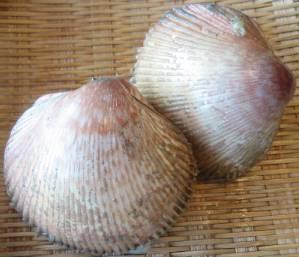
“Torigai” does not have a real name in English. They are approximately translated “large cockle”
They will appear on the market in Spring and earlier in Shizuoka Prefecture. They are mainly found in Tokyo Bay, Ise bay and Seto Inner Sea. Some are imported from Korea, but catches can wildly vary, especially with the occurence of “red tides”. A lot are imported from Aichi Prefecture (Nagoya region) to Shizuoka.

torigai-shellfish

They must be absolutely fresh to be consumed.
One easy way to check if they are still fresh is to slam them on the wooden board. They should immediately retract, even if cut out. They are at their cheapest between March and May.

torigai-nigiri.jpg
(Pic taken at Sushiya No Ichi, Shizuoka City)

They can be appreciated either as “tsumami”/Appetizer with a little grated wasabi and shoyu, or as nigiri.
Beware of torigai with a thin colour! They are not fresh!

Vegan and Vegetarian Japanese Cuisine: Tofu (part 1)-Preparation


The Japan Blog List

Please check the new postings at:
sake, shochu and sushi

—————————————-
日本語のブログ
—————————————-

zarudofu
“Zarudofu”, my favourite variety of tofu just filtered out in a “zaru/basket”. You just eat it with a spoon on its own. No seasoning needed!

As promised, here is the first posting about tofu.
This article concerns the home-making of it.
The next article will introduce different kinds of tofu and recipes!

Ingredients (for one large piece, one cho/丁in Japanese)

Soy beans: 2 cups (360cc)
Nigari: 2 large tablespoons
(Magnesium chloride is an important coagulant used in the preparation of tofu from soy milk. In Japan it is sold as nigari (the term is derived from the Japanese word for “bitter”), a white powder produced from seawater after the sodium chloride has been removed, and the water evaporated. In China it is called “lushui”.. Nigari or Lushui consists mostly of magnesium chloride, with some magnesium sulfate and other trace elements. It is also an ingredient in baby formula milk).
Water: 5 cups (twice and a half the volume of soy beans)

Utensils:
One large pot
One large clean cloth pouch to press tofu through
One bowl
One mixer
One thermometer
One large piece of gauze to filter water off shaped tofu
One large wooden spoon
One wooden tofu-shaper case

RECIPE:
toofu-1
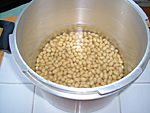
1) Preparation: soak soy beans in water overnight

toofu2
2) Preparation: Mix nigari with 1 cup of water and set aside

toofu-3
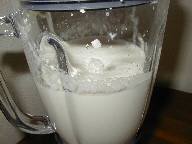
3) According to its size, Pour the whole or part by part soy beans and water (1) and make paste as fine as possible. If mixer runs at an even pace without crushing beans into paste, add more water. The paste obtained is called “namago” (生呉)

toofu-4
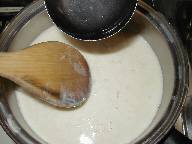
4) Pour the bean paste into a large pot with an equal amount of water. Heat stirring all the time. The paste will come to a boil suddenly. Switch off fire. Switch on low once the paste has settled for 10 minutes and take off fire.

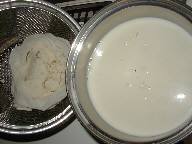
toofu-5
5) Pour paste into the cloth pouch and press. Right of the picture is tofu paste before pressing. Left is pressed out tofu

toofu-6
6) Solidifying (coagulating) with nigari.
Stir tofu over light fire. When the temperature has reached 75~80 degrees Celsius pour in nigari slowly and stir all the time. The solid matter will sink to the bottom and accumulate. The coagulation will be complete when liquid above tofu has become transparent. Stop the operation and let rest for 15 minutes.

toofu-7
7) Arrange the gauze inside tofu a tofu shaper case which should have small holes to let excess water run out.

toofu-8
8) Cover with lid with a weight (or glass of water) of about 250 g and further press out water for 15 minutes

toofu-9
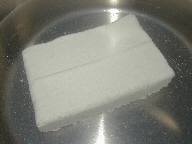
9) Delicately empty tofu in basin filled with called water and leave it there for an hour to take out excess nigari. Store in refrigerator.

Japanese Oysters


The Japan Blog List

Please check the new postings at:
sake, shochu and sushi

—————————————-

Oysters! One would be hard put to find a produce from the sea more internationally recognized as a gourmet’s choice! Moreover, it is the only shellfish you could survive on if you get marrooned on a desert island! It is a complete food in irself if consumed raw.
For a long time (that is before coming to Japan), I had thought that my country, France, was the place to eat them. Well, I must admit that it was a little pretentious from me, especially in the light that more than half of the oysters consumed back at home originated from Japan!

Now the Japanese have come with many ways of appreciating them:
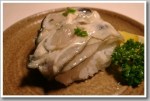
-As in the picture above they would eat them as sashimi with a dash of wasabi and soy sauce.

-Or just a little lemon juice as in Europe, Americas or Oceania.

-Or in another Japanese fashion, with ponzu and momijioroshi (fresh grated daikon mixed with chili pepper. Succulent!)

-Or, and here Japanese and foreigners are simply crazy about them, as “kakifrai”, deep-fried oysters in batter and breadcrumbs with a nice tartare sauce!

-Or finally, and I would recommend the experience to all foreigners, as “kaki-gohan”, either with oysters steamed together with the rice, or cooked apart in light broth poured over a bowl of freshly steamed rice!

kaki-nigiri kakigunkan

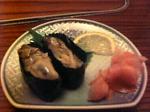
Of course, any good sushi restaurants will serve oysters as nigiri or gunkan!

In Japan, oysters come from various areas, mainly Hiroshima, Iwate and so on.
As for Shizuoka Prefecture, oysters mainly come from Hamanako inland salted lake near Hamamatsu City.

Sashimi at Tomii: The Epitome of Excellency!


The Japan Blog List

Please check the new postings at:
sake, shochu and sushi

—————————————-
日本語のブログ
—————————————-

tomii-08-12-16a

Many people have been asking me: “How can you afford that?”
Well, I don’t smoke and I don’t drive, either. I can imagine what some people in the Northern part of the US might tell me… and I don’t care!
All that “saved” money goes into good food, good drink, good travel and improved relations with my (better, ok for this time!) half! And nothing for those “poor” doctors out there!

I’ve been a regular customer at Tomii in Shizuoka City for many, many, many reasons. But the one I value most is that everyone at this great Japanese restaurant are willing to talk about, explain and extoll the virtues of their craft. Craft, I said? It is probably nearer to artistry as Melinda, Etsuko and Tim will vouch for me!

Anyway, to write a story short, I just popped at Tomii this evening (yes, I’m writing this just after I came back to “work”), and asked for a sashimi plate (well, this is not the way to ask it: You should say: “O-tsukuri, kudasai!”). I did not need to tell them what to serve me. I wouldn’t even have dared!
On the other hand, they didn’t mind explaining no less than three times to make sure that the old geezer got his stuff right!

tomii-08-12-16b
From right to left:
“Kiiro Ninjin”?Yellow Carrot (sashimi is not all about fish, vegetables are rapidly becoming an essential part of the picture!), “Beni Daikon”/Red (“rouge”) Daikon, “Wasabina/not wasabi, but a leaf vegetable with a similar taste!”, “Hirame/Sole”, “Hime Daikon/Princess Daikon”, “Shiso no Hana/Perilla Flowers (edible as Rowena will agree!) on top of “Toro/Tuna Fatty Part) and “Bakudai No Ki no Mi/Impossible to translate”, only that it is an edible part from a tree (sorry, I was not attentive enough!)!

tomii-08-12-16c
From right to left:
“Uni/Sea Urchin Roe” (in front) with freshly grated “Wasabi/Japanese Horseradish” (let me tell for the umpteenth time that wasabi was first grown in Shizuoka City in the 17th Century and that Shizuoka Prefecture still produces 80% of the world total!), “Ishidai/Ishidai Snapper” just behind, the green daikon is called “Uguisu Daikon/Nightingale Daikon”, “Amaebi/Sweet Shrimp”, and “kanpachi/Japanese Amberjack” just behind!

tomii-08-12-16d
From right to left:
“Kuroi Daikon/Black Daikon”, “Aori Ika/Aori Cuttlefish”, “Akami/Lean Tuna” on a “Shiso no happa/perilla leaf”. To back it up a mixture of seasonal sprouts: “Kushinsai + Soba no Mi (Buckwheat) + Cress (from Shizuoka like most of them) + Kawaire Daikon + Cabbage + Broccoli” (about time you call a local farmer for explanations!)!

Small servings they might look, but I challenge anyone to find better quality!
Now, for people who really want to know it, you will have to fork out at least three times as much in Tokyo, and as far the US and Europe are concerned, you might as well start riding a bicycle like I do!

TOMII
Shizuoka City, Aoi Ku, Tokiwa-cho, 1-2-7, Tomii Bldg, 1F
Tel.: 054-274-0666
Business hours: 17:00~22:00
Closed on Sundays
HOMEPAGE (Japanese)

Japanese Cuisine: Zensai/Hors d’oeuvre at Tomii


The Japan Blog List

Please check the new postings at:
sake, shochu and sushi

—————————————-
日本語のブログ
—————————————-

tomii-zensai-1

There is a fine line between cooking and art that the good Japanese Restaurants are happy to cross for the unending pleasure of their customers.
It does require a lot of attention and love for one’s craft.
Chefs at Tomii in Shizuoka City not only work hard to satisfy their clients, regular patrons or not, but will be more than happy to explain and introduce their creations.
Yesterday evening, being starved before the ned of a long working day I just popped in and asked for a “quick fix”.

tomii-zensai-3

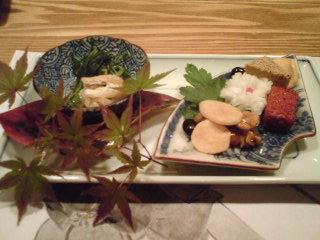
It came under the shape of two small dishes on an earthenware tray.
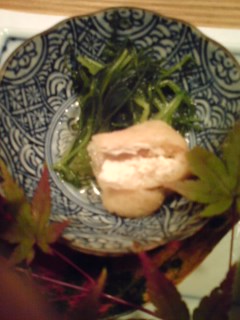
The round tray on the left contained “o-kahijiki no hitashi, a typical Japanese vegetable just lightly poached and cooled down served in its own juice with very little (secret) seasoning, and aburaage/fried tofu sheet.

tomii-zensai-41

Japanese chefs make a great use of natural decoration to enhance their creations and Tomii is no exception.
We are in the Fall/Autumn when leaves are changing colour.
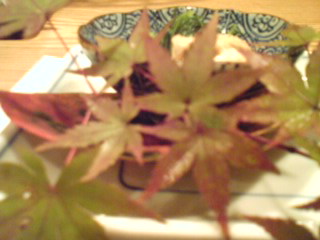
The momiji/Japanese maple leaves (front) had been picked along the Abe River the day before, while the large kaki/persimmon leaf (under the small dish) wa ordered to a farmer.

tomii-zensai-2

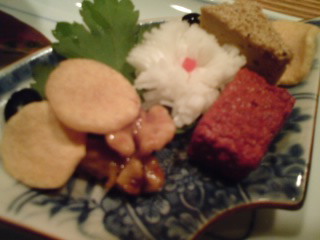
The main plate contained what you might expect in the better restaurants in Kyoto:
Kuwai chips.
Kurumi (walnut) inakani and kuromame(cooked sweet black bean).
Kikukabura: a Kyoto-style preparation of a piece of daikon finely cut into the shape of a chrysanthemum and slightly pickled in sweet rice vinegar.
Aka konyaku no ageni: Kyoto-style red konyaku
Tori no matsukaze no yaki: a piece Japanese-style chicken terrine

I can have this every day!

TOMII
Shizuoka City, Aoi Ku, Tokiwa-cho, 1-2-7, Tomii Bldg, 1F
Tel.: 054-274-0666
Business hours: 17:00~22:00
Closed on Sundays
HOMEPAGE (Japanese)

Vegetarian & Vegan Cuisine: “Mukashi Mushi Pan”/Old-Fashioned Steamed Bread


The Japan Blog List

Please check the new postings at:
sake, shochu and sushi

—————————————-
日本語のブログ
—————————————-

Although I’m neither a vegetarian or vegan, I make a point to introduce anything I discover here which might help friends out!

Fukasawa Foods in Shibakawa Cho at the foot of Mount Fuji produces all year round an incredible array of soba/buckwheat noodles, udon/wheat flour noodles, ice-creams, cakes and I don’t know what else.

Now, all their food is organic. No artificial fertilizers are used for whatever they grow or buy, and no additives or preservatives are used in any of their product, which means all have to be properly stored and eaten quickly.

Vegans will be happy to know they use tofu instead of any dairy product.

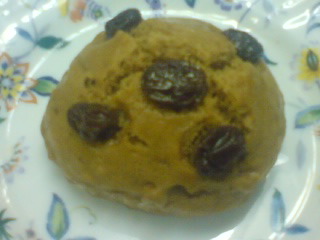
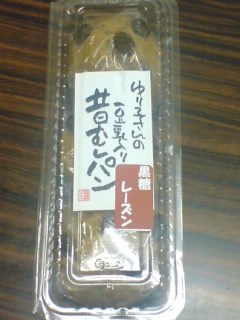
This particular cake called “Mukashi Mushi Pan” or Old-Fashioned Steamed Bread was made with wheat flour, tofu, brown sugar, raisins, salt, vegetable oil.
That is all!

One cake could have easily been held inside your palm, but it was very fulfilling and delicious!
They have other varieties made with pumpkin and other vegetables.

Fukasawa Foods
Fuji Gun, Shibakawa Cho, Naibo, 3895-8
Tel.: 0544-65-0143
Closed on Tuesdays
HOMEPAGE (Japanese)

Vegetarian & Vegan Cuisine: Ginger as a Vegetable


The Japan Blog List

Please check the new postings at:
sake, shochu and sushi

—————————————-
日本語のブログ
—————————————-

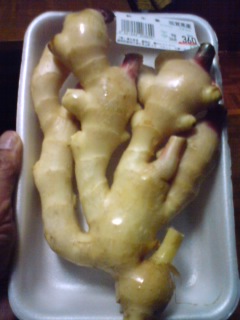
Ginger when eaten outside Japan generally comes under its semi-dry or dry root.
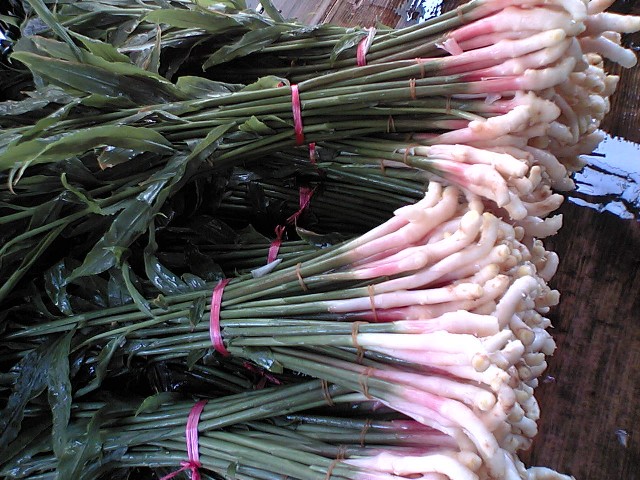
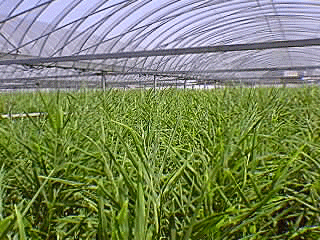
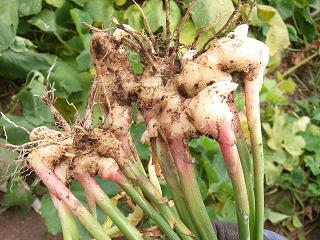
Actually here, and in Shizuoka especially, fresh ginger or “Ha Shoga”/Leaf Ginger comes into some great recipes to please any one who does not consume meat (of course ginger is used in many meat recipes!)

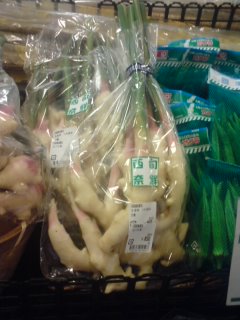
Extensively grown in our Prefecture, it can be bought fresh in season in any Supermarket:

There are many ways to prepare and eat it:


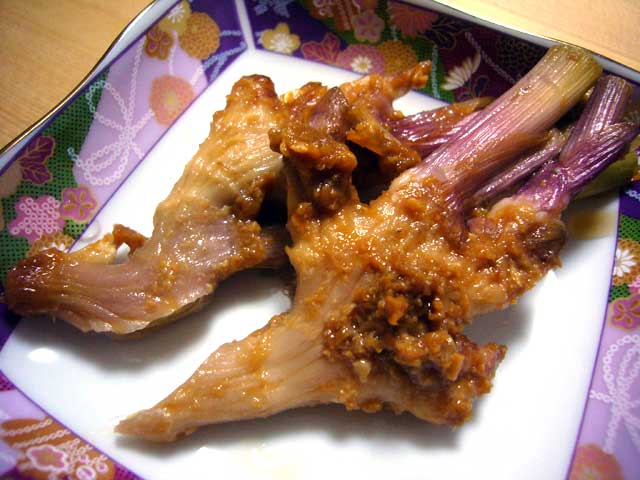
Fresh Ginger pickled in miso.
Very practical when you can buy loads in season. Choose your miso paste well so as avoid too much salt!


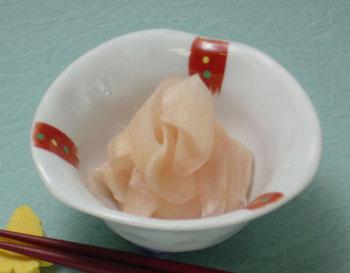
Everyone knows pickled sliced ginger (use fresh plants only!) served with sushi!


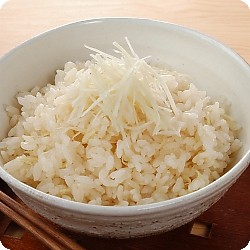
Ginger can be steamed with rice or served very finely cut on top of a bowl of steaming rice!


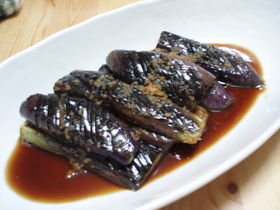
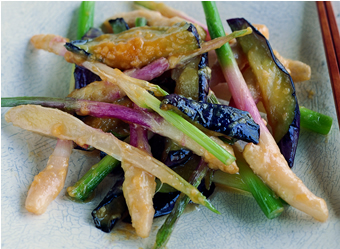
Ginger is great finely chopped and fried with egg-plant/aubergines, soy sauce and mirin!
(Plan to introduce recipe!)


Fresh thin ginger roots are simply beautiful fried/sauteed with othe vegetables!
(Plan to introduce recipe!)

Enjoy!
Vegetarian & Vegan Cuisine: Myoga as a Vegetable


The Japan Blog List

Please check the new postings at:
sake, shochu and sushi

—————————————-
日本語のブログ
—————————————-

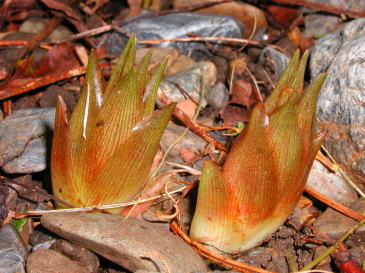
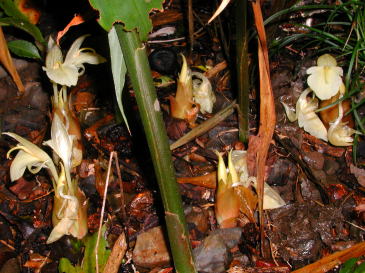
Myōga (茗荷) or myoga ginger (Zingiber mioga, Zingiberaceae) is an herbaceous, deciduous, perennial native to Japan that is grown for its edible flower buds and flavorful shoots.

As a woodland plant myoga has specific shade requirements for its growth. It is frost-tolerant to 0F, -18C possibly colder.
Some constituents of myoga have shown promise for potentially anti-carcinogenic properties

A traditional crop in Japan, myoga has been introduced to cultivation in Australia and New Zealand for export to the Japanese market. I’ve always wondered if it were available on American and European Markets.
It is a great plant for use in vegetarian and vegan dishes as it adds lots of soft flavors.
Flower buds are usually found finely shredded raw in Japanese cuisine as a garnish.
But there are many other possibilities:


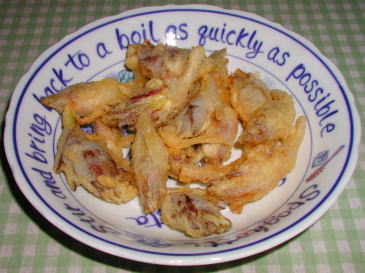
Tenpura.
Actually some Japanese restaurants will prepare the flowers as well as tenpura.
Vegans should replace the egg white included in the batter with a little cornstarch.


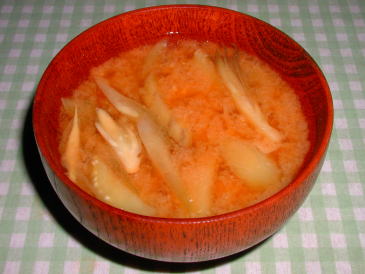
Myoga in Miso Soup.
Cut the myoga into thin strips and just add them to the miso soup inside bowls before serving it.


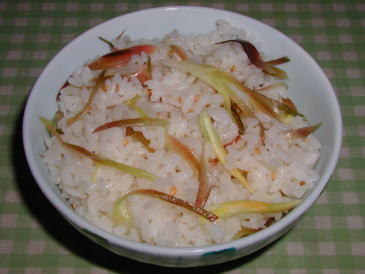
Myoga Gohan/Myoga Rice.
Cut the myoga in very thin strips and put it on top of the rice before steaming it. When the rice is cokked, mix in the myoga with rice and serve.
Vegetarians and Vegans may use genmai/whole rice for higher nutritients.
Beautiful when freshly cooked!


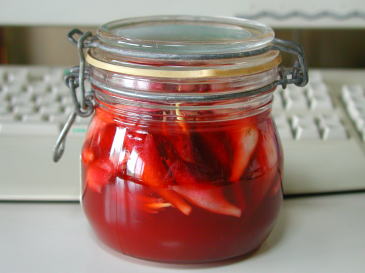
Myoga Pickles
Wash myoga quickly under running water. Drain and take excess water with kitchen paper.
Best pickled with amazu/sweet rice vinegar. If not available use rice vinegar, sugar and soft umeboshi/Japanese pickled plums.

Enjoy!
Shizuoka Wasabi: An encounter with a great Chef!

The Japan Blog List

Please check the new postings at:
sake, shochu and sushi

—————————————-
日本語のブログ
—————————————-

I have recently had the pleasure to make a new friend, namely Dominique Corby, a great French Chef who learned his craft at the Tour d’Argent in Paris, among others, before coming to Japan to look after the kitchen of the Sakura Restaurant in the New Otani Hotel in Osaka and of the 6eme Sens in Tokyo.

Dominique is a chef always looking for fresh seasonal natural ingredients for his cuisine which is resolutely a marriage of Japanese and French culinary traditions.
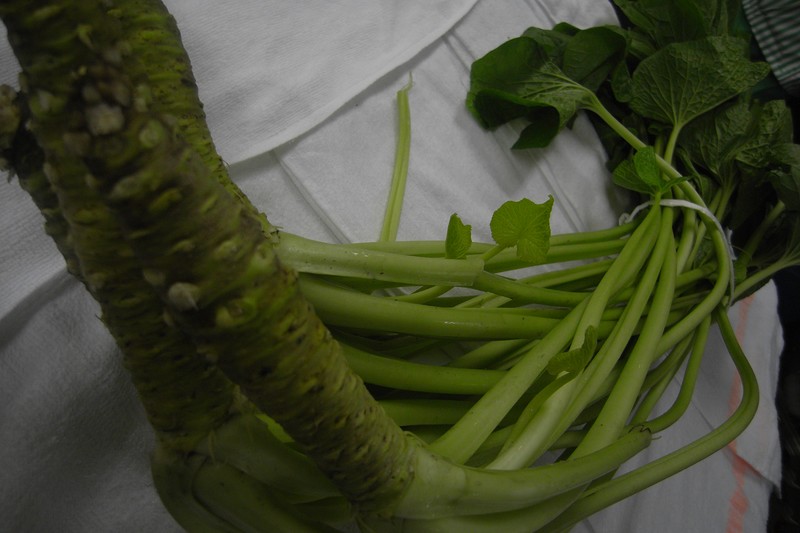
As he recently wrote a post on his blog on wasabi, I took the opportunity to send him a few samples of fresh wasabi grown in Shizuoka City, Utogi, Abe River for the simple pleasure of introducing him to one our great products in Shizuoka Prefecture.

They were almost one metre-high full with stems and leaves (all edible) and freshly uprooted in the very morning (I sent them by cool box just before lunch to reach him just in Osaka just before lunch the next day).
Dominique and his staff appreciated them to the point that a dish was created for the benefit of some customers on the very day.
See above picture. Dominique described it as follows:
-“sur une feuille et tiges de Wasabi, Sawara et Agi abute, kogomi,wasabina, nobiru, mousse de lait au wasabi fraîchement râpée, petite réduction de jus de homard”
-“on a wasabi leaf and stems, sawara and aji abute (grilled large mackerel variety and saurel), kogomi (young ferns), wasabina (a kind of Japanese lettuce), nobiru ( a kind of wild garlic), freshly grated wasabi milk mousse, reduced lobster juice.

A great compliment to a great product by a great chef!