Tag Archives: 日本

Today’s Lunch Box/Bento (’10/28): Two-Box Bento

I called this bento, “Two-Box Bento” simply because the Missus has combined that faithful bamboo leaves/fibers box with half of the new cedar wood lunch box!

The weather has made a complete turnaround from yesterday’s deluge to a balmy day with plenty of sunshine and heat. I will have to find many reasons to get out the office today!

Today’s bento was another hearty one. I love bentoes, but if I had one everyday I would be afraid to step on the scales every morning!

The “main dish” featured tuna fried with tomato sauce, boiled peas in their pods (they are caleed “snap endou” in Japanese), home-pickled myoga ginger (in sweet vinegar), mini tomatoes and home-pickled wasabi stems and leaves.

Rice consisted of three musubi/rice balls containing umeboshi/Jpanese pickle plum. One ball was was seasoned with yuzu kosho furikake/lime pepper seasoning powder and “white” roasted sesame seeds, and the other with Yukari (red shiso powder seasoning) all were wrapped in green shiso leaves and lettuce.

The salad dish consisted of the Missus’ specialties, home-pickled carrot tagliatelle with black olives parsley, spicy fried yam/nagai imo and sweet pimentoes with hujiki/sweet seaweed, and her mother beans, vegetables and konbu seaweed “ni”/simmered food.

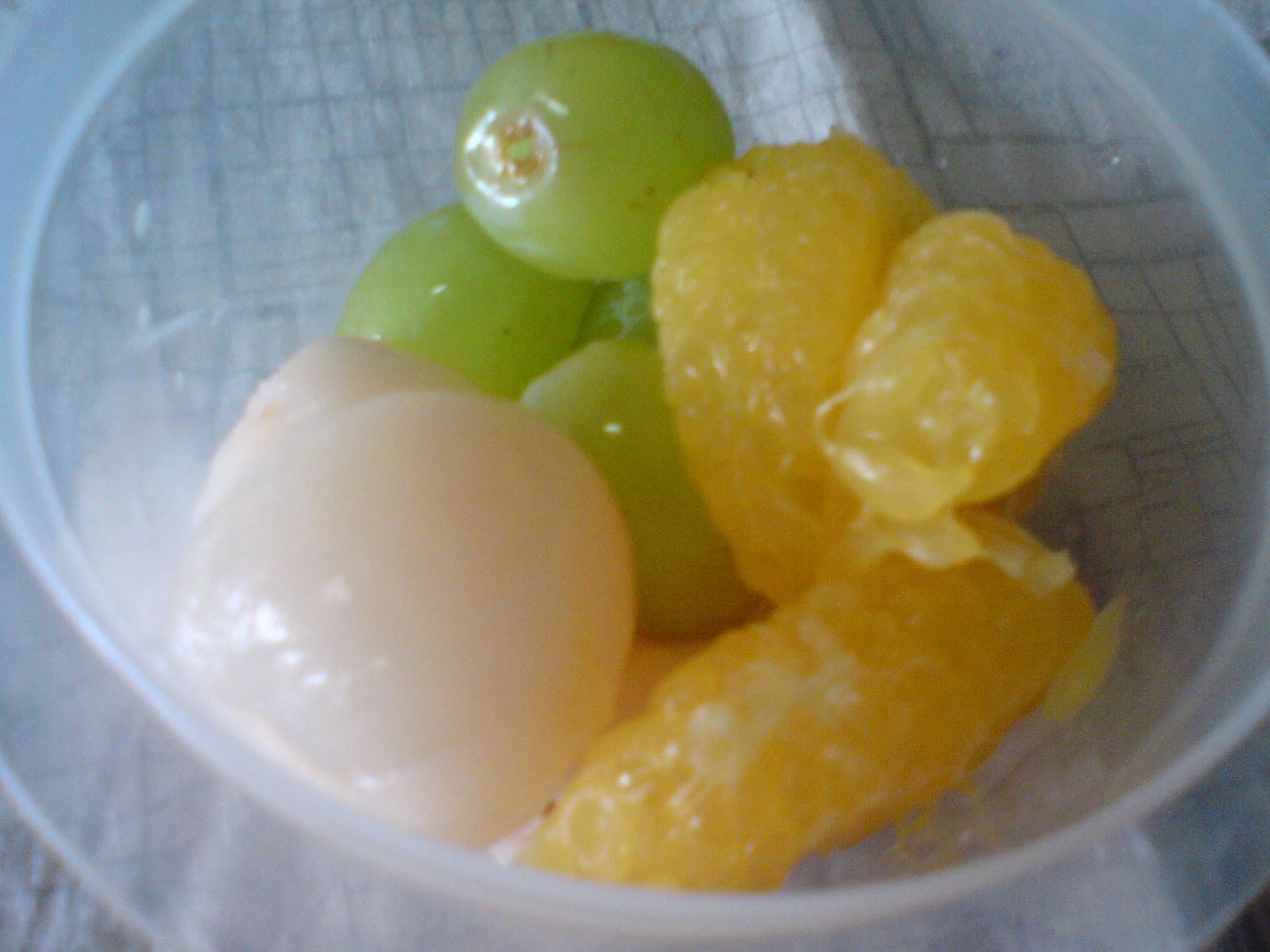
The dessert was a mixture of fresh Shizuoka orange, Chilean grapes and Chinese lychee.

Plenty for a long day!

RECOMMENDED RELATED SITES:
Warren Bobrow, Bread + Butter, Zoy Zhang, Hungry Neko, Think Twice, Frank Fariello, Mangantayon, Hapabento, Elinluv Tidbit Corner, Tokyo Terrace, Maison de Christina, Chrys Niles,Lexi, Culinary Musings, Wheeling Gourmet, Comestiblog, Chronicles Of A Curious Cook, Bento Boutique, Tokyo Through The Drinking Glass, Tokyo Foodcast, Urban Sake, Sake World, Palate To Pen, Yellin Yakimono Gallery, Tokyo Terrace, Hilah Cooking, More than a Mount Full, Arkonite Bento

Please check the new postings at:
sake, shochu and sushi; Happy Little Bento

—————————————-
日本語のブログ
—————————————-

Sansai/Mountain vegetable Recipe: Itadori/Japanese Knotweed

The Sansai/Mountain Vegetable season has started for good in Japan and might be around the corner in many parts of the world, but many people are still wondering how to prepare and eat them.

Here is a simple explanation of how the Japanese do it with some of them.
I’ll try to research for more in the near future.

ITADORI/JAPANESE KNOTWEED
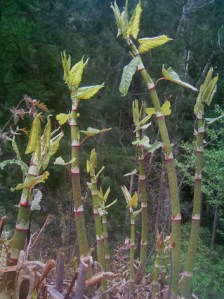
Japanese Knotweed (Fallopia japonica, syn. Polygonum cuspidatum, Reynoutria japonica) is a large, herbaceous perennial plant, native to eastern Asia in Japan, China and Korea. In North America and Europe the species is very successful and has been classified as invasive in several countries. About time to eat it, then!

Closely related species include giant knotweed (Fallopia sachalinensis, syn. Polygonum sachalinense) and Russian vine (Fallopia baldschuanica, syn. Polygonum aubertii, Polygonum baldschuanicum).

Other English names for Japanese knotweed include fleeceflower, Himalayan fleece vine, monkeyweed, Huzhang (Chinese: 虎杖; pinyin: Hǔzhàng), Hancock’s curse, elephant ears, pea shooters, donkey rhubarb (although it is not a rhubarb), sally rhubarb, Japanese bamboo, American bamboo, and Mexican bamboo (though it is not a bamboo). There are also regional names, and it is sometimes confused with sorrel.

In Japanese, the name is itadori (虎杖, イタドリ).

Japanese knotweed flowers are valued by some beekeepers as an important source of nectar for honeybees, at a time of year when little else is flowering. Japanese knotweed yields a monofloral honey, usually called bamboo honey by northeastern U.S. beekeepers, like a mild-flavored version of buckwheat honey (a related plant also in the Polygonaceae).

The young stems are edible as a spring vegetable, with a flavor similar to mild rhubarb. In some locations, semi-cultivating Japanese knotweed for food has been used as a means of controlling knotweed populations that invade sensitive wetland areas and drive out the native vegetation.

RECIPE:
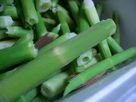
Peel the knotweed from the root (easier this way). Peel all the skin!

Boil the knotweed. If you have a lot of them, proceed in batches.
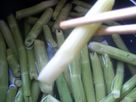
Once the knotweed colour has turned from deep green to “tea green”, the boiling should be enough. It would take up to 2 minutes for items of the thickness shown on the above picture.
Note that that if the deep-green colour hasn’t sufficiently gone, the knotweed will be acid in taste.
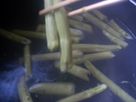
Now as soon as you attained the right colour, scoop knotweed out or over cooking will result in the plant breaking up. Very important!

Transfer immediately into chilled water. Leave it there for a whole night and you will be able to get rid of astrigency and unwanted matters.

Next morning drain, cleanse under cold running water and drain thoroughly.
It can be preserved inside the fridge for quite some time inside a tupperware box.
If you have a lot you can always make salty pickles of them.
If you do so, just put them inside a tightly closed tupperware box with a good measure of salt. Wash them with plenty of water before consuming them.
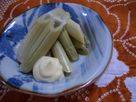
Freshly boiled, they can be eaten as they are with mayonnaise, or a simple dressing for vegans and vegetarians. A little chili pepper is fine, too!

Simple recipe 1:
Two large knotweed (boiled and prepared as above).
Japanese sake: 1/2 tablespoon
Water: 1/2 tablespoon
Mirin/sweet Japanese sake: 1 tablespoon
Men tsuyu/vegan dashi: 1/2 tablespoon
Gently simmer the whole together for a little while.
Try and serve together with other boiled vegetables!

Simple recipe 2:
Two large knotweed (boiled and prepared as above).
Aburaage (fried tofu sheet): 1/2
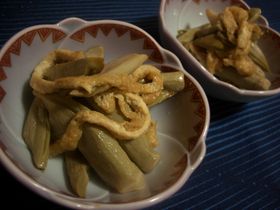
Cut the aburaage into fine strips and fry them quickly with knotweeed.
Add Mirin/sweet sake (1 tablespoon), men tsuyu or vegan dashi (a little less than a tablespoon) while frying. Finish with withsome sesame oil and eat at once!
Great with beer or sake!

Uropean/American style cuisine suggestion:

Itadori/Japanese knotweeed in tomato sauce!

RECOMMENDED RELATED SITES:
Warren Bobrow, Bread + Butter, Zoy Zhang, Hungry Neko, Think Twice, Frank Fariello, Mangantayon, Hapabento, Elinluv Tidbit Corner, Tokyo Terrace, Maison de Christina, Chrys Niles,Lexi, Culinary Musings, Wheeling Gourmet, Comestiblog, Chronicles Of A Curious Cook, Bento Boutique, Tokyo Through The Drinking Glass, Tokyo Foodcast, Urban Sake, Sake World, Palate To Pen, Yellin Yakimono Gallery, Tokyo Terrace, Hilah Cooking, More than a Mount Full, Arkonite Bento

Please check the new postings at:
sake, shochu and sushi

—————————————-
日本語のブログ
—————————————-
Today’s Lunch Box/Bento (’10/27)

After a very hot Sunday (I mean in April) when we got sunburnt playing (and winning!) cricket, this morning’s cold rain called for another hearty traditional Japanese bento!
The Missus being on holiday today cooked for the two of us, which is always a plus! LOL

The pictures I took this morning were too fuzzy because of the prevalent darkness and I had to take new pictures at the office!
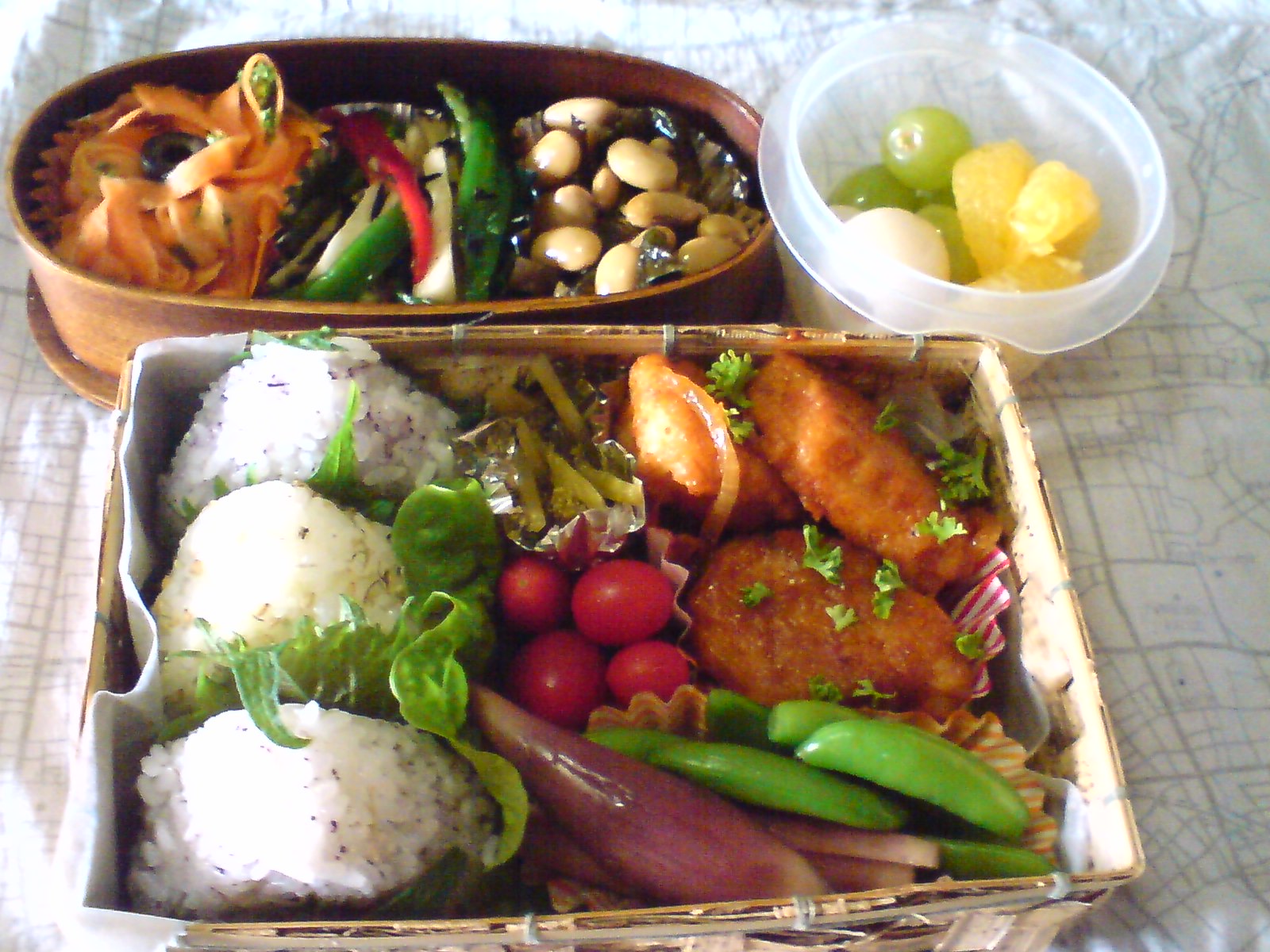
The Missus used that beautiful Aomori Prefecture cedar wood box again!

The rice had been left to soak overnight with water to which she had added musshrooms cooked beforehand and their juices (konbu seaweed was also included).
Having steamed it, she mixed the whole (the mushrooms were left on top of the rice while being steamed) and added boiled broad beans for colour, texture and fibers!

The “side dish” was quite elaborate and the Missus had some difficulties fitting everything in!

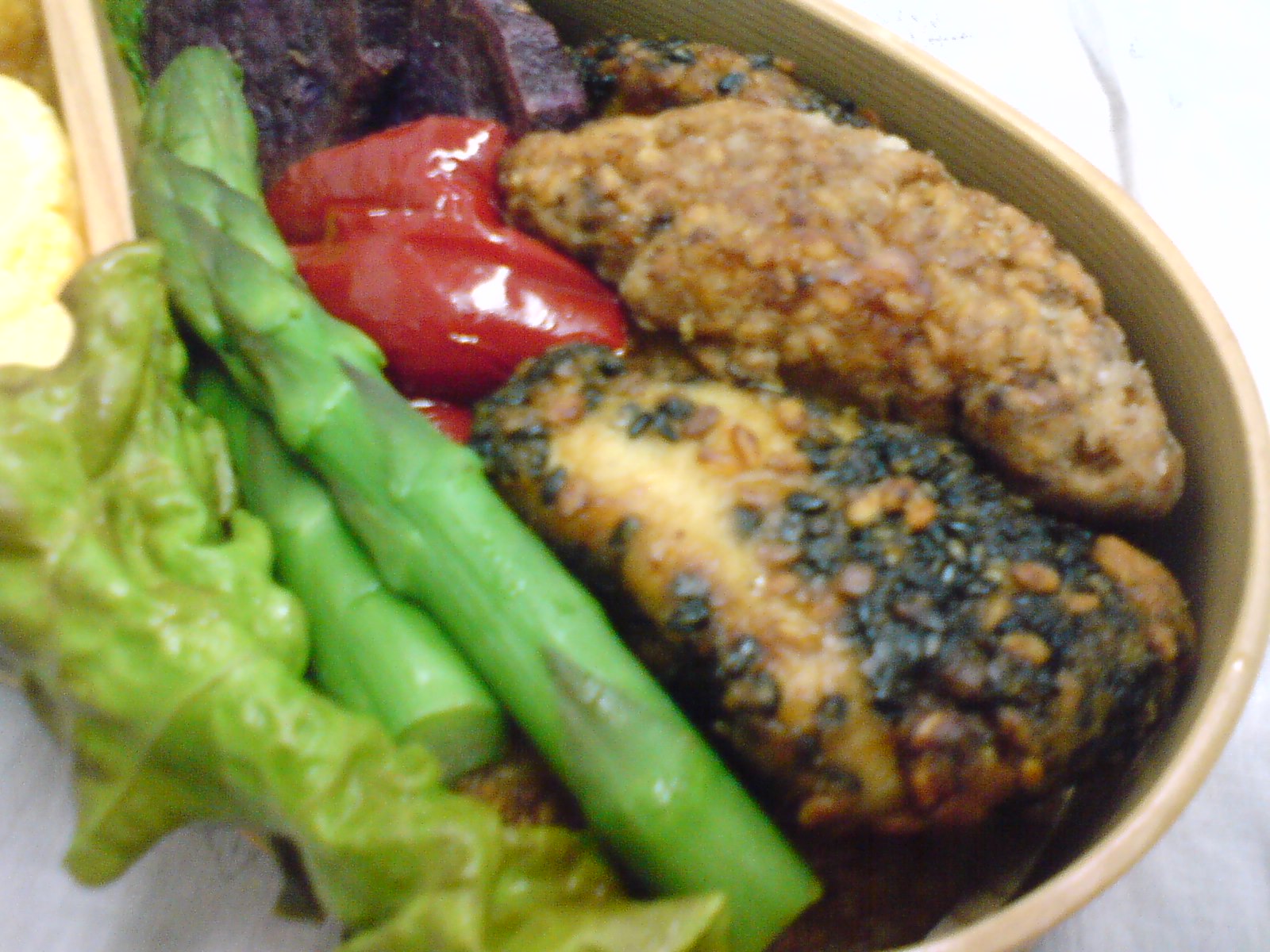
She shallow deep-fried two types of chicken sasami/chicken “tenderloins”, one with “white” sesame seeds, the other with black ones. She also fitted in some (boiled) green asparaguses and lettuce.

Tamagoyaki! Plain one, this ime!

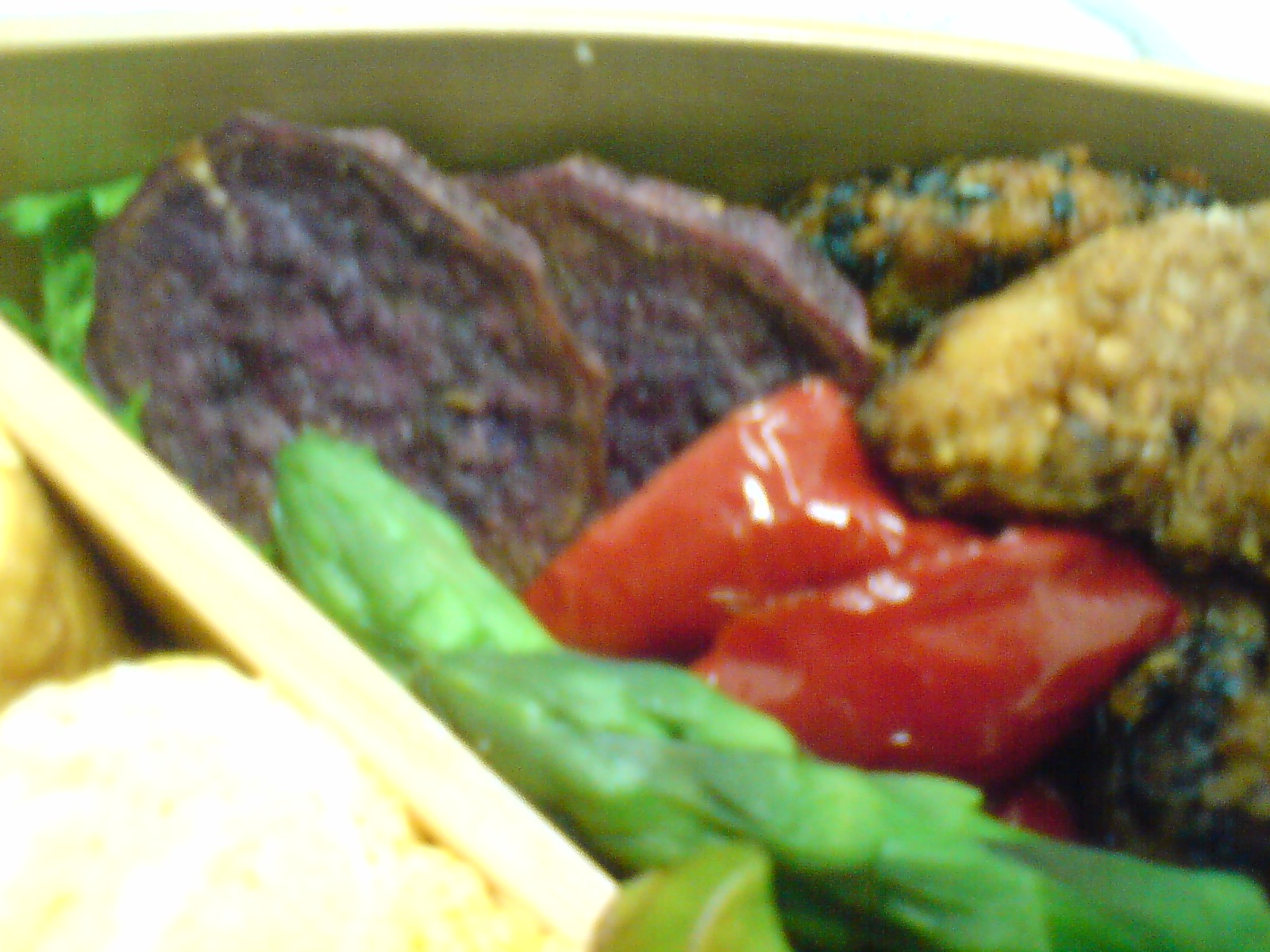
Extra vegetables included fried red sweet pimentoes and violet sweet potatoes/beni imo!

For dessert she gave me sliced green kiwi fruit and a new type of lemon/orange recently grown in our prefecture.

It is a very small type of orange or lemon (I will have to check the name) remiscent of a Meyer lemon, but deep yellw. The skin is quite thin and very fragrant (the latter wil go into the bath!) and the flesh very sweet and juicy!

It was certainly gratifying and bigger than it looked!

RECOMMENDED RELATED SITES:
Warren Bobrow, Bread + Butter, Zoy Zhang, Hungry Neko, Think Twice, Frank Fariello, Mangantayon, Hapabento, Elinluv Tidbit Corner, Tokyo Terrace, Maison de Christina, Chrys Niles,Lexi, Culinary Musings, Wheeling Gourmet, Comestiblog, Chronicles Of A Curious Cook, Bento Boutique, Tokyo Through The Drinking Glass, Tokyo Foodcast, Urban Sake, Sake World, Palate To Pen, Yellin Yakimono Gallery, Tokyo Terrace, Hilah Cooking, More than a Mount Full, Arkonite Bento

Please check the new postings at:
sake, shochu and sushi; Happy Little Bento

—————————————-
日本語のブログ
—————————————-

Baird Beer Awarded 3 Gold Medals at World Beer Cup 2010!

bryan-sayuri.gif

The Brewers Asociation Has Announced the winners of the World Beer Cup 2010!

Bryan Baird who brews Baird Beer in Naumazu has been awarded the Golds Medals in:

Category 8: Specialty Beer (27 Entries)
Beer name: Country Girl Kabocha Ale
Brewer: Baird Brewing Co., Numazu, Japan

Category 36: American-Style Amber Lager (24 Entries)
Beer Name: Numazu Lager
Brewer: Baird Brewing Co., Numazu, Japan

Category 42: Belgian- and French-Style Ale (57 Entries)
Beer name: Saison Sayuri
Brewer: Baird Brewing Co., Numazu, Japan

Sayuri and Bryan, congratulations and thanks for putting Numazu and Shizuoka on the Beer World Map!!


The Japan Blog List

———————————
Must-see tasting websites:
-Sake: Tokyo Through The Drinking Glass, Tokyo Foodcast, Urban Sake, Sake World
-Wine: Palate To Pen, Warren Bobrow, Cellar Tours
-Beer: Good Beer & Country Boys, Another Pint, Please!
-Japanese Pottery to enjoy your favourite drinks: Yellin Yakimono Gallery
——————————–
Please check the new postings at:
sake, shochu and sushi

—————————————-
日本語のブログ
—————————————-

Vegan Tofu Curry

As I said before, Koyadofu is one kind of tofu that can beasily arranged into all kinds of interesting appetizers in Japanese Homes’ Gastronomy!
Here is a simple suggestsion for a yummy lunch to be eaten by all, vegans, vegetarians aor omnivores:

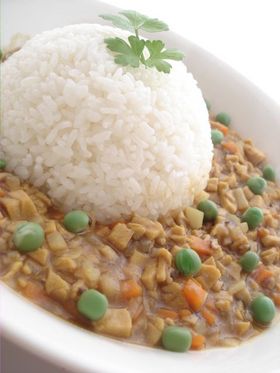
Vegan (Japanese) Tofu Curry!

INGREDIENTS: For 4 people

-Koyadofu: 5 sheets/85 g
-Carrot: 1 medium
-Onion: 1 medium
-Potato: 1 medium
-Shiitake mushrooms: 10 small
-Green peas: the equivalent of 1 small can/60 g
-Curyr powder (of your preference): 1~ tablespoon (I would use 2)
-Soy sauce: 2/3 tablepsoon
-Garan masala powder: 1/2 teaspoon

-Salad oil

-Steamed rice: count a large bowl per person

RECIPE:

-Cut the koyadofu into small bits and let them (if dry) soak in lukewram water until they get soft. Press the water out of them and keep in separate bowl. Finely chop the carrot, onion, potato, and shiitake mushroom. Keep in separate bowl. boil the green peas beforehand if necessary.

-Fry all chopped vegetables in salad oil for a while until the onions become translucent.

-Add some water and bring to boil. Remove any unwanted matter if necessary. Add chopped koyadofu. Cook until carrot are sufficently soft. Switch off fire. Add curry powder and mix quickly. Add soy sauce and garam masala and mix quickly. Switch on the fire and cook over small fire until you are satisfied withe the consistency of the whole.

On a dish turn over a bowl of rice and surround it like in the toppicture with curry to which you add the green peas at the last second (on directly “seeded” over it) for good effect.

RECOMMENDED RELATED SITES:
Warren Bobrow, Bread + Butter, Zoy Zhang, Hungry Neko, Think Twice, Frank Fariello, Mangantayon, Hapabento, Elinluv Tidbit Corner, Tokyo Terrace, Maison de Christina, Chrys Niles,Lexi, Culinary Musings, Wheeling Gourmet, Comestiblog, Chronicles Of A Curious Cook, Bento Boutique, Tokyo Through The Drinking Glass, Tokyo Foodcast, Urban Sake, Sake World, Palate To Pen, Yellin Yakimono Gallery, Tokyo Terrace, Hilah Cooking, More than a Mount Full, Arkonite Bento

Please check the new postings at:
sake, shochu and sushi

—————————————-
日本語のブログ
—————————————-

Foodbuzz 10,000 th Friend!

Taylor’s Foodbuzz Avatar

Today at 07.02 a.m., Sunday April 11th, that is 16.02, Saturday April 10th in the US, I had the pleasure to have my Foodbuzz Friendship request accepted by Greenschocolate!

Taylor’s website is actually greens & chocolate, a charming blog mostly about great homey desserts.
Taylor hails from Midwest America (US).

I’ve been a member at Foodbuzz since February 2008. Making 10,000 friends in the last 2 years and 2 months was certainly an unforeseen boo,
Incidentally I do not “collect” friends, but only make a point to greet any new Foodie on Foodbuzz. That is the least I can do!

Thanks to you for sahring the fun!

Robert-Gilles

RECOMMENDED RELATED SITES:
Warren Bobrow, Bread + Butter, Zoy Zhang, Hungry Neko, Think Twice, Frank Fariello, Mangantayon, Hapabento, Elinluv Tidbit Corner, Tokyo Terrace, Maison de Christina, Chrys Niles,Lexi, Culinary Musings, Wheeling Gourmet, Comestiblog, Chronicles Of A Curious Cook, Bento Boutique, Tokyo Through The Drinking Glass, Tokyo Foodcast, Urban Sake, Sake World, Palate To Pen, Yellin Yakimono Gallery, Tokyo Terrace, Hilah Cooking, More than a Mount Full, Arkonite Bento

Please check the new postings at:
sake, shochu and sushi

—————————————-
日本語のブログ
—————————————-

Japanese Cuisine: Koyadofu Cheese & Bacon Rolls

Koyadofu is one kind of tofu that can beasily arranged into all kinds of interesting appetizers in Japanese Homes’ Gastronomy!
Here is a simple suggestsion for yummy snack to be eaten by all, and with a good beer for adults!

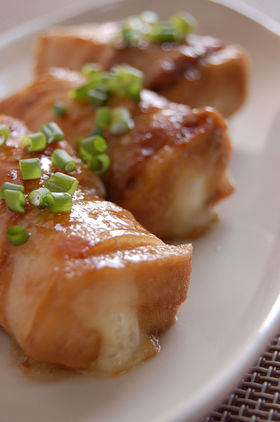
Koyadofu Cheese & Bacon Rolls

INGREDIENTS: For 8 rolls

-Koyadofu: 4 sheets or 80 g
-Sliced cheese: 2
-Flour: as appropriate
-Thin pork belly slices: 8
-Salad oil a little

SAUCE:
-Dashi/Japanese soup stock (if unavailable use bouillon of your choice): 1 cup/200ml/cc
-Soy sauce: 2 tablespoons
-Mirin/sweet Japanese sake: 2 tablespoons
-Sugar: 1 tablespoon

RECIPE:

-Soften the koyadofu into lukewarm water. Press water out firmly.
Cut each “sheet” into identical halves

-Cut the sliced cheese into 4 identical parts.

-Cut the koyadofu as shown in picture through 4 fifths of it depth. Insert a pice of sliced cheese inside the cut.

-Roll the koyadofu “sandwich” inside a slice of pork belly and sprinkle with flour.

-Heat some oil in frying pan. Place the rolls together with their “tails” down. Cover with glass lid and cook over medium fire until the meat is conpletely cooked and attained a nice colour.

-Add the sauce ingredients and cook turning the rolls 2 or 3 times until the juices have practically disappeare/evaporated.

-Serve on a plate with some chopped thin leeks and if desired sprinkle with a little chili pepper!

RECOMMENDED RELATED SITES:
Warren Bobrow, Bread + Butter, Zoy Zhang, Hungry Neko, Think Twice, Frank Fariello, Mangantayon, Hapabento, Elinluv Tidbit Corner, Tokyo Terrace, Maison de Christina, Chrys Niles,Lexi, Culinary Musings, Wheeling Gourmet, Comestiblog, Chronicles Of A Curious Cook, Bento Boutique, Tokyo Through The Drinking Glass, Tokyo Foodcast, Urban Sake, Sake World, Palate To Pen, Yellin Yakimono Gallery, Tokyo Terrace, Hilah Cooking, More than a Mount Full, Arkonite Bento

Please check the new postings at:
sake, shochu and sushi

—————————————-
日本語のブログ
—————————————-

Vegan Japanese Tofu Gratin

Gratin can become a problem for vegans as they usually involve the use of butter and milk.
Here is a simple recipe that will help you solve that problem:

Japanese Beans Gratin!

INGREDIENTS: For 1 person

-Tofu (kinudofu/Silk tofu) 1 block/300g
-Onion: 1
-Shiitake Mushrooms: 3
-Oil: 2 tablespoons
-Flour: 2 tablespoons
-Soy milk: 1 cup/200 cc/ml
-Miso: 1 tablespoon
-Salt & pepper: as appropriate

RECIPE:

-Cut/Dig out tofu block to a depth of 2 cm and leaving a 1 cm wide rim.

-In an oven dish cook the tofu block for 2 miutes 30 seconds in the microwave oven, take out and let rest for more than 3 hours.

-Chop the onion finely and cut the shiitake mushrooms in 5 millimeter/half a centimeter strips.

-Wrap the chopped onion in cellophane paper and cook in microwave oven for 1 minute.

-Pour some oil in a frying pan and sautee the onions. Once a nice smell cmes out the onions add the shiitake mushrooms and fry. Season with salt and pepper.

-Switch off the fire. Add the flour and mix well with a soft spatula.

-Add the soy milk and miso and mix. Switch on the fire and cook until the sauce has acquired a smooth texture. Switch off fire. (you may add the tofu dug out of the block!)

-Pour some oil in a clean frying pan and fry the tofu block on both sides until it attains a nice colour (see picture above).

-Serve the fried tofu on a dish and pour the onion-mushroom sauce on it!

NOTE:

-If you want to really look it like a gratin, you may grill the lot!

-Decorate with some leafy greens!

RECOMMENDED RELATED SITES:
Warren Bobrow, Bread + Butter, Zoy Zhang, Hungry Neko, Think Twice, Frank Fariello, Mangantayon, Hapabento, Elinluv Tidbit Corner, Tokyo Terrace, Maison de Christina, Chrys Niles,Lexi, Culinary Musings, Wheeling Gourmet, Comestiblog, Chronicles Of A Curious Cook, Bento Boutique, Tokyo Through The Drinking Glass, Tokyo Foodcast, Urban Sake, Sake World, Palate To Pen, Yellin Yakimono Gallery, Tokyo Terrace, Hilah Cooking, More than a Mount Full, Arkonite Bento

Please check the new postings at:
sake, shochu and sushi

—————————————-
日本語のブログ
—————————————-

Make your own Tofu (repeat)

zarudofu
“Zarudofu”, my favourite variety of tofu just filtered out in a “zaru/basket”. You just eat it with a spoon on its own. No seasoning needed!

Following a suggestion by Japansoc I decided to pst again the tofu recipe!
This article concerns the home-making of it!

Ingredients (for one large piece, one cho/”丁” in Japanese)

Soy beans: 2 cups (360cc)
Nigari: 2 large tablespoons
(Magnesium chloride is an important coagulant used in the preparation of tofu from soy milk. In Japan it is sold as nigari (the term is derived from the Japanese word for “bitter”), a white powder produced from seawater after the sodium chloride has been removed, and the water evaporated. In China it is called “lushui”.. Nigari or Lushui consists mostly of magnesium chloride, with some magnesium sulfate and other trace elements. It is also an ingredient in baby formula milk).
Water: 5 cups (twice and a half the volume of soy beans)

Utensils:
One large pot
One large clean cloth pouch to press tofu through
One bowl
One mixer
One thermometer
One large piece of gauze to filter water off shaped tofu
One large wooden spoon
One wooden tofu-shaper case

RECIPE:
toofu-1

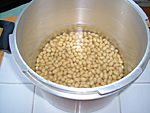
1) Preparation: soak soy beans in water overnight

toofu2

2) Preparation: Mix nigari with 1 cup of water and set aside

toofu-3

3) According to its size, Pour the whole or part by part soy beans and water (1) and make paste as fine as possible. If mixer runs at an even pace without crushing beans into paste, add more water. The paste obtained is called “namago” (生呉)

toofu-4

4) Pour the bean paste into a large pot with an equal amount of water. Heat stirring all the time. The paste will come to a boil suddenly. Switch off fire. Switch on low once the paste has settled for 10 minutes and take off fire.

toofu-5

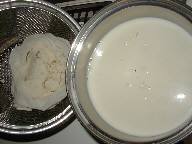
5) Pour paste into the cloth pouch and press. Right of the picture is tofu paste before pressing. Left is pressed out tofu

toofu-6

6) Solidifying (coagulating) with nigari.
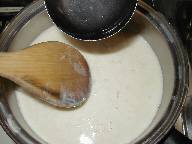
Stir tofu over light fire. When the temperature has reached 75~80 degrees Celsius pour in nigari slowly and stir all the time. The solid matter will sink to the bottom and accumulate. The coagulation will be complete when liquid above tofu has become transparent. Stop the operation and let rest for 15 minutes.

toofu-7

7) Arrange the gauze inside tofu a tofu shaper case which should have small holes to let excess water run out.

toofu-8

8) Cover with lid with a weight (or glass of water) of about 250 g and further press out water for 15 minutes

toofu-9

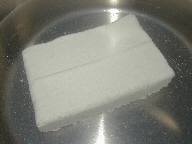
9) Delicately empty tofu in basin filled with called water and leave it there for an hour to take out excess nigari. Store in refrigerator.

RECOMMENDED RELATED SITES:
Warren Bobrow, Bread + Butter, Zoy Zhang, Hungry Neko, Think Twice, Frank Fariello, Mangantayon, Hapabento, Elinluv Tidbit Corner, Tokyo Terrace, Maison de Christina, Chrys Niles,Lexi, Culinary Musings, Wheeling Gourmet, Comestiblog, Chronicles Of A Curious Cook, Bento Boutique, Tokyo Through The Drinking Glass, Tokyo Foodcast, Urban Sake, Sake World, Palate To Pen, Yellin Yakimono Gallery, Tokyo Terrace, Hilah Cooking, More than a Mount Full, Arkonite Bento

Please check the new postings at:
sake, shochu and sushi

—————————————-
日本語のブログ
—————————————-
Koyadofu/Pressed Tofu Recipe

As promised here is the basic recipe to make Koyadofu/高野豆腐 or pressed tofu.

Koyadofu is extensively used in veganand vegetarian food in Japan.

It can also be deep-fried into great crunchy morsels!

INGREDIENTS:

-Tofu: 1 block/400 g (actually it is up to you!)

RECIPE:

-Place the tofu in a plate/bowl and let rest there for 10 minutes.  Throw away the water that comes out naturally. Cut the tofu into 3 “slices” across the width. You may skip that step and proceed with whole block.

-Wrap the tofu into cellophane paper and freeze the tofu inside the freezer of your refrigerator.

-Will be ready once completely frozen.
The trick is to press water out of the tofu once you have thawn it.
The tofu will have taken its colour and consistency naturally.

Recipe suggestion:

Prepare a stock soup with 1 cup of seaweed dashi/soup stock, 2 tablespoons of sugar, a little salt, 1 and a half teaspoons of mirin/sweet sake, and 1 and a half teaspoons of soy sauce.
Cook the koyadofu in it and serve once soft enough.

RECOMMENDED RELATED SITES:
Warren Bobrow, Bread + Butter, Zoy Zhang, Hungry Neko, Think Twice, Frank Fariello, Mangantayon, Hapabento, Elinluv Tidbit Corner, Tokyo Terrace, Maison de Christina, Chrys Niles,Lexi, Culinary Musings, Wheeling Gourmet, Comestiblog, Chronicles Of A Curious Cook, Bento Boutique, Tokyo Through The Drinking Glass, Tokyo Foodcast, Urban Sake, Sake World, Palate To Pen, Yellin Yakimono Gallery, Tokyo Terrace, Hilah Cooking, More than a Mount Full, Arkonite Bento

Please check the new postings at:
sake, shochu and sushi

—————————————-
日本語のブログ
—————————————-

Vegan Japanese Burger

Here is another simple recipe to convince my friends that Japan is a great country for vegans and vegetarians (and omnivores!)!

Vegan Japanese Burger!

INGREDIENTS:

Koyadoufu as sold in Japan either in single sheets or ready cut.

Koyadiufu cuisine example

Koyadoufu/高野豆腐 is tofu which has been pressed hard to almost a solid state although it still possesses an elastic and tender quality.
It is available in Asian markets either dried or preserved in light brine.

I will post the recipe very soon!

-Koyadofu: 1 “sheet” or approximately 100 g (wet weight)
-Boiled soy beans: 1/2 cup
-Carrot: 1/2
-Cabbage: 2 leaves
-Black pepper: a litle
-Miso: 1 teaspoon
-Tomato puree: 1 teaspoon
-Oil: 1 tablespoon
-Flour: 2 tablespoons
-Potato: 1
-Soy milk: 5 tablespoons
-Salad oil: 3 tablespoons
-Salt: a small pinch

RECIPE:

-If the koyadofu is dry let in rest in lukewarm water until it has come back to its soft state. Press the water out hard and chop finely.

-Drop the boiled soy beasn in a food processor/mixer to “chop” finely. Don’t make a paste!

-Chop the carrot finely. Cut the the cabbage leaves into very thin strips>

-Fry the carrot and cabbage in a fry pan with oil and black pepper.

-Once the oil has coated the carrot and cabbage well, reduce fire to low, cover with a lid and steam fry for a while.

-Once the carrot and cabbage are cooked add the miso, tomato puree, chopped koyadoufu, soy beans, and continue steam-frying for a little while.
Switch off the fire.
Add the flour and mix.

-Let cool long enough to be able to handle it.
Form a burger and place on an oiled oven hot plate.

-Peel the potato and cook it in a microwave oven until tender (or boil it beforehand).

-Let the potato cool down before dropping it in the food processor with the soy milk and salad oil. Mash the potato, but don’t process too long or te potato willbecome glue!

-Season with a little salt and cover the burger with it.

-Bake for 10 minutes at 190 degrees Celsius or until it has reached a clour of your liking!

RECOMMENDED RELATED SITES:
Warren Bobrow, Bread + Butter, Zoy Zhang, Hungry Neko, Think Twice, Frank Fariello, Mangantayon, Hapabento, Elinluv Tidbit Corner, Tokyo Terrace, Maison de Christina, Chrys Niles,Lexi, Culinary Musings, Wheeling Gourmet, Comestiblog, Chronicles Of A Curious Cook, Bento Boutique, Tokyo Through The Drinking Glass, Tokyo Foodcast, Urban Sake, Sake World, Palate To Pen, Yellin Yakimono Gallery, Tokyo Terrace, Hilah Cooking, More than a Mount Full, Arkonite Bento

Please check the new postings at:
sake, shochu and sushi

—————————————-
日本語のブログ
—————————————-

Japanese Snack: Wasabi, Umeboshi & Avocado Salad

SYNOPSIS:

Living in a Prefecture that grows 80% of all wasabi in Japan, I thought it was about time I came up with a few recipes with wasabi!

I fully understand that wasabi and wasabi paste is not readily available outside Japan, but if you have the chance to get at least a tube of real wasabi, I a a few recipes for you that requires only a little of the precious stuff.
Bear in mind that wasabi (as well as umeboshi!) is a natural medicine by itself, one more reason for you to buy some.

As for the following recipe, the second one, vegans and vegetarians can substitute the mayonnaise with gomadare/sesame sauce or a simple vinaigrette with olive oil, wine vinegar, salt pepper and wasabi!

Wasabi, Umeboshi & Avocado Salad:

INGREDIENTS: For 1~2 persons

-Avocado: 1 (choose a ripe one!)
-Umeboshi/Japanese pickled plum: 1 (if you don’t want too much salt, choose a sweet one!)
-Mayonnaise: 1 teaspoon
-Wasabi paste: 1/2 teaspoon
-Soy sauce: 1 teaspoon
-Lemon juice: as appropriate
-Nori/dry seaweed: as appropriate

RECIPE:

-Cut avocado in halves, peel, discard seed and cut into samll enough pieces. Drop them in a bowl. Add the lemon juice and stir delicately. Very iportant as it will preserve the colour of the avocado and add to taste.

-Take out and discard the umeboshi seed and chop/mash fine. Add to avocado and stir delicately.

-Add mayonnaise (or vinaigrette), wasabi, soy sauce and stir/mix delicately.

-Serve in a bowl topped with dry seaweed cut in short and thin strips.

NOTE:

-Add peeled orange wedges for looks and taste!

So easy, isn’t it?

RECOMMENDED RELATED SITES:
Warren Bobrow, Bread + Butter, Zoy Zhang, Hungry Neko, Think Twice, Frank Fariello, Mangantayon, Hapabento, Elinluv Tidbit Corner, Tokyo Terrace, Maison de Christina, Chrys Niles,Lexi, Culinary Musings, Wheeling Gourmet, Comestiblog, Chronicles Of A Curious Cook, Bento Boutique, Tokyo Through The Drinking Glass, Tokyo Foodcast, Urban Sake, Sake World, Palate To Pen, Yellin Yakimono Gallery, Tokyo Terrace, Hilah Cooking, More than a Mount Full, Arkonite Bento

Please check the new postings at:
sake, shochu and sushi

—————————————-
日本語のブログ
—————————————-

Vegan Japanese Snack: Imo & Wasabi

Living in a Prefecture that grows 80% of all wasabi in Japan, I thought it was about time I came up with a few recipes with wasabi!

I fully understand that wasabi and wasabi paste is not readily available outside Japan, but if you have the chance to get at least a tube of real wasabi, I a a few recipes for you that requires only a little of the precious stuff.
Bear in mind that wasabi is a natural medicine by itself, one more reason for you to buy some.
The present recipe also include yama imo/山芋, or long yam, which also so good for stamina and health!

Vegan Japanese Snack: Imo & Wasabi

INGREDIENTS: For 2 people

-Long yam (fresh): 7 cm long piece
-Mitsuba/Trefoil/Japanese honeywort
-Dry seaweed/nori: as appropriate
-Soy sauce: 1 teaspoon
-Wasabi paste: 1/2 teaspoon
-Soy sauce for “washing”: 1 teaspoon

RECIPE:

-Peel the yam and cut into pieces of your preferred size.
If you are sensitive to the yam “juice”, freeze it first!

-Boil the trefoil lightly and for only a short time. Drain and press water out. Add the soy sauce “for washing”, mix and press the the trefoil again!
Cut the trefoil into 1 cm long pieces.

-In a bowl mix the yam and trefoil with the soy sauce and wasabi. Mix well.
Place in serving dish topped with dry seaweed cut into short thin strips.

-You may add many green leaf veg to this recipe of course and decorate it with sliced red radihes for example!

RECOMMENDED RELATED SITES:
Warren Bobrow, Bread + Butter, Zoy Zhang, Hungry Neko, Think Twice, Frank Fariello, Mangantayon, Hapabento, Elinluv Tidbit Corner, Tokyo Terrace, Maison de Christina, Chrys Niles,Lexi, Culinary Musings, Wheeling Gourmet, Comestiblog, Chronicles Of A Curious Cook, Bento Boutique, Tokyo Through The Drinking Glass, Tokyo Foodcast, Urban Sake, Sake World, Palate To Pen, Yellin Yakimono Gallery, Tokyo Terrace, Hilah Cooking, More than a Mount Full, Arkonite Bento

Please check the new postings at:
sake, shochu and sushi

—————————————-
日本語のブログ
—————————————-

Gastronomic Cycling in Shizuoka: 8-Takajo Story 1

Picture of Falcon/Taka at Inari Shinto Shrine

Takajo is one of the oldest traditional quarters/precincts (in Japanese 町. Pronouce “machi” or “chyo”) in Shizuoka City.
It already existed more than 500 years ago when our city had a different name, Sumpu, and the Shogun Tokugawa Ieayasu came here to retire from politics.
The city and its depedencies were then divided into precise “machi”, each defined by the craft or profession of its inhabitants.
Takajo/鷹匠, meaning falconry was initially occupied by falcon breeders and their families. Falconry was a favourite past time of the nobility and a statue of Tokugawa Ieyasu with a falcon standing on his wrist is a celebrated sight in town. Accordingly the falconry guild wielded a lot of power in the daily affairs of the city.
Whether it stretched then as far as it presently does is difficult to verify, but the main shinto shrine, Inari Jinja, clearly indicates it lay near Sumpu Castle acroos from the precinct called Sumpu-Jo, the political centre of the City in Edo Era.

The Inarai Shinto Shrine in Takajo 1 Cho-me.

Although the name of Takajo had existed as the name of a village for more than 500 years, it got official recognition as the name of a distinct village only in 1876 and was finally incorporated into Shizuoka City, which has changed its name from Sumpu, in 1890 with three subdivions, or cho/丁 (or called cho-me/丁目 when counted).
In 1945 a part of the third “cho” was incorporated in neighbouring Tenma-Cho, and again in 1966 some areas of Takajo became part of Sumpu-Jo district.

Inari Shinto Shrine/稲荷神社 is probably the oldest living site (although it has been rebuilt numerous times) as it was erected in 1631. It was officially recognized as the Shinto Shrine of Takajo first “cho” in 1879 by the Meiji Emperor Govenment.
For all these years I have lived and worked almost across the road, I haven’t heard yet of an ofiicial shrine for the second and third “cho”.

As Shizuoka City was in great part destroyed during WWII, Takajo grew again in a somewhat haphazard manner in spite of its straight narrow streets.
For long it was a fairly drab residential area with dark alleys at night, although it never bore a notorious reputation.

If you look around, that is along the “back streets”, you still can find old tradional Japanese houses!

Until the 1980’s questions and queries about that particular area did not raise as mauch as an eyebrow, but with the end of the bubble economy, this quiet and almost comatose part of the city suddenly became the focus of many a shop owner’s attention, be they restaurants, bars, fashion shops, antique shops or cake shops to the point that Takajo was soon dubbed as the “Daikanyama” of Shizuoka City in imitation of the fashionable district in Tokyo.

Pupan, a high quality but expensive cake shop/bakery.

The area has now become so replete with “small” businesses that is has become a destination ofits own worth for shoppers and revellers at any times of the day and night.
One would sorely be tried to describe the whole district in a pre-ordained manner unless one would be pedantic enough to grid it into a meaningless pattern. It is simply a maze (I was going to say an amazing labyrinth) and one had better follow his/her instinct when exploring it!

Look out for some beautiful noren/暖簾 or shop entrance curtains, especially old homes reclaimed as restaurants!

The best ay to vist the whole place at leisure is naturally my good bicycle which allows me to rapidly reach a certain spot where I will leave it (don’t worry, nobody is going to steal it!) before I can espy places of interest and steal a picture or two:

Inari Shinto Shrine entrance as seen from the shrine front yard.

This very old shop sells “Abekawa Mochi”, a traditional wagashi/Japanese cake made in this city for than 400 years!

Another noren/暖簾, shop entrance curtain!

This place sells succulent soft ice creams made with matcha tea and kinako!

Do you remember the pasta at this Italian Restaurant?

And the Foie gras at this French restaurant?

Alright, I’ll start introducing (re-introducing)them all with other sights from the next posting!LOL
It promises to be loooonnnngggg series!

RECOMMENDED RELATED SITES:
Warren Bobrow, Bread + Butter, Zoy Zhang, Hungry Neko, Think Twice, Frank Fariello, Mangantayon, Hapabento, Elinluv Tidbit Corner, Tokyo Terrace, Maison de Christina, Chrys Niles,Lexi, Culinary Musings, Wheeling Gourmet, Comestiblog, Chronicles Of A Curious Cook, Bento Boutique, Tokyo Through The Drinking Glass, Tokyo Foodcast, Urban Sake, Sake World, Palate To Pen, Yellin Yakimono Gallery, Tokyo Terrace, Hilah Cooking, More than a Mount Full, Arkonite Bento. Island Vittles, Skewer It!

Please check the new postings at:
sake, shochu and sushi

—————————————-
日本語のブログ
—————————————-

Japanese Seasonal Fish: Torafugu/Tiger Puffer

Torafugu or Tiger Puffer is one of more than a 100 hundred varieties of edible Puffer Fish or Globe Fish, but Tiger Puffer is by a great distance the most popular variety in Japan!

It is also known in Japanese as Honfugu/本河豚 or Oofugu/大河豚.
The main season is Winter and a little later for other regions.
It is caught on both sides of Japan especially in Central and East Japan.
It is a specialty in Hamamatsu in our Shizuoka Prefecture.

11,000 tonnes are caught yearly around Japan.
It is bred in Japan to the tune of 4,700 tonnes.
13,000 tonnes are mainly imported from China and South Korea.

In Japan, although it can be bought already dressed, one needs a special license to cut it, serve it, or sell it as the innards contain a violently lethal poison, although cheap fugu (not torafugu) does not always contain such toxin!

Cheap fugu can be eaten raw as sashimi all over Japan.

But more expensive torafugu sashimi is served as a piece of art!

As sashimi, it is best avoured with leeks, lemon, momijioroshi/grated daikon with chili pepper and ponzu!

As sushi, it can be served fairly plain.

Or aburi/炙り, lightly seared on one side!

Or more artistically with sansho and herbs!

Or even with its skin as the latter is edible!

It can also be served as gunkan seasoned with its own liver: a true delicacy!

Shirako/白子 or male spem sacs are also a delicay!

Torafugu can anturally be cooked, especially the bony parts full of meat but difficult to cut. My favourite is karaage/唐揚, deep-fried!

It is also very popular in cold weather a nabe/鍋 in Japan,

and in South Korea!

RECOMMENDED RELATED SITES:
Warren Bobrow, Bread + Butter, Zoy Zhang, Hungry Neko, Think Twice, Frank Fariello, Mangantayon, Hapabento, Elinluv Tidbit Corner, Tokyo Terrace, Maison de Christina, Chrys Niles,Lexi, Culinary Musings, Wheeling Gourmet, Comestiblog, Chronicles Of A Curious Cook, Bento Boutique, Tokyo Through The Drinking Glass, Tokyo Foodcast, Urban Sake, Sake World, Palate To Pen, Yellin Yakimono Gallery, Tokyo Terrace, Hilah Cooking, More than a Mount Full, Arkonite Bento. Island Vittles, Skewer It!

Please check the new postings at:
sake, shochu and sushi

—————————————-
日本語のブログ
—————————————-