Tag Archives: 静岡

Jouren/常連/Regular Customers: A Japanese Tradition

At Yasaitei,….

The Japanese are in perpetual search for harmony.
This constant pursuit of “wa/和” preoccupies them not only at the office with their fellow workers, at home with their family, but also, and probably most, when taking a pleasurable respite at the table or counter of their favorite restaurant or bar.

Whereas in many other countries patronizing the same establishment on a regular basis might be considered at best as an ostentatious show, and a disreputable habit at worst, eating and drinking out in Japan is a sine qua non prerequisite to a successful life, both professional and social.

“Jouren” can be loosely translated as “regular customer”, although the term does not give justice to its real meaning.
The jouren is an essential feature at any establishment worth its salt. He will usually sit quietly at the end of the counter if he is the only one present at the time, or next to another regular.
Now, if you observe him carefully (unobtrusively) you will notice that he is served food and drinks without orders or enquiries. There is a clear reason to that: the oyakata/chef or ofukuro/lady owner knows what the jouren likes to eat and drink within a tacitly agreed budget.
The jouren is not necessarily a well-off person, but he is a vital actor in the gastronomic theater because he will occasionally come out of his reserve to gently recommend a dish or concoction when he notices a new customer experiencing some difficulty in choosing from an unknown menu. Very often a Japanese client will (politely) ask the local jouren for advice and enquire on the very food he is eating or on the best drink available.

At Tomii,…

Another peculiarity you will not fail to mark is that the jouren usually takes his leave without paying. He simply has a bill in the books that he will pay at a more or less determined date away from the inquisitive eyes of other diners and drinkers. This last arrangement is more practical for the owner’s accounts and tax returns. You will know that you have become a jouren the day or night the owner tells you to pay later, which of course means that he/she expects you to grace the place again soon!

Be it a posh kaiseki restaurant, an expensive sushi bar, a simple but popular izakaya, or a late night cocktail lounge, the “rules” are the same.
The jouren possesses an unfailing instinct as to the timing of his visits. He will avoid the really busy period of the evening, and will retreat with a smile and wave when his favorite haunt is unseasonably busy. He will also take leave when other customers start flowing in. On the other hand, a jouren will get full satisfaction and no questions asked if he requests a few seats for a party or some friends. Simply put, he is priority.

Jouren usually has his/her “bottle keep”, or own bottle of favourite spirits in situ, although the notion can be double-edged. Some izakayas or Japanese restaurants and bars make it rule for all customers, regular or not to acquire their own bottle with the attached condition that it must be consumed within a certain time limit. But a real jouren at an establishment worthy of its salt will probably keep a hard to find whisky or an extravagant shochu for his/her sole usage. On the other hand, if the jouren kindly offers you a glass of his/her own nectar, you may assume you will be part of the selected clientele very soon!

At Ekimae matsuno Sushi,…

Japanese owners value their jouren very much for another reason.
In a tightly preordained world where the customer and the owner/chef are literally sitting on either side of a rigid fence, the jouren becomes an indispensable interlocutor you can talk shop with or even ask for advice. Japanese chefs have very little free time to spend outside work and take the pulse of their society to keep in touch with the prevalent trends of their fellow citizens. The jouren will bring in the news and information on any subject and the answers to questions that the chef will not hesitate to ask.
It works both ways: high-class geishas in Kyoto, who are not mere entertainers, do make a point to read at least two or three daily newspapers every morning, including one financial tabloid to ensure they can not only follow their clients’ conversations but give their own advice when solicited.

The nationality of a jouren is of little importance. Being a Japanese fluent foreigner is actually an advantage as some social restrictions inherent to the Japanese society can easily be done without.
As a case in point a great majority of celebrated resident foreign chefs spend most of their free time patronizing local sushi and kaiseki restaurants for the dual purpose of relaxation and study in great company!

As a final word do not think jouren are exclusively male clients. There are certainly many ladies among them, although they will generally patronize a different type of establishment. But the same “rules” and traditions apply!

RECOMMENDED RELATED SITES:
Warren Bobrow, Bread + Butter, Zoy Zhang, Hungry Neko, Think Twice, Frank Fariello, Mangantayon, Hapabento, Elinluv Tidbit Corner, Tokyo Terrace, Maison de Christina, Chrys Niles,Lexi, Culinary Musings, Wheeling Gourmet, Comestiblog, Chronicles Of A Curious Cook, Tokyo Through The Drinking Glass, Tokyo Foodcast, Urban Sake, Sake World, Palate To Pen, Good Beer & Country Boys, Another Pint, Please!, Yellin Yakimono Gallery, Tokyo Terrace, Hilah Cooking

Please check the new postings at:
sake, shochu and sushi

—————————————-
日本語のブログ
—————————————-

Noren/暖簾/Shop Curtains: A Japanese Tradition 2

A very traditional style for a oden-ya!

When visiting Japan, have you ever noticed those unusual “curtains” hanging outside the main entrance of traditional shops, izakayas and sometimes of private homes?
They are called “noren”.

Noren (暖簾) are traditional Japanese fabric dividers, hung between rooms, on walls, in doorways, or in windows. They usually have one or more vertical slits cut from the bottom to nearly the top of the fabric, allowing for easier passage or viewing. Noren are rectangular (but not always a rule) and come in many different materials, sizes, colors, and patterns.

Noren are traditionally used by shops and restaurants as a means of protection from sun, wind, and dust, and for advertising space. Sentō (commercial bathhouses) also place noren across their entrances, typically blue in color for men and red for women with the kanji 湯 (yu, litterally hot water) or the corresponding hiragana ゆ. They are also hung in the front entrance to a shop to signify that the establishment is open for business, and they are always taken down at the end of the business day.

There are still many left in Shizuoka City and Prefecture in spite of all that modernizing and I do meet a lot of them along my bicycle wanderings. It would be a pity not to share their sight, as it would make for beautiful souvenirs to take back home next time you visit Japan!

Accordingly here is the second of hopefully many postings on those little beauties!

A large noren for a large izakaya, Taihei!

A double entrance for that izakaya with the noren inside a torii gate!

Elegant rabbit!

Great calligraphy!

Very modern approach by this cheaper kind of izakaya!

A traditional matsuri/festival “flag”!

More coming soon!

RECOMMENDED RELATED SITES:
Warren Bobrow, Bread + Butter, Zoy Zhang, Hungry Neko, Think Twice, Frank Fariello, Mangantayon, Hapabento, Elinluv Tidbit Corner, Tokyo Terrace, Maison de Christina, Chrys Niles,Lexi, Culinary Musings, Wheeling Gourmet, Comestiblog, Chronicles Of A Curious Cook, Tokyo Through The Drinking Glass, Tokyo Foodcast, Urban Sake, Sake World, Palate To Pen, Good Beer & Country Boys, Another Pint, Please!, Yellin Yakimono Gallery, Tokyo Terrace, Hilah Cooking

Please check the new postings at:
sake, shochu and sushi

—————————————-
日本語のブログ
—————————————-

Oden at Yasaitei

Service: Excellent and very friendly
Facilities: very clean
Prices: reasonable
Specialty: Vegan and vegetarian Cuisine, Izakaya gastronomy, local products, oden.

I’ve already extensively written about oden the Japanese comfort food, but it is always a pleasure to introduce restaurants and izakayas awhich serve the higher quality.
Yasaitei has been introduced in this blog for its vegan delights many a time, but it also serves very extravagant oden I might need a couple articles on that single subject!).

But let’s start from the beginning!

Like in most izakayas, a o-toshi/snack will come with the first drink (bear in mind that you ususally have to pay for it!). Teh quality of that very snack is good indication of the level attained by the establishment!

“Shugijku no goma ae”: Edible Spring Chrysanthemum leaves (lightly boiled) and thinly cut (and fried) aburaage (deep-fried tofu sheets) seasoned with a sesame dressing.

In Yasaitei, I usually order shochu as they have a few from Shizuoka Prefecture on hand.
This particular one is a favourite of mine. It is a kome shochu/rice shochu called Doman, the name of a rare crab found in Hamana lakein the Western part of Shizuoka Prefecture. The shochu is distilled by Tenjingura-Hamamatsu Brewery.

As for the oden served in Yasaitei they are Kansai/Western Japan style, that is they are stewed in very clear broth with an accent on light flavours. Yasaitei will serve the combination of your choice with a small piece of yuzu lime in the broth, plenty of finely chopped scallions and some yuzu koshio/lime and pepper seasoning mixture.

There is no way I could order all the varieties in one serving, so I decided for 5 of them and will taste the others next time!
Looking from the left, you will noticethe little piece of yuzu floating. Just touching the lime pice is a “ganmo”, a light variety of deep-fried tofu, very fluffy and containg little bits of vegetables and seaweed.
The egg itself has been boiled and then slowly stewed in the broth.
The two balls skered on a stick are “shinjyo age”, fish paste which had been deep-fried first. The two grayish slices in front are “Suji” made of sardine and other fish paste. Not to be confused with the eponymous “suji”, meaning beef tendons, which are also a popular oden morsel. The tube on the right is “chikuwa”, made from fish paste like kamaboko, then stuck around a stick and grilled.
All ingredients have simmered in the broth (around 80 degrees Ceksus) for some time, although not as long as Typical Shizuoka oden.

For a closer view.
It is very healthy food, although packed with good calories!

For a side view. The spoon is lacquered, very soft on the tongue!

YASAITEI
Shizuoka City, Aoi Ku, Tokiwa-Cho, 1-6-2 Green Heights Wamon 1-C
Tel.: 054-2543277
Business hours: 17:30~22:00
Closed on Sundays
Reservations highly recommended
Seating: 6 at counter + 20 at tables
Set Courses: 3,000, 4,000, 5,000 yen
HOMEPAGE (Japanese)

RECOMMENDED RELATED SITES:
Warren Bobrow, Bread + Butter, Zoy Zhang, Hungry Neko, Think Twice, Frank Fariello, Mangantayon, Hapabento, Elinluv Tidbit Corner, Tokyo Terrace, Maison de Christina, Chrys Niles,Lexi, Culinary Musings, Wheeling Gourmet, Comestiblog, Chronicles Of A Curious Cook, Tokyo Through The Drinking Glass, Tokyo Foodcast, Urban Sake, Sake World, Palate To Pen, Good Beer & Country Boys, Another Pint, Please!, Yellin Yakimono Gallery, Tokyo Terrace, Hilah Cooking

Please check the new postings at:
sake, shochu and sushi

—————————————-
日本語のブログ
—————————————-

Noren/暖簾/Shop Curtains: A Japanese Tradition 1

A beautiful turnip noren at Tomii, Shizuoka City!

When visiting Japan, have you ever noticed those unusual “curtains” hanging outside the main entrance of traditional shops, izakayas and sometimes of private homes?
They are called “noren”.

Noren (暖簾) are traditional Japanese fabric dividers, hung between rooms, on walls, in doorways, or in windows. They usually have one or more vertical slits cut from the bottom to nearly the top of the fabric, allowing for easier passage or viewing. Noren are rectangular (but not always a rule) and come in many different materials, sizes, colors, and patterns.

Noren are traditionally used by shops and restaurants as a means of protection from sun, wind, and dust, and for advertising space. Sentō (commercial bathhouses) also place noren across their entrances, typically blue in color for men and red for women with the kanji 湯 (yu, litterally hot water) or the corresponding hiragana ゆ. They are also hung in the front entrance to a shop to signify that the establishment is open for business, and they are always taken down at the end of the business day.

There are still many left in Shizuoka City and Prefecture in spite of all that modernizing and I do meet a lot of them along my bicycle wanderings. It would be a pity not to share their sight, as it would make for beautiful souvenirs to take back home next time you visit Japan!

Accordingly here is the first of hopefully many postings on those little beauties!

A long, sober and narrow one. Pristine white!

For the night owls!

Chibariyo, an Okinawa restaurant.

Izakaya noren: Kurumaya.

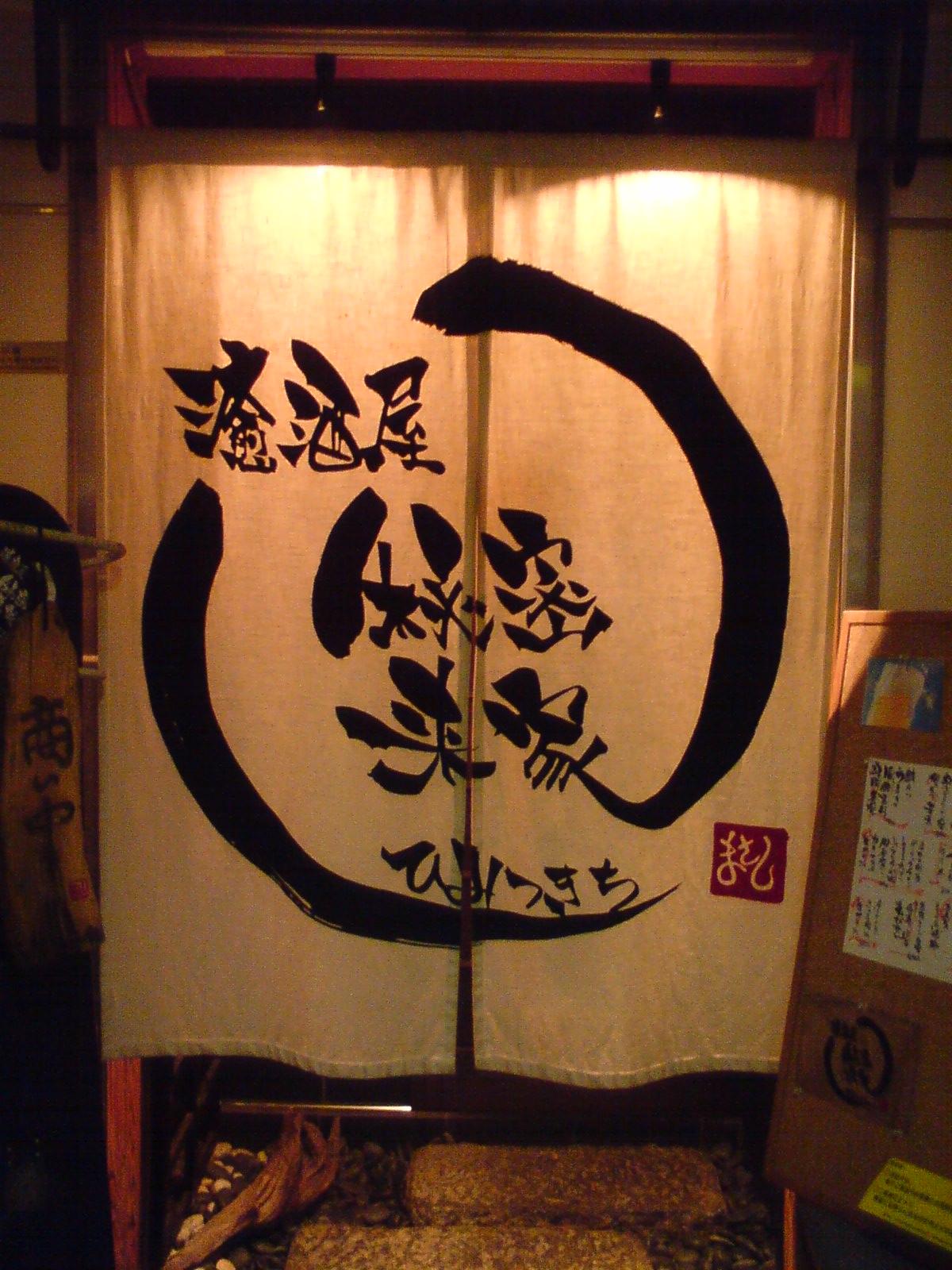
Another izakaya nore, very feminine?

Simple design and pretty complicated characters!

Mishimaya, a Soba Restaurant. Very basic and simple.

Masa Sushi Restaurant. Another basic and simple Noren.

More colourful ones coming soon!

RECOMMENDED RELATED SITES:
Warren Bobrow, Bread + Butter, Zoy Zhang, Hungry Neko, Think Twice, Frank Fariello, Mangantayon, Hapabento, Elinluv Tidbit Corner, Tokyo Terrace, Maison de Christina, Chrys Niles,Lexi, Culinary Musings, Wheeling Gourmet, Comestiblog, Chronicles Of A Curious Cook, Tokyo Through The Drinking Glass, Tokyo Foodcast, Urban Sake, Sake World, Palate To Pen, Good Beer & Country Boys, Another Pint, Please!, Yellin Yakimono Gallery, Tokyo Terrace, Hilah Cooking

Please check the new postings at:
sake, shochu and sushi

—————————————-
日本語のブログ
—————————————-

Italian Restaurant: Lunch at Il Castagno (’10/02/28)

Service: Excellent and very friendly
Facilities: clean
Prices: reasonable
Specialty: Central and south Italian-style cuisine. Home-made pasta. Very reasonables prices
no-smoking-logoentirely non-smoking!

I’ve heard that some countries are suffering from unusually unclement weather (snow drifts in the US and floods in Western Europe), and here we are assailed by sudden chages in temperatures going as far 13 degrees Celsius within 24 hours.
Last Sunday was not a day for sport and I decided to do some work at the office as the Missus is away working for an orthondontist (Sunday is the busiest day).
As usual I felt ravnous at lunch time and decided to have some proper food at neighbouring Il Castagno, a very reasonable and extremely popular Italian restaurant.

They have eminently drinkable wines at very reasonable prices, and I always end up drinking a couple of glasses in spite of the early hour (that is for drinking!).

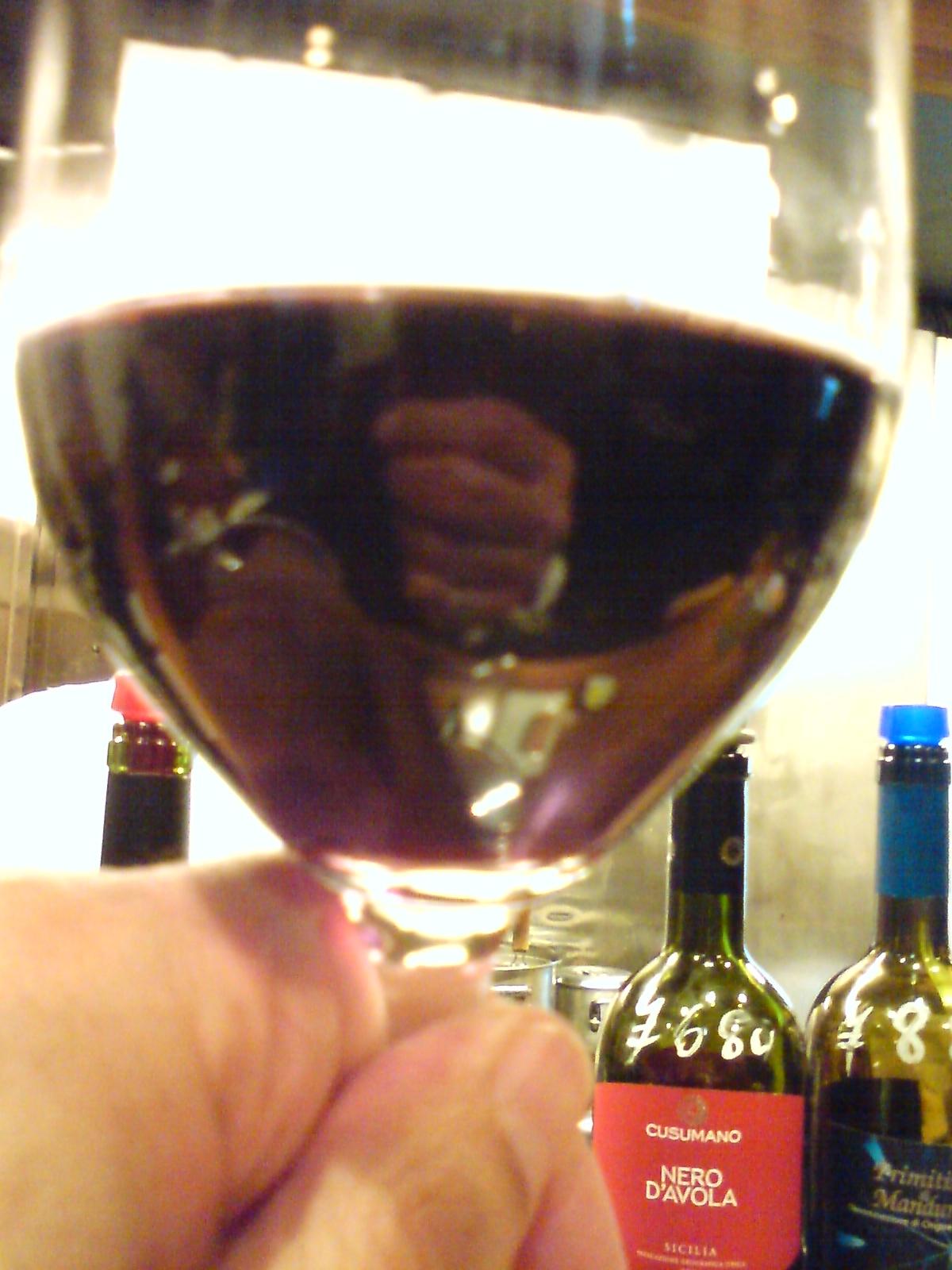
A bit strange picture as you can see my fist holding the glass in side the glass!
Wine: Chianti, Villa Puccini Riserva, 2004. Grapes: Sangiovese+Cabernet Sauvignon+Canaiolle.
Solid and and pleasant Chianti

I opted for the full lunch set menu.
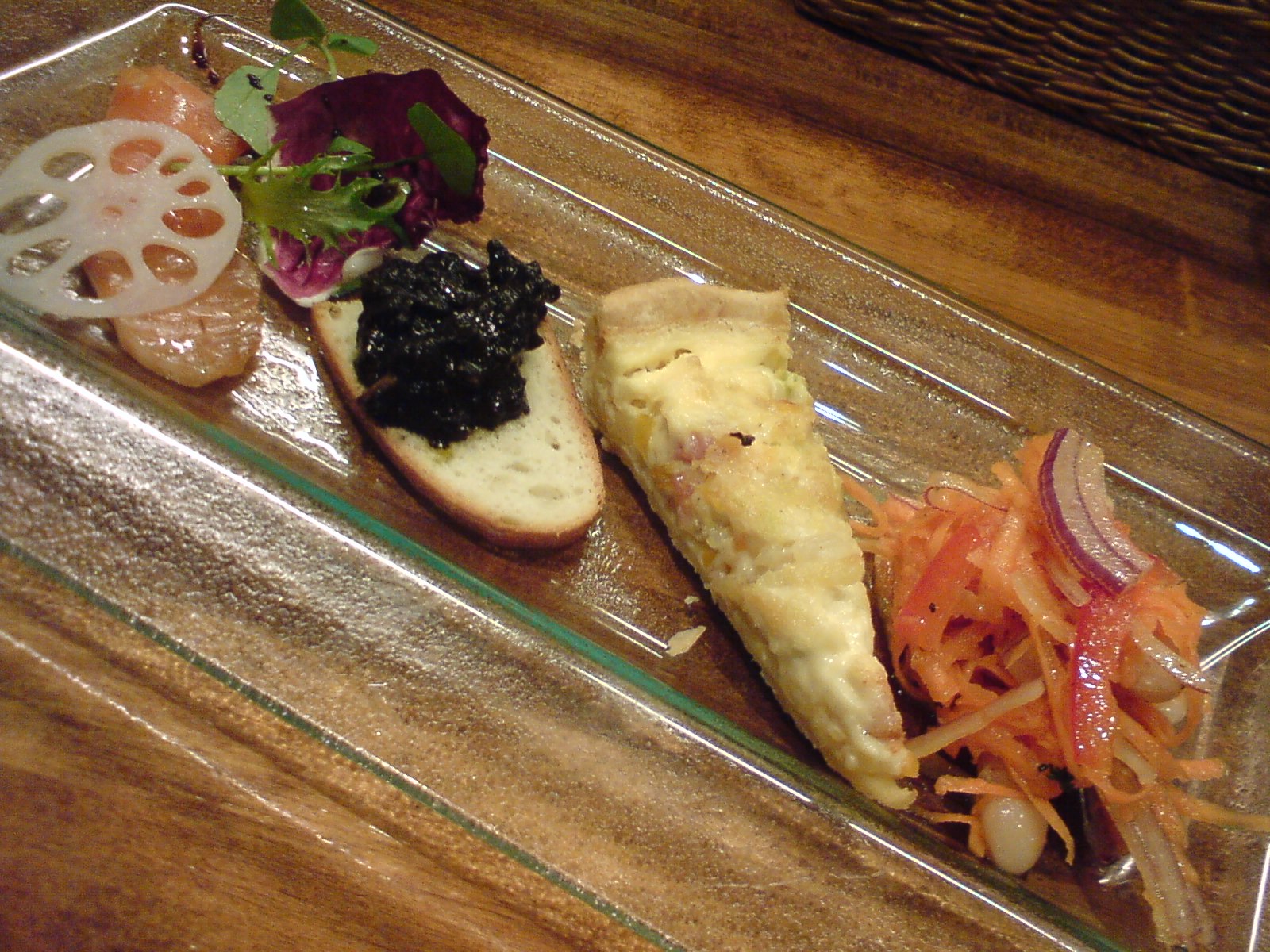
The antipasti misto consisted of Carrots, large white beans and red onions salad, Squid ink Crostini, Quiche (bacon, onion, potato and cabbage), home-made smoked salmon and pickled lotus root. A very global dish!

now, the pasta dish was worth the visit for itself!
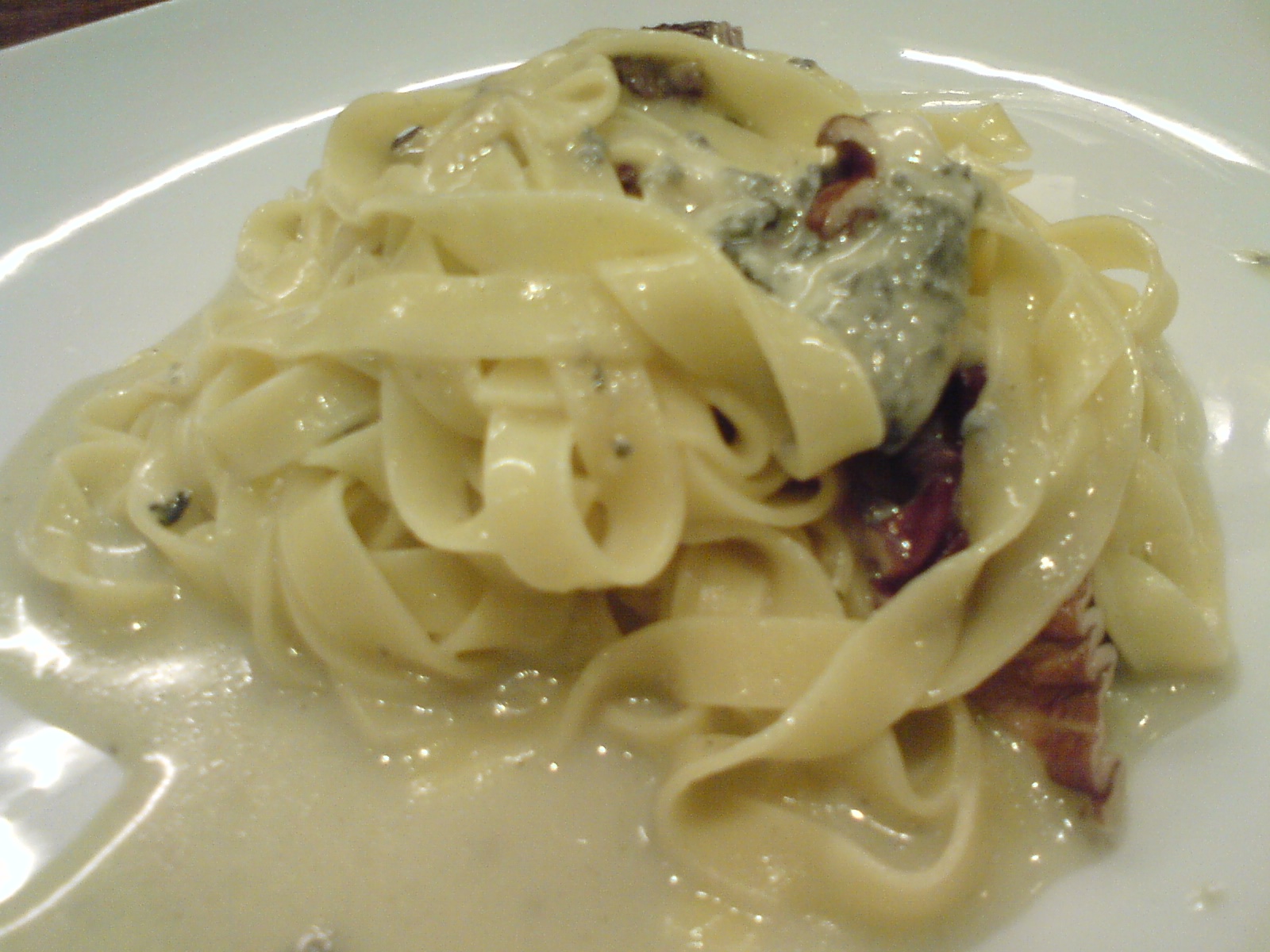
Il Castagno serves exclusively home-made fresh pasta, a luxury in Jpaan!
These particular pasta were tagliatelle (comparatively narrow) in Gorgonzola and Radicchio (a variety of Trevise) Cream sauce. Perfectly balanced and the right quantity. As for the taste, I start to understand why so many local expats have started patronizing the place!

The dessert plate consisted of blanc mange, Apricot Cheese Cake (another specialty expats are running for!), strawberries and Neburu Orange (popular Japanese variety) Sherbet/Sorbet.

Coffee and home-made Italian mignardises!

IL CASTAGNO
420-0843 Shizuoka Shi, Aoi Ku, Tomoe Cho, 48 (along Kitakaido Street)
Tel. & Fax: 054-247-0709
Business hours: 11:45~14:00, 17:30~21:00
Closed on Mondays and second Tuesdays
Lunch: 1,260 and 1,860 yen
Dinner: 4,000 and 5,000 yen
A la Carte menu and wine list available. Wine by the glass ok
Reservations recommended.
HOMEPAGE (Japanese)

RECOMMENDED RELATED SITES:
Warren Bobrow, Bread + Butter, Zoy Zhang, Hungry Neko, Think Twice, Frank Fariello, Mangantayon, Hapabento, Elinluv Tidbit Corner, Tokyo Terrace, Maison de Christina, Chrys Niles,Lexi, Culinary Musings, Wheeling Gourmet, Comestiblog, Chronicles Of A Curious Cook

Please check the new postings at:
sake, shochu and sushi

—————————————-
日本語のブログ
—————————————-
Sushi & Sashimi: The Basics 4/5: Sushi Presentations-Te-Maki Zushi/Cone Sushi

Te-Maki Zushi/手巻き寿司, Hand-rolled sushi or more appropriately said “Cone Sushi). like Te-mari sushi that I introduced yeaterady, are the perfect way of making your own sushi at great informal sushi parties!

I know that Jenn , Debbie, and Melody are going to get some great ideas from that notion!LOL

Now, if you decide to organize a Te-Maki Sushi Party, make sure that you have plenty of “neta”/fillings ready for your guests to easily choose from.
Bear in ind the priorities of your guests. Vegan and vegatarian sushi are very easy to provide for. If need be prepare different plates of ingredients.

Next you need nori/海苔/ dried sheets of seaweed. Cut to the size most appropriate to your te-maki. keep in mind the appetite of ypur guests. Some might want them small, others large. Do experiment!

Prepare enough sushi rice for all to fill their te-maki with.
I would suggets you make at least 3 large bowls of them:
One seasoned with sesame seeds like the Missus does all the time, one plain, and another one seasoned with an ingredient of your choice: finely chopped pickle, chopped cooked shiitake, and so on.

TECHNIQUES:

The above te-maki includes three ingredients: avocado, katsuo/bonito and fresh salmon sashimi.

Spread a triangle of sushi rice on the left half of the nori/dry seaweed.
The seaweed sheets ought to be cut in half along their length first.

Place the ingredients over the rice as shown in picture.

Start rolling from the left.

Keep turning until you have completed the cone!

FILLINGS SUGGESTIONS:

Hera is a group of four different te-maki as a combination suggestion with ingredients that should please both Japanese and non-Japanese.
Do experiment!

Kimchi, tuna flakes, mayonnaise and sesame seeds!

Crab meat and mayonnaise. You could add some green leaf vegetables, too!

Asparaguses (boiled), tuna flakes and mayonnaise. You could include some curry powder in the mayonnaise!

Salmon roe. Season the roe with a little soy sauce first! Some wasabi would be welcome, too!

SAMPLES:

Here are more samples to help your imagination:

Chili sauce shrimps and kawaire daikon sprouts.

Tuna, shiso and ikura/salmon roe.

Roast beef, omelette and vegetables!

Lettuce, surimi, omelette and cucumber.

Fried pork, shiso and kawaire daikon sprouts.

Nato and hijiki seaweed for vegans!

All vegetables again!

I’m going to Sushi Ko with the Missus tomorrow. I will ask Mr. Oda to think of something!LOL

RECOMMENDED RELATED SITES:
Warren Bobrow, Bread + Butter, Zoy Zhang, Hungry Neko, Think Twice, Frank Fariello, Mangantayon, Hapabento, Elinluv Tidbit Corner, Tokyo Terrace, Maison de Christina, Chrys Niles,Lexi, Culinary Musings, Wheeling Gourmet, Comestiblog, Chronicles Of A Curious Cook

Please check the new postings at:
sake, shochu and sushi

—————————————-
日本語のブログ
—————————————-

Sushi & Sashimi: The Basics 4/4: Sushi Presentations-Te-Mari Zushi

Te-Mari Sushi made by the Missus for my bento!

A comment by my friend Jennifer Razon just reminded me I hadn’t explained the technique behind a very enjoyable form of sushi, namely Te-Mari Sushi/手まり寿司!

Te-Mari Sushi was apparently made poular in Kyoto first where gastronomy is more “feminine” than in any other part of Japan. It is very easy to make, present and carry.
It is more welcome when you realize people in Kyoto have more socializing to do than anywhere else, including eating and drinking. Making portions smaller and more artistic are a necessity there!
Actually Te-Mari Sushi can be made in any size and include any ingredients, be it for omnivores, adults, ladies, children, vegetarian or vegans!

TECHNIQUE:

The technique is simple enough: having prepared the sushi rice, take a piece of cellophane paper and first put the tane/topping outer surface down, then place some rice over it. Close the cellphane paper by twisting it and press the sushi into a ball (mari) in your hand (te)! Unwrap it, place it on a plate, tray or in a box and add some more topping if neceassary!

Look at the demonstration pics below for better understanding!
In that case the rice ball is made first inside a piece of cellophane and wrapped again with the toppings!

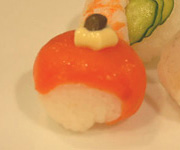
Tai/Seabream

Ebi/boiled shrimp

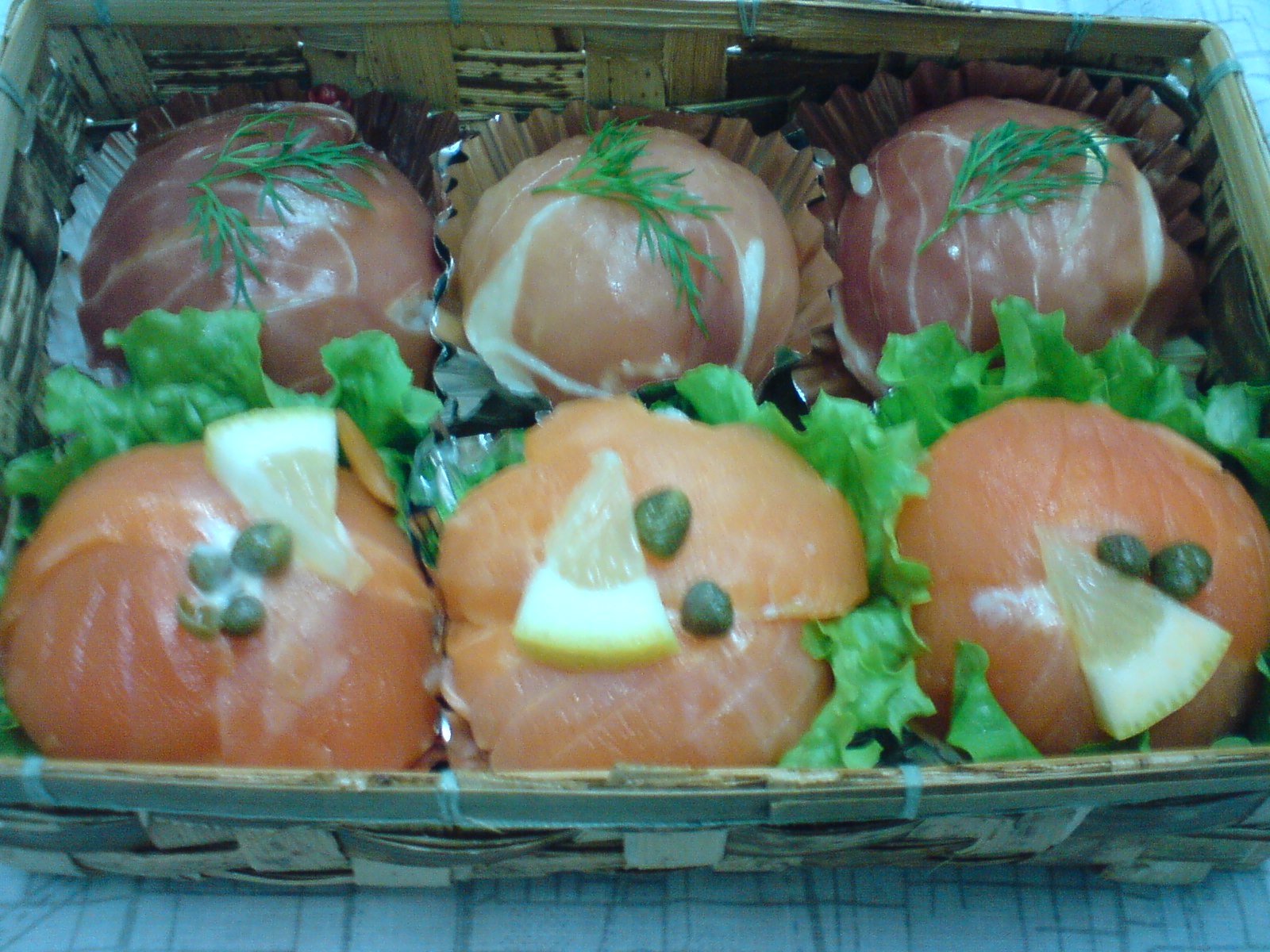
Smoked Salmon

Pickled fish

SUGGESTIONS & SAMPLES:

Below are suggestions and samples for Te-Mari Sushi.
Frankly speaking, varaiations are endless. Have good fun!

For a tea party?

For a lady’s bento?

For a gentleman’s bento?

For a special occasion?

For a European/American style party?

For ladies only?

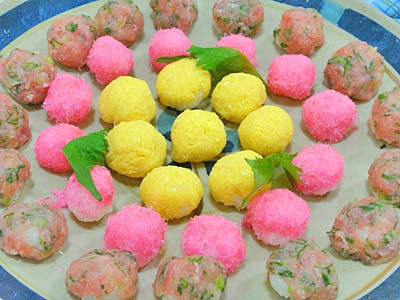
Sweet te-mari for Children!

RECOMMENDED RELATED SITES:
Warren Bobrow, Bread + Butter, Zoy Zhang, Hungry Neko, Think Twice, Frank Fariello, Mangantayon, Hapabento, Elinluv Tidbit Corner, Tokyo Terrace, Maison de Christina, Chrys Niles,Lexi, Culinary Musings, Wheeling Gourmet, Comestiblog, Chronicles Of A Curious Cook

Please check the new postings at:
sake, shochu and sushi

—————————————-
日本語のブログ
—————————————-

Today’s Lunch Box/Bento (’10/17)

Spring has come early in Shizuoka, the mildest region in Japan after Okinawa.
This is both a bonus and a pain. We get all these great vegetables before eveyone else, but we are also plagued with grotty weather and cold rain. Mind you, we shouldn’t complain compared to other regions.
In the end it means that the bentoes will be both rich in calories and vitamins!

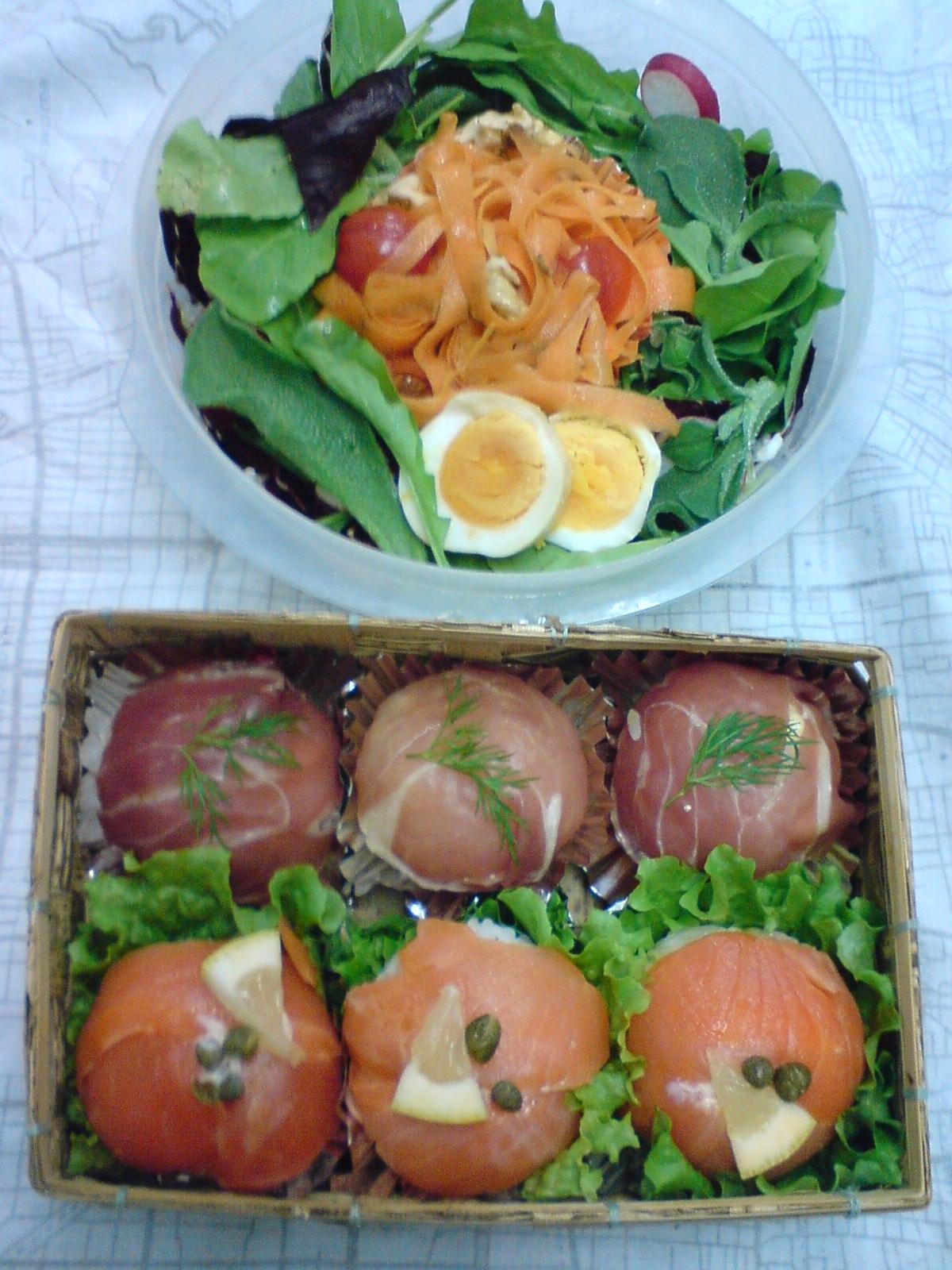
The rice part this time consisted of two kinds of te-mari sushi balls/手まり寿司. The missus, used freshly steamed rice, formed the balls by wrapping rice and the garnish together in cellophane paper, twisting it closed and shaping in balls with her hands. This type of sushi is particular popular in the Kyoto area, where they are both served to adults and kids with beautiful effect.
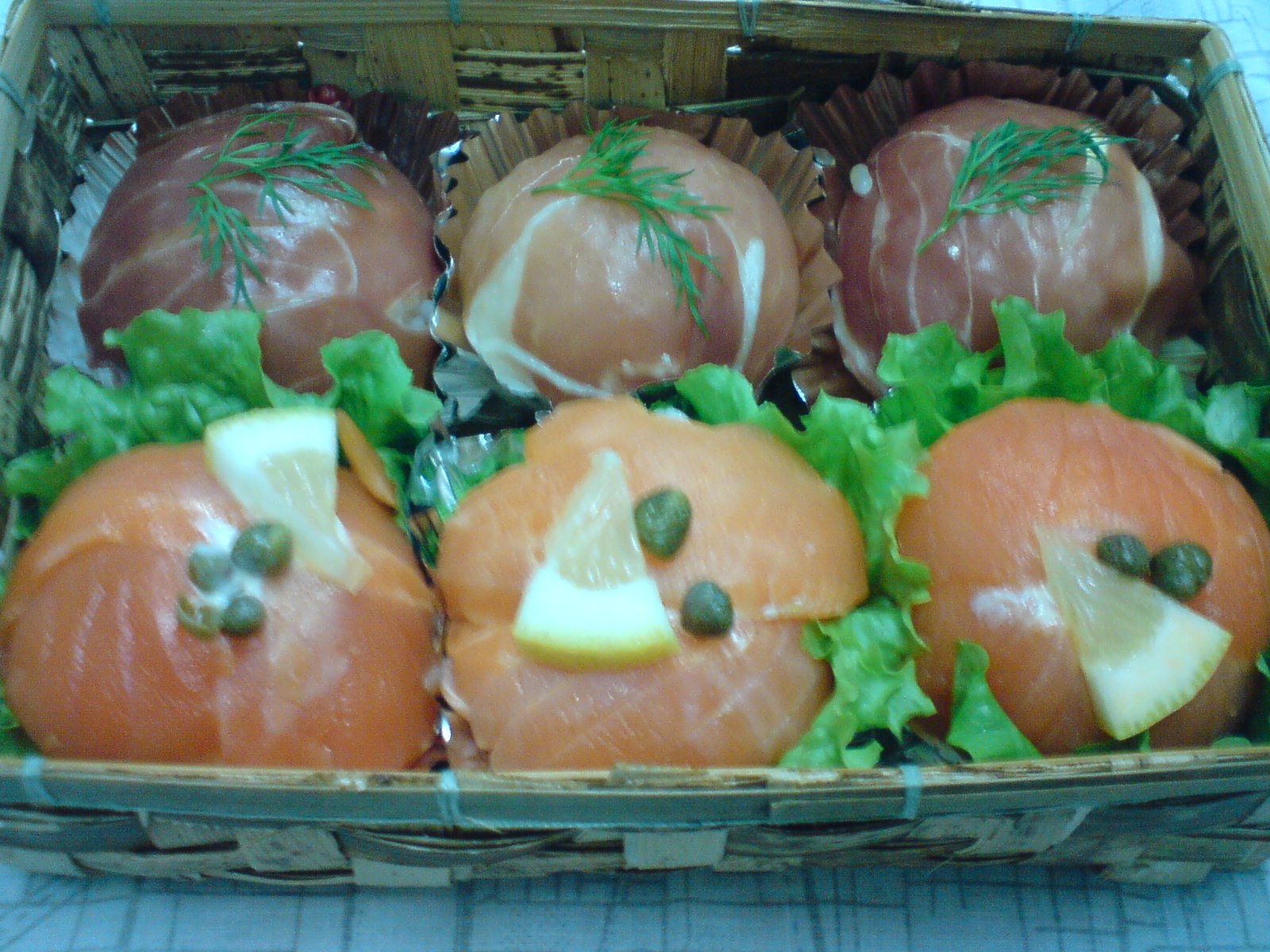
One of my te-mari sushi contained cheese and was topped with raw ham and some fresh dill.
The other contained Japanese-style pickled cucumber (Very finely chopped) and sesame seeds, and was topped with smoked salmon, lemon, capers and a little tartare sauce. A small piece of lettuce added colour and vitamins!

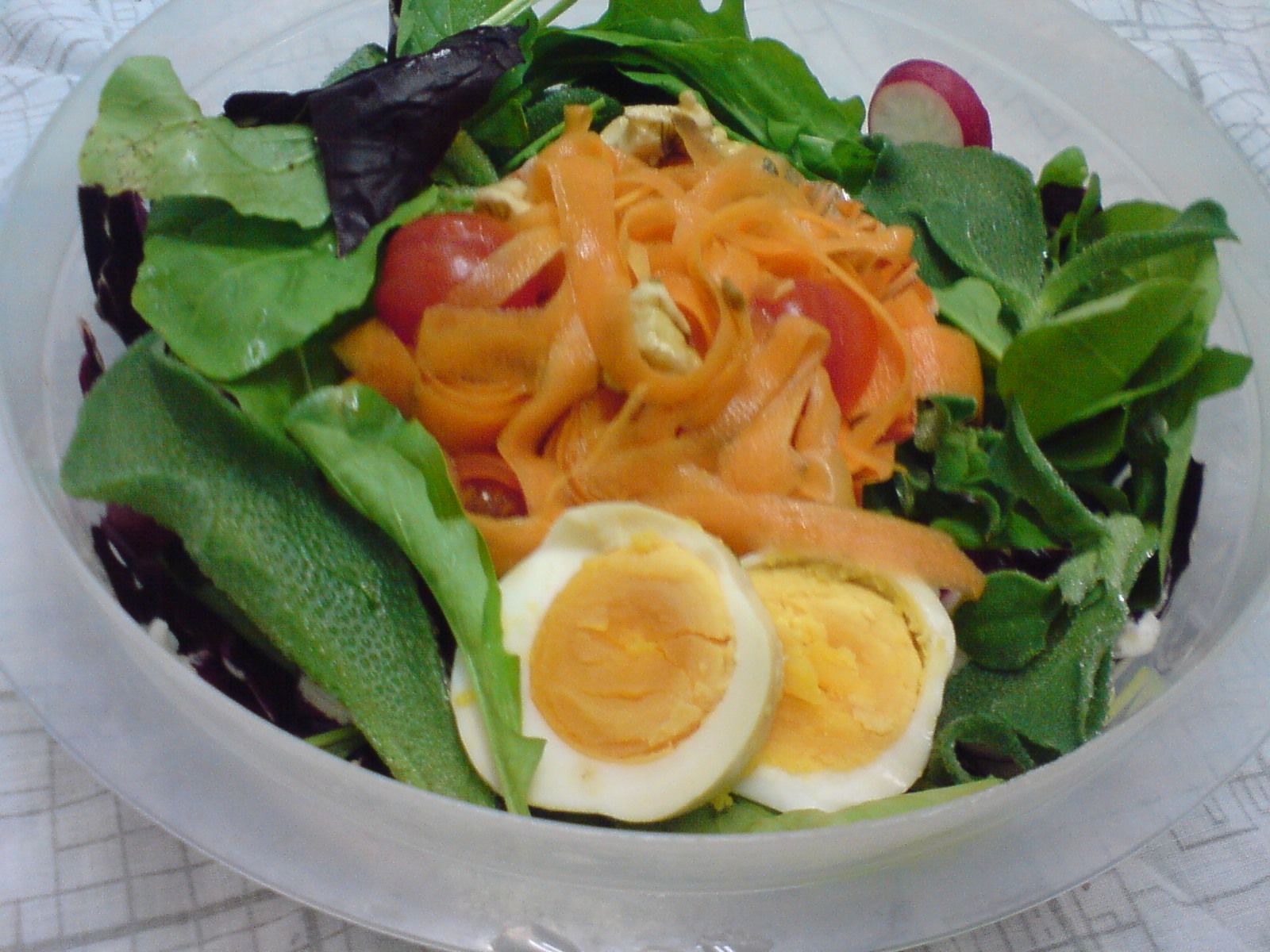
The salad part included home-made marinated carrot tagliatelle salad with walnuts, mini tomatoes and soft-boiled egg. The whole was surrounded by a wealth of hand-broken leaf vegetables: ice plant, trevise, luccolla, and others as well as sliced red radish and mini tomato.

As for dessert I took a couple of mikan/madarines from The Missus’ family garden.
Once again, colourful, healthy and tasty!

RECOMMENDED RELATED SITES:
Warren Bobrow, Bread + Butter, Zoy Zhang, Hungry Neko, Think Twice, Frank Fariello, Mangantayon, Hapabento, Elinluv Tidbit Corner, Tokyo Terrace, Maison de Christina, Chrys Niles,Lexi, Culinary Musings, Wheeling Gourmet, Comestiblog, Chronicles Of A Curious Cook

Please check the new postings at:
sake, shochu and sushi

—————————————-
日本語のブログ
—————————————-

Bryan Baird’s Newsletter (2010/03/02)

Baird Beer & Taproom Events Bulletin
bryan-sayuri.gif

Dear Taproom Friend & Baird Beer Enthusiast:

New Seasonal Baird Beer Releases: Morning Coffee, Wabi-Sabi, Obatarian

The Baird Beer brewers have been busy bees over the past several months crafting a diverse range of unique seasonal brews. Wednesday, March 3 will mark the official debut of the following three seasonal beers:

Morning Coffee Stout 2010 (ABV 7%): Each year we combine our passion for stout beer with our love of coffee in the brewing of Morning Coffee Stout. This 2010 version is an export-style stout infused with freshly ground fair-trade espresso beans from Arabika Coffee. This year we added the coarsely ground espresso beans directly to the stout in the conditioning tank in what amounted to a cold beer toddy extraction method. The result is a perfect flavor marriage between stout beer and java beans.

Wabi-Sabi Ale (ABV 5.5%): Shizuoka is the green tea capital of Japan. Drinking fine Shizuoka tea is to experience the Japanese wabi-sabi cultural aesthetic in microcosm. We feel the same is true of imbibing Baird Beer. So it struck us: why not skillfully combine the two? This we have done in a richly malty brown ale in which hop character is almost wholly absent (only 15 BUs of hops were added in a single kettle addition). We use the Shizuoka tea (infused into the beer in the conditioning tank) to supplement and make complete the bitter, herbal and aromatic character generally supplied by hops. The result is a wonderfully unique beer best characterized by the following descriptors: refinement, elegance, sobriety, dignity.

Obatarian Strong English Ale (ABV 8%): Strong English Ales generally are noted for richness of malt character, alcohol strength which imparts warmth, and a pleasant estery profile. They normally are released only after sufficient aging and maturation. Thus, they tend to be extremely self-assured beers; ones that care little for the opinions or sensitivities of others. In other words, they are the beer version of that old biddy obatarian you sometimes encounter in the supermarket checkout line here in Japan. We promise, though, that your encounter with Obatarian Strong English Ale will prove more satisfying than your experience with the human version at the supermarket.

Morning Coffee Stout 2010 will be available on draught and in bottles (633 ml) and sold throughout Japan through the fine family of Baird Beer retailing establishments (as well as direct from the brewery via our online E-Shop). Wabi-Sabi Ale is a small batch beer that will be available on hand-pump as real ale exclusively at our Taproom pubs. Obatarian Strong English Ale, another small batch brew, is draught only and also will be poured exclusively from the taps of our own Taproom pubs.

Finally, please mark you calendar for the upcoming Lucky Seven Stout Week which kicks off on St. Patrick’s Day (Wednesday, March 17) at our Numazu Fishmarket Taproom and runs through the national holiday on Monday, March 22. During the week we will be celebrating the quintessential Irish beer style: Stout. We will devote seven taps to different varieties of stout beer, serve a special Stout-inspired food menu and engage in other mischievous fun. More details will be forthcoming in next week’s bulletin.

Cheers,

Bryan Baird
Baird Brewing Company
Numazu, Japan
HOMEPAGE


The Japan Blog List

———————————
Must-see tasting websites:
-Sake: Tokyo Through The Drinking Glass, Tokyo Foodcast, Urban Sake, Sake World
-Wine: Palate To Pen, Warren Bobrow, Cellar Tours
-Beer: Good Beer & Country Boys, Another Pint, Please!
-Japanese Pottery to enjoy your favourite drinks: Yellin Yakimono Gallery
——————————–
Please check the new postings at:
sake, shochu and sushi

—————————————-
日本語のブログ
—————————————-

Shizuoka Sake Tasting 1/9: Morimoto Brewery/Sayogoromo

Whereas most brewers in Shizuoka Prefecture concoct soft, almost feminine, sake, Hidetoshi Morimoto, Masterbrewer/owner of Morimoto Brewery in Kikugawa City has often taken the notorious role of a maverick to the delight of lovers of characterful brews bordering on the impertinent.

The latest of his creations is definitely out of the ordinary in this Prefecture famed for making some of the best (popular?) sake in Japan, especially when ones notices that Hidetoshi Morimoto doesn’t bother much about giving all kinds of information usually found in this Prefecture.

Morimoto Brewery, Sayogoromo, Tokubetsu Junmai.

Rice milled down to 60%
Alcohol: 15 degrees

Clarity: Very clear and clean.

Colour: Faint golden hue.

Aroma: Fruity and complex: bananas, pineapple, alcohol, almonds.

Body: Smooth and solid.

Taste: Strong junmai attack. Great combination offruitiness and acidity. Shortish tail. Complex: bananas and flowers.
Abruptly ends on a dry almond note.
Holds well with any food.

Overall: Unusually “macho” sake for Shizuoka, typical of Morimoto brewery sakes.
Great with strong food, especially yakitori and nabe.
Drunk on its on, will please lovers of strong and characteful sakes.

RECOMMENDED RELATED WEBSITES:
-Sake: Tokyo Through The Drinking Glass, Tokyo Foodcast, Urban Sake, Sake World
-Wine: Palate To Pen
-Beer: Good Beer & Country Boys, Another Pint, Please!
-Japanese Pottery to enjoy your favourite drinks: Yellin Yakimono Gallery
Warren Bobrow
Tokyo Terrace

New Vegetable: Tsubomina/蕾菜

Picture taken at Parche Supermarket on March 1st, 2010

Earlier in the day, I mentioned a new vegetable that the Missus included in my bento: Tsubomina or 蕾菜 in Japanese.
The first Kanji character is made up of made up of the character meaning “plant” or “grass” at the top over another character meaning “thunder”. The second kanji means “plant”.

Stir-fried Tsubomina in my bento.

Tsubomina sold in Hakata, Fukuoka, Kysushu island.

Tsubomina sprouts

Tsubomina belongs to the same group of plants as Brussels sprouts, Chinese Cabbage, Komatsuna/leaf Mustard, Broccoli, Daikon, turnips and so on, that is Brassicaceae. It is actually a variety of Leaf Mustard. The latter is a plant introduced in Japan from China.

Picture taken at Parche Supermarket on March 1st, 2010

Although it had been grown since 2005 with various results, JA/Japan Agriculture (Association) officially put it on the markets in Hakata, Fukuoka City in Kyushu island in February 2009.
Due to a certain weakness to insects, it is harvested in Februaray and March only.
Growers started “exporting” it through Japan, altough it is available only in Nagoya, Tokyo and Shizuoka for the moment being. But it is only a question of time before it is sold all over the nation.

Picture taken at Parche Supermarket on March 1st, 2010

Actually the competition is starting heating up for the good of the consumers.
Tsubomina was sold 300~350 yen for 3 small specimens last year. It is already sold for only 250 yen for 3 large specimens since yesterday in Shizuoka City!

Picture taken at Parche Supermarket on March 1st, 2010

Copy of the advertisement appearing in local magazines in Fukuoka where many restaurants serve it in Japanese, Chinese and other foods.

Picture taken at Parche Supermarket on March 1st, 2010

It can be served raw in salads. I tasted it this morning raw. It is crunchy, almost sweet, without any acidity, and eminently eatable.
moreover the high contrast in white and green colours make for a very decorative item.
It can be cooked in almost any kind of Asian gastronomic manner: fried, stir-fried, nabe/pot-au-feu, etc. Vegetarians and vegans should appreciate it as it combines a goog bite, a great taste and plenty of nutrients!

RECOMMENDED RELATED SITES:
Warren Bobrow, Bread + Butter, Zoy Zhang, Hungry Neko, Think Twice, Frank Fariello, Mangantayon, Hapabento, Elinluv Tidbit Corner, Tokyo Terrace, Maison de Christina, Chrys Niles,Lexi, Culinary Musings, Wheeling Gourmet, Comestiblog

Please check the new postings at:
sake, shochu and sushi

—————————————-
日本語のブログ
—————————————-

Today’s Lunch Box/Bento (’10/16)

Shizuoka is replete with new vegetables in this supposedly early Spring and buying them at the local markets in view of including (sorry having them included by the Missus) in the next day’s bento is great fun!

It certainly makes for very colourful bentoes, too!
The Missus has been looking around shops for this elusive (meaning big enough) pinewood bento box for better looks and better taste (she believes that the pine wood will enhance the taste of her creations).
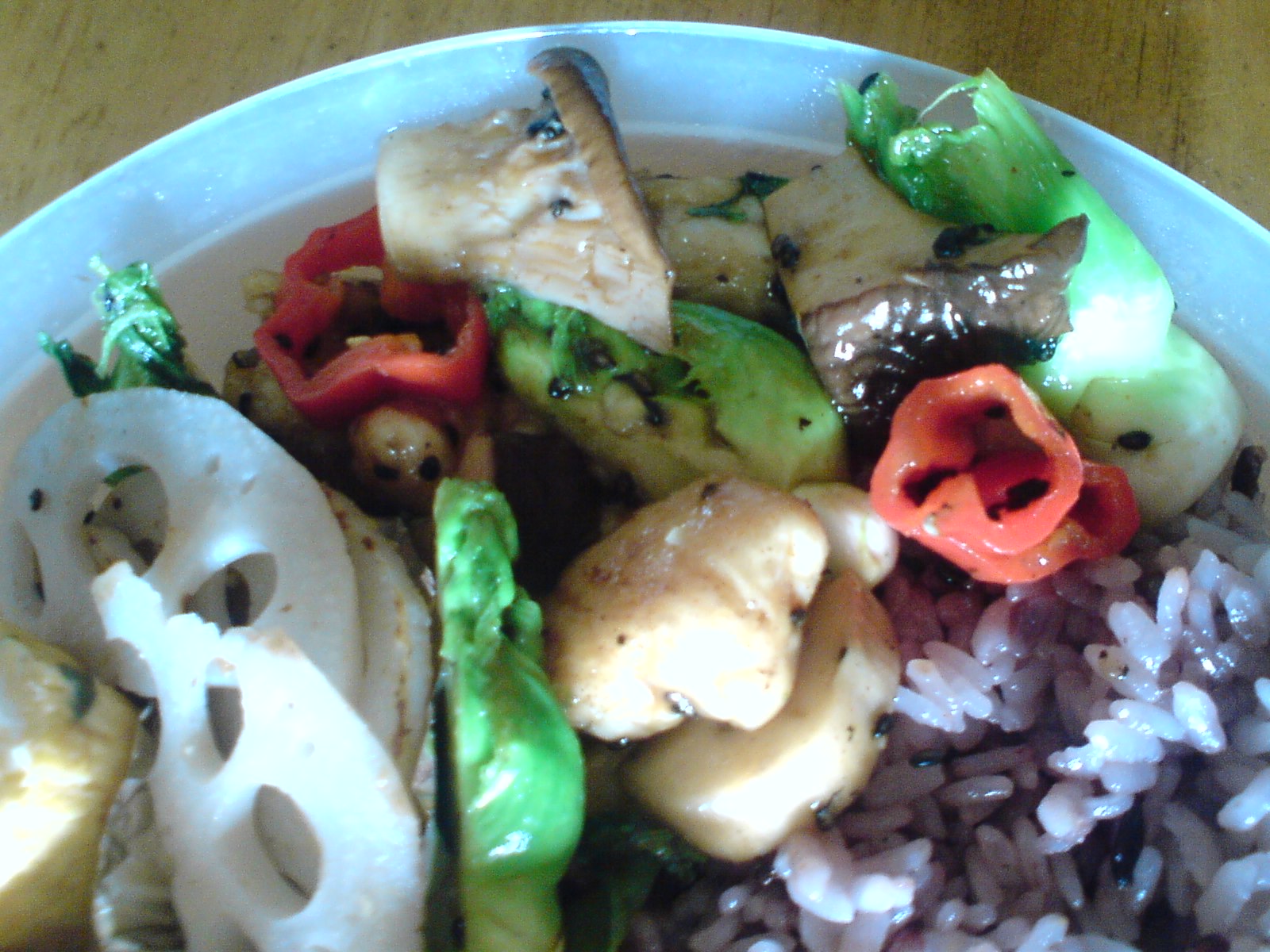
The steamed rice looks violet because it has been supplemented with a little (too much would the rice too dark) with Kuromai/黒米 or “Black Rivce”.
Actually it is not black rice, but dark violet rice. It comes from Iriomote Island in Okinawa. It is simply “ancient rice” as it used to be many centuries ago. It does provide a lot of useful nutrients that have disappeared after white rice was polished.

Now for the garnish:
The Missus concocted her tamagoyaki/Japanese omelette with cheese and ciboulette, also called civette, chiboulette, brelette (French), Schnittlauch (German), chives (English), cebolleta (Spanish). They habeen cultivated for some time in Japan and people are starting discovering them. They contain plenty of Vitamin C and iron! The vegetables include boiled and fried lotus root slices, home-made pickled mini lemons and a new vegetable grown in Fukuoka, Kyushu. I still remember the name but I will check today again and write up some information!

More of the mystery green vegetable, eringe mushrooms. sweet red piments chicken fillets, the whole fried in spicy sauce and agremented with black sesame seeds.

Dessert was benihppe/red cheeks strawberries and mikan/winter oranges from Shizuoka.

Complete, healthy and tasty bento!

RECOMMENDED RELATED SITES:
Warren Bobrow, Bread + Butter, Zoy Zhang, Hungry Neko, Think Twice, Frank Fariello, Mangantayon, Hapabento, Elinluv Tidbit Corner, Tokyo Terrace, Maison de Christina, Chrys Niles,Lexi, Culinary Musings, Wheeling Gourmet, Comestiblog

Please check the new postings at:
sake, shochu and sushi

—————————————-
日本語のブログ
—————————————-

Kimchi Meat Balls in Sweet & Sour Sauce

I found a whole series of meat balls rcipes in my notes that I will have the pleasure to introduce. I’m sure you will be able to expand on them.
As for today: Kimchi Meat Balls in Sweet & Sour Sauce

INGREDIENTS: for 2 people

Meat balls:

-Dried Daikon Kimchi: 100g
-Minced pork: 200 g
-Panko, Breadcrumbs: 2 tablespoons
-leek (finely chopped): 2 tablespoons
-Egg: 1
-Japanese sake: 1 tablespoon
-Pepper: a pinch
-Sesame oil: 1 and half tablespoons
-Cornstarch: 1 and a half tablespoons

Sweet & Sour Sauce:
-Japanese sake: 2 tablespoons
-Sugar: 2 tablespoons
-Soy sauce: 1 and half tablespoons
-Rice vinegar: 1 tablespoon
-Ketchup: 3 tablespoons
-Chicken bouillon powder: 1 teaspoon
-Cornstarch: 2 teaspoons
–Water (lukewarm): 1 and a half tablespoons

RECIPE:

-Separate the dried kimchi Daikon and chop finely

-Mix all the meat balls ingredients in a large ball and mix well until you obtain a smooth mixture. Shape balls small enough.

-Deep-fry meat balls on low (150 degrees Celsius) fire for 14~16 minutes until you obtain a nice colour and well cooked core.

-In a fry pan drop the sweet & sour sauce, except cornstarch and water. Bring to boil first, then lower fire. Add the corntarch dissolved in the lukewarm water. Drop in all themeat balls and stir until all are well-covered with the sauce.

Serve over a bed of lettuce and brocoli boiled in salted water.

RECOMMENDED RELATED SITES:
Warren Bobrow, Bread + Butter, Zoy Zhang, Hungry Neko, Think Twice, Frank Fariello, Mangantayon, Elinluv Tidbit Corner, Maison de Christina, Chrys Niles,Lexi, Culinary Musings, Wheeling Gourmet, Social Culinaire, Sushi Nomads, Cook, Eat & Share, Gourmet Fury, 5 Star Foodie, Easy Does It Recipes, Oyster Culture, Once A Chef, All In Good Food, Cooking Stuff, Cheese Monger, Palate To Pen, Tokyo Through The Drinking Glass, Tokyo Foodcast, Citron Et Vanille, Beyond Koreanfornian Cooking

Please check the new postings at:
sake, shochu and sushi

—————————————-
日本語のブログ
—————————————-

Japanese Seasonal Fish: Kisu/Shirogisu-Sillago

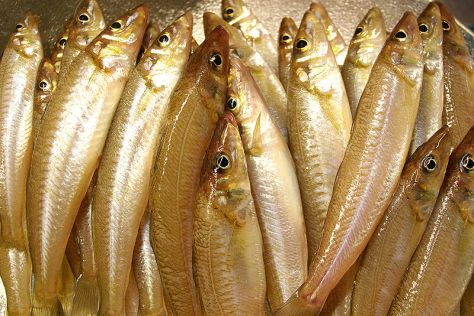
SILLAGO-SHIROGISU

Shirogisu, or Sillago in English probably has as many Japanese names as English names.
The Sillago found along the Japanese shores is also called sillago japonica, Whiting or Smelt-Whiting in english, Shirogisu, Kisu, Magisu and Kisugo in Japanese.

The best specimen in Japan are caught in Fukuoka (Kyushu) and Ehime (Shikoku) prefectures from Spring to Summer.
It is also a sport angler’s favourite as they come in all sizes, although the everage will not measure much more than 10 cm.

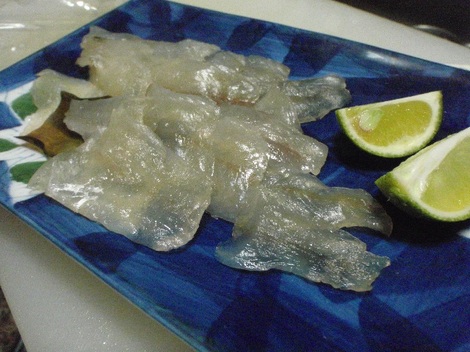
Standard Shirogisu Sashimi

As a sahimi/raw fish it van be prepared in many manners:
Standard sashimi as above.

Shirogisu Konbujime Sashimi.
As konbujime, it will be matured between two sheets of wet konbu/seaweed to attain a sweet taste.

Shirogisu Aburi Sashimi

As aburi/lightly seared, one can enjoy two different textures and tastes at the same time.
Mind you, it is not easy to sear properly as the fillets are very thin!

The greatest part of the sillago catch comes from Indonesia, Korea, Thailand, China and other Asian countries.
Fortunately, here in Shizuoka, we do catch a sizeable amount in Suruga Bay guaranting freshness in season.

Shirogisu Sushi Nigiri.

If absolutely fresh, shirohisu/sillago makes for an interesting morsel, the more for it as it is quite rare in this sushi nigiri form.

Anglers will certainly appreciate it grilled on the stick at a BBQ on the beach with a nice pint of beer!

But the most popular way of savouring it is arguably as tempura or breaded and deep-fried, although the fish taste will vary greatly with freshness!
But if absolutely fresh, don’t forget to deep-fry its bones and head!

RECOMMENDED RELATED SITES:
Warren Bobrow, Bread + Butter, Zoy Zhang, Hungry Neko, Think Twice, Frank Fariello, Mangantayon, Elinluv Tidbit Corner, Maison de Christina, Chrys Niles,Lexi, Culinary Musings, Wheeling Gourmet, Social Culinaire, Sushi Nomads, Cook, Eat & Share, Gourmet Fury, 5 Star Foodie, Easy Does It Recipes, Oyster Culture, Once A Chef, All In Good Food, Cooking Stuff, Cheese Monger, Palate To Pen, Tokyo Through The Drinking Glass, Tokyo Foodcast, Citron Et Vanille

Please check the new postings at:
sake, shochu and sushi

—————————————-
日本語のブログ
—————————————-

Gastronomic Cycling in Shizuoka (7)

I did follow the Koya-Machi street in a previous posting.
The problem is that in Japan cities are not clearly divided into streets or districts. Very often names were given to main streets (only main for that matter) only recently as an indication of the main thoroughfar going through a district of the same name.
Acoordingly I had to cycle around and away from the same Koya-Machi street to give a good indication of the area.

In daytime, the entry to the other street belonging to Koyama-machi has nothing particular about it, but keep an eye open even in daytime (whereas at night, you will need both!LOL).

Gyudon/bowl of rice topped with shredded beef is making for brisk business, especially at lunch time for restricted budgets. As for the taste, I wonder….

Now, this is THE important spot: the oldest wasabi store in the world: Tamaruya since the middle of the 17th Century!

Just in front is the local shrine.

A place you must visit on the second Sunday every month as a big flea-market is staged there!

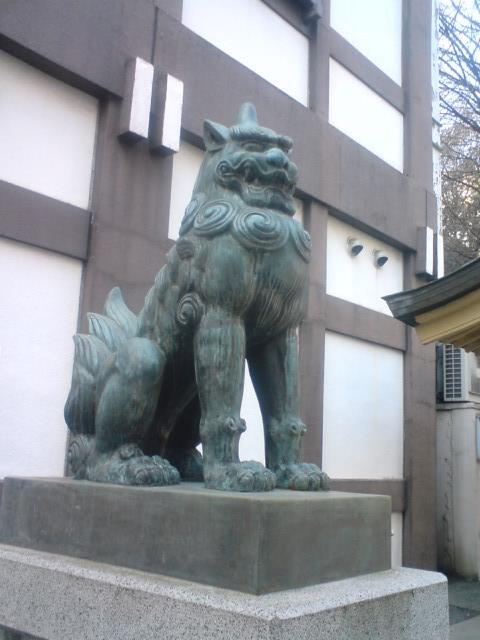
Beware the guardian lion!

Kani-Tei is the only restaurant in town specializing in crab although it has a conveyor-belt sushi restaurant annex just next door.

In daytime, the crab is moving its legs!

But at night it will stay quescient, unless struck by an earthquake!

Check the plastic displays!

Pity it’s all plastic!

Next door they serve Oma Honmaguro/Blue Fin Tuna from Aomori Prefecture!

Check their susuhi displays!

Sushi set displays!

Next door is an invitation to hell. At least you will know how to read it in Japanese. Not bad as an art pic, though!

Toraya, the oldest bag store in town. Ladies should definitely pay it a visit!

Parco, which took over the defunct Seibu Store.
Not a bad place as far as department stores come.

It does have a great merit, though, at it includes an all-organic food stand in the basement run by Mr. Matsuki of Bio Farm in Fujinomiys City!

Organic vegetables grown by the same!

Great organic bentoes!

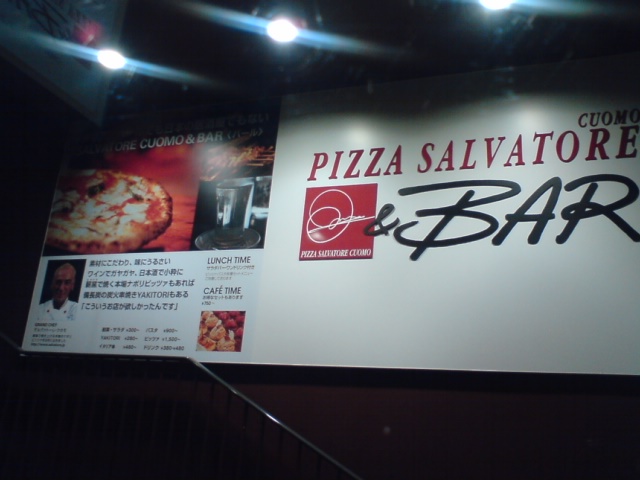
Parco’s pizza restaurant used to serve good enough pizzas. That is, until the Italian chain owner went back to Tokyo to open more diners….

Parco has its own restaurants to compete with the cheap shops in the area.

If you stretch your neck, you will discover izakayas at all levels. “Ikkyu” means “Take a little rest”!

All nationalities seem to have their massage parlour. This one is Chinese…

Judging from the rates, it seems good business!

The area is replete with relatively cheap izakayas. I can’t say anything about their food, but they make for good pics!

A Cafe bringing up memories of the past….

Some fashion clothes store are definitely worth a pause!

Great spot for taxi-drivers to take a rest!

Not many signboards, but you still find them!

At first sight, this new ramen restaurant look much like those everywhere in the country.

The originality resides in the fact they show their menu through a hi-tec computer display screen!

The only place harbouring the Basque flag. A Tapas restaurant, naturally! Sorry for the fuzzy pic, but not that easy to take on a windy night!LOL

A cheap yakitori.

Nakajimaya Hotel, one of the better hotels in town. Its particular location makes very practucal for night owls!

The interesting thing about this cheap izakaya is the old sign board advertizing insectiside! Ought to be clean inside!

Cheap and garish diner.

Now, what do they mean by “Paris care”? Notwithstanding the mistakes!

Cheap chain izakaya do make for good pics, though…

This place has just closed. They must not have had enough of them…

One more reason for me to avoid the place…

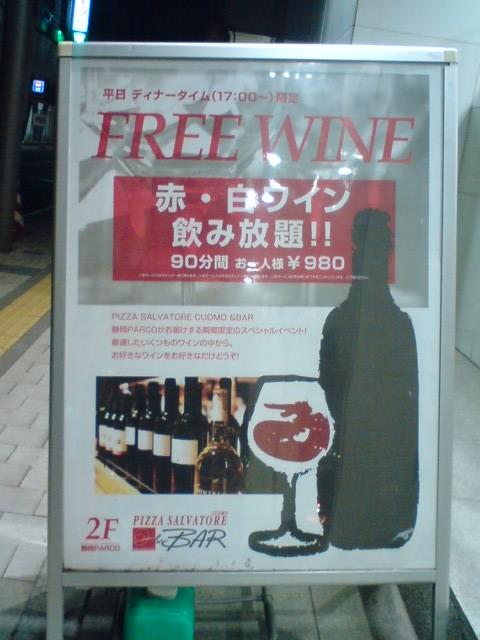
Don’t be fooled by that sign!
They only mean that you can drink all the wine you want for a determined time and price!

Wedding companies are BIG business in Japan!

Couldn’t find the entrance of that bar…serious!

That shop exclusively sells junk sweets!

As for this one, it sells only socks!

Interesting shoes…

This shop specializesin “kamaboko”.

Kamaboko (蒲鉾) is a type of cured surimi, a Japanese processed seafood product, in which various white fish are pureed, combined with additives such as MSG, formed into distinctive loaves, and then steamed until fully cooked and firm.

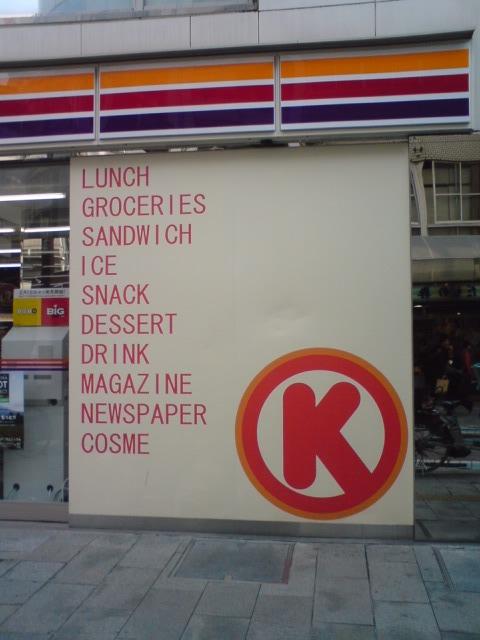
I was about to finish with this fruit parlour,

but I noticed the sign of that “convenience stire. “Cosme” stands for “cosmetics”…

RECOMMENDED RELATED SITES:
Warren Bobrow, Bread + Butter, Zoy Zhang, Hungry Neko, Think Twice, Frank Fariello, Mangantayon, Elinluv Tidbit Corner, Maison de Christina, Chrys Niles,Lexi, Culinary Musings, Wheeling Gourmet, Social Culinaire, Sushi Nomads, Cook, Eat & Share, Gourmet Fury, 5 Star Foodie, Easy Does It Recipes, Oyster Culture, Once A Chef, All In Good Food, Cooking Stuff, Cheese Monger, Palate To Pen, Tokyo Through The Drinking Glass, Tokyo Foodcast, Citron Et Vanille

Please check the new postings at:
sake, shochu and sushi

—————————————-
日本語のブログ
—————————————-