Tag Archives: 静岡

Vegetarian French Cuisine: Dad’s Cream Mushrooms

cream-mushrooms.gif

We are still in mushrooms season, wild ones or cultivated species, fresh, dehydrated or frozen. Mushrooms are low in calories, but high in quality, whether it concerns taste or nutrients.
Some people have told me that mushrooms cannot be frozen. This is a fallacy. Full stop.
I personally receive frozen chanterelles, trompettes and what else from the internet and I can assure they are delicious.

Here is the recipe of a dish my father (85) cooked for us last time I came back home in Burgogne, France. It was made with exclusively frozen mushrooms! It can accompany any meat, especially white-flesh meat, or can be appreciated on its own paired with a solid white wine or heady Japanese sake.
Great for vegetarians! Vegans can accomodate it witheir own substitutes, too.

INGREDIENTS: For 3~4 people

-Mixed mushrooms of your choice, fresh or frozen (if frozen, let them thaw slowly inside refrigerator for a few hours and get rid of excess water, although the same water can be used with the sauce!): 500g
-Shallots (echalottes): 2 finely chopped
-Garlic: 2~3 cloves finely chopped (crush garlic before chopping it. Do not forget to discard core!)
-Parsley or Italian flat parsley: half a cup finely chopped
-Fresh cream: 200cc/1 cup
-Madeira wine: 50cc (yellow port is fine, too, as well as sweet sherry)
-Olive oil and unsalted butter: about 2 large spoons of each
-Salt, pepper, nutmeg (to taste)

RECIPE:

-On a medium fire in large frypan melt an equal quantity of olive oil and unsalted butter (some people prefer more, some less. Experiment!).
Throw in the shallots and garlic and slowly fry until shallots turn transparent. Throw in all the mushrooms and fry until they give back enough water.
Add Madeira wine. Stir well.
Next add fresh cream and stir until cream is perfectly blended.
Add salt, peeper and nutmeg last, stir.
Check taste and add more spices if needed.

Pour the whole in a large dish and sprinkle parsley over the mushrooms before serving.

Eat hot.

RECOMMENDED RELATED SITES:
Bread + Butter, Comestilblog, Greedy Girl, Bouchon For 2, Zoy Zhang, Hungry Neko, Mangantayon, Elinluv Tidbit Corner, Maison de Christina, Chrys Niles, Lexi, Culinary Musings, Eats and Everything, Bite Me New England, Heather Sweet, Warren Bobrow, 5 Star Foodie, Frank Fariello, Oyster Culture, Ramendo, Alchemist Chef, Ochikeron, Mrs. Lavendula, The Gipsy Chef, Spirited Miu Flavor

Please check the new postings at:
sake, shochu and sushi

—————————————-
日本語のブログ
—————————————-

Bryan Baird’s Newsletter (2009/12/16)

Baird Beer & Taproom Events Bulletin
bryan-sayuri.gif

Dear Taproom Friend & Baird Beer Enthusiast:

The year-end holiday season is upon us. While 2009 has proved a difficult year economically in Japan and around the world, the blessings of life remain numerous and they deserve recognition and celebration. At Baird Brewing, we eulogize these blessings in liquid form each December with the release of Jubilation Ale.

Jubilation Ale (ABV 7%):

This malty rich, festively red-hued ale derives its special character from the addition of two wonderful local ingredients: (1) fully ripened figs candied in Japanese red sugar and (2) cinnamon twigs culled from a Japanese Nikki tree. The full bodied character combined with the attendant alcohol strength will warm the flesh just as it brings jubilation to the soul.

Jubilation Ale is available on draught at our Taproom pubs and other specialty beer retailing bars and restaurants in Japan beginning Thursday, December 17. The bottle-conditioned version (633 ml) also is available for purchase from Baird Beer retailing liquor shops in Japan beginning the same day.

If joyous celebration this holiday season is simply beyond your capacity, we fully understand. There is a Grinch in all of us and it needs recognition too. For the Grinch inside of you, we proudly release Bakayaro! Ale.

Bakayaro! Ale (ABV 8%):

This insolent, snotty and mean-spirited brew is pungently hoppy and wickedly strong. High in malt gravity (1.080), bitter in hoppiness (90 IBU), aggressive in aroma (double dry-hopping with Centennial), Bakayaro! Ale just doesn’t give a rat’s ass. We invite you to come in, have a pint and let those around know exactly how you feel.

Bakayaro! Ale is draught only. It will be pouring from the taps of pubs and restaurants everywhere beginning Friday, December 18. Lead Brewer Chris Poel, Bakayaro! Ale’s father, will be kicking off the mean season in person at the Harajuku Taproom on Friday evening. Please show up and tell him to piss off!

Finally, I would like to publicly announce that the long tenure at Baird Brewing of our current Nakameguro Taproom manager, Yokota-chan, is coming to an end this month. Yoko-chan is the first individual that Sayuri and I hired to join us in full-time work at our company. He started at the Fishmarket Taproom back in 2004 and in his almost six years with us has brought great dedication, honesty and professionalism to the task. He will be sorely missed. He is moving on to start his own restaurant business and Shizuoka and we wish him the very best.

Sayuri and I will be at the Nakameguro Taproom this Friday evening participating in a send-off party for our departing manager. Please plan on stopping in and saluting Yoko-chan for his many year’s of dedicated service.

Holiday Cheers

Bryan Baird
Baird Brewing Company
Numazu, Japan
HOMEPAGE


The Japan Blog List

———————————
Must-see tasting websites:
-Sake: Tokyo Through The Drinking Glass, Tokyo Foodcast, Urban Sake, Sake World
-Wine: Palate To Pen, Warren Bobrow, Cellar Tours
-Beer: Good Beer & Country Boys, Another Pint, Please!
-Japanese Pottery to enjoy your favourite drinks: Yellin Yakimono Gallery
——————————–
Please check the new postings at:
sake, shochu and sushi

—————————————-
日本語のブログ
—————————————-

Tempura: Kakiage Recipe

“Kakiage” is a very popular form of Tempura in Japan, especially in homes as it can make use of whatever is available on any particular day.
The main difference with usual tempura is whole eggs are used for better consistency and taste as it is very often served over a bowl of freshly steamed rice.
In restaurants, depending on the level of the chefs, all kinds of kakiage are served and make for hearty meals, even for big caucasians.
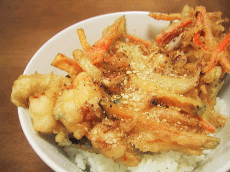
Shizuoka has a specialty that everyone in Japan wishes to sample: sakura ebi/cherry shrimps kakiage that I have already introduced.

Below is the basic recipe. I refrained from giving exact proportions as everyones can easily improvise.

INGREDIENTS:

-Onion
-Carrot
-Burdock root
-Trefoil
-Shrimps
-Cuttle fish
-Etc… there is no restriction!

Batter:
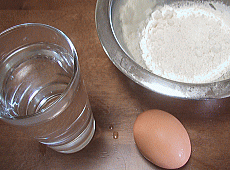
-Thin, light (cookie) flour: 1 cup
-Water: 1 cup
-Egg (whole) 1
Above is basic, which can multiplied equally

-Salad oil
-Sesame oil

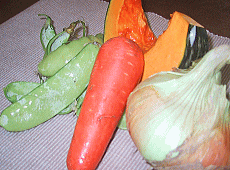
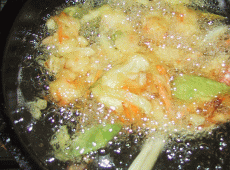
Above is picture of what was included in that particular kakiage. Notice the kabocha and peas in their pods! Let your imagination fly!

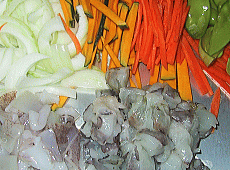
Cut the vegetables into thin strips, no longer than 5 cm/ 2 inches and all of the same size (important!). Cut cuttle fish, shrimps into according size.

Prepare the ingredients for the batter. You don’t chasing them around later!
Important: All three ingredients should have been kept in the fridge to chill them all down to the same temperature.
Beat the egg lightly, not too much. Add water and mix lightly, not too much.
Divide the kakiage ingredients into single portions into different bowls.

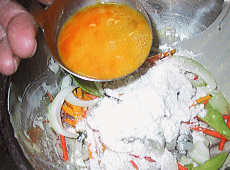
In each single bowl add flour and egg water to ingredients, thinking of batter proportions.
For example, 4 portions: 4 equal portions of flour and 4 equal proportions of egg water you have prepared beforehand.
Now, you could all mix everything into the same bowl and make kakiage into 4 batches. The problem is that there is a good chance of 4 portions unequal in proportion, consistency and taste!
Mix ingredients with flour and egg water roughly. Not too much or the kakiage will get hard and look like overfried fritters!

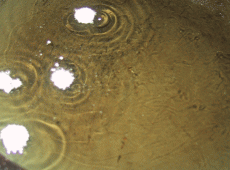
Add a little sesame oil to the salad oil to season oil and according to your preference. Bear in mind that too little oil will mean that the oil temperature will rise too quickly.
The perfect temperature before plunging the kakiage in is 175 degrees Celsius.

Using a ladle drop one portion into oil.
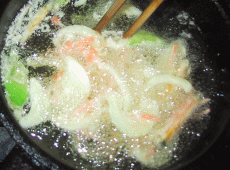
You may need a couple of long wooden chapsticks to keep the ingredients from separating at first and keeping the whole thing into a rough circle.
As for the ladle, a wooden one would be best if available.

As soon as the lower side has solidified turn the kakiage over.
Fry turning 2 or 3 more times for equal even frying until you are staisfied with colour.
Don’t overcook, but don’t undercook either.
You will learn quickly by sampling them later!

Rest the kakiage for a little time over a grill or kitchen paper to get rid of excess oil.
Now, you can serve as it is on a bowl ofresh rice or dip it (break it then) into a tempura dashi soup stock you will have prepared and heated beforehand.
My preference is to season it with a little matcha powder mixed with fine salt.
You may season the kakiage beforehand by sprinkle ingredients with a little salt and pepper or add the same tothe flour.

Here is another great way to serve it with leftover steamed rice.
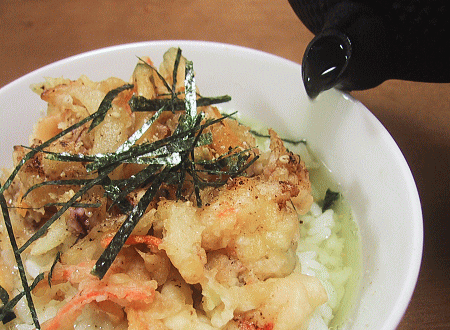
Fill a bowl with leftover rice (even cold, but not chilled), palce the kakiage on top, top the kakiage with thinly cut dry seaweed, and pour hot green tea onto the rice!
It is called: “Kakiage Chazuke”!

RECOMMENDED RELATED SITES:
Bread + Butter, Comestilblog, Greedy Girl, Bouchon For 2, Zoy Zhang, Hungry Neko, Mangantayon, Elinluv Tidbit Corner, Maison de Christina, Chrys Niles, Lexi, Culinary Musings, Eats and Everything, Bite Me New England, Heather Sweet, Warren Bobrow, 5 Star Foodie, Frank Fariello, Oyster Culture, Ramendo, Alchemist Chef, Ochikeron, Mrs. Lavendula, The Gipsy Chef, Spirited Miu Flavor

Please check the new postings at:
sake, shochu and sushi

—————————————-
日本語のブログ
—————————————-

Tiramisu: Japanese Style

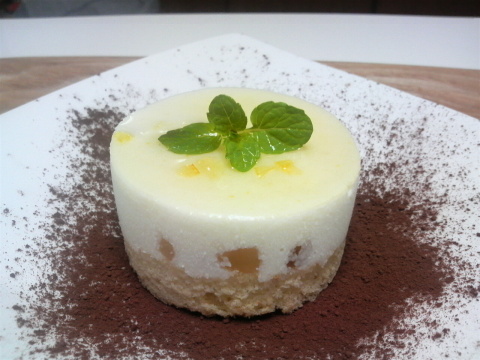
Cheese Tiramisu by Takagi

A Foodbuzz Friend of mine going by the name of Bazooka Gourmet thought that Tiramisu originated from Japan.
Unfortunately it didn’t.
But it is a fact that it is a very popular dessert in Japan.
As the Japanese are incredibly adept at improving original recipes I thought it could be an interesting idea to see what was avalaible in this country!

Here is what I found:

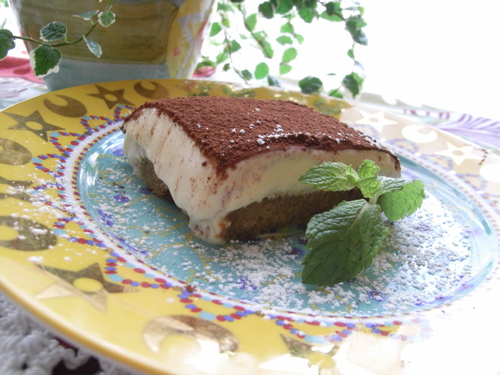
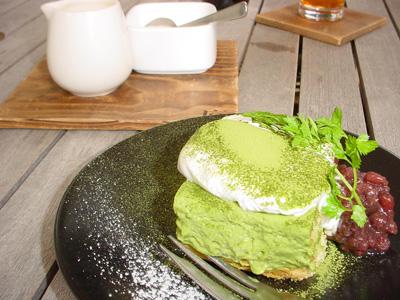
Matcha Tiramisu

As served at Pizzeria Morita (Osaka shi, Fukushima Ku, 5-6-33, Inou Bldg. 1F. Tel.: 06-6450-0630) and TACY CAFE (Osaka shi, Kita Ku, Umeda, 1-12-6, Iima 1F. Tel.: 06-6342-1687)

By Kasarin no Tsurezure Diary

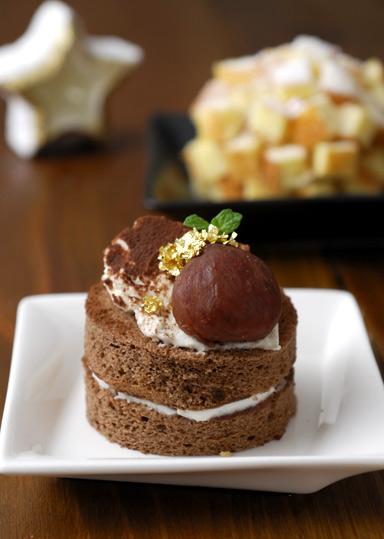
Marron Tiramisu by ABC Cooking Studio

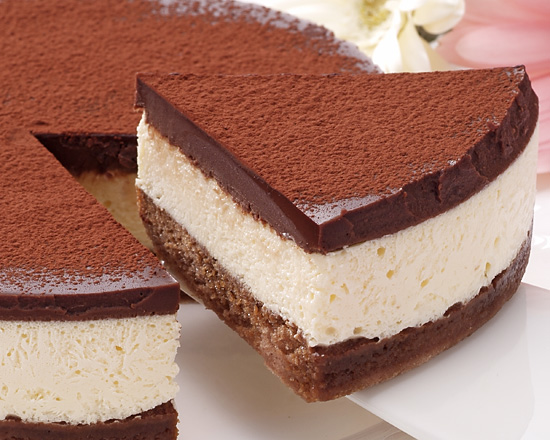
Chocolate Tiramisu by PATISSIER Louise

Tiramisu Ice Cake by Chat de Roll

Damier Tiramisu by Kawajie

Another Matcha Tiramisu by Hand-made Kiki

Tiramisu Cupcake by Sanae Pon

Christmas Tiramisu by Soy

RECOMMENDED RELATED SITES:
Bread + Butter, Comestilblog, Greedy Girl, Bouchon For 2, Zoy Zhang, Hungry Neko, Mangantayon, Elinluv Tidbit Corner, Maison de Christina, Chrys Niles, Lexi, Culinary Musings, Eats and Everything, Bite Me New England, Heather Sweet, Warren Bobrow, 5 Star Foodie, Frank Fariello, Oyster Culture, Ramendo, Alchemist Chef, Ochikeron, Mrs. Lavendula, The Gipsy Chef, Dodol-Mochi

——————————–
Please check the new postings at:
sake, shochu and sushi

—————————————-
日本語のブログ
—————————————-
Ramen Recipe: Chicken Wings Ramen

Ramen are great, but sometimes one is stuck for variety (new ideas).
Here is a very simple recipe that anyone can succeed at with a minimum of time and ingredients:

Chicken Wings Ramen!

INGREDIENTS: For 3 people

-Chicken wings (te-basaki in Japanese): 4~6
-Japanese sake (or cooking sake): half a tablespoon or more (seasoning)
-Sesame oil: half a tablespoon or more
-salt and pepper: to taste (5~6 pinches each)

-Water: 1000cc/ml

◆Japanese sake: 1 teaspoon
◆Soy sauce: 1=2 teaspoons
◆Salt: one pinch
◆Oyster sauce: 1~3 tablespoons (according to preference)

-Ramen: 3 packs
-Leeks (chopped): according to preference
Rayu/Japanese chili oil (ラー油): according to preference

RECIPE:

Thoroughly sponge off chicken wings of any water/humidity

Pour sake over chicken wings. Make sure they all coated and leave to marinate for 10 minutes.

Fry chicken wings 8as they are with the sake) with sesame oil and salt and pepper. make sure they are well seasoned.

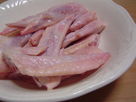
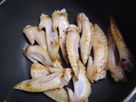
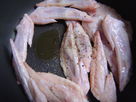
Fry chicken wings until they are nicely coloured as in above picture.

Add all the water. Cover with lid. Bring to boil first. Reduce fire to low and simmer 25~30 minutes.
In a separate bowl mix all ◆-marked ingredients for chicken seasoning.
Prepare water for boiling the ramen.

Add chicken seasoning to chicken.
Boile the ramen.

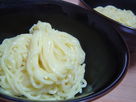
Place the ramen in each of three bowls.

Top the ramen with an equal amount of chicken wings and their soup.
Sprinkle with rayu oil and top with chopped leeks.

Serve and enjoy at once!

RECOMMENDED RELATED SITES:
Bread + Butter, Comestilblog, Greedy Girl, Bouchon For 2, Zoy Zhang, Hungry Neko, Mangantayon, Elinluv Tidbit Corner, Maison de Christina, Chrys Niles, Lexi, Culinary Musings, Eats and Everything, Bite Me New England, Heather Sweet, Warren Bobrow, 5 Star Foodie, Frank Fariello, Oyster Culture, Ramendo, Alchemist Chef, Ochikeron, Mrs. Lavendula, The Gipsy Chef

Please check the new postings at:
sake, shochu and sushi

—————————————-
日本語のブログ
—————————————-
For Vegan and Vegetarians! “Forgotten” Vegetables 24: Pepino/Poire-Melon

SYNOPSIS:
Organic agriculture and biodiversity have in recent years brought about a rediscovery of many “forgotten” vegetables that people especially in Europe and France conscientiously tried to forget as they reminded them of the privations suffered during WWII. The same people had then to make do with untraditional vegetables because potatoes, carrots and so on were confiscated by occupying forces or their own armies.
With sustainibility and bioagriculture made more important by the deficiencies of modern mass agriculture, those “forgotten” vegetables have suddenly come to the fore for the pleasure of all, and that of course of vegetarians and vegans!

This particular series of postings will introduce these vegetables one by one. I hope they will become useful for a long time to come to all my vegan and vegetarian friends!
1) Scorsonere/Oyster Plant, 2)Potimarron, 3) Vitelotte, 4) Rutabaga, 5) Cardon, 6) Panais/Parsnips , 7) Patisson, 8) Topinambour, 9) Crosne, 10) Cerfeuil Tubereux, 11) Poiree, 12) Oca, 13) Ulluque/Ulluco, 14) Tigernuts, 15) Capucine tubereuse-Maschua, 16) Chataigne de Terre-Great Pignut, 17) Yacon, 18) Balsamite/Costmary, 19) Sikkim Cucumber, 20) Tree Spinach, 21) Chayote, 22) Strawberry Blite, 23) Purslane

Here is a palnt that can be considered both as a vegetable and a fruit depending upon its maturity.
Also considered as a great ornamental plant!

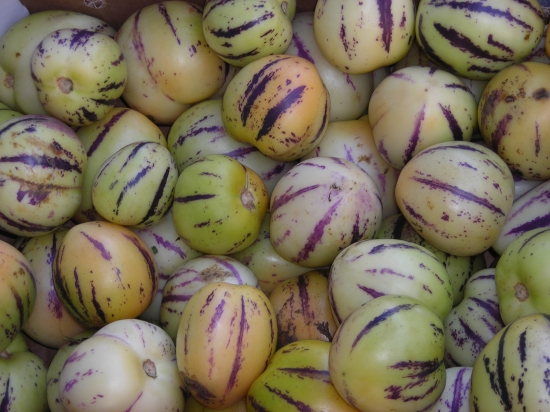
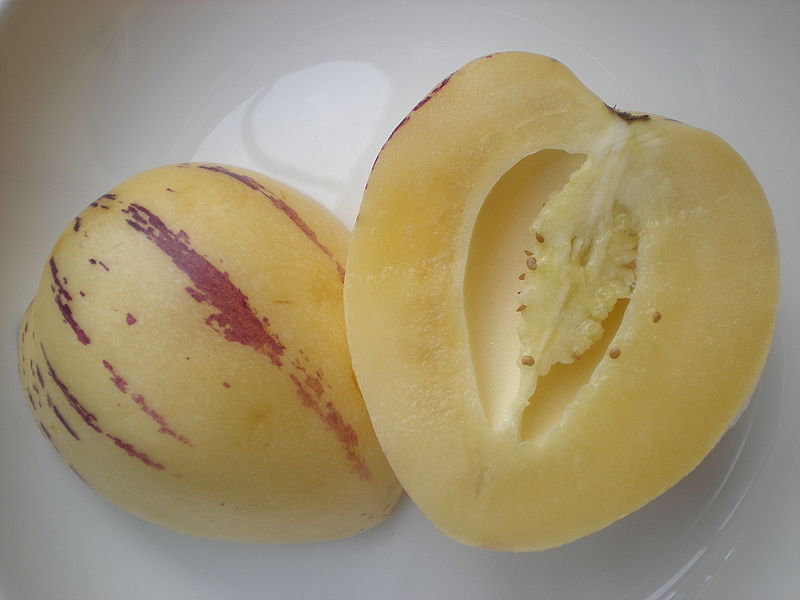
Pepino (Spanish/English) or Poire-melon (pear-melon in French) or Solanum muricatum in Latin is a species of evergreen shrub native to South America and grown for its sweet edible fruit. It is known as pepino dulce (“sweet pepino”) or simply pepino.
The pepino dulce fruit resembles a melon (Cucumis melo) in color and flavor and thus it is also called pepino melon or melon pear, but pepinos are only distantly related to melons and pears.
Another common name, “tree melon”, is more often used for the Papaya (Carica papaya) and the pepino dulce plant does generally not look much like a tree.
The fruit is common in markets in Colombia, Ecuador, Bolivia, Peru and Chile, but less often overseas because it is quite sensitive to handling and does not travel well. Attempts to produce commercial cultivars and to export the fruit have been made in New Zealand and Chile.
They are being increasingly grown in Europe, France and Belgium in particular, where they can be found in all kinds of dishes.
Moreover, in the United States the fruit is known to have been grown in San Diego before 1889 and in Santa Barbara by 1897.

The plant is grown primarily in Chile, New Zealand and Western Australia. In Chile, more than 400 hectares are planted in the Longotoma Valley with an increasing proportion of the harvest being exported. Colombia, Peru, and Ecuador also grow the plant, but on a more local scale. Outside of the Andean region, it been grown in various countries of Central America, Morocco, Spain, Israel, and the highlands of Kenya. In the United States several hundred hectares of the fruit are grown on a small scale in Hawaii and California. More commercially viable cultivars have been introduced from New Zealand and elsewhere in more recent times. As a result, the fruit has been introduced into up-scale markets in Japan, Europe and North America and it is slowly becoming less obscure outside of South America.

Pepino and kiwano salad

It is a vegetable/fruit valuable for its vitamin C as it contains 29 mg per 100 g.
Depending on its maturity, its taste varies from a slightly sweet cucumber to that of a pear or melon.
Most adapted to salads, although can be cooked when immature.

RECOMMENDED RELATED SITES
Not-Just-Recipes, Bengal cuisine, Cooking Vegetarian, Frank Fariello, Gluten-free Vegan Family, Meatless Mama, Warren BobrowBreakfast, Lunch, Dinner and Punch, Kirsten’s Kitchen, Vegan Epicurean

——————————–
Please check the new postings at:
sake, shochu and sushi

—————————————-
日本語のブログ
—————————————-
Sweet Potato Muffins

Here is another simple recipe for a cake where “East Meets West”:
Sweet Potato Muffins!

INGREDIENTS: for 12 cakes

Pastry:
-Cookie/thin flour: 230 g
-Salt: a little less than 1/2 teaspoon
-Sugar: 50 g (to be included with the flour)
-Baking powder: 2 teaspoons
-Sodium bicarbonate: 1/4 teaspoon
-Cinnamonpowder: 1 teaspoon
-Nutmeg powder: 1/2 teaspoon
-Eggs: 2
-Sweet Potato (mashed): 230 cc/ml
-Melted butter: 2~4 tablespoons
-Milk: 150 cc/ml
-Sugar: 50 g (to be incuded with the eggs)
-Walnuts: 50 g

Topping:
-Brown sugar: 1+1/2 tablespoons
-Flour: 3 tablespoons
-Butter: 2/3 tablespoon
-Cinnamon powder: 1/4 teaspoon

RECIPE:

Pre-heat oven to 200 degrees Celsius (400 F)
Coat the paper muffin cups insides with a thin layer of oile just enough to facilitate later unwrapping.
Bring all inf\gredients to room temperature.

Prepare topping first:
In a bowl drop the brown sugar, flower, butter and cinamon.
Work ad mix the lot with the tips of your fingers.

In another bowl drop the flour, sugar, baking powder, sodium bicarbonate, cinnamon powder and nutmeg powder.
Mix and sieve through a fine mesh chinois.

-Wrap the sweet potato inside cellophane paper and heat in a micriwave oven until soft. Take of skin if any. Mash the sweet potato adding the milk to them.

Add the eggs and extra sugar and mix well.
Add melted butter and mix well.

Add the sweet potato puree to the flour mixture.
Mix with a spatula.
Do not worry if you don’t attain a perfectly smoothe paste.
Mixing the whole tooo much would result into a hard muffin!

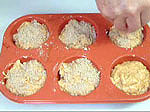
Pour the muffin mixture into the cups or in the apparel as shown in picture above up to two thirds of their depth. Sprinkle with topping.
Bake for 15~20 minutes.
Check if they are properly cooked by stabbing them with a thin wooden stick.

RECOMMENDED RELATED SITES:
Bread + Butter, Comestilblog, Greedy Girl, Bouchon For 2, Zoy Zhang, Hungry Neko, Mangantayon, Elinluv Tidbit Corner, Maison de Christina, Chrys Niles, Lexi, Culinary Musings, Eats and Everything, Bite Me New England, Heather Sweet, Warren Bobrow, 5 Star Foodie, Frank Fariello, Oyster Culture, Ramendo, Alchemist Chef, Ochikeron, Mrs. Lavendula, The Gipsy Chef, Dodol-Mochi

——————————–
Please check the new postings at:
sake, shochu and sushi

—————————————-
日本語のブログ
—————————————-
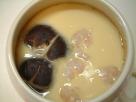
Japanese Cuisine: Chawanmushi-Basic Recipe

Chawanmushi or Chyawanmushi/茶碗蒸し is the Japanese equivalent of a French flan with thebig differencethat is not a dessert, but an appetizer!
It is quite easy to prepare and open to so many variations.
Here is the basic recipe. Just let your imagination fly!

Chawanmushi!

INGREDIENTS: For 2

-Eggs: 2
-Shrimps: 10 small
-Shiitake mushroom: 2
-Chopped leeks: to decorate and taste (or trefoil)
(you can use gingko nuts, kamaboko, crab, sea urchin, etc.)
-Dashi: 100 cc/ml (of your choice)
-Japanese sake: 50 cc/ml
-Soy sauce: half a teaspoon
-Sugar: half a teaspoon
-Salt: 1 pinch
-Water: 2 cups, 400 cc/ml

RECIPE:

Take shell and head off every shrimp.
Let shrimps marinate in the sake for a while.
If you use frozen shrimps, thaw them and sponge off their water first.

Cut the shiitake in two.
If you use fresh shiitake, fry them just a little in butter and sponge them off.
If you use dried shiitake, let them mariante in lukewarm water for two hours. Their water can be used as part of the dashi.
If you use frozen shiitake, thaw them and sponge them off first.

in a saucepan, drop dashi, water, salt, sugar and soy sauce. Heat to before bubbles come up (bubbles will be the main reason for failure!).

Beat eggs and por them slowly into the dashi, whisking them all the time.

Once all the eggs are mixed in, switchoff fire and strain/sieve soup.

Place half of the shrimps and mushrooms at the beottom of each cup.

Slowly pour half of soup in each cup/ramequin/small bowl.

Pour 3 cm of water into your steamer pan and bring to boil.

Place steaming tray inside steamer and place cups on it with lids on.

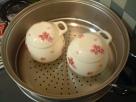
Cover as shown on above picture.
Cook over strong fire for 2 minutes, then 10 minutes over low fire (over high fire all theway through will ened into failure!).

Check if chawanmushi are properly cooked. If you stab a toothpick in it, no dashi shoud come out.

Decorate with leeks or trefoil and serve!

RECOMMENDED RELATED SITES:
Bread + Butter, Comestilblog, Greedy Girl, Bouchon For 2, Zoy Zhang, Hungry Neko, Mangantayon, Elinluv Tidbit Corner, Maison de Christina, Chrys Niles, Lexi, Culinary Musings, Eats and Everything, Bite Me New England, Heather Sweet, Warren Bobrow, 5 Star Foodie, Frank Fariello, Oyster Culture, Ramendo, Alchemist Chef, Ochikeron, Mrs. Lavendula, The Gipsy Chef Hapabento, Tokyo Terrace</a

Please check the new postings at:
sake, shochu and sushi

—————————————-
日本語のブログ
—————————————-
For Vegan and Vegetarians! “Forgotten” Vegetables 23: Purslane

SYNOPSIS:
Organic agriculture and biodiversity have in recent years brought about a rediscovery of many “forgotten” vegetables that people especially in Europe and France conscientiously tried to forget as they reminded them of the privations suffered during WWII. The same people had then to make do with untraditional vegetables because potatoes, carrots and so on were confiscated by occupying forces or their own armies.
With sustainibility and bioagriculture made more important by the deficiencies of modern mass agriculture, those “forgotten” vegetables have suddenly come to the fore for the pleasure of all, and that of course of vegetarians and vegans!

This particular series of postings will introduce these vegetables one by one. I hope they will become useful for a long time to come to all my vegan and vegetarian friends!
1) Scorsonere/Oyster Plant, 2)Potimarron, 3) Vitelotte, 4) Rutabaga, 5) Cardon, 6) Panais/Parsnips , 7) Patisson, 8) Topinambour, 9) Crosne, 10) Cerfeuil Tubereux, 11) Poiree, 12) Oca, 13) Ulluque/Ulluco, 14) Tigernuts, 15) Capucine tubereuse-Maschua, 16) Chataigne de Terre-Great Pignut, 17) Yacon, 18) Balsamite/Costmary, 19) Sikkim Cucumber, 20) Tree Spinach, 21) Chayote, 22) Strawberry Blite

It is my new Foodbluzz Friend, Wizzy, who attracted my attention on this vegetable, being notably forgotten in the States but entertaining a groeing popularity elsewhere.
I decided to investigate further as I recently had the opportunity to taste recently in Japan!

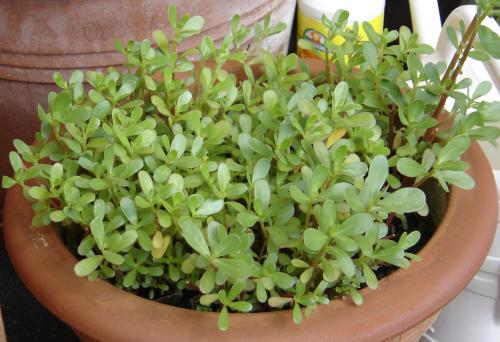
Purslane cultivation

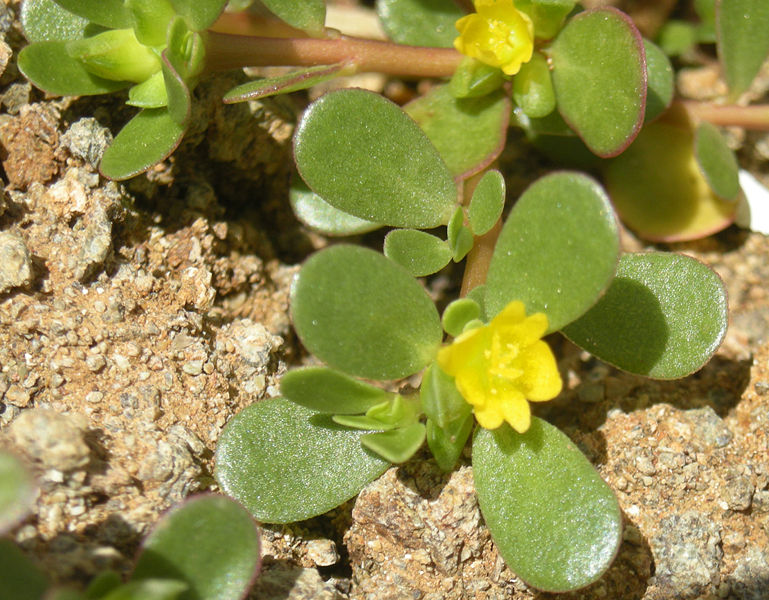
Portulaca oleracea (Common Purslane, also known as Verdolaga, Pigweed, Little Hogweed or Pusley), is an annual succulent in the family Portulacaceae, which can reach 40 cm in height. About 40 varieties are currently cultivated. It has an extensive old-world distribution extending from North Africa through the Middle East and the Indian Subcontinent to Malesia and Australasia. The species status in the New World is uncertain: it is generally considered an exotic weed; however, there is evidence that the species was in Crawford Lake deposits (Ontario) in 1430-89, suggesting that it reached North America in the pre-Columbian era. It is naturalised elsewhere and in some regions is considered an invasive weed. It has smooth, reddish, mostly prostrate stems and alternate leaves clustered at stem joints and ends. The yellow flowers have five regular parts and are up to 6 mm wide. The flowers appear depending upon rainfall and may occur year round. The flowers open singly at the center of the leaf cluster for only a few hours on sunny mornings. Seeds are formed in a tiny pod, which opens when the seeds are ready. Purslane has a taproot with fibrous secondary roots and is able to tolerate poor, compacted soils and drought.

Although purslane is considered a weed in the United States, it can be eaten as a leaf vegetable, providing sources can be found which have not been poisoned deliberately. It has a slightly sour and salty taste and is eaten throughout much of Europe, Asia and Mexico. The stems, leaves and flower buds are all good to eat. Purslane can be used fresh as a salad, stir-fried, or cooked like spinach, and because of its mucilaginous quality it is also suitable for soups and stews. Australian Aborigines used to use the seeds to make seedcakes.

Purslane contains more Omega-3 fatty acids (alpha-linolenic acid in particular) than any other leafy vegetable plant. It also contains vitamins (mainly vitamin A, vitamin C, and some vitamin B and carotenoids), as well as dietary minerals, such as magnesium, calcium, potassium and iron.
It also helps combat ageing as containing antioxydants.

In Greek popular medicine, purslane is used as a remedy for constipation and inflammation of the urinary system.

A common plant in parts of India, purslane is known as “Sanhti”, “Punarva”, or “Kulfa”. In North India it is known to act as a liver tonic and is used in diseases of the liver.

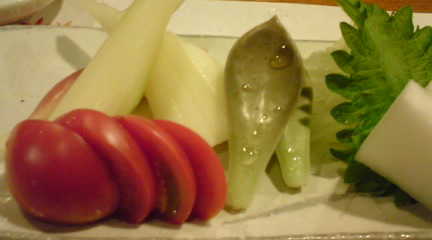
YASAITEI-VEGAN4

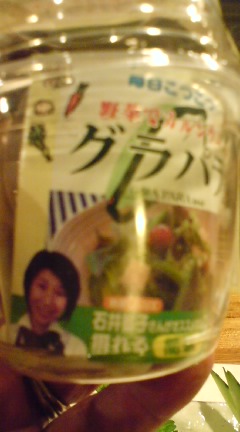
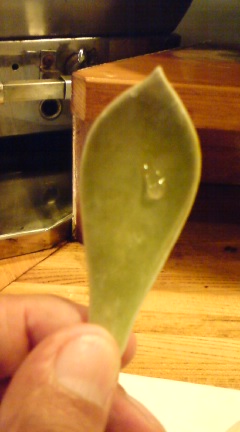
I n japan they are called Grapara leaves (grapara/グラパラ)
Can you see them in the middle of this vegetable sashimi served at yasaitei?

YASAITEI-VEGAN6

These grapara leaves are grown in Chiba Prefecture, north of Tokyo.
For people who can read Japanese, check their homepage!

YASAITEI-VEGAN7

Crunchy but with a juicy and tender inside, they are sweet and taste somewhat like pineapple!

YASAITEI
Shizuoka City, Aoi Ku, Tokiwa-Cho, 1-6-2 Green Heights Wamon 1-C
Tel.: 054-2543277
Business hours: 17:30~22:00
Closed on Sundays
Reservations highly recommended
Seating: 6 at counter + 20 at tables
Set Courses: 3,000, 4,000, 5,000 yen
HOMEPAGE (Japanese)

RECOMMENDED RELATED SITES
Not-Just-Recipes, Bengal cuisine, Cooking Vegetarian, Frank Fariello, Gluten-free Vegan Family, Meatless Mama, Warren BobrowBreakfast, Lunch, Dinner and Punch, Kirsten’s Kitchen, Vegan Epicurean

——————————–
Please check the new postings at:
sake, shochu and sushi

—————————————-
日本語のブログ
—————————————-
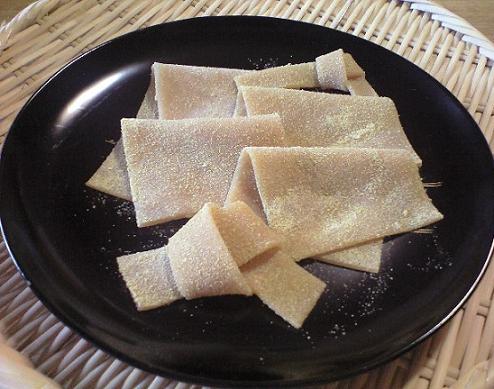
Japanese cakes/Wagashi 15: Yatsuhashi/O-Tabe

Yatsuhashi (八ツ橋 or 八橋) is a Japanese confectionery sold mainly as a souvenir sweet (miyagegashi/土産菓子). It is one of the best known meibutsu/名物 (famous regional products) of Kyoto.
It is also widely known under the name of O-Tabe/お食べ (please eat).

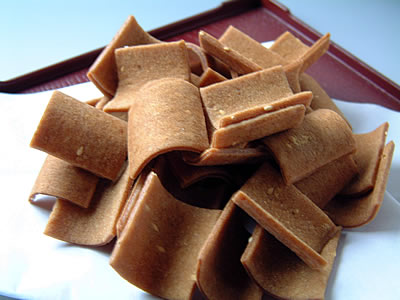
It is made from rice flour (上新粉, jōshinko), sugar and cinnamon. Baked, it is similar to senbei, making suitable for both vegans and flour allergics!

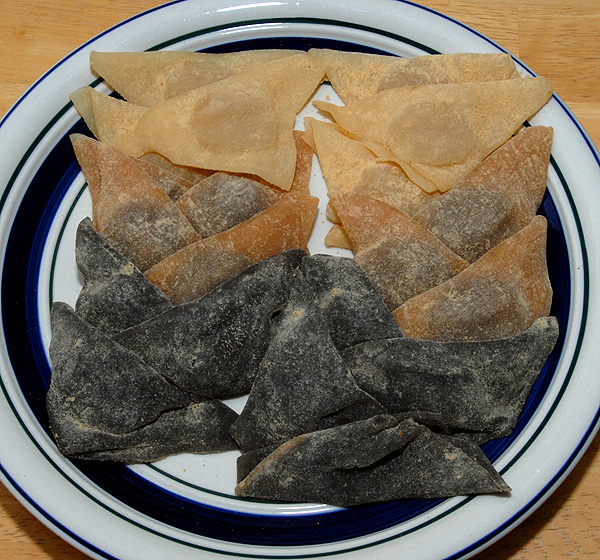
Baked Yatsuhashi

Raw Yatsuhashi

Raw, unbaked yatsuhashi (Nama yatsuhashi/生八橋) has a soft, mochi-like texture and is often eaten wrapped around red bean paste (餡, an), and may come in a variety of different flavours.

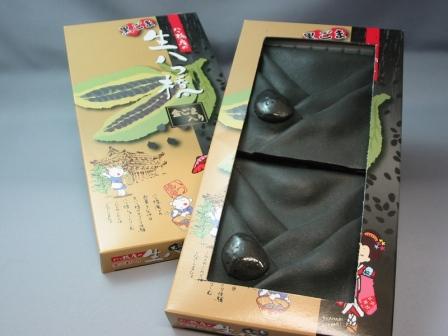
Black Yatsuhashi

Most notable to the Kyoto area is the black version of this. The addition of black bean powder and black sesame seed powder to the wrapper and the an give a distinctive black color.

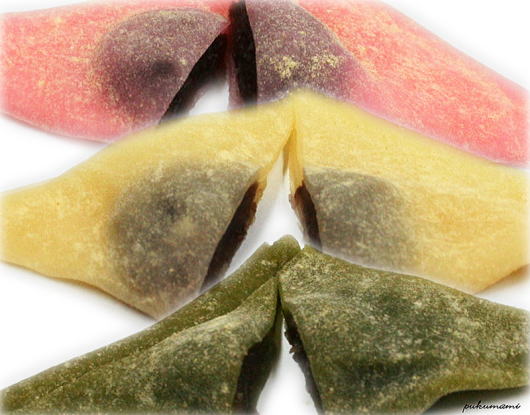
Different flavoured Yatsuhashi

Not so long ago, there were only a few flavours available.
Now, all kinds of flavours are on sale for the pleasur of all:
Cinnamon, Matcha Tea, Ume an (sweetmeats mixed with Jpanese plum), Mandarine, Strawberries, Cherry blossoms, Ramune, Chocolate-banana, Chocolate, Kyoto baked sweet potato, Chestnuts, Green apple, Blueberries, Mango, Orange, Red wine and more seasonal offerings!

RECOMMENDED RELATED SITES
Not-Just-Recipes, Bengal cuisine, Cooking Vegetarian, Frank Fariello, Gluten-free Vegan Family, Meatless Mama, Warren BobrowBreakfast, Lunch, Dinner and Punch, Kirsten’s Kitchen, Vegan Epicurean

——————————–
Please check the new postings at:
sake, shochu and sushi

—————————————-
日本語のブログ
—————————————-
Bryan Baird’s Newsletter (2009/12/14)

Baird Beer & Taproom Events Bulletin
bryan-sayuri.gif

Dear Taproom Friend & Baird Beer Enthusiast:

Artisan brewing is a matter of the heart and the heart, generally, is tied to place. The place tied to the heart of Baird Beer is Numazu city in Shizuoka prefecture. Sayuri and I moved to Numazu in 1997, started a family here and then launched the Baird Brewing Company in the fish market area of Numazu in 2000. Numazu very much reminds me of America’s heartland, the Midwest, the place I grew up. The people of Numazu tend to be simple, honest and industrious; they also share an easy-going attitude and big-hearted spirit. Located at the base of Mount Fuji and on the shore of the Suruga Bay, Numazu is almost idyllic in its natural beauty.

We long have wanted to dedicate a beer to this place of heart of ours and at last we have done so. Numazu Lager is debuting on Tuesday, December 15 as the ninth member of the Baird Beer year-round lineup, and the team’s first lager representative.

Numazu Lager (ABV 5.2%):

One of the strengths of brewing in Numazu is the area’s wonderful natural water supply. It is soft, clean and round, lending a lovely, albeit subtle, character to beer. This character is an important attribute of the amber-tinged golden Numazu Lager. Supremely refreshing, Numazu Lager combines malt roundness and lager-style smoothness with a snappy and brisk hop essence. And unlike industrial lagers, Numazu Lager is minimally processed (unfiltered and naturally carbonated in package) and thus enjoys great depth of flavor.

This maiden batch of Numazu Lager has been bottled in seasonal-style 633 ml bottles. It will be available in our normal 360 ml bottles beginning with batch #2. You will be able to enjoy it on draught at all of our Taproom pubs as well as at other Baird Beer retailing pubs and restaurants in Japan.

The artwork for Numazu Lager has been done, as always, by our talented designer and friend, Ms. Eiko Nishida. The label depicts a view of the Numazu fish market area with our Fishmarket Taproom in the upper left background. You can check out the new label on our website: http://bairdbeer.com/en/bairdbeer/year-round-beers.

Cheers!

Bryan Baird
Baird Brewing Company
Numazu, Japan
HOMEPAGE


The Japan Blog List

———————————
Must-see tasting websites:
-Sake: Tokyo Through The Drinking Glass, Tokyo Foodcast, Urban Sake, Sake World
-Wine: Palate To Pen, Warren Bobrow, Cellar Tours
-Beer: Good Beer & Country Boys, Another Pint, Please!
-Japanese Pottery to enjoy your favourite drinks: Yellin Yakimono Gallery
——————————–
Please check the new postings at:
sake, shochu and sushi

—————————————-
日本語のブログ
—————————————-
Robert Yellin’s Newsletter: Japanese Pottery by Koinuma Michio

Greetings from Mishima,

As the year 2009 slowly winds down we close our exhibition schedule with a look at 20 of Koinuma Michio’s empowered kabuto–Samurai helmets.

Kabuto are objects with a significant history here in Japan, worn by the warrior class Samurai for protection in battle, they also were symbols of power and clan affiliations; many were also beautifully constructed to resemble works of art.

Nowadays families display model ones during Boy’s Day in the spring in hopes of a strong and healthy future. Each of Koinuma’s helmets has an ancient aura surrounding the darkened patina of each work, as if they were excavated from a lord’s tomb.

The symbolism is strong in each representing character, boldness, humility, honor and courage. Fired in a small wood-burning kiln, each is given a unique firing scheme that can never be duplicated.

Koinuma(b.1936) imparts to all his unique ceramic creations a deep spirituality combined with a pure Japanese aesthetic; he’s been doing this for decades and as such is respected as one of Japan’s most important veteran ceramic artists.

Sizes range from 13 to 23cm.tall and prices are between 100,000-160,000 yen with signed boxes. Each is hollow yet very solid with a good weight and balance; additional photos of any gladly sent upon request. Koinuma’s kabuto are on the web gallery now for viewing and in time for the holidays.

Next year look for a new look to our online gallery; we’ve been working with a great team of web designers and look forward to the debut in early January. Also on tap for 2010 are exhibitions by Nagaoka Masami, jars by Koinuma, colorful Shimura Noriyuki and a rare look at veteran Hirashimizu potter Niwa Ryochi; other exhibitions to be announced.

With any orders through the end of the year we’ll be including a traditional hand cloth called a tenugui that was designed by Ajiki Hiro as a year-end gift.

With much thanks for all your interest and support this year.
Wishing all a very pleasant, enjoyable and healthy holiday season.

Warm regards,

Robert Yellin
HOMEPAGE

RECOMMENDED RELATED SITES:
Warren Bobrow
5 Star Foodie
Think Twice
Frank Fariello

Please check the new postings at:
sake, shochu and sushi

—————————————-
日本語のブログ
—————————————-
Sushi Restaurant: Sushi Ko (’09/12/10)

When I go for sushi with the Missus, we invariably visit Sushi Ko in Sushi Ko.
I just can’t enumerate all the good reasons for visiting this sushi restaurant.
It is the best deal in town when it comes to quality, freshness, prices and service. Full stop.

We were served ankimo/アンキモ or monkfish liver (I call it Japanese foir gras!) with the first drink.
That helped us consider which sashimi to start with.
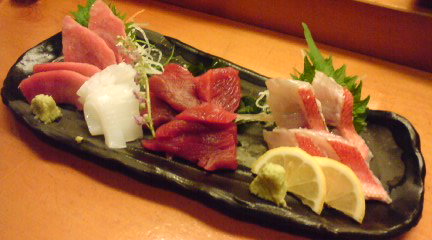
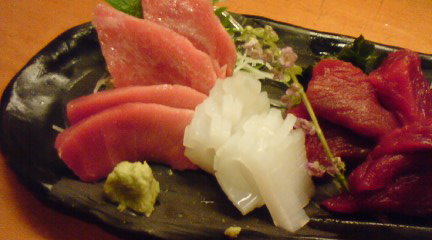
Here is what we ordered on that particular day (the fish served is only seasonal at Sushi Ko, so choosing sashimiis a great venture!):

-Bottom left: “honmaguro/本鮪”, blue fin tuna from Oma (Aomori Prefecture), chu-toro/semi-fat part.
-Top left: O-toro/belly fat part of same fish
-Bottom centre: “Aori Ika/あおり烏賊, Great Fin Reef Squid from Suruga Bay in Shizuoka Prefecture.
-Bottom right: Akami/lean part rom same tuna.

Notice the “shiso/紫蘇”, perilla flowers, grated “wasabi/山葵” from Shizuoka and “wakame/若布” seaweed at the back!

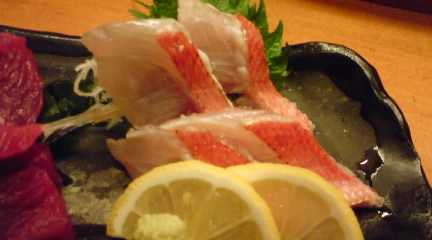
“Kinmeidai/金目鯛”, gold eye seabream from Izu penisula in Shizuoka Prefecture resting on a shiso/perilla leaf.

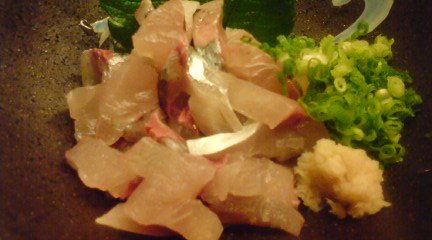
As we were not ready yet for the sushi (rice) we ordered one more sashimi: “aji tataki/鯵たたき”, or saurel/mackerel pike tartare Caught off Shizuoka shores).
Very fresh and enjoyable as you little bits at a time.

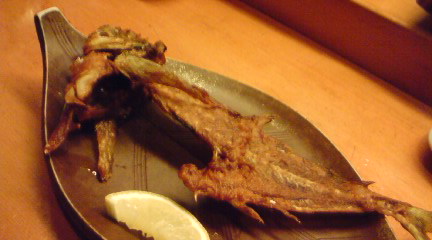
Just to prove how fresh the fish was (it was caught live from the tank), we were served its head and bones dep-fried. This is actually the traditional Japanese way to get their calcium for their bodies!

Sushi is not only superlative at sashimi and sushi, but they also provide a great array of excellent cooked dishes.
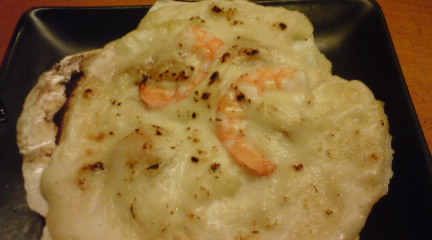
The Missus being ravenous, she couldn’t help asking for the “hotate gratin/帆立グラタン, scallops gratin! French cuisine at a sushi restaurant! Why not!

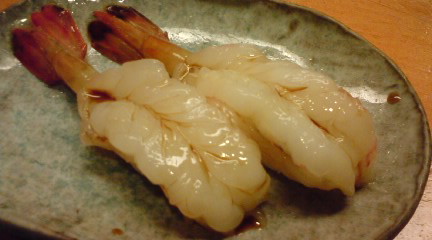
On the other I couldn’t help ogling at the “botan ebi/牡丹蝦, large prawns” from Hokkaido. I opted for them as sushi nigiri. These large prawns are very sweet and are exclusively eaten raw.

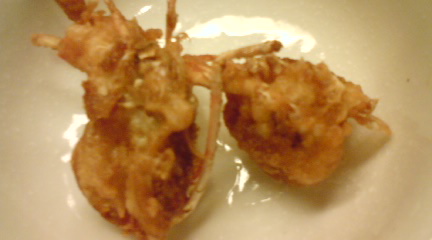
Once again, to prove their freshness, we were served the heads deep-fried!

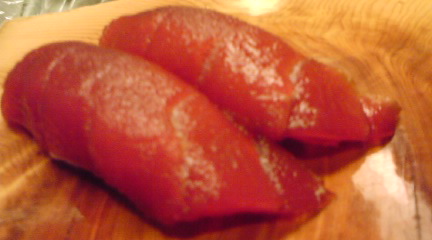
“Maguro Zuke/鮪付け”, marinated tuna is another morsel that we must have. The tuna, akami/lean part usually is marinated for 10~20 minutes in a mixture of soy sauce, sake and mirin (and other “secret” ingredients) before being placed on the shari/rice ball. Almost makes for a dessert.

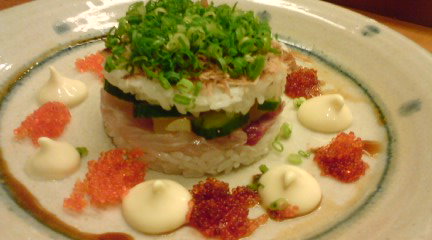
One particular creation by Sushi Ko is their Sushi Millefeuille (another French concept?)
They offer two kinds, one international style, the other Japanese style.
For once, we chose the Japanese style:
“kanpachi/間八” or greater Amberjack, “Kazu no Ko/数の子”, or herring roe and cucumber on the first tier, “Katsuo Bushi/鰹節” or dry bonito shavings and chopped thin leeks, the whole surrounded with dressing and “Tobikko/飛び子” or flying fish roe!

From then it was ordering morsels, one set of two/”nikan-二冠” at a time:
“hotate/帆立”, raw scallops muscle part.

“HIrame/平目”, or sole, served pre-seasoned with a little salt and lemon juice. Perfect as it is. No need for soy sauce!

“Me-negi/芽葱”, or leek sprouts for the vegans!

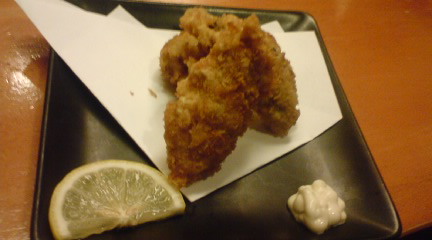
The Missus couldn’t stop and ordered Japanese-style deep-fried oysters!

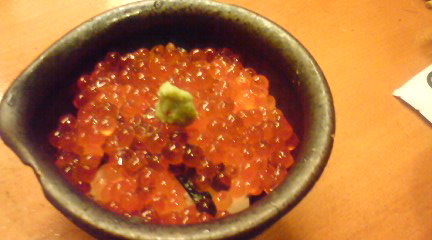
And the ubiquitous “Ikura mini don/いくらミニ丼”, or mini bowl of rice topped with salmon roe and freshly grated wasabi (from Shizuoka, of course!).

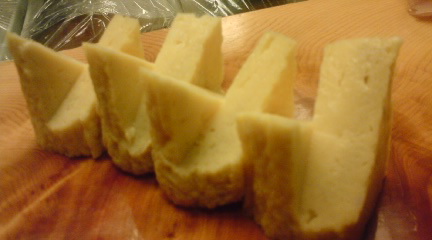
As for me, I will not leave the place without the “Tamagoyaki/卵焼き” or Japanese omellette. Home-made (not all sushi restaurants go through the pain of cooking their own tamagoyaki!”) and artfully cut!

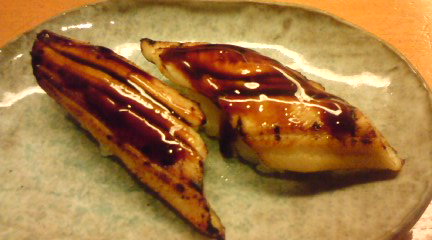
And the extravagant dessert: “Anago/穴子”, conger eel first grilled to a soft texture and topped with tare/sauce (always original at Sushi Ko!)!

We did have a lot of drink, I can assure you, but we remembered what we savoured!
Next time? Very soon, I’m sure!

Sushi Ko
shizuoka City, Aoi Ku, Ryogae-cho. 2-3-1 (Aoba Koen)
Tel.: 054-2512898
Business Hours: 17:00~25:00. 17:00~23:00 (Sundays)
Closed on Wednesdays
Reservations recommended
Credit cards OK
HOMEPAGE (Japanese)

RECOMMENDED RELATED SITES:
Bread + Butter, Comestilblog, Greedy Girl, Bouchon For 2, Zoy Zhang, Hungry Neko, Mangantayon, Elinluv Tidbit Corner, Maison de Christina, Chrys Niles, Lexi, Culinary Musings, Eats and Everything, Bite Me New England, Heather Sweet, Warren Bobrow, 5 Star Foodie, Frank Fariello, Oyster Culture, Ramendo, Alchemist Chef, Ochikeron, Mrs. Lavendula, The Gipsy Chef, Spirited Miu Flavor,
-Sake: Tokyo Through The Drinking Glass, Tokyo Foodcast, Urban Sake, Sake World
-Wine: Palate To Pen
-Beer: Good Beer & Country Boys, Another Pint, Please!
-Japanese Pottery to enjoy your favourite drinks: Yellin Yakimono Gallery

Please check the new postings at:
sake, shochu and sushi

—————————————-
日本語のブログ
—————————————-

Today’s Lunch Box/Bento (’09/77)

Today’s Lunch Box/Bento wasa bit of a mistake as the Missus said she would prepare “mazegohan/混ぜご飯” or mixed steamed rice with the crab (“zuwagani/ずわ蟹 or Snow Crab) I bought yesterday. Well, I’ll have to wait for the crab until tonight. LOL

Mind you we had eaten the best part of it last niight already, so instead of including the rest in the rice, she’ll probably serve it with a salad!

So she steamed the rice with a piece of dry konbu/seaweed and finely chopped “Kyo Ninjin/京人参”, a variety of carrot, log, deep-red and sweet originally grownin the Kyoto area.
Once steamed, she mixed the rice with the carrot (which has been left cooking on top of the rice) and black sesame seeds.

As for the garnish, she sauteed very soft/tender pork fillet with mustard and “eringe/エリンゲ”, eringi mushrooms in its fat and sauce.

The straight “tamagoyaki/卵焼き”, Japanese omelette (by straight, I mean she did not include anything else) and the boiled broccli made for a nice colour variation.

As for the salad/dessert, she placed small cuts of “jiro kaki/次郎柿”, sqaut persimmon, and large pointed Shizuoka plum tomato slices over a bed of roughly chopped lettuce and greens.

As I’m presently on a diet (already lost 3 kg in a week without much strain), it does make for a healthy and colourful bento!

RECOMMENDED RELATED SITES:
Warren Bobrow, Bread + Butter, Zoy Zhang, Hungry Neko, Think Twice, Frank Fariello, Mangantayon, Hapabento, Elinluv Tidbit Corner, Tokyo Terrace, Maison de Christina, Chrys Niles,Lexi, Culinary Musings

Please check the new postings at:
sake, shochu and sushi

—————————————-
日本語のブログ
—————————————-
For Vegan and Vegetarians! “Forgotten” Vegetables 22: Epinard-Fraise/Strawberry Blite

SYNOPSIS:
Organic agriculture and biodiversity have in recent years brought about a rediscovery of many “forgotten” vegetables that people especially in Europe and France conscientiously tried to forget as they reminded them of the privations suffered during WWII. The same people had then to make do with untraditional vegetables because potatoes, carrots and so on were confiscated by occupying forces or their own armies.
With sustainibility and bioagriculture made more important by the deficiencies of modern mass agriculture, those “forgotten” vegetables have suddenly come to the fore for the pleasure of all, and that of course of vegetarians and vegans!

This particular series of postings will introduce these vegetables one by one. I hope they will become useful for a long time to come to all my vegan and vegetarian friends!
1) Scorsonere/Oyster Plant
2)Potimarron
3) Vitelotte
4) Rutabaga
5) Cardon
6) Panais/Parsnips
7) Patisson
8) Topinambour
9) Crosne
10) Cerfeuil Tubereux
11) Poiree
12) Oca
13) Ulluque/Ulluco
14) Tigernuts
15) Capucine tubereuse-Maschua
16) Chataigne de Terre-Great Pignut
17) Yacon

18) Balsamite/Costmary
19) Sikkim Cucumber
20) Tree Spinach
21) Chayote

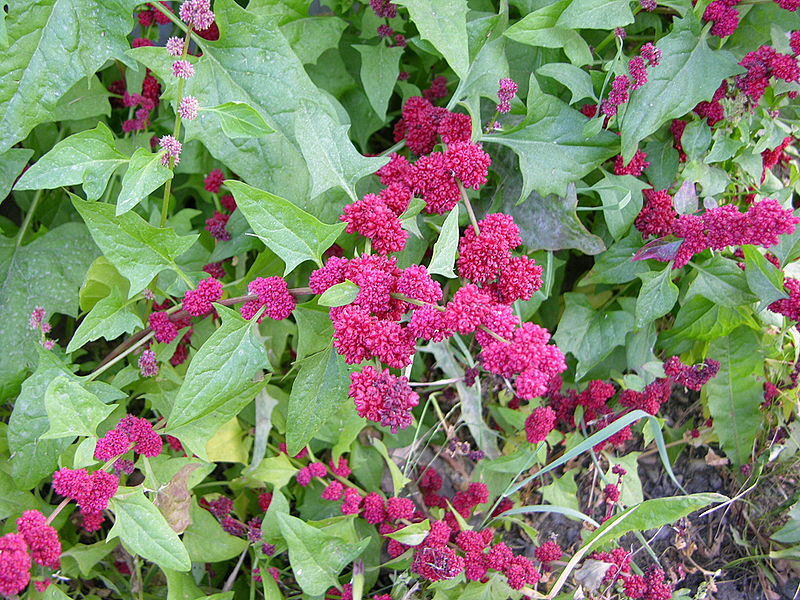
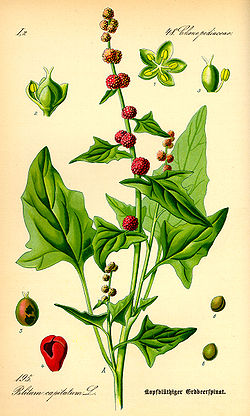
Strawberry Blite (Chenopodium capitatum, Blitum capitatum), or Epinard-Fraise in French (Spinach Strawberry) is an edible annual plant, also known as Blite Goosefoot, Strawberry Goosefoot, Strawberry Spinach, Indian Paint, and Indian Ink.

It is native to most of North America throughout the United States and Canada, including northern areas.
It is also found in parts of Europe and New Zealand.
Strawberry Blite is found in moist mountain valleys.
Some farmers and hobbyists are growing them in France.

Flowers are small, pulpy, bright red and edible, resembling strawberries. The juice from the flowers was also used as a red dye by natives.
The fruits contain small, black, lens-shaped seeds that are 0.7-1.2 mm long.
The Plant is small (30 cm=1 foot) and leaves are small too, but can be eaten like spinach. The harvest lasts all Autumn.
Probably best with the fruit added to salads!
Can also be adapted as sauce or coulis.

RECOMMENDED RELATED SITES
Not-Just-Recipes, Bengal cuisine, Cooking Vegetarian, Frank Fariello, Gluten-free Vegan Family, Meatless MamaFrank Fariello, , Warren Bobrow

Please check the new postings at:
sake, shochu and sushi

—————————————-
日本語のブログ
—————————————-