Tag Archives: seafood

Local Sushi & Sashimi only at Ginta!

GINTA-LOCAL-1

The particularity of Ginta, a minuscule sushi restaurant located near the harbour of Yui in the eastern part of Shizuoka City is that it proposes sushi and sashimi plates from fish exclusively caught in Suruga Bay only a few miles and fathoms from the very shore!

The other day I convinced the Missus to pay Ginta a belated (for me as it was a first for her) visit and sample the fish of the moment.

Iforgot to say that the prices are ridiculously low when taking the quality and rarity in consideration!

The “Jizakana/Local Fish” set of 8 above is priced at 1,800 yen/ 19 US $!

Here is a description of the sushi (Picture above):

Above, from left to right:
-Tora Fugu/a popular species of globefish, served pre-seasoned (no need to dip it in the soy sauce)
-Hanadai/A kind of grouper, served pre-seasoned
Mr. Hara actually deep-fries the scales of that particular fish before inserting them under the slice of raw fish!
-Tachiuo/Scabbard Fish, v
-Sakura Ebi/Cherry Shrimps, served in “gunkan” style.

Bottom, from left to right:
-Kanpachi/Albacore
-Kurodai/another kind of grouper
-Kurozawa Aji/Saurel caught in Kurozawa area, next to Yui.
-Kose/a purely local fish also called “kushikinme or goso (in Numazu City). It is apparently a local variety of grouper.

GINTA-LOCAL-2

Having enjoyed kose for the first time, we decided to order it as a full sashimi plate.
A real beauty: firm, almost crisp, not a hint of “fishy taste” and absloutely delicious!

No wonder customers come all the way from Tokyo!
Now, the advantage I have on such customers is that Mr. Hara is so enthusiastic sharing his knowledge with local patrons!

GINTA
421-3111 Shizuoka Shi, Shimizu Ku, Yui cho, Imajuku, 165. (get off at Yui Station and walk to your right. Only a few minutes away)
Tel.: 0543-75-3004
Opening hours: 11:00~23:00
Closed on Tuesdays
Reservations on the telephone recommended!

Please check the new postings at:
sake, shochu and sushi

—————————————-
日本語のブログ
—————————————-

Wine-marinated Scallops and their Red and White Wine Jelly

SCALLOPS-WINE_0001

It’s Summer.
That is when French and Japanese cuisines tend to fuse in a new natural dimension with the need for lighter gastronomic ventures.

here is a simple recipe that will impress your friends:
Wine-marinated Scallops and its Red and White Wine Jelly!

INGREDIENTS: For 4 persons

-Scallops: 12 large
-Red wine (Chinon, or a wine both spicy and solid, but not too heavy): 450 ml
-White wine (Loire or Vouvray, or a slightly sweet white wine): 200 ml
-Gelatin: 6 sheets
-Olive oil (EV): 2 large tablespoons
-Green leaves of your choice: ~250 g
-Salt & pepper to taste

RECIPE:

-Marinate the scallops in 250 ml of red wine for 2 hours.

-Drop the gelatin sheets in a bowl filled with cold water.
Separately heat both wines slowly to lukewarm in two pans.
Take gelatin sheets out of cold water bowl, drain them and add 3 of each to each wine pan.
Wait until gelatin has dissolved.
Pour the wine jelly into two deep plates or molds.
Put in refrigerator until jelly has completely solidified.

-ake the scallops out of their marinade.
Cut them into thin slices.
heat and reduce the marinade down to one third. Add olive oil, salt and pepper to marinade.
Let cool completely.

-Clean the vegetable leaves and place at the centre of plates.
Make a rondo/circle of slices callops. Cut the jelly into small cubes and place them over or with the salad.
Pour a spoon of the sauce over the salad.

Enjoy the rest of the wine with it!

Please check the new postings at:
sake, shochu and sushi

—————————————-
日本語のブログ
—————————————-

Sashimi Plate at Tomii (’09/07/31)

TOMII-09-07-31

Visited Tomii last night for the first time in three weeks. It was about time I sampled one of their sashimi plates!

No fussing needed, will just explain:

Top: Amaebi/sweet shrimps

Center: Hirame/Sole. Kanpachi/Amberjack, Toro/Tuna fatty part

Bottom: Akami/Tuna lean part, Hirame engawa/Sole “verandah” (actually this is the border flesh that is usually thrown away abroad!), Aka Ika/Red squid, Sanma/Mackerle pik-Saury

Notice the shiso/perilla flowers!

What did I drink with that?
Hakuin Masamune Yamahai by Takashima Shuzo in Numazu City, a sake getting national recognition these days!

Please check the new postings at:
sake, shochu and sushi

—————————————-
日本語のブログ
—————————————-

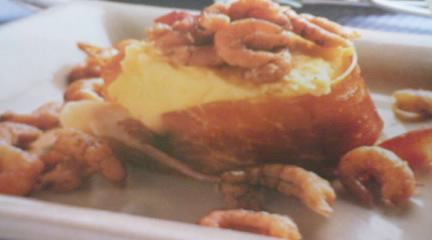
Belgian Cuisine: Potato Cream, Shrimps & Smoked Ham

POTATO-SHRIMPS

Belgium is one those unsung countries when it comes to gastronomy.
Who has heard of the Ardennes Forest and its abundant game and mushrooms? Have you visited Bruges? The biggest misconception is “French fries”! Sorry, mate, but they are Belgian! And what about mussles and waffles?… And the beer?

Here is a typical fare that people in Bruges are fond of:
Potato Cream (Mashed potato cream), Shrimps & Smoked Ham!

INGREDIENTS: for 4 persons

-Potatoes: 4 bintje if possible
-Small (grey) shrimps: 300 g
-Smoked ham: 4 slices
-Egg yolks: 4
-Butter: 150 g
-White wine: 3 cups/600 ml
-Olive oil (EV): a little
-Fresh cream: 1 large tablespoon
-Nutmeg: 1 pinch
-Salt, pepper: to taste

RECIPE:

-Peel the potatoes. Cut them for easier cooking. Boil them in water for 20 minutes. Mash them with a fork. Add a little of the cooking water if necessary. Add and mix in a little olive oil and the fresh cream. Keep warm.

-Lightly fry smoked ham in a little butter. Get the shrimps rid of their shells and heads.

-In a bain-marie (on the fire put a pan with water and heat, use a smaller pan and place it inside the water-filled pan so as to avoid a direct contact with the heat) pan, whisk the egg yolks quickly addin the wine to them litle by little. Then add and mix the butter, a small piece at a time. Season with salt and pepper to taste. Mix.
Add this sauce to the mashed potatoes, mixing the two delicately. Season again if necessary. Ad the nutmeg.

-In a plate place some mashed potatoes in the middle. Wrap a piece of smoked ham around it and put the plate under the grill for a few minutes to obtain a lightly coloured top for the potatoes.

-Steam the shrimps and place them on top and around the mashed potatoes. Add a touch with some flat parsley or other herb of your liking!

To be savoured with a Belgian beer!

Please check the new postings at:
sake, shochu and sushi

—————————————-
日本語のブログ
—————————————-

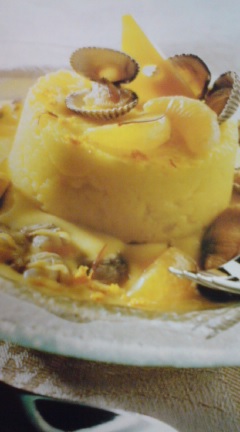
Safran & Mandarine Mashed Potatoes with Cockles & Mussles

MASHED-SAFRAN

One should never be afraid to experiment with seasonal products.
A failed experiment is certainly better than a dish served again and again ad infinitum!
At least this dish will be remarked for its colour!

Safran & Mandarine Mashed Potatoes with Cockles & Mussles!

INGREDIENTS: For 4 persons

-Potatoes: Choose 6 beautiful ones
-Mussles: 1 kg
-Cockles: 1 kg
-Dry white wine: 2 cups/400 ml
-Mandarines: 2 (organic if possible)
-Mandarin oil: 3 large tablespoons
-Shallots: 2
-Butter: 50 g
-Fresh cream: 2 large tablespoons
-Safran powder: 2 g
-Safran filaments: a few
-Mimolette cheese
-Egg yolks: 2
-Salt & pepper (to taste)

RECIPE:

-Mandarine oil:
Take the skin off mandarines (not includging the white part). Take out mandarine wedges.
Drop them in a glass jar with some pepper and cardamom.
Cover with EV olive oil and marinate for a few days in afresh area (not in the fridge as the oil would become solid).

-Wash the mandarines under warm water and leave them in freezer for 10 minutes. Grate their skins onto a plate and press their juice into a small bowl.

-Wash the mussles.
Drop them in a deep pan and heat them together with a glass of white wine, chopped shallot and safran filaments until they all open, stirring from time to time..
Take out the flesh out of the shellfish. Filter put aside the sauce.

-Repeat the same procedure with cockles.

-Peel the potatoes, cut them into pieces and cook them in salted water. When they properly cooked, mash them and mi in mandarine oil, safran powder and the fresh cream. Season with salt and pepper. Keep warm.

-Sauce:
In a pan over a medium fire, pour in the mandarine juice and the mussles and cokcles sauce. Reduce a little. Beat the egg yolks and add them to the sauce, beating all the time as you add the butter in small pieces at a time. Season with salt and pepper, a few safran filaments and grated mandarine skin.

-Take 3 large tablespoons of the sauce and mix them with the mashed potatoes. Dop the mussles, cockles and mandarine wedges into the sauce to heat them slowly on a small fire.

-Serve the mashed potatoes mounted with thin cuts of mimolette cheese and surrund them with sauce, mussles, cockles and mandarine wedges.

Drink a dry white wine with them!

Please check the new postings at:
sake, shochu and sushi

—————————————-
日本語のブログ
—————————————-

Seafood Spaghetti Salad

seafood-spaghetti-salad.jpg

Simple recipes actually means what I’m ordered to cook, prepare or invent for my better (worse?) half on Saturday and Sunday nights as her job keeps her busy on weekends. These concoctions might come helpful for those gentlemen keen to preserve peace at home!

As for measures and proportions, I will leave it to your imagination, although a good observation of the picture should be a good enough guide to you! The plate pictured was one serving.

Prepare or choose a dressing for the spaghetti. I usually use soft Dijon Mustard, Xeres vinegar, hazelnut oil, salt, pepper and a few baies roses. Naturally, Olive oil, wine vinegar, soft mustard, salt and pepper is fine, too.
Boil the spaghetti to the consistency you prefer, drain them and hold them under running cold water for 30 seconds, shaking them well to prevent them from cooking any longer.
Drain the water energically and stir in some dressing for taste and to prevent them from sticking to each other. Leave in a all-purpose bowl.

At the top of the picture are slightly sauteed scallops with onion confit.
To make the onion confit (can be done the day before or a few hours in advance), peel and cut 2 large onions in thin slices. Discard the “foot” (bottom core) as it is indigestible. Fry them in a pot with 100g of white butter on a medium fire. When the onion slices have become soft and translucent, add a large tablespoon of honey, a cup of red wine, a tablespoon each of Xeres vinegar and Port wine. Season with salt and white pepper (thin powder if possible). Simer until most of the liwuid has reduced. Check and add more honey if not sweet enough. A little tomato puree might help,too. Let it cool and keep it away from any heat and light source (do not leave it in the fridge as it might congeal).
Sautee the scallops with a little slat and lemon juice on a small amout of olive oile. As soon as they have reached a very light brown colour, take them off the fire and let them rest on a grill to get rid of excess liquids.

At the bottom of the picture are small prawns.
Take off the carapace, tail and heads (discard or use for making broth).
Make a shallow incision all along the middle of their back.
Sautee them like the scallops. As soon as they changed colour, put them to rest with the scallops.

Keeping in mind you are making two servings, cut a tablespoon each of red, yellow and orange sweet pimentos in small cubes. Fry them in olive oil without any seasoning. When soft, drop them in all-purpose bowl. Do the same with a little assortment of scallops, small shrimps and cockles (can be bought easily frozen at large supermarkets), or whatever seafood you can put your hands on. Keep in mind they ought to be of all the same approximate size (that’s a lot of “keep inmind”, isn’t it?)

When all ingredients have cooled down to room temperature and this just before you are going to serve them, toss in some finely cut fresh tomatoes (if you add them too early they leave out toomuch water in contact with salt!) join the pimentos and seafood in the same bowl and mix in a rasoable amount of dressing. Take half out and mix it with the spaghetti.
Place the spaghetti in the middle.

Arrange scallops interspaced with some onion confit above the spaghetti as in the picture.
Arrange sauteed prawns below as in the picture.

Add a good quantity of “baby leaves” of your choice with rest of the veg and seafood salad and arrange on both side of the spaghetti.

Of course this is open to any kind of variations. I just hope I stimulated you into your own recipes!

Bon appetit!

Please check the new postings at:
sake, shochu and sushi

—————————————-
日本語のブログ
—————————————-

The Pride of Shizuoka: Sakura Ebi/Cherry shrimp!

sakura-ebi1.jpg

With Spring comes the season for a specialty found in Shizuoka Prefecture only!
“Sakura Ebi” or Sakura shrimp is a vey small (maximum 5 cm) crustacean caught in the Suruga Bay of Shizuoka Prefecture. Most of ships are anchored in Yui City (part of Shizuka City city) and Fujikawa Harbours.

sakura-ebi-yui.jpg sakura-ebi-catch.jpg sakura-ebi-market.jpg
The shrimps are caught in special net baskets. They are then siphoned through special “tubes” with the baskets kept just above the water. Later all sea creatures inadvently caught in the nets are released alive back into the sea! Who said the Jpanese are not environment-conscious?
Moreover, for the first time in Japan, the Association of Cherry Shrimps Fishermen decided in 1965 to strictly limit their yearly total catch to preserve stocks. A salutary initiative long before normal citizens became aware of conservation and environment!

According to long traditions they are put on the market immediately for auction.
Many fishermen open their own sushi restaurants, bars and often their catches of the night until early in the afternoon before taking a well-earned sleep.

sakura-ebi2.jpg sakura-ebi-cuisine.jpg sakura-ebi-gunkan.jpg

For people who prefer them as sushi, the gunkan style is the most appreciated!
Most French and Italian Restaurants in Shizuoka City and around will serve them in quiches!

izutsuya6.jpg
(Pic taken at Izutsuya Restaurant, Yui)

Another popular way to eat them is of course as a tempura called kaki-age, either with fresh sakura ebi in season or frozen/dried ones.
Fishermen use to dry their catch for sale and export until the government had the great idea to run an expressway just along the harbour!
The shrimps are now dried along nearby Fujikawa River at the foot of Mount Fuji, creating large quaint rose expanses in the most useen for locations!

sakura-ebi-drying.jpg

Please check the new postings at:
sake, shochu and sushi

—————————————-
日本語のブログ
—————————————-

Foodbuzz Research (for a): Fish Stocks Preservation & Repleneshing in Japan

research-fishingship

First of all, let me say that Foodbuzz never asked me for such an article. I just wrote it out of concern for some of my Foodbuzz Friends!

It was Lou-Ann‘s surprise in particular which prompted me into more investigation to back up knowledge acquired trhough many years spent in this great country, Japan.

I use the word “great” for a simple reason:
Japan is the one country which most extensively conducts and sponsors research and development of fish stocks.
This country has also come up with some momentous discoveries related to the fishing environment:
-Japanese fishermen south of Kyushu Island discovered that planting trees on small islands increased manifold the amount of vegetal plankton carried into the surrounding sea resulting in an immediate increase of the fish population.
-Japanese researchers found out that building small pyramids on the sea floor with concrete or plastic (a beneficial dumping at last?) blocks attracted corals, sea anemones, seaweed and shellfish, thus creating a food chain for fish. Such pyramids will surely prove more beneficial to mankind than all the Egyptian pyramids put together!

The Japanese have been (unjustly) accused of emptying the seas. Actually Spain holds the world record for fish catch and consumption.
I already have written an article on whale meat. I find it galling that Japan is still villified for eating whale meat by the very countries which depopulated the globe of sea-mammals in the 19th Century: US, Canada, Russia, Australia and New Zealand (alright, Great Britain for the last two maybe!) in the Pacific Ocean. Us, Canada, Norway, Great Britain, France (my own country!), Spain and Russia in the Atlantic Ocean. And most of them again in the Arctic and Antarctic Oceans. What do you think Commodore Perry was before he was delegated to order Japan to “open its doors”?
This country is repeatedly thrown into the same basket of evils. I was recently “told off” because the Japanese kill sharks for their fins before throwing the dead fish back into the sea. Sorry, mate, but you will have to ask the Chinese! The Japanese eat the whole fish when they catch it.

It could go on and on, but this is not the real purpose of this article.

Now, to illustrate and justify the heading of this posting, here is a list of the fish and seafood raised in Japan as opposed to being caught in the wild:
research-honmaguro
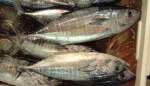
Blue Fin Tuna/Honmaguro

Yes, you read it, Blue Fin Tuna! After 23 years of experimentation, a Kyushu fishmonger has finally succeeded in producing the fish from natural mating inside giant offshore sea parks. The fish is already sold over the counter at supermarkets.
With a ban on tuna fishing in the Mediterranean Sea being pushed through legislation by the EU, Japan will find itself one day in the rich position of actually exporting tuna!
research-mebachi
Big-eyed Tuna/Mebachi Maguro

Human-raising Research is being conducted.
research-kihada
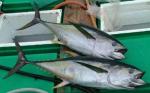
Albacore Tuna: Kihada Maguro

Human-raising Research is being conducted.

Note:
Indian Ocean Tuna/Indo Maguro: Human-raising Research is conducted abroad and such fish are imported to Japan.
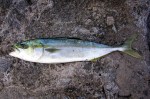
research-buri
Yellowtail/Buri

Over 62,000 tons of human-raised fish consumed last year.
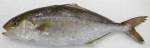
research-kanpachi
Amberjack/Kanpachi

Over 49,000 tons of human-raised fish consumed last year.
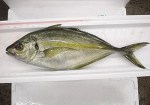
research-shimaaji
Striped Jack/Shima Aji

Over 3,000 tons of human-raised fish consumed last year.
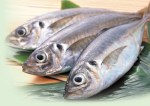
research-maaaji
Horse Mackerel/Ma Aji

Over 3,500 tons of human-raised fish consumed last year.
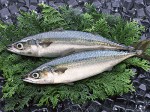
research-masaba
True Mackerel-Japanese Mackerel/Ma Saba

Human-raising succeeded and fish are already sold over the counter.
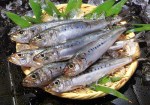
research-maiwashi
True Sardine-Pilchard/Ma Iwashi

Human-raising Research is being conducted.
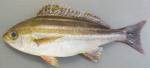
research-isaki
Isaki/Grouper variety-Parapristipona Trilinoatum

9 tons of human-raised fish consumed in Nagasaki Prefecture alone last year.
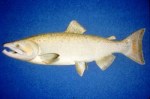
research-silversalmon
Silver Salmon/Gin Sake

Over 8,000 tons of human-raised fish consumed last year.
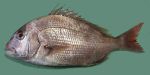
research-madai
Porgy/Madai

Over 71,000 tons of human-raised fish consumed last year as opposed to 15,000 tons caught at sea.
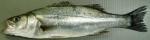
research-suzuki
Seabass/Suzuki

382 tons tons of human-raised fish consumed in Kagawa Prefecture alone last year.
research-kisu
Sand Borer-Sillago/Kisu

Human-raising Research is being conducted.
research-kochi
Bar-tailed Flathead/Kochi

Human-raising Research is being conducted.
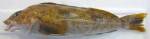
research-ainame
Ainame/Alexagrammos otakii

Human-raising has succeeded and some fish are already sold over the counter.
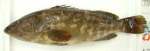
research-kue
Kelp Bass/Kue

A success story in Shizuoka and Nagasaki Prefectures where human-raised fish (one of the most expensive until then) are already sold over the counter.
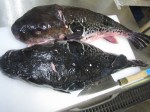
research-torafugu
Globefish-Tiger Globefish/Tora Fugu

Over 5,000 tons of human-raised fish consumed last year.
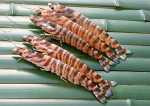
research-kurumaebi
Large Prawn/Kuruma Ebi

Over 1,700 tons of human-raised prawns consumed last year.
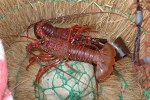
research-iseebi
Spiny Lobster/Ise Ebi

Human-raising Research is being conducted.
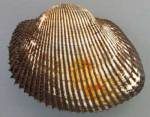
research-akagai
Ark Sheel-Bloody Clam/Akagai

Human-raising Research is being conducted.
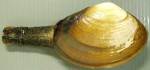
research-mirugai
Gaper/Mirugai

Human-raising Research is being conducted
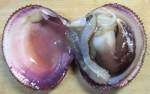
research-torigai
Large Cockle/Torigai

Human-raising Research is being conducted
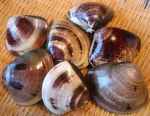
research-hamaguri
Hard Clam/Hamaguri

Very large amounts of half human-raised shellfish consumed last year.
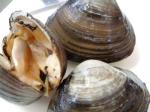
research-hokkigai
Surf Clam/Hokkigai

Human-raising Research being conducted
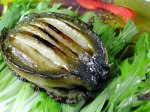
research-awabi
Abalone/ Awabi

32 tons tons of human-raised abalones consumed in Hokkaido and Nagasaki Prefectures alone last year.
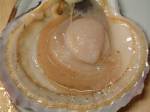
research-hotate1
Scallops/Hotate

Over 270,000 tons of human-raised scallops consumed last year.
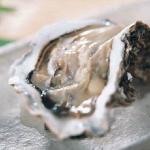
research-kaki
Oysters/Kaki

Over 220,000 tons of human-raised oysters + over 35,000 tons of the same out of the shell consumed last year as opposed to 1,600 tons of wild oysters.
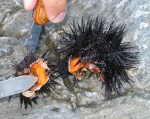
research-uni
Sea Urchin/Uni

7 tons tons of human-raised sea urchin consumed in Hokkaido Prefecture alone last year.

research-maanago
Conger Eel/ Ma Anago

Human-raising Research is being conducted

research-unagi
Common Eel/Unagi

Over 21,000 tons of human-raised fish consumed last year as opposed to 610 tons caught in the wild.

research-hamo
Oike Conger eel/Hamo

Human-raising Research is being conducted.

The Japanes have also starting research on different varieties of octopus/tako and squids/ika.

That is all for the moment! LOL

Please check the new postings at:
sake, shochu and sushi

—————————————-
日本語のブログ
—————————————-

Donburi: Sushi as a full meal

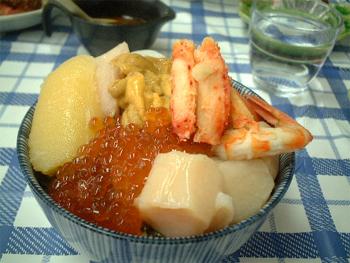
donburi-sapporo-1
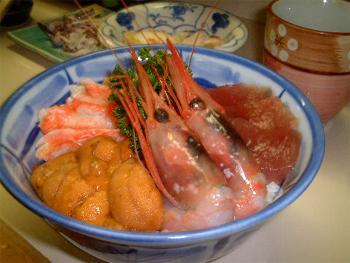
From bottom, clockwise:
“Uni” (Sea Urchin), “Kani Tsume” (Crab legs), “Maguro” (Tuna), “Nanban Ebi” ( large prawn variety)

“Donburi” is a popular way to eat sushi with foreigners as it combines quality and quantity, and usually reasonable prices!
I thought a few examples might help you choose your favourites nex time you come to Japan!
The above donburi and three following were savoured in Sapporo and Otaru (Hokkaido Island).

donburi-sapporo-2
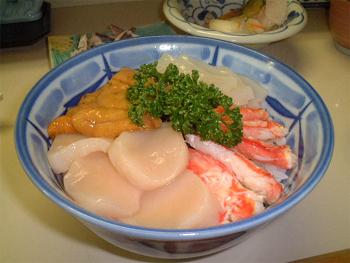
From bottom, clockwise:
A little variation from the first pic!

“Hotate” (Scallops), “Uni” (Sea urchin), “Ika” (Squid), “Kani Tsume” (Crab legs)

donburi-sapporo-3
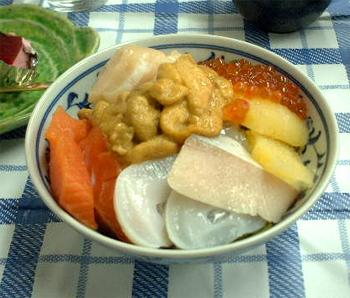
A more extravagant sample this time:

From top middle clockwise:
“Ikura” (salmon roe), “Kazu no ko” (herring roe), “Kampachi” (Amberjack), “Tako” (octopus), “Sake” (raw salmon), “Hotate” (scallops), in the centre, “Uni” (sea urchin)

donburi-sapporo-4
This is a truly extravagant one!

From bottom, clockwise:
“Hotate” (Scallops), “Ikura” (Salmon roe), “Kazu no Ko” (Herring roe), “Kampachi” (Amberjack), “Uni” ( Sea Urchin), “Kani Tsume” (Crab leg), “Ebi” (Boiled prawn)

———————–
During a recent trip in Shiretoko, Hokkaido Island, we dropped at Ikyuya Restaurant, located in a small city called Shari (some of the place names in Hokkaido can become a real puzzle as they are mostly very local names written in Kanji that fit the pronunciation instead of the meaning!).
We (the Missus) had chosen this establishment as a representative of the local cuisine favoured by local people.

donburi-hokkaido-1

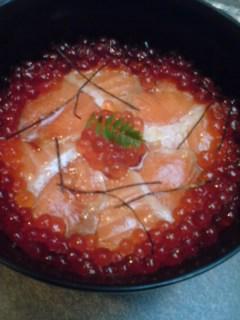
THe Missus oredered the “Oyako Don”/”Father-Mother and Son-Daughter Bowl”.
In Shizuoka it means chicken omelette (the Hen and the Egg!) spread on a bowl of rice. In Hokkaido, it stands for Shake sahimi”/salmon sashimi and “Ikura”/salmon roe spread over a bowl of rice. It must have been good as for once silence reigned around the table!

donburi-hokkaido-2

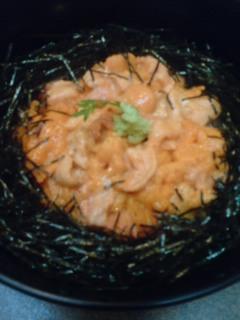
Our two friends (which included our gracious driver) opted for “Uni don”/sea urchin and chopped dry nori/seaweed spread over a bowl of rice,

donburi-hokkaido-3

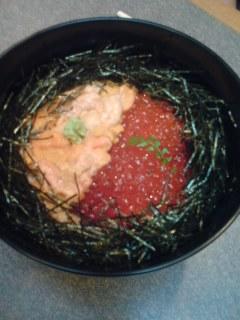
“Uni to Ikura Don”/sea urchin and salmon roe spread over a bowl of rice.
Extravagance at a very reasonable rice, absolutely fresh and sweet seafood away from metropolises, what more can you ask?
Ikyuya
Hokkaido, Shari Cho, Utoro Higashi, 13 (2 minutes walk from Utoro Hotsprings Bus Terminal)
Tel.: 0152-242557
Opening hours: 11:00~18:00 (might get closed in the afternoon on busy days. Come early!)
———————–
Home-made Donburi

donburi-home

You do not have to go to a Japanese restaurant or sushi bar to eat “donburi” if you happen to have a wife who not only likes them but can also concoct them!
In short, my better (worse?) half once came up with the following for lunch:

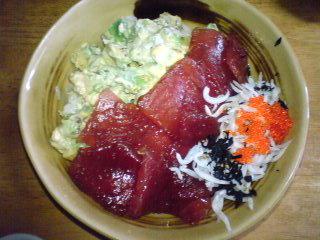
Plain steamed rice topped with slices of “akami”/ lean tuna part, avocado salad with mayonnaise and wasabi pickles (the latter provided a nice balance with a spicy touch), boiled shirasu/whitebait sprinkled with “hijiki” seaweed and “tobikko”/flying fish roe.
The tobikko added a nice colour finish touch. It is quite cheap down here in Shizuoka City. From what I saw on Chuckeats Blog, it seems quite a treat over there in the U.S.!
I poured a little Shizuoka-made wasabi dressing on top. This dressing is a lot milder than pure grated wasabi with a little sweetness which combines well with the fish!

Please check the new postings at:
sake, shochu and sushi

—————————————-
日本語のブログ
—————————————-
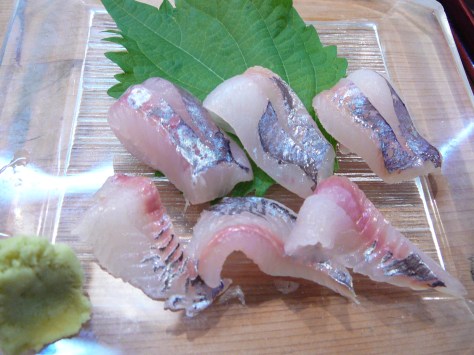
7 US$ Sashimi Plate!

7-sashimi-1

The Missus welcomed me back home last night with her “triumphant smile”. By this, I knew she had made a good bargain at one of the nearby supermarkets.
Good, I will be able to humor her more easily, I thought (sly macho reaction,…)
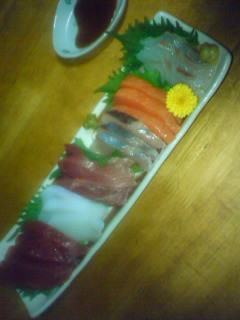
Anyway, she had noticed a good sashimi set being sold for 1,000 yen (about 11 US$) at Coop Supermarket but could not decide whether to buy it or not (it was about 5:00 p.m.) and proceeded forward. But her feminine (sorry!) instincts called her back as this was just the time when bargains start at this good (and very reasonable) big supermarket chain. The price had gone down to 600 yen (about 7 US$)!

7-sashimi-2
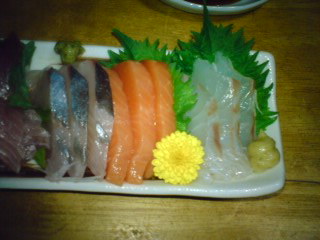
(from right to left: “Tai/Seabream”, “Shake or sake/Salmon” and “Kanpachi/Amberjack)

I don’t have to tell you with what relish she grabbed it!
She had the sashimi already seved on a plate on the dining room table for me to admire. I decided to take a pic, but she said that the dsiplay was not good enough for a pic!
I waited for her to go back to the kitchen and took my mobile phone out to take a few pics in a hurry!
The pics are of poor quality, I must admit, but I hope it will give some ideas to my friends!

7-sashimi-3
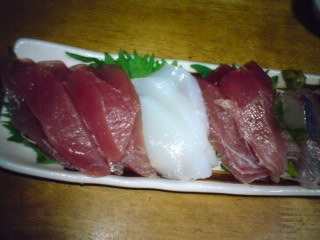
(from right to left: “Tonbo maguro/Tuna Variety, “Ika/Squid” and “Mebachi maguro/Big-eyed tuna”)

All seafood, except for the salmon are apparently from Shizuoka Prefecture. No wonder it is so cheap (even in Japan)

Please check the new postings at:
sake, shochu and sushi

—————————————-
日本語のブログ
—————————————-
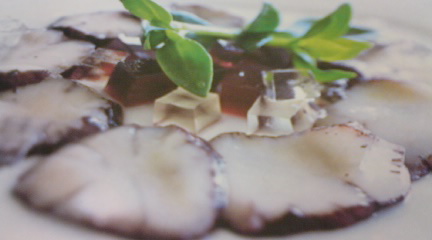
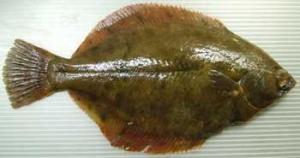
Japanese Seasonal Fish: Turbot/Makogarei

makogarei

“Makogarei” or Pleuronectes yokohamae Gunther for the specialists is one of the many kinds of turbot indigeneous to Japan.
You will find it on the markets between June and August.
Depending where you live, you might do well to know its other names: “Aome” (Sendai), “Mushibirama” (Konahama), “Mako” (Tokyo) or “Amakarei” among many.
It is net-caught all around Japan.
It has comparatively a lot of flesh for a turbot, making it a choice morsel for nigiri or sashimi.

makogare-sushi

It can reach a length of 30 cm. Contrary to many other fish, the size will bear no incidence on the taste, but if you wish for extra taste, avoid female specimen bearing eggs/roe, and if possible, although a bit extravagant, choose a live fish (possible at Parche, Shizuoka JR Station!).
A good sushi or Japanese restaurant will deep-fry the bones and head for you, making for a great snack with great ale!

Please check the new postings at:
sake, shochu and sushi

—————————————-
日本語のブログ
—————————————-

Japanese Fish Species: Scabbard Fish/Tachiuo

scabbard-fish-a1
(Sorry, but that fish is just too long for the screen!)

Scabbard Fish or “Tachiuo” (太刀魚/Great Sword Fish in Japanese), a very popular in Japan in spite of its great length is usually caught in Summer in Japan but also appears in Winter in Shizuoka Prefcture.
As other fish it owns other names: Tachi (not in Hokkaido, where the word means “whiting”!), Shirada and Tachinouo.
It is mainly caught off Wakayama, Ehime and Oita Prefectures, although it is also caught in Suruga Bay off Shizuoka Prefecture
It is both caught by line or net.
In 1999, 37,000 tonnes were caught, but it fell to 23,000 tonnes in 2000.
It is also imported from Kore and China, although their fish is slightly different from the Japanese variety. More than half of imported fish are eaten west of Kansai.

scabbard-fish-c

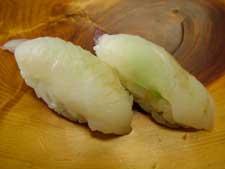
It is fish than can be eaten raw as nigiri.

scbbard-fish-b1

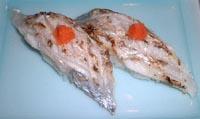
I personally prefer it “aburi” (slightly grilled) with a dash of ponzu and some momijioroshi (grated daikon with chili pepper) as above served at Sushi Ko Restaurant.

scabbard-fish-d

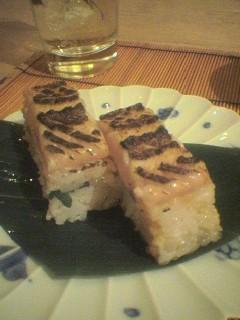
Some time ago I ate it at Oboro No Tsuki Restaurant (now defunct) as above:
They first put a double layer of sushi rice interspaced with shiso leaves (perilla) in a box for “oshi zushi” (pressed sushi), then top it with thick fillets (the fish is actually quite thin) and press the whole.
Next they slightly grill the top (“aburi”), take it out of the box and cut it to size.
Quite tasty and appetizing-looking!


The Japan Blog List

Please check the new postings at:
sake, shochu and sushi

—————————————-
日本語のブログ
—————————————-
Japanese Snack: Sakamushi Asari/Cockles steamed in Sake


The Japan Blog List

Please check the new postings at:
sake, shochu and sushi

—————————————-
日本語のブログ
—————————————-
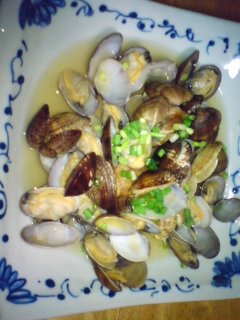
sakamushi

The night before, the Missus did not feel like cooking anything big and came with a succession of “snacks”.
One of them was cockles she had steamed in Sake or “Sakamushi Asari”.
She usually utilizes Japanese sake, but this time she opted for old Chinese rice wine. Of course one can replicate the recipe with a dry white wine!
When you choose your cockles at the market, tap them ligtly with a finger. If they are alive you will see them retract whatever was poking outside. If not, disregard them.
First leave the cockles in slightly salted water overnight to have them disgorge any sand that has been inevitably sucked inside.
Next day drain water and have them “dance” inside a bowl by making them twirl/run around by hand for a minute. This will have them retracting more inside. After cooking they will detach easily from their shells. Incidentally, “tossing” them will not work.
Drop them in a fry pan with a good glass of sake , some mirin/sweet sake and som shoyu ponzu (normal soy sauce is too salty or strong). Cover with a glass lid and heat them on a strong fire until they are all open. Serve them in dish with a good measure of chopped thin leeks.

Simple is sometimes the best!

Blue-Fin Robin and Scampi baked in Foil Paper


The Japan Blog List

Please check the new postings at:
sake, shochu and sushi

—————————————-
日本語のブログ
—————————————-

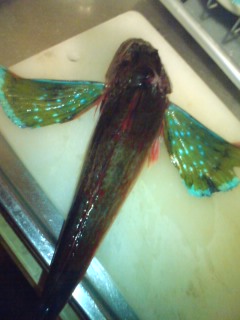
blue-fin2
Pic kindly upgraded by Jay Gustafson!

Last Friday, on my way back from University, I visited the big Parche Supermarket inside Shizuoka City JR Station as I wanted to cook some seafood for the Missus that night!

houbou2

I was lucky to find a couple of medium-sized “Houbou/Blue-Fin Robin” for a little over 4 US$. This fish was caught off the western part of Shizuoka shore. I also discovered a few great value fresh “Te-naga Ebi/Scampi” caught in Suruga Bay (Shizuoka Prefecture). I only needed to check with the vegetables stand nearby and I was back home!

houbou3

Things are (most of the time) best when kept simple.
I had had the fishmonger dress the fish beforehand, so I needed only to make a couple of shallow cuts across the skin.
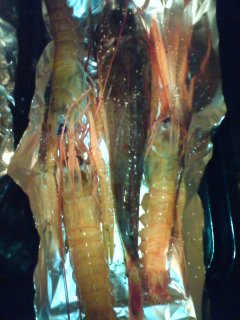
In two separate large sheets of foil paper, I place one fish (seasoned with salt and pepper) in the middle, flanked it with two (on the the left) and one scampi (on the right), filled the upper right corner with plenty of fresh basil and dill. I placed mini asparaguses and large fresh broad beans along them, added a good portion of white wine, a little olive oil, some freshly pressed lime juice and a good measure of sweet and hot Thai sauce.
I closed the foil tightly around the whole and baked it on grill at 250 degrees Celsius for 25 minutes.
Served at once, they made for a great and light dinner enjoyed with white wine (for the Missus) and Japanese sake (for me!)