Tag Archives: 日本

Robert Yellin’s Newsletter: Japanese Pottery by Yokoyama Naoki

scene
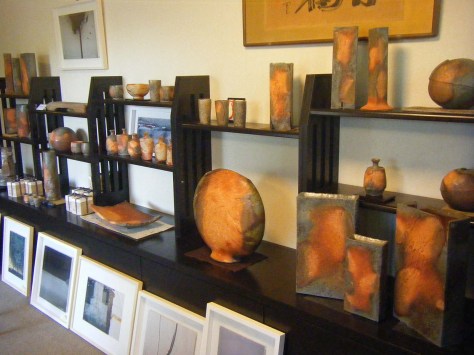
Framed photographs by Mishima photographer Okabe Minoru

Greetings from Mishima,

With autumn in the air in this part of our world, the senses are filled with glorious sights and smells as nature prepares for her winter hibernation. We hope this finds all well and also enjoying the season, whatever it may be where you are.
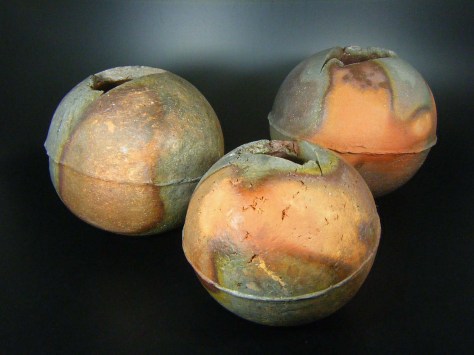
9-10-19-balls-all

Thanks so much to all who visited our recent Miyao Masahiro exhibition and we continue with the Bizen theme in a very different realm though, namely shizen-nerikomi or natural marbled Bizen. This is the world of Yokoyama Naoki.
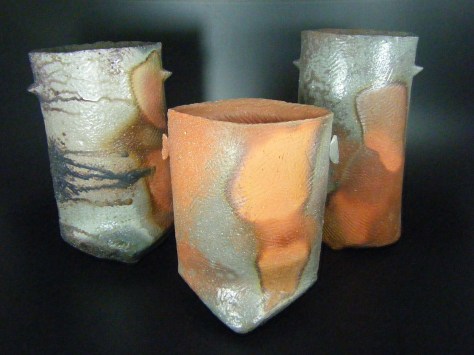
16-17-18-front

Our last Yokoyama exhibition was in May of 2006 and the works offered in the current exhibition were all fired very recently; I went down to his kiln on October 12th to select the works. Most of very much in an autumn tone-themed with rich oranges and browns created from the two or three different toned clay he uses. Yokoyama told me it takes 10 times more labor to make his shizen-nerikomi compared to regular Bizen. The forms range from very strong and stoic to more organic and natural; the larger rectangular forms acting as a canvas for the rich clay landscapes. Some of the cups and guinomi are of a black Bizen marbled type that was achieved by placing the works in
saggar-fire-proof casings and then adding charcoal towards the end of the firing. Each piece was carefully selected and as you’ll see in the following exhibition preview links Yokoyama is a superb Bizen ceramic artist taking Bizen in brilliant directions with his unique vision of marbled Bizen. (There are a few yohen Bizen and other non-marbled Bizen works to be seen as well.)
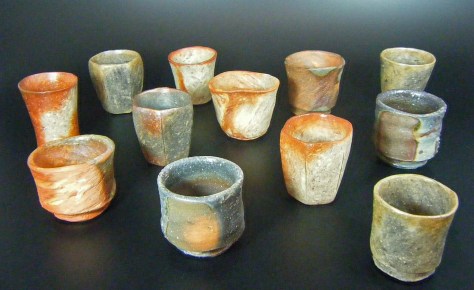
gui-all

Yokoyama (b.1970) lives in the hills of Bizen where he established his kiln in 2000. Before that he studied with Kawabata Fumio and at the Bizen Pottery Center. His works have been accepted into juried exhibitions that include the Tanabe Museum’s Contemporary Tea Forms exhibition, Okayama Prefecture Art exhibition, Japan Traditional Arts and Crafts Chugoku region exhibition, Japan Ceramic Art exhibition and the Japan Traditional Arts and Crafts National exhibition, some of these
numerous times. As with Miyao, Yokoyama is an extremely talented
Bizen ceramic artist and one who’s star will surely rise even higher.
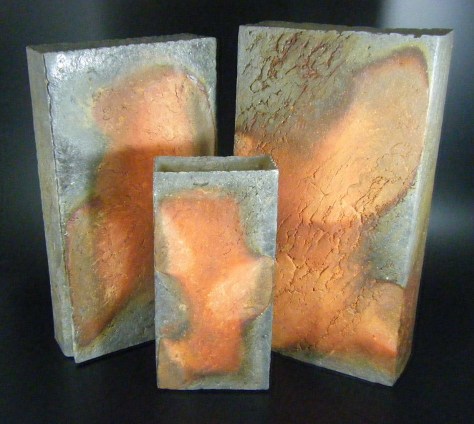
3-together

The hidden preview links are below, additional photos of any work gladly sent on request and the exhibition will go online for public viewing this Friday:
1, 2, 3, 4, 5, 6, 7, 8, 9, 11, 12, 13, 14, 15, 16, 17, 18, 19.

Enjoy!

With deep thanks and appreciation from Mishima.
Sincerely,

Robert Yellin
HOMEPAGE

3-2-18 Omiya-cho, Mishima-shi, Shizuoka-ken
Phone: 81-559-91-5388
Fax: 81-559-91–5387

RECOMMENDED RELATED SITES:
Warren Bobrow
5 Star Foodie
Think Twice
Frank Fariello

Please check the new postings at:
sake, shochu and sushi

—————————————-
日本語のブログ
—————————————-
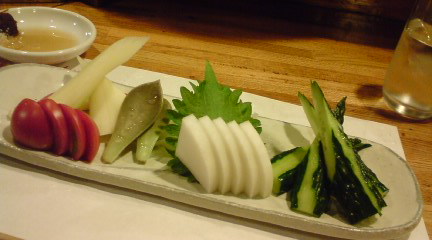
Vegan Sashimi at Yasaitei

YASAITEI-VEGAN2

Service: excellent and very friendly
Facilities: great cleanliness overall
Prices: reasonable, good value.
Strong points: Very fresh local ingredients extensively used. Seasonal ingredients only. All-ladies staff.

I’ve been an unconditional fan of Yasatei in Shizuoka City for quite a while.
Some might say I’m attracted to the all-female staff, but they would be sorely mistaken as I take my Missus there from time to time!
The reasons are very simple:

YASAITEI-VEGAN1

Yasaitei (The Vegetables Inn in Japanese) makes the extra effort(s) to serve whenever possible produce from Shizuoka Prefecture, including sake and shochu! The only place, as far as I know, which offers shochu from three different Shizuoka breweries/distilleries!
Vegan and vegetarian friends have complained to me unaccountable times that they would not be able to survive in Japan. How far from the truth they are!
Vegetables, including organic and biologically-grown, are plentiful in this country. I must gladly admit hat we are blessed with a very special situation here in Shizuoka Prefecture as this is the mildest region in Japan in spite of the snow falling around Mount Fuji. Our Prefecture has become a national reference when it comes to vegetable and fruit agricultural research (omnivores will be glad to hear that it is also at the forefront of marine life sustainibility!), notably in natural environment.

The staff at Yasaitei always keeps an extra eye and ear open for any new information concerning vegetables. Many a time I have brought them heirloom tomatoes, burdock roots, potimarrons and what else grown by lady farmers up Abe River just for the fun of it. On such occasions some surprised patrons find themselves served with an extra “service morsel” (meaning free of charge)!

YASAITEI-VEGAN3

Yesterday evening, I needed a “quick fix” in between two work sessions and pedaled to their restaurant only five minutes away.
I just said, “Yasai sashimi no moriawase/Plate of vegetables sashimi, please!”
Written or not on the day’s menu, it will always be prepared with an extra care.
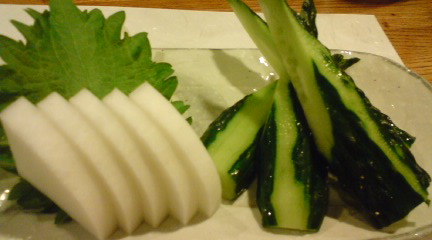
The set I was served consisted of the following (See above pic):
-Cucumber (kyuuri/胡瓜)-the Japanese like them young, narrow and crunchy!
-Japanese long radish (daikon/大根)-Juicy, crunchy, almost sweet (bear in mind that the extremity is astringent!).
-Perilla leaf (shiso/紫蘇) behind the daikon and sitting on a bed of sliced onion (tamanegei/たまねぎ). The onion were thinly sliced and left in cold water for a while to take away the astringency.

YASAITEI-VEGAN4

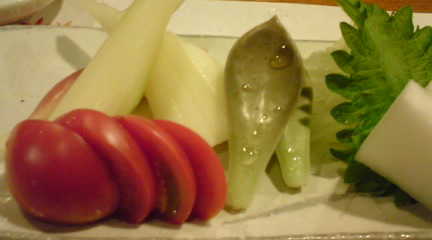
-Grapara leaves (grapara/グラパラ) in the middle. I will talk about this later!
-Sweet Ameera tomatoes (ameera tomato/アメーラトマト). These tomatoes were originally grown in Shizuoka Prefecture, but are slowly expanding all over Japan. They are so sweet that they almsot taste like strawberries!
-Celery (serori/セロリー). Shizuoka Prefecture grows half of them in Japan! Fresh, juicy and crunchy!
-Myoga ginger sprouts (myouga/茗荷) just behind the celery.

YASAITEI-VEGAN6

These grapara leaves are grown in Chiba Prefecture, north of Tokyo.
For people who can read Japanes, check their homepage!

YASAITEI-VEGAN7

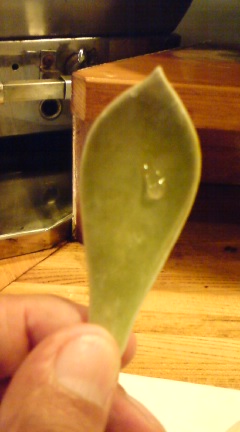
Crunchy but with a juicy and tender inside, they are sweet and taste somewhat like pineapple!

YASAITEI-VEGAN5

Vegans and Vegetarians, do not worry!
Yasaitei does not serve mayonnaise with such beauties.
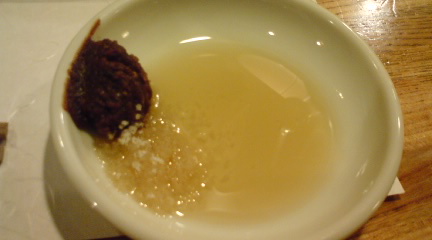
They will accompany this plate of super fresh vegetables with a small saucer containing sesame oil (goma abura/ゴマ油), dark miso (kuro miso/黒味噌) and natural salt (shio/塩)!

Expect more reports!

YASAITEI
Shizuoka City, Aoi Ku, Tokiwa-Cho, 1-6-2 Green Heights Wamon 1-C
Tel.: 054-2543277
Business hours: 17:30~22:00
Closed on Sundays
Reservations highly recommended
Seating: 6 at counter + 20 at tables
Set Courses: 3,000, 4,000, 5,000 yen
HOMEPAGE (Japanese)

RECOMMENDED RELATED SITES
Not-Just-Recipes
Bengal cuisine
Cooking Vegetarian
Frank Fariello
Gluten-free Vegan Family
Meatless Mama
Living In The Kitchen With Puppies
Wild River Review

Please check the new postings at:
sake, shochu and sushi

—————————————-
日本語のブログ
—————————————-
Vegan Tofu Carpaccio

TOFU-CARPACCIO

I’ve been in tofu recipe search mode for quite a while, and I finally found one to please my vegan friends who can’t boast a carpaccio of their own!
It is ridiculously easy, but it makes for great impression!
Choose the best ingredients!

Vegan Tofu Carpaccio!

INGREDIENTS:

-Tofu (kinu tofu/silk tofu): as much as you like?
-Salt (Guerande for example): to taste
-Black pepper (freshly ground only, please!): to taste
-Lemon juice (organic lemon, please!): to taste
-Olive oil (EVO): to taste
-Pink pepper/baies roses: to taste

As you can see, it is basically up to you!

Look for some great organic green leaf vegetables to make a “bed” for the tofu.

RECIPE:

-Wrap tofu inside a large piece of kitchen paper.
Put the wrapped tofu inside a tupperware box (no lid, please) and top the tofu with a light weight.
Leave overnight (a full day, if you can) inside the refrigerator.

-Take out the tofu (discard the water).
-Cut it slices and plave it on a bed of leaf vegetables.
-Sprinkle in that order with salt, pepper, lemon juice and olive oil.
-Srop a few pink pepper grains for decoration and taste.

Simple, ain’t it?

RECOMMENDED RELATED SITES
Not-Just-Recipes
Bengal cuisine
Cooking Vegetarian
Frank Fariello
Gluten-free Vegan Family
Meatless Mama

Please check the new postings at:
sake, shochu and sushi

—————————————-
日本語のブログ
—————————————-
Today’s Lunch Box/Bento (’09/69)

BENTO-06-10-20a

The Missus turned to “Sandwich mode” for today’s bento!

BENTO-06-10-20b

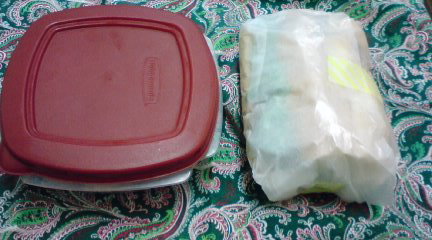
Above pic shows how it was packaged.

BENTO-06-10-20d

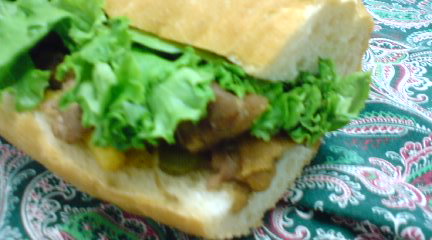
Above pic shows it came out of the package.

BENTO-06-10-20e

Above pic represents the biting end of the sandwich.
The sandwich itself was at least 15 cm (6 inches) long and thick!

BENTO-06-10-20f

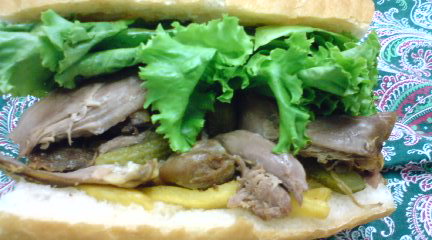
As for the sandwich, the Missus used soft-style (very Japanese!) French baguette she toasted first.
She then fried a whole confit duck leg and shredded it into large enough chunks.
She fried some potato chips in the duck confit fat.
She added lettuce and French pickles for the finishing touch.

BENTO-06-10-20c

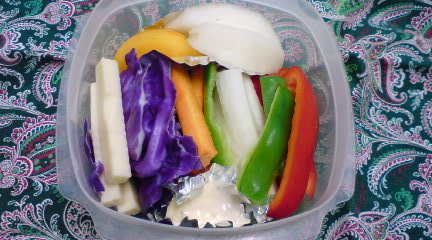
Today’s salad consisted of veg sticks and their dip:
From right to left-red and green soft pimentoes, daikon, carrots, violet cabbage and cheese.

For dessert in-season Asian Pear/Nashi and Squat Persimmons/Jirou Kaki.

It certainly took me quite some time to eat it all!

RECOMMENDED RELATED SITES:
Warren Bobrow
Bread + Butter
5 Star Foodie
Think Twice
Frank Fariello
Mangantayon
Hapabento
Elinluv Tidbit Corner
Tokyo Terrace
Maison de Christina
Chrys Niles

Please check the new postings at:
sake, shochu and sushi

—————————————-
日本語のブログ
—————————————-
Japanese Seasonal Fish: Kawahagi/Thread-sail Filefish

kawahagi1.jpg

Kawahagi or Thread-sail Filefish (or simply Filefish) is an angler’s favourite in summer.
Like any other fishes, it has other names such as “Gihagi, “Hagi”, “Gyuu”, “Subuta” or “bakuchiuchi”.
It is fairly common in Central and South Japan.
It is called Leatherjacket down in Australia where it is considered a pest!

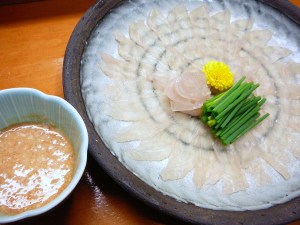
In Kansai area, it replaces Fugu/Globefish when it is out of season for its similarity as sashimi

012

The skin should be rough like that of a shark and brightly coloured.
Avoid sticky skin fish.
The bigger the size, the greater the taste (anglers, enjoy!)

Savouring the full Filfish meal at Sushi Ko, Shizuoka City:

Back in June, as I had to atone for some somewhat egoistical pleasure-seeking, I took the Missus to our favourite Sushi Restaurant in Shizuoka City, namely Sushi Ko,located along Aoba Park.

Although we did order the inevitable favourites, “katsuo/bonito” sashimi, “Shirako to Ankimo/Combination of Cod Sperm sacs and Frogfish/Monkfish liver”, “Pon Kara Maguro/Deep-fried tuna cubes”, “Shishamo/Spirinchus lanceolatus”, “Hotate/Scallops”, “Maguro Zuke/Marinated Tuna sushi”, and “Amaebi nigiri to Shiraebi Gunkan/Sweet shrimp and white shrimp sushi”, the star of the day was “Kawahagi/Filefish”!

The chef took a splendid live specimen (see top pic) just caught off Mochimune coast in Shizuoka City out of the “aquarium” and proceeded to serve the complete fish in three different manners:


“O-Tsukuri”:
After having taken away the inedible skin, the chef first cut the fillets into very thin slices to be served with thin leeks and dip sauce made of ponzu mixed with the fresh liver of the same fish. As now is the best season, those comparatively thin fish come up with enormous livers!


“O nigiri”:
The chef managed to keep four slices aside to prepare nigiri with the fish flesh topped with a piece of its liver, some “momiji oroshi/grated daikon with chili pepper” and seasoned with ponzu!

SUSHI-KO-2008-10-11“Kara age”:
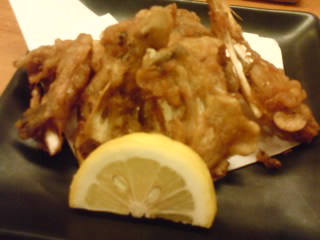
The “cheeks bones” with their meat were last deep-fried and served as they are with some lemon. Simple and great!
All this with one single fish!

Sushi Ko
shizuoka City, Aoi Ku, Ryogae-cho. 2-3-1 (Aoba Koen)
Tel.: 054-2512898
Business Hours: 17:00~25:00. 17:00~23:00 (Sundays)
Closed on Wednesdays
Reservations recommended
Credit cards OK
HOMEPAGE (Japanese)

RECOMMENDED RELATED SITES:
Warren Bobrow
Bread + Butter
5 Star Foodie
Frank Fariello
Elinluv Tidbit Corner
Tokyo Terrace
Maison de Christina
Chrys Niles
Comestilblog
Greedy Girl
Bouchon For 2

Please check the new postings at:
sake, shochu and sushi

—————————————-
日本語のブログ
—————————————-
Ankimo Presentations 2

ANKIMO-STEAMED
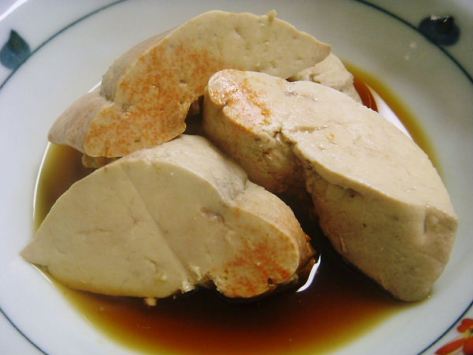
Plain steamed ankimo served with simple cold ponzu sauce

I have already introduced the recipe for preparing Ankimo/Frogfish Liver (Japanese Foie Gras) in a precedent article as well an article on various presentations.
This posting will show you other possibilities!

ANKIMO-SUSH-1

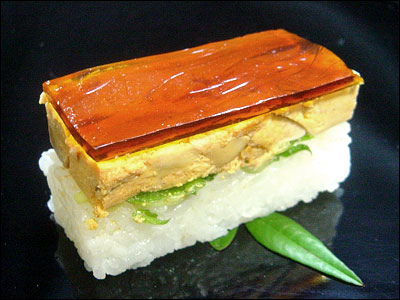
The oshizushi/pressed sushi above is a beauty with fish jelly on top!

—————–

Ankimo Gunkan Mini Seriies!

ANKIMO-SUSHI-2

ANKIMO-SUSHI-3

ANKIMO-SUSHI-4

ANKIMO-SUSHI-5

————————–

ANKIMO-FRIED

Ankimo does not have to be on sushi.
It can be cooked for its own sake such as in Japanese style above or:

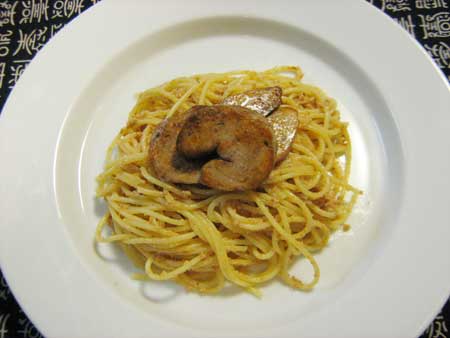
ANKIMO-PASTA

Ankimo Pasta. Japanese foie gras instead of duck/goose foie gras!

RECOMMENDED RELATED SITES:
Warren Bobrow
Bread + Butter
5 Star Foodie
Frank Fariello
Mangantayon
Hapabento
Elinluv Tidbit Corner
Tokyo Terrace
Maison de Christina
Chrys Niles
Comestilblog

Please check the new postings at:
sake, shochu and sushi

—————————————-
日本語のブログ
—————————————-
Vegan Italian Tofu Salad

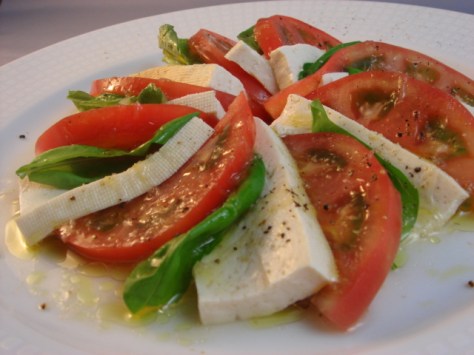
TOFU-VEGAN-SALAD

The Japanese come with some simple and tasty new ideas for Vegans and Vegetarians!
I just discovered this recipe. It is basically a Cabrese-style salad.
The twist is that the cheese is replaced by tofu!

Vegan Italian Tofu Salad:

INGREDIENTS:

-Tofu (kinu dofu): half/200g
-Tomato: 1 large
-Sweet basil: 10 leaves

-Dressing:
Wine vinegar (white): 1/4 cup
White wine: 1/4 cup
Salt: 1/3 teaspoon
Whole black pepper: 3 grains, crushed
Garlic: 1/2 clove
Fresh red chili: 1/2

Olive oil (EVO): 1.1/4~ tablespoon
Onion: 15 g, grated

RECIPE:

-Cut tofu into 1 cm thick slices.
-After taking out the stem part, cut tomatoes into half moons.
-Leave tofu tomatoes in a bowl full of iced water.
-Crush and mince garlic. Mix it with the wine vinefar, white wine, salt, pepper and chili. Cook in a pan until the lot has reduced to half. Let cool.
-Take tomatoes and tofu out the iced water (drain as much water as possible) and drop them in a large bowl. Add onion and olive oil. Mix well.
-Place tomatoes, tofu and basil alternately as shown in picture on a srving dish. Pour dressing all over.

NOTE:

-For calorie conscious vegetarians, tofu has almost none while chesse has loads of them!

RECOMMENDED RELATED SITES
Not-Just-Recipes
Bengal cuisine
Cooking Vegetarian
Frank Fariello
Gluten-free Vegan Family
Meatless Mama

Please check the new postings at:
sake, shochu and sushi

—————————————-
日本語のブログ
—————————————-
Today’s Lunch Box/Bento (’09/68)

BENTO-09-10-19a

We are witnessing a very mild, if not hot Autumn in Shizuoka which promises to be long and pleasant.
This also means more access to local vegetables and local food in general!

BENTO-09-10-19b

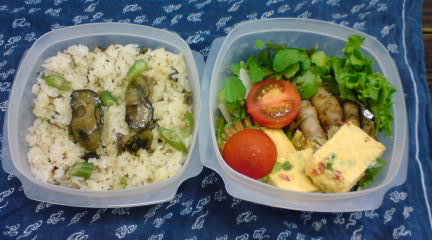
Acually, the rice part was only part local.
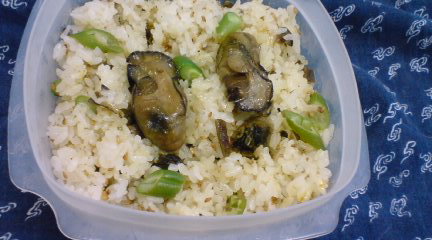
The Missus steamed the rice with chopped konbu/seaweed.
It is certainly more practical than steaming it with a large piece of konbu as the seaweed itself is not only edible but add great taste to the rice.
This time she mixed in canned smoked oysters (this is the “unocal” part).

BENTO-09-10-19c

After keeping two whole oysters for the topping, she vut the rest small enough and add chopped boiled string beans and sesame seeds before mixing the lot together.

BENTO-09-10-19d

The main box was a combination of veg, meat and eggs.

BENTO-09-10-19e

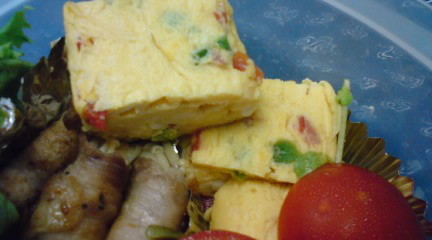
The Missus placed them on a bed of lettuce, cress and thin slices of apple with cut plum tomato.
The tamagoyaki/Japanese omelette contained cut and fried pimetoes and was seasoned with a little Thai sweet and hot sauce.

BENTO-09-10-19f

The meat part was represented by thin pork slices rolled around thin enoki mushrooms and srting beans fried Japanese style.

Good variety and very tasty, I must admit!

RECOMMENDED RELATED SITES:
Warren Bobrow
Bread + Butter
5 Star Foodie
Think Twice
Frank Fariello
Mangantayon
Hapabento
Elinluv Tidbit Corner
Tokyo Terrace
Maison de Christina
Chrys Niles

Please check the new postings at:
sake, shochu and sushi

—————————————-
日本語のブログ
—————————————-

For Vegan and Vegetarians! “Forgotten” Vegetables 17: Yacon

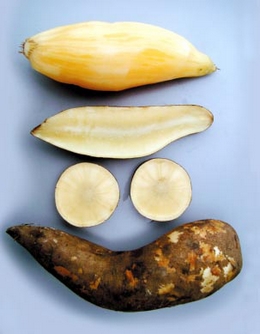
YACON-1

SYNOPSIS:
Organic agriculture and biodiversity have in recent years brought about a rediscovery of many “forgotten” vegetables that people especially in Europe and France conscientiously tried to forget as they reminded them of the privations suffered during WWII. The same people had then to make do with untraditional vegetables because potatoes, carrots and so on were confiscated by occupying forces or their own armies.
With sustainibility and bioagriculture made more important by the deficiencies of modern mass agriculture, those “forgotten” vegetables have suddenly come to the fore for the pleasure of all, and that of course of vegetarians and vegans!

This particular series of postings will introduce these vegetables one by one. I hope they will become useful for a long time to come to all my vegan and vegetarian friends!
1) Scorsonere/Oyster Plant
2)Potimarron
3) Vitelotte
4) Rutabaga
5) Cardon
6) Panais/Parsnips
7) Patisson
8) Topinambour
9) Crosne
10) Cerfeuil Tubereux
11) Poiree
12) Oca
13) Ulluque/Ulluco
14) Tigernuts
15) Capucine tubereuse-Maschua
16) Chataigne de Terre-Great Pignut

Yacon is another example of a forgotten vegetables rapidly getting popular in Japan, where it is very cheap!

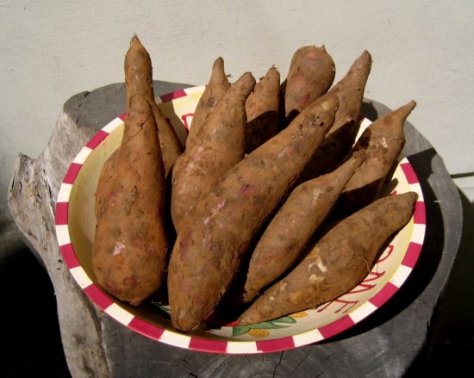
The Yacón is a perennial plant grown in the Andes of Perú for its crisp, sweet-tasting tubers. The texture and flavour have been described as a cross between a fresh apple and watermelon which is why it is sometimes referred to as the apple of the earth. The tuber is composed mostly of water and fructo-oligosaccharides. It has recently been introduced into farmer’s markets and natural food stores in the US.

YACON-2

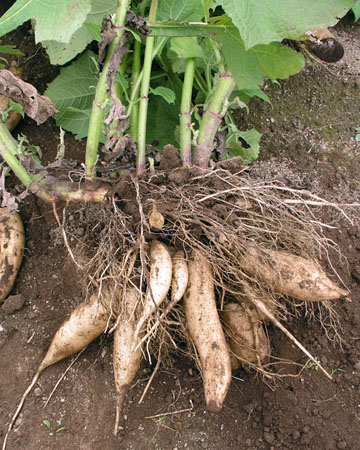
Although sometimes confused with jicama, yacón is actually a close relative of the sunflower and Jerusalem artichoke. The plants produce propagation roots and storage tubers. Propagation roots grow just under the soil surface and produce new growing points that will become next year’s aerial parts. These roots resemble Jerusalem artichokes. Storage tubers are large and edible.

YACON-3

These edible tubers contain inulin, an indigestible sugar, which means that although they have a sweet flavour, the tubers contain fewer calories than would be expected.

Yacón plants can grow to over 2 meters in height and produce small, yellow inconspicuous flowers at the end of the growing season. Unlike many other root vegetables domesticated by the Indigenous Peoples of the Andes (olluco, oca), the yacón is not photoperiod sensitive, and can produce a commercial yield in the tropics.

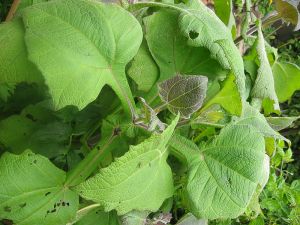
YACON-LEAVES

Yacon Leaves

Yacón provides for two nutritional products the yacón syrup and yacón tea. Both products are popular among diabetic people and dieters who consume these products because of its low sugar properties.

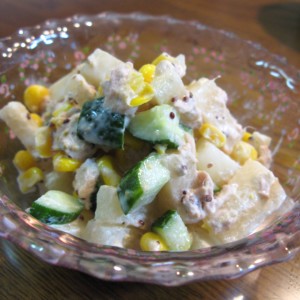
YACON-SALAD

Japanese Yakon Salad

Yacón can easily be grown in home gardens in climates with only gentle frosts. It grows well in southern Australia, Tasmania and New Zealand, where the climate is mild and the growing season long. It has recently been introduced to the Philippines, and is now widely available in markets.

Propagation roots with growing points can be planted in a well-dug bed in early spring, near the time of the last expected frost. While aerial parts are damaged by frost, the roots are not harmed unless they freeze solid. Yacón is a vigorous grower much like Jerusalem artichokes. The plants grow best with fertilization.

After the first few frosts the tops will die and the plants are ready for harvest. It is generally best to leave some in the ground for propagating the following spring. Alternatively, the propagating roots can be kept in the refrigerator or buried away from frost until spring. While usable-sized tubers develop fairly early, they taste much sweeter after some frost.

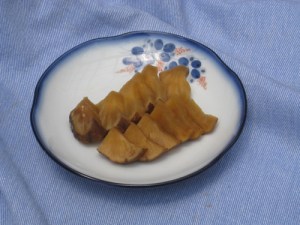
YACON-NARAZUKE

One reason why Yacon is fast becoming popular in Japan is that it is easy to pickle in “Narazuke” Style (see above picture),

YACON-DRIED-SLICES

and as dried slices, making for a great snack all year round!

RECOMMENDED RELATED SITES
Not-Just-Recipes
Bengal cuisine
Cooking Vegetarian
Frank Fariello
Gluten-free Vegan Family
Meatless Mama

Please check the new postings at:
sake, shochu and sushi

—————————————-
日本語のブログ
—————————————-

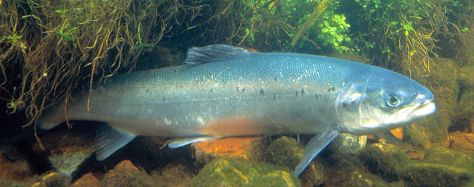
Japanese Seasonal Fish: Salmon-Sake

SAKE-1

Salmon is a favourite almost everywhere on the Globe, but it is in Japan that you can enjoy in the most numerous manners!

Like every other fish it has many names according to season and place:
Shirozake/White Salmon, Akiaji or Akizake for Autumn Salmon, Shake in Tokyo.
In Spring it is called Tokishirazu.
I don’t have to tell you there are many, many names for it all over the world!

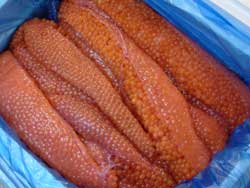
SAKE-SUJIKO

Its roe, before processing, is called Sujiko in Japanese, whereas the salmon roe, once treated, is called Ikura.

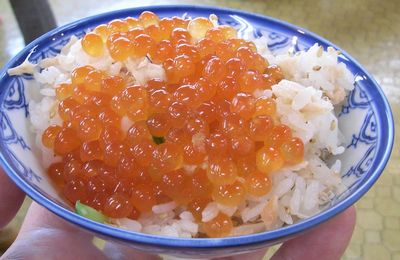
SAKE-ROE-SUSHI

Many Japanese appreciate the roe untreated, but more people enjoy it on top of rice as it is with some soy sauce and grated wasabi.

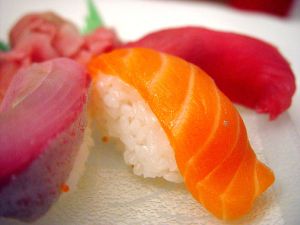
SAKE-SUSHI

It also makes for some splendid colourful creation on a plate of sushi!

SAKE-SUSHI-2

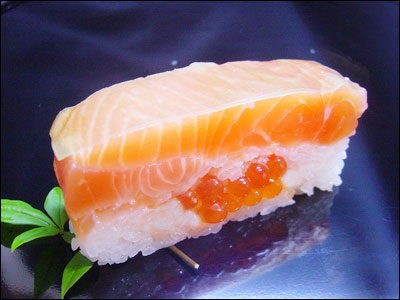
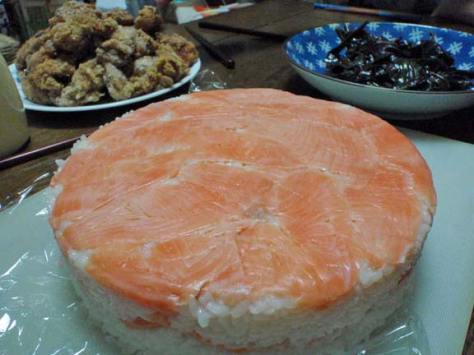
As oshizushi/pressed sushi, it can make some very interesting combinations with the salmon flesh and roe.

SAKE-GOHAN

Have you ever tasted Sake Gohan/Salmon Rice?

SAKE-OSHIZUSHI

Slightly smoked the Japanese way, It is extensively used in the making of bentoes!

RECOMMENDED RELATED SITES:
Warren Bobrow
Bread + Butter
5 Star Foodie
Frank Fariello
Mangantayon
Tokyo Foodcast
Tokyo Through The Drinking Glass
Urban sake
Hapabento
Elinluv Tidbit Corner

Please check the new postings at:
sake, shochu and sushi

—————————————-
日本語のブログ
—————————————-
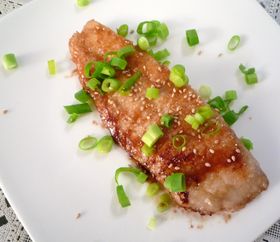
Japanese Cuisine: Seabream in Kabayaki Style

TAI-KABAYAKI1

Seabreams or groupers are aslo common almost all year long.
They make for all kinds of preparation in Japanese cuisine, either in nabe/Japanese pot au feu or grilled.
This very simple recipe is a grill in kabayaki style:

Seabream in Kabayaki Style:

INGREDIENTS: For two persons

-White-flesh fish (seabreams or groupers. Recipe can apply to almost any white flesh fish): 120g~

Marinade
-Soy sauce: 1 teaspoon
-Japanese Sake: 1 teaspoon

-Cornstarch: 2 tablespoons~
-Oil: 1 tablespoon

Sauce:
-Soy sauce: 1 tablespoon
-Japanese Sake: 1 tablespoon
-Mirin/Sweet sake: half a tablespoon
-Sugar: half a tablespoon
-White sesame seeds: 1~2 teaspoons
-Finely chopped thin leeks: 2 tablespoons

RECIPE:

TAI-KABAYAKI2

-Marinate fish soy sauce and Japanese sake for about 10 minutes.
-In a separate bowl mix soy sauce, Japanese Sake, mirin and sugar.

-Rest fish on a piece of kitchen paper to take excess marinade.
-Sprinkle both sides with cornstarch.
-Heat oil on a frypan and grill fish on both sides util “bubbles/eyes” appear on it surface.

-Once the heat has reched/cooked the core of the fish, slide fish against the side or corner of the frypan. Pour the sauce in the remaing space of the frypan. As soon as sauce starts boiling, caramelize both sides of the fish with the sauce.

-As soon as you are satisfied with the cooking of the fish, serve fish on a dish. Mix white sesame seeds with reamining sauce and pour over fish. Sprinkle with chopped thin leeks.

NOTE:

-Keep in mind that fish can break easily when you flip it over to fry it on both sides.
-Fry the skin side first.

RECOMMENDED RELATED SITES:
Warren Bobrow
Bread + Butter
5 Star Foodie
Frank Fariello
Mangantayon
Tokyo Foodcast
Tokyo Through The Drinking Glass
Urban sake
Hapabento
Elinluv Tidbit Corner

Please check the new postings at:
sake, shochu and sushi

—————————————-
日本語のブログ
—————————————-

Japanese Cuisine: Salmon grilled with Leek Miso

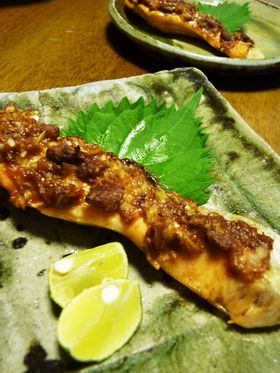
SALMON-NEGI-1

Salmon is basically available all year round these days.
The Japanese prepare it in all kinds of ways.
Here is a simple recipe very popular in Japanese homes you can also enjoy as a snack with a cool beer!

Salmon grilled with leek miso:

INGREDIENTS: For 2 persons

-Salmon: 2 slices
-Miso: 1 large tablespoon
-Japanese sake: 1 tablespoon (can be reduced or increased)
-Leek: 5 cm long cut (chopped fine)
-Umeboshi/pickled Jpanes plum: 1 teaspoon (can be reduced or increased)

RECIPE:

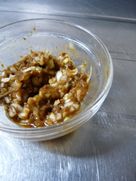
SALMON-NEGI-2

-In a bowl mix miso, sake, leek and umeboshi. Add sake if the mixture is not smooth enough. As for miso, choose one cotaining beans.
Do not be afraid to experiment as far as ingredients and quantities are concerned.

SALMON-NEGI-3

Grill with the lower face/side up first.
Turn over as the first “bubbles” appear on its surface.
Smear the salmon with the leek miso mix and grill until “bubbles apear on the fish surface.

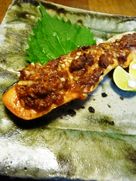
SALMON-NEGI-4

Serve with shiso or lettuce leaves for decoration and limes forthe final touch.

NOTES:

-Take care not to overgrill the fish.
-If you use salmon with its skin, grill skin first.

RECOMMENDED RELATED SITES:
Warren Bobrow
Bread + Butter
5 Star Foodie
Frank Fariello
Mangantayon
Tokyo Foodcast
Tokyo Through The Drinking Glass
Urban sake
Hapabento
Elinluv Tidbit Corner

Please check the new postings at:
sake, shochu and sushi

—————————————-
日本語のブログ
—————————————-
Chicken Sandwich (with a twist)

SANDWICH-1

The Missus usually prepares only sandwiches as bento/lunch boxes on Fridays before I leave for University because I have to eat them aboard the train.
Accordingly they have to be kept simple and as a general rule are not really worthy writing about.

SANDWICH-2

But today’s sandwiches were a bit more sophisticated than usual.
Why? you may ask. Well, Friday is my night out, but for once I invited the Dragon out (we normally eat out on Thursdays9, which might explain the quality of today’s “Train bento”!

SANDWICH-3

Breads are available in an almost infinite range these days in Japan.
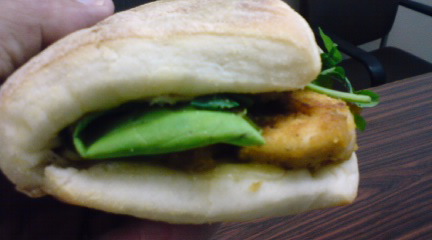
The bread used for these sandwiches are similar to pita bread but square and pre-cut.
Once toasted, they offer a crispy thin surface while the outside is soft and tender.
They are easier to hold, making them very practical to eat on the train where the contents tend to spill out.

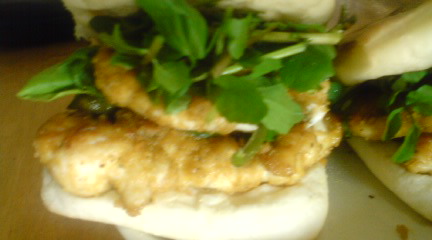
SANDWICH-4

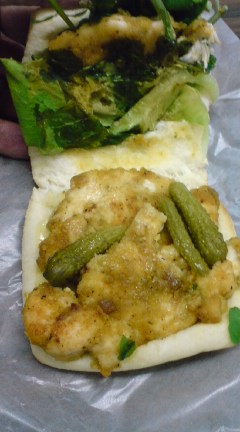
As for the contents, the Missus fried chicken “sasami/fillets” in karaage style with spice mix added.
She added lettuce, cress and French pickles for a great combination.

I can assure you I wolfed them down in a jiffy!

RECOMMENDED RELATED SITES:
Warren Bobrow
Bread + Butter
5 Star Foodie
Think Twice
Frank Fariello
Mangantayon
Hapabento
Elinluv Tidbit Corner
Tokyo Terrace

Please check the new postings at:
sake, shochu and sushi

—————————————-
日本語のブログ
—————————————-
Japanese Fruits 3: Pione Budou-Pione Grapes

PIONE1

SYNOPSIS:
There are a lot of fruit which either originated or grew to be characteristic of Japan.
I’m trying to introduce into this new series to help my vegan and vegetarian (I’m no) friends in particular as fruit can be adapted into so many ways!

1) Nashi/Asian Pear
2) Jirou Kaki/Jirou Persimmon

Grapes are relatively new to Japan, but its people have compensated this with an eye to create new strains with great success.

PIONE3
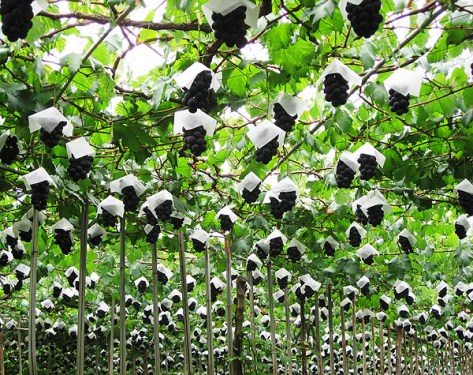
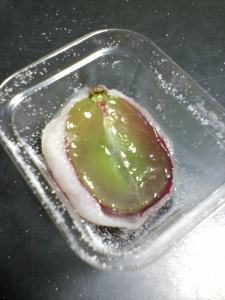
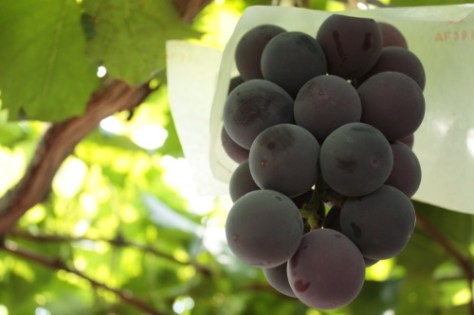
Pione Grapes are grown in aerial style.

Pione Grapes are a typical example.
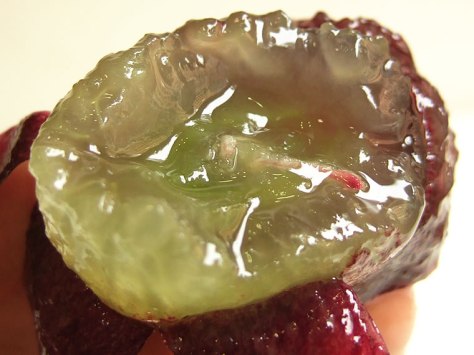
They are a cross between Kyoho Grapes and Cannon Hole Muscat.
Kyoho grapes (巨峰葡萄) are hemselves a Concord-like cross (Vitis vinifera x Vitis labrusca) between Campbell and Centennial grape varieties.

Kyoho grapes were first produced in 1942 in Shizuoka Prefecture, but were not so named until 1946.

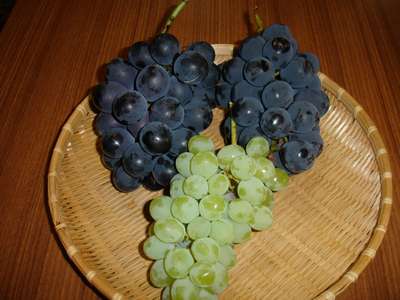
PIONE-MUSCAT
Pione Grapes compared to Muscat Grapes

Pione Grapes (ピオネ葡萄) were also first produced in Shizuoka Prefecture in 1957 by a farmer called Hideo Ikawa.
Pione is an Italian name.

PIONE2
Pione grape

Pione grapes are usually seedless, juicy and very sweet making them very versatile for all kinds of desserts:

PIONE-MOCHI
A typical Japnese dessert:
Pione Grape inside mochi!

PIONE-TART
Pione Tart!
Irresistible, isn’t it?

But Pione Grapes, especially their flesh in “Concasse” style can be used in salads:

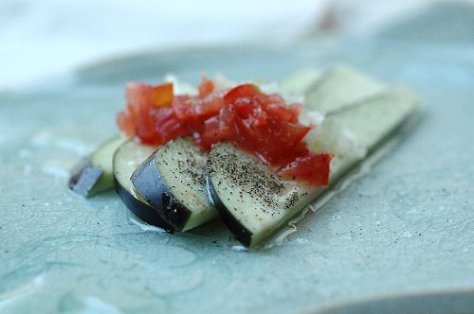
PIONE-ORGANIC-MIZUNASU
A dream salad for vegans!
Pione Grapes flesh on organic “Mizu nasu”/Mizu egg plant sashimi.
This particular kind of (Japanese) egg plant is eaten raw.
A little pepper and voila!

RECOMMENDED RELATED SITES
Not-Just-Recipes
Bengal cuisine
Cooking Vegetarian
Frank Fariello
Gluten-free Vegan Family
Meatless Mama
Think Twice

Please check the new postings at:
sake, shochu and sushi

—————————————-
日本語のブログ
—————————————-
French Cake by Bernard Heberle: 4810 (Mont-Blanc)
4810

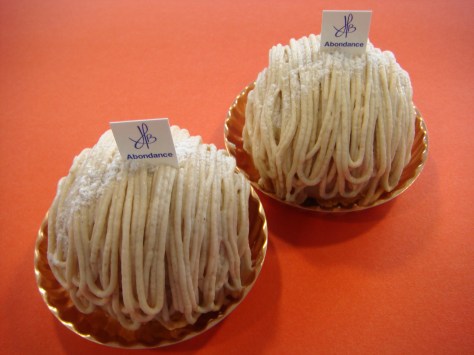
My good French friend, Bernard Heberle, a native from Alsace in France and plying his trade as a patissier in Hamamatsu City, has just sent me his last creation:

4810!
Yes, you read well, this cake’s name is a number!
Can you guess?

In his own words:
“En cette période des Kinmokusei , je te présente ce gâteau bien connu des japonais et peut être leur favori avec les short cake.
Son nom 4810 ( Non , ce n’est pas son prix , seulement l’altitude de notre Mont Blanc )
Celui ci , le notre est une base de meringue au lait avec une crème de marron et une génoise a la vanille , crème pâtissière et crème montée, nous utilisons des marrons italien du Piémont.”

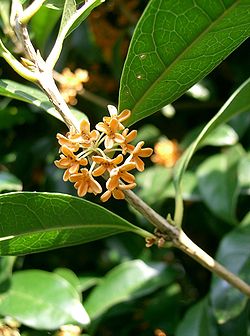
“In the Kinmokusei (fragrant orange-colored olive, the tree of Shizuoka Prefecture. Look below for picture) season, I would like to introduce a cake well known to the Japanese and perhaps their favourite with short cake.
Its name is 4810 (No, it’s not its price, only the height of Mont-Blanc!).
This particular creation rests on a milk meringue, then a marron cream and vanilla genoise. Next a creme patissier and a creme montee.
We use Itlian marrons from Piemonte.”

Kinmokusei
Kinmokusei (fragrant orange-colored olive, the tree of Shizuoka Prefecture)

Abondance
Address: Hamamatsu Shi, Sumiyoshi, 2-14-27 (in front of Seirei Hospital)
Tel.: 053-4738400
Fax: 053-4738401
Opening hours: 10:00~20:00. Closed on Tuesdays.
Homepage

RECOMMENDED RELATED SITES:
Warren Bobrow
Bread + Butter
5 Star Foodie
Frank Fariello
Mangantayon
Elinluv Tidbit Corner
Oyster Culture
Meatless Mama
Think Twice

Please check the new postings at:
sake, shochu and sushi

—————————————-
日本語のブログ
—————————————-