Tag Archives: グルメ

Vegan Japanese Cuisine: Yuki Nabe/Tofu Pot au feu

The Japanese have a very simple and healthy tofu recipe called Yuki Nabe/雪鍋 (“Snow Pot) which can be loosely translated as Tofu Pot Au Feu.
By just adapting the dashi soupstock to a vegan seaweed dashi, vegans and vegetarian can enjoy it!

Before reading the ingredients, check:
Vegan Japanese dashi soupstock recipe

INGREDIENTS: For 5 people

Tofu/Kinudofu/Silk tofu: count 1 block per person (1 block is about 300~400 g)
-Freshly grated daikon: 2 cups/400 cc
-Salt: 2 teaspoons
-Dashi: 5 cups/1000 cc
-Mitsuba/Trefoil/Japanese Honeywort: 1/2 cup/100 cc (Chopped). (if unavailable use fresh coriander or thin leeks, although the taste will be a lot stronger. Chopped shiso is fine, too)

RECIPE:

-Lightly press grated daikon to take out excess water.

-In a large Japanese nabe/pot (earthenware pot) pour the dashi/soupstock.

-Heat over a medium fire. Once the dashi starts boiling add the freshly garted daikon. Once it starts boiling again add the tofu cut into fairly bite-sized pieces.

-When it starts boiling again, lower the fire to very low and add the mitsuba and salt (if needed).

-Ask the guests to seve themselves with a ladle into individual bowls. Eat with a Chinese soup spoon (“renge” in Japanese).

-Have some grated lime skin, grated fresh ginger and even grated wasabi ready in small dishes for adults wishing for some more zip!

RECOMMENDED RELATED SITES:
Warren Bobrow, Bread + Butter, Zoy Zhang, Hungry Neko, Think Twice, Frank Fariello, Mangantayon, Hapabento, Elinluv Tidbit Corner, Tokyo Terrace, Maison de Christina, Chrys Niles,Lexi, Culinary Musings, Wheeling Gourmet, Comestiblog, Chronicles Of A Curious Cook, Bento Boutique, Tokyo Through The Drinking Glass, Tokyo Foodcast, Urban Sake, Sake World, Palate To Pen, Yellin Yakimono Gallery, Tokyo Terrace, Hilah Cooking, More than a Mount Full, Arkonite Bento

Please check the new postings at:
sake, shochu and sushi

—————————————-
日本語のブログ
—————————————-

Oyakodon Recipe: Koyadofu Oyakodon

Oyakodon seems to be a popular dish even outside Japan!
Here is a simple, healthy and light version with Koyadofu!

Before reading the ingredients, check:
Koyadofu Recipe

INGREDIENTS: For 2 people

-Koyadofu: 3 sheets
-Onion:1/2

Garlic chives (simplified Chinese: 韭菜; traditional Chinese: 韭菜; pinyin: jiǔcài, also 韮菜) are also known as Chinese chives, Chinese leek, ku chai, jiu cai, Oriental garlic chives or, in Japanese, nira (kanji: 韮; hiragana: にら; katakana: ニラ); in Kapampangan it is known as Kuse/Cu-se; in Korea known as buchu (부추), sol (솔), or jeongguji (정구지) or in Vietnamese, hẹ.

-Nira/Garlic Chives/Chinese Chives: as appropriate
-Egg: 1

-Dashi/Japanese soupstock: 300 ml/cc
-Sugar: 1 tablespoon
-Soy sauce: 3 tablespoons
-Mirin/Sweet sake: 3 tablespoons

-Two bowls of freshly steamed plain rice

RECIPE:

-In a pan pour the dashi, sugar, soy sauce and mirin. Heat slowly (avoid boiling) to dissolve and belend all the ingredients.

-During that time, if the koyadofu is dry soak it in lukewarm water until soft. Press water out of it. Cut it in pieces the size of your preference. Slice the onion fairly thin. Cut the nira into 5~7 cm long pieces.

-Drop the onion and koyadofu in the pan and cook on a samll fire for 5 minutes on medium-low fir.

-Drop the nira in the bowl and cook for one more minute on a low fire.

-beat the egg and pour delicately over the vegetables in the pan. When the egg is cooked (still a bit soft), pour the whole over two bowls of freshly steamed rice.

Easy, isn’t it?

RECOMMENDED RELATED SITES:
Warren Bobrow, Bread + Butter, Zoy Zhang, Hungry Neko, Think Twice, Frank Fariello, Mangantayon, Hapabento, Elinluv Tidbit Corner, Tokyo Terrace, Maison de Christina, Chrys Niles,Lexi, Culinary Musings, Wheeling Gourmet, Comestiblog, Chronicles Of A Curious Cook, Bento Boutique, Tokyo Through The Drinking Glass, Tokyo Foodcast, Urban Sake, Sake World, Palate To Pen, Yellin Yakimono Gallery, Tokyo Terrace, Hilah Cooking, More than a Mount Full, Arkonite Bento

Please check the new postings at:
sake, shochu and sushi

—————————————-
日本語のブログ
—————————————-

Bryan Baird’s Newsletter (2010/04/14)

Baird Beer & Taproom Events Bulletin
bryan-sayuri.gif

Three 2010 World Beer Cup Gold Medals

Dear Taproom Friend & Baird Beer Enthusiast:

The World Beer Cup is a bi-annual competition of world beers generally thought of as the “Olympics” of beer. The 2010 World Beer Cup — the world’s largest ever commercial beer competition with 642 breweries from 44 countries entering 3,330 beers in 90 beer style categories — was just held in Chicago where medal winners were announced at a gala dinner on Saturday, April 10. I am thrilled to report that Baird Beer took home a competition-tying best three gold medals!

The Baird gold-medal awarded beers are:

(1) Numazu Lager (American-Style Amber Lager category)

(2) Country Girl Kabocha Ale (Specialty Beer category)

(3) Saison Sayuri (Belgian- and French-Style Ale category)

To receive this level of international recognition from our world brewing peers is deeply satisfying to us and, hopefully, encouraging to this nascent but steadily developing market for craft beer in Japan. For more information on the World Beer Cup, please visit its website at: www.worldbeercup.org.

We will be celebrating this 2010 World Beer Cup success at the Numazu Fishmarket Taproom this coming Friday evening (April 16) with a pre-release party for gold-medal winning Saison Sayuri. We, of course, also will be pouring (and celebrating) Numazu Lager and will have a limited quantity of the remaining bottles of Country Girl Kabocha Ale on hand. Doors open at 5:00 pm.

The celebrating moves to Tokyo on Saturday, April 17, where a second round of Saison Sayuri pre-release parties will be happening at the Harajuku and Nakameguro Taprooms. Sayuri and I will be in attendance at Harajuku in the afternoon and at Nakameguro later that evening. We also will plan to arrange for kegs of this year’s champion small brewery, Ballast Point Brewing Company (imported by Nagano Trading) to be pouring from a couple taps at the Nakameguro Taproom. Please plan on joining us at one venue or another for this special celebration and Saison Sayuri sneak-preview launch.

The general release of Saison Sayuri will take place on Monday, April 19. It will be available both on draught and in 633 ml bottles.

Cheers,

Bryan Baird

Baird Brewing Company
Numazu, Japan
HOMEPAGE


The Japan Blog List

———————————
Must-see tasting websites:
-Sake: Tokyo Through The Drinking Glass, Tokyo Foodcast, Urban Sake, Sake World
-Wine: Palate To Pen, Warren Bobrow, Cellar Tours
-Beer: Good Beer & Country Boys, Another Pint, Please!
-Japanese Pottery to enjoy your favourite drinks: Yellin Yakimono Gallery
——————————–
Please check the new postings at:
sake, shochu and sushi

—————————————-
日本語のブログ
—————————————-

For a World Bento Community (A new WBC?)

One of the Missus’ bentoes!

I woke up this morning with an idea floating through my head (not much else at this time of the day!): there seems to be thousands of bloggers out there in the world devoted to bento, so why not try and create together a real community?

The purpose is not to compete with other blogs, be they hobbies or business ventures, nor to force people against their will to join a new group.

Similar efforts have already been achieved. For example, check Biggie’s (Lunch In A Box in San Fransisco) great list of Bento Bloggers!

What needs to be created is a larger informal series of postings or a new blog to inform and direct anyone interested in discovering new tips, health facts, trends and tricks for their lunch boxes.

I was wondering if Foodbuzz would be interested in creating a Bento Buzz and will enquire, but I think it would be more gratifying if bloggers organize it themselves or through like-minded bloggers.

Any thoughts?

P.S:
As for the title WBC meaning “World Bento Community”, it certainly would sound better than a “Group” of people making money out of punching each other to death!

RECOMMENDED RELATED WEBSITES:

Adventures in Bento Making, American Bento, Beanbento, Bento No1, Bento Wo Tsukurimashou, Cooking Cute, Eula, Hapabento , Happy Bento, Jacki’s Bento Blog, Kitchen Cow, Leggo My Obento, Le Petit Journal Bento & CO (French), Lunch In A Box, My Bento Box, Vegan Lunch Box

Please check the new postings at:
sake, shochu and sushi

—————————————-
日本語のブログ
—————————————-

Vegan Chinese Cuisine: Spring Rolls

Chinese (and Japanese) Cuisine can easily be adapted for vegans and vegetarians and deserrves to apprecaited by all.
Vegan and vegetarians recipes are easier and probably healthier!
As for the ingredients, make sure of what the warppers are made of. They can be either made with wheat flour or rice flour. Your choice!
Choose a frying oil of your preference, too.

As for the dip, I leave it to you, although I will check if I can find one for your prirorities!

INGREDIENTS: For 10 rolls

-Spring roll wrappers: 10


Mizuna

Mizuna (Japanese: 水菜 ‘water greens’), also called Xiu Cai, Kyona, Japanese Mustard, Potherb Mustard, Japanese Greens, California Peppergrass, Spider Mustard, etc., is a Japanese name used primarily for cultivated varieties of Brassica rapa nipposinica but also for Brassica juncea var. japonica.


Mizuna and Daikon Salad

In addition to the term “mizuna” (and its alternates) being applied to at least two different species of Brassica, horticulturalists have defined and named a number of varieties. For example, a resource provided by Cornell University and the United States Department of Agriculture lists sixteen varieties including “Early Mizuna”, “Kyona Mizuna”, “Komatsuna Mizuna”, “Vitamin Green Mizuna”, “Kyoto Mizuna”, “Happy Rich Mizuna”, “Summer Fest Mizuna”, “Tokyo Early Mizuna”, “Mibuna Mizuna”, “Red Komatsuna Mizuna”, “Waido Mizuna” and “Purple Mizuna”.[

-Mizuna: as appropriate
-Carrot: as appropriate
-Flour: a little
-Rice vinegar: as you like
-Chili pepper: as you like

RECIPE:

-Cut Mizuna in 6 cm long pieces.

-Cut carrot in 6cm long thin strips.

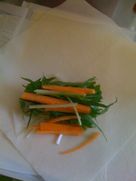
-Place mizuna and carrot on the first third of the wrapper.

-Roll as above. To securely close it apply a little water mixed a little flour on the inside of the wrapper (only on the end!).

-Deep-fry until it has become crispy and a nice light brown.
Bear in mind that the vegetables contain water. Don’t overfry them!
As soon as they look crispy, scop out and lay on a grill or kitchen paper to take off excess oil.
Dip in rice vinegar seaoned with chili pepper (mustard is great, too).

This is only the basice recipe. One can add all kinds of vegetables. The point is that they must be cut in the same size for even cooking!

RECOMMENDED RELATED SITES:
Warren Bobrow, Bread + Butter, Zoy Zhang, Hungry Neko, Think Twice, Frank Fariello, Mangantayon, Hapabento, Elinluv Tidbit Corner, Tokyo Terrace, Maison de Christina, Chrys Niles,Lexi, Culinary Musings, Wheeling Gourmet, Comestiblog, Chronicles Of A Curious Cook, Bento Boutique, Tokyo Through The Drinking Glass, Tokyo Foodcast, Urban Sake, Sake World, Palate To Pen, Yellin Yakimono Gallery, Tokyo Terrace, Hilah Cooking, More than a Mount Full, Arkonite Bento

Please check the new postings at:
sake, shochu and sushi

—————————————-
日本語のブログ
—————————————-

Vegan Japanese Cuisine: Koyadofu Agedashi

As I said before, Koyadofu is one kind of tofu that can beasily arranged into all kinds of interesting appetizers in Japanese Homes’ Gastronomy!
Here is a simple suggestsion for a yummy lunch to be eaten by all, vegans, vegetarians or omnivores:

Koyadofu Agedashi Appetizer!

Before reading the ingredients, check:
Koyadofu Recipe

Vegan Japanese dashi soupstock recipe

INGREDIENTS: For 2 people

-Koyadofu: 1 sheet (multiply everything accordingly for mor!)
-Cornstarch: as appropriate
-Deep-frying oil: a appropriate

-Dashi soup stock: 1 cup (vegans, check recipe!)
Soy sauce: 1 tablespoon
-Mirin/sweet sake: 1 tablespon
-Fresh grated ginger juice: 1/2 teaspoon
-Green shiso/perilla leaves: 2~3 (if unavailable, use stron flavour leaf vegetable)

RECIPE:

-If dry, let the koyadofu saok in plenty lukewarm water for 10 minutes.
In a pan drop the dashi, soy sauce and sweet sake/ mirin. Cook on medium fire for a little while without boiling too much. Switch off fire and add ginger jice. Mix.
Chop/finely cut green shiso and leave in cold water.

-Take kyadofu out of the water. Press water out hard. Cut into 8 pieces.Roll in cornstarch. Deep-fry at 150~160 degrees Celsius until they have attained a nice brownish colour (if the oil is too hot, it will “smoke”). Let rest on kitchen paper to absorb excess oil.

-Let the deep-fried koyadofu soak in the dashi soup until completely cooled down.
Chill the whole for a while in the refrigerator.

-Serve in a dish with the soupstock.
Drain and press water out the chopped green shiso and place on top.

-You can also serve it hot.
In this case after you have deep-fried the koyadofu and let it rest on a pice of paper kitchen to take excess oil, heat the soupstock. Add cornstarch dissolved in some lukewarm water and make a sweet and sour sauce (“ankake”) and serve it as shown in pic above.

RECOMMENDED RELATED SITES:
Warren Bobrow, Bread + Butter, Zoy Zhang, Hungry Neko, Think Twice, Frank Fariello, Mangantayon, Hapabento, Elinluv Tidbit Corner, Tokyo Terrace, Maison de Christina, Chrys Niles,Lexi, Culinary Musings, Wheeling Gourmet, Comestiblog, Chronicles Of A Curious Cook, Bento Boutique, Tokyo Through The Drinking Glass, Tokyo Foodcast, Urban Sake, Sake World, Palate To Pen, Yellin Yakimono Gallery, Tokyo Terrace, Hilah Cooking, More than a Mount Full, Arkonite Bento

Please check the new postings at:
sake, shochu and sushi

—————————————-
日本語のブログ
—————————————-

Yakitori Cutting Techniques 4: Kawa/Skin

SYNOPSIS:

Looking at my friends Island Vittles and Skewer It! blogs on yakitori I decided to start a series on that worldwide known Japanese specialty that is “Yakitori/焼き鳥/”Grilled Chicken”.
I hope that this series of postings on various basic recipes will help her and all other foodies interested in that simple, healthy and so delicious delicacy!

This particular series will deal with the cutting techniques which should help you make your own yakitori at home!

Yakitori Cutting Techniques 4: Kawa/Neck:

The best part for kawa/skin yakitori arguably come from the neck of the chicken (choose a large specimen with a long neck!LOL), but other parts are ok. Still, strive for quality!

Scrape most of the fat from the inside of the skin and discard. Too much fat left and the taste will drop with an increase in smoke. Still, leave a little!

This is haow it should look after scaping.

Spread the skin and cut in strips 25 mm/half an inch wide.

Stab skins with a skewer to form yakitori about 30~40 g each stick.

The finished product!

To make a single stick you will need 50 g of neck skin, fat included.

RECOMMENDED RELATED SITES:
Warren Bobrow, Bread + Butter, Zoy Zhang, Hungry Neko, Think Twice, Frank Fariello, Mangantayon, Hapabento, Elinluv Tidbit Corner, Tokyo Terrace, Maison de Christina, Chrys Niles,Lexi, Culinary Musings, Wheeling Gourmet, Comestiblog, Chronicles Of A Curious Cook, Bento Boutique, Tokyo Through The Drinking Glass, Tokyo Foodcast, Urban Sake, Sake World, Palate To Pen, Yellin Yakimono Gallery, Tokyo Terrace, Hilah Cooking, More than a Mount Full, Arkonite Bento. Island Vittles, Skewer It!

Please check the new postings at:
sake, shochu and sushi

—————————————-
日本語のブログ
—————————————-

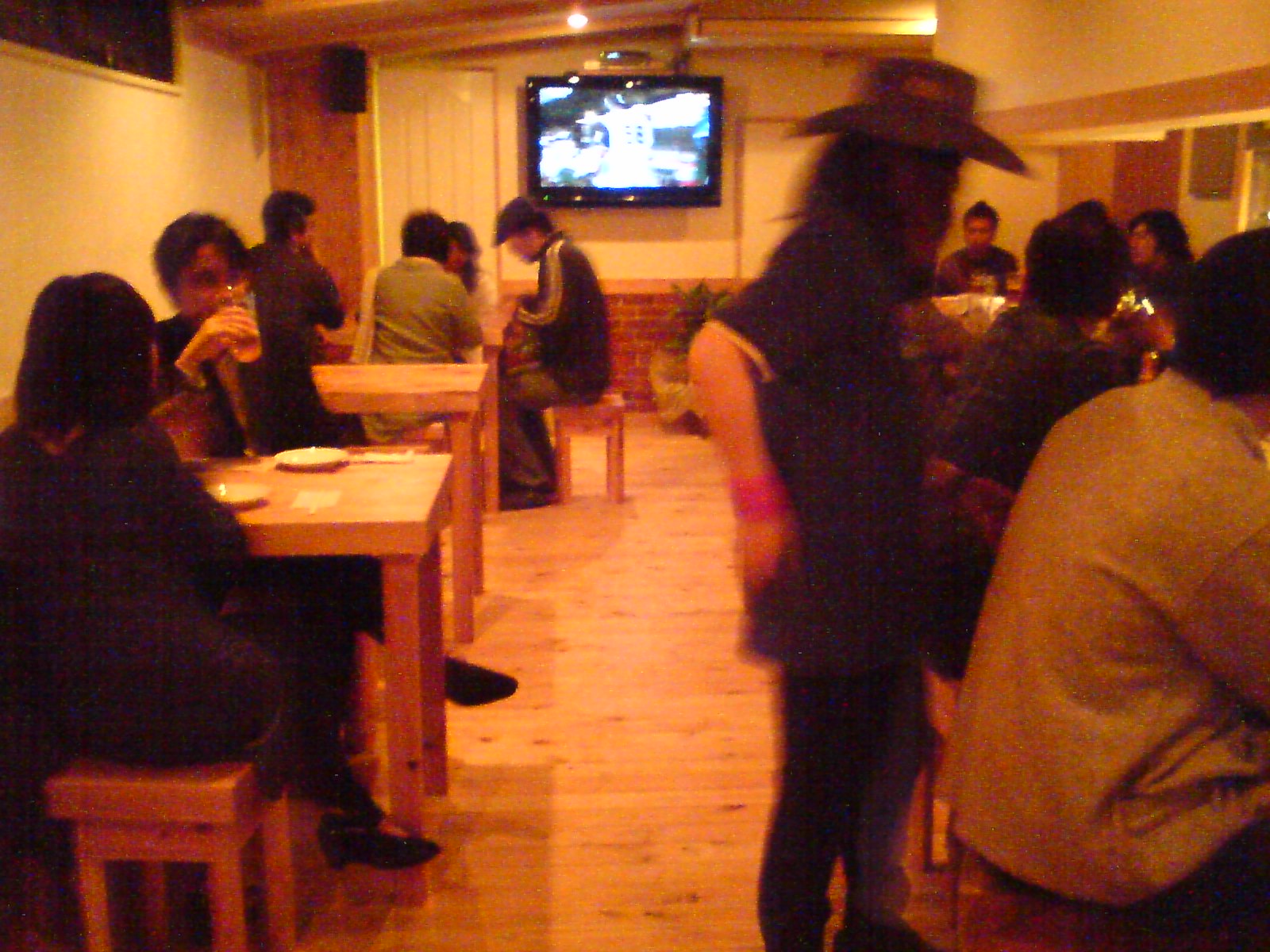
Beer No Yokota (Baird Beer): New Menu!

Service: very friendly
Facilities: very clean
no-smoking-logoNon-smoking!
Strong points: The beer!

Beer No Yokota has a new menu and it is bound to change regularly as some beers disappear quickly!
Will try to keep it up regularly!

FOOD MENU

JAPANESE PICKLES: Y 500
COLESLAW: Y 500
STEAMED CHICKEN & VEGETABLES SALAD: Y 600
ROASTED MUSHROOMS: Y 500
WAKASAGI KARAAGE/DEEP-FRIED JAPANESE SMELT: Y 500
SQUID FRITTERS: Y 700
ROSEMARY FRIED POTATOES: Y500
SPICY FRIED CHICKEN WINGS: Y 650 (3 pieces)
JAPANESE-STYLE FRIED CHICKEN LEG MEAT: Y 850
STEWED MINCED CHICKEN & LIVER SAUCE PASTA: Y 900
ROSEMARY POTATOES: Y 500
STOUT BEER STEWED VENISON (DEER MEAT): Y1,200
MIXED NUTS: Y 300
MATSUURA SWEET POTATO CHIPS: Y 300
CREAM CHEESE & HONEY DESSERT: Y 600
SALAMI: Y 600

BEERS

-PROMPTON ALE (Scottish 80 Shilling Ale): Y700 (473ml), Y500 (300ml)

-BAIRD BEER: Y800 (473ml), Y550 (300ml)
WHEAT KING ALE (4.2%)
RISING SUN PALE ALE (5.2%)
RED ROSE AMBER ALE (5.5%)
SHIMAGUNI STOUT (4.6%)
SURUGA BAY IMPERIAL IPA (7.5%) Y900 ((473ml), Y650 (300ml)

GANKO OYAJI BARLEY WINE (9.0%)-Y750 (200ml)

-YOKOHAMA BEER PILSNER (5.0%): Y800 (420ml)

-ATSUGI HONEY ABBEY DOUBLE (7.0%): Y900 (420ml)

-BISHOP’S FINGER (5.4%): Y950 (473ml), Y650 (300ml)

-EDELWEISS (AUSTRIA): Y900 (420ml)

-WESTON CIDER: Y1,000 (568ml), Y600 (300ml)

Drinks may be paid COD (cash on delivery) at the counter.
If you take food as well, you will be asked to paid a bill instead of COD.

BEER NO YOKOTA
Shizuoka Shi, Aoi Ku, Gofukucho, 2-5-22, Social Kadode Bldg, 2F (above a Chinese restaurant and behind the City Hall-turn left-on your right-hand side)
Tel.: 054-2553683
Opening hours: Monday to Friday: 17:00~24:00; Saturday, Sunday & National Holidays: 15:00~24:00
HOMEPAGE (Japanese)

RECOMMENDED RELATED WEBSITES:
-Shizuoka Bloggers: Think Twice, Mangantayon
-Beer: Good Beer & Country Boys, Another Pint, Please!, Baird Beer
-Sake: Tokyo Through The Drinking Glass, Tokyo Foodcast, Urban Sake, Sake World
-Wine: Palate To Pen
-Japanese Pottery to enjoy your favourite drinks: Yellin Yakimono Gallery, Shizuoka Guide Diary,

Please check the new postings at:
sake, shochu and sushi

—————————————-
日本語のブログ
—————————————-

Kabocha Bread

Here is another simple bread recipe using kabocha this time!
It ca easily be used for sandwiches and even hamburgers!

Kabocha Bread!

INGREDIENTS: For 8 balls

-All-purpose flour: 4 cups
-Egg: 1
-Lukewarm water: 120 cc/ml
-Oilve oil: 2 tablespoons
-Brown sugar: 1 tablespoon
-Salt: 1 teaspoon
-Dry yeast/yeast powder: 2 g
-Kabocha: 100 g

RECIPE:

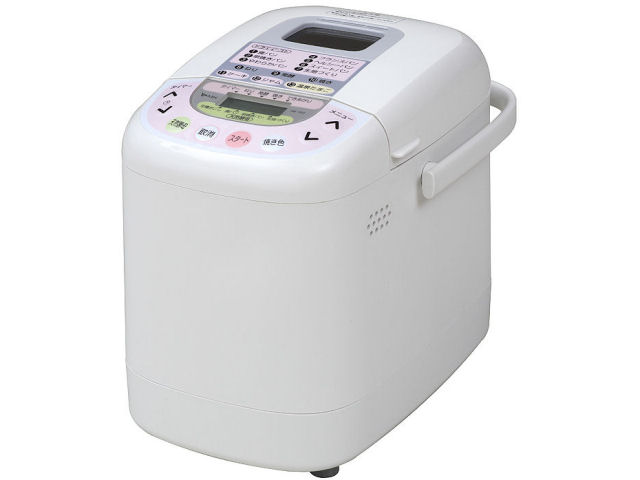
-Pour all ingredients, except kabocha, into the bowl of the Home Bakery (see above pic) and set for a first fermentation and switch on.

-Cut the kabocha into small pieces. Boil until soft. Drain well and pass through a sieve to obtain a puree.

-Once the dough has been fermented, take out of the Home Bakery mold. Mix it with the kabocha puree and knead well.

-Form a ball (it’s ok if some kabocha is still visible) and drop it in the Home Bakery mold. Set it for a first fermentation agan and switch on.

-Once the fermentation is finished take dough out and form 8 equal-sized balls.

-Sprinkle balls with flour and let rest on a oven hot plate for a second fermentation.

-When econd fermentation has been finished bake for 10 minutes at 200 degrees Celsius.

Sandwich samples:

Deep-fried chicken burger!

Bacon sandwich!

Ham sandwich!

RECOMMENDED RELATED SITES:
Warren Bobrow, Bread + Butter, Zoy Zhang, Hungry Neko, Think Twice, Frank Fariello, Mangantayon, Hapabento, Elinluv Tidbit Corner, Tokyo Terrace, Maison de Christina, Chrys Niles,Lexi, Culinary Musings, Wheeling Gourmet, Comestiblog, Chronicles Of A Curious Cook, Bento Boutique, Tokyo Through The Drinking Glass, Tokyo Foodcast, Urban Sake, Sake World, Palate To Pen, Yellin Yakimono Gallery, Tokyo Terrace, Hilah Cooking, More than a Mount Full, Arkonite Bento

Please check the new postings at:
sake, shochu and sushi; Happy Little Bento

—————————————-
日本語のブログ
—————————————-

Today’s Lunch Box/Bento (’10/28): Two-Box Bento

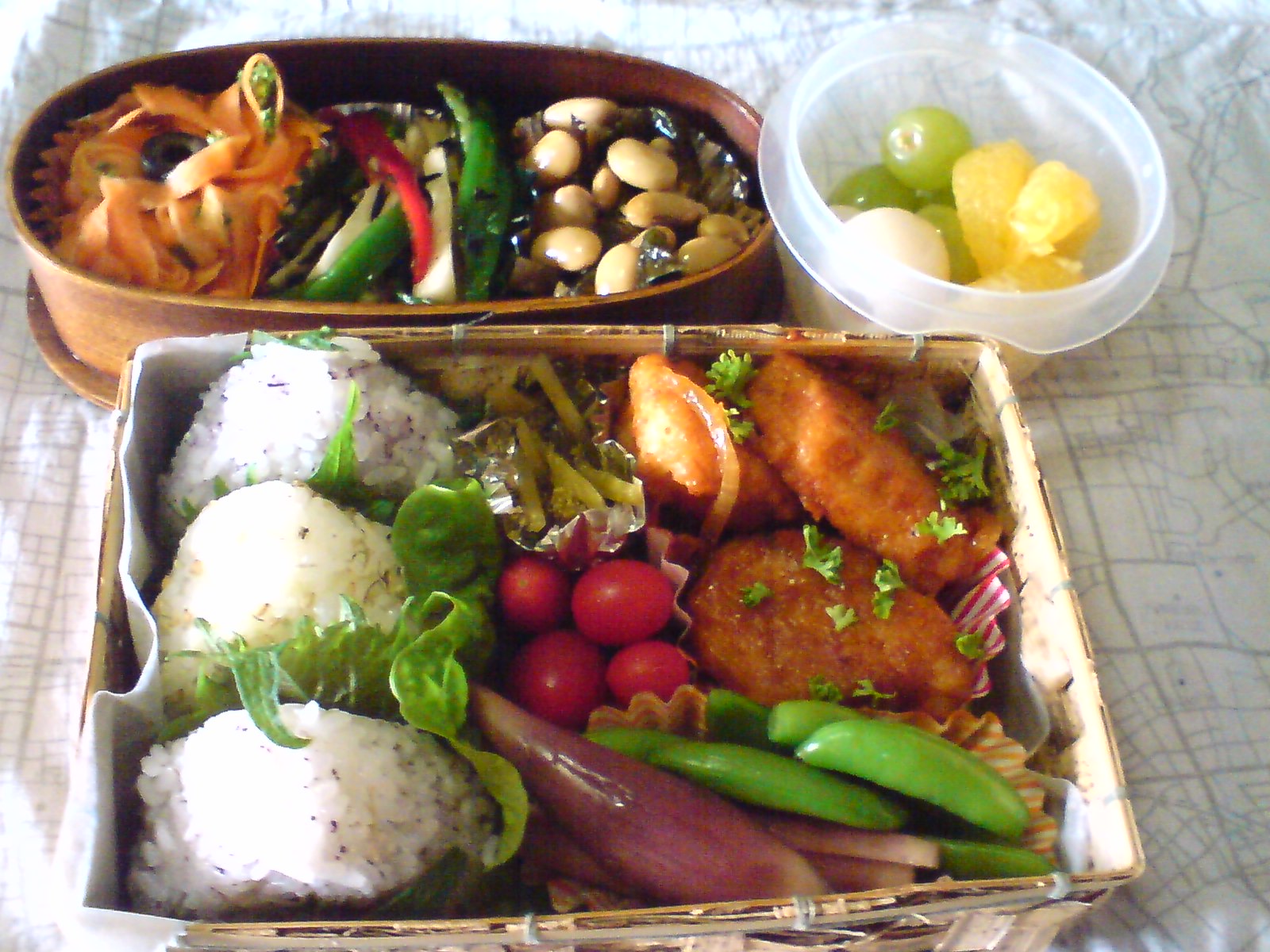
I called this bento, “Two-Box Bento” simply because the Missus has combined that faithful bamboo leaves/fibers box with half of the new cedar wood lunch box!

The weather has made a complete turnaround from yesterday’s deluge to a balmy day with plenty of sunshine and heat. I will have to find many reasons to get out the office today!

Today’s bento was another hearty one. I love bentoes, but if I had one everyday I would be afraid to step on the scales every morning!

The “main dish” featured tuna fried with tomato sauce, boiled peas in their pods (they are caleed “snap endou” in Japanese), home-pickled myoga ginger (in sweet vinegar), mini tomatoes and home-pickled wasabi stems and leaves.

Rice consisted of three musubi/rice balls containing umeboshi/Jpanese pickle plum. One ball was was seasoned with yuzu kosho furikake/lime pepper seasoning powder and “white” roasted sesame seeds, and the other with Yukari (red shiso powder seasoning) all were wrapped in green shiso leaves and lettuce.

The salad dish consisted of the Missus’ specialties, home-pickled carrot tagliatelle with black olives parsley, spicy fried yam/nagai imo and sweet pimentoes with hujiki/sweet seaweed, and her mother beans, vegetables and konbu seaweed “ni”/simmered food.

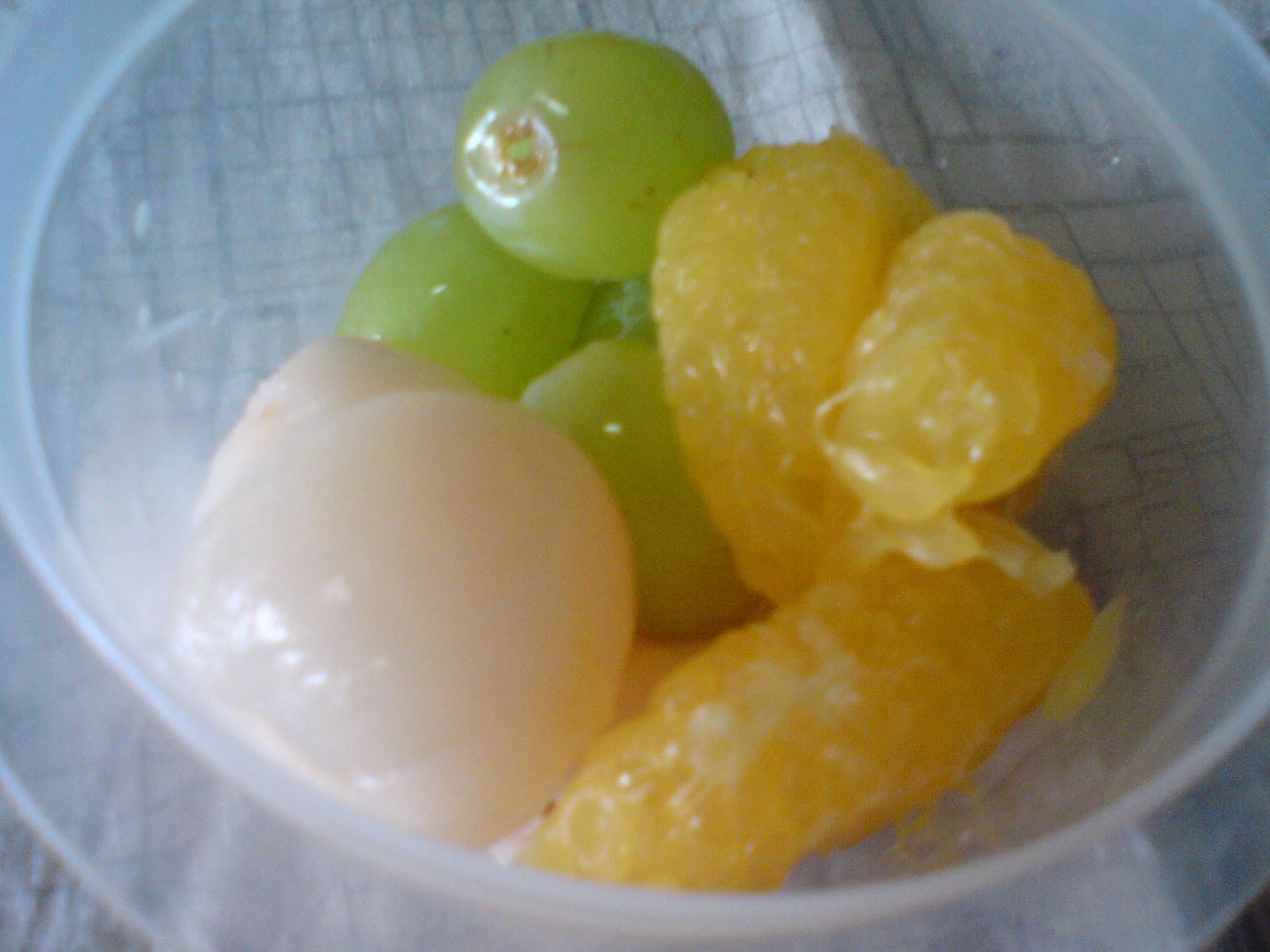
The dessert was a mixture of fresh Shizuoka orange, Chilean grapes and Chinese lychee.

Plenty for a long day!

RECOMMENDED RELATED SITES:
Warren Bobrow, Bread + Butter, Zoy Zhang, Hungry Neko, Think Twice, Frank Fariello, Mangantayon, Hapabento, Elinluv Tidbit Corner, Tokyo Terrace, Maison de Christina, Chrys Niles,Lexi, Culinary Musings, Wheeling Gourmet, Comestiblog, Chronicles Of A Curious Cook, Bento Boutique, Tokyo Through The Drinking Glass, Tokyo Foodcast, Urban Sake, Sake World, Palate To Pen, Yellin Yakimono Gallery, Tokyo Terrace, Hilah Cooking, More than a Mount Full, Arkonite Bento

Please check the new postings at:
sake, shochu and sushi; Happy Little Bento

—————————————-
日本語のブログ
—————————————-

Sansai/Mountain vegetable Recipe: Itadori/Japanese Knotweed

The Sansai/Mountain Vegetable season has started for good in Japan and might be around the corner in many parts of the world, but many people are still wondering how to prepare and eat them.

Here is a simple explanation of how the Japanese do it with some of them.
I’ll try to research for more in the near future.

ITADORI/JAPANESE KNOTWEED
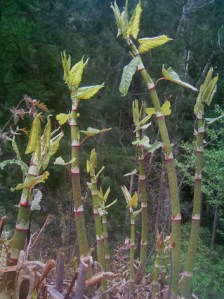
Japanese Knotweed (Fallopia japonica, syn. Polygonum cuspidatum, Reynoutria japonica) is a large, herbaceous perennial plant, native to eastern Asia in Japan, China and Korea. In North America and Europe the species is very successful and has been classified as invasive in several countries. About time to eat it, then!

Closely related species include giant knotweed (Fallopia sachalinensis, syn. Polygonum sachalinense) and Russian vine (Fallopia baldschuanica, syn. Polygonum aubertii, Polygonum baldschuanicum).

Other English names for Japanese knotweed include fleeceflower, Himalayan fleece vine, monkeyweed, Huzhang (Chinese: 虎杖; pinyin: Hǔzhàng), Hancock’s curse, elephant ears, pea shooters, donkey rhubarb (although it is not a rhubarb), sally rhubarb, Japanese bamboo, American bamboo, and Mexican bamboo (though it is not a bamboo). There are also regional names, and it is sometimes confused with sorrel.

In Japanese, the name is itadori (虎杖, イタドリ).

Japanese knotweed flowers are valued by some beekeepers as an important source of nectar for honeybees, at a time of year when little else is flowering. Japanese knotweed yields a monofloral honey, usually called bamboo honey by northeastern U.S. beekeepers, like a mild-flavored version of buckwheat honey (a related plant also in the Polygonaceae).

The young stems are edible as a spring vegetable, with a flavor similar to mild rhubarb. In some locations, semi-cultivating Japanese knotweed for food has been used as a means of controlling knotweed populations that invade sensitive wetland areas and drive out the native vegetation.

RECIPE:
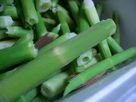
Peel the knotweed from the root (easier this way). Peel all the skin!

Boil the knotweed. If you have a lot of them, proceed in batches.
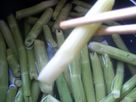
Once the knotweed colour has turned from deep green to “tea green”, the boiling should be enough. It would take up to 2 minutes for items of the thickness shown on the above picture.
Note that that if the deep-green colour hasn’t sufficiently gone, the knotweed will be acid in taste.
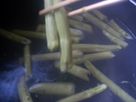
Now as soon as you attained the right colour, scoop knotweed out or over cooking will result in the plant breaking up. Very important!

Transfer immediately into chilled water. Leave it there for a whole night and you will be able to get rid of astrigency and unwanted matters.

Next morning drain, cleanse under cold running water and drain thoroughly.
It can be preserved inside the fridge for quite some time inside a tupperware box.
If you have a lot you can always make salty pickles of them.
If you do so, just put them inside a tightly closed tupperware box with a good measure of salt. Wash them with plenty of water before consuming them.
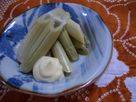
Freshly boiled, they can be eaten as they are with mayonnaise, or a simple dressing for vegans and vegetarians. A little chili pepper is fine, too!

Simple recipe 1:
Two large knotweed (boiled and prepared as above).
Japanese sake: 1/2 tablespoon
Water: 1/2 tablespoon
Mirin/sweet Japanese sake: 1 tablespoon
Men tsuyu/vegan dashi: 1/2 tablespoon
Gently simmer the whole together for a little while.
Try and serve together with other boiled vegetables!

Simple recipe 2:
Two large knotweed (boiled and prepared as above).
Aburaage (fried tofu sheet): 1/2
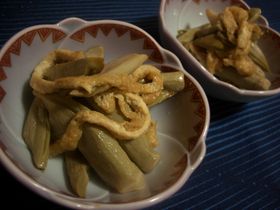
Cut the aburaage into fine strips and fry them quickly with knotweeed.
Add Mirin/sweet sake (1 tablespoon), men tsuyu or vegan dashi (a little less than a tablespoon) while frying. Finish with withsome sesame oil and eat at once!
Great with beer or sake!

Uropean/American style cuisine suggestion:

Itadori/Japanese knotweeed in tomato sauce!

RECOMMENDED RELATED SITES:
Warren Bobrow, Bread + Butter, Zoy Zhang, Hungry Neko, Think Twice, Frank Fariello, Mangantayon, Hapabento, Elinluv Tidbit Corner, Tokyo Terrace, Maison de Christina, Chrys Niles,Lexi, Culinary Musings, Wheeling Gourmet, Comestiblog, Chronicles Of A Curious Cook, Bento Boutique, Tokyo Through The Drinking Glass, Tokyo Foodcast, Urban Sake, Sake World, Palate To Pen, Yellin Yakimono Gallery, Tokyo Terrace, Hilah Cooking, More than a Mount Full, Arkonite Bento

Please check the new postings at:
sake, shochu and sushi

—————————————-
日本語のブログ
—————————————-

Today’s Lunch Box/Bento (’10/27)

After a very hot Sunday (I mean in April) when we got sunburnt playing (and winning!) cricket, this morning’s cold rain called for another hearty traditional Japanese bento!
The Missus being on holiday today cooked for the two of us, which is always a plus! LOL

The pictures I took this morning were too fuzzy because of the prevalent darkness and I had to take new pictures at the office!
The Missus used that beautiful Aomori Prefecture cedar wood box again!

The rice had been left to soak overnight with water to which she had added musshrooms cooked beforehand and their juices (konbu seaweed was also included).
Having steamed it, she mixed the whole (the mushrooms were left on top of the rice while being steamed) and added boiled broad beans for colour, texture and fibers!

The “side dish” was quite elaborate and the Missus had some difficulties fitting everything in!

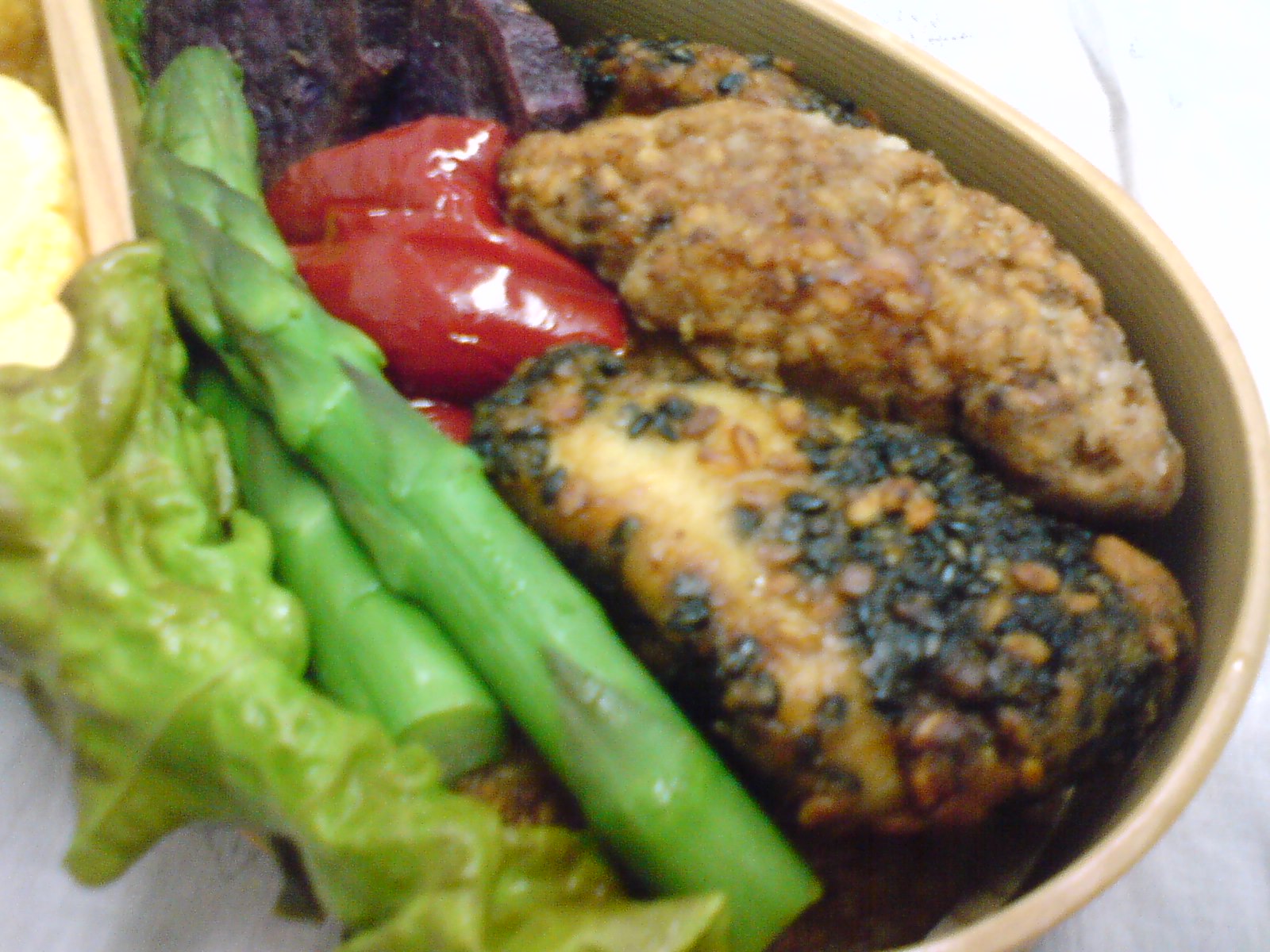
She shallow deep-fried two types of chicken sasami/chicken “tenderloins”, one with “white” sesame seeds, the other with black ones. She also fitted in some (boiled) green asparaguses and lettuce.

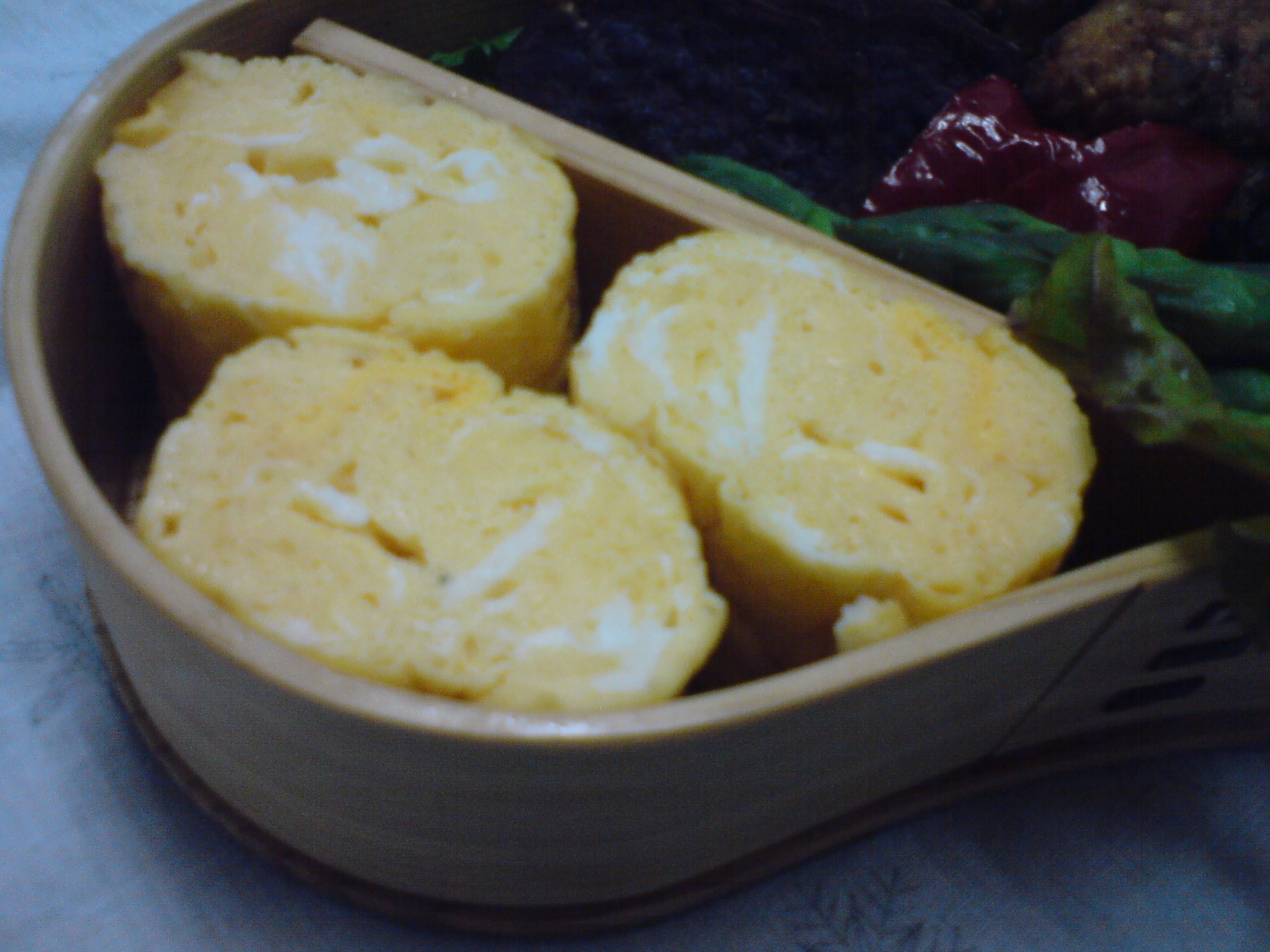
Tamagoyaki! Plain one, this ime!

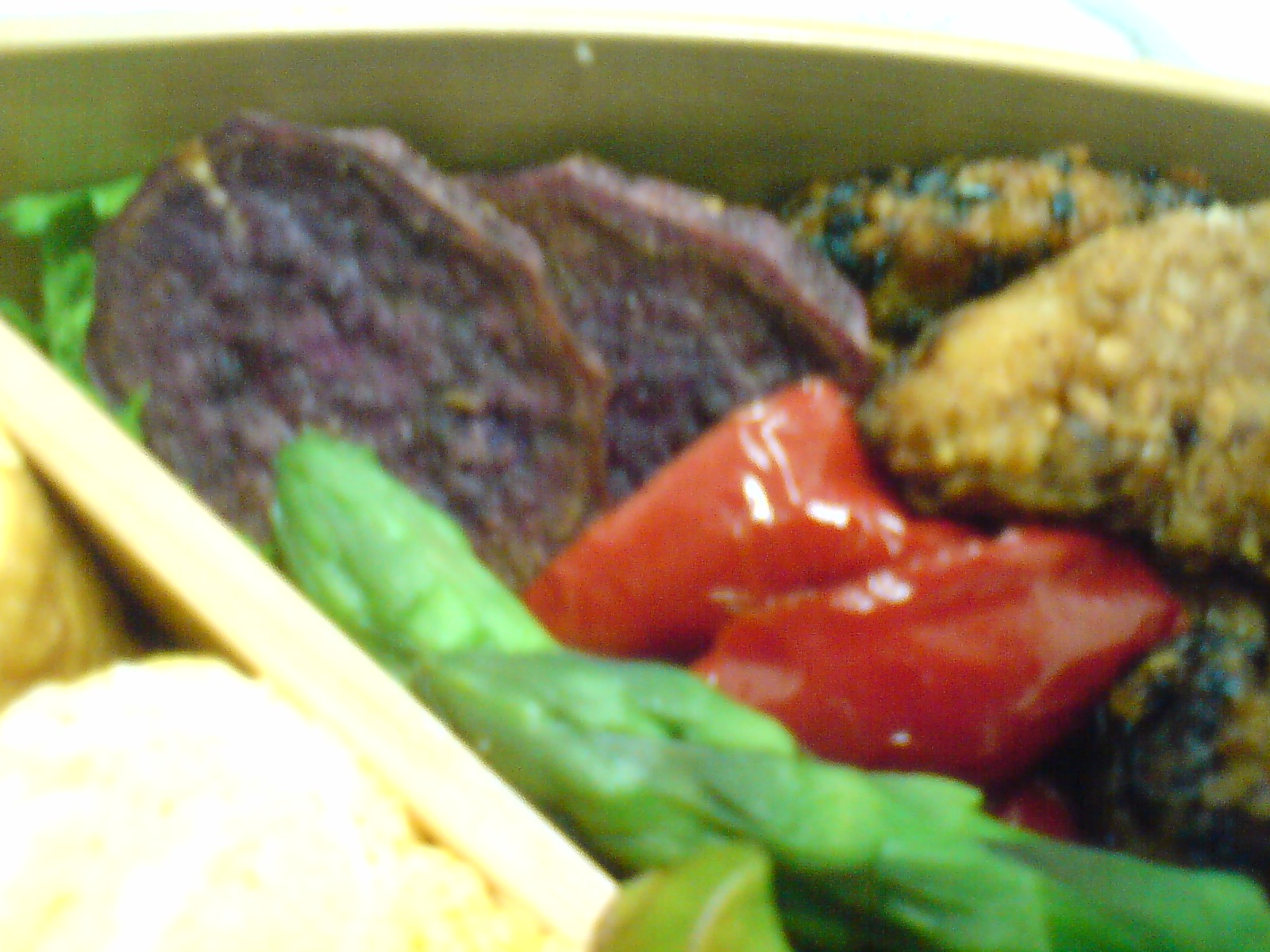
Extra vegetables included fried red sweet pimentoes and violet sweet potatoes/beni imo!

For dessert she gave me sliced green kiwi fruit and a new type of lemon/orange recently grown in our prefecture.

It is a very small type of orange or lemon (I will have to check the name) remiscent of a Meyer lemon, but deep yellw. The skin is quite thin and very fragrant (the latter wil go into the bath!) and the flesh very sweet and juicy!

It was certainly gratifying and bigger than it looked!

RECOMMENDED RELATED SITES:
Warren Bobrow, Bread + Butter, Zoy Zhang, Hungry Neko, Think Twice, Frank Fariello, Mangantayon, Hapabento, Elinluv Tidbit Corner, Tokyo Terrace, Maison de Christina, Chrys Niles,Lexi, Culinary Musings, Wheeling Gourmet, Comestiblog, Chronicles Of A Curious Cook, Bento Boutique, Tokyo Through The Drinking Glass, Tokyo Foodcast, Urban Sake, Sake World, Palate To Pen, Yellin Yakimono Gallery, Tokyo Terrace, Hilah Cooking, More than a Mount Full, Arkonite Bento

Please check the new postings at:
sake, shochu and sushi; Happy Little Bento

—————————————-
日本語のブログ
—————————————-

Baird Beer Awarded 3 Gold Medals at World Beer Cup 2010!

bryan-sayuri.gif

The Brewers Asociation Has Announced the winners of the World Beer Cup 2010!

Bryan Baird who brews Baird Beer in Naumazu has been awarded the Golds Medals in:

Category 8: Specialty Beer (27 Entries)
Beer name: Country Girl Kabocha Ale
Brewer: Baird Brewing Co., Numazu, Japan

Category 36: American-Style Amber Lager (24 Entries)
Beer Name: Numazu Lager
Brewer: Baird Brewing Co., Numazu, Japan

Category 42: Belgian- and French-Style Ale (57 Entries)
Beer name: Saison Sayuri
Brewer: Baird Brewing Co., Numazu, Japan

Sayuri and Bryan, congratulations and thanks for putting Numazu and Shizuoka on the Beer World Map!!


The Japan Blog List

———————————
Must-see tasting websites:
-Sake: Tokyo Through The Drinking Glass, Tokyo Foodcast, Urban Sake, Sake World
-Wine: Palate To Pen, Warren Bobrow, Cellar Tours
-Beer: Good Beer & Country Boys, Another Pint, Please!
-Japanese Pottery to enjoy your favourite drinks: Yellin Yakimono Gallery
——————————–
Please check the new postings at:
sake, shochu and sushi

—————————————-
日本語のブログ
—————————————-

Vegan Tofu Curry

As I said before, Koyadofu is one kind of tofu that can beasily arranged into all kinds of interesting appetizers in Japanese Homes’ Gastronomy!
Here is a simple suggestsion for a yummy lunch to be eaten by all, vegans, vegetarians aor omnivores:

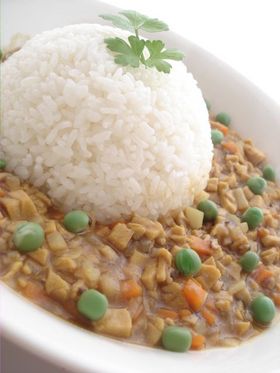
Vegan (Japanese) Tofu Curry!

INGREDIENTS: For 4 people

-Koyadofu: 5 sheets/85 g
-Carrot: 1 medium
-Onion: 1 medium
-Potato: 1 medium
-Shiitake mushrooms: 10 small
-Green peas: the equivalent of 1 small can/60 g
-Curyr powder (of your preference): 1~ tablespoon (I would use 2)
-Soy sauce: 2/3 tablepsoon
-Garan masala powder: 1/2 teaspoon

-Salad oil

-Steamed rice: count a large bowl per person

RECIPE:

-Cut the koyadofu into small bits and let them (if dry) soak in lukewram water until they get soft. Press the water out of them and keep in separate bowl. Finely chop the carrot, onion, potato, and shiitake mushroom. Keep in separate bowl. boil the green peas beforehand if necessary.

-Fry all chopped vegetables in salad oil for a while until the onions become translucent.

-Add some water and bring to boil. Remove any unwanted matter if necessary. Add chopped koyadofu. Cook until carrot are sufficently soft. Switch off fire. Add curry powder and mix quickly. Add soy sauce and garam masala and mix quickly. Switch on the fire and cook over small fire until you are satisfied withe the consistency of the whole.

On a dish turn over a bowl of rice and surround it like in the toppicture with curry to which you add the green peas at the last second (on directly “seeded” over it) for good effect.

RECOMMENDED RELATED SITES:
Warren Bobrow, Bread + Butter, Zoy Zhang, Hungry Neko, Think Twice, Frank Fariello, Mangantayon, Hapabento, Elinluv Tidbit Corner, Tokyo Terrace, Maison de Christina, Chrys Niles,Lexi, Culinary Musings, Wheeling Gourmet, Comestiblog, Chronicles Of A Curious Cook, Bento Boutique, Tokyo Through The Drinking Glass, Tokyo Foodcast, Urban Sake, Sake World, Palate To Pen, Yellin Yakimono Gallery, Tokyo Terrace, Hilah Cooking, More than a Mount Full, Arkonite Bento

Please check the new postings at:
sake, shochu and sushi

—————————————-
日本語のブログ
—————————————-

Foodbuzz 10,000 th Friend!

Taylor’s Foodbuzz Avatar

Today at 07.02 a.m., Sunday April 11th, that is 16.02, Saturday April 10th in the US, I had the pleasure to have my Foodbuzz Friendship request accepted by Greenschocolate!

Taylor’s website is actually greens & chocolate, a charming blog mostly about great homey desserts.
Taylor hails from Midwest America (US).

I’ve been a member at Foodbuzz since February 2008. Making 10,000 friends in the last 2 years and 2 months was certainly an unforeseen boo,
Incidentally I do not “collect” friends, but only make a point to greet any new Foodie on Foodbuzz. That is the least I can do!

Thanks to you for sahring the fun!

Robert-Gilles

RECOMMENDED RELATED SITES:
Warren Bobrow, Bread + Butter, Zoy Zhang, Hungry Neko, Think Twice, Frank Fariello, Mangantayon, Hapabento, Elinluv Tidbit Corner, Tokyo Terrace, Maison de Christina, Chrys Niles,Lexi, Culinary Musings, Wheeling Gourmet, Comestiblog, Chronicles Of A Curious Cook, Bento Boutique, Tokyo Through The Drinking Glass, Tokyo Foodcast, Urban Sake, Sake World, Palate To Pen, Yellin Yakimono Gallery, Tokyo Terrace, Hilah Cooking, More than a Mount Full, Arkonite Bento

Please check the new postings at:
sake, shochu and sushi

—————————————-
日本語のブログ
—————————————-