French Cuisine: Croustillants a la Feta

Cheese is a staple in most European Cuisines.
Traditional Feta is a Greek cheese that should only include sheep and goat’s milk, although modern feta might also consist of cow’s milk.
As Feta is an aged cheese, commonly produced in blocks, and has a slightly grainy texture, it is easy to cook/use in all kind of pastries.
Here is a simple French-inspired recipe of this Greek delicacy:
Croustillants a la Feta/Feta Croustilla g
nts

INGREDIENTS: For 8 pieces

-Feta: 200 g (try and use real Greek feta!)
-Brick/filo sheets (thin pastry brick or filo/fillo): 4
-Young fresh spinach: 100 g
-Egg: 1
-Butter: 20 g
-Freshly grated Parmegiano: 30 g
-Pine seeds: 40 g
-Oil: 200cc/ml
-White pepper: to taste

RECIPE:

-Clean the spinach in running cold water. Drain them thoroughly and fry them in the butter for 5 minutes on a medium fire.
Dry fry the pine seeds for 3 minutes in an teflon pan.

-In a bowl mash the feta with a fork. Add the egg, parmegiano, spinach and pine seeds. Keep a fine pine seeds for decoration. Mix well and add white pepper.
Do not add salt as the feta is already salted!

-Cut the filo/brick sheets in four portions lengthwise. You should have 16 strips. Place one strip each on another one to form 8 double strips. If the brick is round, fold the thr curving part inside.
Place some feta mixture in one corner of the double strip and fold the rest of the strip over it so as to obtain a triangular-shaped pastry (see above picture).
Repeat with the other 7 double strips.

-Heat the oil in a deep enough pan or deep-fry pan. Deep-fry each the pastry 2 minutes for each side until you obtained a nice dark golden colour.

-Serve them immediately decorated with a few roasted pine seeds.

NOTE:

-Instead of deep-frying them, you can brush the pastries lightly with oil and cook them in the oven (over a baking sheet) for 7~8 minutes at 210 degrees Celsius. Turn them over halfway in that case.

Drink a solid dry white wine with it!

RECOMMENDED RELATED SITES:
Warren Bobrow, Bread + Butter, Zoy Zhang, Hungry Neko, Think Twice, Frank Fariello, Mangantayon, Hapabento, Elinluv Tidbit Corner, Tokyo Terrace, Maison de Christina, Chrys Niles,Lexi, Culinary Musings, Wheeling Gourmet

Please check the new postings at:
sake, shochu and sushi

—————————————-
日本語のブログ
—————————————-

Today’s Lunch Box/Bento (’10/11)

The Missus might be right after all when she throws the epithtet, “jiji”, at me when she gets exasperated at me.
“Jiji” means “Grandpa” when muttered by kids when they are seeking further treats, and downright “senile old man” when proffered by my supposedly better half.
After using my hi-tec Japanese mobile phone camera, I finally discovered I had picture size options up to 2 MB! I had been using the 30KB option until then….

The pics are truly enormous now, but reducing them to this will mean a finer grain and an enhanced picture.
The only problem is that it takes ages to download and upload!

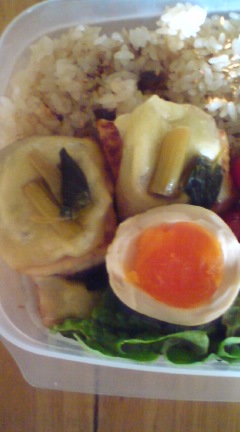
The Missus has been experimenting of late.
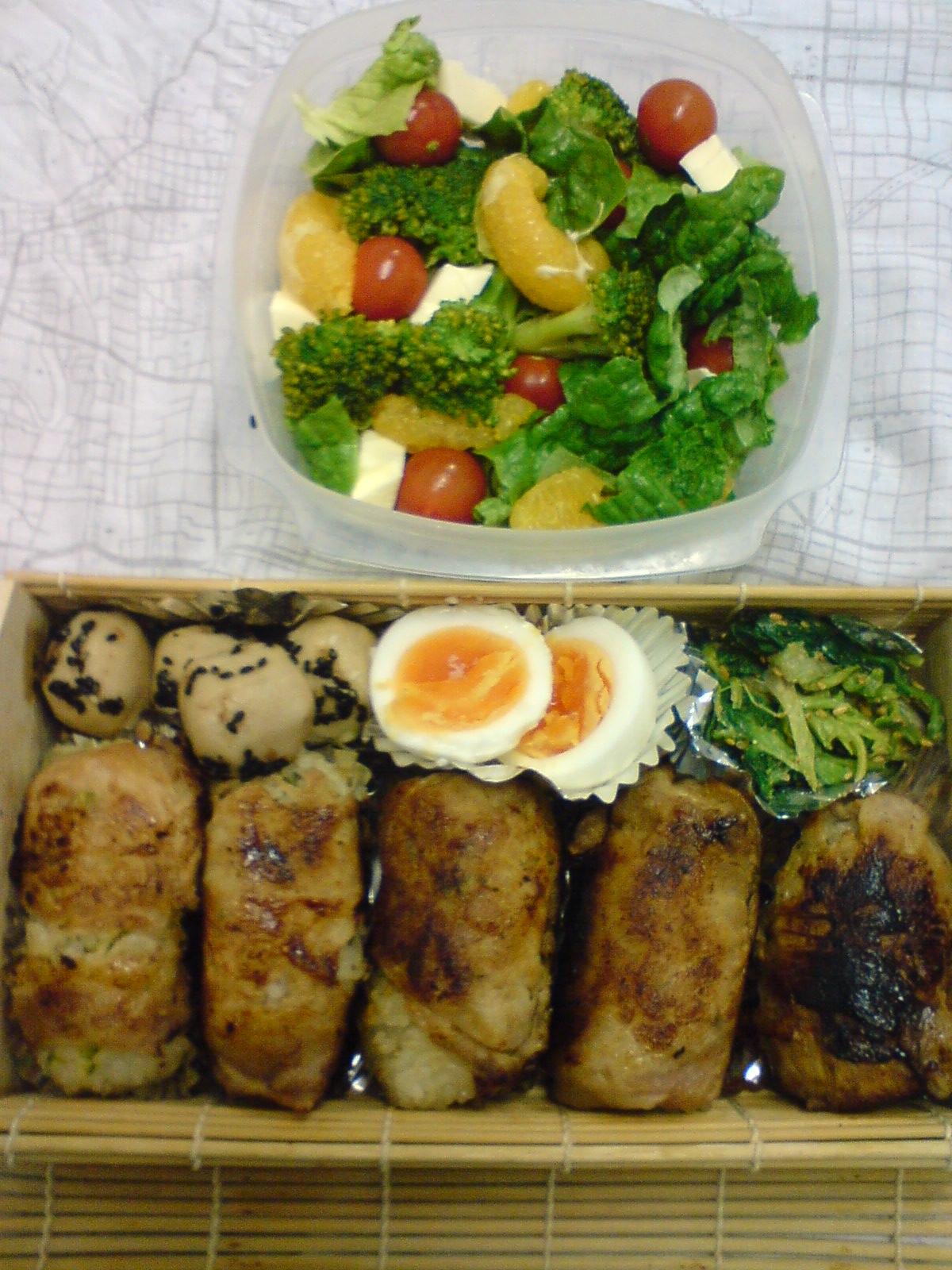
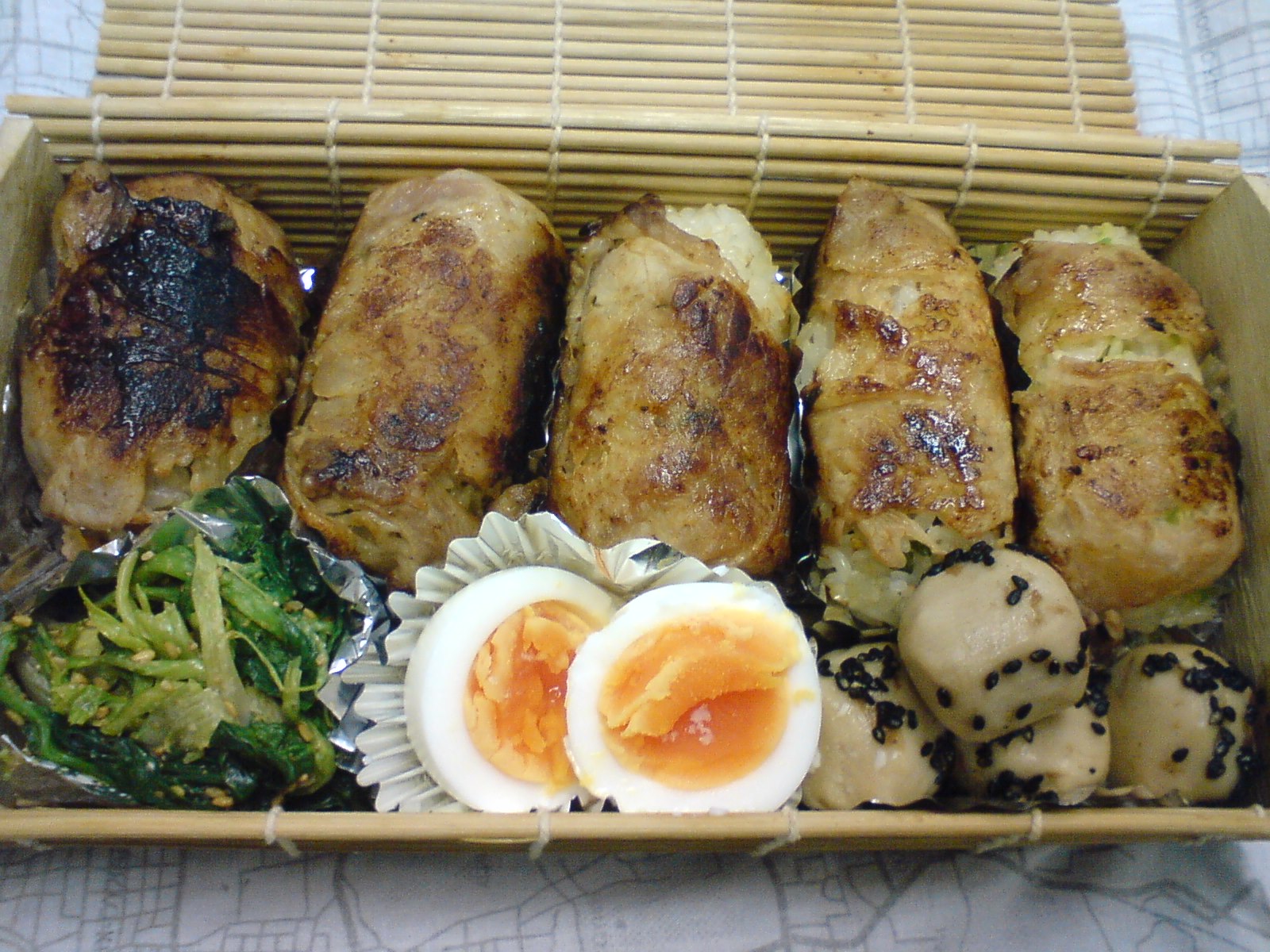
Today she steamed plain rice before mixing it with roasted sesasme seeds and finely chopped pickled wasabi leaves.
She then made large musubi she rolled inside thin pork slices. She fried the the rolls first with a little sesame oil, and then some tare/Japanese sauce.

She is going to kill if she finds out I handled them with my bare fingers!
As for the garnish, she fried some ready cooked sato imo/taro roots seasoned with black sesame seeds.

She also included a soft-boiled egg of hers (she never revealed the full recipe!) and boiled spinach seasoned with gomadare/sesame dressing.

As for the side dish, she prepared a salad-dessert with lettuce, mini tomatoes, boiled broccoli, cheese and orange wedges.

A true winter bento, “jiji”!

RECOMMENDED RELATED SITES:
Warren Bobrow, Bread + Butter, Zoy Zhang, Hungry Neko, Think Twice, Frank Fariello, Mangantayon, Hapabento, Elinluv Tidbit Corner, Tokyo Terrace, Maison de Christina, Chrys Niles,Lexi, Culinary Musings, Wheeling Gourmet

Please check the new postings at:
sake, shochu and sushi

—————————————-
日本語のブログ
—————————————-

Sashimi Feast at Ekimae Matsuno Sushi

Now, what makes sushi restaurants of so high level in Shizuoka?
Tokyoites will say that they have Tsukiji and that is enough…
Have you ever wondered how fresh fish, shellfish and others are “fresh” there?
“Fresh fish” at all costs has become a very misleading notion.
The fact it is alive and swimming does not mean it is fresh.

All fish must be caught first and depending on their kind have to be either eaten right away or…
For example seabreams should be kept at least a day alive in an aquarium/tub to get them rid of unwanted parasites inside their innards. But at the same time keeping them alive longer will result in a loss of proteins and fat with the consequence of a fast quality decline.
Tuna has to be blooded very precisely first, then frozen. Once thawed and cut it is usually left at least a week for maturing/ripening before reaching the perfect taste.
On the other hand, squids must be dressed and eaten alive (still moving!).
It is a “case by case” (said in English) as explained by the chef at Ekimae Matsuno Sushi in Shizuoka City.
Founded in 1930, the oldest sushi restaurant know what they are talking about!

Bachi Maguro/目鉢鮪/Big-eyed Tuna from Ogasawara/Shizuoka Prefecture, Tairagai/玉珧/Pen shell from Aichi Prefecture, Sayori/細魚/Japanese Halfbeak from Suruga Bay/Shizuoka Prefecture

The key to appreciating top-class sashimi at all times and seasons is to savour it locally. Only then will you be sure of its origin and quality.
Naturally you must also discover a trustworthy sushi restaurant and chef. Not very difficult here where the competition is intense!

Tachiuo/太刀魚/Scabbard fish partly seared/aburi/炙り, Aori Ika/障泥烏賊/Bigfin Reef Squid rolled with seaweed/nori/海苔, and Madai/真鯛/Japanese red seabream, red seabream snapper. All from Suruga Bay in Shizuoka Prefecture.

Ekimae matsuno Sushi pride themselves in providing Shizuoka Prefecture fare whenever possible, including Japanese sake (all from Shizuoka Prefecture!), and they make no bones (fish bones!LOL) about that! Shy and reserved, they will quickly warm up to your questions if asked in a gentle enough manner good manners!).

I sudenly felt an urgent longing for more Sayori/細魚/Japanese Halfbeak after having sampled it in the first sashimi set. It is such a great and delicate fish and ripened to perfection as a whole fish inside the refrigerated display window. It canbe manipulated in all kinds of designs.

Sorry for the fuzzy pic. I’m still getting used to the newly discovered possibilities of my old mobile phone camera (up to 2 MB).

Kawahagi no Kimo Ae/カワハギの肝和え/Thread-Sail File Fish sashimi seasoned with its Liver. From Suruga Bay, Shizuoka Prefecture.

Now, here is a fish you must eat as fresh as possible!
Take it out alive (caught the day before maximum) out of the aquarium, dress it quickly, clean the liver, and serve the fish cut either in thin strips or slices with its liver chopped into a dip sauce, or season the cut fish directly (once cut) with its live, and serve it with chopped scallions/thin leeks and grated wasabi!
Ah, I forgot to mention that wasabi is from Shizuoka Prefecture (80% of the total national crop!)! Actually I’m repeating that every time! LOL

The chef had the grace (and pride) of showing me this (small, although reaching more than 20 cm!) Aori Ika/障泥烏賊/Bigfin Reef Squid live and kicking before preparing it for me!

It was still moving (I mean the very strips) under my chopsticks.
The chef gently asked me to taste it first as it is with nothing.
Incredible! Crunchy, not the merest hint of “fishy” taste. An experience!
Then he asked me to try it with a little salt only. Another discovery!

Last, the chef brought an enormous fresh egg yolk in a small crystal bowl and invited me to add a little soy sauce to it before dipping the squid in it. You must try that!

This was lunch and I am not eating much then as a rul these days.
I decided to skip the sushi for another (near) day and asked for tamagoyaki/卵焼き/japanese Omelette as dessert.
It came in two varieties:
the thin slices were eggs mixed with fish paste and the other were plain tamagoyaki fried with shiso.

Now, how much did I pay for all that?
60 US $!
Have I convinced you?

Ekimae Matsuno Sushi/駅前松乃鮨
Shizuoka City, Aoi Ku, Koya Machi, 9-3 (in front of Shizuoka City JR Station, North Side)
Tel.: 054-251-0123
Business hours: 11:00~21:00
Closed on Wednesdays and third Tuesday
HOMEPAGE (Japanese)

RECOMMENDED RELATED SITES:
Bread + Butter, Comestilblog, Greedy Girl, Bouchon For 2, Zoy Zhang, Hungry Neko, Mangantayon, Elinluv Tidbit Corner, Maison de Christina, Chrys Niles, Lexi, Culinary Musings, Eats and Everything, Bite Me New England, Heather Sweet, Warren Bobrow, 5 Star Foodie, Frank Fariello, Oyster Culture, Ramendo, Alchemist Chef, Ochikeron, Mrs. Lavendula, The Gipsy Chef, Spirited Miu Flavor, Wheeling Gourmet, Chef de Plunge, Sushi Nomads, Island Vittles, Jefferson’s Table, Rubber Slippers in Italy, The London Foodie

Please check the new postings at:
sake, shochu and sushi,
—————————————-
日本語のブログ
—————————————-

Shizuoka Oden Festival!

The 2010 Shizuoka Oden Festival kicked off today!
I made a quick visit in-bewteen work to have a quick snack!

Going to the Aoba Koen/Aoba Park Street behind the City Hall, one just could miss it clearly markde as it was giant red lanterns with “ODEN” wrote on them (in Japanese only, mind you!).

Now, choosing one was a bit of a dilemna!
Knowing that the festival would last until Sunday, I decided to wait until a particularly big and troublesome local TV crew left the premises to get some hot food and a glas of local sake!

The great thing about these oden foodstands (they actually were held by regular izakaya in town) is that most of them made an effort to serve local Shizuoka sake.
Above picture shows Masu Ichi Brewery (Shizuoka City), Shidaizumi Brewery (Fujieda City) and Hana no Mai Brewery (Hamamatsu City)!

But the one I had chosen today (I’m planning to go there again during the week-end!) had some unusual sake:
Hana no Mai Brewery (Hamamatsu City), Kumpai Brewery (Shizuoka City) and Kansagawa Brewery (Yui)!

This foodstand had been erected by “Showa Hormone Izakaya, south of Shizuoka JR Station.

All oden were very typical of Shizuoka-Style (almost every region in Japan has its own style) oden.

In Shizuoka, most oden are skewered with a stick for easier consumption.

“Motsu/kind of tripe”, also very popular here!

Pity I couldn’t tay all evening there. The Festival is held between 5 and 7 p.m. for 3 days. I wonder why they choose the colder time of the year. LOL

RECOMMENDED RELATED SITES:
Bread + Butter, Comestilblog, Greedy Girl, Bouchon For 2, Zoy Zhang, Hungry Neko, Mangantayon, Elinluv Tidbit Corner, Maison de Christina, Chrys Niles, Lexi, Culinary Musings, Eats and Everything, Bite Me New England, Heather Sweet, Warren Bobrow, 5 Star Foodie, Frank Fariello, Oyster Culture, Ramendo, Alchemist Chef, Ochikeron, Mrs. Lavendula, The Gipsy Chef, Spirited Miu Flavor, Wheeling Gourmet, Chef de Plunge, Sushi Nomads, Island Vittles, Jefferson’s Table, Rubber Slippers in Italy, The London Foodie

Please check the new postings at:
sake, shochu and sushi,
—————————————-
日本語のブログ
—————————————-

Vegan Japanese Cuisine: Fried Bell Peppers, Shimeji Mushrooms & Umeboshi

There is a wealth of vegan/vegetarian recipes in Japanese cuisine to the point that people with such priorities might feel attracted by this country. Don’t forget there is a traditional Budhist (I’m not) vegetarian gastronomy which can be easily amended to vegan tastes!

A note before I continue:
A vegan friend pointed out that honey is not vegan when I advised to use honey-pickled Japanese plums. I shall leave that to you.
Just bear in mind that non-honey Japanese pickled plums are higher in slat, although the same salt can be used as the seasoning itself.

Green peppers, or bell peppers are full of extremely important beneficial elements, so here is a very simple way to accomodate them:

Fried Bell Peppers, Shimeji Mushrooms & Umeboshi!

INGREDIENTS: For 2~3 people


-Shimeji mushrooms: 1 pack or a large fistful


-Bell Peppers: 2


-Umeboshi/Pickled Japanese plums: 2

-Olive oil: 2 tablespoons
-Black pepper: to taste
-Soy sauce: a little

Optional spices (chili pepper): to taste

RECIPE:

-Take seed out of umeboshi/pickled Japanese plum and cut to a pulp with a knife.

-Cut the bell peppers in trips. Make sure you have discarded all the seeds. They are not easily digested.

-Separate the shimeji mushrooms.

-Pour the olive oil on a frypan and stir fry the bell peppers and shimeji mushrooms until as soft as you wish.

-Add umeboshi, balck pepper, soy sauce and optional spices. Mix and stir-fry for a few seconds.

-Serve topped with some fresh green sprouts.

Easy again, ain’t it?

RECOMMENDED RELATED SITES
Not-Just-Recipes, Bengal cuisine, Cooking Vegetarian, Frank Fariello, Gluten-free Vegan Family, Meatless Mama, Warren Bobrow, Wheeling Gourmet, Le Petit Cuisinier, Vegan Epicurean, Miss V’s Vegan Cookbook, Comestiblog, To Cheese or not To Cheese, The Lacquer Spoon, Russell 3, Octopuspie, Bread + Butter, Pegasus Legend, Think Twice, The French Market Maven, Fuji Mama, Great Teacher Sato

Please check the new postings at:
sake, shochu and sushi

—————————————-
日本語のブログ
—————————————-

Vegetables Facts & Tips 17: Peppers & Paprika

Bell pepper or sweet pepper is a cultivar group of the species Capsicum annuum (chili pepper). Cultivars of the plant produce fruits in different colors, including red, yellow, green and orange. Bell peppers are sometimes grouped with less pungent pepper varieties as “sweet peppers”. Peppers are native to Mexico, Central America and Northern South America. Pepper seeds were later carried to Spain in 1493 and from there spread to other European, African and Asian countries. Today, Mexico remains one of the major pepper producers in the world.

The misleading name “pepper” (pimiento in Spanish) was given by Christopher Columbus upon bringing the plant back to Europe. At that time peppercorns, the fruit of Piper nigrum, an unrelated plant originating from India, were a highly prized condiment; the name “pepper” was at that time applied in Europe to all known spices with a hot and pungent taste and so naturally extended to the newly discovered Capsicum family. The most commonly used alternative name of the plant family, “chili”, is of Central American origin. Bell peppers are botanically fruits, but are generally considered in culinary contexts to be vegetables. When cut off, the top of the bell pepper is referred to as a “pepper pan”.
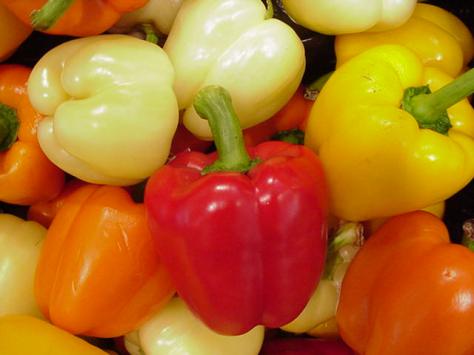
Paprika

The term “bell pepper” or “pepper” or “capsicum” is often used for any of the large bell shaped capsicum fruits, regardless of their color. In British English, the fruit is simply referred to as a “pepper”, or additionally by colour (as in the term “green pepper”, for example), whereas in many Commonwealth of Nations countries, such as Australia, India, Malaysia and New Zealand, they are called “capsicum”. Across Europe, the term “paprika”, which has its roots in the word for pepper, is used—sometimes referred to by their color (e.g., “groene paprika”, “gele paprika”, in Dutch, which are green and yellow, respectively). Paprika also refers to the powdered spice made from the same fruit. In France it is called “poivron”, with the same root as “poivre” (meaning “pepper”), or “piment”. In Japan, the word ピーマン (“pîman” from the French) refers only to green bell peppers, whereas パプリカ (“papurika” from paprika) refers to bell peppers of other colors.

In the United States and Canada, in addition to the terms “bell pepper” and “sweet pepper,” the fruit is often referred to simply as a “pepper” or referred to by color (e.g. “red pepper”, “green pepper”), although the more specific term “bell pepper” is understood in most regions. In parts of Indiana, Ohio, and Pennsylvania, the fruit is called a “mango”. The origin of this use is in the use of the term “mango” or “mangoed” to refer to pickled fruits. At a certain time, mangoes were available in the United States only in pickled form. Later, it became common in these regions to use bell peppers in pickled form, thus the term “mangoed peppers” or “mango peppers,” later shortened to “mangoes.”

In Russia it is commonly called болгарский перец (bolgarskiy perets), meaning Bulgarian pepper. In Denmark the bell pepper is referred to as “peberfrugt”, meaning pepper-fruit. In Germany, Finland, Norway, Sweden, former Yugoslavia, the Netherlands and Belgium it is known as “paprika”.

In Brazil it is commonly called Pimentão, meaning Big pepper. It’s widely used in a variety of dishes, like pasta, rice and other dishes from Cuisine of Brazil.

In Argentina it is called “Morrón”. Green and red bell peppers are usually found in small grocery stores; the yellow ones tend to be in the supermarket. Grilled, they may form part of the traditional barbecue of this country, called “Asado” (Castilian Spanish for ‘roasted’ or ‘grilled’).

In Costa Rica it is called “chile dulce” or sweet chili and many typical dishes include it as part of the ingredients.

In India, it is commonly called “capsicum” in English, in addition to native terms such as “Simla mirch” (“Simla chili”).

In Nepal it is called “bhede khursani”. It is eaten with fried noodles, and is cooked and eaten with any vegetable, but bhede khursani is never eaten raw.

In Sri Lanka it is called “Maalu Miris” in Sinhalese and used in “curries” as a vegetable. “Miris” is Chilli, the hotter variety which is used as a hot spice, and “Maalu” means Vegetable; hence, “Maalu Miris” indicates the less spicy version, which is suitable for cooking as a vegetable, instead of using as a spice. With the similar meaning, bell pepper is called “kaRi miLakaay” (கறிமிளகாய்) in Tamil language.

In Egypt it is commonly called “filfil akhdar”, where “filfil” means pepper and “akhdar” means green. It is eaten as a raw snack, in salads, in various soups and stews, and is also cooked stuffed with a rice and beef filling.

In South Korea, the peppers that are green in color, are the only ones that are called “pimang” (피망). All other colors of bell peppers are referred to as “paprika” (파프리카).

In China, peppers that are green in color, including green bell peppers and hot peppers, are called 青椒 (pinyin: qīngjiāo), meaning “green pepper”. All colors of bell peppers can also be referred to as 柿子椒 (pinyin: shìzǐjiāo).

That is for the excellent information found on Wkipedia!

The color can be green, red, yellow, orange and more rarely, white and purple, depending on when they are harvested and the specific cultivar. Green peppers are less sweet and slightly more bitter than red, yellow or orange peppers. The taste of ripe peppers can also vary with growing conditions and post-harvest storage treatment; the sweetest are fruit allowed to ripen fully on the plant in full sunshine, while fruit harvested green and after-ripened in storage are less sweet.

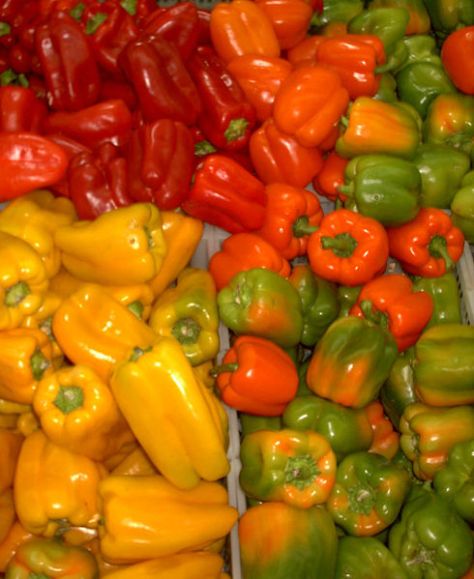
Here are the most common varieties foun in Japan:
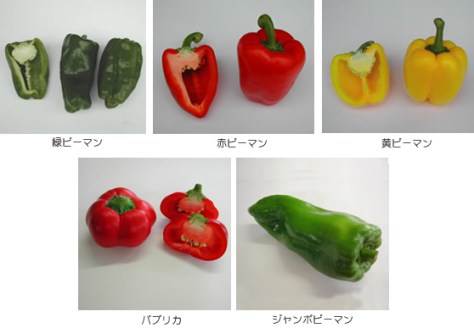
From top to bottom and left to right:
Green, red and yellow peppers (bell peppers)
Paprika and Jumbo Piman/Pepper

Red peppers are ripe green peppers, while the jumbo pepper is valued for its size.

“Tongari Piman/Pepper”
Valued for its shape and fewer seeds.
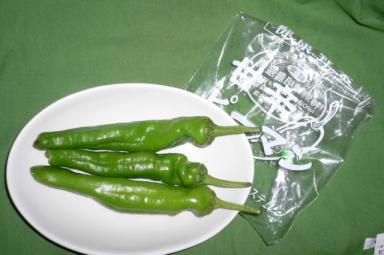
“Ama-Kara/Sweet and hot”
Also called banana peppers when ripe.
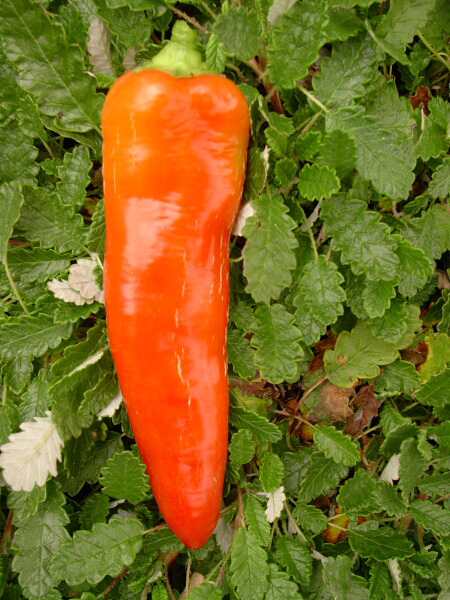
Banana Pepper

Valued for its mild taste, making it popular to a larger audience.
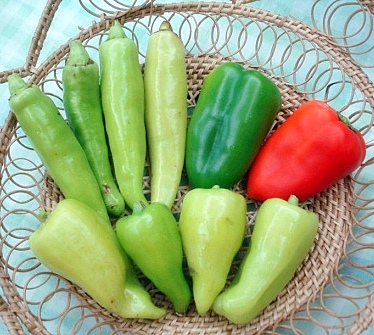
More colour varieties!
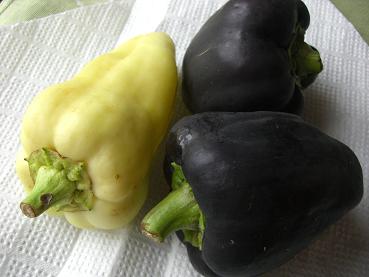
Anastasha Paprikas

These are becoming increasingly popular in Japan and come in red, almost black and yellow.

FACTS:

-Season: from June to October, although available on the markets all year round.

-Main Beneficial ingredients: Carotens, Vitamins B1, B2, B6, C, K, Vegetal fibers, Potaasium, Magnesium, and Phosphourous.

-Greatly beneficial to skin when fried!

-Should be combined with oil (fried, vinaigrette) whwnever possible for better absorption by human bodies. Are generally beneficial against high blood pressure and helps recovery from fatigue.

TIPS:

-Choose specimens with unblemished stem cuts. The older, the more change in colour there.

-They are best stored inside a vinyl pouch in the refrigerator.
Old specimens will show blemishes and black spots.

HEALTH FACTS:

-Pepper bells combined with whole rice, or yam, or scallops, or oysters, will help combat diabetes and obesity, and revitalize digestive system.

-Pepper bells combined with onion, or konnayaku, or celery, will help combat high blood pressure and artery ageing.

-Pepper bells combined with shiso/perilla, or turnips, or leeks, or chili peppers, will prevent digestive system illnesses and help blood circulation.

-Pepper bells combined Chinese chives, or shiitake mushrooms, or egg plant/aubergine, will help combat cancer, will provide stamina, help combat general ageing and help skin.

-Paprika combined with olive oil, will help combine stress and skin.

-Parika combined with turnips, or leeks will hep blood circulation and combat digestive system illnesses.

RECOMMENDED RELATED SITES
Not-Just-Recipes, Bengal cuisine, Cooking Vegetarian, Frank Fariello, Gluten-free Vegan Family, Meatless Mama, Warren Bobrow, Wheeling Gourmet, Le Petit Cuisinier, Vegan Epicurean, Miss V’s Vegan Cookbook, Comestiblog, To Cheese or not To Cheese, The Lacquer Spoon, Russell 3, Octopuspie, Bread + Butter, Pegasus Legend, Think Twice, The French Market Maven, Fuji Mama, Great Teacher Sato, Peas Love Carrots

Please check the new postings at:
sake, shochu and sushi

—————————————-
日本語のブログ
—————————————-

Bryan Baird’s Newsletter (2010/02/12)

Baird Beer & Taproom Events Bulletin
bryan-sayuri.gif

Dear Taproom Friend & Baird Beer Enthusiast:

Winter is a time of hibernation for many species. The Barley Wine style of beer is not one of these. Winter is the season that this big bear of the beer world comes out to play. Baird Ganko Oyaji (”Stubborn Ol’ Man) Barley Wine 2010 is being released from his cellar cave on Saturday, February 13.

Ganko Oyaji Barley Wine 2010 (ABV 10%):

Brewed in July 2009 and packaged upon krausening in August, Ganko Oyaji 2010 sports a grist bill consisting of floor-malted Maris Otter, Munich and Crystal malts and 10% Japanese red (akato) sugar. The starting gravity is high (25.3 Plato), the apparent attenuation is good and thus the alcohol content is potent. 65 BUs of all American hops, and dry-hopping with a combination of Columbus, Centennial and Amarillo, beautifully balance the malt richness. Ganko Oyaji is an ideal after-dinner or before bed restorative. It promises to condition nicely in the bottle and keg for months and years to come.

Ganko Oyaji Barley Wine 2010 will be available on draught at all of our Taproom pubs and other Baird Beer retailing restaurants beginning Saturday, February 13. Bottles (633 ml) can be purchased direct from our brewery E-Shop and through the fine family of Baird Beer retailing liquor shops in Japan beginning the same day.

Vertical tastings for three successive years of Ganko Oyaji (2008 – 2010) are possible at two of our Taprooms: Nakameguro and Numazu Fishmarket. Finally, don’t forget the Big Beer Winter Week celebration now underway at our Nakameguro Taproom. An extraordinary selection of both American and Baird strong ales are being poured and celebrated for an entire week. The special cuisine is terrific too. The event runs through Friday, February 19.

Cheers,

Bryan Baird
Baird Brewing Company
Numazu, Japan
HOMEPAGE


The Japan Blog List

———————————
Must-see tasting websites:
-Sake: Tokyo Through The Drinking Glass, Tokyo Foodcast, Urban Sake, Sake World
-Wine: Palate To Pen, Warren Bobrow, Cellar Tours
-Beer: Good Beer & Country Boys, Another Pint, Please!
-Japanese Pottery to enjoy your favourite drinks: Yellin Yakimono Gallery
——————————–
Please check the new postings at:
sake, shochu and sushi

—————————————-
日本語のブログ
—————————————-

Vegetables Facts & Tips 14: String Beans, French Beans and Common Beans (amended & expanded)

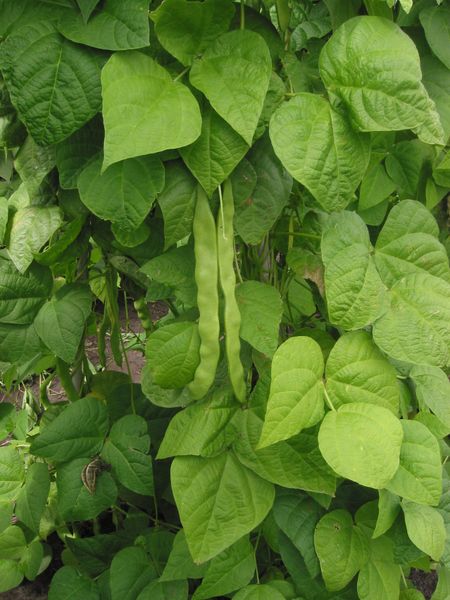
STRING-BEANS-PLANT

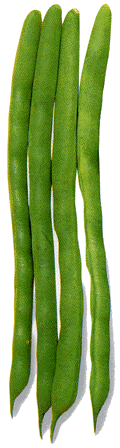
Common beans, when green and immature are either called String Beans or French Beans when they don’t have a string.
When reaching maturity they gave way to all kinds of beans.
They were first discovered in Central and South America in the 16th Century and were later introduced in Europe, then China. The French first planted the beans in Japan in rhe second half of the 19th Century.

90% of the crop is harvested three times a year in Hokkaido Island in Japan.

Ther are two main varieties in this country:

STRING-BEANS-DOJYOINGEN
“Dojyo-Ingen”, also called “Kentucky Wonder”. Slightly soft variety.

STRING-BEANS-SAABERUINGEN
“Saaber-Ingen”, thinner and rounder than above without strings.

The Japanese usually boil them lightly or just just cut them in trunks about 5 cm long and add them to all kinds of dishes from clear soups to sauteed food.

OTHER VARIETIES

Mokko Ingen

This variety is gaining popularity for its large size.
Recently found in French and Italian restaurants.
Make for great decoration onthe plate and are succulent lightly steamed, fried or stewed. Can reach 20 cm.

Juroku Sasage

Very thin and long (30 m), grown in Aichi Prefecture. Soft and easy to cook and eat. They are called because they contain 16 (juroku) seeds each.

Kintoki Mame

More widely known for producing azuki bean varieties.
Can be eaten young and greenlike string beans.

Akishima Sasage

Popular for their varying colors. Grown in geenhouses in Gifu Prefecture.
The beans are delicious when stewed.

FACTS:
-Season: June~September
-Main beneficial elements: Protein, Carotene, Vitamin B1 nad Bz, Vitamin C, Vitamin K, Calcium, Calcium, Magnesium and vegetal fibers.
-Eaten with other food high in protein, their Vitamin C are easily ingested by human bodies.
Cooked with oil, their carotene will be easily assimilated by human bodies.

TIPS:
-Just after boiling drain them and let cool inside a sieve. They will be tastier for it.
-If you have plenty, first boil them before storing them in the refrigerator.
-Peel strings away before cooking.
-Choose firm and straight specimens.

HEALTH FACTS:

-Combined with Judas Ear mushrooms, or Konnyaku, or Bamboo shoots, help combat large intestine cancer and obesity.

-Combined with Yoghurt, or natto, or Spinach, or hijiki/sweet seaweed, helps combat intestines poisoning and constipation.

-Combined with Agar agar or onion, help reduce blood cholesterol and high blood pressure.

-Combined with Broccoli, or rape blossoms, or kabocha, or tomato, helps prevent cancer, helps skin rejuvenation and recovery from illness.

RECOMMENDED RELATED SITES
Not-Just-Recipes, Bengal cuisine, Cooking Vegetarian, Frank Fariello, Gluten-free Vegan Family, Meatless Mama, Warren Bobrow, Wheeling Gourmet, Le Petit Cuisinier, Vegan Epicurean, Miss V’s Vegan Cookbook, Comestiblog, To Cheese or not To Cheese, The Lacquer Spoon, Russell 3, Octopuspie, Bread + Butter, Pegasus Legend, Think Twice, The French Market Maven, Fuji Mama, Great Teacher Sato, Peas Love Carrots

Please check the new postings at:
sake, shochu and sushi

—————————————-
日本語のブログ
—————————————-
Italian Restaurants: New Team at Aquavite!

Service: Excellent and very friendly
Facilities: great and very large washroom, great cleanliness overall
Prices: reasonable to expensive. Top-class Italian wines. Private room for~8 people.
no-smoking-logo1 Non-smoking at counter!

High quality Italian Cuisine is a trademark of Shizuoka City thanks to the extravagant supply of impeachable ingredients both from the nearby sea and the land, which have contributed to an ever-increasing level in all kinds of cuisines. But Italian gastronomy must be the most competitive specialty inthis status-conscious city.

Like in many top restaurants, recruiting first-class staff upon the departure of established chefs to other shores is a constant headache for Aquavite who are justly proud of their rank as the best Italian Restaurant in town and feel responsible for constantly maintaining and improving standards.

The regulars know only too well, and the place being crowded on a Monday evening just proved it was “business as usual”!

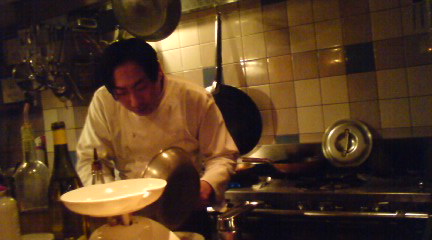
The new team in charge of the kitchen is now Chef Kenichi Honda who worked in Roma for two years and holds an Italian Sommelier License,

and his sous-chef Yuhei Kajiyama.

Both are born in Shizuoka City, a marked advantage when it comes to choosing the best local products which for the majority of their creations.
Like the best Japanese chefs they bring another dimension to Italian cuisine with their almost obsessive attention to every detail.

I managed to pay them a quick visit last night to have a chat (a long one as they were very busy!) and a few pics before I visit them for a full dinner and report in the near future.
Please forgive the inferior quality of the pics, but taking them over the counter in minimum time was not easy!LOL

Stir-fried scallop and grilled “Kinki seabream”.

Italian charcuterie!

Beef Roast.

Porcini cream gnocchi.

Extravagant Minestrone!

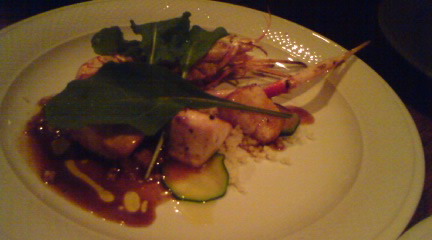
Mekajiki/Marlin and Scampi on a bed of couscous.

See you next time!

Address: 420-0034 Shizuoka Shi, Tokiwa-cho, 1-2-7, Tomii Bldg. 3F
Tel. & fax: 054-2740777
Opening hours: 11:30~14:00 (on reservations only), 18:00~22:00
Closed on Sundays
Homepage (Japanese)
Credit Cards OK

RECOMMENDED RELATED SITES:
Bread + Butter, Comestilblog, Greedy Girl, Bouchon For 2, Zoy Zhang, Hungry Neko, Mangantayon, Elinluv Tidbit Corner, Maison de Christina, Chrys Niles, Lexi, Culinary Musings, Eats and Everything, Bite Me New England, Heather Sweet, Warren Bobrow, 5 Star Foodie, Frank Fariello, Oyster Culture, Ramendo, Alchemist Chef, Ochikeron, Mrs. Lavendula, The Gipsy Chef, Spirited Miu Flavor, Wheeling Gourmet, Chef de Plunge, Sushi Nomads, Island Vittles, Jefferson’s Table, Rubber Slippers in Italy, The London Foodie

Please check the new postings at:
sake, shochu and sushi,
—————————————-
日本語のブログ
—————————————-

Bryan Baird’s Newsletter (2010/02/08)

Baird Beer & Taproom Events Bulletin
bryan-sayuri.gif

Dear Taproom Friend & Baird Beer Enthusiast:

Today marks the 9th annual release of the first fruited ale ever brewed by Baird Beer: The Carpenter’s Mikan Ale.

The Carpenter’s Mikan Ale 2010 (ABV 6.6%):

The mikans used in this brew are fresh, succulent, and local — harvested on the Heda land and by the hand of our carpenter friend, Nagakura-san. The Baird brewers hand-process the harvested mikans, shaving off the outer skin of the peel and pressing the juice. Both peel shavings and juice are added to the brew at different stages of production. The mikans serve to add depth and complexity to an already sumptuous ale; their role is to complement, not dominate.

In addition to mikans, the 2010 Carpenter’s Mikan Ale incorporates a grain bill including Maris Otter pale ale malt, wheat malt, unmalted wheat, carapils malt and Japanese sudakito sugar. The hopping schedule features cirtrusy Centennial, Cascade and NZ Cascade varieties including dry-hop additions. The combination of mikans and citrus hops provide an exquisitely complex yet balanced fruit character. This year, for the first time, we fermented with our American ale yeast which makes the overall character somewhat crisper and more sprite.

The Carpenter’s Mikan Ale is available both on draught and in bottles (633 ml) at fine Baird Beer retailers throughout Japan. It also can be purchased direct from the brewery (beginning Monday, Feb. 11) via our new online E-shop at http://www.bairdbeer.com.

Speaking of fruited ales, I need to mention Second Strike Apple Ale which is being poured exclusively on draught at our Harajuku Taproom. This brisk and refreshing ale is a collaborative project with the local Harajuku company Alias. The concept and the fresh Nagano prefecture apples were provided by Alias’ own Tajima-san. Stop in for a pint while quantities last.

Nakameguro Taproom 2010 Big Beer Winter Week (Feb. 11 – Feb. 19):

Each winter we use our Taproom as a venue for a week-long celebration of strong and fortifying beers. We call this celebration Big Beer Winter Week. During this week, a collection of strong ales and lagers will be served simultaneously and paired with cuisine designed to complement these robust and warming libations. The Nakameguro Taproom will play host to this year’s Big Beer Winter Week which will kick-off at noon on Thursday, February 11 (Japan national holiday). We are partnering with American craft beer importer Nagano Trading on this year’s event and thus will be offering a full range of American big beers in addition to Baird Beer. The Big Beers on tap will include:

(a) American beers from Nagano Trading (Pint 1,100 yen; Half 800 yen):

Oak-aged Yeti Imperial Stout (Great Divide)
Old Ruffian Barley Wine (Great Divide)
Stone 13th Anniversary Ale (Stone)
Old Man Winter Ale (Southern Tier)
Victory at Sea Imperial Coffee Porter (Ballast Point)
Palate Wrecker Double IPA (Greenflash)
Imperial Smoked Brown Ale (Coronado)

(b) Baird Big Beers (Pint 1,000 yen; Half 700 yen):

Ganko Oyaji Barley Wine 2008
Ganko Oyaji Barley Wine 2009
Ganko Oyaji Barley Wine 2010
West Coast Wheat Wine 2008
West Coast Wheat Wine 2009
Dark Sky Imperial Stout 2008
Imperial Belgian Red Ale
Obatarian Strong English Ale
We have a second round of different American Big Beers ready to go as the first round sells out. Additionally, other strong Baird Beers such as Hatsujozo 2010 Belgian Black Ale, Suruga Bay Imperial IPA and Okini Old Ale will be available.

We will be selling Nakameguro Taproom Big Beer Winter Week drink cards in both pint and half-pint versions. These are pre-paid cards with 10 punches in them (5 for American Big Beers and 5 for Baird Big Beers). The cards are valid for the duration of the event (Feb. 11 through Feb. 19). The cost of the cards are: 10,000 yen (pint card) and 7,000 yen (half), respectively. Upon completion of the card, the cardholder will receive a free American style logo pint glass (compliments of Nagano Trading). Also, we will be awarding free American beer T-shirts to the first ten customers ordering beer on opening day (Thursday, Feb. 11). We open at noon that day so have your beer game-day faces ready at an early hour!

Finally, you will want to bring your appetites as well. Ishikawa-san and the kitchen staff are designing a terrific Big Beer-inpsired event food menu designed to complement and enhance this amazing selection of strong ales.

We look forward to seeing you at Nakameguro.

Cheers,

Bryan Baird
Baird Brewing Company
Numazu, Japan
HOMEPAGE


The Japan Blog List

———————————
Must-see tasting websites:
-Sake: Tokyo Through The Drinking Glass, Tokyo Foodcast, Urban Sake, Sake World
-Wine: Palate To Pen, Warren Bobrow, Cellar Tours
-Beer: Good Beer & Country Boys, Another Pint, Please!
-Japanese Pottery to enjoy your favourite drinks: Yellin Yakimono Gallery
——————————–
Please check the new postings at:
sake, shochu and sushi

—————————————-
日本語のブログ
—————————————-

Today’s Lunch Box/Bento (’10/10)

The Missus was into her “colourful” mode in spite of all the grumbling today!

The rice was plain steamed rice sprinkled with roasted sesame seeds with enough peeping out for the looks (and photograph!).
Chicken was “karaage”/Japanese-style deep-fried chicken agremented with pimento pieces in sweet and sour sauce.. and a another sprinkle of roasted seame seeds.

As for the garnish it was a bit of an embarrassment of choices as where to start eating!
Tamagoyaki/Japanese omelette 8 ab it on the sweet note this time), lettuce, mini-tomatoes, Boiled carrots, romanesco broccoli and Brussels sprouts, with some dippping sauce under the the broccoli.

And for dessert?
A big orange from Shizuoka!

RECOMMENDED RELATED SITES:
Warren Bobrow, Bread + Butter, Zoy Zhang, Hungry Neko, Think Twice, Frank Fariello, Mangantayon, Hapabento, Elinluv Tidbit Corner, Tokyo Terrace, Maison de Christina, Chrys Niles,Lexi, Culinary Musings, Wheeling Gourmet

Please check the new postings at:
sake, shochu and sushi

—————————————-
日本語のブログ
—————————————-

Vegan Sushi Suggestions 3: Veggie Sushi Tray, Box & Plate Presentations

Veggie Sushi Box for bento/Lunch box!

SYNOPSIS:

I already have introduced Vegan and Vegetarian Sushi, but following further requests and questions by my vegan (I’m not!) friends, I decided to contribute a small series of postings to give them more detailed suggestions and ideas!

Now, please check sushi rice recipe HERE to make things more practical!

————————————

This particular posting is designed to help you with designing Veggetables sushi tray, box or plate presentations!

Asaparaguses, Kabocha and Okra Sushi Nigiri.

Mushroom, maountai Vegetable, Myoga Ginger, Bamboo Shoots, and Leek sprouts Sushi nigiri.

White leek, Sprouts and yam,fresh or seared (repeated) Sushi Gunkan.

White asparaguses, myoga ginger, corn (gunkan) and tomato sushi nigiri.

Sorry, the pic is small, but the tray isquite sophisiticated:

Top: tomato. Second row (from top down): Rice ball wrapped in shiso/perilla leaf, pickled aubergines and myoga ginger. Third row: Tomato and kawaire daikon sprouts. Fourth row: Rice ball wrapped in shiso/perilla leaf, pickled aubergines and myoga ginger. Fifth row: bamboo shoots.

Here the rice is white and violet rices mixed.
Shhitake mushroom, broccoli, pickled yam and fuki.

Small pic again, sorry.
Goya, daikon pickled in sweet vinegar, okra, bamboo shoots and chopped mountain vegetables.

Pickled aubergine, Okra, Myoga Ginger, Plain rice, Burdock root and pickled aubergine.

Ice plant, Avocado and radish, Leek shoots, Myoga Ginger and Shiitake Mushroom.

Leaf sprouts, pickled aubergine, yam and red sweet pimento cubes, green aspargus tips and seared eringe mushroom.

From top:
Ippon Shimeji mushroom (grilled), Myoga Ginger, Pickled celery, Tomato gunkan with cucumber instead of seaweed/nori and Leek sprouts.

Sorry for the fuzzy picture:
From top: orange and its peel marinated in sweet vinegar, Tomato, Onion marinated in sweet vinegar, Kawaire daikon sprouts (lightly boiled), Tomato and okra gunkan and pickled cucumber.

From left: green leaves gunkan, Chinese cabbage (boiled and topped with grated ginger), red seet pimento (lightly grilled), Na no han/rape blossoms (boiled), Bambooo shoot (boiled), and trefoil (lightly boiled).

Okra, celery, myoga ginger and three different pimento.

Green pimento (lightly grilled), na no hana/rape blossom (boiled) and pickled aubergine.

From bootom upwards:
Leek sprouts, bamboo shoots, Myoga ginger and na no hana/rape blossoms!

Still looking around and ordering!

RECOMMENDED RELATED SITES
Not-Just-Recipes, Bengal cuisine, Cooking Vegetarian, Frank Fariello, Gluten-free Vegan Family, Meatless Mama, Warren Bobrow, Wheeling Gourmet, Le Petit Cuisinier, Vegan Epicurean, Miss V’s Vegan Cookbook, Comestiblog, To Cheese or not To Cheese, The Lacquer Spoon, Russell 3, Octopuspie, Bread + Butter, Pegasus Legend, Think Twice, The French Market Maven, Fuji Mama, Great Teacher Sato, Peas Love Carrots

Please check the new postings at:
sake, shochu and sushi

—————————————-
日本語のブログ
—————————————-
Rutabaga Vegetarian Veloute

I have noticed a great interest for rutabaga or Swede turnip 8actually comes with many names) and have always been wndering about many recipes.
It can be prepared almost in the same way as pumpkins, kabocha and potimarrons.

Here is a simple French cuisine-inspired recipe:

Rutabaga Veloute!

INGREDIENTS: For 4 people

-Rutabaga: 1 kg
-Onion: 1 large
-Carrot: 1
-Garlic: 1 clove
-Milk: 750 ml/cc
-Water: 250 ml/cc
-Sugar: 1 tablespoon
-Salt & Pepper: to taste
-Fresh cream: 100 g
-Safran: a few threads
-Chervil: a few leaves

PREPARATION:

-Peel and cut the rutabaga in cubes.
-Peel the carrot and onion and slice.
-Peel and crush the garlic

RECIPE:

-In a large saucepan, drop the rutabaga, carrot, onion and crushed garlic.

-Cover with the milk and water. Add the sugar, salt and pepper.

-Bring to boil, reduce fire so to simmer for 40 minutes.

-Blend the soup in a blender/food processor. or with an electric mixer.
Add the fresh cream and mix.

-Serve decorated with a few safran threads and finely chopped chervil.

NOTES:

-You may add to this soup cooked chestnuts or fried mushrooms!

– You can serve it hot or chilled!

RECOMMENDED RELATED SITES
Not-Just-Recipes, Bengal cuisine, Cooking Vegetarian, Frank Fariello, Gluten-free Vegan Family, Meatless Mama, Warren Bobrow, Wheeling Gourmet, Le Petit Cuisinier, Vegan Epicurean, Miss V’s Vegan Cookbook, Comestiblog, To Cheese or not To Cheese, The Lacquer Spoon, Russell 3, Octopuspie, Bread + Butter, Pegasus Legend, Think Twice, The French Market Maven, Fuji Mama, Great Teacher Sato, Peas Love Carrots

Please check the new postings at:
sake, shochu and sushi

—————————————-
日本語のブログ
—————————————-
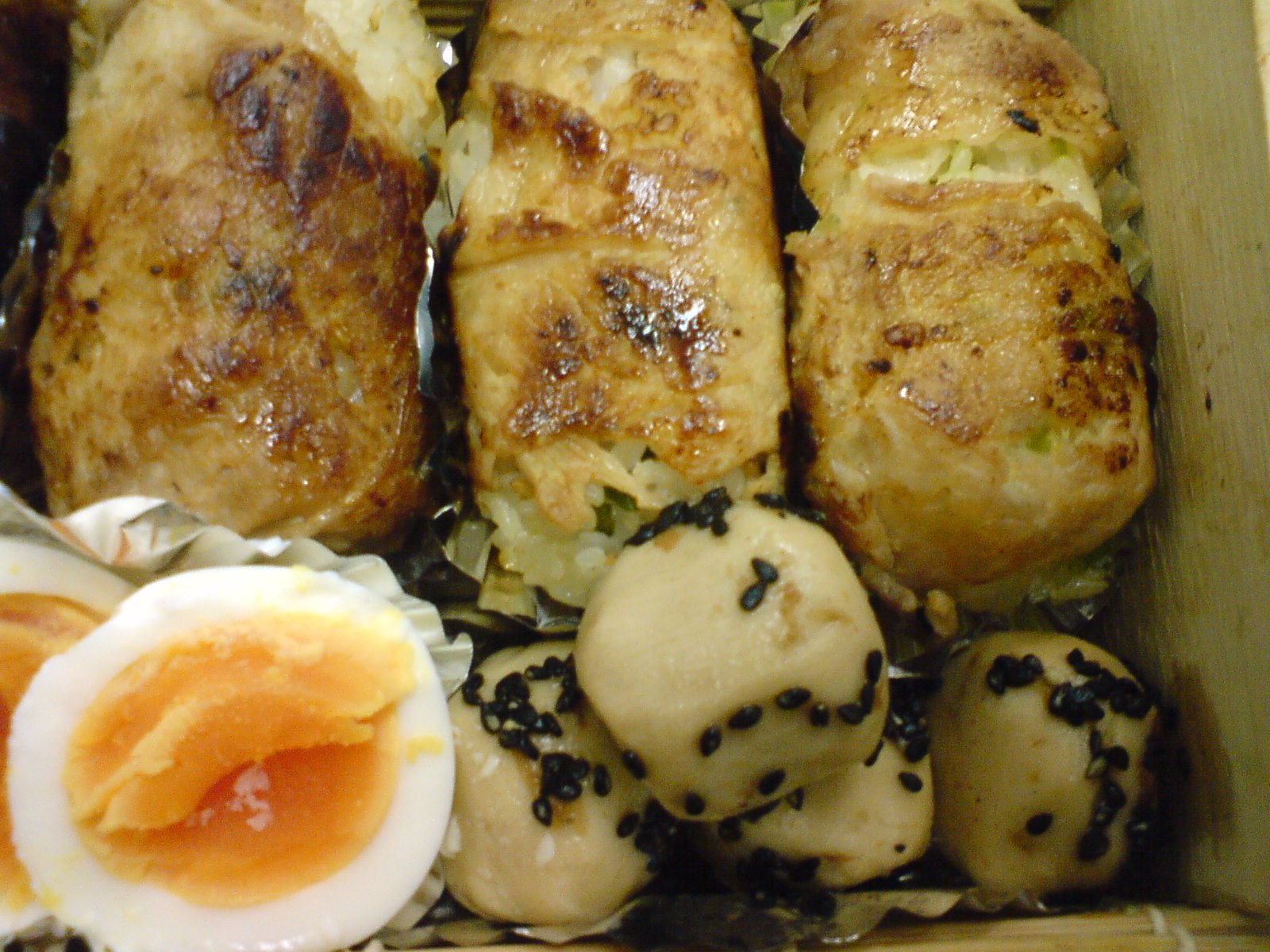
Today’s Lunch Box/Bento (’10/09): Mount Fuji Views Bento

Yesterday I had to go to that disliked city called Tokyo for a Cricket AGM and had to ride the Shikansen Bullet train from Shizuoka City.
It was an incredibly clear windy day. Mount Fuji was magnificent.
Back in the evening I enjoyed the rare sight in Tokyo of a dark Mount Fuji in the distance silhouetted by fiery skies.
I managed to take some pics on the way to Tokyo with my mobile phone camera. Look at the pictures at the end of this posting!

The Missus (who now takes her own pics) pointed out I should take the pic of the bento with the rice in the background, not in the foreground… Who can argue?

So I will start with garnish:
Soft-boiled egg/han-yude-tamago, later marinated in soy sauce, sake and mirin (and probably a little ginger).
Alabcore tuna/tonbo magura (the cheaper kind) first marinated for a little while in soy sauce then fried (with the lid on) topped with cheese and served topped again with some home-made wasabi leaves and flowers pickles (verystrong!).
Lettuce for balance and decoration.

For the slad and vitamins part, mini-tomatoes, home-made pickled carrot salad with black olives and black sesame seeds, na ho hana/rape blossoms salad seasoned with goma dare/sesame dressing.

The rice was steamed together with tinned shijimi/basket clams. These small mollusks are very popular in Asia. Check Wikipedia for more information! She had adde thin strips of fresh ginger to them.
Once the rice was cooked, she mixed the lot before placing it in the bento box and sprinkling it with roasted sesame seeds.

A simple dessert of local straberries and ornage wedges.
Nice bento, I agree!

Mount Fuji Views:

I took the pics with the camera almost aginst the window for clarity. The mobile phone camera has enough speed to obliterate all interference.
This pic was taken before reaching Fuji City, the first stop on the way.
The river in the foreground is the Fujikawa River. Because we are in the middle of winter all grass looks brown.

Another pic taken just before entering Fuji City JR Station.

Mount Fuji again caught just after leaving Fuji JR Station. Sorry for the smudges!

Now that pic was taken as we approached Mishima City which stands at comparatively high altitude surrounded by all kinds of mountains.

Last picture taken just before reaching Mishima JR Station.
After that you have to wait a long time (ifyou are lucky!) to see again over the horizon!

RECOMMENDED RELATED SITES:
Warren Bobrow, Bread + Butter, Zoy Zhang, Hungry Neko, Think Twice, Frank Fariello, Mangantayon, Hapabento, Elinluv Tidbit Corner, Tokyo Terrace, Maison de Christina, Chrys Niles,Lexi, Culinary Musings, Wheeling Gourmet

Please check the new postings at:
sake, shochu and sushi

—————————————-
日本語のブログ
—————————————-

Vegetables Fact & Tips 11: Renkon/Lotus Root (amended and expanded)

lotus-root1

In Japan we are near the end of Lotus Roots season, but eat them all year round!
Lotus roots come from a plant called Nelumbo nucifera, also known by a number of names including Indian lotus, sacred lotus, bean of India, or simply lotus. This plant is an aquatic perennial. Under favorable circumstances its seeds may remain viable for many years.
A common misconception is referring to the lotus as a water-lily (Nymphaea), an entirely different plant.

Native to Greater India and commonly cultivated in water gardens, the lotus is the national flower of India and Vietnam.

The flowers, seeds, young leaves, and “roots” (rhizomes) are all edible. In Asia, the petals are used sometimes for garnish, while the large leaves are used as a wrap for food. In Korea, the leaves and petals are used as a tisane. Yeonkkotcha (연꽃차) is made with dried petals of white lotus and yeonipcha (연잎차) is made with the leaves. The rhizome (called ǒu (藕) in pinyin Chinese, ngau in Cantonese, bhe in Hindi, renkon (レンコン, 蓮根 in Japanese), yeongeun (연근) in Korean is used as a vegetable in soups, deep-fried, stir-fried and braised dishes. Petals, leaves, and rhizome can also all be eaten raw, but there is a risk of parasite transmission (e.g., Fasciolopsis buski): it is therefore recommended that they be cooked before eating.

FACTS:
-Season: September~December in Japan.
-Beneficial elements:
Lotus roots have been found to be rich in dietary fiber, vitamin C, potassium, thiamin, riboflavin, vitamin B1 & B6, phosphorus, copper, iron and manganese, while very low in saturated fat.
Various parts of the lotus are also used in traditional Asian herbal medicine.

TIPS:

-Choose specimens with a clear white cut section. There should not be any black spots.
-Use large specimen as they are easier to cut and use.
-To prevent oxydising, warp cut specimen into wet kitchen paper.
-Add vinegar to water when boling them to keep them white.
-The easiest way to peel them is to use a potato peeler!

COOKING:

The stamens can be dried and made into a fragrant herbal tea called liánhuā cha (蓮花茶) in Chinese, or (particularly in Vietnam) used to impart a scent to tea leaves. The lotus seeds or nuts (called liánzĭ, 蓮子; or xian liánzĭ, 鲜莲子, in Chinese) are quite versatile, and can be eaten raw or dried and popped like popcorn, phool makhana. They can also be boiled until soft and made into a paste, or boiled with dried longans and rock sugar to make a tong sui (sweet soup). Combined with sugar, lotus seed paste becomes one of the most common ingredient used in pastries such as mooncakes, daifuku, and rice flour pudding.

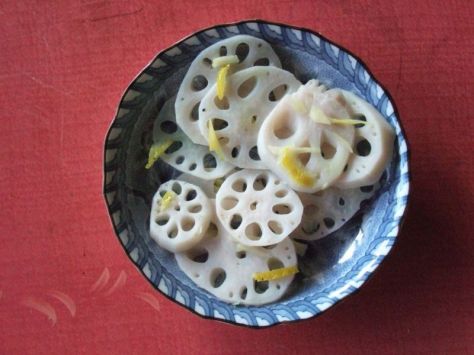
Japanese popular Renkon dishes:

lotus-root-nimono

“NIMONO”

lotus-root-sumono

“SUMONO”

lotus-root-kimpira

“KIMPIRA”

“STUFFED LOTUS ROOTS”

“DEEP-FRIED LOTUS ROOT SANDWICH”

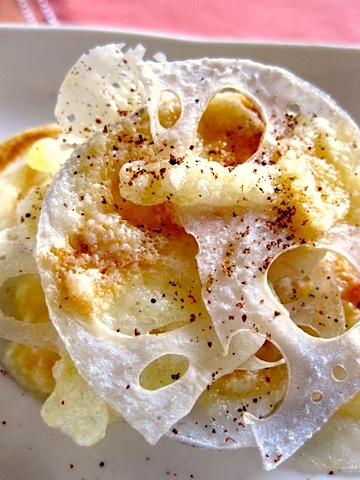
lotus-roots-chips

“CHIPS”

HEALTH FACTS:

-Combined with liver, or beef, or pork, or chicken, helps revitalize human blood and organs.

-Combined with turnips, or daikon, or beansprouts, or trefoil, helps digestion and bowels.

-Combined with leafy vegetables, or potato, or apples, helps combat cancer and obesity.

-Combined with konnyaku, or celery, or lettuce, or green peppers, helps lower blood cholesterol. helps combat artery hardening and prevent heart diseases.

RECOMMENDED RELATED SITES
Not-Just-Recipes, Bengal cuisine, Cooking Vegetarian, Frank Fariello, Gluten-free Vegan Family, Meatless Mama, Warren Bobrow, Wheeling Gourmet, Le Petit Cuisinier, Vegan Epicurean, Miss V’s Vegan Cookbook, Comestiblog, To Cheese or not To Cheese, The Lacquer Spoon, Russell 3, Octopuspie, Bread + Butter, Pegasus Legend, Think Twice, The French Market Maven, Fuji Mama, Great Teacher Sato, Peas Love Carrots

Please check the new postings at:
sake, shochu and sushi

—————————————-
日本語のブログ
—————————————-