Category Archives: Uncategorized

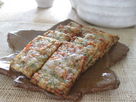
Japanese Cuisine: Sesame Crackers/Goma Senbei

Senbei means rice crackers in Japanese. But they don’t have to be made solely with rice.
How about sesame seeds?
They are not difficult to make and here is another recipe for BG who requested them!

Sesame Crackers/Goma Senbei!

INGREDIENTS: For one “sheet”

Egg: 1
-Sugar: 60 g
-Miso: 1 teaspoon
-Flour: 20 g
-Sesame seeds: 80 g
-Ginger juice: a few drops

RECIPE:

-Drop whole egg and sugar in a bowl.
Preheat oven to 180 degrees Celsius.

-Beat until sugar and sugar are well incorporated. Add miso and ginger juice. Mix thoroughly, but take care not have any bubbles in mixture.

-Sieve flour over mixture and add sesame seeds. Mix well. It seems like a lot of sesame seeds, but don’t worry!

-Humidify your hands. Line the oven plate with kitchen paper. Spread cracker mixture thin so as to cover the whole plate.

-Bake at 180 degrees celsius for 8 minutes.
Might take longer depending on the thickness.

-Once the colour has attained a nice rich brown. Take sheet out.
Cut with a sharp knife into equal pieces.

-They should to a crispy state once they have cooled down.
If they don’t feel crispy enough, bake the cut pieces again at 150 degrees Celsius for a few minutes.

-Serve or keep tighly sealed inside a dry box!

RECOMMENDED RELATED SITES:
Warren Bobrow, Bread + Butter, Zoy Zhang, Hungry Neko, Think Twice, Frank Fariello, Mangantayon, Hapabento, Elinluv Tidbit Corner, Tokyo Terrace, Maison de Christina, Chrys Niles,Lexi, Culinary Musings, Wheeling Gourmet, Comestiblog, Chronicles Of A Curious Cook, Tokyo Through The Drinking Glass, Tokyo Foodcast, Palate To Pen, Yellin Yakimono Gallery, Tokyo Terrace, Hilah Cooking, More than a Mount Full, Arkonite Bento, Happy Little Bento; 5 Star Foodie; Jefferson’s Table; Oyster Culture; Gourmet Fury; Island Vittles; Good Beer & Country Boys; Rubber Slippers In Italy; Color Food daidokoro/Osaka;/a; The Witchy Kitchen; Citron Et Vanille, Lunsj Med Buffet/Estonian Gastronomy (English), Cook, Eat, Play, Repeat, Chrisoscope

Please check the new postings at:
sake, shochu and sushi

For your Dining Room: Tansu/Japanese Chests

Japan is still a very good country to prospect for antiques in spite of its devouring modernity.
When it comes to antique or even more homey tansu/箪笥, one should keep both eyes open as these Japanese-style chests can become extremely useful in any home because of their practical shapes and sturdy material, not to mention their aesthetic qualities.
Even if you are here for a short stay or plan to leave soon, they can easily be filled with your belongings actually helping with the ever tiring chore of removal.

Fine, Sir, but what is a tansu?Sorry, my good friend, I ought to have explained that a bit earlier!
Tansu is the word for chest, chest of drawers or cupboard, all in one word in Japanese. It is often used in the West, notably in the antique business, to refer to traditional Japanese chests, handcrafted and made of fine wood. The latter is important when it comes to pricing. Most popular woods are Hinoki/檜 or Japanese cypress, Keyaki/欅 or Japanese elm, Kuri/栗 or Chestnut,, Sugi/杉 and Kiri/桐 or Paulownia.
After all, it is a very vague term to describe a whole range of chests, but many collectors focus on finding antique Tansu. There are many workshops (especially in Shizuoka or other prefectures with a good supply of wood) in imitation of the classic antiques. Some are made of excellent reclaimed wood causing the new Tansu to retain a more aged look that some people seek. Make sure to ask first if the antique tansu is authentic or an imitation.
But my bet, that is if you have the time, is to look around in farms and in the country where there are not only authentic, but cheap and serviceable. Moreover, people tend to be happy to get rid of them!

Now, before you go prospecting, it always a good idea to acquire a little basic knowledge. One way to conduct a successful bargain!

Main types of Tansu:
-Choba-dansu/著場箪笥/Merchant Tansu. Used by merchants, they display elaborate metal hardware and were used in shops to impress customers. They come in many sizes depending on trade plied by their owners: sewing supplies chests, sea chests, merchant chests, futon chests or kitchen equipment chests. They could either open from a single side or be accessible from both sides.
-Kusuri-dansu/薬箪笥 were and still are apothecary/medicine chest. They were used to store herbs, especially at medicinal herbs/kanpoyaku/漢方薬 traditional pharmacists. They are often made of paulownia wood and have many small drawers. They make for the perfect chest for jewels, spectacles or other small collection object storage, or even display.
-Kaidan-dansu/階段箪笥, or step-chests are another very popular collection item, although their initial purpose was of a totally different nature. They were actually used to avoid taxation on other areas of a home when taxes were levied based on the size of one’s home! When the tax collectors appeared on the horizon, home-dwellers quickly moved those chests under the stairs away from their eyes! When small, they make for great display chests at homes and shops. When big, their aesthetical and practical qualities can be combined to save space.
-Katana-dansu/刀箪笥. These were used to store swords.They are long and low and often made of palownia to keep sword from rusting.
-Mizuya-dansu/水や箪笥 or Daidokoro-dana/台所棚 used in kitchens for the storage of plates, utensils and food items. They usually include many sliding doors and drawers of full plain wood, or adjourned wood, the latter coming with mesh or bars.

-Sendai-dansu/仙台箪笥. These are used to store kimomo and clothing. Originally made from the Sendai region, they are often made of zelkova wood with drawers lined in cedar. They usually come as one long top drawer with three slightly smaller drawers underneath. Some are true antiques as they were commissioned from former sword makers after the Samurai were disbanded in the Meiji era.
-Cha-dansu/茶箪笥. They were used to store tea ceremony implements. This is one type of antique chest that can still be found in homes or in the country!
-Funa-dansu/船箪笥. They were ship chests, used a scontainers from the Edo period to the Meiji Era. They came in three basic designs:
Kakesuzuri/かけすずり, a small chest with a single swinging door and multiple internal drawers inside.
Hangai/半外, a small chest for clothing storage.
Cho-Bako/庁箱, or account box.. This last comes in many more types, a pleasure for collectors!

Many regions of Japan made tansu. Check where the former castle towns on the posts roads stood and you will have a good chance to make a discovery. Look for the ironware and quizz their owners! Wood and lacqyuer types are also clue to the origin of some pieces.
The elements of antique tansu hardware were created from forged iron, and sometimes with copper. Search for design elements engraved or inlaid. Incidentally, black finish on the iron was created by applying rapeseed oil to the hot metal.

Recommended Books:
Traditional Japanese Furniture by Kazuko Koizumi
Japanese Cabinetry/The Art & Craft Of Tansu by David Jackson & Dane Owen

Recommended website:
Jtansu at: http://www.jtansu.com/Japanese-Tansu-s/1.htm
David Jackson: Tansu Restoration & Conservation at: http://www.tansuconservation.com/

RECOMMENDED RELATED SITES:
Warren Bobrow, Bread + Butter, Zoy Zhang, Hungry Neko, Think Twice, Frank Fariello, Mangantayon, Hapabento, Elinluv Tidbit Corner, Tokyo Terrace, Maison de Christina, Chrys Niles,Lexi, Culinary Musings, Wheeling Gourmet, Comestiblog, Chronicles Of A Curious Cook, Tokyo Through The Drinking Glass, Tokyo Foodcast, Palate To Pen, Yellin Yakimono Gallery, Tokyo Terrace, Hilah Cooking, More than a Mount Full, Arkonite Bento, Happy Little Bento; 5 Star Foodie; Jefferson’s Table; Oyster Culture; Gourmet Fury; Island Vittles; Good Beer & Country Boys; Rubber Slippers In Italy; Color Food daidokoro/Osaka;/a; The Witchy Kitchen; Citron Et Vanille, Lunsj Med Buffet/Estonian Gastronomy (English), Cook, Eat, Play, Repeat, Chrisoscope

Please check the new postings at:
sake, shochu and sushi

Today’s Lunch Box/Bento (’10/57): Shake Maze Sushi Bento

Tuesday: Sushi Bento Day!
Did I say it was flaming hot outside?
I am certainly going to enjoy my day in my air-conditioned office!
“Shake or Sake/鮭”, although BG will come with another snide remark, means “Salmon”. Both words might turn a bit confusing for some when you write them! LOL

Salmon can easily be bought all year round at supermarkets as “Shiozake/Salted Salmon/塩鮭” and frozen when you have any left.
The Missus is always keen on using some, although I always ask her to discard the skin and fat after sauteing it.
She steamed some rice with a big piece of konbu/seaweed before seasoning it into sushi rice. She mixed it with sauteed salmon flakes, thinly cut pickled myoga ginger and cucumber and sesame seeds (these were not cut, BG!).

She lined the bento box with fresh lettuce before filling it with the sushi rice. She topped it plenty of thinly sliced fresh shiso/perilla leaves, home-pickled sansho/Japanese pepper and a piece of lemon for extra seasoning.

The Missus came up with a Salvador Dali (or is it a Picasso?) like side dish!

She came up with the interesting idea of including a half avocado pear inside its skin as a kind of vessel with its filling, the whole to be eaten with a spoon (I’ve got one at the office!). The semi-hard egg had been boiled in onsen tamago style with its yolk still running. The egg had furthermore been marinated in soy sauce and amazu/sweet vinegar, thus providing the seasoning to the avocado (you “crush” the egg into the avocado with your spoon when eating it!). Some more lettuce for the fiber and Vitamin C, and walnut for dessert.

The salad part was completed with raw sweet pimento sticks and home-pickled cucumber. Cream cheese dressing was provided as a dip sauce for the pimentoes.

I should have called that bento, Mexican Bento!

RELATED ECOMMENDED SITES

Adventures in Bento Making, American Bento, Beanbento, Bento No1, Bento Wo Tsukurimashou, Cooking Cute, Eula, Hapabento , Happy Bento, Jacki’s Bento Blog, Kitchen Cow, Leggo My Obento, Le Petit Journal Bento & CO (French), Lunch In A Box, My Bento Box, Vegan Lunch Box; Tokyo Tom Baker, Daily Food Porn/Osaka, Only Nature Food Porn, Happy Little Bento, The Herbed Kitchen, J-Mama’s Kitchen, Cook, Eat, Play, Repeat; Bento Lunch Blog (German); Adventures In Bento; Anna The Red’s Bento Factory; Cooking Cute; Timeless Gourmet; Bento Bug; Ideal Meal; Bentosaurus;

Please check the new postings at:
sake, shochu and sushi

—————————————-
日本語のブログ
—————————————-

Shizuoka Agricultural Products: The Nemotos’ Garden

Royichi/良一 and Sumiko/スミ子 Nemoto/根本

It was another one of those blistering days this year’s summer seems intent on inflicting on all of us, citizens or farmers alike.
I already had lost a sizeable amount of liquid when I reached Miwa Agriroad, my regular Wednesday starting point for investigating the local farmers and their products.

Yuyama/湯山 was still a long way away, but my good friend Natsuko Koyanagi/小柳奈津子 and I only had to wait a little while before her husband obligingly delivered his car to us. For all of the locally made chilled lemon and honey drink I had guzzled down, I was really thankful to make the second part of my trip in an air-conditioned car than on my dear bicycle!

The Nemotos are the second generation of that particular farming family.
Their main crops are rice and tea, but that still leaves them with enough time to look after a vast “garden” for extra cash.
Natsuko had called Sumiko Nemoto beforehand , and the dear lady was waiting for us!

Taking pictures and talking to the farmers were a pretty straightforward affair as everything was set as straight as you could hope for. The weather having been dry for a good couple of weeks, no need for boots either. While I was taking the pictures of the egg-plants/aubergines/nasu/茄子 above, the ladies were chatting away, but were always ready to answer questions. They wouldn’t let that city man repeat the same mistakes! LOL

The leeks/negi/葱 did look thirsty!

The hedge of cucumbers/kyuri/胡瓜 had been cleverly placed so as to block a good part of a single side of the garden from the sun and the elements.

These are okra/オクラ, and I’ve learned to appreciate them of late. The Missus chooses them as big as possible before lightly steaming them and then marinate them in the fridge. Make for great appetizers in summer! Have you ever seen their flowers? Beautiful!

Taro/Sato Imo/里芋. The Nemotos actually grow two varieties. I couldn’t see the tubers, but the stems were of two definitely different colours.

While the ladies were busy chattering and I taking pictures, Mr. Nemoto stolidly kept watering the garden. And it certainly needed plenty! He was using a motor pump for it as water is abundant underground.

Aster/アスター

It is not all vegetables in the Nemoto’s garden. Actually many farmers in this vicinity grow flowers, and I can tell you these disappear quickly form the market every morning.
The Nemotos have a special love for Asters, and I agree that they make beautiful flowers!
They also grow Chrysnathemums and daliahs!

Mr. Nemoto kept slowly walking back his hose in hand all the time…

Here’s the grand old chap at last!
I wonder if I might dress like them in summer.
We citizens seem badly protected, whereas Sumiko San in particular seemed to wear half a dozen layers without a sweat!

Bitter melons/Goya/ゴーヤー are not grown in the “warmer” areas of Japan anymore. They are very common in Shizuoka Prefecture where all vegetables and fruit seem to grow. They even grow bananas in nearby Shimizu!

Tomatillo, a Japanese variety.
Except for some specialized farms, these are used more for decoration than food. Very popular with flower arrangement/ikebana/活花 artists!

These are Devil’s Tongue Tubers/Konnyaku/コニャク. The Japanese love these “tubers” to make a kind of jelly. Very popular with vegetarians and people on a diet!

Talking to the farmers has definitely become a pleasure. There are always little stories to listen to and so much to learn!
And like many farmers all over the world, they are generous and proud of their work.
I shouldn’t tell you maybe, but I always end up with a batch of vegetables!
“Did you bring your ecobag?”, Natsuko asked me again with a laugh.
I wouldn’t have forgotten it, although this sounds like using these nice people.
To cut a story short, I ended up with enormous egg plants, small and juicy goya, okra straight as arrows, but then I had to stop them!

Nemotos’ Garden
Shizuoka City, Aoi Ku, Yuyama, 1898
Tel.: 054-2941325

RECOMMENDED RELATED SITES:
Warren Bobrow, Bread + Butter, Zoy Zhang, Hungry Neko, Think Twice, Frank Fariello, Mangantayon, Hapabento, Elinluv Tidbit Corner, Tokyo Terrace, Maison de Christina, Chrys Niles,Lexi, Culinary Musings, Wheeling Gourmet, Comestiblog, Chronicles Of A Curious Cook, Tokyo Through The Drinking Glass, Tokyo Foodcast, Palate To Pen, Yellin Yakimono Gallery, Tokyo Terrace, Hilah Cooking, More than a Mount Full, Arkonite Bento, Happy Little Bento; 5 Star Foodie; Jefferson’s Table; Oyster Culture; Gourmet Fury; Island Vittles; Good Beer & Country Boys; Rubber Slippers In Italy; Color Food daidokoro/Osaka;/a; The Witchy Kitchen; Citron Et Vanille, Lunsj Med Buffet/Estonian Gastronomy (English), Cook, Eat, Play, Repeat, Chrisoscope

Please check the new postings at:
sake, shochu and sushi

Today’s Lunch Box/Bento (’10/56): Pork & Beans Curry Bento

We are in for a long and dreary summer, what with the infernal heat or torrential rains. Take your pick.
I’ve been repeating this for a few weeks now, but I suppose I’m only emulating the Missus who is having a hard time in her hot kitchen!
Accordingly, although meals still have to stay balanced and contain enough greens for the vital vitamin, they must also pack for more energy as we tend to drink more and eat less.

The Missus foraged in the refrigerator and came up with a curry of her own (she can’t live without pasta or curry, incdentally!). I do not really want to go into details as I was busy while she was cooking.
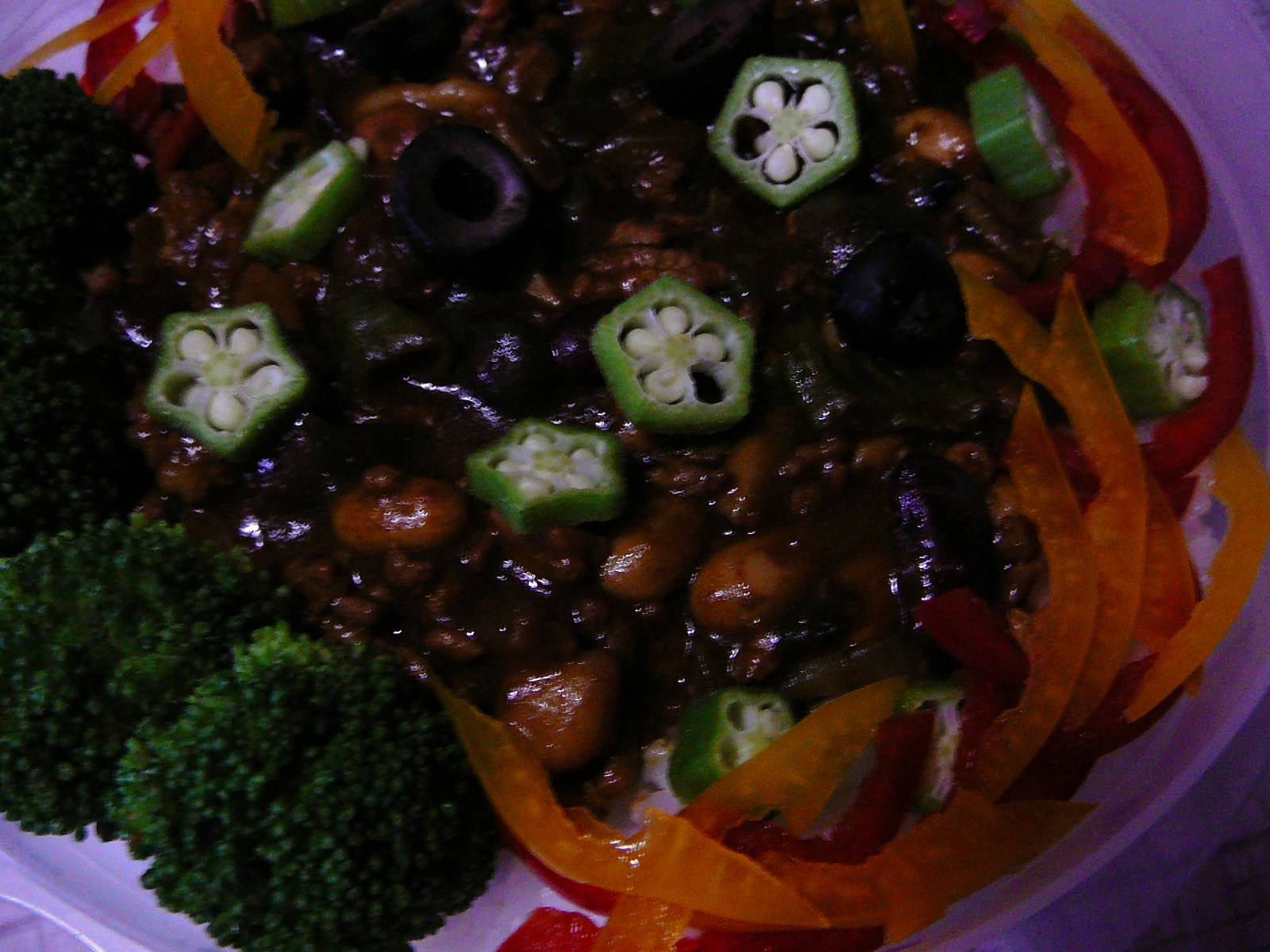
This is one her favourites: beans of all kinds stewed with minced pork and mushrooms, the whole in a curry sauce of her own.

She used these dear old tupperware box and filled it with plain steamed rice, making a dip/valley in the middle to include more curry.
The Vitamins and fibers came boiled brocoli and sliced raw okra (very much in season. Have you ever seen their flowers?), red and yellow pimentoes ad a few sliced black olives.
Plenty, I can assure you!

Fresh peaches for dessert.

I should be able to hold until tonight!

Adventures in Bento Making, American Bento, Beanbento, Bento No1, Bento Wo Tsukurimashou, Cooking Cute, Eula, Hapabento , Happy Bento, Jacki’s Bento Blog, Kitchen Cow, Leggo My Obento, Le Petit Journal Bento & CO (French), Lunch In A Box, My Bento Box, Vegan Lunch Box; Tokyo Tom Baker, Daily Food Porn/Osaka, Only Nature Food Porn, Happy Little Bento, The Herbed Kitchen, J-Mama’s Kitchen, Cook, Eat, Play, Repeat; Bento Lunch Blog (German); Adventures In Bento; Anna The Red’s Bento Factory; Cooking Cute; Timeless Gourmet; Bento Bug; Ideal Meal; Bentosaurus;

Please check the new postings at:
sake, shochu and sushi

—————————————-
日本語のブログ
—————————————-

Japanese Cuisine: Surimi Rice Crackers/Surimi Senbei

Senbei means rice crackers in Japanese.
They have been made in this country since immemorial times.
One can still eat them freshly grilled (in front of you) at specialised stores.
They are not difficult to make and here is a recipe for BG who requested them!

Surimi Rice Crackers/Kani Senbei!

INGREDIENTS:

-Rice powder: 60 g
-Surimi: 6 (or the equivalent in kamaboko)
-Salad oil: 2 tablespoons
-Milk: 2 tablespoons
-Aoi Kaiso/Dry seaweed: 1 tablespoon

RECIPE:

-Cut the surimi in half and shred it finely.
Preheat oven to 200 degrees Celsius.

-In a bowl mix the rice powder, oil and milk thoroughly. Add the shredded surimi and dry seaweed. Mix well.

-Wrap the mixture into cellophane paper.
Spread into a square 3 mm thick.
Unwrap and lay onto cooking paper.

-Cut into rectangles of your preferred size.
Put them together with the cooking paper inside the oven.

-Cook for 18~20 minutes at 200 degrees Celsius.

-Let cool down on a grid.

-Serve!

RECOMMENDED RELATED SITES:
Warren Bobrow, Bread + Butter, Zoy Zhang, Hungry Neko, Think Twice, Frank Fariello, Mangantayon, Hapabento, Elinluv Tidbit Corner, Tokyo Terrace, Maison de Christina, Chrys Niles,Lexi, Culinary Musings, Wheeling Gourmet, Comestiblog, Chronicles Of A Curious Cook, Tokyo Through The Drinking Glass, Tokyo Foodcast, Palate To Pen, Yellin Yakimono Gallery, Tokyo Terrace, Hilah Cooking, More than a Mount Full, Arkonite Bento, Happy Little Bento; 5 Star Foodie; Jefferson’s Table; Oyster Culture; Gourmet Fury; Island Vittles; Good Beer & Country Boys; Rubber Slippers In Italy; Color Food daidokoro/Osaka;/a; The Witchy Kitchen; Citron Et Vanille, Lunsj Med Buffet/Estonian Gastronomy (English), Cook, Eat, Play, Repeat, Chrisoscope

Please check the new postings at:
sake, shochu and sushi

French Cuisine: Shizuoka Organic Tomato Appetizer at Pissenlit

Service: excellent and very friendly
Facilities: great washroom, great cleanliness overall
Prices: reasonable, good value.
Strong points: Interesting wine list. Great use of local products.
no-smoking-logo!

As mentioned before, Shizuoka Prefecture is famous all over the country for its tomatoes, especially organic and sweet.
These turn easily into real fruit (as they should be), and I just don’t count how many I eat back home just to refresh myself!

Mr. Tooru Arima had finally announced on his menu board outside his restaurant that he received those great sweet tomatoes gron by Mr. Ishitani In Hamamatsu City!

It was very easy to convince the Missus to sample them!

The dish we were served could be classified under many appellations as it could be considered as an apetizer, a salad or even a dえssert.

Mr. Arima placed quarters of tomatoes around the centre surmounted with mozarella slices and organic greens and basil pesto.
The vinigrette was more a kind of gaspacho made of fine olive oil, juice/coulis for the tomatoes and other seasoning!

The whole concept became very interesting with (same) tomato jelly in the very centre, soft and light, with a topping of (same) omato sherbet!

The perfect appetizer for thirsty customers in scorching summer!

PISSENLIT
420-0839 Shizuoka City, Aoi Ku, Takajo, 2-3-4
Tel.: 054-270-8768
Fax: 054-627-3868
Business hours: 11:30~14:30; 17:00~22:00
Closed on Tuesdays and Sunday evening
Homepage (Japanese)
Credit Cards OK

RECOMMENDED RELATED SITES:
Warren Bobrow, Bread + Butter, Zoy Zhang, Hungry Neko, Think Twice, Frank Fariello, Mangantayon, Hapabento, Elinluv Tidbit Corner, Tokyo Terrace, Maison de Christina, Chrys Niles,Lexi, Culinary Musings, Wheeling Gourmet, Comestiblog, Chronicles Of A Curious Cook, Tokyo Through The Drinking Glass, Tokyo Foodcast, Palate To Pen, Yellin Yakimono Gallery, Tokyo Terrace, Hilah Cooking, More than a Mount Full, Arkonite Bento, Happy Little Bento; 5 Star Foodie; Jefferson’s Table; Oyster Culture; Gourmet Fury; Island Vittles; Good Beer & Country Boys; Rubber Slippers In Italy; Color Food daidokoro/Osaka;/a; The Witchy Kitchen; Citron Et Vanille, Lunsj Med Buffet/Estonian Gastronomy (English), Cook, Eat, Play, Repeat, Chrisoscope

Please check the new postings at:
sake, shochu and sushi

Shizuoka Sake Rice: “Azekura Ishin” by Sugii Brewery

“Sakamai/酒米”, or sake rice in Japanese is a variety of riice only exclusively in the making of Japanese sake. You will never find it on your table at a meal.
Sakamai has been traditionally grown only in some regions of Japan.
Shizuoka, for all being arguably the best when coming to Japanese sake, had to “import” its sakamai from other regions.
The problem is that such rice production is not only declining but also unpredictable when it comes to quality.
For example, if the grains of rice are split or broken one cannot make good-quality Japanese sake. The quality of rice will be assessed only upon receipt with the consequent problems if unsatisfactory.
Accordingly, Shizuoka Breweries have gradually come to encourage and rely on Shizuoka-grown sakamai with various success, especially their own brand of Yamanishiki rice or a local hybrid called Homare Fuji.

Sugii Brewery in Fujieda City who has always been willing to experiment, especially in old-style (forgotten) methods, came up with an original (limited) brand.
This sake is made with sakamai exclusively grown by Fujieda farmers.
But since the various batches of rice came in grains of different size, Mr Sugii could not really define his sake. It would qualify as a junmai if the grains were of similar size.
The process, dating back to the Meiji Area is the equivalent of “Yamahai” method, a way avoided by many breweries for its difficulty.

Sugii Brewery: Azekura Ishin

Rice milled down to 70%
Alcohol: 15.5 degrees
Dryness: +2
Acidity: 2.1 (high for Shizuoka!)
All rice being harvested in Fujieda in 2009

Clarity: Very clear
Colour: Golden hue
Aroma: Fruity backed by alcohol. Nuts.Custard, Memories of banana and vanilla
Body: Fluid
Taste: Strongish attack, warming back of the palate. Lingers for a short while with a welcome acidity.
Complex: Custard and macadamia nuts. memories of coffee beans/dry grapes/dry cherries.
Stay lighter than expected on its own or with food.

Overal: Very difficult to define. hence a very intriguing and inteesting sake. Completely “out of range” as a Shizuoka sake.
Deserves a second, third and more glasses. Strong ut pleasurable sake. Probably best appreciated as “nurukan/lukewarm”, although it would become drier.
Great with any food, although can be truly appreciated on its own.
definitely a sake deserving plenty of interest!

RECOMMENDED RELATED SITES:
Warren Bobrow, Bread + Butter, Zoy Zhang, Hungry Neko, Think Twice, Frank Fariello, Mangantayon, Hapabento, Elinluv Tidbit Corner, Tokyo Terrace, Maison de Christina, Chrys Niles,Lexi, Culinary Musings, Wheeling Gourmet, Comestiblog, Chronicles Of A Curious Cook, Tokyo Through The Drinking Glass, Tokyo Foodcast, Palate To Pen, Yellin Yakimono Gallery, Tokyo Terrace, Hilah Cooking, More than a Mount Full, Arkonite Bento, Happy Little Bento; 5 Star Foodie; Jefferson’s Table; Oyster Culture; Gourmet Fury; Island Vittles; Good Beer & Country Boys; Rubber Slippers In Italy; Color Food daidokoro/Osaka;/a; The Witchy Kitchen; Citron Et Vanille, Lunsj Med Buffet/Estonian Gastronomy (English), Cook, Eat, Play, Repeat, Chrisoscope

Please check the new postings at:
sake, shochu and sushi

Egg Farm in Shizuoka City: Bi-Ou-Ran (Part 2)

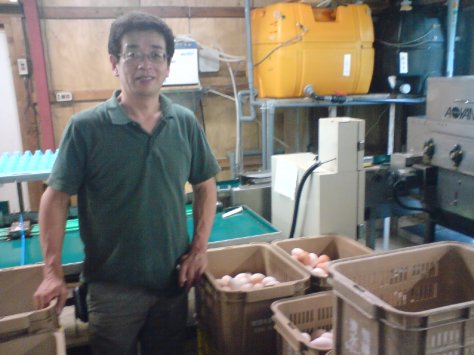
Mr. Shigeru Shimizu/清水茂

As explained in my previous article I was back on the bicycle trail on Saturday with the difference was that I reached the place in record time in spite of the oppressive heat!
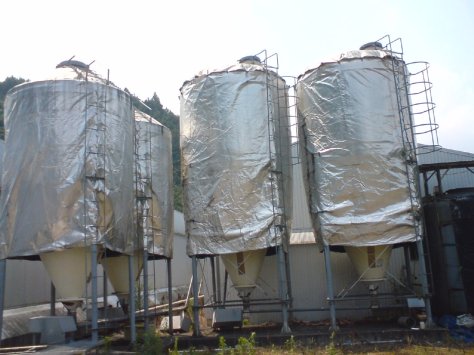
I wonder how many tonnes of feed are contained in these silos and accordingly, how many birds are inside the coops!
After all, the whole place covers no less than 1,500 tsubos (4,300 quare meters), big for a single producer in Japan!
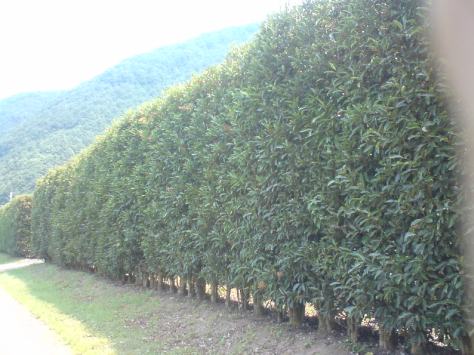
The whole complex is surrounded by a tall hedge to protect it from the wind and help control the ambiant temperature.
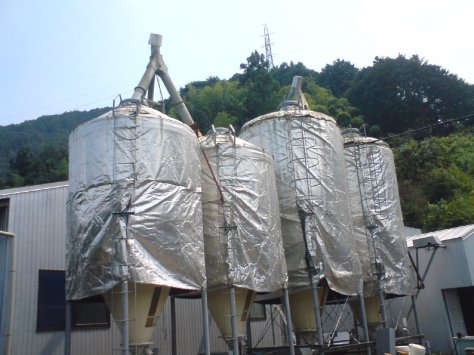
Incidentally, I noticed that the silos were also protected against the variations of temperature.
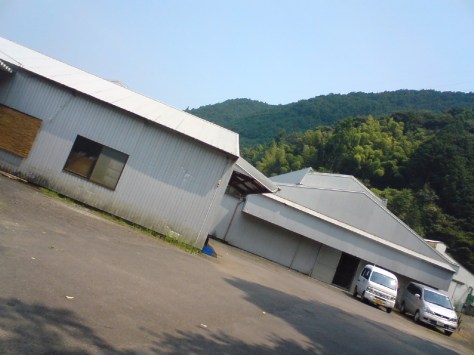
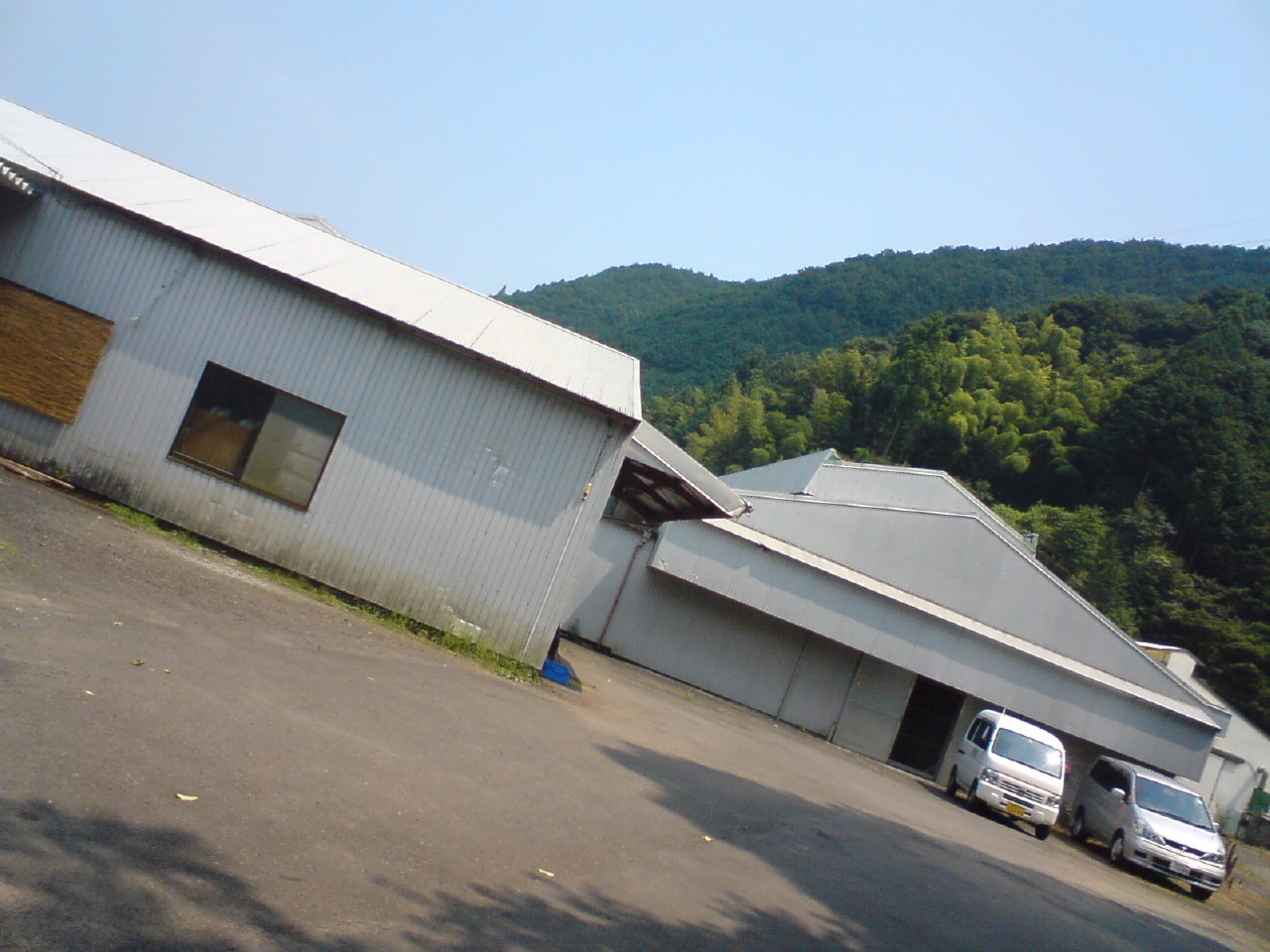
I finally found the real entrance to the compound which opens at the very back, away from unknown eyes!
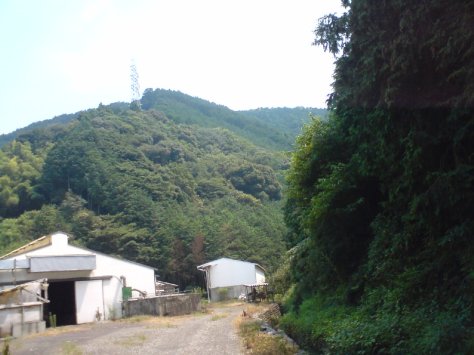
I quickly met Mr. Shimizu who asked me to wait for a while as he was busy with a small emergency. He offered me to stay inside in the cool, but I declined as snooping around is a bad habit of mine!LOL
It is located very much in the middle of the nature with a beautiful mountain background.
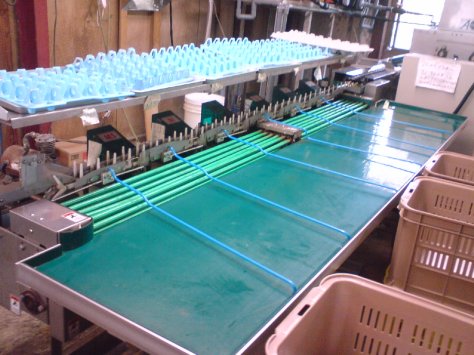
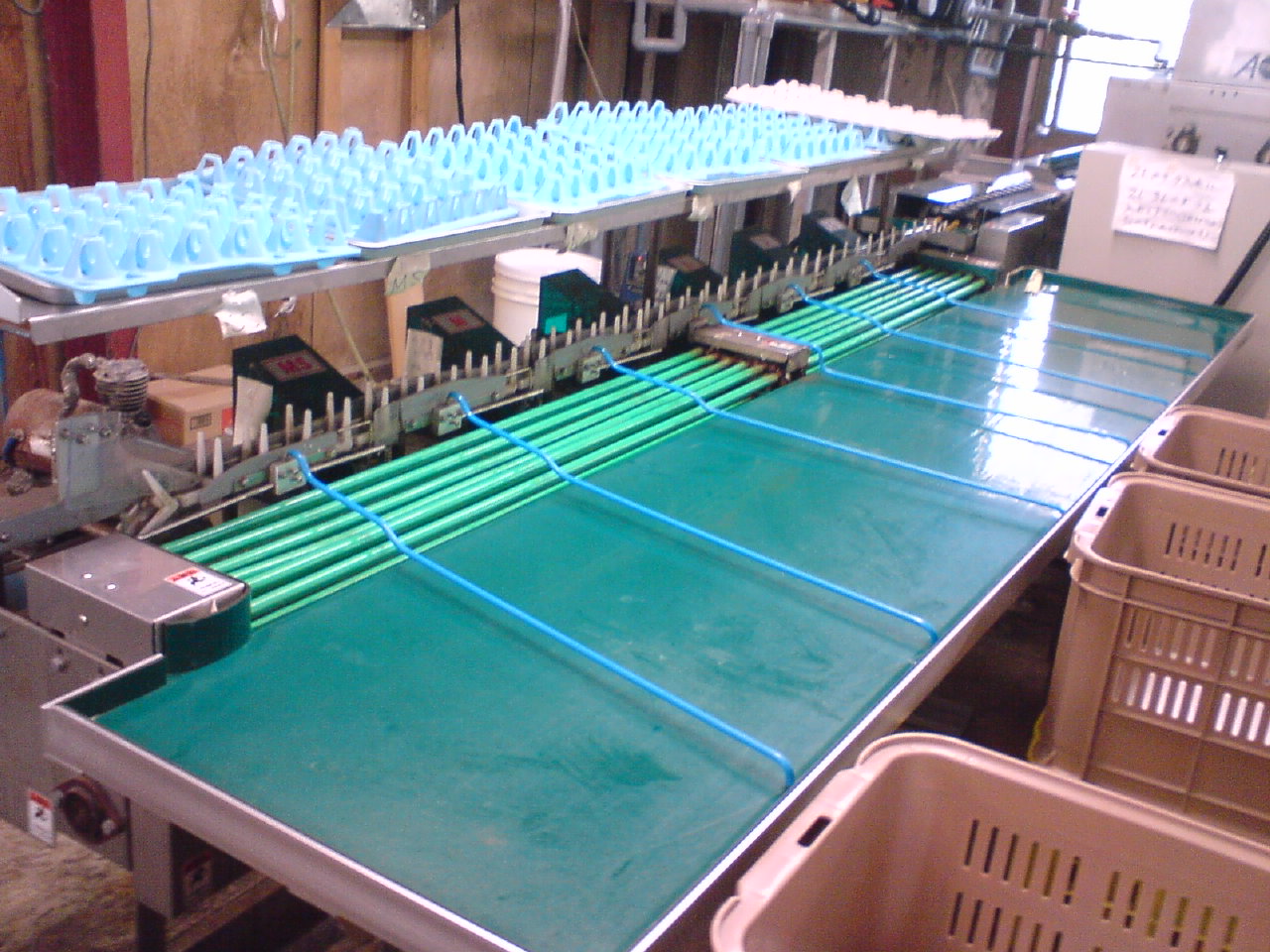
Hand egg-calibrating machine.

I was finally admitted inside, and knowing we were limited in time, I started firing questions.

-When was the egg farm founded?
-1996

-How long have you been actually working in the business?
-Let’s see. I’m 57. I started at 25. 32 years!

-When were you awarded a brand name for your eggs?
-In 1996 (that was quick!).

-How many hens (no cockerel needed whatsoever. I didn’t know!)?
-14,000 (geez!).
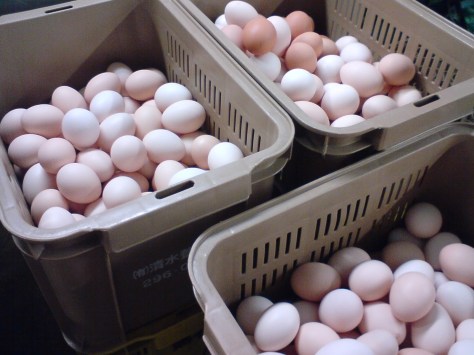
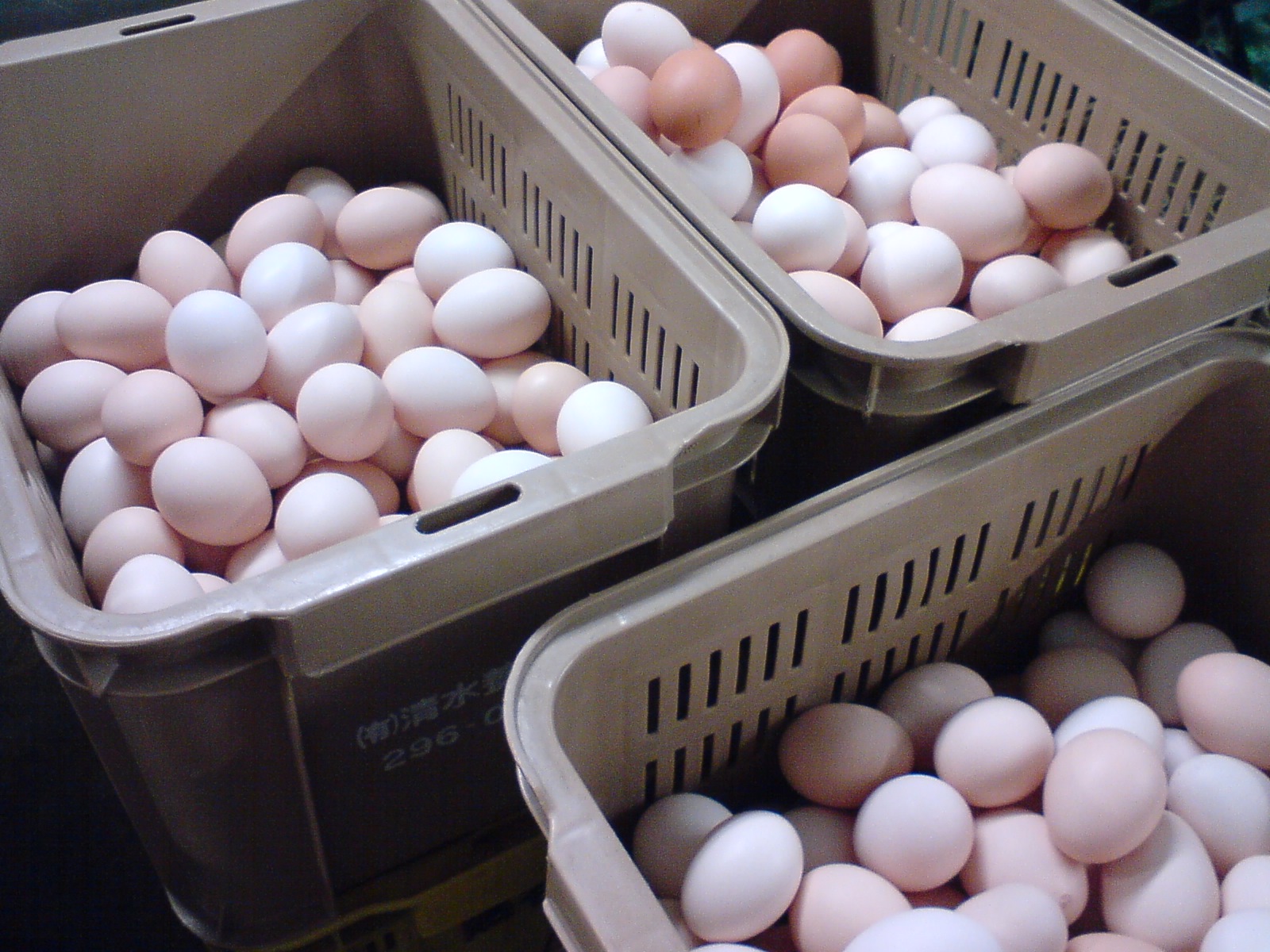
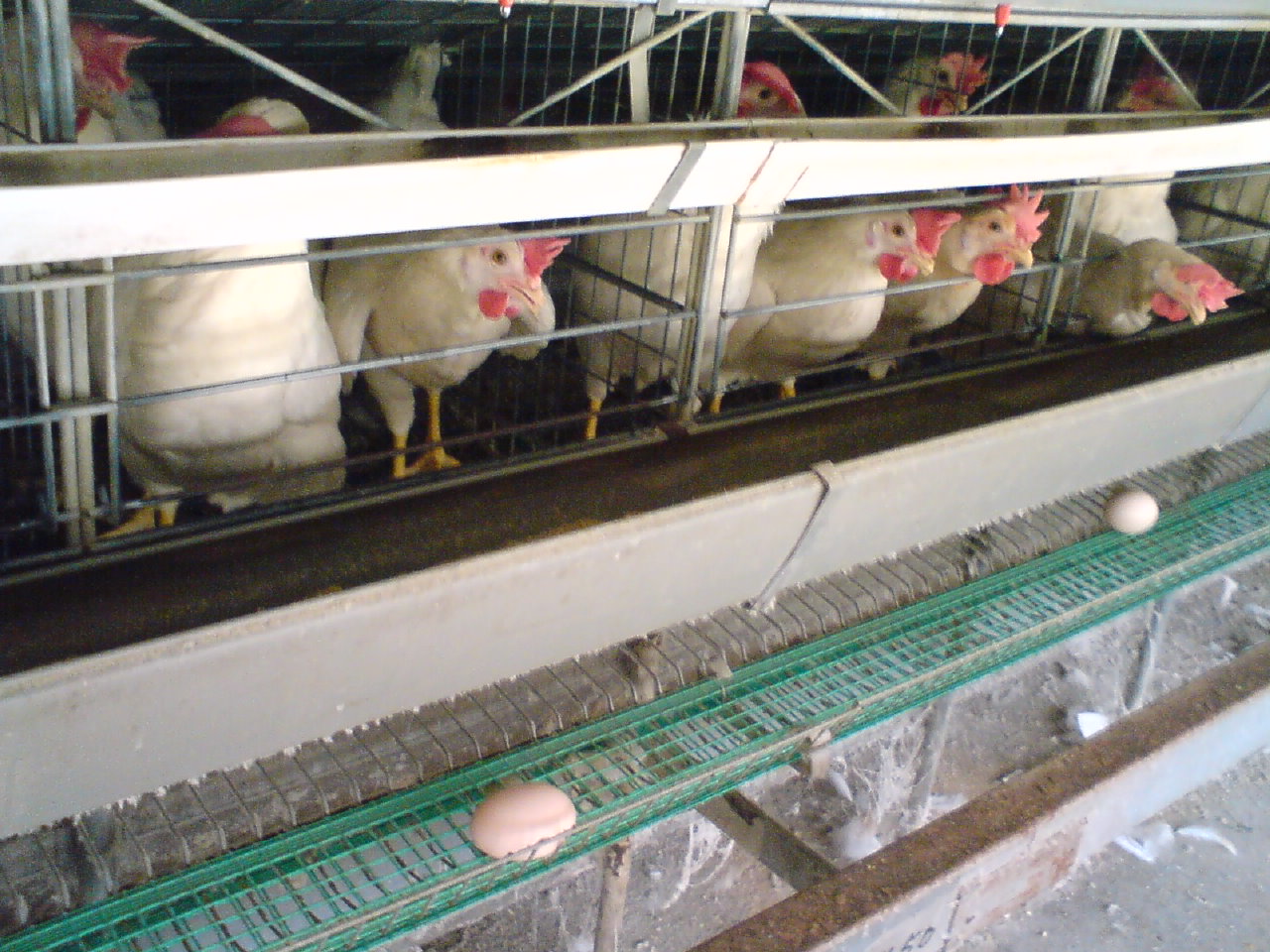
I had trouble keeping my hands off these beauties.

-Then how many eggs do you produce a day?
-About 1,200, but that’s little compared to industrial farms. We strive for quality, not quantity (even so, that’ s a lot to me!). We expect each to produce between 280 and 300 eggs.

-You need quite some staff, then?
-We are 10 in all. That’s enough, although we do have to work in shifts (that was said with a knowing smile, meaning Mr. Shimizu was working all day!).
-How long lasts a working day, then?
-7:00 to 7:00, 12 hours. The hens have to sleep. No forced laying here! (good to know!)

-How do you grade your eggs?
-By size first, into 7 different sizes. The largest are reserved for cake-shops and restaurants. The shell quality has to be the same, and the only way to check it is by touch, sight and experience.

-How many kinds of hens do you breed?
-Two only, Sakura and Momiji. It is enough since we strive for only one kind of yolk, whatever the color of the shell.
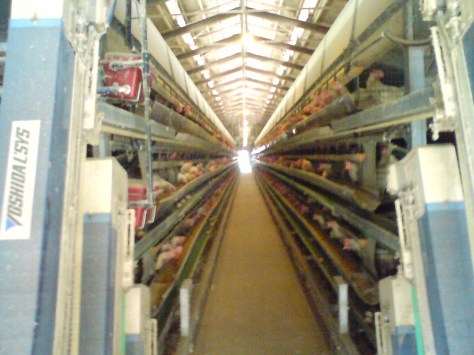
-That is a lot of hens, still. How long is their life span?
-As far as the egg-laying season is concerned, only one year. Which means an almost constant turn over. Even so, the hens have to be regulary vaccinated after we get the chicks from a designated hatchery. There are many keys to producing a good product (I didn’t have to ask the questions, as Mr. Shimizu warmed up to the subject. I had told him I was born in the country, and that the questions would not be too general, although I would be careful not to delve in trade secrets!):
The hens must naturally stay healthy. We personally check them everyday. This is not an industrial farm where productivity is placed above the animals’ comfort. They are actually penned in smaller numbers than usual.
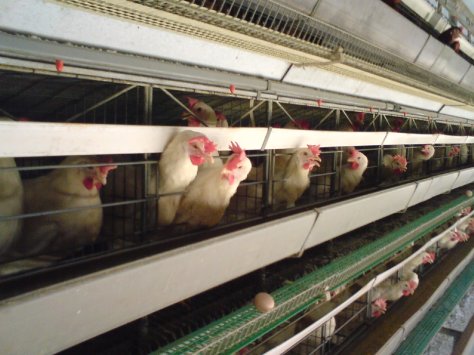
Interestingly enough, the hens were not nervous at all. Their crests looked so healthy!

-How do you dispose of the droppings?
-Mixed with other ingredients, they will become fertilizer we sell to local farmers.
-Almost organic, then?
-Yes, almost.
-What about the hens which die on the way?
-We ask a specialized disposal company to take care of them.
-What do you do with the hens after the year has elapsed?
-We sell them to a specialized butcher.
-For how much?
-5 yen per head.
-That’s not much, isn’t it?
-You are telling me!
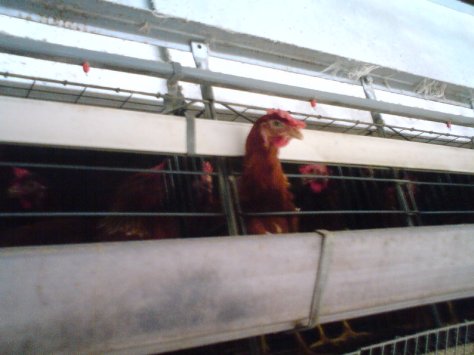
-What kind of feed do you nourish them with?
-A recipe of our own only.
Mr. Shimizu handed me then a pamphlet with all the ingredients clearly stated. I counted no less than 22, 12 of them not found in industrial egg farms. Enumerating them would be fastidious but I have kept the pamphlet for your questions. It is certainly impressive! At least I can affirm that the corn used is not GM and that some ingredients include garlic and paprika!
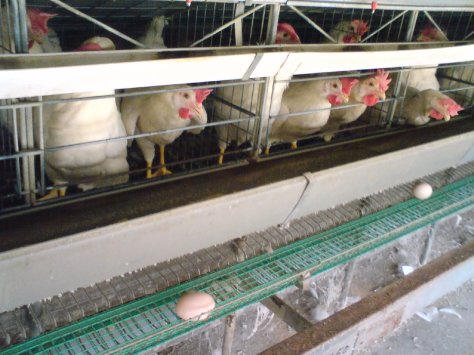
The egss! I came too late. They had already been collected!
One thing is for sure: a soft shell wouldn’t take that shock. No wonder Mr. Shimizu’s eggs are so popular!
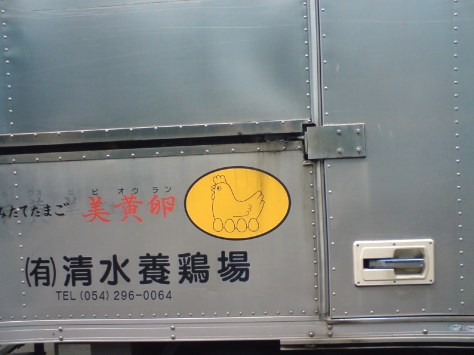
The eggs are transported in a cute van!

Mr. Shimizu delivers his eggs to no less than 21 main distributing shops and to no less than 40 restaurants and cake shops. I counted them, but I’m pretty sure they do not include special customers!
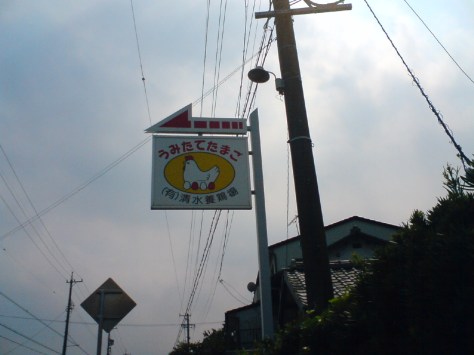
The sign to the original shop!

Please remind me I have to buy some for the Missus’ tamagoyaki!

Bi-Ou-Ran
Shimizu Chicken Farm
421-2112, Shizuoka City, Aoi Ku, Endo Shinden, 41-3
Tel.: 054-296-0064

RECOMMENDED RELATED SITES:
Warren Bobrow, Bread + Butter, Zoy Zhang, Hungry Neko, Think Twice, Frank Fariello, Mangantayon, Hapabento, Elinluv Tidbit Corner, Tokyo Terrace, Maison de Christina, Chrys Niles,Lexi, Culinary Musings, Wheeling Gourmet, Comestiblog, Chronicles Of A Curious Cook, Tokyo Through The Drinking Glass, Tokyo Foodcast, Palate To Pen, Yellin Yakimono Gallery, Tokyo Terrace, Hilah Cooking, More than a Mount Full, Arkonite Bento, Happy Little Bento; 5 Star Foodie; Jefferson’s Table; Oyster Culture; Gourmet Fury; Island Vittles; Good Beer & Country Boys; Rubber Slippers In Italy; Color Food daidokoro/Osaka;/a; The Witchy Kitchen; Citron Et Vanille, Lunsj Med Buffet/Estonian Gastronomy (English), Cook, Eat, Play, Repeat, Chrisoscope

Please check the new postings at:
sake, shochu and sushi

Shizuoka Agricultural Products: The Yamaguchis’ Benihoppe Strawberry Fields (end of July)

“Benihoppe” or “Red Cheeks” strawberries is a cultivar which was successfully developped no later than in 2002 in Shizuoka Prefecture. It has since been voted as the best-balanced strawberry in Japan, and Izu Peninsula being near Tokyo, we do not see too many of our fruit on our own market stands!

Now, by sheer coincidence a university student of mine, Haruka Yamaguchi/山口春香, just happened to come from a family, based in Nirayama located in the newly named Izu No Kuni City/伊豆の国市, who have switched to the growing of Benihoppe Strawberries as soon as their cultivar was made available through their cooperative!

To make things even easier, Mr. Izuzawa/伊豆沢秀慶, belonging to the government-sponsored local JA (Japan Agriculture) office, was there on hand to provide me with piles of welcome information. Mind you, I had done a bit of preparation as I had asked Haruka to distribute some business cards to the local farming community!

Mitsuo/光雄 and Tamako/玉子 Yamaguchi are the second generation of strawberry growers in their family. Strawberry culture is big in that particular area as it counts no less than 187 registered farms!
The Yamaguchis’ plot covers 1,500 tsubo (4,500 square meters), a fairly sizeable land in this country, and I don’t include other pieces of land here and there they use for re-planting and so on!
As I said, they switched from Akihime Strawberries to Benihoppe Strawberries as soon possible, and this was certainly a good move.
They employ 3 people on a permanent basis and a couple more at harvest time.

Strawberry culture is more complicated than it looks at first, and I didn’t realize how much I would have to go through (and more later) through this interview.
Abroad, for purposes of commercial production, plants are propagated from runners and, in general, distributed as either bare root plants or plugs. Cultivation follows one of two general models, annual plasticulture or a perennial system of matted rows or mounds. A small amount of strawberries are also produced in greenhouses during the off season.
Now, the Japanese seem to do all that at the same time.
End of March every year the original strawberry seedlings are first acquired from Cooperative nurseries and planted under into a “parent soil”.
Runners are encouraged to developped and are re-planted in small elongated pots called “Nira” (as of Nirayama) pots, an idea locally developped.

Interestingly enough, the “nira” pots are not filled with soil, but with a mixture of peat moss and shredded palm fronds and some fertilizer.

The fertilizer is “IBSI 1” sold at the Cooperative. The Yamaguchis were kind enough to show me a bag of it and

its contents. If one can manipulate it with bare hands (Mrs. Yamaguchi’s in this case) there is little doubt the fertilizer is easy on the environment!

The runners are encouraged onto new seedlings into at least 3 successive “nira” pots.

The strawberry plants will be cultivated separately in open air until the middle of August.

Then the vynil covers will be drawn over the greenhouses and ventilators will reduce the temperature as low as 15~18 degrees Celsius to “trick” the strawberries into believing thay are back into winter.

This is the easy way…
Until 15 years ago, when giant refrigerating ventilators were not used, all the seedlings had to be carried by truck up on the slopes of Mount Fuji as high as the Second Trek Station!

By the middle of September, one seedling will be completely cut out and examined to decide whether the time is ripe for re-planting in real soil inside greenhouses.

The greenhouses are already being prepared and this does involve more work and costly specialized equipment.

The method will then be more traditional with plasticulture system. In this method, raised beds are formed each year, fumigated, and covered with plastic to prevent weed growth and erosion.
Holes will be opened for individual re-planting.

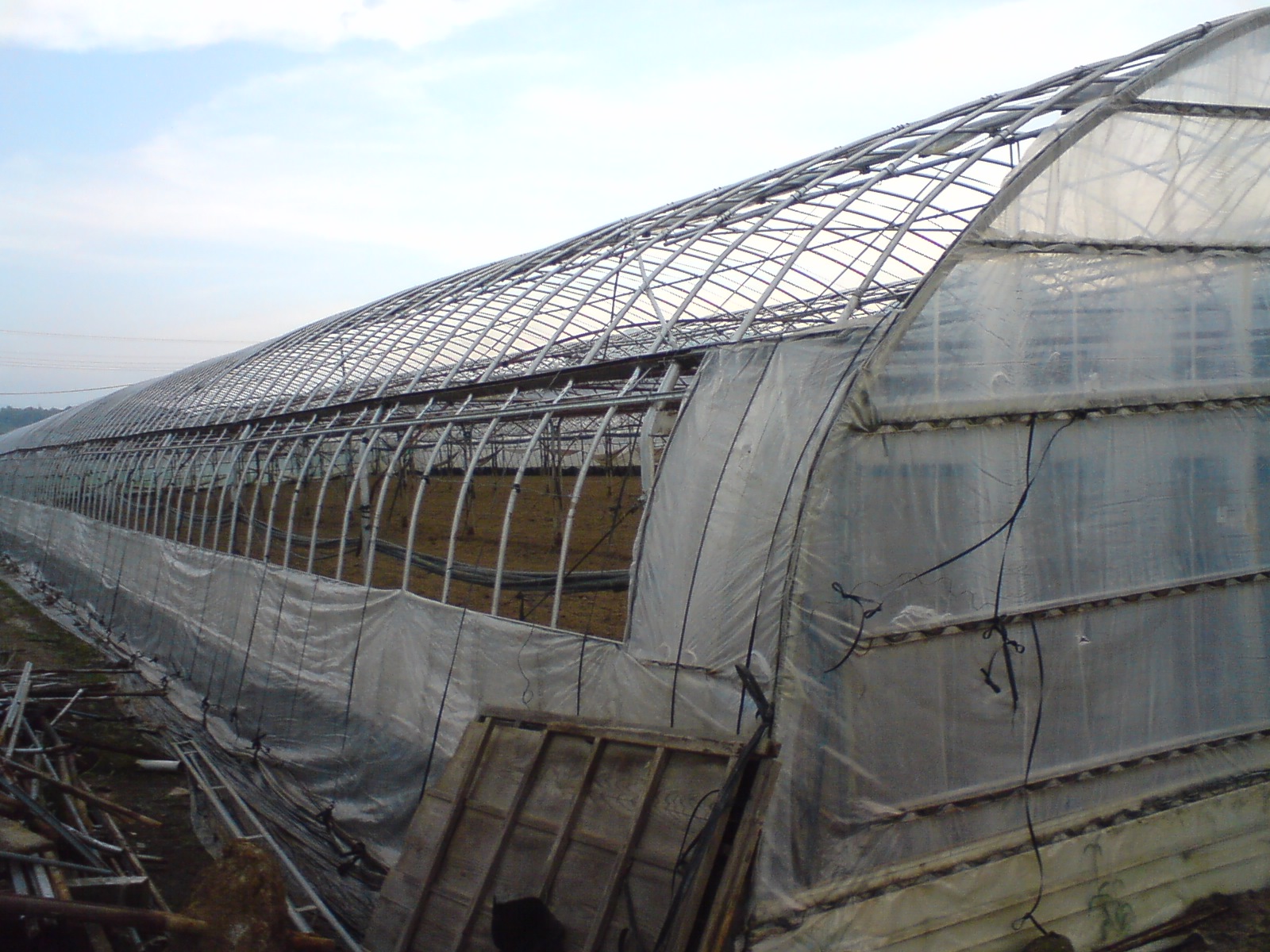
The greenhouses along the road crossing the rice paddies.

Harvesting will start in November and lasts until May with up to 6 peaks.

But that is for the next report!

Yamaguchi Benihoppe Strawberry Farm
410-2114, Izu no Kuni, Nan-jo, 8
Tel.: 055-949-2330

RECOMMENDED RELATED SITES:
Warren Bobrow, Bread + Butter, Zoy Zhang, Hungry Neko, Think Twice, Frank Fariello, Mangantayon, Hapabento, Elinluv Tidbit Corner, Tokyo Terrace, Maison de Christina, Chrys Niles,Lexi, Culinary Musings, Wheeling Gourmet, Comestiblog, Chronicles Of A Curious Cook, Tokyo Through The Drinking Glass, Tokyo Foodcast, Palate To Pen, Yellin Yakimono Gallery, Tokyo Terrace, Hilah Cooking, More than a Mount Full, Arkonite Bento, Happy Little Bento; 5 Star Foodie; Jefferson’s Table; Oyster Culture; Gourmet Fury; Island Vittles; Good Beer & Country Boys; Rubber Slippers In Italy; Color Food daidokoro/Osaka;/a; The Witchy Kitchen; Citron Et Vanille, Lunsj Med Buffet/Estonian Gastronomy (English), Cook, Eat, Play, Repeat, Chrisoscope

Please check the new postings at:
sake, shochu and sushi

Bryan Baird’s Newsletter (2010/07/28)

Baird Beer & Taproom Events Bulletin
bryan-sayuri.gif

Latest Seasonal Releases; Harajuku Taproom 1-Year Anniversary Party

Dear Taproom Friend & Baird Beer Enthusiast:

Our summer beat-the-heat beer parade continues with the release of two new seasonal brews: 10-Year Sour Fruit Ale and Export Lager.

New Seasonal Releases:
10-Year Sour Fruit Ale (ABV 5%): Continuing with our series of 10-year anniversary commemorative ales, we are releasing today an extraordinarily unique summer session beer. Mild in gravity and alcohol content, this snappy summer ale is infused with only one 15-IBU flavor addition of NZ Cascade hops. Its key attribute, a tartly sour fruitiness, stems from generous additions of fresh amanatsu citrus fruit (peels and juice) picked in the orchard of our Carpenter.
Export Lager (ABV 5.5%): Brewed in the tradition of Dortmund-style export lagers, Baird Export Lager combines depth of flavor with a brisk and refreshing character. Less fragrant in hop character but brawnier in malt body than a pilsner, Baird Export Lager is a supreme thirst quencher. Drink it side by side our Cool Breeze Pils and your tastebuds will experience a demonstration in subtle flavor differentiation that simply can’t be conveyed in words. Our soft Numazu water really stands out in this lager.
Both of these seasonal brews will be available on draught and in bottles (633 ml) beginning Thursday, July 29. They can be enjoyed at one of our Taproom pubs or at one of the many fine establishments retailing Baird Beer in Japan. They also are available for purchase direct from the brewery via our online E-Shop.

Upcoming Events:
*Harajuku Taproom 1-Year Anniversary Party (Sat-Sun, August 7-8):

We opened the doors of our third Taproom pub, the Harajuku Taproom, last August in our first attempt to marry the culture of craft beer with traditional Japanese pub cuisine. Thanks to your enthusiastic support, the Harajuku Taproom enjoyed a very successful maiden year. The Harajuku Taproom will be throwing itself a birthday party on the weekend of August 7-8 (doors opening at noon each day). Highlights of the celebration include:

Numazu-priced Baird Beer (700 yen pints and 500 yen half-pints)
Debut of HT Anniversary Lager (Dekopon Bock)
A smorgasboard of tasty beer fare all for 500 yen or less (one-coin cuisine)
The Anniversary Lager, Dekopon Bock, is a traditional German-style Bock brewed with the unusual addition of fresh dekopon citrus fruit (peels and juice). It has been conditioning in kegs for several months and was absolutely delightful at packaging. Dekopon Bock will be available exclusively on draught only at the Harajuku Taproom.

Kindly mark your calendar and plan to help manager Naruoka-san and his terrific team celebrate their 1-year birthday in fantastic style.

Cheers,

Bryan Baird

Baird Brewing Company
Numazu, Japan
HOMEPAGE


The Japan Blog List

———————————
Must-see tasting websites:
-Sake: Tokyo Through The Drinking Glass, Tokyo Foodcast, Urban Sake, Sake World
-Wine: Palate To Pen, Warren Bobrow, Cellar Tours, Ancient Fire Wines Blog
-Beer: Good Beer & Country Boys, Another Pint, Please!
-Japanese Pottery to enjoy your favourite drinks: Yellin Yakimono Gallery
——————————–
Please check the new postings at:
sake, shochu and sushi

—————————————-
日本語のブログ
—————————————-

Vegan Japanese Cuisine: Nasu Somen/Egg-plant Somen

I’m neither vegan or vegetarian, but I can tell you that the present scorching weather might convince me to become one! LOL
Egg-plants or aubergines (frankly speaking, I orefer the latter!) are abondant in this season, and they are easily available as organic vegetables, too. There are so many kinds in Jpaan, including Mizu Nasu/Water Aubergines that are eaten raw!

Grilled or fried aubergines are very popular, but there are simpler and healthier ways to prepare them!
Somen/素麺 are very thin noodles that are enjoyed cold/chilled in summer.
Here is a simple recipe just in between: Nasu Somen.

INGREDIENTS & RECIPE:

-Count one long-type aubergine per person.

-Peel the aubergine and cut it in very thin strips with the point of a sharp knife.

-Coat the the aubergine strips with cornstarch.

-Prepare one pan full of hot (just before boiling point) and a large bowl full of icy (leave some cubes of ice in it) water.

-Cook the cornstarch-coated aubergine strips in the pan full of hot water (keep the fire low), a small bunch at a time, and as soon as cooked to satisfaction (should not take long, bu experiment!) transfer into icy water.

-Once the aubergine strips have cooled down completely, transfer into a sieve and drain thoroughly. Place on a serving dish as shown on picture above.

-Use vegan dashi and some light soy sauce or ponzu as sauce. Add a little chili pepper if you like your food hot.
Top with plenty of available sprouts and greens as well as grated ginger. Experiment again! There is no end to delicious variations!

RECOMMENDED RELATED SITES:
Warren Bobrow, Bread + Butter, Zoy Zhang, Hungry Neko, Think Twice, Frank Fariello, Mangantayon, Hapabento, Elinluv Tidbit Corner, Tokyo Terrace, Maison de Christina, Chrys Niles,Lexi, Culinary Musings, Wheeling Gourmet, Comestiblog, Chronicles Of A Curious Cook, Tokyo Through The Drinking Glass, Tokyo Foodcast, Palate To Pen, Yellin Yakimono Gallery, Tokyo Terrace, Hilah Cooking, More than a Mount Full, Arkonite Bento, Happy Little Bento; 5 Star Foodie; Jefferson’s Table; Oyster Culture; Gourmet Fury; Island Vittles; Good Beer & Country Boys; Rubber Slippers In Italy; Color Food daidokoro/Osaka;/a; The Witchy Kitchen; Citron Et Vanille, Lunsj Med Buffet/Estonian Gastronomy (English), Cook, Eat, Play, Repeat

Please check the new postings at:
sake, shochu and sushi

Shizuoka Agriculture Portal: Agrigraph

AgriGraph Japan is an enterprise commissioned by Shizuoka Prefecture.
It is a project aiming at making the agriculture (and also tourism, esppecially green tourism) in Shizuoka Prefecture known to the whole world in real time through IT-related tools.

Shizuoka Prefecture is a region blessed with nature thanks to its famous mountains such as Mount Fuji and the Southern Alps to the north, its rich sea to the south, and also with a great economy due to its privileged location along the east-west axis from Tokyo to Nagoya and Osaka.

Therefore, no less than five reporters will scour the whole Prefecture every day in an endeavor to help everyone discover the agriculture and rural villages of this rich “Fuji no Kuni Shizuoka/Shizuoka, the Land of Mount Fuji” through live blogs posted through iPhone in Japanese and immediately delivered in English, Chinese, Korean, French and Portuguese by qualified native staff translators to convey the true meaning and nuances of the reports. No automatic translation whatsoever!

If you wish to promote your own agriculture and farm(s) and create a new relation with other producers abroad, do please join us through our interactive blogs as guest participants. All blogs about agriculture from any country are most welcome!

Check the following links:

AGRIGRAPH (Entry Homepage with acces to all articles and languages)

AGRIGRAPH ENGLISH BLOG

AGRIGRAPGH FRENCH BLOG (FRANÇAIS)

AGRIGRAPH PORTUGUESE BLOG (PORTUGUÊS)

AGRIGRAPH KOREAN (관하여)

AGRIGRAPH CHINESE (中文)

RECOMMENDED RELATED SITES:
Warren Bobrow, Bread + Butter, Zoy Zhang, Hungry Neko, Think Twice, Frank Fariello, Mangantayon, Hapabento, Elinluv Tidbit Corner, Tokyo Terrace, Maison de Christina, Chrys Niles,Lexi, Culinary Musings, Wheeling Gourmet, Comestiblog, Chronicles Of A Curious Cook, Tokyo Through The Drinking Glass, Tokyo Foodcast, Palate To Pen, Yellin Yakimono Gallery, Tokyo Terrace, Hilah Cooking, More than a Mount Full, Arkonite Bento, Happy Little Bento; 5 Star Foodie; Jefferson’s Table; Oyster Culture; Gourmet Fury; Island Vittles; Good Beer & Country Boys; Rubber Slippers In Italy; Color Food daidokoro/Osaka;/a; The Witchy Kitchen; Citron Et Vanille, Lunsj Med Buffet/Estonian Gastronomy (English), Cook, Eat, Play, Repeat, Chrisoscope

Please check the new postings at:
sake, shochu and sushi

Today’s Lunch Box/Bento (’10/55): Indian Sushi Bento

Most Indian people have to devise their food according to a somewhat harsh climate (at times. Of course people living at the foot of the Himalayas would say otherwise!). The Missus is a great fan of Indian cuisine and anything called “curry”!
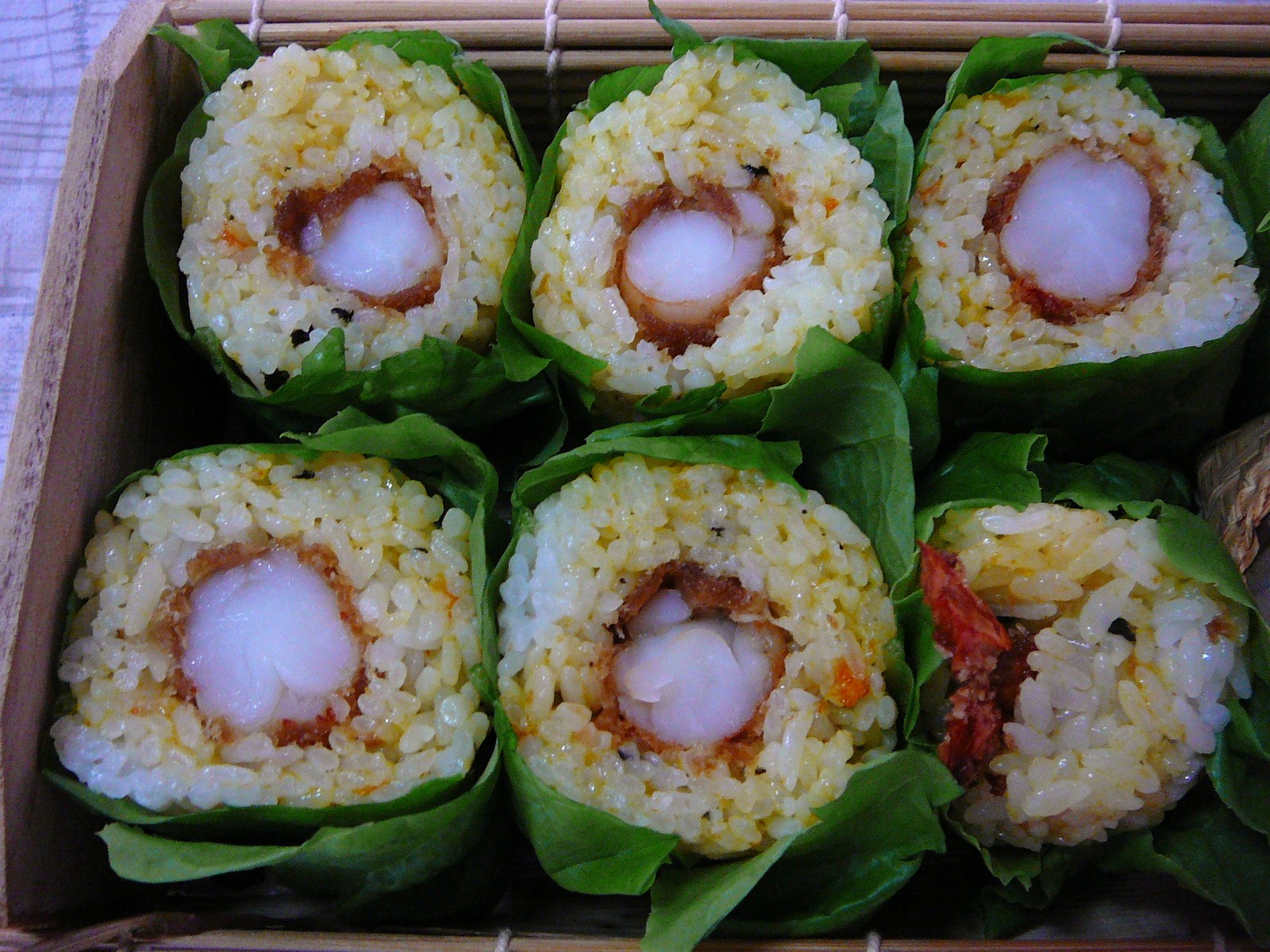
Today, sushi bento day, she came up with a simple twist to call her sushi Indian-style!

Having prepared the sushi rice, she added a good measure of curry furikake to it. Furikake means “seasoning to be sprinkled” in Japanese. There a good many of them including the curry variety she used today.
Simple, ain’t it?

She deep-fried large prawns in breadcrumbs and included them in rolls she made with a bamboo sushi roll and cellophane paper. She then took the rolls out of their cellophane paper and rolled them inside lettuce before wrapping them again into cellophane paper to facilitate the cutting.

plenty of home-made pickles to provide me with the salt I will lose during the sweating-hot day: cucumber, fresh geinger, carrot and sansho/Japanese pepper.

Loads of fruit for dessert for the vitamin C and fibers: red grapefruit, nectarines and blueberries. The latter are supposed to be good for the eyes. If true, they will help mine which tend to get tired at the end of the day with all my PC work!

Adventures in Bento Making, American Bento, Beanbento, Bento No1, Bento Wo Tsukurimashou, Cooking Cute, Eula, Hapabento , Happy Bento, Jacki’s Bento Blog, Kitchen Cow, Leggo My Obento, Le Petit Journal Bento & CO (French), Lunch In A Box, My Bento Box, Vegan Lunch Box; Tokyo Tom Baker, Daily Food Porn/Osaka, Only Nature Food Porn, Happy Little Bento, The Herbed Kitchen, J-Mama’s Kitchen, Cook, Eat, Play, Repeat; Bento Lunch Blog (German); Adventures In Bento; Anna The Red’s Bento Factory; Cooking Cute; Timeless Gourmet; Bento Bug; Ideal Meal; Bentosaurus;

Please check the new postings at:
sake, shochu and sushi

—————————————-
日本語のブログ
—————————————-

Today’s Lunch Box/Bento (’10/54): Neverending (Heat) Story Bento

-“I hate this place! It must be 50 degress (C) in this kitchen!”
The Missus has been badgering me for some time with moving to a new home. What with the neverending scorching heat assiling us for the past two weeks with no end in view, her argument sounds the more convincing by the day!

All that heat means a lot of sweat and loss of body salts.
The Japanese are conscious of their health to the point of addiction. You wouldn’t believe the number of TV health programs we are subjected to ( no wonder I keep away from the TV. BG, that’s one for you!)! be assured that my bento are partly devised according to them (LOL)!

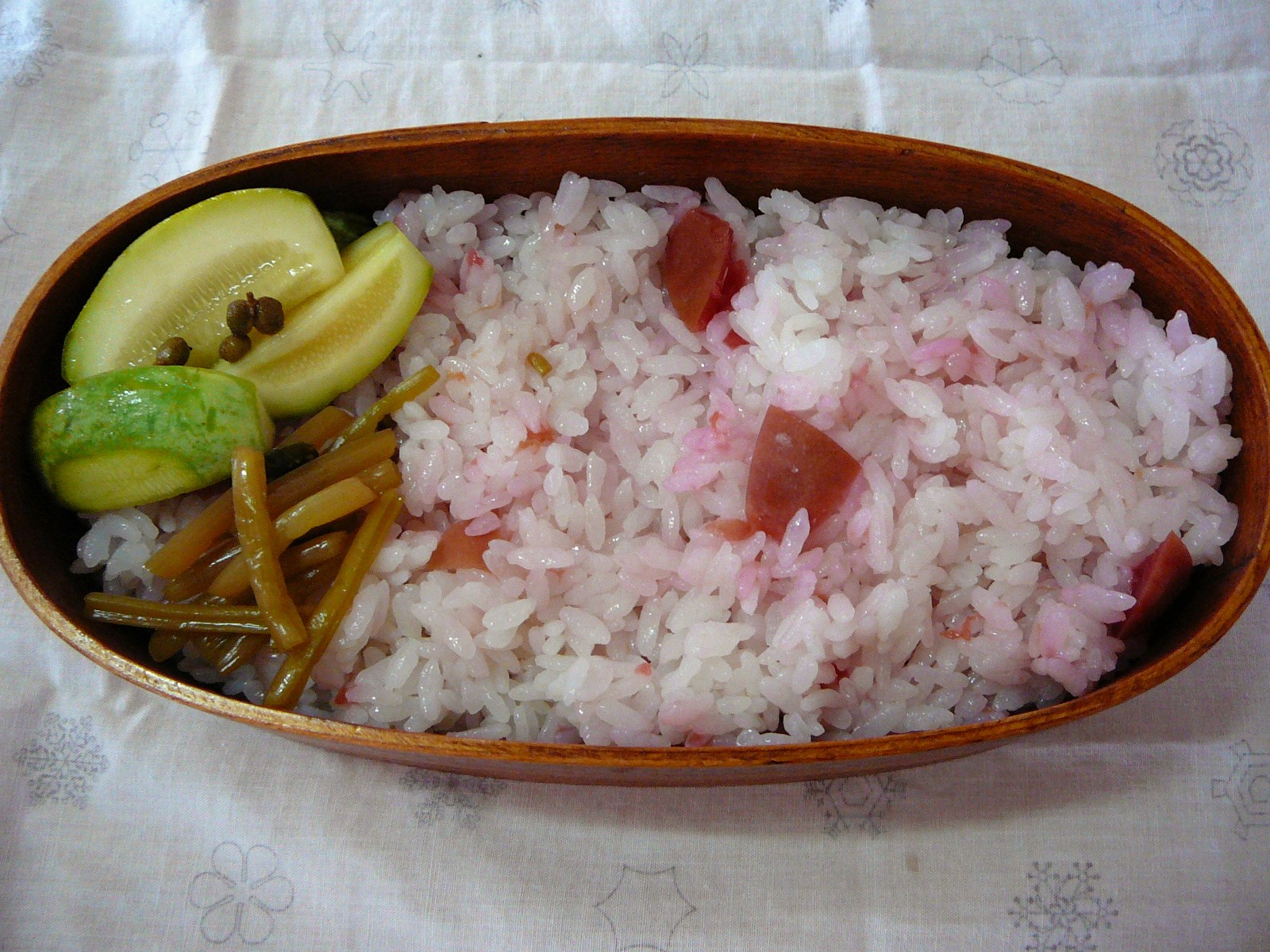
To compensate this loss of body salts, The Missus mixed the freshly seamed rice with home-pickled umeboshi (in vinegar, not slat). mini melons, asabi stems and sansho/Japanese pepper (I mean all are pickled)!

Now, for the stamina and vitamins!

She first made karaage/deep-fried chicken, and then cooked them in amazu/sweet vinegar, seame seeds and cornstarch. Very tasty!

Some fresh lettuces, fried goya and red pimentoes seasoned with gomadare and tamagoyaki.
Mow, these tamagoyaki were a bit different with the white in the middle and the yolk outside. I don’t have a clue as to how she made them but they were delicious!

The heat has finally a good side to it!

Adventures in Bento Making, American Bento, Beanbento, Bento No1, Bento Wo Tsukurimashou, Cooking Cute, Eula, Hapabento , Happy Bento, Jacki’s Bento Blog, Kitchen Cow, Leggo My Obento, Le Petit Journal Bento & CO (French), Lunch In A Box, My Bento Box, Vegan Lunch Box; Tokyo Tom Baker, Daily Food Porn/Osaka, Only Nature Food Porn, Happy Little Bento, The Herbed Kitchen, J-Mama’s Kitchen, Cook, Eat, Play, Repeat; Bento Lunch Blog (German); Adventures In Bento; Anna The Red’s Bento Factory; Cooking Cute;

Please check the new postings at:
sake, shochu and sushi

—————————————-
日本語のブログ
—————————————-