Tag Archives: 簡単なレシピ

Yakitori Recipes: Tsukune 1~5

SYNOPSIS:

My friend Island Vittles has decided to start a series on that worldwide known Japanese specialty that is “Yakitori/焼き鳥/”Grilled Chicken”.
I hope that this series of postings on various basic recipes will help her and all other foodies interested in that simple, healthy and so delicious delicacy!

For the sake of continuity, I also decided to re-post the Tsukune Recipes I have published so far for all to refer to before I start publishing new ones.

1) Basic recipe
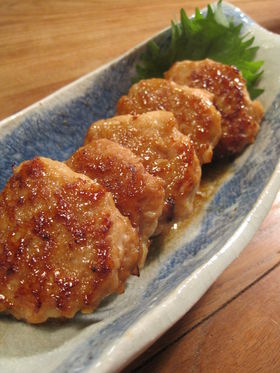
TSUKUNE-RECIPES-1

Apparently, yakitori and especially tsukune are very popular not only in Japan but almost everywhere in the world as they share similarities with many other countries’ specialties! After all a hamburger is nothing less than a big tsukune!LOL

Here is the first of (long) series of simple recipes that I hope will stimulate into you creating more recipes!

Tsukune Recipe 1:

INGREDIENTS: For 4 people

-High quality chicken (breast or thigh): 250 g
-Leek (long narrow one): 1
-Soy sauce + Japanese sake + mirin/sweet sake: 4 tablespoons each
-Honey: 2 teaspoons
-Fresh ginger juice (also available over the counter in Asian stores): 10 ml
-Water: 2 tablespoons
-Cornstarch: 2 tablespoons
-Salad oil: 2 tablespoons

RECIPE:

-Cut chicken and leek into rough pieces and drop them into a food processor. Add one half of the cornstarch, water, soy sauce, sake and mirin each.

-Process well until you obtain a smooth paste. Stop the food processor from time to time to move chicken from the centre with a spatula.

-Make/shape “patties”/tsukune.
Fry in oil on a frypan over a low fire on both side until you obtain a light brown colour (“foxy” in Japanese)

-Pour the rest of the soy sauce, sake, mirin, ginger juice, and cornstarch dissolved in water over the tsukune and cook until the sauce has caramelized.
Serve immediately!

NOTE:
By dividing the seasoning in two halves, the chicken will be thoroughly impregnated with the taste.
make sure you cook over a low fire all the time!
——————————
2) Basic Recipe

TSUKUNE-RECIPES-2-a

Here is the second of (long) series of simple recipes that I hope will stimulate into you creating more recipes!

INGREDIENTS:
-Minced Chicken: 400 g+
-Large shiso/perilla leaves (can be replaced with basil or other green tasty leaves): 15~20
-Salt, pepper: 1 pinc each
-Black sesame: 1 teaspoon
-Grated fresh ginger: 5×5 cm cube
-Japanese Sake: 1 teaspoon
-Cornstarch: 1 tablespoon
-Egg yolk: 1 large

-For seasoning:
Lemon juice
Yuzu koshio/lime and pepper paste

RECIPE:
TSUKUNE-RECIPES-2-b

-Chop the leaves fine as shown on above picture.
TSUKUNE-RECIPES-2-c

-In a large bowl, drop in the minced chicken, salt, pepper and black sesame seeds. Mix well until it becomes a smooth paste.
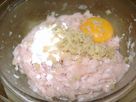
TSUKUNE-RECIPES-2-d

-Add egg yolk, Japanese Sake, Cornstarch and grated ginger.
Mix well.
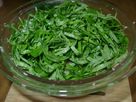
TSUKUNE-RECIPES-2-f

-Add chopped shiso (leaves) and mix well.
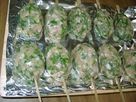
TSUKUNE-RECIPES-2-g

-make tsukune/patties in size of your liking around a wooden stick.

TSUKUNE-RECIPES-2-h

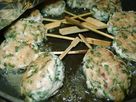
-Pour a little oil in a non-stick frypan and place tsukune as shown on picture.
Start frying.
TSUKUNE-RECIPES-2-i

-When one side has reached the right colour, turn over and fry until both sides have reached the proper colour.
You may add a little more Japanese sake for seasoning.
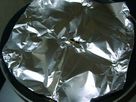
TSUKUNE-RECIPES-2-j

-Cover with large piece of foil paper and stema/fry on a small fire for a while.
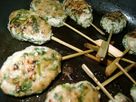
TSUKUNE-RECIPES-2-k

-That’s how the should look when ready!

-Serve a little lemon juice and lime and peppr paste, and plenty of beer!

NOTE:
Naturally, youi may use a sauce of your choice as well, or ponzu, or soy sauce, etc.
———————————-
3) Tofu Tsukune
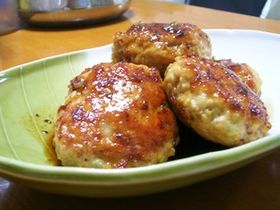
TSUKUNE-TOFU

Here is the third of (long) series of simple recipes that I hope will stimulate into you creating more recipes!
The difference is that this time it is made with tofu as well!

INGREDIENTS: For 2~3 persons

-Tofu: 100 g
-Minced chicen: 300 g
-Onion, finely chopped, 1/2
-Grated fresh ginger, 3~3cm cube
-Egg: 1
-Black pepper: a pinch or two
-Cornstarch: 2 teaspoons
-Soy sauce: 2 tablespoons
-Japanese sake: 2 tablepoons
-Sugar: 2+1/2 tablespoons
-Salad oil

RECIPE:

-In a bowl mix tofu, chicken, onion, ginger, egg, pepper and cornstarch. Make patties/tsukune.

-Pour some oil in a frypan. On medium high fire fry both sides of tsukune until they have reached a nice colour. Add some water. Cover with lid and steam/cook on low fire.

-Mix soy sauce, Japanese sake and sugar in a bowl.

-Take off lid from tsukune. Turn to medium fire. Pour in the sauce and simmer until ready for serving.

NOTE:

Great served wrapped in shiso leaves!
—————————–
4) Large Tsukune
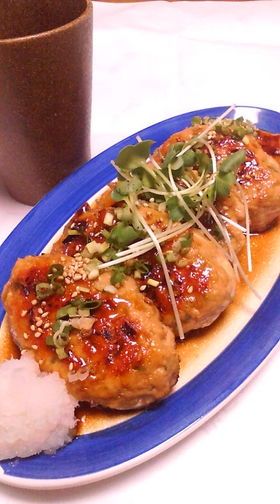
TSUKUNE-RECIPES-3

Here is the fourth of (long) series of simple recipes that I hope will stimulate into you creating more recipes!

INGREDIENTS: For 3~4 persons

-Minced Chicken (breast or thigh): 250 g
-Leek, lon and thin type: 1
-Fresh ginger, grated, to taste
-Soy sauce: 1 tablespoon
-Salt and pepper: a little to taste
-Cornstarch: 1 tablespoon
-Sesame oil: a little to taste
-Yama Imo/Japanese glutinous yam, grated: 2 tablespoons

Tare/Sauce
-Soy sauce: 2 tablespoons
-Mirin/sweet sake: 2 tablespoons
-Water: 1 teaspoon
-Seven spices, to taste

Decoration/presentation:

-Kaiwaredaikon/Daikon sprouts: to taste
-White sesame seeds: to taste
-Grated fresh daikon: to taste

RECIPE:

-Chop leek finely. Grate the ginger. Grate the yama imo.

-In a large bowl drop the the minced chicken, soy sauce, salt & pepper, seame oil and mix quickly by hand.

-Add leek, ginger, yama imo and the cornstarch. Mix well. Let the mixture rest in the fridge for 30 minutes.

-During that time prepare the kaiwaredaikon, freshly grated daikon and sesame sesame seeds.
Prepare the tare/sauce ingredients.

-Fry the tsukune/patties after having shaped them into 3 or 4 equal sized circles with salad oil on both sides over a medium fire until they are a light brown.

-Add 2 tablespoons of water, cover with lid and steam/simmer for a while. Check if tsukune are well cooked with a thin wooden stick.

-Add the tare/sauce ingredients and cook until the tare has “caramelized”.
Serve on a plate with kaiware daikon, grated fresh daikon and white seasme seeds for the final touch.

NOTE:
Do not fry tsukune over a strong fire or they will get hard.
——————————
5) PORK TSUKUNE
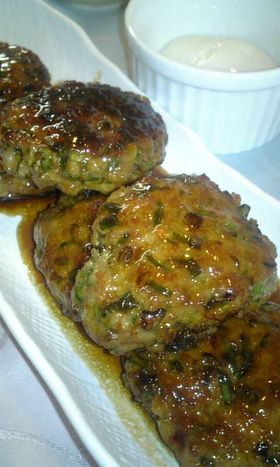
TSUKUNE-PORK

Here is the fourth of (long) series of simple recipes that I hope will stimulate into you creating more recipes!

INGREDIENTS: For 2 persons

-Minced pork: 200 g
-Thin green leeks: 4~5
-Ginger, grated: 1 piece, 5×5 cm
-Japanese sake: 2 tablespoons
-Soy sauce: 3 tablespoons
-Naga imo/glutinous Japanese yam/Chinese yam, grated: 2 tablespoons
-Cornstarch: 1 tablespoon

Tare/Sauce
-Soy sauce: 2~3 tablespoons
-Sugar: 2 teaspoons
-Mirin/sweet sake: 3 tablespoons

-Japanese sake: 2 tablespoons (for steam/fry)
-Onsen Tamago/Japanese-style poached eggs (normal poached eggs are great!)

RECIPE:

-Chop the thin leeks coarsely.
In a bowl mix minced pork, Japanese sake, soy sauce and grated ginger until smooth.

-Add grated Chinese yam and mix until smooth. It will take some time as the yam will tend to separate at first. Add cornstarch and mix until smooth.

-Add chopped leeks and mix well.

-Heat a frypan. Pour in a little oil. Make 6~7 round patties/tsukune by hand or with a mold.
Fry both sides on a medium fire.

-When “eyes” have appeared on both sides, reduce fire to small. Add sake, cover with glass lid and steam fry.

-When you are sure that the tsukune are well cooked, add soy sauce, mirin and sugar and let simmer until sauce has “caramelized” the tsukune.

-Serve with a poached egg in a separate ramequin for each person who will choose either to break it directly over the tsukune or use it as a dip (the former will be probably easier!LOL)

NOTE:
-You can increase the amount of leeks and gingeraccording to your taste.
-You may replace leeks with parsley.
-Any soy sauce is fine, although a sweet variety is recommended. Otherwise you may increase the amount of mirin.

RECOMMENDED RELATED SITES:
Warren Bobrow, Bread + Butter, Zoy Zhang, Hungry Neko, Think Twice, Frank Fariello, Mangantayon, Hapabento, Elinluv Tidbit Corner, Tokyo Terrace, Maison de Christina, Chrys Niles,Lexi, Culinary Musings, Wheeling Gourmet, Comestiblog, Chronicles Of A Curious Cook, Bento Boutique, Tokyo Through The Drinking Glass, Tokyo Foodcast, Urban Sake, Sake World, Palate To Pen, Yellin Yakimono Gallery, Tokyo Terrace, Hilah Cooking, More than a Mount Full, Arkonite Bento. Island Vittles

Please check the new postings at:
sake, shochu and sushi

—————————————-
日本語のブログ
—————————————-

Yakitori: Tsukune-The Basics

TSUKUNE-5
Modern tsukune at Japanese Izakaya

SYNOPSIS:

My friend Island Vittles has decided to start a series on that worldwide known Japanese specialty that is “Yakitori/焼き鳥/”Grilled Chicken”.
I hope that this series of postings on various basic recipes will help her and all other foodies interested in that simple, healthy and so delicious delicacy!

For the sake of continuity, I also decided to re-post Tsukune-The Basics for all to refer to.

Yakitori is not only all parts of a chicken (or other bird, actually) on sticks or skewers.
One very popular yakitori is “Tsukune”!
Tsukune (つくね) could described as a japanese chicken meatball either on stick or completely separate.

Whereas usual yakitori requires fine products and sauce (and a cooking skills) only, tsukune calls for a real recipe.

TSUKUNE-2
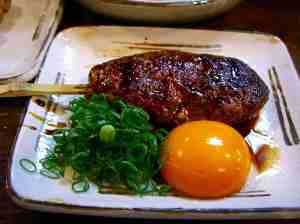
Traditional tsukune serves with egg yolk and chopped leeks.

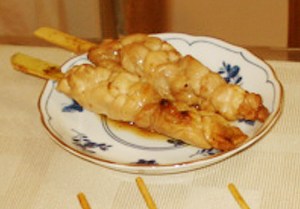
Traditional tsukune are presented as a single larger sausage-shaped “ball” grilled around a skewer and will be served with some sauce and an egg yolk (either chicken or quail). A good amount of chopped leeks is always welcome.

TSUKUNE-4

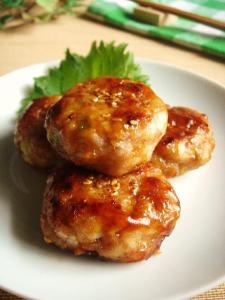
Home-made tsukune will be simpler and served as chicken meat balls with home-made or bought tare/sauce.

TSUKUNE-3

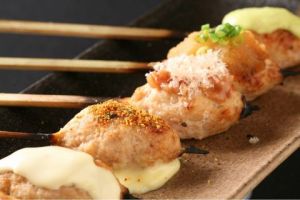
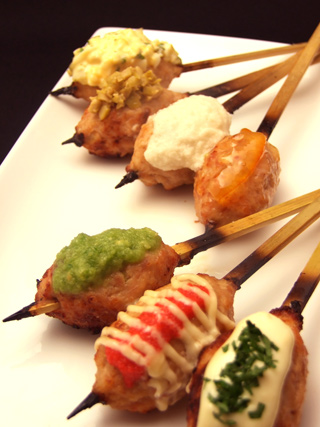
Modern tsukune seem come in many varieties all on the same plate. Actually the toppings are different but the meat balls are the same.

TSUKUNE-1

They certainly look appetizing!
Thay are fine, but as a purist I still prefer the traitional ones!

Next, I will publish a recipe!
You will find out there more ingredients included than in simple chicken balls!

RECOMMENDED RELATED SITES:
Warren Bobrow, Bread + Butter, Zoy Zhang, Hungry Neko, Think Twice, Frank Fariello, Mangantayon, Hapabento, Elinluv Tidbit Corner, Tokyo Terrace, Maison de Christina, Chrys Niles,Lexi, Culinary Musings, Wheeling Gourmet, Comestiblog, Chronicles Of A Curious Cook, Bento Boutique, Tokyo Through The Drinking Glass, Tokyo Foodcast, Urban Sake, Sake World, Palate To Pen, Yellin Yakimono Gallery, Tokyo Terrace, Hilah Cooking, More than a Mount Full, Arkonite Bento. Island Vittles

Please check the new postings at:
sake, shochu and sushi

—————————————-
日本語のブログ
—————————————-
Yakitori Recipes: The Basics

YAKITORI-1

SYNOPSIS:

My friend Island Vittles has decided to start a series on that worldwide known Japanese specialty that is “Yakitori/焼き鳥/”Grilled Chicken”.
I hope that this series of postings on various basic recipes will help her and all other foodies interested in that simple, healthy and so delicious delicacy!

For the sake of continuity, I decided to re-post The Basics for all to refer to.

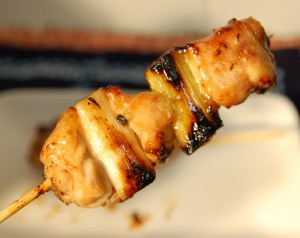
Yakitori (焼き鳥 やきとり), or fried chicken, is a Japanese type of skewered chicken that is found everywhere in Japan and i many countries abroad.
They are served all year round and have the advantage not only to be tasty but very healthy as meat comes by.

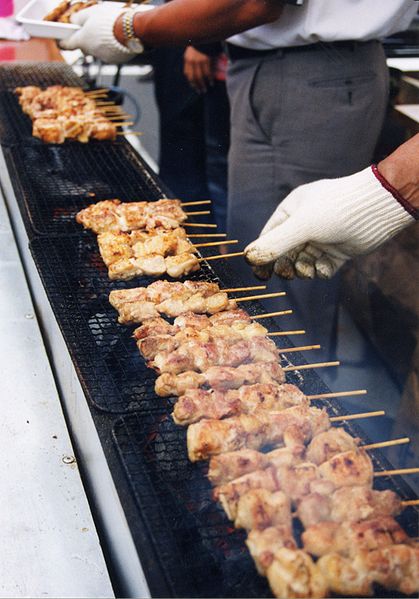
It is made from several bite-sized pieces of chicken meat, or chicken offal, skewered on a bamboo skewer and barbecued, usually over charcoal.

Diners ordering yakitori usually have a choice of having it served with salt (and sometimes lemon juice) or with tare sauce, which is generally made up of mirin, sake, soy sauce and sugar. The sauce is applied to the skewered meat and is grilled until delicately cooked and is served with the tare sauce as a dip.

Ways of serving naturally vary with regions.

YAKITORI-MURORAN

As served in Mururoran, Hokkaido.

YAKITORI-EHIME

As served in Ehime Prefecture, Shikoku Island.

One can order for sets or individually.
In the later case, you would do weel to remember basic names:

YAKITORI-HATSU
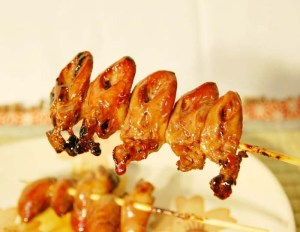
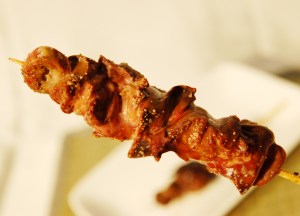
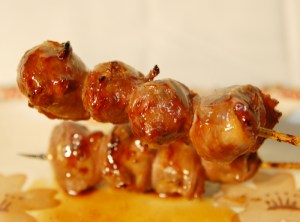
hatsu (ハツ) or kokoro (こころ), chicken heart

YAKITORI-LIVER
rebā (レバー), liver

YAKITORI-SUNAGIMO
sunagimo (砂肝), or zuri (ずり) chicken gizzard

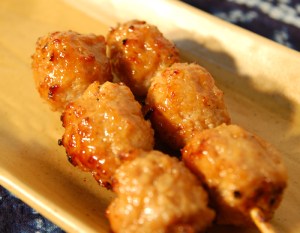
YAKITORI-TSUKUNE
tsukune (つくね), chicken meatballs
Great served with an egg yolk and tare!

YAKITORI-KAWA
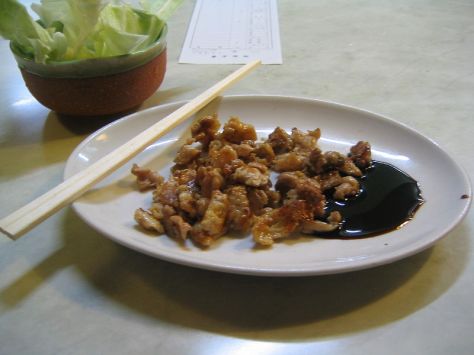
(tori)kawa ((とり)かわ) chicken skin, grilled until crispy

YAKITORI-TABASAKI
tebasaki (手羽先), chicken wing
The same can be ordered whole.

YAKITORI-BONCHIRI
bonjiri (ぼんじり), chicken tail

YAKITORI-SHIRO
shiro (シロ), chicken small intestines

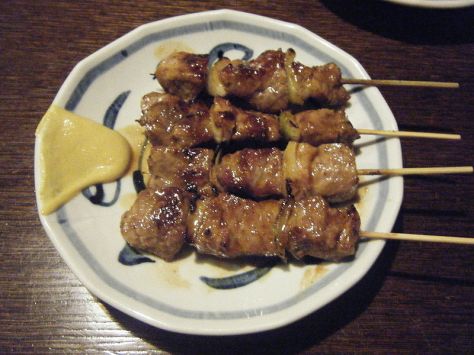
YAKITORI-NEGIMA
ikada (筏) (lit. raft), Japanese scallion, with two skewers to prevent rotation. Also called negima (ネギ間)

YAKITORI-AOTO
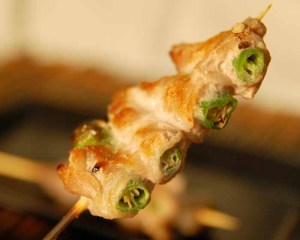
Aoto (青と). Here the leek/scallion is rolled insde the chicken

YAKITORI-KASHIRA
Kashira (かしら) made from the tender par of the breast.

YAKITORI-SESERI
Seseri (せせり) similar to kashira

nankotsu, chicken cartilage
toriniku, Free Range “Chicken of the Earth” (all white meat on skewer)

Common kushiyaki (non-poultry) dishes:

atsuage tofu (厚揚げとうふ, deep-fried tofu)
enoki maki (エノキ巻き, enoki mushrooms wrapped in slices of pork)
pīman (ピーマン, green pepper)
asuparabēkon (アスパラベーコン, asparagus wrapped in bacon)

YAKITORI-BUTABARA
butabara (豚ばら, pork belly)

gyutan (牛タン), ox tongue, sliced thinly

Naturally if you take purely regional specialties in account, there are many more!

RECOMMENDED RELATED SITES:
Warren Bobrow, Bread + Butter, Zoy Zhang, Hungry Neko, Think Twice, Frank Fariello, Mangantayon, Hapabento, Elinluv Tidbit Corner, Tokyo Terrace, Maison de Christina, Chrys Niles,Lexi, Culinary Musings, Wheeling Gourmet, Comestiblog, Chronicles Of A Curious Cook, Bento Boutique, Tokyo Through The Drinking Glass, Tokyo Foodcast, Urban Sake, Sake World, Palate To Pen, Yellin Yakimono Gallery, Tokyo Terrace, Hilah Cooking, More than a Mount Full, Arkonite Bento. Island Vittles

Please check the new postings at:
sake, shochu and sushi

—————————————-
日本語のブログ
—————————————-
Yakitori Recipes: Sauce/Tare 1~3

SYNOPSIS:

My friend Island Vittles has decided to start a series on that worldwide known Japanese specialty that is “Yakitori/焼き鳥/”Grilled Chicken”.
I hope that this series of postings on various basic recipes will help her and all other foodies interested in that simple, healthy and so delicious delicacy!

I’ve already introduced two recipes for Sasami, but I thought it was time I introduced a few easy recipes for “tare” or sauce in Japanese, before I embarked on a long article on cutting techniques to appear soon!

YAKITORI TARE 1:

INGREDIENTS:

-Soy sauce: 130 cc/ml
-Japanese sake: 100 cc/ml
-Sweet Japanese sake/mirin: 100 cc/ml

-Mizuame: 50 g (if unavailable, use corn syrup)

Mizuame (水飴) is a sweetener from Japan which is translated literally to ‘water candy’. A clear, thick, sticky liquid, it is made by converting starch to sugars. Mizuame is added to wagashi to give them a sheen, eaten in ways similar to honey and can be a main ingredient in sweets. Mizuame is produced in a very similar fashion to corn syrup and is very similar in taste.

-Sugar: 30 g
-Garlic: 1 clove (chopped)
-Fresh ginger: 5x5cm piece (Thinly sliced)

RECIPE:

-In a bowl pour the Japanese sake and mirin/sweet Japanese sake and heat to suppress the alcohol.

-Add soy sauce, mizuame (corn syrup), sugar, garlic and ginger and simmer until the mixture “glows”.

-Take the garlic and ginger out. Preserve in a securely closed jar in the fridge.

YAKITORI TARE 2

INGREDIENTS:

-Soy sauce: 50~60 cc/ml
-Sweet Japanese sake/mirin: 50 cc/ml
-Japanese sake: 50 cc/ml
-Sugar: 1 tablespoon

RECIPE:

-Pour everything into a pan and cook over medium fire until reduced to half.

-If you want to preserve it in a securely closed jar in the fridge, better prepare 2~ 4 fold!

YAKITORI TARE 3

INGREDIENTS:

-Japanese sake: 1 tablespoon
-Japanese sweet sake/mirin: 1 tablespoon
-White wine: 2 tablespoons
-Light soy sauce: 7 tablespoons
-Thick soy sauce (tamari shoyu): 1/2 teaspoon
-Brown sugar: 7 tablespoons
-Black pepper: as appropriate
-Garlic: 3g (grated)

RECIPE:

-In a small pan, pour the japanese sake, Japanese sweet sake/mirin, and white wine. Cook on a low fire to allow the alcohol disappear.

-Add the soy sauce, thick soy sauce, brown sugar, black pepper and garlic.

-Cook over a strong fire. As soon as bubbles appear, switch off fire.

RECOMMENDED RELATED SITES:
Warren Bobrow, Bread + Butter, Zoy Zhang, Hungry Neko, Think Twice, Frank Fariello, Mangantayon, Hapabento, Elinluv Tidbit Corner, Tokyo Terrace, Maison de Christina, Chrys Niles,Lexi, Culinary Musings, Wheeling Gourmet, Comestiblog, Chronicles Of A Curious Cook, Bento Boutique, Tokyo Through The Drinking Glass, Tokyo Foodcast, Urban Sake, Sake World, Palate To Pen, Yellin Yakimono Gallery, Tokyo Terrace, Hilah Cooking, More than a Mount Full, Arkonite Bento. Island Vittles

Please check the new postings at:
sake, shochu and sushi

—————————————-
日本語のブログ
—————————————-
Yakitori Recipes: Sasami 2

SYNOPSIS:

My friend Island Vittles has decided to start a series on that worldwide known Japanese specialty that is “Yakitori/焼き鳥/”Grilled Chicken”.
I hope that this series of postings on various basic recipes will help her and all other foodies interested in that simple, healthy and so delicious delicacy!

This is the second Recipe: Yakitori Sasami 2:

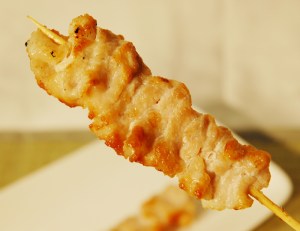
“Sasami/ささ身 or 笹身” may be roughly translated as “white light chicken meat”. It is found in the breast (see picture above) and is considered the most tender part of the chicken.

“Sasami” as sold in Japanese supermarkets.

Yakitori Sasami with Shiso & Umeboshi:

INGREDIENTS: For 3 persons

-Chicken sasami: 300 g
-Umeboshi: as appropriate
-Shiso/perilla leaves: 4
-Salt and pepper: as appropriate

RECIPE:

-Cut the sasami into bite-sized chunks and salt lightly.

-Fry the chicken chunks in a non-stick pan over a medium fire.

-Once the the chicken is cooked (do not overcook it! No “black spots”) should appear!), align them on skewers.
Mince the umeboshi flesh with a knife and paste it along the Top.
Chop the shiso leaves finely and decorate as shown on top picture.

-makes for an easy, cheap and elegant snack!

RECOMMENDED RELATED SITES:
Warren Bobrow, Bread + Butter, Zoy Zhang, Hungry Neko, Think Twice, Frank Fariello, Mangantayon, Hapabento, Elinluv Tidbit Corner, Tokyo Terrace, Maison de Christina, Chrys Niles,Lexi, Culinary Musings, Wheeling Gourmet, Comestiblog, Chronicles Of A Curious Cook, Bento Boutique, Tokyo Through The Drinking Glass, Tokyo Foodcast, Urban Sake, Sake World, Palate To Pen, Yellin Yakimono Gallery, Tokyo Terrace, Hilah Cooking, More than a Mount Full, Arkonite Bento. Island Vittles

Please check the new postings at:
sake, shochu and sushi

—————————————-
日本語のブログ
—————————————-
Korean Cuisine: Home-Made Gochujang

Gochujang is a savory and pungent fermented Korean condiment. Traditionally, it has been naturally fermented over years in large earthen pots outdoors, more often on an elevated stone platform, called jangdokdae (장독대) in the backyard.
It has been made at home in Korea since the 16th century, after chili peppers were first introduced. The making of gochujang at home began tapering off when commercial production started in the early 1970s and came into the mass market. Now, homemade gochujang can hardly be found.

Not only the Koreans, but the Japanese use it a lot when they make their own-style Korean food!

Here is a simple home-made recipe that should help everyone control the ingredients.
And it has the merit to be vegan/vegetarian!

INGREDIENTS:

-Water: 270 ml/cc
-Brown sugar/cane sugar: 250 g
-Miso: 300 g (try use more than 1 kind!)
-Korean Chili pepper powder: 100 g
-Salt: 1 tablespoon
-Japanese sake or Korean soju: 1 teaspoon
-Rice vinegar: 1 teaspoon

RECIPE:

-Pour water in a large enough pan. Add sugar. Heat until all brown sugar is dissolved.

-Add miso. try and use a combination of a few miso pastes. It will add to the taste. Keep heating, stirring with a wooden spatula all the time until mixture is smooth.

-Once most of the water has disappeared, add Korean Chili pepper powder. Mix well. Keep heating and slowly stirring untl water has disappeared and big bubbles start bursting at the surface.

-Switch off fire. Let cool until about 25~30 degrees Celsius temperature (your own skin temperature!). Add salt, sake/soju and rice vinegar. Stir well. This last step at this temperature will insure that all yeasts are killed and will prevent further fermentation.

-Secure inside a vessel and leave inside the fridge. Can be kept for a whole year inside the fridge.

USAGE SUGGESTION:

Korean-Style Fish Carpaccio

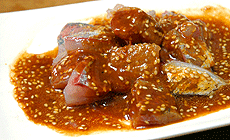
Mix some gochujang with red miso, rice vinegar, sugar, soy sauce, Japanese sake or Korean soju and sesame oil. Stir the lot well and pour over a plate of sliced fish such as pike mackerel/saurel!

RECOMMENDED RELATED SITES:
Warren Bobrow, Bread + Butter, Zoy Zhang, Hungry Neko, Think Twice, Frank Fariello, Mangantayon, Hapabento, Elinluv Tidbit Corner, Tokyo Terrace, Maison de Christina, Chrys Niles,Lexi, Culinary Musings, Wheeling Gourmet, Comestiblog, Chronicles Of A Curious Cook, Bento Boutique, Tokyo Through The Drinking Glass, Tokyo Foodcast, Urban Sake, Sake World, Palate To Pen, Yellin Yakimono Gallery, Tokyo Terrace, Hilah Cooking, More than a Mount Full, Arkonite Bento

Please check the new postings at:
sake, shochu and sushi

—————————————-
日本語のブログ
—————————————-
Chinese Cuisine: Home-Made Sweet Bean Paste/Tiánmiànjiàng

Sweet bean sauce also known as sweet bean paste, sweet soybean paste, sweet flour sauce, or sweet noodle sauce, is a thick, dark brown- or black-colored Chinese sauce made from wheat flour, sugar, salt, mantou, and ground fermented yellow soybeans (that is, what is left of the soybeans after the fermentation of soybeans into soy sauce).

Not only the Chinese, but the Japanese use it a lot when they make their own-style Chinese food!
You can avoid looking for it by making it yourself and at the same time control the ingredients.
Here is a simple suggestion for a home-made recipe!
And it has the merit to be vegan/vegetarian!

INGREDIENTS:

-Red miso: 600 g
-Sugar: 300 g
-Soy sauce: 5 tablespoons
-Japanese sake/Cooking sake: 3 tablespoons
-Water: 3 cups/600 cc/ml

RECIPE:

-Pour all ingredients into a large enough pan and stir well.

-Switch on fire and cook over low fire stirring all the time.

-The water will gradually disappear. When large bubbles break out on the surface, switch off fire and let cool completely.

-Transfer into a vessel you can securely close and keep in the fridge.
The sauce can be preserved for 4 months in the fridge.

USE SUGESTIONS:

With tofu:
Vegan, vegetarians can fry vegetables with tofu and sauce.
Omnivores can add minced meat fried beforehand.

With noodles:
Vegan, Vegetarians can fry vegetables and nuts in the sauce before topping the noodles (non-egg noodles)

Can be added to stewed beef (and sprinkled with some chopped leeks just before serving).

Can be used in sauce for “Hayashi Rice”, a typical Japanese beef and rice dish.

RECOMMENDED RELATED SITES:
Warren Bobrow, Bread + Butter, Zoy Zhang, Hungry Neko, Think Twice, Frank Fariello, Mangantayon, Hapabento, Elinluv Tidbit Corner, Tokyo Terrace, Maison de Christina, Chrys Niles,Lexi, Culinary Musings, Wheeling Gourmet, Comestiblog, Chronicles Of A Curious Cook, Bento Boutique, Tokyo Through The Drinking Glass, Tokyo Foodcast, Urban Sake, Sake World, Palate To Pen, Yellin Yakimono Gallery, Tokyo Terrace, Hilah Cooking, More than a Mount Full, Arkonite Bento

Please check the new postings at:
sake, shochu and sushi

—————————————-
日本語のブログ
—————————————-
Yakitori Recipes: Sasami 1

My friend Island Vittles has decided to start a series on that worldwide known Japanese specialty that is “Yakitori/焼き鳥/”Grilled Chicken”.
I hope that this series of postings on various basic recipes will help her and all other foodies interested in that simple, healthy and so delicious delicacy!

“Sasami/ささ身 or 笹身” may be roughly translated as “white light chicken meat”. It is found in the breast (see picture above) and is considered the most tender part of the chicken.

“Sasami” as sold in Japanese supermarkets.

SASAMI RECIPES 1: Soft sasami on skewers

INGREDIENTS: For 10 sticks

-Chicken Sasami: 400 g (or 10 sasami)
-Skewers: 10
-Japanese sake: as appropriate
-Chicken soup stock (powder): 1/2 tablespoon (best is Chinese chicken bones soup stock powder)
-Sesame oil: as appropriate

RECIPE:

-Cut each sasami into 4~6 pieces for each skewer.
Drop all the cut chicken in a bowl and add just enough sake for seasoning/marinating. Add chicken soup stock powder and mix well by hand.
Let marinate for 30 minutes.

Drain chicken (throw away the “juices) with a sieve or “Zaru” (Japanese bamboo sieve). Transfer into clean bowl and add enough sesame oil to season the whole. Stir with hand for even seasoning.

-Skewer the sasami pieces.

-Grill both sides.
Don’t overgrill. No “black spots” should appear.

-Serve.
Best served with real wasabi.
You may of course serve them with a little salt, or pepper or whatever you fancy.
Have lettuce handy for a great and simple combination.
For foodies of all ages!

RECOMMENDED RELATED SITES:
Warren Bobrow, Bread + Butter, Zoy Zhang, Hungry Neko, Think Twice, Frank Fariello, Mangantayon, Hapabento, Elinluv Tidbit Corner, Tokyo Terrace, Maison de Christina, Chrys Niles,Lexi, Culinary Musings, Wheeling Gourmet, Comestiblog, Chronicles Of A Curious Cook, Bento Boutique, Tokyo Through The Drinking Glass, Tokyo Foodcast, Urban Sake, Sake World, Palate To Pen, Yellin Yakimono Gallery, Tokyo Terrace, Hilah Cooking, More than a Mount Full, Arkonite Bento. Island Vittles

Please check the new postings at:
sake, shochu and sushi

—————————————-
日本語のブログ
—————————————-
Today’s Lunch Box/Bento (’10/24): Hail, Cherry Blossoms & Imo

Now, you may ask why I gave this “subtitle” to Today’s bento!
“Hail” for bento? Unless it is an ice-cream bento…

Actually we had a good 10 minutes of hail in Shizuoka City yesterday afternoon, and this only in our city! On the other hand some people were blocked for the night in the vicinity of Mount Fuji.
If I recall properly, itis only the third time I witness such an event in 34 years of lif in this town. No wonder the TV crews were out in force downtown!

Now cherry blossoms are easier to understand.
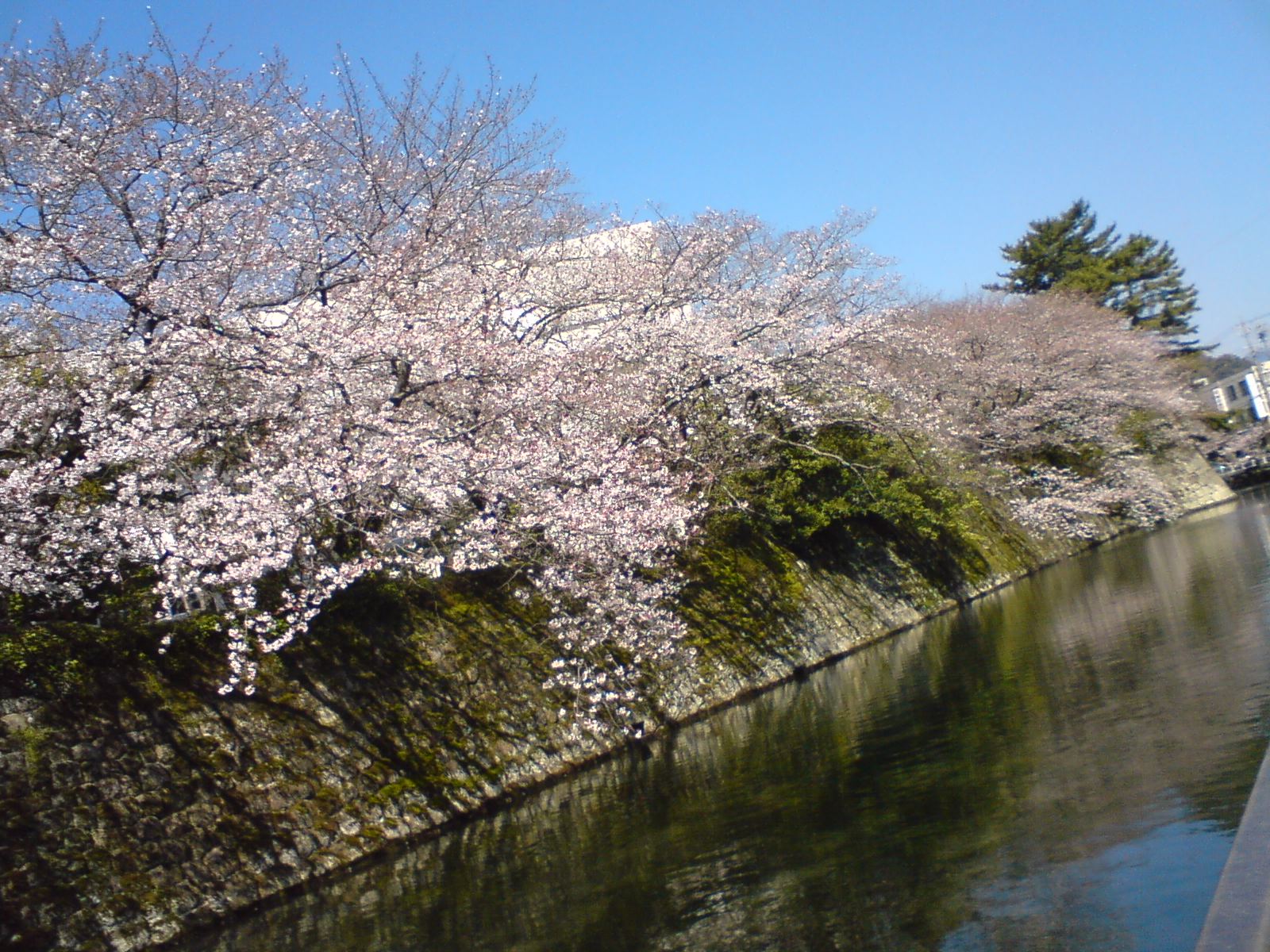
Japan, like many other countries in the Northern Hemisphere has gone through a very unseasonably cold winter. At long last cherry blossoms are litterally exploding into full bloom around us.
The above picture was taken along the moat of Sumpu Castle.
On the other hand I don’t know if these flowers will last until the Shizuoka Festival starting on the 1st of April as the next two days will see more rain…

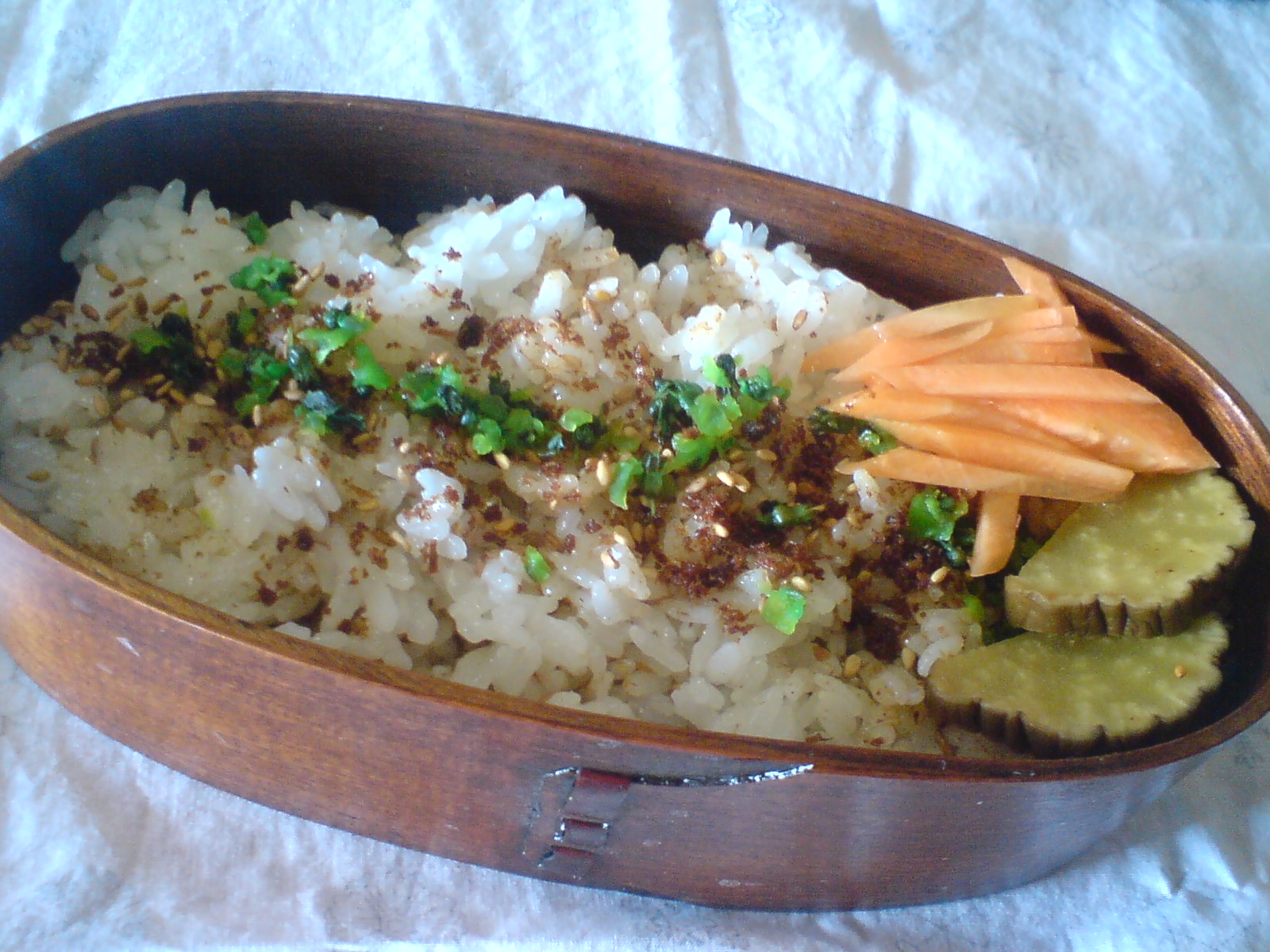
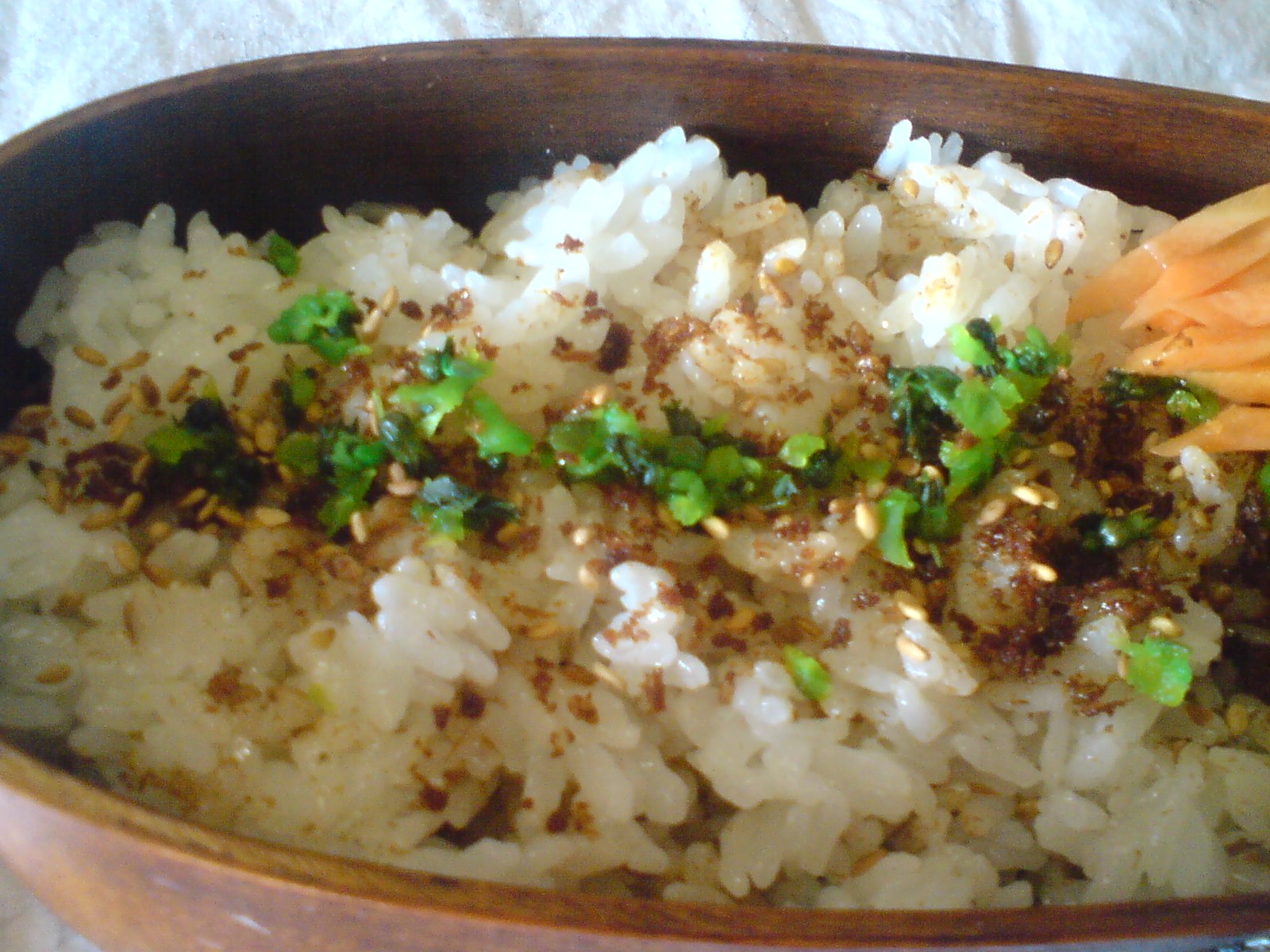
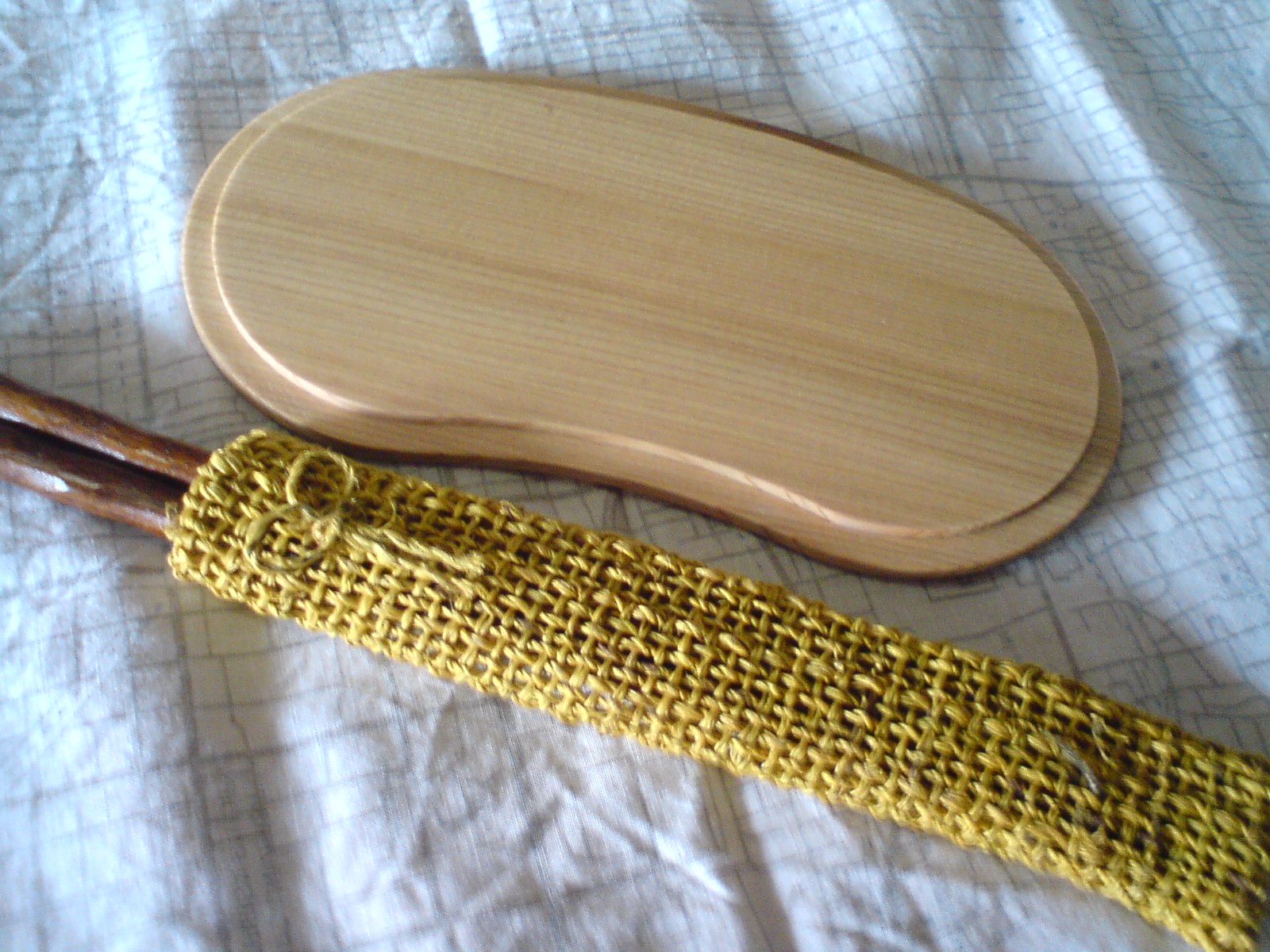
For today’s bento the Missus used the other cedar wood box she bought from Akita Prefecture. Contrary to yesterday, this box is made of sturdy lacquered cedar wood. The two tiers can be used a single box with the second tier becomeing the lid. A “belt” is also provided for securing it.
It is also cheaper, but still expensive at a little less than 50 US$, but it is very resilient.

First the rice or staple “dish”.

The Missus steamed plain rice with a piece of konbu/seaweed.
Having filled the box with it, she sprinkled the middle first with “katsuo soboro/鰹そぼろ/”, that is coked bonito “powder” (not dry) and then with Japanese-style (chopped) cucumber pickle for a colourful contrast.

She added two types of pickles: home-made sweet (sweet vinegar) carrot pickles and pickled daikon slices I got from a friend who travelled to Niigata Prefecture on the other side of Japan. The latter is very crunchy and tasty.

And then for the garnish “dish”.

The meat is Japanese-style char siu/kakuni pork she cooked in a jiffy in a pressure cooker, and the egg is another specialty of hers, half-boiled and sprinkled with roasted/black sesame seeds.

The opposite extremity was filled with boiled peas in their pods and home-made sweet pickled myoga ginger.

The middle is occupied with what justifies the third element of the title: imo.
She simmered yellow and violet satsuma imo/sweet potatoes together with a dash of honey (she wouldn’t tell me more…).
Cetainly makes for great colours and taste.
Sorry for the slightly fuzzy pictures (the Missus is giving me hell for that, but that gives her an incentive to take her own ics!LOL).

For dessert, Shizuoka-grown Benihoppe/Red Cheeks strawberries!

Do I need to tell you I’m looking forward to next week?

RECOMMENDED RELATED SITES:
Warren Bobrow, Bread + Butter, Zoy Zhang, Hungry Neko, Think Twice, Frank Fariello, Mangantayon, Hapabento, Elinluv Tidbit Corner, Tokyo Terrace, Maison de Christina, Chrys Niles,Lexi, Culinary Musings, Wheeling Gourmet, Comestiblog, Chronicles Of A Curious Cook, Bento Boutique, Tokyo Through The Drinking Glass, Tokyo Foodcast, Urban Sake, Sake World, Palate To Pen, Yellin Yakimono Gallery, Tokyo Terrace, Hilah Cooking, More than a Mount Full, Arkonite Bento

Please check the new postings at:
sake, shochu and sushi; Happy Little Bento

—————————————-
日本語のブログ
—————————————-

Today’s Lunch Box/Bento (’10/23): Akita Cedar Wood Bento Box

The Missus at long last received the two cedar wood bento boxes she had ordered from Akita Prefecture in the far north of Japan!
The one she used today cost a whopping 90 US$ although she managed to buy it through the Internet for a little less than 60 US $.

The reason for such a cost is that all boxes are manually fabricated with the best cedar wood cut into very thin sheets to be later shaped with molds and then affixed to each other in painstaking process. Such boxes are washable, although they need some care then. The fact is that the cedar wood will add extra flavour to the food!

The box comes into two tiers with a lid, a small inner mobile partition and its own lacquered cedar wood chopsticks. A “belt” is also provided to secure the box before the Missus wraps it in napkin.
Traditional multi-tiered bento boxes used to be secured with bamboo twine or tightly wrapped into a large piece of cloth.

The boxes seem to be of small small size at first look but they contain more than one might think thanks to their depth.

Not only the box, but the meal too as very traditionla today!
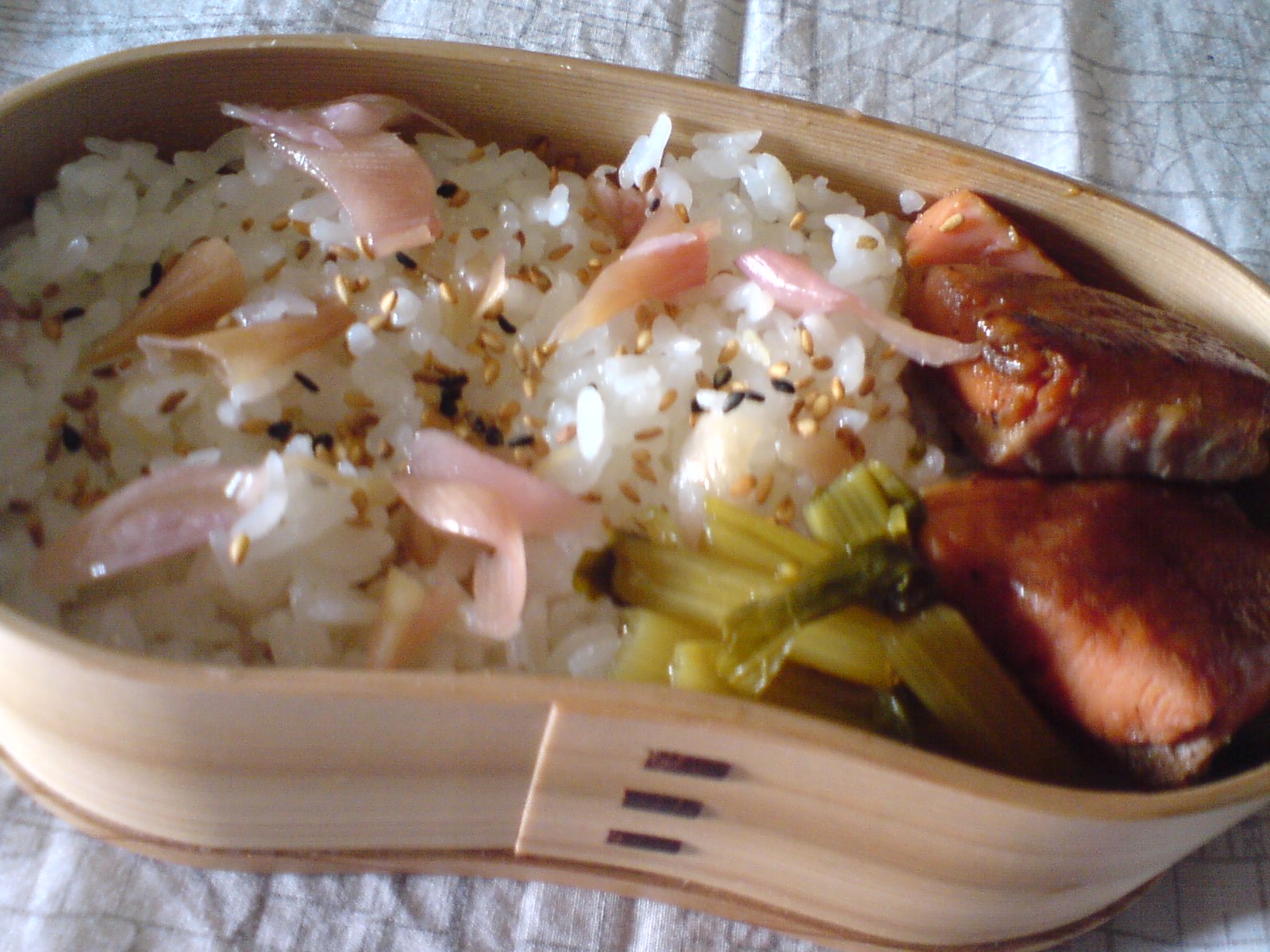
The rice was plain rice steamed with konbu/seaweed and later mixed with home-sweet vinegar pickled myoga ginger and sprinkled with roasted yellow and black sesame seeds.

The Missus fried the salted salmon she bought at the local supermarket in a teriyaki sauce of her own. Shee added some home-pickled wasabi stems for extra punch.

The garnish box was filled to the brim!

The vegetables are separated with a small cedar wood partition:
on the right is mixture of yama imo/yam, red and green pimentoes and carrot strips fried together in spicy sauce with hijiki/sweet seaweed;
on the left salad of rapeseed flowers with their stwms and leaves seasoned with gomadare/sesame dressing and sprinkled with ground roasted sesame seeds.
Note that the salads are placed inside paper cups to avoid too much direct contact with the wood.

As for dessert, The Missus included freshly fried plain tamagoyaki/Japanese omelette.
Tamgoyaki is readily available in supermarkets amd are tasty enough, but contains large amounts of sugar and preservatives. The Missus never touches them.
On the other hand the sweet beans were bought at the supermarket, although the Missus from time to time uses beans cooked by her mother.

RECOMMENDED RELATED SITES:
Warren Bobrow, Bread + Butter, Zoy Zhang, Hungry Neko, Think Twice, Frank Fariello, Mangantayon, Hapabento, Elinluv Tidbit Corner, Tokyo Terrace, Maison de Christina, Chrys Niles,Lexi, Culinary Musings, Wheeling Gourmet, Comestiblog, Chronicles Of A Curious Cook, Bento Boutique, Tokyo Through The Drinking Glass, Tokyo Foodcast, Urban Sake, Sake World, Palate To Pen, Yellin Yakimono Gallery, Tokyo Terrace, Hilah Cooking, More than a Mount Full, Arkonite Bento

Please check the new postings at:
sake, shochu and sushi; Happy Little Bento

—————————————-
日本語のブログ
—————————————-

Chinese-Style Sashimi!

Sashimi is not and should not the sole property of Japanese gastronomy.
After all, carpaccio is nothing but a varietyof sahimi!
I remember savouring this Cinese=style sashimi for the first time in Shizuoka City in a great French restaurant!

So next time you get your hands on a nice piece of fresh white-fleshed fish, why don’t you try experiment?
Below is the method. Do experiment with quantities!

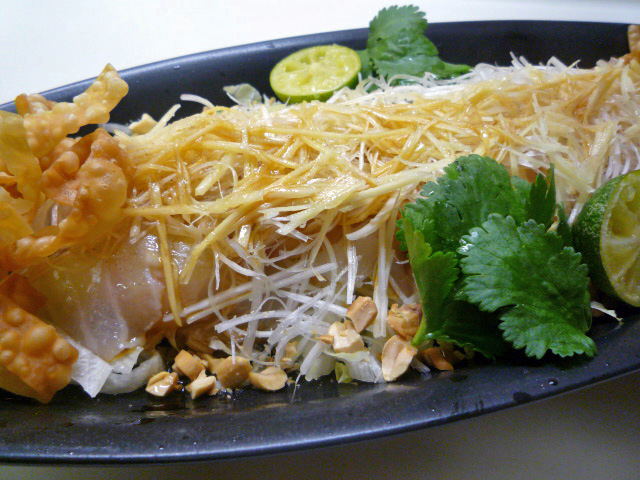
Chionese-Style Sashimi!

INGREDIENTS: For 2~people

-Sole, Seabream, Snapper: a large fillet
-White leek: 1
-Fresh coriander: as appropriate
-Wantan, wonton, wuntun wrappers: as appropriate
-Peanuts: as appropriate
-Fresh ginger: as appropriate
-Lettuce: a appropriate
-Lemon or lime: as appropriate
-Peanuts oil: 2 tablespoons
-Sesame oil: 2 tablespoons

Sauce:
-Soy sauce: 3 tablespoons
-White leeks: 1 tablespoon (Chopped finely)
-Red chillies (sliced thin): 1
-Coriander (finely chopped): 1 tablespoon (chopped finely)
-White Sesame oil: 1 tablespoon

RECIPE:

-Cut the fish into thin slices.

-Cut the white leek into very thin strips, leave in water for a while and drain well.

-Cut the lettuce into 1 cm wide strips.

-Cut the wanton wrappers into 1 cm wide strips and deep-fried until crispy. Place them on a kitchen paper to absorb excess oil and cool down.

-Crush the peanuts in small bits.

-Cut the fresh ginger into very thin strips, leave in clean water for a while, then drain thoroughly.

-Prepare the sauce. in a bowl drop the soy sauce, chopped white leeks, thinly sliced red chili, chopped coriander and white sesame oil and mix well. If you warm this sauce up a little before pouring it over the fish, the flavours will be enhanced.

-On a serving dish (look at the picture!), place the slices of fish on a bed of lettuce and sprinkle with a very small amount of salt and pepper.

-Top with a much as you want white leek strips, ginger strips, deep-fried wanton wrappers, crushed peanuts, appropriately cut fresh coriander, lemon or lime slices and pour the sauce all over.

-As a last optional touch, heat peanuts oil and sesame oil (2 to 1) until it smokes and pour it over the top! You could also press a lemon over the top and add more spices in the sauce!

RECOMMENDED RELATED SITES:
Warren Bobrow, Bread + Butter, Zoy Zhang, Hungry Neko, Think Twice, Frank Fariello, Mangantayon, Hapabento, Elinluv Tidbit Corner, Tokyo Terrace, Maison de Christina, Chrys Niles,Lexi, Culinary Musings, Wheeling Gourmet, Comestiblog, Chronicles Of A Curious Cook, Bento Boutique, Tokyo Through The Drinking Glass, Tokyo Foodcast, Urban Sake, Sake World, Palate To Pen, Yellin Yakimono Gallery, Tokyo Terrace, Hilah Cooking, More than a Mount Full, Arkonite Bento

Please check the new postings at:
sake, shochu and sushi

—————————————-
日本語のブログ
—————————————-
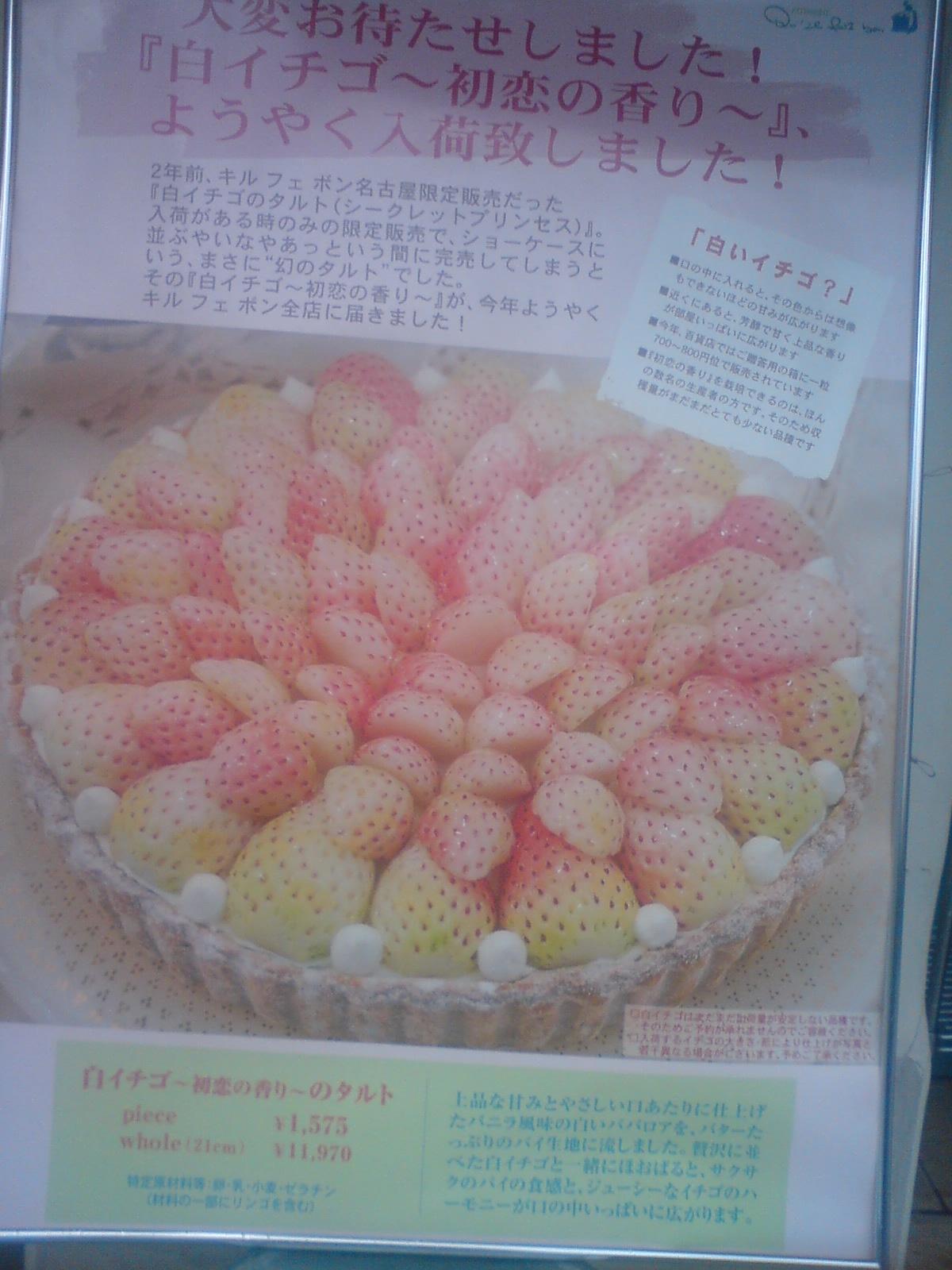
White Strawberries Tart!

Do you remember this posting about Strawberries Facts & Tips?

I introduced the “Hatsukoi no kaori/the Scent of First Love!” White Strawberry developped in 2006. Probably the most expensive strawberry in the world!

I also mentioned that its flesh is completely white while the skin is ivory with red seeds. It is not an albino strawberry!
But the taste is somewhat average.

Just discovered that Qu’Il Fait Bon, a large cake store has just been advertizing their new tart under the name of “Shiroi Ichigo~Hatsu Koi No Kaori/白いイチゴ~初恋の香り/White Strawberries=the Scent of First Love”!

At 1,575 yen a portion (16 US $) or 11,970 yen for the whole tart (125 US $), one (s) had better make sure this first love is the last and true one!LOL

RECOMMENDED RELATED SITES:
Warren Bobrow, Bread + Butter, Zoy Zhang, Hungry Neko, Think Twice, Frank Fariello, Mangantayon, Hapabento, Elinluv Tidbit Corner, Tokyo Terrace, Maison de Christina, Chrys Niles,Lexi, Culinary Musings, Wheeling Gourmet, Comestiblog, Chronicles Of A Curious Cook, Bento Boutique, Tokyo Through The Drinking Glass, Tokyo Foodcast, Urban Sake, Sake World, Palate To Pen, Yellin Yakimono Gallery, Tokyo Terrace, Hilah Cooking, More than a Mount Full, Arkonite Bento

Please check the new postings at:
sake, shochu and sushi

—————————————-
日本語のブログ
—————————————-
Italian Restaurant: “Quick Fix” at Il Paladino

Rainy day/evening…
Having a break…
Il Paladino almost next door…
A no-brainer!

And I was there before I could say “it’s still raing cats and dogs outside!”.

“A plate of antipasti misto and make it small as I have to eat dinner back home!”
“Bona!”

Madago/octopus and Uikyou/Japanese fennel salad, Fritatta of zucchini and eggs, Broccoli AOP Peperocino with anchovy seasoning, and marinated tomato. And home-made focaccia and bread!

“You know, we have these big white asaparaguses from Holland…”
“Not fair! OK, I’ll have one of them!”

For another view.
The asparagus is simply grilled and served with a delicious dressing.
The new bamboo shoot is fried. It is actually the extremity of the shoot called “himekawa/姫皮/Princess’ skin”. The inside is almost fruity and part of the “leaves” are edible and crunchy! A great asociation of European and Asian vegetables!

Now, how was I going to explain that to the MIssus….

Service: Excellent and very friendly
Facilities: great and very large washroom, great cleanliness overall
Prices: reasonable to expensive.
Specialty:Sicilian Cuisine. Top-class Italian wines and great collection of Grappa.
no-smoking-logo1 Non-smoking at tables.

Tratorria . Il Paladino
420-9839 Shizuoka City, Aoi-Ku, Takajo, 2-8-19
Tel.: 054-253-6537
Opening hours: 11:30~13:30, 17:00~22:00
Closed on Mondays
Credit cards OK (Dinner only)

RECOMMENDED RELATED SITES:
Warren Bobrow, Bread + Butter, Zoy Zhang, Hungry Neko, Think Twice, Frank Fariello, Mangantayon, Hapabento, Elinluv Tidbit Corner, Tokyo Terrace, Maison de Christina, Chrys Niles,Lexi, Culinary Musings, Wheeling Gourmet, Comestiblog, Chronicles Of A Curious Cook, Bento Boutique, Tokyo Through The Drinking Glass, Tokyo Foodcast, Urban Sake, Sake World, Palate To Pen, Yellin Yakimono Gallery, Tokyo Terrace, Hilah Cooking, More than a Mount Full, Arkonite Bento

Please check the new postings at:
sake, shochu and sushi

—————————————-
日本語のブログ
—————————————-
Steamed Sushi

A new foodie friend of mine, Michelle Karam, whom I met on Social Culinaire, was just mentioning she could not wait to come to Japan to eat sushi, as it was just frustrating and terribly expensive in her own country.
Well, why not making it yourself, then?
“It’s too difficult and one cannot get the ingredients!”
Really? There must be enough stores all the world by now which sell the basics. So why don’t you try this simple recipe for a start!

Steamed sushi!

INGREDIENTS: For 3~ people

-Rice: 3 cups/600 cc

Sushi vinegar:
-Rice vinegar: 3 tablespoons
-Sugar: just under 3 tablespoons
-Salt: 1 teaspoon

-Conger eels (anago/穴子): 3 (can be bought frozen
-Soy sauce: 2 tablespoons
-Mirin/Japanese sweet sake: 2 tablespoons

-Dried shiitake mushrooms: 3~4 (medium-sized)
-Dashi/Japanese soup stock: 1 cup/200 cc/ml
-Sugar: 1 tablespoon
-Soy sauce:1 tablespoon

-Trefoil or Italian Parsley: 1 bunch

-Eggs: 5
-Sugar: 1 teaspoon
-Salt: 1/2 teaspoon

-Amazu jinja/ginger marinated in sweet vinegar: as appropriate for decoration/seasoning

RECIPE:

-Wash rice and steam in the normal way

-Unless you can buy the conger eels already cooked and seasoned, vut their heads and tail, cut in half lengthwise and across again into one-bite sized pieces. Fry slowly with soy sauce and mirin/sweet sake until cooked and well-impregnated with seasoning sauce. Set apart.

-In a pan pour the dashi/Japanese soup stock. Add the dried shiitake and stew until the mushrooms have become soft. Add the sugar and soy sauce. Keep simmering until all liquid has disappeared. Let cool. Cut into fine slices. Set apart.

-Drop the trefoil in hot salted water for a few seconds. Drain well and cut into 2 cm long pieces.

-Make a thin omelette with the eggs beaten with sugar and salt. Cut into thin threads.

-Once the rice has been steamed, transfer it into a large vessel (wooden preferably, but a large ceramic dish will do). add the rice vinegar, sugar and salt evenly over it. Mix by “cutting in” the rice with a wet paddle. Add conger eels and their juices, shiitake mushrooms and mix lightly.

-Place an equal amount of the rice into bowls and steam (with a lid on) for 15 minutes over a strong fire. Open the lid, placean equal amount of eggthreads and steam again for 1 more minute.

-Serve topped with trefoil and sweet vinegar marinated ginger!

RECOMMENDED RELATED SITES:
Warren Bobrow, Bread + Butter, Zoy Zhang, Hungry Neko, Think Twice, Frank Fariello, Mangantayon, Hapabento, Elinluv Tidbit Corner, Tokyo Terrace, Maison de Christina, Chrys Niles,Lexi, Culinary Musings, Wheeling Gourmet, Comestiblog, Chronicles Of A Curious Cook, Bento Boutique, Tokyo Through The Drinking Glass, Tokyo Foodcast, Urban Sake, Sake World, Palate To Pen, Yellin Yakimono Gallery, Tokyo Terrace, Hilah Cooking, More than a Mount Full, Arkonite Bento

Please check the new postings at:
sake, shochu and sushi

—————————————-
日本語のブログ
—————————————-
Zucchini Flower Fritters

Zuucchini flowers have been a long-time favourite of people living around the Mediterranean Sea, especailly in Italy and French Provence.
The Japanese has recently grown fond of not only zucchini, but laso their flowers and are growing them with a revenge!
It is little wonder they come up with their own, if much simpler, version of zucchini flower fritters!

INGREDIENTS: For 4 people

-Zucchini Flowers: 4
-Prawns/shrimps: 6 (medium-sized)
-Mozzarella Cheese (they make it in Jpaan, now! And that from real water buffaloes!): 1
-Onion: 3 tablespoons (very finely chopped)
-Flour: as appropriate (or if you are Japanese food cognizant, use tempura batter)
-Lemon juice: 1/2
-Baby leaves mix for accompaniment: as much as you like!
-Salt: as appropriate
-Pepper: as appropriate
-White wine: a little

RECIPE:

-Take the pistils out the zucchini flowers.

-“Peel” the shrimps if necessary and clean them. Cut them into 2 cm long pieces. Cut off half of the zucchini green part (not the flower) and cut again into 1 cm long pieces.

-Lightly fry the zucchini and shrimps with olive oil. Season with a litlle salt, pepper and white wine. Transfer into a bowl and let cool for a while.

-Cut the mozzarella into small pieces and add into the bowl. Mix the lot.

-Delicately open the zucchini flowers and fill them with the above mixture. Do not fill completely as you need to close the flower by twisting their extremities.

-Either wrap the flowers in a little flour or tempura batter and delicately them fry in shallow olive oil.

-Serve with baby leaves seasoned with a very little salt, some pepper and wine vinegar, and a wedge of lemon/lime.

RECOMMENDED RELATED SITES:
Warren Bobrow, Bread + Butter, Zoy Zhang, Hungry Neko, Think Twice, Frank Fariello, Mangantayon, Hapabento, Elinluv Tidbit Corner, Tokyo Terrace, Maison de Christina, Chrys Niles,Lexi, Culinary Musings, Wheeling Gourmet, Comestiblog, Chronicles Of A Curious Cook, Bento Boutique, Tokyo Through The Drinking Glass, Tokyo Foodcast, Urban Sake, Sake World, Palate To Pen, Yellin Yakimono Gallery, Tokyo Terrace, Hilah Cooking, More than a Mount Full, Arkonite Bento

Please check the new postings at:
sake, shochu and sushi

—————————————-
日本語のブログ
—————————————-