Please check the new postings at:
sake, shochu and sushi
—————————————-
日本語のブログ
—————————————-
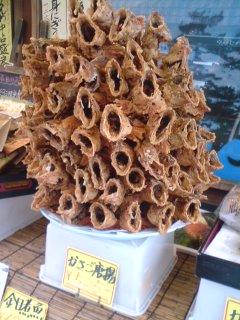
No, they are not singing!
I found those deep-fried “hata-hata”/Japanese sandfish outside a Japanese restaurant in Numazu City harbor!
Please check the new postings at:
sake, shochu and sushi
—————————————-
日本語のブログ
—————————————-
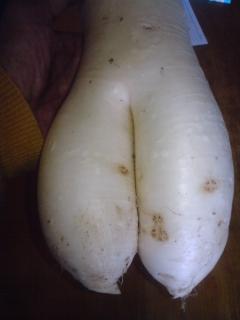
My usually prudish half turned up triumphantly with this strange daikon grown in her parents’ garden!
I didn’t know where to start cutting it…
In the end I saw gradually disappearing as I grated the whole for a “daikon-nabe”!
Please check the new postings at:
sake, shochu and sushi
—————————————-
日本語のブログ
—————————————-
Baird Beer & Taproom Events Bulletin 2009 #2

Dear Taproom Friend & Baird Beer Enthusiast:
During this winter period of short days and long nights have you been wondering about the 2009 release of Dark Sky Imperial Stout? Wonder no longer — Dark Sky will be pouring from the taps of fine pubs and restaurants throughout Japan beginning Wednesday, January 21.
*Dark Sky Imperial Stout (ABV 9%):
As the name implies, this is an extremely foreboding brew, pitch black in color, unctuous in body, complex and elusive in flavor, and hoppily aromatic. This granddaddy of Stouts is brewed with eight different malts, Japanese dark sugar and five varieties of hops. If you are a fan of hearty dark ales, Dark Sky Imperial Stout is for you!
In addition to Dark Sky on draught, a limited number of 633 ml bottles (adorned with our new label artwork) will be available for purchase both direct from the brewery estore and through the family of Baird Beer retaililng liquor stores in Japan.
Remainder: The IPA Festival (Ten Days, 10 IPAs) is in progress at our Nakameguro Taproom in Tokyo. The final festival day is Monday, January 26. If you have yet to attend, please make haste.
Cheers,
Bryan Baird
Baird Brewing Company
Numazu, Japan
HOMEPAGE
Please check the new postings at:
sake, shochu and sushi
—————————————-
日本語のブログ
—————————————-
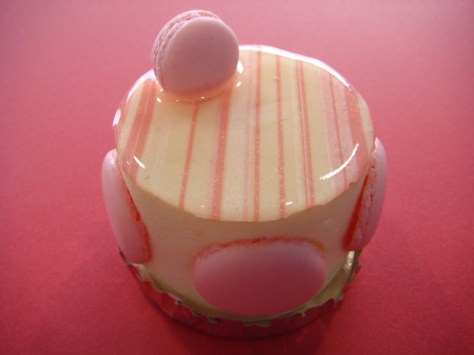
Bernard Heberle in Hamamatsu City has become the reference in the whole of Shizuoka Prefecture when it comes to French cake and confectionery.
A man of character, he has steadfastly kept faithful to his principles and ethics and blessed us with uncompromising creations of a level diificult to equal!
This particular creation is named “Tendresse” in French, meaning tenderness in English.
In Bernard’s French words:
-“Voici le gâteau que je te propose ce mois ” Tendresse ” qui est un gâteau a base de Fromage blanc et de pâte a bombe , très léger et même ceux qui n’aime pas le fromage y trouverons leurs plaisir. Léger et onctueux décoré avec des macarons a la Framboise.”
-“Here is the cake I would like to introduce your friends to this month. It is called “Tenderness” and is made with a very light combination of Fromage Blanc/White cheese and Pate a bombe/very fine sponge cake variety. Even people who do not like cheese will appreciate it. Light and soft, it is decorated with raspberry macarons”.
I’m ready to take the 30-minute bullet train to Hamamatsu to savour it!
Abondance
Address: Hamamatsu Shi, Sumiyoshi, 2-14-27 (in front of Seirei Hospital)
Tel.: 053-4738400
Fax: 053-4738401
Opening hours: 10:00~20:00. Closed on Tuesdays.
Homepage
Please check the new postings at:
sake, shochu and sushi
—————————————-
日本語のブログ
—————————————-
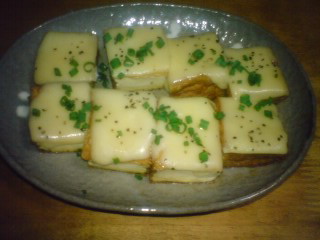
This is I hope the first installment of a long series of simple recipes with tofu. Some will be vegan and vegetarian, some vegetarian like this one, others for omnivores!

This particular one is one one of the Missus’ favorites.
She uses on full “namaage tofu”, tofu that was deep-fried whole and that you can buy either fresh at a Japanese market or packaged.
She cuts the tofu in equal-sized bite pieces about 1 cm thick and fry them in a non-stick pan. No real need for any oil as what is contained in the surface of the tofu will be sufficient.
The point is that she fries them only on side. While they cook she lay a thin piece of mild/processed cheese over each tofu piece, add some black pepper, and cover with a glass lid. When the cheese has nicely melted over the tofu, she takes off the lid, sprinkles the whole with ponzu and fries for another minute. She serves on a dish with the sauce and liberally sprinkles the lot with chopped thin leeks!
Great snack with Japanese sake or beer!
Please check the new postings at:
sake, shochu and sushi
—————————————-
日本語のブログ
—————————————-

Yams or “Satsuma Imo” were first introduced to Japan in the rykyu Islands (Okinawa) in 1604 by the Chinese. It was then introduced in Kyushu in 1609, an area that grows 80% of the total Japanese production.
It has been recognized in this country fro a long time for both its nutritional and pharmaceutical qualities.
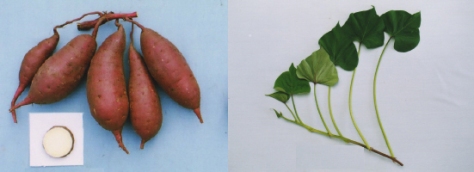
There are over a hundred species in Japan, but the most popular edible ones (not the ones exclusively used for making shochu) have red skins and light yellow flesh.
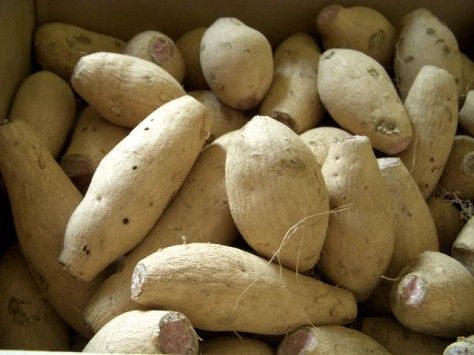
My personal favorite is the “Tanekoshima Gold Imo” grown in Taneko Island south of Kyushu. It has the particularity of being red when raw before chaning to a rich golden color when cooked. Among other varieties, the violet yams are getting increasingly popular.

Tanekoshima yam (deep yellow), “common yam” (light yellow) and Murasaki/Violet yam.
The Missus particularly likes to mix the three above as a cold salad with mayonnaise or cream-based dressing.
FACTS:
-Season: September to November
-Main elements: Carbohydrates, Carotene, Vitamin C, Vitamin E, Potassium, Calcium, Magnesium, vegetal fibers.
-Beneficial to digestion.
-Lose very little of its beneficial elements even after a long cooking.
TIPS:
-Choose specimens with nice color and a “fat/roundish” aspect!
-Plunge yam in cold water as soon as you have cut them. They will not lose their color!
-Boil, bake or steam long enough before taking skin off. Discard skin!
Please check the new postings at:
sake, shochu and sushi
—————————————-
日本語のブログ
—————————————-
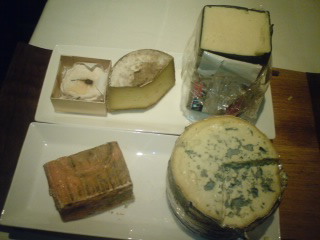
Last night I visited in the company of a good friend, I paid my first visit of the year to Gentil Restaurant In Shizuoka City.
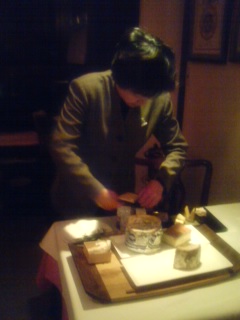
My good friend, Ms. Keiko Kubota, the only Japanese Cheese Sommelierto hold the title of Compagnon d’Honneur de Taste Fromage came up with Cheeses she is currently maturing:
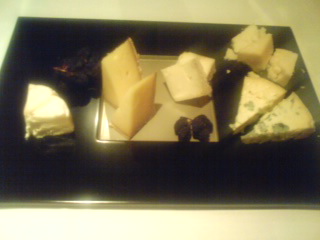
-“Sakura” (Cow’s milk, Hokkaido)
-Tommette D’Aravis (Cow’s milk, Pyrenees, France)
-Talegio (Cow’s Milk,Italy). Rowena, for you!
-Le Chevre Noir (Goat’s milk, Canada). She served that particular creamy hard goat cheese at the G8 Summit in Hokkaido in July last year!
-Fourme d’Ambert(Cow’s milk, France)
We had a very tasty mature Bourgogne wine with the cheese, and a Fonseca Port with the dessert:
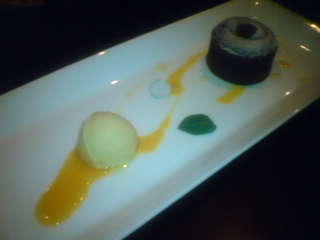
Chocolat Fondant and vanilla ice-cream!
Restaurant Gentil
Address:420-0031 Shizuoka Shi, Gofuku-cho, 2-9-1, Gennan Kairaku building, 2F
Tel.: 054-2547655 (Reservations advisable)
Fax: 054-2210509
Opening hours: 12:00~14:00, 18:00~last orders for meals at 21:30. Bar time 18:00~23:30. Closed on Mondays.
Credit cards OK
Homepage (Japanese)
Please check the new postings at:
sake, shochu and sushi
—————————————-
日本語のブログ
—————————————-

This evening, on my way back from University in Fukuroi City, I ventured inside the great Supermarket inside Shizuoka City JR Station as they are bound, especially in the seafood department, to exhibit some interesting specimens.
I certainly was not disappointed!
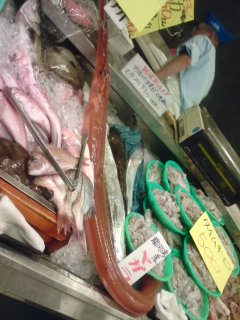
Here is another picture to give you an idea of the size!
Trumpet Fishes come in “blue” and “red” varieties.
This one is a red (“aka”) Trumpet Fish.
A bit of a monster, it was a good 1,5 meter (five feet) long and weighed over 5 kg.
I was told 3 meters (10 feet) long specimens are regularly caught in Suruga Bay, the main Bay of Shizuoka Prefecture!
I knew that my friends at Tomii Restaurant would be interested.
I called them on my mobile.
They replied they definitely were!
I bought the fish on their behalf. At 130 US$, it was cheap (I actually bargained a bit!), considering what customers would pay for this delicate fish, either as sublime sashimi or delicious “nabe”!
Please check the new postings at:
sake, shochu and sushi
—————————————-
日本語のブログ
—————————————-

Last Tuesday night I had to go to the lavatory in a fairly busy and popular izakaya (sorry, I won’t tell you the name!) in Shizuoka City.
The “Mens” and “Ladies” were separate (important deatil!).
I found this “notice” pinned on the wall at eye-level.
The notice says:
“Genki no nai Otoko ha mamushi sake!”/Viper Sake for people (men) not feeling enrgetic!”
This is real sake in which a snake was marinated!
The note says above that you should be careful not too drink too much, or you will suffer from nosebleed (Japanese men supposedly go through this predicament when their libido is overstimulated!).
Actually, orders are limited to a single glass. It had better work as it costs a whopping 22 US$!
Last, but not least, as if men needed more incentive, they added a picture of a “well-endowed” man (face not shown!) wearing snake skin pants!
N.B.: A lady friend in our party told us later that there was nothing hanging on the wall inside the ladies’ facilities!
Please check the new postings at:
sake, shochu and sushi
—————————————-
日本語のブログ
—————————————-

The Missus does not work on Thursday. This is the day we usually go out at night, but the frigid temperature outside having discouraged her to venture into town, she decided to cook both lunch and dinner for us for my (and her own ) pleasure!
For lunch we had a salad of beans, yams from Ishigaki Island and greens with a big bowl of miso and mushrooms soup. As for the main dish featured above, she prepare “Chirashizushi/Sushi on a plate or in a lunch box.
She steamed the rice with a piece of konbu/seaweed.
She later added this seaweed shredded once the rice had been mixed with the rice vinegar, sugar and some “secrets”. She also mixed in some shredded “takuan”/yellow pickled daikon to balance the sweetness of the sushi. Sushi in Shizuoka in generally “sweeter” than that found in other areas of japan, notably Tokyo where it is more “vinegary”.
On top of the rice she placed slices of “maguro”/tuna she had marinated beforehand in konbu ponzu ( a lot lighter tha soy sauce!) and mirin. She added “ikura”/salmon roe and “tobikko”/flying fish roe and completed for color effect and balance pieces of “shiso”/perilla leaves. A dollop of real grated wasabi, et voila!
She couldn’t help remark how much she would price it for customers at her virtual restaurant! LOL (not a bad price, actually!)
Please check the new postings at:
sake, shochu and sushi
—————————————-
日本語のブログ
—————————————-

“Noresore” will soon appear at some select fish markets, and as it will be a very short season, you will have to keep your eyes open!
Noresore stands for very young conger eels. They are called different names depending on regions: “Berada” in Okayama Prefecture, “Tachikurage” in Misaki, “Nagatankurage” in Wakayama Prefecture
In Shizuoka, they mainly come from Hamana Lake, a seawater lake west of the Prefecture, famous for its oysters, eels and clams.

5~6cm long, they are practically transparent, save for their eyes. They emit no smell. In our Prefecture they are available only during the first two weeks of March. They are slowly but surely becoming a rarity wherever in Japan, and people come from afar just for the experience!

Before serving them, lightly wash them in clean salted water.
As sushi, put them on top of “gunkan”, or a rice ball if you are an expert, with freshly grated ginger and chopped thin leeks.
I like them best served as they are with a little “ponzu or “yuzu” vinegar, a dash of “momijioroshi” (freshly grated daikon and chili pepper) and some chopped thin leeks for a last touch of colour!
Please check the new postings at:
sake, shochu and sushi
—————————————-
日本語のブログ
—————————————-

“Zarudofu”, my favourite variety of tofu just filtered out in a “zaru/basket”. You just eat it with a spoon on its own. No seasoning needed!
This is the second article dedicated to some of the many varieties of that celebrated food, tofu. A third article is in preparation as for recipes!
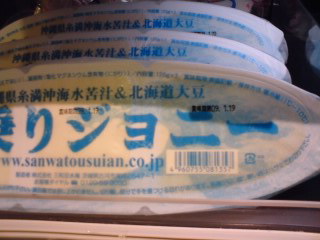
Okinawa Tofu
Tofu comes in various degrees of firmness.
The softest are “Zaru dofu” (see pic above) and Okinawa-style tofu.
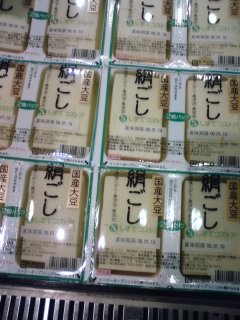
“Kinu Goshi Tofu”
Next come “Kinu Tofu/Kinu Goshi Tofu”/Silk-sieved tofu. It can be used for almost any recipe, although you might have to press it as it contains a lot of water.

“On Tofu”
“On Tofu” is similar to “Kinu tofu”, but it has been conceived as it its name indicates for being eaten hot or warm instead of cold.
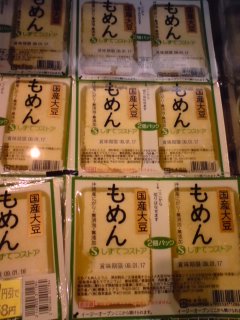
“Momen Tofu”
“Momen Tofu”/”Wool Tofu” contains less water, is firmer and is perfect for “Nabe/Japanese Pot-au-feu”.

“Yaki Tofu”
“Yaki Tofu/Grilled tofu” (not to be confused with deep-fried tofu) is usually “Momen tofu” grilled to give it the “gratine” look. Tasty, it is particularly interesting when sauteed with vegetables and so forth in Japanese, Chinese, Korean or Thai food.
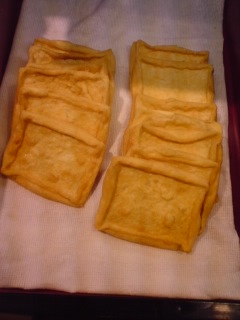
“Yawarakaage or Yawarakai Aburaage”
Tofu can be bought cooked/deep-fried in many manners.
“Yawarakaage” is tofu deep-fried into a thin sheet which can be opened as a pouch like in:
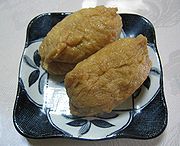
“Inari”
“Inari” is “Yawarakaage”, which has been first marinated in mirin, soy Sauce and sugar. Do ask about its preparation as some companies or individuals add dashi, which is usually not vegan or vegetarian!

“Namaage”
“Karaage Tofu/Deep-fried Tofu” comes in many forms.
The above “Namaage/Deep-fried raw” is the most common.
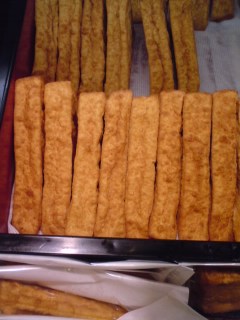
“Kinu Namaage”
“Kinu namaage” is great for the contrast between a solid outside and vey soft inside.
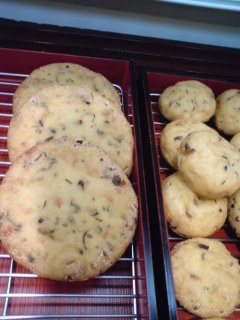
“Ganmo” and “Kyo-Ganmo”
“Ganmo” is Tofu that has pressed to almost dry, then broken into very small lumps to which one added cooked carrots, Hijiki sweet seaweed, grated yam, a little sugar (not always), shaped into a ball and lightly deep-fried. Great, heated again with vegetables and a swet and sour sauce, or in whatever recipe you might imagine. “Kyo-Ganmo” is the smaller Kyoto-Style variety. Ganmo should be made exclusively with vegetal matter, but do ask if you are not sure!

“Tofu Doughnuts”
Yes, you have read it, “Tofu Doughnuts”, very popular with kids!
Other varieties:
-“Okara” is hard-pressed, almost dry tofu sold broken into very small lumps.
-“Yuba” is the “skin” appearing on top of the pan when tofu is being prepared. Very popular served cold with all kinds of ingredients.
-“Koya” is hard-pressed tofu sold marinated. Now, as it contains fish stock dashi, it is not suitable to vegans or vegetarians.
-“Kuro goma tofu” or “Shiro goma tofu” (Black and white sesame curd) are not made with soy beans but sesame, although they make for great food for vegans and vegetarians.
There are many other “fancy” varieties, but I cannot guarantee their suitability to vegans or vegetarians!
Enjoy!
Please check the new postings at:
sake, shochu and sushi
—————————————-
日本語のブログ
—————————————-

Pic kindly upgraded by Jay Gustafson!
Last Friday, on my way back from University, I visited the big Parche Supermarket inside Shizuoka City JR Station as I wanted to cook some seafood for the Missus that night!
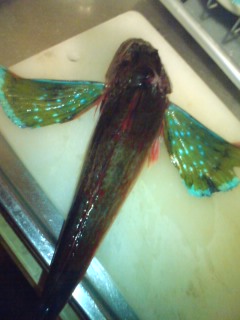
I was lucky to find a couple of medium-sized “Houbou/Blue-Fin Robin” for a little over 4 US$. This fish was caught off the western part of Shizuoka shore. I also discovered a few great value fresh “Te-naga Ebi/Scampi” caught in Suruga Bay (Shizuoka Prefecture). I only needed to check with the vegetables stand nearby and I was back home!
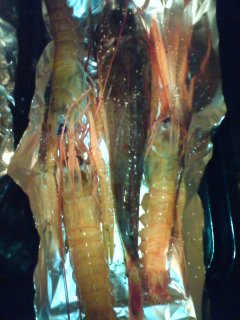
Things are (most of the time) best when kept simple.
I had had the fishmonger dress the fish beforehand, so I needed only to make a couple of shallow cuts across the skin.
In two separate large sheets of foil paper, I place one fish (seasoned with salt and pepper) in the middle, flanked it with two (on the the left) and one scampi (on the right), filled the upper right corner with plenty of fresh basil and dill. I placed mini asparaguses and large fresh broad beans along them, added a good portion of white wine, a little olive oil, some freshly pressed lime juice and a good measure of sweet and hot Thai sauce.
I closed the foil tightly around the whole and baked it on grill at 250 degrees Celsius for 25 minutes.
Served at once, they made for a great and light dinner enjoyed with white wine (for the Missus) and Japanese sake (for me!)
Please check the new postings at:
sake, shochu and sushi
—————————————-
日本語のブログ
—————————————-
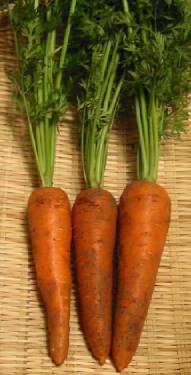
Carrots are consumed everywhere in the World, raw or cooked in so many manners, including desserts, that you need a whole book to describe all the recipes! And you might have to come up with a special addenda leaflet to introduce all its varieties!
Now, people might have forgotten that this cousin of the spinach orignated from Afghanistan before it was first introduced in China and Europe (by the Dutch) in the 12th Century. Japan had to wait until the 16th Century before the Chinese brought it to the Island of the Rising Sun.
FACTS:
Some time ago carrots were not popular in Japan because of their strong taste characteristics, but the Japanese have come with sweeter and softer varieties:

“Kyo-Ninjin”, a variety developed in Kyoto, with a deep dark red colour and very sweet taste.
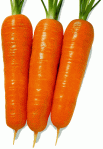
“Go-Sun Ninjin”, the most common in Japan.

“San-Sun Ninjin”, a smaller variety of the above.

“Daijyo Ninjin”, a very long and thin variety very popular in Japanese restaurants! Great for sticks!
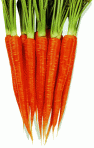
“Kinji Ninjin”, probably the most elegant of them all!

“Kiiro Ninjin”, beautiful and very sweet!
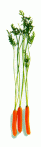
“Mini Ninjin”, so much fun!
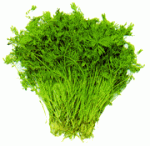
Now, do not forget the leaves which contain an enormous amount of Vitamin C!
-Season: May to June, and October to Deecember in the Northern Hemisphere.
-Beneficial elements:
Carotenes
An absolute need for humans. Carotenes are more easily absorbed by the body systems when the carrots are eaten together with oil, dressing or “glace”.
Vitamin C, Potassium, Calcium.
TIPS:
Preservation: Carrots should not be kept inside too cold fridges. Protect them by wrapping them into newspaper “standing up”, or into cellophane paper if they are cut.
Choose specimen with a good constant colour and with a small stem core if you buy them with leaves already cut away.
Important: When you peel them, do so as thinly as possible as the majority of the carotenes lie just under the skin!
Please check the new postings at:
sake, shochu and sushi
—————————————-
日本語のブログ
—————————————-
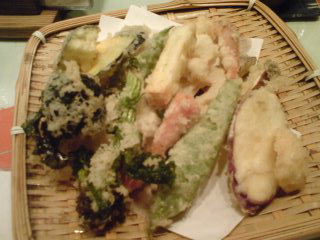
Last Thursday, the Missus and I finally found the time to make a quick visit to our favourite Izakaya in Shizuoka City, namely Bu-Ichi
Not only the food (most of it local) is great, but the Shizuoka Sake are regularly changed according to the food of the moment!
Moreover, vegetarians (and I’m sure they an make something for vegans! Japanese sake is vegan, by the way!) will be glad to learn that tenpura is one of their specialties. See above picture and try to tell what vegetables are served!
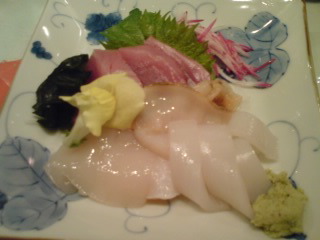
Now for the sashimi lovers, it is simply first class (and very reasonable compared to the prices in Tokyo!). We asked only for a small set and savoured the following:
-Mejiro maguro/big-eyed tuna
-Hotate/Scallops with their “threads”
-Ika/Squid-Cuttlefish
Incidentally the flower is edible (grown in Shizuoka Prefecture!)
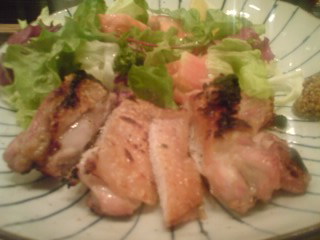
As the last bite before we headed home, we ordered the “Shio-yaki-niwatori/salted grilled chicken.
Crispy skin and absolutely tender flesh! How they do it, I simply don’t have a clue! No need to say the salad was splendid!
Looking forward to our next visit!
Bu-Ichi
420-0032 Shizuoka City, Aoi Ku, Ryogae-cho, 1-6-10, Dai 2 Matsunaga Bldg. 2F
Tel.: 054-2521166
Closed on Wednesdays
Reservations advisable
 SHIZUOKA GOURMET