Tag Archives: 静岡

Sauteed Liver with Garlic Stems

For all the recipes I publish to help my vegan and vegetarian friends, I need my meat!
The difference is that I tried to balance my diet as much as I can.
Mind you, if one keeps to good ingredients, it is quite easy.
Here is a simple recipe, both Japanese and Chinese in cocept, which has the merits to be bvery healthy, calorie-low and balanced.
Makes for a great snack with a beer!

Sauteed Liver with Garlic Stems

INGREDIENTS: For 1 person?

-Liver (sliced): 150 g (choose the liver according to your priorities!)
-Garlic stems: 5 or 6
-Garlic: 1 clove
-Soy sauce: 2 tablespoons
-Japanese sake: 2 tablespoons
-Water: 50 ml/cc
-Salad oil: 1 tablespoon

RECIPE:

-Slice the garlic thinly. Cut the garlic stems into 6~7 cm long pieces.

-Mix the soy sauce, Japanese sake and water as a sauce in a separate bowl.

-Heat the oil in a frypan over a strong fire. Stirfry sliced garlic and liver together.

-Once the liver is almost cooked add garlic stems and sauce.

-Cover with lid, reduce fire and simmer it for about 3 minutes.

-Serve immediately.

NOTES:

There are many possible variations to this recipe:
-add spices of your liking, especially black pepper and chilies.
-add vegetables, especially leaf vegetables.

RECOMMENDED RELATED SITES:
Bread + Butter, Comestilblog, Greedy Girl, Bouchon For 2, Zoy Zhang, Hungry Neko, Mangantayon, Elinluv Tidbit Corner, Maison de Christina, Chrys Niles, Lexi, Culinary Musings, Eats and Everything, Bite Me New England, Heather Sweet, Warren Bobrow, 5 Star Foodie, Frank Fariello, Oyster Culture, Ramendo, Alchemist Chef, Ochikeron, Mrs. Lavendula, The Gipsy Chef, Spirited Miu Flavor, Wheeling Gourmet

Please check the new postings at:
sake, shochu and sushi

—————————————-
日本語のブログ
—————————————-

Vegetables Facts and Tips 6: Asparaguses (amended & expanded)

asparagus-varieties

SYNOPSIS:

I started this series (15 articles so far) quite some time ago to help my vegan and vegetarian (I’m not!) friends and omnivores as well because of the obvious health benefits.
Since then, I’ve learned and discovered a lot more information that could not stay ignored.
Therefore I plan to amend and expand all former articles before I can continue introducing a lot more vegetables!
Incidentally、 nothing, pictures included, is copyrighted in my food blogs, so please feel free to use anything!
1) POTATOES, 2) TOMATOES, 3) BROCCOLI, 4) CARROTS, 5) Sweet Potatoes

Asparagus has been used from very early times as a vegetable and medicine, owing to its delicate flavour and diuretic properties. There is a recipe for cooking asparagus in the oldest surviving book of recipes, Apicius’s third century AD De re coquinaria, Book III. It is said that it was cultivated by the ancient Egyptians, Greeks and Romans, who ate it fresh when in season and dried the vegetable for use in winter.It lost its popularity in the Middle Ages but returned to favour in the seventeenth century.

FACTS:

-Season: They are at their best March~June in the Northern Hemisphere, but can be obtained all year round thanks to state-of-the-art greenhouse cultivation.

-Beneficial elements: Carotene, Vitamin C and E, Vitamins from the B group (B1, B2, B6), Rutin, Vegetal fibers, Folic Acid, Potassium. The amino acid asparagine gets its name from the plant.

-Asparagus rhizomes and root are used ethnomedically to treat urinary tract infections, as well as kidney and bladder stones.

-Asparagus is also believed to have aphrodisiac properties (this belief is at least partially due to the phallic shape of the shoots).

TIPS:

-Choose asparaguses with a clean cutting surface. No black spots should appear.

-The darker the colour, the better. As for white asparaguses, choses with a “wet cutting”

-When storing your asparaguses in the fridge, have them stand upright in a long narrow container with their foot wrapped in wet kitchen paper. Discard bent asparaguses on the supermarket stands.

-Choose green asparaguses with the smallest possible foliage along the stems and dark tips.

-When boiling them, either boil them stading upright inside a pasta mesh container, or absolutely flat in a sauce pan. Do not bend them.

-Asparaguses are best digested when lightly fried with oil.

-If Asparaguses cannot be obtained directly from the farmer, lightly peel but keep yop half as it is to preserve Vitamins.

Varieties:
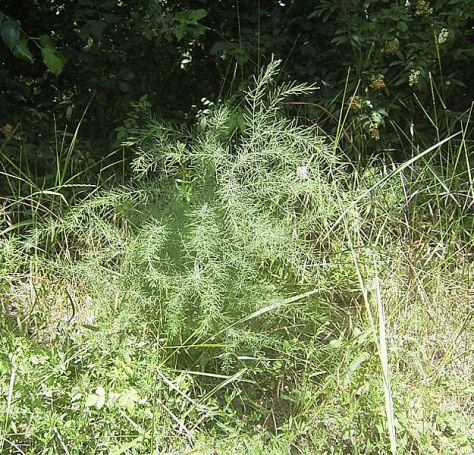
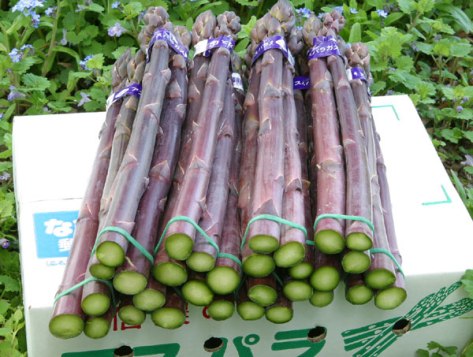
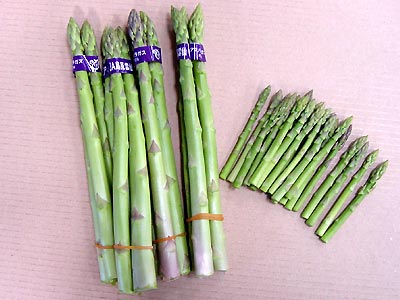
Most popular varieties are shown in the picture above: White, Green and “wild-style” (apeelations vary!)
asparagus-wild

Asparaguses are abundant in the while, but they grow very quickly and get too hard for consumption.
The wild ones picked in their natural environment are my favourite as I fondly rememebr picking them up as a soldier in the South of France during our drills and cooking them in simple omelettes!
asparagus-violet

Violet asparaguse are very popular in any restaurants!
asparagus-mini

Mini-asparaguses are ever so popular in Japan thanks to their practical size.
uzu-41

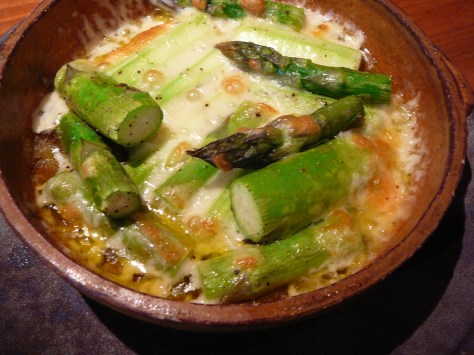
Recipes are endless, but my favourite is the large green asparaguses and mozzarella gratin as prepared and served at Uzu Izakaya in Shizuoka City!

HEALTH FACTS:

-When combined with seaweed, or carrot, or Broccoli, or Spinach, provides stamina and helps combat cancer and colds.

-When combined with shellfish, or chicken, or turnips, or red-fleshed fat fish, helps combat liver problems and provides stamina.

-When combined with okr, or avocado, or celery, or garlic, heps combat cancer, high blood pressure and heart diseases.

-When combined with onion, or codfish, or tofu (especially yuba), or konnyaku/devil’s tongue tuber, helps with qaulitey and flow of blood, helps combat obesity and blood vessel hardening.

RECOMMENDED RELATED SITES
Not-Just-Recipes, Bengal cuisine, Cooking Vegetarian, Frank Fariello, Gluten-free Vegan Family, Meatless MamaFrank Fariello, , Warren Bobrow, Wheeling Gourmet, Le Petit Cuisinier, Vegan Epicurean, Miss V’s Vegan Cookbook, Comestiblog

Please check the new postings at:
sake, shochu and sushi

—————————————-
日本語のブログ
—————————————-

French Cuisine: New Year Lunch at Pissenlit

Last Monday (I mean the 4th of July), we belatedly visited that favourite French restaurant of ours in Shizuoka City for the lunch out of the year.
I’ve already introduced that particular restaurant and his chef, Mr. Arima.
The prices are not only reasonable but the ingredients are simply extravagant.Moreover they are exclusively seasonal, be they from Shizuoka, Japan or abroad. A great emphasis is done on local bio bvegetables and one can expect a feast of colors!

Here what we enjoyed on tha particular day:

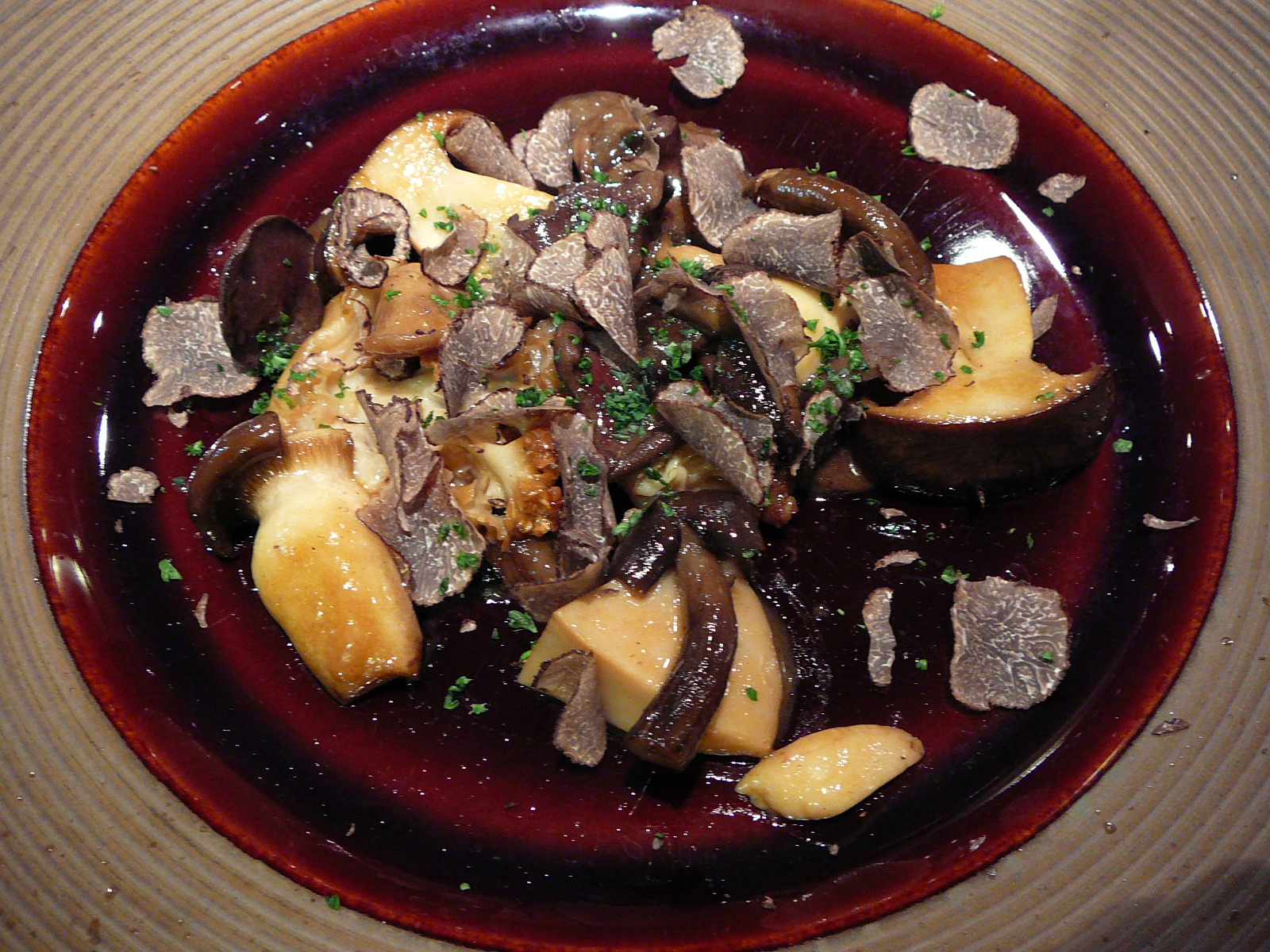
The Missus chose that beautiful plate of sauteed mushrooms topped with fresh truffles!

When I eat French food, I tend to a bit rustic. LOL.
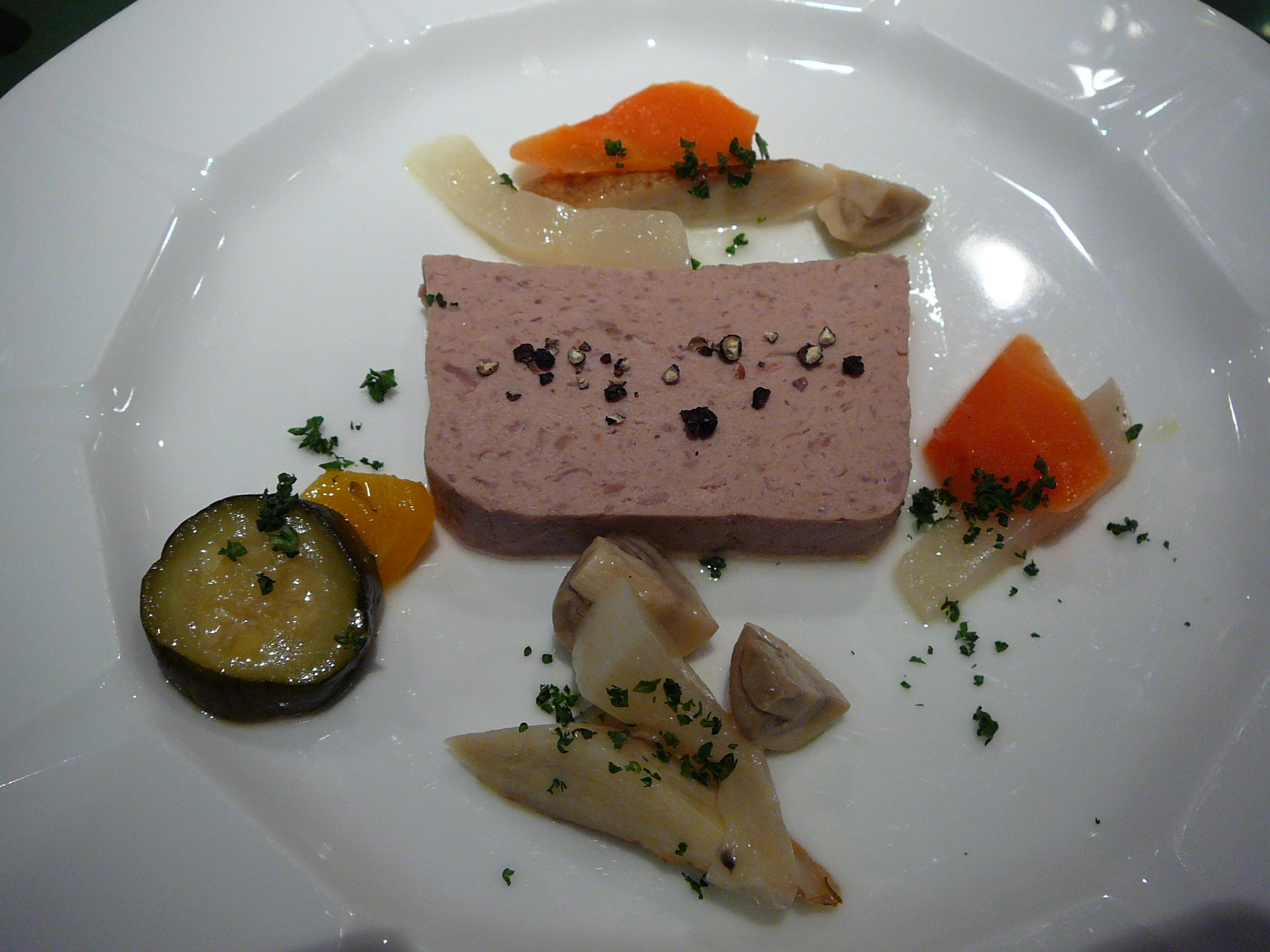
Simple but elegant and perfect chicken liver terrine!

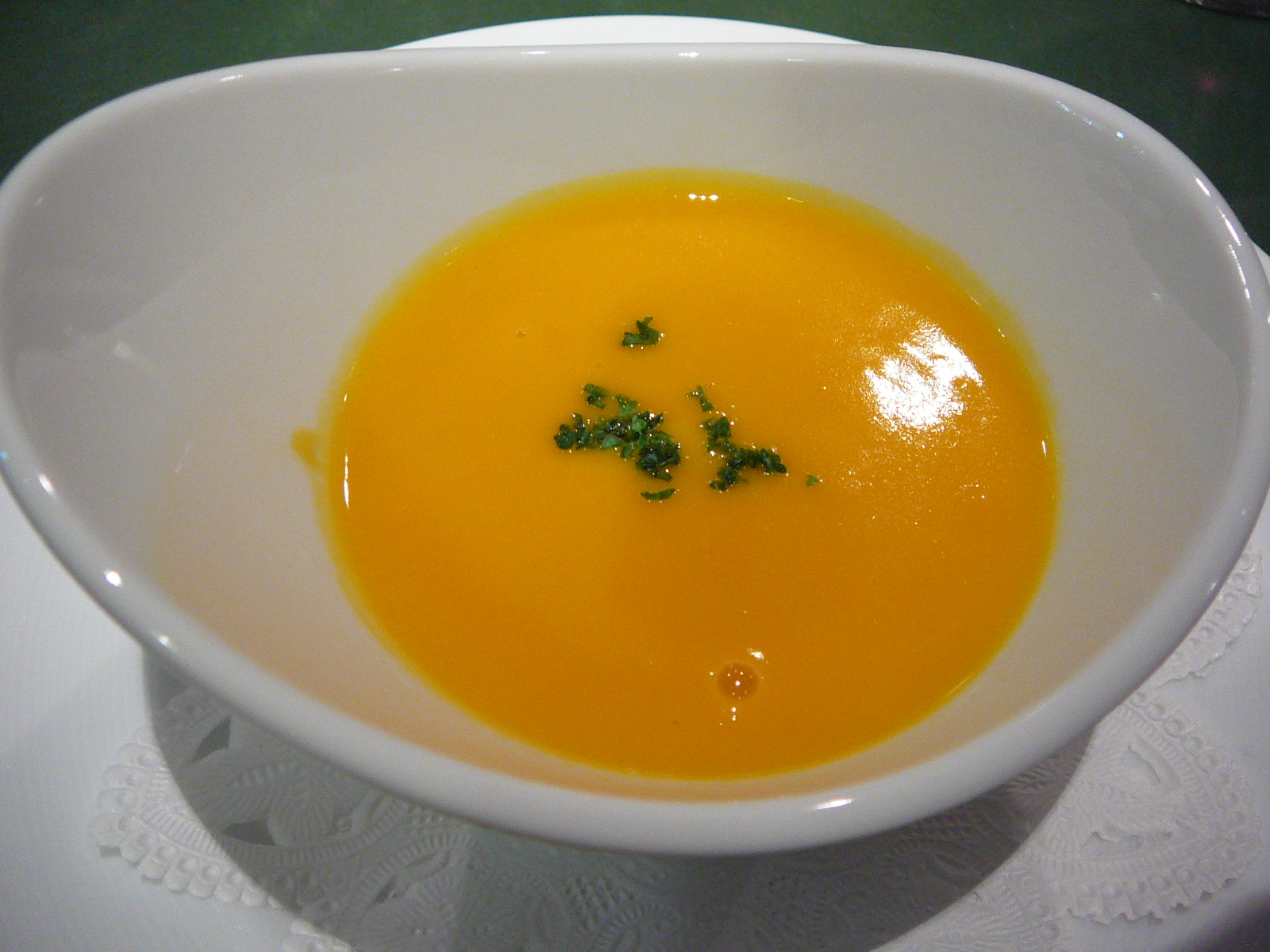
A beautiful kabocha cream for both of us before the main dish.

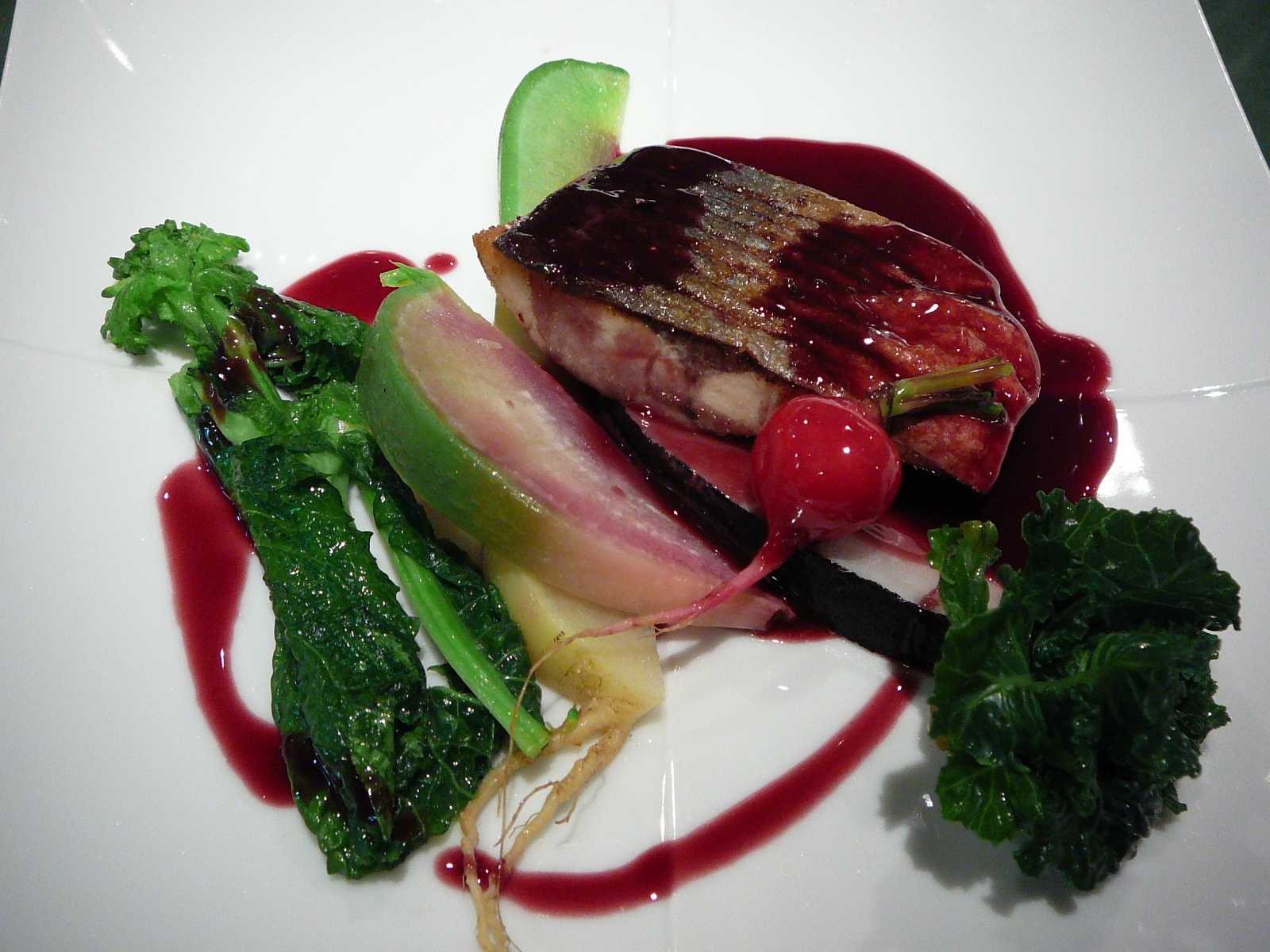
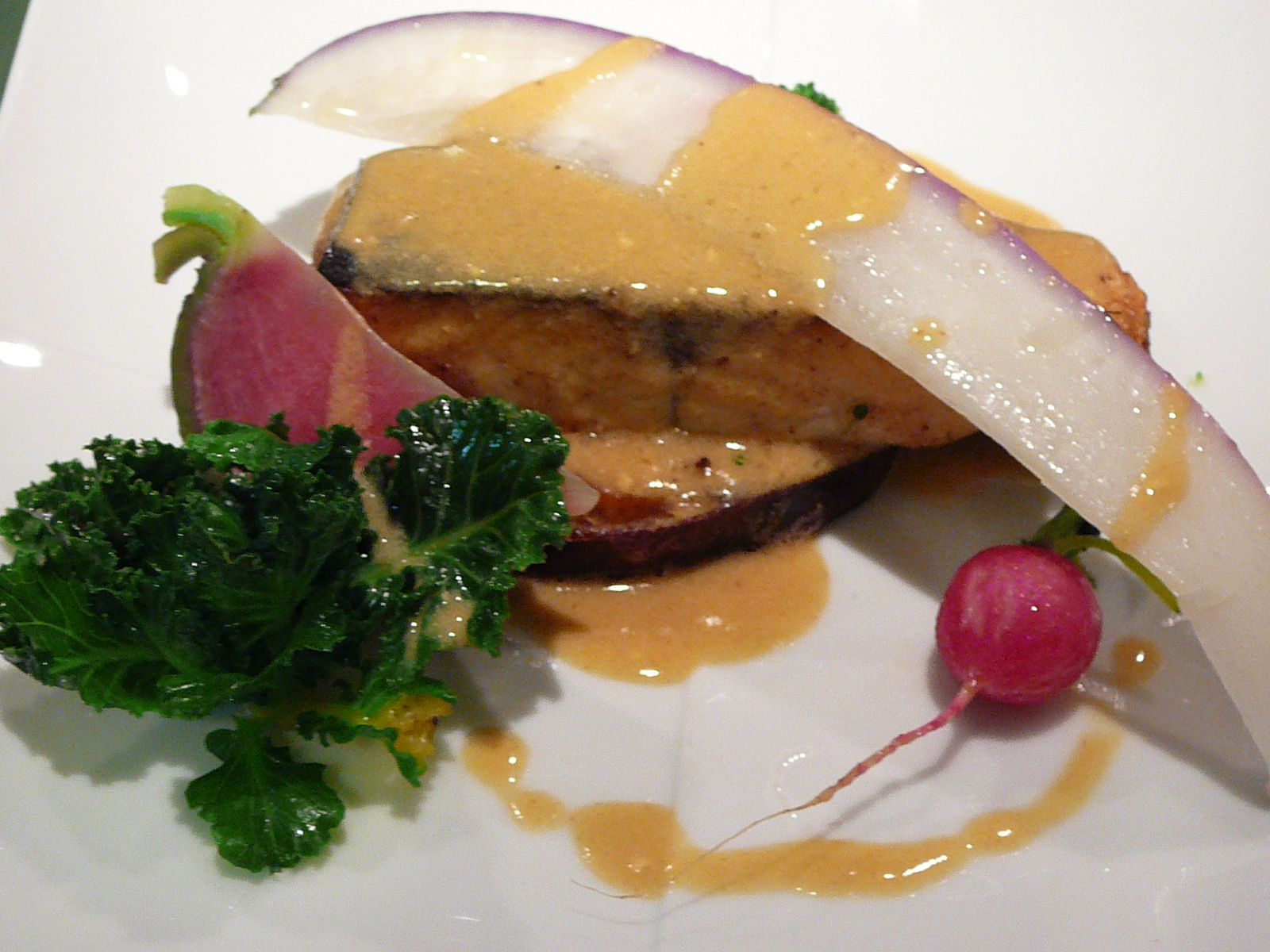
For once, we both opted for fish.
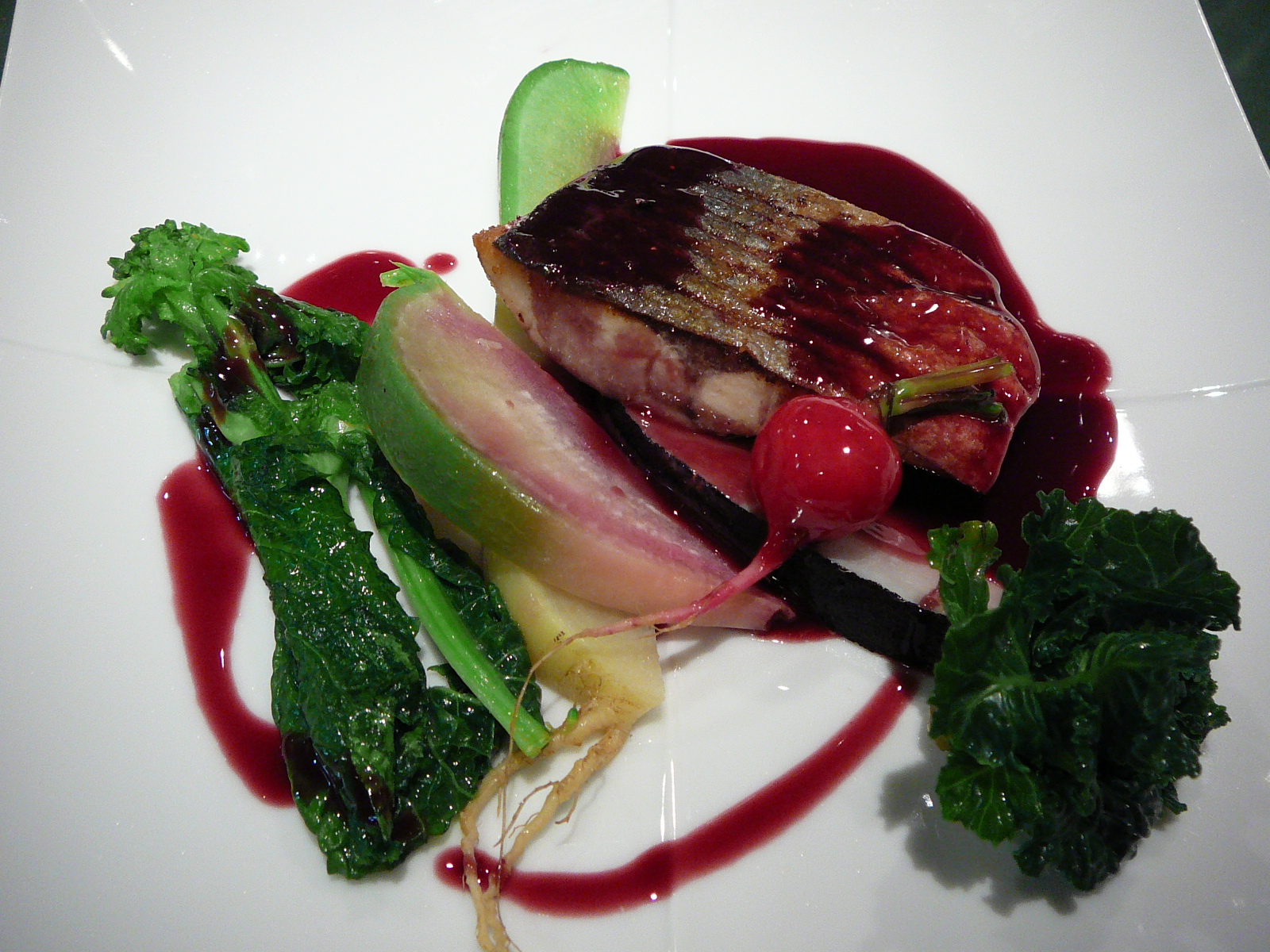
The Missus ordered sauteed “Sawara/Spanish Mackerel” with cassis sauce. Look at those veg!

As for me, I devoured “Inada or young buri/yellowtail” sauteed and served with a dijon mustard cream sauce. Look at those veg again!

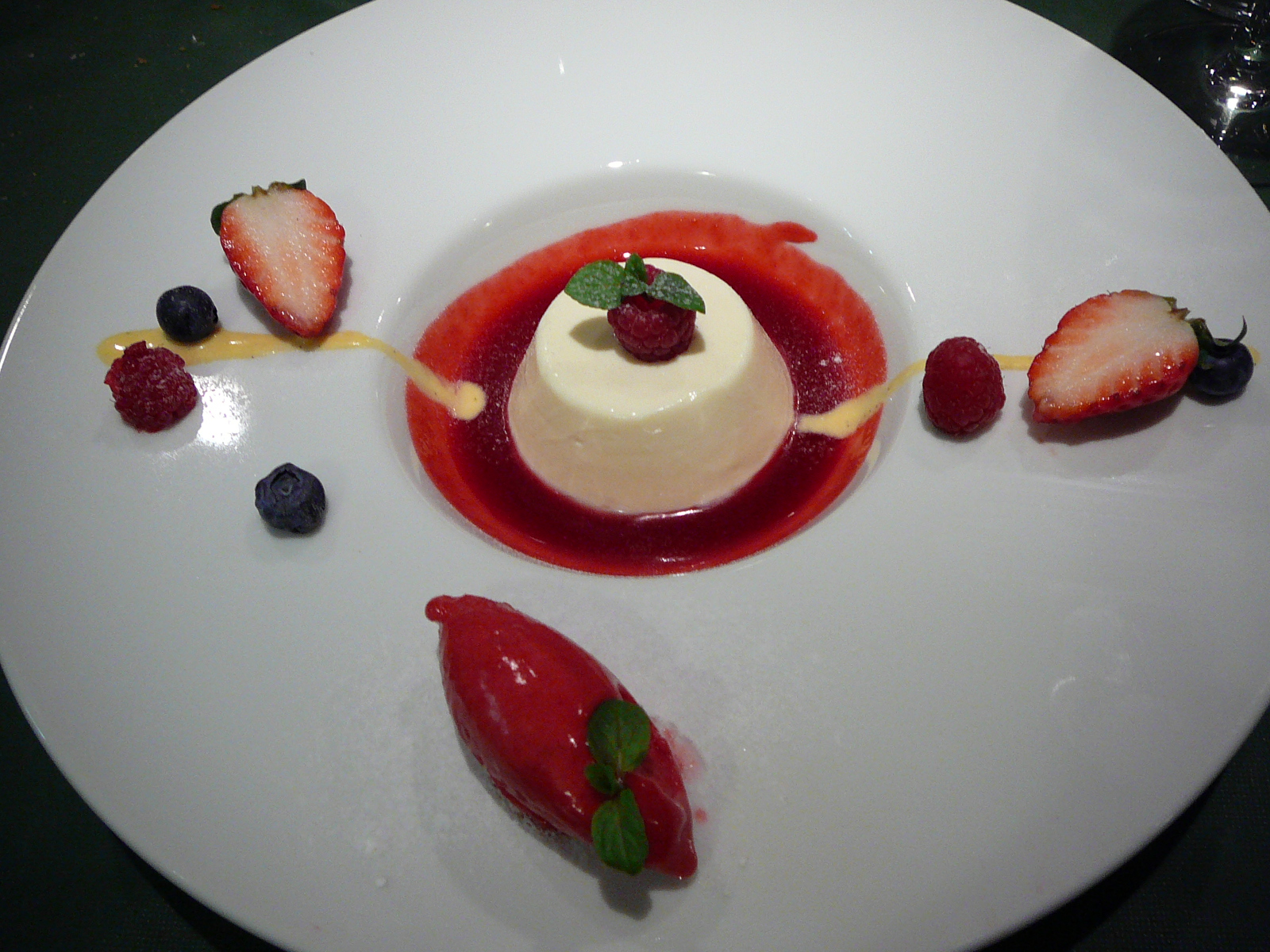
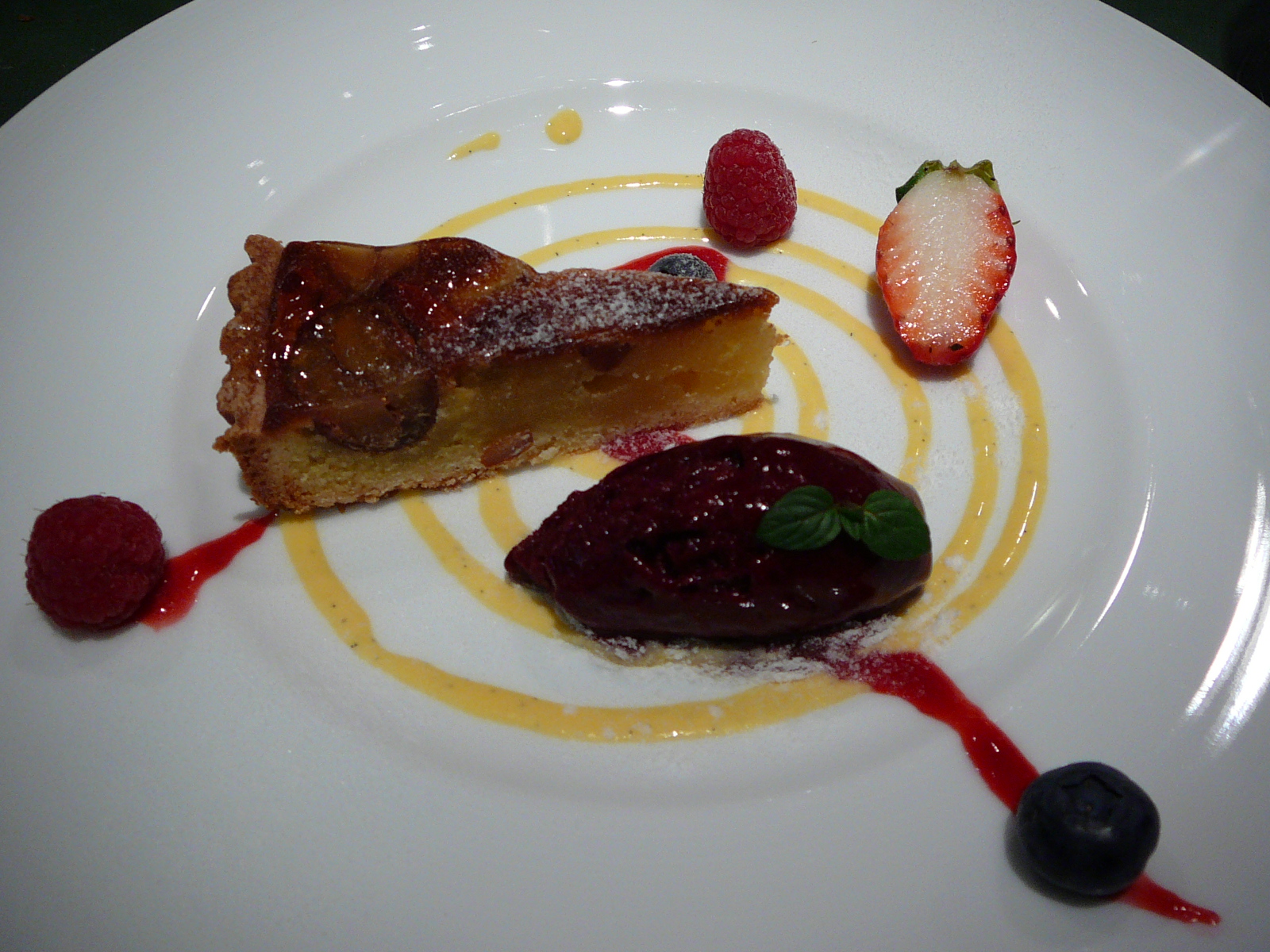
And it was time for dessert:
The Missus delved into Panacotta and raspberry sorbet.

As for me, marrons and almonds tart with cassis sorbet.

Alright, alright, you want to know how much we paid for that?
30 US$ per person, bread, butter and coffee included.
We had 3 glasses of wine each. The total bill was 110 US$.
Worth it, wasn’t it?

PISSENLIT
420-0839 Shizuoka City, Aoi Ku, Takajo, 2-3-4
Tel.: 054-270-8768
Fax: 054-627-3868
Business hours: 11:30~14:30; 17:00~22:00
Closed on Tuesdays and Sunday evening
Homepage (Japanese)
Credit Cards OK

RECOMMENDED RELATED SITES:
Bread + Butter, Comestilblog, Greedy Girl, Bouchon For 2, Zoy Zhang, Hungry Neko, Mangantayon, Elinluv Tidbit Corner, Maison de Christina, Chrys Niles, Lexi, Culinary Musings, Eats and Everything, Bite Me New England, Heather Sweet, Warren Bobrow, 5 Star Foodie, Frank Fariello, Oyster Culture, Ramendo, Alchemist Chef, Ochikeron, Mrs. Lavendula, The Gipsy Chef, Spirited Miu Flavor, Wheeling Gourmet

Please check the new postings at:
sake, shochu and sushi

—————————————-
日本語のブログ
—————————————-
Vegan Sushi Recipe Suggestions 2: Daikon

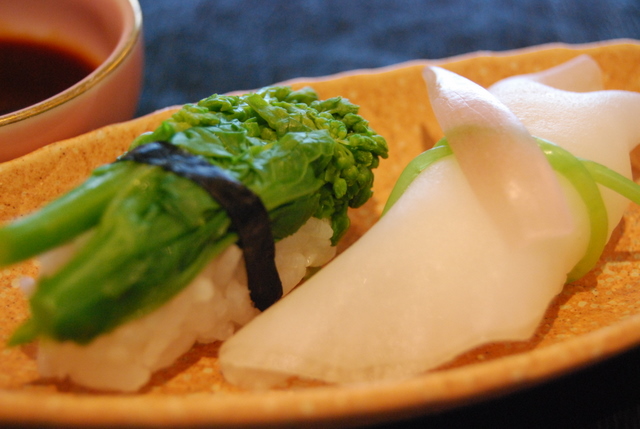
Daikon Nigiri as served at Sushi Ko, Shizuoka City, Japan!

SYNOPSIS:

I already have introduced Vegan and Vegetarian Sushi, but following further requests and questions by my vegan (I’m not!) friends, I decided to contribute a small series of postings to give them more detailed suggestions and ideas!

Now, please check sushi rice recipe HERE to make things more practical!

1) Myoga/Myoga Ginger

————————————

The second vegetable amenable to sushi I would like to introduce is Daikon, or Japanese Radish/Daikon Radish.

Please check DAIKON HERE on Wikipedia!

Daikon seems to be known only in its big white shape with a green top.
Actually, not only it is a versatile vegetables, but it does come into many shapes and colors as shown in picture above.

Once cut, look at these beautiful colors.

Daikon sushi, especially served as nigiri can be made very simple as in above picture where the daikon was sliced very thin and marinated for a while in lemon added water.

For more sophisticated preparations and presentations browse below!

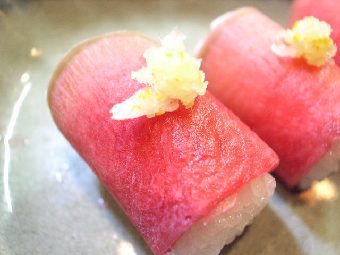
The same as the top picture. The daikon was marinated for a while in yuzu juice and rice vinegar then derved with grated yuzu zest/skin.

Simple but so sophisticated. The other one is rape blossom.

Daikon can be pickled Japanese-style into “takuan/沢庵”, making for great colors and combination!

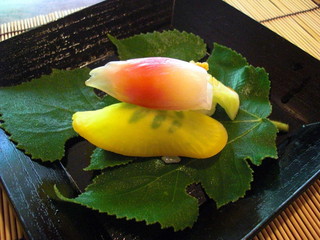
Takuan & Beni Shoga/takuan and red ginger temari sushi!

Great color afain with Koushin Daikon/紅芯大根!

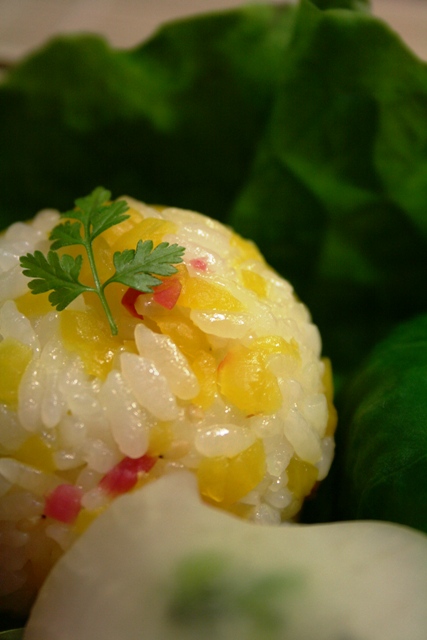
The possibilities are infinite. Can you imagine the takuan above on a rice ball. The whole daikon was first pickled then peeled/cut into a sheet, rolled with lettuce and cut across!

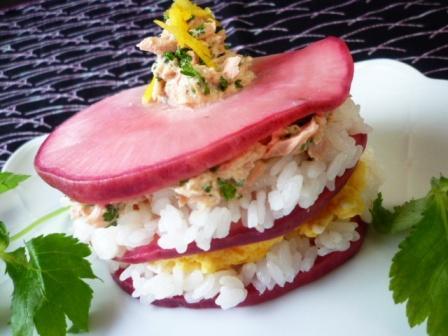
And how about a daikon millefeuille sushi for dessert!

RECOMMENDED RELATED SITES
Not-Just-Recipes, Bengal cuisine, Cooking Vegetarian, Frank Fariello, Gluten-free Vegan Family, Meatless MamaFrank Fariello, , Warren Bobrow, Wheeling Gourmet, Le Petit Cuisinier, Vegan Epicurean, Miss V’s Vegan Cookbook, Comestiblog, To Cheese or not To Cheese, The Lacquer Spoon, Russell 3

Please check the new postings at:
sake, shochu and sushi

—————————————-
日本語のブログ
—————————————-
Vegan New Year Sashimi at Yasaitei

January 5th, 2010. Tuesday, isn’t it? Back to the office. Usual break before late evening work. Hungry, but can’t eat too much as dinner will be waiting for me at 9:30 back home.
Only one option: the quick snack at Yasaitei. Becoming too much of a habit….

What would you expect me to order, then?
Vegatables sashimi!
Boring, you might say…
Totally agree, but boredom is so tatsy sometimes!

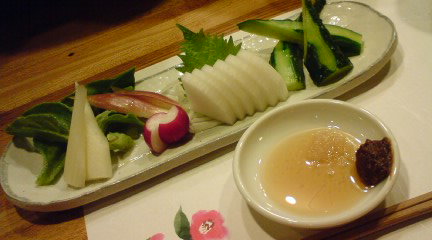
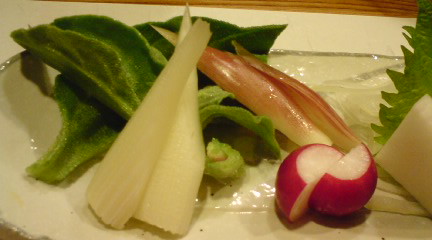
In the front, “the usual stuff” you might say:
Celery (grown in Shizuoka Prefecture), red radihes and myoga ginger sprouts.
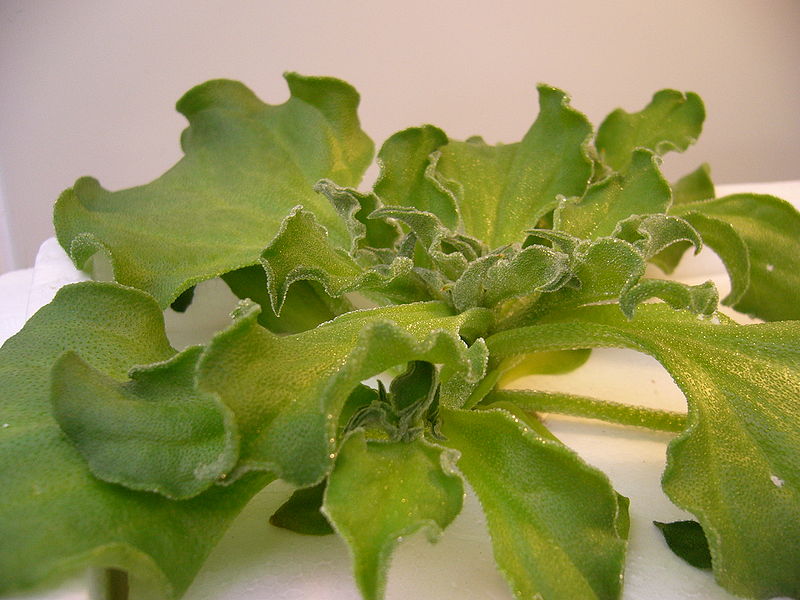
Now, what is that leafy thing on the left in the background?

Common Ice Plant or Crystalline Iceplant? In Japanese? Ice Plant?
The French actually use it in their cuisine under the name of ficoïde glaciale.

Wikipedia will only say that Mesembryanthemum crystallinum is a prostrate succulent plant that is native to Africa, Western Asia and Europe. The plant is covered with large, glistening bladder cells, reflected in its common names of Common Ice Plant, Crystalline Iceplant or Iceplant.
Its leaves are edible, as with other some members of the Aizoaceae family. It is also cultivated for ornamentation (hum!).

And I can tell you they are worth discovering, be vegan, vegetarian or omnivore!

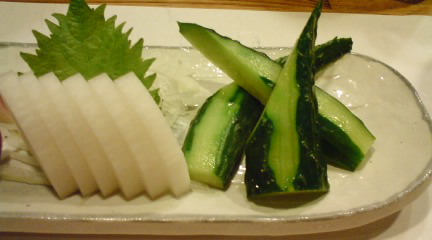
Now, for the second half of the plate: Juicy daikon and crunchy succulent cucumber backed with shiso/perill leaf and sliced winter onions (sweet!)

The dressing was the “usual” sesame oil with rock salt and dark miso.

But I needed a little more (with the second glass of Doman shochu!):
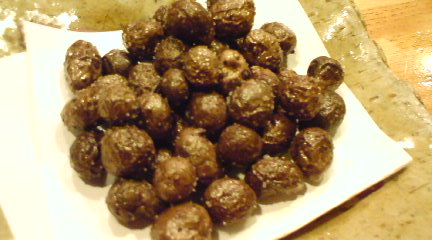
Mukago/零余子!
Now, unfortunately, it might be difficult to find that little thing outside Japan, but note it down on your notebook!

Mukago

A bit difficult to explain. An aerial tuber?
The fact is that it is some kind of fruit/nut/seed (I don’t have a clue here!) produced by yama imo or glutinous yam in Japanese, as one form of natural reproduction.
These mukago are succulent either boiled, or as in this case deep-fried.
Can’t stop eating them once started!

YASAITEI
Shizuoka City, Aoi Ku, Tokiwa-Cho, 1-6-2 Green Heights Wamon 1-C
Tel.: 054-2543277
Business hours: 17:30~22:00
Closed on Sundays
Reservations highly recommended
Seating: 6 at counter + 20 at tables
Set Courses: 3,000, 4,000, 5,000 yen
HOMEPAGE (Japanese)

RECOMMENDED RELATED SITES
Not-Just-Recipes, Bengal cuisine, Cooking Vegetarian, Frank Fariello, Gluten-free Vegan Family, Meatless MamaFrank Fariello, , Warren Bobrow, Wheeling Gourmet, Le Petit Cuisinier, Vegan Epicurean, Miss V’s Vegan Cookbook, Comestiblog, To Cheese or not To Cheese, The Lacquer Spoon, Russell 3

Please check the new postings at:
sake, shochu and sushi

—————————————-
日本語のブログ
—————————————-
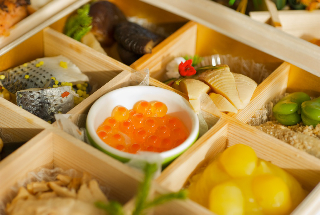
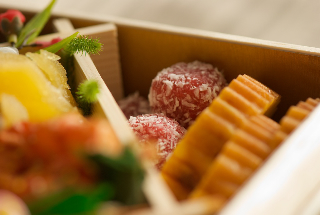
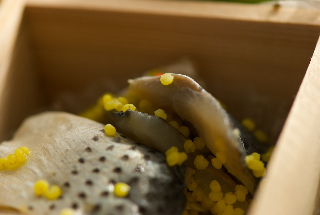
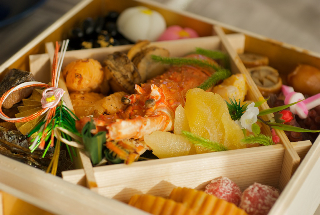
Japanese New Year Cuisine/O-Sechi Ryouri

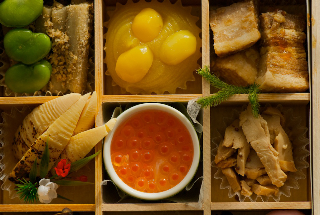
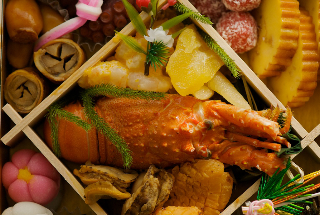
A great friend of mine, who also lives in Shizuoka just sent me pictures of the traditional Japanese New Year Meal he shared with his Missus:
In his own words:

“First meal of 2010. Traditional Japanese food. 45 different items in three boxes, plus sake and special soup. Brunch. Fantastic meal!”

All pictures taken by Marcus Grandon:

Marcus’ first serving!

RECOMMENDED RELATED SITES:
Warren Bobrow, Bread + Butter, Zoy Zhang, Hungry Neko, Think Twice, Frank Fariello, Mangantayon, Hapabento, Elinluv Tidbit Corner, Tokyo Terrace, Maison de Christina, Chrys Niles,Lexi, Culinary Musings, Wheeling Gourmet, Sushi Nomads, Oyster Culture, Ravenous Couple

Please check the new postings at:
sake, shochu and sushi

—————————————-
日本語のブログ
—————————————-
Macha Madeleines

Since Comestilblog nicely asked me, here is a Japanese-style Madeleine.
Madeleines are easy to make and can be come into infinite variations.
Since I could not make it French for fear to bore everyone, i though that macha tea powder would be welcome!

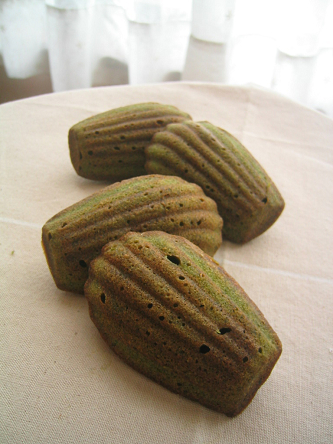
Macha Madeleines!

INGREDIENTS: enough for 15 small ones

-Egg: 1
-Sugar: 55 g
-Cookie (light) flour: 45 g
-Almond powder: 10 g
-Baking powder: 1g
-Macha Tea powder: 5 g
-Melted butter: 60 g (unslated)

RECIPE:

-Mix and sift flour, almond poder, baking powder and macha powder.
Melt butter.
Butter the madeleines molds with butter (not included in the recipe) and then sprinkle flour on the butter (not included in the recipe) for easy unmolding after baking.

-In a bowl, mix egg and sugar gently (so as not to create any bubbles).

-Add egg mixture little by little to flour mixture and mix.

-Once you have mixed above, add little by little melted butter and mix in gently.

-Wrap the top of the bowl and leave it inside the refrigerator for 1~2 hours.

-Bake at 180 Degrees Celsius for 12~15 minutes (depending on the “charater” of your oven).

-Let cool down completely before unmolding!

Easy, isn’t it?

RECOMMENDED RELATED SITES:
Bread + Butter, Comestilblog, Greedy Girl, Bouchon For 2, Zoy Zhang, Hungry Neko, Mangantayon, Elinluv Tidbit Corner, Maison de Christina, Chrys Niles, Lexi, Culinary Musings, Eats and Everything, Bite Me New England, Heather Sweet, Warren Bobrow, 5 Star Foodie, Frank Fariello, Oyster Culture, Ramendo, Alchemist Chef, Ochikeron, Mrs. Lavendula, The Gipsy Chef, Dodol-Mochi, Wheeling GourmetLe Petit Cuisinier, Vegan Epicurean, Miss V’s Vegan Cookbook

——————————–
Please check the new postings at:
sake, shochu and sushi

—————————————-
日本語のブログ
—————————————-
Today’s Lunch Box/Bento (’10/01)

Today’s bento was the first of the year.
The Missus being still on holiday made it in a bit of a hurry as she being bsuy cleaning our place like very Japanese housewife does at the beginning of the year. A good time forme to escape to work! LOL

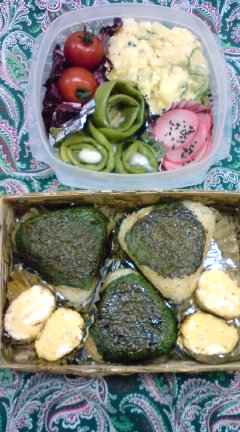
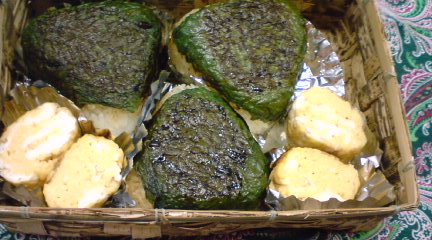
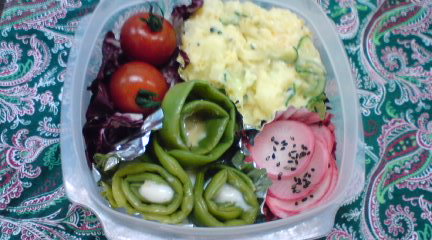
Being conscious of the too many calories I’ve been infgetsing recently she kept my bento to a healthy minimum.: musubi/rice balls, tamagoyaki and salad.

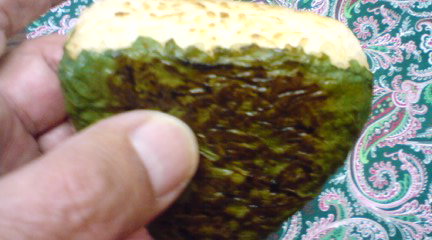
The musubi/rice balls were an interesting concept: She had marinated large egoma leaves (a large and very tasty variety of shiso/perilla) overnght in miso and what else. After steaming the rice, she made triangular rice balls (balls is not the right term, then!), sauteed and then wrapped them inside the leaves. They also contained a honey-sweetened umeboshi/Japanese pickled plum. Very tasty!

The salad dish was basically made up of leftovers:
Potato, onion, cucumber and tobikko/flying fish roe salad, boiled large green beans she rolled with some dressing in the middle. home-made pickled red daikon with black sesame, and plum tomatoes on trevise cabbage.

Colorful, healthy and tasty! No complaints! LOL

RECOMMENDED RELATED SITES:
Warren Bobrow, Bread + Butter, Zoy Zhang, Hungry Neko, Think Twice, Frank Fariello, Mangantayon, Hapabento, Elinluv Tidbit Corner, Tokyo Terrace, Maison de Christina, Chrys Niles,Lexi, Culinary Musings, Wheeling Gourmet

Please check the new postings at:
sake, shochu and sushi

—————————————-
日本語のブログ
—————————————-
Vegan Sushi Recipe Suggestions 1: Myoga/Myoga Ginger

I already have introduced Vegan and Vegetarian Sushi, but following further requests and questions by my vegan (I’m not!) friends, I decided to contribute a small series of postings to give them more detailed suggestions and ideas!

Now, please check sushi rice recipe HERE to make things more practical!

The first vegetable amenable to sushi I would like to introduce is Myoga, or Myoga Ginger.

Please check Myoga HERE on Wikipedia!

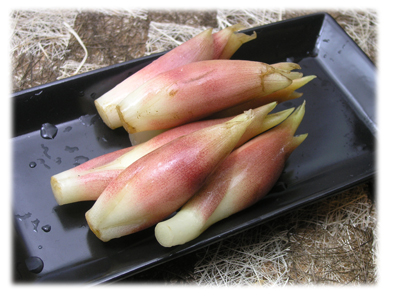
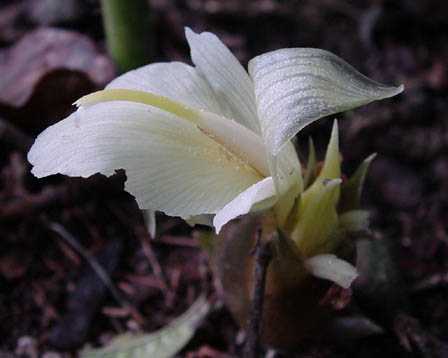
Myoga is a very interesting vegetable as not only the shoots but also the flowers are edible!

The flower in its natural state!

As bought at the market.

Interestingly enough, as Japan makes an enormous consumption of them it has to import a lot from New Zealand and Australia. I’m sure you can buy it at local Asian markets. It could porve an interesting cultivation for some, too!

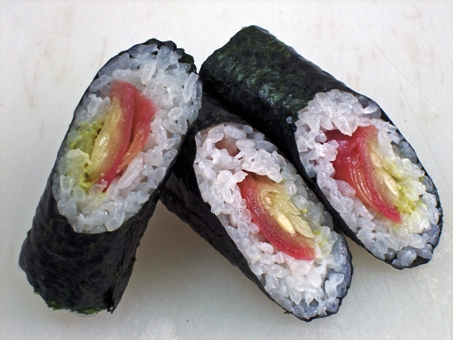
Myoga sushi roll.

Now there are two basic ways of presenting myoga as sushi.
First, as shown on above picture, as a roll.
It doesn’t have to be complicated. Just chop the myoga in strips and fill the roll with it accompanied by some wasabi.

Myoga Sushi nigiri.

The other basic way is present it as sushi nigiri on top of a small ball of sushi rice previously smeared with a little wasabi.

You can prepare the myoga in two basic ways,too:
The first one would would be just to wash it and use it raw.
The second would be to pickle it in rice vinegar and sugar for a while, press it and serve it in both sushi styles as explained above.

There are other interesting possibilities when you let your imagination go free as in above picture where the rice is replaced with a small cube of tofu and the topping is made with chopped myoga, tofu and wasabi all mixed together!

To further convince you, look at the picture above:
All vegan sushi:
from top down: Cucumber, egg plant/aubergine and myoga. The last are pickled daikon!

RECOMMENDED RELATED SITES
Not-Just-Recipes, Bengal cuisine, Cooking Vegetarian, Frank Fariello, Gluten-free Vegan Family, Meatless MamaFrank Fariello, , Warren Bobrow, Wheeling Gourmet, Le Petit Cuisinier, Vegan Epicurean, Miss V’s Vegan Cookbook, Comestiblog, To Cheese or not To Cheese, The Lacquer Spoon, Russell 3

Please check the new postings at:
sake, shochu and sushi

—————————————-
日本語のブログ
—————————————-
New Year Sashimi Sets in Shizuoka Supermarkets

Tradition has been changed or made with altogether!
From this year, the main supermarkets were oprn on New Year’s Day in Shizuoka.
Economic crisis? Cutthroat competition with “Convenience Stores”?
The result is that you don’t to worry any more about stocking up foood for the long Japanese New Year Holidays!

Not only the Shizutetsu Chain Supermarkets were open, but they had advertized bargains well in advance.
One concerned sashimi.
I just couldn’t ignore it and visited the largest store near my home yesterday afternoon.
I noticed that I had messed with my mobile phone camera today when I noticed the dates printed on the pics. I never do so, but at least, it will serve as a proof that I reaaly the pics yesterday! LOL

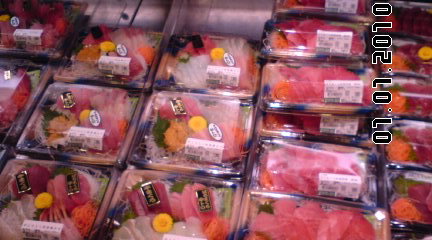
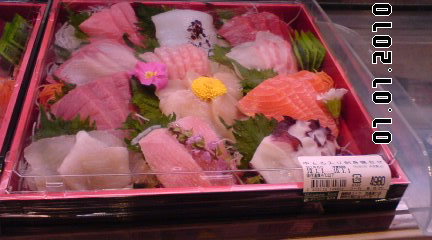
As you can see on the above pic there was plenty to choose from.
The main particularity was that the tuna was all wild tuna (Shizutetsu has a direct delivery deal with the various harbours in the Prefecture!)

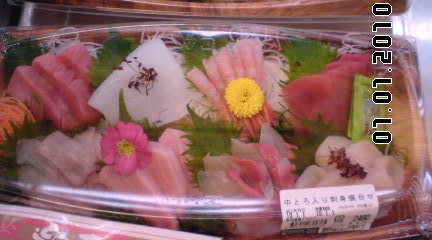
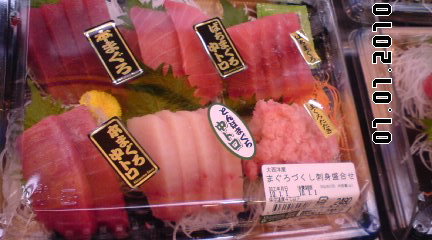
The set above is priced at about 25US$ and included sashimi from 3 different tuna: honmaguro, tonbomaguro and bachimaguro, from akami to chu-toro.

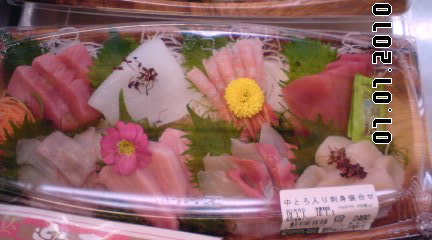
The above set for about 50US$ is a bit extravagant, athough very cheap (dead cheap abroad, I suppose!) and included three types of maguro/tuna, one tai/seabream, one madai/true seabream, one tako/octopus, one hirame/sole, one ika/cuttlefish, one buri/yellowtail, amaebi/sweet shrimps, hotate/scallops and one shake/salmon!

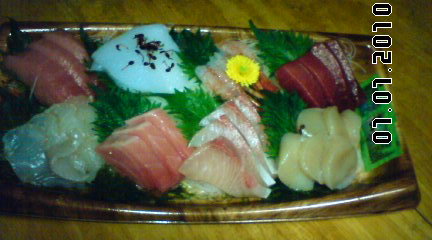
This is the one I chose for both of us (25US$)!

Top from left to right:
Honbomagurao Chutoro, Surumeika/Cuttlefish, Amaebi/Sweet Shrimps and Bachimaguro Chutoro
Bottom from left to right:
Hirame/Sole, Bachimaguro Chutoro, Buri/Yellowtail, and Hotate/ Scallops.

Of course I had Sake from Shizuoka with that lot!

RECOMMENDED RELATED SITES:
Warren Bobrow, Bread + Butter, Zoy Zhang, Hungry Neko, Think Twice, Frank Fariello, Mangantayon, Hapabento, Elinluv Tidbit Corner, Tokyo Terrace, Maison de Christina, Chrys Niles,Lexi, Culinary Musings, Wheeling Gourmet, Sushi Nomads, Oyster Culture, Ravenous Couple

Please check the new postings at:
sake, shochu and sushi

—————————————-
日本語のブログ
—————————————-
Vegan Japanese Pickled Turnips

As i said in my previous posting, for too long, turnips have been considered food for the poor and destitutes.
In France it is also the symbol of a bad play or movie!
Actually they make for great vegetables, cheap and easy to cook!

The Japanese have come with all kinds of ways to prepare them forthe pleasure of vegans, be they Japanese or expats in this country.
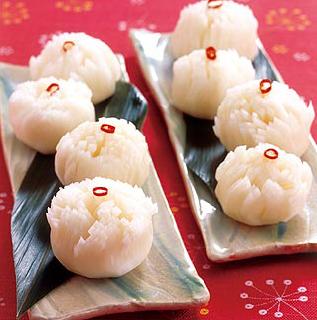
The following recipe is called “Kabu no Kiku Hana Zuke/かぶの菊花漬け or:
Japanese pickled Turnips in the shape of Chrysanthemums!

INGREDIENTS: For 4 people

-Turnips: 8 small
-Sugar: 3 tablespoons

-Rice vinegar: 1/2 Cup/100 cc/ml
-Red Chili pepper (dried, 1 whole)

RECIPE:

-Peel the turnips carefully and take out leaves and their green spot from the top of the vegtables. With a sharp knife make incisions two thirds deep all around the top of the turnips.

-Place the turnips side by side inside a bowl. Cover them completely with salted water. Leave them marinate for 15 minutes to soften them.

-Mix rice vinegar and sugar.
Drain the turnips thoroughly.
Pour the sweet vinegar over the turnips and let marinate for a whole night.

-Take turnips out and press out the vinegar only lightly.
Open and spread the indented parts as to give tem the shape of a looming flower like in the picture.
Top with a small circle of cut chili pepper.

Enjoy as a snack any time of the day or use as a central part of a vegetable salad!

RECOMMENDED RELATED SITES
Not-Just-Recipes, Bengal cuisine, Cooking Vegetarian, Frank Fariello, Gluten-free Vegan Family, Meatless MamaFrank Fariello, , Warren Bobrow, Wheeling Gourmet, Le Petit Cuisinier, Vegan Epicurean, Miss V’s Vegan Cookbook, Comestiblog, To Cheese or not To Cheese, The Lacquer Spoon

Please check the new postings at:
sake, shochu and sushi

—————————————-
日本語のブログ
—————————————-
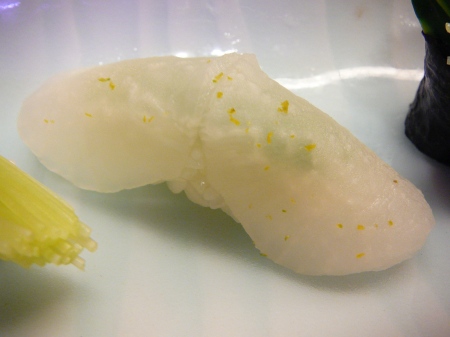
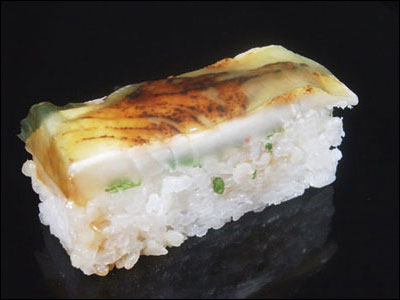
Oshizushi/Pressed Sushi Techniques 4: Seared Seabream/Tai no Aburi

SYNOPSIS:

Sushi exists under many forms and guises.
It is not all nigiri and (more ubiquitous) sushi rolls!
Have you ever heard of Oshizushi?

Oshizushi (押し寿司, litterally pressed sushi), is a pressed sushi from the Kansai Region, a favourite and specialty of Osaka.

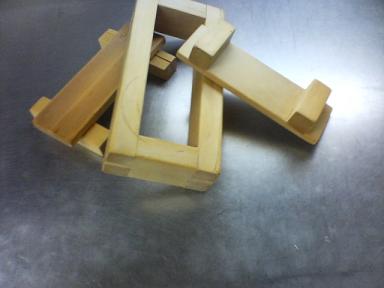
Oshibako unmounted

It is made with the help of a block-shaped piece formed using a wooden mold, called an oshibako/押し箱.

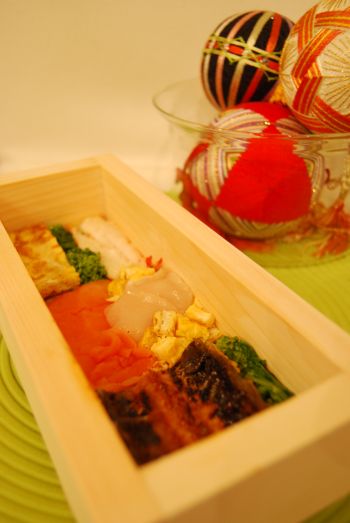
Oshibako lined with toppings

The chef lines the bottom of the oshibako with the toppings, covers them with sushi rice, and then presses the lid of the mold down to create a compact, rectilinear block.

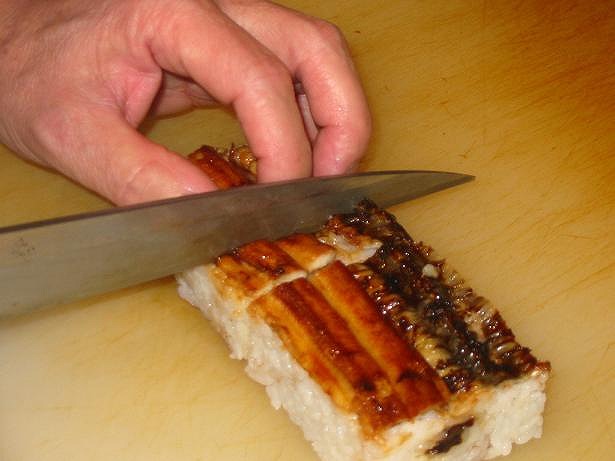
Cutting Grilled Eel Oshizushi

The block is then removed from the mold and then cut into bite-sized pieces.

It is great fun to experiment at home for large parties or the family as you can include almost anything.
Moreover, oshizuhi is easy to transport and include in bento!

The recipes and techniques I’m introducing here are professional, but with a little practice I’m sure you will become a specialist

1)Salmon Marinated in Seaweed/Sake Sushi Konbushime, 2) Seared Prime Beef/Gyuniku Aburi, 3) Egg Bearing Snow Crab/Seikogani

———————————-

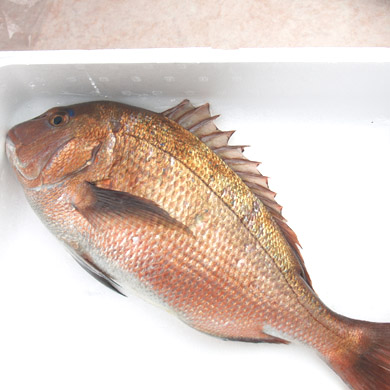
Seabreams or Snappers come in so many varieties all over thw orld that it becomes quite easy to find and adapt to various cuisines.
The Japanese are extremely fond of it either raw or steamed with rice.
When using it as sashimi or sushi, choose a fresh fis. Look at their eyes and press with fingers. And use your nose!

Madai/真鯛 or “True Seabream”, the most commonly used type of seabream in Japan.

For an extra finishing touch for the taste, use fresh leaves of sansho/山椒 or Japanese pepper (also called ki no me/木の芽).
The English name is Shichuan Pepper, although we are talking of the fresh plant here.

In Japan the dried and powdered leaves of Zanthoxylum sancho are used to make noodle dishes and soups mildly hot and fragrant. The whole fresh leaves, 木の芽 kinome, are used to flavour vegetables, especially bamboo shoots, and to decorate soups. Typically the young shoots are used in this way giving an aromatic lemony flavour to food. They are used to denote spring seasonality in food. The buds, seeds, flowers, and hulls are also used.

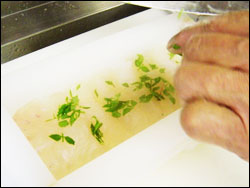
Chop some leaves finely enough to use with sushi, but not to fine. Cut them as short as shown in picture.

Soften light seaweed in lukewarm water and spread it over a clean cloth.

Line the bottom of the oshibako/box with slices of seabream fillet as tightly to each other as possible.
Sprinkle with chopped sansho leaves.
Fill with sushi rice and press.

Unloose oshizushi out of the box.
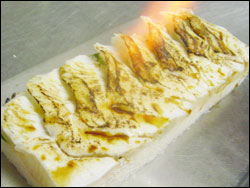
Brush the surface lightly with some soy sauce (I sweeten it a bit by mixing it with a little mirin/sweet sake).
Sear the fish lightly.
Repeat the same process twice more so as to cook only the surface and make it take a nice colour.
This way you will be able to taste the fish in two different ways inside your mouth!

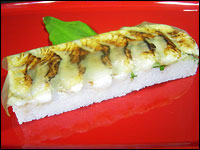
Spread the light seaweed over the top.
Cut to size and serve immediately for maximum enjoyment!

RECOMMENDED RELATED SITES:
Warren Bobrow, Bread + Butter, Zoy Zhang, Hungry Neko, Think Twice, Frank Fariello, Mangantayon, Hapabento, Elinluv Tidbit Corner, Tokyo Terrace, Maison de Christina, Chrys Niles,Lexi, Culinary Musings, Wheeling Gourmet, Sushi Nomads, Oyster Culture, Ravenous Couple

Please check the new postings at:
sake, shochu and sushi

—————————————-
日本語のブログ
—————————————-
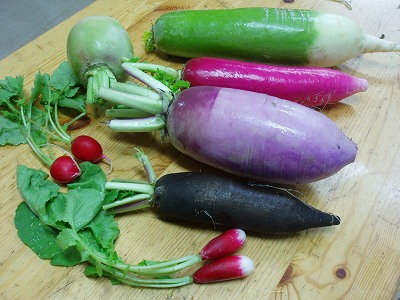
Vegan Japanese Tomato Turnips

For too long, turnips have been considered food for the poor and destitutes.
In France it is also the symbol of a bad play or movie!
Actually they make for great vegetables, cheap and easy to cook!

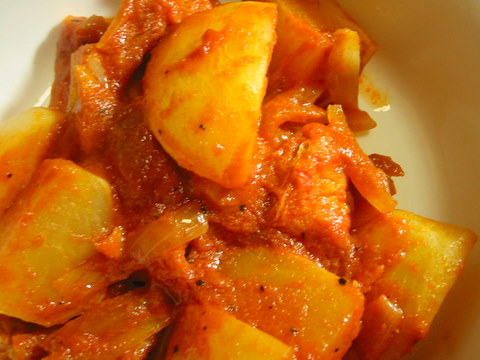
Here is a very simple recipe with simple cheap ingredients for “poor” vegans.
Great for kids, too!

INGREDIENTS: 1 person?

-Turnips: 2 (organic!)
-Onion: half 1 (organic!)
-Aburaage/fried tofu: 1 (sliced into 5 cm long thin strips)
-Olive oil: for frying
-Tomato juice (organic, please, or makeyour own!): 300 cc/ml
-Salt: 1 teaspoon (can be reduced, especially for kids!)
-Ground black pepper: to taste

RECIPE:

1 Cut turnips into wedges. Slice the onions thin.

2 Pour some olive oil in a fry pan. Fry sliced turnips, onions and aburaage, bearing in mind turnips become soft very quickly.

3 After frying on a medium fire for about 3 minutes, add tomato juice, salt and simmer for about 8 minutes on a low fire.
If and when the turnips are cooked, switch off fire and sprinkle with ground black pepper.

Simple, isn’t it? The point is to stew/simmer the vegetables in tomato juice. Aburaage will provide some bite!

RECOMMENDED RELATED SITES
Not-Just-Recipes, Bengal cuisine, Cooking Vegetarian, Frank Fariello, Gluten-free Vegan Family, Meatless MamaFrank Fariello, , Warren Bobrow, Wheeling Gourmet, Le Petit Cuisinier, Vegan Epicurean, Miss V’s Vegan Cookbook, Comestiblog, To Cheese or not To Cheese, The Lacquer Spoon

Please check the new postings at:
sake, shochu and sushi

—————————————-
日本語のブログ
—————————————-

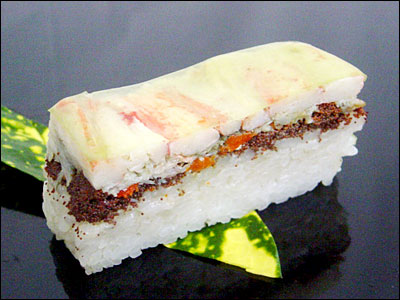
Oshizushi/Pressed Sushi Techniques 3: Egg Bearing Snow Crab/Seikogani

SYNOPSIS:

Sushi exists under many forms and guises.
It is not all nigiri and (more ubiquitous) sushi rolls!
Have you ever heard of Oshizushi?

Oshizushi (押し寿司, litterally pressed sushi), is a pressed sushi from the Kansai Region, a favourite and specialty of Osaka.

Oshibako unmounted

It is made with the help of a block-shaped piece formed using a wooden mold, called an oshibako/押し箱.

Oshibako lined with toppings

The chef lines the bottom of the oshibako with the toppings, covers them with sushi rice, and then presses the lid of the mold down to create a compact, rectilinear block.

Cutting Grilled Eel Oshizushi

The block is then removed from the mold and then cut into bite-sized pieces.

It is great fun to experiment at home for large parties or the family as you can include almost anything.
Moreover, oshizuhi is easy to transport and include in bento!

The recipes and techniques I’m introducing here are professional, but with a little practice I’m sure you will become a specialist

1)Salmon Marinated in Seaweed/Sake Sushi Konbushime, 2) Seared Prime Beef/Gyuniku Aburi

———————————-

Egg Bearing Snow Crab/Seikogani

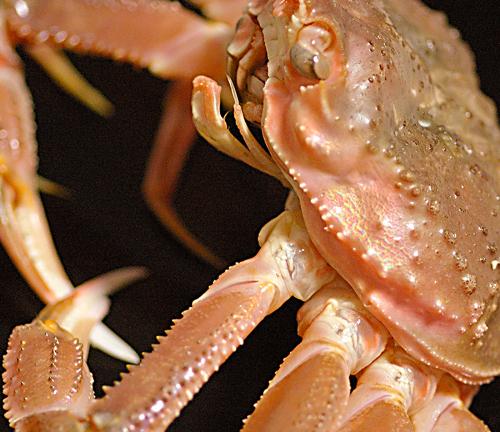
Snow Crab/Zuwagani

Seikogani is the Japanese name for the female Snow Crab or Zuwagani, when she is bearing her eggs.
Contrary to many other kinds of crabs, the female snow crabs, even when bearing eggs, lose little of their food and taste quality with the added advantage of an extra delicacy and taste. On the other hand the main food is found inside the shell instead of the legs and pincers for the males.
Therefore, if you get your hands on such a specimen, do not ignore it, even if they are noticeably smaller than their male counterparts!

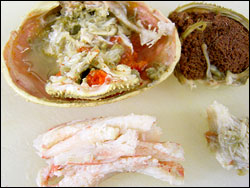
Boiled snow crabs.

The best is actually to combine both male and female into a combination sushi.

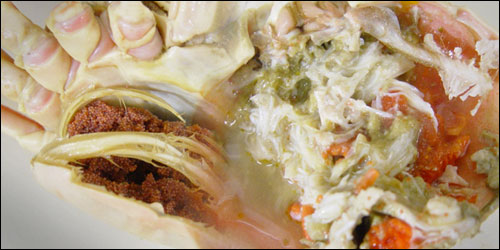
Above are the shells of two snow crabs, the large male one containing white flesh and red brains from both male and female, the smaller female one containing the eggs, and the flesh taken out of the male legs after boiling and cooling.

See above picture for better view of the edible morsels: white flesh, red brains (don’t forget these!) and eggs.

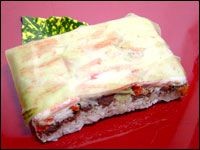
As there is a danger of a general crumbling out of the ingredients, line the bottom of the oshibako/box with a good layer of light seaweed first instead of doing it after you have unloose the sushi out ofits box.
Then place legs flesh tightly parallel to each other to form as compact as possible layer. Cover the leg flesh with the eggs and red brains into a pleasing design.
Finally fill with sushi rice and press.

Unloose sushi from its box and cut to size before serving!

RECOMMENDED RELATED SITES:
Warren Bobrow, Bread + Butter, Zoy Zhang, Hungry Neko, Think Twice, Frank Fariello, Mangantayon, Hapabento, Elinluv Tidbit Corner, Tokyo Terrace, Maison de Christina, Chrys Niles,Lexi, Culinary Musings, Wheeling Gourmet, Sushi Nomads, Oyster Culture

Please check the new postings at:
sake, shochu and sushi

—————————————-
日本語のブログ
—————————————-

Japanese Vegan Avocado Pudding

The same as for shakes, vegans should not worry about ingredients when making a pudding!

Here is a very simple way to make a healthy appetizer the Japanese way!

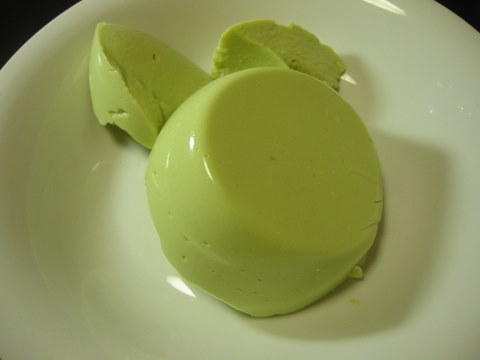
Japanese Vegan Avocado Pudding!

INGREDIENTS: For 3~4 people

-Agar agar: 2~4 g (depending how solid you like your pudding!)
-Tofu (kinu/silk tofu): 1 standard portion~400 g
-Avocado: 1 ripe
-Very fine salt, ground white pepper: to taste and according to preferences
-Spices: if preferred

RECIPE:

-Mix the agar agar in a little water.

-In a pan drop the tofu and agar agar. Heat over a medium fire and stir into smooth paste. As soon as the agar agar has dissolved into the tofu. Switch off fire and take away the pan from the fire.

-Drop the tofu inside a food processor. Add the avocado cut into rough pieces and seasoning, and process until smooth.

-Pour the mixture inside lightly oiled molds. Let cool completely and leave inside refrigerator to chill and harden.

Great with wasabi dressing, or ponzu!
If you like your pudding solid, pour it into a rectangular mold and cut it in slices like sashimi!

RECOMMENDED RELATED SITES
Not-Just-Recipes, Bengal cuisine, Cooking Vegetarian, Frank Fariello, Gluten-free Vegan Family, Meatless MamaFrank Fariello, , Warren Bobrow, Wheeling Gourmet, Le Petit Cuisinier, Vegan Epicurean, Miss V’s Vegan Cookbook, Comestiblog, To Cheese or not To Cheese, The Lacquer Spoon

Please check the new postings at:
sake, shochu and sushi

—————————————-
日本語のブログ
—————————————-