Tag Archives: Japanese Gastronomy

Miso Paste: Made Onsite at Miwa Agriroad

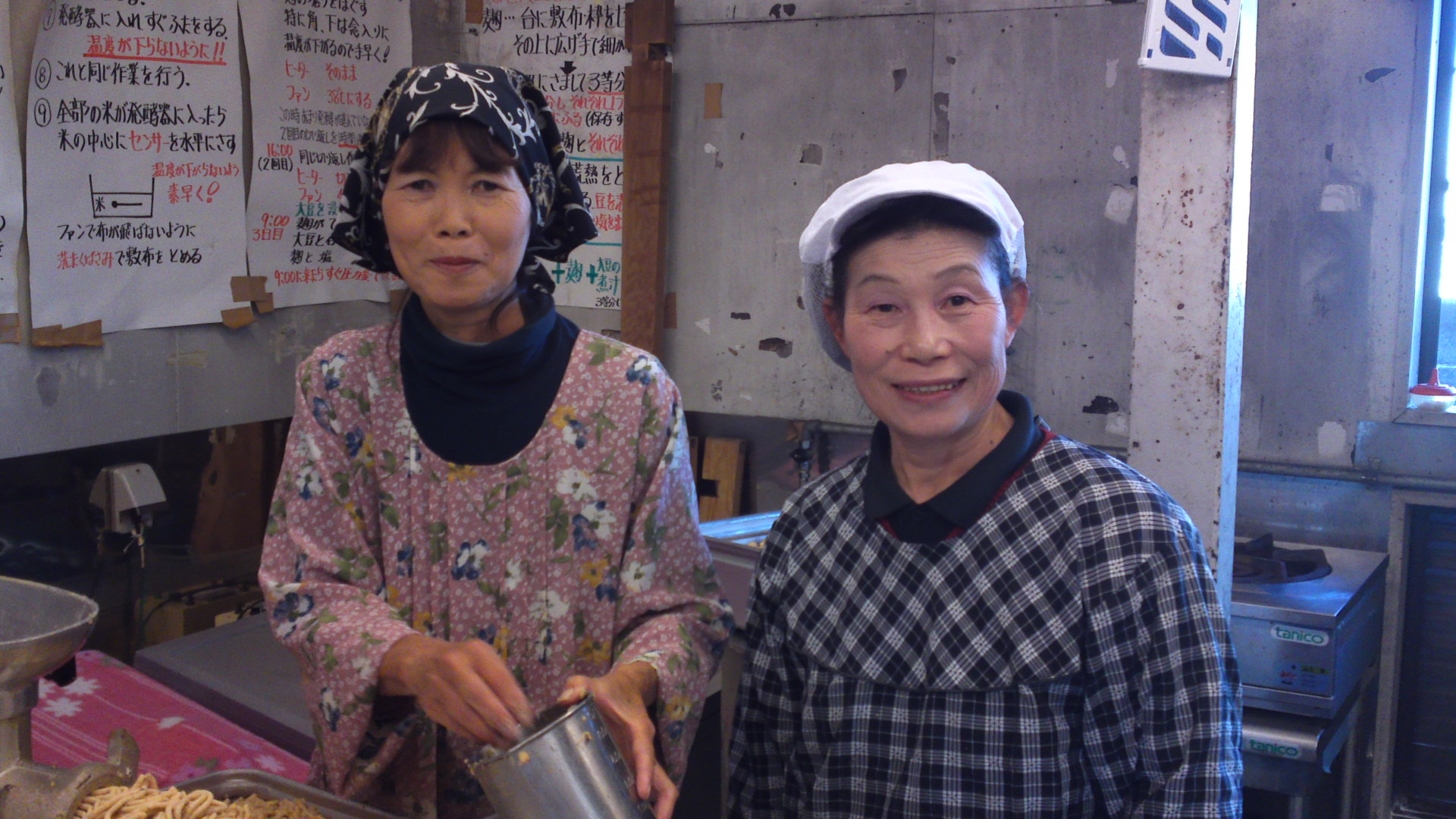
Mrs. Yukiko Mochizuki/望月幸子 and Mrs. Kayoko Mochizuki/望月加代子

“We make miso onsite for better quality, safety and traceability!”

Wednesday is on of the days I usually reserve for on-field interviews. On Wednesday mornings, whenever I have the chance, I try to meet my old friend, Mrs. Natsuko Koyanagi/小柳奈津子 in Agriroad Miwa, in Miwa, Aoi Ku, Shizuoka City.

As mentioned before, Agriroad Miwa is a market run in collaboration by the JA and local ladies to sell all kinds of vegetables, bentoes and processed foods prepared by more than 100 lady members.
There are quite a few of these locally-run markets in town and prefecture, and they are the best bet for freshest and best quality without mentioning the very low prices!

I had noticed for quite a while these big boxes of miso paste on sale at this market. At 650 yen for a kg, this is quite good value.

When I questioned Natsuko about it, she explained that it was made in turns by lady members inside the Agriroad Market kitchen between December and March!
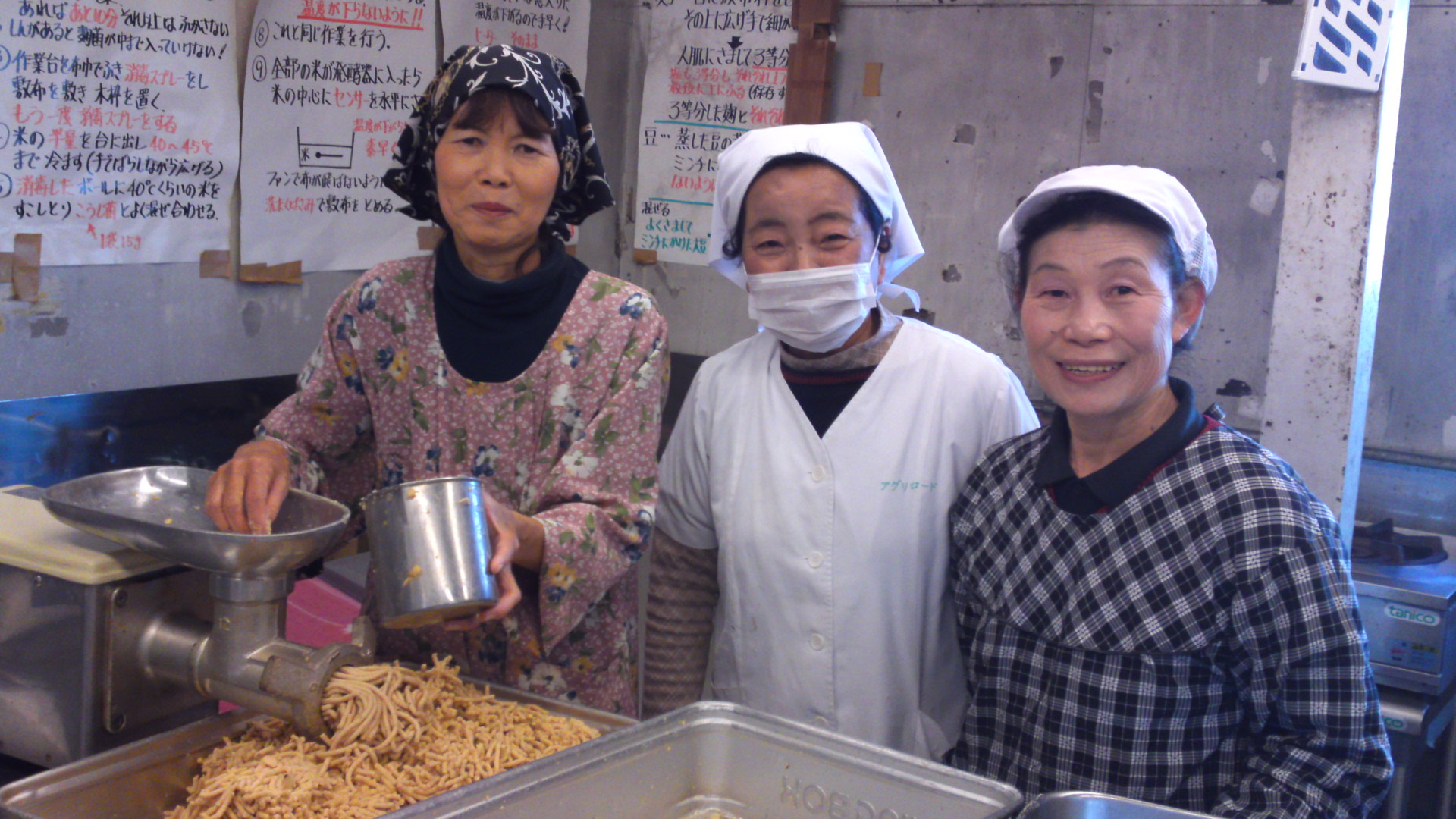
Natsuko hiding behind her mask (she had just caught a cold! LOL)

Good miso should not be complicated to make.
The good thing about this particular miso is that it is not only fresh and free of all preservatives and whatnot found in mass-produced miso pastes, it is also safe, stable and traceable!

The big vat in which the soy beans are boiled.

What do you need, then?
Quantities will be also according to the size of your kitchen snd utensils, but the bigger, the better!
-Soy beans: 30 kg
-Rice: 30 kg
-Salt: coarse salt/arashio/荒塩. Natsuko actually uses rock salt form Nepal!: 12 kg
-Yeast/koujikin/麹菌: one standard pack (can be bought in specialized shops all over Japan)
-Water, water, and more water (lol)

The ladies of the day were kind enough to explain the process with plenty of smiles!
The soybeans are first soaked for a whole night and then boiled until soft. Keep some of the soybeans water when you want to adjust the miso paste humidity later instead of plain water!
Agriroad uses soybeans grown in Hokkaido.

At the same time wash, rince and steam the rice. Old rice, that is from the previous year’s harvest, is best.
Agriroad uses exclusively local rice and salt made in Japan.
Let the rice cool down just a little. Sprinkle the yeast all over it evenly and let ferment for one day and a half (break it and mix it a few times).
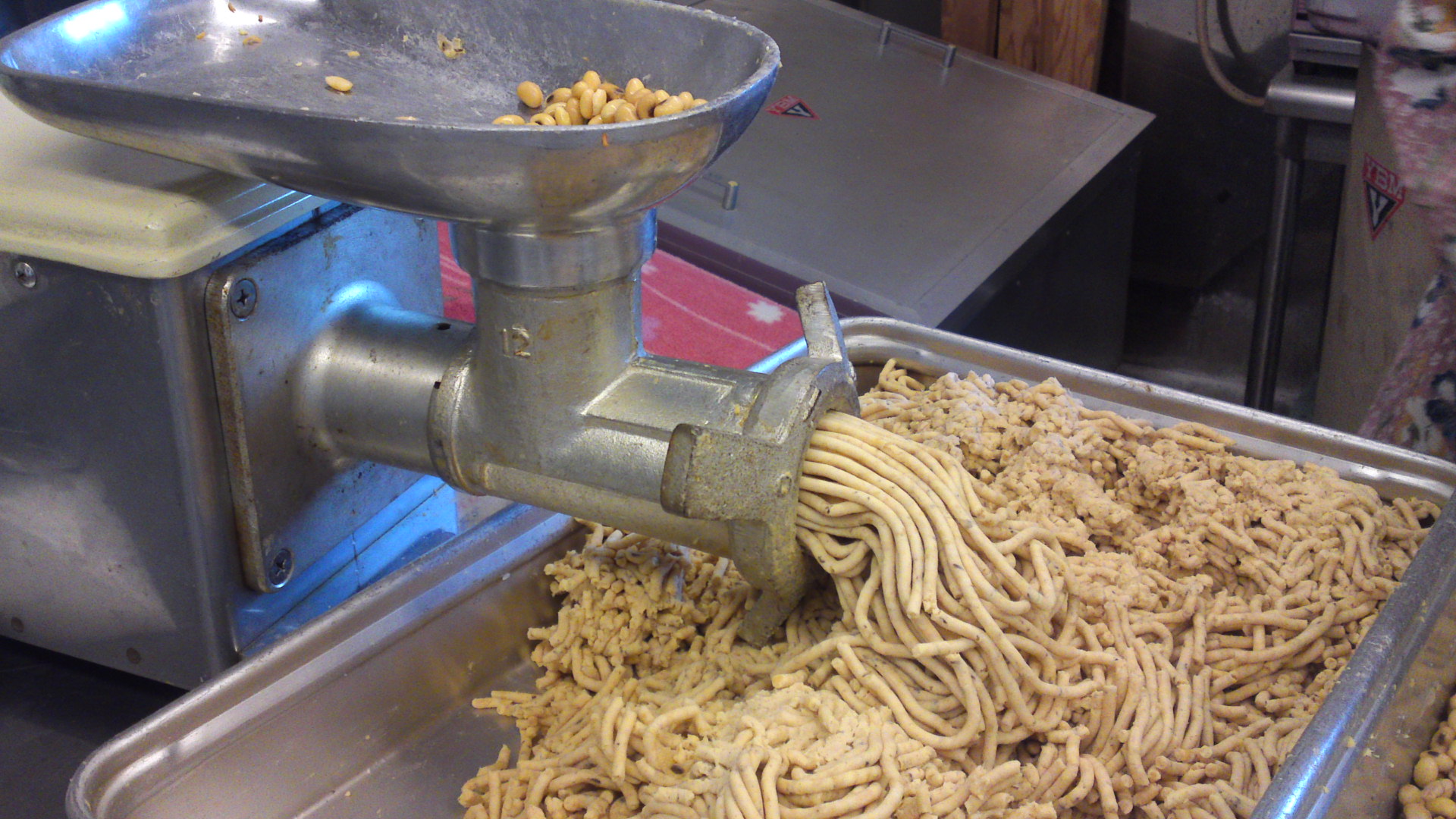
Mash the soybeans.

Pour the mashed soybeans, fermented rice, salt, and whenever wanted (use your eyes and tastebuds) the “juices”/soybean boil water (cold) and mix well.

And that’s it!
Pour the miso into jars or other vessels, close tightly.
Some people use it as it is, but is best matured for 6 months at room temperature in winter or in the fridge in summer.

This the basic and delicious recipe.
Natsuko mixes her own with yuzu/lime/柚子!

Agriraod miwa/アグリロード美和
〒421-2114 Shizuoka Shi, Aoi Ku, Abeguchishinden, 537-1.
〒421-2114 静岡市葵区安部口新田, 537-1.
Tel.: 054-296-7878.
Fax: 054-296-7878
Business hours: 09:30~15:30 (from 08:30 on Saturday, Sunday and Holidays)

RECOMMENDED RELATED SITES:
Warren Bobrow, Bread + Butter, Zoy Zhang, Hungry Neko, Think Twice, Frank Fariello, Mangantayon, Hapabento, Elinluv Tidbit Corner, Tokyo Terrace, Maison de Christina, Chrys Niles,Lexi, Culinary Musings, Wheeling Gourmet, Comestiblog, Chronicles Of A Curious Cook, Tokyo Through The Drinking Glass, Tokyo Foodcast, Palate To Pen, Yellin Yakimono Gallery, Tokyo Terrace, Hilah Cooking, More than a Mount Full, Arkonite Bento, Happy Little Bento; 5 Star Foodie; Jefferson’s Table; Oyster Culture; Gourmet Fury; Island Vittles; Good Beer & Country Boys; Rubber Slippers In Italy; Color Food daidokoro/Osaka;/a; The Witchy Kitchen; Citron Et Vanille, Lunsj Med Buffet/Estonian Gastronomy (English), Cook, Eat, Play, Repeat, Chrisoscope, Agrigraph, The Agriculture Portal to shizuoka!

Please check the new postings at:
sake, shochu and sushi

Agricultural Products from Producer to the Gastronomic Table: LOCOMANI

Ranking
Very friendly and relaxed
Equipment: Very clean
Prices: Very reasonable
Strong points:Freshest produce and ingredients only, mainly from Shizuoka Prefecture. Organic vegetables. Seasonal food only

Entirely non-smoking!

“Healthy and tasty Shizuoka food!”

When Shigeyuki Aoshima/青島茂幸 (35) and his wife Hiroko/寛子 (33) opened Locomani in Takajo Machi, Shizuoka City in June 2008 they were on a mission: create healthy food for all and mainly from Shizuoka products.

Their restaurant/cafe is a very cozy place all wood and country decoration, a warm place to enjoy slow food at lunch or early dinner or a little haven for a quiet drink and a book or friend.

Their menus outside and inside are written in Japanese but they will be glad to explain the food to foreigners, however long it will take with a constant smile. Actually both are very shy, but once the ice is broken they enjoy a good talk!

Chicken in Peking Duck fashion set meal.

They cater both for vegetarians (vegan is possible on order) and omnivores. They always use the freshest ingredients and organic vegetables whenever possible.

Even set lunches (all priced at 1,000 yen) are for the main part vegetables, cooked or raw.

genmai/玄米/whole rice

Rice can be ordered white, genmai/玄米/whole, or half white, half whole.

Vegetarian kuruma fun katsu/車ふんカツ lunch set

The katsu/cutlets are vegetarian and served with an apple and miso sauce!

Organic vegetables curry set

This very tasty curry is practically vegan as they use coconut milk!

All set lunches come with miso soup and three-year old organic tea!
As a rule they change 2 of 4 set lunches every week (the other two, including the organic vegetable curry are “regular set lunches”)

Fresh fig tart

if you come in the afternoon be on the lookout for their simple but great seasonal desserts!

As I mentioned above, the Aoshimas are always trying to use local vegetables, especially organic vegetables, and others. Accordingly they are on a constant search of new sources.
If you are a gardener, producer or farmer proud of your vegetables, do contact them for an eventual business collaboration!

And do check their blog. too!

LOCOMANI
Shizuoka City, Aoi Ku, Takajo machi, 1-10-06
静岡市葵区鷹匠町1-10-06
Tel.: 054-260-6622
opening hours: 11:30~20:00
Closed on Wednesdays

Blog: http://rokomani.exblog.jp/

RECOMMENDED RELATED SITES:
Warren Bobrow, Bread + Butter, Zoy Zhang, Hungry Neko, Think Twice, Frank Fariello, Mangantayon, Hapabento, Elinluv Tidbit Corner, Tokyo Terrace, Maison de Christina, Chrys Niles,Lexi, Culinary Musings, Wheeling Gourmet, Comestiblog, Chronicles Of A Curious Cook, Tokyo Through The Drinking Glass, Tokyo Foodcast, Palate To Pen, Yellin Yakimono Gallery, Tokyo Terrace, Hilah Cooking, More than a Mount Full, Arkonite Bento, Happy Little Bento; 5 Star Foodie; Jefferson’s Table; Oyster Culture; Gourmet Fury; Island Vittles; Good Beer & Country Boys; Rubber Slippers In Italy; Color Food daidokoro/Osaka;/a; The Witchy Kitchen; Citron Et Vanille, Lunsj Med Buffet/Estonian Gastronomy (English), Cook, Eat, Play, Repeat, Chrisoscope

Please check the new postings at:
sake, shochu and sushi

The Yamaguchis’ Benihoppe Strawberry Fields (beginning of December)

Mrs. Tamako Yamaguchi/山口玉子 and her daughter Haruka/晴香

Last Monday, December 6th, I traveled to the Izu Peninsula for the second time in eight days.
The occasion was my third visit to Yamaguchi Benihoppe Strawberry Farm.

Their daughter, Haruka (she is also a student of mine at University!), was on hand to pick me up at Mishima JR Station and drive me all the way to Nirayama/韮山 in Izu No Kuni City/伊豆の国市.

It was another gorgeous day of that unending Autumn and Mount Fuji kept an eye on us all the time!

Her father, Mitsuo/光雄, being away to a meeting ,Haruka had arranged the interview with her mother who knows as much as her husband.
When we arrived at her home (above picture) her mother, Tamako/玉子, was still busy in one of their greenhouses, so we took a leisurely tour of their home and the neighborhood.

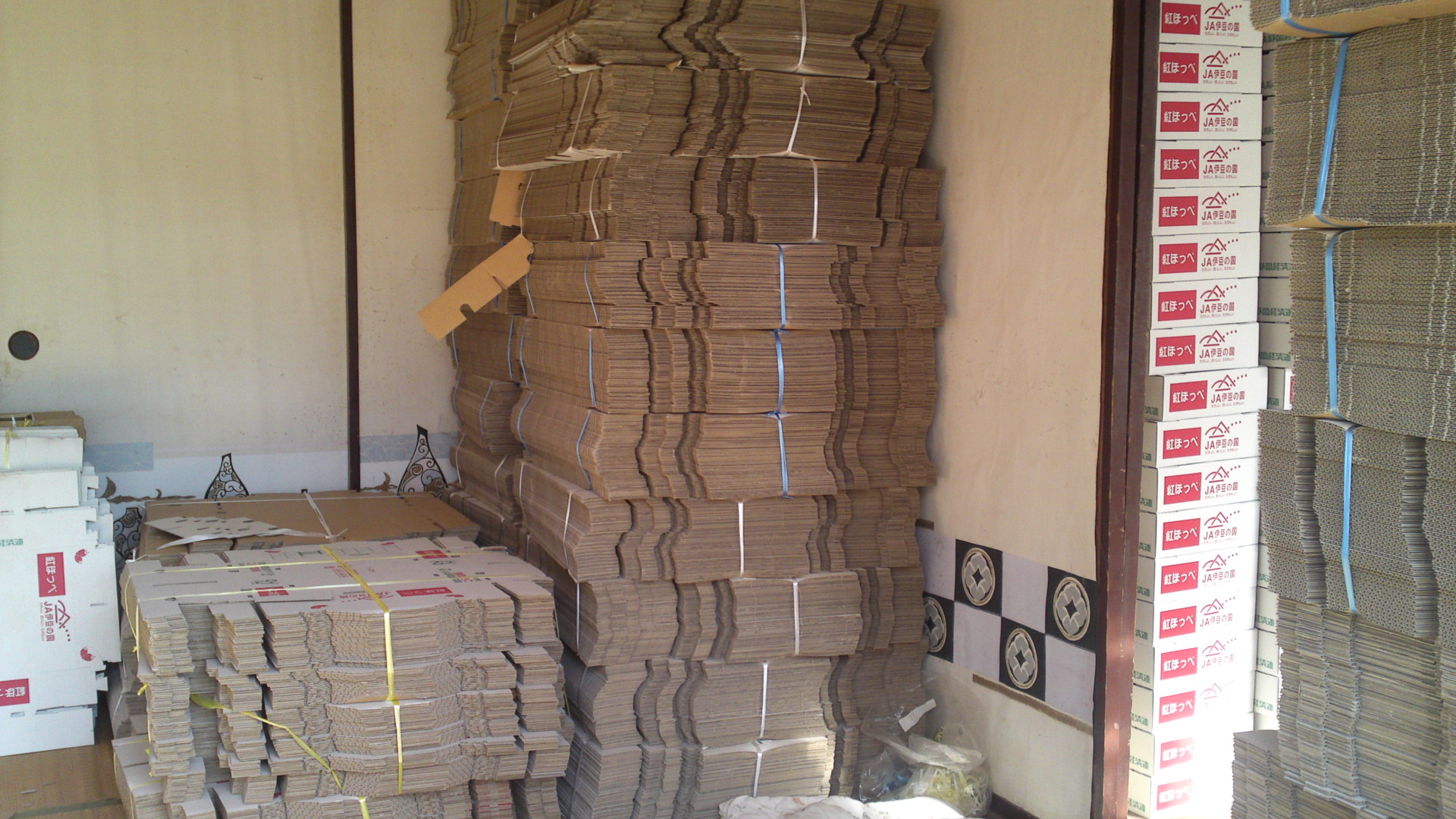
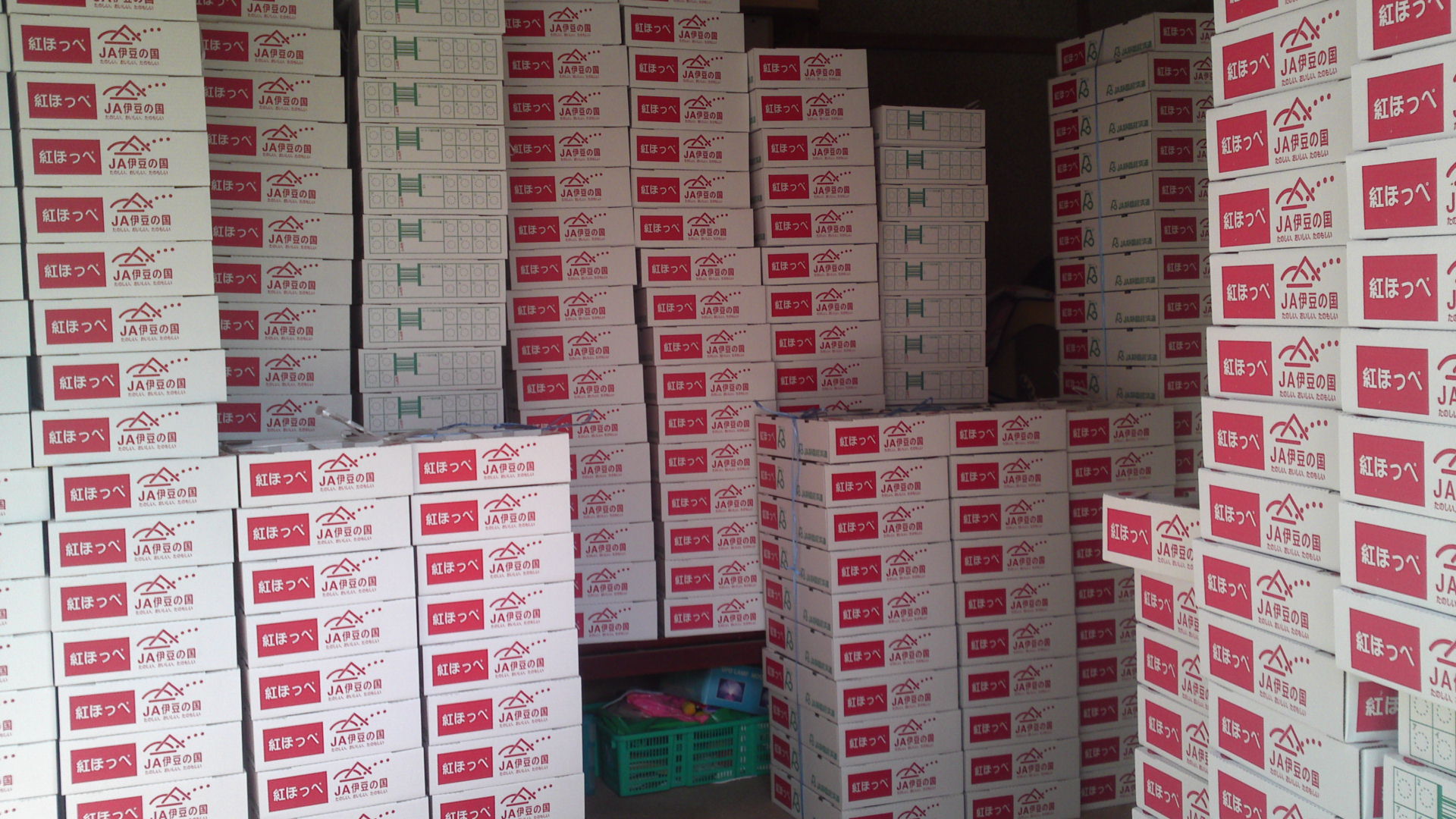
The strawberry packages storeroom.
Plenty of work every morning!

The strawberries are usually picked early every morning, sorted, packed and stored into a large refrigerator before being sent and delivered the next morning.

Near their home I noticed the sign of an abandoned yakiniku restaurant. The name of the sake advertized, Kikugenji/菊源氏 was from a brewery in Izu Peninsula which has been absorbed by Bandai Brewery/万代酒造 quite some time ago. It must have been abandoned a long time ago!

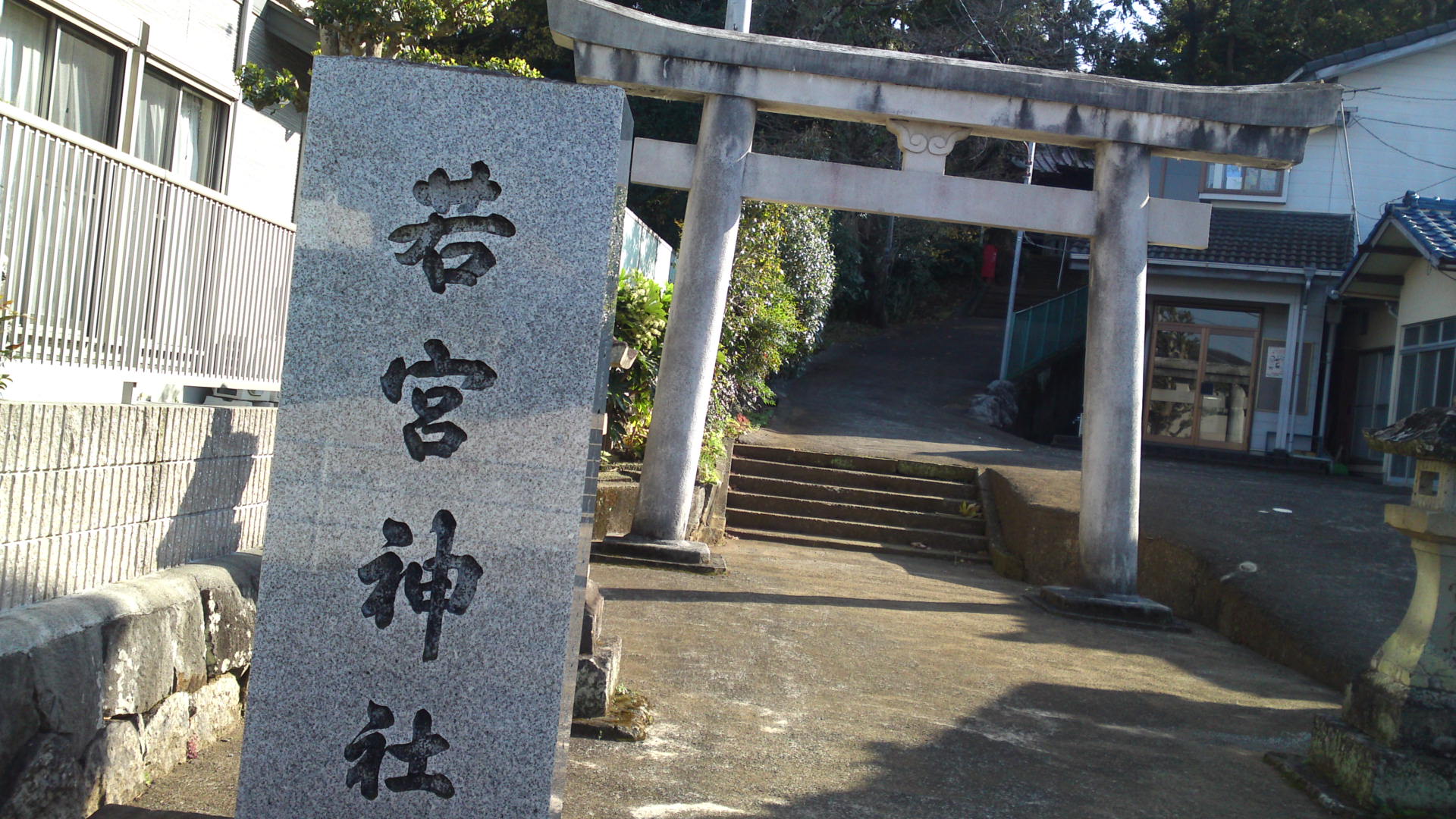
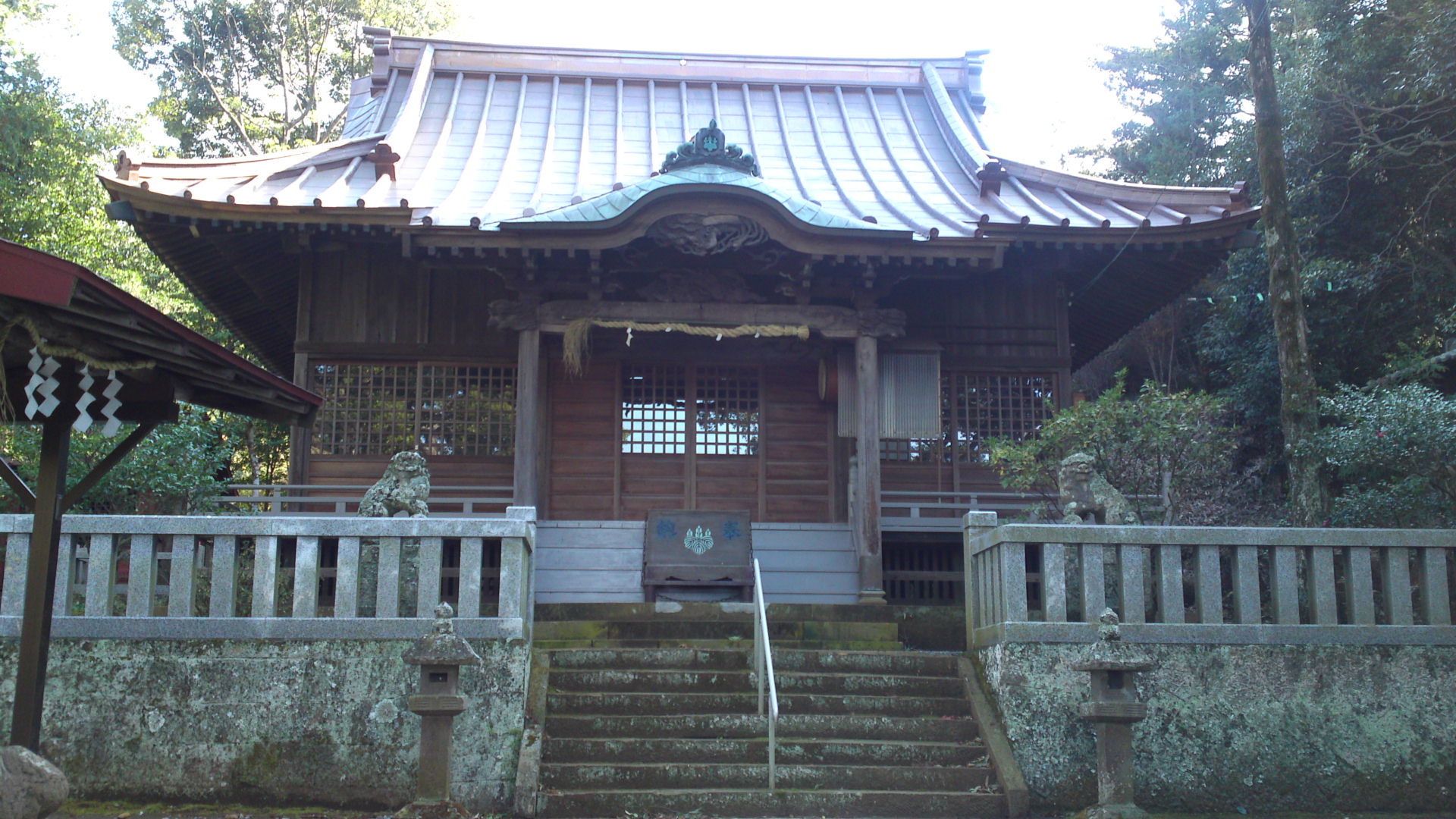
Just next to their home again is the entrance to a shinto shrine called Wakamiya Jinja/若宮神社.
If you look carefully around you will found many of them tucked away in the Japanese countryside!

This one is not that old by Japanese standards (1926), but it did look venerable!

Her mother finally joined us and we all went to one of their many greenhouses.
You will find a box in front of every greenhouse. They are beehives. Mr. Yamaguchi does not bother about frills and makes his boxes practical. The bees don’t seem to mind! The latter are very peaceful, used as they are to humans.
Usually other growers will borrow such boxes for a fee.
Strawberry culture might be possible without the bees, but you will never obtain large fruit of a regular shape!

Those “bee boxes” don’t look much from the outside, but they are so valuable that they have to secured against theft (unfortunately it regularly happens!)!

A very small exit from the beehive and a slightly larger entrance into the greenhouse.

Inside the greenhouse. A lot of green foliage, but don’t worry, plenty of strawberries can be found under it!
On the average each plant produces 20 crops!

Each grower has his/her own techniques.
The Yamaguchis keep the inner temperature at nearly 30 degrees Celsius with this apparatus.

This apparatus will distribute carbon dioxide gas to help fruition.
It is carefully used and as little as possible. The Yamaguchis understand they cannot avoid using it but they do so sparsely and with utmost care.

As a rule, the Yamaguchis do not use pesticides from the very moment the plants are transfered to soil inside the greenhouses. They fight pests in many ways: these sticky yellow cards will catch a lot of insects, especially flies. The bees practically never get caught as they are placed well above the plants. They also use natural enemies such as ladybugs.

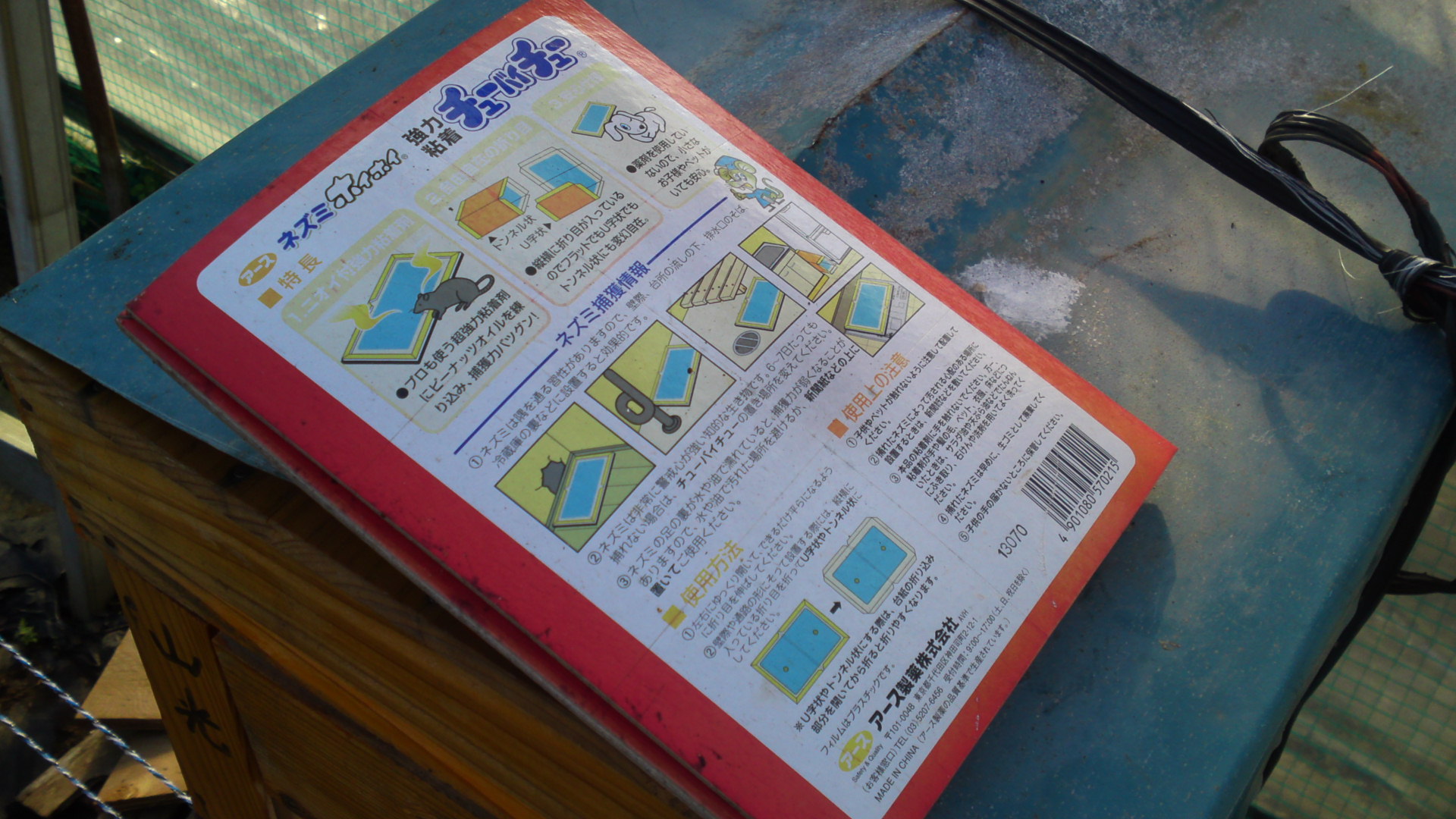
These traps are usually devised for mice, but placed atop the beehives, they will catch nastier enemies!

Giant carnivorous wasps/suzumebachi/雀蜂 and what else!

At night they have to surround the greenhouses with electric wires to fend off hakubishin/白鼻芯/civets! Those pests (they can eat a whole crop in a single night!) found their way into Japan through our very Prefecture in 1945 when pets from China were abandoned into the wild!

The space between the rows is filled with rice husks to absorb excess humidity and allow for easier harvesting.

Strawberry flowers.

A bee pollinating a flower.
They produce top-class honey!

A view of the strawberries in the afternoon which had been harvesting the morning.

Because of the very large demand for Christmas cakes, the small round strawberries are the most expensive in this season.
After Christmas, the plants will be regularly pruned to allow only for large strawberries.

But I was offered no less than 4 boxes of these great large specimens!

Enormous!
They are always packed with their sepals, otherwise they would lose half of their Vitamin C and nutrients within half an hour.
Strawberries without their sepals in cakes are not that good for the body, whereas half a dozen medium ones (with their sepals) pack enough Vitamin C for a whole day!

Yamaguchi Benihoppe Strawberry Farm
410-2114, Izu no Kuni, Nan-jo, 8
Tel.: 055-949-2330

RECOMMENDED RELATED SITES:
Warren Bobrow, Bread + Butter, Zoy Zhang, Hungry Neko, Think Twice, Frank Fariello, Mangantayon, Hapabento, Elinluv Tidbit Corner, Tokyo Terrace, Maison de Christina, Chrys Niles,Lexi, Culinary Musings, Wheeling Gourmet, Comestiblog, Chronicles Of A Curious Cook, Tokyo Through The Drinking Glass, Tokyo Foodcast, Palate To Pen, Yellin Yakimono Gallery, Tokyo Terrace, Hilah Cooking, More than a Mount Full, Arkonite Bento, Happy Little Bento; 5 Star Foodie; Jefferson’s Table; Oyster Culture; Gourmet Fury; Island Vittles; Good Beer & Country Boys; Rubber Slippers In Italy; Color Food daidokoro/Osaka;/a; The Witchy Kitchen; Citron Et Vanille, Lunsj Med Buffet/Estonian Gastronomy (English), Cook, Eat, Play, Repeat, Chrisoscope, Agrigraph, The Agriculture Portal to shizuoka!

Please check the new postings at:
sake, shochu and sushi

Healthy Oranges in a Healthy Environment: Shiratori Orchard in Izu Peninsula

Healthy Oranges in a Healthy Environment!

Last Monday I somehow managed to get a full day free (and I certainly needed the whole of it!). My good friend Yasushi Imaizumi/今泉康 drove me on a grand tour of the Eastern part of Shizuoka Prefecture.
Our destination was a remote place deep south the eastern coast of Izu Peninsula.

The day was just gorgeous!
Absolutely blue skies and mild temperatures.
We just couldn’t help taking pictures of snow-capped Mount Fuji on the way!

It took us (Yasushi) three hours to drive down to Shirata/白田, near the minuscule fishing harbor of Inatori/稲取, in Kamo Gun/賀茂郡, only a short distance from Shimoda City/下田市.

There, we discovered the oranges orchard of the Shiratori Family with an incredible view over the ocean. By clear weather you can see as far as Oshima/大島 Island!

Miyoko Shiratori/白鳥美代子, a live-in student, her daughter-in-law, Hiroko/弘子, her son, Takehisa/岳寿 and her husband, Ryuusaku/龍作.

Mr. Ryuusaku Shiratori/白鳥龍作 (82), was a seventh generation of growers of rice, tea, oranges and wasabi back in Shizuoka City until he decided to move there 40 years ago to become the first of three generations of orange growers.
This must have been the right choice as he and his wife Miyoko/美代子 could pose in any magazines as models of incredibly healthy longevity!

Having bought those 2 ha of steep terrain, he had it buldozzed into shelves within three days!

I can tell you that you need good feet and good eyes to move through the orchard!

He has never looked back since then!
He is presently helped by his son Takehisa/岳寿 (54), his daughter-in-law, Hiroko/弘子 (49) and his grandson Tatsumi/達巳 (26). They also get the very much needed hands of a live-in student from Shizuoka City.

Ryuusaku Shiratori demonstrating cuttings to my friend Yasushi.

They do grow many varieties of oranges and one of them, a hybrid developed by Ryuusaku, Shiratori Hyuuga/白鳥日向 (developed from Hyuuga Natsu/日向夏 from Miyazaki Prefecture in Kyushu Island) has been registered with the Japanese Agriculture & Forestry Ministry!
Actually, he is quite well-known as no later than a week before a whole Tokyo HHK TV crew of 10 staff and 2 cameras spent a whole day there!

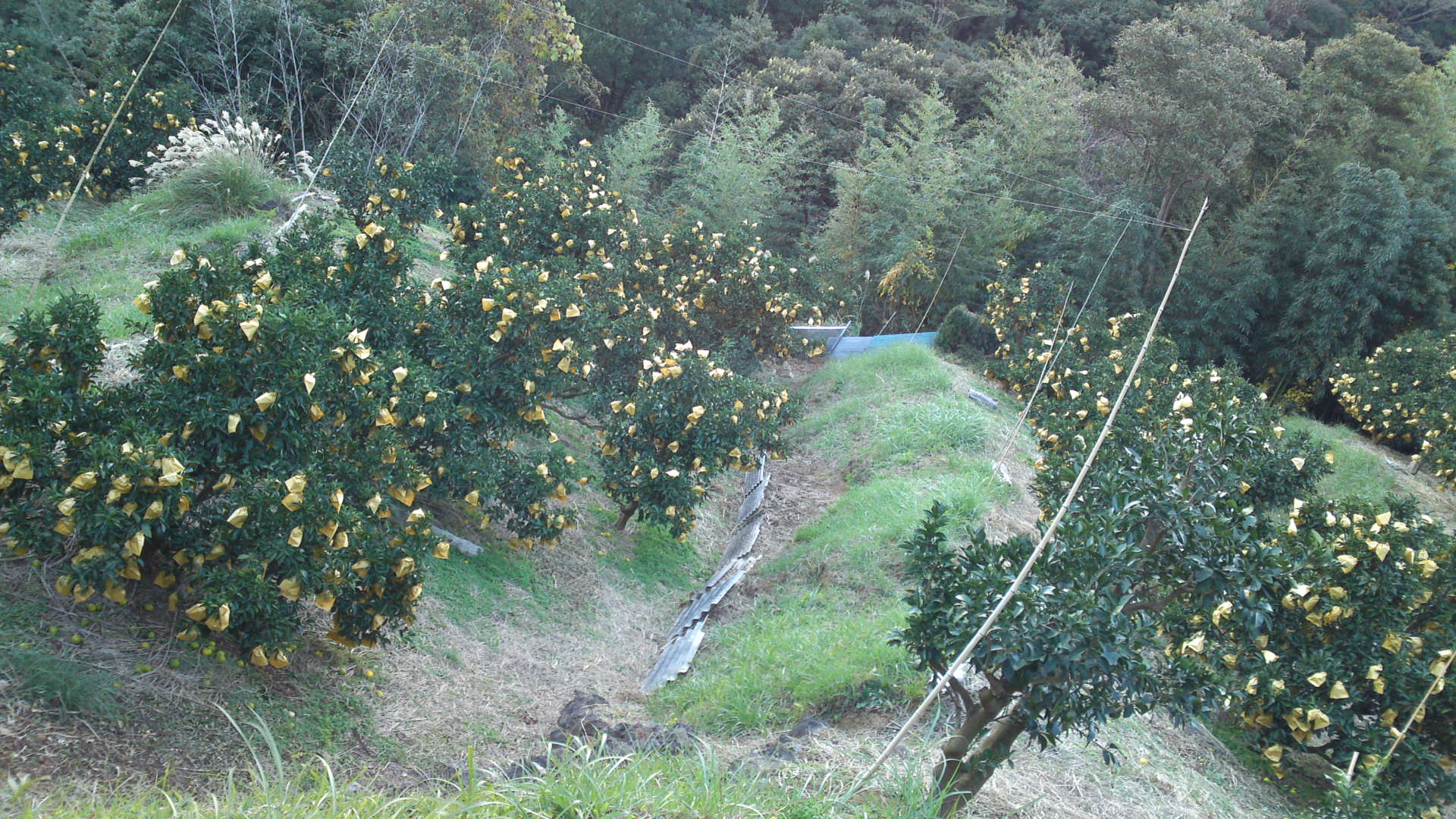
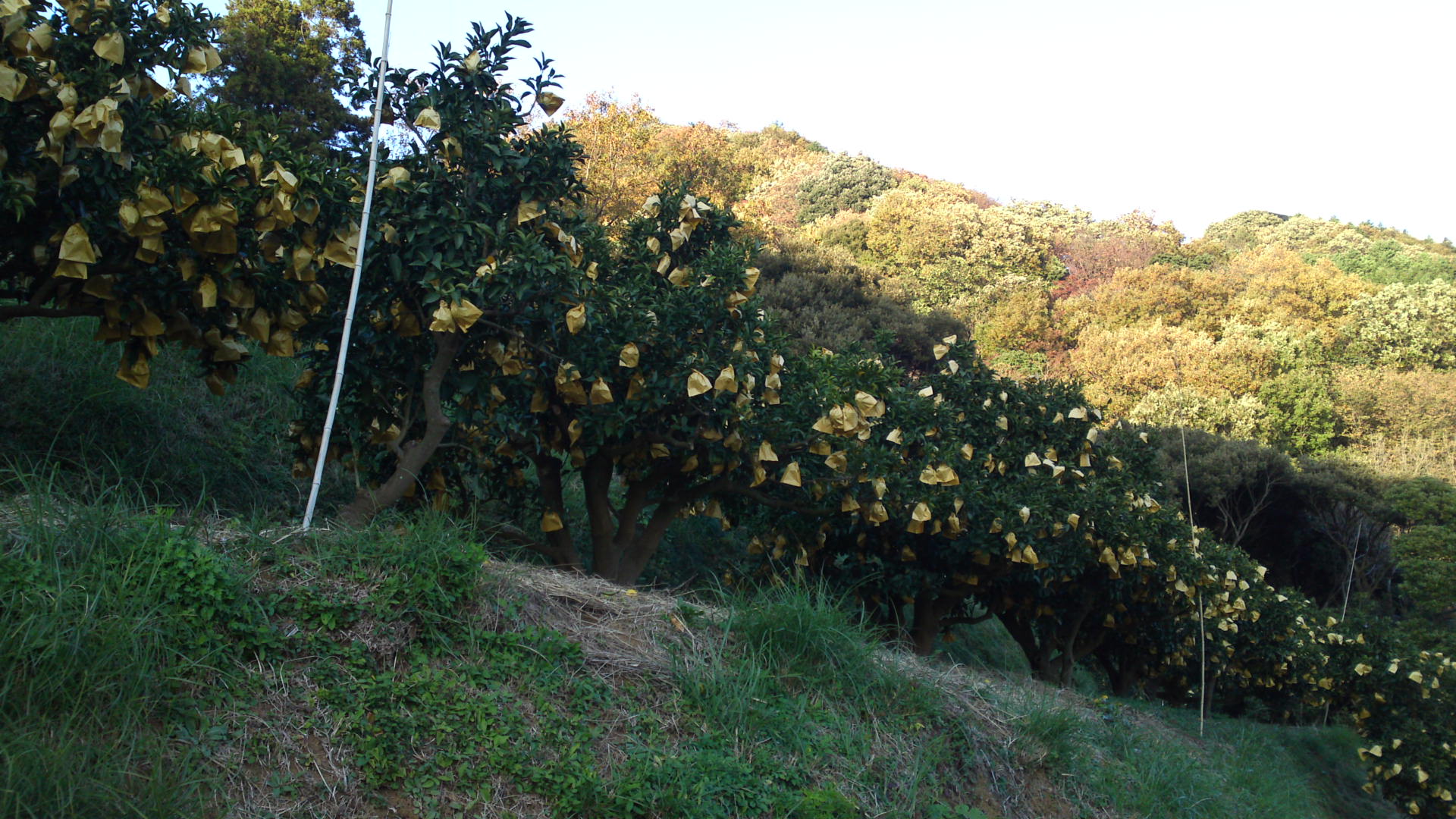
These Hyuuga Shiratori oranges are carefully pruned away to leave only the best fruit which are wrapped in paper for better fruition!

Another view of the trees!

The wrapping takes days and days!

40-years old trees! They can be harvested until the grand age of 60 years!

Trees are propagated with cuttings planted directly into the soil.
These new trees will be completely pruned for 4~5 years before harvesting the first oranges.

100% organic culture is impossible, but the Shiratoris reckon that their orchard is more than 90% organic. The second and third generations have actually been awarded the title of Ecofarmers by the Government!
Fertilizer is practically organic. You understand it when you see the beautiful grass growing between the trees.
As for pests, they use the very minimum of pesticides and introduce natural enemies of such pests such as ladybugs and other carnivorous insects!
Pollination is done either by hand, with the help of the wind, or with rented bees!

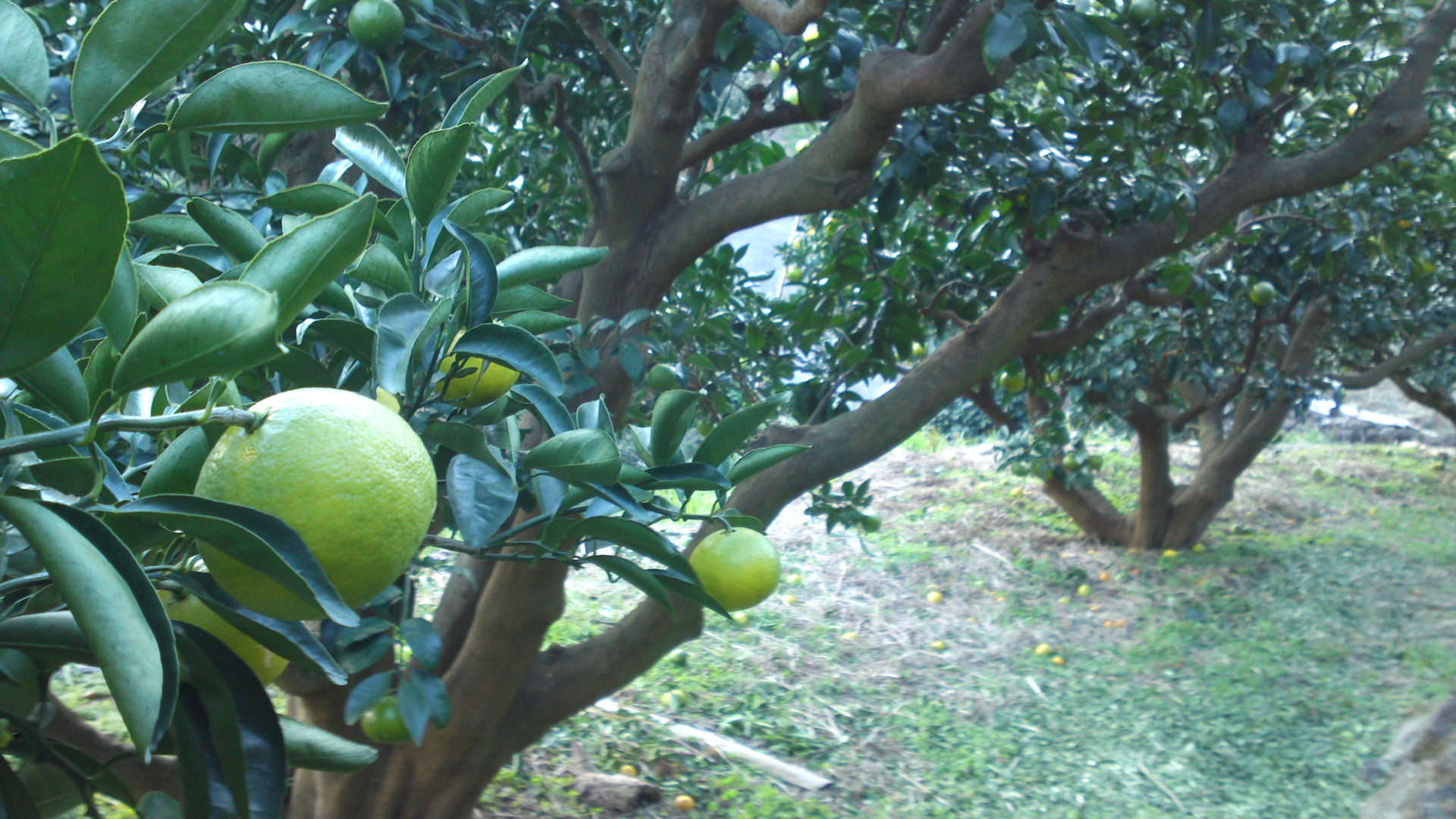
Their Shiratori Hyuuga oranges, although seedless and full of juice, will take two more months to mature to a tasty and sweet juice.


This beauty is not ready yet!

New Summer Oranges (will be mature in May!)

As I said, they grow many varieties to organize a constant harvest and delivery.
Among them Haruka/晴香, Ponkan/ポンカン, and New Summer Oranges are extremely popular.

Ponkan ready for harvest and delivery!

They do grow and experiment with other fruit such as loquats/biwa/琵琶!

Although great exposure to the sun and big differences of temperature between day and night are welcome, the wind isn’t!
To fend off the wind, Ryuusaku planted hedges of camelias/tusbaki/椿.
He likes them so much that he made a point to plant as many varieties as possible. He invited me to admire them next February!

They do also grow a lot of their own food, such as these shiitake mushrooms and string beans I was offered to take back home with a whole bunch of ponkan!

Since I have to make at least two more trips expect more pics and explanations!

Shiratori Orchard/白鳥農園
413-0304 Shizuoka Ken, Kamo Gun, Higashi izu Cho, Shirata, 1742
413-0304 静岡県賀茂郡東伊豆町白田1742
Tel./Fax: 0557-95-2083
Mobile phone: 090-7025-6659

Check their HOMEPAGE for orange varieties, prices and orders!

RECOMMENDED RELATED SITES:
Warren Bobrow, Bread + Butter, Zoy Zhang, Hungry Neko, Think Twice, Frank Fariello, Mangantayon, Hapabento, Elinluv Tidbit Corner, Tokyo Terrace, Maison de Christina, Chrys Niles,Lexi, Culinary Musings, Wheeling Gourmet, Comestiblog, Chronicles Of A Curious Cook, Tokyo Through The Drinking Glass, Tokyo Foodcast, Palate To Pen, Yellin Yakimono Gallery, Tokyo Terrace, Hilah Cooking, More than a Mount Full, Arkonite Bento, Happy Little Bento; 5 Star Foodie; Jefferson’s Table; Oyster Culture; Gourmet Fury; Island Vittles; Good Beer & Country Boys; Rubber Slippers In Italy; Color Food daidokoro/Osaka;/a; The Witchy Kitchen; Citron Et Vanille, Lunsj Med Buffet/Estonian Gastronomy (English), Cook, Eat, Play, Repeat, Chrisoscope, Agrigraph, The Agriculture Portal to shizuoka!

Please check the new postings at:
sake, shochu and sushi

Shizuoka Agricultural Products from The Producers to the Gastronomic Table: Dinner at UZU

Organic vegetables shabu-shabu

Service: excellent, easy-going and very friendly
Facilities: great washroom, great cleanliness overall
Prices: very reasonable, good value.
Strong points: Very fresh local ingredients, especially organic vegetables extensively used. Local sake. Home-made umeshu. Great shochu list.

Uzu has become the reference in the whole Shizuoka Prefecture when it comes to enjoy local ingredients of the highest quality in a Japanese Izakaya or Restaurant!

The “oyakata”/Chef, Mr. Yoshimura constantly scours the whole Prefecture for the best vegetables, meat, fish and fruit.
But he will neither scorn a great product if it is not from Shizuoka, especially shochu! But more than 90% of the food was grown, caught or raised in our plains, mountains and sea!
The overwhelming result of his enthusiasm is that he can please anyone whatever his/her gastronomic priorities.
A phone call beforehand will be enough to devise a vegan, vegetarian or omnivore meal!

As an example, let me describe what the four of us ordered there a couple of weeks ago. Do not forget we also had plenty of local sake/jizake/地酒!
The above picture features sashimi Shizuoka is particularly famous for:
-Katsuo/鰹/Bonito from Suruga Bay.
-Kinmedai/金目鯛/Splendid Alfonsino (interesting name in English!) from the Izu peninsula.
-Benimasu/紅鱒/Rainbow Trout raised in Fujinomya City at the foot of Mount Fuji!

Shamo Chicken/軍鶏 from Umegashima up the Abe River.
This dish solely consists of grilled or fried offal including shirako/白子/sperm sacs! Don’t worry, these morsels can be served only if they are super fresh and the chef has a special license!

Organic green tomatoes from Matsuki Biofarm in Fujinomiya City served as tempura!

Fried (enormous) lotus roots/renkon/蓮根 from Asabata/麻端 in Shizuoka City. So crunchy and satisfying!

Salad of organic mushrooms and broccoli from Matsuki Biofarm!

Organic Vegetables (from Matsuki Biofarm) Shabu Shabu!
Bear in mind this particular dish must be ordered at least 2 days in advance!

The Shabu Shabu is served with a great soup (can be ordered vegan!) in which you either dip or simmer the fresh vegetables to your liking!

Depending on the season and the ever-changing menu one can order organic salads such as above (I had it one month ago!) and many other delicacies!
Make a point of checking their homepage first (even if you don’t read Japanese, the pictures will give you a good idea of what’s in store for you!)

UZU
Shizuoka City, Otowa-cho, 3-18
Tel.: 054-249-6262
Business hours: 17:00~23:00
Closed on Mondays and first Tuesday
Reservations recommended
Credit cards OK
HOMEPAGE (Japanese)

RECOMMENDED RELATED SITES:
Warren Bobrow, Bread + Butter, Zoy Zhang, Hungry Neko, Think Twice, Frank Fariello, Mangantayon, Hapabento, Elinluv Tidbit Corner, Tokyo Terrace, Maison de Christina, Chrys Niles,Lexi, Culinary Musings, Wheeling Gourmet, Comestiblog, Chronicles Of A Curious Cook, Tokyo Through The Drinking Glass, Tokyo Foodcast, Palate To Pen, Yellin Yakimono Gallery, Tokyo Terrace, Hilah Cooking, More than a Mount Full, Arkonite Bento, Happy Little Bento; 5 Star Foodie; Jefferson’s Table; Oyster Culture; Gourmet Fury; Island Vittles; Good Beer & Country Boys; Rubber Slippers In Italy; Color Food daidokoro/Osaka;/a; The Witchy Kitchen; Citron Et Vanille, Lunsj Med Buffet/Estonian Gastronomy (English), Cook, Eat, Play, Repeat, Chrisoscope, Agrigraph, The Agriculture Portal to shizuoka!

Please check the new postings at:
sake, shochu and sushi

A Japanese Gardener’s Winter Preparations

Looking at my dear neighbor, Mr. Yoshizo Sugiyama’s garden this morning I realized that winter was about to fall on us in spite of the prevailing mild weather.
The telltale signs were the fruit and vegetables hung out to dry as the climate will turn very dry and cold enough for such a process.

I know he has a few persimmon/kaki/柿 trees in another plot he’s lent for some time.
Dried persimmons are a typical Japanese delicacy, and they certainly don’t come cheap on the market. It is definitely worth drying them yourself!
The persmmons are first peeled, then a twine is passed through them under their sepals before they are hung to dry.
The fruit will reduce to less than half their size and will be delicious with all their concentrated sugar!

The daikon of the same garden were being for takuan/沢庵 or Japanese pickled daikon!

In spite of their crazy shapes, these dailon will make excellent pickles.
They were first thoroughly washed before being hung.
Beside them you can also freshly hung persimmons and more that are almost completely matured into dry fruit.

The picture shows you how easy to hang the daikon.
Their heavy leaves are used as a counterweight with the result there is not need to secure them with twine.
After the daikon have dried to almost half their size they will be pickled for the whole winter!
The same picture shows you again the persimmons!

RECOMMENDED RELATED SITES:
Warren Bobrow, Bread + Butter, Zoy Zhang, Hungry Neko, Think Twice, Frank Fariello, Mangantayon, Hapabento, Elinluv Tidbit Corner, Tokyo Terrace, Maison de Christina, Chrys Niles,Lexi, Culinary Musings, Wheeling Gourmet, Comestiblog, Chronicles Of A Curious Cook, Tokyo Through The Drinking Glass, Tokyo Foodcast, Palate To Pen, Yellin Yakimono Gallery, Tokyo Terrace, Hilah Cooking, More than a Mount Full, Arkonite Bento, Happy Little Bento; 5 Star Foodie; Jefferson’s Table; Oyster Culture; Gourmet Fury; Island Vittles; Good Beer & Country Boys; Rubber Slippers In Italy; Color Food daidokoro/Osaka;/a; The Witchy Kitchen; Citron Et Vanille, Lunsj Med Buffet/Estonian Gastronomy (English), Cook, Eat, Play, Repeat, Chrisoscope

Please check the new postings at:
sake, shochu and sushi

Shimada City: a New Portal to Japan!

Horai Bridge

Ask Businessmen and tourists coming to Japan from China and Korea and they will answer the new starting venue in this country is Shimada City!
Shimada City? Where can that be? So many people in other celebrated metropolises will surely ask.

Shimada City is slightly away from the center of Shizuoka Prefecture which in turn lies in the very middle of Japan halfway between Tokyo and Nagoya, the most traveled portion of this country. But it all started with the advent of Shimada Airport, also called Mount Fuji-Shizuoka Airport, in 2009. You will understand why we see many Chinese and Korean visitors in this area when you realize planes daily land there directly form Seoul-Incheon and Shanghai-Pudong. In fact, it is faster and cheaper to travel from Shimada to Paris via Seoul-Incheon Aiport!

All that is fine, you might say, what brings all these visitors to that particular part of Japan? What does it has to offer to businessmen and tourists?
Well businessmen know that Shizuoka is the third richest Prefecture, GDP-wise, after Aichi and Kanagawa Prefectures (which incidentally follow each other along the Tokaido Road!), and that ought to be a good enough reason.
Alright, alright, businessmen also share more reasons to come with tourists!

Shimada City and its neighborhoods certainly have enough to warrant a serious visit and a longer stay than expected. After all, if you also come from Kyushu or Hokkaido you will appreciate to learn they are regularly serviced with direct flights from Mount Fuji-Shizuoka Airport.

Shimada tea fields

Shimada City being in the middle of Shizuoka prefecture finds itself in the heart of green tea country. It also has two railway stations, more precisely in Kanaya where you can board the Steam Locomotive for a beautiful trip along the Oigawa Main Line up to Senzu Hot Springs Resort across vast expanses of green tea fields bordering the Oi River. Do not forget to pay an enriching visit to the Tea Museum/Ocha No Sato in Kanaya!

Horai Bridge

The same Oi River was at its most difficult to cross in Shimada City along the Old Tokaido Road prompting the Meiji Government to build the (still) longest wooden bridge in the world, the Horai Bridge, in 1879. It is 897.4m long and 2.7m wide.
Not only it deserved to be walked across for a great vista but it also has the great merit to lead to vast green tea fields beyond a small mountain ridge along a lane dotted with statues of Seven Deities.

Obi Sword dancer

Every city worth its salt in Japan has a major festival to boast from.
Shimada City not only has one, but it is one of the so-called most unusual festivals in Japan!: the Shimada Obi Matsuri and its Daimyo Procession.
The 300-year old Daimyo Gyoretsu imitates the procession of a grand jumangoku (one hundred thousand koku, units of rice) daimyo, and a total of 250 marchers stretch over 500 meters. Particularly striking is the presence of oyakko who walk gracefully, carrying an obi for safe delivery of babies on the tip of a wooden sword.
The procession is held every three years, in the years of the tiger, snake, monkey and wild boar. It’s commemorated by a grand statue in case you cannot visit the city on time for the festival!

Oomuraya Brewery

Now that we have enough reasons to either choose Shimada as a practical entry portal to Japan for our business or a source of new hidden treasures, what about the communications, accommodations and gastronomy?

Communications are no problem at all as the Mount Fuji Shizuoka Airport is directly linked by bus to Shimada Tokaido Line Railway Stations and the Shinkasen/Bullet Train Stations in Hamamatsu, Kakegawa and Shizuoka Cities, all within 90 minutes of Nagoya and Tokyo. Moreover, a (free) parking lot for more than 1,000 cars, taxis and car rental companies are part of the facilities.

Accommodations should not be a worry either as the city has enough hotels of all grades, Western or Japanese style near and by the railway station.

As for gastronomy, the City is blessed with a celebrated Sake Brewery, Oomuraya Shuzo, whose brands “Onna Nakase” (“Make a Lady weep”), “Wakatake” (“Young Bamboo) and “Onigoroshi” (“Goblin-Killing”) are known as far as New York, Paris and London.
The presence of a great sake brewery means that the local Japanese Izakayas in particular are of a higher level. What with superlative marine products from nearby Suruga Bay and the extravagant abundance of vegetables (don’t forget the green tea!), there is plenty to please everyone, be they vegetarian, omnivores, drinkers or not!

Recommended Hotel:
Hotel Route Inn Shimada Ekimae, 427-0022 Shizuoka Ken, Shimada Shi, Hon Toori, 5-1-13, Tel.: (81)(0)547-37-0055, Fax: (81)(0)547-037-0065, http://www.route-inn.co.jp/search/hotel/index.php?hotel_id=48

Recommended Restaurant:
Setsugetsuka (Soba, menus to please both vegetarians and omnivores alike. Great sake!), (Closed on Mondays and third Tuesday), 427-0022 Shizuoka ken, Shimada Shi, Hon Toori, 2-3-4, Tel.: (81)(0)547-35-5241
http://www3.tokai.or.jp/soba-setugetuka/top.htm

Tea Museum/Ocha No Sato, (Closed on Tuesdays) Shizuoka Ken, Shimada Shi, Kanaya, 3053-2, Tel.: (81)(0)547-46-5588
http://www.ochanosato.com/

Oomuraya Sake Brewery (Closed on Sundays), 427-0022 Shizuoka ken, Hon Toori, 1-1-8, tel.: (81)(0)547-37-3058, Fax: (81)(0)547-37-7567
(Visits and tasting sessions for small groups possible upon reservation)

RECOMMENDED RELATED SITES:
Warren Bobrow, Bread + Butter, Zoy Zhang, Hungry Neko, Think Twice, Frank Fariello, Mangantayon, Hapabento, Elinluv Tidbit Corner, Tokyo Terrace, Maison de Christina, Chrys Niles,Lexi, Culinary Musings, Wheeling Gourmet, Comestiblog, Chronicles Of A Curious Cook, Tokyo Through The Drinking Glass, Tokyo Foodcast, Palate To Pen, Yellin Yakimono Gallery, Tokyo Terrace, Hilah Cooking, More than a Mount Full, Arkonite Bento, Happy Little Bento; 5 Star Foodie; Jefferson’s Table; Oyster Culture; Gourmet Fury; Island Vittles; Good Beer & Country Boys; Rubber Slippers In Italy; Color Food daidokoro/Osaka;/a; The Witchy Kitchen; Citron Et Vanille, Lunsj Med Buffet/Estonian Gastronomy (English), Cook, Eat, Play, Repeat, Chrisoscope

Please check the new postings at:
sake, shochu and sushi

Food & Drinks Bloggers in Japan (updated)

The number of foreigners and Japanese nationals who write about the food and drinks in Japan in English (or at least answer comments in English) has remarkably increased lately.
I thought it was about time to start some kind of round-up to help people discover these deserving foodies and their blogs!The list below is far from exhaustive, but I’m planning to update and announce it regularly!
Of course if you know more foodies residing in Japan, do please direct them to me and I will introduce them gladly!

HOKKAIDO TRIBE
(Hokkaido Island)
Meishu no Yutaka by Carlin

TOHOKU TRIBE
(Norteastern Japan: Aomori, Iwate, Miyagi, Akita, Yamagata, Fukushima)
Slow Food From Japan by Nigel Fodgen in Miyagi Prefecture.

KANTO TRIBE
(Eastern Japan: Ibaraki, Tochigi, Gunma, Saitama, Chiba, Tokyo, Kanagawa)
Tokyo Through The Drinking Glass by Melinda Joe in Tokyo
Tokyo Foodcast by Etsuko Nakamura in Tokyo
Sake World by John Gauntner in Tokyo: The inernational Reference for Japanese Sake!
Tokyo Terrace by Rachael in Tokyo
Gaijin Tonic in Tokyo and Kanagawa Prefecture
Nonjatta by Chris Bunting in Tokyo
The Soul Of Japan in Kanagawa Prefecture
Sake, kimono and Tabi In Tokyo
Tokyo Kawai, Etc… in Tokyo
Blue Lotus in Tokyo
The Japanese Food Report by Harris Salat in Tokyo
The Sake Chronicles in Tokyo
Watashi to Tokyo by Mari kanazawa in Tokyo
Japanese Food-Food Lover’s Guide by Yukari Yamamoto in Tokyo
Gaijin Life by a Canadian gentleman in Tokyo
Leo’s Japan Food Blog in Tokyo
Eating Out In Tokyo With Jon
Fugu Tabetai in Tokyo
Japan Style in Tokyo
COCO’s Oriental Kitchen by angela Cooper in Tokyo

CHUBU TRIBE
(Central Japan: Niigata, Toyama, Ishikawa, Fukui, Yamanashi, Nagano, Gifu, Shizuoka, Aichi)
Good Beer & Country Boys in Aichi Prefecture
Yellin Yakimono Gallery by Robert Yellin in Shizuoka Prefecture
Mangantayon in Shizuoka Prefecture
Shizuoka Gourmet, Shizuoka Sake, Shizuoka Sushi, Shizuoka Shochu in Shizuoka Prefecture
Bryan Baird’s Beer & Brewery in Numazu in Shizuoka Prefecture

KANSAI TRIBE
(Western Japan: Mie, Shiga, Kyoto, Osaka, Hyogo, Nara, Kyoto, Wakayama)
Colorfood Daidokoro in Osaka (Englis & French)
Dominique Corby In Osaka (in French, but can answer and read in English)
Nagaijin in Osaka
Kyoto Foodie in Kyoto
Our Adventures in Japan by K and S Minoo in Osaka
Japan Food Addict by Mai in Kyoto

CHUGOKU
(“Central Country”: Tottori, Shimane, Okayama, Hiroshima, Yamaguchi)
Get Hiroshima Blog in Hiroshima
The Wide Island Review, The JET Programme Webzine Of Hiroshima Prefecture (includes food & drink articles)

SHIKOKU
(Shikoku Island: Kagawa, Kochi, Ehime, Tokushima)
Obachan’s Kitchen & Garden Balcony in Kochi Prefecture
Still Clumsy With Chopsticks in Kochi Prfecture (Continuation of Obachan’s Kitchen & Garden Balcony)
Rocking in Hakata by Deas Richardson

KYUSHU
(Kyushu Island: Fukuoka, Nagasaki, Saga, Kumamoto, Miyazaki, Kagoshima)
Not yet!

OKINAWA
(Okinawa Archipelago)
HWN Pake in Okinawa in Chatan, Okinawa

RECOMMENDED RELATED SITES:
Warren Bobrow, Bread + Butter, Zoy Zhang, Hungry Neko, Think Twice, Frank Fariello, Mangantayon, Hapabento, Elinluv Tidbit Corner, Tokyo Terrace, Maison de Christina, Chrys Niles,Lexi, Culinary Musings, Wheeling Gourmet, Comestiblog, Chronicles Of A Curious Cook, Tokyo Through The Drinking Glass, Tokyo Foodcast, Palate To Pen, Yellin Yakimono Gallery, Tokyo Terrace, Hilah Cooking, More than a Mount Full, Arkonite Bento, Happy Little Bento; 5 Star Foodie; Jefferson’s Table; Oyster Culture; Gourmet Fury; Island Vittles; Good Beer & Country Boys; Rubber Slippers In Italy; Color Food daidokoro/Osaka;/a; The Witchy Kitchen; Citron Et Vanille, Lunsj Med Buffet/Estonian Gastronomy (English), Cook, Eat, Play, Repeat, Chrisoscope

Please check the new postings at:
sake, shochu and sushi

Green Tea Processing at Marufuku Tea Factory

Mr. Bunji Itoh/伊藤文治 and his daughter Asami/麻美 at Marufuku Tea Factory/丸福造者株式j会社 were kind enough to show me twice the mechanical part of processing green tea as well as explain the various kinds of tea they make.
Bear in mind this the mechanical part of green tea which takes place after picking, steaming and massaging the fresh leaves.

The basic first step is hi-ire/火入れ/roasting which can be done with two different machines:

A comparatively small roasting drum-style machine which can roast green tea at 120~135 degrees Celsius from 10 kg in 20 minutes.

A larger and more elaborate roasting machine which can take care of 300 kg in an hour.

The second step will involve separation according to quality into 5 basic teas I will describe later.

But more than one type of machine is used to produce tea according to the demands and preferences of clients.

Some of quality tea has to be treated by hand!

But the machines certainly make the job easier!

Tea also has to go through other apparatuses to take out unwanted particles, especially metallic powder with magnets.

Finally after the tea has been processed satisfactorily it will have to be put into packs of various sizes.

The tea packs will be then put into larger boxes for delivery!

Basic types of green tea:

Arai-cha/荒い茶/ Coarse Tea

For a closer view of the same.

Boo-cha/棒茶/ Stick tea

For a closer view of the same.

Me cha/芽茶/ Bud tea, the best quality

For a closer view of the same.

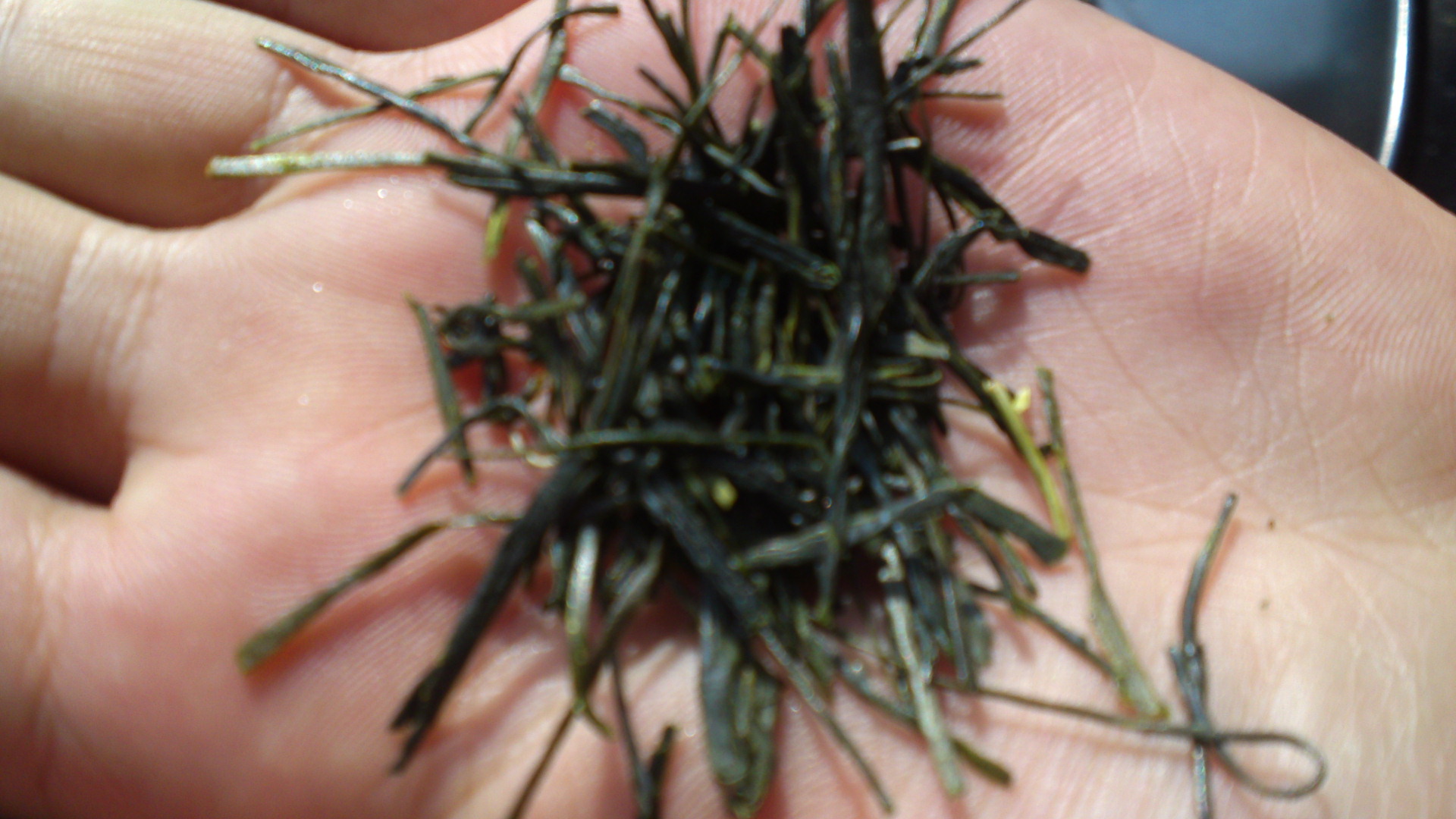
Yanagi Cha/柳茶/ Willow Tea, called so because the the roasted leaves look like willow leaves. Also commonly called Ban cha/番茶/ Number Tea

For a closer view of the same.

Kona cha/粉茶/ Powder Tea

For a closer view of the same.

Marufuku Seishya Co. Ltd. (Mr. Bunji Itoh)
Shizuoka Shi, Aoi Ku, Wakamatsu Cho, 25
Tel.: 054-271-2011
Fax: 054-271-2010

RECOMMENDED RELATED SITES:
Warren Bobrow, Bread + Butter, Zoy Zhang, Hungry Neko, Think Twice, Frank Fariello, Mangantayon, Hapabento, Elinluv Tidbit Corner, Tokyo Terrace, Maison de Christina, Chrys Niles,Lexi, Culinary Musings, Wheeling Gourmet, Comestiblog, Chronicles Of A Curious Cook, Tokyo Through The Drinking Glass, Tokyo Foodcast, Palate To Pen, Yellin Yakimono Gallery, Tokyo Terrace, Hilah Cooking, More than a Mount Full, Arkonite Bento, Happy Little Bento; 5 Star Foodie; Jefferson’s Table; Oyster Culture; Gourmet Fury; Island Vittles; Good Beer & Country Boys; Rubber Slippers In Italy; Color Food daidokoro/Osaka;/a; The Witchy Kitchen; Citron Et Vanille, Lunsj Med Buffet/Estonian Gastronomy (English), Cook, Eat, Play, Repeat, Chrisoscope

Please check the new postings at:
sake, shochu and sushi

Food Humor: Boomerang Daikon et al!

As I going down the stairs of my apartment this morning to dispose of our rubbish I noticed our dear neighbor, Mr. Yoshizo Sugiyama, washing the daikon he had just pulled out of his big garden.
Nothing much to comment about that, except that some of the daikon were of a farout shape!

Apparently the sudden changes of temperature last summer affected the drainage forcing the daikon in “searching for water.

A “twisting ballet dancer”?

That one really tried to swim into two different directions at the same time! LOL

Looking for more!

RECOMMENDED RELATED SITES:
Warren Bobrow, Bread + Butter, Zoy Zhang, Hungry Neko, Think Twice, Frank Fariello, Mangantayon, Hapabento, Elinluv Tidbit Corner, Tokyo Terrace, Maison de Christina, Chrys Niles,Lexi, Culinary Musings, Wheeling Gourmet, Comestiblog, Chronicles Of A Curious Cook, Tokyo Through The Drinking Glass, Tokyo Foodcast, Palate To Pen, Yellin Yakimono Gallery, Tokyo Terrace, Hilah Cooking, More than a Mount Full, Arkonite Bento, Happy Little Bento; 5 Star Foodie; Jefferson’s Table; Oyster Culture; Gourmet Fury; Island Vittles; Good Beer & Country Boys; Rubber Slippers In Italy; Color Food daidokoro/Osaka;/a; The Witchy Kitchen; Citron Et Vanille, Lunsj Med Buffet/Estonian Gastronomy (English), Cook, Eat, Play, Repeat, Chrisoscope

Please check the new postings at:
sake, shochu and sushi

As I going down the stairs of my appartment this morning to get rid of our rubbish, I noticed my dear neighbour, Mr. Yoshizo Sugiyama, washing daikon he has jest pulled out of his graden.
Nothing to talk about in itself, bu the shapes of some daikon were a different matter!

Due to the great sudden changes of temperature this summer and drainage being consequently affected, the daikon had to “search” their water, hence the strange shapes!

RECOMMENDED RELATED SITES:
Warren Bobrow, Bread + Butter, Zoy Zhang, Hungry Neko, Think Twice, Frank Fariello, Mangantayon, Hapabento, Elinluv Tidbit Corner, Tokyo Terrace, Maison de Christina, Chrys Niles,Lexi, Culinary Musings, Wheeling Gourmet, Comestiblog, Chronicles Of A Curious Cook, Tokyo Through The Drinking Glass, Tokyo Foodcast, Palate To Pen, Yellin Yakimono Gallery, Tokyo Terrace, Hilah Cooking, More than a Mount Full, Arkonite Bento, Happy Little Bento; 5 Star Foodie; Jefferson’s Table; Oyster Culture; Gourmet Fury; Island Vittles; Good Beer & Country Boys; Rubber Slippers In Italy; Color Food daidokoro/Osaka;/a; The Witchy Kitchen; Citron Et Vanille, Lunsj Med Buffet/Estonian Gastronomy (English), Cook, Eat, Play, Repeat, Chrisoscope

Please check the new postings at:
sake, shochu and sushi

Italian Cuisine: Umegashima Wild Boar Ragu Pici Pasta at Il Castagno

Service: Excellent and very friendly
Facilities: clean
Prices: reasonable
Specialty: Central and south Italian-style cuisine. Home-made pasta. Very reasonables prices. Progressive wine list.
no-smoking-logo1 Non-smoking!

The other day as I cycled around to find out where I was going to have my lunch between two bouts of computer work, I noticed an interesting if not unusual dish on the menu of the day posted in front of Il Castagno:
Umegashima Wild Boar Pasta!

Umegashima is the area located near the source of the Abe River flowing across Shizuoka city.
It is nationally famous for its many hotsprings, tea culture and wasabi and shamo chicken.
But what people know less is that it is a region replete with wild game, especially deer and wild boar!
The chef at Il Castagno managed to put his hands on a wild boar leg and hind which had been shot down a few days before my visit!

He marinated the meat for 24 hours in herbs, wine and ingredients he did not really want to reveal…
He then simmered slowly with white wine into an incredible Ragu!
Themeat had been so softened that it was easily shredded into convenient bits for a pasta dish.
The present pasta are Toscana Pici, hand-made at the resataurant (all pasta there is freshly hand-made!).
Serve with Italian parsley and Parmeggiano Regiano, it made for an utterly extravagant pasta dish!

IL CASTAGNO
420-0843 Shizuoka Shi, Aoi Ku, Tomoe Cho, 48 (along Kitakaido Street)
Tel. & Fax: 054-247-0709
Business hours: 11:45~14:00, 17:30~21:00
Closed on Mondays and second Tuesdays
Lunch: 1,260 and 1,860 yen
Dinner: 4,000 and 5,000 yen
A la Carte menu and wine list available. Wine by the glass ok
Reservations recommended.
Credit Cards OK (evening only)
HOMEPAGE (Japanese)

RECOMMENDED RELATED SITES:
Warren Bobrow, Bread + Butter, Zoy Zhang, Hungry Neko, Think Twice, Frank Fariello, Mangantayon, Hapabento, Elinluv Tidbit Corner, Tokyo Terrace, Maison de Christina, Chrys Niles,Lexi, Culinary Musings, Wheeling Gourmet, Comestiblog, Chronicles Of A Curious Cook, Tokyo Through The Drinking Glass, Tokyo Foodcast, Palate To Pen, Yellin Yakimono Gallery, Tokyo Terrace, Hilah Cooking, More than a Mount Full, Arkonite Bento, Happy Little Bento; 5 Star Foodie; Jefferson’s Table; Oyster Culture; Gourmet Fury; Island Vittles; Good Beer & Country Boys; Rubber Slippers In Italy; Color Food daidokoro/Osaka;/a; The Witchy Kitchen; Citron Et Vanille, Lunsj Med Buffet/Estonian Gastronomy (English), Cook, Eat, Play, Repeat, Chrisoscope

Please check the new postings at:
sake, shochu and sushi

French Desserts at Pissenlit

Service: excellent and very friendly
Facilities: great washroom, great cleanliness overall
Prices: reasonable, good value.
Strong points: Interesting wine list. Great use of local products.
no-smoking-logoentirely non-smoking!

I do not need to introduce Pissenlit, one of the very best French restaurants in the whole Shizuoka Prefecture.
As I often go there, alone, with the Missus or friends, I find it more practical to introduce Tooru Arima’s creations as a group!
This time I would like to introduce you to some of his recent desserts!

Let’s start with the first one (Top picture repeated!):
La France Pear Compote on Vanilla Ice-cream and Creme Brulee.
The pear had been compoted beforehand and kept in the fridge.
It was placed on a portion of home-made vanilla ice-cream.
The whole was covered and surrounded with a light creme anglaise/custard which was then “brulee” with a gas burner. Some glazing sugar and mint were added to the fear as a finishing point!
Succulent and lighter than it looks!

Coffee Creme Brulee.

The dreme/pudding contained a lot of strong mocha coffee for the perfect mariage. The creme was brulee until its srface was thick and crackling.
Served with fresh figs, it almost looked like a chocolate cream.
As usual lighter than usual and a treat you never tires of. Of course served with a high-quality coffee!

Roasted Figs with Vanilla Ice Cream and Roquefort Blue Cheese Cream.

Now, this was quite a discovery!
The sweet taste of the roasted (Shizuoka-grown) figs was counterbalanced in two gradual ways: first the vanilla ice-cream (light as usual) will bring you down a little from the sweet plane onto the salted and sweet plane formed by the Roqufort cheese mixed into a light cream!
An experience!

Caramel Flan/Pudding with Fruits and Vegetables Sorbets.

A seemingly simple dessert until you discover than sorbets are made with vegetables, spinach and tomato! The fruit are persimmon, pione grapes and two small fruits I don’t have a clue about (sorry,I’ll check during my next visit!).
Incidentally the caramel pudding is firm, sweet to the right point and the caramel sauce a beauty!

looking forward to the next ones!

PISSENLIT
420-0839 Shizuoka City, Aoi Ku, Takajo, 2-3-4
Tel.: 054-270-8768
Fax: 054-627-3868
Business hours: 11:30~14:30; 17:00~22:00
Closed on Tuesdays and Sunday evening
Homepage (Japanese)
Credit Cards OK

RECOMMENDED RELATED SITES:
Warren Bobrow, Bread + Butter, Zoy Zhang, Hungry Neko, Think Twice, Frank Fariello, Mangantayon, Hapabento, Elinluv Tidbit Corner, Tokyo Terrace, Maison de Christina, Chrys Niles,Lexi, Culinary Musings, Wheeling Gourmet, Comestiblog, Chronicles Of A Curious Cook, Tokyo Through The Drinking Glass, Tokyo Foodcast, Palate To Pen, Yellin Yakimono Gallery, Tokyo Terrace, Hilah Cooking, More than a Mount Full, Arkonite Bento, Happy Little Bento; 5 Star Foodie; Jefferson’s Table; Oyster Culture; Gourmet Fury; Island Vittles; Good Beer & Country Boys; Rubber Slippers In Italy; Color Food daidokoro/Osaka;/a; The Witchy Kitchen; Citron Et Vanille, Lunsj Med Buffet/Estonian Gastronomy (English), Cook, Eat, Play, Repeat, Chrisoscope

Please check the new postings at:
sake, shochu and sushi

Shizuoka Sake Tasting: Yamanaka Brewery-Aoitenka Junmai Hyakumangoku Rice

Yamanaka Brewery is a small, ancient and traditional brewery lost a long way south of Kakegawa Station and it is not easy to find their brews even in Shizuoka City. Luckily enough I happened to find this sake made with Hyakumangoku rice grown in Shizuoka Prefecture!

Rice: Hyakumangoku (Shizuoka-grown)
Milled down to: 65%
Dryness: +2.0
Acidity: 1.4
Yeast: Association No 1001
Alcohol: 15~16 degrees
Bottled in June 2010

Clarity: very clear
Color: transparent
Aroma: fruity, light, banana, chocolate, vanilla, hints of pineapple
Body: fluid
Taste: Dry soft attack with junmai petillant.
Complex and fruity: chocolate, coffee beans, banana.
Quickly disappears with notes of almonds.
Gets drier with food.
Easy to drink.

Overall: A sake for all seasons.
Very fruity, dry and soft.
Actually quite complex and showing more facets than expected.
A sure value!

Must-see tasting websites:
-Sake: Tokyo Through The Drinking Glass, Tokyo Foodcast, Urban Sake, Sake World
-Wine: Palate To Pen, Warren Bobrow, Cellar Tours, Ancient Fire Wines Blog
-Beer: Good Beer & Country Boys, Another Pint, Please!
-Japanese Pottery to enjoy your favourite drinks: Yellin Yakimono Gallery
——————————–
Please check the new postings at:
sake, shochu and sushi

—————————————-
日本語のブログ
—————————————-

Shizuoka Agricultural Products: Horiuchi Vegetables Garden

“We grow vegetables 364 days a year, and sometimes 365 days!”, replied Mrs. Satoko Horiuchi/堀内里子 when asked how busy she and her husband were.

Her family has been growing tea and rice for 6 or 7 generations (“I don’t remember!” confided the sweet old lady with a laugh).

Eggplants.

The Horiuchi family was introduced to me by my good friend Natsuko Koyanagi/小柳奈津子from Agriroad/アグリロード in Miwa/美和 in Aoi Ku/葵区 in Shizuoka City.

Basil.

“Whenever we are short of vegetables at Agriroad Market, we just give her a call and she will fill the place again!” Natsuko explained.

Komatsuna/小松菜 or Japanese Mustard Spinach.

The Horiuchi family cultivates vegetables over an area of 25 acres.
Satoko and her husband do most of the work with occasional from their daughter.

Satoimo/里芋, taro

As far as fertilizer is concerned they use a combination of organic manure fertilizer and artificial fertilizer.

Can you guess what these are?
Peanuts/Rakkasei/落花生!

Exploring their garden is like a lesson!
These are kabocha/南瓜 flowers!

The kabocha itself. Still too young and soft yet!

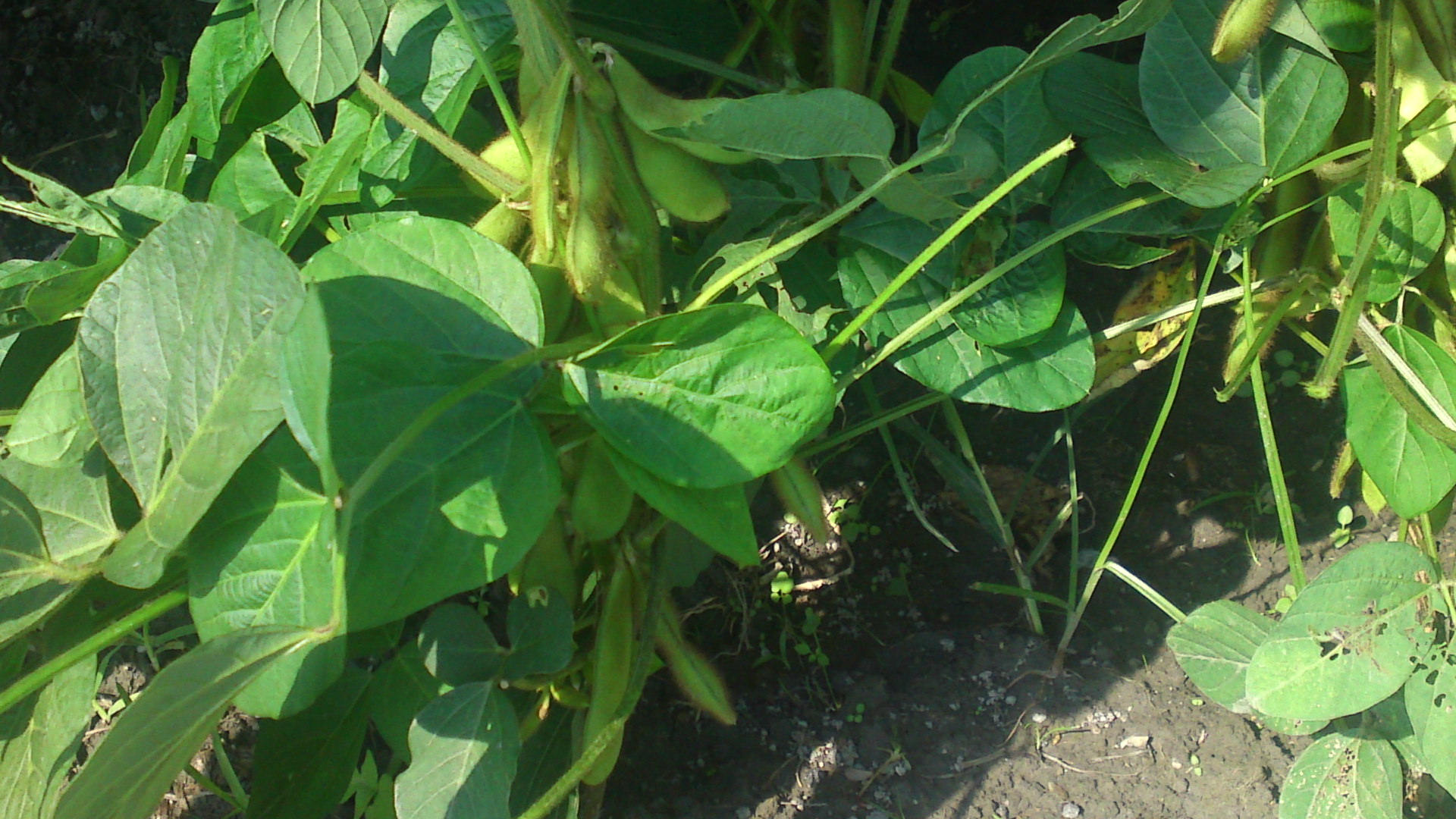
Edamame/枝豆! They are actually soy beans/daizu/大豆 harvested still green like you would do with string beans.

Enormous okra/オクラ!
The Japanese like them small, although I like biting through their seeds after having steamed and marinated them!

Satsuma Imo/Sweet potatoes/薩摩芋.
The Horiuchis use as little pesticide as possible although it is a daily fight with their daughter who wishes to grow more organic vegetables to satisfy the new demands!

Broccoli in front and myoga/myoga ginger/茗荷 at the back.

Japanese lettuce variety.

The Horiuchis on the average will grow at least two if not three of vegetable varieties on the same plot of land depending on the season.

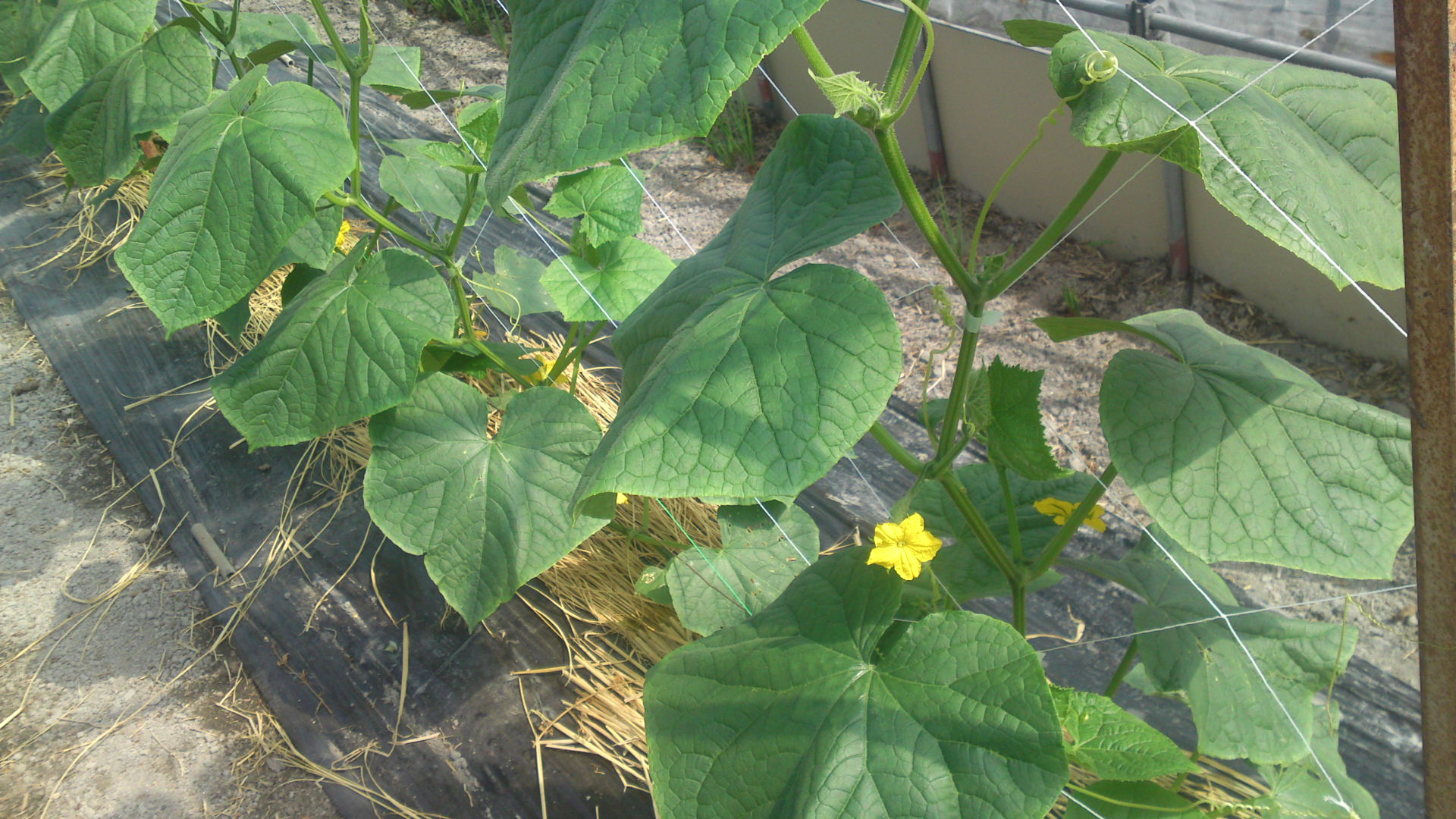
Cucumbers.
This particular greenhouse is their daughter’s organic domain!

Beautiful and healthy!

The “heart” of the garden!

All these are the Horiuchis’ property, not counting the oranges and tea fields in nearby mountains!

There is a constant demand for peppers or piman/ピーマン in Japanese!

Daikon still at an early stage.
Don’t forget that the leaves are also edible. They make for great pickles!

And the leeks/negi/葱 naturally!
I’m convinced that the Japanese must be some of the highest consumers in the world!

You will understand why I will have to visit their garden in the near future!

Incidentally they also take direct orders apart of of selling their vegetables in many markets. Give them a call to find out what is available!

Horiuchi Garden
Shizuoka City, Aoi Ku, Nakanogo, 32
静岡市葵区中乃郷32
Tel.: 054-296-3886

RECOMMENDED RELATED SITES:
Warren Bobrow, Bread + Butter, Zoy Zhang, Hungry Neko, Think Twice, Frank Fariello, Mangantayon, Hapabento, Elinluv Tidbit Corner, Tokyo Terrace, Maison de Christina, Chrys Niles,Lexi, Culinary Musings, Wheeling Gourmet, Comestiblog, Chronicles Of A Curious Cook, Tokyo Through The Drinking Glass, Tokyo Foodcast, Palate To Pen, Yellin Yakimono Gallery, Tokyo Terrace, Hilah Cooking, More than a Mount Full, Arkonite Bento, Happy Little Bento; 5 Star Foodie; Jefferson’s Table; Oyster Culture; Gourmet Fury; Island Vittles; Good Beer & Country Boys; Rubber Slippers In Italy; Color Food daidokoro/Osaka;/a; The Witchy Kitchen; Citron Et Vanille, Lunsj Med Buffet/Estonian Gastronomy (English), Cook, Eat, Play, Repeat, Chrisoscope

Please check the new postings at:
sake, shochu and sushi

Vegetarian French Lunch with Shizuoka Ingredients at Tetsuya SUGIMOTO (2010/10/28)

Ranking
Service: Highly professional and friendly
Equipment: Great overall cleanliness. Beautiful washroom
Prices:~
Strong points:Freshest produce and ingredients only, mainly from Shizuoka Prefecture. Organic vegetables. Seasonal food only

Map (Japanese)
Entirely non-smoking!

I have to keep regularly to Tetsuya Sugimoto Restaurant as his ingredients are seasonal and nothing else!
As today is practical for a light lunch I visited him a bit late on purpose to have ample time to report. Tetsuya does not mind at all and actually always welcome the chat!

As there was no real local meat around, we kept it purely to vegetables.
He didn’t say he had that many form Shizuoka, only to show a dozen Tupperware to choose from!
Now, the mushrooms above are wild ones from Fujinomiya City’s vicinity at the foot of Mount Fuji!
They are called “Shougenji” mushrooms. And these were bigger than the cultivated variety!

Tetsuya Sugimoto is quickly turning into the Alain Passard of Shizuoka!
So he started “shopping” among the incredible (and he said small!) array of his vegetables.
The above are organic chayottes (hayato uri in Japanese)f from Hamamatsu.

His vegetables and all other ingredients are stored with such great care!

Now, can you guess what this vegetable might be? If you can, you owe my respect as this was a first for me!

Rice stalks or “ine” in Japanese. These are grown that thick on Amagi Plateau in Izu Peninsula!. The thick core is very easy to cook!

Look at these! All from Shizuoka Prefecture and organic to boot!

The other vegetables included:
Lotus root (“renkon” in Japanese, slightly boiled preserved in its own water) from Asabata, Shizuoka City
Winged Bean (“Shikaku Mame”) from Hamamatsu City
White and violet “Mabiki” Daikon, Tsurumurasaki and Carrot (“Ninjin”), all from Matsuki Biofarm at the foot of Mount Fuji!

The vegetables were first slowly fried with some white butter and a minimum of water and covered with a lid to prevent the juices to evaporate.

The vegetables were taken out in order according to their size and softness.
A minimum amount of water was added from time to time to help the larger vegetables to cook properly.

A lttle butter was added to liaise the sauce made up of the vegetables juices only as well as a little salt and a little lemon vinegar. Nothing else!

In front of me!

From another angle!

Testuya told he is going to scour the Izu Peninsula in search for seaweed varieties (Shizuoka has the largest number of varieties in Japan!) to create a vegetarian marine cuisine!

Tetsuya SUGIMOTO
420-0038 Shizuoka City, Aoi Ku, Umeya,, 2-13,1F
Tel./Fax: 054-251-3051
Opening hours:11:30~14:30,17:30~21:30
Holidays: undecided
Cedit cards OK
HOMEPAGE

RECOMMENDED RELATED SITES:
Warren Bobrow, Bread + Butter, Zoy Zhang, Hungry Neko, Think Twice, Frank Fariello, Mangantayon, Hapabento, Elinluv Tidbit Corner, Tokyo Terrace, Maison de Christina, Chrys Niles,Lexi, Culinary Musings, Wheeling Gourmet, Comestiblog, Chronicles Of A Curious Cook, Tokyo Through The Drinking Glass, Tokyo Foodcast, Palate To Pen, Yellin Yakimono Gallery, Tokyo Terrace, Hilah Cooking, More than a Mount Full, Arkonite Bento, Happy Little Bento; 5 Star Foodie; Jefferson’s Table; Oyster Culture; Gourmet Fury; Island Vittles; Good Beer & Country Boys; Rubber Slippers In Italy; Color Food daidokoro/Osaka;/a; The Witchy Kitchen; Citron Et Vanille, Lunsj Med Buffet/Estonian Gastronomy (English), Cook, Eat, Play, Repeat, Chrisoscope

Please check the new postings at:
sake, shochu and sushi