Tag Archives: seafood

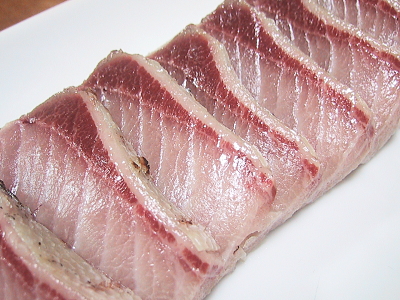
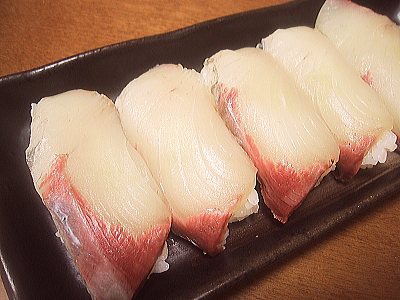
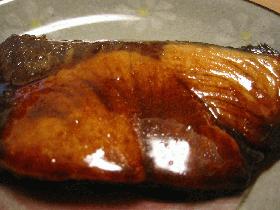
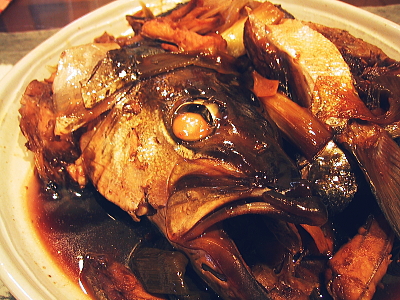
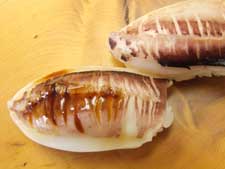
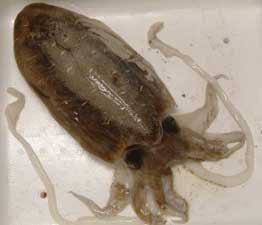
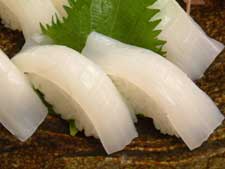
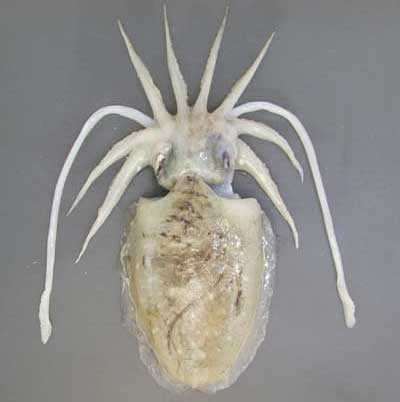
Japanese Fish Species 7: Bonito-Katuso-鰹

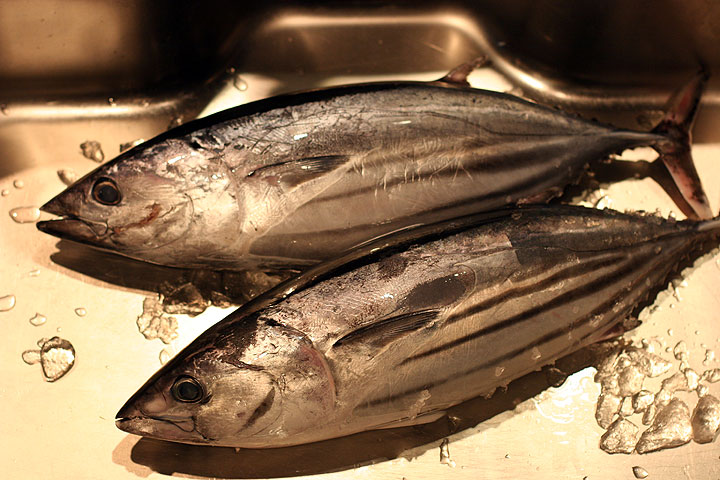
Bonito or “katsuo” in Japanese are extensively caught by fishermen from Numazu, Shimizu, Yaizu and Omaezaki Harbours (all Shizuoka Prefecture). The main fishing areas are Shizuoka, Mie, Kochi & Miyazaki Prefectures.
It is also called “katsu” (Tohoku Region), “Honkatsuo” (Kyushu Island), “Magatsuo” (Shikoku and Kyushu Islands. N.B.: the same name designates another fish in other parts of Japan!), “Suji” (Yamaguchi & Wakayama Pref.).
It appears on the markets early Spring~Autumn as “sho gatsuo” (first bonito in Spring) and “modori gatsuo” (return bonito end of Autumn).
They are traditionally line-caught but nets have been used extensively in recent years.
Of the same family this is the only tuna variety whose stocks are still preserved.
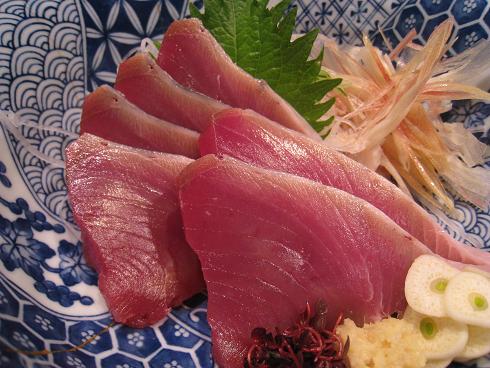
It can be appreciated raw, as sashimi with its skin or without it, preferably served with a saucer of soy sauce (shoyu) mixed with thin slices of fresh garlic, or with wasabi, a touch of lemon and shoyu,
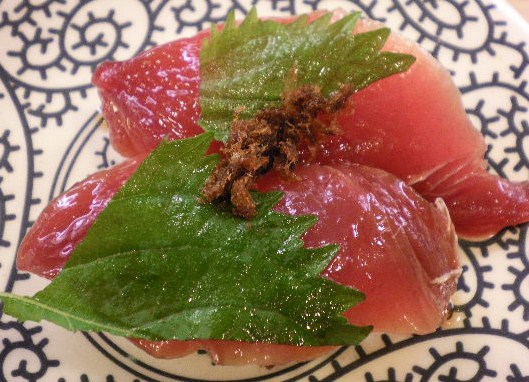
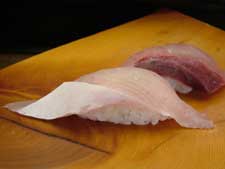
or as nigiri topped with grated fresh ginger a thin slice of garlic, unless you prefer grated fresh ginger with chopped thin leeks.
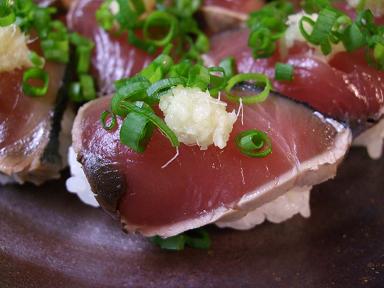
The same is done with lightly grilled/aburi (or tataki) bonito as sushi nigiri.
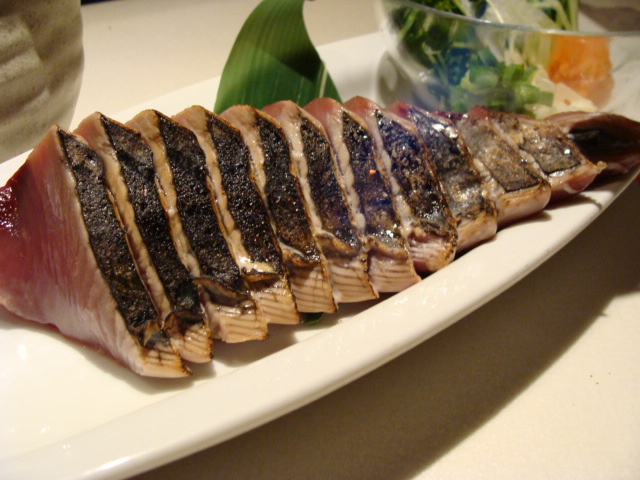
Another very popular way to eat it that will please Europeans and North Americans alike, is “tataki”.
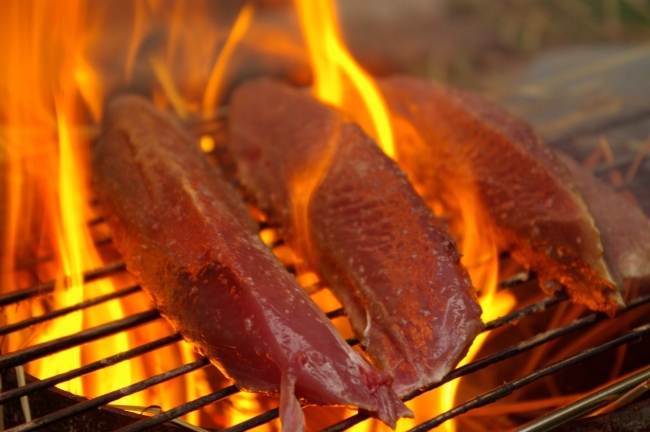
The fish is first seared/grilled over charcoal until it is lightly cooked on the whole outside then plunged into iced water to stop it from cooking any longer. It is then cut into large slices and served with freshly chopped garlic and thin leeks, “shiso” leaves (perilla/beefsteak plant) and wasabi.

Note 1: in restaurants specify whether you want the skin or not when ordering sashimi.

Note 2: the same fish is a staple food in Sri Lanka where it is first smoked and then prepared as soup or curry!
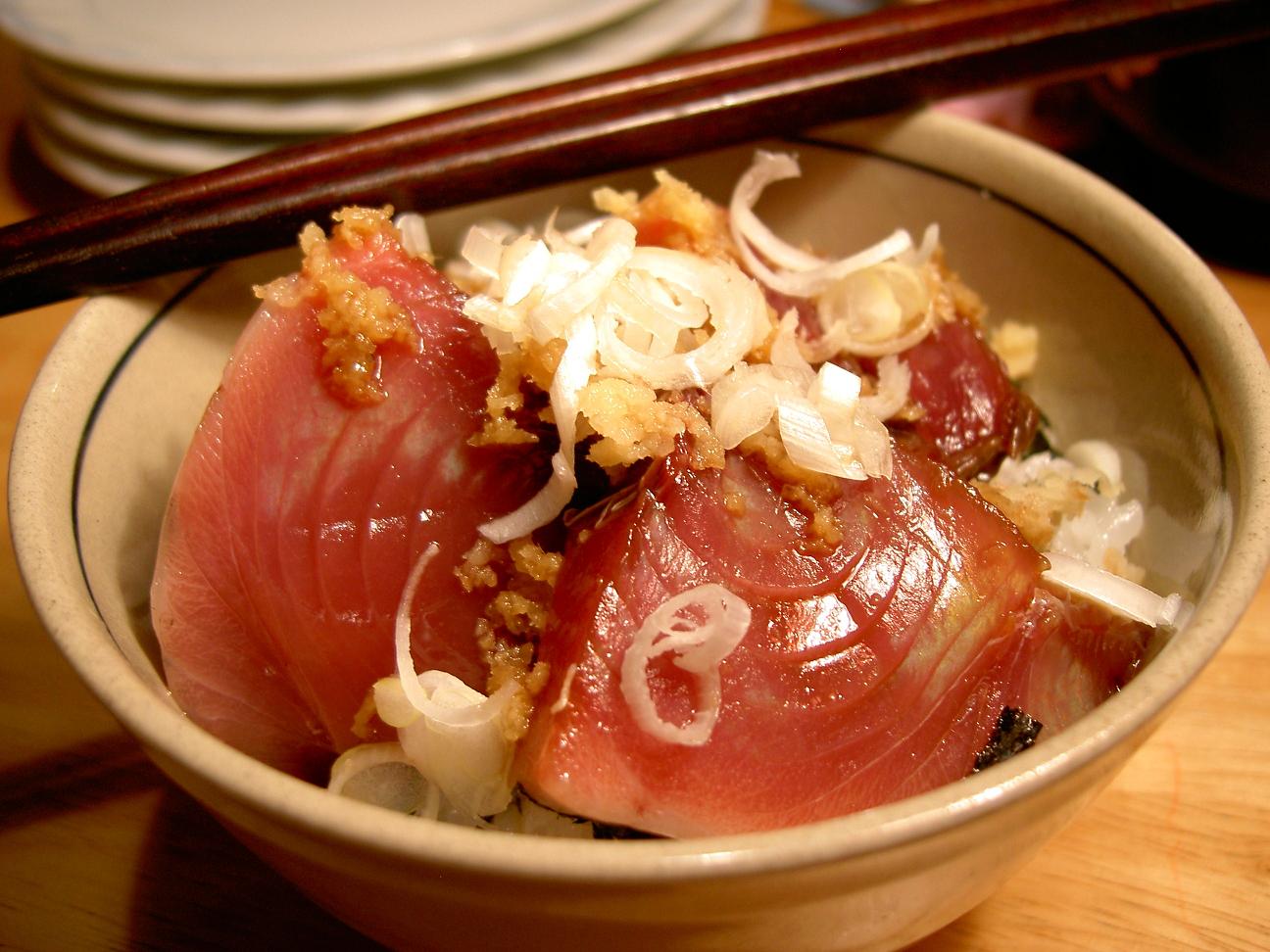
It is one of the most versatile fish in Japan.
It can be appreciated in many ways:
As a simple donburi/on a bowl or rice at home (see above picture),
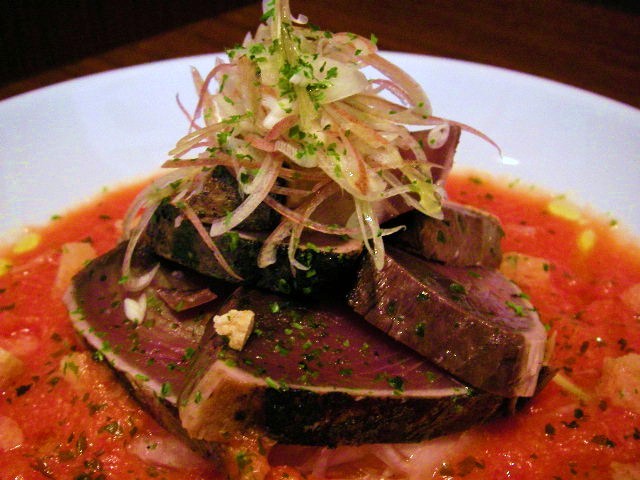
Lightly seared and served as carpaccio,
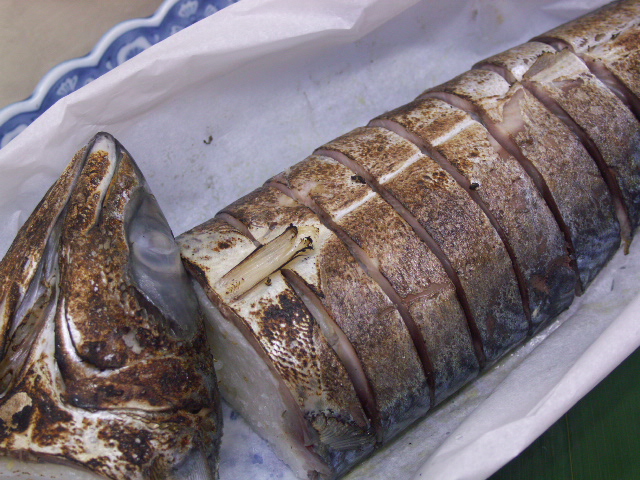
as bogata sushi/whole fish stuffed with sushi rice,
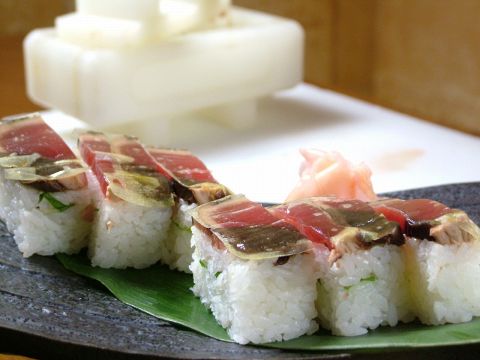
as oshizushi/pressed sushi,
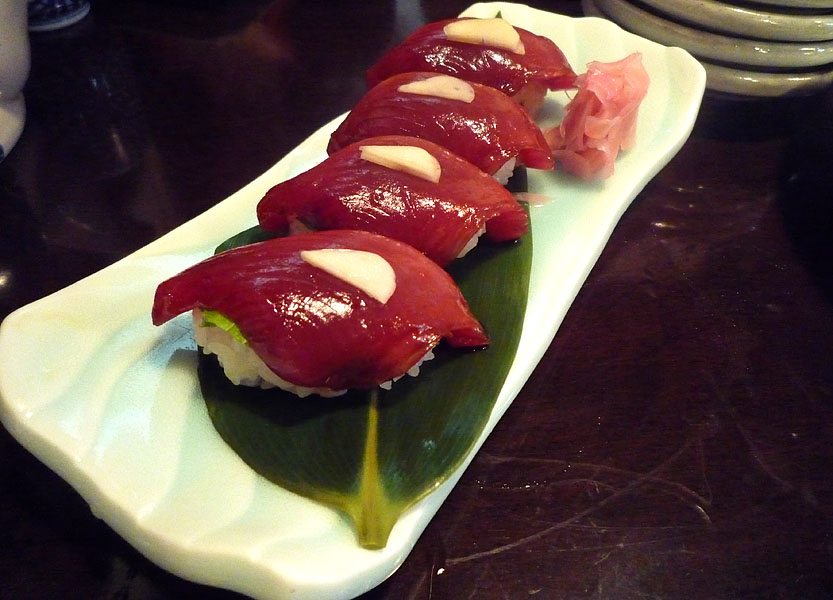
but my favourite is probably as zuke/marinated in soy sauce, mirin, sake, etc. before being served with a slice of garlic!

RECOMMENDED RELATED WEBSITES

Green Tea Club by Satoshi Nihonyanagi in Shizuoka!, Mind Some by Tina in Taiwan, Le Manger by Camille Oger (French), The Indian Tourist, Masala Herb by Helene Dsouza in Goa, India, Mummy I Can Cook! by Shu Han in London, Pierre.Cuisine, Francescannotwrite, My White Kitchen, 47 Japanese Farms Through The Eyes of Its Rural Communities, Foodhoe, Chucks Eats, Things that Fizz & Stuff, Five Euro Food by Charles,Red Shallot Kitchen by Priscilla,With a Glass, Nami | Just One Cookbook, Peach Farm Studio, Clumsyfingers by Xethia, PepperBento,Adventures in Bento Making, American Bent, Beanbento, Bento No, Bento Wo Tsukurimashou, Cooking Cute, Eula, Hapabento , Happy Bento, Jacki’s Bento Blog, Kitchen Cow, Leggo My Obento, Le Petit Journal Bento & CO (French), Lunch In A Box,
Susan at Arkonlite, Vegan Lunch Box; Tokyo Tom Baker, Daily Food Porn/Osaka, Only Nature Food Porn, Happy Little Bento, The Herbed Kitchen, J-Mama’s Kitchen, Cook, Eat, Play, Repeat, Bento Lunch Blog (German), Adventures In Bento, Anna The Red’s Bento Factory, Cooking Cute, Timeless Gourmet, Bento Bug, Ideal Meal, Bentosaurus, Mr. Foodie (London/UK), Ohayo Bento,

Must-see tasting websites:

-Sake: Tokyo Through The Drinking Glass, Tokyo Foodcast, Urban Sake, Sake World
-Wine: Palate To Pen, Warren Bobrow, Cellar Tours, Ancient Fire Wines Blog
-Beer: Good Beer & Country Boys, Another Pint, Please!
-Japanese Pottery to enjoy your favourite drinks: Yellin Yakimono Gallery
Japanese Fish Species 6: Amberjack-Kampachi-環八

KAMPACHI-1

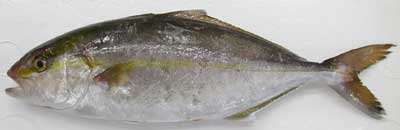
With the first days of Autumn Kampachi or Amberjack is appearing on our plates in Japan, although we have them almost all year round in Shizuoka!

The fish seems to have so many names in any language: Amberjack, Purplish Amberjack, Yellowtail, Greater Yellowtail, and Ruderfish in English, whereas in Japanese it is called Kampachi, Akahana, Kampa, or Shokko among others, not accounting for regional names!.

KAMPACHI-3

It is caught along Central and South Honshu Island, including a lot in Suruga Bay in Shizuoka Prefecture!
It is a very popular fish as it happens to come just in between Hiramasa/Young Japanese Amberjack-Five ray Yellowtail in Summer and Buri/Mature Japanese Amberjack-Five Ray Yellowtail in Winter, making a favourite for the season, but bringing a lot of confusion on foreign tables because of the similar names.
Kampachi (Seriola dumerili (Risso) in Latin) and Buri (Seriola quinqueradiata Temminck and Schlegel in Latin) are very similar but their season is different. Beware of scams! Actually the meat looks different.

KAMPACHI-2BURI-SUSHI

Kampachi vs Buri Sushi

Natural Kampachi is quite rare in Japan these days whereas human-raised are plenty.

Japanese-style simmered Amberjack

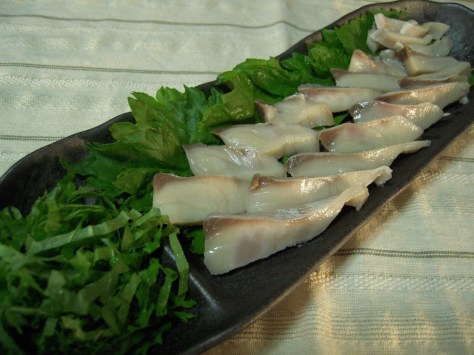
Kampachi is savoured in many ways: Sashimi & Sushi, Grilled (Yakimono), Simmered (Nizuke), Meuniere and fried.
Choose comparatively small specimens. Beware of the large cheap specimens!

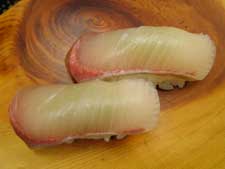
Ask for a variation in Sushi called “Kampachi Aburi”/kampachi lightly grilled on one side: a beauty!

RECOMMENDED RELATED WEBSITES

Green Tea Club by Satoshi Nihonyanagi in Shizuoka!, Mind Some by Tina in Taiwan, Le Manger by Camille Oger (French), The Indian Tourist, Masala Herb by Helene Dsouza in Goa, India, Mummy I Can Cook! by Shu Han in London, Pierre.Cuisine, Francescannotwrite, My White Kitchen, 47 Japanese Farms Through The Eyes of Its Rural Communities, Foodhoe, Chucks Eats, Things that Fizz & Stuff, Five Euro Food by Charles,Red Shallot Kitchen by Priscilla,With a Glass, Nami | Just One Cookbook, Peach Farm Studio, Clumsyfingers by Xethia, PepperBento,Adventures in Bento Making, American Bent, Beanbento, Bento No, Bento Wo Tsukurimashou, Cooking Cute, Eula, Hapabento , Happy Bento, Jacki’s Bento Blog, Kitchen Cow, Leggo My Obento, Le Petit Journal Bento & CO (French), Lunch In A Box,
Susan at Arkonlite, Vegan Lunch Box; Tokyo Tom Baker, Daily Food Porn/Osaka, Only Nature Food Porn, Happy Little Bento, The Herbed Kitchen, J-Mama’s Kitchen, Cook, Eat, Play, Repeat, Bento Lunch Blog (German), Adventures In Bento, Anna The Red’s Bento Factory, Cooking Cute, Timeless Gourmet, Bento Bug, Ideal Meal, Bentosaurus, Mr. Foodie (London/UK), Ohayo Bento,

Must-see tasting websites:

-Sake: Tokyo Through The Drinking Glass, Tokyo Foodcast, Urban Sake, Sake World
-Wine: Palate To Pen, Warren Bobrow, Cellar Tours, Ancient Fire Wines Blog
-Beer: Good Beer & Country Boys, Another Pint, Please!
-Japanese Pottery to enjoy your favourite drinks: Yellin Yakimono Gallery
Japanese Fish Species 5: Stone Flounder-Ishigarei-石鰈

Ishigarei, イシガレイ、石鰈 in Japanese, is another popular flatfish/flounder in this country. For the specialists the Englidh name is Stone flounder, and its Latin name Kareus bicoloratus. Interestingly enough these fishes are commonly called flatfishes in English, wheeras the Jaapnese write them as “leaf Fishes”!

In Japan, depending upon the region it will be called other names, such as Ishimochi, Ishimochigarei or Shirogarei.
Their season is mainly in Summer in Hokkaido and Eastern Japan, although they might appear a lot earlier in Shizuoka.

Ishigarei is considered the best of all flounders in this country. People generally avoid to catch them during the female egg incubation, but the same egg-bearing fish are a delicacy in Tokyo.

Always choose “lively” specimens when buying them as the taste will soon deteriorate if the fish is not dressed quickly first.
If an angler-friend of yours calls on the phone with one of them, don’t discuus and buy the fish!

Stone flounders make for such superlative sashimi that it becomes a bit of a waste to consume it in another way.

But who would pass such a Japanese-style carpaccio?

Or an Italian Carpaccio?

Sushi lovers will appreciate it as a sushi nigiri!

A truly extravagant sushi nigiri display. Eat it quickly!

Alright, you were not lucky enough to get it absolutely fresh.
In this case simmer it the Japanese way as Ishigarei Ni (Ni stands for simmer) with soy sauce, sake, mirin and ginger!

Or do it the Italian way with olive oil and dry tomatoes!

RECOMMENDED RELATED WEBSITES

Green Tea Club by Satoshi Nihonyanagi in Shizuoka!, Mind Some by Tina in Taiwan, Le Manger by Camille Oger (French), The Indian Tourist, Masala Herb by Helene Dsouza in Goa, India, Mummy I Can Cook! by Shu Han in London, Pierre.Cuisine, Francescannotwrite, My White Kitchen, 47 Japanese Farms Through The Eyes of Its Rural Communities, Foodhoe, Chucks Eats, Things that Fizz & Stuff, Five Euro Food by Charles,Red Shallot Kitchen by Priscilla,With a Glass, Nami | Just One Cookbook, Peach Farm Studio, Clumsyfingers by Xethia, PepperBento,Adventures in Bento Making, American Bent, Beanbento, Bento No, Bento Wo Tsukurimashou, Cooking Cute, Eula, Hapabento , Happy Bento, Jacki’s Bento Blog, Kitchen Cow, Leggo My Obento, Le Petit Journal Bento & CO (French), Lunch In A Box,
Susan at Arkonlite, Vegan Lunch Box; Tokyo Tom Baker, Daily Food Porn/Osaka, Only Nature Food Porn, Happy Little Bento, The Herbed Kitchen, J-Mama’s Kitchen, Cook, Eat, Play, Repeat, Bento Lunch Blog (German), Adventures In Bento, Anna The Red’s Bento Factory, Cooking Cute, Timeless Gourmet, Bento Bug, Ideal Meal, Bentosaurus, Mr. Foodie (London/UK), Ohayo Bento,

Must-see tasting websites:

-Sake: Tokyo Through The Drinking Glass, Tokyo Foodcast, Urban Sake, Sake World
-Wine: Palate To Pen, Warren Bobrow, Cellar Tours, Ancient Fire Wines Blog
-Beer: Good Beer & Country Boys, Another Pint, Please!
-Japanese Pottery to enjoy your favourite drinks: Yellin Yakimono Gallery
French Recipe: Okabe Venison Bourgogne Wine Stew and Penne!

My plate!

What with wild deer making themselves a real nuisance in Shizuoka Prefecture (and almost all over Japan) succulent meat is readily avalaible if you know when, where and whom to ask!
The other day my good friend Yasushi Imaizumi/今泉康さん, owner of IMAIZUMI Fashion Company and a well-known local gastronome, gave me a good 2 kg of venison from a deer that had been culled by licensed hunters in Okabe, Fuijeda City!

Being a native of Bourgogne, France, I knew the simple way to prepare it: Wine Stew/Bourguignon as for beef!
Although the meat was basically rump whereas meat on the bone would have been more proper, I still cooked it in the above manner.
This was a source of a bone of contention with the Dragon as I was for the analog recipe whereas she cooks such dishes through pressure cooking (autocuiseur/圧力鍋 !
If you are for the pressure cooker, the process is the same though the cooking will take only a few minutes but you still will need to strain and reduce the sauce.
Now, i did it the long ang and traditonal way:
-I cut the meat (about 2~3kg of it) into large chunks and marinated them overnight with a cup of whisky (you can try cognac or even vodka!), a bit of salt, plenty of pepper, bay leaves, a little sage and plenty of thyme powder (whole would have been best!).
-The next day, I took the meat out of its marinade and drained it. Some people wipe the marinade off but I don’t. The beauty of the Bourguignonne recipe is that it is wide open to priorities!
I didn’t discard the marinade!
-I cut a large carrot into big chunks, peeled a whole garlic and separated the cloves. I did not cut the latter. I peeled a large hard fresh onion. Some people would cut the onion into quarters but I wanted to keep it for the dish whereas quartered onion would have almost melted.
-I first fried cubes of baco in a little olive oil in a learge pan.
-I then fried the venison (with the bacon) all over in plenty more olive oil over a hot fire. Once the meat had completely changed color I dropped the carrot in, added some flour and cooked until the flour became a foxy color.
-I then reduced the fire to very low. I added the garlic, some tomato ketchup, the whole marinade and 2 thirds of a bottle of strong red wine (it was Italian as I didn’t have a French one!). People in Corsica also add a good portion of fresh home-made pistou/pesto, bvut I didn’t have the time or will to prepare it although I love it.
-I mixed the whole roughly and placed the onion in the middle punctured with a couple of whole cloves, put the lid on and cooked the whole on a very little fire for over 2 hours.
=I then took the venison, bacon and onion carefully out and drained the sauce.
I discarded the vegetables and reduced the sauce to a good half.
While it was reducing I cut the venison into single-bite chunks.
Once the sauce had been properly reduced I asted it and seasoned a little more and I put the venison and bacon back into the sauce and cooked it on a low fire while I was preparing some penne in plenty of salted water in which I had poured some olive oil.
I dropped the penne inside two large plates, placed plenty of venison in the middle, poure enough sauce (there was olenty left for the next two days!). On top of it all I placed the hot and (only then!) quartered onion for better effect and enjoyment. I put a finaltouch by sprinkling plenty of chopped fresh parsley all over it.

Pretty simple and open to variations!

The Dragon’s plate!

RECOMMENDED RELATED WEBSITES

Green Tea Club by Satoshi Nihonyanagi in Shizuoka!, Mind Some by Tina in Taiwan, Le Manger by Camille Oger (French), The Indian Tourist, Masala Herb by Helene Dsouza in Goa, India, Mummy I Can Cook! by Shu Han in London, Pierre.Cuisine, Francescannotwrite, My White Kitchen, 47 Japanese Farms Through The Eyes of Its Rural Communities, Foodhoe, Chucks Eats, Things that Fizz & Stuff, Five Euro Food by Charles,Red Shallot Kitchen by Priscilla,With a Glass, Nami | Just One Cookbook, Peach Farm Studio, Clumsyfingers by Xethia, PepperBento,Adventures in Bento Making, American Bent, Beanbento, Bento No, Bento Wo Tsukurimashou, Cooking Cute, Eula, Hapabento , Happy Bento, Jacki’s Bento Blog, Kitchen Cow, Leggo My Obento, Le Petit Journal Bento & CO (French), Lunch In A Box,
Susan at Arkonlite, Vegan Lunch Box; Tokyo Tom Baker, Daily Food Porn/Osaka, Only Nature Food Porn, Happy Little Bento, The Herbed Kitchen, J-Mama’s Kitchen, Cook, Eat, Play, Repeat, Bento Lunch Blog (German), Adventures In Bento, Anna The Red’s Bento Factory, Cooking Cute, Timeless Gourmet, Bento Bug, Ideal Meal, Bentosaurus, Mr. Foodie (London/UK), Ohayo Bento,

Must-see tasting websites:

-Sake: Tokyo Through The Drinking Glass, Tokyo Foodcast, Urban Sake, Sake World
-Wine: Palate To Pen, Warren Bobrow, Cellar Tours, Ancient Fire Wines Blog
-Beer: Good Beer & Country Boys, Another Pint, Please!
-Japanese Pottery to enjoy your favourite drinks: Yellin Yakimono Gallery

Japanese Fish Species 4: Sole-Olive Flounder-Bastard Halibut-Tonguefish-Hirame-平目

Hirame/平目

“Hirame” could be translated in many ways depending of your country of origin: Flat Fish, Sole, Turbot (although the latter should define “karei”) and what else. There are many varieties, wild or human-raised. In Japanese, the names are numerous: Hirame, Shitabirame, Ooguchikarei, Oyanirami, etc.

Actually, they can be divided into two main groups:

1)The Olive flounder or Bastard halibut (Paralichthys olivaceus; Japanese: ヒラメ/平目) is a species of large-tooth flounder native to the north-western Pacific Ocean.
It is often referred to as the Japanese flatfish or Korea(n) flatfish (광어) when mentioned in the context of those countries.
It is the most common flatfish species raised in aquaculture in Korea. They are raised in Japan and China as well.

Shitabirame/舌平目

2) Tonguefishes (shitabirame/舌平目in Japanese) are a family, Cynoglossidae, of flatfishes. They are distinguished by the presence of a long hook on the snout overhanging the mouth, and the absence of pectoral fins. Their eyes are both on the left side of their body, which also lacks a pelvic fin.

The best season is Autumn to Winter. They are still available until Spring in Shizuoka Prefecture. Wild ones come from Hokkaido and Aomori. Human-raised ones mainly hail from Oita, Ehime, Mie, and Kagoshima Prefectures.

Hirame Sashimi

The domestic wild catch is around 7,600 tonnes a year, while farmed fish amounts to around 7,100 tonnes a year. A recent increase has been observed in recent years, though. A lot are imported from Korea through Fukuoka and Shimoseki.
They are found in tropical and subtropical oceans, mainly in shallow waters and estuaries, though a few species are found in deep sea floors, and a few in rivers.

Hirame can be enjoyed in many ways:
As sashimi, cut in various thickness, according to the chef’s preference and presented artfully.

It can be enjoyed cut in small dices, as tartare, especially shitabirame/tonguefish with tomato and strawberry!

Of course, hiirame is great as sushi nigiri with all kinds of seasoning. I prefer it just seasoned with a little lemon juice or yuzu (if available) and salt (preferably “snow salt” from Okinawa!

The Japanese have a fondness for “engawa”, that is the frilled border along the fillets which are usually thrown away in other countries. The texture is different, almost crunchy.

Hirame is great marinated with konbu/seaweed as konbujime/seaweed marinated.

The same konbujime hirame can be served as oshizushi/pressed sushi topped with more seaweed!

An interesting oshizusshi combination is hirame topped with kabu/turnip and seasoned with yuzu juice and zest!

It is also very popular dried as himono/干物, especially shitabirame/tonguefish.

Naturally the Japanese all kinds of hirame cooked in the French way in a simple and succulent manner as above,

or as a beautiful gratin!

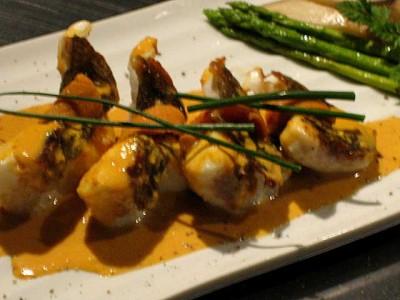
Last, but not least, how about grilled hirame with uni/sea urchin sauce?

RECOMMENDED RELATED WEBSITES

Green Tea Club by Satoshi Nihonyanagi in Shizuoka!, Mind Some by Tina in Taiwan, Le Manger by Camille Oger (French), The Indian Tourist, Masala Herb by Helene Dsouza in Goa, India, Mummy I Can Cook! by Shu Han in London, Pierre.Cuisine, Francescannotwrite, My White Kitchen, 47 Japanese Farms Through The Eyes of Its Rural Communities, Foodhoe, Chucks Eats, Things that Fizz & Stuff, Five Euro Food by Charles,Red Shallot Kitchen by Priscilla,With a Glass, Nami | Just One Cookbook, Peach Farm Studio, Clumsyfingers by Xethia, PepperBento,Adventures in Bento Making, American Bent, Beanbento, Bento No, Bento Wo Tsukurimashou, Cooking Cute, Eula, Hapabento , Happy Bento, Jacki’s Bento Blog, Kitchen Cow, Leggo My Obento, Le Petit Journal Bento & CO (French), Lunch In A Box,
Susan at Arkonlite, Vegan Lunch Box; Tokyo Tom Baker, Daily Food Porn/Osaka, Only Nature Food Porn, Happy Little Bento, The Herbed Kitchen, J-Mama’s Kitchen, Cook, Eat, Play, Repeat, Bento Lunch Blog (German), Adventures In Bento, Anna The Red’s Bento Factory, Cooking Cute, Timeless Gourmet, Bento Bug, Ideal Meal, Bentosaurus, Mr. Foodie (London/UK), Ohayo Bento,

Must-see tasting websites:

-Sake: Tokyo Through The Drinking Glass, Tokyo Foodcast, Urban Sake, Sake World
-Wine: Palate To Pen, Warren Bobrow, Cellar Tours, Ancient Fire Wines Blog
-Beer: Good Beer & Country Boys, Another Pint, Please!
-Japanese Pottery to enjoy your favourite drinks: Yellin Yakimono Gallery

Japanese Fish Species 3: Yellowtail-Buri-鰤

BURI-1

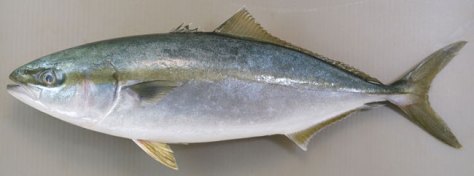
Buri/鰤 or Yellowtail, as Hiramasa or young Yellowtail is caught in Summer and Buri/Mature Yellowtail is caught in Winter.

How do you recognize them apart?

BURI-AGO
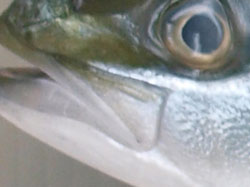
Buri has a “square chin” as they say in Japanese. Look at the back extremity of the mouth,

BURI-HIRAMASA-AGO
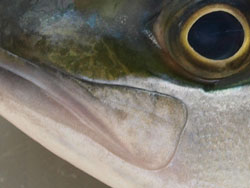
whereas it is more rounded for the hiramasa.

In Japan they are caught south of Hokkaido Island.
They come under many names: Wakashi, Inada, Warasa, Wakana, Hamachi and Mejiro.

Buri/Yellowyail is most popular when caught in rising waters in Winter when called Kan Buri/寒鰤 or “Cold Yellowtail”.

BURI-SASHIMI

Buri sashimi after light grill/Aburi/炙り

Young Yellowtails are best eaten as sahimi or

BURI-SUSHI-2

Buri Sushi

or as sushi as they are leaner then.

Older buri, containing a lot of fat, are better eaten cooked as

BURI-TERIYAKI

Buri Teriyaki,

BURI-ARA

Buri Ara with the whole head, or

BURI-MOPPONZU

Buri Mopponzu, including innards, especially liver and heart.

In the West of Japan, a New Year Meal cannot be conceived without buri!

Natural Buri catch accounts for 70,000~80,000 tonnes, while human-raised buri accounts for over 130,000 tonnes every year.
Imported buri accounts for less than 3,000 tonnes.

RECOMMENDED RELATED WEBSITES

Green Tea Club by Satoshi Nihonyanagi in Shizuoka!, Mind Some by Tina in Taiwan, Le Manger by Camille Oger (French), The Indian Tourist, Masala Herb by Helene Dsouza in Goa, India, Mummy I Can Cook! by Shu Han in London, Pierre.Cuisine, Francescannotwrite, My White Kitchen, 47 Japanese Farms Through The Eyes of Its Rural Communities, Foodhoe, Chucks Eats, Things that Fizz & Stuff, Five Euro Food by Charles,Red Shallot Kitchen by Priscilla,With a Glass, Nami | Just One Cookbook, Peach Farm Studio, Clumsyfingers by Xethia, PepperBento,Adventures in Bento Making, American Bent, Beanbento, Bento No, Bento Wo Tsukurimashou, Cooking Cute, Eula, Hapabento , Happy Bento, Jacki’s Bento Blog, Kitchen Cow, Leggo My Obento, Le Petit Journal Bento & CO (French), Lunch In A Box,
Susan at Arkonlite, Vegan Lunch Box; Tokyo Tom Baker, Daily Food Porn/Osaka, Only Nature Food Porn, Happy Little Bento, The Herbed Kitchen, J-Mama’s Kitchen, Cook, Eat, Play, Repeat, Bento Lunch Blog (German), Adventures In Bento, Anna The Red’s Bento Factory, Cooking Cute, Timeless Gourmet, Bento Bug, Ideal Meal, Bentosaurus, Mr. Foodie (London/UK), Ohayo Bento,

Must-see tasting websites:

-Sake: Tokyo Through The Drinking Glass, Tokyo Foodcast, Urban Sake, Sake World
-Wine: Palate To Pen, Warren Bobrow, Cellar Tours, Ancient Fire Wines Blog
-Beer: Good Beer & Country Boys, Another Pint, Please!
-Japanese Pottery to enjoy your favourite drinks: Yellin Yakimono Gallery

Japanese Fish Species 2: Mullet-Bora-鯔

There are at least 12 recognized kinds of mullet being caught all over the world.
The flathead mullet in particular is an important food fish for many around the world, and can be both fished and farmed. The roe of this mullet is salted, dried, and compressed to make a specialty food across the world, such as Korean myeongran jeot, Japanese karasumi, Italian botargo, and Egyptian batarekh . In Egypt, the fish itself is salted, dried, and pickled to make feseekh.

Flathead Mullet, Mugil Cephalus in Latin, or Bora/鯔/鰡 in Japanese, will reach length of over 80 cm in Japan, although the average length will more around 50 cm.

It is caught south of Hokkaido near river mouths or in bays receiving lots of river waters.
Like any othe fish, it will be called other names depending upon the region: Isegoi (Western Japan), Itanebora (Ehime Prefecture), Mabora (Hiroshima Prefecture), Tsukura (Okinawa), Kuchime, Mejiro, Hebuna, Haku, Makuchi, Kurome, or Merome.

It is a versatile fish:

Served raw as sashimi in Japanese Cuisine or,

as carpaccio in Italian style.

It is more unusual as sushi nigiri (front two) and will probably be found as such only locally.

To answer a query from a friend, it is more encountered cooked:
Deep-fried and served with a soy-based sauce is common to many asian countries.

Deep-fried before being served with a sweet and sour sauce,

or the same again with tofu is popular in Taiwan (and in Japan!).

First steamed and then served with a sauce made with sweet pickled plum and miso is supposed to be of Chinese origin, but can be found again in many Asians countries.

But for all these recipes, the most valuable (and very expensive at that!) is the roe of the female mullets!

It is served as it is, extravagantly in Japanese or Italian cuisine sashimi or carpaccio.

The combinations are infinite!

An extravagant salad of Japanese and Italian inspiration!

Grated over an extravagant pasta dish!

RECOMMENDED RELATED WEBSITES

Green Tea Club by Satoshi Nihonyanagi in Shizuoka!, Mind Some by Tina in Taiwan, Le Manger by Camille Oger (French), The Indian Tourist, Masala Herb by Helene Dsouza in Goa, India, Mummy I Can Cook! by Shu Han in London, Pierre.Cuisine, Francescannotwrite, My White Kitchen, 47 Japanese Farms Through The Eyes of Its Rural Communities, Foodhoe, Chucks Eats, Things that Fizz & Stuff, Five Euro Food by Charles,Red Shallot Kitchen by Priscilla,With a Glass, Nami | Just One Cookbook, Peach Farm Studio, Clumsyfingers by Xethia, PepperBento,Adventures in Bento Making, American Bent, Beanbento, Bento No, Bento Wo Tsukurimashou, Cooking Cute, Eula, Hapabento , Happy Bento, Jacki’s Bento Blog, Kitchen Cow, Leggo My Obento, Le Petit Journal Bento & CO (French), Lunch In A Box,
Susan at Arkonlite, Vegan Lunch Box; Tokyo Tom Baker, Daily Food Porn/Osaka, Only Nature Food Porn, Happy Little Bento, The Herbed Kitchen, J-Mama’s Kitchen, Cook, Eat, Play, Repeat, Bento Lunch Blog (German), Adventures In Bento, Anna The Red’s Bento Factory, Cooking Cute, Timeless Gourmet, Bento Bug, Ideal Meal, Bentosaurus, Mr. Foodie (London/UK), Ohayo Bento,

Must-see tasting websites:

-Sake: Tokyo Through The Drinking Glass, Tokyo Foodcast, Urban Sake, Sake World
-Wine: Palate To Pen, Warren Bobrow, Cellar Tours, Ancient Fire Wines Blog
-Beer: Good Beer & Country Boys, Another Pint, Please!
-Japanese Pottery to enjoy your favourite drinks: Yellin Yakimono Gallery

Sushi Design by Chef Kenta Birukawa at Sushi Ko in Shizuoka City!


Picture: Camille Oger

Service: Pro and very friendly
Facilities: Very clean. Excellent toilets
Prices: Reasonable
Strong points: Great variety of seafood from Shizuoka Prefecture and the rest of Japan. Great list of sake

The other day I had the pleasure to introduce my new friends Camille Oger and Julien Morelo to my favorite sushi restaurant, namely Sushi Ko in Aoba Park Street in Shizuoka City to show them what their Chef, Mr. Kenta Birukawa/尾留川健太さん was able of! Mind you, Mr. Birukawa is not anybody as he was elected one of the best 10 sushi designers in all Japan by his own peers last year!
Actually I was lucky to have Camille around as she is a professional journalist and her photos were of an inestimable help in the end!


Picture: Camille Oger

Chef Mirukawa is especially celebrated for his “Sushi Millefeuille”!
I asked him to devise one for us and he came with “Roses Millefeuille” made of sushi rice, cucumber, akami (tuna), avocado, sushi rice, katsuo bushi, shiso, the whole topped with three roses made of akami tuna, salmon and kampachi/amberjack!


Picture: Camille Oger

Actually, one of our two lady neighbors was celebrating her birthday! Upon seeing our Millefeuille she asked Chef Birukawa to design one as a Birthday Millefeuille!
Chef Mirukawa was only too glad to oblige!

Here is another sample of Chef Birukawa’s Millefeuille!


Picture: Camille Oger

Next we asked Chef Birukawa to prepare us a “Rainbow Roll”!
Camille did a great work taking pictures of every step!
The above picture is the first step: preparing the ingredients.


Picture: Camille Oger

Second step!


Picture: Camille Oger

Rolling the whole carefully…


Picture:Camille Oger

Rolling…


Picture: Camille Oger

Rolling…


Picture: Camille Oger

Almost there!


Picture: Camille Oger

A lot of care at the end…


Picture: Camille Oger

Rolled!
Next the cutting!


Picture: Camille Oger

Et voila!

It was not all millefeuilles and rolls. We also had a beautiful kawahagi o tsukuri/filefish sashimi plate!

You roll the thin slices of fish around a few pieces of thin leek and dip the whole in a sauce made with the raw liver of the fish!


Picture: Camille Oger

Chef Birukawa had kept a few pieces apart to make this beautiful filefish nigiri with its liver on top!

And we had its deep-fried cheeks later!

We had more sashimi including the hirame/sole above!

And also this beautiful lightly seared kinmedai/golden eyes seabream!

Special service: daikon and botarga/mullet roe/karasumi sandwich!

Among the many nigiri, I had my friends discover magurozuke/marinated tuna!

A Shizuoka specialty: Shirasu/sardine whiting!
Raw and fresh it is very difficult to eat outside Shizuoka Prefecture!

As a gunkan/mothership nigiri with chopped leeks and grated ginger!

Or as a mini nigiri!

To be continued…

SUSHI KO
420-0032 Shizuoka City, Aoi Ku, Ryogae-cho, 2-3-1 (Aoba Park Street)
Tel.: 054-251-9701
Business Hours: 17:00~25:00. 17:00~23:00 (Sundays)
Closed on Wednesdays
Reservations recommended
Credit cards OK
HOMEPAGE (in Japanese)
Smoking allowed. Private room can be arranged for non-smoking (4 people)

RECOMMENDED RELATED WEBSITES

Green Tea Club by Satoshi Nihonyanagi in Shizuoka!, Mind Some by Tina in Taiwan, Le Manger by Camille Oger (French), The Indian Tourist, Masala Herb by Helene Dsouza in Goa, India, Mummy I Can Cook! by Shu Han in London, Pierre.Cuisine, Francescannotwrite, My White Kitchen, 47 Japanese Farms Through The Eyes of Its Rural Communities, Foodhoe, Chucks Eats, Things that Fizz & Stuff, Five Euro Food by Charles,Red Shallot Kitchen by Priscilla,With a Glass, Nami | Just One Cookbook, Peach Farm Studio, Clumsyfingers by Xethia, PepperBento,Adventures in Bento Making, American Bent, Beanbento, Bento No, Bento Wo Tsukurimashou, Cooking Cute, Eula, Hapabento , Happy Bento, Jacki’s Bento Blog, Kitchen Cow, Leggo My Obento, Le Petit Journal Bento & CO (French), Lunch In A Box,
Susan at Arkonlite, Vegan Lunch Box; Tokyo Tom Baker, Daily Food Porn/Osaka, Only Nature Food Porn, Happy Little Bento, The Herbed Kitchen, J-Mama’s Kitchen, Cook, Eat, Play, Repeat, Bento Lunch Blog (German), Adventures In Bento, Anna The Red’s Bento Factory, Cooking Cute, Timeless Gourmet, Bento Bug, Ideal Meal, Bentosaurus, Mr. Foodie (London/UK), Ohayo Bento,

Must-see tasting websites:

-Sake: Tokyo Through The Drinking Glass, Tokyo Foodcast, Urban Sake, Sake World
-Wine: Palate To Pen, Warren Bobrow, Cellar Tours, Ancient Fire Wines Blog
-Beer: Good Beer & Country Boys, Another Pint, Please!
-Japanese Pottery to enjoy your favourite drinks: Yellin Yakimono Gallery

Japanese Fish Species 1: Fat Greening-Ainame-鮎魚女

Ainame/鮎魚女/Hexagrammos otakii or Fat Greening is a truly Japanese seasonal fish, which has become a rarity as it lives only around the Japanese archipelago along rocky shores in water comparatively high in salt (some are also found around the Korean Peninsula).
Luckily enough it has been raised successfully in the Western part of Shizuoka Prefecture for the last few years.
Its rarity is caused by its popularity with anglers and its very fine taste.
A cousin of the rock fish, it is called many other names such as Aburako, Aburame and when young, Kujime.
The best season is in May and June. As it lay eggs in Winter, the taste loses its appeal.

It is a real morsel to be enjoyed in many ways:

As sashimi, even its skin is edible!

It makes for superb sushi nigiri!

Like any great white-fleshed fish, you must sample it in karaage/deep-fried!

The same karaage can be then marinated!

Another great way to enjoy it is to cook it as Japanese nimono, either slowly simmered or steamed and served with a soy sauce, sake and mirin sauce!

Of course it makes for a supreme delicacy “poele” in French or Italian gastronomy!

RECOMMENDED RELATED WEBSITES

Green Tea Club by Satoshi Nihonyanagi in Shizuoka!, Mind Some by Tina in Taiwan, Le Manger by Camille Oger (French), The Indian Tourist, Masala Herb by Helene Dsouza in Goa, India, Mummy I Can Cook! by Shu Han in London, Pierre.Cuisine, Francescannotwrite, My White Kitchen, 47 Japanese Farms Through The Eyes of Its Rural Communities, Foodhoe, Chucks Eats, Things that Fizz & Stuff, Five Euro Food by Charles,Red Shallot Kitchen by Priscilla,With a Glass, Nami | Just One Cookbook, Peach Farm Studio, Clumsyfingers by Xethia, PepperBento,Adventures in Bento Making, American Bent, Beanbento, Bento No, Bento Wo Tsukurimashou, Cooking Cute, Eula, Hapabento , Happy Bento, Jacki’s Bento Blog, Kitchen Cow, Leggo My Obento, Le Petit Journal Bento & CO (French), Lunch In A Box,
Susan at Arkonlite, Vegan Lunch Box; Tokyo Tom Baker, Daily Food Porn/Osaka, Only Nature Food Porn, Happy Little Bento, The Herbed Kitchen, J-Mama’s Kitchen, Cook, Eat, Play, Repeat, Bento Lunch Blog (German), Adventures In Bento, Anna The Red’s Bento Factory, Cooking Cute, Timeless Gourmet, Bento Bug, Ideal Meal, Bentosaurus, Mr. Foodie (London/UK), Ohayo Bento,

Must-see tasting websites:

-Sake: Tokyo Through The Drinking Glass, Tokyo Foodcast, Urban Sake, Sake World
-Wine: Palate To Pen, Warren Bobrow, Cellar Tours, Ancient Fire Wines Blog
-Beer: Good Beer & Country Boys, Another Pint, Please!
-Japanese Pottery to enjoy your favourite drinks: Yellin Yakimono Gallery

Japanese Gastronomy: Himono-Dried Fish-干物-Recipe

How many people outside Shizuoka Prefecture know that half (yes, half!) of all dried fish are caught and processed in our Prefecture, notably along the shores of the Izu Peninsula?
When will I convince everyone that Shizuoka Prefecture is THE true gastronomic region of Japan? LOL
To those guys living in Tokyo, may I remind them that Mount Fuji, Izu Peninsula and wasabi are all in Shizuoka Prefecture? Please someone stop me!

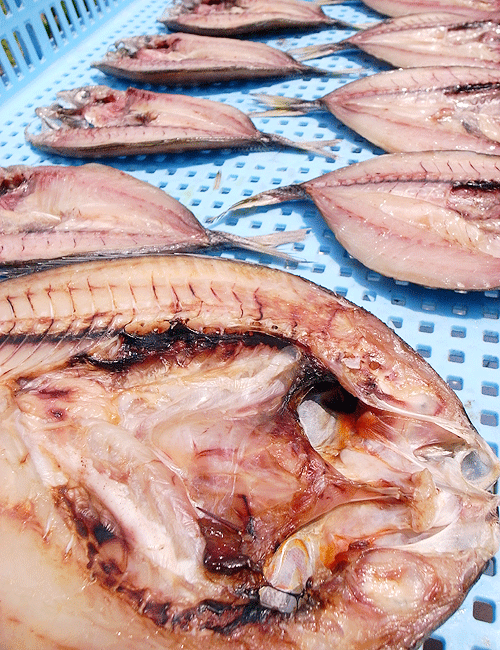
Houbou/竹麦魚、魴鮄/Bluefin Robbin (Red Gurnard) Himono in Mochimune, Shizuoka City.

Actually if you walk around the fishing cities of Numazu City, Yaizu City, Omaezaki City, Shimoda City, Shimizu & Yui & Mochimune in Shizuoka City you will discover all varieties of fish drying in front of shops or homes!

Saba/鯖/mackerel in Mochimune drying across the street!

Tai/鯛/Seabream form Mochimune. A bit extravagant for a dried fish.

Aji/鯵/Horse Mackerel from the Suruga Bay. You can eat them all. Great source of calcium!

BASIC RECIPE

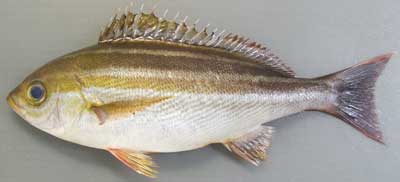
I chose a fish called “isaki” or “Chicken Grunt” (who came up with that English name?) that is quite common on our shores.
The recipe naturally applies to loads of fish!

CLEANING THE FISH:

Using a strong short sharp knife (the Japanese use the same knife to cut and gut medium size fish), first get rid of the scales as much as possible.
Wash once under running clear cold water.
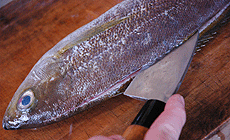
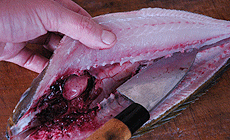
Cut along the back (not the belly! very important) from the tail to the head as shown on above picture deeply enough to reach the main bone.

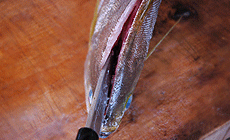
Once the knife has cut all along the back and reached the head, cut the head in half along the same cutting line.
The head of a isaki being small it is quite easy. It might require some strength for bigger head fish like seabreams. Call the MOTH then! (not the moths, the “Man”! LOL).

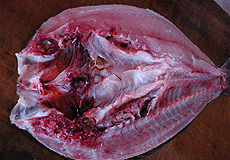
Open the fish and continue cutting in half all the way through.

Take out innards carefully so as not having them getting in contact with the flesh!
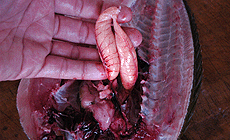
Depending upon the season, you might be lucky to get male sperm sacks (shirako). Don’t throw that away. They are great simmered with soy sauce, mirin/sweet sake, japanese sake and chili pepper! (see pic below).

Open the fish and clean it under running clear cold water.
Take water off with some kitchen paper or a clean piece of cloth.
Sprinkle with salt and dry outside under the sun until it has reached a nice aspect. You could also smoke it.
It can be preserved insde an airtight plastic bag and frozen, although eaten quickly it will taste so much better!

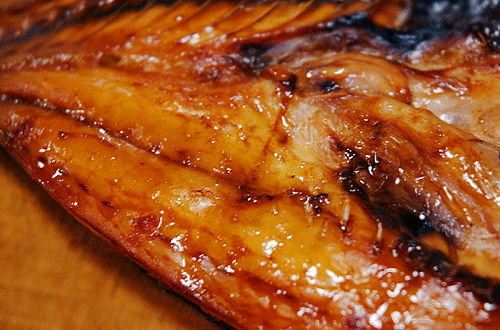
The Japanese grill their himono/dried fish pasted with a little soy sauce or tare. Beautiful with beer, Good Beer and Country Boys!

Great also grilled with a little salt!

If grilled with salt don’t forget the freshly grated daikon (and lemon juice, and soy sauce…)

The male sperm sacs (shirako) make for a great snack with your beer or sake once simmered in soy sauce, mirin/sweet sake and Japanese sake (and a little chili pepper)!

RECOMMENDED RELATED WEBSITES

Green Tea Club by Satoshi Nihonyanagi in Shizuoka!, Mind Some by Tina in Taiwan, Le Manger by Camille Oger (French), The Indian Tourist, Masala Herb by Helene Dsouza in Goa, India, Mummy I Can Cook! by Shu Han in London, Pierre.Cuisine, Francescannotwrite, My White Kitchen, 47 Japanese Farms Through The Eyes of Its Rural Communities, Foodhoe, Chucks Eats, Things that Fizz & Stuff, Five Euro Food by Charles,Red Shallot Kitchen by Priscilla,With a Glass, Nami | Just One Cookbook, Peach Farm Studio, Clumsyfingers by Xethia, PepperBento,Adventures in Bento Making, American Bent, Beanbento, Bento No, Bento Wo Tsukurimashou, Cooking Cute, Eula, Hapabento , Happy Bento, Jacki’s Bento Blog, Kitchen Cow, Leggo My Obento, Le Petit Journal Bento & CO (French), Lunch In A Box,
Susan at Arkonlite, Vegan Lunch Box; Tokyo Tom Baker, Daily Food Porn/Osaka, Only Nature Food Porn, Happy Little Bento, The Herbed Kitchen, J-Mama’s Kitchen, Cook, Eat, Play, Repeat, Bento Lunch Blog (German), Adventures In Bento, Anna The Red’s Bento Factory, Cooking Cute, Timeless Gourmet, Bento Bug, Ideal Meal, Bentosaurus, Mr. Foodie (London/UK), Ohayo Bento,

Must-see tasting websites:

-Sake: Tokyo Through The Drinking Glass, Tokyo Foodcast, Urban Sake, Sake World
-Wine: Palate To Pen, Warren Bobrow, Cellar Tours, Ancient Fire Wines Blog
-Beer: Good Beer & Country Boys, Another Pint, Please!
-Japanese Pottery to enjoy your favourite drinks: Yellin Yakimono Gallery

Japanese Cuttlefish/Squid Species 6: “Japanese lesser” Varieties

IKA-MONSTER
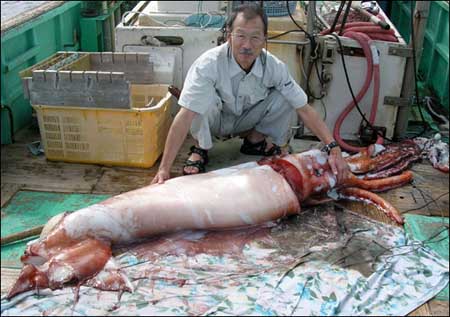
Inedible Lesser Variety!: Giant Squid

By “Japanese lesser” I mean species both more difficult to find on markets, more local and not as appreciated as the former five varieties.
Howeve these should not be looked over as they are still good enough for the finnicky Japanese and appreciated as rarities!

I kept the pictures small as this would be just too big a report!

BOZU IKA

IKA-BOUZUIKA-1

IKA-BOUZUIKA-2

IKA-BOUZUIKA-3

IKA-BOUZUIKA-4

EZOHARI IKA

IKA-EZOHARIIKA-1

IKA-EZOHARIIKA-2

HAKUTENKOU IKA

IKA-HAKUTENKOUIKA-1

IKA-HAKUTENKOUIKA-2

HIMEKOU IKA

IKA-HIMEKOUIKA-1

IKA-HIMEKOUIKA-2

KAMINARI IKA

IKA-KAMINARIIKA-1

IKA-KAMINARIIKA-2

KO IKA

IKA-KOIKA-1

IKA-KOIKA-2

IKA-KOIKA-3

IKA-KOIKA-4

SHINDO IKA

IKA-SHINDOIKA-1

IKA-SHINDOIKA-2

IKA-SHINDOIKA-3-SHIOYAKI

IKA-SHINDOIKA-4

SHIRIYAKE IKA

IKA-SHIRIYAKEIKA-1

IKA-SHIRIYAKEIKA-2

IKA-SHIRIYAKEIKA-3

SODE IKA

IKA-SODEIKA-1

IKA-SODEIKA-2

SUJI IKA

IKA-SUJIIKA-1

IKA-SUJIIKA-2

USUBENI IKA

IKA-USUBENIIKA-1

IKA-USUBENIIKA-2

If you have any questions, don’t hesitate!

RECOMMENDED RELATED WEBSITES

Green Tea Club by Satoshi Nihonyanagi in Shizuoka!, Mind Some by Tina in Taiwan, Le Manger by Camille Oger (French), The Indian Tourist, Masala Herb by Helene Dsouza in Goa, India, Mummy I Can Cook! by Shu Han in London, Pierre.Cuisine, Francescannotwrite, My White Kitchen, 47 Japanese Farms Through The Eyes of Its Rural Communities, Foodhoe, Chucks Eats, Things that Fizz & Stuff, Five Euro Food by Charles,Red Shallot Kitchen by Priscilla,With a Glass, Nami | Just One Cookbook, Peach Farm Studio, Clumsyfingers by Xethia, PepperBento,Adventures in Bento Making, American Bent, Beanbento, Bento No, Bento Wo Tsukurimashou, Cooking Cute, Eula, Hapabento , Happy Bento, Jacki’s Bento Blog, Kitchen Cow, Leggo My Obento, Le Petit Journal Bento & CO (French), Lunch In A Box,
Susan at Arkonlite, Vegan Lunch Box; Tokyo Tom Baker, Daily Food Porn/Osaka, Only Nature Food Porn, Happy Little Bento, The Herbed Kitchen, J-Mama’s Kitchen, Cook, Eat, Play, Repeat, Bento Lunch Blog (German), Adventures In Bento, Anna The Red’s Bento Factory, Cooking Cute, Timeless Gourmet, Bento Bug, Ideal Meal, Bentosaurus, Mr. Foodie (London/UK), Ohayo Bento,

Must-see tasting websites:

-Sake: Tokyo Through The Drinking Glass, Tokyo Foodcast, Urban Sake, Sake World
-Wine: Palate To Pen, Warren Bobrow, Cellar Tours, Ancient Fire Wines Blog
-Beer: Good Beer & Country Boys, Another Pint, Please!
-Japanese Pottery to enjoy your favourite drinks: Yellin Yakimono Gallery

Japanese Cuttlefish/Squid Species 5: Firefly Squid-Sparkling Enope Squid-Hotaru Ika-蛍烏賊

IKA-HOTARUIKA-1

Sparkling Enope Squid is a name difficult to remember and the translation of the Japanese name, Hotaru Ika/蛍烏賊 or Firefly Squid, certainly holds a better sound and is more adapted to reality.
It is also known as Matsui Ika in Toyama Prefecture.

The Sparkling Enope Squid is found in the Western Pacific ocean at depths of 600 to 1200 feet and exhibits bioluminescence. Each tentacle has an organ called a photophore, which produces light. By flashing these lights, the Sparkling Enope Squid can attract small fish to feed upon.

The Sparkling Enope Squid is the only species of cephalopod in which evidence of color vision has been found. While most cephalopods have only one visual pigment, firefly squid have three, along with a double-layered retina. These adaptations for color vision may have evolved to enable firefly squid to distinguish between ambient light and bioluminescence.

The Sparkling Enope Squid measures about 3 inches long at maturity and dies after one year of life.
The Sparkling Enope Squid can also light up its whole body to attract a mate. The mating season of the Sparkling Enope Squid lasts from March to June.

The fishing season lasts from Spring to Summer. The annual catch varies between 4,500 and 6,500 tonnes.

Very fresh Firefly squid can be appreciated as sashimi when very fres.

Boiled, they make for a great snack with bee!

They are very cute served as nigiri sushi!

Italian restaurants in Japan often feature them in their menus!

RECOMMENDED RELATED WEBSITES

Green Tea Club by Satoshi Nihonyanagi in Shizuoka!, Mind Some by Tina in Taiwan, Le Manger by Camille Oger (French), The Indian Tourist, Masala Herb by Helene Dsouza in Goa, India, Mummy I Can Cook! by Shu Han in London, Pierre.Cuisine, Francescannotwrite, My White Kitchen, 47 Japanese Farms Through The Eyes of Its Rural Communities, Foodhoe, Chucks Eats, Things that Fizz & Stuff, Five Euro Food by Charles,Red Shallot Kitchen by Priscilla,With a Glass, Nami | Just One Cookbook, Peach Farm Studio, Clumsyfingers by Xethia, PepperBento,Adventures in Bento Making, American Bent, Beanbento, Bento No, Bento Wo Tsukurimashou, Cooking Cute, Eula, Hapabento , Happy Bento, Jacki’s Bento Blog, Kitchen Cow, Leggo My Obento, Le Petit Journal Bento & CO (French), Lunch In A Box,
Susan at Arkonlite, Vegan Lunch Box; Tokyo Tom Baker, Daily Food Porn/Osaka, Only Nature Food Porn, Happy Little Bento, The Herbed Kitchen, J-Mama’s Kitchen, Cook, Eat, Play, Repeat, Bento Lunch Blog (German), Adventures In Bento, Anna The Red’s Bento Factory, Cooking Cute, Timeless Gourmet, Bento Bug, Ideal Meal, Bentosaurus, Mr. Foodie (London/UK), Ohayo Bento,

Must-see tasting websites:

-Sake: Tokyo Through The Drinking Glass, Tokyo Foodcast, Urban Sake, Sake World
-Wine: Palate To Pen, Warren Bobrow, Cellar Tours, Ancient Fire Wines Blog
-Beer: Good Beer & Country Boys, Another Pint, Please!
-Japanese Pottery to enjoy your favourite drinks: Yellin Yakimono Gallery

Japanese Cuttlefish/Squid Species 4: Japanese Common Squid-Pacific Flying Squid-Surme Ika-鯣烏賊

IKA-SURUMEIKA-1

Surume Ika/鯣烏賊 or Japanese Common Squid/Pacific Flying Squid is also called by regional names of Ma Ika, Matsu Ika or Kanzegi.

It caught off the shores of Northern Japan and south of Kyushu Island.
Catches tend to vary widely.
The Japanese squid can live anywhere in temperatures from 5° to 27°C, and tend to inhabit the upper layers of the ocean. They are short lived, only surviving about a year.
Flying squid have been observed to cover distances as long as 50 meters above the surface of the water, presumably to avoid predators or save energy as they migrate across vast expanses of ocean, uniquely utilizing jet-propelled aerial locomotion.
The fishing season for the Japanese flying squid is all year round, but the largest and most popular seasons are from January to March, and again from June to September. Gear used to catch the Japanese flying squid is mainly line and hook, lift nets, and gill nets, the most popular method being hook and line used in jigging.

When very fresh it can be enjoyed as sashimi, especially with a niso or sesame dressing-based dipping sauce!

Dried surume ika! Greta with beer or sake!

Most of it is turned into various pickled or dried cuttle fish/squid products.
It is also much appreciated broiled or simmered.

Also a great snack when boiled or grilled!

Fresh specimens ought also to be samples as sushi nigiri!

The same simmered and seasoned with tare sauce!

RECOMMENDED RELATED WEBSITES

Green Tea Club by Satoshi Nihonyanagi in Shizuoka!, Mind Some by Tina in Taiwan, Le Manger by Camille Oger (French), The Indian Tourist, Masala Herb by Helene Dsouza in Goa, India, Mummy I Can Cook! by Shu Han in London, Pierre.Cuisine, Francescannotwrite, My White Kitchen, 47 Japanese Farms Through The Eyes of Its Rural Communities, Foodhoe, Chucks Eats, Things that Fizz & Stuff, Five Euro Food by Charles,Red Shallot Kitchen by Priscilla,With a Glass, Nami | Just One Cookbook, Peach Farm Studio, Clumsyfingers by Xethia, PepperBento,Adventures in Bento Making, American Bent, Beanbento, Bento No, Bento Wo Tsukurimashou, Cooking Cute, Eula, Hapabento , Happy Bento, Jacki’s Bento Blog, Kitchen Cow, Leggo My Obento, Le Petit Journal Bento & CO (French), Lunch In A Box,
Susan at Arkonlite, Vegan Lunch Box; Tokyo Tom Baker, Daily Food Porn/Osaka, Only Nature Food Porn, Happy Little Bento, The Herbed Kitchen, J-Mama’s Kitchen, Cook, Eat, Play, Repeat, Bento Lunch Blog (German), Adventures In Bento, Anna The Red’s Bento Factory, Cooking Cute, Timeless Gourmet, Bento Bug, Ideal Meal, Bentosaurus, Mr. Foodie (London/UK), Ohayo Bento,

Must-see tasting websites:

-Sake: Tokyo Through The Drinking Glass, Tokyo Foodcast, Urban Sake, Sake World
-Wine: Palate To Pen, Warren Bobrow, Cellar Tours, Ancient Fire Wines Blog
-Beer: Good Beer & Country Boys, Another Pint, Please!
-Japanese Pottery to enjoy your favourite drinks: Yellin Yakimono Gallery

Spiny Lobster: Basic Sashimi Presentation

LOBSTER-SASHIMI-12

Spiny lobsters can be eaten raw!
Here is the basic recipe for preparing it.
Note that lobsters are fine, but spiny lobsters are best, especially small/medium specimens!

LOBSTER-SASHIMI-1

The lobster should be still alive before you start proceeding.
First clean the live lobster under running clear cold water.
Note that live lobsters are very “lively”!

LOBSTER-SASHIMI-2

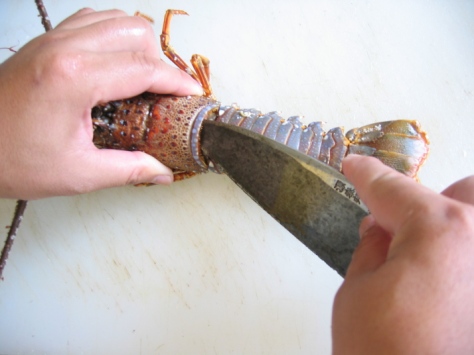
Use a short and sharp wide blade knife.
Maintaining the lobster securely in one hand, stab the lobster with the knife point deeply just behind the head at a slant forward.

LOBSTER-SASHIMI-3

You should be able to easily twist the tail away from the head.

LOBSTER-SASHIMI-4

Put the head aside (will come onto the plate later).

LOBSTER-SASHIMI-5

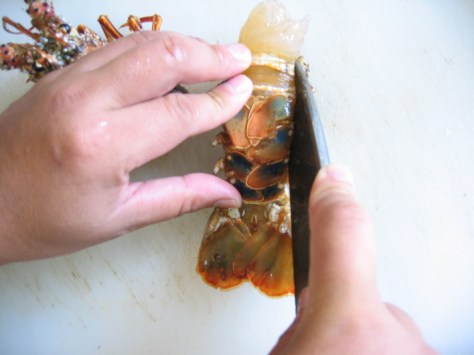
Turn tail over and cut between soft underbelly part and hard shell part.

LOBSTER-SASHIMI-6

Cut along both sides.

LOBSTER-SASHIMI-7

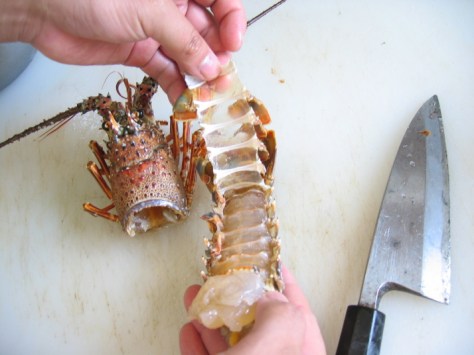
You should be able to easily pull out the underbelly shell. If you have problems pulling it out, insert a spoon between the shell and the flesh.
It should come out easily then.

LOBSTER-SASHIMI-8

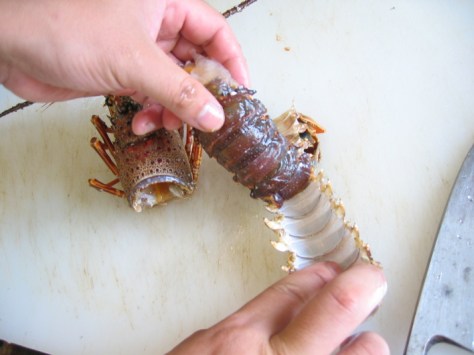
Pull the flesh out the shell.
Peel off the thin brown skin and discard.

LOBSTER-SASHIMI-9

First cut tail flesh lengthwise through the middle.
Take innards out and discard.
Ten cut the flesh across into one bite size (small size by European/American standards!).

LOBSTER-SASHIMI-10

Drop into iced water and clean off the sticky juices. As the flesh will turn white if you leave it in the water too long, this process should not last more than 1 minute!

LOBSTER-SASHIMI-11

Take water off in kitchen paper.

LOBSTER-SASHIMI-12

Using the shell (cleaned in cold running water and wiped), arrange sashimi as above. Very easy!
You will find out that the flesh is sweet.
A little wasabi and soy sauce (ponzu is even better) is all you need!

RECOMMENDED RELATED WEBSITES

Green Tea Club by Satoshi Nihonyanagi in Shizuoka!, Mind Some by Tina in Taiwan, Le Manger by Camille Oger (French), The Indian Tourist, Masala Herb by Helene Dsouza in Goa, India, Mummy I Can Cook! by Shu Han in London, Pierre.Cuisine, Francescannotwrite, My White Kitchen, 47 Japanese Farms Through The Eyes of Its Rural Communities, Foodhoe, Chucks Eats, Things that Fizz & Stuff, Five Euro Food by Charles,Red Shallot Kitchen by Priscilla,With a Glass, Nami | Just One Cookbook, Peach Farm Studio, Clumsyfingers by Xethia, PepperBento,Adventures in Bento Making, American Bent, Beanbento, Bento No, Bento Wo Tsukurimashou, Cooking Cute, Eula, Hapabento , Happy Bento, Jacki’s Bento Blog, Kitchen Cow, Leggo My Obento, Le Petit Journal Bento & CO (French), Lunch In A Box,
Susan at Arkonlite, Vegan Lunch Box; Tokyo Tom Baker, Daily Food Porn/Osaka, Only Nature Food Porn, Happy Little Bento, The Herbed Kitchen, J-Mama’s Kitchen, Cook, Eat, Play, Repeat, Bento Lunch Blog (German), Adventures In Bento, Anna The Red’s Bento Factory, Cooking Cute, Timeless Gourmet, Bento Bug, Ideal Meal, Bentosaurus, Mr. Foodie (London/UK), Ohayo Bento,

Must-see tasting websites:

-Sake: Tokyo Through The Drinking Glass, Tokyo Foodcast, Urban Sake, Sake World
-Wine: Palate To Pen, Warren Bobrow, Cellar Tours, Ancient Fire Wines Blog
-Beer: Good Beer & Country Boys, Another Pint, Please!
-Japanese Pottery to enjoy your favourite drinks: Yellin Yakimono Gallery

Japanese Cuttlefish/Squid Species 3: Bigfin Reef Squid-Aori Ika-障泥烏賊

IKA-AORIIKA-3

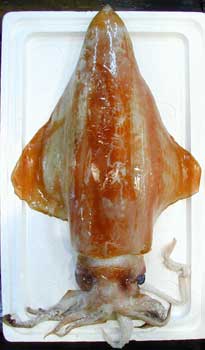
Aori Ika/障泥烏賊, or Bigfin Reef Squid is another extremely popular cuttle fish not only in Jpaan but also in many othere countries.
In French languedoc and Roussillon they call them “piste” and eat them raw marinated in lemon juice, olive oil and spices on top of freshly toasted bread!

IKA-AORIIKA-4
America Aori Ika/Caribbean Reef Squid

Of course they come by various regional names in Japan: Mo Ika, Bashoo Ika, Kutsu Ika, Misu Ika, Shiroi Ika.
They are fairly large as they can attain 40~45 cm length for a weight up to 6 kg.
Their season is from Summer to early Autumn. They are mainly caught in Central and South Japan along the Southern shores.
The catch has never been big (mainly by trawling nets), making them a choice morsel.
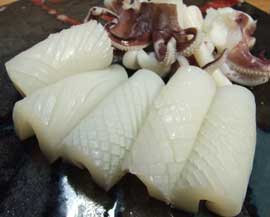
They are considered the best cuttlefish as far as sashimi is concerned.
The Japanese often catch them as a hobby to process and sell at local markets.

Artful Aori Ika sashimi!

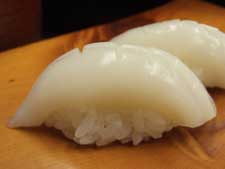
Naturally, they make for beautiful succulent sushi!

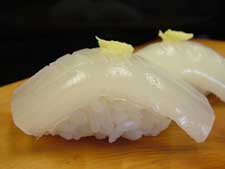
here is another delightful way to serve it as a pre-seasoned sushi nigiri!

They can be cooked in many ways including tempura!

Jaoanese-style pasta with udon!

RECOMMENDED RELATED WEBSITES

Green Tea Club by Satoshi Nihonyanagi in Shizuoka!, Mind Some by Tina in Taiwan, Le Manger by Camille Oger (French), The Indian Tourist, Masala Herb by Helene Dsouza in Goa, India, Mummy I Can Cook! by Shu Han in London, Pierre.Cuisine, Francescannotwrite, My White Kitchen, 47 Japanese Farms Through The Eyes of Its Rural Communities, Foodhoe, Chucks Eats, Things that Fizz & Stuff, Five Euro Food by Charles,Red Shallot Kitchen by Priscilla,With a Glass, Nami | Just One Cookbook, Peach Farm Studio, Clumsyfingers by Xethia, PepperBento,Adventures in Bento Making, American Bent, Beanbento, Bento No, Bento Wo Tsukurimashou, Cooking Cute, Eula, Hapabento , Happy Bento, Jacki’s Bento Blog, Kitchen Cow, Leggo My Obento, Le Petit Journal Bento & CO (French), Lunch In A Box,
Susan at Arkonlite, Vegan Lunch Box; Tokyo Tom Baker, Daily Food Porn/Osaka, Only Nature Food Porn, Happy Little Bento, The Herbed Kitchen, J-Mama’s Kitchen, Cook, Eat, Play, Repeat, Bento Lunch Blog (German), Adventures In Bento, Anna The Red’s Bento Factory, Cooking Cute, Timeless Gourmet, Bento Bug, Ideal Meal, Bentosaurus, Mr. Foodie (London/UK), Ohayo Bento,

Must-see tasting websites:

-Sake: Tokyo Through The Drinking Glass, Tokyo Foodcast, Urban Sake, Sake World
-Wine: Palate To Pen, Warren Bobrow, Cellar Tours, Ancient Fire Wines Blog
-Beer: Good Beer & Country Boys, Another Pint, Please!
-Japanese Pottery to enjoy your favourite drinks: Yellin Yakimono Gallery