Tag Archives: Vegan

Vegan Japanese Dashi/Soup Stock: The Basic Recipe

So many times have I heard my vegan and vegetarian friends complain about the fact that most dashi/soup stock is not done according to their priorities in Japan, making it impossible for them to enjoy food in this country.
Fortunately, this is a big misconception. Vegan dashi exists and is very easy to make or request.
Now, to make sure that the same friends can savour Japanese food, either at home or with friends, here is the basic ans simple recipe!
Please save or copy this recipe for future reference (I have more vegan soup recipes in store for you!)

Vegan Japanese Dashi/Soup Stock

INGREDIENTS: (multiply according to demands. This is the minimum quantity!)

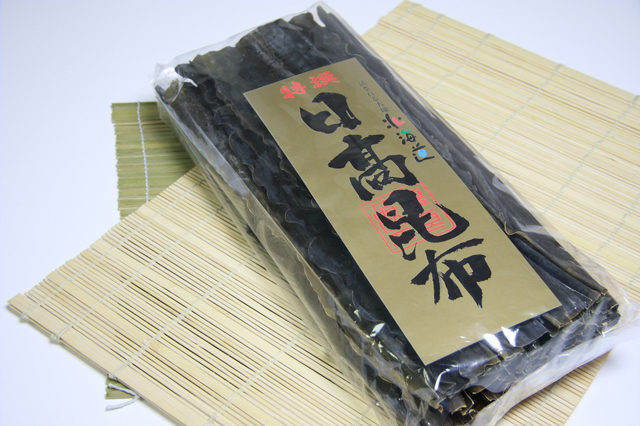
Konbu as sold in Japan

Konbu out of its packaging

-Konbu/dried thick dark seaweed: 5cm×5cm piece (dry)
-Water: 400cc/ml
-Japanese sake: 1 tablespoon (don’t worry, the alcohol will disappear upon heating/cooking!)
-Mirin/sweet sake (same comments as above!): 2 tablespoons
-Soy sauce: 2 and a half tablespoons

RECIPE:

Pour the awter into a large pan. Drop the seaweed into the water.
Switch on the fire.
The moment bubbles appear on the surface of the konbu, the water will start sucking the its essence in.
At that time add soy sauce, sake and mirin.

Taste from time to time to decide when taste suits you best.
Switch fire then and take konbu out.
Let cool completely, pour it inside a bottle. Seal the bottle properly and store inside refrigerator.
Use it as soon as possible.

The seaweed doesn’t have to be thrown away. It is edible as it is once cooked!

RECOMMENDED RELATED SITES
Not-Just-Recipes, Bengal cuisine, Cooking Vegetarian, Frank Fariello, Gluten-free Vegan Family, Meatless MamaFrank Fariello, , Warren Bobrow, Wheeling Gourmet, Le Petit Cuisinier, Vegan Epicurean, Miss V’s Vegan Cookbook, Comestiblog, To Cheese or not To Cheese, The Lacquer Spoon, Russell 3

Please check the new postings at:
sake, shochu and sushi

—————————————-
日本語のブログ
—————————————-

Vegetables Facts and Tips 6: Asparaguses (amended & expanded)

asparagus-varieties

SYNOPSIS:

I started this series (15 articles so far) quite some time ago to help my vegan and vegetarian (I’m not!) friends and omnivores as well because of the obvious health benefits.
Since then, I’ve learned and discovered a lot more information that could not stay ignored.
Therefore I plan to amend and expand all former articles before I can continue introducing a lot more vegetables!
Incidentally、 nothing, pictures included, is copyrighted in my food blogs, so please feel free to use anything!
1) POTATOES, 2) TOMATOES, 3) BROCCOLI, 4) CARROTS, 5) Sweet Potatoes

Asparagus has been used from very early times as a vegetable and medicine, owing to its delicate flavour and diuretic properties. There is a recipe for cooking asparagus in the oldest surviving book of recipes, Apicius’s third century AD De re coquinaria, Book III. It is said that it was cultivated by the ancient Egyptians, Greeks and Romans, who ate it fresh when in season and dried the vegetable for use in winter.It lost its popularity in the Middle Ages but returned to favour in the seventeenth century.

FACTS:

-Season: They are at their best March~June in the Northern Hemisphere, but can be obtained all year round thanks to state-of-the-art greenhouse cultivation.

-Beneficial elements: Carotene, Vitamin C and E, Vitamins from the B group (B1, B2, B6), Rutin, Vegetal fibers, Folic Acid, Potassium. The amino acid asparagine gets its name from the plant.

-Asparagus rhizomes and root are used ethnomedically to treat urinary tract infections, as well as kidney and bladder stones.

-Asparagus is also believed to have aphrodisiac properties (this belief is at least partially due to the phallic shape of the shoots).

TIPS:

-Choose asparaguses with a clean cutting surface. No black spots should appear.

-The darker the colour, the better. As for white asparaguses, choses with a “wet cutting”

-When storing your asparaguses in the fridge, have them stand upright in a long narrow container with their foot wrapped in wet kitchen paper. Discard bent asparaguses on the supermarket stands.

-Choose green asparaguses with the smallest possible foliage along the stems and dark tips.

-When boiling them, either boil them stading upright inside a pasta mesh container, or absolutely flat in a sauce pan. Do not bend them.

-Asparaguses are best digested when lightly fried with oil.

-If Asparaguses cannot be obtained directly from the farmer, lightly peel but keep yop half as it is to preserve Vitamins.

Varieties:
Most popular varieties are shown in the picture above: White, Green and “wild-style” (apeelations vary!)

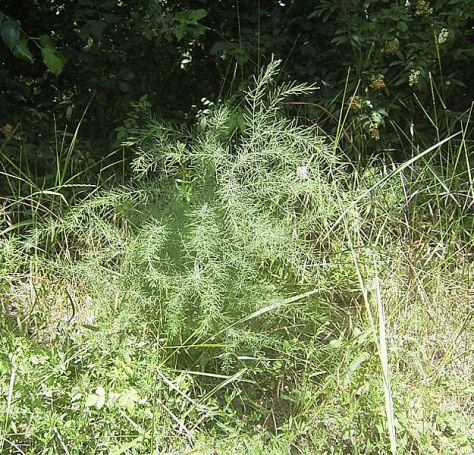
asparagus-wild

Asparaguses are abundant in the while, but they grow very quickly and get too hard for consumption.
The wild ones picked in their natural environment are my favourite as I fondly rememebr picking them up as a soldier in the South of France during our drills and cooking them in simple omelettes!

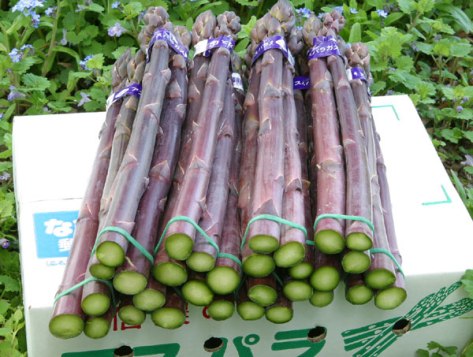
asparagus-violet

Violet asparaguse are very popular in any restaurants!

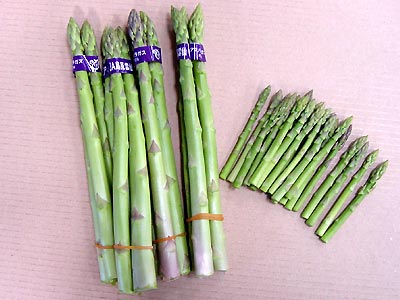
asparagus-mini

Mini-asparaguses are ever so popular in Japan thanks to their practical size.

uzu-41

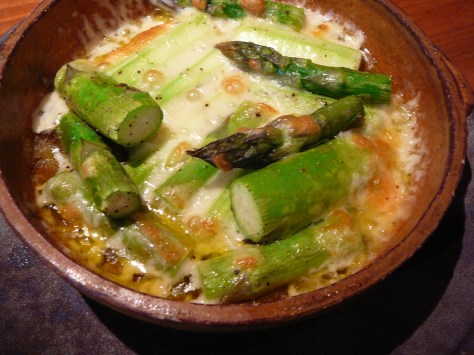
Recipes are endless, but my favourite is the large green asparaguses and mozzarella gratin as prepared and served at Uzu Izakaya in Shizuoka City!

HEALTH FACTS:

-When combined with seaweed, or carrot, or Broccoli, or Spinach, provides stamina and helps combat cancer and colds.

-When combined with shellfish, or chicken, or turnips, or red-fleshed fat fish, helps combat liver problems and provides stamina.

-When combined with okr, or avocado, or celery, or garlic, heps combat cancer, high blood pressure and heart diseases.

-When combined with onion, or codfish, or tofu (especially yuba), or konnyaku/devil’s tongue tuber, helps with qaulitey and flow of blood, helps combat obesity and blood vessel hardening.

RECOMMENDED RELATED SITES
Not-Just-Recipes, Bengal cuisine, Cooking Vegetarian, Frank Fariello, Gluten-free Vegan Family, Meatless MamaFrank Fariello, , Warren Bobrow, Wheeling Gourmet, Le Petit Cuisinier, Vegan Epicurean, Miss V’s Vegan Cookbook, Comestiblog

Please check the new postings at:
sake, shochu and sushi

—————————————-
日本語のブログ
—————————————-

Vegan Sushi Recipe Suggestions 2: Daikon

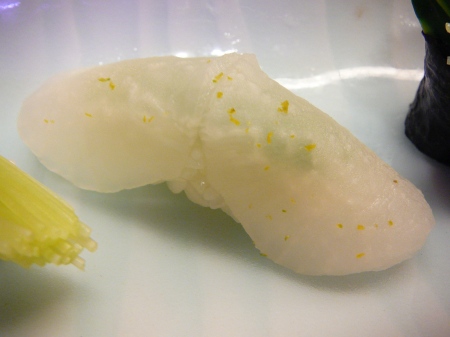
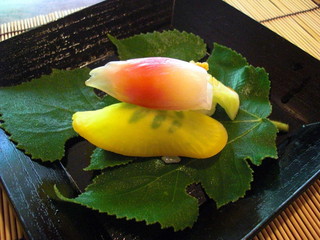
Daikon Nigiri as served at Sushi Ko, Shizuoka City, Japan!

SYNOPSIS:

I already have introduced Vegan and Vegetarian Sushi, but following further requests and questions by my vegan (I’m not!) friends, I decided to contribute a small series of postings to give them more detailed suggestions and ideas!

Now, please check sushi rice recipe HERE to make things more practical!

1) Myoga/Myoga Ginger

————————————

The second vegetable amenable to sushi I would like to introduce is Daikon, or Japanese Radish/Daikon Radish.

Please check DAIKON HERE on Wikipedia!

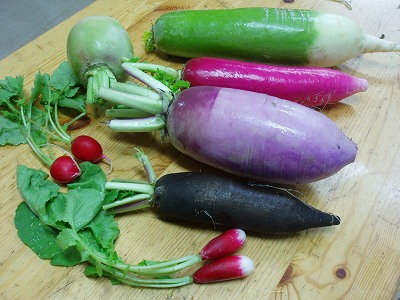
Daikon seems to be known only in its big white shape with a green top.
Actually, not only it is a versatile vegetables, but it does come into many shapes and colors as shown in picture above.

Once cut, look at these beautiful colors.

Daikon sushi, especially served as nigiri can be made very simple as in above picture where the daikon was sliced very thin and marinated for a while in lemon added water.

For more sophisticated preparations and presentations browse below!

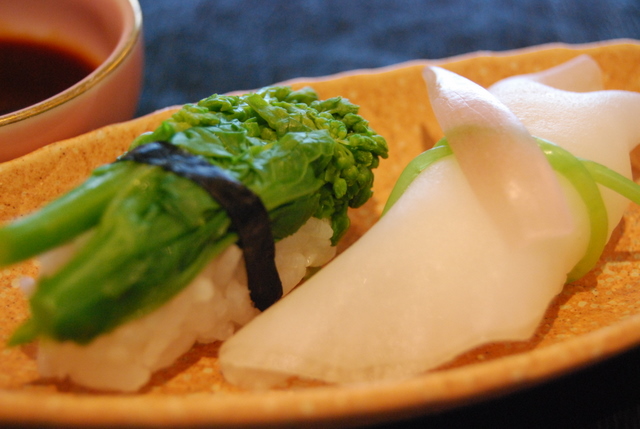
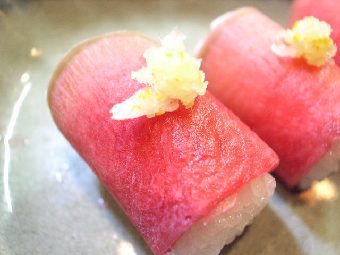
The same as the top picture. The daikon was marinated for a while in yuzu juice and rice vinegar then derved with grated yuzu zest/skin.

Simple but so sophisticated. The other one is rape blossom.

Daikon can be pickled Japanese-style into “takuan/沢庵”, making for great colors and combination!

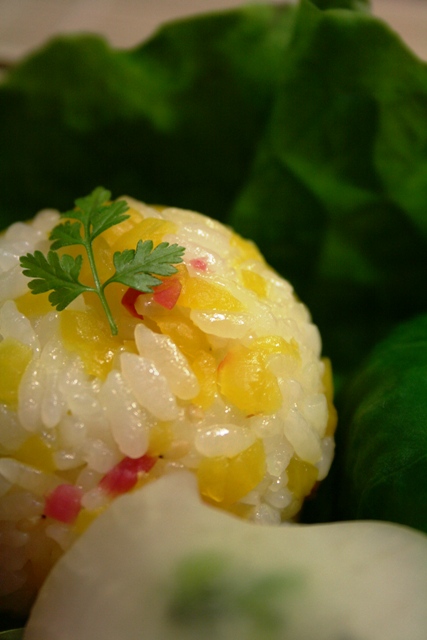
Takuan & Beni Shoga/takuan and red ginger temari sushi!

Great color afain with Koushin Daikon/紅芯大根!

The possibilities are infinite. Can you imagine the takuan above on a rice ball. The whole daikon was first pickled then peeled/cut into a sheet, rolled with lettuce and cut across!

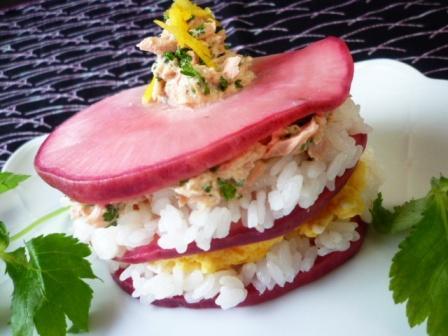
And how about a daikon millefeuille sushi for dessert!

RECOMMENDED RELATED SITES
Not-Just-Recipes, Bengal cuisine, Cooking Vegetarian, Frank Fariello, Gluten-free Vegan Family, Meatless MamaFrank Fariello, , Warren Bobrow, Wheeling Gourmet, Le Petit Cuisinier, Vegan Epicurean, Miss V’s Vegan Cookbook, Comestiblog, To Cheese or not To Cheese, The Lacquer Spoon, Russell 3

Please check the new postings at:
sake, shochu and sushi

—————————————-
日本語のブログ
—————————————-

Vegan New Year Sashimi at Yasaitei

January 5th, 2010. Tuesday, isn’t it? Back to the office. Usual break before late evening work. Hungry, but can’t eat too much as dinner will be waiting for me at 9:30 back home.
Only one option: the quick snack at Yasaitei. Becoming too much of a habit….

What would you expect me to order, then?
Vegatables sashimi!
Boring, you might say…
Totally agree, but boredom is so tatsy sometimes!

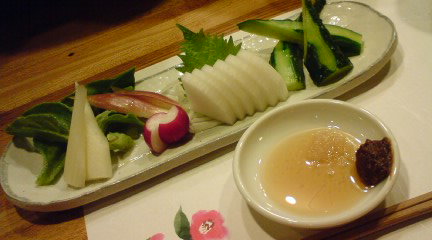
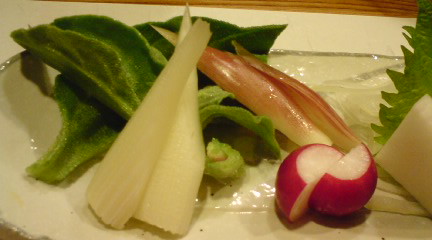
In the front, “the usual stuff” you might say:
Celery (grown in Shizuoka Prefecture), red radihes and myoga ginger sprouts.
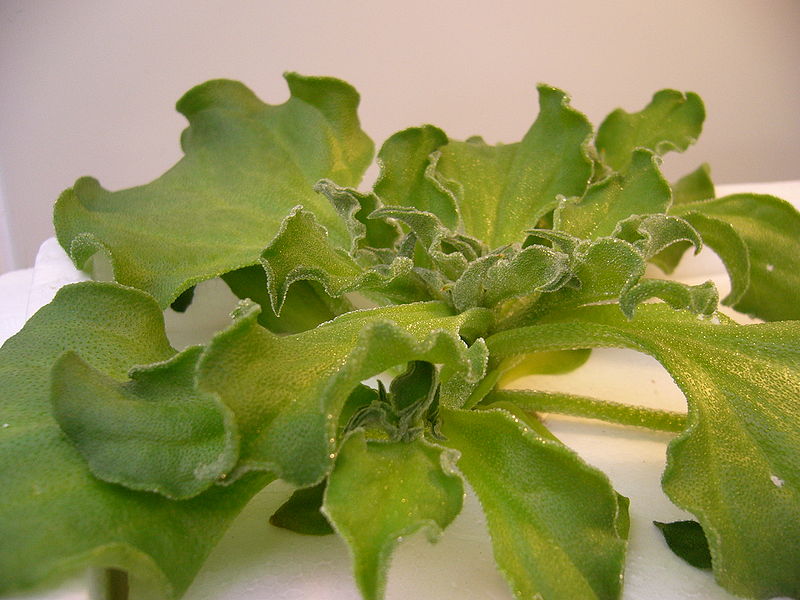
Now, what is that leafy thing on the left in the background?

Common Ice Plant or Crystalline Iceplant? In Japanese? Ice Plant?
The French actually use it in their cuisine under the name of ficoïde glaciale.

Wikipedia will only say that Mesembryanthemum crystallinum is a prostrate succulent plant that is native to Africa, Western Asia and Europe. The plant is covered with large, glistening bladder cells, reflected in its common names of Common Ice Plant, Crystalline Iceplant or Iceplant.
Its leaves are edible, as with other some members of the Aizoaceae family. It is also cultivated for ornamentation (hum!).

And I can tell you they are worth discovering, be vegan, vegetarian or omnivore!

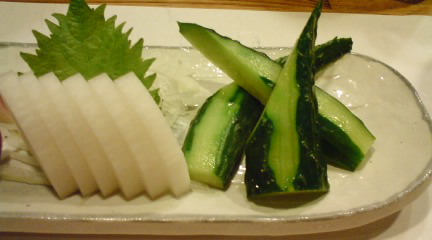
Now, for the second half of the plate: Juicy daikon and crunchy succulent cucumber backed with shiso/perill leaf and sliced winter onions (sweet!)

The dressing was the “usual” sesame oil with rock salt and dark miso.

But I needed a little more (with the second glass of Doman shochu!):
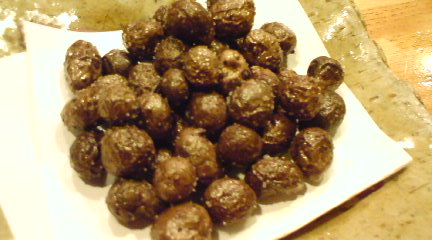
Mukago/零余子!
Now, unfortunately, it might be difficult to find that little thing outside Japan, but note it down on your notebook!

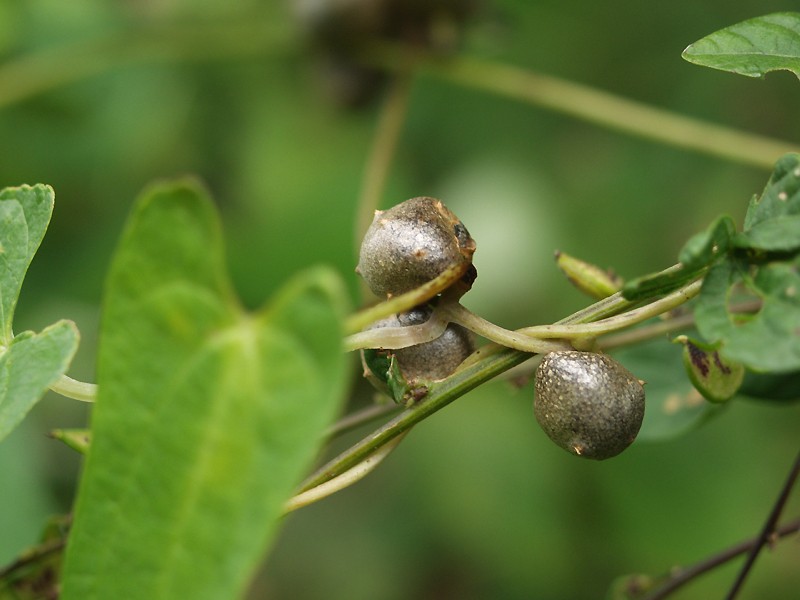
Mukago

A bit difficult to explain. An aerial tuber?
The fact is that it is some kind of fruit/nut/seed (I don’t have a clue here!) produced by yama imo or glutinous yam in Japanese, as one form of natural reproduction.
These mukago are succulent either boiled, or as in this case deep-fried.
Can’t stop eating them once started!

YASAITEI
Shizuoka City, Aoi Ku, Tokiwa-Cho, 1-6-2 Green Heights Wamon 1-C
Tel.: 054-2543277
Business hours: 17:30~22:00
Closed on Sundays
Reservations highly recommended
Seating: 6 at counter + 20 at tables
Set Courses: 3,000, 4,000, 5,000 yen
HOMEPAGE (Japanese)

RECOMMENDED RELATED SITES
Not-Just-Recipes, Bengal cuisine, Cooking Vegetarian, Frank Fariello, Gluten-free Vegan Family, Meatless MamaFrank Fariello, , Warren Bobrow, Wheeling Gourmet, Le Petit Cuisinier, Vegan Epicurean, Miss V’s Vegan Cookbook, Comestiblog, To Cheese or not To Cheese, The Lacquer Spoon, Russell 3

Please check the new postings at:
sake, shochu and sushi

—————————————-
日本語のブログ
—————————————-

Vegan Sushi Recipe Suggestions 1: Myoga/Myoga Ginger

I already have introduced Vegan and Vegetarian Sushi, but following further requests and questions by my vegan (I’m not!) friends, I decided to contribute a small series of postings to give them more detailed suggestions and ideas!

Now, please check sushi rice recipe HERE to make things more practical!

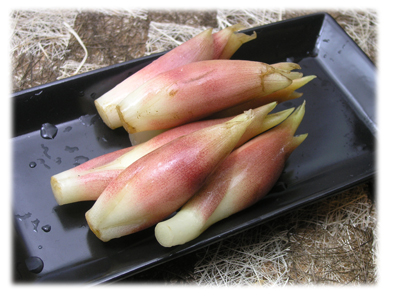
The first vegetable amenable to sushi I would like to introduce is Myoga, or Myoga Ginger.

Please check Myoga HERE on Wikipedia!

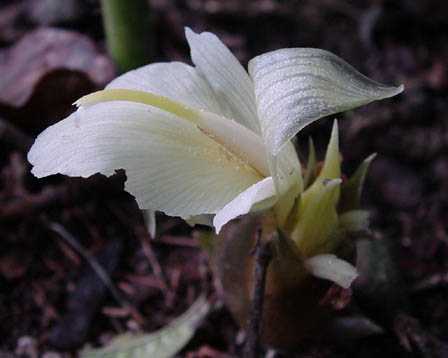
Myoga is a very interesting vegetable as not only the shoots but also the flowers are edible!

The flower in its natural state!

As bought at the market.

Interestingly enough, as Japan makes an enormous consumption of them it has to import a lot from New Zealand and Australia. I’m sure you can buy it at local Asian markets. It could porve an interesting cultivation for some, too!

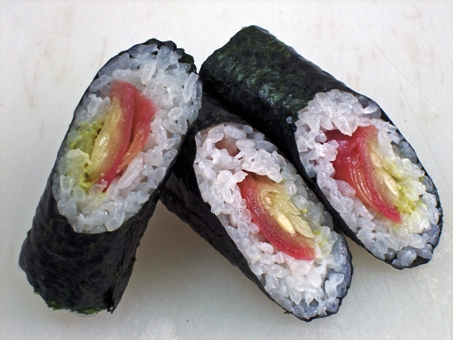
Myoga sushi roll.

Now there are two basic ways of presenting myoga as sushi.
First, as shown on above picture, as a roll.
It doesn’t have to be complicated. Just chop the myoga in strips and fill the roll with it accompanied by some wasabi.

Myoga Sushi nigiri.

The other basic way is present it as sushi nigiri on top of a small ball of sushi rice previously smeared with a little wasabi.

You can prepare the myoga in two basic ways,too:
The first one would would be just to wash it and use it raw.
The second would be to pickle it in rice vinegar and sugar for a while, press it and serve it in both sushi styles as explained above.

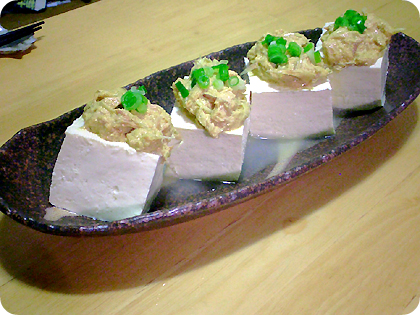
There are other interesting possibilities when you let your imagination go free as in above picture where the rice is replaced with a small cube of tofu and the topping is made with chopped myoga, tofu and wasabi all mixed together!

To further convince you, look at the picture above:
All vegan sushi:
from top down: Cucumber, egg plant/aubergine and myoga. The last are pickled daikon!

RECOMMENDED RELATED SITES
Not-Just-Recipes, Bengal cuisine, Cooking Vegetarian, Frank Fariello, Gluten-free Vegan Family, Meatless MamaFrank Fariello, , Warren Bobrow, Wheeling Gourmet, Le Petit Cuisinier, Vegan Epicurean, Miss V’s Vegan Cookbook, Comestiblog, To Cheese or not To Cheese, The Lacquer Spoon, Russell 3

Please check the new postings at:
sake, shochu and sushi

—————————————-
日本語のブログ
—————————————-

Vegan Japanese Pickled Turnips

As i said in my previous posting, for too long, turnips have been considered food for the poor and destitutes.
In France it is also the symbol of a bad play or movie!
Actually they make for great vegetables, cheap and easy to cook!

The Japanese have come with all kinds of ways to prepare them forthe pleasure of vegans, be they Japanese or expats in this country.
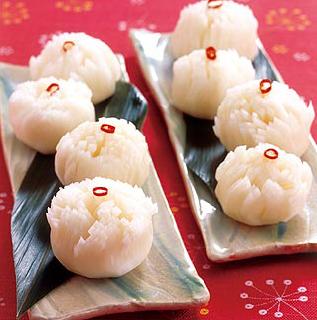
The following recipe is called “Kabu no Kiku Hana Zuke/かぶの菊花漬け or:
Japanese pickled Turnips in the shape of Chrysanthemums!

INGREDIENTS: For 4 people

-Turnips: 8 small
-Sugar: 3 tablespoons

-Rice vinegar: 1/2 Cup/100 cc/ml
-Red Chili pepper (dried, 1 whole)

RECIPE:

-Peel the turnips carefully and take out leaves and their green spot from the top of the vegtables. With a sharp knife make incisions two thirds deep all around the top of the turnips.

-Place the turnips side by side inside a bowl. Cover them completely with salted water. Leave them marinate for 15 minutes to soften them.

-Mix rice vinegar and sugar.
Drain the turnips thoroughly.
Pour the sweet vinegar over the turnips and let marinate for a whole night.

-Take turnips out and press out the vinegar only lightly.
Open and spread the indented parts as to give tem the shape of a looming flower like in the picture.
Top with a small circle of cut chili pepper.

Enjoy as a snack any time of the day or use as a central part of a vegetable salad!

RECOMMENDED RELATED SITES
Not-Just-Recipes, Bengal cuisine, Cooking Vegetarian, Frank Fariello, Gluten-free Vegan Family, Meatless MamaFrank Fariello, , Warren Bobrow, Wheeling Gourmet, Le Petit Cuisinier, Vegan Epicurean, Miss V’s Vegan Cookbook, Comestiblog, To Cheese or not To Cheese, The Lacquer Spoon

Please check the new postings at:
sake, shochu and sushi

—————————————-
日本語のブログ
—————————————-

Vegan Japanese Tomato Turnips

For too long, turnips have been considered food for the poor and destitutes.
In France it is also the symbol of a bad play or movie!
Actually they make for great vegetables, cheap and easy to cook!

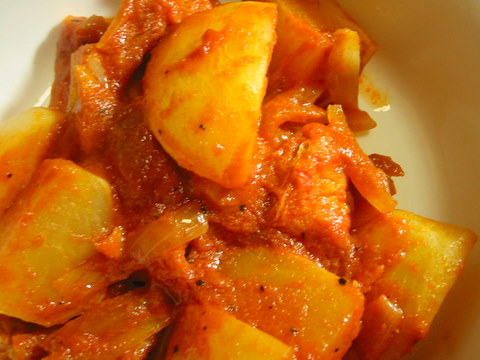
Here is a very simple recipe with simple cheap ingredients for “poor” vegans.
Great for kids, too!

INGREDIENTS: 1 person?

-Turnips: 2 (organic!)
-Onion: half 1 (organic!)
-Aburaage/fried tofu: 1 (sliced into 5 cm long thin strips)
-Olive oil: for frying
-Tomato juice (organic, please, or makeyour own!): 300 cc/ml
-Salt: 1 teaspoon (can be reduced, especially for kids!)
-Ground black pepper: to taste

RECIPE:

1 Cut turnips into wedges. Slice the onions thin.

2 Pour some olive oil in a fry pan. Fry sliced turnips, onions and aburaage, bearing in mind turnips become soft very quickly.

3 After frying on a medium fire for about 3 minutes, add tomato juice, salt and simmer for about 8 minutes on a low fire.
If and when the turnips are cooked, switch off fire and sprinkle with ground black pepper.

Simple, isn’t it? The point is to stew/simmer the vegetables in tomato juice. Aburaage will provide some bite!

RECOMMENDED RELATED SITES
Not-Just-Recipes, Bengal cuisine, Cooking Vegetarian, Frank Fariello, Gluten-free Vegan Family, Meatless MamaFrank Fariello, , Warren Bobrow, Wheeling Gourmet, Le Petit Cuisinier, Vegan Epicurean, Miss V’s Vegan Cookbook, Comestiblog, To Cheese or not To Cheese, The Lacquer Spoon

Please check the new postings at:
sake, shochu and sushi

—————————————-
日本語のブログ
—————————————-

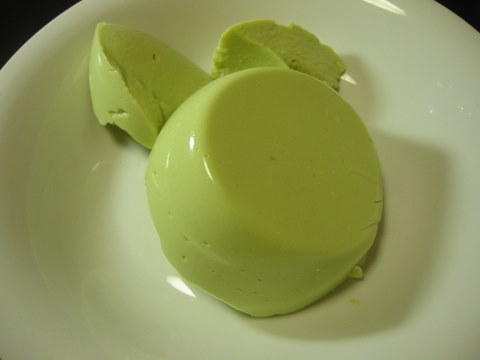
Japanese Vegan Avocado Pudding

The same as for shakes, vegans should not worry about ingredients when making a pudding!

Here is a very simple way to make a healthy appetizer the Japanese way!

Japanese Vegan Avocado Pudding!

INGREDIENTS: For 3~4 people

-Agar agar: 2~4 g (depending how solid you like your pudding!)
-Tofu (kinu/silk tofu): 1 standard portion~400 g
-Avocado: 1 ripe
-Very fine salt, ground white pepper: to taste and according to preferences
-Spices: if preferred

RECIPE:

-Mix the agar agar in a little water.

-In a pan drop the tofu and agar agar. Heat over a medium fire and stir into smooth paste. As soon as the agar agar has dissolved into the tofu. Switch off fire and take away the pan from the fire.

-Drop the tofu inside a food processor. Add the avocado cut into rough pieces and seasoning, and process until smooth.

-Pour the mixture inside lightly oiled molds. Let cool completely and leave inside refrigerator to chill and harden.

Great with wasabi dressing, or ponzu!
If you like your pudding solid, pour it into a rectangular mold and cut it in slices like sashimi!

RECOMMENDED RELATED SITES
Not-Just-Recipes, Bengal cuisine, Cooking Vegetarian, Frank Fariello, Gluten-free Vegan Family, Meatless MamaFrank Fariello, , Warren Bobrow, Wheeling Gourmet, Le Petit Cuisinier, Vegan Epicurean, Miss V’s Vegan Cookbook, Comestiblog, To Cheese or not To Cheese, The Lacquer Spoon

Please check the new postings at:
sake, shochu and sushi

—————————————-
日本語のブログ
—————————————-

Vegan & Avocado & Banana Shake

I wonder if there is a country where one cannot find some kind of shake!
But, they use ice-cream and dairy products to make them!

Well, there is a simple way to make them vegan!
How about this one:

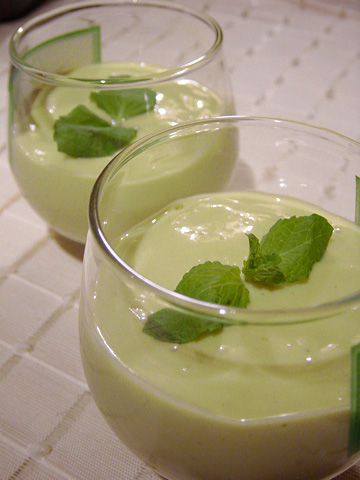
Vegan & Avocado & Banana Shake!

INGREDIENTS: For 2 people
-Avocado: 1/2 ripe
-Soy milk: 200 cc/ml
-Banana: 1
-Lemon juice: 1 reaspoon
-Honey (liquid): 2 teaspoons
-Mint leaves: for decoration.

RECIPE:

-Leave banana and avacado in refrigeartor long enough to get them really chilled.

-Cut avocado and banana in small enough pieces.

-Put everything into blender and mix well.

-Pour in glasses and serve topped with mint leaves.

How simpler can you make it? LOL

RECOMMENDED RELATED SITES
Not-Just-Recipes, Bengal cuisine, Cooking Vegetarian, Frank Fariello, Gluten-free Vegan Family, Meatless MamaFrank Fariello, , Warren Bobrow, Wheeling Gourmet, Le Petit Cuisinier, Vegan Epicurean, Miss V’s Vegan Cookbook, Comestiblog, To Cheese or not To Cheese, The Lacquer Spoon

Please check the new postings at:
sake, shochu and sushi

—————————————-
日本語のブログ
—————————————-

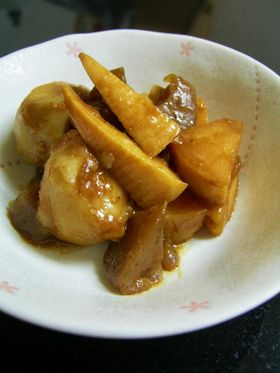
Vegan Japanese Cuisine: Taro & Bamboo Shoots in Sweet and Hot Miso

Not ready yet to give up on those simple and healthy recipes with taro, or sato imo/里芋 as they are called in Japan that should please my vegan and vegetarian friends (omnivore friends, just be a little more patient!)!

This one is called “Taro & Bamboo Shoots in Sweet and Hot Miso/里芋と竹の子の甘辛味噌煮”, or Sato Imo to Take no Ko no Amakara Miso Ni”
It is another very simple dish that should provide food with a filling sensation to vegans.

INGREDIENTS: For 2 people

-Taro/Sato imo: 3~4 middle-sized specimens
-Bamboo shoots: 1 cup (cut to size. Canned Bamboo Shoots are fine)
-Konnyaku/Devil’s Tongur Tuber: 2/3 cup (cut to size. Canned specimen are fine)
-Japanese sake: 1 tablespoon
-Mirin/Sweet sake: 1 tablespoon
-Konbu/seaweed dashi/Soup stock: enough to submerge all ingredients upon cooking
-Salt: a pinch
-Salad oil: 1 tablespoon
-Sweet Miso (red miso base): 1 tablespoon
-Yuzu koshio/Lime & Chili Pepper Paste: to taste

RECIPE:

-Peel taro/sato imo and cut into bite-sized pieces. Cut bamboo shoots in approximately size (if needed). Cut the konnyaku/devil’s tongue tuber in slightly smaller pieces.

-Boil the Taro/sato imo a little beforehand to soften them.

-In a pan drop the half cooked taro/stao imo, bamboo shoots and konnyaku. Pour dashi until dashi until it had submerged everything.
Switch on fire.

-Add sake, mirin and salt and bring to boil. Lower fire to low~medium and simmer/stew until soup/stock has disappeared.

-Once the soup has disappeared, a frying sound will be heard. At that moment add the oil and stir fry the lot.

-Once the oil has coated everything, add the miso and mix gently as the taro will be soft by then.

-Add the yuzu koshio/Lime and chili pepper mix just before serving.

NOTES:

-For variation you may use chopped lime skin/zest or/and hot chili powder

Easy once again!

RECOMMENDED RELATED SITES
Not-Just-Recipes, Bengal cuisine, Cooking Vegetarian, Frank Fariello, Gluten-free Vegan Family, Meatless MamaFrank Fariello, , Warren Bobrow, Wheeling Gourmet, Le Petit Cuisinier, Vegan Epicurean, Miss V’s Vegan Cookbook, Comestiblog, To Cheese or not To Cheese, The Lacquer Spoon

Please check the new postings at:
sake, shochu and sushi

—————————————-
日本語のブログ
—————————————-

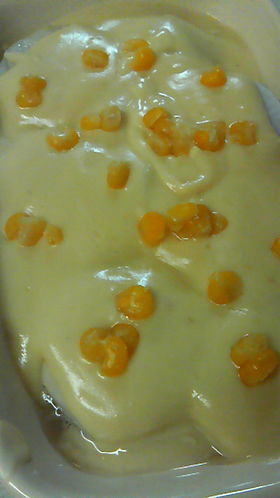
Vegan Japanese Cuisine: Taro & Soy Milk Gratin/Sato Imo & Tonyu Gratin

Still working on a whole bunch of simple and healthy recipes with taro, or sato imo/里芋 as they are called in Japan that should please my vegan and vegetarian friends!

This one is called “Taro & Soy Milk Gratin/里芋と豆乳グラタン”, or Sato Imo & Tonyu Gratin”
It is a very simple dish that should provide food with a filling sensation to vegans. Great for kids, too!

INGREDIENTS: for 1 plate/serving

-Taro/sato imo: 2
-Oil (of your choice): 3 tablespoons
-All-purpose Flour (of your choice):2 tablespoons
-Soy Milk: 1 cup/200 cc/ml
-Sweet white miso paste ( as you like)
-Tinned corn or freshly boiled corn (a you like)
-Panko/breadcrumbs (as you like)

RECIPE:

-Peel the taro/sato imo, cut them in 1 cm thick slices and boil until soft. Drain.

-In a fry pan, heat the oil on a low-middle fire. Add flour and mix well with a spatula. Add soy milk and sweet white miso.

-Keep stirring. The mixture will eventually thicken. Lower the fire and keep stirring well until it has reached the thickness of a white/bechamel sauce for gratins.

-On an oven plate place the taro/sato imo. Pour the gratin sauce all over. Top with corn and breadcrumbs.

-Cook in oven (180 degrees Celsius) until it has attained the colour of your liking!

NOTES:

The picture above was taken before sprinkling the gratin with breadcrumbs.
You can use the same recipe with vegan pasta instead of the taro/sato imo!

RECOMMENDED RELATED SITES
Not-Just-Recipes, Bengal cuisine, Cooking Vegetarian, Frank Fariello, Gluten-free Vegan Family, Meatless MamaFrank Fariello, , Warren Bobrow, Wheeling Gourmet, Le Petit Cuisinier, Vegan Epicurean, Miss V’s Vegan Cookbook, Comestiblog, To Cheese or not To Cheese, The Lacquer Spoon

Please check the new postings at:
sake, shochu and sushi

—————————————-
日本語のブログ
—————————————-

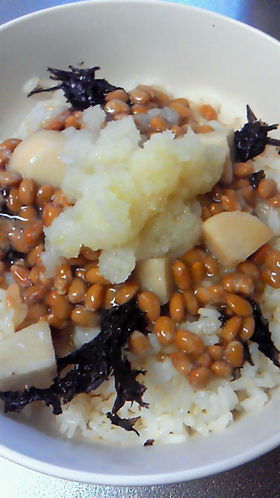
Vegan Japanese Cuisine: Taro, Natto & Grated Daikon/Natto no Tororo Donburi

I’ve found a whole bunch of simple and healthy recipes on taro, or sato imo/里芋 as they are called in Japan that should please my vegan and vegetarian friends!

This one is called “Natto no Tororo Donburi/納豆のとろろ丼”, or Taro, Natto & Grated daikon (on a bowl of rice).
It is a very simple traditional Japanese dish that will provide a very healthy meal to vegans!

INGREDIENTS: For 1 person

-Steamed rice: 1 bowl
-Taro/sato imo: 2
-Soy sauce: 1 tablespoon
-Salt: a little pinch
-Cornstarch: 1 teaspoon
-Natto/Japanese fermented beans: 1 pack
-Grated daikon: 1~2 tablepoons ( you can mix it with a little chili powder or grated wasabi!)
-Seaweed: as much as you want

RECIPE:

-Peel the taro/satoimo and cut them into 1 cm-sided squares

-Boil the taro/satoimo in seaweed dashi stock soup or water, salt and soy sauce until tender enough.

-Mix the cornstarch in the same amount of water and add to taro/satoimo to obtain a smooth soup.

-Add natto and cok for a minute or two. Switch fire.

-Fill a bowl with rice with frshly steamed rice.
Top with seaweed, then pour the the taro/satoimo over rice.
Top with grated daikon.

NOTES:

-Mushrooms, like namakotake or shimeji can be added for more taste to the taro/sato imo.
-As said above adding chili powder to grated daikon is very popular in Japan!

Simple and easy!

RECOMMENDED RELATED SITES
Not-Just-Recipes, Bengal cuisine, Cooking Vegetarian, Frank Fariello, Gluten-free Vegan Family, Meatless MamaFrank Fariello, , Warren Bobrow, Wheeling Gourmet, Le Petit Cuisinier, Vegan Epicurean, Miss V’s Vegan Cookbook, Comestiblog, To Cheese or not To Cheese, The Lacquer Spoon

Please check the new postings at:
sake, shochu and sushi

—————————————-
日本語のブログ
—————————————-

Vegan Japanese Cuisine: Taro in Sweet and Sour Sauce/Sato Imo Ankake

I’ve found a whole bunch of simple and healthy recipes on taro, or sato imo/里芋 as they are called in Japan that should please my vegan and vegetarian friends!

This one is called “satoimo nakake/里芋餡かけ” or taro in sweet and sour sauce.
It wiil make for an excellent snack to go with a drink!

INGREDIENTS: for 2 people

-Taro/sato imo: 4~5 small
-Dashi (use konbu dashi/seaweed soup stock): 125 cc/ml or 1/2 cup
-Japanese sake: 1 tablespoon
-Mirin/sweet sake: 1 tablespoon
-Fresh grated ginger: 1/8 teaspoon
-Cornstarh: 1 teaspoon
-Water: 1 tablespoon
-Salt: to taste
-Chopped leeks (for topping)

RECIPE:

-Soften the taro/sato imo inside a microwave oven.
Peel them and cut them in halves.

-In a pan, pour yhe dashi/soup stock, sake, mirin and grated ginger. Let simmer for a while. Add salt for taste.

-Mix the water with the cornstarch and add to soup sauce. Stir well until smooth.

-Roll taro/sato imo in cornstarch and deep-fry in 180 degrees Celsius oil until they are cooked to a saisfying colour.

-Place deep-fried taro/sato imo on a grill or kitchen paper to take off exces oil.

-Place taro/sato imo in a dish, pour the sweet and sour sauce all over it. Top with chopped leeks and serve!

RECOMMENDED RELATED SITES
Not-Just-Recipes, Bengal cuisine, Cooking Vegetarian, Frank Fariello, Gluten-free Vegan Family, Meatless MamaFrank Fariello, , Warren Bobrow, Wheeling Gourmet, Le Petit Cuisinier, Vegan Epicurean, Miss V’s Vegan Cookbook, Comestiblog

Please check the new postings at:
sake, shochu and sushi, To Cheese or not To Cheese

—————————————-
日本語のブログ
—————————————-

Vegetables Facts and Tips 15: Taro/Sato Imo

SYNOPSIS:

I started this series (14 articles so far) quite some time ago to help my vegan and vegetarian (I’m not!) friends and omnivores as well because of the obvious health benefits.
Since then, I’ve learned and discovered a lot more information that could not ignored.
Therefore I plan to amend and expand all 14 former articles before I can continue introducing a lot more vegetables!
Incidentally、 nothing, pictures included, is copyrighted in my food blogs, so please feel free to use anything!

Actually this particular posting is completely new and dedicated to my new veggie-crazy friend Kinzie!

1) POTATOES, 2) TOMATOES, 3) BROCCOLI, 4) CARROTS, 5) Sweet Potatoes

Taro, also called Dasheen, and one of several plants called Cocoyam ,is a tropical plant grown primarily as a vegetable food for its edible corm, and secondarily as a leaf vegetable. It is considered a staple in Oceanic cultures. It is believed to be one of the earliest cultivated plants. In its raw form the plant is toxic due to the presence of calcium oxalate, although the toxin is destroyed by cooking or can be removed by steeping taro roots in cold water overnight. Taro is closely related to Xanthosoma and Caladium, plants commonly grown as ornamentals, and like them it is sometimes loosely called elephant ear.

The name “taro” is from Tahitian or other Polynesian languages; the plant is also called kalo (from Hawaiian), gabi in The Philippines, dalo in Fiji, Alu (अळू) in Marathi, seppankizhangu in Tamil, chembu in Malayalam, Arvee, Arvi, or Arbi in Hindi, Kosu in Assamese, Kochu(কচু) in Bengali, and Karkalo in Nepali.

In Japan, it is called satoimo (サトイモ, satoimo), (kanji: 里芋) “village potato”. The “child” and “grandchild” corms which bud from the parent satoimo, are called imonoko (芋の子, imonoko). Satoimo has been propagated in Southeast Asia since the late Jōmon period. It was a regional staple food before rice became predominant.

The tuber, satoimo, is often prepared through simmering, but occasionally grated and eaten raw or steamed. The stalk, zuiki, can also be prepared a number of ways, depending on its variety.

It is a very popular tuber in Japan and although the best season runs from September to November, it is very easy to conserve and is extensively used in many Japanese dishes.

It is of especially great value to vegetarians and vegans!

Here are some sample of cooking amenable to special priorities:

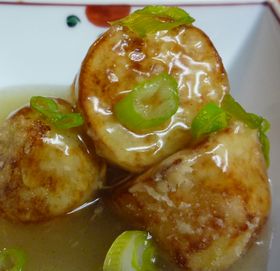
Sato Imo An/Taro in sweet and sour sauce

Taro wholly fried and seasoned with umeboshi/pickled Japanese plums
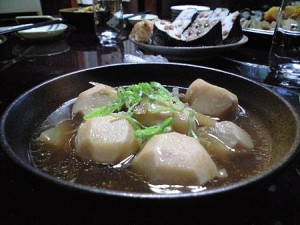
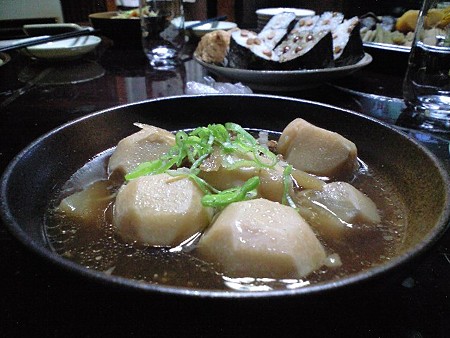
Sato Imo Nikome/Stewed Taro

TARO/SATO IMO VARIETIES:
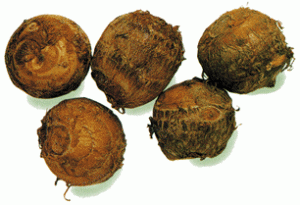
Ishikawawase, very tender once steamed. Must be peeled before consumption.

Dodare, with strong stickiness, very soft, prevalent in Eastern Japan.

Kyo Imo, also called Take no Ko Imo, very popular for its long shape.
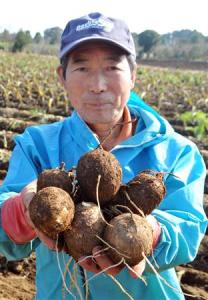
Chiba Maru, great and elegant taste.
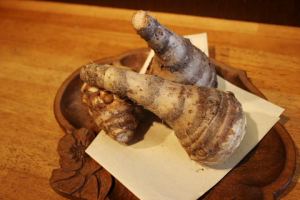
Ebi Imo, although called Tou no Imo, quite sticky.

Yatsu Gashira, “Eight heads”, great stewed.
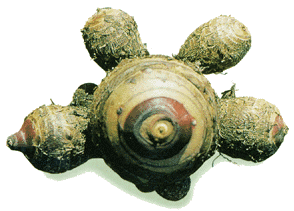
Serebesu, little stickiness, can be cooked as normal potato.

Hasu Imo, is not actually the tuber itself but the stems, eaten as green vegetables.

Yamato Wase, from Niigate and Toyama Prefectures, very white, sticky and fine-grained.
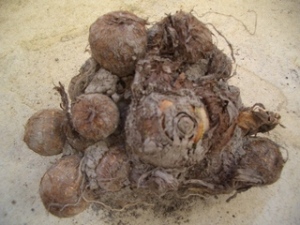
Yahata Imo, from Niigata Prefecture, great for stews.

Dentouji Sato Imo, sticky. Stems can be also eaten.

Zuiki Imo, are actually edible shoots of sato imo, mainly cooked in stews.

FACTS:

-Very rich in potassium and phosphorus!
-Vitamins B1, B2 and C.
-Rich in fibers.

TIPS:

-Best season: September~November.
-Prevent them from getting dry. Wrap them in newspaper with their attached mud/soil and keep in a well ventilated place away from the light.
-When cut, the best specimens are uniformly white without specks or blemishes.
-Very beneficial against obesity.

HEALTH FACTS:

-Combined with eggs, or chicken, or sardines, or bonito, helps brain activity and increases stamina.
-Combined with tofu, or dry bonito shavings, or skimmed milk, helps brain activity.
-Combined with mushrooms, or devil’s tongue tuber, or burdock root, helps lower blood cholesterol and cobat high blood pressure and cancer.
-Combined with seaweed, or miso, or onions, or chili peppers, helps with digestion and blood flow.

RECOMMENDED RELATED SITES
Not-Just-Recipes, Bengal cuisine, Cooking Vegetarian, Frank Fariello, Gluten-free Vegan Family, Meatless MamaFrank Fariello, , Warren Bobrow, Wheeling Gourmet, Le Petit Cuisinier, Vegan Epicurean, Miss V’s Vegan Cookbook, Comestiblog

Please check the new postings at:
sake, shochu and sushi, To Cheese or not To Cheese

—————————————-
日本語のブログ
—————————————-

Vegan Steamed Organic Vegetables at Uzu

Shizuoka Prefecture is increasingly becoming renown all over Japan for its organic (biological/macrobiotic) vegetables and it has become a mind-boggling business to keep track of them all!
To (pleasingly) compound the problem, Shizuoka is the mildest area in Japan after Okinawa, with the direct consequence of yearlong uninterrupted culture.
For example, Shizuoka Prefecture produces half of all celery and Chinese leaf vegetables grown in this country. It is also the first to put out delicious white or yellow winter onions on the markets.

Uzu Izakaya in Shizuoka City is always on the look-out for new vegetables (we are planning to visit an upriver market next month together!), especially organic ones.
This particular way of serving organic vegetables steamed for an unadulterated tasting is their trademark.

I’m no vegan or vegetarian, but I can assure you I won’t let such a dish away from me!

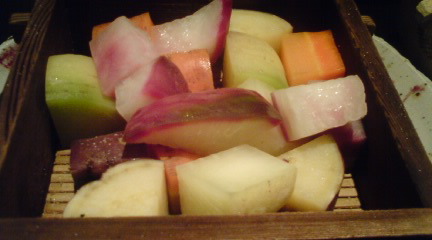
The picture above was taken last night during that memorable dinner at Uzu.
All vegetables are grown organically in Shizuoka Prefecture: carrot, white, red and green daikon, white-fleshed and purple-fleshed sweet potatoes. Don’t you think they look like fruits?

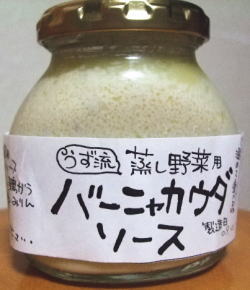
Barnyakauda Sauce

Uzu prepare and sell their own dressing/sauce for such steamed vegetables, although it is not vegan or vegetarian.
As an alternative, vegans and vegetarians could experiment with a sauce/dressing based on soy milk and curry seasoning!

UZU
Shizuoka City, Otowa-cho, 3-18
Tel.: 054-249-6262
Business hours: 17:00=23:00
Closed on Mondays and first Tuesday
Reservations recommended
Credit cards OK
HOMEPAGE (Japanese, but have a look at the pics!)

RECOMMENDED RELATED SITES:
Bread + Butter, Comestiblog, Greedy Girl, Bouchon For 2, Zoy Zhang, Hungry Neko, Mangantayon, Elinluv Tidbit Corner, Maison de Christina, Chrys Niles, Lexi, Culinary Musings, Eats and Everything, Bite Me New England, Heather Sweet, Warren Bobrow, 5 Star Foodie, Frank Fariello, Oyster Culture, Ramendo, Alchemist Chef, Ochikeron, Mrs. Lavendula, The Gipsy Chef, Dodol-Mochi, Wheeling GourmetLe Petit Cuisinier, Vegan Epicurean, Miss V’s Vegan Cookbook

——————————–
Please check the new postings at:
sake, shochu and sushi

—————————————-
日本語のブログ
—————————————-