Tag Archives: 美食

Japanese Seasonal Fish: Salmon-Sake

SAKE-1

Salmon is a favourite almost everywhere on the Globe, but it is in Japan that you can enjoy in the most numerous manners!

Like every other fish it has many names according to season and place:
Shirozake/White Salmon, Akiaji or Akizake for Autumn Salmon, Shake in Tokyo.
In Spring it is called Tokishirazu.
I don’t have to tell you there are many, many names for it all over the world!

SAKE-SUJIKO

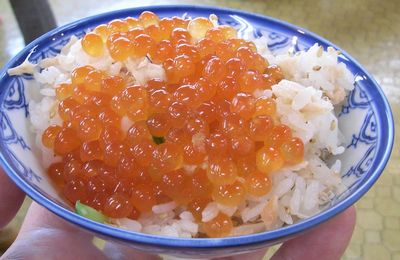
Its roe, before processing, is called Sujiko in Japanese, whereas the salmon roe, once treated, is called Ikura.

SAKE-ROE-SUSHI

Many Japanese appreciate the roe untreated, but more people enjoy it on top of rice as it is with some soy sauce and grated wasabi.

SAKE-SUSHI

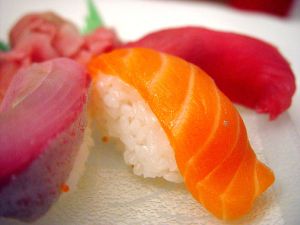
It also makes for some splendid colourful creation on a plate of sushi!

SAKE-SUSHI-2

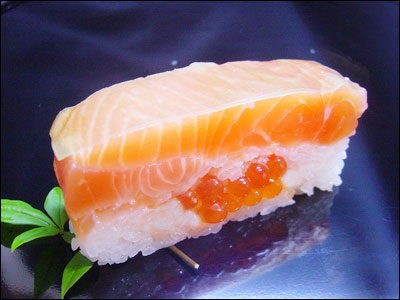
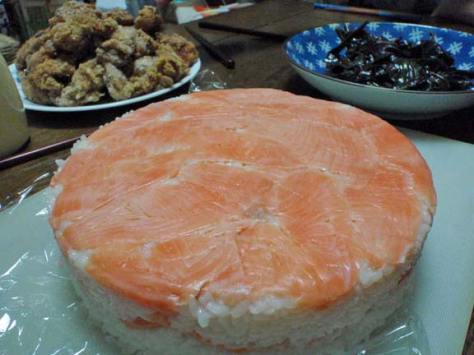
As oshizushi/pressed sushi, it can make some very interesting combinations with the salmon flesh and roe.

SAKE-GOHAN

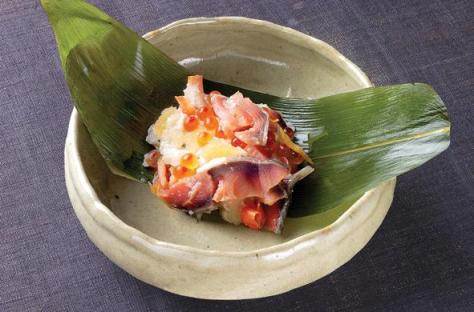
Have you ever tasted Sake Gohan/Salmon Rice?

SAKE-OSHIZUSHI

Slightly smoked the Japanese way, It is extensively used in the making of bentoes!

RECOMMENDED RELATED SITES:
Warren Bobrow
Bread + Butter
5 Star Foodie
Frank Fariello
Mangantayon
Tokyo Foodcast
Tokyo Through The Drinking Glass
Urban sake
Hapabento
Elinluv Tidbit Corner

Please check the new postings at:
sake, shochu and sushi

—————————————-
日本語のブログ
—————————————-

Japanese Cuisine: Seabream in Kabayaki Style

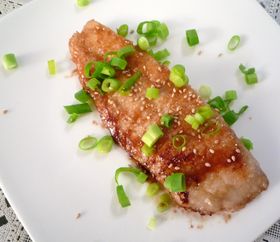
TAI-KABAYAKI1

Seabreams or groupers are aslo common almost all year long.
They make for all kinds of preparation in Japanese cuisine, either in nabe/Japanese pot au feu or grilled.
This very simple recipe is a grill in kabayaki style:

Seabream in Kabayaki Style:

INGREDIENTS: For two persons

-White-flesh fish (seabreams or groupers. Recipe can apply to almost any white flesh fish): 120g~

Marinade
-Soy sauce: 1 teaspoon
-Japanese Sake: 1 teaspoon

-Cornstarch: 2 tablespoons~
-Oil: 1 tablespoon

Sauce:
-Soy sauce: 1 tablespoon
-Japanese Sake: 1 tablespoon
-Mirin/Sweet sake: half a tablespoon
-Sugar: half a tablespoon
-White sesame seeds: 1~2 teaspoons
-Finely chopped thin leeks: 2 tablespoons

RECIPE:

TAI-KABAYAKI2

-Marinate fish soy sauce and Japanese sake for about 10 minutes.
-In a separate bowl mix soy sauce, Japanese Sake, mirin and sugar.

-Rest fish on a piece of kitchen paper to take excess marinade.
-Sprinkle both sides with cornstarch.
-Heat oil on a frypan and grill fish on both sides util “bubbles/eyes” appear on it surface.

-Once the heat has reched/cooked the core of the fish, slide fish against the side or corner of the frypan. Pour the sauce in the remaing space of the frypan. As soon as sauce starts boiling, caramelize both sides of the fish with the sauce.

-As soon as you are satisfied with the cooking of the fish, serve fish on a dish. Mix white sesame seeds with reamining sauce and pour over fish. Sprinkle with chopped thin leeks.

NOTE:

-Keep in mind that fish can break easily when you flip it over to fry it on both sides.
-Fry the skin side first.

RECOMMENDED RELATED SITES:
Warren Bobrow
Bread + Butter
5 Star Foodie
Frank Fariello
Mangantayon
Tokyo Foodcast
Tokyo Through The Drinking Glass
Urban sake
Hapabento
Elinluv Tidbit Corner

Please check the new postings at:
sake, shochu and sushi

—————————————-
日本語のブログ
—————————————-

Japanese Cuisine: Salmon grilled with Leek Miso

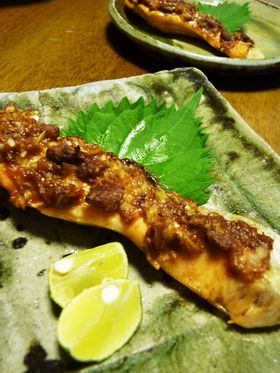
SALMON-NEGI-1

Salmon is basically available all year round these days.
The Japanese prepare it in all kinds of ways.
Here is a simple recipe very popular in Japanese homes you can also enjoy as a snack with a cool beer!

Salmon grilled with leek miso:

INGREDIENTS: For 2 persons

-Salmon: 2 slices
-Miso: 1 large tablespoon
-Japanese sake: 1 tablespoon (can be reduced or increased)
-Leek: 5 cm long cut (chopped fine)
-Umeboshi/pickled Jpanes plum: 1 teaspoon (can be reduced or increased)

RECIPE:

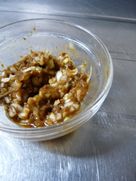
SALMON-NEGI-2

-In a bowl mix miso, sake, leek and umeboshi. Add sake if the mixture is not smooth enough. As for miso, choose one cotaining beans.
Do not be afraid to experiment as far as ingredients and quantities are concerned.

SALMON-NEGI-3

Grill with the lower face/side up first.
Turn over as the first “bubbles” appear on its surface.
Smear the salmon with the leek miso mix and grill until “bubbles apear on the fish surface.

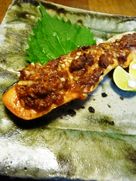
SALMON-NEGI-4

Serve with shiso or lettuce leaves for decoration and limes forthe final touch.

NOTES:

-Take care not to overgrill the fish.
-If you use salmon with its skin, grill skin first.

RECOMMENDED RELATED SITES:
Warren Bobrow
Bread + Butter
5 Star Foodie
Frank Fariello
Mangantayon
Tokyo Foodcast
Tokyo Through The Drinking Glass
Urban sake
Hapabento
Elinluv Tidbit Corner

Please check the new postings at:
sake, shochu and sushi

—————————————-
日本語のブログ
—————————————-

Wine Tasting in Shizuoka 3: Le Temps Des Cerises (Languedoc)

CERISE-2

As I mentioned in my previous tatsing I’m not ready yet to completely forget my roots. When there is good wine around, I see no reason to ignore it.
I thought it might be a good idea to taste the wines (within reasonability) available in this part of Japan!

This tasting also occurred at Lavigne in Shizuoka City!

Axel Prufer is a yaoung German vigneron who learned his trade before establihing himself in Languedoc, France in 2003.
He is an active member of a new type of winegrower belonging to the “Natural Wine School”.
This “Vin de Table/Table Wine” of his was conceived away from the higher appelations’ restrictions, but certainly has nothing to do with the legal Vin de Table! The alcohol content alone is a good enough indication. As for the price, although deserved, it would make vins de table inaccessible!
Incidentally the design on the label means “Spring has come!”

CERISE-1

Les Lendemains Qui Chantent
Le Temps des Cerises
Vin de Table Francais
Axel Prufer, Vigneron a 34260 Le Mas Blanc (Languedoc)
Grenache Grapes 100%
Alcohol: 13.5 proof degrees
Retail price (in Japan): 3,654 yen

Colour: Ruby red, very deep, clea.

Aroma: Strong, a little pungent, dry red fruits, green leaves

Taste: Soft attack backed by a little tannin.
Strong red fruits: Strawberries, raspberries, cherries, blueberries.
Very dry and soft.
Strong and short finish.
Taste lingering for quite long in the back of the mouth.

Eminently drinkable. Goes well with meat and heavy sauces.

LAVIGNE
420-0852, Shizuoka City, Aoi-Ku, Kutsunoya Cho, 17-2, 1F (2 minutes walk from JR Station)
Tel/fax: 054-205-4181
Opening hours: 11:00~22:00
HOMEPAGE (Japanese)

RECOMMENDED RELATED SITES:
Warren Bobrow
5 Star Foodie
Frank Fariello
Mangantayon
Cheese Monger
Rubber Slippers in Italy
Palate To Pen
Tokyo Foodcast
Urban Sake
Tokyo Through The Drinking Glass
Oyster Culture

Please check the new postings at:
sake, shochu and sushi

—————————————-
日本語のブログ
—————————————-

Japanese Fruits 3: Pione Budou-Pione Grapes

PIONE1

SYNOPSIS:
There are a lot of fruit which either originated or grew to be characteristic of Japan.
I’m trying to introduce into this new series to help my vegan and vegetarian (I’m no) friends in particular as fruit can be adapted into so many ways!

1) Nashi/Asian Pear
2) Jirou Kaki/Jirou Persimmon

Grapes are relatively new to Japan, but its people have compensated this with an eye to create new strains with great success.

PIONE3
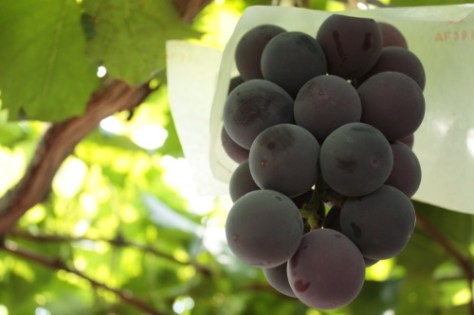
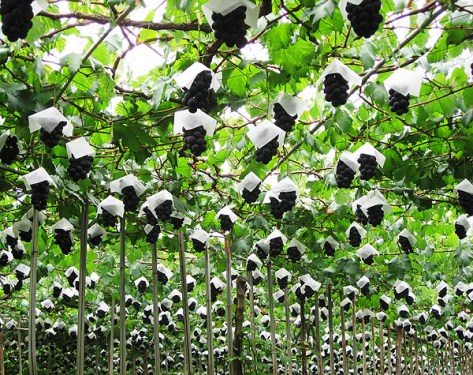
Pione Grapes are grown in aerial style.

Pione Grapes are a typical example.
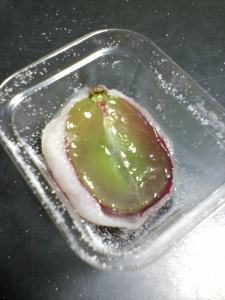
They are a cross between Kyoho Grapes and Cannon Hole Muscat.
Kyoho grapes (巨峰葡萄) are hemselves a Concord-like cross (Vitis vinifera x Vitis labrusca) between Campbell and Centennial grape varieties.

Kyoho grapes were first produced in 1942 in Shizuoka Prefecture, but were not so named until 1946.

PIONE-MUSCAT
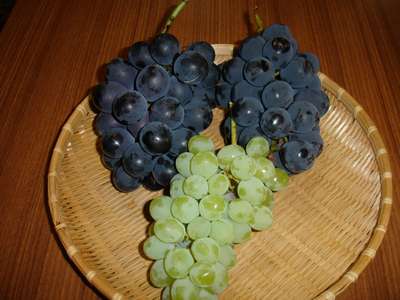
Pione Grapes compared to Muscat Grapes

Pione Grapes (ピオネ葡萄) were also first produced in Shizuoka Prefecture in 1957 by a farmer called Hideo Ikawa.
Pione is an Italian name.

PIONE2
Pione grape

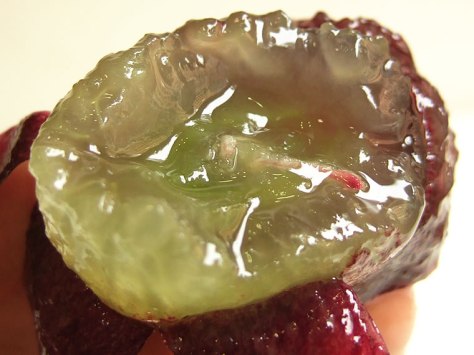
Pione grapes are usually seedless, juicy and very sweet making them very versatile for all kinds of desserts:

PIONE-MOCHI
A typical Japnese dessert:
Pione Grape inside mochi!

PIONE-TART
Pione Tart!
Irresistible, isn’t it?

But Pione Grapes, especially their flesh in “Concasse” style can be used in salads:

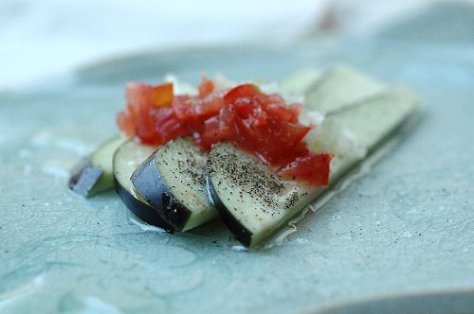
PIONE-ORGANIC-MIZUNASU
A dream salad for vegans!
Pione Grapes flesh on organic “Mizu nasu”/Mizu egg plant sashimi.
This particular kind of (Japanese) egg plant is eaten raw.
A little pepper and voila!

RECOMMENDED RELATED SITES
Not-Just-Recipes
Bengal cuisine
Cooking Vegetarian
Frank Fariello
Gluten-free Vegan Family
Meatless Mama
Think Twice

Please check the new postings at:
sake, shochu and sushi

—————————————-
日本語のブログ
—————————————-

French Cake by Bernard Heberle: 4810 (Mont-Blanc)

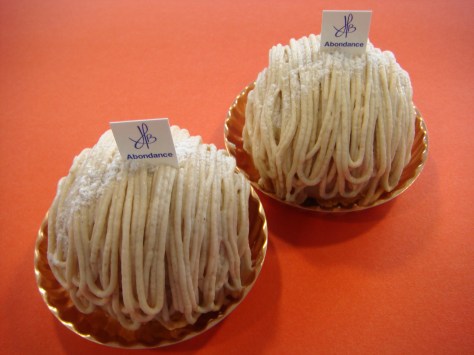
4810

My good French friend, Bernard Heberle, a native from Alsace in France and plying his trade as a patissier in Hamamatsu City, has just sent me his last creation:

4810!
Yes, you read well, this cake’s name is a number!
Can you guess?

In his own words:
“En cette période des Kinmokusei , je te présente ce gâteau bien connu des japonais et peut être leur favori avec les short cake.
Son nom 4810 ( Non , ce n’est pas son prix , seulement l’altitude de notre Mont Blanc )
Celui ci , le notre est une base de meringue au lait avec une crème de marron et une génoise a la vanille , crème pâtissière et crème montée, nous utilisons des marrons italien du Piémont.”

“In the Kinmokusei (fragrant orange-colored olive, the tree of Shizuoka Prefecture. Look below for picture) season, I would like to introduce a cake well known to the Japanese and perhaps their favourite with short cake.
Its name is 4810 (No, it’s not its price, only the height of Mont-Blanc!).
This particular creation rests on a milk meringue, then a marron cream and vanilla genoise. Next a creme patissier and a creme montee.
We use Itlian marrons from Piemonte.”

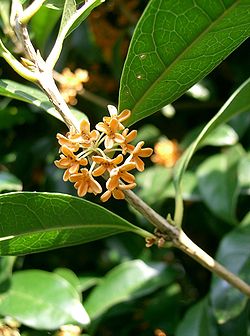
Kinmokusei
Kinmokusei (fragrant orange-colored olive, the tree of Shizuoka Prefecture)

Abondance
Address: Hamamatsu Shi, Sumiyoshi, 2-14-27 (in front of Seirei Hospital)
Tel.: 053-4738400
Fax: 053-4738401
Opening hours: 10:00~20:00. Closed on Tuesdays.
Homepage

RECOMMENDED RELATED SITES:
Warren Bobrow
Bread + Butter
5 Star Foodie
Frank Fariello
Mangantayon
Elinluv Tidbit Corner
Oyster Culture
Meatless Mama
Think Twice

Please check the new postings at:
sake, shochu and sushi

—————————————-
日本語のブログ
—————————————-

Tofu Donuts: Recipe

tofu-kinds-5
“Tofu Doughnuts” at Shizutetsu Supermarket in Shizuoka City

Following a kind message from Dawn Figueroa who after returning from Japan could not find the tofu donuts back home, nor their recipes.

There are many recipes indeed, most of them including eggs, milk, wheat flour, pancake mix and what not.
Moreover I discovered that the stores in Japan use wheat flour, too.
Although this would be enough for vegans and vegetarians (I’M not), I decided to introduce an easy recipe which non-gluten, nor containing wheat flour.

For people who want to start from scratch, check tofu preparation recipe below!

HOME-MADE TOFU DONUTS
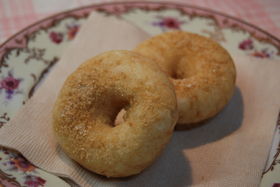
TOFU-DONUTS-1

Ingredients: For 3 donuts (multiply accordingly!)

-Rice powder (riz blanc in French): 45 g
-Cornstarch: 15 g
-Baking powder (non-gluten): half a teaspoon
Sugar beet: 10 g (optional/use a little salt if you want to prepare appetizer donuts)
-(Kinu tofu) Silk Tofu: 60 g
-Deepfry oil

Recipe:

TOFU-DONUTS-2

-In a large bowl, mash/crush the tofu
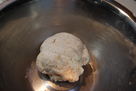
TOFU-DONUTS-3

-Add rice powder, cornstarch, baking powder and sugar beet. Mix well.Form a ball.
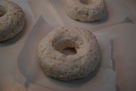
TOFU-DONUTS-4

-Shape three donuts by hand and place them atop pieces of cooking paper. Shape the central hole large enough.
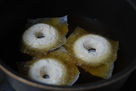
TOFU-DONUTS-5

-Preheat oil to 160 degrees Celsius.
Drop the doughnuts into the oil with their cooking paper.
Take paper out with tongs as soon as the oil “boil”around the donuts.
Fry the donuts until they attain a nice “fox”/brown colour.
Turn the donuts over halfway for an even cooking and colour.

NOTES:

-If you use too much tofu in the recipe the donuts will be difficult to shape.
-Proportion between rice powder, beet sugar and baking pwder is based on the following:
Rice powder: 100 g
Beet sugar: 10 g
Baking powder: 3 g
-You can add taste to the donuts according to your preferences.

————————

TOFU PREPARATION

zarudofu
“Zarudofu”, my favourite variety of tofu just filtered out in a “zaru/basket”. You just eat it with a spoon on its own. No seasoning needed!

Ingredients (for one large piece, one cho/丁in Japanese)

Soy beans: 2 cups (360cc)
Nigari: 2 large tablespoons
(Magnesium chloride is an important coagulant used in the preparation of tofu from soy milk. In Japan it is sold as nigari (the term is derived from the Japanese word for “bitter”), a white powder produced from seawater after the sodium chloride has been removed, and the water evaporated. In China it is called “lushui”.. Nigari or Lushui consists mostly of magnesium chloride, with some magnesium sulfate and other trace elements. It is also an ingredient in baby formula milk).
Water: 5 cups (twice and a half the volume of soy beans)

Utensils:
One large pot
One large clean cloth pouch to press tofu through
One bowl
One mixer
One thermometer
One large piece of gauze to filter water off shaped tofu
One large wooden spoon
One wooden tofu-shaper case

RECIPE:
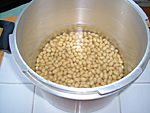
toofu-1
1) Preparation: soak soy beans in water overnight

toofu2
2) Preparation: Mix nigari with 1 cup of water and set aside

toofu-3
3) According to its size, Pour the whole or part by part soy beans and water (1) and make paste as fine as possible. If mixer runs at an even pace without crushing beans into paste, add more water. The paste obtained is called “namago” (生呉)

toofu-4
4) Pour the bean paste into a large pot with an equal amount of water. Heat stirring all the time. The paste will come to a boil suddenly. Switch off fire. Switch on low once the paste has settled for 10 minutes and take off fire.
toofu-5
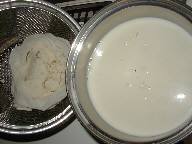
5) Pour paste into the cloth pouch and press. Right of the picture is tofu paste before pressing. Left is pressed out tofu
toofu-6
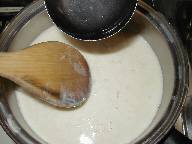
6) Solidifying (coagulating) with nigari.
Stir tofu over light fire. When the temperature has reached 75~80 degrees Celsius pour in nigari slowly and stir all the time. The solid matter will sink to the bottom and accumulate. The coagulation will be complete when liquid above tofu has become transparent. Stop the operation and let rest for 15 minutes.

toofu-7
7) Arrange the gauze inside tofu a tofu shaper case which should have small holes to let excess water run out.

toofu-8
8) Cover with lid with a weight (or glass of water) of about 250 g and further press out water for 15 minutes
toofu-9
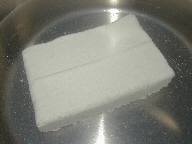
9) Delicately empty tofu in basin filled with called water and leave it there for an hour to take out excess nigari. Store in refrigerator.

RECOMMENDED RELATED SITES
Not-Just-Recipes
Bengal cuisine
Cooking Vegetarian
Frank Fariello
Gluten-free Vegan Family
Meatless Mama

Please check the new postings at:
sake, shochu and sushi

—————————————-
日本語のブログ
—————————————-

Japanese Fruits 2: Jirou Kaki-Jirou Persimmon

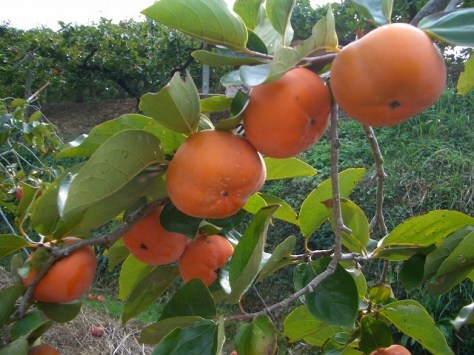
JIRO-KAKI1

SYNOPSIS:
There are a lot of fruit which either originated or grew to be characteristic of Japan.
I’m trying to introduce into this new series to help my vegan and vegetarian (I’m no) friends in particular as fruit can be adapted into so many ways!

1) Nashi/Asian Pear

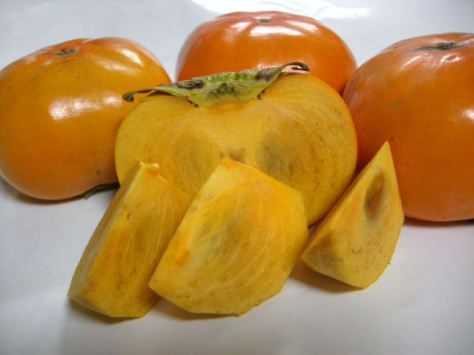
Jirou kaki or Jirou Persimmons are not to be confused with “normal persimmons”, or heart-shaped Hachiya which is the most common variety of astringent persimmon. Astringent persimmons contain very high levels of soluble tannins and are unpalatable if eaten before softening.

JIRO-KAKI-FALSE

Hachiya Persimmons

The astringency of tannins is removed through ripening by exposure to light over several days, wrapping the fruit in paper for heating it, and/or artificially with chemicals such as alcohol and carbon dioxide which change tannin into the insoluble form. This bletting process is sometimes jumpstarted by exposing the fruit to cold or frost which hastens cellular wall breakdown. These astringent persimmons can also be prepared for commercial purposes by drying.

JIRO-KAKI-TREE

The non-astringent persimmon, or Jirou kaki, is squat like a tomato and is most commonly sold as fuyu. Non-astringent persimmons are not actually free of tannins as the term suggests, but rather are far less astringent before ripening, and lose more of their tannic quality sooner. Non-astringent persimmons may be consumed when still very firm to very very soft.

JIRO-KAKI-DRIED

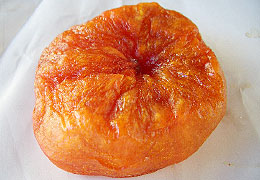
Dried Jirou Persimmon

Actually, Jirou Kaki/Jirou Persimmons are the pride of our Prefecture, Shizuoka Prefecture, as they were first grown in 1844 by a farmer called Jiroushi Matsumoto in Mori-Cho, Western Shizuoka Prefecture!
Their trees were finally successfully raised in 1869.

JIRO-KAKI-JAM

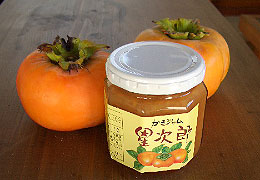
Jirou Persimmon Jam

The persimmons were finally given their name, Jirou Kaki, by the Emperor of Japan upon his meeting with Fujitarou Suzuki (the grower of that time) in Mori-Cho where a Shinto Temple is still dedicated to the Emperor of Japan.

JIRO-KAKI-CAKES

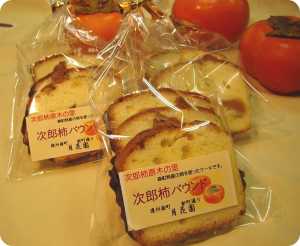
In Shizuoka Prefecture, Jirou Persimmon are found under many guises such as cakes (above)

JIRO-KAKI-WINE

Jirou Persimmon wine!

JIRO-KAKI-VINEGAR

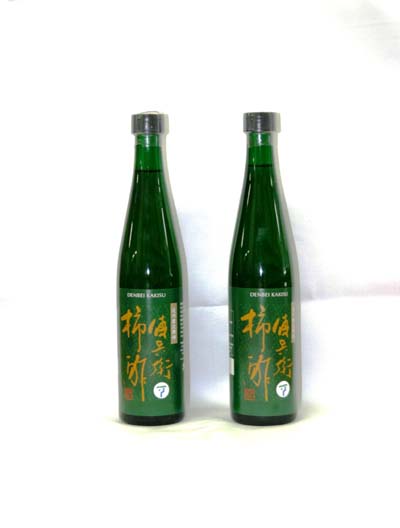
Jirou Persimmon vinegar, a rarity created by Bembei Kawamura, the Father of Shizuoka Sake!
It can drunk as a health drink mixed with with good wateror used as a finish on many dishes!

JIRO-KAKI-DRYING

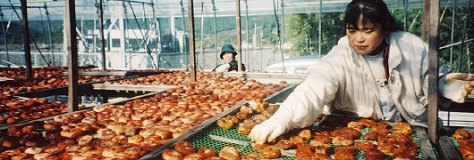
Although I personally like them fresh either as dessert or in salads with vegetables, my favourite is dried persimmons, a big business in Shizuoka Prefecture!

RECOMMENDED RELATED SITES
Not-Just-Recipes
Bengal cuisine
Cooking Vegetarian
Frank Fariello
Gluten-free Vegan Family
Meatless Mama
Think Twice

Please check the new postings at:
sake, shochu and sushi

—————————————-
日本語のブログ
—————————————-

For Vegan and Vegetarians! “Forgotten” Vegetables 16: Chataigne de Terre-Great Pignut

CHATAIGNE-DE-TERRE
(Courtesy: Jean-Luc de Belgique)

SYNOPSIS:
Organic agriculture and biodiversity have in recent years brought about a rediscovery of many “forgotten” vegetables that people especially in Europe and France conscientiously tried to forget as they reminded them of the privations suffered during WWII. The same people had then to make do with untraditional vegetables because potatoes, carrots and so on were confiscated by occupying forces or their own armies.
With sustainibility and bioagriculture made more important by the deficiencies of modern mass agriculture, those “forgotten” vegetables have suddenly come to the fore for the pleasure of all, and that of course of vegetarians and vegans!

This particular series of postings will introduce these vegetables one by one. I hope they will become useful for a long time to come to all my vegan and vegetarian friends!
1) Scorsonere/Oyster Plant
2)Potimarron
3) Vitelotte
4) Rutabaga
5) Cardon
6) Panais/Parsnips
7) Patisson
8) Topinambour
9) Crosne
10) Cerfeuil Tubereux
11) Poiree
12) Oca
13) Ulluque/Ulluco
14) Tigernuts
15) Capucine tubereuse-Maschua

The Chataigne de Terre (Earth Chestnut in French) or Bunium bulbocastanum in latin is a truly rare vegetable, even in Europe where gardeners, more than farmers, grow it in France and Belgium notably.

Its other names include: terre noix, marron de terre, gland de terre, moinson (French), Erdkastanie (German) ; bulbo castaño (Spanish) ; bulbocastano comune (Portuguese) great pignut (English) and aardkastanje (Dutch).

CHATAIGNE-DE-TERRE.1jpg

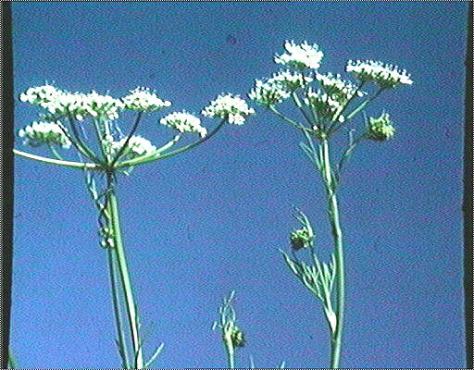
It is an ombrelliferea and is also cultivated as a decoration garden plant.

The plant, wit comparatively few leaves can reach a height of 30~70 cm (1~2 feet).
It blossoms in Autumn with beautiful white flowers.
After seeds have been formed, the arial part of the plant will dry out.
It is then than one can find many tuber-like (they are not true tubers) nodules coming out of the roots when the whole plant is pulled out the earth.

These can be eaten raw after being washed in clear cold running water.
They have a distinctive chestnut taste and are greatly appreciated as a snack (for aperitif!)

They also become an ingredient for the German Liqueur called Kummel!

RECOMMENDED RELATED SITES
Not-Just-Recipes
Bengal cuisine
Cooking Vegetarian
Frank Fariello
Gluten-free Vegan Family
Meatless Mama

Please check the new postings at:
sake, shochu and sushi

—————————————-
日本語のブログ
—————————————-
Japanese Fruits 1: Nashi/Asian Pear

nashi1

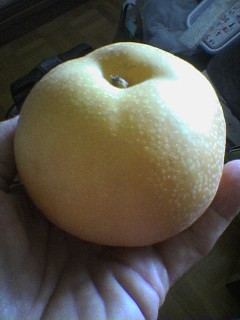
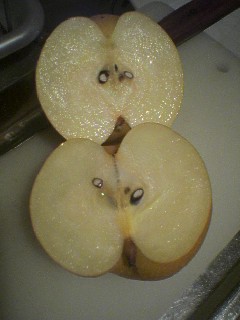
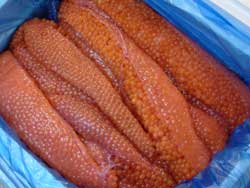
Pyrus pyrifolia is a pear tree species native to China, Japan, and Korea. The tree’s edible fruit is known by many names, including: Asian pear, nashi or nashi pear, African pear, Japanese pear, Korean pear, Taiwan pear, sand pear, apple pear, bapple, papple, bae, li (Japanese: ナシ;Chinese: 梨; Korean: 배). In South Asia, the fruit is known as nashipati or nashpati.

nashi2

Pyrus pyrifolia is cultivated throughout East Asia, as well as in Australia, India , New Zealand, and other countries. It was recently grown successfully in France and is also sold under the name pf Nashi.

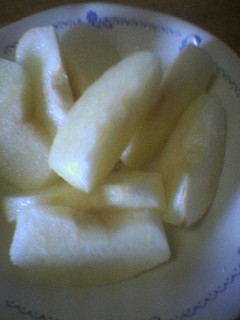
nashi3

Nashi pears are widely grown for their sweet fruit, a popular food in East Asia. They are sweet on the tree and are eaten crisp.

nashi4

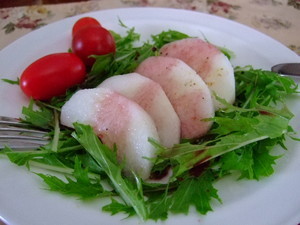
Healthy salad!

Nashi pears generally are not baked in pies or made into jams because they have a high water content and a crisp, grainy texture, very different from the buttery European varieties. Also, Nashi pears are not as intensely sweet, having a more refreshing, light taste.

They are grown in various areas in Japan under different cultivar and brand names.

nashi5

Great salads!

I have the luck to be offered every summer a full box of them coming from Yaizu City where their brand name is “Shinsui”/新水. They are the perfect fruit for a hot summer and have far more value than a whole bottle of soda!

RECOMMENDED RELATED SITES
Not-Just-Recipes
Bengal cuisine
Cooking Vegetarian
Frank Fariello
Gluten-free Vegan Family
Meatless Mama

Please check the new postings at:
sake, shochu and sushi

—————————————-
日本語のブログ
—————————————-
For Vegan and Vegetarians! “Forgotten” Vegetables 15: Capucine tubereuse-Maschua

capucine-tubereuse2

SYNOPSIS:
Organic agriculture and biodiversity have in recent years brought about a rediscovery of many “forgotten” vegetables that people especially in Europe and France conscientiously tried to forget as they reminded them of the privations suffered during WWII. The same people had then to make do with untraditional vegetables because potatoes, carrots and so on were confiscated by occupying forces or their own armies.
With sustainibility and bioagriculture made more important by the deficiencies of modern mass agriculture, those “forgotten” vegetables have suddenly come to the fore for the pleasure of all, and that of course of vegetarians and vegans!

This particular series of postings will introduce these vegetables one by one. I hope they will become useful for a long time to come to all my vegan and vegetarian friends!
1) Scorsonere/Oyster Plant
2)Potimarron
3) Vitelotte
4) Rutabaga
5) Cardon
6) Panais/Parsnips
7) Patisson
8) Topinambour
9) Crosne
10) Cerfeuil Tubereux
11) Poiree
12) Oca
13) Ulluque/Ulluco
14) Tigernuts

The Capucine tubereuse (French), Maschua (Inca) or Tropaeolum tuberosum (Latin) is a very old tuber originally grown on the high plateaux of Peru and around Titicaca Lake.

2m high, it is mainly used for its flowers as a decorative plant.
It blooms from July to Autumn. The seeds are formed at the same time.

capucine-tubereuse

It was already grown and eaten by the pre-Incas 5.500 years BC.
It gives out fairly good yields.

Maschua has recently become popular in France and Belgium for its tubers.
They can be eaten like potatoes.
Its peppery taste (it contains mustard oils) is not always appreciated.
This peppery taste disappears upon freezing or long boiling.
The taste is best when the tubers are harvested after the first frosts.
In Bolivia and Peru the tubers are also eaten with molasses and frozen as a dessert.

The young leaves can be eaten as a green vegetable, either raw or cooked.
The flowers can be eaten raw and have a sweet taste ending up on a peppery note.

RECOMMENDED RELATED SITES
Not-Just-Recipes
Bengal cuisine
Cooking Vegetarian
Frank Fariello
Gluten-free Vegan Family

Please check the new postings at:
sake, shochu and sushi

—————————————-
日本語のブログ
—————————————-
For Vegan and Vegetarians! “Forgotten” Vegetables 14: Tigernuts, Amande de Terre

AMANDE-DE-TERRE-1a

SYNOPSIS:
Organic agriculture and biodiversity have in recent years brought about a rediscovery of many “forgotten” vegetables that people especially in Europe and France conscientiously tried to forget as they reminded them of the privations suffered during WWII. The same people had then to make do with untraditional vegetables because potatoes, carrots and so on were confiscated by occupying forces or their own armies.
With sustainibility and bioagriculture made more important by the deficiencies of modern mass agriculture, those “forgotten” vegetables have suddenly come to the fore for the pleasure of all, and that of course of vegetarians and vegans!

This particular series of postings will introduce these vegetables one by one. I hope they will become useful for a long time to come to all my vegan and vegetarian friends!
1) Scorsonere/Oyster Plant
2)Potimarron
3) Vitelotte
4) Rutabaga
5) Cardon
6) Panais/Parsnips
7) Patisson
8) Topinambour
9) Crosne
10) Cerfeuil Tubereux
11) Poiree
12) Oca
13) Ulluque/Ulluco

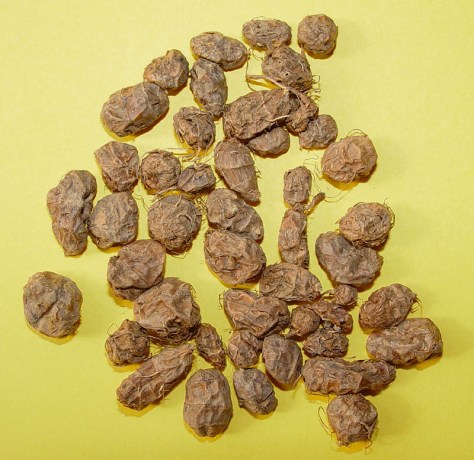
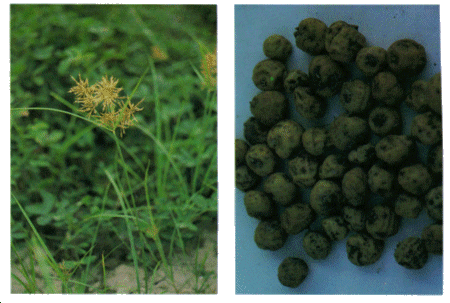
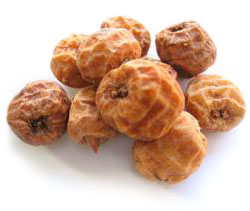
Tigernuts or chufa flatsedge in English, amande de terre (earth almond!), choufa, noix tigrée, souchet comestible in French, Chufa in Sapnish, Zigolo dolce in Italian or Yellow Nutsedge in the US, Cyperus esculentus does have many names!

AMNDE-DE-TERRE-1

Very popular in Spain, the plant is a cousin of the papyrus.
It produces small 2~3 cm tubers/rhyhomes in Autumn.
Once dried thay can be safely kept for years.

AMANDE-DE-TERRE

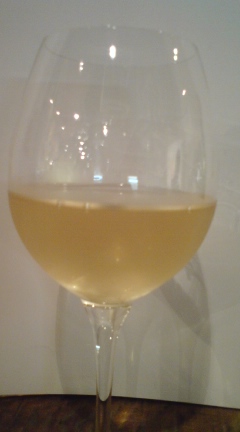
In Spain they are fermented into a celebrated drink with an almond taste called Hodchata!

Many people eat them raw as snacks or griilled or in salads with a drink, too!

Before re-planting them April~May, let them in lukewarm water for 48 hours. They need quite some watering, especially during dry seasons.

Harvest are conducted from end of Otober to the beginning of November by pulling out the whole plant.ue vous conserverez au frais.

Le saviez-vous ?
Le souchet sert à préparer une boisson Espagnole appelée “horchata de chufa”. Chufa est son nom en Espagne.

It is also used in place of almonds in cakes.

RECOMMENDED RELATED SITES
Not-Just-Recipes
Bengal cuisine
Cooking Vegetarian
Frank Fariello

Please check the new postings at:
sake, shochu and sushi

—————————————-
日本語のブログ
—————————————-
Shizuoka Local Fish: Houbo/Blue Fin Robin

houbou.jpg

Many a time, my good friend Patrick Harrington has rightly pointed out on the importance to eat “local” as much as possible. Consequently, I have endeavoured whenever possible to introduce any vegetables, dairy products, meat and fish grown, made, raised or caught in Shizuoka Prefecture (and its waters)
As for today I would like to introduce again a fairly cheap and tasty fish: houbou. Its English name is quite poetic: blue fin robin (“Chelidonichthys spinosus” for the purists). The reason is its very wide round green-blue side fins.
Some call it grotesque, others beautiful.

Most of them are found in Niigata Prefecture from Autumn to Winter (30~50 cm), but they are caught in early Spring in Suruga Bay (the Shizuoka variety is smaller, up to 20 cm). But now and thenwe find them at dfferent times of the year.

It can be prepared in many ways:

-Sashimi and sushi if just caught.

-In “nabe/鍋” (soup pot) or as “nimono/煮物” (simmered) in Japanese-style cuisine.

-Steamed and served with a sweet and sour sauce in Chinese-style food.

My preferred way is Mediterranean style (one fish per person):
Cut the side fins and scrape the scales off. discard the insides and clean under clear cold running water. Make a couple of shallow incisions over each flank.
Fill the stomach with a mixture of finely chopped vegetables and herbs (leave your imagination go free!).
Put it on a large sheet of olive oil coated cooking foil paper, sprinkle it with a little salt and pepper. Place vegetables cut in long strings on both sides (plenty is fine), and one or two thin lemon slices on top. Coat it with some (not too much) extra virgin oil. As a last touch, I add some white wine and a little anise spirit (Pernod, Ricard or Absinthe).
Loosely wrap the fish with foil paper, close both ends by twisting them around.
Place the fish in its foil paper directly on the metal plate inside the oven preheated at 180 degrees Celsius and cook for about 15 minutes (longer for large fish).
If you do not have an oven, steam it the Chinese way!

RECOMMENDED RELATED SITES:
Warren Bobrow
Bread + Butter
5 Star Foodie
Frank Fariello
Mangantayon
Elinluv Tidbit Corner

Please check the new postings at:
sake, shochu and sushi

—————————————-
日本語のブログ
—————————————-
Wine Tasting in Shizuoka 2: Saint-Veran-La Bernardiere

ST-V1

As I mentioned in my previous tatsing I’m not ready yet to completely forget my roots. When there is good wine around, I see no reason to ignore it.
I thought it might be a good idea to taste the wines (within reasonability) available in this part of Japan!

This tasting also occurred at Lavigne in Shizuoka City!

ST-V2

Saint-Veran is still a very new and still raltively unknown AOC from the very southern tip of the Maconnais area in Bourgogne. Longer summers than in vaunted northern Bourgogne give it a different character.

Domaine Combier
Saint-veran AOC (Maconnais, Bourgogne, France)
La Bernardiere in Prisse Village
2005, 100% Chardonnay, 14 degrees proof (high)
Retailed in Japan at 3,000 yen

Colour: Beautiful, clear, limpid gold. Darker than usual Chardonnay.

Aroma: Fruity, flowers. Pleasantly strong. Nutty, honey. Complex.

Taste: dry attack. Longish but light tail.
Nuts, macadamia, butter,memories of smoked cheese.
Turns slightly sweeter with food.
Pleasant finish expanding at the back of the mouth.
Changes little with food.
Pleasant overall impression.
Can be enjoyed on its own as well as with almost any food.
Well-rounded and lively.

LAVIGNE
420-0852, Shizuoka City, Aoi-Ku, Kutsunoya Cho, 17-2, 1F (2 minutes walk from JR Station)
Tel/fax: 054-205-4181
Opening hours: 11:00~22:00
HOMEPAGE (Japanese)

RECOMMENDED RELATED SITES:
Warren Bobrow
5 Star Foodie
Frank Fariello
Mangantayon
Cheese Monger
Rubber Slippers in Italy
Palate To Pen
Tokyo Foodcast
Urban Sake
Tokyo Through The Drinking Glass

Please check the new postings at:
sake, shochu and sushi

—————————————-
日本語のブログ
—————————————-
Sushi & Sashimi: The Basics 5 – Sashimi Presentations

SUSHIK-09-08-31-5
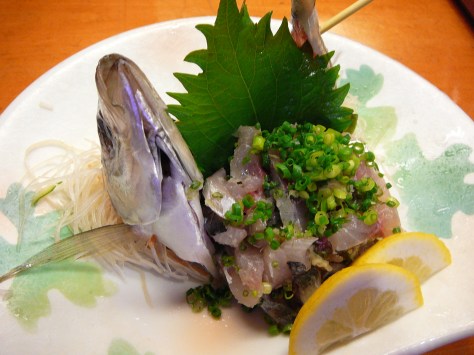
Aji Tataki/Horse mackerel Tartare served at Sushi Ko, Shizuoka City

SYNOPSIS:
I already have wrtitten a lot in bits and pieces on Sushi and Sashimi, including in my other blog, Shizuoka Sushi, but I felt it was time to post an article that could be used as general reference by my blogging friends.
The Basic 1: Definitions
The Basics 2: Questions & Answers
The Basics 3: Ingredients
The Basics 4/1: Sushi Presentations
The Basics 4/2: Sushi Presenations-Rolls
The Basics 4/3: Sushi Presentations-Donburi

Sashimi, as almost everyone knows means thin slices, whether it be fish, meat or vegetables. When raw fish, seafood or meat is not sashimi but served raw, it is usually called tsumami/side, snack.
Fish and other seafood van be presented solely as sashimi or as a combination of sashimi and tsumami.

The possibilities are infinite as there are many ways a chef can cut and present his food.

Below I propse a “small” selection of waht can be found in Japan.
here is a little challenge for you:
Can you recognize all ingredients?

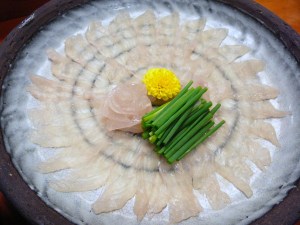
011
Usu tsukuri style/Thin cut style

SASHIMI-PRESENTATIONS-1
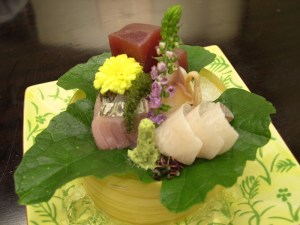
Japanese Cuisine Sashimi O-Tsukuri/Plate

SASHIMI-PRESENTATIONS-2
Another Japanese Cuisine Sashimi O-Tsukuri/Plate

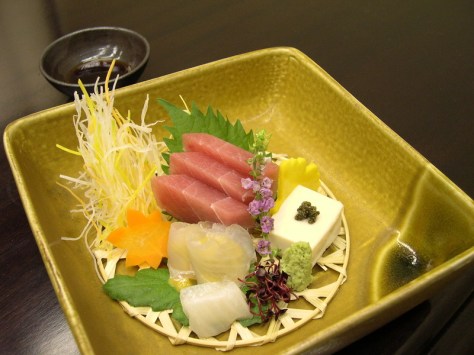
SASHIMI-PRESENTATIONS-3
Japanese Cuisine Sashimi O-Tsukuri/Plate in Kado/Square style

SASHIMI-PRESENTATIONS-4
I suppose you recognize this single sashimi served in Somen/thin noodles style!

SASHIMI-PRESENTATIONS-5
Another way to serve the whole fish

SASHIMI-PRESENTATIONS-6
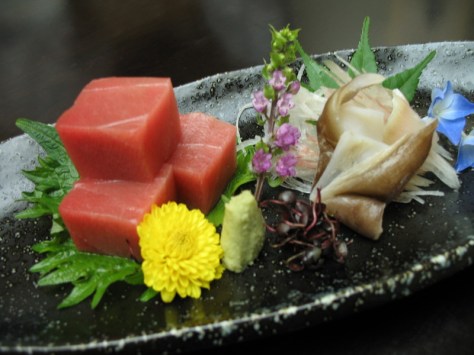
A simple individual plate of sashimi

SASHIMI-PRESENTATIONS-7
A more sophisiticated individual plate of sashimi and tsumami

SASHIMI-PRESENTATIONS-8
An individual Plate of sashimi served with the seasoning

SASHIMI-PRESENTATIONS-9
Elegant and simple individual plate of sashimi!

RECOMMENDED RELATED SITES:
Warren Bobrow
Bread + Butter
5 Star Foodie
Frank Fariello
Mangantayon
Tokyo Foodcast
Tokyo Through The Drinking Glass
Urban sake
Hapabento
Elinluv Tidbit Corner

Please check the new postings at:
sake, shochu and sushi

—————————————-
日本語のブログ
—————————————-