Tag Archives: Japanese Gastronomy

French Dessert: Chilled Musk Melon Soup at Pissenlit

Service: excellent and very friendly
Facilities: great washroom, great cleanliness overall
Prices: reasonable, good value.
Strong points: Interesting wine list. Great use of local products.
no-smoking-logoentirely non-smoking!

This is the “third part” of my previous lunch at Pissenlit, dessert!

Musk Melons are a specialty of Fukuroi City, where more than 300 farmers grow them in a great environment, most of the time organic!

This dessert for all its simple concept, was a true dlicacy.
Half of it was soup made with flesh and juice of musk melon, and the other half of musk melon quarters you scoope out with yor spoon with some of the grapefruit sorbet wimming on top!

It certainly deserved a separate posting!

PISSENLIT
420-0839 Shizuoka City, Aoi Ku, Takajo, 2-3-4
Tel.: 054-270-8768
Fax: 054-627-3868
Business hours: 11:30~14:30; 17:00~22:00
Closed on Tuesdays and Sunday evening
Homepage (Japanese)
Credit Cards OK

RECOMMENDED RELATED SITES:
Warren Bobrow, Bread + Butter, Zoy Zhang, Hungry Neko, Think Twice, Frank Fariello, Mangantayon, Hapabento, Elinluv Tidbit Corner, Tokyo Terrace, Maison de Christina, Chrys Niles,Lexi, Culinary Musings, Wheeling Gourmet, Comestiblog, Chronicles Of A Curious Cook, Tokyo Through The Drinking Glass, Tokyo Foodcast, Palate To Pen, Yellin Yakimono Gallery, Tokyo Terrace, Hilah Cooking, More than a Mount Full, Arkonite Bento, Happy Little Bento; 5 Star Foodie; Jefferson’s Table; Oyster Culture; Gourmet Fury; Island Vittles; Good Beer & Country Boys; Rubber Slippers In Italy; Color Food daidokoro/Osaka;/a; The Witchy Kitchen; Citron Et Vanille, Lunsj Med Buffet/Estonian Gastronomy (English), Cook, Eat, Play, Repeat, Chrisoscope

Please check the new postings at:
sake, shochu and sushi

Food & Drinks Bloggers in Japan (expanded on 2010/06/27)

The number of foreigners and Japanese nationals who write about the food and drinks in Japan in English (or at least answer comments in English) has remarkably increased lately.
I thought it was about time to start some kind of round-up to help people discover these deserving foodies and their blogs!The list below is far from exhaustive, but I’m planning to update and announce it regularly!
Of course if you know more foodies residing in Japan, do please direct them to me and I will introduce them gladly!

HOKKAIDO TRIBE
(Hokkaido Island)
Meishu no Yutaka by Carlin

TOHOKU TRIBE
(Norteastern Japan: Aomori, Iwate, Miyagi, Akita, Yamagata, Fukushima)
Slow Food From Japan by Nigel Fodgen in Miyagi Prefecture.

KANTO TRIBE
(Eastern Japan: Ibaraki, Tochigi, Gunma, Saitama, Chiba, Tokyo, Kanagawa)
Tokyo Through The Drinking Glass by Melinda Joe in Tokyo
Tokyo Foodcast by Etsuko Nakamura in Tokyo
Sake World by John Gauntner in Tokyo: The inernational Reference for Japanese Sake!
Tokyo Terrace by Rachael in Tokyo
Gaijin Tonic in Tokyo and Kanagawa Prefecture
Nonjatta by Chris Bunting in Tokyo
The Soul Of Japan in Kanagawa Prefecture
Sake, kimono and Tabi In Tokyo
Tokyo Kawai, Etc… in Tokyo
Blue Lotus in Tokyo
The Japanese Food Report by Harris Salat in Tokyo
The Sake Chronicles in Tokyo
Watashi to Tokyo by Mari kanazawa in Tokyo
Japanese Food-Food Lover’s Guide by Yukari Yamamoto in Tokyo
Gaijin Life by a Canadian gentleman in Tokyo
Leo’s Japan Food Blog in Tokyo
Eating Out In Tokyo With Jon

CHUBU TRIBE
(Central Japan: Niigata, Toyama, Ishikawa, Fukui, Yamanashi, Nagano, Gifu, Shizuoka, Aichi)
Good Beer & Country Boys in Aichi Prefecture
Yellin Yakimono Gallery by Robert Yellin in Shizuoka Prefecture
Mangantayon in Shizuoka Prefecture
Shizuoka Gourmet, Shizuoka Sake, Shizuoka Sushi, Shizuoka Shochu in Shizuoka Prefecture
Bryan Baird’s Beer & Brewery in Numazu in Shizuoka Prefecture

KANSAI TRIBE
(Western Japan: Mie, Shiga, Kyoto, Osaka, Hyogo, Nara, Kyoto, Wakayama)
Colorfood Daidokoro in Osaka (Englis & French)
Dominique Corby In Osaka (in French, but can answer and read in English)
Nagaijin in Osaka
Kyoto Foodie in Kyoto
Our Adventures in Japan by K and S Minoo in Osaka
Japan Food Addict by Mai in Kyoto

CHUGOKU
(“Central Country”: Tottori, Shimane, Okayama, Hiroshima, Yamaguchi)
Get Hiroshima Blog in Hiroshima

SHIKOKU
(Shikoku Island: Kagawa, Kochi, Ehime, Tokushima)
Obachan’s Kitchen & Garden Balcony in Kochi Prefecture
Still Clumsy With Chopsticks in Kochi Prfecture (Continuation of Obachan’s Kitchen & Garden Balcony)

KYUSHU
(Kyushu Island: Fukuoka, Nagasaki, Saga, Kumamoto, Miyazaki, Kagoshima)
Not yet!

OKINAWA
(Okinawa Archipelago)
HWN Pake in Okinawa in Chatan, Okinawa

Beef Cheek and Wild Boar by Yasushi Imaizumi

Because of my work and my love for food, whatever gastronomy, I’m blessed with friends in Japan and elsewhere who are always keen to share their experiences.
Yasushi Imaizumi is a very old Japanese friend for whom I also work regularly as a trouble shooter for his fashion clothes company.
As he extensively travels all year round in Japan and abroad, he cooks a lot back home.
A few days ago, he came to my working place with a tupperware full with sauce he had just made.
Only later, I found out that the pasta sauce had been made as a second part of a whole dinner he cooked himself at home.
In the picture above is Beef Cheek stewed in beer as served at the Restaurant in Nao Jima Setonaikai, a restaurant restaurant produced by Stella Maris.
He served his own fried potatoes, and fresh pasta and the meat topped with a julienne of onion, celery and carrot with olive oil.

Now, the sauce for the pasta back (my) home was made with wild boar (70%) stir fried in olive oil with beef (20%) and pancetta (10%).
stir fried [sofuritto] with onion, celery, carrot,, red wine, beef bouillon, Banyuls, basil, nutmeg, tomato, salt and pepper about 2 hours, later seasoned with Parmigiano Reggiano.

Very hearty, delicious and extravagant!

RECOMMENDED RELATED SITES:
Warren Bobrow, Bread + Butter, Zoy Zhang, Hungry Neko, Think Twice, Frank Fariello, Mangantayon, Hapabento, Elinluv Tidbit Corner, Tokyo Terrace, Maison de Christina, Chrys Niles,Lexi, Culinary Musings, Wheeling Gourmet, Comestiblog, Chronicles Of A Curious Cook, Tokyo Through The Drinking Glass, Tokyo Foodcast, Palate To Pen, Yellin Yakimono Gallery, Tokyo Terrace, Hilah Cooking, More than a Mount Full, Arkonite Bento, Happy Little Bento; 5 Star Foodie; Jefferson’s Table; Oyster Culture; Gourmet Fury; Island Vittles; Good Beer & Country Boys; Rubber Slippers In Italy; Color Food daidokoro/Osaka;/a; The Witchy Kitchen; Citron Et Vanille, Lunsj Med Buffet/Estonian Gastronomy (English), Cook, Eat, Play, Repeat, Chrisoscope

Please check the new postings at:
sake, shochu and sushi

Shamo Chicken from Umegashima at Pissenlit

Service: excellent and very friendly
Facilities: great washroom, great cleanliness overall
Prices: reasonable, good value.
Strong points: Interesting wine list. Great use of local products.
no-smoking-logoentirely non-smoking!

This is the “second part” of my previous lunch at Pissenlit.
As it is not fit for vegans or vegetarians, I kept separate, although organic vegetables do figure in this great gastronomic experience!

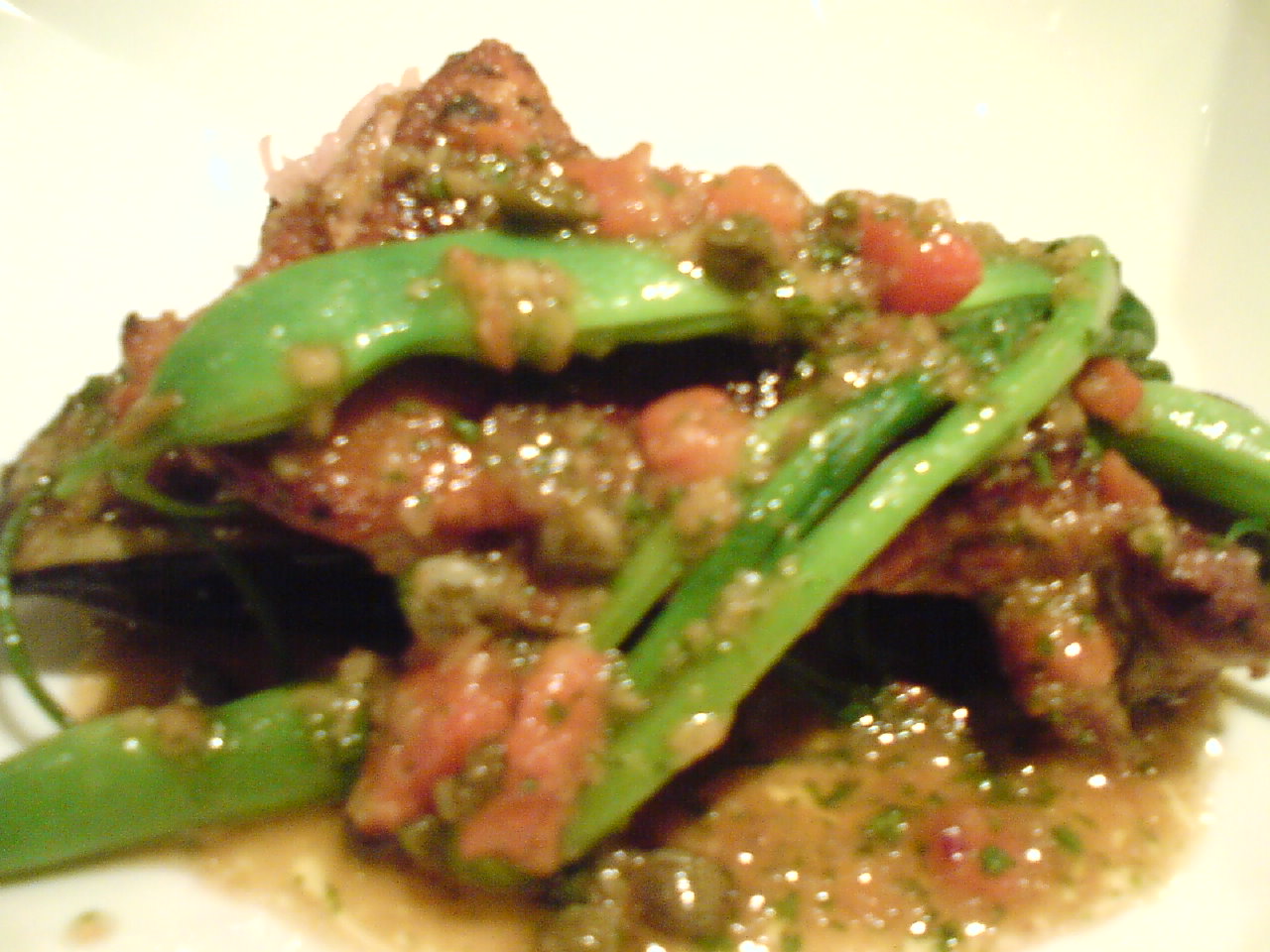
As for the meat, it is roasted chicken.
But the chicken is very special: Of the shamo/軍鶏 variety, it is some some of the best chicken available in this country.
Moreover, it was kept in a natural habitat in Umegashima, up in the mountains near the source of the Abe River, and fed only with natural food.

As for the vegetables, they are all organic.
The onions on the zucchini slice are confit, and the sauce is Provencal in concept with high quality EV oil and local tomatoes, garlic, and so forth.

The chicken breast with its skin roasted to crunchy perfection was placed atop a grilled slice of aubergine with Okahijiki, Komatsuna and Morokko Ingen/large string beans, all organically grown in Mishima City by Mr. Hideyaki Hirooka.

An “internal” view of the dish!

PISSENLIT
420-0839 Shizuoka City, Aoi Ku, Takajo, 2-3-4
Tel.: 054-270-8768
Fax: 054-627-3868
Business hours: 11:30~14:30; 17:00~22:00
Closed on Tuesdays and Sunday evening
Homepage (Japanese)
Credit Cards OK

RECOMMENDED RELATED SITES:
Warren Bobrow, Bread + Butter, Zoy Zhang, Hungry Neko, Think Twice, Frank Fariello, Mangantayon, Hapabento, Elinluv Tidbit Corner, Tokyo Terrace, Maison de Christina, Chrys Niles,Lexi, Culinary Musings, Wheeling Gourmet, Comestiblog, Chronicles Of A Curious Cook, Tokyo Through The Drinking Glass, Tokyo Foodcast, Palate To Pen, Yellin Yakimono Gallery, Tokyo Terrace, Hilah Cooking, More than a Mount Full, Arkonite Bento, Happy Little Bento; 5 Star Foodie; Jefferson’s Table; Oyster Culture; Gourmet Fury; Island Vittles; Good Beer & Country Boys; Rubber Slippers In Italy; Color Food daidokoro/Osaka;/a; The Witchy Kitchen; Citron Et Vanille, Lunsj Med Buffet/Estonian Gastronomy (English), Cook, Eat, Play, Repeat, Chrisoscope

Please check the new postings at:
sake, shochu and sushi

Imo Souffle (Naga Imo Souffle)

After extolling the virtues of yams/imo in another posting, I thought I had to introduce a few simple Japanese recipes using this very useful vegetable!
This recipe is more a combination of Japanese and French gastronomy than anything else. It has the merit to be very simple and healthy!
No need for an ove, a simple grill is enough!

The yam used in this particular recipe is “naga imo/長いも or long yam”.

The same, cleaned and cut!

INGREDIENTS: For 2 people

-Yam/naga imo: 150 g
-Egg: 1
-White dashi/shirodashi/shiradshi (if not available, plain dashi or souptock of your choice): 1 tablespoon
-Flour: 1 teaspoon
-Salt, pepper and spices: if and as you like!

RECIPE:

-Peel the yam and grate into a bowl.

-Add the beaten egg, dashi, flour and (optional) seasoning and mix well.

Pour into shallow oven dish and cook in the grill for 5~10 minutes.
Serve at once!

Simple, ain’t it?

RECOMMENDED RELATED SITES:
Warren Bobrow, Bread + Butter, Zoy Zhang, Hungry Neko, Think Twice, Frank Fariello, Mangantayon, Hapabento, Elinluv Tidbit Corner, Tokyo Terrace, Maison de Christina, Chrys Niles,Lexi, Culinary Musings, Wheeling Gourmet, Comestiblog, Chronicles Of A Curious Cook, Tokyo Through The Drinking Glass, Tokyo Foodcast, Palate To Pen, Yellin Yakimono Gallery, Tokyo Terrace, Hilah Cooking, More than a Mount Full, Arkonite Bento, Happy Little Bento; 5 Star Foodie; Jefferson’s Table; Oyster Culture; Gourmet Fury; Island Vittles; Good Beer & Country Boys; Rubber Slippers In Italy; Color Food daidokoro/Osaka;/a; The Witchy Kitchen; Citron Et Vanille, Lunsj Med Buffet/Estonian Gastronomy (English), Cook, Eat, Play, Repeat

Please check the new postings at:
sake, shochu and sushi

Health & Nutrition Facts in Japanese Food 11: Yama Imo/山芋

As demonstrated by many food bloggers, cooking and creating great foods and drinks have become incomplete and unsatisfying when not considering the benefits or adverse effects of the same foods and drinks regardless of their taste.
I do not intend to delve into counselling or consulting, but only to offer some knowledge about the good sides of Japanese foods and drinks. I will not extoll on its possible lacks and negative aspects. After all, the Japanese are not the longest-living people in the world for no reason!
I will also offr at least one nutritious or healthy recipe at the end of each posting.

Health & Nutrition Facts in Japanese Food 11: Yama Imo/山芋

Yam, or Yamo Imo/Yamanoimo/山芋/ヤマノイモ in Japanese are not only a great source of energy, but also of great help when it comes to digestion in general thanks to the proteins (glycosylated proteins) provided by the mucin contained in its jelly-like sap.
Moreover its high contents in Vitamin B and C, Potaasium, and dietary fibres make for a remarkably balanced source of food.
It is best assimilated by the human body in its raw form, either cut or grated.
It is of vital importance to vegans, vegetarians and wheat allergics as it can replace wheat flour and egg whites as a liaising agent in cooking!

For each 100g (edible parts) it contains:
-Energy: 65 kcal
-Water: 82.6 g
-Proteins: 2,2 g
-Carbohydrates: 13.9 g
-Natrium: 3 mg
-Potassium: 430 mg
-Calcium: 17 mg
-Phosphorous: 27 mg
-Copper: 0.10 mg
-Magnesium: 17 mg
-Vitamin B1: 0.10 mg
-Vitamin B2: 0.02 mg
-Vitamin B6: 0.09 mg
-Vitamin C: 5 mg
-Dietary (roughage) fibre: 1.0 g

HEALTH FACTS & TIPS:

-Combined with shiso/perilla leaves, or with turnip, or with Chinese Cabbage, or with green chili peppers, will promote digestion and digestive flow and appetite.

-Combined with moroheiya/nalta jute, or with okra, or with lotus root, or with namaeko mushrooms, wil help lower down blood cholesterol and increase stamina.

-Combine with soy beans, or with pomegranate, or with myoga ginger, will help with hormonal balance and blood flow.

-Combined with cabbage, or with potatoes, or with broccoli, or with Chinese Cabbage, will will help prevent cancer and aging.

RECIPE:

Here is a recipe to help with hormonal balance and resistance to cancer and aging: yam okonomiyaki!

Yam/yam imo: 100g
Cabbage: 2~3 leaves
Pork (sliced): 50 g
Egg: 1
Flour: 100 g
Water: as appropriate
Agetama/deep-fried breadcrumbs (from tempura, etc.): according to taste
Salad oil: as appropriate

Roughly chop cabbage. If the pork is not sliced, cut it in 1.5 mm thick strips.

Peel yam and grate it into a bowl. Add flour and beaten eggand mix. Add water and mix to the batter fluidity of your preference.

Add cabbage, pork and agetama. Season with a little salt, ground pepper as you like. Mix the whole roughly.

Fry in the shape of pancakes on salad oil.
Serve with your favourite sauce!

RECOMMENDED RELATED SITES:
Warren Bobrow, Bread + Butter, Zoy Zhang, Hungry Neko, Think Twice, Frank Fariello, Mangantayon, Hapabento, Elinluv Tidbit Corner, Tokyo Terrace, Maison de Christina, Chrys Niles,Lexi, Culinary Musings, Wheeling Gourmet, Comestiblog, Chronicles Of A Curious Cook, Tokyo Through The Drinking Glass, Tokyo Foodcast, Palate To Pen, Yellin Yakimono Gallery, Tokyo Terrace, Hilah Cooking, More than a Mount Full, Arkonite Bento, Happy Little Bento; 5 Star Foodie; Jefferson’s Table; Oyster Culture; Gourmet Fury; Island Vittles; Good Beer & Country Boys; Rubber Slippers In Italy; Color Food daidokoro/Osaka;/a; The Witchy Kitchen; Citron Et Vanille, Lunsj Med Buffet/Estonian Gastronomy (English), Cook, Eat, Play, Repeat

Please check the new postings at:
sake, shochu and sushi

Vegan French Steamed Organic Salad at Pissenlit

Service: excellent and very friendly
Facilities: great washroom, great cleanliness overall
Prices: reasonable, good value.
Strong points: Interesting wine list. Great use of local products.
no-smoking-logoentirely non-smoking!

Great food is great food!
Be you vegan, vegetarian or omnivore, one can only appreciate and being thankful for savouring vegetables not only of the best quality, but local and organically grown to boot!
I will never tire of saying to everyone how lucky we are here in Shizuoka Prefecture, Japan, a region renown nationally and increasingly internationally for its exceptional gastronomy!

Bazooka Gourmet is probably going to have another (shooting) field day when he learns that I have just been approached by the local government to help promote the local agriculture through blogging!
What can I say? It’s simply a pleasure!

To cut an increasingly long story short, I visited Pissenlit for lunch, and when I saw “Mishima Hirokawa San Yasai no Etuvee”/Steamed vegetables grown by Mr. (Hideyaki) Hirokawa in Mishima City, I knew that no-one could unhook me from my (delicious) doom!

To tell the truth I have nurtured a special relation with chef Tooru Arima (and many others), and he is only too happy to oblige with my sometimes very selfish requests!

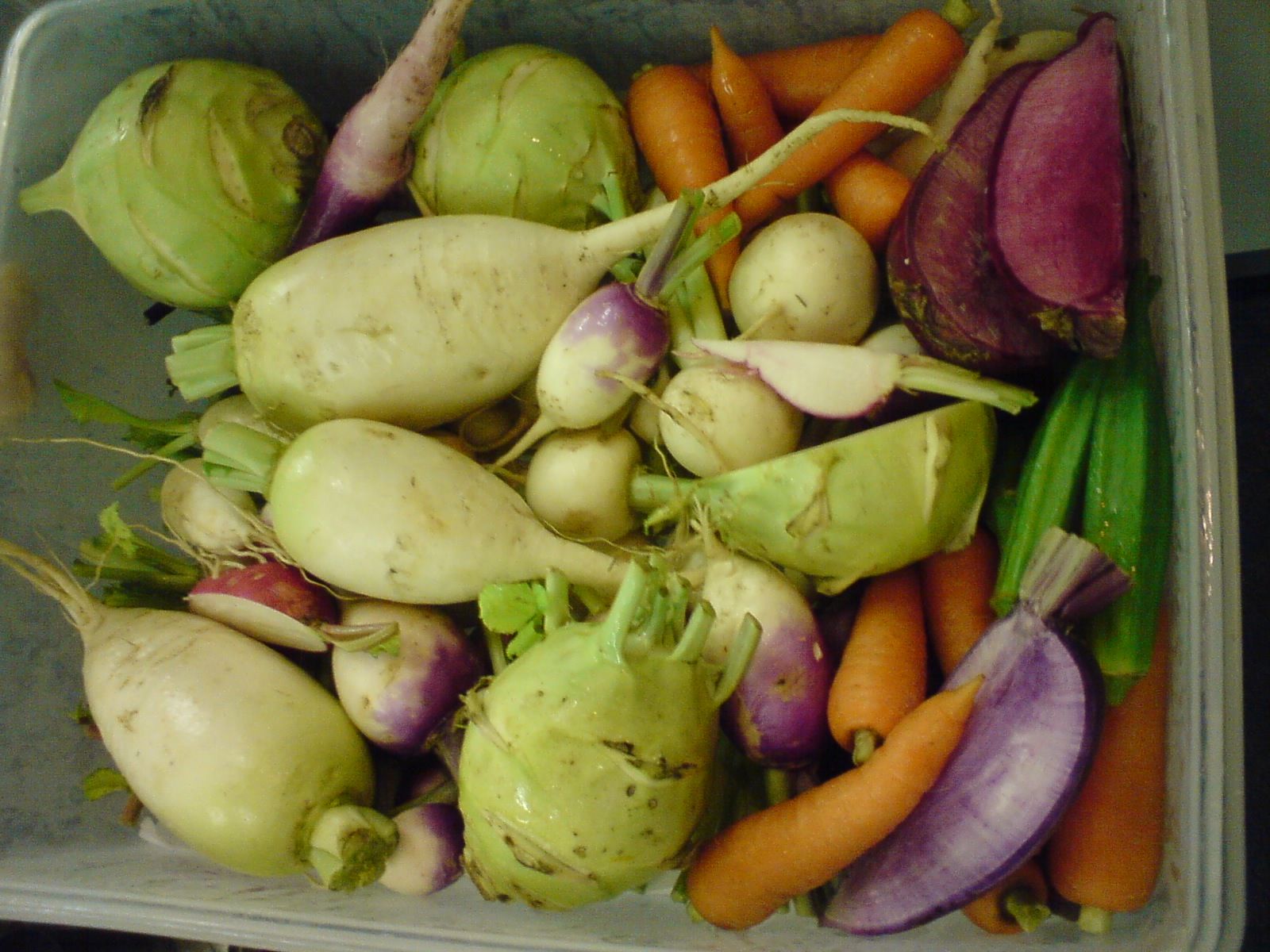
He gracefully allowed me to take pics of his treasures! The pic above are greens grown by Mr. Hirokawa!

And these the other organic vegetables grown by the same farmer!

Alright, let me give you at least the names of the vegetables I enjoyed so much:
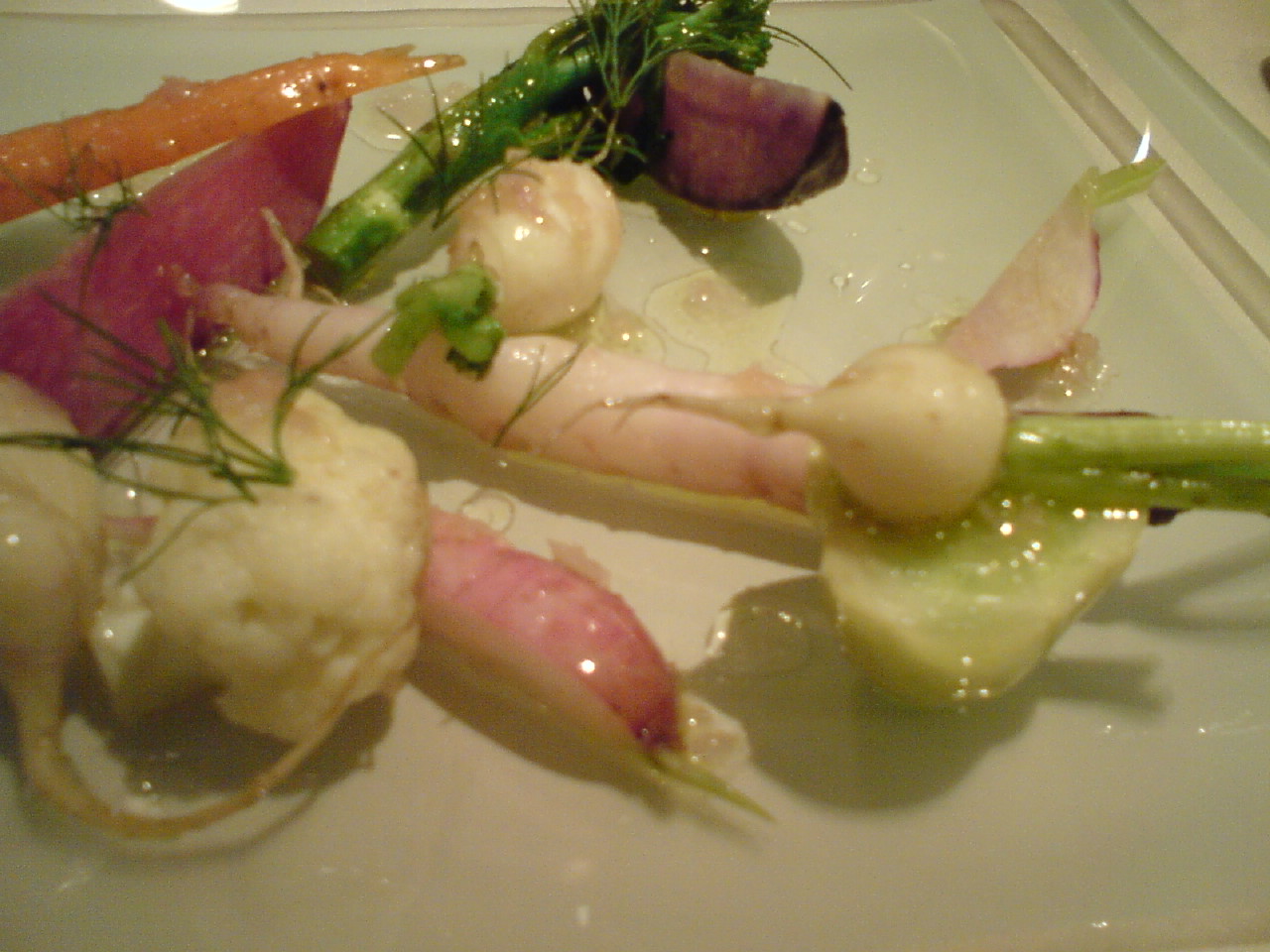
in above picture you can see:
Front row: Carrot/Ninjin/人参, Red Round Daikon/Beni Maru Daikon/紅丸大根
Second row: Violet Round Daikon/Murasaki Maru Daikon/紫丸大根, Snow Beauty Daikon/Yuki Bijin Daikon/雪美人大根, Day Field Leaf Turnip/Hinona No Kabu/日野菜の蕪, Cauliflower/こりフラワー, and Ayame Turnip/Ayame Kabu/あやめ蕪.

Front row: Violet Round Daikon/Murasaki Maru Daikon/紫丸大根, Stick Junior Broccoli/シティックジューニアブロッコリー, Snow Beauty Daikon/Yuki Bijin Daikon/雪美人大根, Red Round Daikon/Beni Maru Daikon/紅丸大根,
Carrot/Ninjin/人参
Second row: Akakura Daikon/赤くら大根, Day Field Leaf Turnip/Hinona No Kabu/日野菜の蕪, Red Long Water Daikon/Aka Naga Mizu Daikon/赤長水大根, Cauliflower/こりフラワー, and Ayame Turnip/Ayame Kabu/あやめ蕪.
Third row: Small Turnip/Ko Kabu/子株 on top of White Cucumber/Shiro Kyuuri/白胡瓜.

Front row: Ayame Turnip/Ayame Kabu/あやめ蕪, Cauliflower/こりフラワー, Aka Naga Mizu Daikon/赤長水大根, and Small Turnip/Ko Kabu/子株 on top of White Cucumber/Shiro Kyuuri/白胡瓜.
Second row: Carrot/Ninjin/人参, Red Round Daikon/Beni Maru Daikon/紅丸大根, Snow Beauty Daikon/Yuki Bijin Daikon/雪美人大根, Day Field Leaf Turnip/Hinona No Kabu/日野菜の蕪, and Akakura Daikon/赤くら大根.
Third row: Stick Junior Broccoli/シティックジューニアブロッコリー and Akakura Daikon/赤くら大根.

Front row: Small Turnip/Ko Kabu/子株 on top of White Cucumber/Shiro Kyuusri/白胡瓜, Day Field Leaf Turnip/Hinona No Kabu/日野菜の蕪, Violet Round Daikon/Murasaki Maru Daikon/紫丸大根.
Second row: Red Log Water Daikon/Aka Naga mizu Daikon/赤長水大根, Cauliflower/こりフラワー, Snow Beauty daikon/Yuki Bijin Daikon/雪美人大根, and Stick Junior Broccoli/シティックジューニアブロッコリー.
Third row: Ayame Turnip/Ayame Kabu/あやめ蕪, Red Round Daikon/Beni maru Daikon/紅丸大根 and Carrot/Ninjin/人参!

The vegetables were steamed/cooked to perfection providing a satisfying bite with the right combination of tenderness and crunchiness.
The dressing was also vegan, shallots, garlic, olive oil, Guerande salt and vegetables “juices”, providing for an elegant and precise seasoning!

If you have the occasion to visit Mishima City this is the address of our great farmer!

Mr. Hideyaki Hirokawa, Mishima City, Kawaharagaya Yamada, 765
Tel.: 055-973-2702

PISSENLIT
420-0839 Shizuoka City, Aoi Ku, Takajo, 2-3-4
Tel.: 054-270-8768
Fax: 054-627-3868
Business hours: 11:30~14:30; 17:00~22:00
Closed on Tuesdays and Sunday evening
Homepage (Japanese)
Credit Cards OK

RECOMMENDED RELATED SITES:
Warren Bobrow, Bread + Butter, Zoy Zhang, Hungry Neko, Think Twice, Frank Fariello, Mangantayon, Hapabento, Elinluv Tidbit Corner, Tokyo Terrace, Maison de Christina, Chrys Niles,Lexi, Culinary Musings, Wheeling Gourmet, Comestiblog, Chronicles Of A Curious Cook, Tokyo Through The Drinking Glass, Tokyo Foodcast, Palate To Pen, Yellin Yakimono Gallery, Tokyo Terrace, Hilah Cooking, More than a Mount Full, Arkonite Bento, Happy Little Bento; 5 Star Foodie; Jefferson’s Table; Oyster Culture; Gourmet Fury; Island Vittles; Good Beer & Country Boys; Rubber Slippers In Italy; Color Food daidokoro/Osaka;/a; The Witchy Kitchen; Citron Et Vanille, Lunsj Med Buffet/Estonian Gastronomy (English), Cook, Eat, Play, Repeat, Chrisoscope

Please check the new postings at:
sake, shochu and sushi

Japanese Dessert: Yuzu Sorbet 2

This recipe is also dedicated to Comestiblog who made the request!
It is the frist of simpler recipes!

INGREDIENTS: For 4~5 people

-Yuzu: 8 small ones
Will produce 75 cc/ml of juice
Zest/skin: 3
-Sugar: 80 + 20 g
-Water: 350 cc/ml
-White wine: 50 cc/ml
-Egg whites: 2

RECIPE:

-Clean the yuzu throroughly. Grate the skin/zest of two of them. Peel 1 more and cut skin/zest in very thin strips. Set apart.
Press out all the juice. Ypu should obtain 75 cc/ml (if not, press another one!).

-In a small pan pour the water and add 80 g of sugar (in hat order!).
Bring to boil. Once the sugar has completely dissolved, add the thin yuzu strips. Switch off fire and let cool completely.

-In a bowl drop the egg whites. Add 20 g of sugar. Beat until “hard”.

-When the yuzu syrup has completely cool down add the grated yuzu skin/zest and white wine. Mix well.

-Add the meringue little by lttle and mix. Put the whi\ole into a Tupperware and leave inside freezer. Take out every 2 hours (3 times in all should be sufficient), break with a spoon and mix and put back into freezer.

-Break and mix again before serving in a glass of your choice!

NOTE:

-You can either replicate the recipe with oranges, lemons or grapefruit, or experiment with mixtures of all!

RECOMMENDED RELATED SITES:
Warren Bobrow, Bread + Butter, Zoy Zhang, Hungry Neko, Think Twice, Frank Fariello, Mangantayon, Hapabento, Elinluv Tidbit Corner, Tokyo Terrace, Maison de Christina, Chrys Niles,Lexi, Culinary Musings, Wheeling Gourmet, Comestiblog, Chronicles Of A Curious Cook, Tokyo Through The Drinking Glass, Tokyo Foodcast, Palate To Pen, Yellin Yakimono Gallery, Tokyo Terrace, Hilah Cooking, More than a Mount Full, Arkonite Bento, Happy Little Bento; 5 Star Foodie; Jefferson’s Table; Oyster Culture; Gourmet Fury; Island Vittles; Good Beer & Country Boys; Rubber Slippers In Italy; Color Food daidokoro/Osaka;/a; The Witchy Kitchen; Citron Et Vanille, Lunsj Med Buffet/Estonian Gastronomy (English), Cook, Eat, Play, Repeat, Chrisoscope

Please check the new postings at:
sake, shochu and sushi

Japanese Citrus Fruits 1a: Oranges

Satsuma Mikan Basket

Oranges are not only one of the best sources of natural fluids/water for the human body, but its skin is also a very valuable medicinal asset (provided it is cleaned of all insectisides, wax et al!).
Naturally everyone knows about their high contents in Vitamin A beta Carotene and other irreplaceable vitamins.
Combined with other foods it can help prevent cancer like other ctrus fruits!

In Japan, depending on the season, oranges will be called natsu mikan/夏みかん/Summer oranges, haru mikan/春みかん or even fuyu mikan/冬みかん/Winter oranges and accordingly will be available im more varieties.

I will present in a separate posting called Japanese Citrus Fruits 1b: Oranges!

VARIETIES:


Unshu Mikan Cross Section

Unshu Mikan/温州みかん

The satsuma (Citrus unshiu) is a seedless and easy-peeling citrus mutant of Japanese origin introduced to the West. In Japan, it is known as mikan or formally unshu mikan (Japanese: 温州蜜柑, unshū mikan). In China, it is known as Wenzhou migan (Chinese: 温州蜜柑; pinyin: Wēnzhōu Mìgān). The Japanese name is a result of the local reading of the same characters used in the Chinese, the name meaning “Honey Citrus of Wenzhou” in both languages. It is also often known as “Seedless mandarin” (Chinese: 无核桔; pinyin: wúhé jú). The Korean name for the fruit is gyul (Korean: 귤).
Shizuoka Prefecture is a major growing region in Japan.
Depending on the growing area, they will come up with many brand names.

</a

Valencia Orange

Also simply called “Oranges”, The Valencia Orange is an orange first created by the Californian agronomist William Wolfskill, on his farm in Santa Ana. Its name comes from the Spanish city of Valencia, widely known for its excellent orange trees. Most in Japan are imported from the US for their good value as orange juice.

Miko Orange/美娘オレンジ


Miko Orange Cross Section

A variety grown in Oita Prefecture, Kyushu Island, Miko Orange is difficult to grow and is comparatively expensive, but very juicy with a beautiful aroma.

Setoka/せとか

Setoka are remarkable fortheir rich skin. That skin being thin, it ios very easy to peel. Very juicy and sweet. Slightly bigger than Unshu mikan.

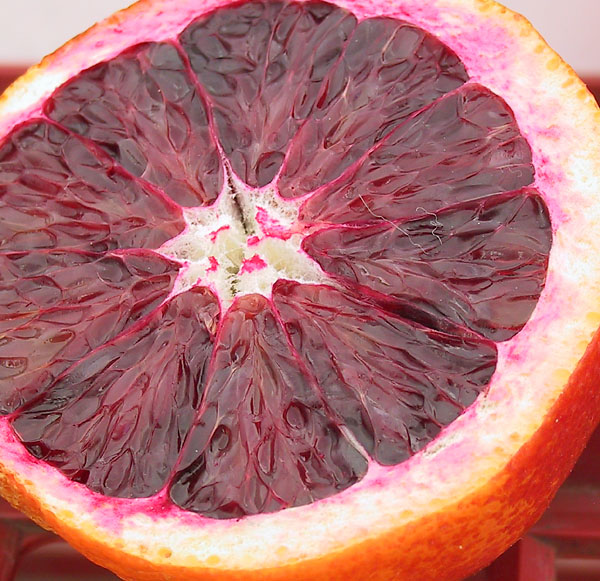
Blood Orange

Blodd Oranges are called so because of the colour of their flesh.
They are particularly popular for fresh pressed juice.

Neburu/Navel oranges/ネーブル

A single mutation in 1820 in an orchard of sweet oranges planted at a monastery in Brazil yielded the navel orange, also known as the Washington, Riverside, or Bahia navel. The mutation causes the orange to develop a second orange at the base of the original fruit, opposite the stem, as a conjoined twin in a set of smaller segments embedded within the peel of the larger orange. From the outside, it looks similar to the human navel, hence its name.

Because the mutation left the fruit seedless, and therefore sterile, the only means available to cultivate more of this new variety is to graft cuttings onto other varieties of citrus tree.
Today, navel oranges continue to be produced via cutting and grafting. This does not allow for the usual selective breeding methodologies, and so not only do the navel oranges of today have exactly the same genetic makeup as the original tree, and are therefore clones, all navel oranges can be considered to be the fruit of that single nearly two hundred year-old tree.

he Japanese varieties are available around February and March, making for an invaluable late winter orange.

HEALTH FACTS & TIPS:

-Choose specimen with a uniform colour and bright colour.

-For every 100 g, oranges (enshu mikan) contain:
Energy: 46 kcal
Water: 86.2 g
Proteins: 0.7 g
Carbohydrates: 12.0 g
Potassium: 150 mg
Calcium: 21 mg
Iron: 0,2 mg
Vitamin A Beta Carotene: 1000 micrograms
Vitamin B1: 0.10 mg
Vitamin B2: 0.03 mg
Nyacin: 0.3 mg
Vitamin B6: 0.06 mg
Vitamin C: 32 mg
Dietary fibers: 1.0 g

-Combined with asparguses, or with turnips, or with beansprouts, or with potatoes, will re-inforce the digestive system, help prevent common colds, and help recover from constipation.

-Combined with broccoli, or with chingensai, or with shiitake mushrooms, or with strawberries, will help prevent cancer, obesity and common colds.

RECOMMENDED RELATED SITES:
Warren Bobrow, Bread + Butter, Zoy Zhang, Hungry Neko, Think Twice, Frank Fariello, Mangantayon, Hapabento, Elinluv Tidbit Corner, Tokyo Terrace, Maison de Christina, Chrys Niles,Lexi, Culinary Musings, Wheeling Gourmet, Comestiblog, Chronicles Of A Curious Cook, Tokyo Through The Drinking Glass, Tokyo Foodcast, Palate To Pen, Yellin Yakimono Gallery, Tokyo Terrace, Hilah Cooking, More than a Mount Full, Arkonite Bento, Happy Little Bento; 5 Star Foodie; Jefferson’s Table; Oyster Culture; Gourmet Fury; Island Vittles; Good Beer & Country Boys; Rubber Slippers In Italy; Color Food daidokoro/Osaka;/a; The Witchy Kitchen; Citron Et Vanille, Lunsj Med Buffet/Estonian Gastronomy (English), Cook, Eat, Play, Repeat, Chrisoscope

Please check the new postings at:
sake, shochu and sushi

Japanese Dessert: Yuzu Sorbet 1

This recipe is dedicated to Comestiblog who made the request!
This is the complicated one.
I will come with two more, far simpler!

Yuzu, ripe

Yuzu, young

The yuzu (Citrus ichangensis × C. reticulata, formerly C. junos Siebold ex. Tanaka; Japanese ユズ, 柚, 柚子 (yuzu); 유자 (yuja) in Korean; from Chinese 柚子, yòuzi) is a citrus fruit and plant originating in East Asia. It is believed to be a hybrid of sour mandarin and Ichang papeda. The fruit looks a bit like a very small grapefruit with an uneven skin, and can be either yellow or green depending on the degree of ripeness. Yuzu fruits, which are very aromatic, typically range between 5.5 and 7.5 cm in diameter, but can be as large as a grapefruit (up to 10 cm or larger).

The Japanese use yuzu, both young and ripe, depending whetherit is used for seasoning or making dessert.

For this recipe, use ripe yuzu.

INGREDIENTS:

A)
-Yuzu: 3
-Sugar: 70 g
-Water: 180 cc/ml
-White Wine: 50 cc/ml

B) Italian Meringue
-Egg white, 1 + 10 g (if egg white has been kept inside fridge, bring it back to room temperature!)
-Sugar, 50 g + water, 50 cc/ml

C) Yuzu zest marmelade
-Yuzu zest (skin): 1 whole fruit
-Sugar: 30 g
-Water: 30 CC

RECIPE:

-Peel off 2 of the 3 yuzu and chop finely, or grate them off directly from the fruit.
Peel the third one into thin strips (about 1 cm long) to be cooked in syrup to be used for decoration later.

-Press the juice off the 3 yuzu. You should obtain about 75 cc/ml of juice. Depending on the size and maturity of the fruit, you might fall short of your target. Either complement with water or an additional fruit.
Add the finely cut/grated yuzu zests/skin to juice.
Add 180 cc/ml of water, 50 g of sugar
Cook for a while to obtain a jam mixture.
Let cool completely and work it smooth with a blender.
Add wine and put inside freezer.

-Prepare the zest marmelade:
Peel off the zest/skin of 1 yuzu, cut into thin strips and chopp finely again across the legth.
Boil in water for 1~2 minutes.
Drain.
In a small pan, pour 30 cc/ml of water and 30 g of sugar.
Bring to boil.
Drop in the chopped yuzu zest/skin. Lower the fire to low and simmer for 5 minutes.
Let cool completely and store inside the fridge.

-Take out yuzu/wine mixture out of the freezer, break and mix with a fork and put back inside the freezer. Repeat the operation twice, leaving enough time in between to allow the mixture to freeze again.

-Once the yuzu/wine has frozen well, prepare the Italian meringue:

-In a small pan pour 50 cc/ml of water and 50 g of sugar. In that order, please!
As the quantity is small, heat on a lower fire until dissolved.
While the syrup is dissolving, beat the egg white in a clean bowl.
Add the sugar to egg white and beat again until “hard”.
Using an electric had mixer at middle speed, add the syrup little by little in a very thin thread, beating all the time. When all the syrup has been included, raise the speed and beat until to obtain a very smooth meringue.
Chill inside fridge.

Take the frozen yuzu/wine mixture. Break and mix with a hand mixer. Take care that it does not melt!

Use a patula or fork if you think that the hand mixer will melt it.
You should obtain the mixture as shown in above picture.

-Add half of the Italian meringue and mix carefully.

-Add the second half of the Italian meringue. Mix quickly but well.

-Pour in a metal dish (plastic is ok, but metal is better!) and keep inside freezer

-When serving, make sure it is well frozen.

-Serve decorated with yuzu zest marmelade

RECOMMENDED RELATED SITES:
Warren Bobrow, Bread + Butter, Zoy Zhang, Hungry Neko, Think Twice, Frank Fariello, Mangantayon, Hapabento, Elinluv Tidbit Corner, Tokyo Terrace, Maison de Christina, Chrys Niles,Lexi, Culinary Musings, Wheeling Gourmet, Comestiblog, Chronicles Of A Curious Cook, Tokyo Through The Drinking Glass, Tokyo Foodcast, Palate To Pen, Yellin Yakimono Gallery, Tokyo Terrace, Hilah Cooking, More than a Mount Full, Arkonite Bento, Happy Little Bento; 5 Star Foodie; Jefferson’s Table; Oyster Culture; Gourmet Fury; Island Vittles; Good Beer & Country Boys; Rubber Slippers In Italy; Color Food daidokoro/Osaka;/a; The Witchy Kitchen; Citron Et Vanille, Lunsj Med Buffet/Estonian Gastronomy (English), Cook, Eat, Play, Repeat, Chrisoscope

Please check the new postings at:
sake, shochu and sushi

A Dragon’s Banquet 6: Clams Steamed in Rice Wine

This is a series of exerpts taken from The Life Of A Dragon to prove that gastronomy can be discreetly introduced in any story or novel, be it fiction or not!

Qusan and the Lords of Narosan, on King Marcus’ advice, had opted to pay a visit to the Blue mermaid. They were only too glad to escape from the interminable parties and ceremonies held at the Palace to accommodate an endless procession of well-wishers and diplomats. It would also provide them with some absorbing encounters with relatively more ordinary citizens, a rare pleasure practically out of their reach in their country where soldiers simply could not mingle freely with lay people.
When they reached the tavern just before dusk, big was their surprise to realize that they were not the only ones to flee the Palace.
The verandah was already crowded with regulars who knew exactly when to come and grab the favored tables. The lounge was as much congested. They were about to turn heel in disappointment, when a voice familiarly called them from the taproom:
“Lord Qusan! Come and join us over here!”
They were astonished to discover that no less than King Gerhart of Beaulieu was hailing them from his seat at a long table on trestles with a motley bunch of friends sitting on long benches. Interestingly enough, they were all men. There were not shunning the Palace only, the veteran soldier wondered. Males were the same anywhere in the world, were they not?
He recognized Wilfred, Chief Constable Petren, Ironfoot in the company of a few Dwarves, Nepomucene de Beauvoir, Lieutenant Gratien de Salle-Lavauguyon without his fiery Dwarf companion this time, and even three of those dangerous-looking Tribesmen.
Sensing their surprise, Gerhart stood up and came to them in person. He put his arm around the shoulders of the Narosan officer to steer him to their table. The Lords of the Eastern Empire were only beginning to accept the familiarity of the Alymndes denizens, but a King almost embracing Her Majesty’s General? But after all, none of them were wearing any distinctive clothes or marks of authority. Even the Narosan men had adopted a very practical garb composed of a light cloth jacket over long pants of the same material, although the different shades and patterns painted their group into a very colorful walking tableau, which had the customers pause for a better look.
Counselor Makan’ shaved pate stood in contrast with his peers who all wore their long black hair tied in a loose knot on their napes. Their feet were set in unusual sandals with a cord passing between the first two toes, giving them great freedom of movement as they walked to the table.
King Gerhart genially ordered:
“Good Gentlemen, would you be kind enough as to make room for our guests!”
As everyone scrambled to accommodate the newcomers, Gerhart had Qusan sit at his right, while the other Lords of Narosan found themselves smoothly included in various companies.
Just as everyone was settled, Jonas appeared in the company of Naeem both with large covered dishes in their hands.
Lord Qusan found himself lost for words when he realized that the Black Dragon, whose true identity he knew, was working in the kitchens of a tavern!
“Ah, good man Jonas! What succulent treat have you concocted for our delight today?” exclaimed the King of Beaulieu, effectively interrupting the General’s thoughts.
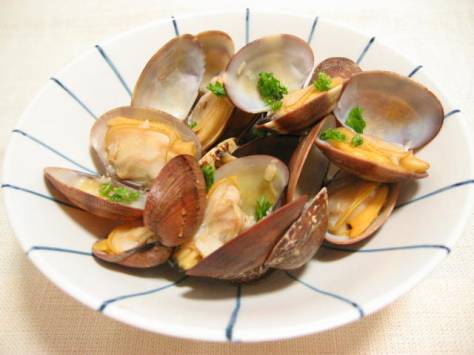
Jonas readily explained as servants were putting bowls and plates in front of the new guests.
“These are clams,” he started as he uncovered the first dish, a very large and deep one “cooked in white wine with a little pepper and chopped herbs. Try them and if you appreciate them, I will prepare a second serving!”
The servants quickly filled the bowls and all began to masticate in unison, using the shells to scoop some of the delicious broth. The Lords of Narosan, great lovers of any seafood, ate in a solemn manner, savoring their food with deliberate concentration.
The first dish, being quickly disposed of, the bowls were taken away.
Naeem opened the second dish, a shallow and wide one, on which lay rows of cut shellfish.
“Sea ears!” a common cry came out of every Narosan Lord’s mouth.
General Qusan forgot all decorum:
“Good man Jonas! Have you any idea of the value of such a delicacy in our lands? Every year, divers have to venture further and further at sea to discover this rare shellfish!”
“Well, Naeem’s friends seem to find plenty of them! We are the only place serving them, although they are commonly found on the tables of our fishermen! They are a bit of an acquired taste in spite of their popularity!
”The least I can say is that I do not mind to eat mountains of them any time, when back home we would consider ourselves lucky to be served a single slice!”
Counselor Makan had to interrupt him:
“Qusan, if you do not cease your speech, we will never be given the opportunity to relish our hosts’ food! That is unless it is your wish to punish us for an unknown demeanor!”
Everybody laughed and began to eat in earnest. But before touching their food, Qusan and his retainers were seen putting their right hand under their jackets.
Was it a prayer of some kind? Gerhart wondered.
But the same hand quickly came out holding an elongated kind of pouch, from which they extracted exquisite chopsticks of lacquered wood. By now people were used to such utensils in Alymndes, but the dexterity shown by the Narosan Lords in their handling was simply awesome. The long sticks seemed like an extension of their fingers, taking slices one by one to bring them to their mouths where they were firmly held to allow their owners to nibble at the food.
“I had better prepare a second serving of clams at the pace you are eating your food!” chortled Ekan who started towards the kitchen.
“Good man Jonas, please wait!” Qusan called.
Ekan raised a querying eyebrow, but patiently waited as the General asked something to the Lord of the House of Tsutan in quick words of their own tongue. The ever smiling Wan-Si, jumped off his bench and virtually ran out of the tavern.
While he was away, everyone returned their attention to the feast, although one could not fail to notice that the highest Commander in Narosan took on his own responsibility to keep the plate of the departed retainer filled with his share of abalone slices. No wonder Lord Qusan commanded such respectful obedience from his followers.
Lord Wan-Si came back soon enough, carrying a stoppered kind of earthenware bottle he immediately handed over to the General.
The latter stood up and asked Ekan:
“Good man Jonas, would you be kind enough to show me to your kitchen?”
The Black Dragon smiled:
“If you would care to follow me, General?”
Naeem was in the kitchen when he saw the two of them enter. He made to leave, but the Narosan Lord called him:
“Good man Naeem, could you please stay with us? It would be a great pleasure to talk matters of common interest with you!”
The request surprised Ekan’s friend, but he did not comment. If Jonas had let him into their sanctuary, there should be a good enough reason.
General Qusan addressed both of them:
“I could not help notice that your way of cooking shellfish was almost identical to that in our lands. Only the ingredients are very slightly different.”
He opened the bottle he held, picked up a goblet on one table and poured in a generous measure of a transparent liquid.
“This is rice wine. Would you mind sampling it first?” he commented, presenting the cup to Ekan who first sniffed, then took a sip. The Black Dragon turned it inside his mouth appreciatively for a while and then gulped it down. He handed the goblet to Naeem who sampled the liqueur in the same manner before venturing:
“Very tasty, indeed. A bit stronger than our wine, but a more delicate flavor. I actually like it. How about you, Jonas?”
Ekan grinned:
“I have a hunch it will taste even better after General Qusan has unveiled his recipe for our benefit!”
The staff inside the kitchen was too busy to catch the words, but they nonetheless wondered what an honored guest from a fabled land was doing in their work place.
“Shall I demonstrate first? If you like it, then you can cook a big serving as it is quick and easy to prepare!”
Naeem brought a wooden box filled with clams lying on a bed of fresh seaweed. Lord Qusan’s lifted eyebrows told him the General was impressed by the care taken in the handling of the shellfish.
Qusan grabbed a clean bowl from a nearby shelf and scooped a handful of clams into it and began to stir them around vigorously with his hand.
“If you make them dance this way long enough,” he explained, “the flesh inside the shells will detach very easily while cooking!”
After a while he asked for a pan and a lid.
He put the pan onto the fire and threw the shellfish in it and poured rice wine onto them before putting the lid over the pan.
“If I may have some chopped thin leeks, we shall add them when we uncover the lid and serve them at once!”
The cooking took only a minute, as the fire was very hot. He moved the pan away, took the lid off and added the herbs. Meanwhile, Naeem had brought some small bowls in which they served the shellfish for the three of them and Grazel, the matron of the place, who had just joined them out of curiosity. She certainly knew when a good morsel was about to come out of the two chefs’ experiments, and would not have missed it for all the gold in the world.
She closed her eyes as she masticated the shellfish. She ate them all and drank the broth. Lifting her eyes from the bowl, she met the laughing faces of the men who had observed her while eating from their own bowls.
“What do you think, Grazel?” Ekan asked.
“Forgive me for saying, but you had better run and grab all the rice wine you can put your hands on! I can foresee a revolution in Dunlago’s cooking!”
The three men chuckled in agreement.
“Which brings me back to my idea!” Qusan began. “I know personally the Narosan merchant who brought this rice wine. I could get the bottle so fast as he is staying near that covered market your King has so gracefully provided. I shall talk to him and have him keep all he has left for your sole benefit! Instead of paying him in gold, I can see and even better barter that may profit us all. We have come here for trade after all, have we not?”
“What do you have in mind we can trade for your rice wine?” Naeem asked.
“Well, it is good you are the one who asked because you will be the key! We shall leave in less than a week now. Therefore, how many sea ears, or abalones as you call them, can you get your hands on?”
“If I ask everybody around, quite a few in fact, probably enough to fill two barrels. But how can you manage to preserve them?”
“Two barrels!” Qusan exclaimed. He could barely contain his excitement. “Provide me with one barrel of salt and I shall show you how to preserve them! Once the shells and the innards are disposed of, two barrels would just be enough!”
He thought for a while.
“The only problem is how can I pay for them?”
Naeem laughed:
“That should not be any trouble! I have enough money stashed to pay for them in advance! Why do we not form a partnership with your rice wine merchant? Tell him you are our sole agent. In this way, we can keep the trade benefits within a very small circle!”
Lord Qusan held his hand forward.
“Deal!”
Naeem took it with enthusiasm.
“Deal!”
“Now, gentlemen,! Grazel interrupted, “General Qusan had better go back to the lounge, or I can imagine some very pointed questions directed at him! As for you Jonas and Naeem, you ought to start cooking if you do not want our customers raising hell!”
The matron was crafty enough to realize this small chat augured even better for future trade relations with those outlandish guests. But it was a woman’s lot to keep a lid on men’s ardor, was it not? She had the satisfaction to see her opinion clearly vindicated by the sheepish smile on the General’s face. The man went as far as granting her with a slight bow before moving towards the door.
“We certainly could do with such women back home!” a voice rang inside Ekan’s head.
“Hsu Yia!” Ekan could not hide his pleasure, even in mindspeech, upon hearing the Eastern Dragon’s words. “I doubt it would be wise to bring changes to your society so abruptly! After all, a woman is already ruling it, are you not?!”

RECOMMENDED RELATED SITES:
Warren Bobrow, Bread + Butter, Zoy Zhang, Hungry Neko, Think Twice, Frank Fariello, Mangantayon, Hapabento, Elinluv Tidbit Corner, Tokyo Terrace, Maison de Christina, Chrys Niles,Lexi, Culinary Musings, Wheeling Gourmet, Comestiblog, Chronicles Of A Curious Cook, Tokyo Through The Drinking Glass, Tokyo Foodcast, Palate To Pen, Yellin Yakimono Gallery, Tokyo Terrace, Hilah Cooking, More than a Mount Full, Arkonite Bento, Happy Little Bento; 5 Star Foodie; Jefferson’s Table; Oyster Culture; Gourmet Fury; Island Vittles; Good Beer & Country Boys; Rubber Slippers In Italy; Color Food daidokoro/Osaka;/a; The Witchy Kitchen; Citron Et Vanille, Lunsj Med Buffet/Estonian Gastronomy (English), Cook, Eat, Play, Repeat, Chrisoscope

Please check the new postings at:
sake, shochu and sushi

Japanese Seasonal Fish: Kohada/Gizzard Shad

Kohada/コハダ、or “small skin” actually is not the Japanese name of gizzard shad, but a generic name for the small fish as sashimi or sushi.
The real Japanese name for gizzard shad is konoshiro/コノシロ, and even the same fish goes by other names depending on its size:
-Up to 5 cm: shinko/シンコ
-Around 10 cm: kohada/コハダ
-More than 15 cm: konoshiro/コノシロ

Although the mainfishing/angling season is around November~December, it can be found in good sushi restaurants all year round.
This said, in July, it will be the small shinko season.

Choose fresh specimens. Fish with reddish eyes and flaking scales should be avoided.
The fish is particularly popular pickled in salt and vinegar before being served either as sashimi or sushi, as the smell emanating form the grilled fish is too strong for many.

Kohada maki, with no rice, is an interesting morsel for people wishing to savour it alone with a great drink.

But it is most popular as sushi!
The small size of the fish allows for all kinds of combinations, but the fun, and the skill, reside in the “shallow cutting” practicd by many chefs for best taste.

The cutting techniques are almost infinite.
I hope that the following pictures will give an idea of what to expect, or create!

Will publish the recipe to prepare the fish soon!

RECOMMENDED RELATED SITES:
Warren Bobrow, Bread + Butter, Zoy Zhang, Hungry Neko, Think Twice, Frank Fariello, Mangantayon, Hapabento, Elinluv Tidbit Corner, Tokyo Terrace, Maison de Christina, Chrys Niles,Lexi, Culinary Musings, Wheeling Gourmet, Comestiblog, Chronicles Of A Curious Cook, Tokyo Through The Drinking Glass, Tokyo Foodcast, Palate To Pen, Yellin Yakimono Gallery, Tokyo Terrace, Hilah Cooking, More than a Mount Full, Arkonite Bento, Happy Little Bento; 5 Star Foodie; Jefferson’s Table; Oyster Culture; Gourmet Fury; Island Vittles; Good Beer & Country Boys; Rubber Slippers In Italy; Color Food daidokoro/Osaka;/a; The Witchy Kitchen; Citron Et Vanille, Lunsj Med Buffet/Estonian Gastronomy (English), Cook, Eat, Play, Repeat, Chrisoscope

Please check the new postings at:
sake, shochu and sushi

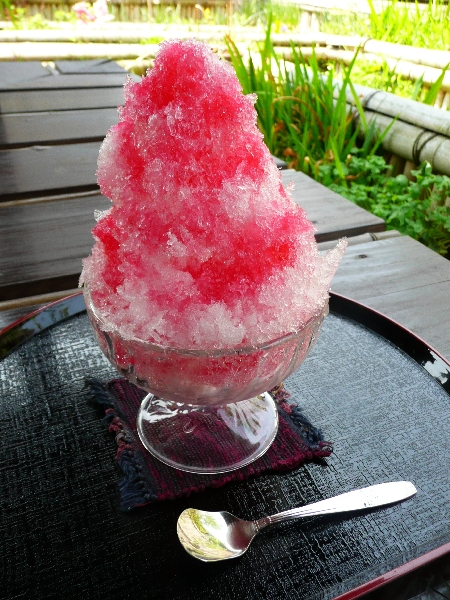
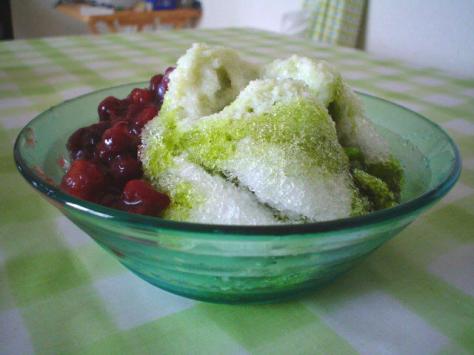
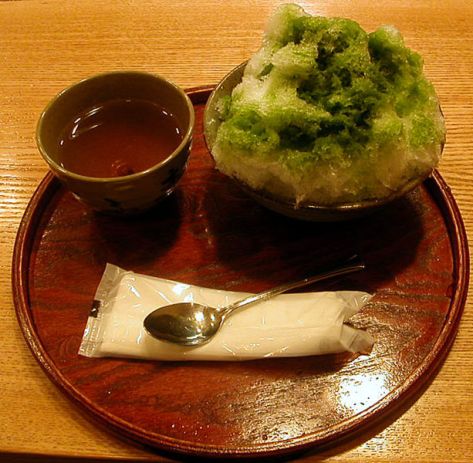
Japanese Dessert: Kakigoori/Shaved Ice With Syrup

KAKEKOORI-1

The days have turned with a vengeance, but this is the time to enjoy Kakigōri!

Kakigōri (かき氷) is a very popular Japanese dessert made from shaved ice flavored with syrup.
It was served for the first time in Kanagawa Prefecture in 1869!

KAKEKOORI-2

Popular flavors include: strawberry, cherry, lemon, green tea, grape, melon, “blue-Hawaii” sweet plum, and colorless syrup. Some shops provide colorful varieties by using two or more different syrups. To sweeten Kakigōri, condensed milk is often poured on top of it.

KAKEKOORI-3

It is nearly identical to a snow cone but can have a slightly rougher consistency and a spoon is almost always used. The traditional way of making kakigōri involves using a hand cranked machine to spin a block of ice over an ice shaving blade. However, electric ice shavers are most often used, though street vendors can still be seen hand-shaving ice blocks in the summer.

KAKEKOORI-4

In addition to the streets, kakigōri is also sold in festivals, convenience stores, coffee shops, and restaurants. During the hot summer months, kakigōri is sold virtually everywhere in Japan. Some coffee shops serve it with ice cream and sweet bean paste. Convenience stores may also sell it already flavored and packaged similar to ice cream.

KAKEKOORI-5

In other countries in East Asia, similar varieties can be seen.

Halo halo: Filipino shaved ice topped with sweetened beans, nata de coco and ice cream. “Halo-Halo” literally means “mix-mix” in the Tagalog language. Some shops in Japan also sell these sweets.
Bingsu (빙수) Korean shaved ice. The most popular kind is patbingsu. It is topped with sweetened red beans, canned fruits, and soybean powder. Many other varieties can be found throughout the country.
Bàobīng (刨冰) in Mandarin Pinyin or Chhoah-peng (剉冰) in Taiwanese POJ: Taiwanese shaved ice. There are many varieties in Taiwan. Some of them are topped with fresh fruits, fruits syrup and condensed milk. Some of them are topped with sweetened beans, glutinous rice balls and brown sugar syrup, while others will even use seafood. Some vendors use milk ice to make finer shaved ice, and some vendors may sometimes use a hand blade to shave block ice in order to produce rough crushed ice.
Ice kacang: Malaysia and Singapore Shaved ice topped with sweetened syrup of various colours and flavours, condensed and evaporated milk, and sometimes also durian pulp or vanilla ice cream. Beneath the ice sweetened red beans, canned fruit, attap seeds and grass jelly are usually added. Electric ice shavers are often used; though some vendors may use a hand blade to shave the ice in order to produce a rough texture. A variation of this would be Cendol which is shaved ice with sweet green coloured glutinous rice noodles drizzled with palm sugar it is usually accompanied with kidney beans and canned sweetcorn.
Nam Kang Sai: Thai Shaved Ice. In Thailand, this kind of cold dessert is very popular as well. The differences from other countries’ shaved ice is that in the Thai version the toppings (mixings) are in the bottom and the shaved ice is on top. There are between 20-30 varieties of mixings that can be mixed in. Among them are young coconut that have been soaked in coconut milk, black sticky rice, chestnuts,sweetened taro, red beans, sarim (thin strands of cooked flour that is very chewy and slippery) and many more.

RECOMMENDED RELATED SITES:
Warren Bobrow, Bread + Butter, Zoy Zhang, Hungry Neko, Think Twice, Frank Fariello, Mangantayon, Hapabento, Elinluv Tidbit Corner, Tokyo Terrace, Maison de Christina, Chrys Niles,Lexi, Culinary Musings, Wheeling Gourmet, Comestiblog, Chronicles Of A Curious Cook, Tokyo Through The Drinking Glass, Tokyo Foodcast, Palate To Pen, Yellin Yakimono Gallery, Tokyo Terrace, Hilah Cooking, More than a Mount Full, Arkonite Bento, Happy Little Bento; 5 Star Foodie; Jefferson’s Table; Oyster Culture; Gourmet Fury; Island Vittles; Good Beer & Country Boys; Rubber Slippers In Italy; Color Food daidokoro/Osaka;/a; The Witchy Kitchen; Citron Et Vanille, Lunsj Med Buffet/Estonian Gastronomy (English), Cook, Eat, Play, Repeat

Please check the new postings at:
sake, shochu and sushi

Health & Nutrition Facts in Japanese Food 10: Sato Imo/Taro/里芋

As demonstrated by many food bloggers, cooking and creating great foods and drinks have become incomplete and unsatisfying when not considering the benefits or adverse effects of the same foods and drinks regardless of their taste.
I do not intend to delve into counselling or consulting, but only to offer some knowledge about the good sides of Japanese foods and drinks. I will not extoll on its possible lacks and negative aspects. After all, the Japanese are not the longest-living people in the world for no reason!
I will also offr at least one nutritious or healthy recipe at the end of each posting.

Health & Nutrition Facts in Japanese Food 10: Sato Imo/Taro/里芋

Sato Imo, or Taro, orignally come from Malaysia and its Latin name is Colocasia esculenta.
Apart of water, they mainly contain starches, making a stamina food. Onced cooked, the same starches are very easy to digest by the human body. It is also a “health food” because of its high potassium contents (to combat high blood pressure and stress in particular).
Their high contents in vegetal fibers also make it a very important vegetable.

For each 100g (edible parts) it contains:
-Energy: 58 kcal
-Water: 84.1 g
-Proteins: 1,5 g
-Carbohydrates: 13.1 g
-Ash: 1.2 g
-Potassium: 640 mg
-Phosphorous: 55 mg
-Iron: 0.5 mg
-Copper: 0.15 mg
-Manganese: 0.19 mg
-Vitamin B1: 0.07 mg
-Vitamin B2: 0.02 mg
-Vitamin C: 6 mg
-Dietary (roughage) fibre: 2.3 g

HEALTH FACTS & TIPS:

-Combined with eggs, or with chicken, or with sardine, or with bonito, increases stamina and promotes general health.

-Combined with tofu, or with milk, helps promote general health and brain activity.

-Combined with enokitake mushrooms, or with devil’s tongue tuber/konnyaku, or with burdock root/gobo, helps lower down blood cholesterol, helps prevent high blood pressure and cancer.

-Combined with konbu/seaweed, or with miso paste, or with onion, or with green chili pepper, promotes general health and blood circulation.

RECIPE:

A simple recipe to promote health and help combat obesity:

Sato imo/taro: 10
Miso: 2 tablespoons
Mirin/Japanese sweet sake: 1 tablespoon
Sugar: 1 teaspoon
Japanese sake: 2 teaspoons

Wash the sato imo/taro well in clear cold running water. Cut off both extremities. Place in an oven dish. Cover with cellophane paper. Heat in microwave oven for 6 minutes. Check if they are cooked by stabbing them with a sharp and thin wooden stick.

In a small pan, drop miso, mirin, sugar and sake. Mix well. Heat over a small fire and stir at th same time until the sauce has become smooth.

Peel the taro while hot. Place on a dish and pour sauce on top!

RECOMMENDED RELATED SITES:
Warren Bobrow, Bread + Butter, Zoy Zhang, Hungry Neko, Think Twice, Frank Fariello, Mangantayon, Hapabento, Elinluv Tidbit Corner, Tokyo Terrace, Maison de Christina, Chrys Niles,Lexi, Culinary Musings, Wheeling Gourmet, Comestiblog, Chronicles Of A Curious Cook, Tokyo Through The Drinking Glass, Tokyo Foodcast, Palate To Pen, Yellin Yakimono Gallery, Tokyo Terrace, Hilah Cooking, More than a Mount Full, Arkonite Bento, Happy Little Bento; 5 Star Foodie; Jefferson’s Table; Oyster Culture; Gourmet Fury; Island Vittles; Good Beer & Country Boys; Rubber Slippers In Italy; Color Food daidokoro/Osaka;/a; The Witchy Kitchen; Citron Et Vanille, Lunsj Med Buffet/Estonian Gastronomy (English), Cook, Eat, Play, Repeat

Please check the new postings at:
sake, shochu and sushi

Sushi Restaurant: Yoshimizu

Chef Mamoru Yoshimuzu at work

Service: excellent, professional and friendly
Facilities: great washroom, great cleanliness overall
Prices: reasonable to slight expensive. Good value.
Strong points: Edomae-style sushi. Good sake and drinks.
no-smoking-logoentirely non-smoking!

Thanks to a bunch of new friends, I had the occasion last night to pay my first visit to an excellent Sushi Restauarant called Yoshimizu in Shizuoka City.
It proved a good idea to have gone there with friends as there is little chance to find a seat if you haven’t made a reservation.
The oyakata prepares only enough to be served to guests with reservations every evening!

Visiting a new restaurant with new friends can be a problem when taking pictures as you do not have the time, nor the best of lightings!
At least no smoke is interfering as it is an entirely non-smoking establishement, a rare case for a sushi restaurant!

The above is an appetizer combination of Aji Namuro/Pike Mackerel Tartare and Surumeika Meshi/Rivce stuffed briled squid-cuttle fish.

All the morsels are served on/in minoyaki earthenware.
The sushi style is uncompromisingly edomae-style (Tokyo style) by an oyakata/chef who also spent 3 years in London before opening his restaurants 5 years ago.

Isaki

Whenever possible the fish and seafood are local such as the above isaki.
There is no menu to choose from because one is serve a menu set depending on the day’s avaibility.
As for drinks, there is enough to please everywhere, including some great sake from Shizuoka Prefecture and elsewhere.

Mirugai.

The service is very professional but friendly.
All questions and queries will be answered with plenty of details.

Seitoro: Toro from the back of a minami maguro/southern tuna.
The fact that the place seats only 10 guests means that everyone is sitting at a counter in full view of the chef’s work!

Aka Ika: red squid seasoned with Himalaya salt and sesame seeds.
No small saucer is provided as all mrseld come -preseasoned by the chef. No need for extra soy sauce or wasabi!

Kinjiso leaves and ikura/salmon roe.
Before starting serving the chef will chef if you have any problems and ny food (in my case I can’t stand mentaiko) and will take good note (on his notebook!) to make sure you pleased and satisfied!

Kuruma ebi, boiled and seasoned.

Sagoshi/Young Sawara/Spanish Mackerel.

Anago sho/conger eel, so soft!

Megochi/Young kochi

Tamagoyaki (made with shrimp paste)!

Alright, I will have to go there again very soon, and on my own , for better pics!

Sushi Yoshimizu/鮨よし水
Shizuoka Shi, Aoi Ku, Showa-cho, 4-8, Rumankan 4F
Tel.: 054-253-3889
Opening hours: 17:30~24:00 (mon., Tues, Wed.); 17:30~02:00 (Fri., Sat.); 17:30~22:30 (Sun. and National Holidays)
Closed on Thursdays and on Mondays after National Holidays.
Cards OK

RECOMMENDED RELATED SITES:
Warren Bobrow, Bread + Butter, Zoy Zhang, Hungry Neko, Think Twice, Frank Fariello, Mangantayon, Hapabento, Elinluv Tidbit Corner, Tokyo Terrace, Maison de Christina, Chrys Niles,Lexi, Culinary Musings, Wheeling Gourmet, Comestiblog, Chronicles Of A Curious Cook, Tokyo Through The Drinking Glass, Tokyo Foodcast, Palate To Pen, Yellin Yakimono Gallery, Tokyo Terrace, Hilah Cooking, More than a Mount Full, Arkonite Bento, Happy Little Bento; 5 Star Foodie; Jefferson’s Table; Oyster Culture; Gourmet Fury; Island Vittles; Good Beer & Country Boys; Rubber Slippers In Italy; Color Food daidokoro/Osaka;/a; The Witchy Kitchen; Citron Et Vanille, Lunsj Med Buffet/Estonian Gastronomy (English), Cook, Eat, Play, Repeat, Chrisoscope

Please check the new postings at:
sake, shochu and sushi