Tag Archives: Tourism

Japanese Ladies Fashion In Shizuoka 2: FLORAISON

Manager Sakura holding a 3.1 Philliplim skirt

As to answer requests in particular from Sissi, Quizoxy and Bena nDR in particular, I though it might be helpful to introduce the best fashion boutiques in Shizuoka as well!

FLORAISON in Shizuoka City, Aoi Ku, is one of the boutiques owned by the very top fashion retailer in Shizuoka Prefecture, namely IMAIZUMI Co Ltd. (in Japanese, but have a look at the pictures!).

Staff Natsumi holding a CARVEN one-piece dress.

Although IMAIZUMI Co Ltd. as a whole covers all upscale fashion for all ages, FLORAISON specializes in elegance for adult ladies from young to not so young.
Their brand list, both made up of creations from famous houses and little-known small designers is impressive:
3.1 Philliplim
CARVEN
Sacai
MUVEIL
Ilian Ioeb
SEE BY CHLOE
SHARE SPIRIT
Marylin Moon
Athena NY and many others!

A small view of the dresses available.

FLORAISON was opened fairly recently in 2008 and has been looked after ever since by Sakura San, a young and ever-energetic manager.
Her BLOG is a must-see! Although written in Japanese it is a goldmine of photographs on fashion and gastronomy!

Elegant bags for career women and young ladies!

The boutique offers the whole gamut from shoes to bags, accessories and all imaginable clothing according to seasons!
Although the designers are quite stable their creations come and go quickly, so regular visits are on the calendar!

Their shoes are not only elegant but so practical!

And beautiful belts and scalves for the last touch!
Actually they also offer a very interesting range of original accessories, but I will have to take more photos!

FLORAISON
Imaizumi Co. Ltd.
Shizuoka Shi, Aoi Ku, Ryogae-cho, 1-6-14 (behind Isetan Department Store)
Tel.: 054-271-8945
Business hours: 11:00~20:00
HOMEPAGE (Japanese)
BLOG (Japanese)

RECOMMENDED RELATED WEBSITES

Green Tea Club by Satoshi Nihonyanagi in Shizuoka!, Mind Some by Tina in Taiwan, Le Manger by Camille Oger (French), The Indian Tourist, Masala Herb by Helene Dsouza in Goa, India, Mummy I Can Cook! by Shu Han in London, Pierre.Cuisine, Francescannotwrite, My White Kitchen, 47 Japanese Farms Through The Eyes of Its Rural Communities, Foodhoe, Chucks Eats, Things that Fizz & Stuff, Five Euro Food by Charles,Red Shallot Kitchen by Priscilla,With a Glass, Nami | Just One Cookbook, Peach Farm Studio, Clumsyfingers by Xethia, PepperBento,Adventures in Bento Making, American Bent, Beanbento, Bento No, Bento Wo Tsukurimashou, Cooking Cute, Eula, Hapabento , Happy Bento, Jacki’s Bento Blog, Kitchen Cow, Leggo My Obento, Le Petit Journal Bento & CO (French), Lunch In A Box,
Susan at Arkonlite, Vegan Lunch Box; Tokyo Tom Baker, Daily Food Porn/Osaka, Only Nature Food Porn, Happy Little Bento, The Herbed Kitchen, J-Mama’s Kitchen, Cook, Eat, Play, Repeat, Bento Lunch Blog (German), Adventures In Bento, Anna The Red’s Bento Factory, Cooking Cute, Timeless Gourmet, Bento Bug, Ideal Meal, Bentosaurus, Mr. Foodie (London/UK), Ohayo Bento,

Must-see tasting websites:

-Sake: Tokyo Through The Drinking Glass, Tokyo Foodcast, Urban Sake, Sake World
-Wine: Palate To Pen, Warren Bobrow, Cellar Tours, Ancient Fire Wines Blog
-Beer: Good Beer & Country Boys, Another Pint, Please!
-Japanese Pottery to enjoy your favourite drinks: Yellin Yakimono Gallery

Japanese Ladies Fashion in Shizuoka 1: “Cutie” waiting inside the station

Sissi at With a Glass mentioned she would like to see more pictures of Japanese fashion, especially ladies, when she found one inserted in a report on a Japanese Festival!
I agreed it might interest quite a few people in spite of the title of this blog.
Mind you, it is a slightly risky job to take such pictures although a mobile phone camera is easier to use and less conspicuous than a real camera!
I don’t want to ask people to pose (unless they ask!), so I do have to be discreet and has too miss out a lot of great pictures!
Shizuoka is actually considered the hardest Prefecture to sell in Japan and it is a constant trial area for the big Tokyo companies. “If you sell in Shizuoka, you sell everywhere!” has become a proverb in Japanese fashion.
The weather being mild all year round fashion is easy to wear here although Shizuoka Fashionistas are vain and fashion slaves to the point of wearing long booots on the 1st of September even if it 35 degrees outside!
I am not inerested in taking pictures of anorexic and obese fashionistas (I wouls have to start another blog!) who have no sense of balance or harmony either!
Let’s hope I do not get arrested in my efforts to discover some cute ladies to show you!

I called this particular picture,[ “Cutie” waiting inside the station], as “cutie” is a fashion genre indeed. The young lady (18+?) above is not a complete “cutie” with frills in hair and the like, but the socks and the skirt definitely are.
I must admit she is actually quite cute!

RECOMMENDED RELATED WEBSITES

Green Tea Club by Satoshi Nihonyanagi in Shizuoka!, Mind Some by Tina in Taiwan, Le Manger by Camille Oger (French), The Indian Tourist, Masala Herb by Helene Dsouza in Goa, India, Mummy I Can Cook! by Shu Han in London, Pierre.Cuisine, Francescannotwrite, My White Kitchen, 47 Japanese Farms Through The Eyes of Its Rural Communities, Foodhoe, Chucks Eats, Things that Fizz & Stuff, Five Euro Food by Charles,Red Shallot Kitchen by Priscilla,With a Glass, Nami | Just One Cookbook, Peach Farm Studio, Clumsyfingers by Xethia, PepperBento,Adventures in Bento Making, American Bent, Beanbento, Bento No, Bento Wo Tsukurimashou, Cooking Cute, Eula, Hapabento , Happy Bento, Jacki’s Bento Blog, Kitchen Cow, Leggo My Obento, Le Petit Journal Bento & CO (French), Lunch In A Box,
Susan at Arkonlite, Vegan Lunch Box; Tokyo Tom Baker, Daily Food Porn/Osaka, Only Nature Food Porn, Happy Little Bento, The Herbed Kitchen, J-Mama’s Kitchen, Cook, Eat, Play, Repeat, Bento Lunch Blog (German), Adventures In Bento, Anna The Red’s Bento Factory, Cooking Cute, Timeless Gourmet, Bento Bug, Ideal Meal, Bentosaurus, Mr. Foodie (London/UK), Ohayo Bento,

Must-see tasting websites:

-Sake: Tokyo Through The Drinking Glass, Tokyo Foodcast, Urban Sake, Sake World
-Wine: Palate To Pen, Warren Bobrow, Cellar Tours, Ancient Fire Wines Blog
-Beer: Good Beer & Country Boys, Another Pint, Please!
-Japanese Pottery to enjoy your favourite drinks: Yellin Yakimono Gallery

Japanese Cuttlefish/Squids Species 1: Spear Squid-Yari Ika-槍烏賊

Cuttlefish or squids are eaten almost all the world as they seem to inhabit the whole planet! They are the favourite food of many big fish such as tuna, whales and birds. Although humans contribute to dwindling stocks, they will never consume the same amount as its natural predators.

The Japanese call them Ika/烏賊, roughly meaning crow shellfish/cephalopods.

This is the start of a long series. I do hope you like them, otherwise you are in for a long haul!LOL

Yari Ika Sashimi Salad!

Yari Ika/槍烏賊, or Spear Squid, are also known under the names of Sashiika, Sayaika, Shyakuhachi, Tsutsuika or Sayanaga.
In Japan they are mainly caught in Winter and Spring off the shores of Aomori, Hokkaido, Ibaragi, Mie, Aichi and Yamaguchi Prefectures. Suruga Bay in Shizuoka Prefecture is replete with many varieties.
Females are slightly more rounded than the males.
They are either caught with nets or lines.
Their flesh is comparatively thin, but soft and sweet. They are among the most popular in Japan.
The best specimens are the ones caught by line. Buy them live whenever possible.

They make for beautiful sushi with the body and tentacles (geso/ゲソ) served separately.
They can ordered seasoned with salt and lemon juice, or with tare sauce!
The best sushi restaurants will serve them sashimi or sushi with two different types of soy sauce.

Cooked Japanese style they are simple and succulent, grilled served with soy sauce!

Do try them stuffed, Japanese style!

Or Spanish style!

Needless to say, they are popular in local Italian Restaurants!

RECOMMENDED RELATED WEBSITES

Mind Some by Tina in Taiwan, Le Manger by Camille Oger (French), The Indian Tourist, Masala Herb by Helene Dsouza in Goa, India, Mummy I Can Cook! by Shu Han in London, Pierre.Cuisine, Francescannotwrite, My White Kitchen, 47 Japanese Farms Through The Eyes of Its Rural Communities, Foodhoe, Chucks Eats, Things that Fizz & Stuff, Five Euro Food by Charles,Red Shallot Kitchen by Priscilla,With a Glass, Nami | Just One Cookbook, Peach Farm Studio, Clumsyfingers by Xethia, PepperBento,Adventures in Bento Making, American Bent, Beanbento, Bento No, Bento Wo Tsukurimashou, Cooking Cute, Eula, Hapabento , Happy Bento, Jacki’s Bento Blog, Kitchen Cow, Leggo My Obento, Le Petit Journal Bento & CO (French), Lunch In A Box,
Susan at Arkonlite, Vegan Lunch Box; Tokyo Tom Baker, Daily Food Porn/Osaka, Only Nature Food Porn, Happy Little Bento, The Herbed Kitchen, J-Mama’s Kitchen, Cook, Eat, Play, Repeat, Bento Lunch Blog (German), Adventures In Bento, Anna The Red’s Bento Factory, Cooking Cute, Timeless Gourmet, Bento Bug, Ideal Meal, Bentosaurus, Mr. Foodie (London/UK), Ohayo Bento,

Must-see tasting websites:

-Sake: Tokyo Through The Drinking Glass, Tokyo Foodcast, Urban Sake, Sake World
-Wine: Palate To Pen, Warren Bobrow, Cellar Tours, Ancient Fire Wines Blog
-Beer: Good Beer & Country Boys, Another Pint, Please!
-Japanese Pottery to enjoy your favourite drinks: Yellin Yakimono Gallery

Italian Gastronomy: Spring “Tidbits” at Soloio in Shizuoka City, Japan!

Now, what was that superlative risotto made with?
Read below!

Service: Pro and very friendly
Equipment & Facilities: Great overall cleanliness and superb washroom
Prices: Reasonable
Strong points: Fresh local ingredients whenever possible. Both traditional and inventive Italian cuisine. Good wine list at moderate prices. Open late!

Whenever I discover a new risotto concocted by Chef Takehiko Katoh/加藤武彦, who unofficially make the best in Shizuoka Prefecture, it seems to reminds me of Charles at Five Euro Food.. It might be time to challenge him to create a risotto for 5 euros!

I’ve already introduced Solio in Shizuoka many a time, but I go there regularly for a glass of wine and a single dish in between work I’ll just proceed directly to introduce the “tidbits” I recently enjoyed!

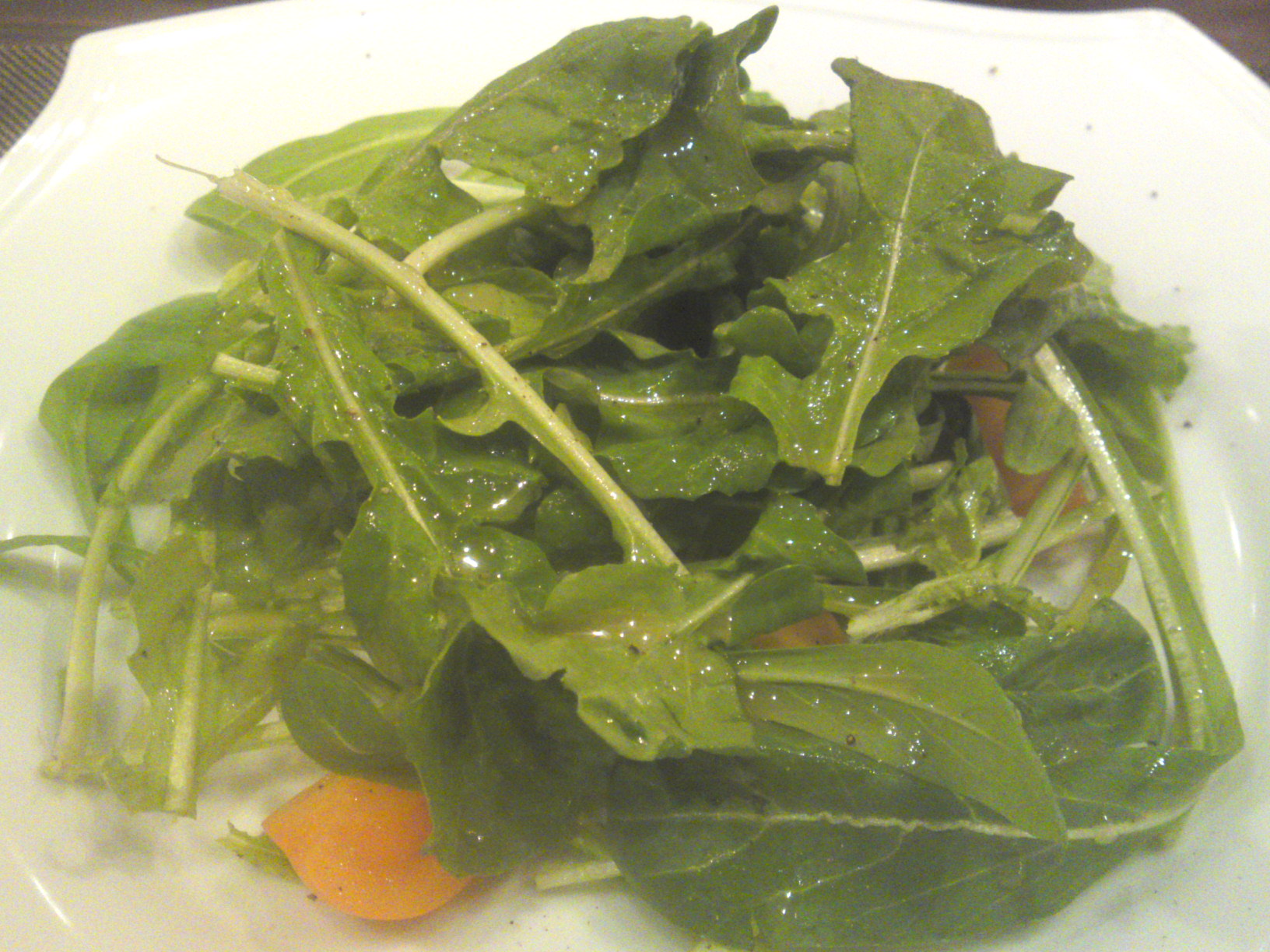
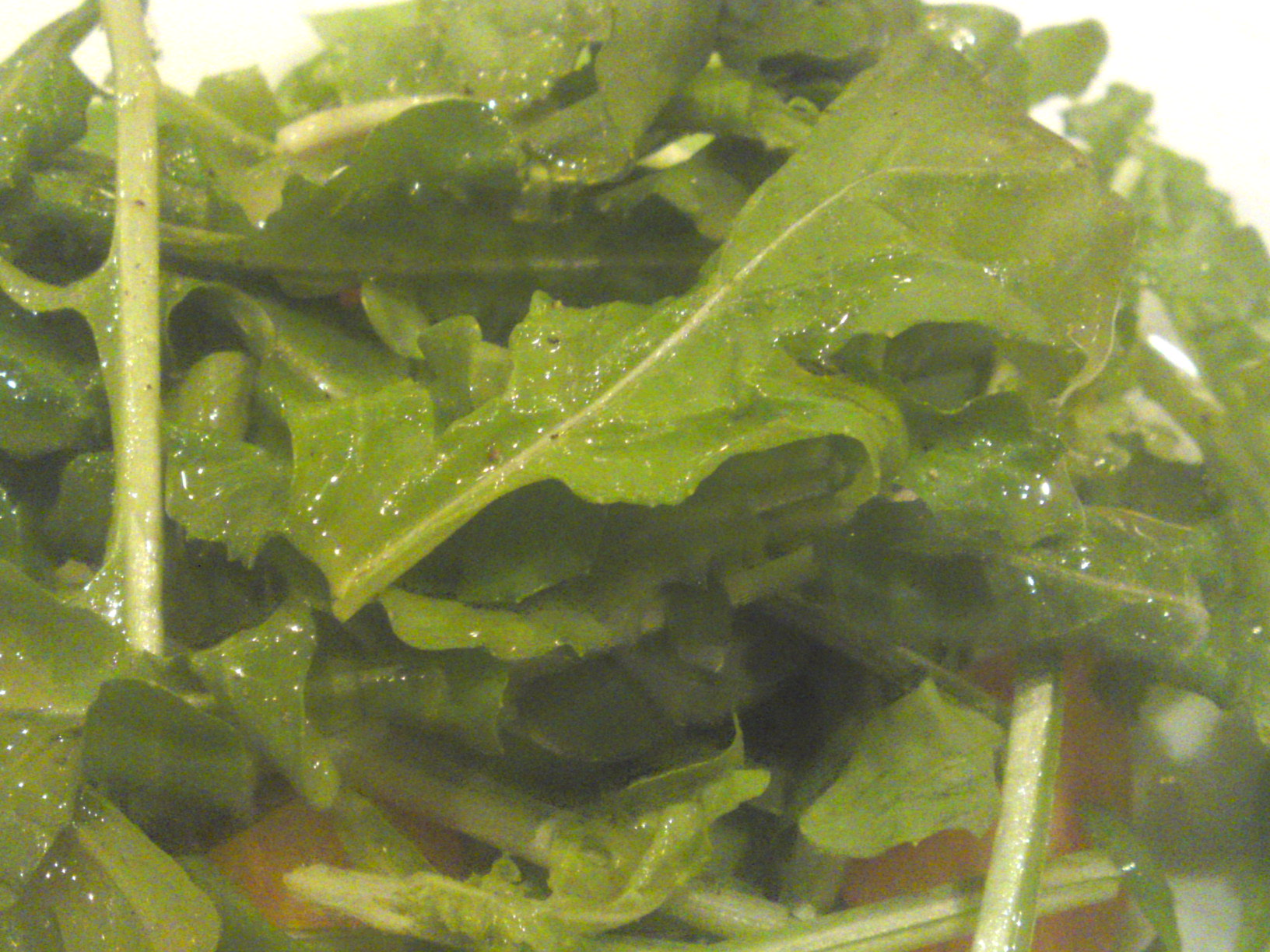
This salad was prepared with enormous lucolla/roquette leaves organically grown by one of the Chef’s neighbors!
In Shizuoka there is very little in using imported or mass-produced vegetables!

Beautiful lucolla leaves! Enormous, crispy and so delicious with a minimal dressing. Health in heaven!

The orange tomatoes are also grown in Shizuoka City!

Solio’s risottos are mostly seasonal.
The other day I asked if Chef Takehiko Katoh/加藤武彦 had any secrets for his famous recipes.
He simply enough replied:
“Any good chef can come up with truly great risottos if he uses good and fresh products. The only difference is the stock/stock soup!”
Great answer, but I will never know his secret stock!
Now, what was the above risotto made with?

Shizuoka-grown Na no Hana/Broccolini and Hokkaido “Kegani/毛蟹/Horsehair crab, Horse crab, supposedly the best crab in Japan!
Extravagant!

Now, how about this creamy one I had last night?

Sora mame/蚕豆/Broad beans and Talegio Cheese!

Takehiko asked me to try and come when the restaurant is not too busy as I tend to request dishes that are written on the official menu…

To be continued…

SOLOIO
420-0858 Shizuoka City, Aoi Ku, Tenmacho, 9-7, Kita, 1
Tel./fax: 054-260-4637
Business hours: 16:00~24:00
Closed on Monday
Credit cards OK
Private parties welcome!
Smoking allowed BUT Non-smoking until 20:00 everyday!

RECOMMENDED RELATED WEBSITES

Le Manger by Camille Oger (French), The Indian Tourist, Masala Herb by Helene Dsouza in Goa, India, Mummy I Can Cook! by Shu Han in London, Pierre.Cuisine, Francescannotwrite, My White Kitchen, 47 Japanese Farms Through The Eyes of Its Rural Communities, Foodhoe, Chucks Eats, Things that Fizz & Stuff, Five Euro Food by Charles,Red Shallot Kitchen by Priscilla,With a Glass, Nami | Just One Cookbook, Peach Farm Studio, Clumsyfingers by Xethia, PepperBento,Adventures in Bento Making, American Bent, Beanbento, Bento No, Bento Wo Tsukurimashou, Cooking Cute, Eula, Hapabento , Happy Bento, Jacki’s Bento Blog, Kitchen Cow, Leggo My Obento, Le Petit Journal Bento & CO (French), Lunch In A Box,
Susan at Arkonlite, Vegan Lunch Box; Tokyo Tom Baker, Daily Food Porn/Osaka, Only Nature Food Porn, Happy Little Bento, The Herbed Kitchen, J-Mama’s Kitchen, Cook, Eat, Play, Repeat, Bento Lunch Blog (German), Adventures In Bento, Anna The Red’s Bento Factory, Cooking Cute, Timeless Gourmet, Bento Bug, Ideal Meal, Bentosaurus, Mr. Foodie (London/UK), Ohayo Bento,

Must-see tasting websites:

-Sake: Tokyo Through The Drinking Glass, Tokyo Foodcast, Urban Sake, Sake World
-Wine: Palate To Pen, Warren Bobrow, Cellar Tours, Ancient Fire Wines Blog
-Beer: Good Beer & Country Boys, Another Pint, Please!
-Japanese Pottery to enjoy your favourite drinks: Yellin Yakimono Gallery

Japanese Fish Recipe: Curry-marinated Pike Mackerel/Aji No Kari Marine

Pike Mackerel, Horse Mackerel or Saurel is called Aji/鯵 in Japanese.
Shizuoka Prefecture, and especially Suruga Bay is very famous for great quality pike Mackerel almost all year round.

Here is a simple way to eat it cold, a welcome notion for the coming summer!

Curry-marinated Pike Mackerel/Aji No Kari Marine!
INGREDIENTS: for 5 persons

-Pike mackerel/Saurel: 2
-Red onion: 1
-Lemon slices: 3~4
-Flour: 2 tablespoons
-Curry mix powder: 1 tablespoon
-Salad oil: 100 cc/ml/1/2 cup
-Rice vinegar: 50 cc/ml/1/4 cup
-Salt: a little

RECIPE:

-Dress the fish (cut out the fillets) and cut into 4cm long pieces. Sprinkle with a little salt.

-Cut the red onion in half. Cut out the hard core. Slice it thin. Let the onion slices rest into clean cold water long enough to take out astringency (bitterness).

-Peel the lemon slices and cut them 6~8 “quarters”.

-Mix the flour with curry mix powder and lightly coat the fish with it. Deep-fry the fish.

-Line a large enough flat vessel (preferably rectangular) with the deep-fried fish. Place the lemon bits evenly on top. Cover evenly with the sliced red onion (drain it thouroughly first). Mix the oil, rice vinegar and salt and then pour the lot over the fish.
Cover with cellophane paper and let it marinate inside the fridge long enough for the taste to penetrate the fish.

SUGGESTION:

Grill sweet red pimentoes. Peel off the skin. Cut it in strips. You could do the same with string beans you boil first and then cut in strips.
Add them to the marinade for added taste and effect.

Don’t forget that the presentation will be the more important that this dish is simple!

RECOMMENDED RELATED WEBSITES

Le Manger by Camille Oger (French), The Indian Tourist, Masala Herb by Helene Dsouza in Goa, India, Mummy I Can Cook! by Shu Han in London, Pierre.Cuisine, Francescannotwrite, My White Kitchen, 47 Japanese Farms Through The Eyes of Its Rural Communities, Foodhoe, Chucks Eats, Things that Fizz & Stuff, Five Euro Food by Charles,Red Shallot Kitchen by Priscilla,With a Glass, Nami | Just One Cookbook, Peach Farm Studio, Clumsyfingers by Xethia, PepperBento,Adventures in Bento Making, American Bent, Beanbento, Bento No, Bento Wo Tsukurimashou, Cooking Cute, Eula, Hapabento , Happy Bento, Jacki’s Bento Blog, Kitchen Cow, Leggo My Obento, Le Petit Journal Bento & CO (French), Lunch In A Box,
Susan at Arkonlite, Vegan Lunch Box; Tokyo Tom Baker, Daily Food Porn/Osaka, Only Nature Food Porn, Happy Little Bento, The Herbed Kitchen, J-Mama’s Kitchen, Cook, Eat, Play, Repeat, Bento Lunch Blog (German), Adventures In Bento, Anna The Red’s Bento Factory, Cooking Cute, Timeless Gourmet, Bento Bug, Ideal Meal, Bentosaurus, Mr. Foodie (London/UK), Ohayo Bento,

Must-see tasting websites:

-Sake: Tokyo Through The Drinking Glass, Tokyo Foodcast, Urban Sake, Sake World
-Wine: Palate To Pen, Warren Bobrow, Cellar Tours, Ancient Fire Wines Blog
-Beer: Good Beer & Country Boys, Another Pint, Please!
-Japanese Pottery to enjoy your favourite drinks: Yellin Yakimono Gallery

Japanese Crustacean Species 7: Sakura Shrimp-Sakura Ebi-桜海老

My favorite, sakura ebi sashimi served with grated ginger!

SWakura Ebi Portal in Yui!

“Sakura Ebi” or Sakura shrimp/桜海老 is a vey small (maximum 5 cm) crustacean mostly caught in the Suruga Bay off the shores of Shizuoka Prefecture. Most of ships are anchored in Yui, formerly a city recently merged to Shizuoka City in Shimizu Ku, and also Oigawa Harbor in Yaizu City.

Sakura ebi ships leaving Yui before dusk!

The modern technique is to catch them in a net between two ships and next to syphon them out of the net for a neat separation from other seafood.
The shrimps are displayed in special net baskets according to long traditions before they are put on the market immediately for auction.
Many fishermen open their own sushi restaurants, bars and often serve their catches of the night until early in the afternoon before taking a well-earned sleep.

For people who prefer them as sushi, the gunkan style is the most appreciated!

Most French and Italian Restaurants in Shizuoka City and around will serve them in quiches!

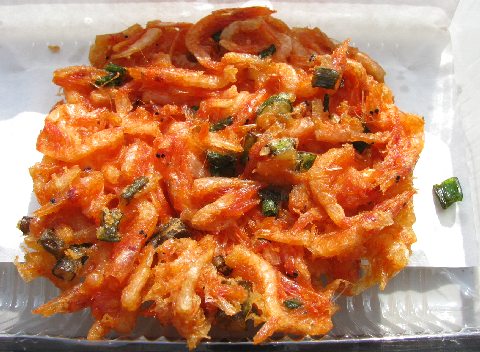
Another popular way to eat them is of course as a tempura called kaki-age, either with fresh sakura ebi in season or dried ones.

The same in my bento!

Fishermen use to dry their catch for sale and export until the government had the great idea to run an expressway just along the harbour!

The shrimps are now dried along nearby Fujikawa River, creating large quaint rose expanses in the most useen for locations!

Next time you visit Shizuoka don’t forget to buy sakura ebi senbei as a souvenir!

RECOMMENDED RELATED WEBSITES

Le Manger by Camille Oger (French), The Indian Tourist, Masala Herb by Helene Dsouza in Goa, India, Mummy I Can Cook! by Shu Han in London, Pierre.Cuisine, Francescannotwrite, My White Kitchen, 47 Japanese Farms Through The Eyes of Its Rural Communities, Foodhoe, Chucks Eats, Things that Fizz & Stuff, Five Euro Food by Charles,Red Shallot Kitchen by Priscilla,With a Glass, Nami | Just One Cookbook, Peach Farm Studio, Clumsyfingers by Xethia, PepperBento,Adventures in Bento Making, American Bent, Beanbento, Bento No, Bento Wo Tsukurimashou, Cooking Cute, Eula, Hapabento , Happy Bento, Jacki’s Bento Blog, Kitchen Cow, Leggo My Obento, Le Petit Journal Bento & CO (French), Lunch In A Box,
Susan at Arkonlite, Vegan Lunch Box; Tokyo Tom Baker, Daily Food Porn/Osaka, Only Nature Food Porn, Happy Little Bento, The Herbed Kitchen, J-Mama’s Kitchen, Cook, Eat, Play, Repeat, Bento Lunch Blog (German), Adventures In Bento, Anna The Red’s Bento Factory, Cooking Cute, Timeless Gourmet, Bento Bug, Ideal Meal, Bentosaurus, Mr. Foodie (London/UK), Ohayo Bento,

Must-see tasting websites:

-Sake: Tokyo Through The Drinking Glass, Tokyo Foodcast, Urban Sake, Sake World
-Wine: Palate To Pen, Warren Bobrow, Cellar Tours, Ancient Fire Wines Blog
-Beer: Good Beer & Country Boys, Another Pint, Please!
-Japanese Pottery to enjoy your favourite drinks: Yellin Yakimono Gallery

Cheese: Queso Fresco made by Jean Sabedora Garcia in Shizuoka City, Japan!

Who said they don’t make cheese in Japan?
Actually, a lot is made especially in the North, that is, in Hokkaido Island, and some had been made in the Eastern part of Shizuoka Prefecture from cow’s milk for at least ten years, not withstanding the numerous smoked cheese made here and there…

And now, I discovered a cheese maker in Shimizu Ku, Shizuoka City who makes his cheese from cow’s milk!

Jean Sabedora Garcia (I will have to check the proper spelling in a soon to come interview!) is a Peruvian gentleman who makes his cheese the way they fabricate it in South America.

The cheese is made with pasteurized cow’s milk, food salt, potassium chloride and rennet, all clearly indicated on the package label.

The consumption date is also clearly indicated and it is double-packed for maximum food safety. It should be stored at a temperature of 10 degrees Celsius.

Queso fresco (Spanish), Queijo Fresco (Portuguese) or “Natural Cheese” (Japanese) is of a beautiful white color and very firm, making it easy to cut and serve.
It is quite similar to feta in concept, firmness and color but slightly more salted.
The aroma is very pleasant.
Surprisingly well-balanced and easy to eat.
Although made from cow’s milk, it tastes very much like a very young goat’s milk cheese.
Best appreciated on its own with high quality crackers, or in caprese style salad.
I had a little weakness for it toasted on home-made bread!
Really worth discovering!

Jean Sabodera Garcia
DEKASEGUI PRODUCTS-JF Shokuhin Kougyou
Shizuoka City, Shimizu ku, Minato Minami Cho, 1-11-1F
Tel.: 054-537-0374
Mobile Phone: 090-65953065

RECOMMENDED RELATED WEBSITES

Le Manger by Camille Oger (French), The Indian Tourist, Masala Herb by Helene Dsouza in Goa, India, Mummy I Can Cook! by Shu Han in London, Pierre.Cuisine, Francescannotwrite, My White Kitchen, 47 Japanese Farms Through The Eyes of Its Rural Communities, Foodhoe, Chucks Eats, Things that Fizz & Stuff, Five Euro Food by Charles,Red Shallot Kitchen by Priscilla,With a Glass, Nami | Just One Cookbook, Peach Farm Studio, Clumsyfingers by Xethia, PepperBento,Adventures in Bento Making, American Bent, Beanbento, Bento No, Bento Wo Tsukurimashou, Cooking Cute, Eula, Hapabento , Happy Bento, Jacki’s Bento Blog, Kitchen Cow, Leggo My Obento, Le Petit Journal Bento & CO (French), Lunch In A Box,
Susan at Arkonlite, Vegan Lunch Box; Tokyo Tom Baker, Daily Food Porn/Osaka, Only Nature Food Porn, Happy Little Bento, The Herbed Kitchen, J-Mama’s Kitchen, Cook, Eat, Play, Repeat, Bento Lunch Blog (German), Adventures In Bento, Anna The Red’s Bento Factory, Cooking Cute, Timeless Gourmet, Bento Bug, Ideal Meal, Bentosaurus, Mr. Foodie (London/UK), Ohayo Bento,

Must-see tasting websites:

-Sake: Tokyo Through The Drinking Glass, Tokyo Foodcast, Urban Sake, Sake World
-Wine: Palate To Pen, Warren Bobrow, Cellar Tours, Ancient Fire Wines Blog
-Beer: Good Beer & Country Boys, Another Pint, Please!
-Japanese Pottery to enjoy your favourite drinks: Yellin Yakimono Gallery

Japanese Crustacean Species 6: Japanese Imperial Prawn-Kuruma Ebi-車海老

KURUMA-EBI-1

Kuruma Ebi/車海老, or Japanese Imperial Prwan, is probably the most popular prawn in Japan!
It has different names depending on its size: Saimaki (up to 5 cm), Maki (up to 10cm)

Its season lasts from late Autumn to the end of Winter.
It is found south of Hokkaido Island down to the Indian Ocean until depths of 50 metres.
It had been successfully artificially grown for some time until diseases put a momentary stop on the breeding.
The prawn has steadily become a rare morsel. Altogether, natural and human-raised specimen, the annual catch amounts only to 2,000 tonnes.

KURUMA-EBI-1a

Raw, or

KURUMA-EBI-2

boiled, they make for great decoration on top of succulent taste!

KURUMA-EBI-4

They are very much appreciated a sashimi, especially after having been made to “dance” in Japanese sake!

Grilled on the stick would tempt many an officionado!

They make for extravagant tempura!

As sushi Nigiri, they are equally popular raw, or

boiled!

If you the chance to buy tem alive (In shizuoka, we do have them kicking), especially coming from Okinawa, put them in a pan with Japanese sake under a lid. Wait until they have grown “quiet”, and prepare them right away!

RECOMMENDED RELATED WEBSITES

Le Manger by Camille Oger (French), The Indian Tourist, Masala Herb by Helene Dsouza in Goa, India, Mummy I Can Cook! by Shu Han in London, Pierre.Cuisine, Francescannotwrite, My White Kitchen, 47 Japanese Farms Through The Eyes of Its Rural Communities, Foodhoe, Chucks Eats, Things that Fizz & Stuff, Five Euro Food by Charles,Red Shallot Kitchen by Priscilla,With a Glass, Nami | Just One Cookbook, Peach Farm Studio, Clumsyfingers by Xethia, PepperBento,Adventures in Bento Making, American Bent, Beanbento, Bento No, Bento Wo Tsukurimashou, Cooking Cute, Eula, Hapabento , Happy Bento, Jacki’s Bento Blog, Kitchen Cow, Leggo My Obento, Le Petit Journal Bento & CO (French), Lunch In A Box,
Susan at Arkonlite, Vegan Lunch Box; Tokyo Tom Baker, Daily Food Porn/Osaka, Only Nature Food Porn, Happy Little Bento, The Herbed Kitchen, J-Mama’s Kitchen, Cook, Eat, Play, Repeat, Bento Lunch Blog (German), Adventures In Bento, Anna The Red’s Bento Factory, Cooking Cute, Timeless Gourmet, Bento Bug, Ideal Meal, Bentosaurus, Mr. Foodie (London/UK), Ohayo Bento,

Must-see tasting websites:

-Sake: Tokyo Through The Drinking Glass, Tokyo Foodcast, Urban Sake, Sake World
-Wine: Palate To Pen, Warren Bobrow, Cellar Tours, Ancient Fire Wines Blog
-Beer: Good Beer & Country Boys, Another Pint, Please!
-Japanese Pottery to enjoy your favourite drinks: Yellin Yakimono Gallery

Japanese Crustacean Species 5: Spiny Lobster-Ise Ebi-伊勢海老

ISE-EBI-1

Ise Ebi/伊勢海老, or Japanese Spiny Lobster is one the Spiny lobster varieties so popular all over the World.
The Japanese variety is smaller, or more precisely is more popular under a certain size.

Also called Kamakura Ebi, it is caught off the shores of Chiba, Wakayama, Mie and Shizuoka Prefectures.

The best specimens are aught in Winter, although imported lobsters can be found in other seasons.

The annual catch is fairly stable at 1,000 tonnes a year.
Imprted specimens account for 10,000 tonnes, mainly from Australia, New Zealand and New Caledonia.
In that case they are also called Minami/South Ebi.

The Japanese appreciate their lobsters raw.

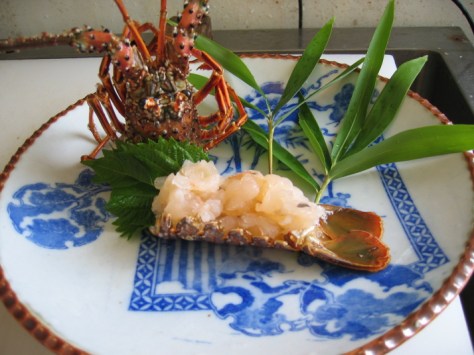
ISE-EBI-SASHIMI

As o-tsukuri/sashimi plate they are quite spectacular!

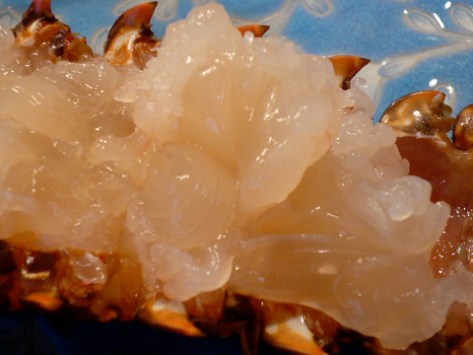
ISE-EBI-SASHIMI2

For a closer look!

Another extravagant to serve as sashimi is to have them slightly seared outside and raw inside!

They are natuarally very popular as a sushi nigiri!

If they are small enough they can be served as another extravagant sushi grilled whole over a single ball of rice/shari!

And the larger specimens can be prepared western-style in gratin!

RECOMMENDED RELATED WEBSITES

Le Manger by Camille Oger (French), The Indian Tourist, Masala Herb by Helene Dsouza in Goa, India, Mummy I Can Cook! by Shu Han in London, Pierre.Cuisine, Francescannotwrite, My White Kitchen, 47 Japanese Farms Through The Eyes of Its Rural Communities, Foodhoe, Chucks Eats, Things that Fizz & Stuff, Five Euro Food by Charles,Red Shallot Kitchen by Priscilla,With a Glass, Nami | Just One Cookbook, Peach Farm Studio, Clumsyfingers by Xethia, PepperBento,Adventures in Bento Making, American Bent, Beanbento, Bento No, Bento Wo Tsukurimashou, Cooking Cute, Eula, Hapabento , Happy Bento, Jacki’s Bento Blog, Kitchen Cow, Leggo My Obento, Le Petit Journal Bento & CO (French), Lunch In A Box,
Susan at Arkonlite, Vegan Lunch Box; Tokyo Tom Baker, Daily Food Porn/Osaka, Only Nature Food Porn, Happy Little Bento, The Herbed Kitchen, J-Mama’s Kitchen, Cook, Eat, Play, Repeat, Bento Lunch Blog (German), Adventures In Bento, Anna The Red’s Bento Factory, Cooking Cute, Timeless Gourmet, Bento Bug, Ideal Meal, Bentosaurus, Mr. Foodie (London/UK), Ohayo Bento,

Must-see tasting websites:

-Sake: Tokyo Through The Drinking Glass, Tokyo Foodcast, Urban Sake, Sake World
-Wine: Palate To Pen, Warren Bobrow, Cellar Tours, Ancient Fire Wines Blog
-Beer: Good Beer & Country Boys, Another Pint, Please!
-Japanese Pottery to enjoy your favourite drinks: Yellin Yakimono Gallery

Japanese Crustacean Species 4: Alaskan Pink Shrimp-Pink Shrimp-Amaebi-甘海老

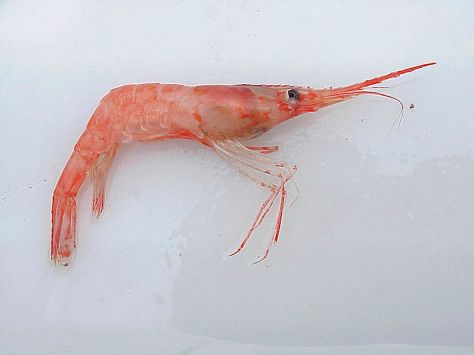
AMAEBI-1

Amaebi (甘海老 in Japanese) or by its Latin name Pandalus borealis (also called Pandalus eous) is a species of shrimp found in cold parts of the Atlantic and Pacific Oceans. Many different English names are used, with little consensus (deep-water shrimp, cold-water shrimp, northern shrimp, Alaskan pink shrimp, pink shrimp, northern red shrimp, Greenland prawn (UK)). Often the word shrimp is replaced by prawn, albeit incorrectly.

In Japan, it is also known as Akaebi, Hokkoku Akaebi/North Country Red Shrimp, Nanban Ebi or Tongarasahi.

The season in Japan is Winter, although it can be found all year round thanks to large imports from Greenland and Canada. Yearly domestic catch amount to 2,000 tonnes in Hokkaido and 800 tonnes in Ishikawa Prefecture.

It is a species famous for its sexual properties: the shrimps are hermaphroditic. They start out male, but after a year or two, their testicles turn to ovaries and they complete their lives as females. However, if there is a predominance of female Pandalus shrimp, the males will delay their transformation. Likewise should there be a shortage of females, the male shrimp will begin their transformation earlier, all for the sake of maintaining balance for procreational purposes.

They are called “Ama Ebi/Sweet Shrimp” in Japanese as they will turn very sweet after a couple of days in the refrigerator, whereas they will show no sweetness at all when fresh!

They are great as sashimi on their own, in salads or as part of a larger sashimi plate!

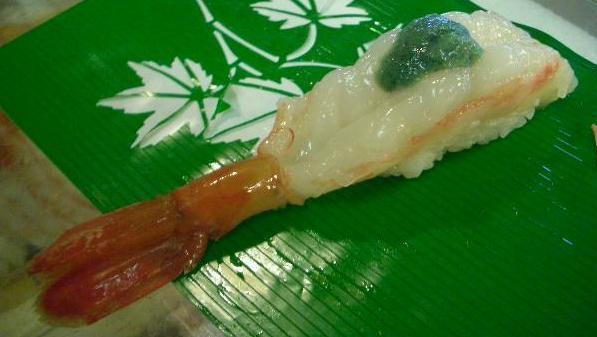
Of course, as sushi, they are a superb morsel!

RECOMMENDED RELATED WEBSITES

Le Manger by Camille Oger (French), The Indian Tourist, Masala Herb by Helene Dsouza in Goa, India, Mummy I Can Cook! by Shu Han in London, Pierre.Cuisine, Francescannotwrite, My White Kitchen, 47 Japanese Farms Through The Eyes of Its Rural Communities, Foodhoe, Chucks Eats, Things that Fizz & Stuff, Five Euro Food by Charles,Red Shallot Kitchen by Priscilla,With a Glass, Nami | Just One Cookbook, Peach Farm Studio, Clumsyfingers by Xethia, PepperBento,Adventures in Bento Making, American Bent, Beanbento, Bento No, Bento Wo Tsukurimashou, Cooking Cute, Eula, Hapabento , Happy Bento, Jacki’s Bento Blog, Kitchen Cow, Leggo My Obento, Le Petit Journal Bento & CO (French), Lunch In A Box,
Susan at Arkonlite, Vegan Lunch Box; Tokyo Tom Baker, Daily Food Porn/Osaka, Only Nature Food Porn, Happy Little Bento, The Herbed Kitchen, J-Mama’s Kitchen, Cook, Eat, Play, Repeat, Bento Lunch Blog (German), Adventures In Bento, Anna The Red’s Bento Factory, Cooking Cute, Timeless Gourmet, Bento Bug, Ideal Meal, Bentosaurus, Mr. Foodie (London/UK), Ohayo Bento,

Must-see tasting websites:

-Sake: Tokyo Through The Drinking Glass, Tokyo Foodcast, Urban Sake, Sake World
-Wine: Palate To Pen, Warren Bobrow, Cellar Tours, Ancient Fire Wines Blog
-Beer: Good Beer & Country Boys, Another Pint, Please!
-Japanese Pottery to enjoy your favourite drinks: Yellin Yakimono Gallery

Japanese Crustacean Species 3: Squiila-Mantis Shrimp-Shako-蝦蛄

A tropical squilla!

Squillae as found on Japanese markets.
Note the dun color as they come from dark northern seas!

The Squilla or “Shako” (蝦蛄in Japanese) is a delicacy that appears on the sushi bar counters from April to Summer, although different varieties can be found in Hokkaido markets (Otaru City in particular) almost all year round.
You will discover it under names such as “Shaku” and “Gazaebi”.
They are actually caught in almost all Japanese seas, but the best are supposed to originate from Hokkaido.

Served boiled or steamed on their own, they make for a great snack!

Like any crustaceans, they can be eaten in many ways.
The Japanese favor the small kind with a violet back. I had the opportunity to buy some very large specimen in Otaru, and eat them just boiled and served with rice vinegar mixed with a little Japanese mustard, or in salads.
They almost disappeared from Tokyo Bay in the 1960’s but reappeared in the 1970’s. Most fishermen in the Kanto (Eastern Japan) area will place them in boxes themselves to sell them directly at fish markets. The market value can vary wildly, but look for the genuine harbor markets and buy them yourself.

Simple nigiri with boiled/steamed squilla

Naturally, they are most popular as nigiri sushi. Customers jokingly ask for “garage” (in English) as “shako” also means (different kanji, of course: 車庫) “garage”!

Seasoned with “tare” sauce.

An unusual offering with grilled squilla!

RECOMMENDED RELATED WEBSITES

The Indian Tourist, Masala Herb by Helene Dsouza in Goa, India
Mummy I Can Cook! by Shu Han in London
Pierre.Cuisine, Francescannotwrite, My White Kitchen, 47 Japanese Farms Through The Eyes of Its Rural Communities, Foodhoe, Chucks Eats, Things that Fizz & Stuff, Five Euro Food by Charles,Red Shallot Kitchen by Priscilla,With a Glass, Nami | Just One Cookbook, Peach Farm Studio, Clumsyfingers by Xethia, PepperBento,Adventures in Bento Making, American Bent, Beanbento, Bento No, Bento Wo Tsukurimashou, Cooking Cute, Eula, Hapabento , Happy Bento, Jacki’s Bento Blog, Kitchen Cow, Leggo My Obento, Le Petit Journal Bento & CO (French), Lunch In A Box,
Susan at Arkonlite, Vegan Lunch Box; Tokyo Tom Baker, Daily Food Porn/Osaka, Only Nature Food Porn, Happy Little Bento, The Herbed Kitchen, J-Mama’s Kitchen, Cook, Eat, Play, Repeat, Bento Lunch Blog (German), Adventures In Bento, Anna The Red’s Bento Factory, Cooking Cute, Timeless Gourmet, Bento Bug, Ideal Meal, Bentosaurus, Mr. Foodie (London/UK), Ohayo Bento,

Must-see tasting websites:

-Sake: Tokyo Through The Drinking Glass, Tokyo Foodcast, Urban Sake, Sake World
-Wine: Palate To Pen, Warren Bobrow, Cellar Tours, Ancient Fire Wines Blog
-Beer: Good Beer & Country Boys, Another Pint, Please!
-Japanese Pottery to enjoy your favourite drinks: Yellin Yakimono Gallery

Japanese Crustacean Species 2: Large Sweet Prawn-Botan Ebi-牡丹海老

Botanebi/”Botan” Prawn, or “Pandalus nipponesis” for the specialists, is a large prawn found in all seas of Japan, especially off Hokkaido Island, at depths varying from 300 to 500 metres. They are caught at 200~300 metres depth in Suruga Bay and along the Western coast of Izu Peninsula In Shizuoka Prefecture. Once abundant, they have become scarce and only small specimens are found, whereas Hokkaido produces up to 20cm-long prawns.

They are known under different names: “Toyamaebi and Kijiebi”.
It is not a cheap morsel in Sushi bars. But it is interesting to note they are essentially eaten raw as like “Amaebi”. They become very sweet after some time in the refrigerator.

They make for big servings as sushi nigiri!

Now, if you are lucky enough to find them fresh with their eggs, ask your chef to dress them as above for sashimi…

as sushi nigiri,…

or even better, put the eggs on top of a “gunkan nigiri”!

And one more thing, if they are fresh again, don’t forget to ask for the heads deep-fried!

Incidentally, botanebi change sex (gender) with age to end up as big juicy females!

RECOMMENDED RELATED WEBSITES

The Indian Tourist, Masala Herb by Helene Dsouza in Goa, India
Mummy I Can Cook! by Shu Han in London
Pierre.Cuisine, Francescannotwrite, My White Kitchen, 47 Japanese Farms Through The Eyes of Its Rural Communities, Foodhoe, Chucks Eats, Things that Fizz & Stuff, Five Euro Food by Charles,Red Shallot Kitchen by Priscilla,With a Glass, Nami | Just One Cookbook, Peach Farm Studio, Clumsyfingers by Xethia, PepperBento,Adventures in Bento Making, American Bent, Beanbento, Bento No, Bento Wo Tsukurimashou, Cooking Cute, Eula, Hapabento , Happy Bento, Jacki’s Bento Blog, Kitchen Cow, Leggo My Obento, Le Petit Journal Bento & CO (French), Lunch In A Box,
Susan at Arkonlite, Vegan Lunch Box; Tokyo Tom Baker, Daily Food Porn/Osaka, Only Nature Food Porn, Happy Little Bento, The Herbed Kitchen, J-Mama’s Kitchen, Cook, Eat, Play, Repeat, Bento Lunch Blog (German), Adventures In Bento, Anna The Red’s Bento Factory, Cooking Cute, Timeless Gourmet, Bento Bug, Ideal Meal, Bentosaurus, Mr. Foodie (London/UK), Ohayo Bento,

Must-see tasting websites:

-Sake: Tokyo Through The Drinking Glass, Tokyo Foodcast, Urban Sake, Sake World
-Wine: Palate To Pen, Warren Bobrow, Cellar Tours, Ancient Fire Wines Blog
-Beer: Good Beer & Country Boys, Another Pint, Please!
-Japanese Pottery to enjoy your favourite drinks: Yellin Yakimono Gallery

Sushi: Oshizushi-Pressed Sushi-The Techniques

1) Salmon Marinated in Seaweed/Sake Sushi Konbushime
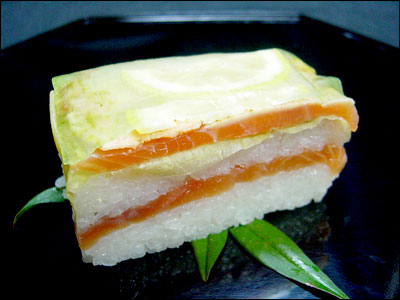
Sushi exists under many forms and guises.
It not all nigiri and (more ubiquitous) sushi rolls!
Have you ever heard of Oshizushi?

Oshizushi (押し寿司, litterally pressed sushi), is a pressed sushi from the Kansai Region, a favourite and specialty of Osaka.

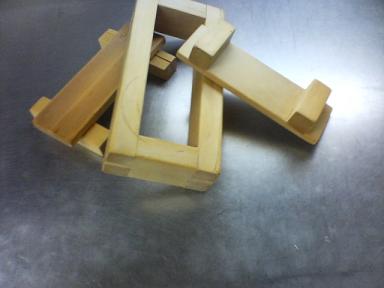
Oshibako unmounted

It is made with the help of a block-shaped piece formed using a wooden mold, called an oshibako/押し箱.
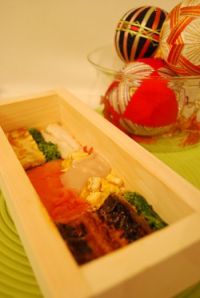
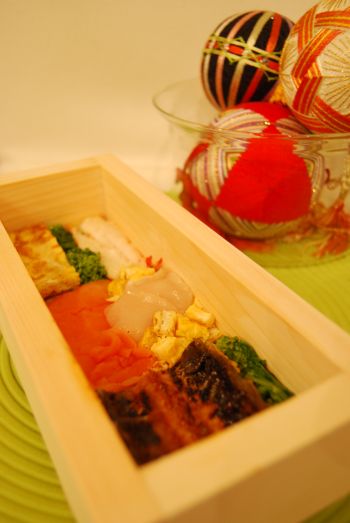
Oshibako lined with toppings

The chef lines the bottom of the oshibako with the toppings, covers them with sushi rice, and then presses the lid of the mold down to create a compact, rectilinear block.
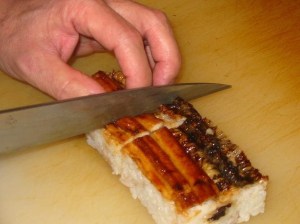
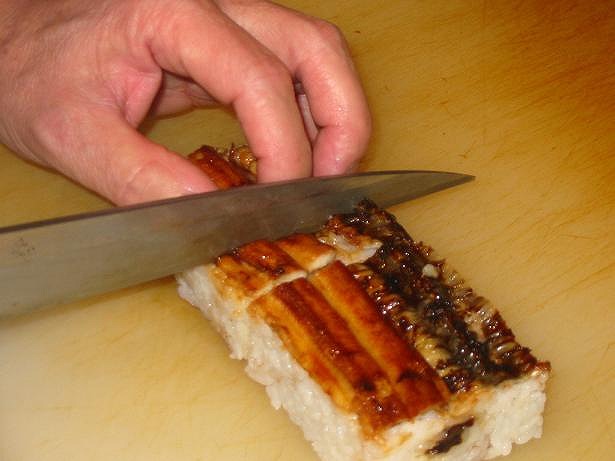
Cutting Grilled Eel Oshizushi

The block is then removed from the mold and then cut into bite-sized pieces.

It is great fun to experiment at home for large parties or the family as you can include almost anything.
Moreover, oshizuhi is easy to transport and include in bento!

The recipes and techniques I’m introducing here are professional, but with a little practice I’m sure you will become a specialist

——————————

Oshizushi/Pressed Sushi Techniques 1: Salmon Marinated in Seaweed/Sake Sushi Konbushime

For sushi rice preparation, check HERE for previous posting!
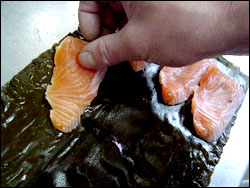
Konbushime/昆布〆means that the fish is “marinated with seaweed.
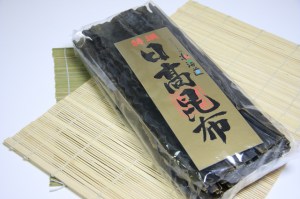
Konbu/Seaweed is now readily available on Japanese and Asian markets all over the world or on the internet.
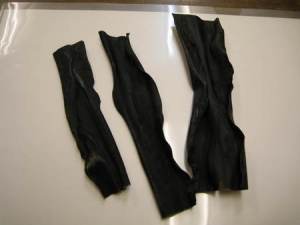
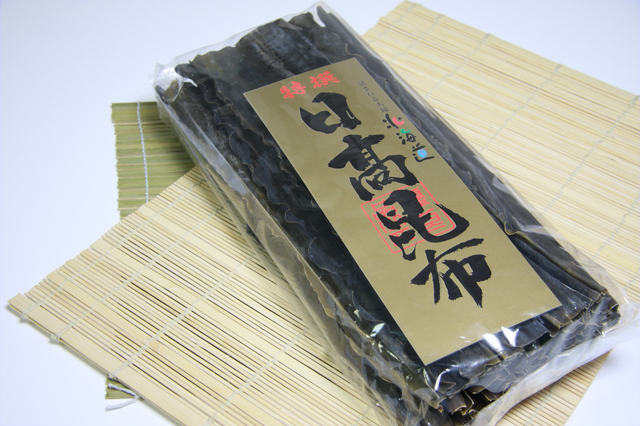
Two types of konbu/seaweed are used:
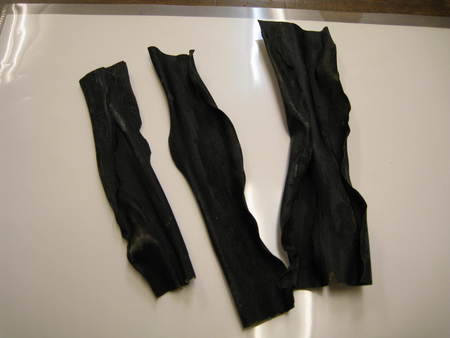
-Dark/black thick Konbu/Seaweed is bought dry and has to be softened in lukewarm water for a while. That particular step is very easy to learn.
Keep in mind it is edible, although after marination, it should be discarded.
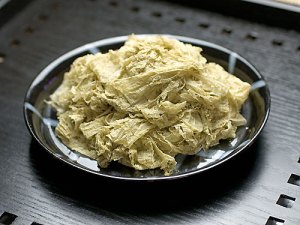
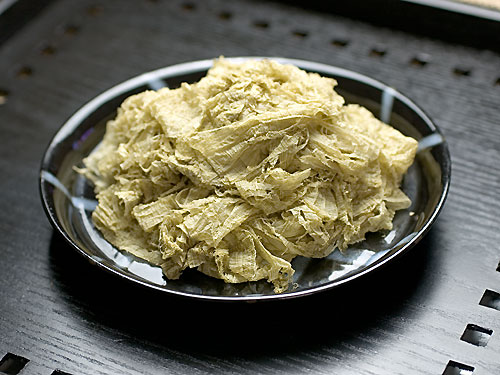
-Thin, light coloured (almost transparent) is used as an ingredient both for taste and the finishing touch. If not available, you may replace it with fine green leaves.
It is called “Kagome Konbu/かごめ昆布”.
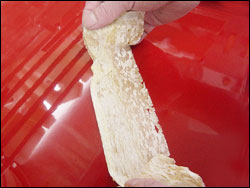
An even better light seaweed is called “Take Kawa Konbu/竹皮昆布/Bamboo Skin Saweed” and is widely used by professionals.

Both light coloured seaweeds have to be softened in lukewarm water, sponged off and spread into thin sheets first. But it is really worth the work!

After having softened the dark konbu, spread it over a clean working table and place the fresh (fresh, please!) salmon slices over one sheet and covering the lot with another sheet.
Wrap it in cellophane paper and leave it in the fridge for at least 30 minutes.
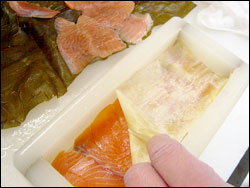
During that time soften light seaweed in lukewarm water and spread it over a clean cloth.

Line the bottom of the oshibako/box with one layer of salmon (no dark seaweed!). Spread light seaweed over the salmon and spread a first layer sushi rice.

Repeat the same operation once more and press.
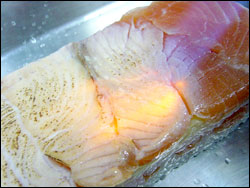
Unloose the sushi out of its box.
The fish should be on top.
Grill the top of the fish lightly with a hand burner just enough to change the colour.
That step will enable to savour two different tastes at the same time!
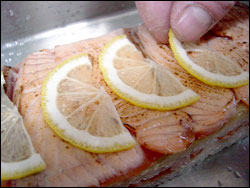
Place very thin slices of lemon (clean organic, please!) on top of the rice.
It will abate the “fishy smell/taste”.
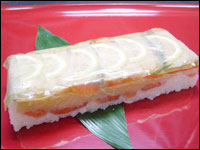
Lay another layer of fine light seaweed over the top.
Cut and serve!
————————-
2) Seared Prime Beef/Gyuniku Aburi

Japanese prime beef has become a registered trademark all over the world be it from Kobe or other regions.
The present sushi was made with “Kuroge Gyuniku/黒毛牛肉/Black Hair Beef from animals raised to the age of 12 months in Fukui Prefecture.
Do check the origin of your beef!

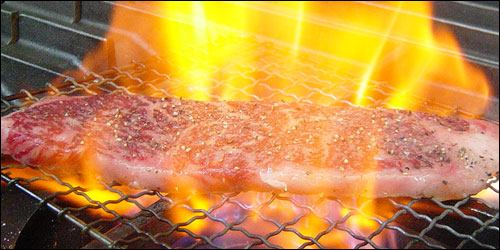
When preparing this slightly extravagant sushi, choose a large slice of prime beef with plenty of “fat veins” as shown on the above picture.
Don’t choose too thick or too thin, either. Think of the proportion of the beef and rice. Bear in mind that the the seared beef will also loose some of its thickness.

Sprinkle the beef with quality ground balck pepper and salt.
Sear it or grill it lightly on both sides quickly.
This process will enhance the sweetness of the meat.

-Slice the meat into bite-sized portions as shown in above picture at a slant after having cut off the fatty extremity.

Lay the bottom of the oshibako/box with slices of beef as shown in above picture in a “staggering” fashion. If you don’t, the slices will slideaway from each other.
Cover with shiso/perilla leaves.
Cover with sushi rice and press.

Soften light seaweed in lukewarm water and spread it over a clean cloth.
Unloose the sushi out of its box.
The beef should be on top.
Spread the light seaweed over the top.
Cut to size and serve immediately for maximum enjoyment!

—————————-

3) Egg Bearing Snow Crab/Seikogani
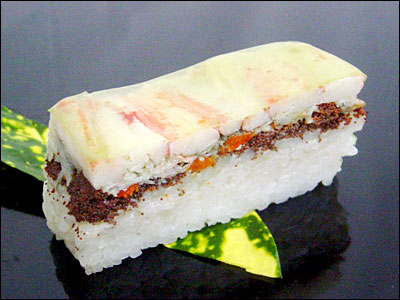
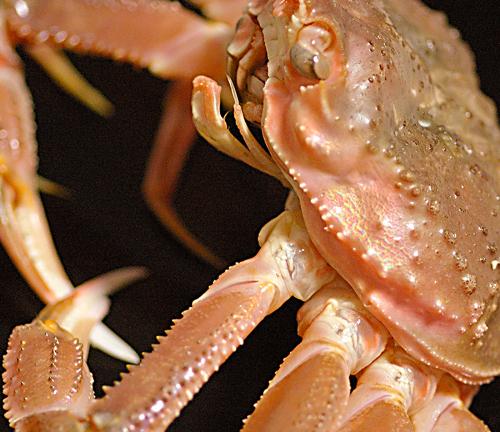
Seikogani is the Japanese name for the female Snow Crab or Zuwagani, when she is bearing her eggs.
Contrary to many other kinds of crabs, the female snow crabs, even when bearing eggs, lose little of their food and taste quality with the added advantage of an extra delicacy and taste. On the other hand the main food is found inside the shell instead of the legs and pincers for the males.
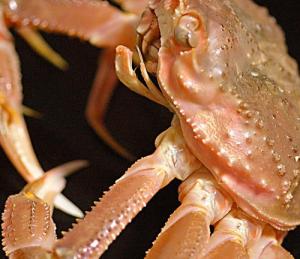
Snow Crab/Zuwagani

Therefore, if you get your hands on such a specimen, do not ignore it, even if they are noticeably smaller than their male counterparts!
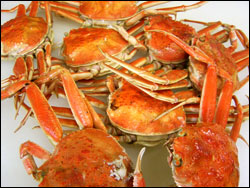
Boiled snow crabs.

The best is actually to combine both male and female into a combination sushi.
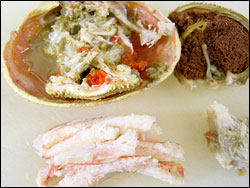
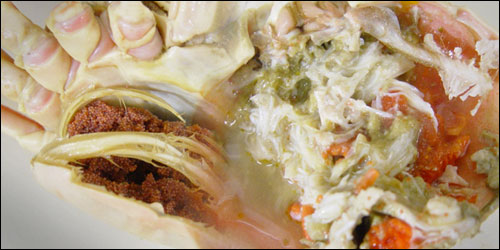
Above are the shells of two snow crabs, the large male one containing white flesh and red brains from both male and female, the smaller female one containing the eggs, and the flesh taken out of the male legs after boiling and cooling.
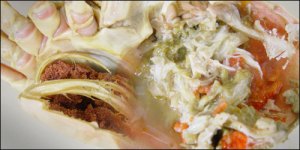
See above picture for better view of the edible morsels: white flesh, red brains (don’t forget these!) and eggs.
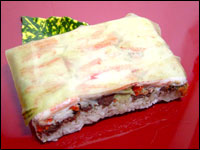
As there is a danger of a general crumbling out of the ingredients, line the bottom of the oshibako/box with a good layer of light seaweed first instead of doing it after you have unloose the sushi out ofits box.
Then place legs flesh tightly parallel to each other to form as compact as possible layer. Cover the leg flesh with the eggs and red brains into a pleasing design.
Finally fill with sushi rice and press.

Unloose sushi from its box and cut to size before serving!
————————————–

4) Seared Seabream/Tai no Aburi
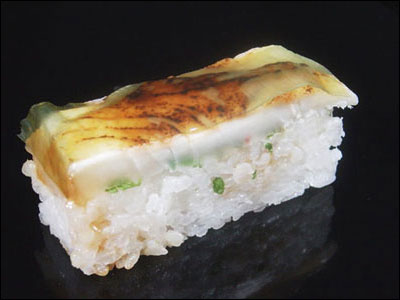
Seabreams or Snappers come in so many varieties all over thw orld that it becomes quite easy to find and adapt to various cuisines.
The Japanese are extremely fond of it either raw or steamed with rice.
When using it as sashimi or sushi, choose a fresh fis. Look at their eyes and press with fingers. And use your nose!
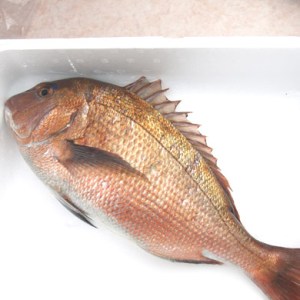
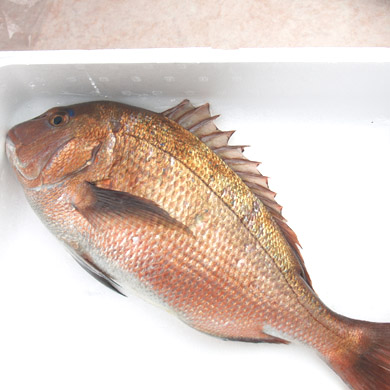
Madai/真鯛 or “True Seabream”, the most commonly used type of seabream in Japan.
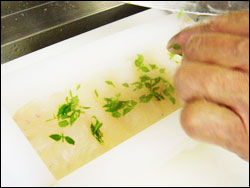
For an extra finishing touch for the taste, use fresh leaves of sansho/山椒 or Japanese pepper (also called ki no me/木の芽).
The English name is Shichuan Pepper, although we are talking of the fresh plant here.
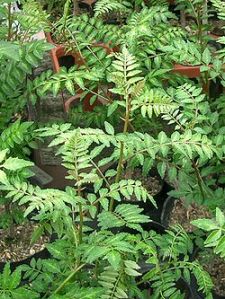
In Japan the dried and powdered leaves of Zanthoxylum sancho are used to make noodle dishes and soups mildly hot and fragrant. The whole fresh leaves, 木の芽 kinome, are used to flavour vegetables, especially bamboo shoots, and to decorate soups. Typically the young shoots are used in this way giving an aromatic lemony flavour to food. They are used to denote spring seasonality in food. The buds, seeds, flowers, and hulls are also used.

Chop some leaves finely enough to use with sushi, but not to fine. Cut them as short as shown in picture.

Soften light seaweed in lukewarm water and spread it over a clean cloth.

Line the bottom of the oshibako/box with slices of seabream fillet as tightly to each other as possible.
Sprinkle with chopped sansho leaves.
Fill with sushi rice and press.
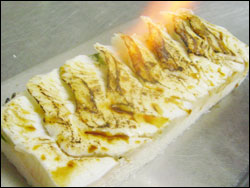
Unloose oshizushi out of the box.
Brush the surface lightly with some soy sauce (I sweeten it a bit by mixing it with a little mirin/sweet sake).
Sear the fish lightly.
Repeat the same process twice more so as to cook only the surface and make it take a nice colour.
This way you will be able to taste the fish in two different ways inside your mouth!
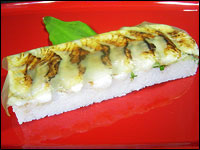
Spread the light seaweed over the top.
Cut to size and serve immediately for maximum enjoyment!

RECOMMENDED RELATED WEBSITES

The Indian Tourist, Masala Herb by Helene Dsouza in Goa, India
Mummy I Can Cook! by Shu Han in London
Pierre.Cuisine, Francescannotwrite, My White Kitchen, 47 Japanese Farms Through The Eyes of Its Rural Communities, Foodhoe, Chucks Eats, Things that Fizz & Stuff, Five Euro Food by Charles,Red Shallot Kitchen by Priscilla,With a Glass, Nami | Just One Cookbook, Peach Farm Studio, Clumsyfingers by Xethia, PepperBento,Adventures in Bento Making, American Bent, Beanbento, Bento No, Bento Wo Tsukurimashou, Cooking Cute, Eula, Hapabento , Happy Bento, Jacki’s Bento Blog, Kitchen Cow, Leggo My Obento, Le Petit Journal Bento & CO (French), Lunch In A Box,
Susan at Arkonlite, Vegan Lunch Box; Tokyo Tom Baker, Daily Food Porn/Osaka, Only Nature Food Porn, Happy Little Bento, The Herbed Kitchen, J-Mama’s Kitchen, Cook, Eat, Play, Repeat, Bento Lunch Blog (German), Adventures In Bento, Anna The Red’s Bento Factory, Cooking Cute, Timeless Gourmet, Bento Bug, Ideal Meal, Bentosaurus, Mr. Foodie (London/UK), Ohayo Bento,

Must-see tasting websites:

-Sake: Tokyo Through The Drinking Glass, Tokyo Foodcast, Urban Sake, Sake World
-Wine: Palate To Pen, Warren Bobrow, Cellar Tours, Ancient Fire Wines Blog
-Beer: Good Beer & Country Boys, Another Pint, Please!
-Japanese Pottery to enjoy your favourite drinks: Yellin Yakimono Gallery

Japanese Crustacean Species 1: White Shrimp-Shiro Ebi-白海老

Having obtained more information and species, I decided to restart the Series on Crustaceans for the sake of secure information! I might end amending this series every 2 years!

Deep-fried white shrimp

Shiroebi or White Shrimp is not as known as other shrimp/prawn varieties. However, it is a very popular crustacean in Japanese cuisine.
Also known under the the names of “Shiraebi, Hirataebi and Bekkoebi”, it is mainly caught between depths of 40 and 200 metres off the coasts of Toyama Bay on the other side of Japan and Suruga Bay in Shizuoka Prefecture.

It is mainlly served as sashimi with some ponzu and grated fresh ginger or freshly grated wasabi in Shizuoka Prefecture.

It is popular as sushi although one needs large specimen as the biggest are only 7 cm long.
One popular way to serve them as sushi in the Kansai area is as oshizushi/preshed sushi, either raw or marinated with seaweed as shown above.

One easier way to serve it sushi is gunkan/mothership and it allows for great decoration with flying fish roe and grated ginger for example!

Shiroebi appears on our tables between April and November in many guises:
The picture above shows on the right the shiroebi in its natural flesh whereas on the left it has been kept between two sheets of wetted seaweed for a while as “kombu-jime”, another very popular way to prepare all kinds of sashimi/sushi.

White Shrimps also enter in the preparation of a kind of “Tamagoyaki”/Japanese Omelette when they are first processed into a paste and mixed thoroughly with beaten eggs, sieved and then cooked.

The Japanese also love them as soft sembei/rice crackers.

An original recipe that will please Japanese and expats alike: Shiro Ebi Hamburger!

The annual catch has exceeded 600 tonnes in recent years, half of them in Toyama.
They are also exported whole.

RECOMMENDED RELATED WEBSITES

The Indian Tourist, Masala Herb by Helene Dsouza in Goa, India
Mummy I Can Cook! by Shu Han in London
Pierre.Cuisine, Francescannotwrite, My White Kitchen, 47 Japanese Farms Through The Eyes of Its Rural Communities, Foodhoe, Chucks Eats, Things that Fizz & Stuff, Five Euro Food by Charles,Red Shallot Kitchen by Priscilla,With a Glass, Nami | Just One Cookbook, Peach Farm Studio, Clumsyfingers by Xethia, PepperBento,Adventures in Bento Making, American Bent, Beanbento, Bento No, Bento Wo Tsukurimashou, Cooking Cute, Eula, Hapabento , Happy Bento, Jacki’s Bento Blog, Kitchen Cow, Leggo My Obento, Le Petit Journal Bento & CO (French), Lunch In A Box,
Susan at Arkonlite, Vegan Lunch Box; Tokyo Tom Baker, Daily Food Porn/Osaka, Only Nature Food Porn, Happy Little Bento, The Herbed Kitchen, J-Mama’s Kitchen, Cook, Eat, Play, Repeat, Bento Lunch Blog (German), Adventures In Bento, Anna The Red’s Bento Factory, Cooking Cute, Timeless Gourmet, Bento Bug, Ideal Meal, Bentosaurus, Mr. Foodie (London/UK), Ohayo Bento,

Must-see tasting websites:

-Sake: Tokyo Through The Drinking Glass, Tokyo Foodcast, Urban Sake, Sake World
-Wine: Palate To Pen, Warren Bobrow, Cellar Tours, Ancient Fire Wines Blog
-Beer: Good Beer & Country Boys, Another Pint, Please!
-Japanese Pottery to enjoy your favourite drinks: Yellin Yakimono Gallery

Spring Flowers in Shizuoka City, Japan!

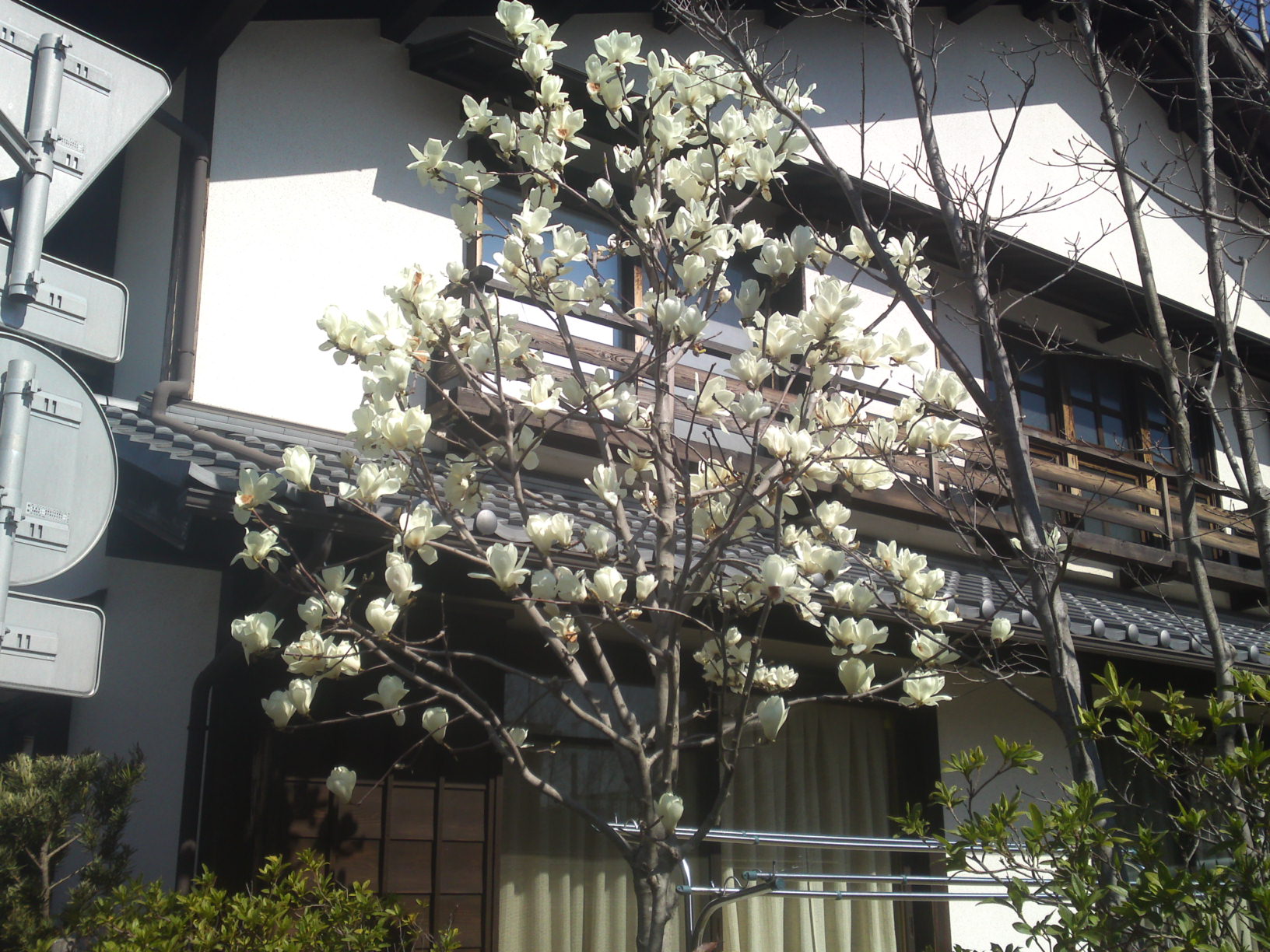
White peonies?

Spring has finally arived with a steep rise temperature and flowers blooming everywhere although the main cherry trees are still late and will bloom only for the Shizuoka Festival taking place next week (report in the offing!)!

I couldn’t help taking pictures on my way to work yhis mornig.
My office is only a 10-miute bicycle ride away and I took these pics along the way to show you the simple pleasures of everyday life in Japan!
I don’t know the names of many of these flowers and I hope my friends help me there!
I will credit them of course!

All pices are shown in the order on my trip to work!

I know the French word for these but not the English one!

These small white flower bushes are very popular in Japan!

Late blooming Japanese plum tree.

Red camelias in front of a vetenerary hospital.

Rape flowers.

Not flowers, but kumquats!

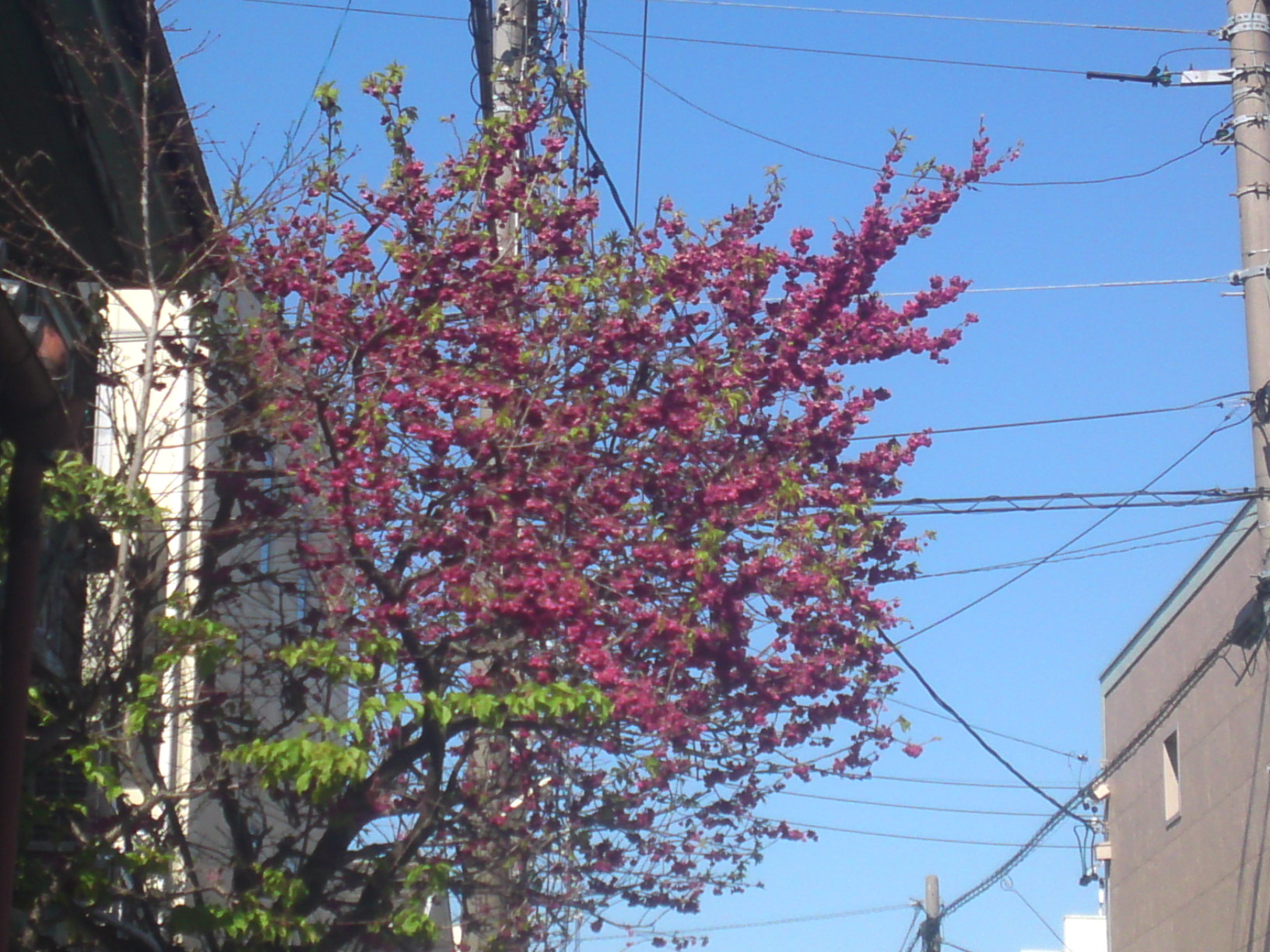
Cherry blossoms.

Large cherry blossom variety.

Winter oranges!

More white peonies?

Cherry blossoms at a kindergarten!

Very popular again but I don’t know their name…
Cherry blossoms.
White peonies again?

Peeking over the hedge…

I don’t know their name but their yellow color suit the nearby police-box well!
RECOMMENDED RELATED WEBSITES

The Indian Tourist, Masala Herb by Helene Dsouza in Goa, India
Mummy I Can Cook! by Shu Han in London
Pierre.Cuisine, Francescannotwrite, My White Kitchen, 47 Japanese Farms Through The Eyes of Its Rural Communities, Foodhoe, Chucks Eats, Things that Fizz & Stuff, Five Euro Food by Charles,Red Shallot Kitchen by Priscilla,With a Glass, Nami | Just One Cookbook, Peach Farm Studio, Clumsyfingers by Xethia, PepperBento,Adventures in Bento Making, American Bent, Beanbento, Bento No, Bento Wo Tsukurimashou, Cooking Cute, Eula, Hapabento , Happy Bento, Jacki’s Bento Blog, Kitchen Cow, Leggo My Obento, Le Petit Journal Bento & CO (French), Lunch In A Box,
Susan at Arkonlite, Vegan Lunch Box; Tokyo Tom Baker, Daily Food Porn/Osaka, Only Nature Food Porn, Happy Little Bento, The Herbed Kitchen, J-Mama’s Kitchen, Cook, Eat, Play, Repeat, Bento Lunch Blog (German), Adventures In Bento, Anna The Red’s Bento Factory, Cooking Cute, Timeless Gourmet, Bento Bug, Ideal Meal, Bentosaurus, Mr. Foodie (London/UK), Ohayo Bento,

Must-see tasting websites:

-Sake: Tokyo Through The Drinking Glass, Tokyo Foodcast, Urban Sake, Sake World
-Wine: Palate To Pen, Warren Bobrow, Cellar Tours, Ancient Fire Wines Blog
-Beer: Good Beer & Country Boys, Another Pint, Please!
-Japanese Pottery to enjoy your favourite drinks: Yellin Yakimono Gallery