Tag Archives: Fruit

SHIZUOKA X CANNES 2011

a href=”https://shizuokagourmet.com/wp-content/uploads/2011/05/shizukan-1.jpg”>

I know this guy! LOL

The cities of Shizuoka and Cannes in France (you know, the Cannes Film Festival!) have been sister cities for quite a while now.
The citizens of Shizuoka have been holding their own event every year in the middle of May in Shikencho street in Aoi kU in Shizuoka City.
This year Agrigraph joined the event as a great opportunity to introduce local farmers and their produce.
This year the event is held on May 14th and 15th from 13:00 to 17:00 in Shichikencho. You still have tomorrow left! Do visit and I can garantee you will discover quite a few things to your liking!
Anyway I visited the event today and I hope this quick report will encourage you to have a good look tomorrow!

I actually visited the place twice before the start and later in the afternoon!

The Agrigraph staff busy organizing their stand!

This stand was designed especially to show and seel farmers’ produce!

Unpacking the goodies!

Red orange jam pamphlets!

Enormous zucchini harvested in the morning!

Beautiful turnips. The leaves and stems make for great soups and pickles!

Busy writing the boards!

Not only in Japanese, but also in French!

I came back later to see how things were going.
I found the Shizuoka Prefecture Agricultural High School busy selling their famous bread and cakes!

Busy cutting samples to taste!

I found some good friends like Matsukiya Wine Shop selling French wines!

There were all kinds of shops selling curios, wares, souvenirs and wahtnot!

Cooking ware from France!

<

Cute little things!

A bycicle taxi, Japanese version!

Back to the Agrigraph stand…

So much great food to try there!

I love these mixed sets. Quite a few of the vegetables were organic.

Sampling the farmers’ jams!

I know that the kid was after the little tomatoes!

See you tomorrow!

RECOMMENDED RELATED SITES:
With a Glass, Foodhoe’s Foraging
Bread + Butter, Zoy Zhang, Hungry Neko, Think Twice, Frank Fariello, Mangantayon, Hapabento, Elinluv Tidbit Corner, Tokyo Terrace, Maison de Christina, Chrys Niles,Lexi, Culinary Musings, Wheeling Gourmet, Comestiblog, Chronicles Of A Curious Cook, Tokyo Through The Drinking Glass, Tokyo Foodcast, Palate To Pen, Yellin Yakimono Gallery, Tokyo Terrace, Hilah Cooking, More than a Mount Full, Arkonite Bento, Happy Little Bento; 5 Star Foodie; Jefferson’s Table; Oyster Culture; Gourmet Fury; Island Vittles; Good Beer & Country Boys; Rubber Slippers In Italy; Color Food daidokoro/Osaka;/a; The Witchy Kitchen; Citron Et Vanille, Lunsj Med Buffet/Estonian Gastronomy (English), Cook, Eat, Play, Repeat, Chrisoscope, Agrigraph, The Agriculture Portal to shizuoka!

A Japanese Gardener’s Winter Preparations

Looking at my dear neighbor, Mr. Yoshizo Sugiyama’s garden this morning I realized that winter was about to fall on us in spite of the prevailing mild weather.
The telltale signs were the fruit and vegetables hung out to dry as the climate will turn very dry and cold enough for such a process.

I know he has a few persimmon/kaki/柿 trees in another plot he’s lent for some time.
Dried persimmons are a typical Japanese delicacy, and they certainly don’t come cheap on the market. It is definitely worth drying them yourself!
The persmmons are first peeled, then a twine is passed through them under their sepals before they are hung to dry.
The fruit will reduce to less than half their size and will be delicious with all their concentrated sugar!

The daikon of the same garden were being for takuan/沢庵 or Japanese pickled daikon!

In spite of their crazy shapes, these dailon will make excellent pickles.
They were first thoroughly washed before being hung.
Beside them you can also freshly hung persimmons and more that are almost completely matured into dry fruit.

The picture shows you how easy to hang the daikon.
Their heavy leaves are used as a counterweight with the result there is not need to secure them with twine.
After the daikon have dried to almost half their size they will be pickled for the whole winter!
The same picture shows you again the persimmons!

RECOMMENDED RELATED SITES:
Warren Bobrow, Bread + Butter, Zoy Zhang, Hungry Neko, Think Twice, Frank Fariello, Mangantayon, Hapabento, Elinluv Tidbit Corner, Tokyo Terrace, Maison de Christina, Chrys Niles,Lexi, Culinary Musings, Wheeling Gourmet, Comestiblog, Chronicles Of A Curious Cook, Tokyo Through The Drinking Glass, Tokyo Foodcast, Palate To Pen, Yellin Yakimono Gallery, Tokyo Terrace, Hilah Cooking, More than a Mount Full, Arkonite Bento, Happy Little Bento; 5 Star Foodie; Jefferson’s Table; Oyster Culture; Gourmet Fury; Island Vittles; Good Beer & Country Boys; Rubber Slippers In Italy; Color Food daidokoro/Osaka;/a; The Witchy Kitchen; Citron Et Vanille, Lunsj Med Buffet/Estonian Gastronomy (English), Cook, Eat, Play, Repeat, Chrisoscope

Please check the new postings at:
sake, shochu and sushi

Shizuoka Agricultural Products: Naitoh Fig Orchard in Okitsu

“With the present changes in climate my neighbors are joking that we might have to think of growing pineapples soon!” Mr. Yoshihiko Naitoh told me while driving me from Okitsu Station to his orchard up in the mountains.

I had called him te day before after my good friend Yasushi Imaizumi, a gastronome and real connoisseur, has introduced me to this great farmer.
He had gracefully agreed to pick me up as his farm is noteasy to find, but had warned me he had some work on the way.

Which suited me fine as it gave me the occasion to visit Okitsu JA Farmers Market where he delivered some of the morning’s crop.
Mr. Naitoh is a fourth generation farmer as far as tea and mikan/madarine oranges are concerned, but as for figs he is a first generation farmer and has grown them for 22 years.

The first that struck me in his orchard is that he uses almost no pesticides or herbicides as proved by the grasses growing freely between the rows of fig trees.
As for fertilizer he mainly uses pig’s manure from a neighboring farmer that he mixes with only a minimum of artificial fertilizer, mainly calcium and potassium.

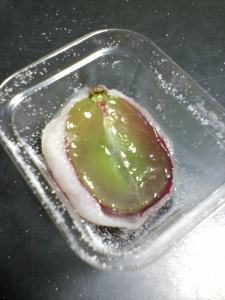
This particular fig, in spite of its green/-yellow skin is ripe!
It is a “banané fig/バナネ無花果”, a French variety. Beautiful and succulent!

Mr. Naitoh grows three types of figs which don’t need any help for pollination: Banané Fig/バナネ無花果, Common Fig/普通無花果, and

and Violet Figs/ヴィオレ無花果, another French variety which turns to a striking black/purple color when ripe!

One cannot replant a fig tree in the same spot from where another fig tree has been rooted out. Mr. Naitoh therefore keeps experimenting even using discarded polysterene boxes!

Mr. Naitoh also grows fig trees in pots to sell to homes and gardeners!

I wouldn’t mind one of those on my balcony!

For a closer look!
Taking care of a fig tree is not so difficult. Don’t forget to cut the fruit-bearing branches at their base in winter. Don’t worry they will grow fast again and produce two crops in July and Ocotober in warm conditions!

As Mr. Naitoh uses no pesticides, in the afternoon he turns hunter and kill the little critters by hand!

Mr. Naitoh is not only a grower but a fine chef!
I bought this succulent-looking fig compote!
I also got his fig jam!

These figs will be delivered as far as Chiba Prefecture on the other side of Tokyo!

Apart of oranges and tea on pieces of land dispersed in the mountains, Mr. Naitoh also cultivates Roselle/ロセル, a variety of hibiscus.
Now, why is he growing flowers in the middle of his orchards?

For food!

The flowers are picked before they open at all.
The core will be discarded and only the red sepal will be kept to be turned into jam!
I got a full bag of them and made my own jam, reminiscent of acid pomegranates. Absolutely beautiful (in taste as well as in looks!)!

Mr. Naitoh accepts private orders of his three types of figs, fig compote, fig jam, roselle, so do not hesitate to call him!

NAITOH ORCHARD/内藤農園
Yoshihiko Naitoh/内藤好彦
Mobile: 09029465250
Tel.: 054-369-1679

RECOMMENDED RELATED SITES:
Warren Bobrow, Bread + Butter, Zoy Zhang, Hungry Neko, Think Twice, Frank Fariello, Mangantayon, Hapabento, Elinluv Tidbit Corner, Tokyo Terrace, Maison de Christina, Chrys Niles,Lexi, Culinary Musings, Wheeling Gourmet, Comestiblog, Chronicles Of A Curious Cook, Tokyo Through The Drinking Glass, Tokyo Foodcast, Palate To Pen, Yellin Yakimono Gallery, Tokyo Terrace, Hilah Cooking, More than a Mount Full, Arkonite Bento, Happy Little Bento; 5 Star Foodie; Jefferson’s Table; Oyster Culture; Gourmet Fury; Island Vittles; Good Beer & Country Boys; Rubber Slippers In Italy; Color Food daidokoro/Osaka;/a; The Witchy Kitchen; Citron Et Vanille, Lunsj Med Buffet/Estonian Gastronomy (English), Cook, Eat, Play, Repeat, Chrisoscope

Please check the new postings at:
sake, shochu and sushi

French Dessert with Shizuoka Ingredients At Tetsuya SUGIMOTO

Ranking
Service: Highly professional and friendly
Equipment: Great overall cleanliness. Beautiful washroom
Prices:~
Strong points:Freshest produce and ingredients only, mainly from Shizuoka Prfecture. Organic vegetables. Seasonal food only

Map (Japanese)
Entirely non-smoking!

If you happen to visit Shizuoka City, you will find many restaurants and izakayas serving and mainly using produce/products and ingredients from Shizuoka Prefecture. There are many treasures to be discovered in this hoard!
One of them is the French restaurant going by the name of Tetsuya SUGIMOTO!
But when it comes to serving desserts mainly made up of Shizuoka ingredients, it is simply a tour de force!

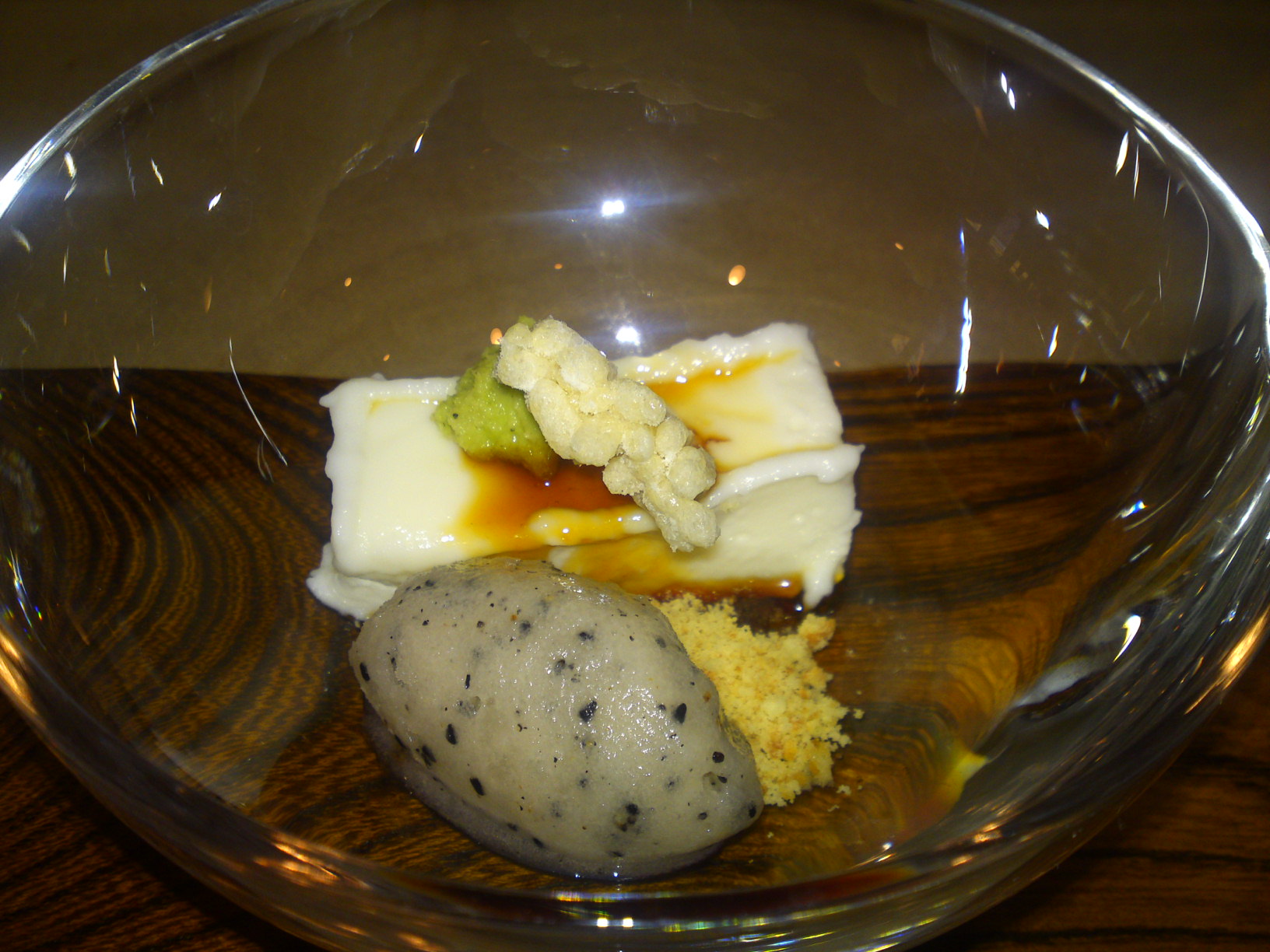
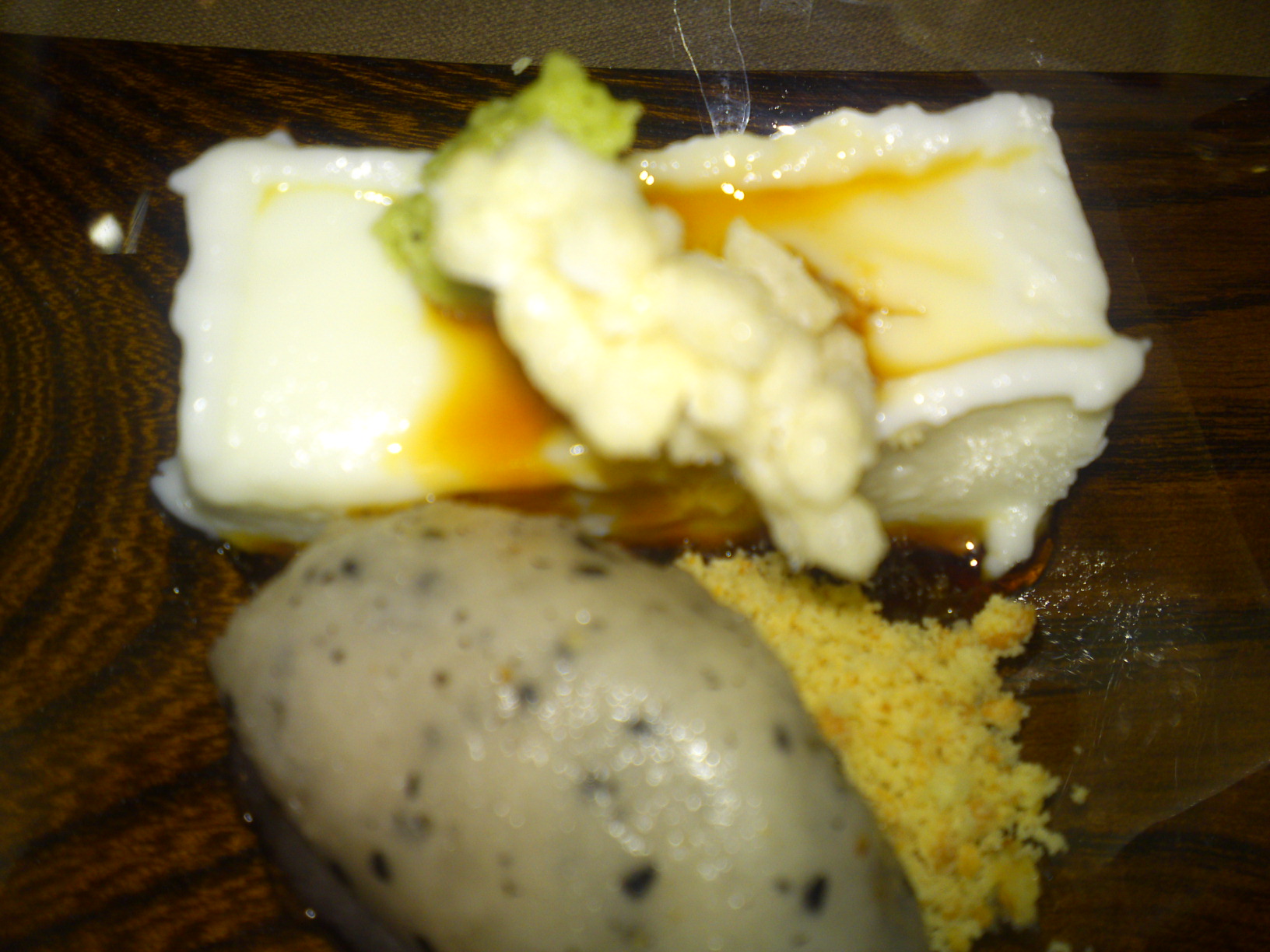
For a closer view!

Now what is that dessert made of?
-First the white part is a blanc manger (pudding) made with rice!
The sauce is a combination of honey and soy sauce while the topping of freshly wasabi and the rice popcorn are also from Shizuoka Prefecture!
-The dragonfruit sorbet with its unusual grey colour for a dessert was made from fruit grown in Shizuoka Prefecture.
-The “powder” is actually crumbled sponge cake for a fine last touch in design, colour and taste!

I wonder what is going to be the next Shizuoka dessert!

Tetsuya SUGIMOTO
420-0038 Shizuoka City, Aoi Ku, Umeya,, 2-13,1F
Tel./Fax: 054-251-3051
Opening hours:11:30~14:30,17:30~21:30
Holidays: undecided
Cedit cards OK
HOMEPAGE

RECOMMENDED RELATED SITES:
Warren Bobrow, Bread + Butter, Zoy Zhang, Hungry Neko, Think Twice, Frank Fariello, Mangantayon, Hapabento, Elinluv Tidbit Corner, Tokyo Terrace, Maison de Christina, Chrys Niles,Lexi, Culinary Musings, Wheeling Gourmet, Comestiblog, Chronicles Of A Curious Cook, Tokyo Through The Drinking Glass, Tokyo Foodcast, Palate To Pen, Yellin Yakimono Gallery, Tokyo Terrace, Hilah Cooking, More than a Mount Full, Arkonite Bento, Happy Little Bento; 5 Star Foodie; Jefferson’s Table; Oyster Culture; Gourmet Fury; Island Vittles; Good Beer & Country Boys; Rubber Slippers In Italy; Color Food daidokoro/Osaka;/a; The Witchy Kitchen; Citron Et Vanille, Lunsj Med Buffet/Estonian Gastronomy (English), Cook, Eat, Play, Repeat, Chrisoscope

Please check the new postings at:
sake, shochu and sushi

Shizuoka Agricultural Products: The Yamaguchis’ Benihoppe Strawberry Fields (beginning of October)

Haruka/晴香, Tamako/玉子 and Mitsuo/光雄 Yamaguchi/山口

This the second part as promised of my interview of the Yamaguchi Family, a major grower of strawberries, exclusively of the Benihoppe variety, in Nirayama, Izu Peninsula. Read the first part for better understanding!

As mentioned before, “Benihoppe” or “Red Cheeks” strawberries is a cultivar which was successfully developed no later than in 2002 in Shizuoka Prefecture. It has since been voted as the best-balanced strawberry in Japan, and Izu Peninsula being near Tokyo, we do not see too many of our fruit on our own market stands!

To cut a long story short I was back at Mishima JR Station yesterday where Haruka Yamaguchi picked me up to give me a lift to her parents strawberry fields.

The Yamaguchis own a total of 15 greenhouses for a total of 1,500 tsubo (4,500 square meters), a fairly large property for a single family in this particular area counting for no less than 187 registered farms!
When you realize that their greenhouses stand in many different locations you can understand the sheer work of only opening and closing the roofs depending upon the weather, humidity and temperature every day! No need to say that when torrential rains fall upon them it becomes a real scramble!

The new strawberry seedlings were finally planted on the 15th of September. A couple of seedlings had been cut out and analyzed to ascertain that the flowers buds were forming.

Now, what is that box for?
A beehive will stand on it 5 days before the first strawberry flowers start blooming.
One just can’t pollinate the flowers without them!
Artificial pollination would be too cumbersome and will not be uniform with the consequence of misshaped fruits.
The Yamaguchis breed their own bees in 16 beehives, one for each greenhouse.
Don’t worry, they eat and share the honey!

Fruit size will depend on how well the flowers are pollinated.
Only the strict minimum of fertilizer will be dispensed until the soil is covered with vinyl sheets.
Weeds will have to be picked out by hand until then.
No pesticides will be used either.
Insects-eating insects will then be introduced!

The Yamaguchis will use large vinyl sheets to close the soil between the seedlings and rows. Instead of making holes in the sheets which tend to damage the seedlings, they join the sheets between the plants with staplers.
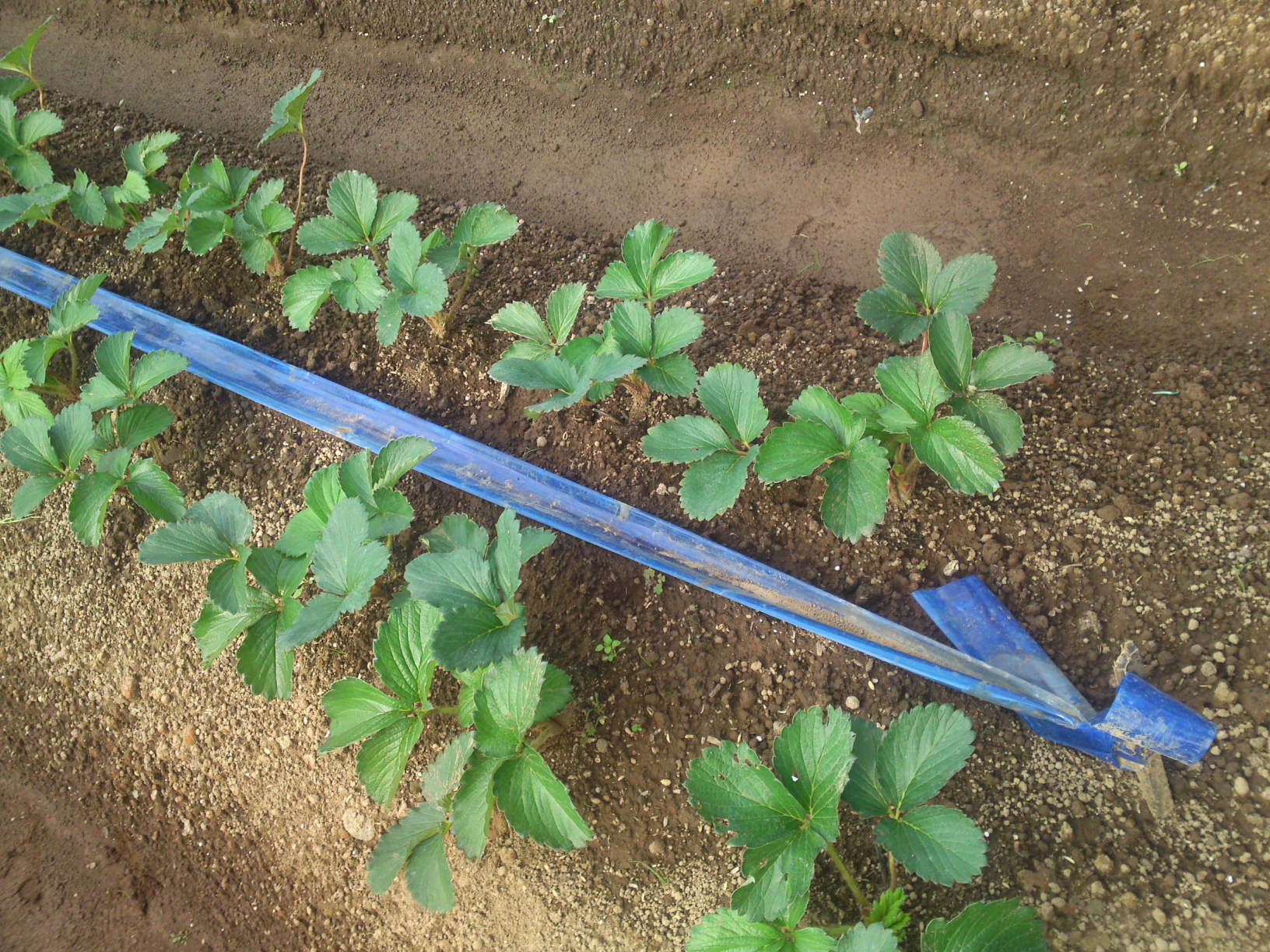
Now, do you see the blue tube running between the plants?

They are actually water hoses (or pipes, as you like)

The water springs out of the tube exactly between the plants.
That is, there will be enough space left between the vinyl sheets for the seedlings to be watered twice a week for 15 minutes.
Clever, isn’t it?

Maintaining the plants and picking the fruit is impossible work to do standing or kneeling.
The Yamaguchis and many other strawberry growers use that clever contraption to “run/roll” between the rows and work in relative ease!

Strawberry season lasts from about November 15th and 31st of May.
The best season are December and May as for sweetness. February see the largest fruits while the largest production occurs in March.

Look forward to my next report in December!

Yamaguchi Benihoppe Strawberry Farm
410-2114, Izu no Kuni, Nan-jo, 8
Tel.: 055-949-2330

RECOMMENDED RELATED SITES:
Warren Bobrow, Bread + Butter, Zoy Zhang, Hungry Neko, Think Twice, Frank Fariello, Mangantayon, Hapabento, Elinluv Tidbit Corner, Tokyo Terrace, Maison de Christina, Chrys Niles,Lexi, Culinary Musings, Wheeling Gourmet, Comestiblog, Chronicles Of A Curious Cook, Tokyo Through The Drinking Glass, Tokyo Foodcast, Palate To Pen, Yellin Yakimono Gallery, Tokyo Terrace, Hilah Cooking, More than a Mount Full, Arkonite Bento, Happy Little Bento; 5 Star Foodie; Jefferson’s Table; Oyster Culture; Gourmet Fury; Island Vittles; Good Beer & Country Boys; Rubber Slippers In Italy; Color Food daidokoro/Osaka;/a; The Witchy Kitchen; Citron Et Vanille, Lunsj Med Buffet/Estonian Gastronomy (English), Cook, Eat, Play, Repeat, Chrisoscope

Please check the new postings at:
sake, shochu and sushi

Vegan Sushi at Sushi Ko (2010/09/16)

For once, thatis last Thursday, the heat has somewhat abated.
We even had welcome rain almost all day long.
The Missus and I did not need more encouragement to pay a belated visit to our favourite sushi Restaurant in Shizuoka Cyt, Sushi Ko.
We did have a lot I will describe in the next posting but I thought my vegan and vegetarian friends would like to see a separate article about vegan/vegetarian sushi!

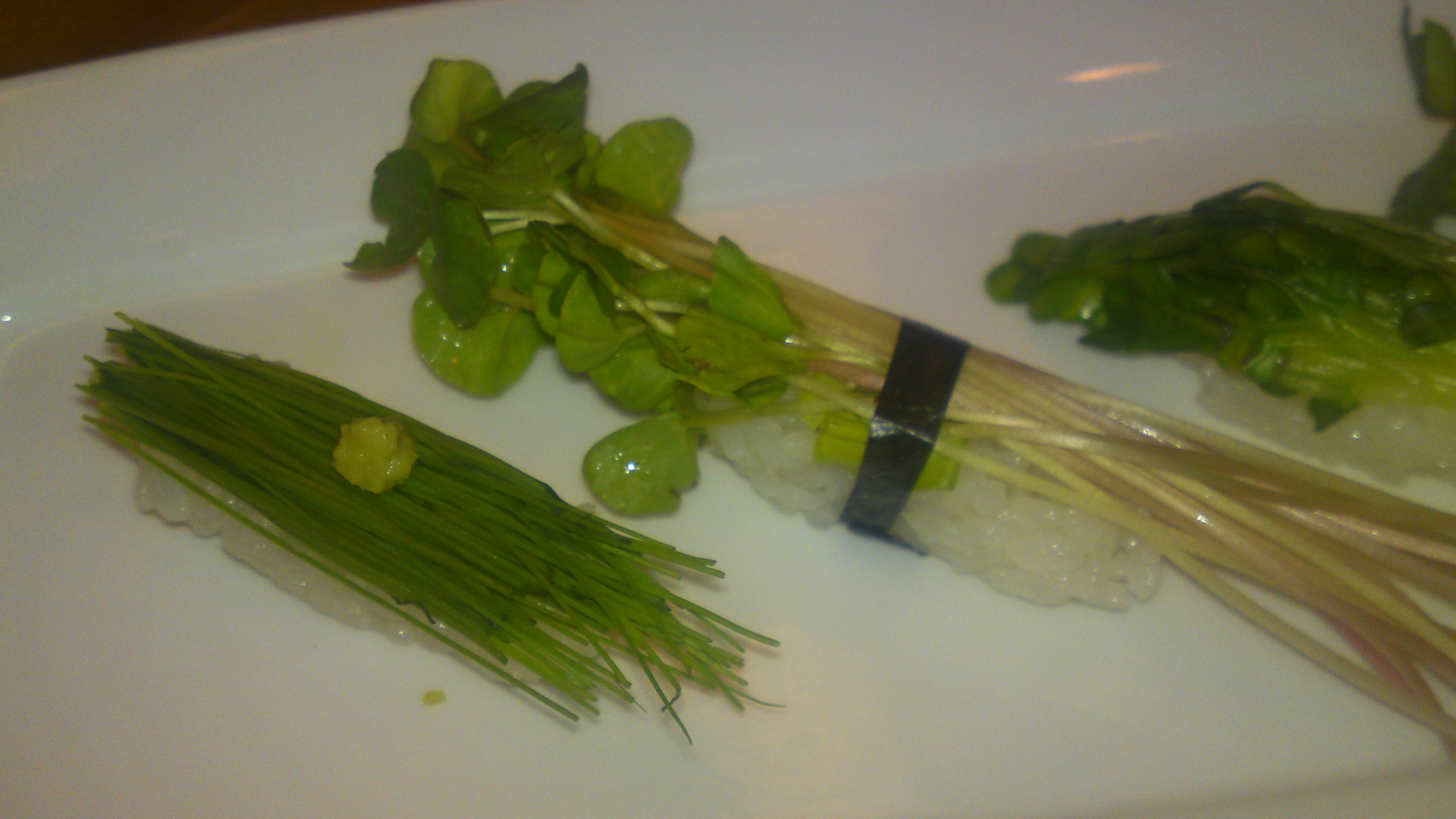
Mr. Oda seved us 5 different types.
The first two are menegi/芽葱 or thin leeks sprouts topped with a little yuzukoshio paste.
The second one is himesoba/姫蕎麦 or buckwheat sprouts secured with a small band of nori/dry seaweed.
Both were serve raw.

The third one was kaiwaredaikon/貝割れ大根 or daikon sprous, boiled and topped with some umeboshi/梅干 pickled Japanese plum paste.
The fourth was raw mitsuba/三つ葉 or Japanese Honeywort secured with a thin band of nori/dry seaweed.

The fifth was mitsuba/三つ葉 or Japanese Honeywort again but slightly boiled and served as gunkan shushi/軍艦寿司 style.

Looking forward to the next visit!

Sushi Ko
Shizuoka City, Aoi Ku, Ryogae-cho. 2-3-1 (Aoba Koen)
Tel.: 054-2512898
Business Hours: 17:00~25:00. 17:00~23:00 (Sundays)
Closed on Wednesdays
Reservations recommended
Credit cards OK
HOMEPAGE (Japanese)

RECOMMENDED RELATED SITES:
Warren Bobrow, Bread + Butter, Zoy Zhang, Hungry Neko, Think Twice, Frank Fariello, Mangantayon, Hapabento, Elinluv Tidbit Corner, Tokyo Terrace, Maison de Christina, Chrys Niles,Lexi, Culinary Musings, Wheeling Gourmet, Comestiblog, Chronicles Of A Curious Cook, Tokyo Through The Drinking Glass, Tokyo Foodcast, Palate To Pen, Yellin Yakimono Gallery, Tokyo Terrace, Hilah Cooking, More than a Mount Full, Arkonite Bento, Happy Little Bento; 5 Star Foodie; Jefferson’s Table; Oyster Culture; Gourmet Fury; Island Vittles; Good Beer & Country Boys; Rubber Slippers In Italy; Color Food daidokoro/Osaka;/a; The Witchy Kitchen; Citron Et Vanille, Lunsj Med Buffet/Estonian Gastronomy (English), Cook, Eat, Play, Repeat, Chrisoscope; Jacqueline Church; The Foodonymph (in Dubai!); Alchemy, Simple Ingredients, magical Food (in Ireland!); Curious Foodie; Mr. Foodie (London/UK)

Please check the new postings at:
sake, shochu and sushi

French Dessert: Roasted Figs, Vanilla Ice Cream & Blue Cheese Sauce at Pissenlit

Service: excellent and very friendly
Facilities: great washroom, great cleanliness overall
Prices: reasonable, good value.
Strong points: Interesting wine list. Great use of local products.
no-smoking-logoentirely non-smoking!

We are about to enter the best season to savour figs and there are plenty available in our Prefecture and City as the climate is particularly propitious for grwoing ll kinds of fruit here.

Figs come in many gusise from small and black to enormous and violet (there also green ones here. I mean green and ripe!).

Tooru Arima at Pissenlit in Shizuoka City came up with an interesting concept in this seasonal dessert.

He first siced the large figs chosen amon still a little green spcimen and roasted them.

He served them with a spoon of vanilla sauce and Roquefort Blue Cheese sauce. There werestill small intact pieces of blue chees inside the sauce.
The combination of sweet, sugared, salty, sweet and sour and others was incredible, especially in regards to the apparent simplicty of the dish!
Too many taste and nusaces to describe, but certainly heaven for sweet teeth woorying about one’s health!

PISSENLIT
420-0839 Shizuoka City, Aoi Ku, Takajo, 2-3-4
Tel.: 054-270-8768
Fax: 054-627-3868
Business hours: 11:30~14:30; 17:00~22:00
Closed on Tuesdays and Sunday evening
Homepage (Japanese)
Credit Cards OK

RECOMMENDED RELATED SITES:
Warren Bobrow, Bread + Butter, Zoy Zhang, Hungry Neko, Think Twice, Frank Fariello, Mangantayon, Hapabento, Elinluv Tidbit Corner, Tokyo Terrace, Maison de Christina, Chrys Niles,Lexi, Culinary Musings, Wheeling Gourmet, Comestiblog, Chronicles Of A Curious Cook, Tokyo Through The Drinking Glass, Tokyo Foodcast, Palate To Pen, Yellin Yakimono Gallery, Tokyo Terrace, Hilah Cooking, More than a Mount Full, Arkonite Bento, Happy Little Bento; 5 Star Foodie; Jefferson’s Table; Oyster Culture; Gourmet Fury; Island Vittles; Good Beer & Country Boys; Rubber Slippers In Italy; Color Food daidokoro/Osaka;/a; The Witchy Kitchen; Citron Et Vanille, Lunsj Med Buffet/Estonian Gastronomy (English), Cook, Eat, Play, Repeat, Chrisoscope; Jacqueline Church; The Foodonymph (in Dubai!); Alchemy, Simple Ingredients, magical Food (in Ireland!); Curious Foodie; Mr. Foodie (London/UK)

Please check the new postings at:
sake, shochu and sushi

French Cuisine: Shizuoka Organic Tomato Appetizer at Pissenlit

Service: excellent and very friendly
Facilities: great washroom, great cleanliness overall
Prices: reasonable, good value.
Strong points: Interesting wine list. Great use of local products.
no-smoking-logo!

As mentioned before, Shizuoka Prefecture is famous all over the country for its tomatoes, especially organic and sweet.
These turn easily into real fruit (as they should be), and I just don’t count how many I eat back home just to refresh myself!

Mr. Tooru Arima had finally announced on his menu board outside his restaurant that he received those great sweet tomatoes gron by Mr. Ishitani In Hamamatsu City!

It was very easy to convince the Missus to sample them!

The dish we were served could be classified under many appellations as it could be considered as an apetizer, a salad or even a dえssert.

Mr. Arima placed quarters of tomatoes around the centre surmounted with mozarella slices and organic greens and basil pesto.
The vinigrette was more a kind of gaspacho made of fine olive oil, juice/coulis for the tomatoes and other seasoning!

The whole concept became very interesting with (same) tomato jelly in the very centre, soft and light, with a topping of (same) omato sherbet!

The perfect appetizer for thirsty customers in scorching summer!

PISSENLIT
420-0839 Shizuoka City, Aoi Ku, Takajo, 2-3-4
Tel.: 054-270-8768
Fax: 054-627-3868
Business hours: 11:30~14:30; 17:00~22:00
Closed on Tuesdays and Sunday evening
Homepage (Japanese)
Credit Cards OK

RECOMMENDED RELATED SITES:
Warren Bobrow, Bread + Butter, Zoy Zhang, Hungry Neko, Think Twice, Frank Fariello, Mangantayon, Hapabento, Elinluv Tidbit Corner, Tokyo Terrace, Maison de Christina, Chrys Niles,Lexi, Culinary Musings, Wheeling Gourmet, Comestiblog, Chronicles Of A Curious Cook, Tokyo Through The Drinking Glass, Tokyo Foodcast, Palate To Pen, Yellin Yakimono Gallery, Tokyo Terrace, Hilah Cooking, More than a Mount Full, Arkonite Bento, Happy Little Bento; 5 Star Foodie; Jefferson’s Table; Oyster Culture; Gourmet Fury; Island Vittles; Good Beer & Country Boys; Rubber Slippers In Italy; Color Food daidokoro/Osaka;/a; The Witchy Kitchen; Citron Et Vanille, Lunsj Med Buffet/Estonian Gastronomy (English), Cook, Eat, Play, Repeat, Chrisoscope

Please check the new postings at:
sake, shochu and sushi

Egg Farm in Shizuoka City: Bi-Ou-Ran (Part 2)

Mr. Shigeru Shimizu/清水茂

As explained in my previous article I was back on the bicycle trail on Saturday with the difference was that I reached the place in record time in spite of the oppressive heat!

I wonder how many tonnes of feed are contained in these silos and accordingly, how many birds are inside the coops!
After all, the whole place covers no less than 1,500 tsubos (4,300 quare meters), big for a single producer in Japan!

The whole complex is surrounded by a tall hedge to protect it from the wind and help control the ambiant temperature.

Incidentally, I noticed that the silos were also protected against the variations of temperature.

I finally found the real entrance to the compound which opens at the very back, away from unknown eyes!

I quickly met Mr. Shimizu who asked me to wait for a while as he was busy with a small emergency. He offered me to stay inside in the cool, but I declined as snooping around is a bad habit of mine!LOL
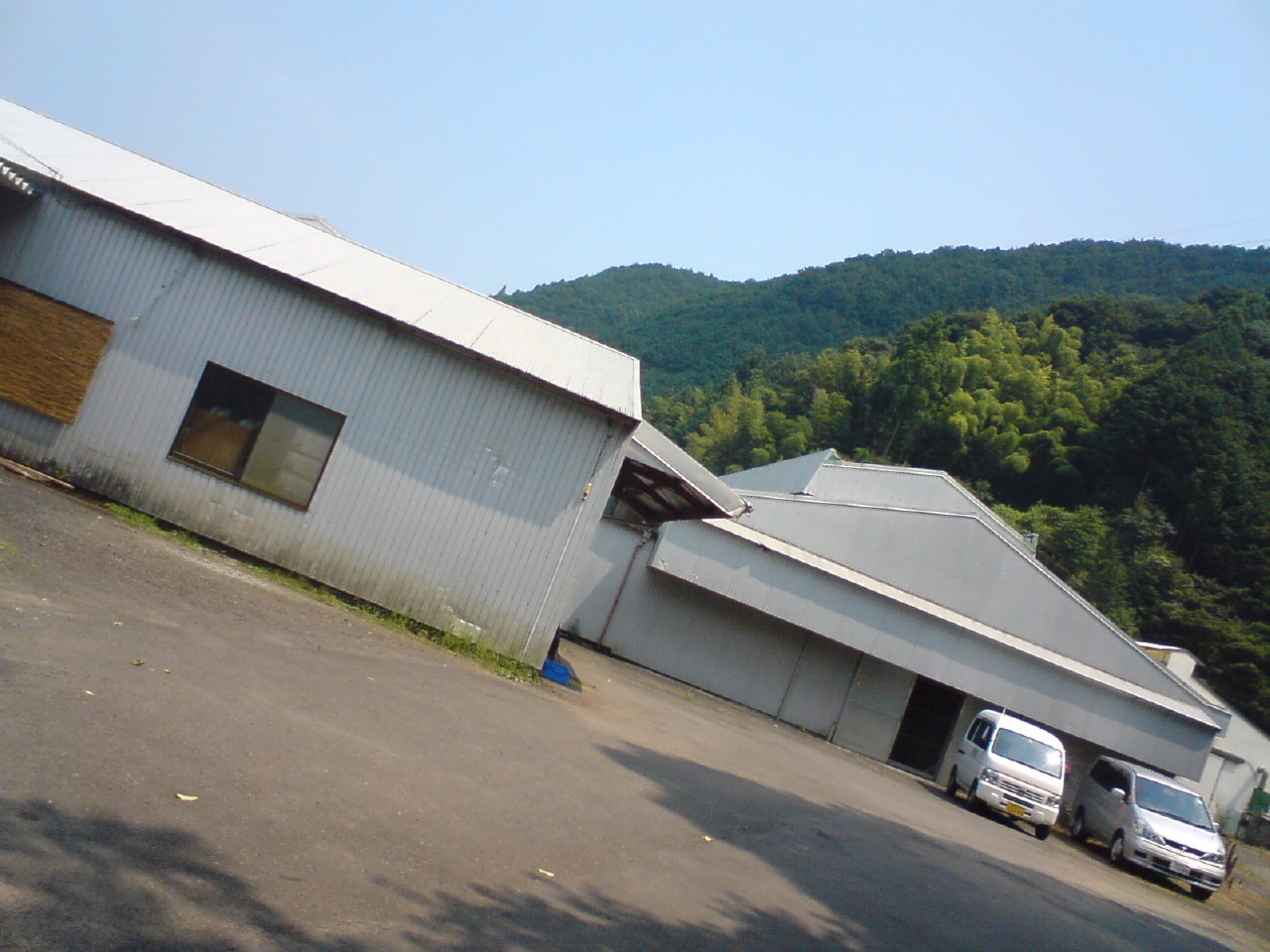
It is located very much in the middle of the nature with a beautiful mountain background.

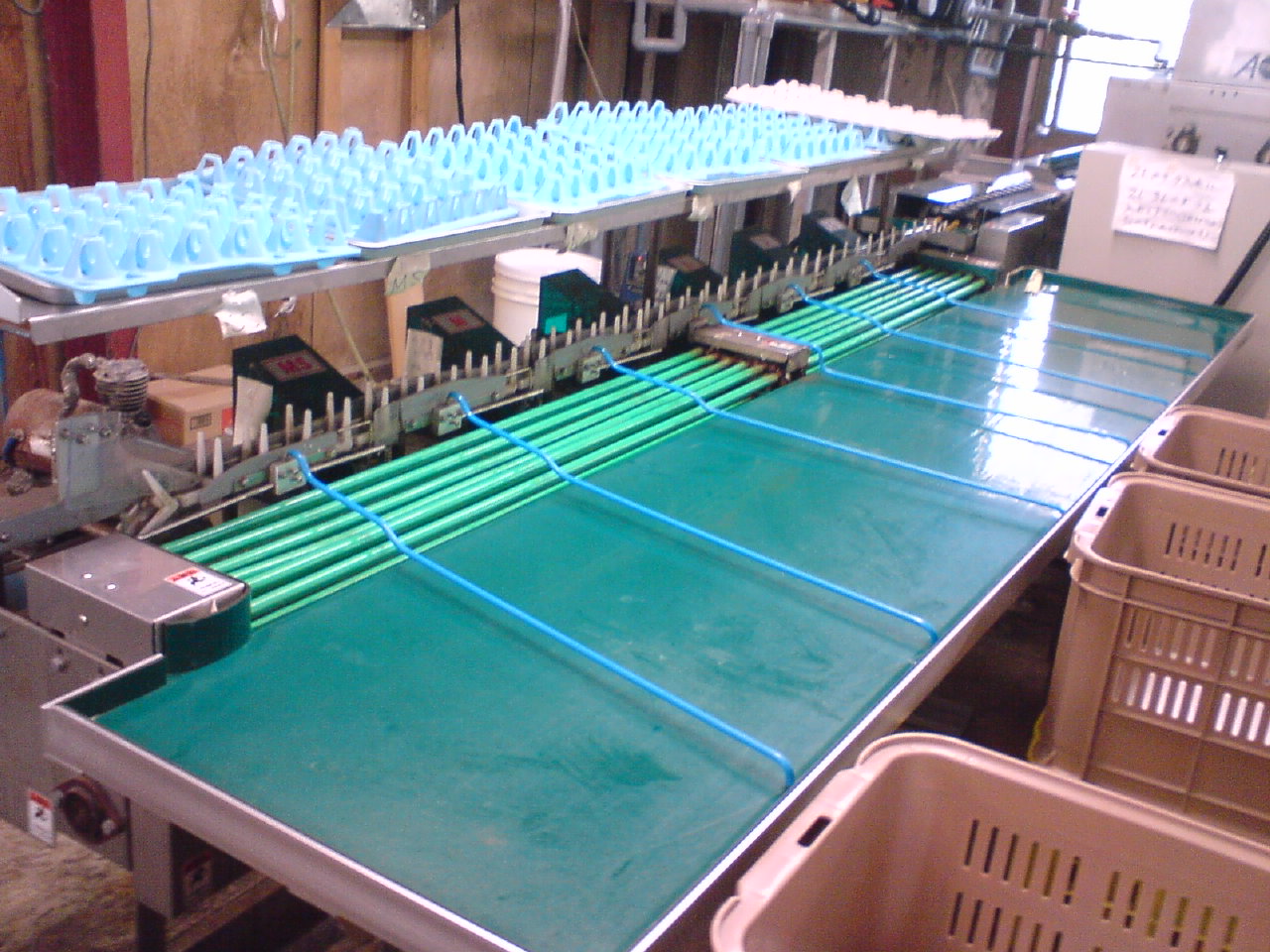
Hand egg-calibrating machine.

I was finally admitted inside, and knowing we were limited in time, I started firing questions.

-When was the egg farm founded?
-1996

-How long have you been actually working in the business?
-Let’s see. I’m 57. I started at 25. 32 years!

-When were you awarded a brand name for your eggs?
-In 1996 (that was quick!).

-How many hens (no cockerel needed whatsoever. I didn’t know!)?
-14,000 (geez!).

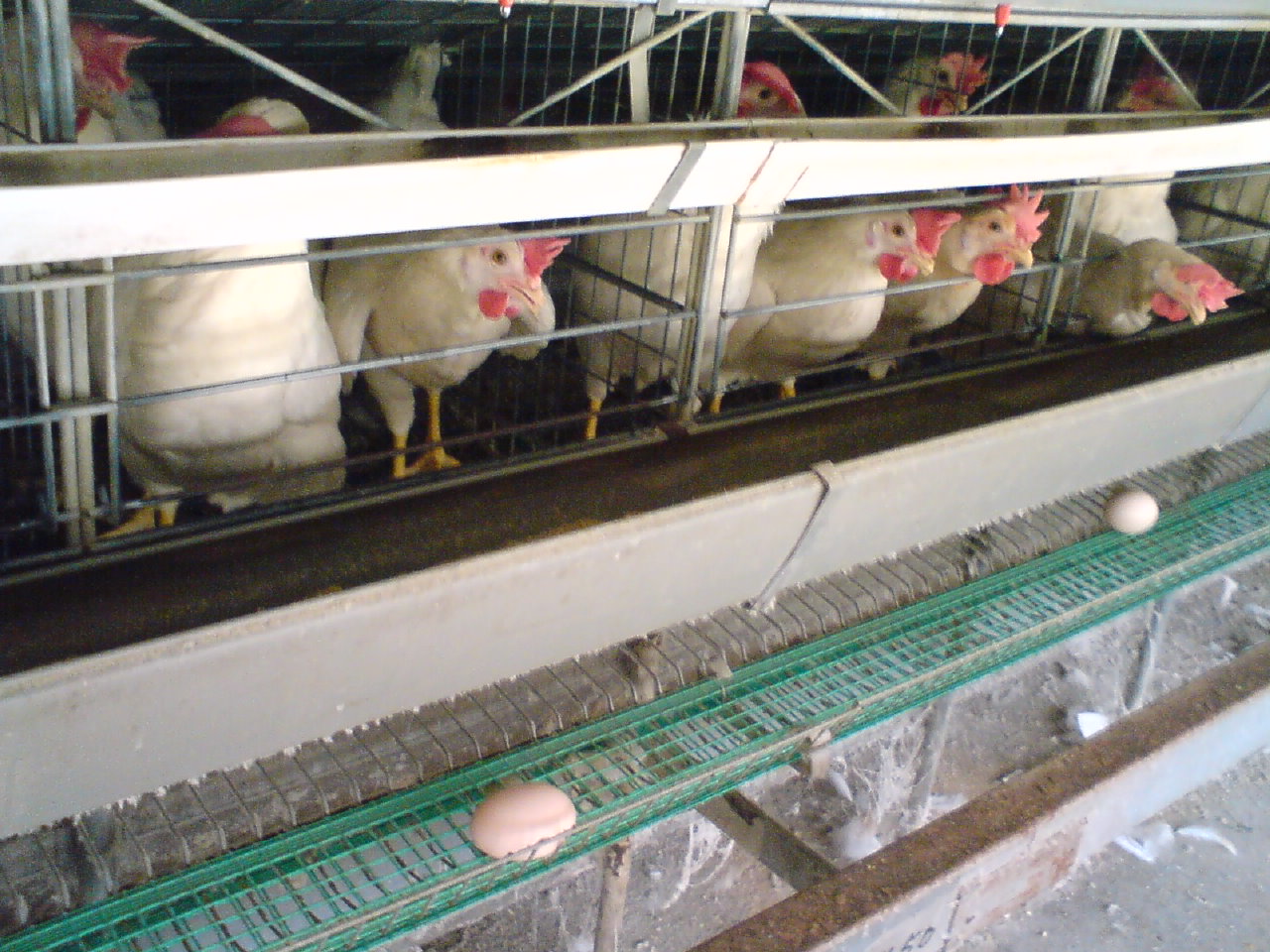
I had trouble keeping my hands off these beauties.

-Then how many eggs do you produce a day?
-About 1,200, but that’s little compared to industrial farms. We strive for quality, not quantity (even so, that’ s a lot to me!). We expect each to produce between 280 and 300 eggs.

-You need quite some staff, then?
-We are 10 in all. That’s enough, although we do have to work in shifts (that was said with a knowing smile, meaning Mr. Shimizu was working all day!).
-How long lasts a working day, then?
-7:00 to 7:00, 12 hours. The hens have to sleep. No forced laying here! (good to know!)

-How do you grade your eggs?
-By size first, into 7 different sizes. The largest are reserved for cake-shops and restaurants. The shell quality has to be the same, and the only way to check it is by touch, sight and experience.

-How many kinds of hens do you breed?
-Two only, Sakura and Momiji. It is enough since we strive for only one kind of yolk, whatever the color of the shell.

-That is a lot of hens, still. How long is their life span?
-As far as the egg-laying season is concerned, only one year. Which means an almost constant turn over. Even so, the hens have to be regulary vaccinated after we get the chicks from a designated hatchery. There are many keys to producing a good product (I didn’t have to ask the questions, as Mr. Shimizu warmed up to the subject. I had told him I was born in the country, and that the questions would not be too general, although I would be careful not to delve in trade secrets!):
The hens must naturally stay healthy. We personally check them everyday. This is not an industrial farm where productivity is placed above the animals’ comfort. They are actually penned in smaller numbers than usual.

Interestingly enough, the hens were not nervous at all. Their crests looked so healthy!

-How do you dispose of the droppings?
-Mixed with other ingredients, they will become fertilizer we sell to local farmers.
-Almost organic, then?
-Yes, almost.
-What about the hens which die on the way?
-We ask a specialized disposal company to take care of them.
-What do you do with the hens after the year has elapsed?
-We sell them to a specialized butcher.
-For how much?
-5 yen per head.
-That’s not much, isn’t it?
-You are telling me!

-What kind of feed do you nourish them with?
-A recipe of our own only.
Mr. Shimizu handed me then a pamphlet with all the ingredients clearly stated. I counted no less than 22, 12 of them not found in industrial egg farms. Enumerating them would be fastidious but I have kept the pamphlet for your questions. It is certainly impressive! At least I can affirm that the corn used is not GM and that some ingredients include garlic and paprika!

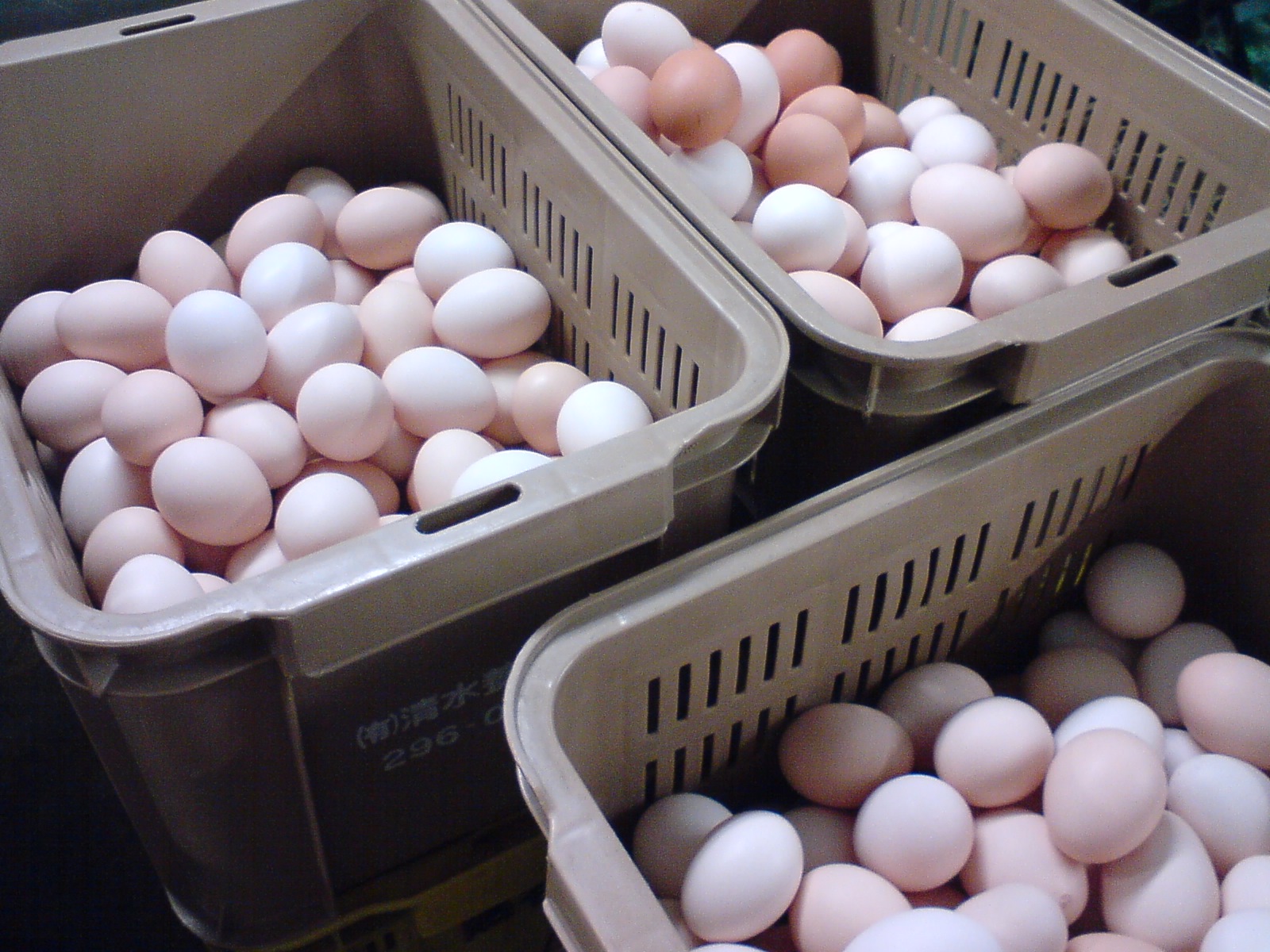
The egss! I came too late. They had already been collected!
One thing is for sure: a soft shell wouldn’t take that shock. No wonder Mr. Shimizu’s eggs are so popular!

The eggs are transported in a cute van!

Mr. Shimizu delivers his eggs to no less than 21 main distributing shops and to no less than 40 restaurants and cake shops. I counted them, but I’m pretty sure they do not include special customers!

The sign to the original shop!

Please remind me I have to buy some for the Missus’ tamagoyaki!

Bi-Ou-Ran
Shimizu Chicken Farm
421-2112, Shizuoka City, Aoi Ku, Endo Shinden, 41-3
Tel.: 054-296-0064

RECOMMENDED RELATED SITES:
Warren Bobrow, Bread + Butter, Zoy Zhang, Hungry Neko, Think Twice, Frank Fariello, Mangantayon, Hapabento, Elinluv Tidbit Corner, Tokyo Terrace, Maison de Christina, Chrys Niles,Lexi, Culinary Musings, Wheeling Gourmet, Comestiblog, Chronicles Of A Curious Cook, Tokyo Through The Drinking Glass, Tokyo Foodcast, Palate To Pen, Yellin Yakimono Gallery, Tokyo Terrace, Hilah Cooking, More than a Mount Full, Arkonite Bento, Happy Little Bento; 5 Star Foodie; Jefferson’s Table; Oyster Culture; Gourmet Fury; Island Vittles; Good Beer & Country Boys; Rubber Slippers In Italy; Color Food daidokoro/Osaka;/a; The Witchy Kitchen; Citron Et Vanille, Lunsj Med Buffet/Estonian Gastronomy (English), Cook, Eat, Play, Repeat, Chrisoscope

Please check the new postings at:
sake, shochu and sushi

Shizuoka Agricultural Products: The Yamaguchis’ Benihoppe Strawberry Fields (end of July)

“Benihoppe” or “Red Cheeks” strawberries is a cultivar which was successfully developped no later than in 2002 in Shizuoka Prefecture. It has since been voted as the best-balanced strawberry in Japan, and Izu Peninsula being near Tokyo, we do not see too many of our fruit on our own market stands!

Now, by sheer coincidence a university student of mine, Haruka Yamaguchi/山口春香, just happened to come from a family, based in Nirayama located in the newly named Izu No Kuni City/伊豆の国市, who have switched to the growing of Benihoppe Strawberries as soon as their cultivar was made available through their cooperative!

To make things even easier, Mr. Izuzawa/伊豆沢秀慶, belonging to the government-sponsored local JA (Japan Agriculture) office, was there on hand to provide me with piles of welcome information. Mind you, I had done a bit of preparation as I had asked Haruka to distribute some business cards to the local farming community!

Mitsuo/光雄 and Tamako/玉子 Yamaguchi are the second generation of strawberry growers in their family. Strawberry culture is big in that particular area as it counts no less than 187 registered farms!
The Yamaguchis’ plot covers 1,500 tsubo (4,500 square meters), a fairly sizeable land in this country, and I don’t include other pieces of land here and there they use for re-planting and so on!
As I said, they switched from Akihime Strawberries to Benihoppe Strawberries as soon possible, and this was certainly a good move.
They employ 3 people on a permanent basis and a couple more at harvest time.

Strawberry culture is more complicated than it looks at first, and I didn’t realize how much I would have to go through (and more later) through this interview.
Abroad, for purposes of commercial production, plants are propagated from runners and, in general, distributed as either bare root plants or plugs. Cultivation follows one of two general models, annual plasticulture or a perennial system of matted rows or mounds. A small amount of strawberries are also produced in greenhouses during the off season.
Now, the Japanese seem to do all that at the same time.
End of March every year the original strawberry seedlings are first acquired from Cooperative nurseries and planted under into a “parent soil”.
Runners are encouraged to developped and are re-planted in small elongated pots called “Nira” (as of Nirayama) pots, an idea locally developped.

Interestingly enough, the “nira” pots are not filled with soil, but with a mixture of peat moss and shredded palm fronds and some fertilizer.

The fertilizer is “IBSI 1” sold at the Cooperative. The Yamaguchis were kind enough to show me a bag of it and

its contents. If one can manipulate it with bare hands (Mrs. Yamaguchi’s in this case) there is little doubt the fertilizer is easy on the environment!

The runners are encouraged onto new seedlings into at least 3 successive “nira” pots.

The strawberry plants will be cultivated separately in open air until the middle of August.

Then the vynil covers will be drawn over the greenhouses and ventilators will reduce the temperature as low as 15~18 degrees Celsius to “trick” the strawberries into believing thay are back into winter.

This is the easy way…
Until 15 years ago, when giant refrigerating ventilators were not used, all the seedlings had to be carried by truck up on the slopes of Mount Fuji as high as the Second Trek Station!

By the middle of September, one seedling will be completely cut out and examined to decide whether the time is ripe for re-planting in real soil inside greenhouses.

The greenhouses are already being prepared and this does involve more work and costly specialized equipment.

The method will then be more traditional with plasticulture system. In this method, raised beds are formed each year, fumigated, and covered with plastic to prevent weed growth and erosion.
Holes will be opened for individual re-planting.

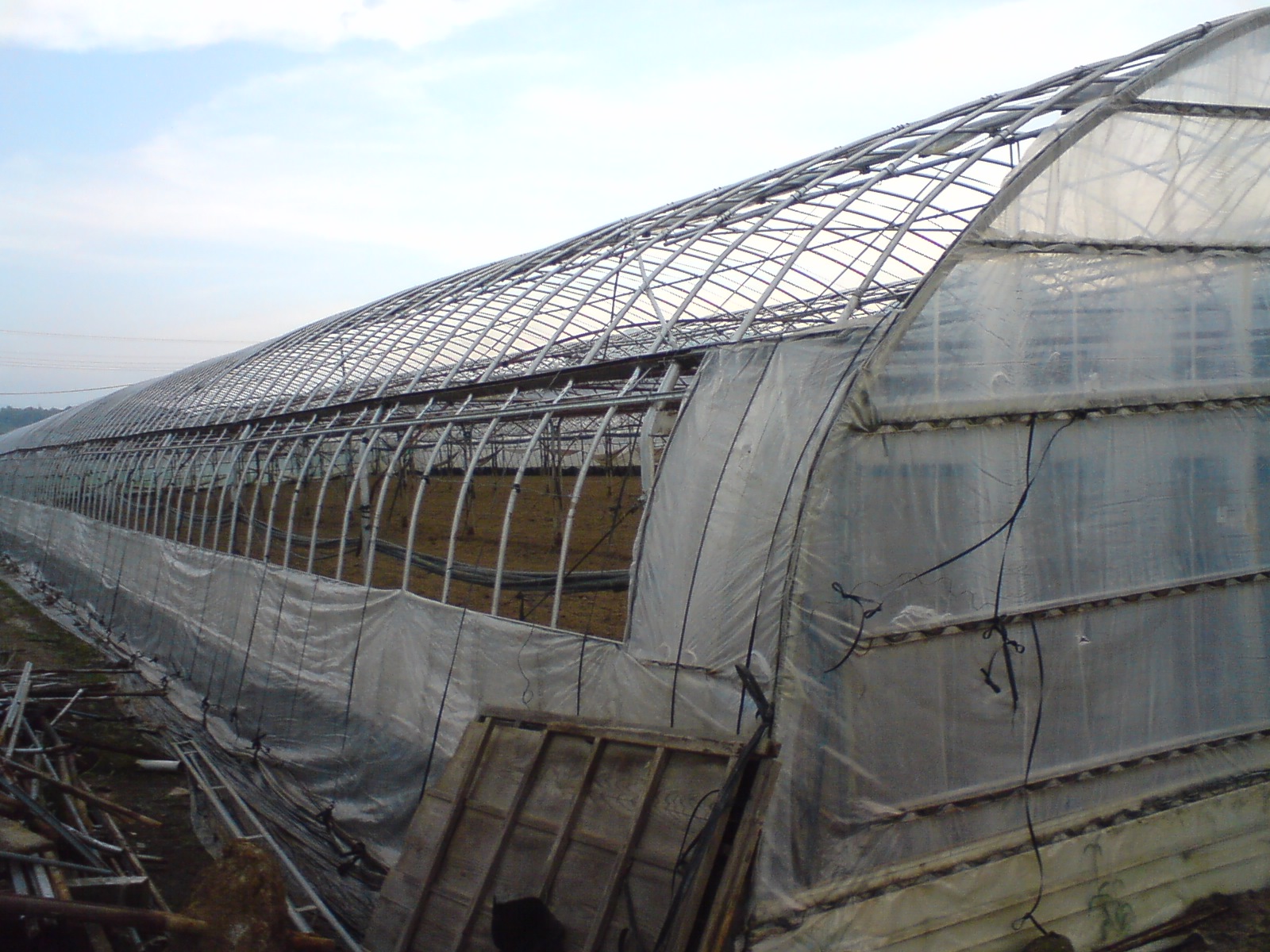
The greenhouses along the road crossing the rice paddies.

Harvesting will start in November and lasts until May with up to 6 peaks.

But that is for the next report!

Yamaguchi Benihoppe Strawberry Farm
410-2114, Izu no Kuni, Nan-jo, 8
Tel.: 055-949-2330

RECOMMENDED RELATED SITES:
Warren Bobrow, Bread + Butter, Zoy Zhang, Hungry Neko, Think Twice, Frank Fariello, Mangantayon, Hapabento, Elinluv Tidbit Corner, Tokyo Terrace, Maison de Christina, Chrys Niles,Lexi, Culinary Musings, Wheeling Gourmet, Comestiblog, Chronicles Of A Curious Cook, Tokyo Through The Drinking Glass, Tokyo Foodcast, Palate To Pen, Yellin Yakimono Gallery, Tokyo Terrace, Hilah Cooking, More than a Mount Full, Arkonite Bento, Happy Little Bento; 5 Star Foodie; Jefferson’s Table; Oyster Culture; Gourmet Fury; Island Vittles; Good Beer & Country Boys; Rubber Slippers In Italy; Color Food daidokoro/Osaka;/a; The Witchy Kitchen; Citron Et Vanille, Lunsj Med Buffet/Estonian Gastronomy (English), Cook, Eat, Play, Repeat, Chrisoscope

Please check the new postings at:
sake, shochu and sushi

Shizuoka Agricultural Products: Aoi Farm

Asabata District in Shizuoka City has been long known as a farming community area. It used to be mostly marshlands in the very far past but is now almost exclusively farmland.

I just cannot count the times I have leisurely cycled through that area. Even so I still make a lot of discoveries.
The other Sunday, as I had little to do, I thought of cycling again through that particular area.
That is when I found Aoi Farm just in front of a rehabilitation hospital.

There are many almost identical farms in the vicinity. But this one looked a bit different.

It was bleeding hot and the sharp sun prevented me from taking good shots.

“Please visit freely”, the sign said. I gladly obliged.
A lady was watering the fruit trees there.
“Good afternoon! May I take some pictures please?” I asked somewhat impertinently
“Please, do as you like!”
“Thank you so much!”

It was not all fruit trees but also flowers and all kind of decorative trees. All could be bought right away. Cypresses, Japanese maples and many trees I just was ignorant of their names.

What kind of pine is that…?

That’s a blueberry tree? No way! But that’s what the name tag says!
About time I politely introduced myself!
I returned to the lady and explained the “real reason” I came here. She was certainly caught by surprise and replied I’d better talk to her husband.
(Tell the truth I prefer interviewing ladies to gentlemen, whatever their age! LOL)

Let’s take a pic of those roses on the way…

Her husband went by the name of Takao Inaba.
A bit shy, he was nonetheless very kind and patient with me!
At the age of 62 he retired in 2007 from his “usual” farming job (that is, growing rice) and has been working on his orchard for 3 years now.

These big fruits are blueberries? Well, I didn’t want look stupid with more foolish questions, so I refrained from asking (LOL).

These look like blueberries!

Blueberries are the main culture, no less than 90 varieties.
-Really?
-Sure! But since our customers wouldn’t know even a few of them, I just strive on cultivating delicious ones…

Since this is a blueberry farm, let’s take more pics!

-What is the total area?
-900 tsubo (multiply this by 2.3 to convert into square metres)
-What kind of fertilizers do you use?
-That depends on the season, but I get all of them directly from the farmers’ Cooperative!

-Apart of blueberries, what do you mainly grow?
-Citrus varieties, especially mikan (mandarines).

More blueberries?

-Recently the weather has been quite unpredictable. Any problems?
-Plenty! The weather has indeed gone mad!

Blueberries as big as my thumb nail!

-Do you have any children?
-Sure, I do!
-Are they farming, too?
-No way! Impossible!
-Why is that?
-I would be able to pay tem only 200 yen (2 US$) an hour!

These blueberry trees are not for sale. Their fruit are sold at the Farmers’ Cooperative.

Takao Inaba, in spite of retiring, apparently had to continue working and I can guarantee you that at the age of 65 he is fighting hard!
He told me that he was feeling his age, but he was certainly far healthier than a lot of people of his age that I know! Life as a farmer might be tough, but it is healthy!

Are these dwarf apples?
I’ll have to ask during my next visit!

Aoi Farm
Shizuoka City, Aoi Ku, Asabata, Akamatsu, 7
Business hours09:00~17:00
Holidays: Mondays & Tuesdays
Tel. 054-2459380(Home)

RECOMMENDED RELATED WEBSITES:
-Sake: Tokyo Through The Drinking Glass, Tokyo Foodcast, Urban Sake, Sake World
-Wine: Palate To Pen, Ancient Fire Wines Blog
-Beer: Good Beer & Country Boys, Another Pint, Please!
-Japanese Pottery to enjoy your favourite drinks: Yellin Yakimono Gallery
-Drink Lovers of The World:
5 Star Foodie Culinary Adventures; Warren Bobrow; Tokyo Terrace; Chez What?
Pran Gravy Kadai Curry; My Kitchen Treasures; Indulge Inspire Imbibe; Simple Math Bakery; Cheap Ethnic Eatz; Taste With The Eyes; Jacob’s Kitchen; The Pink Apron; Kopiatse…To Greek Hospitality; Zomppa; The Baking Barrister; The Witchy Kitchen; What’s Cooking Italian Style Cuisine; Nirmala’s Cooking Corner; Ancient Fire Wines; The Ardent Epicure

————————-
英語を読めれば次のブログを是非ご覧になって下い!
Shizuoka Sake
Shizuoka Shochu
Shizuoka Sushi
Shizuoka Gourmet

White Strawberries Tart!

Do you remember this posting about Strawberries Facts & Tips?

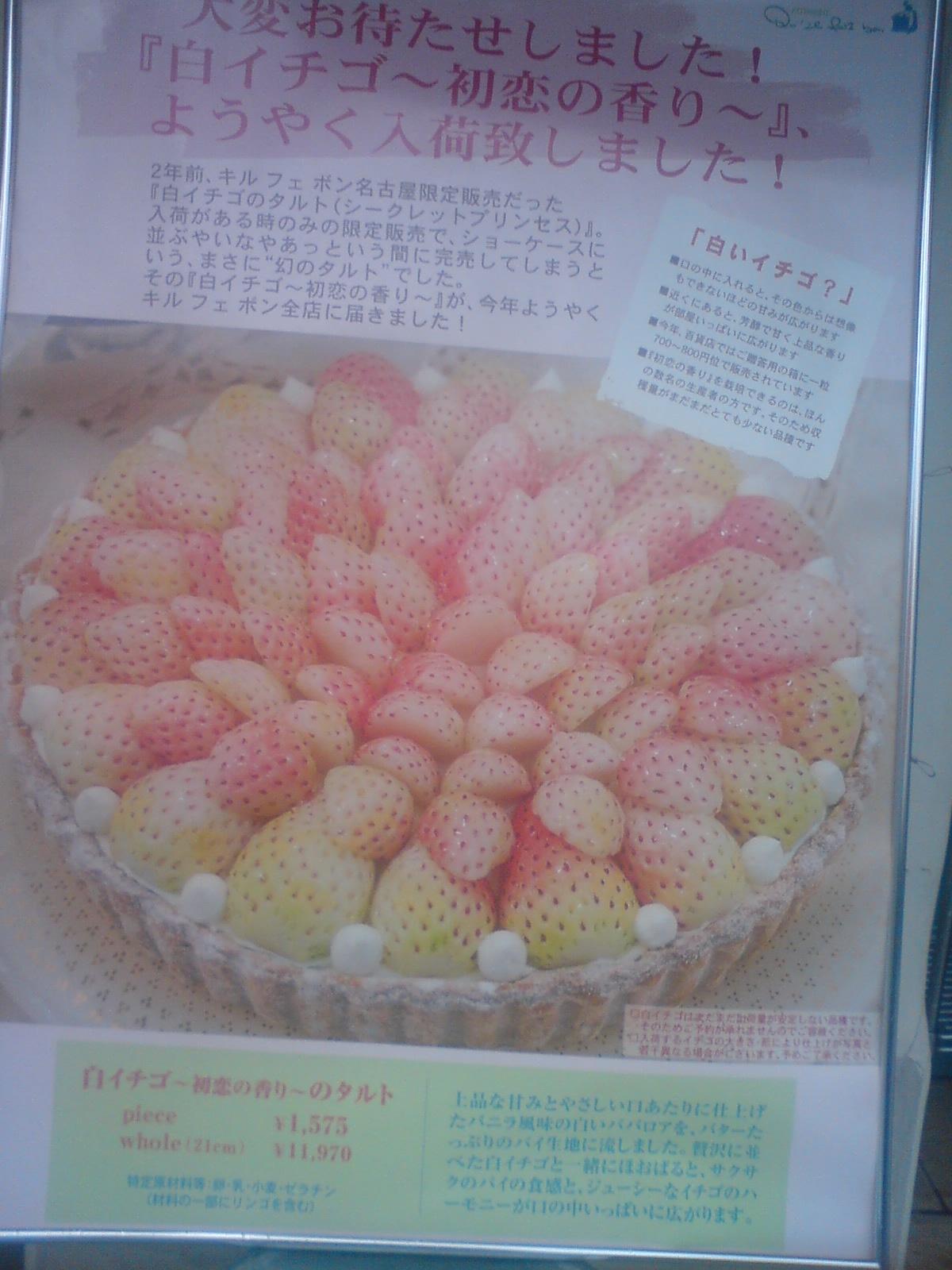
I introduced the “Hatsukoi no kaori/the Scent of First Love!” White Strawberry developped in 2006. Probably the most expensive strawberry in the world!

I also mentioned that its flesh is completely white while the skin is ivory with red seeds. It is not an albino strawberry!
But the taste is somewhat average.

Just discovered that Qu’Il Fait Bon, a large cake store has just been advertizing their new tart under the name of “Shiroi Ichigo~Hatsu Koi No Kaori/白いイチゴ~初恋の香り/White Strawberries=the Scent of First Love”!

At 1,575 yen a portion (16 US $) or 11,970 yen for the whole tart (125 US $), one (s) had better make sure this first love is the last and true one!LOL

RECOMMENDED RELATED SITES:
Warren Bobrow, Bread + Butter, Zoy Zhang, Hungry Neko, Think Twice, Frank Fariello, Mangantayon, Hapabento, Elinluv Tidbit Corner, Tokyo Terrace, Maison de Christina, Chrys Niles,Lexi, Culinary Musings, Wheeling Gourmet, Comestiblog, Chronicles Of A Curious Cook, Bento Boutique, Tokyo Through The Drinking Glass, Tokyo Foodcast, Urban Sake, Sake World, Palate To Pen, Yellin Yakimono Gallery, Tokyo Terrace, Hilah Cooking, More than a Mount Full, Arkonite Bento

Please check the new postings at:
sake, shochu and sushi

—————————————-
日本語のブログ
—————————————-

Strawberries: Facts & Tips

I was going to start an information series on Fruits like I’m doing for vegetables, but after realizing the enormous task I decided to limit myself to the fruits popular and grown in Japan.
Believe there are enough!

Why do I start with strawberries?
Can you guess?
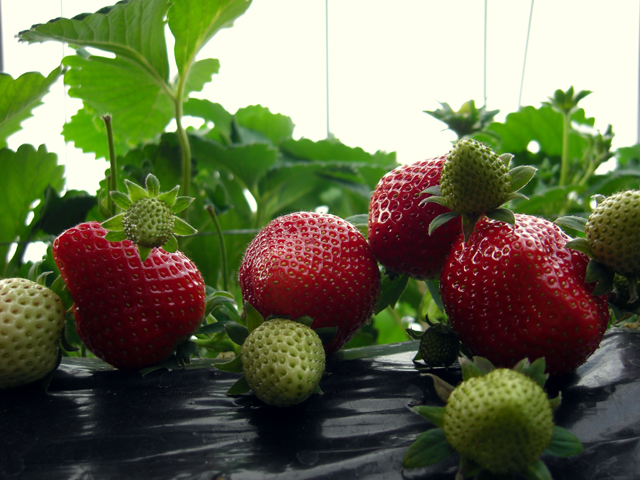
Shizuoka Prefecture with more 1,500 strawberry commercial growers officially registered is called “Ichigo no Ookoku/Strawberry Kigdom” in Japan!

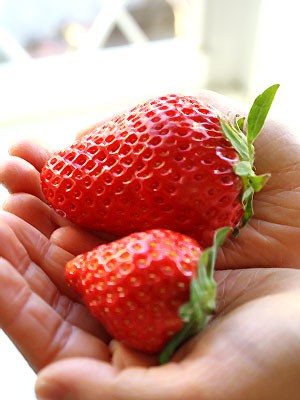
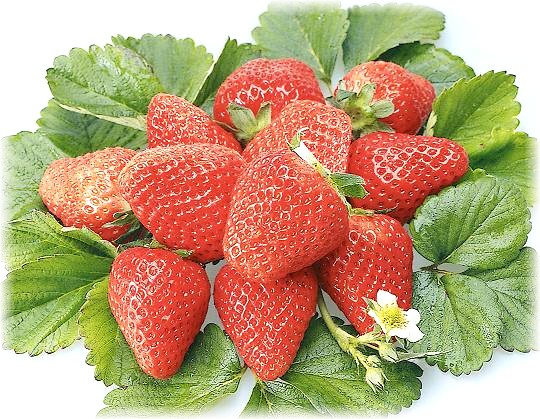
The garden strawberry is a common plant of the genus Fragaria which is cultivated worldwide for its fruit, the (common) strawberry. The fruit is widely appreciated, mainly for its characteristic aroma but also for its bright red color, and it is consumed in large quantities — either fresh, or in prepared foods such as preserves, fruit juice, pies, ice creams, milk shake, etc..

The garden strawberry was first bred in Bretagne/Brittany, France in 1740 via a cross of Fragaria virginiana from eastern North America , which was noted for its flavor, and Fragaria chiloensis from Chile and Argentina brought by Amédée-François Frézier, which was noted for its large size.

Cultivars of Fragaria × ananassa have replaced, in commercial production, the woodland strawberry, which was the first strawberry species cultivated in the early 17th century.

TIPS:

-Best season for natural Strawberries is May~June
For green house-cultivated, hydroponically or not, specimens the season is from December to April.

-To preserve them, don’t wash them, cover themlightly with cellophane paper and keep them inthe vegetable compartment of your refrigerator.
If you want to freeze them, get them rid of their leaves and stem first, then wash them and drain them thoroughly.

-if you wish to wash them, leave them in clear cold water for 5 minutes. If you take the leaves and stem out before washing them, they will lose a lot of their vitamin C.

-Wherever possible, don’t take the leaves and stem out before eating them. Strawberries in decoration cakes have lost large amounts of tehir beneficial elements!

-Eat strawberries after drinking alcohol or when stressed! You will be surprised how much they help!

VARIETIES:

Although Japan was late in starting growing strawberries, they probably have the largest number of varieties!

“Benihoppe/Red Cheeks”
A recent cultivar developped in Shizuoka Prefecture!
Really sweet, but with a striking balance with just enough acidity.
Most of them go to Tokyo!

“Amaou/Sweet, Round & Big”
From Fukuoka Prefecture. Sweet and a little acidity.

“Nyohou”
From Tochigi Prefecture. Juicy. Cultivation has recently decreased.

“Tochiotome”
From Tochigi Prefecture. The most common in Japan. Very sweet.

“Moikko/One More Please”
From Miyagi Prefecture. Round and refreshingly sweet.

“Sagahonaka”
From Saga Prefecture. Extensively sold in Western Japan. Very sweet.

“Hatsukoi no kaori/the Scent of First Love!”
Developped in 2006. Probably the most expensive strawberry in the world.

Its flesh is completely white while the skin is ivory with red seeds. It is not an albino strawberry!
But the taste is somewhat average.

“Aiberi/Love Berry”
From Aichi Prefecture. High qaulity and expensive. Great balance. Red flesh.

“Toyohime”
Very popular with “strawberry picking tours”. Very sweet.

“Sachinoka”
High in sugar. Popular for its high sun resistance.

“Yayoihime”
From Gunma Prefecture. Ver sweet. Especially available in December (in time for the celebrations!).

“Hinoshizuku”
From Kumamoto Prefecture. High in sugar, low acidity. Available from December, too!

“Yumenoka”
From Aichi Prefecture. Very juicy and great balance.

FACTS:

Strawberries contain a great amount of Vitamin C and flavonoids.
7 medium-sized strawberries contain enough Vitamin C for a whole day for an adult human!
Thy also contain Vitamin B1, B2.and B6, Potassium, Calcium and Magnesium and a little iron.

They also contain a lot of digestible vegetal fibers, helping digestion a lot.
They also contain a lot of collagen, helping skin against blemishes!

HEALTH FACTS:

-Combined with yams, or yoghurt, or chickory, or shiso/perilla, helps strengthen the stomach, helps combat cancer and ageing.

-Combined with broccoli, or pink gapefruit, or tomato, or red carrot, helps combat cancer, stress, and helps the skin and stimulates brain activity.

-Combined with wakame seaweed, or onion, Judas’ era mushroom, or peanuts, helps prevent high blood pressure, heart diseases and blood vessels hardening.

-Combined with oyters, or kiwi fruit, or lemon, helps the skin and combats stress (and over-drinking!)

RECOMMENDED RELATED SITES:
Bread + Butter, Comestilblog, Greedy Girl, Bouchon For 2, Zoy Zhang, Hungry Neko, Mangantayon, Elinluv Tidbit Corner, Maison de Christina, Chrys Niles, Lexi, Culinary Musings, Eats and Everything, Bite Me New England, Heather Sweet, Warren Bobrow, 5 Star Foodie, Frank Fariello, Oyster Culture, Ramendo, Alchemist Chef, Ochikeron, Mrs. Lavendula, The Gipsy Chef, Spirited Miu Flavor, Wheeling Gourmet, Chef de Plunge, Sushi Nomads, Island Vittles, Jefferson’s Table

Please check the new postings at:
sake, shochu and sushi,
—————————————-
日本語のブログ
—————————————-

Japanese Fruits 3: Pione Budou-Pione Grapes

PIONE1

SYNOPSIS:
There are a lot of fruit which either originated or grew to be characteristic of Japan.
I’m trying to introduce into this new series to help my vegan and vegetarian (I’m no) friends in particular as fruit can be adapted into so many ways!

1) Nashi/Asian Pear
2) Jirou Kaki/Jirou Persimmon

Grapes are relatively new to Japan, but its people have compensated this with an eye to create new strains with great success.

PIONE3
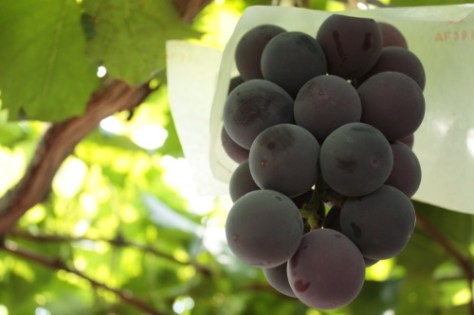
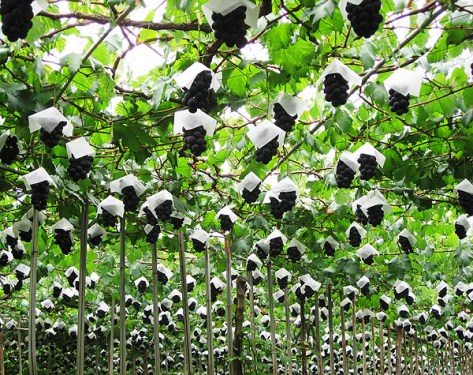
Pione Grapes are grown in aerial style.

Pione Grapes are a typical example.
They are a cross between Kyoho Grapes and Cannon Hole Muscat.
Kyoho grapes (巨峰葡萄) are hemselves a Concord-like cross (Vitis vinifera x Vitis labrusca) between Campbell and Centennial grape varieties.

Kyoho grapes were first produced in 1942 in Shizuoka Prefecture, but were not so named until 1946.

PIONE-MUSCAT
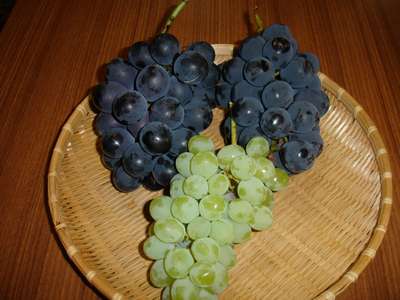
Pione Grapes compared to Muscat Grapes

Pione Grapes (ピオネ葡萄) were also first produced in Shizuoka Prefecture in 1957 by a farmer called Hideo Ikawa.
Pione is an Italian name.

PIONE2
Pione grape

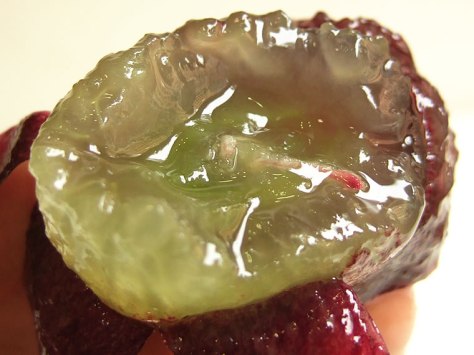
Pione grapes are usually seedless, juicy and very sweet making them very versatile for all kinds of desserts:

PIONE-MOCHI
A typical Japnese dessert:
Pione Grape inside mochi!

PIONE-TART
Pione Tart!
Irresistible, isn’t it?

But Pione Grapes, especially their flesh in “Concasse” style can be used in salads:

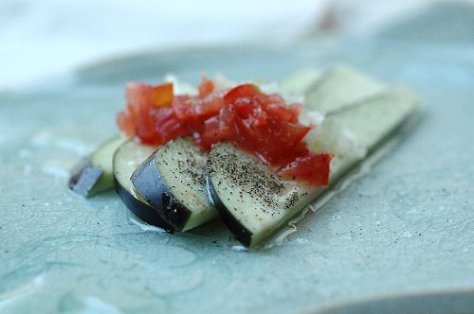
PIONE-ORGANIC-MIZUNASU
A dream salad for vegans!
Pione Grapes flesh on organic “Mizu nasu”/Mizu egg plant sashimi.
This particular kind of (Japanese) egg plant is eaten raw.
A little pepper and voila!

RECOMMENDED RELATED SITES
Not-Just-Recipes
Bengal cuisine
Cooking Vegetarian
Frank Fariello
Gluten-free Vegan Family
Meatless Mama
Think Twice

Please check the new postings at:
sake, shochu and sushi

—————————————-
日本語のブログ
—————————————-

French Cake by Bernard Heberle: 4810 (Mont-Blanc)

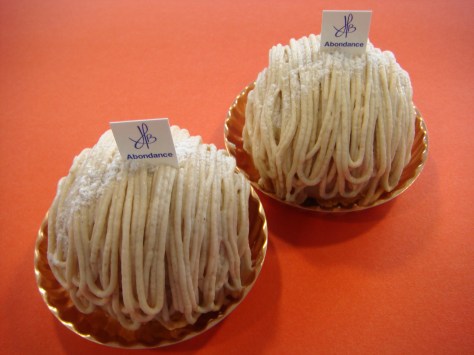
4810

My good French friend, Bernard Heberle, a native from Alsace in France and plying his trade as a patissier in Hamamatsu City, has just sent me his last creation:

4810!
Yes, you read well, this cake’s name is a number!
Can you guess?

In his own words:
“En cette période des Kinmokusei , je te présente ce gâteau bien connu des japonais et peut être leur favori avec les short cake.
Son nom 4810 ( Non , ce n’est pas son prix , seulement l’altitude de notre Mont Blanc )
Celui ci , le notre est une base de meringue au lait avec une crème de marron et une génoise a la vanille , crème pâtissière et crème montée, nous utilisons des marrons italien du Piémont.”

“In the Kinmokusei (fragrant orange-colored olive, the tree of Shizuoka Prefecture. Look below for picture) season, I would like to introduce a cake well known to the Japanese and perhaps their favourite with short cake.
Its name is 4810 (No, it’s not its price, only the height of Mont-Blanc!).
This particular creation rests on a milk meringue, then a marron cream and vanilla genoise. Next a creme patissier and a creme montee.
We use Itlian marrons from Piemonte.”

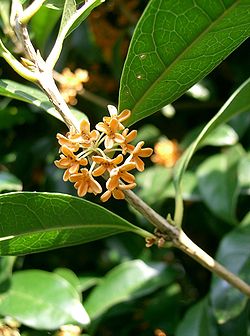
Kinmokusei
Kinmokusei (fragrant orange-colored olive, the tree of Shizuoka Prefecture)

Abondance
Address: Hamamatsu Shi, Sumiyoshi, 2-14-27 (in front of Seirei Hospital)
Tel.: 053-4738400
Fax: 053-4738401
Opening hours: 10:00~20:00. Closed on Tuesdays.
Homepage

RECOMMENDED RELATED SITES:
Warren Bobrow
Bread + Butter
5 Star Foodie
Frank Fariello
Mangantayon
Elinluv Tidbit Corner
Oyster Culture
Meatless Mama
Think Twice

Please check the new postings at:
sake, shochu and sushi

—————————————-
日本語のブログ
—————————————-