Tag Archives: Japan

Cheese Souffle

Please check the new postings at:
sake, shochu and sushi

—————————————-
日本語のブログ
—————————————-

cheesesouffle.jpg

When you mention the word “Souffle”, the first reaction you get is: “Too difficult”. It is actually dead easy, and I can tell you that some restaurants make an enormous profit from them!
And it is great food for vegetarians, too!

Ingredients (4 people):
Eggs: 4
Flour: 50g
Butter: 50g
Milk: 300cc
Shredded cheese: 100g
Salt
White Pepper
Nutmeg
Thyme
Laurel

Recipe:

Preheat oven to 180 degrees Celsius.
Butter well the inside of a (possibly round) deep oven dish (about 18cm x 8cm). This will help the souffle rise and prevent it fom sticking.

Separate egg yolks from egg whites.
In a large bowl add a little salt to whites and beat until solid.

On a small fire, prepare a Bechamel sauce (white sauce):
Melt butter completely, pour in flour and mix well with spatula until smooth. Pour in milk and mix well (diffferent people have different techniques, but I found that the best technique is to mix half of the milk little by little first, then pour in the rest and use a whisker to make a smooth sauce). Add salt, pepper and spices. Keep stirring gently.

Once the sauce has thickened to the point of almost solid, take off the fire (or switch off the fire).
Mix in the egg yolks with a spatula until colour is even. Then do the same with the cheese little by little until mixture comes smooth off the spatula.

Check that the whites have not gone back to liquid (That happened to me quite a few times, so make sure to check! In such a case, just beat them again. They will go back to a satisfactory state quite fast.). Mix in half first as delicately as possible with a spatula (not a whisker, or you will break the air bubbles in the whites and the souffle will not rise!). Then do the same with the second half. Pour in the mixture in the dish and put in the oven to bake for 45 minutes (although that depends with every oven). To check whether the souffle is properly cooked, insert a thin wooden stick or knife deep into the souffle. It should come out smooth.

Before serving, make sure that everybody is at the table before serving. ” The guests wait for a Souffle, a Souffle does not wait for the guests!”

NOTES:1) This souffle can be cooked in individual dishes. In that case the cooking time shall be about 30~35 minutes.
2) Instead of cheese you could use tinned tuna (2 x cans), or fresh spinach (one bunch; boil it a couple of minutes in salted water first, then drain thouroughly, and mince it as thinly as possible), or crab (add a little brandy and mix beforehand), or thin short narrow strips of ham, or even ham & cheese. The variations are endless.
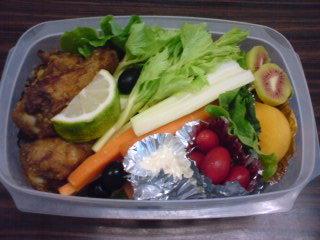
Today’s Lunch Box/ Bento (41)

Please check the new postings at:
sake, shochu and sushi
Shizuoka Pics

—————————————-
日本語のブログ
—————————————-

bento-2008-11-18a

The Missus had my health in mind when she devised today’s bento!
The doctor having warned me on my rising blood pressure, she is cutting on salt. Which is perfect with me, as I do not favor over salty foods very much!

bento-2008-11-18b

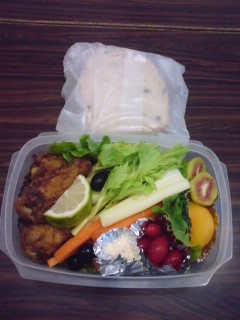
Accordingly, I discovered many vegetables in the main dish:
celery (Shizuoka produces 50% of all celery in Japan!), endive/chickory leaves, carrot sticks, lettuce and olives. Some tartare mayonnaise was included.

bento-2008-11-18c

The minuscule tomatoes are called “Ameera Rubbins”. They are very sweet. Only two farmers in Iwata City, Western Shizuoka, produce them in the whole of Japan!

bento-2008-11-18e

The Missus had marinated the chicken legs all night long before deep-frying (actually shally-frying) them this morning. A piece of lemon was provided for extra seasoning.

bento-2008-11-18f

As for dessert she included persimmon wedges and mini-kiwi fruit (above pic) grown in Shizuoka Prefecture.

bento-2008-11-18d

The bread had been baked the night before and toasted this morning. It includes black olives, chopped mint leaves and processed cheese.

Now, to answer Barbara‘s question whether the Missus shared her bread recipes, unfortunately, my other half (Rowena might have a few things to say about that! But she also knows I had a hard time “stealing” the Missus’ fried chicken recipe!), like most Japanese wives, is very cagey and possessive about her recipes.
As a rule I’m not allowed inside the kitchen, except when I wash the dishes (sometimes) and when I cook for her!
As for bread, she uses a bread baker gadget (more than 200 US$) which does absolutely everything from fermenting to baking!
Now, I know that she used rye flour and wheat flour at a 1 to 9 ratio and always adds a lttle olive oil with the water.
Once the dough has been completely leavened, fermented, raised and kneaded, the gadget will “call her”. Only then, will she add things like cheese, herbs and so on!
And then the gadget will take over again!

Sushi Restaurant: Ekimae Matsuno Sushi (revisited)

Please check the new postings at:
sake, shochu and sushi
Shizuoka Pics

—————————————-
日本語のブログ
—————————————-

matsuno-2008-11-10c

As the grotty weather last Sunday prevented any cricket to be played, I just went to do some “work” at my classroom. When lunch came, I decided it was about time I paid a visit to an old favourite sushi restaurant of mine, namely Ekimae Matsuno Sushi in fornt of Shizuoka City JR Station.
They do make a point to serve local fish whenever practical and last Sunday was no exception!

matsuno-2008-11-10b
The “snack” served with the sake (See below article) from Yoshiya Brewery in Shizuoka was “Seguro Iwashi”/”black back sardine”, a succulent fatty fish in season.

matsuno-2008-11-10c
The “sashimi no moriawase”/sashimi plate were all fish (as well as all other fish cited in this article) brought from Yaizu Harbour in Central Shizuoka Prefecture:
From left to right:
-“Akami”/tuna lean part
-“Yari Ika”/cuttle-fish (calamari)
-“Kawahagi to Kimo”/filefish cut in thin strips and mixed with its own liver. Sweet dipped in a mixture of three different miso paste rice vinegar!
-“Bora”/mullet. So fresh there was no need for soy sauce. Just a little “yuzu”/lime juice was perfect!

matsuno-2008-11-10d

The chef recommended a couple of seasonal morsels:
the first one, above, was “Tachiuo Aburi”/scabbard fish lightly grilled on one side. Just a little salt, wasabi and lime juice. The meat melts away between your teeth!

matsuno-2008-11-10e
The second one was “Houbo”/blue fin robin. Tender and sweet!

matsuno-2008-11-10d_0001

As for dessert I asked for “Tamagoyaki”/Japanese omelette (not shown) and “Kanpyou Maki”/dry gourd shavings maki!

Here are my tastig notes for the sake:

Yoshiya Brewery (Shizuoka City): Chuumasa Junmai Ginjo
Alcohol: 15~16 degrees
Contents: 300ml
Bottled: April 2008

Clarity: Very clear
Colour: Transparent
Aroma: Dry, light and fruity: Pineapple, ricey
Body: Velvety
Taste: Short tail. Junmai tingle. Complex. Fruity: Pineapple, almonds, nuts, coffee beans.
Nice acid finish with bitter chocolate, coffee beans and banan.
Turns drier with food with a strong comeback by coffee beans and almonds, although it did surprise me with a sweetish finish at times.

Overall: A “Shizuoka Type” Sake.
Very elegant, pleasant and easy to drink.
Great with sushi and sashimi.
Strong character and many facets revealed all way through.

Ekimae Matsuno Sushi
Shizuoka City, Aoi Ku, Oyuki Cho, 9-3 (just across from Shizuoka JR Station North Exit after Matsuzakaya Dept)
Tel.: 054-2510123
Business hours: 11:00~21:00
Closed on Wednesdays
Credit Cards OK
HOMEPAGE (Japanese)

Vegan & Vegetarian Sushi

Please check the new postings at:
sake, shochu and sushi

—————————————-
日本語のブログ
—————————————-

iroha-2.jpg
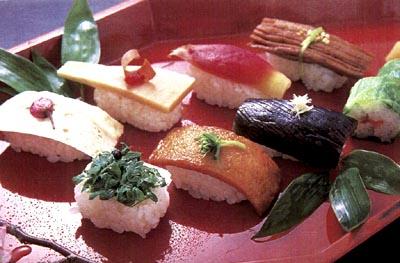
(from top to bottom and left to right: Konnyaku/Devil’s Tongue Tuber, Celery marinated in Amazu/sweet vinegar and pickled Japanese plums, Shiro negi/White leek, Na no Hana/Rape Blossoms, Gobo/Burdock roots, Satsuma Imo/Sweet yams, Daikon/Long Japanese radish)

Whenever I can convince there is Japanese food fit for Vegans and Vegetarians (I’m neither!), I make a point of posting articles that might help friends with different culinary priorities!

There is vegan and vegetarian sushi in Japan and elsewhere!
As a proof have a good look at the picture and explanations above. The pic was taken at Iroha Sushi, a small but extremely renown sushi restaurant in Iwata City, an area celebrated for its vegetables!

vegan-sushi1
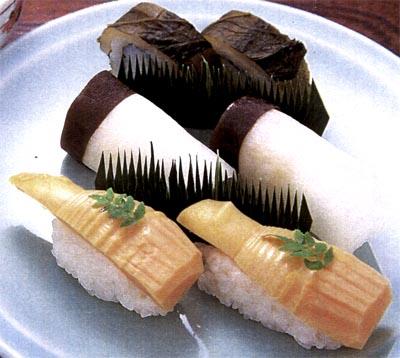
Kyoto is a renown place for Vegan & Vegetarian Sushi!
From right to left, top to bottom:, Yuuba (tofu sheets), Takenoko (Bamboo shoots), Myoga (myoga ginger), Zenmai (Spring vegetable variety), Ki no mi (Spring vegetables), Awafu (grilled tofu sheets), Kamo Nasu (kamo egg-plant), Hakusai Maki (Chinese cabbage).
Print a copy of this pic, show it to your local Sushi Restaurant and challenge him/her into preparing your favorite tidbits!

vegan-sushi2
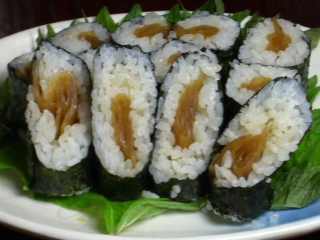
From bottom to top: Takenoko (boiled bamboo shoots topped with a sprig of sansho/Japanese pepper plant)), Kabu Tsukemono (pickled turnip), Sugiku no Ha Maki (sugiku Chrysanthemum leaves)
And what about these? Not only tasty but fulfilling!

efbd8befbd81efbd8defbd90efbd99efbd8fefbd95efbd8daki
“Kanpyou maki”/dry gourd shavings: here is one that any sushi restaurant will serve you!

vegan-sushi3
That small one is my personal favourite: “menegi”/thin leeks sprouts!

I promise I’ll keep searching!

To smoke or not to smoke!

Please check the new postings at:
sake, shochu and sushi

—————————————-
日本語のブログ
—————————————-

lojol

Patrick Harrington is a good friend of mine at Think Twice, a blog dedicated to his English students.
Like me he is a dedicated anti-smoker, although I’m only a repented non-smoker!
As we both live in Shizuoka City, Japan, we hope this will bring a little contribution to the betterment of life and gastronomy!

_To smoke or not to smoke_

It’s a battle of rights: the right to smoke against the right to a smoke-free environment.

In the past the right to smoke has been the undisputed winner.
However for a few decades smoking has been banned on public transport, such as airplanes, trains (except the Shinkansen!) and even buses, and this has spread to subway train systems and cinemas. But these bans were because of fire-risk, ie on safety rather than health grounds.
More recently legislation in Europe and North America has required a full or partial ban on smoking in many more public places, such as restaurants and bars. This has been on health grounds, and the pendulum continues to swing.

I must confess that I do not smoke and the new legislation has made an immense difference to my social life back home. No longer do I think twice about going out, no longer do I become disgusted when a stream of smoke envelops my head, and no longer do I worry about the laundry bill.
Most of all though I am content that I am not putting myself into a higher risk group of developing lung or throat cancer.
Incidentally there is some fledgling research which suggests two knock-on effects of this smoking ban.
Firstly, there has been an increase in traffic accidents as tipsy smokers spill onto the streets for a relaxing smoke.
And, secondly, it is predicted that there will be an increase in the incidence of cancer in children, since many smokers are choosing to enjoy their cigarettes in the comfort of their homes, and the rest you can guess.
Worrying as these may be, these effects remain unsubstantiated.

So how is the battle faring in Japan? As far as restaurants and bars are concerned the right to smoke is still certainly winning. Despite the fact that a few Tokyo wards and some city centres have been designated smoke-free, it is very rare to find a place to eat or drink where
smoking is prohibited.
Many establishments, particularly family restaurants, have separate smoking and non-smoking sections, but these are often two sections of the same room, even sharing the same air-conditioning system, so have limited effect.
Some places have separate rooms, often divided by a glass partition, and these work pretty well for the customers, but the staff still suffer.
And there are some places, especially in Tokyo and the major cities, that have prohibited smoking altogether, the Starbucks chain being one famous example.
But in a provincial city like Shizuoka such places are rare. My sister-in-law opened her own cafe a few years ago, and took the brave decision to go smoke-free. It has probably cost her some business, but it has surely preserved her health.

The tide has turned and the current movement toward smoking bans will inevitably come to Tokyo, and then to Yokohama and the provinces, but it is not a great vote-catcher at present. My personal estimate is that we won’t see a full ban for another generation or so, 2020 is my
guess.

Simple Recipes: Potato Pizza

Please check the new postings at:
sake, shochu and sushi

—————————————-
日本語のブログ
—————————————-

potato-pizza.jpg

Have you ever wondered how to make a pizza when you do not have the bread dough or the ready-made bread? Have you ever thought that for once you could bypass the bread and it its soggy appearance as soon as it has cooled down/

The solution is cheap, easy to prepare, tasty (I can hear the fried potato addicts lick their lips in anticipation…) and open to infinite variations!

Now, how do you prepare that?

For the pizza above, I used 3 large potatoes (enough for 4 persons). If you plan to make a very large one, say use 5 or 6 potatoes, but the it will become pretty thick. Better experiment first!

Peel the potatoes and shred them as thin as possible. Wash them under running water, drain them thoroughly and take as much moisture off in cloth or kitchen paper towel. Put them in a large bowl and add salt, pepper according to your need. I always add a generous amount of nutmeg. Mix well.
In a large non-stick frying pan of the size wanted for the pizza, pour two tablespoons of olive oil and heat sufficiently. Put all the potatoes in the frying pan and spread them evenly. Press the whole upper surface with a spoon, spatula or flat piece of metal to help potatoes to adhere quickly. Fry on middle fire until the potatoes have become translucent on the whole upper surface. Check how cooked the lower surface then. Wait until it has become a deep brown colour. Only then, should you be able to turn it over without breaking it. When both sides have cooked to a crispy dark brown colour slide onto an oven plate covered with baking paper. Let it cool a bit.
Preheat the oven to 180 degrees Celsius.
As for the garnish, it is entirely up to your imagination!
Usually I first brush the “potato bread” with tomato ketchup or puree and Thai sweet chili sauce. Then I had bacon (raw or fried/skip them if you are vegetarian!), thin slices of onion or Belgian shallots, at least three types of thinly slices pimentoes and plenty of cheese.
As for the one in the picture above, I utilized left overs of that particular day:
bacon fried to a crisp, smoked salmon marinated in Thai sweet chili sauce, previously sauteed mushrooms and pimento slices, the whole with a generous helping of grated cheese, some seasoning and fresh herbs, including basil and Italian flat parsley.

Enjoy!

Today’s Lunch Box/Bento (40)


The Japan Blog List

Please check the new postings at:
sake, shochu and sushi

—————————————-
日本語のブログ
—————————————-

bento-2008-11-14a

I do not usually publish The Missus’ bento on Friday when I have to take the train to University as they are very simple sandwich affairs.
But for once, she decided to bring some variety, which meant extra things to carry!

bento-2008-11-14b
Rice balls contained umeboshi/pickled Japanese plum and o-kaka/fine bonito shavings.

bento-2008-11-14c bento-2008-11-14e
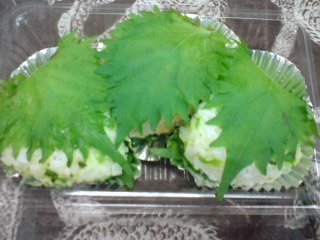
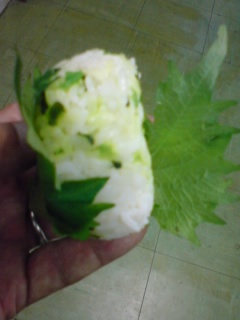
The nigiri/rice balls were “wrapped” in two shiso/perilla leaves each, as nori/seaweed would get soggy before I could eat them. Very tasty and healthy!

bento-2008-11-14f
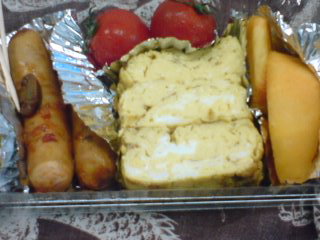
The “main dish” consisted of (from left): home-made pickles (not really visible, sorry!), fried sausages, plum tomatoes, “tamagoyaki”/Japanese omelette (she sweetend it honey on purpose) and wedges of “kaki”/persimmon for dessert.
I had a pack of vegetable juice to help it down.

bento-2008-11-14g
Now, Japanese trains everywhere in the world are not very clean places for obvious reasons.
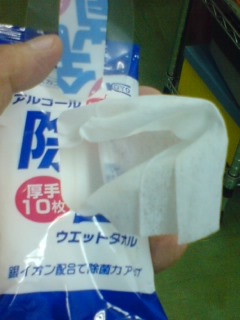
The Missus, like most Japanese ladies is very cleanliness-conscious. She makes a point to ensure that I carry “wet tissues” with me all the time. I certainly cannot fault her for that as I did have to eat with my fingers!
These are very common in Japan, and I always carry a couple. I wonder if my European/Asian/African/American friends know or use them!

Taky’s: Classic Cakes (2)/Caramel & Pear Cake


The Japan Blog List

Please check the new postings at:
sake, shochu and sushi

—————————————-
日本語のブログ
—————————————-

caramel-poire-1

This is the second (once again for the benefit of my students!) from this new cake shop/Cafe in Shizuoka City, which has the added advantage of concocting new cakes according to the day’s mood instead of “regulars”. I simply discover new creations every time I visit the establishment!

caramel-poire-2

The cake is more sophisticated than it looks at first.
It consists of a first layer of Chocolate Sponge Cake imbibed with Poire Williams Liqueur supporting a large layer of Caramel/Vanilla Mousse including Poire Williams pear chips.
It is topped again by a thin layer of Chocolate Sponge Cake and anothre of Caramel/Vanilla Mousse.
The whole is covered with a thick layer of Chocolate Ganache peppered with gold flakes!
Simply extravagant with a strong coffee!

TAKY’S
420-0839 Shizuoka City, Aoi Ku, Takajo, 1-11-10
Tel.: 054-255-2829
Opening hours: 11:00~22:00
Closed on Sundays

A Recipe for trouble? Some Carrots should be left alone!

Please check the new postings at:
sake, shochu and sushi

—————————————-
日本語のブログ
—————————————-

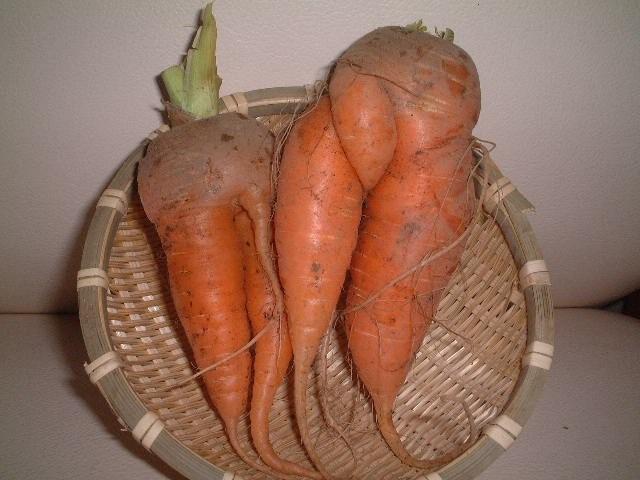
carrotsperv

This must be my shortest recipe ever!
They ended into carottes rapees/carrot salad!
And please don’t ask me how I peeled them!

Shizuoka Hotsprings: Guest House Kazeyoobi


The Japan Blog List

Please check the new postings at:
sake, shochu and sushi

—————————————-
日本語のブログ
—————————————-

kazeyoobi-17

Izu Peninsula in Eastern Shizuoka Prefecture is the most famous and oldest hotsprings area in Japan. Start either from Atami or Mishima JR Shinkasen Stations and visit this great region by train, bus or car!
If you begin your journey from Atami, take the train to Ito City and change onto the local private line and get off at Izu Koogen Station. From there you can either walk (45 minutes) or take a taxi if you are in a hurry!
Guest House Kazeyoubi in fact is a private pension with real hotsprings private bath and open-air bath fed with water coming from the nearby Ooumuro Yama, a long-extinct volcano.

The Guest House is a bit out the ordinary as it is conceived and decorated as a Spanish House with Spanish food as its main course for dinner! Plenty to please and satisfy expats! The owner actually told us that foreigners are far from being the exception, but keep in mind that they offer Japanese cuisine options as you will see later!

kazeyoobi-1 kazeyoobi-15a kazeyoobi-15_0001
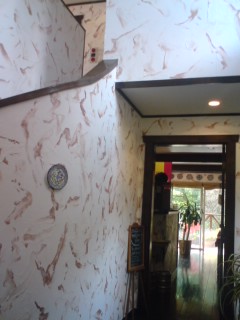
As I said, the whole interior decoration has been conceived along Spanish lines!

kazeyoobi-2a kazeyoobi-3a
But the Japanese bath on the balcony is definitely Japanese-style with real hotsprings water!
The rooms do have European-style shower, bathrooms, so no worries there, either!
There is also a “rotenburo”/open-air semi-public bath. As the guest house has only 6 rooms, you will always find some time during the day or night vacant all for yourself (ves)!

kazeyoobi-10a kazeyoobi-16a
The dining room for dinner and breakfast has also been decorated in Spanish style. You can even eat on the verandah when the weather is good enough!
Dinners are served early from 18:00 but breakfasts start from 08:00 (nothing Spanish about that, LOL!)

kazeyoobi-4a
Now, expats will happy to learn that meals are Gargantuan by Japanese standards! Above Amuse include Iberico Smoked Ham!

kazeyoobi-7a
Now if you want to drink wine (Spanish. There are all kinds of drinks available, though!), ask for “nomihoudai”/”drink as much as you want” system, it’s a bargain!

We had ordered the sashimi plate on the Internet as an optional dish to an already great meal!:
-From top clockwise (see above picture):
Aji no sashimi/Saurel Sashimi
Amaebi/Sweet Shrimps
Aji no tataki/Saurel cut in small pieces
Katsuo/Bonito with freshly grated ginger
Inada/Young Japanese amberjack (buri)
Maguro/Tuna
-Centre:
Ika somen/Cuttle-fish served in long thin strips
Notice all the shiso leaves!

kazeyoobi-6a
The very Spanish garlic soup!

kazeyoobi-8a
The (small) lobster (enormous) paella for two!

kazeyoobi-9a
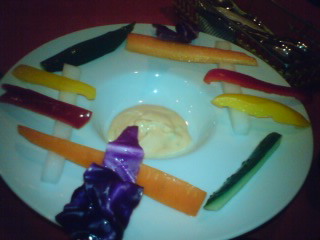
The fresh vegetable dip to help us wait for the next courses!

kazeyoobi-11a
The Iberico Pork Steak for me,

kazeyoobi-12a
and a great Japanese Beef steak for the Missus!

kazeyoobi-13a
Do not ask how we managed to finish the dessert (actually, I helped the Missus!)!

In fact eating dinner so early was a good idea, because
kazeyoobi-14a
I had to help the Missus finish it!

Guest House Kazeyoobi, a place I would definitely recommend to anyone, especially considering the great smiling and attentive welcome!

Guest House Kazeyoubi
〒413-0235 Ito City, Oomuro Kougen, 7-210 
TEL 0557-51-2935
HOMEPAGE (Japanese)

Shizuoka Beer 5: Izu Koogen Brewery


The Japan Blog List

Please check the new postings at:
sake, shochu and sushi

—————————————-
日本語のブログ
—————————————-

izu-kogen-beer3

Izu Peninsula and especially Izu Koogen (part of Ito City) is renown for its great natural water. No wonder it counts no less than three micro-breweries!
Izuo Koogen Brewery has three restaurants to provide beer with (you can buy the beer at Ito JR Station, too!), but the best is probably Izu Koogen Biiru Honten, that is their main restaurant cum brewery cum shop.

izu-kogen-beer1
located along the main thoroughfare, the restaurant is very busy even on week days.
One can both enjoy Japanese food and European/American fare.
If you want to challenge Japanese food I recommend you to try the “mini donburi set”.
Plenty for big appetites!

izu-kogen-beer2
But guys like Good Beer and Country Boys must try the sample set with a plate of sausages and some fried potatoes! Don’t go for the small set. Order the 6-glass sample set comprising of three regular beers, two seasonal ones and one sparkling fruit beer!

To your health (and safe driving!)

Izu Kogen Brewery
413-0231 Ito City, Tomito, 1103-21
Tel.: 0120-513-540, 0557-513000
Fax: 0557-513001
HOMEPAGE

Wasabi: Japanese Horseradish


The Japan Blog List

Please check the new postings at:
sake, shochu and sushi

—————————————-
日本語のブログ
—————————————-

wasabi-harvest.jpg

As winter is approaching again I felt compelled to write again in this Shizuoka Gourmet Blog an article I had written some time ago in Shizuoka Sushi Blog.
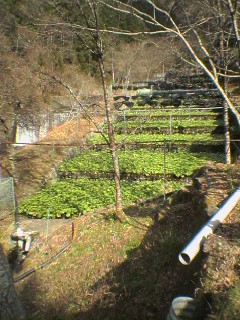
Wasabi harvest will soon start in earnest in Shizuoka City, Aoi Ku, Utougi (along the Abe River), the birthplace of wasabi (c. 1600) as shown in picture above.
They will soon appear on the markets and Internet all over the country. A sizeable amount is also directly exported to South Korea and theU.S.
—————-
Wasabi: Japanese green horseradish

wasabi.jpg

Did you know that wasabi originated from Shizuoka City?
Around 1600, farmers in Utougi District, some 33 km from Shizuoka JR STation along the Abe River, first started experimenting with the culture of that particular plant, which they already knew as a wild vegetable used for pickling. At the time they were only processing the stems, leaves and flowers.

wasabiplant.jpg

This is still a very popular kind of pickles in Shizuoka where they are sold in season.
In 1604, Tokugawa Ieyasu, who had just moved to Sumpu (presently Shizuoka City), grew extremely fond of the grated root and helped spread its use all over the country. Its present culture has expanded outside our Prefecture, especially in Nagano, but Shizuoka still produces the best In Utougi and in the Amagi Range in Izu Peninsula (80% of the total Japanese production!).
The above-ground part of the plant is also used for making delicious “wasabi zuke” with “sake kasu” (Sake white lees). You can imagine why Shizuoka products are of so high quality when you realize what “sake kasu” is being used!
wasabizuke.jpg
In my own biased opinion, the best “wasabi zuke” is made by Tamaruya Company in Shizuoka City.
tamuraya-haneda.jpg
Above picture was taken in Haneda Airport where the Company has its own stand!

Now, if you want to buy and serve your own “wasabi”, which I would recommend to any real Japanese cuisine amateur, you will need a wasabi grater.
wasabigrater.jpg
If you want to visit Utougi, where you will find a soba restaurant and other shops as well as the possibility of trekking and festivals watching in April and October, either go by car (55 minutes) or take a bus (bus platform 7 at Shizuoka JR Station/75 minutes). The trip along along the Abe River is worth it with all the changing landscapes!
utouki.jpg wasabi.jpg

Now, you might not know it, but thinly sliced wasabi root is not as strong as grated wasabi. In Shizuoka, as it is not that expensive, try and ask your favourite sushi chef to cut it in very thin strips and roll as it is in a “maki”. It’s called “bakudan maki” (the real one, not the buster made with grated wasabi!). A favourite of mine!

Note: Wasabi is proper food for vegans!

Today’s Lunch Box/Bento (39)


The Japan Blog List

Please check the new postings at:
sake, shochu and sushi

—————————————-
日本語のブログ
—————————————-

bento-2008-11-11a

Today’s bento was a “rice bento” as it is Tuesday!
It was a return to basics!

bento-2008-11-11c
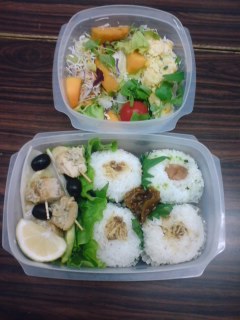
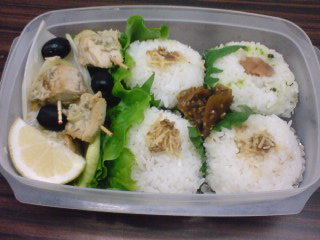
The “main dish” nigiri/rice balls, all wrapped in fresh “shiso”/perilla leaves were of two kinds:
one with ume/Japanese pickled plum,
bento-2008-11-11e
the other three contained “o kaka”/very fine bonito dry shavings and processed cheese. The combination might sound a bit outlandish, but it is very popular in Japan!
bento-2008-11-11d
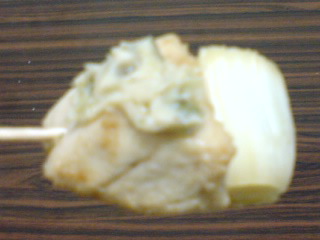
The brochettes/”kushiyaki” you see on chickory/endive leaves are “negima”/ “negi” for leeks and “ma” for maguro/tuna. The Missus put some “wasabizuke” on them for extra seasoning. This “wasabizuke” is wasabi leaves and stems pickled in “sake kasu”/sake white lees. Extravagant! A piece of lemon was added for more seasoning.
In the middle are home-made sweet ginger pickles.

bento-2008-11-11b
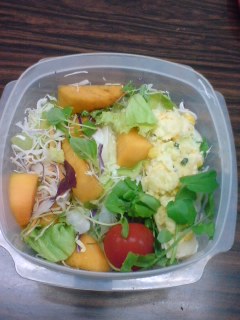
The Missus has got this habit to put my dessert (fruit in this case) in/on the salad. Not a bad idea actually. Finely chopped greens, plum tomato, fresh cress from Shizuoka, potato and tobikko/Flying fish roe salad leftover from yesterday inside chickory/endive leaf and pesimmon/”kaki” wedges.

Now, did you know that persimmons have the property to prevent bad/strong breath?

Umeshu: Sanwa Brewery


The Japan Blog List

Please check the new postings at:
sake, shochu and sushi

—————————————-
日本語のブログ
—————————————-

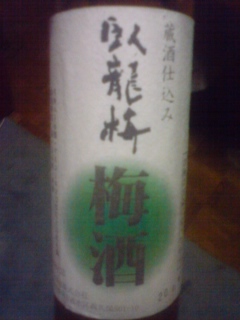
umeshu-sanwa

Umeshu comes under different guises in Japan, but if you buy one instead of making it yourself make sure you buy one brewed by a reputable Brewery!
In Shizuoka Prefecture, umeshu is an extravagant affair when made by the local breweries.
Sanwa Brewery in Shimizu Ku, Shizuoka City is no exception!

Sanwa Brewery Garyubai Umeshu

Alcohol: 12 degrees (fairly low for Shizuoka but still high when compared with cheap stuff!)
Ingredients: Japanese Plum (“Ume”), Sake. Sugar.

Clarity: Very clear at rest. Smoky if stirred beforehand
Colour: Orange/sepia
Aroma: Ver fragrant and sweet plums.
Body: Velvety~fluid
Taste: Dry attack, turns sweet later. Shortish tail. Very pleasant impression. Elegant.

Overall: Very enjoyable and easy to drink.
Fine at room temperature.
Makes for a great aperitif when chilled.
Great with cheese at room temperature.
Elegant beverage. Should please both ladies and gentlemen!

Shizuoka Beer 5/2: Izu Kogen Brewery


The Japan Blog List

Please check the new postings at:
sake, shochu and sushi

—————————————-
日本語のブログ
—————————————-

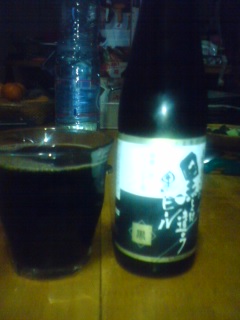
izu-kogen-black

Good Beer and Country Boys and Beer Haiku Daily should be interested to know that Izu Kogen Brewery in Ito City, Izu Peninsula not only brews beer but serve very adequate food at their restaurant cum brewery!

Last time I went there (Posting coming soon!) I bought a few bottles I had not tasted yet:

Izu Kogen Brewery Black Beer (Kuro Biiru)

Ingredients: Grain Malt, Hops
Alcohol: 5%
Contents: 300ml
Live yeast, unfiltered.

Clarity: Smoky (live yeast)
Colour: Very dark brown, almost black
Foam: Very short head, fine bubbles
Aroma: Bread, blueberries
Taste: Kalhua, a hint of caramel. Welcome acidity. Comparatively light for a stout.

Overall: Very easy to drink in spite of its stout nature.
Can be drunk at all times.
A beer for all seasons and food.

Izu Kogen Brewery
413-0231 Ito City, Tomito, 1103-21
Tel.: 0120-513-540
HOMEPAGE