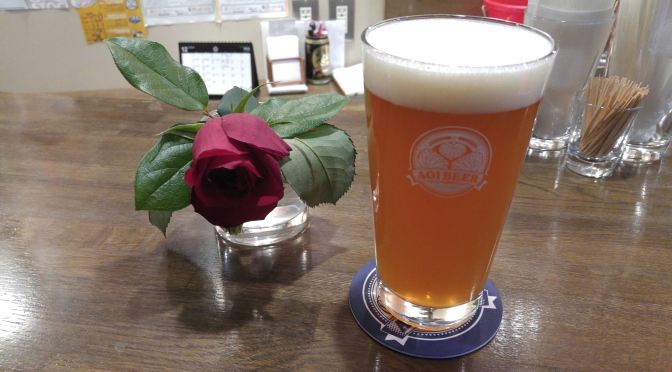
Hug Coffee Espresso Roaster just behind Cenova Department Store in Shizuoka City is known for serving limited brews by Baird Beer (Shuzenji, Shizuoka Prefecture) and I certainly never miss them!
The latest one: The Carpenter’s Mikan Ale!
“Mikan” are mandarin oranges grown in Shizuoka Prefecture!
Name: Baird Beer The Carpenter’s Mikあn Ale
Bottle contents: 330 ml
Wheat, wheat malt, mikan (mandarin oranges), hops, sugars, yeast
Double fermentation
Unfiltered
ABV: 7%
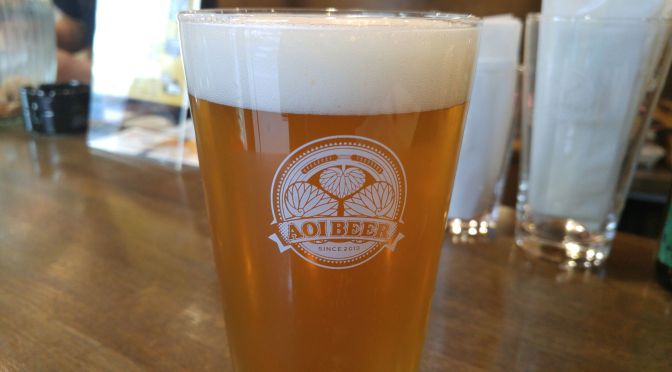
Bubbles: very fine bubbles. Long head. creamy, white
Clarity: slightly smoky (normal considering live yeast and being unfiltered), very clean
Color: orange
Aroma: very fresh, dry and fruity. Oranges, faint biscuits
Taste: Dry and fruity attack.
Oranges.
Lingers long enough for true tasting before departing on a more acid note and more oranges and lemon.
Sweetish biscuits tend to appear before leaving place to dry oranges.
Overall: Splendid craft fruit beer!
Great balance with a remarkable acid finish.
Very elegant for a fruit craft beer!
Will please every gender of any age all year round (that is if it is still available!)!
Another beauty by Baird Beer!
HUG COFFEE ESPRESSO ROASTER
420-0857 Shizuoka City, Aoi Ku, Tenma Cho, 8-1-1, Sunrose Bldg., 1F, No. 1-2-8
Opening hours: 12:00~24:00
Closed on Tuesdays
Non-smoking! HOMEPAGE FACEBOOK
I eat bread every morning, therefore I wish to something not only decent but very tasty for my first meal of the day!
In Shizuoka City we are actually blessed with quite a few artisanal bakeries and Tsuchikiri Bakery is one of them, but you must be prepared to visit it at definite times as their bread will be sold out within a blink of the eye!
Actually the bakery has moved only recently to its new address at a crossroads in Jyoto Cho, quite away from the busy Kitakaido Street!
The place is run by ever smiling mother and daughter team who bake their bread twice a day and sell it at 10:00 and 13:30 From Tuesday to Saturday!
Since it is overwhelmingly popular customers can purchase only up 2 of each of the three kinds of bread on offer per person. As far as I know reservations are not accepted!
Loaves on display will be cut into standard portions accordingly to order: whole. from 2 to 10 slices!
The three types of loaves. Prices are for a standard portion!
Raisins bread (not vegan), Plain bread (“yamagata”. Vegan!) and Three-cereal bread (Vegan!)!
Not cheap, I agree, but one of the healthiest bread in town! Industrial bread just does not compare!
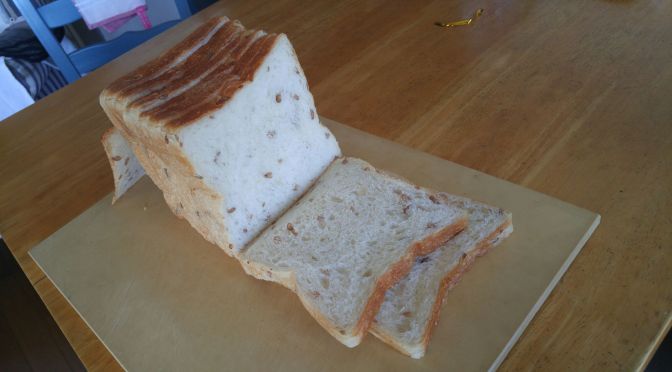
My choice of the day, which would be perfect for vegans who want their vegan bread made without eggs or dairy products: Job’s tears/Adlay (“hato mugi” in Japanese), rye and whole rice!
Moreover the yeast is natural!
Your standard loaf one cut is packed and handed to you in a paper bag!
Out of the bag!
Bear in mind that such bread, being not made with eggs or dairy products, is very soft out of the oven.
I eat it the following morning plain or toasted!
And if your standard loaf was cut first out of the main loaf you will get the yummy end as service!
TSUCHIKRI BAKERY/土切製缶
Shizuoka City, Aoi Ku, Jyoto Cho, 4-4(NTT and Mini Stop Shop crossroads)
Tel.: 054-245-1661
Opening hours: 10:00~17:30
Freshly baked bread at 10:00 and 13:30
Closed on Sundays and mondays
When In Fukuoka City for the first time, being religious-minded or not a site not to be missed is Kushida shinto Shrine/Kushida Shrine/櫛田神社, a Shinto shrine located in Hakata-ku. Dedicated to the deities Amaterasu and Susanoo, it is said to have been founded in 757. Its visit can enjoyed at all times of the year although the New Year and during the Hakata Gion Yamakasa Festival during the first two weeks of July are arguably the best periods of the year!
SN3O0048
A horned lion guard, called “shishi or komainu” seems to ensure the safety of the donated Japanese sake kegs behind it!
The whole visit makes for a truly great photographic experience of a typical Japanese Shinto Shrine, and I can assure you are bound for some surprises!
just follow me for this first visit and I can guarantee you will wish to come back again and stroll around the place at your own pace!
SN3O0049
The other lion guard with its maw open also guarding the sake kegs!
Sake kegs will be found at Shinto Shrines only and not at Buddhist Temples as sake is considered as the food of gods in Shintoism.
SN3O0110
The whole shrine is actually a group of them erected at various times and their lion guards differ!
SN3O0095
There are always two lion gurads at each shrine, one with its maw closed,…
SN3O0096
The other with its maw open!
SN3O0119
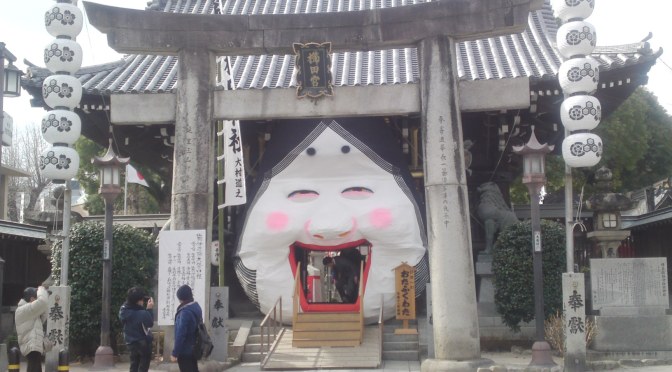
On the new Year visitors are requested to walk through the mouth of a giant Ameterasu Goddess under a torii/sacred bird gate!
SN3O0045
Placed at both entrances, but do not worry they won’t eat you!
SN3O0070
You will also meet fox guards/kitsune meaning that the shrine is dedicated to Inari, the Goddess of Plenty!
SN3O0069
Its counterpart is carrying a sacred scroll inits mouth.
Both look unusually fierce!
SN3O0066
Torii/sacred bird gate can be fund in stone or red-painted wood, alone or in rows!
SN3O0065
A whole mixture of torii!
SN3O0064
A small but highly venerated shrine at the very end of the torii tunnel!
SN3O0062
A stone torii arch?
SN3O0100
You will discover a whole menagerie as well such as this sacred bull!
SN3O0083
Sacred cranes guarding a natural salty hot spring!
SN3O0098
A Lord Horse!
SN3O0075
Belgians will be astounded to find a Japanese version of their Manneken Piss!
SN3O0078
Keep a sharp eye for the bonsai/miniature trees!
SN3O0088
you cane even buy (for 50 yen) your own fortune-telling slip/o-mikuji in five different languages: Japanese, English, Korean, Taiwanese and Chinese!
SN3O0091
My fortune-telling slip in English!
Now, what did it say?
SN3O0092
“Very lucky”!
Wishing you the same!
Access: 1-41, Kamikawabata-machi, Hakata-ku, Fukuoka City, Fukuoka Prefecture 812-0026
Between Hakata JR Station and Nakagawa River, near Gion Station.
Phone: 092-291-2951
Some of the information is based on official Fukuoka City Tourism Internet Sites.
Hakata Gion Yamakasa (博多祇園山笠) is the name of one of the most famous Japanese festivals celebrated every year from the 1st to the 15th of July in Hakata Ku, Fukuoka City, Fukuoka prefecture in Northern Kyushu Island.
This grand event, more than 750 years old, attracts more than a million spectators every year and was designated an Important Intangible Folk Cultural Property in 1979.
Moreover, the sound of the Kaki Yamakasa has been selected by the Ministry of the Environment as one of the 100 Soundscapes of Japan.
Its rites are centered on Kushida Shinto Shrine/Kushida Jinja/串田神社.
In fact the official name of the Festival is Kushida jinja Gion Retsu Oomatsuri/櫛田神社祇園例大祭.
Now, you need not worry if you cannot visit Fukuoka City during the first two weeks of July as the giant floats are on constant display for all to enjoy either under roof along the Nakagawa River at a walking distance from Hakata JR STation or inside Kushida Shinto Shrine!
Festival Floats exhibited along the Nakagawa River:
SN3O0033
Don’ forget you can see both sides of the float!
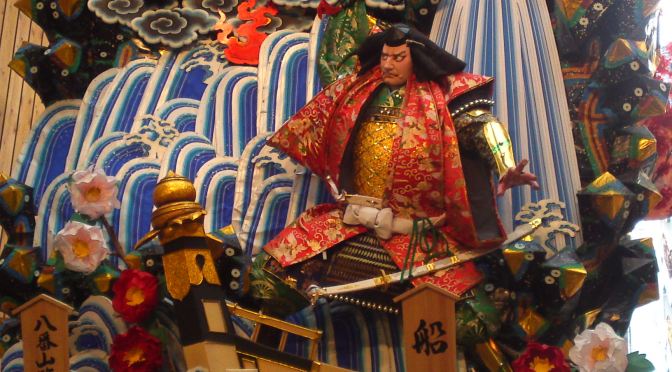
The Yamakasa floats come in two categories, namely, colorful floats for decorative purposes called kazariyama, and floats to be carried in the festival known as kakiyama. The decorated floats are set up on the street corners on July 1st for display, and you can take a look at them while strolling through the city. They are almost 10 meters tall, and are decorated with samurai or popular anime character dolls produced through the expertise of master Hakata Doll craftsmen. Formerly, men used to run about carrying these tall decorated floats, but because they would get stuck on electric cables and lights, it was decided that they were more suited for display purposes only. The floats exhibited at the Kushida Shinto Shrine and along the Nakagawa Rivercan be viewed all year round.
SN3O0034
The kazariyama floats are truly enormous and you had probably better take photographs at different levels for more precise viewing: bottom part!
SN3O0035
Middle part!
SN3O0036
Top part!
SN3O0037
One full space is dedicated to the history of the Festival and the tools needed to drive the floats!
These poles are placed under the kakiyama, “Yamakasa/Festival Floats” and over the shoulders of carriers running at full speed in the streets of Hakata! Bear in mind that each float weighs at least a ton!
SN3O0038
The back side, or “river side side” of the same float!
SN3O0039
The bottom half!
SN3O0040
The top half!
Festival Floats exhibited at the Kushida Shinto Shrine:
SN3O0051
These are exhibited all year round under special covers with explanations Japanese and English!
SN3O0052
The bottom part!
SN3O0053
The top half!
SN3O0054
The very top!
SN3O0055
The second float!
SN3O0056
The bottom part!
SN3O0057
The middle part!
SN3O0058
The top part!
The carried floats are borne by the men from the 10th and the festival culminates in excitement on the 15th. Early in the morning, at 4:59 on this final day of the festival, the first float sets off at the signal of beating drums. This is a contest in which men compete on the time taken to race along a 5 km course, over more or less 30 minutes; although speed is important, they are also required to maintain a graceful and heroic style as they run carrying the floats on their shoulders.
The interesting thing about this festival is that the citizens of Hakata refrain from eating cucumbers during the festival period. Even if they happen to find slices of cucumber in a bowl of salad, they will pick them out. This practice is said to derive from the fact that the pattern of the round cucumber slices resembles the emblem of the festive deity called Gion-sama enshrined in Kushida Shrine!
Aoi Brewing has just put out a Belgian Type of beer!
It is actually a new version of their belgian Wheat Craft Beer!
Flemish Blanc!
By the way, Aoi Brewing Co. will start bottling their beers next month!
Served on tap
Barley, Wheat, Pilsner malt, Wheat malt, Topaz hop, Perle hop, Orange peels, Coriander, Nutmeg, Lemon peels, live yeast.
Unfiltered
Alcohol/ABV: 5%
IBU: 28
Natural carbonation
Production: 450 liters
Bubbles: very fine bubbles. Long head. Creamy. White color
Clarity: slightly smoky (normal considering live yeast and being unfiltered), very clean
Color: lemon orange
Aroma: assertive, dry and fruity. Oranges, citruses, faint biscuits
Taste: dry and fruity attack with some acidity.
Light but satisfying.
Complex. Dry oranges and lemon.
Very easy to drink.
Lingers long enough for true tasting before departing with more dry oranges and biscuits.
Stays faithfully dry all the way through.
Acidity tends to rise with following sips.
Overall: A craft beer for all seasons!
Dry, light, but reliable.
Recommended pairings: cold meats, Chinese Cuisine, sauerkraut, Thai and other spicy cuisines.
Beer Junkie MOTEL
420-0035 Shizuoka City, Aoi Ku, Shichiken Cho, 11-5, IMAKKOKO Bldg. 1F
Tel.: 054-253-6558
Opening hours: 17:00~25:00, 17:00~26:00 (Saturday), 15:00~22:00 (Sunday)
Closed on Tuesday
Parties welcome FACEBOOK
BEER GARAGE
Aoi Brewing Co.,Shizuoka City, Aoi Ku, Miyagasaki Chyo, 30
Tel.: 054-294-8911
Opening hours: 17:00~23:00 (Monday~Friday), 15:00~23:00 (Saturday), 15:00~22:00 (Sunday)
Closed on Tuesdays
COD, Cash On Delivery only for all orders. MAP FACEBOOK
AOI BEER STAND
Shizuoka City, Aoi Ku, Miyuki Cho, 4-6, Den bill, 1F
Tel.: 054-260-5203
Opening hours: 11:00~23:00
Credit cards OK FACEBOOK
Some Aoi beers are also available at Aoi Brewery’s restaurant in Shizuoka City, namely
GROWSTOCK
420-0852 Shizuoka City, Aoi Ku, Koyamachi Naka Building, 5F
Tel.: 054-293-9331
Opening hours: 17:00~25:00 (Mon.~Thurs.), 17:00~27:00 (Fri & Sat.), 17:00~24:00 (Sun.)
Parties welcome (reserve!)
Credit Cards OK FACEBOOK
Beer Junkie MOTEL
420-0035 Shizuoka City, Aoi Ku, Shichiken Cho, 11-5, IMAKKOKO Bldg. 1F
Tel.: 054-253-6558
Opening hours: 17:00~25:00, 17:00~26:00 (Saturday), 15:00~22:00 (Sunday)
Closed on Tuesday
Parties welcome FACEBOOK
BEER GARAGE
Aoi Brewing Co.,Shizuoka City, Aoi Ku, Miyagasaki Chyo, 30
Tel.: 054-294-8911
Opening hours: 17:00~23:00 (Monday~Friday), 15:00~23:00 (Saturday), 15:00~22:00 (Sunday)
Closed on Tuesdays
COD, Cash On Delivery only for all orders. MAP FACEBOOK
AOI BEER STAND
Shizuoka City, Aoi Ku, Miyuki Cho, 4-6, Den bill, 1F
Tel.: 054-260-5203
Opening hours: 11:00~23:00
Credit cards OK FACEBOOK
Some Aoi beers are also available at Aoi Brewery’s restaurant in Shizuoka City, namely
GROWSTOCK
420-0852 Shizuoka City, Aoi Ku, Koyamachi Naka Building, 5F
Tel.: 054-293-9331
Opening hours: 17:00~25:00 (Mon.~Thurs.), 17:00~27:00 (Fri & Sat.), 17:00~24:00 (Sun.)
Parties welcome (reserve!)
Credit Cards OK FACEBOOK
Service: Pro and very friendly Facilities: Very clean. Excellent toilets Prices: Reasonable Strong points: Great variety of seafood from Shizuoka Prefecture and the rest of Japan. Great list of sake and shochu
The other day for our first visit at Sushi Ko on Aoba Park Street in Shizuoka City we challenged Chef Kenta Birukawa/尾留川健太さん to create a new Sushi Millefeuille for the Year 2016!
Bear in mind that he only can and may do it and that it does not feature on the menu!
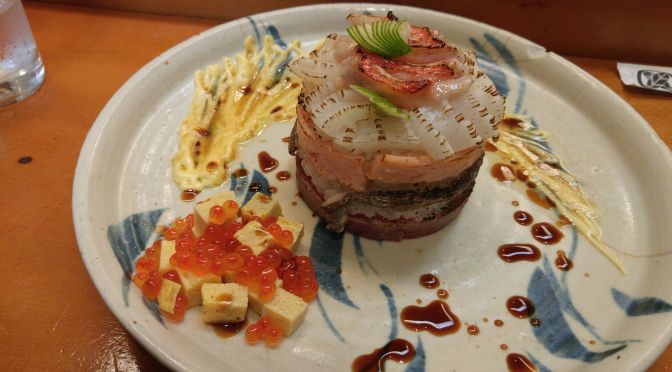
“Aburi Sushi Millefeuille/Seared Sushi Millefeuille”!
The concept was indeed new as he announced beforehand that he would “burn” it, a joke meaning that at least the outside would be seared!
The main part of the millefeuille made of sushi rice was surrounded with thin bands of 1) akami/red lean part of tuna, 2) tachiuo/scabbard or cutlass fish, 3) shake/salmon.
It was topped with pieces of ika/cuttle fish/squid and kinmedai/splendid alfonsino.
The whole was then seared before being decorated with thinly sliced cucumber and presented with pieces of tamagoyaki/Japanese omelet and ikura/salmon roe!
And the interior revealed pieces of kyuuri/cucumber, boiled ebi/prawn, tobiko/flying fish roe, tachiuo/scabbard or cutlass fish, shake/salmon and akami/red lean part of tuna!
What is going to be the next challenge? LOL
SUSHI KO
420-0032 Shizuoka City, Aoi Ku, Ryogae-cho, 2-3-1 (Aoba Park Street)
Tel.: 054-251-9701
Business Hours: 17:00~25:00. 17:00~23:00 (Sundays)
Closed on Wednesdays
Reservations recommended
Credit cards OK HOMEPAGE (in Japanese) Smoking allowed.Private room can be arranged for non-smoking (4 people)
The Japanese are in perpetual search for harmony.
This constant pursuit of “wa/和” preoccupies them not only at the office with their fellow workers, at home with their family, but also, and probably most, when taking a pleasurable respite at the table or counter of their favorite restaurant or bar.
SN3O0585
At Uogashi Sushi Restaurant…
Whereas in many other countries patronizing the same establishment on a regular basis might be considered at best as an ostentatious show, and a disreputable habit at worst, eating and drinking out in Japan is a sine qua non prerequisite to a successful life, both professional and social.
At Kasuri…
“Jouren” (常連) can be loosely translated as “regular customer”, although the term does not give justice to its real meaning.
The jouren is an essential feature at any establishment worth its salt. He/she will usually sit quietly at the end of the counter if he/she is the only one present at the time, or next to another regular.
Now, if you observe him /her carefully (unobtrusively) you will notice that he /she is served food and drinks without orders or enquiries. There is a clear reason to that: the oyakata/chef or ofukuro/lady owner knows what the jouren likes to eat and drink within a tacitly agreed budget.
The jouren is not necessarily a well-off person, but he/she is a vital actor in the gastronomic theater because he/she will occasionally come out of hi/her reserve to gently recommend a dish or concoction when he/she notices a new customer experiencing some difficulty in choosing from an unknown menu. Very often a Japanese client will (politely) ask the local jouren for advice and enquire on the very food he/she is eating or on the best drink available.
At Tomii,…
Another peculiarity you will not fail to mark is that the jouren usually takes his/her leave without paying. He/she simply has a bill in the books that he/she will pay at a more or less determined date away from the inquisitive eyes of other diners and drinkers. This last arrangement is more practical for the owner’s accounts and tax returns. You will know that you have become a jouren the day or night the owner tells you to pay later, which of course means that he/she expects you to grace the place again soon!
At Minato Machi Okamura Ikichi…
Be it a posh kaiseki restaurant, an expensive sushi bar, a simple but popular izakaya, or a late night cocktail lounge, the “rules” are the same.
The jouren possesses an unfailing instinct as to the timing of his/her visits. He/she will avoid the really busy period of the evening, and will retreat with a smile and wave when his/her favorite haunt is unseasonably busy. He/she will also take leave when other customers start flowing in. On the other hand, a jouren will get full satisfaction and no questions asked if h/she requests a few seats for a party or some friends. Simply put, he/she is priority.
SN3O0255
At Kawasaki…
Jouren usually has his/her “bottle keep”, or own bottle of favourite spirits in situ, although the notion can be double-edged. Some izakayas or Japanese restaurants and bars make it rule for all customers, regular or not to acquire their own bottle with the attached condition that it must be consumed within a certain time limit. But a real jouren at an establishment worthy of its salt will probably keep a hard to find whisky or an extravagant shochu for his/her sole usage. On the other hand, if the jouren kindly offers you a glass of his/her own nectar, you may assume you will be part of the selected clientele very soon!
At Ekimae Matsuno Sushi,…
Japanese owners value their jouren very much for another reason.
In a tightly preordained world where the customer and the owner/chef are literally sitting on either side of a rigid fence, the jouren becomes an indispensable interlocutor you can talk shop with or even ask for advice. Japanese chefs have very little free time to spend outside work and take the pulse of their society to keep in touch with the prevalent trends of their fellow citizens. The jouren will bring in the news and information on any subject and the answers to questions that the chef will not hesitate to ask.
It works both ways: high-class geishas in Kyoto, who are not mere entertainers, do make a point to read at least two or three daily newspapers every morning, including one financial tabloid to ensure they can not only follow their clients’ conversations but give their own advice when solicited.
SN3O0038
At Anchorz…
The nationality of a jouren is of little importance. Being a Japanese fluent foreigner is actually an advantage as some social restrictions inherent to the Japanese society can easily be circumvented.
As a case in point a great majority of celebrated resident foreign chefs spend most of their free time patronizing local sushi and kaiseki restaurants for the dual purpose of relaxation and study in great company!
At Sushi Ko…
As a final word do not think jouren are exclusively male clients. There are certainly many ladies among them, although they will generally patronize a different type of establishment. But the same “rules” and traditions apply!
Service: Friendly, attentive and smiling Equipment & Facilities: Great cleanliness overall. Beautiful and modern gender-separated washrooms Prices: Reasonable (wayuu is not cheap anywhere!) Strong points: Almost completely local ingredients. High class beef and pork. Great local sake and shochu list! Non-smoking at lunch time!
I had been curious for some time about a new restaurant which had been opened three years ago above a convenience store of all things this year when the far corner across Cenova Department Store in Aoi Ku, Shizuoka City, was reclaimed for development.
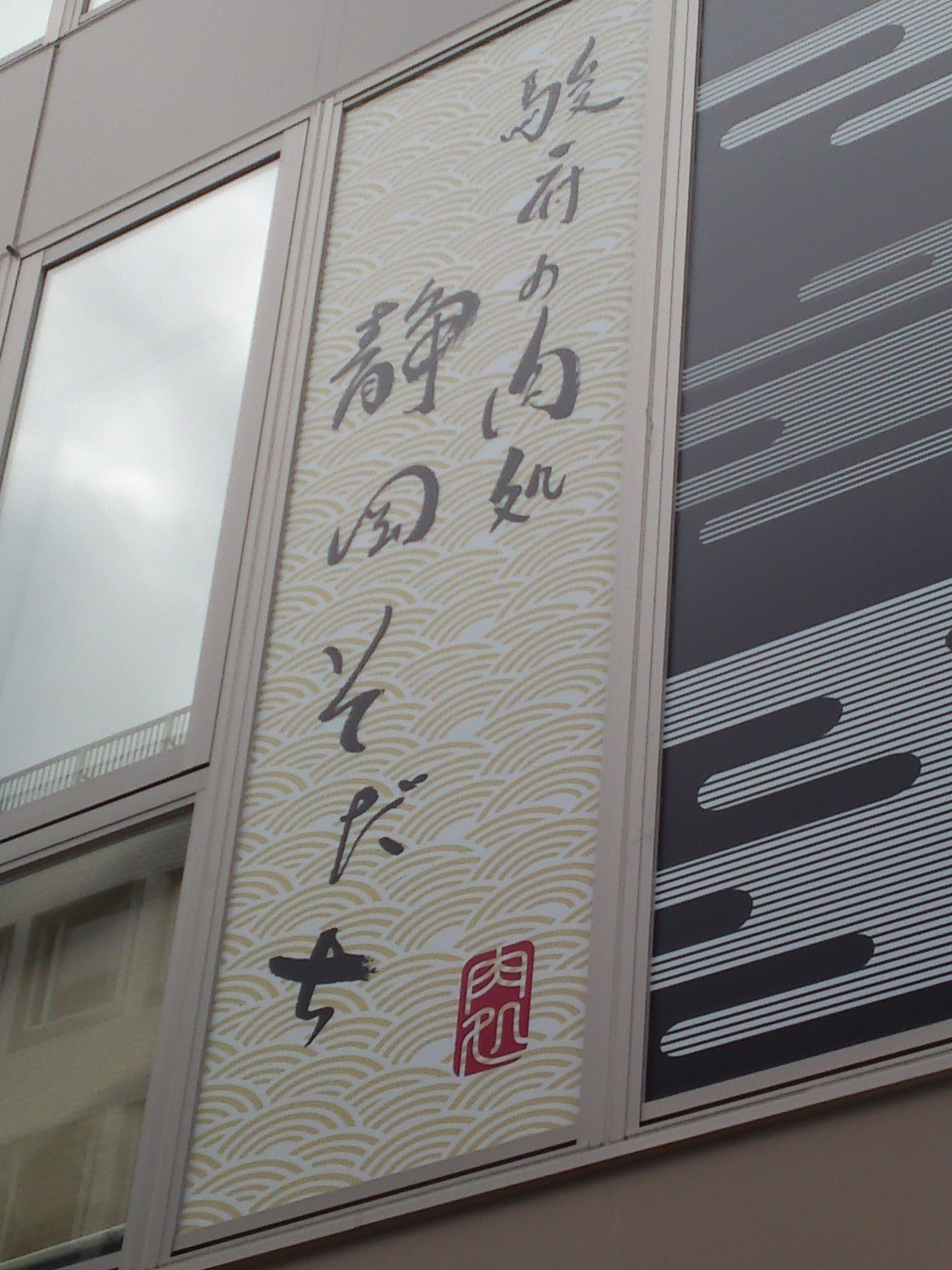
The name of the restaurant is “Sumpu No Nikudokoro/駿府の肉処”. Sumpu stands for the old name of Shizuoka City and Nikudokoro means “the Place for Meat”!
Pity they don’t take the pains of at least writing the English pronunciation when you hear that Shizuoka Prefecture and City have recently declared to promote tourism more actively…
I had noticed this advert for a single donburi/bowl dish priced at 800 yen/8 US $/6 Euros for quite a while and I had thought that the place was maybe a very reasonable and simple restaurant subsidized by the Shizuoka Prefecture Government, the Agriculture Department in particular. I was proved slightly wrong!
Frankly speaking the lack of explanations and introductions on the ground floor was a bit frustrating and I was somewhat surprised to find out after climbing nondescript stairs to stand in front of small but elegant entrance!
An the surprises only continued after I had stepped inside!
Wow! Special Wagyu certified from Shizuoka Prefecture!
Actually no less than 12 breeders have been awarded the distinction in our Prefecture!
They were not shy about exhibiting the meat used in the restaurant, a sure sign of superior quality!
Then I started to understand!
Wagyu is horribly expensive in Japan, wherever it is produced and moreover if it has received the label ‘Special Choice” by the Government!
The restaurant is owned and run by the Shizuoka JA (Japan Agriculture), the biggest Agricultural Association in Shizuoka Prefecture (and also heavily subsidized by the country!)!
Now, I knew why the prices were still comparatively reasonable, even for local products!
The establishment is absolutely spotless clean with a direct view into the kitchen! Talk about superior hygiene!
Not only the meat, but most of the sake and shochu are also brewed in Shizuoka Prefecture!
There are three types of seating: A counter by the window, very practical for individual guests or couples, benches and tables for 4 people apiece and a dig-in kotatsu Japanese room you can partly or completely reserved for a meal away from other guests’ sight (500 yen extra per person in that case). The Japanese room can be completely reserved for up to 8 guests. Otherwise parties up to 26 guests are accepted. Total reservation can be insured for up to 66 guests.
The sliding doors of the private Japanese-style room.
My first visit was for lunch at which you can a choice of single bowl dishes between 800 and 980 yen (very popular with office workers and doctors working nearby!), and three meat lunch sets between 1,200 yen and 3,000 yen. I chose the latter, which at 25 US $ is still very reasonable!
Next time I will strongly suggest that they write an English translation!
Not only the wasabi (of course!) but even the salt is local!
Supreme fat to coat the BBQ plate with before grilling the meat and vegetables! Extravagant!
Absolutely beautiful!
Now, what do we have?
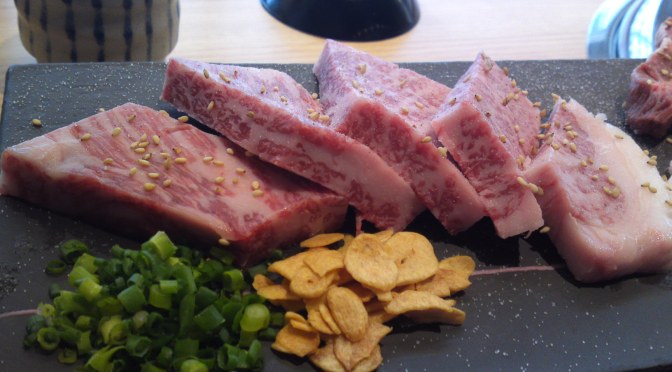
Two kinds of Wagyu Beef and Kinton-o Pork form Shizuoka Prefecture!
Actually our Prefecture is nationally renown for its supreme pork!
They need to translate that, too!
It does make for good reading, actually!
In the bckground lean Wagyu Beef and in the forefront Kinton-O Pork!
Great attentions to detail: served with grilled garlic slices and chopped thin scallions!
Naturally the vegetables are exclusively local!
Local vegetable salad and Shizuoka green tea as a bavarois with jelly!
Shizuoka-grown Koshihikari rice! A real beauty!
They should translate that too in English:
Shizuoka Koshikari rice is the earliest to be harvested in the island of Honshu: planted in April, rice grains appear in July and the rice is harvested end of August!
It is nicknamed “Pearl Rice”!
A light soup, perfect to wash all that good food down!
100% Shizuoka orange juice! The real article!
You grill everything at your own pace and order!
So tender and so juicy Wagyu Beef!
What else can you ask for?
Look forward to more reports as I want to investigate some of the ridiculously cheap meat bowl lunches and of course a full dinner with local sake and shochu!
Sumpu No Nikudokoro Shizuoka Sodachi
Shizuoka City, Aoi Ku, Oote Machi, 2-15, MRK Bldg., 2f (across Cenova Dept. Store above 7 eleven convenience store)
Tel.: 054-251-4129
Opening hours: 11:30~14:00, 17:00~23:00
Closed on third Wednesday of each month
Credit Cards OK
Reservations highly recommended for dinner! HOMEPAGE (Japanese)
All original pictures taken in Shizuoka Prefecture!
SN3B0158
Sushi for vegans and vegetarians!
Next time you visit Japan and Shizuoka Prefecture I suppose that the first thing you might like to check if you are a sushi lover is the “real article”!
SN3O0011
The ubiquitous “Hon Maguro Nigiri” or “Blue Fin Tuna on a rice ball”. In this case marinated beforehand!
If it your first visit to Japan you might also be in for a surprise as you will discover that the varieties of sushi are practically unlimited!
Sashimi or thin slices of fish when put onto some rice could be called “sushi” as long as rice vinegar, salt and sugar have been added to season the rice beforehand.
On the other hand it does not have to be sashimi as almost anything could be used for making sushi: fish guts, roe, shellfish, meat, vegetables. etc.
Even the word “sashimi” does not actually apply to fish only as its meaning is “thin slices” (debatable).
There are 3 basic kinds of sushi:
“Nare Zushi”, or pickled fish sushi.
“Nigiri Sushi” or “Edomae Zushi”,or sliced fish et al onto small balls of rice.
“Oshi Zushi” or “Osaka Zushi”, or sliced fish et al pressed onto rice inside a wooden box or mould and then cut into equal-sized pieces.
Of course the three above kinds can be divided into numerous sub-varieties.
SN3O1628
Home-made “chirashi zushi”!
One important variety is “Chirashi Zushi”, basically all kinds of (available) ingredients, preferably small, strewn on a layer of rice inside a bowl or shallow Japanese dish. This last variety is commonly encountered at home meals when it is more practical for a housewife to serve to a whole family.
“NARE ZUSHI”
This is the original form of sushi in Japan. One way to preserve fish was to gut it, slice the meat with or without the skin and pickle it (ferment it) in rice. The fish could then always be presented at meals after having taken it out of the pickle jar, cleaned it and served it on a dish as an accompaniment (or main dish) to the usual Japanese fare of rice, miso (fermented beans) soup and pickles.
“Nare Zushi” is slowly disappearing in japan due to better and safer transport of raw fish. One still available is “funa zushi/crucian carp sushi”.
Then one day, somebody selling fish in Edo (old Tokyo) struck on the idea to serve it wrapped around balls of rice to which vinegar, salt and sugar had been added for preservation. These balls were 2 or 3 times as big as nowadays and 3 balls would be enough for a meal.
This form of sushi is rarely encountered or available these days.
SN3O2954
“Katsuo/Bonito”, “Shake/Salmon” and “Hon Maguro/Blue Fin Tuna”, all marinated beforehand, that is in “Zuke” style.
One modern extension of this technique is “Zuke” whereas tuna (“maguro”) or other fish has been first dipped in hot water for a while, then transferred into iced water to stop it cooking and finally marinated into a pickle brine (“tsuke shiru”) for a while. When cut, the surface is cooked and slightly harder while the inside is still soft and comparatively raw. If it is not dipped in brine it becomes “tataki”.
(Note: “Zuke” also means leaving the fish slices in a mixture of soy sauce, mirin and sake for about a certain amount of time before making any kind of sushi. Each restaurant has its own original secrets and recipes.)
“NIGIRI ZUSHI EXAMPLES”
SN3O5189
“Amaebi/Sweet shrimps” nigiri!
SN3O0290
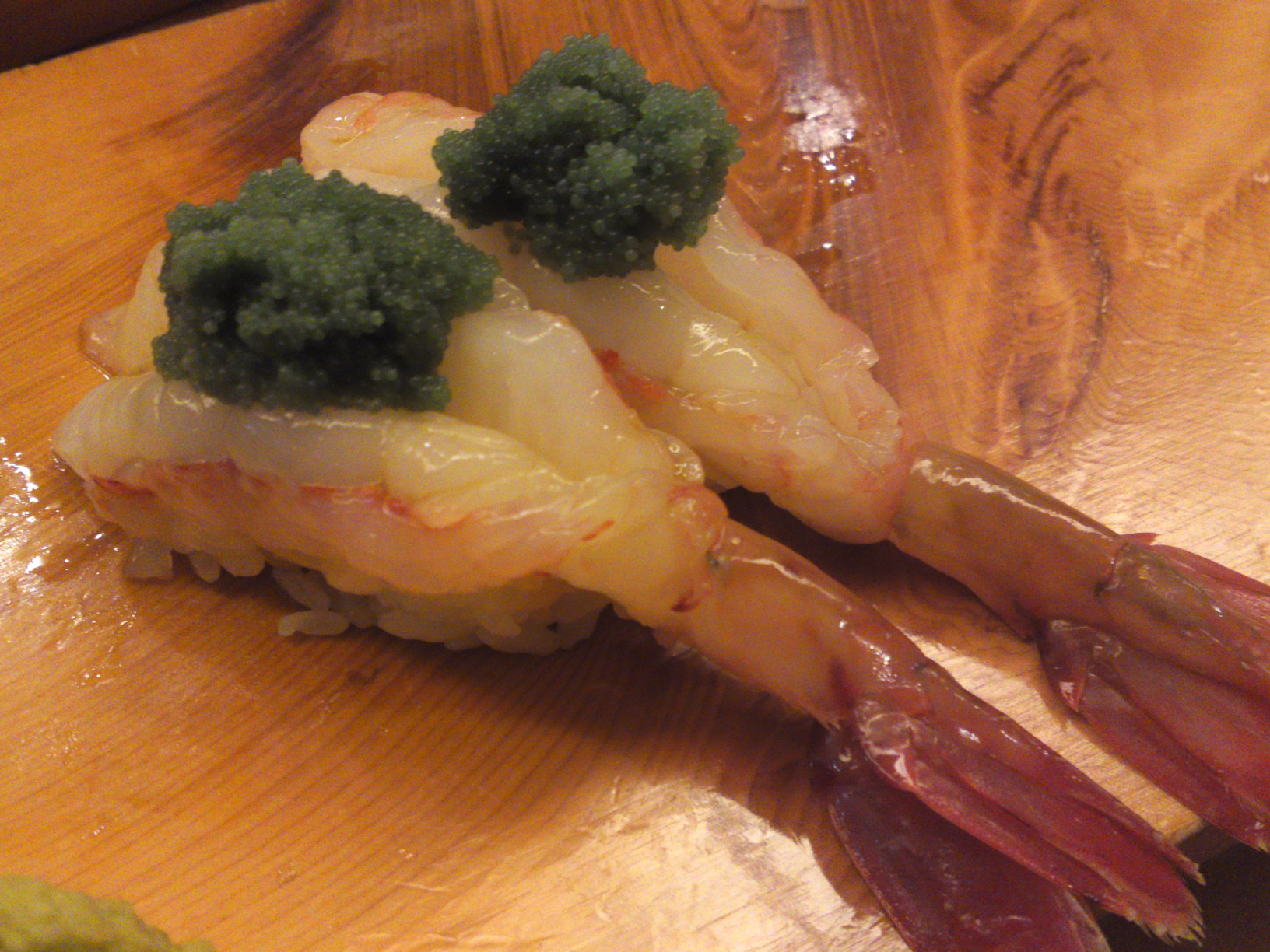
“Botan ebi/Large sweet prawns” nigiri topped with their roe!
SN3O2946
“Shita birame/Sole” nigiri!
SN3O0372
“Tachiuo/Scabbard or Cutlass Fish” nigiri in “Aburi/seared” style topped with “momiji oroshi/grated daikon seasoned with chili powder and chopped scallion!
SN3O0012
“Hotate/scallops” nigiri!
SN3O5174
“Kawahagi/Filefish” nigiri topped with its raw liver!
“BOGATA SUSHI”
SN3O1797
“Aji/Horse Mackerel” bogata sushi!
“Bogata” style is a variant of Osaka Oshi Zushi style by wrapping a fish over or a pressed “baton” of sushi rice and presenting it cut!
“GUNKAN”
SN3O2969
From top and left: “Uni/Sea Urchin”, “Sakura ebi/Cherry shrimps), “Uzura/Quail egg” with seaweed and dry bonito shavings, “Shirako/male cod milt”, and “Negitoro/Grated tuna” gunkan!
“Gunkan” means “Mothership” and consists of a small ball of rice laterally wrapped in a thin band of dry seaweed and topped with various ingredients!
SN3O2526
“Ankimo/Steamed monkfish liver in Japanese sake and preserved like a terrine” seasoned with momiji oroshi and chopped scallion! “Ankimo” is also called “Japanese foie gras”!
SN3O2977
A rare “Oyako/Parent and Child” rendition of “Ikura/salmon Roe” gunkan with its two “kids in the form of small gunkan with raw salmon wrapped around minuscule rice balls!
“MAKI ZUSHI/SUSHI ROLLS”
SN3O5444
“Natto/Fermented beans and Ika/Cuttlefish” thin sushi roll!
The ever popular (especially overseas!) sushi rolls come into two basic types: thin, or called “hoso maki” and thick, or called “futo maki”!
SN3O2513
A “California roll” made with spicy raw scallops and cucumber!
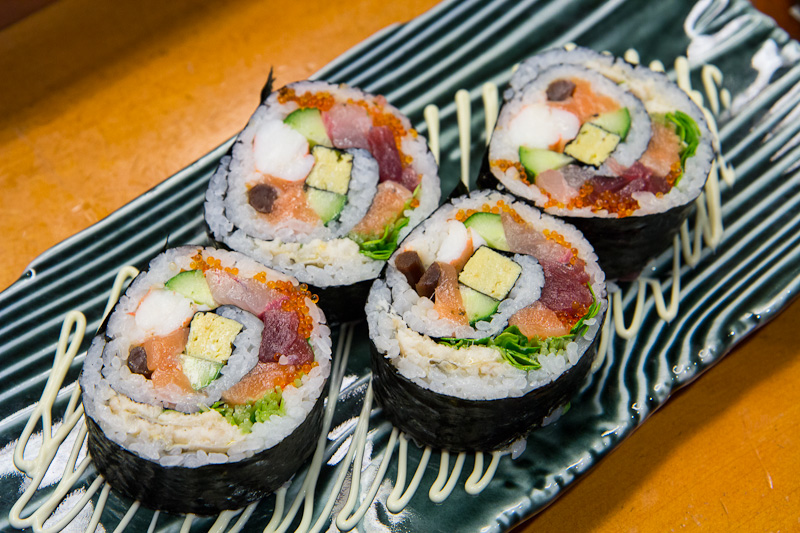
“Rainbow Roll”, a very thick futo maki with no less than 15 ingredients wrapped in sushi rice and dry seaweed!
“DONBURI ZUSHI/SUSHI BOWLS”
SN3O0293
“Ikura/Salmon roe” ko donburi with sliced cucumber and grated fresh wasabi!
“Donburi Zushi” is a big or small (in the latter case called “Ko Donburi”) filled with sushi rice and topped with one or many ingredients! The variants are unlimited!
“FANCY SUSHI”
Flower Millefeuille Sushi!
Young chefs do experiment with shapes and appearance, but such “fancy sushi” are rarely introduced on menus, therefore the need to become a regular customer at at least one sushi restaurant!
“Happy Birthday Millefeuuille!
SN3O0280
An extravagant “Piece Montee”!
SN3B0158
And don’t forget the sushi for vegans and vegetarians! It is possible!
This article is only an introduction to what you may encounter during your trip! Do not worry too much about etiquette, the Japanese will have the pleasure to teach you!
Naoki Mando/万度直樹さん, the owner of a few bars and restaurants in Shizuoka City achieved a long dream when his Brewery, the newest in Shizuoka Prefectyre at the time, Aoi Brewing Co. produced its first craft beer on May 22nd, 2014.
SN3O0307
“Aoi” is a name rarely recorded by Shizuoka City as it is the official emblem of Lord Ieyasu Tokugawa who more or less founded Sumpu, the old name of Shizuoka City.
Naoki had to get not only the Shizuoka City’s permission to use the name and crest but also that of Kunozan Toshogu Shrine in Kuno, Suruga Ku, Shizuoka City, the Shrine dedicated to Lord Ieyasu!
SN3O0289
Aoi Brewing Company was built inside a former soy sauce manufacture near Sengen Shrine, another sanctuary related with Lord Tokugawa Ieayasu.
SN3O0291
Now the brewery has its own Brew Pub, Beer Garage, where only Aoi Brewing Co craft beers are served on the tap.
The same pub also serves all kinds of food typical of a brew pub.
Customers are mainly locals or beer lovers wanting to enjoy their past time away from the crowds in downtown Shizuoka City!
SN3B0321
On the other hand, Naoki Mando’s oldest property, Growstock bar & Restaurant in downtown Shizuoka City also serves a couple of Aoi Craft Beers on the tap.
SN3B0328
But Growstock basically serves beers from all over the world either in bottles or on the tap!
SN3B0330
They serve a large array of foods, some of which finds its way into the beer stand located in Miyuki-Cho, near Shizuoka JR Station.
SN3O5029
This is a very busy place as it serves at least 6 beers on the tap, usually all from Aoi Brewing Co. although guest beers from Shizuoka Prefecture and far beyond also appear for the great pleasure of all aficionados!
SN3O5692
Although Aoi Brewing Co. has already produced no less than 47 limited craft beers until December 31st, 2015, it will soon also put out bottled carft beers including Weissen, Ales, Alt and Stouts!
SN3O0165
Although customers at Aoi Beer Stand are basically for the beer, some unusual snacks such as the above mutton gyoza do appear from time to time, the food is not to be forgotten easily!
SN3O0132
Look out for the Mexican hot dog,although these days they serve a Mexican pisza and a Japanese quiche!
SN3O0011
last year, Naoki Mando opened a fourth establishment to satsify the notorious Shizuoka City night owls: Beer Junkies Motel!
SN3O0017
They serve 4 Aoi Brewing Co craft beers on the tap plus two more guest tap beers, including overseas brews along with all kinds of bottled beers, wine, spirits and cocktails!
SN3O0021
The food menu there is definitively more extensive and includes grilled lamb chops, succulent meat pies, and what else!
A great place for late eating!
But always keep in mind that Aoi Brewing Co. is always putting out superlative brews fast gathering a lot of attention all over Japan such as this rare Christmas Ale, Abv: 10%!
Beer Junkie MOTEL
420-0035 Shizuoka City, Aoi Ku, Shichiken Cho, 11-5, IMAKKOKO Bldg. 1F
Tel.: 054-253-6558
Opening hours: 17:00~25:00, 17:00~26:00 (Saturday), 15:00~22:00 (Sunday)
Closed on Tuesday
Parties welcome FACEBOOK
BEER GARAGE
Aoi Brewing Co.,Shizuoka City, Aoi Ku, Miyagasaki Chyo, 30
Tel.: 054-294-8911
Opening hours: 17:00~23:00 (Monday~Friday), 15:00~23:00 (Saturday), 15:00~22:00 (Sunday)
Closed on Tuesdays
COD, Cash On Delivery only for all orders. MAP FACEBOOK
AOI BEER STAND
Shizuoka City, Aoi Ku, Miyuki Cho, 4-6, Den bill, 1F
Tel.: 054-260-5203
Opening hours: 11:00~23:00
Credit cards OK FACEBOOK
Some Aoi beers are also available at Aoi Brewery’s restaurant in Shizuoka City, namely
GROWSTOCK
420-0852 Shizuoka City, Aoi Ku, Koyamachi Naka Building, 5F
Tel.: 054-293-9331
Opening hours: 17:00~25:00 (Mon.~Thurs.), 17:00~27:00 (Fri & Sat.), 17:00~24:00 (Sun.)
Parties welcome (reserve!)
Credit Cards OK FACEBOOK
IZAKAYA RANKING: +3 Service: +3 Excellent and very friendly Facilities: +3 Very clean, Beautiful washroom Prices: +2 reasonable Strong points: Vegan and vegetarian Cuisine possible any time, Izakaya gastronomy, local products, oden. Good list of sake, shochu. Wines also available.
Time and again I have said that vegans and vegetarians would probably have their happiest times in Japan, at least for gastronomes, because this country, and especially Shizuoka with its mild weather and abundance of vegetables in all seasons, can provide all ingredients all year round whose traceability is easy to prove!
The above o-tooshi/お通し/is not vegetarian, but you aforementioned priorities will ensure it is!
There are many places in Shizuoka City and Prefecture offering alternatives to their omnivorous dishes for vegans and vegetarians who still want to enjoy their outing with friends with different priorities.
One such place, and arguably the best at it, is Yasaitei in Tokiwa Cho, Aoi Ku, Shizuoka City!
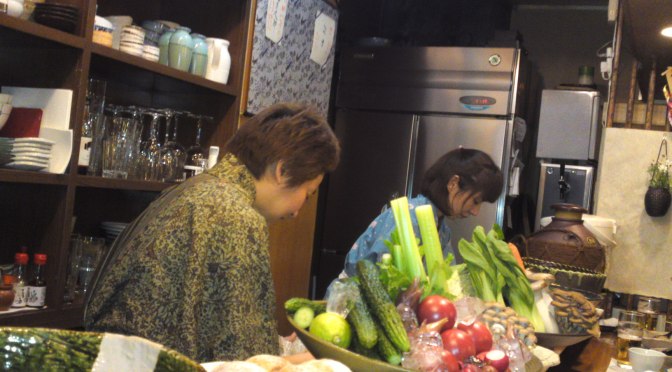
Incidentally the owner/chef and staff are all ladies, but customers are certainly of both genders!
And here is one recommendation:
Vegetable sashimi plate!
The above is the basic one, but you certainly may order for a bigger variety!
View for the other side!
Ice plant and celery!
One thing all these vegetables have in common is that they are super fresh, crunchy, juicy and so tasty!
Tomatoes and daikon!
Japanese cucumber!
Onion and shiso/perilla leaf!
Simple but exquisite dressing made with higher-class sesame oil, rock salt and miso paste!
For friends who like seafood: cod roe steamed and marinated in rice vinegar!
Another “o-tooshi/お通し/snack served with the first drink!
Lotus root/renkon/蓮根 in “kinpira” fashion!
Such a satisfying crunch!
Grilled fresh shiitake/椎茸!
The shiitake were simply grilled and seasoned with soy sauce before being served over shiso/perilla leaves.
Freshly grated daikon and ginger were provided for further seasoning and enjoyment.
Surely one of the best ways to enjoy fresh shiitake!
Another o-tooshi!
Mushrooms and fried tofu o-hitashi/お浸し/Japanese-style light appetizer!
Maitake, tomato and spinach stir-fried in sesame oil and served with fresh coriander!
Maitake/舞茸 in English stands for mushrooms called Hen-of-the-Woods, Ram’s Head or Sheep’s Head!
Juicy and so tasty mushrooms!
Note the coriander for beautiful balance in presentation and taste!
Another o-tooshi!
Mushrooms and mekabu/芽蕪/small turnips! If you are vegetarian or vegan just tell them not to top it with katsuo bushi!
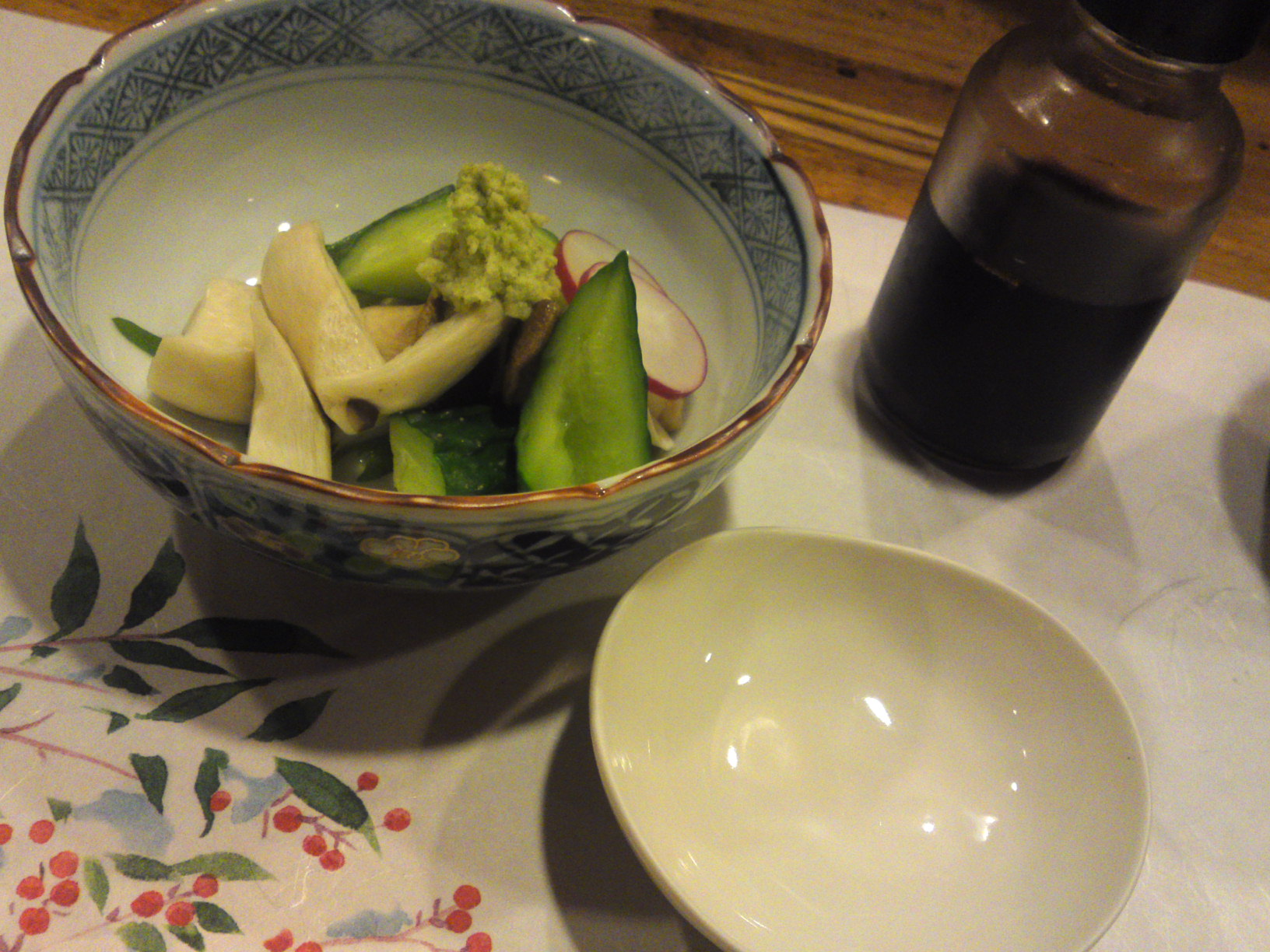
Steamed eringe (or eringi)/エリンゲ/known in English as king trumpet mushroom, French horn mushroom or king oyster mushroom!
The eringe were steamed together with fresh cucumber and served with freshly grated Shizuoka-grown wasabi!
See “Izakaya Ranking” system at bottom of article!
YASAITEI/やさい亭
Shizuoka City, Aoi Ku, Tokiwa-Cho, 1-6-2 Green Heights Wamon 1-C
Tel.: 054-2543277
Business hours: 17:30~22:00
Closed on Sundays
Reservations highly recommended
Seating: 6 at counter + 14 at tables
Set Courses: 3,000, 4,000, 5,000 yen
Individual orders (carte) welcome
Parties welcome
IZAKAYA RANKING SYSTEM
IZAKAYA RANKING:
+1 ought to be visited at least once
+2 could be become a regular visit
+3 must visit!
Service:
+1 standard
+2 pleasant
+3 very good
Equipment & Facilities:
+1 standard
+2 excellent
+3 Superb
Prices:
+1 cheap
+2 slightly expensive but good value
+3 expensive but good value
Service: Very friendly, polite and smiling Facilities & Equipment: Very clean overall. Spacious washroom Prices: Reasonable Strong points: A great blend of Indian and Nepalese cuisines. More than sufficient drinks list. Vegetarian set or single dishes available. Very generous portions!
Namaste Nippon Nepalese-Indian Restaurant and its bright colors have been standing along the Kitakaido Street in Aoi Ku, Shizuoka City, 10 minutes walk from Cenova Department Store, and had often been recommended to me by friends.
I took advantage of free time at lunch the other day to pay them a belated visit!
The owner and the staff all hail from Nepal but the chefs graduated from a cooking school in India, allowing them to combine the two cuisines with even a little Japanese twist at times!
Lunch time is particularly busy and they do have a hefty menu!
One can choose from set menus or single dishes.
I already know I’ll have to plan a few more visits!
A good idea, since they serve a great variety of drinks including Shizuoka sake, would be to g there for a drink in the evening and eat their food as snacks!
I chose the vegetarian set lunch which should give me a good idea of the chefs’ skills!
It includes a lot!
But first of all I had to taste a “Nepal Ice” beer!
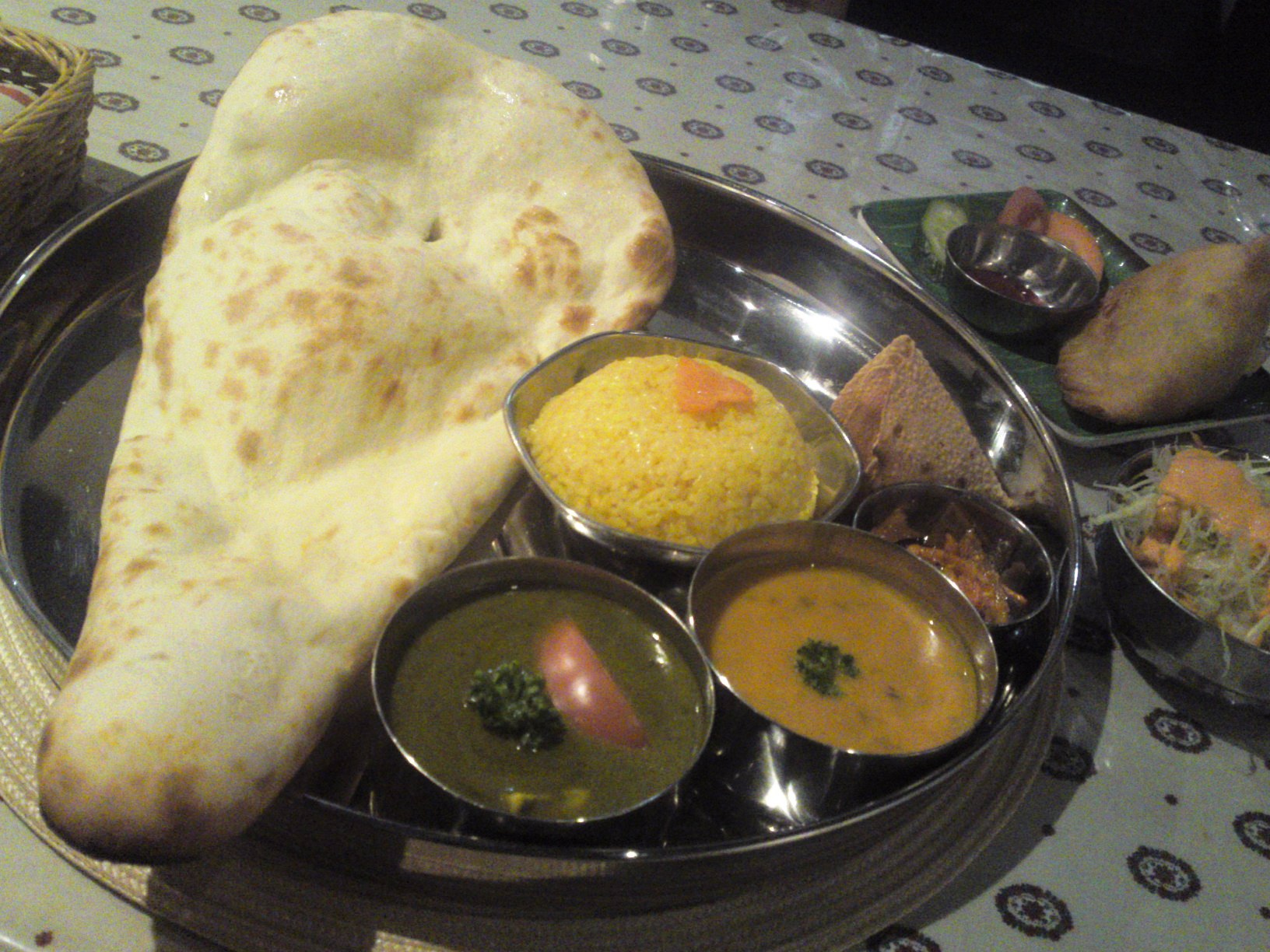
Enormous potato samosa coming fresh and hot on your plate with vegetable salad!
It would be enough as a great snack with a nice beer in the evenings!
The Vegetarian Lunch Plate, which includes the aforementioned samosa and a drink!
You can choose 2 out of 3 curries (sorry, this is how it is written on the Japanese menu! Mind you, they all speak fluent English and Japanese):
I opted for the above “Parapanilu” spinach and cottage cheese curry!
Dahl/beans Curry!
The third one was “Alparaku” Potato and Cottage Cheese!
Turmeric rice!
One can opt for plain rice, too!
“Achar” home-made Nepalese vegetable pickles! Very tasty!
“Papado”!
And a great freshly baked nan!
Actually they bake many kinds of nan, chapati and so on!
Try the same with two of you! Great fun!
I couldn’ help taste an Indian Legend beer!
Meet you in the evening there again!
NAMASTE NIPPON Nepalese-Indian Restaurant
420-0845 Shizuoka City, Aoi Ku, Oda Cho, 31-1, Ono Bldg, 1F (along the Kitakaido Street, 10 minutes walk from Cenova Department Store)
Tel. & Fax: 054-247-6775
Opening hours: 11:00~15:00, 17:00~22:30
Closed on Thursdays
Credit Cards OK
Paries welcome!
Take outs OK!
When it comes to a home party one always looks for a sake which is not only tasty and easy to pair at all temperatures but also reasonably-priced.
The other day I did participate to a big home party with old mates and I had the perfect present to bring with me!
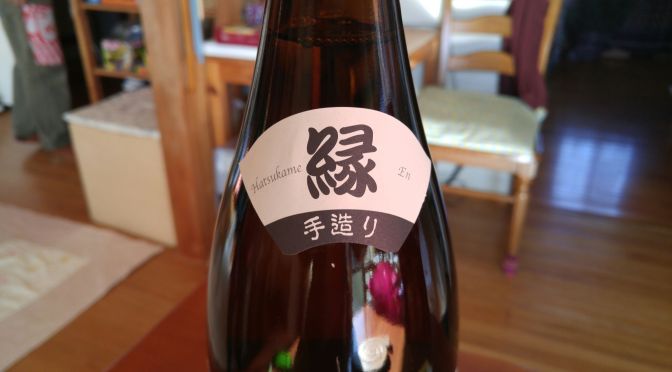
Hatsukame Brewery in Okabe, Fujieda City produces this extravagant honjozo called “En/縁”!
When you read the specs you will realize that some breweries in Shizuoka Prefecture are spoiling their customers!
Rice: Yamada Nishiki
Rice milled down to 65%
Dryness: + 4
Acidity: 1.30
Alcohol: 15~16 degrees
Brewed in September 2015
Bottled in November 2015
Clarity: very clear
Color: faint golden hue
Aroma: dry and fruity. pears, banana, rice, greens
Body: fluid
Taste: Dry and fruity attack.
Complex: oranges, custard, chestnuts.
Lingers only for a short while before departing on a still drier note with oranges, custard and coffee beans.
Becomes milder and lighter with food before finishing on a drier note.
Oranges and custard in particular will come back once again away from food.
At lukewarm temperature/”nurukan”, tends to become lighter and less complex, but still very pleasant on the palate.
Overall: I conducted that tasting in a light-hearted manner with my friends before he alcohol took the best of them. We all agreed it was simply extravagant considering the ridiculously cheap price!
This is the kind of sake you can bring to any party any time of the year when you can savor it on its own or with any food, at room temperature or warmed up!
The kind of sake you won’t let inside the bottle very long and a great introduction to beginners!
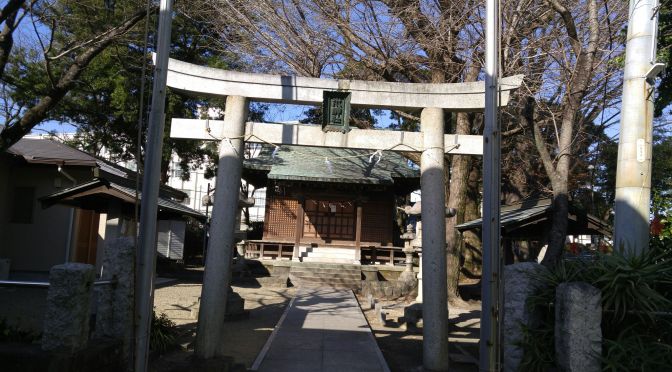
Yesterday on my way to Anzai Bridge across the Abe River in Shizuoka City, I decided to cycle along a die road on a whim and discovered this small Shinto shrine in Ta Machi!
Upon seeing the name plaque on the torii/sacred gate I wondered how the kanji for “water/水”, that is “mizu” would be pronounced.
Luckily enough a neighbor had just come out and I decided to ask him and get some more information!
The locals pronounce the name “wata”!
And apparently it is a very old if small shrine, dating back to Edo Era!
Although their roofing is recent the hand washing stone basin are very ancient.
Two of them in such a small shrine is indeed rare and the neighbor indicated me through their engravings that they had been erected in totally different eras!
Two large stone lanterns and two smaller ones stood along the short path with mountain and clouds carvings!
I noted an interesting difference between the two deers!
The one above has its right foreleg raised!
But not this one!
A smaller stone lantern between two venerable trees!
The “haiden”/worshipers hall!
Unusually the lion guards/shishi are not represented as stone statues, but as wooden carvings abovehead!
Its companion!
I pointed out the fact to the kind neighbor relating the history of the shrine and I had the pleasure to notice his surprise!
Money offerings are unusually thrown though the door instead of inside a box placed outside!
Side view of the “haiden” and “honden/deity abode”!
The enshrined deity is male!
A side view of the completely isolated “haiden”!
The trees inside the shrine are dwarfing the building proving its ancient origins!
A very interesting and reasonable way to taste sake is to acquire one-cup sake!
They also make for cute collection of glasses or cups!
SN3O0472
Now, this is the sixth tasting of the second batch of Shizuoka Prefecture One Cup Sake I obtained at Matsuzakaya Department Store in Shizuoka City!
Shidaizumi Brewery-Nyan Cup Shidaizumi Junmai Ginjo!
Actually, this is the original Nyan Cup which has now 4 different types all with different sake inside!
If you look at the inside of cup once empty you will find out that the cats look at with different eyes!
Rice: Yamada Nishiki
Rice milled down to 55%
Alcohol: 16 degrees
Bottled in July 2015
Clarity: very clear
Color: very faint golden hue
Aroma: assertive, dry and fruity.
Banana, pears, custard, green apple.
Body: fluid, a little sirupy
Taste: dry and very fruity attack backed up with puissant junmai petillant.
Complex. Bananas, dry oranges, faint almonds.
Lingers only for a little while before departing on a drier note with drier chocolate, custard and mandarin oranges.
Oranges and coffee beans will make a surprise appearance once in a while.
Turns drier with food with faint coffee beans appearing.
Stays dry all the way through with plenty of junmai petillant.
Overall: very elegant and extravagant one cup sake!
I wonder if people understand its real value as a premium sake and as a splendid souvenir!
To take with you on any trip and to forget the crowds!
No wonder it sells out so quickly!









































 SHIZUOKA GOURMET