Tag Archives: 簡単なレシピ

Today’s Lunch Box/Bento (’11/12): Vegan & Vegetarian Sushi Bento

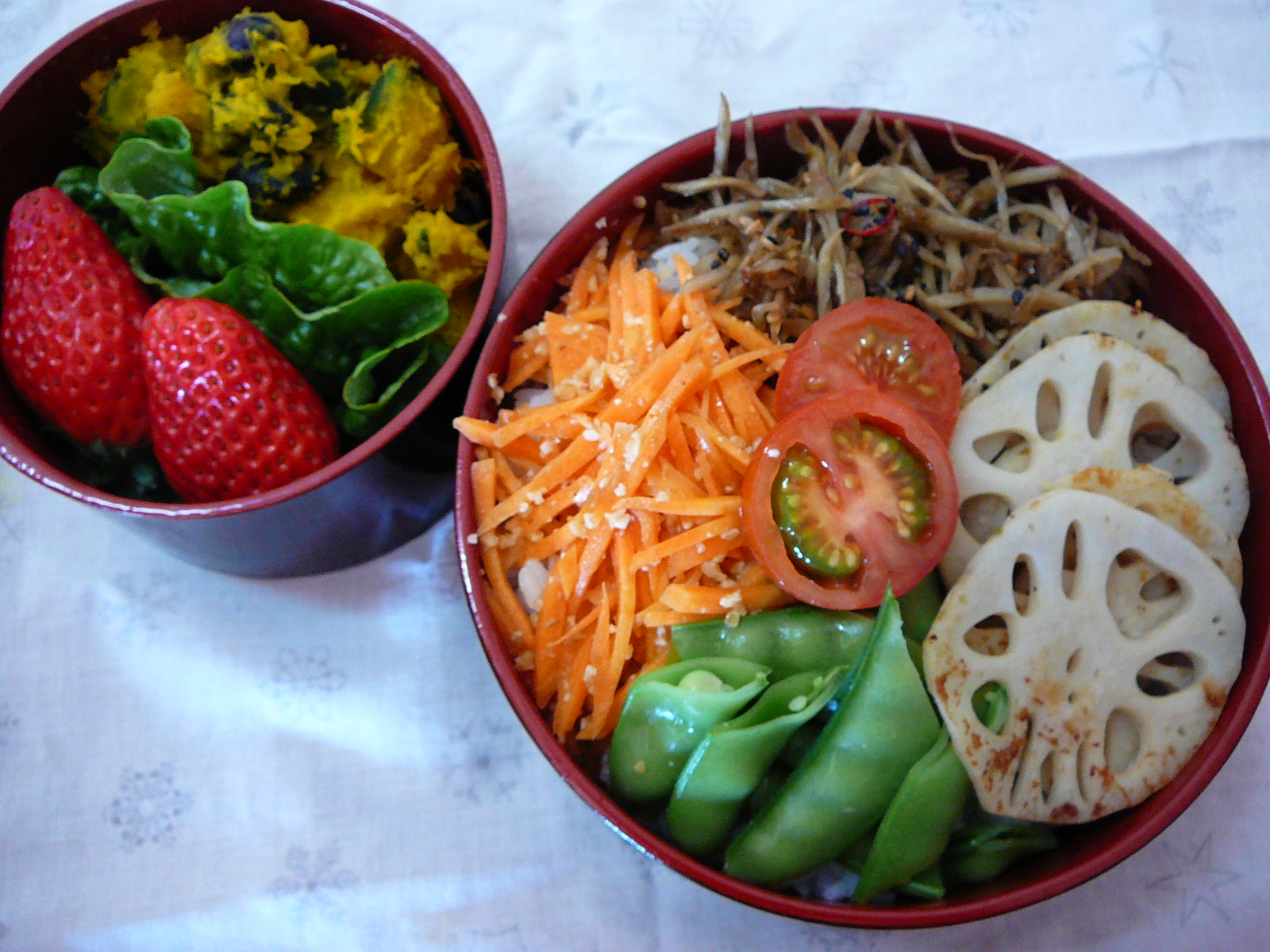
Although I’m not a vegetarian I’ve wanted for a long time the Missus to concoct me an entirely vegetarian bento. Not only she complied, but she made it a sushi as well!

She first steamed the rice and prepared as sushi rice before mixing plenty of sesame seeds in.
She then proceded to cover the lot with vegetables.

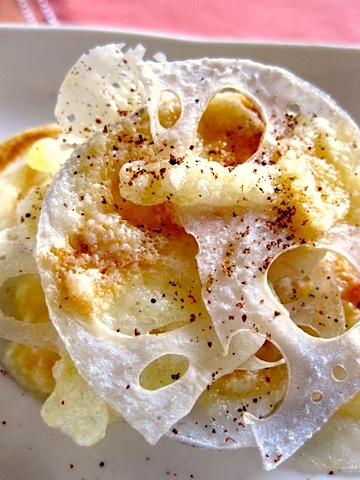
She fried sliced lotus roots in spices for a hot addition to the plain boiled green peas in their pods.

Then, keeping in mind the color arrangement and the whole balance, she first added a shredded carrot salad seasoned with gomadare/sesame dressing and crushed peanuts, and next gobo kinpira/stir-fried hot burdock roots (seasoned with chili pepper and black sesame seeds). She finally topped the whole with some sliced plum tomato.

For salad and dessert she prpared a vegan/vegetarian kabocha and black beans salad to which she added fresh lettuce and Akihime strawberries from Shizuoka!

I don’t plan to be a vegan or vegetarian but my sometimes tired body can really appreciate the cuisine now and then!

RECOMMENDED RELATED SITES

Clumsyfingers by Xethia
Adventures in Bento Making, American Bento, Beanbento, Bento No1, Bento Wo Tsukurimashou, Cooking Cute, Eula, Hapabento , Happy Bento, Jacki’s Bento Blog, Kitchen Cow, Leggo My Obento, Le Petit Journal Bento & CO (French), Lunch In A Box, My Bento Box, Vegan Lunch Box; Tokyo Tom Baker, Daily Food Porn/Osaka, Only Nature Food Porn, Happy Little Bento, The Herbed Kitchen, J-Mama’s Kitchen, Cook, Eat, Play, Repeat; Bento Lunch Blog (German); Adventures In Bento; Anna The Red’s Bento Factory; Cooking Cute; Timeless Gourmet; Bento Bug; Ideal Meal; Bentosaurus; Mr. Foodie (London/UK); Ohayo Bento

Please check the new postings at:
sake, shochu and sushi

—————————————-
日本語のブログ
—————————————-

Vegan Sashimi at Yasaitei (18/02/2011)

It has been some time since I paid my last visit to Yasaitei.
I do have to show up there regulaly as they use only seasonal vegetables and other products, be they from the land or the sea!

My vegan and vegetarian (I’m not!) friends know this is a place where they can expect a full meal (thinking ofdevising one for the next article!) according to their priorities! Even the shochu and sake are OK!

All vegetables, from the very snack coming with the first drink!

Yasaitei might be an unpretentious izakaya, but it is a very elegant one!
The chopsticks are of great quality and the paper tablecloth is always decorated with seasonal motifs. Rape flowers/na no hana/菜の花 in this case!

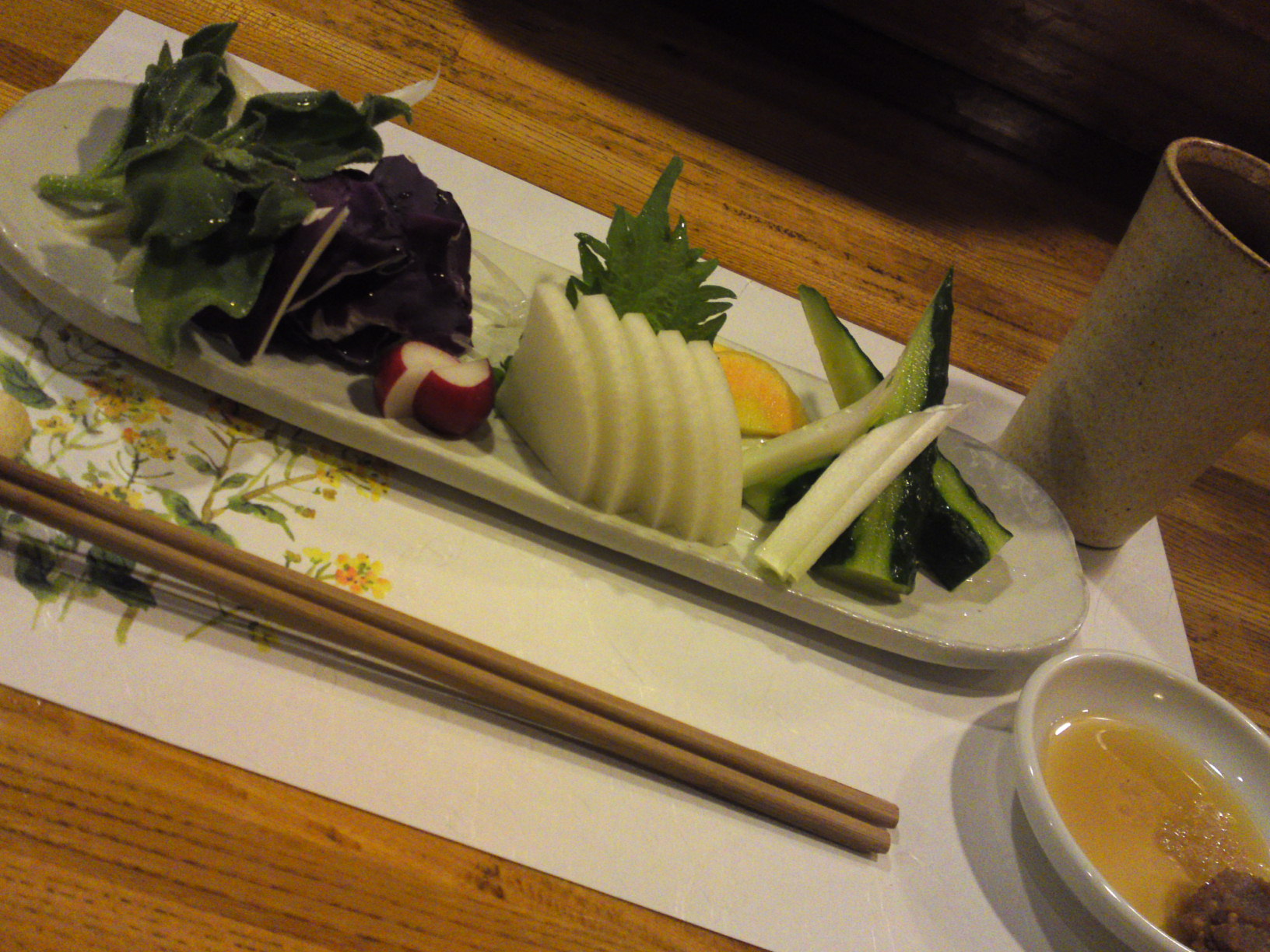
So here is the vegan vegetable sashimi of the day!
Great colors as usual!

Ice plant, myoga (almost completely hidden as it was used as a support), celery, red cabbage (in Japanese, although it is dark violet) and mini radishes.

Daikon (sweet and juicy!) supported by chopped winter onion and a leaf of perilla/shiso. (Yellow carrot at the back.)

A side-view of the daikon support.

Cute urui/hasta montana and crunchy cucumber!

Always wondering what is going to be on offer next time!

YASAITEI
Shizuoka City, Aoi Ku, Tokiwa-Cho, 1-6-2 Green Heights Wamon 1-C
Tel.: 054-2543277
Business hours: 17:30~22:00
Closed on Sundays
Reservations highly recommended
Seating: 6 at counter + 14 at tables
Set Courses: 3,000, 4,000, 5,000 yen
HOMEPAGE (Japanese)

RECOMMENDED RELATED SITES:
Warren Bobrow, Bread + Butter, Zoy Zhang, Hungry Neko, Think Twice, Frank Fariello, Mangantayon, Hapabento, Elinluv Tidbit Corner, Tokyo Terrace, Maison de Christina, Chrys Niles,Lexi, Culinary Musings, Wheeling Gourmet, Comestiblog, Chronicles Of A Curious Cook, Tokyo Through The Drinking Glass, Tokyo Foodcast, Palate To Pen, Yellin Yakimono Gallery, Tokyo Terrace, Hilah Cooking, More than a Mount Full, Arkonite Bento, Happy Little Bento; 5 Star Foodie; Jefferson’s Table; Oyster Culture; Gourmet Fury; Island Vittles; Good Beer & Country Boys; Rubber Slippers In Italy; Color Food daidokoro/Osaka;/a; The Witchy Kitchen; Citron Et Vanille, Lunsj Med Buffet/Estonian Gastronomy (English), Cook, Eat, Play, Repeat, Chrisoscope, Agrigraph, The Agriculture Portal to shizuoka!

Please check the new postings at:
sake, shochu and sushi

Japanese Vegetables 3: Tomatoes

tomato1

Tomatoes have appeared on our tables for so long that we have almost forgotten they came from South America. The Spanish and the Portuguese ignored them. The British studied them. The French brought them to Europe under the name of “Love Apple”, a name still existing in Italy. So it is said,…

FACTS:

-Season: All year round for greenhouse tomatoes, June=September for open-air tomatoes

-Analytic data (as per 100g):
Energy: 19 kcal
Water: 94.0 g
Carbohydrates: 4.7 g

Inorganic qualities:
Natrium: 3 mg
Potassium: 210 mg
Magnesium: 9 mg
Phosphorus: 26 mg

Vitamins:
A Beta caroten: 540 microg
B1: 0.05mg
B2: 0.02 mg
B6: 0.08 mg
C: 15 mg

Dietary fibers: 1.0 g

Licopin (Ricopin), Pectin, Luchin (Ruchin).
Licopin is a carotene variety particularly beneficial in fights against allergies and ageing. The Potassium and Vitamin C and Pectin help control cholesterol in blood.
Luchin reinforces capillary veins and arteries.
Recent researches in Germany and China have proven that tomatoes help control high blood pressure.

HEALTH FACTS:

-Combined with Potatoes, or Broccoli, or garlic, or onion, helps combat ageing.
-Combined with cabbage, or chilies, or spinach, helps combat cancer and helps blood flow.
-Combined with lemon, or cauliflower, or pimentoes, or parsley, helps lower blood pressure and improve blood flow.
-Combined with vinegar, or oranges, or apples, or strawberries, helps recovery from illness and injury, helps combat stiff shoulder.

Who said that the Italians look healthier than everybody else? LOL

VARIETIES
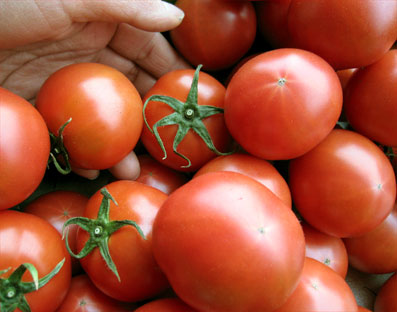
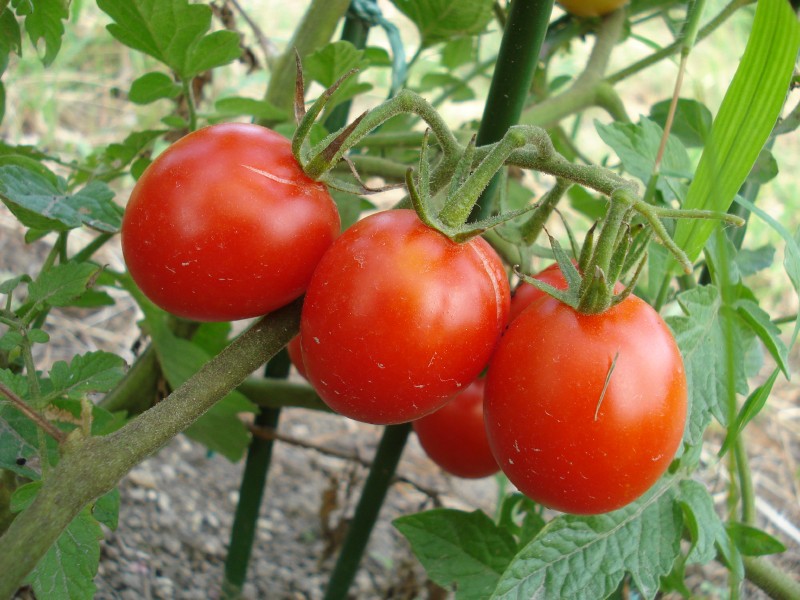
tomato-fruit

“Fruit Tomatoes”

This summer-maturing fruit can be bought all year round with the interesting consequence that tomatoes ripened in winter are sweeter than their summer cousins as they contain less water, earning themselves the name of “fruit tomatoes”, a great oxymoron, if there was one!

Thanks to consumers’ insatiable appetite for novelty, tomatoes are grown into all kinds of size, shape and colour.
Just to cite a few, the following are the most popular in Japan:

tomato-momotaro

“Momotaro Tomatoes”

-Momotaro (after the Japanese “Peach Boy” tale), which becomes “Fruit tomato” in winter.

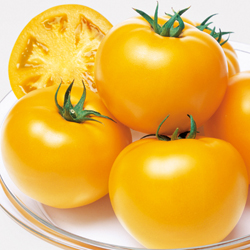
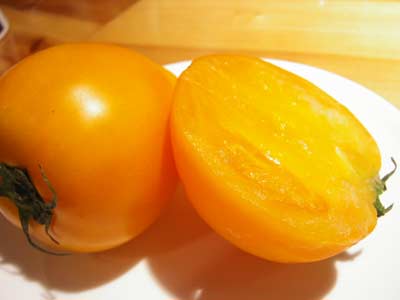
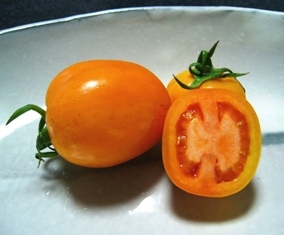
“Momotaro Tomato/Gold Variety”
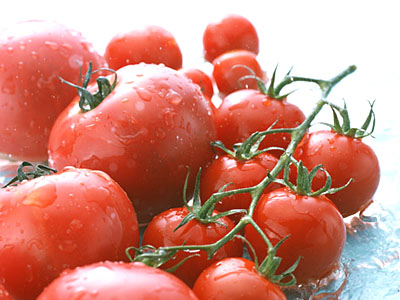
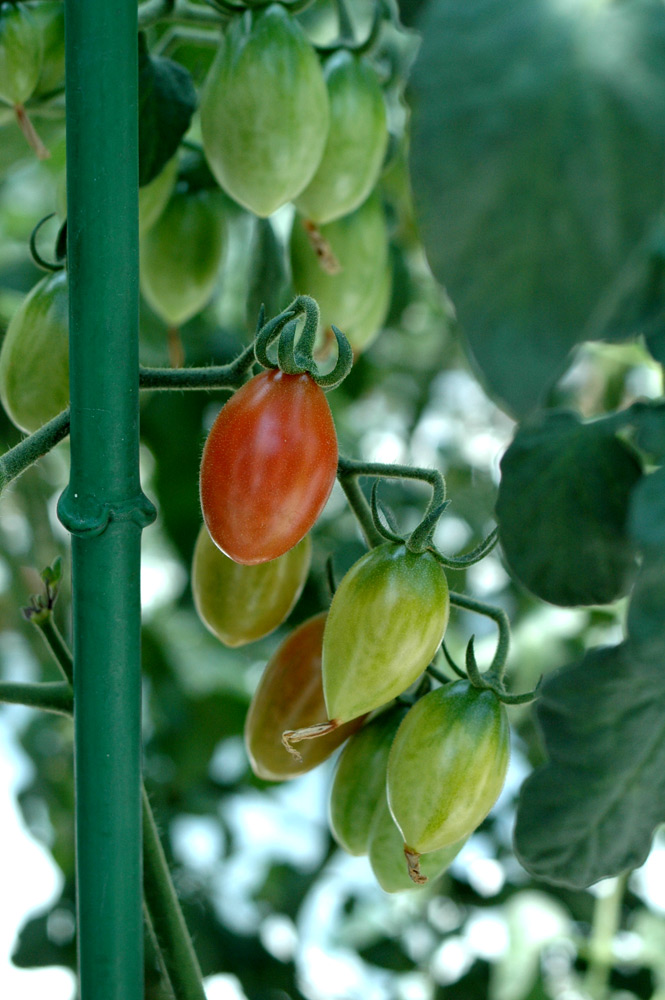
tomato-midi

“Midi Tomatoes”

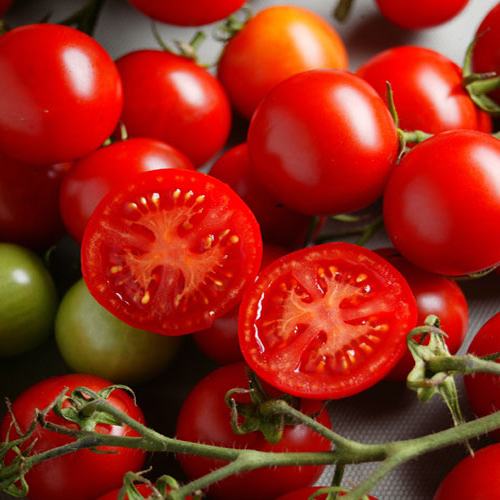
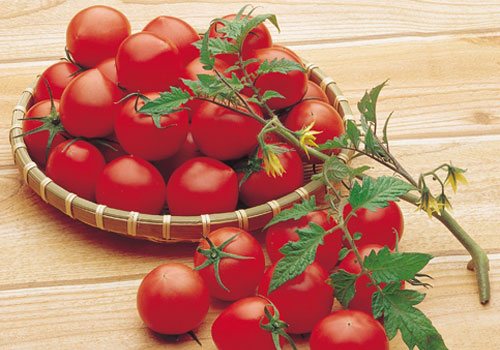
-Midi Tomato (sometimes called “Plum tomatoes”), a larger cousin of the “Mini tomato”, is very sweet and very high in nutrients. Its aroma has a particularly long life.

tomato-italian
“Italian tomatoes”

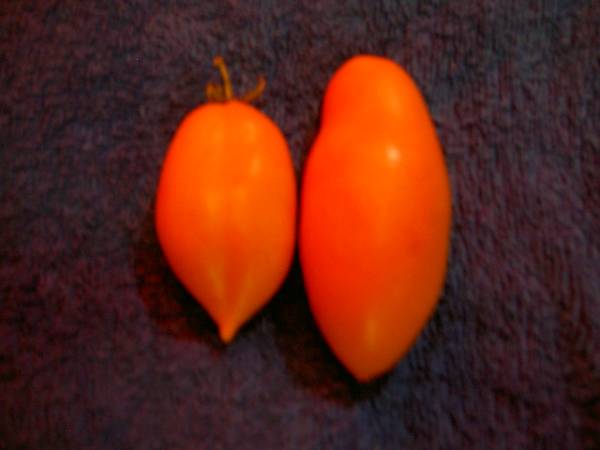
-Italian Tomato: mainly used for cooking, it may often come in a comparatively elongated shape.
It contains less water and reveals both large amounts of sweetness and acidity, making it very conducive to long cooking with the extra bonus of actually improving in taste upon heating.
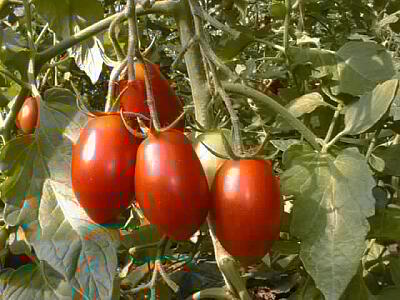
“Sicilian Rouge”, both for cooking and salads.
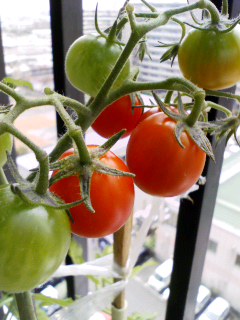
tomato-mini
“Mini Tomatoes”

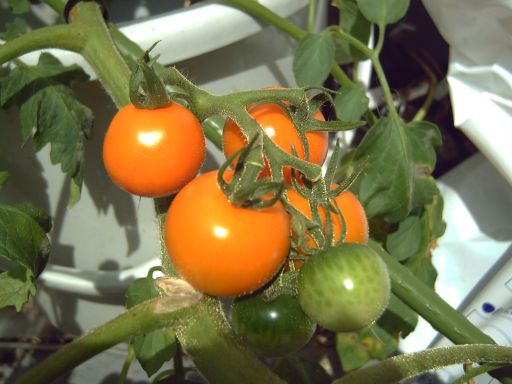
-Mini Tomato: one-bite sized, it is also called “Petit tomato”. It contains twice as many Vitamin C, and it is very rich in beneficent ingredients.

tomato-yellow-mini
“Yellow Mini Tomatoes”

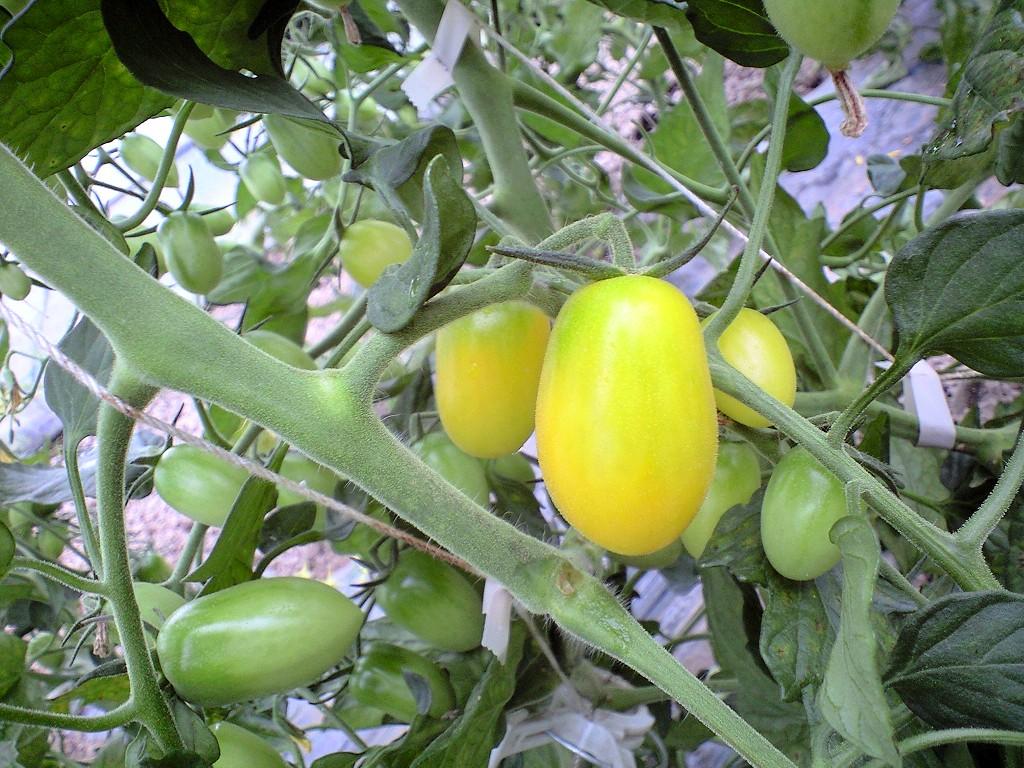
-Yellow Mini Tomato: characteristic for a lot of sweetness and very little acidity. Very handy for children who dislike vegetables!
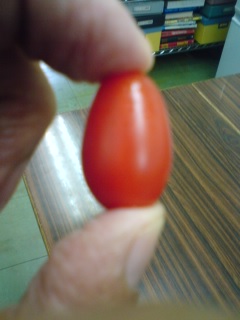
rubbins

“Ameera Rubbins”

-Ameera Rubbins: with its larger Ammeera tomato, it used to be grown exclusively in Shizuoka Prefecture. They are the sweetest of all, tasting like strawberries, and very firm, making them ideal for decoration, notwithstanding their nutrient value. The smallest variety called “Rubbins” used to be grown by only two farmers near Iwata City!
Recently a yellow version is being grown experimentally.

tomato-micromini

“Micro Mini Tomatoes”

-Micro Mini Tomatoes: increasingly popular, they are only 8~10 mm and look somewhat like redcurrants. Very tasty with a beautiful acidity, the Japanese use them not only in salads, but also as the final touch on a plate of sashimi!

“Fruit Yellow”, a small variety popular with kids!
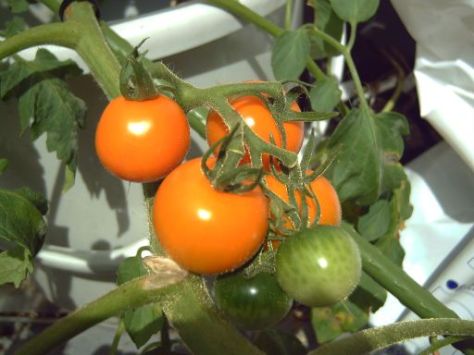
“Fruit Gold”, sweet and rich in vitamins!
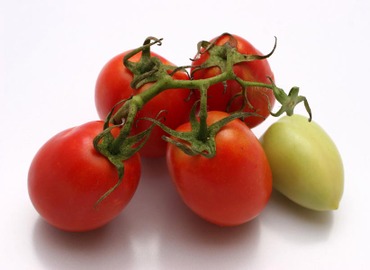
“Nitakikoma”, a Japanese variety which does not break away even after long cooking.

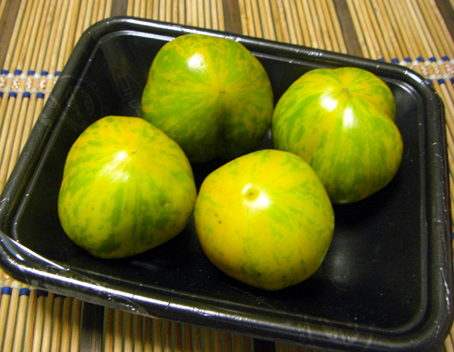
“Green Zebra”, Japanese name for green heirloom tomato
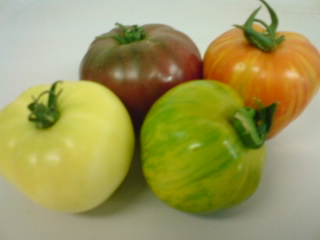
AGRI-TOMATO1

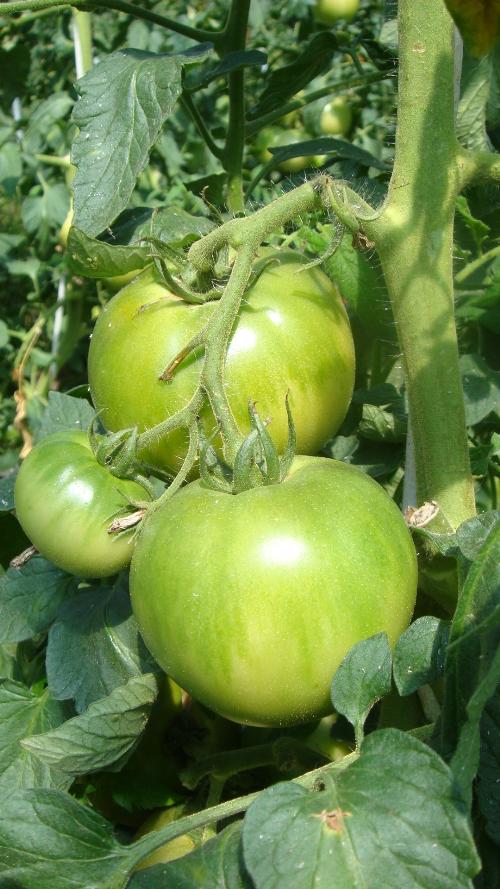
Heirloom Tomatoes grown in Shizuoka City!
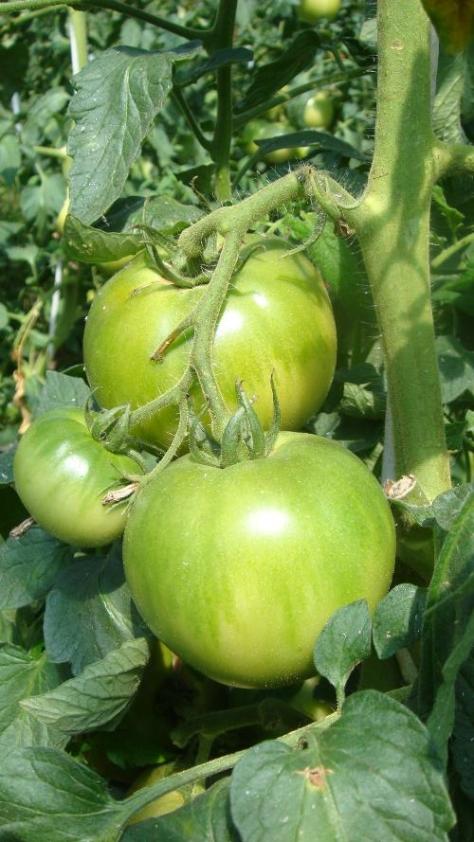
“Green”, stays green when ripe
Great in tenpura!
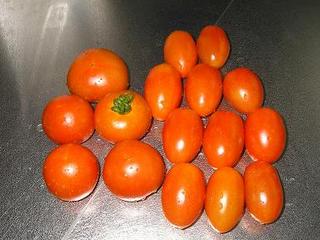
“Cindy Sweet”, well-balanced and sweet

“Aiko”, Japanese variety. Exists both in yellow and red. Eaten cooked or raw.
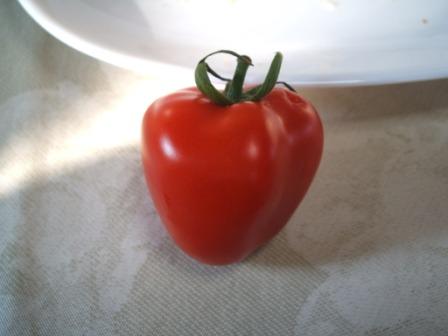
“Tomato Berry”, small, sweet and well-balanced.

“Campari”, grown in Hokkaido, Japan, originally from Holland. Fruity!

“Amakko”, similar to “Campari”. Very sweet!
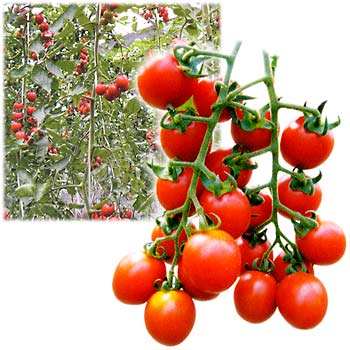
“Piccola Rouge”, Japanese version of an Italian Mini-tomato variety.

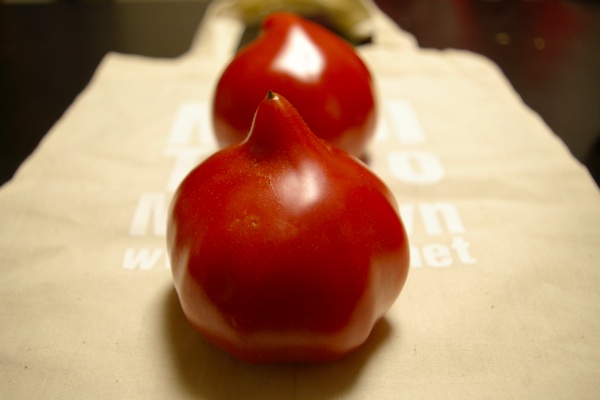
“First”. Appears in Winter. Grown in Iwata City, too! Beautiful pointed shape. Juicy!
Also called “Renaissance” in Shizuoka Prefecture.
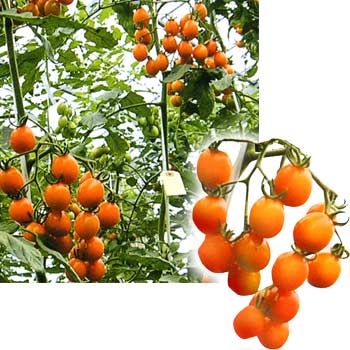
“Piccola Canaria”, an orange variety of the Piccola.
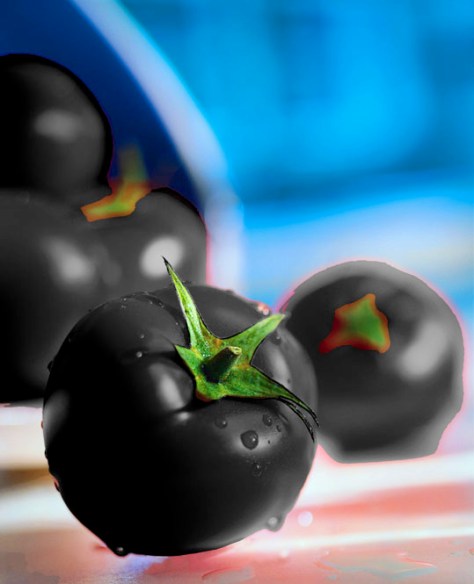
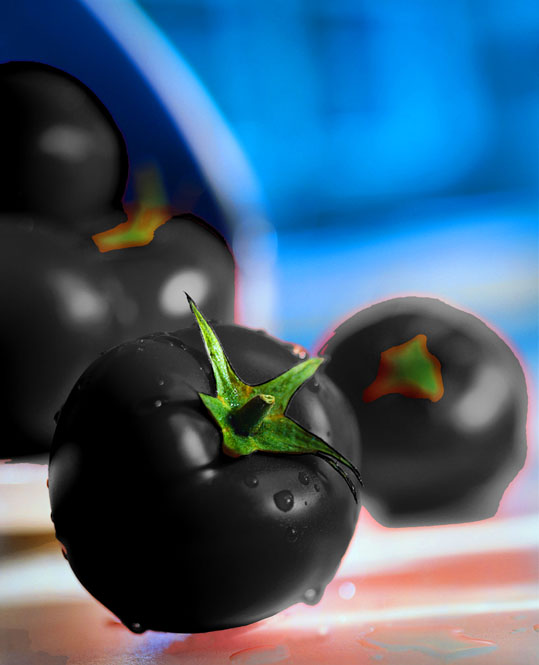
“Black”, as it is called!

“Kisu”. Beautiful colour and very sweet!
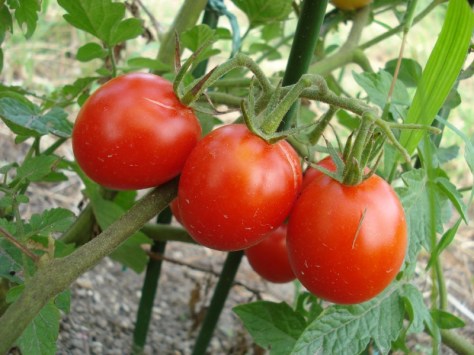
“Zeitaku Tomato”, meaning “Extravagant Tomato” in Japanese! Fruity, juicy and sweet!
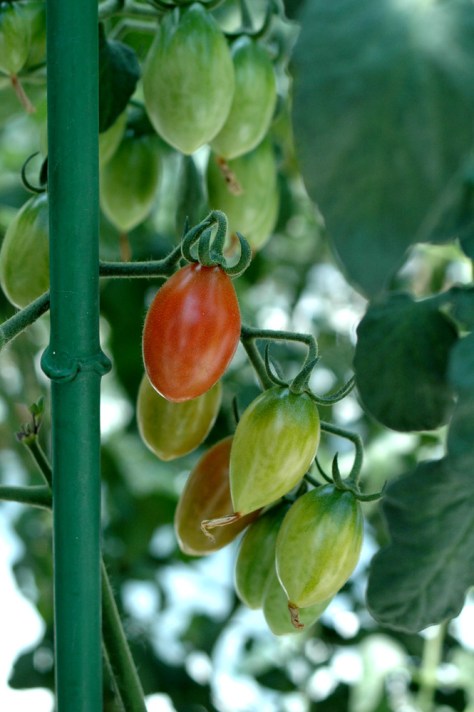
“Guppi”, a tasty tomato apt for cooking.

“Carrot Tomato”. High in carotens, taste similar to carrot. Appreciated raw.

“Orange Banana” from Russia! Very sweet!
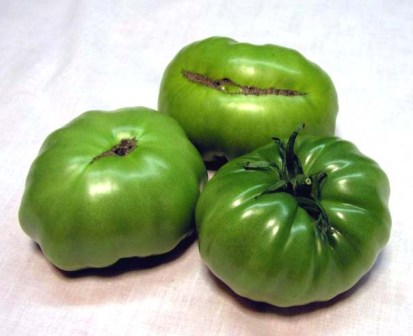
“Evergreen”. Versatile, can be eaten raw, cooked or pickled.
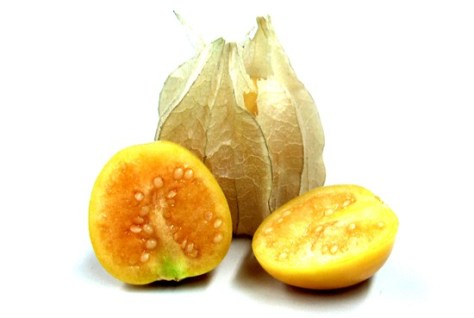
“Strawberry Tomato”. A cousin of tomatoes. God balance between sweetness and acidity.
Also used as decoration.

“Tokutani Tomato”. Fruit tomato, especially grown in Shikoku Island. Brand Tomato. Very expensive!

Many more varieties are regularly imported!

RECOMMENDED RELATED SITES:
Warren Bobrow, Bread + Butter, Zoy Zhang, Hungry Neko, Think Twice, Frank Fariello, Mangantayon, Hapabento, Elinluv Tidbit Corner, Tokyo Terrace, Maison de Christina, Chrys Niles,Lexi, Culinary Musings, Wheeling Gourmet, Comestiblog, Chronicles Of A Curious Cook, Tokyo Through The Drinking Glass, Tokyo Foodcast, Palate To Pen, Yellin Yakimono Gallery, Tokyo Terrace, Hilah Cooking, More than a Mount Full, Arkonite Bento, Happy Little Bento; 5 Star Foodie; Jefferson’s Table; Oyster Culture; Gourmet Fury; Island Vittles; Good Beer & Country Boys; Rubber Slippers In Italy; Color Food daidokoro/Osaka;/a; The Witchy Kitchen; Citron Et Vanille, Lunsj Med Buffet/Estonian Gastronomy (English), Cook, Eat, Play, Repeat, Chrisoscope, Agrigraph, The Agriculture Portal to shizuoka!

Please check the new postings at:
sake, shochu and sushi
Vegan Japanese Recipe: Burdock, Lotus Root & Carrot Kinpira

There are vast treasures to explore for vegetarians and vegans in Japanese gastronomy.
Once such pleasure (rhyme with treasure) is Kinpira/金平!
Here is a recipe that can be built on at will depending on the available vegetables: Burdock, Lotus Root & Carrot Kinpira/gobou, Renkon to Ninjin no Kinpira/牛蒡・蓮根・人参の金平!

INGREDIENTS: 4 people~

-Burdock root: 1
-Carrot: 1/2
-Lotus root: 4~5 cm long piece
-Grated fresh ginger: 1 teaspoon
-Spices of your choice (include chili pepper!)
Vegan Dashi: 1 cup
-Sesame oil: 2 teaspoons
-Mirin/sweet Japanese sake: 3 tablespoons
-Soy sauce 1+1/2 Tablespoons.

RECIPE:

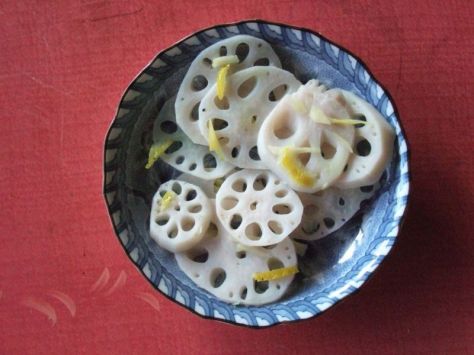
-Clean the burdock root under running clear water, cut out in appropriate-sized thin sticks. Drain well. Peel carrot and cut in same size as burdock root. Peel the lotus roots, slice into 5 mm thick pieces, clean in fresh cold water and drain well.

-In a frypan (if possible, non-stick), pour the sesame oil, drop well-drained vegetables and fry.
When the lotu root pieces have started changing color, add dashi, spices of your choice, grated ginger, mirin and soy sauce, and fry on a low fire (10 minutes).
Once the juices have almost reduced stop fire.

Can be served hot, lukewarm or cold!

RECOMMENDED RELATED SITES:
Warren Bobrow, Bread + Butter, Zoy Zhang, Hungry Neko, Think Twice, Frank Fariello, Mangantayon, Hapabento, Elinluv Tidbit Corner, Tokyo Terrace, Maison de Christina, Chrys Niles,Lexi, Culinary Musings, Wheeling Gourmet, Comestiblog, Chronicles Of A Curious Cook, Tokyo Through The Drinking Glass, Tokyo Foodcast, Palate To Pen, Yellin Yakimono Gallery, Tokyo Terrace, Hilah Cooking, More than a Mount Full, Arkonite Bento, Happy Little Bento; 5 Star Foodie; Jefferson’s Table; Oyster Culture; Gourmet Fury; Island Vittles; Good Beer & Country Boys; Rubber Slippers In Italy; Color Food daidokoro/Osaka;/a; The Witchy Kitchen; Citron Et Vanille, Lunsj Med Buffet/Estonian Gastronomy (English), Cook, Eat, Play, Repeat, Chrisoscope, Agrigraph, The Agriculture Portal to shizuoka!

Please check the new postings at:
sake, shochu and sushi

Japanese Vegetables 2: lotus Roots/Renkon/蓮根

lotus-root1

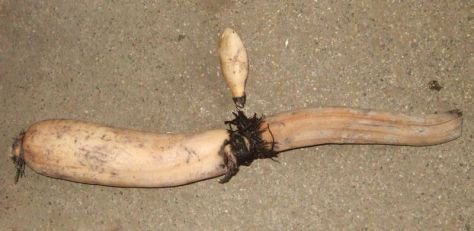
Lotus roots come from a plant called Nelumbo nucifera, also known by a number of names including Indian lotus, sacred lotus, bean of India, or simply lotus. This plant is an aquatic perennial. Under favorable circumstances its seeds may remain viable for many years.
A common misconception is referring to the lotus as a water-lily (Nymphaea), an entirely different plant.

Native to Greater India and commonly cultivated in water gardens, the lotus is the national flower of India and Vietnam.

The flowers, seeds, young leaves, and “roots” (rhizomes) are all edible. In Asia, the petals are used sometimes for garnish, while the large leaves are used as a wrap for food. In Korea, the leaves and petals are used as a tisane. Yeonkkotcha (연꽃차) is made with dried petals of white lotus and yeonipcha (연잎차) is made with the leaves. The rhizome (called ǒu (藕) in pinyin Chinese, ngau in Cantonese, bhe in Hindi, renkon (レンコン, 蓮根 in Japanese), yeongeun (연근) in Korean is used as a vegetable in soups, deep-fried, stir-fried and braised dishes. Petals, leaves, and rhizome can also all be eaten raw, but there is a risk of parasite transmission (e.g., Fasciolopsis buski): it is therefore recommended that they be cooked before eating.

FACTS:

-Season (in Japan): September~December

-Analytic data (as per 100g):

Energy: 66 kcal
Water: 81.5 g
Protein: 1.9 g
Carbohydrates: 15.5 g

Inorganic qualities:
Natriu: 24 mg
Potassium: 440 mg
Calcium: 20 mg
Iron: 00.5 mg
Zinc: 0.3 mg
Manganese: 0.78 mg

Vitamins:
B1: 0.10 mg
B6: 0.09 mg

Dietary fibers: 5.7 g

HEALTH FACTS:

-Combined with liver, or beef, or pork, or chicken, helps revitalize human blood and organs.

-Combined with turnips, or daikon, or beansprouts, or trefoil, helps digestion and bowels.

-Combined with leafy vegetables, or potato, or apples, helps combat cancer and obesity.

-Combined with konnyaku, or celery, or lettuce, or green peppers, helps lower blood cholesterol. helps combat artery hardening and prevent heart diseases.

VARIETIES

Kaga Renkon/加賀れんこん

Very fine texture and high content in starch,
Best appreciated steamed.

Iwakuni Renkon/岩国れんこん

Large specimen with large holes.

TIPS:

-Choose specimens with a clear white cut section. There should not be any black spots.
-Use large specimen as they are easier to cut and use.
-To prevent oxydising, wrap cut specimen into wet kitchen paper.
-Add vinegar to water when boling them to keep them white.
-The easiest way to peel them is to use a potato peeler!

COOKING:

The stamens can be dried and made into a fragrant herbal tea called liánhuā cha (蓮花茶) in Chinese, or (particularly in Vietnam) used to impart a scent to tea leaves. The lotus seeds or nuts (called liánzĭ, 蓮子; or xian liánzĭ, 鲜莲子, in Chinese) are quite versatile, and can be eaten raw or dried and popped like popcorn, phool makhana. They can also be boiled until soft and made into a paste, or boiled with dried longans and rock sugar to make a tong sui (sweet soup). Combined with sugar, lotus seed paste becomes one of the most common ingredient used in pastries such as mooncakes, daifuku, and rice flour pudding.

Japanese popular Renkon dishes:

lotus-root-nimono

“NIMONO”

lotus-root-sumono

“SUMONO”

lotus-root-kimpira

“KIMPIRA”

“STUFFED LOTUS ROOTS”

“DEEP-FRIED LOTUS ROOT SANDWICH”

lotus-roots-chips

“CHIPS”

RECOMMENDED RELATED SITES:
Warren Bobrow, Bread + Butter, Zoy Zhang, Hungry Neko, Think Twice, Frank Fariello, Mangantayon, Hapabento, Elinluv Tidbit Corner, Tokyo Terrace, Maison de Christina, Chrys Niles,Lexi, Culinary Musings, Wheeling Gourmet, Comestiblog, Chronicles Of A Curious Cook, Tokyo Through The Drinking Glass, Tokyo Foodcast, Palate To Pen, Yellin Yakimono Gallery, Tokyo Terrace, Hilah Cooking, More than a Mount Full, Arkonite Bento, Happy Little Bento; 5 Star Foodie; Jefferson’s Table; Oyster Culture; Gourmet Fury; Island Vittles; Good Beer & Country Boys; Rubber Slippers In Italy; Color Food daidokoro/Osaka;/a; The Witchy Kitchen; Citron Et Vanille, Lunsj Med Buffet/Estonian Gastronomy (English), Cook, Eat, Play, Repeat, Chrisoscope, Agrigraph, The Agriculture Portal to shizuoka!

Please check the new postings at:
sake, shochu and sushi

Today’s Lunch Box/Bento (’11/11): “Dry Curry” Bento

The Japanese ususally prepare their “curry” in the form of a more or less consistent “soup” that the pour on top of rice.
What they call “dry curry” has nothing dry about it. They mean that the curry, instead of a soup, will take the form of a consistent meat sauce similar to that of Bolognese sauce. In England it would be labelled a “savoury”.

The Missus had already prepared a curry of roughly minced pork and beef with chopped vegetables and plenty of curry paste and condiments of her own.
She reheated it while she steamed the rice.

She then mixed the hot rice with curry poder for a beautiful yellow color.
AS she placed it in the bento box she formed a “well” to be filled with the minced meat curry. She then topped it with a soft-boiled egg broken in small pieces before putting the last touch with kawaire daikon/daikon sprouts and fancy stuffed olives.

As for the fibers and vitamin she preapred a simple salad of baby leaves, boiled Brussels spouts, plum tomatoe, small pieces of cheese and alnuts.

Very hearty and delicious!

RECOMMENDED RELATED SITES

Clumsyfingers by Xethia
Adventures in Bento Making, American Bento, Beanbento, Bento No1, Bento Wo Tsukurimashou, Cooking Cute, Eula, Hapabento , Happy Bento, Jacki’s Bento Blog, Kitchen Cow, Leggo My Obento, Le Petit Journal Bento & CO (French), Lunch In A Box, My Bento Box, Vegan Lunch Box; Tokyo Tom Baker, Daily Food Porn/Osaka, Only Nature Food Porn, Happy Little Bento, The Herbed Kitchen, J-Mama’s Kitchen, Cook, Eat, Play, Repeat; Bento Lunch Blog (German); Adventures In Bento; Anna The Red’s Bento Factory; Cooking Cute; Timeless Gourmet; Bento Bug; Ideal Meal; Bentosaurus; Mr. Foodie (London/UK); Ohayo Bento

Please check the new postings at:
sake, shochu and sushi

—————————————-
日本語のブログ
—————————————-

Japanese Vegetables 1: Burdock Root/Gobou/牛蒡

Burdock root, greater burdock or edible burdock root is called “gobou/牛蒡” in Japanese.
Its Latin name is Arctium lappa.

Although it is a root vegetable with great nutritious and even medical properties, it is commonly eaten only in Japan and Taiwan.

This species is native to the temperate regions of the old world, from Scandinavia to the Mediterranean, and from the British Isles through Russia, and the Middle East to China and Japan, including India.

It is naturalized almost everywhere and is usually found in disturbed areas, especially in soil rich in nitrogen. It is commonly cultivated in Japan.

It prefers a fresh, worked soil, rich in humus, and should be positioned in full sunlight. Burdock is very reactive to nitrogen fertilizer. Propagation is achieved through sowing the seeds midsummer. The harvest occurs three to four months after the seeding until late autumn, when the roots become too fibrous.
In shizuoka it is more and more cultivated in organic fashion with natural/organic fertilizer and no pesticides.

Greater burdock was used during the Middle Ages as a vegetable, but now it is rarely used, with the exception of Japan where it is called gobō (牛蒡 or ゴボウ), Taiwan (牛蒡), Korea where it is called ueong (우엉), Italy, Brazil and Portugal, where it is known as bardana. Plants are cultivated for their slender roots, which can grow about 1 meter long and 2 cm across.

Immature flower stalks may also be harvested in late spring, before flowers appear. The taste resembles that of artichoke, to which the burdock is related.

The root is very crisp and has a sweet, mild, and pungent flavor with a little muddy harshness that can be reduced by soaking julienned/shredded roots in water for five to ten minutes. The harshness shows excellent harmonization with pork in miso soup (tonjiru) and takikomi gohan (a Japanese-style pilaf).

A popular Japanese dish is kinpira gobō, julienned or shredded burdock root and carrot, braised with soy sauce, sugar, mirin and/or sake, and sesame oil. Another is burdock makizushi (rolled sushi filled with pickled burdock root; the burdock root is often artificially colored orange to resemble a carrot). In Kyoto, gobō can also be found as a snack food similar to potato chips. The root is eaten cooked and the young sprout can be eaten just like asparagus. Gobo is also used in tempura.

Apart of its obvious culinary value, it is also valuable for its high content in dietary fibers and beneficiary nutrients.
It has been utilized as a medicinal plant with diuretic, diaphoretic, and blood purifying capabilities. The Japanese have also recognized it to prevent cancer and combat diabetes.

FACTS:

-Season (in Japan): November to January and April to May

-Analytic data (as per 100g):

Energy: 65 kcal
Water: 81.7 g
Protein: 1.8 g
Carbohydrates: 15.4 g
Ash: 0.9 g

Inorganic qualities:
Potassium: 320 mg
Calcium: 46 mg
Magnesium: 54 mg
Phosphorus: 62 mg
Iron: 0,7 mg
Zinc: 0.8 mg

Vitamins:
B1: 0.05 mg
B6: 0.10 mg

Dietary fibers: 5.7 g

HEALTH FACTS:

-Combined with seaweed (wakame), or celery, or enoki mushroom, or konnyaku, helps prevent high blood pressure and blood vessels hardening, helps with hair health and recovery from constipation.
-Combined with dried daikon, or shiitake mushrooms, or celery, or turnips, helps prevent cancer, helps fotiify stomach, and increases skin qulaity.
-Combined with hijiki sweet seaweed, or tofu, or bamboo shoots, or agar agar, helps reduce blood cholesterol and general diets.
-Combined with whole rice (genmai), or oatmeal, or corn flakes, helps prevent diabetes, helps combat obesity and helps prevent blood vessels hardening.

VARIETIES:

Common burdock/gobou/牛蒡

Oura Gobou/大浦ごぼう (on the left), a very thick variety, which reaches 10cm in diameter for 1 meter in length.

Yama Gobou/山gpぼう, a thinner and shorter variety.

Super Risou Gobou/スーパー理想ごぼう, a75 cm long and thin variety with a smooth skin.

TIPS
Do not peel before cooking as the skins contain a lot of nutrients.
Just brush the dirt away under clear running water
Can be easily preserved frozen once cooked

GASTRONOMY

Steamed and seasone burdock root

Simmered burdock appetizer

“Kinpira” burdock, thinly cut and fried with sake, soy sauce, mirin and chili sesame oil.

Simmered Oura Gobou.

Grilled gobou salad

Mixed vegetable “kinpira”

Super Risou Gobou salad/appetizer

Steamed/fried Yama Gobou

Vegan Yama Gobou Sushi

RECOMMENDED RELATED SITES:
Warren Bobrow, Bread + Butter, Zoy Zhang, Hungry Neko, Think Twice, Frank Fariello, Mangantayon, Hapabento, Elinluv Tidbit Corner, Tokyo Terrace, Maison de Christina, Chrys Niles,Lexi, Culinary Musings, Wheeling Gourmet, Comestiblog, Chronicles Of A Curious Cook, Tokyo Through The Drinking Glass, Tokyo Foodcast, Palate To Pen, Yellin Yakimono Gallery, Tokyo Terrace, Hilah Cooking, More than a Mount Full, Arkonite Bento, Happy Little Bento; 5 Star Foodie; Jefferson’s Table; Oyster Culture; Gourmet Fury; Island Vittles; Good Beer & Country Boys; Rubber Slippers In Italy; Color Food daidokoro/Osaka;/a; The Witchy Kitchen; Citron Et Vanille, Lunsj Med Buffet/Estonian Gastronomy (English), Cook, Eat, Play, Repeat, Chrisoscope, Agrigraph, The Agriculture Portal to shizuoka!

Please check the new postings at:
sake, shochu and sushi

Today’s Lunch Box/Bento (’11/10): St. Valentine Bento!

I had to call this bento, “St. Valentine Bento” because the Missus, although one day late, couldn’t help introducing a couple of little hearts in today’s lunch!
Can you see them?

The rice was plain steamed rice but she seasoned it with umeboshi furikake/梅干振り掛け. “Furikake” in Japanese means “sprinkle”, and they come in many varieties in Japan! Actually people make their own in the countryside. For example, Shizuoka is famous for wasabi furikake!
The Missus thought of the color combination when she added home-pickled mini-melon and red daikon!

I must admit that the “side dish” box was pretty elaborate.
Actually, I didn’t request for a bento yesterday and won’t either tomorrow in all probability. That could explain the Missus’ inspiration!

The “white end” consisted of daikon and scallops salad with pink pepper seeds, mini-tomatoes, lettuce and the Missus’ specialty, deep-fried chicken in sesame seeds.
The seasame seeds were coated on the chicken “sasami/fillets” with cornstarch and seasoning before being shallow-fried (“deep-fried” in shallow oil). Very tasty!

The “green end” consisted of boiled broccoli, a half “onsen tamago/温泉卵, that is, a semi-boiled egg which had been later marinated for extra seasoning, fried slices of lotus roots and boiled carrot hearts for the Saint Valentine!

Note that there is no dessert, but I took a batch of mandarines with me!

RECOMMENDED RELATED SITES

Clumsyfingers by Xethia
Adventures in Bento Making, American Bento, Beanbento, Bento No1, Bento Wo Tsukurimashou, Cooking Cute, Eula, Hapabento , Happy Bento, Jacki’s Bento Blog, Kitchen Cow, Leggo My Obento, Le Petit Journal Bento & CO (French), Lunch In A Box, My Bento Box, Vegan Lunch Box; Tokyo Tom Baker, Daily Food Porn/Osaka, Only Nature Food Porn, Happy Little Bento, The Herbed Kitchen, J-Mama’s Kitchen, Cook, Eat, Play, Repeat; Bento Lunch Blog (German); Adventures In Bento; Anna The Red’s Bento Factory; Cooking Cute; Timeless Gourmet; Bento Bug; Ideal Meal; Bentosaurus; Mr. Foodie (London/UK); Ohayo Bento

Please check the new postings at:
sake, shochu and sushi

—————————————-
日本語のブログ
—————————————-

Sushi: Local Seafood at Ekimae Matsuno Sushi

The great thing about (good) sushi restaurants in Shizuoka Prefecture is that they try to serve as much local seafood and products as possible.
One such establishment is Ekimae Matsuno Susuhi,the oldest existing sushi restaurant in Shizuoka City.
Not only the food is (reasonably-priced) first-class but it is mostly from Shizuoka Prefecture.
Here is what I had the pleasure to sample on my last visit:

Maguro no akami/マグロの赤身/ lean part of the yuna. I prefer the lean part to toro which is only for the status-minded or snobbish gastronomes. We do have many kinds of tuna roaming the waters of Suruga Bay and there is not much need to “import” it, either from the rest of Japan or of the World.

Hirame/平目/Sole and Tairagi/タイラギ/Pen shell.
The seaweed, orange and wasabi are all from Shizuoka Prefecture! LOL

Mr. Ueda is experimenting with a new chawanmushi/茶碗蒸し/Japanese salted pudding. Can you guess what it contains?

Ankimo/アンキモ/Steamed frogfish (monkfish) liver.
It is also called “Japanese foie gras” and made with the liver of Frogfish/Ankou/鮟鱇 steamed in Japanese sake!

Deep-fried Red Trumpet Fish/Karaage aka yagara/唐揚げ赤やがら.
A very versatile fish that can enjoyed raw, marinated or cooked!

Vegetables are always welcome: lightly boiled Na no Hana/菜の花/rape plant and grilled Take no Ko/竹の子/bamboo shoots!

Aji no Tataki/鯵のたたき/chopped raw horse mackerel.

The fish is so fresh that you can ask for the bones and head to be deep-fried!

Tamagoyaki/卵焼き/Japanese omelette made with Shizuoka-raised eggs!

My favourite: Tachiuo Aburi Nigiri/Seared Scabbard Fish Nigiri/太刀魚炙り握り
The Scabbard Fish is seared on the skin only and lightly seasoned before being served as nigiri sushi.
A must! So simple and so tasty!

First dessert: Kanpyou Maki/Dried Gourd Shavings Roll/干瓢巻き.
I must mention this is a sushi fit for vegans!

Second dessert: Creme Brulee!
Mr. Ueda is really eclectic and proves he is a good chef with any food!

Are you tempted?

Ekimae Matsuno Sushi/駅前松乃鮨
Shizuoka City, Aoi Ku, Koya Machi, 9-3 (in front of Shizuoka City JR Station, North Side)
Tel.: 054-251-0123
Business hours: 11:00~21:00
Closed on Wednesdays and third Tuesday
HOMEPAGE (Japanese)

RECOMMENDED RELATED SITES:
Taste With The Eyes, Bread + Butter, Zoy Zhang, Hungry Neko, Think Twice, Frank Fariello, Mangantayon, Hapabento, Elinluv Tidbit Corner, Tokyo Terrace, Maison de Christina, Chrys Niles,Lexi, Culinary Musings, Wheeling Gourmet, Comestiblog, Chronicles Of A Curious Cook, Tokyo Through The Drinking Glass, Tokyo Foodcast, Palate To Pen, Yellin Yakimono Gallery, Tokyo Terrace, Hilah Cooking, More than a Mount Full, Arkonite Bento, Happy Little Bento; 5 Star Foodie; Jefferson’s Table; Oyster Culture; Gourmet Fury; Island Vittles; Good Beer & Country Boys; Rubber Slippers In Italy; Color Food daidokoro/Osaka;/a; The Witchy Kitchen, Citron Et Vanille, Lunsj Med Buffet/Estonian Gastronomy (English), Cook, Eat, Play, Repeat, Chrisoscope, Agrigraph, The Agriculture Portal to shizuoka!; Tes At Home, Three Tastes, Tao In The Kitchen

Please check the new postings at:
sake, shochu and sushi

Shimizu Harbor Food Fair: Shimizu Minato Yatai Matsuri

Grand old Ladies serving local food from Kiyozawa Village Station up the Abe River In Shizuoka City!

Today was the second day of the Shimizu Harbor Food Fair/清水みなと屋台まつり, an increasingly popular event already in its 3rd year.
Even at 10:00 in the morning it was already pretty crowded and reporting (and eating) was quite a tussle!

The event seen from Shimizu JR Station platform.

The sun was back with us after 2 days of miserable weather and people were keen to go out and enjoy great local food at the stands/yatai/屋台!

Don’t forget to take a picture of snow-capped Mount Fuji whenever you come to Shimizu as the elevated station is a great viewpoint!

We were still at 10:00. I don’t want to imagine the crowds early in the afternoon, or even in the dark as the event is held until 20:00!

The banner for “inoshishi man/steamed wild boar meat bun”!
All the way from Kiyosawa up in the mountains along the Abe River!

I had to wait 20 minutes before I could get mine!
Actually, one the ladies chased me as I was reporting to kindly hand me the steaming hot wild boar bun in person!

Kintsuba, already almost gone!
A favorite Japanese cake of mine! Actually, it is vegan!

The stand of the famous yakisoba/fried noodles from Fujinomiya City!

Hands off, LOL!
I know a lot of non-Japanese who would not stop eating them!

That is, unless their eyes catch the fried food in that stand!

Appetizing, aren’t they?

But if I were you I would take my time and after two rounds maybe sample of these yakitori!

But there is plenty for those who don’t fancy meat: Scrumptious-looking sastuma sticks/fried sweet potato wedges!

Many local izakayas like “Ashika” had raised their stands for some great PR!

How about some kushiyaki/串焼き/Japanese brochettes?

Don’t forget to sip a glass of great Shimizu Sake: Garyubai/臥龍梅 by Sanwa Brewery/三和酒造!

Takoyaki/たこ焼/Fried octopus dumplings are a universal favorite!

And so much fun to see them being prepared!

And more brochettes and other morsels that Japanese and non-Japanese would love to sample with a (big) glass of beer!

Now, this is a very local specialty: Stick ginger (fresh) and leek bun from Kuno Yamaguchi Garden (Near Kunozan Shrine!)!

I kept this for the end and my just reward for reporting (lol): Shizuoka Ken Suruga Shamo/Shizuoka Prefecture Suruga Shamo Chicken/静岡県駿河しゃも!
Now, this is true (and comparatively expensive: 200 yen a small stick or 500 yen a small bowl of soup) gastronomic food as this variety of chicken raised in Shizuoka Prefecture is known all over the country for its superlative taste!

No need to say that I exchanged business cards with the breeder as I will interview him soon at his farm up in Umegashima in the mountains near the source of the Abe River!

Looking forward to the next event in Shimizu Harbor, a major fishing harbor in the whole of Japan (and the izakas in the vicinity)!

RECOMMENDED RELATED SITES:
Taste With The Eyes, Bread + Butter, Zoy Zhang, Hungry Neko, Think Twice, Frank Fariello, Mangantayon, Hapabento, Elinluv Tidbit Corner, Tokyo Terrace, Maison de Christina, Chrys Niles,Lexi, Culinary Musings, Wheeling Gourmet, Comestiblog, Chronicles Of A Curious Cook, Tokyo Through The Drinking Glass, Tokyo Foodcast, Palate To Pen, Yellin Yakimono Gallery, Tokyo Terrace, Hilah Cooking, More than a Mount Full, Arkonite Bento, Happy Little Bento; 5 Star Foodie; Jefferson’s Table; Oyster Culture; Gourmet Fury; Island Vittles; Good Beer & Country Boys; Rubber Slippers In Italy; Color Food daidokoro/Osaka;/a; The Witchy Kitchen, Citron Et Vanille, Lunsj Med Buffet/Estonian Gastronomy (English), Cook, Eat, Play, Repeat, Chrisoscope, Agrigraph, The Agriculture Portal to shizuoka!; Tes At Home, Three Tastes, Tao In The Kitchen

Please check the new postings at:
sake, shochu and sushi

Masahiro Sugimoto at Sugimoto Garden: A Young Farmer Looking Ahead!

Masahiro Sugimoto/杉本政紘

Agriculture in Japan (and Shizuoka, which s no exception in spite of its favorable position) is suffering from two chronic problems: ageing of the farming population and too much untended farming land.
The situation as far ageing is concened is slowly improving in Shizuoka but there are still 12.000 ha of untended farming land asking to be exploited.

On the bright side more and more young people not only choose farming as their life but also adopt new directions even if it means breaking “traditions”.

One such farmer is Masahiro Sugimoto, only 26 years of age and still only in his second year as an individual farmer.

Experimenting with Italian putarella.

After graduating form Shizuoka Industrial High School/静岡市立商業高校, instead of attending a full university course, he opted for a meaningful two-year study at the Iwata Agricultural Institute/磐田農林大学校 to enable him to continue and improve of his family’s farming venture which had been growing vegetables for 10 generations.

Although mainly growing lettuces and corn on a total of 80 ha comprising 7 ha in greenhouses, he also experiment with all kinds of vegetables for a meaningful diversification.

A closer view of the putarella.

Corn is grown from February to June and lettuces from September to March.
That still leaves him with plenty of time to experiment with different vegetable varieties.

European cabbage variety.

He is on contract with markets such as Shizutetsu as far as his lettuce and corn are concerned but he is actively seeking new markets including local restaurants always looking for new varieties.

Masahiro’s lettuce greenhouses.

Lettuce is big business in Shizuoka!

Masahiro is also reducing all artificial pesticides and fertilizers to the minimum to produce those beautiful vegetables!

He is seriously thinking of making more organic fertilizers and is always carefully listening to suggestions.

Lettuces grown in open fields have to be covered with insect nets to avoid using pesticides.

His own mother is experimenting with wasabina/わさび菜/ a variety of lettuce called such because its taste remniscing of wasabi!

Masahiro will lend this vacant space between his greenhouses for free to local primary schools for on-field classes. A young man already thinking of the future generations!

Atsushi Sugimura/杉村敦志 (33) and Masahiro Sugimoto/杉本政紘 (26)

Masahiro is also very active exchanging views with his peers to form a farming community with better communications and a new common direction not only in farming but also in agri-business!

Sugimoto Garden
Masahiro Sugimoto
427-0111 Shizuoka Ken, Shimada Shi, Sakamoto, 1007-1
Tel. & Fax: 0547-38-08305
Mobile: 090-7958-8969
E-mail: masahiro@smile.tnc.ne.jp
Homepage & Blog: http://hatake.eshizuoka.jp/

RECOMMENDED RELATED SITES:
Warren Bobrow, Bread + Butter, Zoy Zhang, Hungry Neko, Think Twice, Frank Fariello, Mangantayon, Hapabento, Elinluv Tidbit Corner, Tokyo Terrace, Maison de Christina, Chrys Niles,Lexi, Culinary Musings, Wheeling Gourmet, Comestiblog, Chronicles Of A Curious Cook, Tokyo Through The Drinking Glass, Tokyo Foodcast, Palate To Pen, Yellin Yakimono Gallery, Tokyo Terrace, Hilah Cooking, More than a Mount Full, Arkonite Bento, Happy Little Bento; 5 Star Foodie; Jefferson’s Table; Oyster Culture; Gourmet Fury; Island Vittles; Good Beer & Country Boys; Rubber Slippers In Italy; Color Food daidokoro/Osaka;/a; The Witchy Kitchen; Citron Et Vanille, Lunsj Med Buffet/Estonian Gastronomy (English), Cook, Eat, Play, Repeat, Chrisoscope, Agrigraph, The Agriculture Portal to shizuoka!

Please check the new postings at:
sake, shochu and sushi

Shizuoka Oden Fair 2011!

Yamako’s miso oden!

The Shizuoka (Shizooka in local dialect) Oden fair 2011 has finally come to us.
It has become a yearly event reported by all TV’s (local and more and more national), newspapers and various media. Actually reporting on such an event turns into a major TV crew dodging exercise!

Unfortunately today was cold and rainy, but it separated the true officionados from the casual visitors!
Sunday promises for clear skies and it will a real tussle!

When it comes to oden, I do have my preferences, some of them very subjective due to the fact I have some friends in the business such as Yamako/山幸 in Mariko, Shizuoka City!

Pose!
The Kondohs are being helped by their friends working at Yamanashi Clinic in Shizuoka City!

They offered one of the most complete assortment with oden, bento rice, tororojiru, soup and what else.

My favourite: Yamako’s miso oden!

Having fun!

The whole event is worth a whole tour and a second one and a benediction for photographers who want to discover real Japanese life!

But there are also a lot of foreign residents in Japan with their own version of oden!
The above stall was selling Korean oden!
They were certainly very loud about it! LOL

Korean oden. Very large!

The stand of the Shizuoka Oden Lovers Association!

They had the merit to serve great Shizuoka sake!

My other favourite stand by Annam, the best Vietnamese restaurant in the whole Prefecture!

Very welcoming ladies!
Actually they were very professional and devoted to their customer who flocked at their stand!

Vietnamese oden!

The oden dish of the day:
Vietnamese oden served with noodles in Pho Soup!

Alright I’ll go there again tomorrow and the day after tomorrow for further investigation!

The event is held in two different locales until the 13th:
-Aoba Park/青葉公園・青葉シンボルロード and Aoba Square:青葉スクエア
Time: 11:00~20:00

-Shichiken-cho Doori/七間町通り and Gofujuku-cho Doori/呉服町通り
Time: 11:00~17:00

RECOMMENDED RELATED SITES:
Warren Bobrow, Bread + Butter, Zoy Zhang, Hungry Neko, Think Twice, Frank Fariello, Mangantayon, Hapabento, Elinluv Tidbit Corner, Tokyo Terrace, Maison de Christina, Chrys Niles,Lexi, Culinary Musings, Wheeling Gourmet, Comestiblog, Chronicles Of A Curious Cook, Tokyo Through The Drinking Glass, Tokyo Foodcast, Palate To Pen, Yellin Yakimono Gallery, Tokyo Terrace, Hilah Cooking, More than a Mount Full, Arkonite Bento, Happy Little Bento; 5 Star Foodie; Jefferson’s Table; Oyster Culture; Gourmet Fury; Island Vittles; Good Beer & Country Boys; Rubber Slippers In Italy; Color Food daidokoro/Osaka;/a; The Witchy Kitchen; Citron Et Vanille, Lunsj Med Buffet/Estonian Gastronomy (English), Cook, Eat, Play, Repeat, Chrisoscope, Agrigraph, The Agriculture Portal to shizuoka!

Please check the new postings at:
sake, shochu and sushi
Sashimi: Shizuoka Local Fish at Uosei in Heda, Izu Peninsula

Just came from another visit in Izu Peninsula!
This time another two and half hours car trip took us to Heda, a harbor part of Numazu City at the Western top of Izu Peninsula across from Mount Fuji.

Although a small harbor, Heda is well-known for one seafood I’ll introduce later!
We were not very fortunate today as the skies were overcast. By fine weather you can admire Mount Fuji in its full splendor just through the narrow gullet leading to the harbor waters.

No, this was not freshly caught from the sea!
Izu Peninsula is celebrated for its dried fish/himono/干物!

Here is the place we chose to have lunch.
Can you see the big crab?

The speciality I was talking about: Takaashigani/Long-Legged Crabb/高足蟹!

For a closer view.
These are small to medium-sized specimens.
Takaashigani is the largest crab in the world and it is caught only in Suruga Bay!

Now, this is the real size.
The pincers’s full length is over 1 metre each!

As we came there for work, we skipped the Takaashigani Lunch Set, which simply too big and opted for two different local sashimi lunch sets!

I chose the above: Amaebi/Sweet Shrimps/甘エビ, maguro/tuna/鮪, ika/cuttlefish/烏賊, and aji/hose mackerel/鯵.

My friend chose the single fish sashimi lunch set featuring horse mackerel!

For a side view!
There is need to say that the fish was freshe than anywhere else!
I was about to forget: and so delicious!

Moreover, Heda is worth a visit for its touristic charm!
Can you see the “torii/鳥居” in the distance?
A torii is a gate found at the entry of Shinto Shrine.

Beautiful, isn’t it?
This the torii of a Shrine called “Murokuchi”
The Shrine is there for the safety and prosperity of the local fishermen and households!

Do visit after a nice walk along the small beach or through the pine grove!

UOSEI
410-3402 Shizuoka ken, Numazu City, Heda, 580
Tel.: 0558-94-2114/0558-94-2598
Open from lunch to dinner

Access: Train & Bus= change trains at Mishima JR Station and go to Shuzenji. Get off at Shuzenji Station and take a bus to Heda.
By boat: Take a bus from Numazu JR Station to Numazu harbor and board one of the regular ships.
By Car Ferry: Board at Shimizu harbor and land at Doi, then drive to Heda.

RECOMMENDED RELATED SITES:
Warren Bobrow, Bread + Butter, Zoy Zhang, Hungry Neko, Think Twice, Frank Fariello, Mangantayon, Hapabento, Elinluv Tidbit Corner, Tokyo Terrace, Maison de Christina, Chrys Niles,Lexi, Culinary Musings, Wheeling Gourmet, Comestiblog, Chronicles Of A Curious Cook, Tokyo Through The Drinking Glass, Tokyo Foodcast, Palate To Pen, Yellin Yakimono Gallery, Tokyo Terrace, Hilah Cooking, More than a Mount Full, Arkonite Bento, Happy Little Bento; 5 Star Foodie; Jefferson’s Table; Oyster Culture; Gourmet Fury; Island Vittles; Good Beer & Country Boys; Rubber Slippers In Italy; Color Food daidokoro/Osaka;/a; The Witchy Kitchen; Citron Et Vanille, Lunsj Med Buffet/Estonian Gastronomy (English), Cook, Eat, Play, Repeat, Chrisoscope, Agrigraph, The Agriculture Portal to shizuoka!

Please check the new postings at:
sake, shochu and sushi

Italian Cuisine: Shizuoka Local Land an Sea Products at Contorno!

Service: Excellent and very friendly
Facilities: great cleanliness overall
Prices: reasonable.
Strong points: Many local products be they from the land or the sea. Organic vegetables. Car park.
no-smoking-logo1 Entirely non-smoking!
Map

Many more restaurants in Shizuoka join the “Local Products” trend for the pleasure and health of their customers.
One does not have to explain why one ought to eat fully traceable food!
But we are on the very lucky side of Japan as Shizuoka Prefecture could manage to live on its own resources alone for at least 6 months, a feat unequalled anywhere in Japan!

Contorno is great place, not only for its gastronomy (naturally!), but because it is so well exposed to the sun in a quiet area not far from the sea of Mochimune whose harbor is famous all over the country for its shirasu/whitebait and other bounties from the sea.

And it has the enormous merit to be completely non smoking!

Their lunches are not only a bargain but a healthy joy!
All vegetables are organic by Mr. Nagomi in Fujinomiya City at the foot os Mount Fuji.
The above antipasto misto vegetables (except for the French cornichon) are all above-mentioned vegetables with a chicken-pork terrine and a shrimps-fish terrine.

The bread is naturally all home-made and served with a high quality olive oil!

For lunch I ordered this black bass (suzuki/鱸) from the Suruga Bay sauteed on its skin and served with Provencal-style organic vegetables.

The Missus opted for this delicious plate of prawn pasta!
beautiful colors! I managed to get a forkful!

And look forward to a great different dessert everyday!

And they serve the coffee the right way!

Dinner report to come next!LOL

CONTORNO
421-0122, Shizuoka City, Suruga Ku, Mochimune, 5-1-10, Sunrise Mochimune (5 minutes walk from Mochimune JR Station. Second stop after Shizuoka)
Tel.: 054-2565877
Business hours: 11:30~14:30, 17:00~21:30
Closed on Wednesdays
Credit Cards OK
HOMEPAGE (Japanese)
BLOG

Lunch sets: 1,480 yen~
Dinner: Appetizers: 500~yen, 1,000 yen~
Pasta: 930 yen~
Pizza (oven-baked): 1,180 yen~
Carte available

RECOMMENDED RELATED SITES:
Warren Bobrow, Bread + Butter, Zoy Zhang, Hungry Neko, Think Twice, Frank Fariello, Mangantayon, Hapabento, Elinluv Tidbit Corner, Tokyo Terrace, Maison de Christina, Chrys Niles,Lexi, Culinary Musings, Wheeling Gourmet, Comestiblog, Chronicles Of A Curious Cook, Tokyo Through The Drinking Glass, Tokyo Foodcast, Palate To Pen, Yellin Yakimono Gallery, Tokyo Terrace, Hilah Cooking, More than a Mount Full, Arkonite Bento, Happy Little Bento; 5 Star Foodie; Jefferson’s Table; Oyster Culture; Gourmet Fury; Island Vittles; Good Beer & Country Boys; Rubber Slippers In Italy; Color Food daidokoro/Osaka;/a; The Witchy Kitchen; Citron Et Vanille, Lunsj Med Buffet/Estonian Gastronomy (English), Cook, Eat, Play, Repeat, Chrisoscope, Agrigraph, The Agriculture Portal to shizuoka!

Please check the new postings at:
sake, shochu and sushi

Yamako: A tiny Izakaya Hidden in the Mountains of Mariko!

Hiroyuki and Mie Kondoh/近藤広幸、美枝

If you feel energetic (mind you, you can go there by car, but then no alcohol! LOL), take your bicycle and venture in the mountains of Mariko, one of the most celebrated stages on the Old Tokaido Road.

After all, it is only a 50-minute ride from Shizuoka JR Station. You can also take a bus until very near and walk for 1.5 km through real rural Japan!

There, you will find, almost at the end of the road, a tiny izakaya called !Yamako/山幸”/”Mountain Happiness”!
It was re-opened by the amiable Kondohs 10 years ago after Mie’s father passed away.

It is a microcosm of old Japan with its small wooden side entry to a minuscule park with flowering trees.

Nice place to sit waiting for your turn!

A view of the same from inside the tatami room.

The tatami room where up to 10 people can sit.

The inside is all old wood making for a great atmosphere.
The above picture was taken inside the other room where 5 can be seated at a table on chairs.

At lunch time you have a choice of three sets:
Tororo soba, 900 yen
Zaru Soba: 700 yen
Sansai Soba: 800 yen

I chose the latter.
Very tasty and healthy!

For (early) dinner you can either take the 2,000 yen set which makes for quite a lot of food or you can have a large plate of oden for 1,200 yen.
But it is possible to arrange for a more complete meal according to a pre-arranged budget through reservation on the phone.

They have plenty to drink for thirsty people including beer and local sake (Morimoto and Aoshima Breweries!), in glasses or bottles for the latter.

They also provide a large BBQ site just beside the izakaya I had the luck to use last year!

Know there is a tiny haven waiting for you at the end of a nice journey!

Yamako/山幸
Shizuoka Shi, Suruga Ku, Mariko, 6088
Tel. & Fax: 054-257-3228
Opening hours: 11:00~19:00 (Please call for a reservation if you come after 13:00!)
Closed on Tuesdays
Credit cards OK (within reasonability!)
Reservations expressly recommended!

RECOMMENDED RELATED SITES:
Warren Bobrow, Bread + Butter, Zoy Zhang, Hungry Neko, Think Twice, Frank Fariello, Mangantayon, Hapabento, Elinluv Tidbit Corner, Tokyo Terrace, Maison de Christina, Chrys Niles,Lexi, Culinary Musings, Wheeling Gourmet, Comestiblog, Chronicles Of A Curious Cook, Tokyo Through The Drinking Glass, Tokyo Foodcast, Palate To Pen, Yellin Yakimono Gallery, Tokyo Terrace, Hilah Cooking, More than a Mount Full, Arkonite Bento, Happy Little Bento; 5 Star Foodie; Jefferson’s Table; Oyster Culture; Gourmet Fury; Island Vittles; Good Beer & Country Boys; Rubber Slippers In Italy; Color Food daidokoro/Osaka;/a; The Witchy Kitchen; Citron Et Vanille, Lunsj Med Buffet/Estonian Gastronomy (English), Cook, Eat, Play, Repeat, Chrisoscope, Agrigraph, The Agriculture Portal to shizuoka!

Please check the new postings at:
sake, shochu and sushi