Tag Archives: 日本

Shizuoka Agricultural Products: Mrs. Toshiko Otsuka’s Fig Orchard

Mrs. Toshika Otsuka/大塚敏子

Figs have been very popular in Japan for eons.
They were introduced in Japan at the beginning of the Edo Era (17th Century) in Nagasaki (Kyushu Island) from Persia through China.
Interestingly enough the Japanese consume only a little quantity of dry figs that they mainly use in cakes. They prefer their fruit fresh and eat them either as appetizers (with sesame dressing/gomadare) or as dessertfruit.

They are grown inside greenhouses or in open air, depending on the variety and growing method.
Mrs. Otsuka grows hers exclusively inside greenhouses on a total area of 240 tsubo/~750 square meters.

Once again my good friend, Natsuko Koyanagi/小柳奈津子 was on hand to help with introductions.
It was quite a distance away from her usual area as figs are grown only on the right bank of the Abe River due to the needed sun exposure whereas Natsuko lives on the left bank. We knew we had arrived before we discovered the greenhouses as the cloying smell of the figs had wafting around us into our car very quickly!
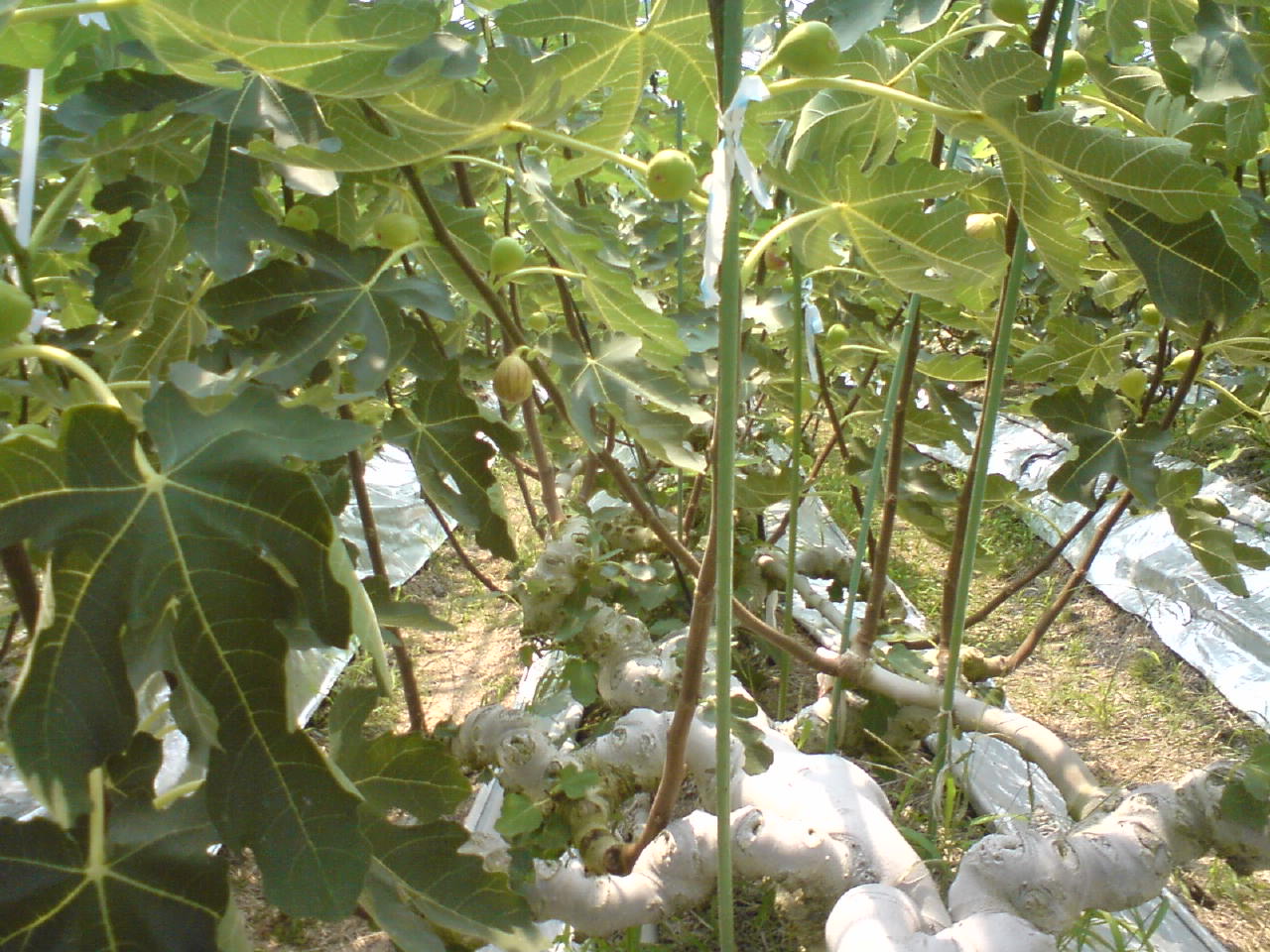
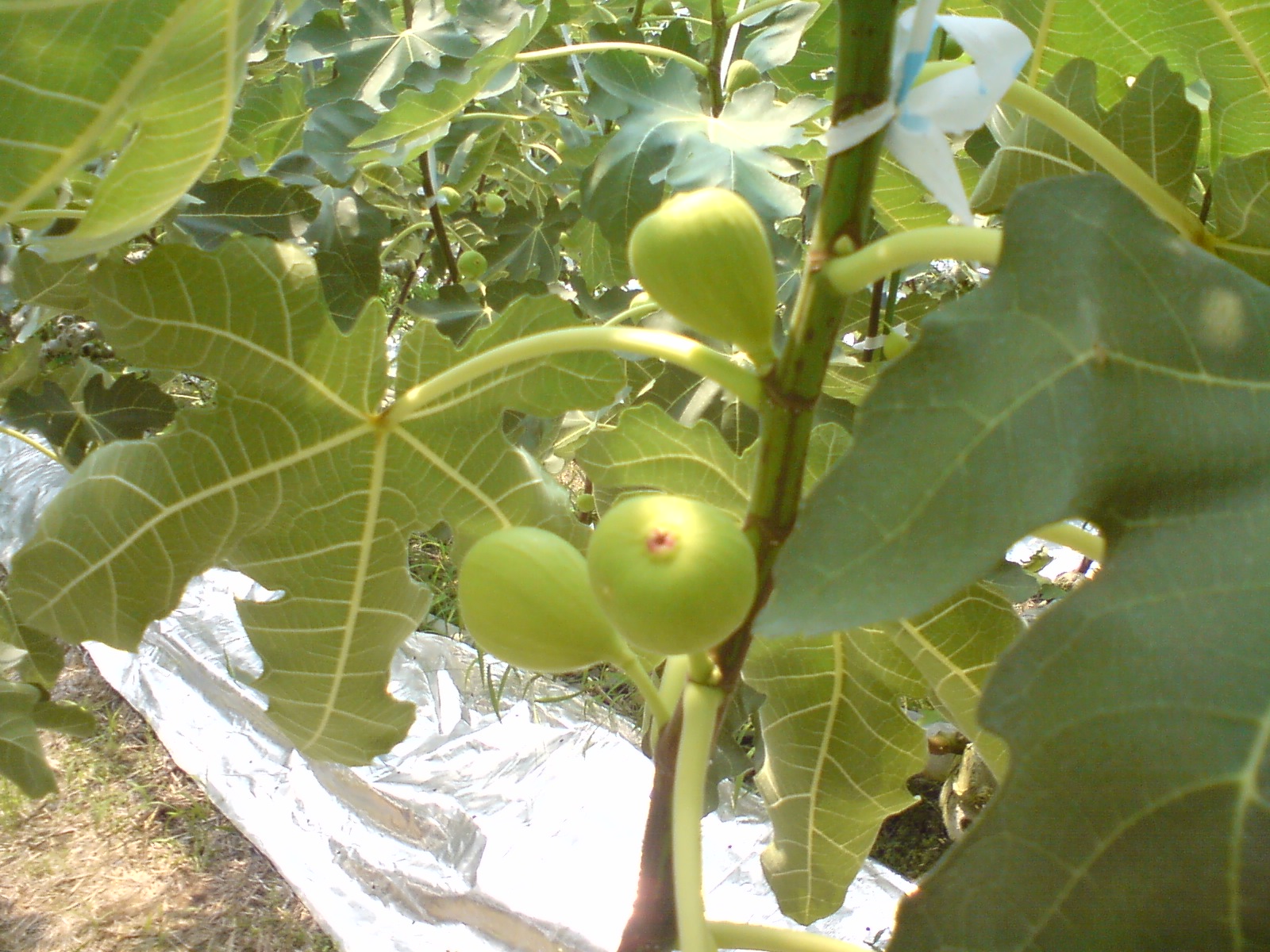
Mrs. Otsuko grows a single variety called Masui Dofin/マスイドフィン, a Japanese hybrid.
Do you know how the Japanese write “ichijiku” for fig? 無花果/No flower fruit! At least knowing the kanji characters meant I was not going to make the mistake asking when flowers were supposed to bloom!
Her trees are pretty old by Japanese standards (these can live a long time indeed!) as she first planted them 27 years ago. Her orchard is her own supply of cash to the homestead as her husband has his own job. Nevertheless, he gives a hand before leaving to work and after coming back from work. Either he is a tough guy or a loving one! (or both? LOL).

Watering is done through a pipe system snaking over the whole grenhouses.
As for fertilizer, she told me in with almost naive honesty that she asks a specialist every year to check on her orchard and decide what’s best!

I saw quite a few figs I would lay my hands on!
Actually, Mrs. Otsuka explained me that Summer is not so much the right season to really savor them. Although she harvests them everyday and “ship” them to the Cooperative, the best season is the Fall when figs are at their best and do not spoil easily.
As she accepte personal orders, you can be sure I will visit her again in a couple of months!
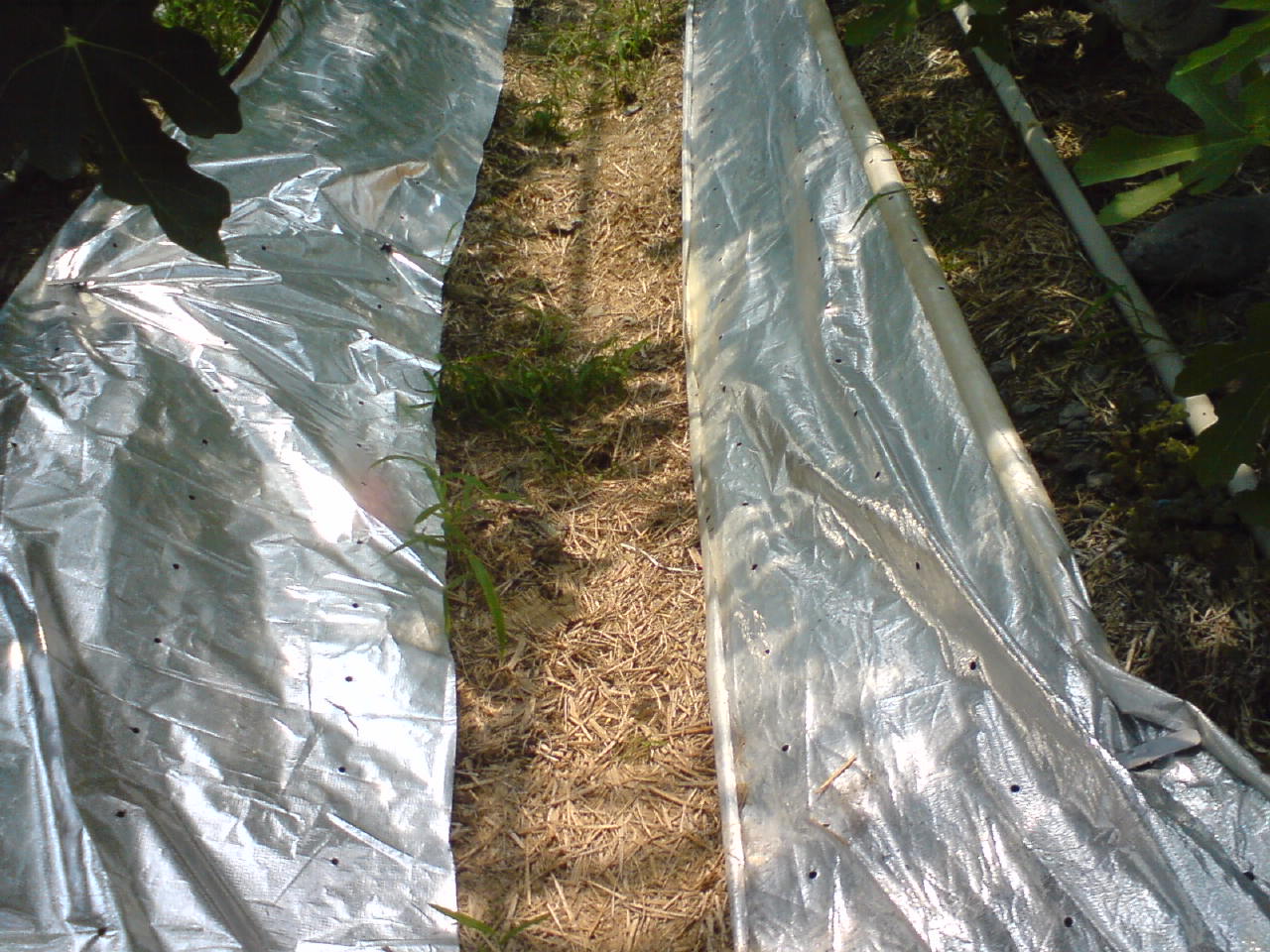
Aluminum foil sheets are spread on the soil along each row of fig trees not so much to protect the soil but to reflect the sun and provide more exposure and heat. And I can tell you this is sweat work!

Trees are trimmed completely of their branches around January and you can count each year going along the scars left on them!
Fruit bearing branches do have to be supported and are tied with twine to the roof to keep them erect and give as much as vital space as possible to the fruit.
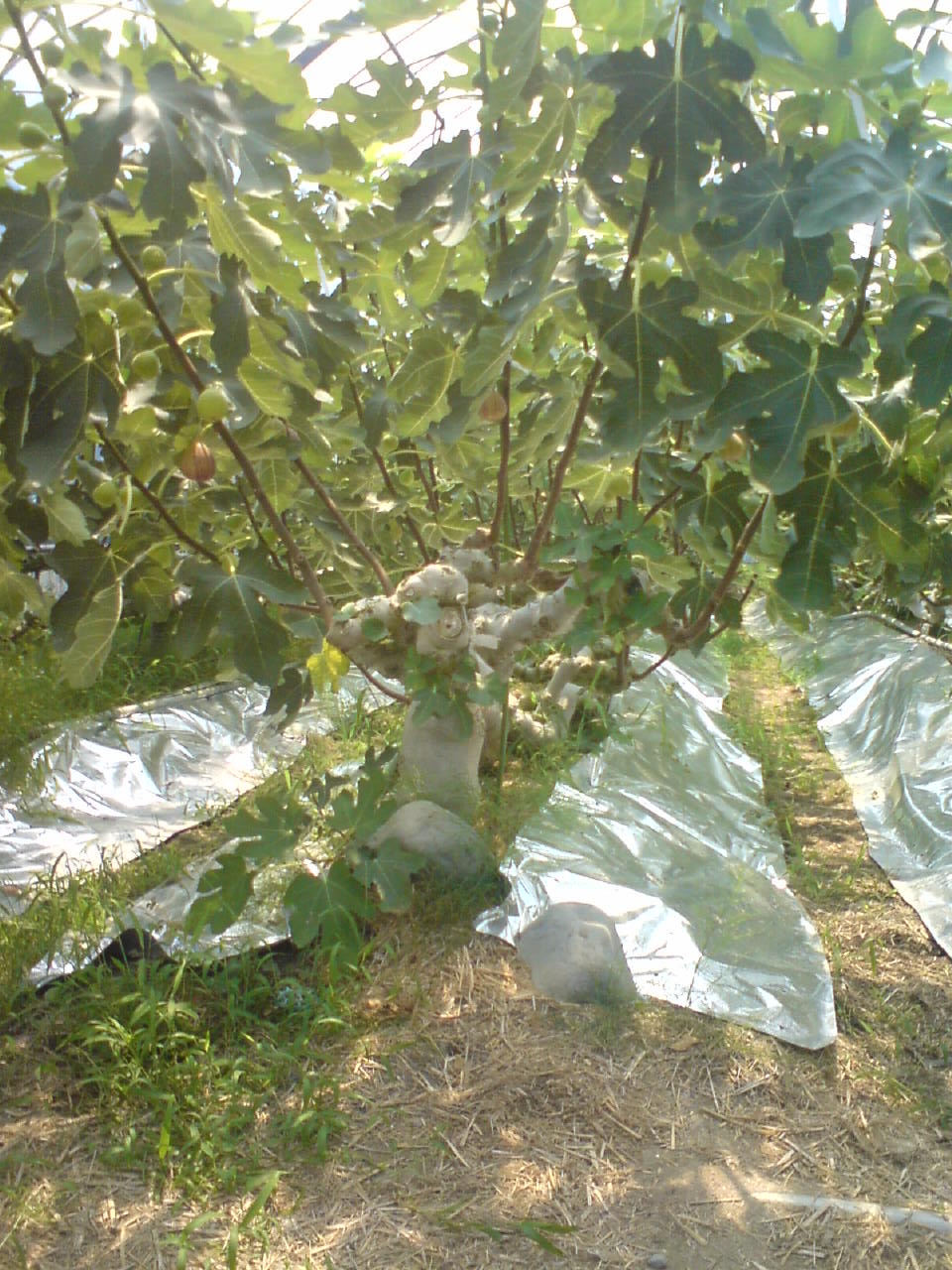
Harvesting is always done in the morning when the temperature is lower. The fruit will keep their umami/balance then. Fruit are calibrated and carefully put into boxes before delivery.

Mrs. Otsuka pointed out an interesting detail: when harvesting one has cto cover herself/himself completely, especially arms an legs as fig leaves are really tough and their rims can cut through your skin if you are not careful!
And one has to constantly clean the soil of fallen leaves as they rot easily!

Greenhouses have to left open on their side for better air circulation, but all openings have to be netted or birds will have a feast!

Certainly learned a lot again and am ready to be taught more!

Mrs. Toshiko Otsuka’s Fig Orchard
Sshizuoka City, Aoi Ku, Fukudagaya, 123-1
Tel.: 054-294-9787
Personal orders accepted

RECOMMENDED RELATED SITES:
Warren Bobrow, Bread + Butter, Zoy Zhang, Hungry Neko, Think Twice, Frank Fariello, Mangantayon, Hapabento, Elinluv Tidbit Corner, Tokyo Terrace, Maison de Christina, Chrys Niles,Lexi, Culinary Musings, Wheeling Gourmet, Comestiblog, Chronicles Of A Curious Cook, Tokyo Through The Drinking Glass, Tokyo Foodcast, Palate To Pen, Yellin Yakimono Gallery, Tokyo Terrace, Hilah Cooking, More than a Mount Full, Arkonite Bento, Happy Little Bento; 5 Star Foodie; Jefferson’s Table; Oyster Culture; Gourmet Fury; Island Vittles; Good Beer & Country Boys; Rubber Slippers In Italy; Color Food daidokoro/Osaka;/a; The Witchy Kitchen; Citron Et Vanille, Lunsj Med Buffet/Estonian Gastronomy (English), Cook, Eat, Play, Repeat, Chrisoscope; Jacqueline Church; The Foodonymph (in Dubai!); Alchemy, Simple Ingredients, magical Food (in Ireland!); Curious Foodie; Mr. Foodie (London/UK)
Please check the new postings at:
sake, shochu and sushi

Seaweed: The Vegan Food of the Oceans!

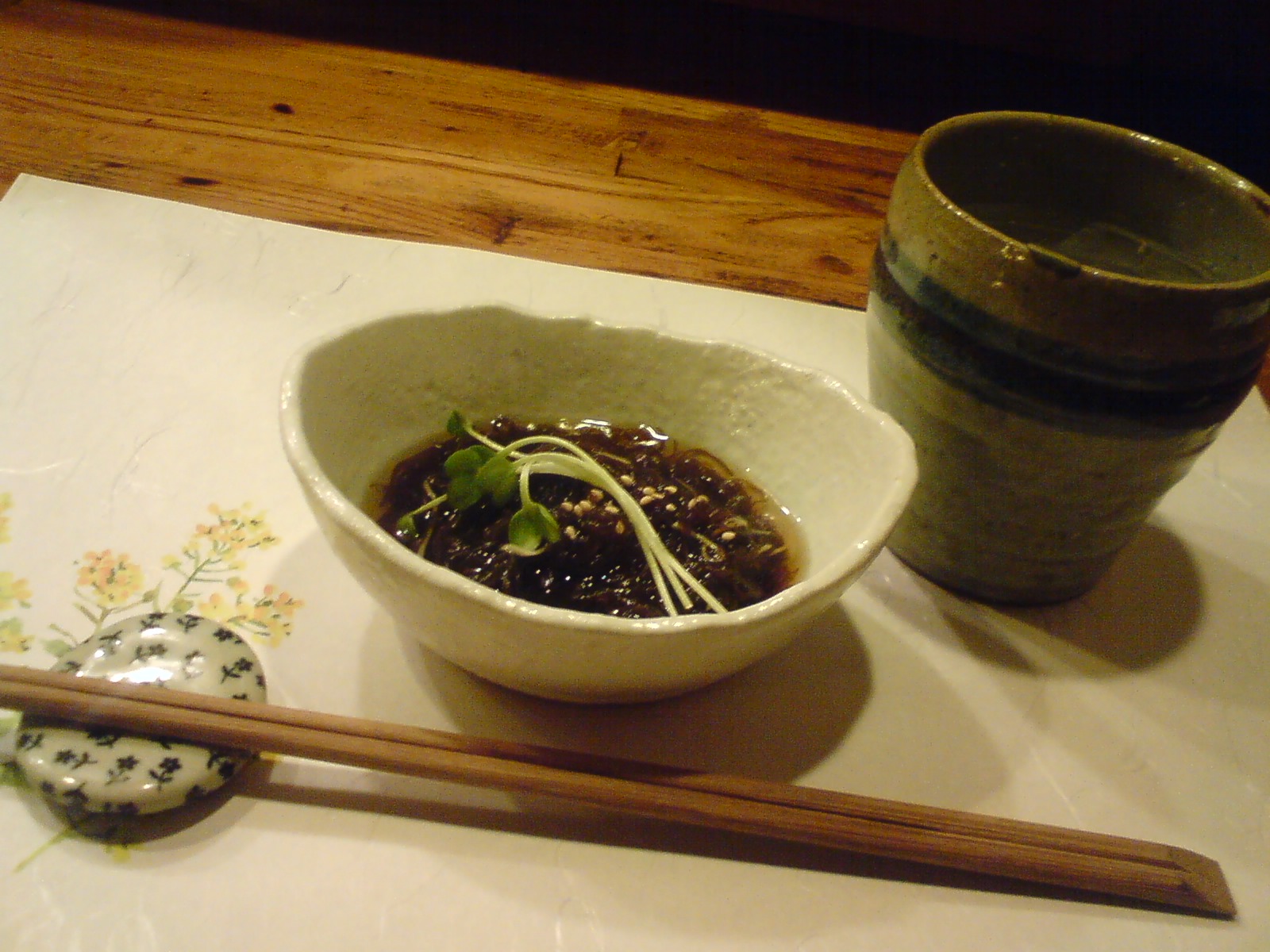
Mozuku in amazu/sweet vinegar as served at Yasaitei, Shizuoka City.

I have recently been asked again by many friends about seaweed in Japan. Here is the original posting with a few additions!

Seaweed or algae have been used for eons by humans, but have only been recently rediscovered as a food of their own.
Seaweeds are consumed by coastal people, particularly in East Asia, e.g., Japan, China, Korea, Taiwan, Thailand, and Vietnam, but also in Indonesia, Belize, Peru, the Canadian Maritimes, Scandinavia, Ireland, Wales, the Philippines, and Scotland.
It is rich in calcium and magnesium and seaweed noodles can be cooked into pancit canton, pancit luglug, spaghetti or carbonara.

Nori

In Asia, Zicai (紫菜) (in China), gim (in Korea) and nori (in Japan) are sheets of dried Porphyra used in soups or to wrap sushi. Chondrus crispus (commonly known as Irish moss or carrageenan moss) is another red alga used in producing various food additives, along with Kappaphycus and various gigartinoid seaweeds. Porphyra is a red alga used in Wales to make laver. Laverbread, made from oats and the laver, is a popular dish there. Affectionately called “Dulce” in northern Belize, seaweeds are mixed with milk, nutmeg, cinnamon, and vanilla to make a common beverage.

Seaweeds are also harvested or cultivated for the extraction of alginate, agar and carrageenan, gelatinous substances collectively known as hydrocolloids or phycocolloids. Hydrocolloids have attained commercial significance as food additives. The food industry exploits their gelling, water-retention, emulsifying and other physical properties. Agar is used in foods such as confectionery, meat and poultry products, desserts and beverages and moulded foods. Carrageenan is used in salad dressings and sauces, dietetic foods, and as a preservative in meat and fish products, dairy items and baked goods. It is a vital jelly component for vegansand vegetarians.

Alginates are used in wound dressings, and production of dental moulds. In microbiology research, agar is extensively used as culture medium.

Seaweed is a source of iodine, necessary for thyroid function and to prevent goitre.

Seaweed extract is used in some diet pills. Other seaweed pills exploit the same effect as gastric banding, expanding in the stomach to make the body feel more full.

Finally seaweed provide jel for beauty products and make-ups!

Konbu Tsukudani, a popular Japanese seaweed dish.

The Japanese divide their edible seaweed into three main groups:
BROWN ALGAE:

-Konbu/昆布, or Laminariaceae Bory (Latin), comprises many varieties, some of them regional: Makonbu or Saccharina japonica(真昆布), Onikonbu or Laminaria diabolica(羅臼昆布), Rishiri Konbu or Laminaria ochotensis(利尻昆布), Hosome Konbu or Laminaria religiosa(細目昆布), Hitaka or Mitsuishi Konbu or Laminaria angustata(日高昆布、三石昆布), Naga or Hamanaka Konbu or Laminaria longissima(長昆布、浜中昆布), and Kagome or Kjellmaniella crassifolia(籠目昆布).

-Hijiki or hiziki (ヒジキ, 鹿尾菜 or 羊栖菜, hijiki) (Sargassum fusiforme, or Hizikia fusiformis) is a brown sea vegetable growing wild on rocky coastlines around Japan, Korea, and China. Its two names mean deer-tail grass and sheep-nest grass respectively. It is also called sweet seaweed.

-Hibatama or Fucus, a genus of brown alga in the Class Phaeophyceae to be found in the intertidal zones of rocky seashores almost everywhere in the world.

-Hondawara or ホンダワラ(馬尾藻、神馬藻 (Sargassum fulvellum)

-Mozuku, or Cladosiphon okamuranus (水雲; 藻付; 海蘊; 海雲) , a type of edible seaweed in the genus Cladosiphon, naturally found in Okinawa, Japan. Most of the mozuku now is farmed by locals, and sold to processing factories. The main use of mozuku is as food, and as source of one type of sulfated polysaccharide called Fucoidan to be used in cancer treatment aid health supplements. Mozuu is usually served in rice vinegar in Japan.
-Wakame (ワカメ), Undaria pinnatifida, a sea vegetable, or edible seaweed. In Japan it is most widely used in miso soup.

Yes, these violet and green alagae are edible!

VIOLET ALGAE:

-Asakusa Nori, or アサクサノリ(浅草海苔 (Porphyra tenera).

-Tengusa, which gives agar agar, a gelatinous substance. Historically and in a modern context, it is chiefly used as an ingredient in desserts throughout Japan, but also as solid jelly used as decoration in salads and others.

GREEN ALGAE:

-Aosa or sea lettuce comprising comprise the genus Ulva, a group of edible green algae that are widely distributed along the coasts of the world’s oceans.

-Aonori (青海苔 or アオノリ, “blue seaweed” or “green seaweed”), also known as green laver, a type of edible green seaweed, including species from the genera Monostroma and Enteromorpha of Ulvaceae. It is commercially cultivated in some bay areas in Japan, such as Ise Bay. It contains rich minerals such as calcium, magnesium, lithium, vitamins, and amino acids such as methionine.

-Umibudou, or sea grapes, a delicacy of its own!

MARKET AVAIBILITY IN JAPAN:

In Japan it is interesting to note you can easily buy seaweed in paste form:

Konbu

Aosa

Hijiki

Next here are some pics to help you discover/recognize edible varieties in the markets:

Akamoku

Makusa

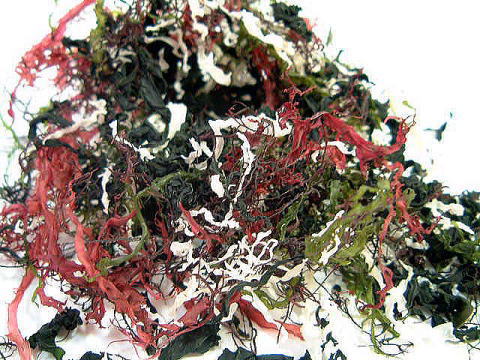
They often come as a mixture!

Red Algae

JAPANESE GASTRONOMY:

Here are some examples of the use of seaweed in Japanese gastronomy that can be expanded and inspired from wherever in the world you are, you being vegan, vegetarian or omnivore!
I have reduced the size of the pictures. Click on them to enlarge and copy them!

Agar or Crystal Kaiso/Crystal Seaweed!

The same in a salad!

An example of seaweed salad with wakame and agar.

Another seaweed salad with samples harvesyed in Noto Peninsula, Ishikawa Prefecture!

An Okinawa variety called somen nori!

Another local variety called Tsunotama/Horns and Balls!

Wakame appetizer!

Wakame Noodles!

Another Wakame salad!

Wakame sticks cooked with miso paste!

Wakame and Miso Paste mix from Kanzanji, Shizuoka Prefecture!

Wakame and Miso Bread!

Wakame Miso Soup!

Wakame, tofu and miso Soup!

A bowl of freshly steamed rice with seaweed paste!

Soba/Buckwheat noodles with nori and green leaf vegetables!

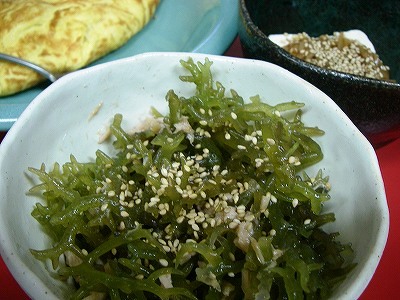
Seaweed, trefoil and ground seame seeds salad!

The best way to eat rice?

RECOMMENDED RELATED SITES:
Warren Bobrow, Bread + Butter, Zoy Zhang, Hungry Neko, Think Twice, Frank Fariello, Mangantayon, Hapabento, Elinluv Tidbit Corner, Tokyo Terrace, Maison de Christina, Chrys Niles,Lexi, Culinary Musings, Wheeling Gourmet, Comestiblog, Chronicles Of A Curious Cook, Tokyo Through The Drinking Glass, Tokyo Foodcast, Palate To Pen, Yellin Yakimono Gallery, Tokyo Terrace, Hilah Cooking, More than a Mount Full, Arkonite Bento, Happy Little Bento; 5 Star Foodie; Jefferson’s Table; Oyster Culture; Gourmet Fury; Island Vittles; Good Beer & Country Boys; Rubber Slippers In Italy; Color Food daidokoro/Osaka;/a; The Witchy Kitchen; Citron Et Vanille, Lunsj Med Buffet/Estonian Gastronomy (English), Cook, Eat, Play, Repeat, Chrisoscope; Jacqueline Church; The Foodonymph (in Dubai!); Alchemy, Simple Ingredients, magical Food (in Ireland!); Curious Foodie

Please check the new postings at:
sake, shochu and sushi

Matsutake Mushrooms and Conger Eel Fritters at Pissenlit

Service: excellent and very friendly
Facilities: great washroom, great cleanliness overall
Prices: reasonable, good value.
Strong points: Interesting wine list. Great use of local products.
no-smoking-logoentirely non-smoking!

If celebrated chefs like Dominique Corby at 6eme Sens in Tokyo (1 Michelin Star and a regular on TV’s) say that Tooru Arima at Pissenlit is a chef is worth the trip all the way don to Shizuoka City, there is little else I can say except paying a regular visit to the establishment!

The cuisine at Pissenlit is always seasonal as his Matsutake Mushrooms and Conger Eel Fritters/Beignets de Matsutake et de Congre.
Matsutake Mushrooms have just appeared on the market, and he announced them as Haya matsutake/早松茸/early matsutake.
Frankly speaking i don’t have a real clue as to the order of the cooking, although I suspect it was done allat one time (maybe not for the mushroom, though) but it is certainly a small tour de force.

Thin strips of congre eel/anago/穴子 were rolled around matsutake mushroom and dipped in a thickish batter. The way of serving it was also a little piece of art.
The batter was solid and slightly crispy, more like a cake than a fritter batter.
The dressing made of olive oil, river weeds extract and matsutake juice was sublime and I cerainly didn’t leave a drop (sponged in a little nread…).
I left the plate absolutely clean!

PISSENLIT
420-0839 Shizuoka City, Aoi Ku, Takajo, 2-3-4
Tel.: 054-270-8768
Fax: 054-627-3868
Business hours: 11:30~14:30; 17:00~22:00
Closed on Tuesdays and Sunday evening
Homepage (Japanese)
Credit Cards OK

RECOMMENDED RELATED SITES:
Warren Bobrow, Bread + Butter, Zoy Zhang, Hungry Neko, Think Twice, Frank Fariello, Mangantayon, Hapabento, Elinluv Tidbit Corner, Tokyo Terrace, Maison de Christina, Chrys Niles,Lexi, Culinary Musings, Wheeling Gourmet, Comestiblog, Chronicles Of A Curious Cook, Tokyo Through The Drinking Glass, Tokyo Foodcast, Palate To Pen, Yellin Yakimono Gallery, Tokyo Terrace, Hilah Cooking, More than a Mount Full, Arkonite Bento, Happy Little Bento; 5 Star Foodie; Jefferson’s Table; Oyster Culture; Gourmet Fury; Island Vittles; Good Beer & Country Boys; Rubber Slippers In Italy; Color Food daidokoro/Osaka;/a; The Witchy Kitchen; Citron Et Vanille, Lunsj Med Buffet/Estonian Gastronomy (English), Cook, Eat, Play, Repeat, Chrisoscope; Jacqueline Church; The Foodonymph (in Dubai!); Alchemy, Simple Ingredients, magical Food (in Ireland!); Curious Foodie

Please check the new postings at:
sake, shochu and sushi

Fromage Creme Brulee at Pissenlit

Service: excellent and very friendly
Facilities: great washroom, great cleanliness overall
Prices: reasonable, good value.
Strong points: Interesting wine list. Great use of local products.
no-smoking-logoentirely non-smoking!

Some desserts are classics wherever you find yourself in the world.
Creme brulee is one of them.
Thinking that it means “burnt cream” in French, one would be excused to question the naming of such a good and simple (in concept) dessert!
Many French restaurants are judged through the way handle so-called easy classics, especially terrines and pates for appetizers and creme brulee for dessert as they often tend to leave a lasting image as the first and last dish of a superb meal!

Whatever their simplicity, they cannot be served with a sophisticated touch.
This is where chefs like Tooru Arima are above the crowds.
The creme brulee comes with a spoon of passion fruit for extra seasoning and a small fruit salad for more decoration and a lightened dessert.

The creme is based on a pudding/custard made with fromage blanc and eggs of the best quality into an unctuous blend under a solid caramel you dleight into breaking after you have smeared it with the passion fruit!

Who said one would kill for such desserts! LOL

PISSENLIT
420-0839 Shizuoka City, Aoi Ku, Takajo, 2-3-4
Tel.: 054-270-8768
Fax: 054-627-3868
Business hours: 11:30~14:30; 17:00~22:00
Closed on Tuesdays and Sunday evening
Homepage (Japanese)
Credit Cards OK

RECOMMENDED RELATED SITES:
Warren Bobrow, Bread + Butter, Zoy Zhang, Hungry Neko, Think Twice, Frank Fariello, Mangantayon, Hapabento, Elinluv Tidbit Corner, Tokyo Terrace, Maison de Christina, Chrys Niles,Lexi, Culinary Musings, Wheeling Gourmet, Comestiblog, Chronicles Of A Curious Cook, Tokyo Through The Drinking Glass, Tokyo Foodcast, Palate To Pen, Yellin Yakimono Gallery, Tokyo Terrace, Hilah Cooking, More than a Mount Full, Arkonite Bento, Happy Little Bento; 5 Star Foodie; Jefferson’s Table; Oyster Culture; Gourmet Fury; Island Vittles; Good Beer & Country Boys; Rubber Slippers In Italy; Color Food daidokoro/Osaka;/a; The Witchy Kitchen; Citron Et Vanille, Lunsj Med Buffet/Estonian Gastronomy (English), Cook, Eat, Play, Repeat, Chrisoscope; Jacqueline Church; The Foodonymph (in Dubai!); Alchemy, Simple Ingredients, magical Food (in Ireland!); Curious Foodie

Please check the new postings at:
sake, shochu and sushi

Marinated Tuna Sushi/Magurozuke Sushi

Whenever tuna is available one ought to taste it raw as sashimi or sushi.
Now, avaibility does not always mean quality.
On the other hand, the Japanese have a simple and delicious way to accomodate tuna of any quality: magurozuke, which basically means marinated tuna, a concept easy to understand anywhere in our world!
Here is a basic recipe you can easily improve and adapt. I can guarantee you that your friends will look at you with a different eye!

INGREDIENTS:

-Tuna: raw for sashimi, enough for a plate of sushi
-Sushi rice: as appropriate. Check Sushi Rice Recipe here!

-Marinade/Zuketare:
-Soy sauce: 2 tablespoons
-Japanese sake: 2 tablespoons
-Mirin/Japanese sweet sake: 1 tablespoon
-Chopped thin leeks: as appropriate
-Wasabi paste: as appropriate

RECIPE

-Prepare the marinade: In a bowl drop the soy sauce, Japanese sake, mirin and chopped leeks. Mix quickly.
Slice the tuna for sushi. Take care of slicing it in equal size (especially thickness) slices!
Drop all the slices inside the marinade. Stir gently so as all fish is marinated. Cover with cellophane paper and leave inside the fridge for at least 30 minutes.

-Prepare the rice balls/shari in a slightly elongated size. Remember that the rice balls/shari should be slightly narrower and shoter than the tuna slices.
Smear a little wasabi paste on top of each rice ball. Skip if you don’t like wasabi. On the other hand you could top the nigiri (taht is on top ofthe fish, not the rice ball) with a little grated ginger!
Take tuna slice out one by one, shake them over the marinade bowl to let run excess marinade (do not sponge it off!), place a slice on each rice ball firmly enough (no need to overpress it between your hands, or you will have marinade everywhere!).
Place on a service dish and eat as soon as possible.

Easy and so impressive!

RECOMMENDED RELATED SITES:
Warren Bobrow, Bread + Butter, Zoy Zhang, Hungry Neko, Think Twice, Frank Fariello, Mangantayon, Hapabento, Elinluv Tidbit Corner, Tokyo Terrace, Maison de Christina, Chrys Niles,Lexi, Culinary Musings, Wheeling Gourmet, Comestiblog, Chronicles Of A Curious Cook, Tokyo Through The Drinking Glass, Tokyo Foodcast, Palate To Pen, Yellin Yakimono Gallery, Tokyo Terrace, Hilah Cooking, More than a Mount Full, Arkonite Bento, Happy Little Bento; 5 Star Foodie; Jefferson’s Table; Oyster Culture; Gourmet Fury; Island Vittles; Good Beer & Country Boys; Rubber Slippers In Italy; Color Food daidokoro/Osaka;/a; The Witchy Kitchen; Citron Et Vanille, Lunsj Med Buffet/Estonian Gastronomy (English), Cook, Eat, Play, Repeat, Chrisoscope; Jacqueline Church; The Foodonymph (in Dubai!); Alchemy, Simple Ingredients, magical Food (in Ireland!); Curious Foodie

Please check the new postings at:
sake, shochu and sushi

Raspberry Tiramisu

The summer and the heat have this strange influence on me: I don’t seem to be able to get away from sweet comfort (I don’t much dessert usually) and soft drinks (I usually prefer beer or Japanese sake, LOL)!
Since I’m still in my “Tiramisu Mode” here is another simple recipe that will delight the kids (and adults, of course!)!

Raspberry (ies) Tiramisu!

INGREDIENTS: Enough for 10 (Japanese-sized) portions? Michael might not agree with that! LOL

-Frozen raspberries: 500~600 g
-Sugar: 6~8 tablespoons
-Lemon juice: 2 tablespoons
-Mascarpone Cheese: 450 g
-Egg: 1
-Glazing sugar/fine sugar powder: 6 tablespoons
-Fresh cream: 300 g
-Fresh raspberries for decoration (the more, the better!)
-Lady finger biscuits: 30~34

RECIPE:

-In a large pan drop the frozen raspberries, sugar and lemon juice. Heat over medium fire for 20 minutes. Switch off fire when mixture has taken the consistency of jam. let cool down.

-A) In a bowl drop the mascarpone cheese, the glazing/fine sugar powder and mix well.
B)In another bowl beat fresh cream to semi-firm.

-Mix A and B delicately until smooth.

-Dip lady finger biscuits well into raspberry jam (but have a look at the next step, first!)

-In a large bowl of your choosing, first line the bottom with a layer of mascarpone mixture, then lay a layer of jam-dipped ladyfinger biscuits over it. Repeat the process three times.

-Lay the rest of the mascarpone mixture on top. Sooth it out with a spatula and decorate it with plenty of fresh raspberries.
Cover with cellophane paper and chill inside fridge overnight.
Sprinkle with plenty of glazing sugar before serving.
For people who like them add more color withsmall mint leaves!

So easy and so impresive!

RECOMMENDED RELATED SITES:
Warren Bobrow, Bread + Butter, Zoy Zhang, Hungry Neko, Think Twice, Frank Fariello, Mangantayon, Hapabento, Elinluv Tidbit Corner, Tokyo Terrace, Maison de Christina, Chrys Niles,Lexi, Culinary Musings, Wheeling Gourmet, Comestiblog, Chronicles Of A Curious Cook, Tokyo Through The Drinking Glass, Tokyo Foodcast, Palate To Pen, Yellin Yakimono Gallery, Tokyo Terrace, Hilah Cooking, More than a Mount Full, Arkonite Bento, Happy Little Bento; 5 Star Foodie; Jefferson’s Table; Oyster Culture; Gourmet Fury; Island Vittles; Good Beer & Country Boys; Rubber Slippers In Italy; Color Food daidokoro/Osaka;/a; The Witchy Kitchen; Citron Et Vanille, Lunsj Med Buffet/Estonian Gastronomy (English), Cook, Eat, Play, Repeat, Chrisoscope; Jacqueline Church; The Foodonymph (in Dubai!); Alchemy, Simple Ingredients, magical Food (in Ireland!); Curious Foodie

Please check the new postings at:
sake, shochu and sushi

Marshmallow Tiramisu

I seem to have entered a “Tiramisu Mode” as this is my third (and I have more!) recipe in less than a week!
I might have found myself under the curse of a sweet tooth fairy!
Marshmallows are popular everywhere, even in Japan, so I thought a little “American note” was in order this time! LOL
This particular recipe has not only the merit to be yummy and fit for all ages, but is also so simple and adaptable!

Marshmallow Tiramisu!

INGREDIENTS:

-Cream cheese: 200 g
-Milk: 100 ml/1/2 cup
-Marshmallow: 100 g
-Sugar: 100 g
-Cookies/Biscuits/Sable: 1 “box” or whatever is appropriate
-Instant coffee powder: 2 tablespoons
-Water: 100 ml/1/2 cup
-Cocoa powder: as appropriate

RECIPE:

-Get all your ingredients ready! Leave them outside long enough to reach room temperature (relative in summer. Say that 25 degrees Celsius is fine!). Above ingredients are shown as found in Japan. We also use Philadelphia cream cheese. As for the biscuits and marshmallows use whatever you fancy!

-Mix the coffee powder and water to obtain a strong coffee.

-Drop the cream cheese into a large bowl. Heat it for about 30 seconds in a microwave oven to soften it. Add sugar and mix well.

-In a separate bowl drop the marshmallow with 2 tablespoons of the milk. Leave in microwave oven for 30~50 seconds to melt the marshmallow. Mix well.

-Add the rest of the milk to the melted marshmallows and mix well.

-Add the cream cheese to the marshmallow mixture and mix well.

-Line the bottom a large glass terrine mold with one layer of biscuits. Brush enough coffee onto biscuits for them to absorb it. Cover with a layer of marshmallow/cream cheese layer of same thickness. Repeat the same process three more times or until you run out of ingredients!

-Smoothen the surface with a spatula and leave inside the fridge for at least 3 hours (overnight is best!). Sieve cocoa powder over it before serving (not before or the coca powder will sink in the cake!).

RECOMMENDED RELATED SITES:
Warren Bobrow, Bread + Butter, Zoy Zhang, Hungry Neko, Think Twice, Frank Fariello, Mangantayon, Hapabento, Elinluv Tidbit Corner, Tokyo Terrace, Maison de Christina, Chrys Niles,Lexi, Culinary Musings, Wheeling Gourmet, Comestiblog, Chronicles Of A Curious Cook, Tokyo Through The Drinking Glass, Tokyo Foodcast, Palate To Pen, Yellin Yakimono Gallery, Tokyo Terrace, Hilah Cooking, More than a Mount Full, Arkonite Bento, Happy Little Bento; 5 Star Foodie; Jefferson’s Table; Oyster Culture; Gourmet Fury; Island Vittles; Good Beer & Country Boys; Rubber Slippers In Italy; Color Food daidokoro/Osaka;/a; The Witchy Kitchen; Citron Et Vanille, Lunsj Med Buffet/Estonian Gastronomy (English), Cook, Eat, Play, Repeat, Chrisoscope; Jacqueline Church; The Foodonymph (in Dubai!); Alchemy, Simple Ingredients, magical Food (in Ireland!)

Please check the new postings at:
sake, shochu and sushi

Vegan Tofu & Macha Tiramisu

I’m not vegan or vegetarian, but I’m certainly interested, not only for the sake of healthy food, but also for the challenge.
Tiramisu is difficult to imagine for vegans and even vegetarians, but don’t forget that the Japanese are blessed with both tofu for consistent food and macha for extra taste!

Vegan Tofu & Macha Tiramisu!

INGREDIENTS: For 4 people

-Avocado 1 (ripe)
-Tofu/Silk tofu: 125 g
-Soy milk: 60 cc
-Agave Strup: 1.5 tablespoon
-Oatmeal: 70 g
-Vanilla Oil: as appropriate
-Macrobiotic coffee: 1.5 tablespoons
-Powdered macha: as appropriate

RECIPE:

-Mix oatmeal with coffee. Add 1 tablepoon of hot water and mix. It will will turn up as soft cookie when all the liquid has been absorbed..

-Thorw in the cut avocado, tofu, soy milk, agave syrup and vanilla oil into a blender. Mix. Check taste and add syrup if not sweet enough.

-Line bottom of cup with oatmeal mix.

-Top with avocado cream, Chill inside fridge.

-Top with plenty of macha powder and serve!

Simple, ain’t it!

RECOMMENDED RELATED SITES:
Warren Bobrow, Bread + Butter, Zoy Zhang, Hungry Neko, Think Twice, Frank Fariello, Mangantayon, Hapabento, Elinluv Tidbit Corner, Tokyo Terrace, Maison de Christina, Chrys Niles,Lexi, Culinary Musings, Wheeling Gourmet, Comestiblog, Chronicles Of A Curious Cook, Tokyo Through The Drinking Glass, Tokyo Foodcast, Palate To Pen, Yellin Yakimono Gallery, Tokyo Terrace, Hilah Cooking, More than a Mount Full, Arkonite Bento, Happy Little Bento; 5 Star Foodie; Jefferson’s Table; Oyster Culture; Gourmet Fury; Island Vittles; Good Beer & Country Boys; Rubber Slippers In Italy; Color Food daidokoro/Osaka;/a; The Witchy Kitchen; Citron Et Vanille, Lunsj Med Buffet/Estonian Gastronomy (English), Cook, Eat, Play, Repeat, Chrisoscope; Jacqueline Church; The Foodonymph (in Dubai!); Alchemy, Simple Ingredients, magical Food (in Ireland!)

Please check the new postings at:
sake, shochu and sushi

Tiramisu Cupcakes

The Japanese are famous for miniaturizing (making smaller) anything in sight, and it does apply in cooking, especially desserts.
Tiramisu is “usually” made into large affairs to be scooped from.
Here is a Japanese home-style version which will prevent fights between children and adults alike!

Tiramisu Cupcakes!

INGREDIENTS: For 5 cups

Sponge cake:
-Whole egg: 1
-Sugar (white): 2 tablespoons
-Flour: 2 tablespoons
-Salad oil: 1 Tablespoon

Coffee Syrup:
-Hot water: 2 tablespoons
-Instant coffee powder: 1 teaspoon
-Coffee Liqueur: 1 tablespoon

Cheese Cream:
-Egg yolk: 1
-Sugar (white): 1 tablespoon
-Mascarpone cheese: 100 g
-Fresh cream: 50 cc/mm (1/4 cup)
-Egg white: 1
-Sugar (white): 2 tablespoons
-Cocoa Powder: as appropriate

RECIPE:

-Sponge cake:
Beat the egg and sugar together until they have properly risen.

Add oil and mix well. Add flour through a sieve in three steps and mix.

Fill each cup with an equal amount of sponge cake mixture. Bake for 13 minutes at 180 degrees Celsius.

-Coffee Syrup.
Dissolve completely instant coffee powder in hot water. Add Coffee Liqueur and mix well.

-As soon as the spong cake has been baked brush in the coffee syrup on it while it is hot top allow for a good soaking.

-Cheese cream:
Beat egg yolk and sugar together until mixture whitens.

-Add mascarpone and mix well.
Beat fresh cream in a separate bowl until 7/10 hard.
Add to mascarpone and mix

-In another separate bowl beat the egg white and sugar until hard risen.
Fold inside mascarpone mixture.

-Fill each cup with cheese mixture.
Sieve chocolate powder on top.

=Chill inside fridge!

Easy, isn’t it!

RECOMMENDED RELATED SITES:
Warren Bobrow, Bread + Butter, Zoy Zhang, Hungry Neko, Think Twice, Frank Fariello, Mangantayon, Hapabento, Elinluv Tidbit Corner, Tokyo Terrace, Maison de Christina, Chrys Niles,Lexi, Culinary Musings, Wheeling Gourmet, Comestiblog, Chronicles Of A Curious Cook, Tokyo Through The Drinking Glass, Tokyo Foodcast, Palate To Pen, Yellin Yakimono Gallery, Tokyo Terrace, Hilah Cooking, More than a Mount Full, Arkonite Bento, Happy Little Bento; 5 Star Foodie; Jefferson’s Table; Oyster Culture; Gourmet Fury; Island Vittles; Good Beer & Country Boys; Rubber Slippers In Italy; Color Food daidokoro/Osaka;/a; The Witchy Kitchen; Citron Et Vanille, Lunsj Med Buffet/Estonian Gastronomy (English), Cook, Eat, Play, Repeat, Chrisoscope; Jacqueline Church; The Foodonymph (in Dubai!); Alchemy, Simple Ingredients, magical Food (in Ireland!)
Please check the new postings at:
sake, shochu and sushi

Organic French Fries at Uzu/An Interesting Cooking Technique

Service: excellent, easy-going and very friendly
Facilities: great washroom, great cleanliness overall
Prices: very reasonable, good value.
Strong points: Very fresh local ingredients, especially organic vegetables extensively used. Local sake. Home-made umeshu. Great shochu list.

The other day when I visited Uzu with the Missus, I had found the fried potatoes included in the Vegan Oarganic Salad so intriguing that I couldn’t help ordering them separately!

The potatoes are of two kinds:
Pinkish ones called Red Moon and the other yellowish called Inca Mezame.
Both were gron organically by Mr. Matsuki at Bio Farm in Shibakawa Cho in Fujinomiya City at the foot of Mount Fuji.

Now the cooking technique was a bit out of the ordinary:
The potatoes are first steamed whole with their skins.
Instead of slicing them or cutting them into sticks, the potatoes are broken by hand. The potates are chosen small enough to be broken only in two to four chunks of irregular shape.
They are then deep-fried in high quality oil.
The fact their shape is uneven allows for a bigger outer surface with a lot of crispiness, especially when accounting with the skins!
Having been steamed, the potatoes have acquired the perfect balance of outside crispiness and inside tenderness, but keeping their firmness at the same time, allowing for a deep and satisfactory bite!

Do try it!

UZU
Shizuoka City, Otowa-cho, 3-18
Tel.: 054-249-6262
Business hours: 17:00=23:00
Closed on Mondays and first Tuesday
Reservations recommended
Credit cards OK
HOMEPAGE (Japanese)

RECOMMENDED RELATED SITES:
Warren Bobrow, Bread + Butter, Zoy Zhang, Hungry Neko, Think Twice, Frank Fariello, Mangantayon, Hapabento, Elinluv Tidbit Corner, Tokyo Terrace, Maison de Christina, Chrys Niles,Lexi, Culinary Musings, Wheeling Gourmet, Comestiblog, Chronicles Of A Curious Cook, Tokyo Through The Drinking Glass, Tokyo Foodcast, Palate To Pen, Yellin Yakimono Gallery, Tokyo Terrace, Hilah Cooking, More than a Mount Full, Arkonite Bento, Happy Little Bento; 5 Star Foodie; Jefferson’s Table; Oyster Culture; Gourmet Fury; Island Vittles; Good Beer & Country Boys; Rubber Slippers In Italy; Color Food daidokoro/Osaka;/a; The Witchy Kitchen; Citron Et Vanille, Lunsj Med Buffet/Estonian Gastronomy (English), Cook, Eat, Play, Repeat, Chrisoscope; Jacqueline Church

Please check the new postings at:
sake, shochu and sushi

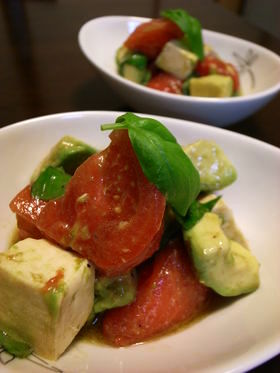
Vegan Japanese Cuisine: Tofu, Avocado & Tomato Marinade

Tofu, Avocado & Tomato?
Very much in “season”! Actually could be obtained easily all year round!
Here is a Japanese (and Italian?) inspired vegan (and vegetarian) recipe for the hot days of summer!
Choose your ingredients well, striving for the best and organic, if you can!

INGREDIENTS: For 2~ people

-Tomato: 1
-Avocado: 1
-Tofu: half a standard block~200 g
-Basil: 6 medium leaves

Marinade:
-Olive oil (EV): 2 tablespoons
-Lemon juice: 1.5 tablespoons
-Balsamico vinegar: 1 teaspoon
-Sugar: 1/2 teaspoon
-Salt & black pepper: as appropriate

RECIPE:

-Press water out of tofu (cover it with a clean cloth and a weight on top).
Cut tomatoes, tofu and avocado in same size chunks/cubes (important!).
Think of final look!

-Cut basil in small enough bits for easy mixing.

-Mix all marinade ingredients in a large bowl.

-Add tofu, tomato, avocado and cut basil. Mix delicately. Cover with cellophane paper. Keep in fridge long enough to chill or until you serve.

-Try to be inventive on presentation!

-So easy and yummy!

NOTES:

-Peel skin off tomato if too hard. Choose “fleshy” tomatoes with a little water and seeds as possible. Take the later off if possible.

-Choose a particularly aromatic lemon juice. Meyer would be interesting!

-Keep basil leaves handy for decoration! Mint could be interetsing, too!

RECOMMENDED RELATED SITES:
Warren Bobrow, Bread + Butter, Zoy Zhang, Hungry Neko, Think Twice, Frank Fariello, Mangantayon, Hapabento, Elinluv Tidbit Corner, Tokyo Terrace, Maison de Christina, Chrys Niles,Lexi, Culinary Musings, Wheeling Gourmet, Comestiblog, Chronicles Of A Curious Cook, Tokyo Through The Drinking Glass, Tokyo Foodcast, Palate To Pen, Yellin Yakimono Gallery, Tokyo Terrace, Hilah Cooking, More than a Mount Full, Arkonite Bento, Happy Little Bento; 5 Star Foodie; Jefferson’s Table; Oyster Culture; Gourmet Fury; Island Vittles; Good Beer & Country Boys; Rubber Slippers In Italy; Color Food daidokoro/Osaka;/a; The Witchy Kitchen; Citron Et Vanille, Lunsj Med Buffet/Estonian Gastronomy (English), Cook, Eat, Play, Repeat, Chrisoscope; Jacqueline Church

Please check the new postings at:
sake, shochu and sushi

Sushi Cupcakes: For an easy Party!

Cupcakes don’t need to be introduced, neither sushi!
But have you ever thought of combining the two for an easy party meal/snack for adults or children?
Here is a simple suggestion you can easily adapt to impress your friends!

Sushi Cupcakes!

INGREDIENTS: for 15~20 cups

-Sushi Tarou Sushi Mix: 1 pack
The above can be found easily in Japan or at Asian supermarkets abroad to make your work very easy! They are also called “Go Moku Chirashi”.

The above is available on Amazon.com in Japan!

-Steamed rice (warm): 500 g

A)Boiled prawn: 2
A)Avocado and lemon juice: as appropriate

B)Kamaboko/Fish paste (red): as appropriate
B)Mitsuba/Trefoil: as appropriate

C)Mini Tomato: as appropriate
C)Sliced cheese: as appropriate
C)Kaiware/Daikon Sprouts (or other): as appropriate

D)Sweet Rice vinegar renkon/lotus root: as appropriate
D)Cucumber: as appropriate
D)Kanikama/Surimi: as appropriate
D)Ginnan/gingko nuts (boiled): as appropriate

E)Smoked salmon: as appropriate
E)Shiso or Oba/Perilla leaves: as appropriate
E)Yuzu/lime zests (grated) as appropriate

RECIPE:

-Pour the warm rice and the sushi mixture into a large bowl and mix quickly.

-Fill aluminum foil cupcakes or cups with the sushi rice. Make groups of two or three cups. Srim\nkle them all with finley cut dry seaweed (skip seaweeed if you don’t like it!), or with some roasted sesame seeds. If you have some tube wasabi handy, put a little in the middle.

-Top first series with A) you will have beforehand seasoned with mayonnaise of your liking.

-Top second series with B). Season with a little yuzu koshio if you have some. If not, a little lemon juice is fine.

-Top third series with C).

-Top fourth series with D) Notice the way the cucumber are cut!

-Top fifth series with E)

Have good fun!

RECOMMENDED RELATED SITES:
Warren Bobrow, Bread + Butter, Zoy Zhang, Hungry Neko, Think Twice, Frank Fariello, Mangantayon, Hapabento, Elinluv Tidbit Corner, Tokyo Terrace, Maison de Christina, Chrys Niles,Lexi, Culinary Musings, Wheeling Gourmet, Comestiblog, Chronicles Of A Curious Cook, Tokyo Through The Drinking Glass, Tokyo Foodcast, Palate To Pen, Yellin Yakimono Gallery, Tokyo Terrace, Hilah Cooking, More than a Mount Full, Arkonite Bento, Happy Little Bento; 5 Star Foodie; Jefferson’s Table; Oyster Culture; Gourmet Fury; Island Vittles; Good Beer & Country Boys; Rubber Slippers In Italy; Color Food daidokoro/Osaka;/a; The Witchy Kitchen; Citron Et Vanille, Lunsj Med Buffet/Estonian Gastronomy (English), Cook, Eat, Play, Repeat, Chrisoscope; Jacqueline Church

Please check the new postings at:
sake, shochu and sushi

Vegan Local Organic Salad at Uzu

Service: excellent, easy-going and very friendly
Facilities: great washroom, great cleanliness overall
Prices: very reasonable, good value.
Strong points: Very fresh local ingredients, especially organic vegetables extensively used. Local sake. Home-made umeshu. Great shochu list.

I wish all my vegan and vegeterian friends could at least visit once Uzu Izakaya in Shizuoka City!
They try really hard to serve local organic vegetables, especially those grown by Mr Satsuki at Satsuki Bio Farm in Shibakawa Cho, Fujinomiya City at the foot of Mount Fuji!

The above salad was ordered last Thursday by the Missus.
It was enormous and I was certainly supposed to help finishi it!
We were actually lucky to get as they they were limited to 5 serving only.
We always make a point of ordering it as the vegetables will be different next time!

They did include many varieties, some of which I can’t remember.
There are red okra, white goya, Red Moon and Inca mezame potatoes (first fried), black tomatoes, green peppers, shishito chili pepper, red chickory/endive, orange, zucchini, the whole basket!

Another view!

To be savored one at a time, with chopsticks (and a great glass of sake!)!

UZU
Shizuoka City, Otowa-cho, 3-18
Tel.: 054-249-6262
Business hours: 17:00=23:00
Closed on Mondays and first Tuesday
Reservations recommended
Credit cards OK
HOMEPAGE (Japanese)

RECOMMENDED RELATED SITES:
Warren Bobrow, Bread + Butter, Zoy Zhang, Hungry Neko, Think Twice, Frank Fariello, Mangantayon, Hapabento, Elinluv Tidbit Corner, Tokyo Terrace, Maison de Christina, Chrys Niles,Lexi, Culinary Musings, Wheeling Gourmet, Comestiblog, Chronicles Of A Curious Cook, Tokyo Through The Drinking Glass, Tokyo Foodcast, Palate To Pen, Yellin Yakimono Gallery, Tokyo Terrace, Hilah Cooking, More than a Mount Full, Arkonite Bento, Happy Little Bento; 5 Star Foodie; Jefferson’s Table; Oyster Culture; Gourmet Fury; Island Vittles; Good Beer & Country Boys; Rubber Slippers In Italy; Color Food daidokoro/Osaka;/a; The Witchy Kitchen; Citron Et Vanille, Lunsj Med Buffet/Estonian Gastronomy (English), Cook, Eat, Play, Repeat, Chrisoscope; Jacqueline Church

Please check the new postings at:
sake, shochu and sushi

Sushi Recipe: Grilled Mackerel/Yaki Saba

Mackerel, or saba/鯖 in Japanese is a very popular fish everywhere in the world.
The Japanese love theiir mackerel sushi either raw or pickled as “shimesaba/しめ鯖”.
For people who both love sushi, but prefer their mackerel cooked, hereis a simple recipe:

Grilled Mackerel Sushi/yaki Saba Sushi!

INGREDIENTS: for 2 people

-Rice: 180 cc/ml (uncooked)
-Mackerel: 1/2, fresh (not salted)
-Fresh ginger: 20 g
-Salt: 1/2 teaspoon
-Rice vinegar: 2 large tablespoons
-Sugar: 2 tablespoons
-Salt: 1/2 teaspoon

RECIPE:

-Wash the rice and steam it normally, but with a little less water than ususal.

-Chop the fresh ginger very finely.
Add the rice vinegar, sugar and salt to the chopped fressh ginger into a bowl and heat to boil. Reduce fire to low immediately and cook for 1~2 minutes.
Let cool down.

-Take bones out of the fish.
Salt both sides and grill on both sides.
Grill until skin becomes “bubbly”.

-In a bowl, drop the freshly steamed rice. Add the ginger dressing to it.
Using a fan to cool it at the same time, “cut in/mix” the rice gently with a spatula until it has become brilliant and well-coated.

-Spread the fish skin down on a sheet of cellophane paper. Place the sushi rice on top and along so as to cover it completely. Don’t be afraid to use plenty!

-Wrap the cellophane paper around the mackerel and rice and form a thick “stick” with your hands. Leave aside for a while.

-Cutting: use a sharp knife and cut acroos the wrapped sushi, wiping the knife clean after every cut.
Unwrap and serve!

Easy sushi recipe for people who don’t like raw fish!

RECOMMENDED RELATED SITES:
Warren Bobrow, Bread + Butter, Zoy Zhang, Hungry Neko, Think Twice, Frank Fariello, Mangantayon, Hapabento, Elinluv Tidbit Corner, Tokyo Terrace, Maison de Christina, Chrys Niles,Lexi, Culinary Musings, Wheeling Gourmet, Comestiblog, Chronicles Of A Curious Cook, Tokyo Through The Drinking Glass, Tokyo Foodcast, Palate To Pen, Yellin Yakimono Gallery, Tokyo Terrace, Hilah Cooking, More than a Mount Full, Arkonite Bento, Happy Little Bento; 5 Star Foodie; Jefferson’s Table; Oyster Culture; Gourmet Fury; Island Vittles; Good Beer & Country Boys; Rubber Slippers In Italy; Color Food daidokoro/Osaka;/a; The Witchy Kitchen; Citron Et Vanille, Lunsj Med Buffet/Estonian Gastronomy (English), Cook, Eat, Play, Repeat, Chrisoscope; Jacqueline Church

Please check the new postings at:
sake, shochu and sushi

Japanese Cuisine: Himono-Dried Fish

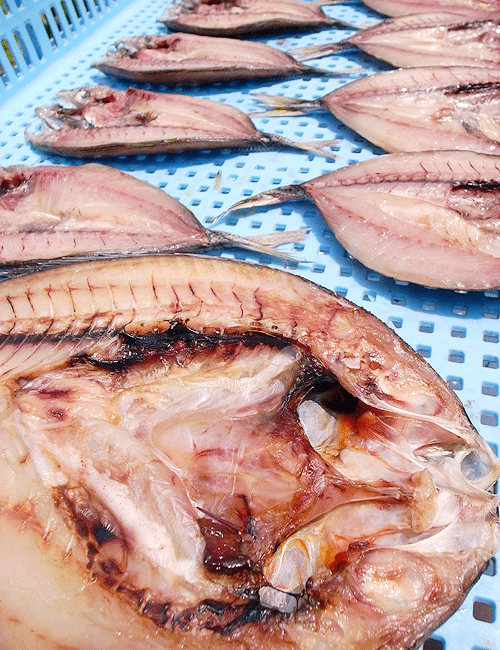
How many people outside Shizuoka Prefecture know that half (yes, half!) of all dried fish are caught and processed in our Prefecture, notably along the shores of the Izu Peninsula?
When will I convince everyone that Shizuoka Prefecture is THE true gastronomic region of Japan? LOL
To those guys living in Tokyo, may I remind them that Mount Fuji, Izu Peninsula and wasabi are all in Shizuoka Prefecture? Please, someone stop me!

Soon the season for preparing died fish will start anew, although it lasts almost all year round in some parts of Izu peninsula. i take the opportuity to re-publish this posting. The Spanish in particular are good at making the same thing, and the basic recipe can be applied alost worldwide.

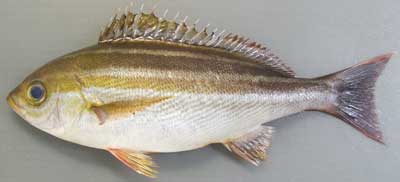
I chose a fish called “isaki” or “Chicken Grunt” (who came up with that English name?) that is quite common on our shores.
The same recipe naturally applies to loads of fish!

CLEANING THE FISH:

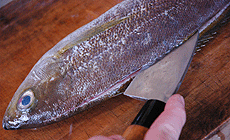
Using a strong short sharp knife (the Japanese use the same knife to cut and gut medium size fish), first get rid of the scales as much as possible.
Wash once under running clear cold water.
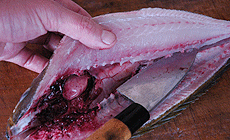
Cut along the back (not the belly! very important) from the tail to the head as shown on above picture deeply enough to reach the main bone.

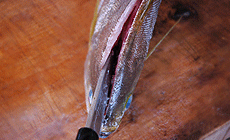
Once the knife has cut all along the back and reached the head, cut the head in half along the same cutting line.
The head of a isaki being small it is quite easy. It might requires some strength for bigger head fish like seabreams. Call the MOTH then! (not the moths, the “Man”! LOL).

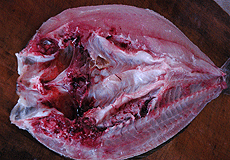
Open the fish and continue cutting in half all the way through.

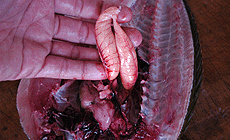
Take out innards carefully so as not having them getting in contact with the flesh!
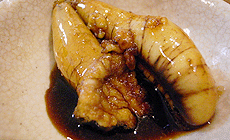
Depending upon the season, you might be lucky to get male sperm sacks (shirako). Don’t throw that away. They are great simmered with soy sauce, mirin/sweet sake, japanese sake and chili pepper! (see pic below).

Open the fish and clean it under running clear cold water.
Take water off with some kitchen paper or a clean piece of cloth.
Sprinkle with salt and dry outside under the sun until it has reached a nice aspect. You could also smoke it.
It can be preserved insde an airtight plastic bag and frozen, although eaten quickly it will taste so much better!

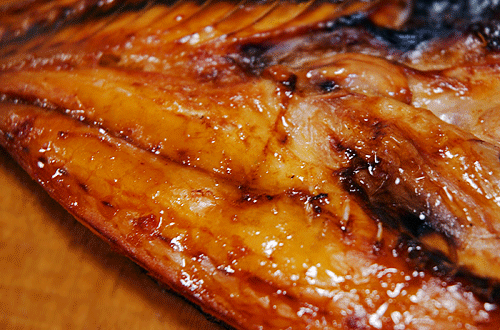
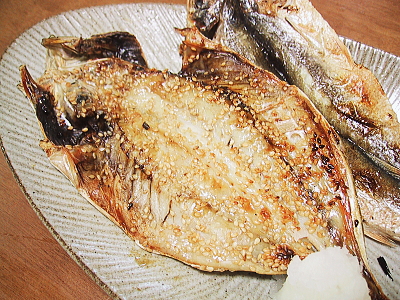
The Japanese grill their himono/dried fish pasted with a liuttel soy sauce or tare. Beautiful with beer, Good Beer and Country Boys!

Great also grilled with a little salt!

If grilled with salt don’t forget the freshly grated daikon (and lemon juice, and soy sauce…)

The male sperm sacs (shirako) make for a great snack with your beer or sake once simmered in soy sauce, mirin/sweet sake and Japanese sake (and a little chili pepper)!

RECOMMENDED RELATED SITES:
Warren Bobrow, Bread + Butter, Zoy Zhang, Hungry Neko, Think Twice, Frank Fariello, Mangantayon, Hapabento, Elinluv Tidbit Corner, Tokyo Terrace, Maison de Christina, Chrys Niles,Lexi, Culinary Musings, Wheeling Gourmet, Comestiblog, Chronicles Of A Curious Cook, Tokyo Through The Drinking Glass, Tokyo Foodcast, Palate To Pen, Yellin Yakimono Gallery, Tokyo Terrace, Hilah Cooking, More than a Mount Full, Arkonite Bento, Happy Little Bento; 5 Star Foodie; Jefferson’s Table; Oyster Culture; Gourmet Fury; Island Vittles; Good Beer & Country Boys; Rubber Slippers In Italy; Color Food daidokoro/Osaka;/a; The Witchy Kitchen; Citron Et Vanille, Lunsj Med Buffet/Estonian Gastronomy (English), Cook, Eat, Play, Repeat, Chrisoscope; Jacqueline Church

Please check the new postings at:
sake, shochu and sushi