Tag Archives: Japanese

Japanese Gastronomy: Udon-The Basic Recipe

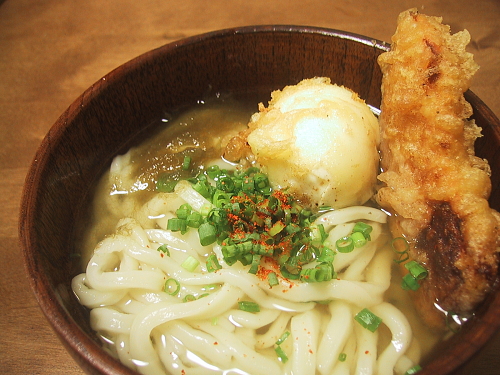
Udon/饂飩/うどん, although not suitable for wheat allergics, can be easily turned vegetarian or vegan, depending on the soup and seasonings/accompaniments.
It is fullfilling and healthy and can be eaten hot in soup or fried, or cold, especially in salads!

INGREDIENTS (basic):

-Wheat flour: 1 kg (fine, light type)
-Salt: 40 g (can be reduced to 30 g)
-Water: 460 ml

RECIPE:
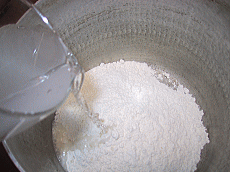
Dissolve salt in water first.
Pour flour in an all-purpose large bowl.
Pour the water onto the flour little by little.
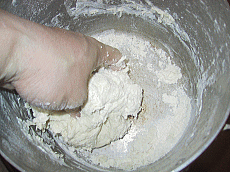
Mix and knead little by little until all the water has been used.
At that time you may think you haven’t added enough water. Don’t worry. Just keep kneading for 10 minutes. it will eventually become smooth.

The following is interesting. In restaurants it is done with a special wooden lever with the chef standing on one end!
Wrap the dough in a cellophane paper and press the whole (wash your feet!) with the whole foot until the dough has spread somewhat flat. Take the dough out of the cellophane paper, shape it into a ball, wrap it again and press again with your foot.
Do that for 15 minutes.
Do not skip that step!
Ask hubby or (big) kids to help if necessary!

Shape the dough in a ball, wrap it in cellophane paper and leave it to rest for a while.
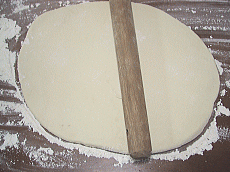
Sprinkle flour on a working table.
Roll the dough out into a 3 mm thick sheet.

Sprinkle flour on the dough sheet surface, fold the dough as shown on pic above and cut every 3 mm to obtain square section noodles/udon.
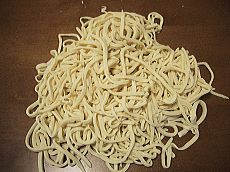
Shake and separate the udon and gather them as in picture above.
They are ready!

Throw the udon in water heated just before boiling point. Cook (make sure the water does not boil) for 6 minutes.
You can use the udon just after after but it is better to go through the next step:

Drop the udon into a strainer and wash them quickly under cold clear water. They will look far more appetizing this way and easy to conserve until you drop them into soup, fry them or dress them into a salad!

As for the soup, there are many ways to make it, whereas you are vegan, vegetarian or omnivore. If you use dashi, use konbu/seaweed dashi if you are not an omnivore. One can add soy sauce, mirin/sweet sake and sugar.
Serve the udon as they are or with chopped leeks and aburaage tofu and so forth!

RECOMMENDED RELATED WEBSITES

Masala Herb by Helene Dsouza in Goa, India
Mummy I Can Cook! by Shu Han in London
Pierre.Cuisine, Francescannotwrite, My White Kitchen, 47 Japanese Farms Through The Eyes of Its Rural Communities, Foodhoe, Chucks Eats, Things that Fizz & Stuff, Five Euro Food by Charles,Red Shallot Kitchen by Priscilla,With a Glass, Nami | Just One Cookbook, Peach Farm Studio, Clumsyfingers by Xethia, PepperBento,Adventures in Bento Making, American Bent, Beanbento, Bento No, Bento Wo Tsukurimashou, Cooking Cute, Eula, Hapabento , Happy Bento, Jacki’s Bento Blog, Kitchen Cow, Leggo My Obento, Le Petit Journal Bento & CO (French), Lunch In A Box,
Susan at Arkonlite, Vegan Lunch Box; Tokyo Tom Baker, Daily Food Porn/Osaka, Only Nature Food Porn, Happy Little Bento, The Herbed Kitchen, J-Mama’s Kitchen, Cook, Eat, Play, Repeat, Bento Lunch Blog (German), Adventures In Bento, Anna The Red’s Bento Factory, Cooking Cute, Timeless Gourmet, Bento Bug, Ideal Meal, Bentosaurus, Mr. Foodie (London/UK), Ohayo Bento,

Must-see tasting websites:

-Sake: Tokyo Through The Drinking Glass, Tokyo Foodcast, Urban Sake, Sake World
-Wine: Palate To Pen, Warren Bobrow, Cellar Tours, Ancient Fire Wines Blog
-Beer: Good Beer & Country Boys, Another Pint, Please!
-Japanese Pottery to enjoy your favourite drinks: Yellin Yakimono Gallery

Vegan Life & Gastronomy in Japan (& Shizuoka)

Vegan Fried Avocado

I have always been intrigued by the priorities and needs of my vegan and vegetarian friends. I’m an incorrigible omnivore and will ever be, but I can appreciate other gastronomies, be they even based on vegetables only.
I also hold a deep interest in anything organic, although I don’t make it a tenet of my everyday life.
As a general rule I strive for balance.
Vegans and vegetarians have their reasons to be so, and that is their private concern. Full stop.
On the other hand, I cannot be forced into changing my ways. I did recently have to fend a concerted hate mail assault by a group of slightly misled vegans following an article of mine, but that is not going to stop me from trying to help my friends in this country.

Many vegans and vegetarians harbour doubts as to whether visit Japan, or Shizuoka for that matter.
They should not be wary of the life here. I dare say that it is almost the ideal country for them to live!
Shizuokaisalso a paradise for organic vegetables. I know of one extraordinary farmer who grows more than 190 varieties on 3 ha in Fujinomiya City!
Alright, vegans and vegetarians certainly need to be prepared!

Japanese Vegan Dashi

The very first query I have to field is:
-“But they use dashi everywhere!”
The Japanese certainly do, but there two basic kinds of dashi/Japanese soupstocks: one made with dry bonito shavings and the other made with konbu/seaweed. Check Vegan Dashi Recipe.

Now miso is also vegan, so you can imagine all the soup recipes you can concoct! Just Have a look at Vegan Recipes and you will discover what I’m suggesting!

-“Alright! Now, I have my soup to keep me hot in winter. But I also fancy a drink with my food. Now, what would you recommend?”
Well there is a atriaght easy answer: Japanese Sake!
To cut a long story short, do read what I wrote about the ultimate vegan drink!
Let just me say that true high quality (Shizuoka is the best! Lucky, aren’t I?) is made with pure water, rice, and yeast. That is all! Sometimes lactic acid is used, but it is of vegetal origin.
Incidentally, high quality shochu is also vegan!

Vegan sashimi at Yasaitei, Japan.

Now, that we have covered this important subject, shall we go to our main concern, namely vegetables?
You will be, I’m ready to bet about it, really flabbergasted by the variety of vegetables available in this country and especially Shizuoka, a famed area for organic vegetable cultivation.
The Japanese are even cultivating vegetables that have been forgotten elsewhere!
Check the following:
Vegetables Facts & Tips.
For Vegans and Vegetarians: Forgotten Vegetables.

tomii-veg31

Mountain vegetables at Tomii, Shzuoka City.

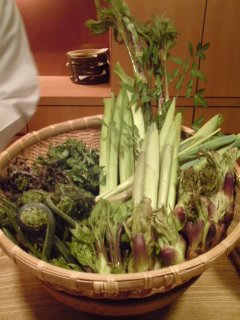
Have you heard of the Japanese mountain vegetables/Sansai/山菜?
It is just mind-boggling to discover them all!
Check: Japanese Mountain Vegetables!

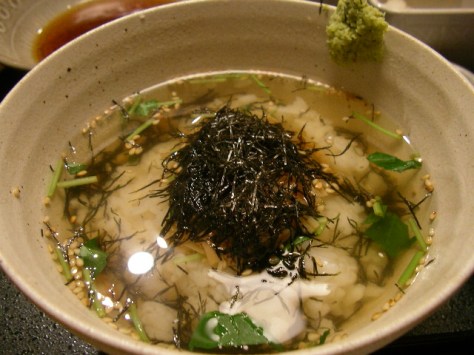
Do not forget that tea and soba can be vegan! How about a combination of tea and soba for a quick lunch?

CHAZUKE-1

Chazuke

And how about Somen, Chazuke, and Tofu?

zarudofu

“Zarudofu”

Learn how to make your own Tofu!

tofu-kinds-5

“Tofu Doughnuts” at Shizutetsu Supermarket in Shizuoka City

Ever heard of Tofu Donuts?
Why don’t you try your hand after reading that easy Vegan Tofu Donut Recipe?

Vegan sushi plate at Sushi Ko, Shizuoka City.

-“I want to eat sushi, but how can I get vegan sushi in Japan?”
That should not be a problem.
First why don’t you have a look at the following:
Vegan & Vegetarian Sushi.
Vegan Sushi Recipe Suggestions.

Just walk around and try to find a friendly Sushi Restaurant along with some friends first and gently ask for vegetable sushi (without the bonito shavings or mayonnaise!). Keep going to the same place and soon or later the chef will enjoy the challenge and even propose you new creations.
Or check the Sushi Rice Basic Recipe and try making it at home!

And Wasabi is also vegan!

Mozuku seaweed served at Yasaitei, Shizuoka City.

Do not forget all the possibilities offered by seaweed, probably the most ubiquitous gastronomic ingredient in this country!
And ther are plenty of varieties: check Seaweed, the Vegetable of the Oceans!
Actually Shizuoka is not only a great producer of agar but also boasts the greatest number of edible seaweed varieties!

The all-organic vegetables lunch tray at Magokoro in Kamakura, Kanagawa Prefecture. They have a vegan version!

I’m not that keen on religion, but if your are a Buddhist, Japanese temples sometimes offer vegan/vegetarian meals! Kamakura is just but an example!

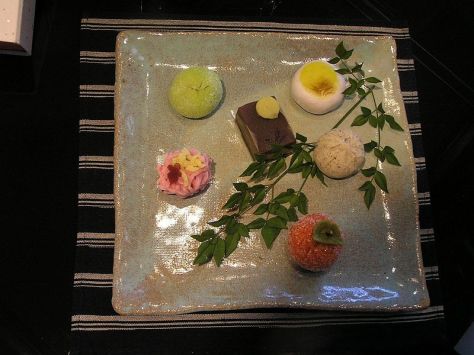
WAGASHI-1

Wagashi Tray.

-“And what for dessert?”
I knew you were going to ask that!
Have you heard of Wagashi?
Just reading about it will make you salivate!

Aright, if you need help, just drop me a line!LOL
At least I sincerely hope I have contributed to the image of Japan you wished to see!

RECOMMENDED RELATED WEBSITES

Masala Herb by Helene Dsouza in Goa, India
Mummy I Can Cook! by Shu Han in London
Pierre.Cuisine, Francescannotwrite, My White Kitchen, 47 Japanese Farms Through The Eyes of Its Rural Communities, Foodhoe, Chucks Eats, Things that Fizz & Stuff, Five Euro Food by Charles,Red Shallot Kitchen by Priscilla,With a Glass, Nami | Just One Cookbook, Peach Farm Studio, Clumsyfingers by Xethia, PepperBento,Adventures in Bento Making, American Bent, Beanbento, Bento No, Bento Wo Tsukurimashou, Cooking Cute, Eula, Hapabento , Happy Bento, Jacki’s Bento Blog, Kitchen Cow, Leggo My Obento, Le Petit Journal Bento & CO (French), Lunch In A Box,
Susan at Arkonlite, Vegan Lunch Box; Tokyo Tom Baker, Daily Food Porn/Osaka, Only Nature Food Porn, Happy Little Bento, The Herbed Kitchen, J-Mama’s Kitchen, Cook, Eat, Play, Repeat, Bento Lunch Blog (German), Adventures In Bento, Anna The Red’s Bento Factory, Cooking Cute, Timeless Gourmet, Bento Bug, Ideal Meal, Bentosaurus, Mr. Foodie (London/UK), Ohayo Bento,

Must-see tasting websites:

-Sake: Tokyo Through The Drinking Glass, Tokyo Foodcast, Urban Sake, Sake World
-Wine: Palate To Pen, Warren Bobrow, Cellar Tours, Ancient Fire Wines Blog
-Beer: Good Beer & Country Boys, Another Pint, Please!
-Japanese Pottery to enjoy your favourite drinks: Yellin Yakimono Gallery

Kyoto Gastronomy: Kyoto Vegetables-Kyoyasai/京野菜

I have just come back from a 3-day “holiday” in Kyoto, a touristic spot famed all over the world.
Kyoto does have its own gastronomy, what with the untold number of temples of different religions and sects.
Vegetables have been the staple of the city for a long time and when they are grown in Kyoto they are simply called “Kyo-yasai” (“kyo” for “Kyoto” and “yasai” for “vegetables”).
There are officially 41 traditional varieties of them including 21 with a registered brand/controlled appelation and 43 more varieties have also been recently recognised as such.

One way to discover them if you do not have the opportunity or time to discover vegetable fields is to visit the long and narrow Nishiki/錦 covered market in Central Kyoto.

Unfortunately, in my own view, the market has turned into a crowded touristic spot with all the pitfalls bound to open under your feet.
The real Kyoto vegetables are the minority and you need to understand Japanese to discern what is real and what is “fake”. I even found anorexic wasabi imported from South Korea!
Moreover, so-called Kyo-yasai are increasingly being grown away from Kyoto, especially in Shizuoka where the single town of Iwata grows 80% of all “ebi-imo”, one of the most representative vegetables of the famed city!

But there is another way to discover those celebrated vegetables for the pleasure of vegans, vegetarians and vegans!
About lunch time or before dinner time, just walk past the restaurants lining the side and back streets!

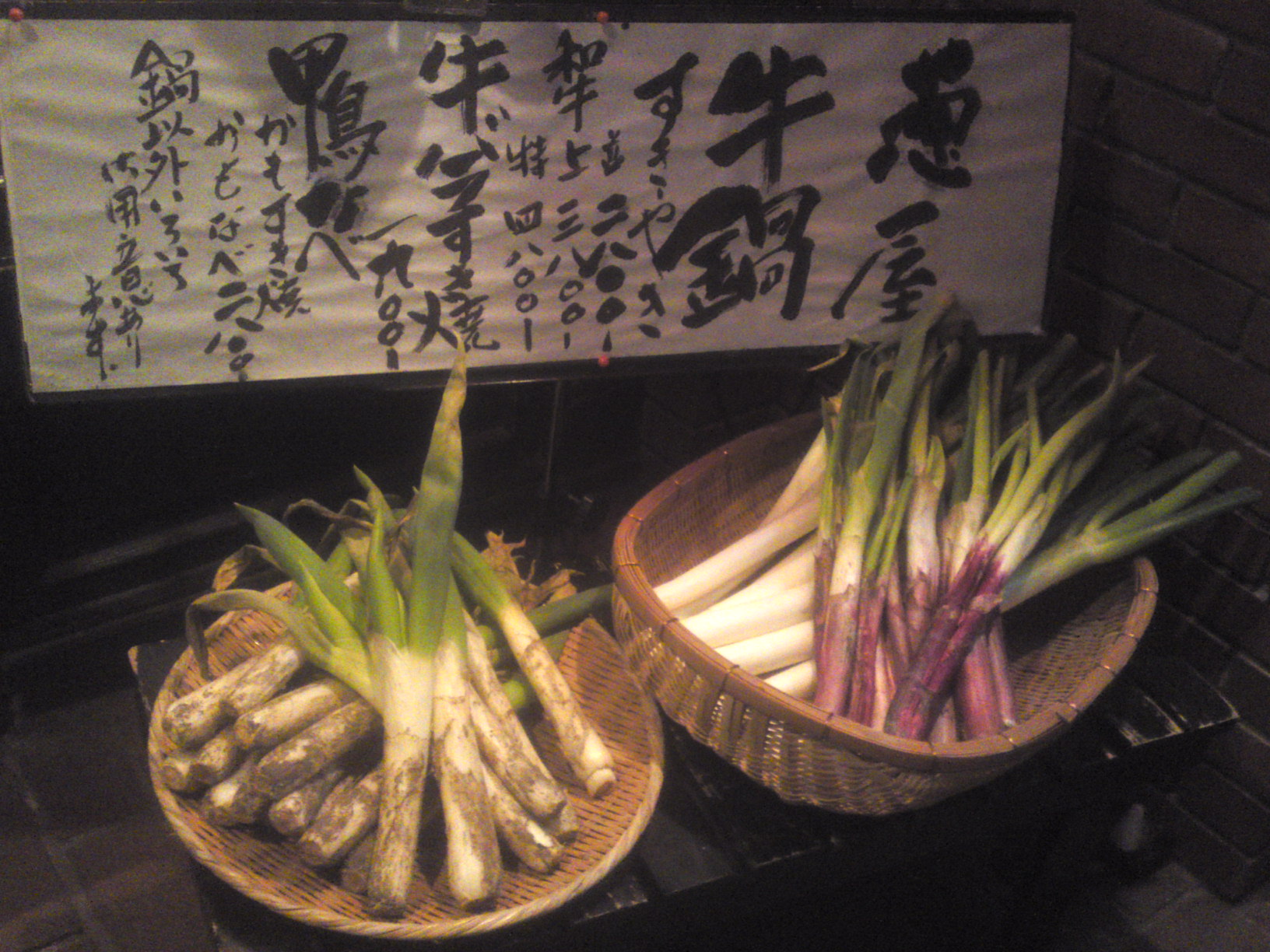
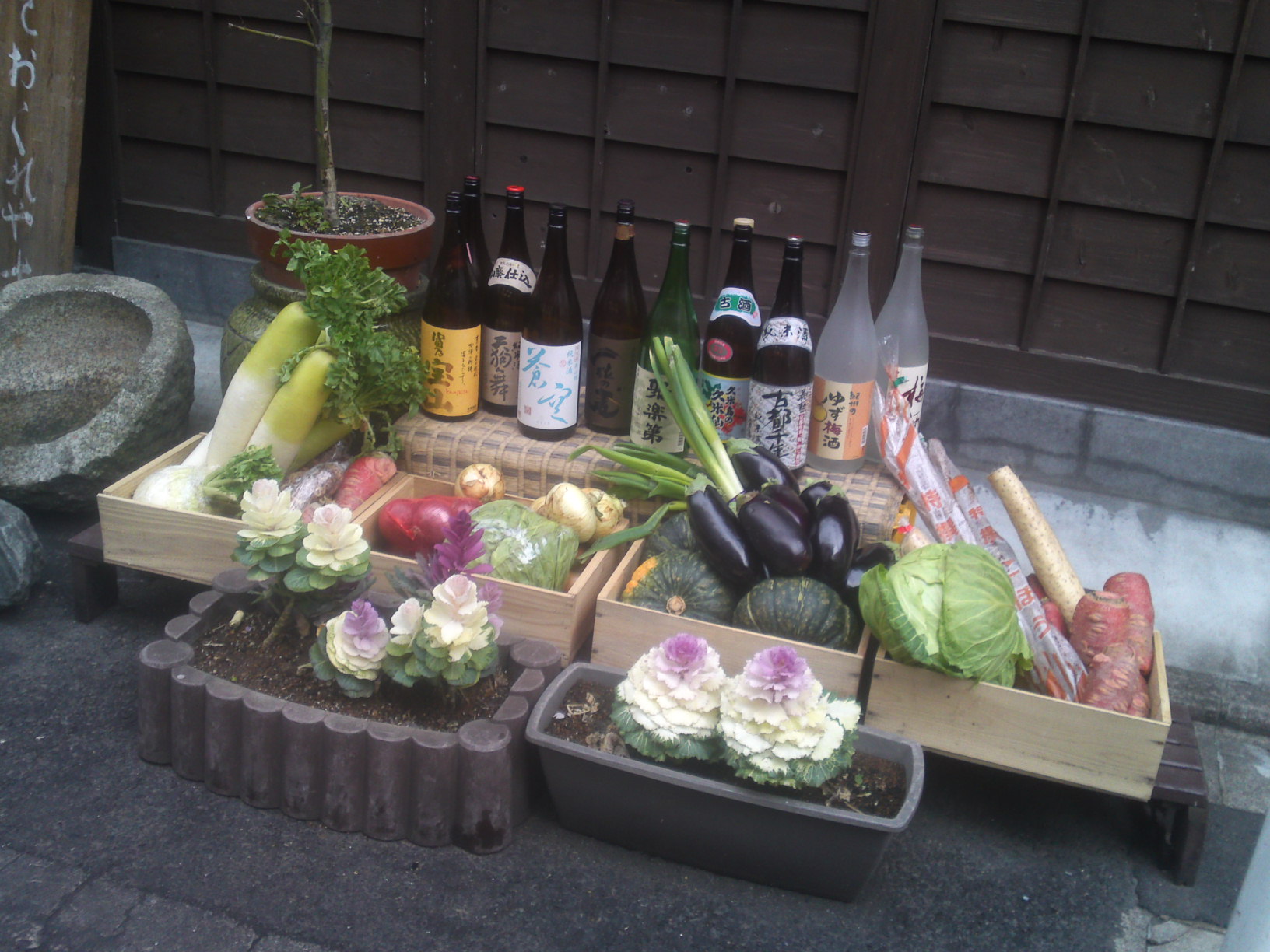
All izakayas and restaurants proud of their vegetables will display them outside for all to see!

They make for great souvenir photographs to show back home!

For a closer view!
Do you recognize any?

Even in front of Italian restaurants!

Placed in front of the outdoors menu board…

For a more distant view to discover the small Japanese restaurant at lunch time!

In front of another busy Japanese restaurant at night!

But this was my favorite!

Lined between a small cabbage garden and a great queue of Japanese sake!

I hope this will give you another idea as to how visit Kyoto!

RECOMMENDED RELATED WEBSITES

Masala Herb by Helene Dsouza in Goa, India
Mummy I Can Cook! by Shu Han in London
Pierre.Cuisine, Francescannotwrite, My White Kitchen, 47 Japanese Farms Through The Eyes of Its Rural Communities, Foodhoe, Chucks Eats, Things that Fizz & Stuff, Five Euro Food by Charles,Red Shallot Kitchen by Priscilla,With a Glass, Nami | Just One Cookbook, Peach Farm Studio, Clumsyfingers by Xethia, PepperBento,Adventures in Bento Making, American Bent, Beanbento, Bento No, Bento Wo Tsukurimashou, Cooking Cute, Eula, Hapabento , Happy Bento, Jacki’s Bento Blog, Kitchen Cow, Leggo My Obento, Le Petit Journal Bento & CO (French), Lunch In A Box,
Susan at Arkonlite, Vegan Lunch Box; Tokyo Tom Baker, Daily Food Porn/Osaka, Only Nature Food Porn, Happy Little Bento, The Herbed Kitchen, J-Mama’s Kitchen, Cook, Eat, Play, Repeat, Bento Lunch Blog (German), Adventures In Bento, Anna The Red’s Bento Factory, Cooking Cute, Timeless Gourmet, Bento Bug, Ideal Meal, Bentosaurus, Mr. Foodie (London/UK), Ohayo Bento,

Must-see tasting websites:

-Sake: Tokyo Through The Drinking Glass, Tokyo Foodcast, Urban Sake, Sake World
-Wine: Palate To Pen, Warren Bobrow, Cellar Tours, Ancient Fire Wines Blog
-Beer: Good Beer & Country Boys, Another Pint, Please!
-Japanese Pottery to enjoy your favourite drinks: Yellin Yakimono Gallery

Japanese Gastronomy: Yuzu Koshio/Lime & Chilies Mix-Recipe

YUZU-KOSHIO-1

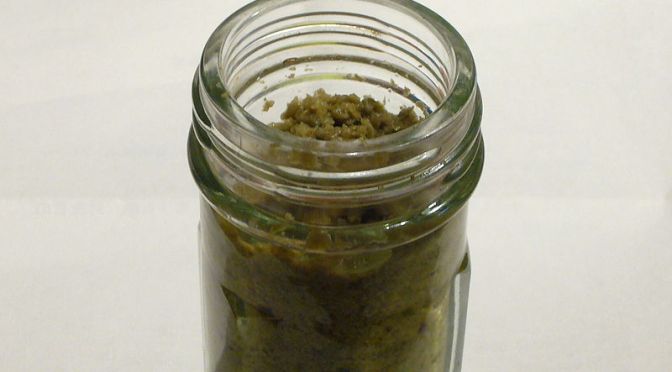
Yuzu Koshio or lime and Chili mix is prepared with green hot chili (as opposed to red one) and lime skin/zest.
It is quite comnon in Kyushu Island, especially in Oita Prefecture, as well as far as in Okinawa.
It is quickly becoming more and more popular all over Japan, and is even locally produced in our Prefecture, Shizuoka!
It is a very versatile condiment that can be used in all kinds of Asian cuisines by vegans, vegetarians and omnivores alike!

Here is a simple recipe. Don’t forget you can replace green chilies with red chilies for two varieties!

INGREDIENTS:

-Green lime: 1 large
-Fresh green chilies: 6
-Salt: to taste

RECIPE:

YUZU-KOSHIO-2

-Peel the lime.
Wash the lime zests and green chilies in clean cold water.

YUZU-KOSHIO-3

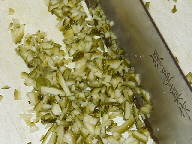
-Chop lime zests as fine as possible.

YUZU-KOSHIO-4

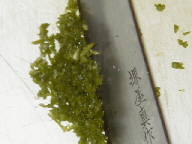
-Cut the chilies in two, discard the seeds and chop them all as fine as possible.

YUZU-KOSHIO-5

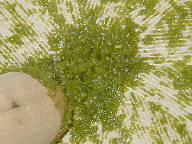
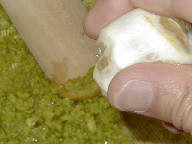
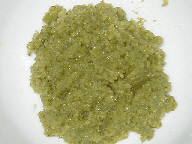
-Grind lime zests and chilies with a pestle so as to obtain a paste.

YUZU-KOSHIO-6

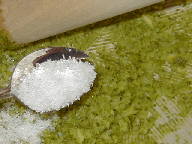
-Add salt (experimentation might be needed there) and mix well.

YUZU-KOSHIO-7

-Add lime juice (experimentation might be needed there, too) and mix well.

YUZU-KOSHIO-8

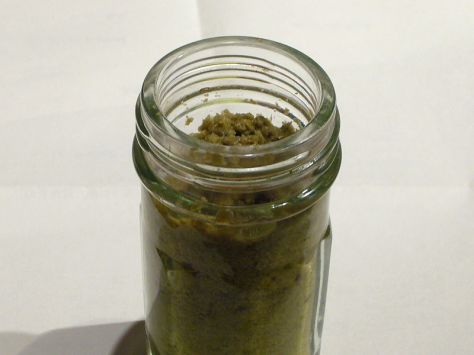
-Wrap the mix in cellophane paper and store in a tupperware box, or pour it inside a small bottle. Keep it in the fridge away from the light.
Consume as soon as possible!

RECOMMENDED RELATED WEBSITES

Masala Herb by Helene Dsouza in Goa, India
Mummy I Can Cook! by Shu Han in London
Pierre.Cuisine, Francescannotwrite, My White Kitchen, 47 Japanese Farms Through The Eyes of Its Rural Communities, Foodhoe, Chucks Eats, Things that Fizz & Stuff, Five Euro Food by Charles,Red Shallot Kitchen by Priscilla,With a Glass, Nami | Just One Cookbook, Peach Farm Studio, Clumsyfingers by Xethia, PepperBento,Adventures in Bento Making, American Bent, Beanbento, Bento No, Bento Wo Tsukurimashou, Cooking Cute, Eula, Hapabento , Happy Bento, Jacki’s Bento Blog, Kitchen Cow, Leggo My Obento, Le Petit Journal Bento & CO (French), Lunch In A Box,
Susan at Arkonlite, Vegan Lunch Box; Tokyo Tom Baker, Daily Food Porn/Osaka, Only Nature Food Porn, Happy Little Bento, The Herbed Kitchen, J-Mama’s Kitchen, Cook, Eat, Play, Repeat, Bento Lunch Blog (German), Adventures In Bento, Anna The Red’s Bento Factory, Cooking Cute, Timeless Gourmet, Bento Bug, Ideal Meal, Bentosaurus, Mr. Foodie (London/UK), Ohayo Bento,

Must-see tasting websites:

-Sake: Tokyo Through The Drinking Glass, Tokyo Foodcast, Urban Sake, Sake World
-Wine: Palate To Pen, Warren Bobrow, Cellar Tours, Ancient Fire Wines Blog
-Beer: Good Beer & Country Boys, Another Pint, Please!
-Japanese Pottery to enjoy your favourite drinks: Yellin Yakimono Gallery
Japanese Gastronomy: Steamed Sushi-Recipe

A foodie friend of mine, was just mentioning she could not wait to come to Japan to eat sushi, as it was just frustrating and terribly expensive in her own country.
Well, why not making it yourself, then?
“It’s too difficult and one cannot get the ingredients!”
Really? There must be enough stores all over the world by now which sell the basics. So why don’t you try this simple recipe for a start!

Steamed sushi!

INGREDIENTS: For 3~ people

-Rice: 3 cups/600 cc

Sushi vinegar:
-Rice vinegar: 3 tablespoons
-Sugar: just under 3 tablespoons
-Salt: 1 teaspoon

-Conger eels (anago/穴子): 3 (can be bought frozen)
-Soy sauce: 2 tablespoons
-Mirin/Japanese sweet sake: 2 tablespoons

-Dried shiitake mushrooms: 3~4 (medium-sized)
-Dashi/Japanese soup stock: 1 cup/200 cc/ml
-Sugar: 1 tablespoon
-Soy sauce:1 tablespoon

-Trefoil or Italian Parsley: 1 bunch

-Eggs: 5
-Sugar: 1 teaspoon
-Salt: 1/2 teaspoon

-Amazu jinja/ginger marinated in sweet vinegar: as appropriate for decoration/seasoning

RECIPE:

-Wash rice and steam in the normal way

-Unless you can buy the conger eels already cooked and seasoned, cut their heads and tail, cut in half lengthwise and across again into one-bite sized pieces. Fry slowly with soy sauce and mirin/sweet sake until cooked and well-impregnated with seasoning sauce. Set apart.

-In a pan pour the dashi/Japanese soup stock. Add the dried shiitake and stew until the mushrooms have become soft. Add the sugar and soy sauce. Keep simmering until all liquid has disappeared. Let cool. Cut into fine slices. Set apart.

-Drop the trefoil in hot salted water for a few seconds. Drain well and cut into 2 cm long pieces.

-Make a thin omelette with the eggs beaten with sugar and salt. Cut into thin threads.

-Once the rice has been steamed, transfer it into a large vessel (wooden preferably, but a large ceramic dish will do). add the rice vinegar, sugar and salt evenly over it. Mix by “cutting in” the rice with a wet paddle. Add conger eels and their juices, shiitake mushrooms and mix lightly.

-Place an equal amount of the rice into bowls and steam (with a lid on) for 15 minutes over a strong fire. Open the lid, place an equal amount of egg ribbons and steam again for 1 more minute.

-Serve topped with trefoil and sweet vinegar marinated ginger!

RECOMMENDED RELATED WEBSITES

Masala Herb by Helene Dsouza in Goa, India
Mummy I Can Cook! by Shu Han in London
Pierre.Cuisine, Francescannotwrite, My White Kitchen, 47 Japanese Farms Through The Eyes of Its Rural Communities, Foodhoe, Chucks Eats, Things that Fizz & Stuff, Five Euro Food by Charles,Red Shallot Kitchen by Priscilla,With a Glass, Nami | Just One Cookbook, Peach Farm Studio, Clumsyfingers by Xethia, PepperBento,Adventures in Bento Making, American Bent, Beanbento, Bento No, Bento Wo Tsukurimashou, Cooking Cute, Eula, Hapabento , Happy Bento, Jacki’s Bento Blog, Kitchen Cow, Leggo My Obento, Le Petit Journal Bento & CO (French), Lunch In A Box,
Susan at Arkonlite, Vegan Lunch Box; Tokyo Tom Baker, Daily Food Porn/Osaka, Only Nature Food Porn, Happy Little Bento, The Herbed Kitchen, J-Mama’s Kitchen, Cook, Eat, Play, Repeat, Bento Lunch Blog (German), Adventures In Bento, Anna The Red’s Bento Factory, Cooking Cute, Timeless Gourmet, Bento Bug, Ideal Meal, Bentosaurus, Mr. Foodie (London/UK), Ohayo Bento,

Must-see tasting websites:

-Sake: Tokyo Through The Drinking Glass, Tokyo Foodcast, Urban Sake, Sake World
-Wine: Palate To Pen, Warren Bobrow, Cellar Tours, Ancient Fire Wines Blog
-Beer: Good Beer & Country Boys, Another Pint, Please!
-Japanese Pottery to enjoy your favourite drinks: Yellin Yakimono Gallery
Japanese Gastronomy: Oysters steamed in Rice/Kaki Meshi Recipe

Winter means a large supply of fresh oyters in Japan and many other countries! But we certainly need some fresh and simple ideas to consume them, even if raw oysters are the norm.
Oyster chowder is a traditional option for example.
Have you heard of this typical Japanese dish called “Kaki Meshi/牡蠣飯, or oysters steamed in rice?
It has the advantage of being a hearty, simple and very healthy recipe.

Here is the basic recipe. There are plenty of options open for it!

INGREDIENTS: As I often do with basic Japanese recipes, I leave it to you as for exact quantities to accomodate personal preferences and priorities.

-Oysters/蠣
-Rice/米
-Soy sauce/醤油
-Japanese sake/酒
-Dashi/Japanese soup stock/出汁
-Grated daikon/大根おろし
-Ginger/生姜/cut into very fine strips
-Lime/yuzu/柚子/grated zest
-Thin leeks/子葱/コネギ
-Trefoil/Mitsuba/三葉

RECIPE:

Oysters:
Using fresh oysters in their shells (don’t forget to take them out!LOL) is a bit too extravagant for this recipe, and hard work.
In Japan they can be found in any markets sold packed in water. This country being very strict on hygiene rules, I have no problem using them.

Rice:
Prepare the rice before opening the pack of oysters.
3 “go”, or about 540 cc (liquid measure) should be enough. Use Japanese round rice. Check if it has to be washed first or not, as both varieties are available.
(After washing the rice, if necessary) let soak the rice in clear water for 30 minutes.
Drain thoroughly.

Massaging the oysters in grated daikon:
This is a very important step which will ensure that the oysters are properly cleaned.
Prepare enough grated daikon.
If you use oysters just taken out of their shells, massaging them with salt might be better.
Wash quickly under clear clean water and drain thoroughly.

Pre-cooking the oysters:
In pan pour just enough sake and soft soy sauce variety to simmer the the oysters in for 2~3 minutes.
The more sake, the better!
Do experiment!

Sieving/filter the juices:
Take oysters out with a sieve ladle and keep aside.
Strain/filter the juices into the rice cooker.

Preparing the rice steaming liquid/soup:
Add dashi/Japanese soup stock so that the total liquid is the equivalent of the rice volume x 1.2=about 650 cc.

Steaming:
Pour the rice into the steaming liquid.
Place oysters and ginger on top.
Close rice cooker and switch on.

Wait until the rice is cooked.
DO NOT OPEN the cooker at once, but leave it closed for 10 more minutes!
Open the cooker.
Drop in 90% of the chopped thin leeks, grated yuzu zest and cut trefoil.
Mix in quickly.
Serve at once sprinkled with some more thin leeks, grated yuzu and cut trefoil.

RECOMMENDED RELATED WEBSITES

Masala Herb by Helene Dsouza in Goa, India
Mummy I Can Cook! by Shu Han in London
Pierre.Cuisine, Francescannotwrite, My White Kitchen, 47 Japanese Farms Through The Eyes of Its Rural Communities, Foodhoe, Chucks Eats, Things that Fizz & Stuff, Five Euro Food by Charles,Red Shallot Kitchen by Priscilla,With a Glass, Nami | Just One Cookbook, Peach Farm Studio, Clumsyfingers by Xethia, PepperBento,Adventures in Bento Making, American Bent, Beanbento, Bento No, Bento Wo Tsukurimashou, Cooking Cute, Eula, Hapabento , Happy Bento, Jacki’s Bento Blog, Kitchen Cow, Leggo My Obento, Le Petit Journal Bento & CO (French), Lunch In A Box,
Susan at Arkonlite, Vegan Lunch Box; Tokyo Tom Baker, Daily Food Porn/Osaka, Only Nature Food Porn, Happy Little Bento, The Herbed Kitchen, J-Mama’s Kitchen, Cook, Eat, Play, Repeat, Bento Lunch Blog (German), Adventures In Bento, Anna The Red’s Bento Factory, Cooking Cute, Timeless Gourmet, Bento Bug, Ideal Meal, Bentosaurus, Mr. Foodie (London/UK), Ohayo Bento,

Must-see tasting websites:

-Sake: Tokyo Through The Drinking Glass, Tokyo Foodcast, Urban Sake, Sake World
-Wine: Palate To Pen, Warren Bobrow, Cellar Tours, Ancient Fire Wines Blog
-Beer: Good Beer & Country Boys, Another Pint, Please!
-Japanese Pottery to enjoy your favourite drinks: Yellin Yakimono Gallery

Shizuoka Sake Tasting: Oomuraya Brewery-Tokubetsu Junmai-Oni Otome Yume

She looks cute, doesn’t she?
Actually, you should beware…
Oomuraya Brewery in Shimada City is celebrated for its brand “Oni koroshi/Kill a Goblin”, meaning that the sake is so good it would overwhelm a Japanese ogre.
Now, the brewery has come up with a dangerous “partner”, “Oni Otome”/ “The Goblin’s Sweetheart” and topped it with “Yume/Dream”! Brrrr….

Rice milled down to 60%
Alcohol: 16 degrees
Dryness: + 2
Acidity: 1.3
Amino acids: 1.2
Bottled in February 2012

Clarity: Very clear
Color: Faint golden hue
Aroma: Assertive, fruity, sweetish and flowery.
Pineapple, vanilla, oranges.
Body: Fluid, slightly liquorish
Taste: A little dry attack backed up by junmai petillant.
Fruity and complex. Elegant. Pineapple, oranges, faint dark chocolate.
Lingers for a while warming up the palate.
Ending on a softer dry note with almonds and cherries.
Turns on a lighter note with food along an accent on oranges.

Overall: A sake probably best enjoyed on its own or as an aperitif.
Light and easy to drink.
Tends to a back seat with food.
A sake which should please the younger generation and ladies in particular.

RECOMMENDED RELATED WEBSITES

Masala Herb by Helene Dsouza in Goa, India
Mummy I Can Cook! by Shu Han in London
Pierre.Cuisine, Francescannotwrite, My White Kitchen, 47 Japanese Farms Through The Eyes of Its Rural Communities, Foodhoe, Chucks Eats, Things that Fizz & Stuff, Five Euro Food by Charles,Red Shallot Kitchen by Priscilla,With a Glass, Nami | Just One Cookbook, Peach Farm Studio, Clumsyfingers by Xethia, PepperBento,Adventures in Bento Making, American Bent, Beanbento, Bento No, Bento Wo Tsukurimashou, Cooking Cute, Eula, Hapabento , Happy Bento, Jacki’s Bento Blog, Kitchen Cow, Leggo My Obento, Le Petit Journal Bento & CO (French), Lunch In A Box,
Susan at Arkonlite, Vegan Lunch Box; Tokyo Tom Baker, Daily Food Porn/Osaka, Only Nature Food Porn, Happy Little Bento, The Herbed Kitchen, J-Mama’s Kitchen, Cook, Eat, Play, Repeat, Bento Lunch Blog (German), Adventures In Bento, Anna The Red’s Bento Factory, Cooking Cute, Timeless Gourmet, Bento Bug, Ideal Meal, Bentosaurus, Mr. Foodie (London/UK), Ohayo Bento,

Must-see tasting websites:

-Sake: Tokyo Through The Drinking Glass, Tokyo Foodcast, Urban Sake, Sake World
-Wine: Palate To Pen, Warren Bobrow, Cellar Tours, Ancient Fire Wines Blog
-Beer: Good Beer & Country Boys, Another Pint, Please!
-Japanese Pottery to enjoy your favourite drinks: Yellin Yakimono Gallery

Today’s Bento/Lunch Box (12/12): Salmon and Smileys Bento!

I try to come up with a name for each bento the Missus concocts for me for the sake of variety.
I had a hard time finding one today! Well, the salmon is obvious and the smileys are to be found with the tamagoyaki!

This bento was made with whatever was found in the fridge and even includes some leftovers from the previous bento!
After having steamed the rice, filled the main box with it and sprinkled it with chopped red pickled cucumber, the Missus fried some slices of salmon and topped them with tartare sauce at the last moment before placing them on top of the rice.
She fried some boiled green cauliflower for yesterday’s bento for more colors and balance and put the finishing touch with some sliced black olive.

Can you see the smileys?
Well, two of them have slanted eyes while the third one is blowing me a kiss!

The Missus had prepared a batch of “kinpira” vegetables with hijiki/sweet seaweed, burdock root, carrot and green/red peppers and filled one end of the side box with it.

The smileys were made of tamagoyaki with apparent whites and filled with boiled black beans.
The Missus placed them on a bed of ice-plant with plum tomatoes and boiled peas in their pods.

Very colorful again, Spring is around the corner! Solid and yummy!

RECOMMENDED RELATED WEBSITES

Masala Herb by Helene Dsouza in Goa, India
Mummy I Can Cook! by Shu Han in London
Pierre.Cuisine, Francescannotwrite, My White Kitchen, 47 Japanese Farms Through The Eyes of Its Rural Communities, Foodhoe, Chucks Eats, Things that Fizz & Stuff, Five Euro Food by Charles,Red Shallot Kitchen by Priscilla,With a Glass, Nami | Just One Cookbook, Peach Farm Studio, Clumsyfingers by Xethia, PepperBento,Adventures in Bento Making, American Bent, Beanbento, Bento No, Bento Wo Tsukurimashou, Cooking Cute, Eula, Hapabento , Happy Bento, Jacki’s Bento Blog, Kitchen Cow, Leggo My Obento, Le Petit Journal Bento & CO (French), Lunch In A Box,
Susan at Arkonlite, Vegan Lunch Box; Tokyo Tom Baker, Daily Food Porn/Osaka, Only Nature Food Porn, Happy Little Bento, The Herbed Kitchen, J-Mama’s Kitchen, Cook, Eat, Play, Repeat, Bento Lunch Blog (German), Adventures In Bento, Anna The Red’s Bento Factory, Cooking Cute, Timeless Gourmet, Bento Bug, Ideal Meal, Bentosaurus, Mr. Foodie (London/UK), Ohayo Bento,

Must-see tasting websites:

-Sake: Tokyo Through The Drinking Glass, Tokyo Foodcast, Urban Sake, Sake World
-Wine: Palate To Pen, Warren Bobrow, Cellar Tours, Ancient Fire Wines Blog
-Beer: Good Beer & Country Boys, Another Pint, Please!
-Japanese Pottery to enjoy your favourite drinks: Yellin Yakimono Gallery

Today’s Bento/Lunch Box (12/11): Gyoza Meat Sauce Bento!

Now, why did I call this bentoGyoza meat sauce bento”? There is no gyoza included, right?
Actually, the Missus helped herself with unused gyoza filling made the previous day!

</a

She steamed plain rice before filling the main box with it.
She then topped part of the rice with boiled carrots and green cauliflower (cauliflower, not romanesco or broccoli!).
I wonder what flag colors it would represent?

Don’t ask about the recipe, I just don’t know!
The Missus fried the gyoza filling left from overnight mixed with some tomato sauce before adding boiled taro/sato imo cut into pieces. Incidentally, the taro roots were boiled by your servant as the Missus does not care much for them! They were also leftovers!
Having fried the lot, she poured it over the rice and sprinkled it with plenty of black sesame seeds.

The side dish was both beautiful and healthy!
Boiled rape flowers/na no hana seasoned with gomadare/sesame dressing.
Lotus root slices fried with yuzu koshio. Very piquant!
Yama imo/Japanese yam pickled with amazu and red cucumber pickles.
Boiled black beans.

Very solid, healthy and yummy!

RECOMMENDED RELATED WEBSITES

Masala Herb by Helene Dsouza in Goa, India
Mummy I Can Cook! by Shu Han in London
Pierre.Cuisine, Francescannotwrite, My White Kitchen, 47 Japanese Farms Through The Eyes of Its Rural Communities, Foodhoe, Chucks Eats, Things that Fizz & Stuff, Five Euro Food by Charles,Red Shallot Kitchen by Priscilla,With a Glass, Nami | Just One Cookbook, Peach Farm Studio, Clumsyfingers by Xethia, PepperBento,Adventures in Bento Making, American Bent, Beanbento, Bento No, Bento Wo Tsukurimashou, Cooking Cute, Eula, Hapabento , Happy Bento, Jacki’s Bento Blog, Kitchen Cow, Leggo My Obento, Le Petit Journal Bento & CO (French), Lunch In A Box,
Susan at Arkonlite, Vegan Lunch Box; Tokyo Tom Baker, Daily Food Porn/Osaka, Only Nature Food Porn, Happy Little Bento, The Herbed Kitchen, J-Mama’s Kitchen, Cook, Eat, Play, Repeat, Bento Lunch Blog (German), Adventures In Bento, Anna The Red’s Bento Factory, Cooking Cute, Timeless Gourmet, Bento Bug, Ideal Meal, Bentosaurus, Mr. Foodie (London/UK), Ohayo Bento,

Must-see tasting websites:

-Sake: Tokyo Through The Drinking Glass, Tokyo Foodcast, Urban Sake, Sake World
-Wine: Palate To Pen, Warren Bobrow, Cellar Tours, Ancient Fire Wines Blog
-Beer: Good Beer & Country Boys, Another Pint, Please!
-Japanese Pottery to enjoy your favourite drinks: Yellin Yakimono Gallery

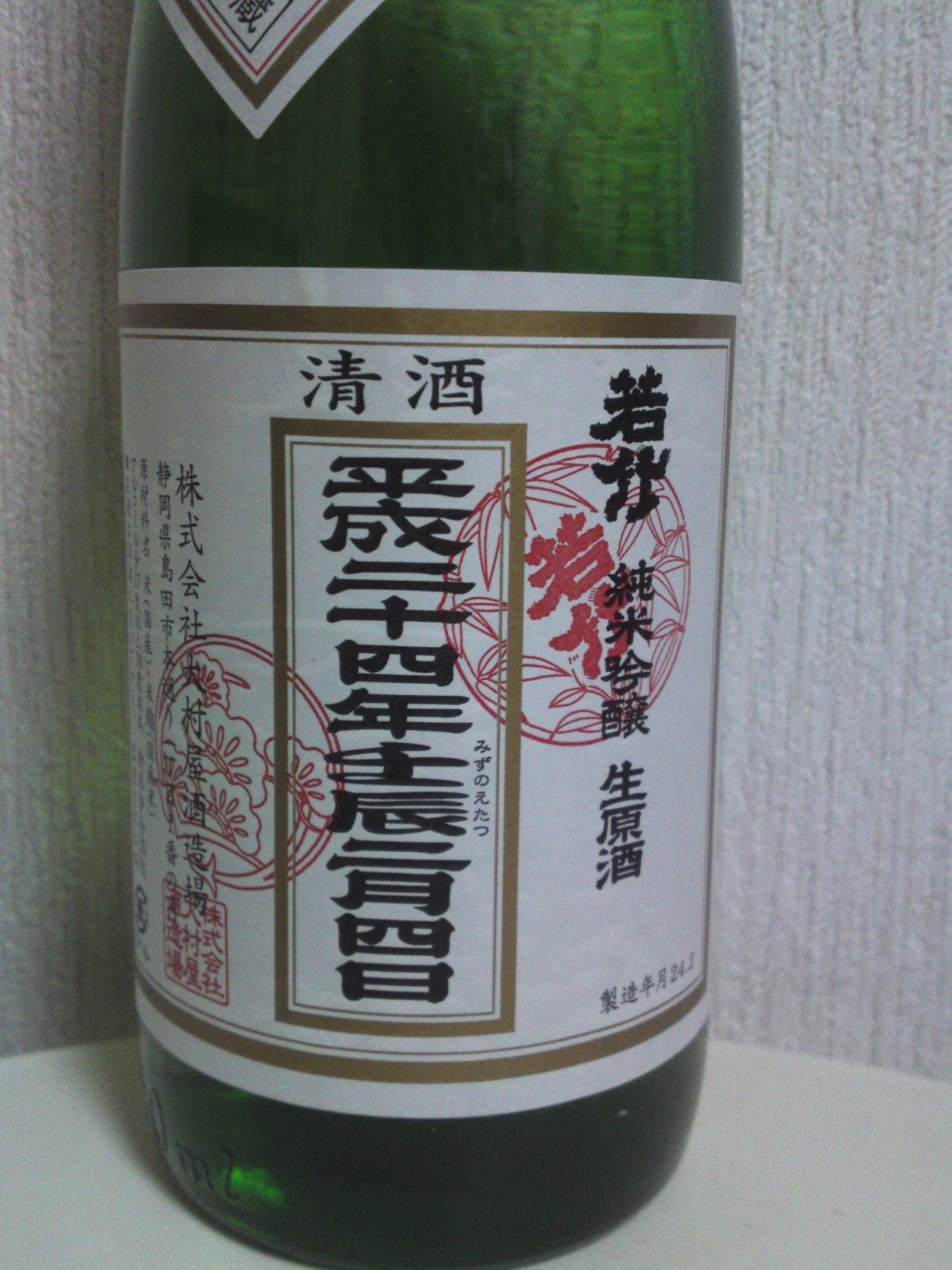
Shizuoka Sake Tasting: Oomuraya Brewery-Wakatake Risshun Asa Shiborit Junmai Ginjo Nama Genshu

Another long name for an annual limited nectar by Oomuraya brewery in Shimada City!

Now, what does “Oomuraya Brewery-Wakatake Risshun Asa Shiboritate Junmai Ginjo Nama Genshu” stand for?
“Wakatake” is the name of Oomuraya Brewery’s main brand name.
“Haru Asa Shibori” means this sake had just been pressed on a Spring morning.
“Junmai Ginjo” is a premium level for a sake to which no alcohol was added.
“Nama” means it was not pasteurized.
“Genshu” means that no water was added.
A sake as it came out of the pressing!

The paper envelope attached to the neck contains a five yen coin for good luck!

Rice milled down to 55%
Alcohol: 17~18 degrees
Bottled in December 2011

Clarity: Very clear
Color: Faint golden hue
Aroma: Puissant. Flowery. Fruity, banana, Macadamia nuts, vanilla. Pleasant alcohol
Body: Fluid
Taste: Strong attack backed up by pleasant alcohol and junmai petillant.
Fruity and complex: banana, oranges, vanilla, pears.
Lingers for a while warming up the palate.
Disappears on a dry note with almonds and macadamia nuts.
Great balance between fruit and acidity.
Changes little and drinks well with any food.

Overall: A traditional limited brew typical of Oomuraya Brewery’s approach.
A very solid and strong sake, but nonetheless elegant in its superlative balance between fruit and acidity.
A sake perfect with izakaya gastronomy!

RECOMMENDED RELATED WEBSITES

Masala Herb by Helene Dsouza in Goa, India
Mummy I Can Cook! by Shu Han in London
Pierre.Cuisine, Francescannotwrite, My White Kitchen, 47 Japanese Farms Through The Eyes of Its Rural Communities, Foodhoe, Chucks Eats, Things that Fizz & Stuff, Five Euro Food by Charles,Red Shallot Kitchen by Priscilla,With a Glass, Nami | Just One Cookbook, Peach Farm Studio, Clumsyfingers by Xethia, PepperBento,Adventures in Bento Making, American Bent, Beanbento, Bento No, Bento Wo Tsukurimashou, Cooking Cute, Eula, Hapabento , Happy Bento, Jacki’s Bento Blog, Kitchen Cow, Leggo My Obento, Le Petit Journal Bento & CO (French), Lunch In A Box,
Susan at Arkonlite, Vegan Lunch Box; Tokyo Tom Baker, Daily Food Porn/Osaka, Only Nature Food Porn, Happy Little Bento, The Herbed Kitchen, J-Mama’s Kitchen, Cook, Eat, Play, Repeat, Bento Lunch Blog (German), Adventures In Bento, Anna The Red’s Bento Factory, Cooking Cute, Timeless Gourmet, Bento Bug, Ideal Meal, Bentosaurus, Mr. Foodie (London/UK), Ohayo Bento,

Must-see tasting websites:

-Sake: Tokyo Through The Drinking Glass, Tokyo Foodcast, Urban Sake, Sake World
-Wine: Palate To Pen, Warren Bobrow, Cellar Tours, Ancient Fire Wines Blog
-Beer: Good Beer & Country Boys, Another Pint, Please!
-Japanese Pottery to enjoy your favourite drinks: Yellin Yakimono Gallery
Rainbow Charity Cocktail Rally 2012 in Shizuoka City March 11th~April 11th!

The BCS/Bartender’s Club Shizuoka will organize a Cocktail Rally from March 11th to April 11th to raise some money for the victims of the earthquake and tsunami which devastated the north east of Japan last year on March 11th!

The method is very simple:
Tickets for 3,500 yen are on sale at the 7 different bars of the Association or on the telephone or through friends. Check the bars information at the end of this posting!

The ticket includes a map for better orienteering!
Keep it with you at all times!

The ticket includes 7 coupons, one for each bar.
Each coupon can be used only once at the bar indicated on it.
It will entitle you to one original cocktail.
Note that the bars also charge a 500 yen cover charge. At about 1,000 yen for the first drink, it a great bargain!
500 yen for each whole ticket will go to charity!
No better way to get acquainted with the best cocktail bars in Shizuoka City!

Bartender’s Club Shizuoka, the 7 Samurais!

JUILLET
Shizuoka City, Aoi Ku, Takajo, 2-10-8
Tel.: 054-273-5755
Opening hours: 12:00~24:00
Closed on Wednesdays

BAR BOTANICAL
Shizuoka City, Aoi Ku, Ryogae Cho, 1-6-13, Shade Bldg, 1F
Tel.: 054-221-8686
Opening hours: 18:00~02:00
Closed on Mondays

BAR ALCHEMIST
Shizuoka City, Aoi Ku, Tenma Cho, 22-1
Tel.: 054-251-7356
Opening hours: 16:00~24:00
Closed on Sundays and National Holidays

BAR LE REFUGE
Shizuoka City, Aoi Ku, Tenma Cho, 9-15, Liberte Hirano Bldg, 1F-B
Tel.: 054-221-0339
Opening hours: 18:00~02:00
Closed on Sundays

BAR NO’AGE
Shizuoka City, Aoi Ku, Shichiken Cho, 8-6, ACT7 Bldg., 2f
Tel.: 054-253-6615
Opening hours: 17:00~01:00 (16:00~24:00 on Sundays)
Closed on Tuesdays

BAR-CODE
Shizuoka City, Aoi Ku, Tokiwa Cho, 1-2-1, Friend Kuki Bldg., 1F
Tel.: 054-221-1999
Opening hours: 18:00~03:00 (18:00~05:00 on Fridays & Saturdays)
Closed on Sundays

BAR SHAMROCK
Shizuoka City, Aoi Ku, Shichiken-Cho, 8-6, ACT7 Bldg., 1F
tel.: 054-252-1600
Opening hours: 18:00~03:00

RECOMMENDED RELATED WEBSITES

Pierre.Cuisine, Francescannotwrite, My White Kitchen, 47 Japanese Farms Through The Eyes of Its Rural Communities, Foodhoe, Chucks Eats, Things that Fizz & Stuff, Five Euro Food by Charles,Red Shallot Kitchen by Priscilla,With a Glass, Nami | Just One Cookbook, Peach Farm Studio, Clumsyfingers by Xethia, PepperBento,Adventures in Bento Making, American Bent, Beanbento, Bento No, Bento Wo Tsukurimashou, Cooking Cute, Eula, Hapabento , Happy Bento, Jacki’s Bento Blog, Kitchen Cow, Leggo My Obento, Le Petit Journal Bento & CO (French), Lunch In A Box,
Susan at Arkonlite, Vegan Lunch Box; Tokyo Tom Baker, Daily Food Porn/Osaka, Only Nature Food Porn, Happy Little Bento, The Herbed Kitchen, J-Mama’s Kitchen, Cook, Eat, Play, Repeat, Bento Lunch Blog (German), Adventures In Bento, Anna The Red’s Bento Factory, Cooking Cute, Timeless Gourmet, Bento Bug, Ideal Meal, Bentosaurus, Mr. Foodie (London/UK), Ohayo Bento,

Must-see tasting websites:

-Sake: Tokyo Through The Drinking Glass, Tokyo Foodcast, Urban Sake, Sake World
-Wine: Palate To Pen, Warren Bobrow, Cellar Tours, Ancient Fire Wines Blog
-Beer: Good Beer & Country Boys, Another Pint, Please!
-Japanese Pottery to enjoy your favourite drinks: Yellin Yakimono Gallery
Japanese Gastronomy: Tamago Miso Tsuke:Miso-pickled Egg Yolk

TAMAGO-MISO-1

Charles at Five Euro Food has just reminded me of an old post of mine when he wrote about his 5-hour egg!

Eggs are the one single ingredient used all over the World (except for the glacial caps maybe!), and people have come up with infinite ways of preserving them.
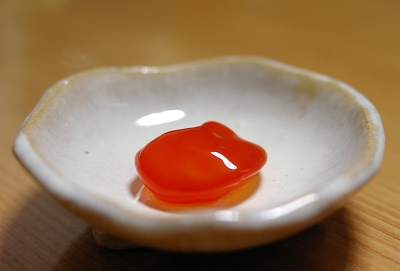
Tamago Miso Tsuke/卵黄味噌漬け is a popular way in Japan to preserve egg yolk in miso.
This very simple recipe could become useful for a tasty decoration!

INGREDIENTS:

-Raw eggs: 2
-Japanese sake: half a tablespoon
-Miso: 50 g
-Sugar: half a tablespoon

RECIPE:

TAMAGO-MISO-2

-Mix miso, Japanese sake and sugar well.

TAMAGO-MISO-3

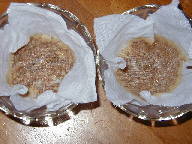
-Line two cups (narrow bottom and wide top) with gauze cloth (first clean it in cold clean water and press out all water). Pour half of the miso mix on each.

TAMAGO-MISO-4

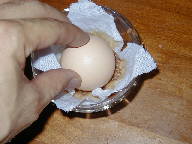
-Wash the egg and wipe it clean of water. Use it to fashion a “bed” inside the miso.

TAMAGO-MISO-5

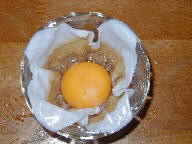
-Break the egg and separate yolk from white. Drop the egg yolk (only!) inside the miso bed. Cover with cellophane paper and leave inside the refrigeartor for 2 days.

TAMAGO-MISO-6

-After the first two days take the cup out and turn the egg yolk over delicately with a spoon. Leave in the fridge for three~four more days.
It should be ready by then!
It can be safely preserved inside a tightly closed tupperware inside the fridge for up to ten days!

RECOMMENDED RELATED WEBSITES

Pierre.Cuisine, Francescannotwrite, My White Kitchen, 47 Japanese Farms Through The Eyes of Its Rural Communities, Foodhoe, Chucks Eats, Things that Fizz & Stuff, Five Euro Food by Charles,Red Shallot Kitchen by Priscilla,With a Glass, Nami | Just One Cookbook, Peach Farm Studio, Clumsyfingers by Xethia, PepperBento,Adventures in Bento Making, American Bent, Beanbento, Bento No, Bento Wo Tsukurimashou, Cooking Cute, Eula, Hapabento , Happy Bento, Jacki’s Bento Blog, Kitchen Cow, Leggo My Obento, Le Petit Journal Bento & CO (French), Lunch In A Box,
Susan at Arkonlite, Vegan Lunch Box; Tokyo Tom Baker, Daily Food Porn/Osaka, Only Nature Food Porn, Happy Little Bento, The Herbed Kitchen, J-Mama’s Kitchen, Cook, Eat, Play, Repeat, Bento Lunch Blog (German), Adventures In Bento, Anna The Red’s Bento Factory, Cooking Cute, Timeless Gourmet, Bento Bug, Ideal Meal, Bentosaurus, Mr. Foodie (London/UK), Ohayo Bento,

Must-see tasting websites:

-Sake: Tokyo Through The Drinking Glass, Tokyo Foodcast, Urban Sake, Sake World
-Wine: Palate To Pen, Warren Bobrow, Cellar Tours, Ancient Fire Wines Blog
-Beer: Good Beer & Country Boys, Another Pint, Please!
-Japanese Pottery to enjoy your favourite drinks: Yellin Yakimono Gallery
Japanese Gastronomy: Himono/干物-Dried Fish

How many people outside Shizuoka Prefecture know that half (yes, half!) of all dried fish are caught and processed in our Prefecture, notably along the shores of the Izu Peninsula?
When will i convince everyone that Shizuoka Prefecture is THE true gastronomic region of Japan? LOL
To those guys living in Tokyo, may I remind them that Mount Fuji, Izu Peninsula and wasabi are all in Shizuoka Prefecture? Please someone stop me! (Would you belive I have been challenged on the veracity of the last?)

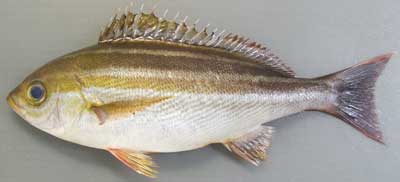
I chose a fish called “isaki” or “Chicken Grunt” (who came up with that English name?) that is quite common on our shores.
The recipe naturally applies to loads of fish!

CLEANING THE FISH:

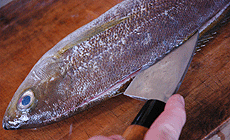
Using a strong short sharp knife (the Japanese use the same knife to cut and gut medium size fish), first get rid of the scales as much as possible.
Wash once under running clear cold water.
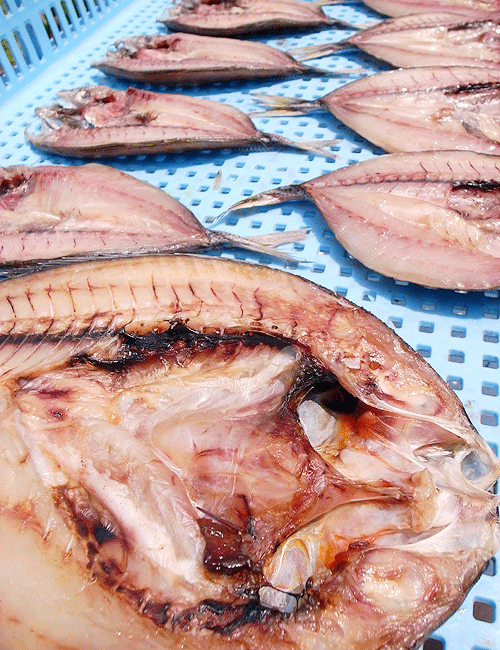
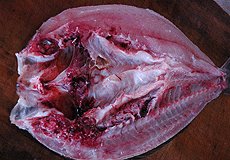
Cut along the back (not the belly! very important) from the tail to the head as shown on above picture deeply enough to reach the main bone.

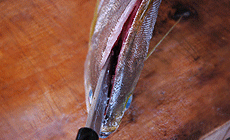
Once the knife has cut all along the back and reached the head, cut the head in half along the same cutting line.
The head of a isaki being small it is quite easy. It might require some strength for bigger head fish like seabreams. Call the MOTH then! (not the moths, the “Man”! LOL).

Open the fish and continue cutting in half all the way through.

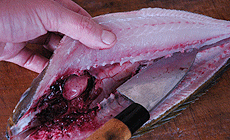
Take out all innards carefully so as not having them getting in contact with the flesh!
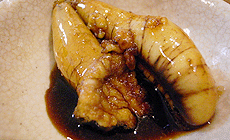
Depending upon the season, you might be lucky to get male sperm sacks (shirako). Don’t throw that away. They are great simmered with soy sauce, mirin/sweet sake, japanese sake and chili pepper! (see pic below).

Open the fish and clean it under running clear cold water.
Take water off with some kitchen paper or a clean piece of cloth.
Sprinkle with salt and dry outside under the sun until it has reached a nice aspect. You could also smoke it.
It can be preserved inside an airtight plastic bag and frozen, although eaten quickly it will taste so much better!

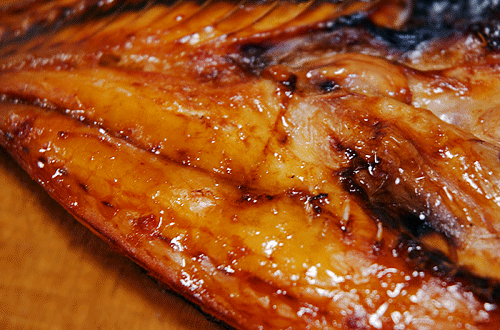
The Japanese grill their himono/dried fish pasted with a little soy sauce or tare. Beautiful with beer!

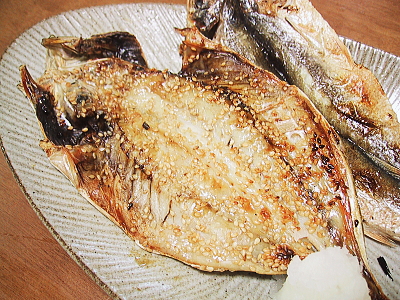
Great also grilled with a little salt!

If grilled with salt don’t forget the freshly grated daikon (and lemon juice, and soy sauce…)

The male sperm sacs (shirako) make for a great snack with your beer or sake once simmered in soy sauce, mirin/sweet sake and Japanese sake (and a little chili pepper)!

RECOMMENDED RELATED WEBSITES

Pierre.Cuisine, Francescannotwrite, My White Kitchen, 47 Japanese Farms Through The Eyes of Its Rural Communities, Foodhoe, Chucks Eats, Things that Fizz & Stuff, Five Euro Food by Charles,Red Shallot Kitchen by Priscilla,With a Glass, Nami | Just One Cookbook, Peach Farm Studio, Clumsyfingers by Xethia, PepperBento,Adventures in Bento Making, American Bent, Beanbento, Bento No, Bento Wo Tsukurimashou, Cooking Cute, Eula, Hapabento , Happy Bento, Jacki’s Bento Blog, Kitchen Cow, Leggo My Obento, Le Petit Journal Bento & CO (French), Lunch In A Box,
Susan at Arkonlite, Vegan Lunch Box; Tokyo Tom Baker, Daily Food Porn/Osaka, Only Nature Food Porn, Happy Little Bento, The Herbed Kitchen, J-Mama’s Kitchen, Cook, Eat, Play, Repeat, Bento Lunch Blog (German), Adventures In Bento, Anna The Red’s Bento Factory, Cooking Cute, Timeless Gourmet, Bento Bug, Ideal Meal, Bentosaurus, Mr. Foodie (London/UK), Ohayo Bento,

Must-see tasting websites:

-Sake: Tokyo Through The Drinking Glass, Tokyo Foodcast, Urban Sake, Sake World
-Wine: Palate To Pen, Warren Bobrow, Cellar Tours, Ancient Fire Wines Blog
-Beer: Good Beer & Country Boys, Another Pint, Please!
-Japanese Pottery to enjoy your favourite drinks: Yellin Yakimono Gallery

Japanese Gastronomy: Ebi Furai/Deep-fried Prawns

The Japanese love to deep-fry their food to the point that many izakaya propose full deep-fried food sets and menus including vegetables and seafood, and the ubiquitous prawns.
The Japanese will usually utilize kuruma ebi/Imperial prawns or Black Tiger variety for the latter.
There is nothing complicated about preparing deep-fried prawns. The key is to use fresh ingredients and serve everything as soon as ready.

INGREDIENTS:

-Imperial Prawns/Black Tiger Prawns
-Salt and pepper: to taste
-All-purpose flour
-Egg (s)
-Breadcrumbs or panko (the rough style). Real fresh breadcrumbs are the best.
-Tartare sauce for serving. or tare/bulldog sauce and mustard.

RECIPE:

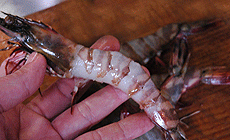
If the prawn is absolutely fresh take the shell off leaving the head and tail on. Note that the shell can be deep-fried for a crunchy snack!
If not, take the head off but leave the point of the the tail on for “handling” when eating it.

Take off the innards with a toothpick by inserting it under the blackish thread and pulling it out. Don’t worry about “breaking the back” of the prawn. Actually this is the trick which prevents the prawn from bending upon frying!

Actually, continue with the trick by making a few shallow cuts acrosss the back of the prawn to make sure it will not bend at all!
Sprinkle with salt (a little only!) and pepper to taste.

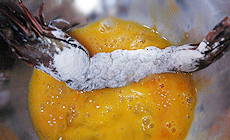
Roll prawns in flour.

Then in the beaten eggs.

Apply plenty of breadcrumbs/panko all over the prawns, head and tail included. Pat them lightly between you palms to help breadcrumbs to adhere.

Heat the oil at 170 degrees (less is unsuitable, 180 degrees is the very maximum). Drop the prawns gently into the oil head first.
Avoid manipulating them while frying.
Don’t fry too many at one time as the temperature of the oil will suddenly decrease.
Take them out with chopsticks. Place them on a grill for a few seconds to get rid of excess oil.
Serve with sauce and eat at once!

RECOMMENDED RELATED WEBSITES

Pierre.Cuisine, Francescannotwrite, My White Kitchen, 47 Japanese Farms Through The Eyes of Its Rural Communities, Foodhoe, Chucks Eats, Things that Fizz & Stuff, Five Euro Food by Charles,Red Shallot Kitchen by Priscilla,With a Glass, Nami | Just One Cookbook, Peach Farm Studio, Clumsyfingers by Xethia, PepperBento,Adventures in Bento Making, American Bent, Beanbento, Bento No, Bento Wo Tsukurimashou, Cooking Cute, Eula, Hapabento , Happy Bento, Jacki’s Bento Blog, Kitchen Cow, Leggo My Obento, Le Petit Journal Bento & CO (French), Lunch In A Box,
Susan at Arkonlite, Vegan Lunch Box; Tokyo Tom Baker, Daily Food Porn/Osaka, Only Nature Food Porn, Happy Little Bento, The Herbed Kitchen, J-Mama’s Kitchen, Cook, Eat, Play, Repeat, Bento Lunch Blog (German), Adventures In Bento, Anna The Red’s Bento Factory, Cooking Cute, Timeless Gourmet, Bento Bug, Ideal Meal, Bentosaurus, Mr. Foodie (London/UK), Ohayo Bento,

Must-see tasting websites:

-Sake: Tokyo Through The Drinking Glass, Tokyo Foodcast, Urban Sake, Sake World
-Wine: Palate To Pen, Warren Bobrow, Cellar Tours, Ancient Fire Wines Blog
-Beer: Good Beer & Country Boys, Another Pint, Please!
-Japanese Pottery to enjoy your favourite drinks: Yellin Yakimono Gallery

Japanese Gastronomy: Korokke-Croquettes/Introduction & Basic Recipe!

KOROKKE-1

Korokke (Japanese: コロッケ) is the Japanese name for a deep fried dish originally related to a French dish, the croquette. It is also said that it comes from the Dutch, Kroket.
It was introduced in the early 1900s. This dish is also popular in South Korea where it is typically sold in bakeries.

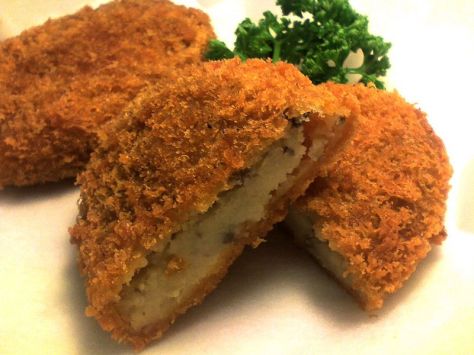
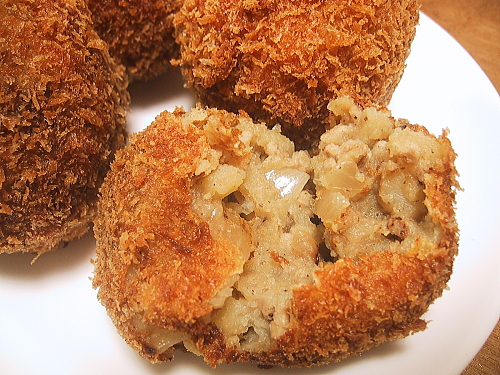
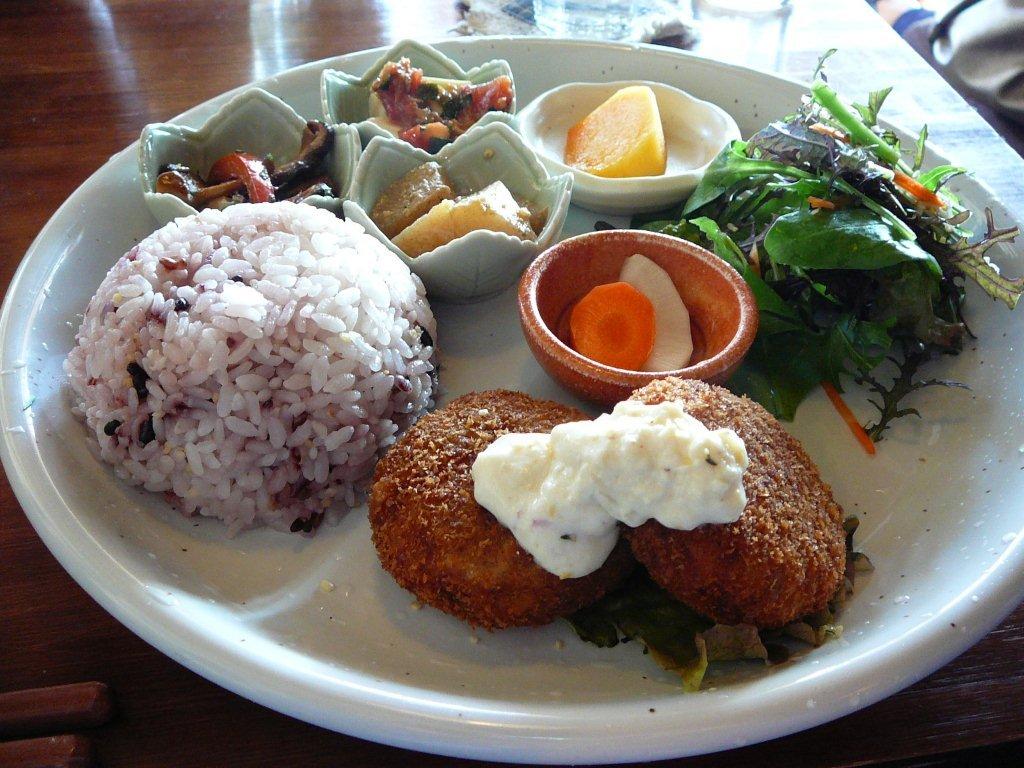
Korokke is made by mixing cooked chopped meat or seafood, vegetables with mashed potato or white sauce, or both, rolling it in wheat flour, eggs, and breadcrumbs/panko, then deep frying this until brown (fox colour in Japanese!) on the outside.
Korokke are usually shaped like flat patties. They are generally called “ingredient + Korokke”. For example, those using beef would be called “beef (gyu) korokke”, those using shrimp, “ebi korokke“, etc.. Those using white sauce may also be called “Cream Korokke”.

KOROKKE-2

Korokke are often served with Worcestershire sauce and shredded cabbage.

Korokke can be eaten as is, and are sometimes sold wrapped in paper at stalls. They may also be used as a topping for other dishes. When sandwiched between a piece of bread, they are be called “Korokke pan” (“pan” being bread in Japanese).

Korrokke was the most sold single frozen food in 2007 and has been among the top three ever since.

——————————–

BASIC RECIPE

Here is the basic recipe prevalent in restaurants and homesteads.
Naturally, it can be expanded and modified at will.
I will not bother you with measurements as the method is the point of this posting!

1) INGREDIENTS:

-Potatoes (you will have to decide which variety! In Japan, “Danshaku” are best!)
-Onion
-Minced meat (of your choice!)
-Salt and pepper
-Flour (of your choice)
-Egg
-Milk
-Breadcrumbs (fresh if possible)
-Oil
-Lard (skip that if you don’t like it, but it would be a pity!)

2) RECIPE:

-Boil the potatoes with their skins.
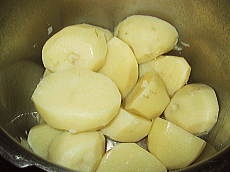
Peel the skins off just out of the water when very hot. This way, the potatoes will not be too wet.

-Mash the potatoes roughly with a wooden spoon/spatula. Add salt and pepper and mix roughly. Cover with cellophane paper to keep the potatoes warm as long as possible.

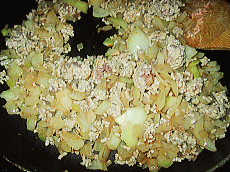
-Chop the onions finely and fry in lard if possible for better taste. If you don’t like lard, use oil. You could add chopped garlic and small pieces of bacon.
Add minced meat of your choice. Season with a little salt, pepper, sugar and soy sauce according to you preferences. Fry until the minced meat is cooked.

-Add the mashed potatoes. Mixing them all atogether at the same time fry until potatoes have become dry enough.
Let cool completely and transfer to a storage dish. Cover with cellophane paper and leave overnight in the refrigerator to allow taste to permeate the potatoes. This is an important point as not only it will enhance the taste but also make the croquettes easier to shape.
-Spread a little oil over your palms and shape croquettes into you prefered size.

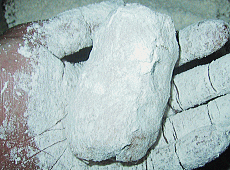
-Roll in flour and “shake” croquettes so that not too much flour adheres to them.

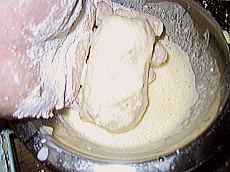
-Prepare (you might better do that first, LOL) the croquettes egg dip by mixing beaten egg, flour and milk to your preference.
Dip the croquettes in the batter completely.

-Roll the croquettes in the breadcrumbs.
One way to make breadcrumbs is to use real bread which had turned completely solid, soften it in milk, let it dry again and crush it into powder!

-Deep-fry croquettes at 170 degrees Celsius until they have reached a color of your liking.
As everything is already cooked inside, don’t worry whether they are cooked enough or not.
Point: add a little sesame oil to your frying oil for extra taste.

There are all kinds of sauce and decoration you cane serve croquettes with, unless you like them plain with a little mustard for example.

Here is a little suggestion for good taste and appetizing presentation:
Prepare a light white sauce/bechamel in the aurora style sauce with plenty of white pepper and boiled green peas.

Don’t they look nice like that!

RECOMMENDED RELATED WEBSITES

Pierre.Cuisine, Francescannotwrite, My White Kitchen, 47 Japanese Farms Through The Eyes of Its Rural Communities, Foodhoe, Chucks Eats, Things that Fizz & Stuff, Five Euro Food by Charles,Red Shallot Kitchen by Priscilla,With a Glass, Nami | Just One Cookbook, Peach Farm Studio, Clumsyfingers by Xethia, PepperBento,Adventures in Bento Making, American Bent, Beanbento, Bento No, Bento Wo Tsukurimashou, Cooking Cute, Eula, Hapabento , Happy Bento, Jacki’s Bento Blog, Kitchen Cow, Leggo My Obento, Le Petit Journal Bento & CO (French), Lunch In A Box,
Susan at Arkonlite, Vegan Lunch Box; Tokyo Tom Baker, Daily Food Porn/Osaka, Only Nature Food Porn, Happy Little Bento, The Herbed Kitchen, J-Mama’s Kitchen, Cook, Eat, Play, Repeat, Bento Lunch Blog (German), Adventures In Bento, Anna The Red’s Bento Factory, Cooking Cute, Timeless Gourmet, Bento Bug, Ideal Meal, Bentosaurus, Mr. Foodie (London/UK), Ohayo Bento,

Must-see tasting websites:

-Sake: Tokyo Through The Drinking Glass, Tokyo Foodcast, Urban Sake, Sake World
-Wine: Palate To Pen, Warren Bobrow, Cellar Tours, Ancient Fire Wines Blog
-Beer: Good Beer & Country Boys, Another Pint, Please!
-Japanese Pottery to enjoy your favourite drinks: Yellin Yakimono Gallery