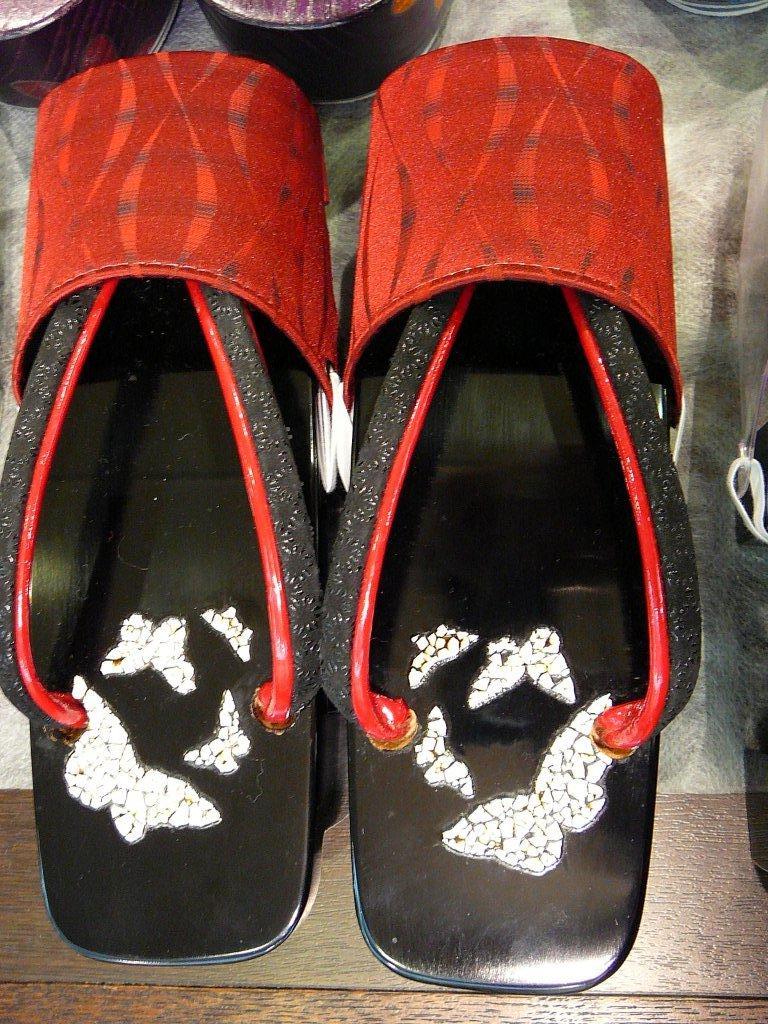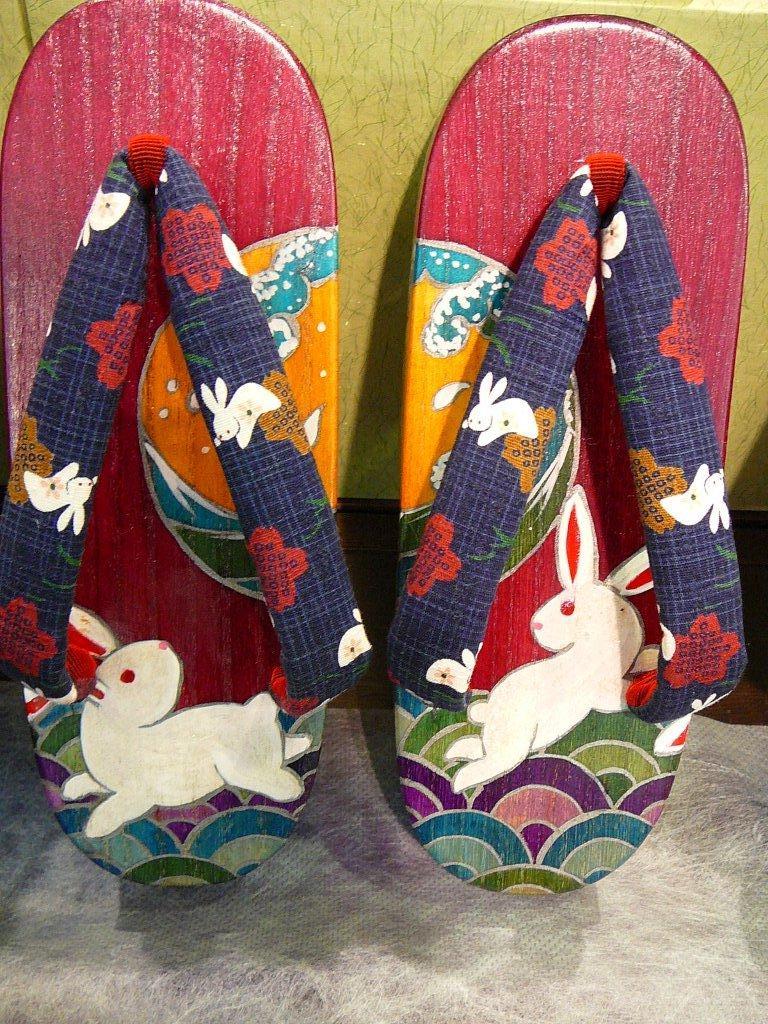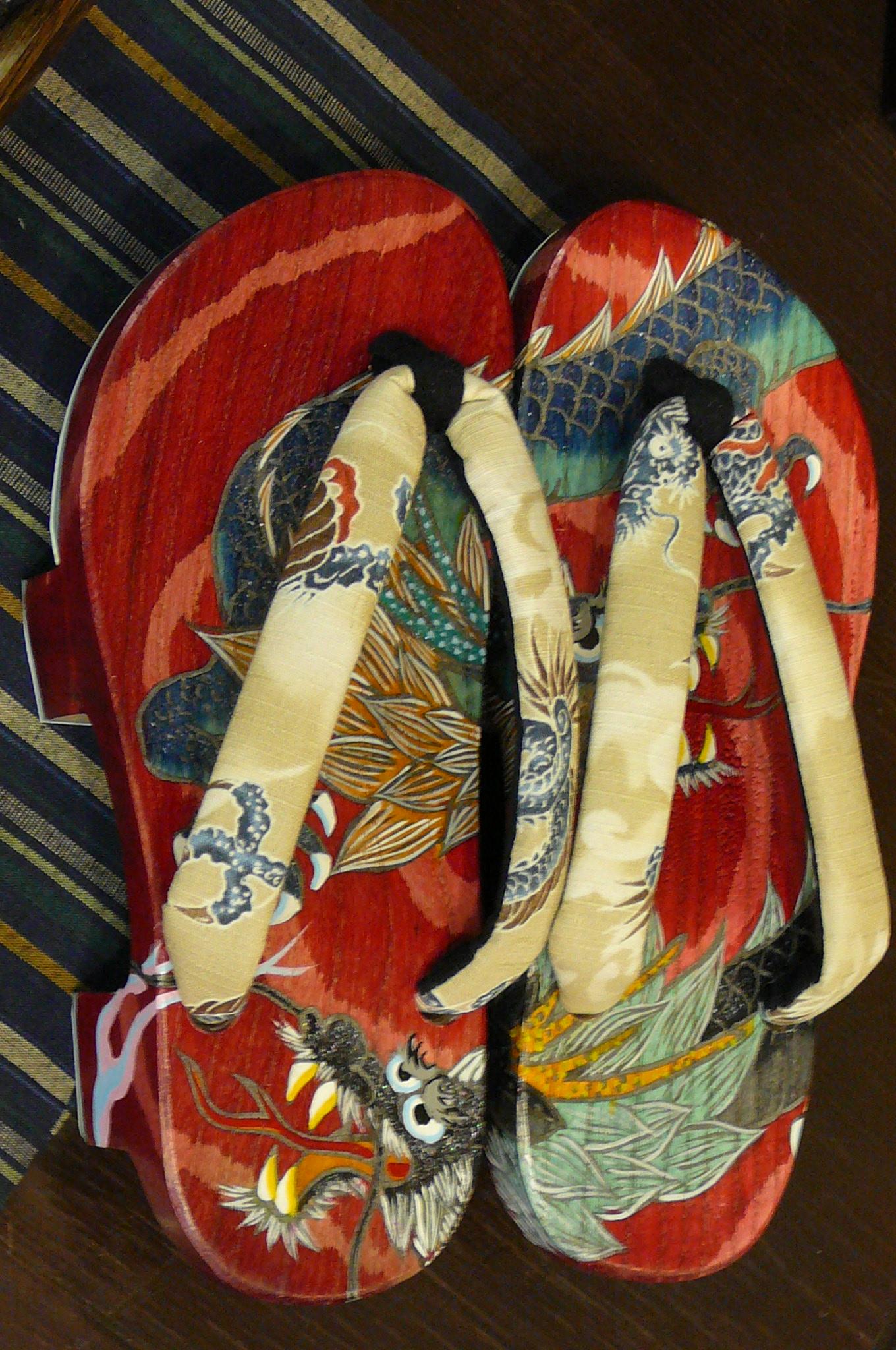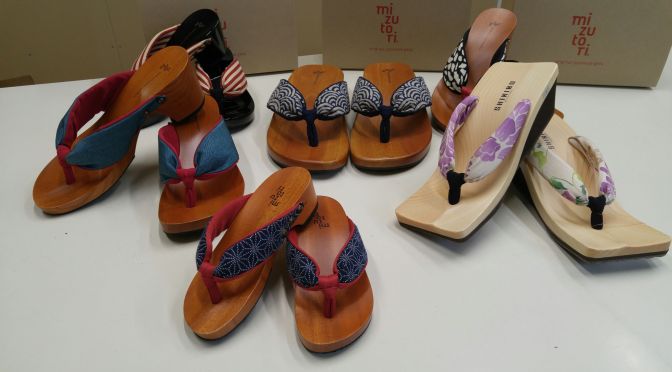
Mizutori Geta/Japanese Traditional Clogs/Sandals in Shizuoka City!

At last I had the opportunity to visit and witness the power of a Japanese lady in Shizuoka Prefecture!
Yukiko Mizutori had not thought of succeeding her father, Masashi Mizutori, the 3rd generation owner of Mizutori Company founded in 1937 in Shizuoka City and instead opted to become a beautician 10 years ago.

Jonathan holding the main sole (“dai”) of a geta in its original form cut out of high quality hinoki/Japanese cypress.

But 4 years ago, having worked away from home for 7 years and getting married to Jonathan Barnabe from Quebec, she had to take a dudden turnin her life when her father, due to declining health, became increasingly worried about his business.

Beautiful range of sandal straps (“hanao”) from which customers can choose.

Having no sons, but three daughters, Yukiko being the second one, it would have been nigh impossible to find a suitable successor when she decided to ask her father to let her take care of Mizutori Company. He accepted and now only participates as a an overseer and exhibition manager.
On the other hand Yukiko had to study very hard and fast to succeed him.

Lady staff working on the sole of a geta.

But in spite of the enormity of her decision to take over acompany in male-dominated industry, she did have some advantages:
First, as a lady she would be free to implement new ideas and thinking into the craft.
Second, her husband is a former engineer nad now that he has acquired sufficient abilty in the Japanese language he can contribute much needed unique ideas to develop the business.
Third, instead of thinking solely of competition, she knew that collaboration would be far more beneficial and outsourced the making of geta with more than 12 local companies to provide design ideas, materials and work togeteher for combined products.
Fourth, and maybe more importantly, she uses, as much as possible, Japanese material form nearbymountains and forests.
When she needs exoctic wood her husband travel to Vietnam, Indonesia and other countries where his foreign language ability comes in handy.

Making geta/sandals involved many materials which have to be stored permanently!

Her company presently counts 15 staff and all participate, young and not so young, to the whole concpet of the company, even modelling for their pamhlets and brochures!
Not only her company supports local workers by using made-in-Shizuoka products whenever possible but also by hiring residents in the neighborhood.

Some work is done with traditional machiney.

But highly specialsed craft needs the hands and skills of veterans!

But young power is also definitely needed!

Without mentioning the need for a professional office team!

And orders are piling up!

Prices for Mizutori’s geta range from ¥6,800 to ¥18,000, but those painted with urushi lacquer cost as much as ¥200,000, and the award-winning made-to-order product requires two months until delivery.

Geta can be made with flat soles in a modern style but also with two ha/stilts for more tradiyonal footwear.

Geta may look unwieldy at first to a Westerner, but the fit and breathability are such that they are as easy to wear as a rubber beach sandal.

Mizutori Company provides sandals up to 32 size!

Geta are designed both for ladies and gentlemen and of course for children.
As for ladies’ footwear height can be designed according to the customer’s priorities and preferences!

The great news is that Mizutori Company is planning to accept and design visits for foreign visitors who will be able to make their own sandals on site!

They would certainly make for a great and unique souvenir gift back home!

The other good news are that Mizutori Company will soon open an otlet shop in the middle of Shizuoka City, on Aoba Street (Aoi Ward) in the middle of the of an area replet with great shops, izakayas and restaurants. But this is for another article!

Mizutori Company
Address: 420-0876 Shizuoka City, Aoi Ku, Heiwa, 1-16-22
Tel.: 054-271-6787 (English & French possible)
Fax: 054-272-1302
E-Mail: info@mizutori.co.jp
Homepage: http://www.geta.co.jp
Web Shop: http://www.geta-shop.jp

RECOMMENDED RELATED WEBSITES

So Good Sushi Restaurant in Nice France
Navigating Nagoya by Paige, Shop with Intent by Debbie, BULA KANA in Fiji, Kraemer’s Culinary blog by Frank Kraemer in New York,Tokyo Food File by Robbie Swinnerton, Green Tea Club by Satoshi Nihonyanagi in Shizuoka!, Mind Some by Tina in Taiwan, Le Manger by Camille Oger (French), The Indian Tourist, Masala Herb by Helene Dsouza in Goa, India, Mummy I Can Cook! by Shu Han in London, Pie
rre.Cuisine
, Francescannotwrite, My White Kitchen, Foodhoe, Chucks Eats, Things that Fizz & Stuff, Five Euro Food by Charles,Red Shallot Kitchen by Priscilla,With a Glass, Nami | Just One Cookbook, Peach Farm Studio, Clumsyfingers by Xethia, PepperBento, Hapabento, Kitchen Cow, Lunch In A Box, Susan at Arkonlite, Vegan Lunch Box; Tokyo Tom Baker, Daily Food Porn/Osaka, Only Nature Food Porn, Happy Little Bento, J-Mama’s Kitchen, Cook, Eat, Play, Repeat, Bento Lunch Blog (German), Adventures In Bento, Anna The Red’s Bento Factory, Ohayo Bento,

Must-see tasting websites:

-Sake: Ichi For The Michi by Rebekah Wilson-Lye in Tokyo, Tokyo Through The Drinking Glass, Tokyo Foodcast, Urban Sake, Sake World
-Wine: Palate To Pen, Warren Bobrow, Cellar Tours, Ancient Fire Wines Blog
-Beer: Another Pint, Please!, Beering In Good Mind: All about Craft Beer in Kansai by Nevitt Reagan!
ABRACADABREW, Magical Craftbeer from Japan
-Whisky: Nonjatta: All about whisky in Japan by Stefan Van Eycken
-Japanese Pottery to enjoy your favourite drinks: Yellin Yakimono Gallery

Non gastronomy must-see sites by Shizuoka Residents

HIGHOCTANE/HAIOKU by Nick Itoh in Shizuoka City
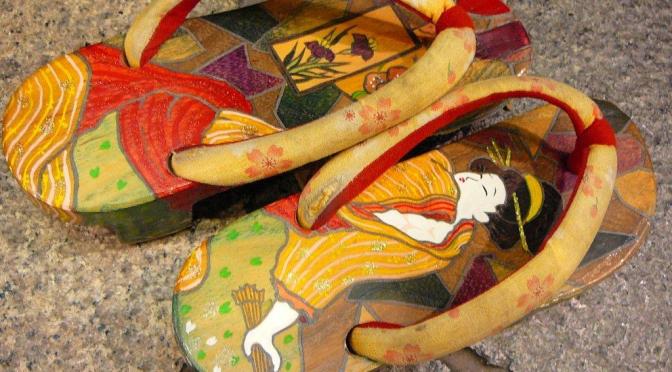
Walking to the Izakaya the Japanese Way: Geta/Japanese Clogs

Not so long ago, the sound of wooden clogs (geta/下駄 in Japanese) could still be heard at any time of the day and night in any season in cities as well as in the countryside.
This is still mentioned as one of the sounds that older Japanese miss most in modern life. A traditional saying in Japanese says that “You do not know until you have worn geta.” meaning that you cannot tell the results until the game is over.
Chefs were wearing them at work inside izakayas and sushi restaurants. Now they wear graceless white vinyl boots.
Interestingly enough, by ignoring geta in favor of Western footwear, the Japanese are not doing a favour to their own health. Instead of being constricted inside shoes with the consequent skin problems during the rainy season and sweaty socks to wear with them, geta allow free movement of the feet in the most natural environment. Contrary to belief, walking with the skin in direct contact with a wooden or lacquered surface does keep the feet at a comfortable temperature, even in the snow.
Moreover, good Japanese-made geta cost an average of 5~6,000 yen (50~60 US dollars), which make them cheaper and far more durable than Western shoes! They can be easily worn day in day out for up to 10 years according to traditional makers in Shizuoka Prefecture!
The great majority of modern geta are made abroad, especially in China these days but traditional manufacture still survives in Japan.
The City of Fukuyama in Hiroshima Prefecture produces 60% of the national output. Hida City in Oita Prefecture is also a major producer.
Traditional and high quality geta are especially made in Fukushima, Nagano, Niigata, Akita and Shizuoka Prefectures.

Geta are sometimes called wooden clogs in English because of their resemblance wit clogs and flip-flops. One could describe them as a kind of elevated wooden base held onto the foot with a fabric thong to keep well above the ground. They are worn with traditional Japanese clothing such as kimono or yukata but (in Japan) also with Western clothing during the summer months. One can still see people wearing them in rain or snow to keep the feet dry, dur to their extra height and impermeability compared to other shoes such as zori.
There are several styles of geta. The most familiar style in the West consists of unfinished wooden board called a dai (台, stand) that the the foot is set upon, with a cloth thong (鼻緒, hanao) that passes between the big toe and second toe. Although there is no need to wear socks, apprentice geisha (also called “maiko”) wear their special geta with tabi (Japanese socks) to accommodate the hanao.

Ladies will often add a protective cap called tsumakawa (爪掛) to protect their toes from the rain or mud in inclement weather.
The supporting pieces below the base board, called teeth (歯, ha), are also made of wood. Cheap clogs are made with cedar wood (杉, sugi), whereas high-quality geta are made of very light-weight paulownia (桐, kiri) imported from Northern Japan.
The teeth are usually made separately and fixed to the base board later (Funageta/船下駄), whereas more valuable geta will be carved out of a single block called (Okaku/大角).
Although great craftsmen are becoming scarce (there are only five recognized in Shizuoka Prefecture in spite of their fame), geta can and usually are suggested to be made on order, so as to perfectly “fit the feet” of its wearer.
Such footwear is becoming increasingly popular abroad where more and more people have recognized not only their practical, health and ecological values, but also for their decorative and fashion merits.

The dai may vary in shape: oval and narow for ladies to rectangular and wide for men as well as in color: natural (harigeta/張下駄), lacquered (nurigeta/塗り下駄) or stained.
The teeth of any geta may have harder wood drilled into the bottom to avoid splitting, and the soles of modern clogs of the teeth may have rubber soles glued to them.
The hanao can be wide and padded, or narrow and hard, and it can be made with many fabrics Printed cotton with traditional Japanese motifs is popular. Inside the hanao is a cord (recently synthetic, but traditionally hemp) which is knotted in a special way to the three holes of the dai. The hanao are replaceable, although breaking the thong of one’s geta is considered very unlucky!
Maiko in Kyoto wear distinctive tall geta called okobo. Also very young girls wear “okobo”, also called “pokkuri” and “koppori”, that have a small bell inside a cavity in the thick “sole”/dai. These geta have no teeth but are formed of one piece of wood. They are carved in such a way as to accommodate for walking.
Japanese professional sumo wrestlers in the lowest wo divisions of Jonokuchi and Jonidan must wear geat with their yukata at all times!

Various types of geta for the true collectors! (this list is far from exhaustive!):
-Sokugeta/足駄: real antiques as these were worn between the Heian Era and Edo Era! They became the symbolic footwear of students in meiji Era
-Yama Geta/山下駄: Square mountain Clogs made of paulownia wood and worn at the beginning of Edo Era. When made with cedar pine wood, they are called Yoshiwara geta/吉原下駄 as revellers in the Yaoshiwara Distritc used them on rainy days.
-Pokkuri Geta/ぽっくり下駄 worn by maiko, geisha and young girls, generally higher and decorated with golden motifs.
-Robou/露卯, Yanagi Geta柳下駄 worn in the early Edo Era.
-Uma Geta/馬下駄, square and made of cedar pine wood. “Horse Clogs”, called so because they sound like horse’s hooves on paved streets.
-Koma Geta/駒下駄, most common all-weather clogs until before the Meiji Era.
-Kiri Geta/桐下駄, high-quality expensive clogs made of paulownia wood. Originally finished with black lacquer.
-Odawara Geta/小田原下駄, very popular among harbor workers and fishermen in the 18th Century in spite of their high price.
-Ippon Geta/一本下駄 or Tengu Geta/天狗下駄, a clog with only one ha/歯/”tooth”. Both worn by kids and adults.
-Taka Geta/高下駄, very high clogs
-Bankara/バンカラ/Narrow clogs with high teeth, popular with older time students.

Recommended manufacture/display center:
Suruga Nuri Geta (駿河塗下駄) (designated by the Shizuoka Prefecture Government)
420-0047, Shizuoka City, Aoi Ku, Seikancho, 9-22
Tel. & fax: 054-253-4917
Homepage: http://www.shizuoka-kougei.jp/009.html (Japanese)

RECOMMENDED RELATED WEBSITES

So Good Sushi Restaurant in Nice France
Navigating Nagoya by Paige, Shop with Intent by Debbie, BULA KANA in Fiji, Kraemer’s Culinary blog by Frank Kraemer in New York,Tokyo Food File by Robbie Swinnerton, Green Tea Club by Satoshi Nihonyanagi in Shizuoka!, Mind Some by Tina in Taiwan, Le Manger by Camille Oger (French), The Indian Tourist, Masala Herb by Helene Dsouza in Goa, India, Mummy I Can Cook! by Shu Han in London, Pie
rre.Cuisine
, Francescannotwrite, My White Kitchen, Foodhoe, Chucks Eats, Things that Fizz & Stuff, Five Euro Food by Charles,Red Shallot Kitchen by Priscilla,With a Glass, Nami | Just One Cookbook, Peach Farm Studio, Clumsyfingers by Xethia, PepperBento, Hapabento, Kitchen Cow, Lunch In A Box, Susan at Arkonlite, Vegan Lunch Box; Tokyo Tom Baker, Daily Food Porn/Osaka, Only Nature Food Porn, Happy Little Bento, J-Mama’s Kitchen, Cook, Eat, Play, Repeat, Bento Lunch Blog (German), Adventures In Bento, Anna The Red’s Bento Factory, Ohayo Bento,

Must-see tasting websites:

-Sake: Ichi For The Michi by Rebekah Wilson-Lye in Tokyo, Tokyo Through The Drinking Glass, Tokyo Foodcast, Urban Sake, Sake World
-Wine: Palate To Pen, Warren Bobrow, Cellar Tours, Ancient Fire Wines Blog
-Beer: Another Pint, Please!, Beering In Good Mind: All about Craft Beer in Kansai by Nevitt Reagan!
ABRACADABREW, Magical Craftbeer from Japan
-Whisky: Nonjatta: All about whisky in Japan by Stefan Van Eycken
-Japanese Pottery to enjoy your favourite drinks: Yellin Yakimono Gallery

Non gastronomy must-see sites by Shizuoka Residents

HIGHOCTANE/HAIOKU by Nick Itoh in Shizuoka City

The Rugby World Cup is coming to Shizuoka!

We are barely a year left before the coming of the Rugby World to Japan and Shizuoka Prefecture is feverishly gearing itself for it with a new sense of responsibility!
After all, Ecopa Stadium in Fukuroi City, Shizuoka Prefecture, will be the venue for no less than 4 games, the third busiest in all Japan!
The first game will provide a true gem as it will feature Japan against the European Champions, Ireland!
Moreover, we shall be offered the great chance to see major teams in the names of South Africa and Australia from the Southern Hemisphere, Scotland and Italy from the VI Nations Tournament and some truly “exotic” teams represented by Georgia and newcomers, Russia!

Ecopa Stadium was chosen as a major venue for many reasons:
The Stadium with a capacity of over 50,000 was built for the Soccer World Cup and needs little improvements as it is used regularly for major events.
Shizuoka Prefecture is the home of Yamaha Jubilo (the rugby club, not the soccer club which belongs to the same company and is based in the same area), a powerful member (Japan Champions once) of the Japan Rugby Top League.
The neighboring Shinkansen Stations in Kakegawa City, Shizuoka City and Hamamatsu City.
The local International Airport, Shizuoka Fuji Airport in Shimada City.

Now, games will kick off early in the afternoon or early evenings, meaning that a lot of people will have to stay overnight in Shizuoka Prefecture!
What better opportunity can it be to introduce all these visitors, tourists and guests to our Prefecture, to its tourism and to its superior gastronomy?

Rugby fans all over the world are a hungry and thirsty lot! Not only before and during the game, but mainly during the “third half time” when any rugby player or fan worth his name spends as much time as possible socializing with the opponents of the day for some great talks and exchanges. Accordingly, Fukuroi City in particular should seriously think of cooperating with local producers and brewers to keep such a crowd happy for as long as possible not only during the game but after, thus encouraging all these welcome visitors to at least stay overnight and enjoy Shizuoka’s famed gastronomy! To start with, food and drink stands should be erected around the Stadium itself where there is enough space for such an enterprise and bring a great profit to the local farmers, brewers, food companies and local restaurants/izakayas!
The city should also seriously think of providing extra accommodation and services to all these Japanese and overseas fans! One solution would be to invite and encourage local farmers to provide farmhouse stays as the majority of foreign rugby fans hail from the “country” and certainly prefer the rural pleasures to overcrowded and senseless cities!

Food for thought, if I may allow myself this corny comment!

Ecopa Stadium 2019 Rugby World Cup Schedule
Saturday, September 28th (14th game), Group A, Japan vs Ireland, kick off at 16:15
Friday, October 4th, (23rd game), Group B, South Africa vs Italy, kick off at 18:45
Wednesday, October 9th, (31st game), Group A, Scotland vs Russia, kickoff at 16:15
Friday October 11th, (33rd game), Group D, Australia vs Georgia, kick off at 19:15

RECOMMENDED RELATED WEBSITES

So Good Sushi Restaurant in Nice France
Navigating Nagoya by Paige, Shop with Intent by Debbie, BULA KANA in Fiji, Kraemer’s Culinary blog by Frank Kraemer in New York,Tokyo Food File by Robbie Swinnerton, Green Tea Club by Satoshi Nihonyanagi in Shizuoka!, Mind Some by Tina in Taiwan, Le Manger by Camille Oger (French), The Indian Tourist, Masala Herb by Helene Dsouza in Goa, India, Mummy I Can Cook! by Shu Han in London, Pie
rre.Cuisine
, Francescannotwrite, My White Kitchen, Foodhoe, Chucks Eats, Things that Fizz & Stuff, Five Euro Food by Charles,Red Shallot Kitchen by Priscilla,With a Glass, Nami | Just One Cookbook, Peach Farm Studio, Clumsyfingers by Xethia, PepperBento, Hapabento, Kitchen Cow, Lunch In A Box, Susan at Arkonlite, Vegan Lunch Box; Tokyo Tom Baker, Daily Food Porn/Osaka, Only Nature Food Porn, Happy Little Bento, J-Mama’s Kitchen, Cook, Eat, Play, Repeat, Bento Lunch Blog (German), Adventures In Bento, Anna The Red’s Bento Factory, Ohayo Bento,

Must-see tasting websites:

-Sake: Ichi For The Michi by Rebekah Wilson-Lye in Tokyo, Tokyo Through The Drinking Glass, Tokyo Foodcast, Urban Sake, Sake World
-Wine: Palate To Pen, Warren Bobrow, Cellar Tours, Ancient Fire Wines Blog
-Beer: Another Pint, Please!, Beering In Good Mind: All about Craft Beer in Kansai by Nevitt Reagan!
ABRACADABREW, Magical Craftbeer from Japan
-Whisky: Nonjatta: All about whisky in Japan by Stefan Van Eycken
-Japanese Pottery to enjoy your favourite drinks: Yellin Yakimono Gallery

Non gastronomy must-see sites by Shizuoka Residents

Shizuoka Cycling Gourmet Ride 1: Shimada JR Station North Exit Area

Cycling has many advantages when searching nice places both on and off the beaten tracks!
You can stop anywhere, any time while moving at an easy pace faster than on foot and with much less strain. Moreover it is a very healthy way to eliminate the extra calories you have been enjoying on the way!
Moreover, cycling is a joy in Shizuoka Prefecture thanks to its mild climate allowing for long sorties any time of the year!
Shimada City is a location rapidly gaining recognition, what with the nearby international airport and the ever increasing influx of tourists, so shall we start by getting off or meeting at the north exit of Shimada JR Station!

SN3O0124

B Cafe is a nice little cafe cum bar very close to the station but along a side street away from the traffic.
The cakes there are all made on site and although food generally is yummy this is my favorite spot for a quiet drip coffee and one of those succulent cheese cakes!

427–0022 Shimada City, Hontori, 1-9-10
Tel.: 0547-35-6538
Opening hours: 10:00 am~~
Closed on Wednesdays, 1st & 3rd Sundays
Entirely non-smoking!
Check the opening hours and other offerings on AYANO ASAOKA on FACEBOOK!

SN3O0449
SN3O0449

Tonbo/とんぼ is a real find when it comes to takoyaki/octopus dumplings, a favorite among tourists and Japanese alike!
This is the genuine article in Osaka-style fashion cooked in front of your very eyes!
And don’t forget the succulent hot plate cooked okonmiyaki, soba Modan and pork egg roll, the whole accompanied by a local Oomuraya Brewery sake!

427-0029 Shimada City, Hinode-Cho, 1-1 ( few minutes’ walk straight from Shimada JR Station North exit)
Tel.: 0547-35-7635
Opening hours: 17:00~22:00
Closed on Sundays and national Holidays.
Orders on the phone and take-out OK!

SN3O3609

SETSUGEKKA/雪月花 is not only a way above average soba/buckwheat noodles restaurant but an establishment specializing in exquisite tempura, all at reasonable prices, served with rare sake from the neighboring oomuraya sake Brewery!
Come early as it tends to be full quickly!

Shimada City, Hontouri, 2-3-4
Tel.: 0547-35-5241
Opening hours: 11:30~14:30, 17:00~22:00
Closed on Monday and third Tuesday
HOMEPAGE (Japanese)
Entirely non-smoking for lunch!

hizuki-11

HIZUKI/ひづき for such a “country city” is just extravagant while very reasonably priced. A French/Japanese style Izakaya, it offers all the classic in a modern manner from juicy chicken karaage to butter-fried scallops and shrimps!
A place to take your “special one” to!

Chef/owner: Akimasa Ooishi/大石明昌さん
Shizuoka Prefecture, Shimada City, Hon Toori, 1 Chome, 9-19
Tel.: 0547-54-5860
Opening hours:17:30~23:30
Closed on Wednesdays

SAKURAI-12

OKONOMIYAKI SAKURAI/お好み焼桜井 is also another favorite both with locals and visitors for serving authentic Hiroshima-style okonomiyaki and this in enormous and reasonbly-priced portions! Take-outs ok!
Satisfaction guaranteed!

Shimada City, Ougi Cho, 11-14
Tel.: 0547-37-6777
Opening hours: 11:30~13:30, 16:30~20:30. 11:30~20:00 on Sundays
Closed on Wednesdays
Take-outs can be ordered on the phone
Parties welcome!

SN3O0573
SN3O0573

din/g.place is another cafe tucked away from the main street but definitely worth a visit, especially in the afternoon if you have a sweet tooth! Enormous dessert plates and fine coffee!

Shimada City, Hon Toori, 1-1-10, Miyanokomichi Passage
Tel.: 0547-35-5005
Opening hours: 11:00~18:00, 08:30~18:00 on week ends. 17:00~21:00 on reservation only (from 5 guests~)
Closed on Mondays
HOMEPAGE (Japanese)
FACEBOOK

SN3O0183

And don’t forget OOMURAYA BREWERY
Sakes internationally recognized and be always on the lookout for extravagant and rare nectars!

Oomuraya Brewery (Wakatake, Onigoroshi, Onna Nakase)
Shimada City, Hontoori, 1-1-8
tel.: 0547-37-3058

Now, this is only a fraction of a discovery, but I am sure you will a special pleasure adding to it!
Until then, good cycling and appetite!

RECOMMENDED RELATED WEBSITES

So Good Sushi Restaurant in Nice France
Navigating Nagoya by Paige, Shop with Intent by Debbie, BULA KANA in Fiji, Kraemer’s Culinary blog by Frank Kraemer in New York,Tokyo Food File by Robbie Swinnerton, Green Tea Club by Satoshi Nihonyanagi in Shizuoka!, Mind Some by Tina in Taiwan, Le Manger by Camille Oger (French), The Indian Tourist, Masala Herb by Helene Dsouza in Goa, India, Mummy I Can Cook! by Shu Han in London, Pie
rre.Cuisine
, Francescannotwrite, My White Kitchen, Foodhoe, Chucks Eats, Things that Fizz & Stuff, Five Euro Food by Charles,Red Shallot Kitchen by Priscilla,With a Glass, Nami | Just One Cookbook, Peach Farm Studio, Clumsyfingers by Xethia, PepperBento, Hapabento, Kitchen Cow, Lunch In A Box, Susan at Arkonlite, Vegan Lunch Box; Tokyo Tom Baker, Daily Food Porn/Osaka, Only Nature Food Porn, Happy Little Bento, J-Mama’s Kitchen, Cook, Eat, Play, Repeat, Bento Lunch Blog (German), Adventures In Bento, Anna The Red’s Bento Factory, Ohayo Bento,

Must-see tasting websites:

-Sake: Ichi For The Michi by Rebekah Wilson-Lye in Tokyo, Tokyo Through The Drinking Glass, Tokyo Foodcast, Urban Sake, Sake World
-Wine: Palate To Pen, Warren Bobrow, Cellar Tours, Ancient Fire Wines Blog
-Beer: Another Pint, Please!, Beering In Good Mind: All about Craft Beer in Kansai by Nevitt Reagan!
ABRACADABREW, Magical Craftbeer from Japan
-Whisky: Nonjatta: All about whisky in Japan by Stefan Van Eycken
-Japanese Pottery to enjoy your favourite drinks: Yellin Yakimono Gallery

Non gastronomy must-see sites by Shizuoka Residents

Sports, Health & Vegetables in Shizuoka With Mitchell Duke at Shimizu S-Pulse

Mitchell and Charlotte Duke

Mitchell Duke, who also played for the Australian National Football (Soccer) Team, is now in his 4th year at Shimizu S-Pulse Football Club in Shizuoka City, a member of the J1 League with a long tradition and history.
He gracefully agreed to an interview to answer questions and express his views on culinary diet and especially vegetables in a region which boasts the largest official number of varieties in all Japan.
Question: Dear Mitchell, thank you so much for sparing your time. First of all, what was your daily diet back in Australia before moving to Shizuoka City?
Mitchell Duke: Quite heavy, actually! As a typical Ozzie (Australian) it started right away with enormous breakfasts with eggs, meat, avocadoes, bread and what else. In comparison, Japanese breakfasts would amount to calories ingested in our comparatively lighter dinners. Lunches and dinners still included large amounts of carbohydrates, what with all the steaks and pasta!

Q: What has changed since you came to Japan?
MD: Everything! I immediately began in earnest to research more into nutrition to the point of taking a TFE course in nutrition. First of all, I cut out the red meat to shift to a pescarian (fish, especially white-fleshed fish) diet. I also came to bypass most dairies although I still eat eggs. And of course, I came to pay more attention to all vegetables of all kinds.

Q: Do you find it easy to maintain your new diet in Shizuoka (and Japan for that matter!)?
MD: Yes, indeed! There are enough restaurants (I do have to eat out, what with trips and inevitable socializing) with enough variety to allow me to choose food according to my priorities without much of a fuss. Truth to tell, my teammates often indulge in plenty of meat, especially at their favorite yakiniku restaurants. In such cases I keep to grilled vegetables and dig a lot into the kimuchi! LOL. One thing is sure: I keep my eyes and ears open for new venues and possibilities!

Q: Can you obtain your requirements when eating at the club facilities?
MD: no problem there! Meals are served on a buffet style basis which allows me plenty of options including heaps of vegetables and salads! The food there is not only plentiful, but definitely above average cafeteria!

Q: Where do you usually make your daily food shopping?
MD: So far I have used the local Max Value supermarket and other local shops, but I must admit that I probably need to investigate a bit further! The more options, the better! If you have any suggestions, I shall be the happier for it!

Q: Do you consider Shizuoka an easy place to follow your diet compared to the rest of Japan?
MD: Yes, I may say that Shizuoka is arguably the best place when it comes to satisfy my personal dietary requirements, especially when you consider that it is an endless discovery! When you choose to concentrate on vegetables, the variety offered here is nigh unbeatable! The neutral weather plays an important role when it comes to a yearlong search for the best vegetables!

Q: What are the main benefits from your present diet?
MD: First of all, weight control has become so much easier to attain. And I actually enjoy the whole experience. I haven’t been sick for a long time, and most importantly I do recover faster from fatigue or injuries inherent to my occupation! The few times I do have to ingest meat I always end up feeling sluggish the next day! A kind of food hangover!

Q: The last question: would you be kind enough to introduce one your favorite restaurants to our readers?
MD: Ristorante Massimo Italian Restaurant (89-1, Miho, Shimizu Ku, Shizuoka City. Tel.: 054-335-0030. http://www.geocities.jp/granmassimo/)!

-Dear Mitchell, thank you so much for sharinggyour time! It was a rare pleasure!
-You are most welcome, mate!

RECOMMENDED RELATED WEBSITES

So Good Sushi Restaurant in Nice France
Navigating Nagoya by Paige, Shop with Intent by Debbie, BULA KANA in Fiji, Kraemer’s Culinary blog by Frank Kraemer in New York,Tokyo Food File by Robbie Swinnerton, Green Tea Club by Satoshi Nihonyanagi in Shizuoka!, Mind Some by Tina in Taiwan, Le Manger by Camille Oger (French), The Indian Tourist, Masala Herb by Helene Dsouza in Goa, India, Mummy I Can Cook! by Shu Han in London, Pie
rre.Cuisine
, Francescannotwrite, My White Kitchen, Foodhoe, Chucks Eats, Things that Fizz & Stuff, Five Euro Food by Charles,Red Shallot Kitchen by Priscilla,With a Glass, Nami | Just One Cookbook, Peach Farm Studio, Clumsyfingers by Xethia, PepperBento, Hapabento, Kitchen Cow, Lunch In A Box, Susan at Arkonlite, Vegan Lunch Box; Tokyo Tom Baker, Daily Food Porn/Osaka, Only Nature Food Porn, Happy Little Bento, J-Mama’s Kitchen, Cook, Eat, Play, Repeat, Bento Lunch Blog (German), Adventures In Bento, Anna The Red’s Bento Factory, Ohayo Bento,

Must-see tasting websites:

-Sake: Ichi For The Michi by Rebekah Wilson-Lye in Tokyo, Tokyo Through The Drinking Glass, Tokyo Foodcast, Urban Sake, Sake World
-Wine: Palate To Pen, Warren Bobrow, Cellar Tours, Ancient Fire Wines Blog
-Beer: Another Pint, Please!, Beering In Good Mind: All about Craft Beer in Kansai by Nevitt Reagan!
ABRACADABREW, Magical Craftbeer from Japan
-Whisky: Nonjatta: All about whisky in Japan by Stefan Van Eycken
-Japanese Pottery to enjoy your favourite drinks: Yellin Yakimono Gallery

Non gastronomy must-see sites by Shizuoka Residents

Vegetarian (& Vegan) Sushi: It exists in Shizuoka!

“But it is all fish!”

Well, Shizuoka City and Prefecture, being the region in Japan where the largest number of vegetable varieties is grown it is almost too easy to reassure our vegetarian (& vegan, and naturally omnivorous) friends.

With a little research you will discover more than one chef willing to tackle the challenge of a client eager to eat sushi but not fish or meat. I have introduced one of them at end of this article, but I am sure your japanese friends will come up with more!

For a start let me introduce vegetarian ( I am not but I love vegetables!) let me introduce some of the possibilities I have tasted myself!

Daikon rolls!

These rolls were made with thin wide strips of Daikon  quickly marinated in lemon water to be used instead of dry nori/seaweed.
The daikon was rolled around  sushi rice (shari) with trefoil stems, umeboshi/pickled Japanese plum meat (sorry for the unintended joke!) and shiso/perilla leaves!

The three nigiri coming with the rolls are:

Buckwheat sprouts/Hime Soba Me/姫蕎麦芽 Nigiri!

Thin leek sprouts/Me Negi/芽葱 Nigiri!

Trefoil/Mitsuba/三つ葉 Nigiri!

SUSHIK-09-08-31-12

Another assortment of vegetarian sushi nigiri!

SUSHIK-09-08-31-13

Himenegi/young thin leeks reminiscent of French ciboulette.

SUSHIK-09-08-31-14

Kaiwaredaikon/Japanese radish sprout, lightly boiled and topped with some umeboshi/Japanese pickled plum.

SUSHIK-09-08-31-15

Betarazuke/daikon lightly pickled in sweet vinegar. In this case served with a piece of shiso/perilla leaf between the shari/sushi rice and the neta/topping. Some lime skin was grated o top making for a sweet sophisticated taste!

SUSHIK-09-08-31-16

Mitsuba/Trefoil: the stems and leaves were slightly boiled and separated, making for a bicolour combination accentuated by finely cut kyuri/cucumber!

SN3B0158

Let us continue with another assortment!
Can you guess the vegetables?

SN3O2213

Another Himenegi/芽葱young thin leek topped with umeboshi!

SN3O2198

Slightly seared green peppers nigiri!

SN3O0019

My favorite natto/fermented beans roll!
Natto, Ume, Shiso Maki/梅紫蘇納豆巻! fermented beans, pickled Japanese plum and perilla roll!

And for dessert: Kampyou Maki?かんぴょうまき/Dry gourd shavings (recooked) Roll!

Of course this is only a start!
Depending on the season you could ask for seared mushrooms, pickled eggplants, cooked burdock root, boiled spinach, boiled rape seed flower, green or violet mizuna, salad celery, pickled radishes, etc. And for not so strict vegetarians, tamagoyaki/卵焼き?Japanese omelet!

A great time to have, surely!

Recommended Sushi Restaurant:
SUSHI SHOKUNIN BIRUKAWA/鮨職人 びる川

420-0037 Shizuoka City, Aoi Ku, Hitoyado-Cho, 2-5-8
Tel.: 054-251-9787
Opening hours: 17:00~23:00
Closed on Wednesdays
Reservations highly recommended
Credit cards OK
Google Map

RECOMMENDED RELATED WEBSITES

So Good Sushi Restaurant in Nice France
Navigating Nagoya by Paige, Shop with Intent by Debbie, BULA KANA in Fiji, Kraemer’s Culinary blog by Frank Kraemer in New York,Tokyo Food File by Robbie Swinnerton, Green Tea Club by Satoshi Nihonyanagi in Shizuoka!, Mind Some by Tina in Taiwan, Le Manger by Camille Oger (French), The Indian Tourist, Masala Herb by Helene Dsouza in Goa, India, Mummy I Can Cook! by Shu Han in London, Pie
rre.Cuisine
, Francescannotwrite, My White Kitchen, Foodhoe, Chucks Eats, Things that Fizz & Stuff, Five Euro Food by Charles,Red Shallot Kitchen by Priscilla,With a Glass, Nami | Just One Cookbook, Peach Farm Studio, Clumsyfingers by Xethia, PepperBento, Hapabento, Kitchen Cow, Lunch In A Box, Susan at Arkonlite, Vegan Lunch Box; Tokyo Tom Baker, Daily Food Porn/Osaka, Only Nature Food Porn, Happy Little Bento, J-Mama’s Kitchen, Cook, Eat, Play, Repeat, Bento Lunch Blog (German), Adventures In Bento, Anna The Red’s Bento Factory, Ohayo Bento,

Must-see tasting websites:

-Sake: Ichi For The Michi by Rebekah Wilson-Lye in Tokyo, Tokyo Through The Drinking Glass, Tokyo Foodcast, Urban Sake, Sake World
-Wine: Palate To Pen, Warren Bobrow, Cellar Tours, Ancient Fire Wines Blog
-Beer: Another Pint, Please!, Beering In Good Mind: All about Craft Beer in Kansai by Nevitt Reagan!
ABRACADABREW, Magical Craftbeer from Japan
-Whisky: Nonjatta: All about whisky in Japan by Stefan Van Eycken
-Japanese Pottery to enjoy your favourite drinks: Yellin Yakimono Gallery

Non gastronomy must-see sites by Shizuoka Residents

Seaweed: The Vegetable of the Oceans!

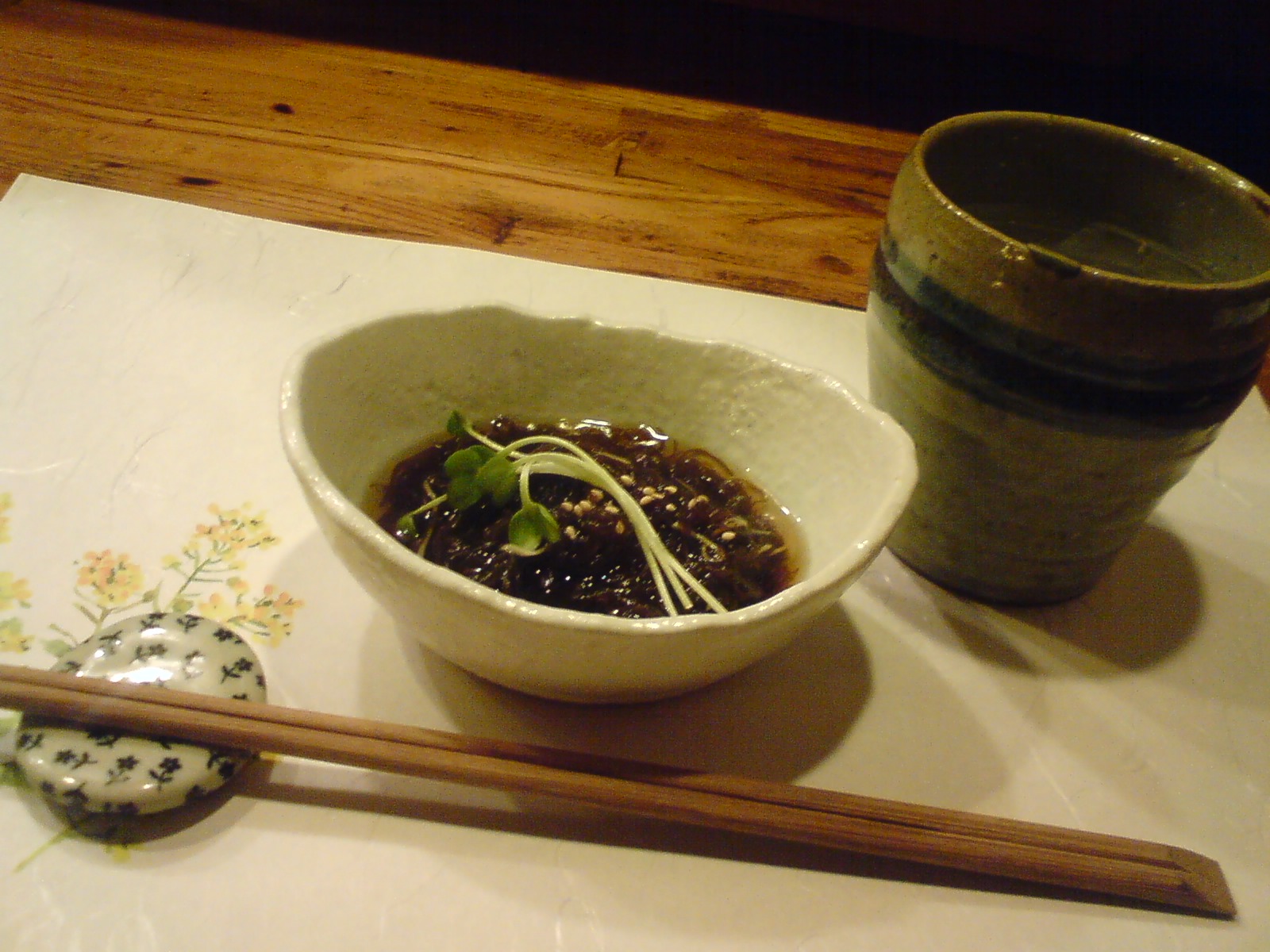
Mozuku in amazu/sweet vinegar as served at Yasaitei, Shizuoka City.

Seaweed or algae have been used for eons by humans, but have only been recently rediscovered as a food of their own.
Seaweeds are consumed by coastal people, particularly in East Asia, e.g., Japan, China, Korea, Taiwan, Thailand, and Vietnam, but also in Indonesia, Belize, Peru, the Canadian Maritimes, Scandinavia, Ireland, Wales, Philippines, and Scotland.
It is rich in calcium and magnesium and seaweed noodles can be cooked into pancit canton, pancit luglug, spaghetti or carbonara.

Nori

In Asia, Zicai (紫菜) (in China), gim (in Korea) and nori (in Japan) are sheets of dried Porphyra used in soups or to wrap sushi. Chondrus crispus (commonly known as Irish moss or carrageenan moss) is another red alga used in producing various food additives, along with Kappaphycus and various gigartinoid seaweeds. Porphyra is a red alga used in Wales to make laver. Laverbread, made from oats and the laver, is a popular dish there. Affectionately called “Dulce” in northern Belize, seaweeds are mixed with milk, nutmeg, cinnamon, and vanilla to make a common beverage.

Seaweeds are also harvested or cultivated for the extraction of alginate, agar and carrageenan, gelatinous substances collectively known as hydrocolloids or phycocolloids. Hydrocolloids have attained commercial significance as food additives. The food industry exploits their gelling, water-retention, emulsifying and other physical properties. Agar is used in foods such as confectionery, meat and poultry products, desserts and beverages and moulded foods. Carrageenan is used in salad dressings and sauces, dietetic foods, and as a preservative in meat and fish products, dairy items and baked goods.

Alginates are used in wound dressings, and production of dental molds. In microbiology research, agar is extensively used as culture medium.

Seaweed is a source of iodine, necessary for thyroid function and to prevent goitre.

Seaweed extract is used in some diet pills. Other seaweed pills exploit the same effect as gastric banding, expanding in the stomach to make the body feel more full.

Konbu Tsukudani, a popular Japanese seaweed dish.

The Japanese divide their edible seaweed into three main groups:
BROWN ALGAE:

-Konbu/昆布, or Laminariaceae Bory (Latin), comprises many varieties, some of them regional: Makonbu or Saccharina japonica(真昆布), Onikonbu or Laminaria diabolica(羅臼昆布), Rishiri Konbu or Laminaria ochotensis(利尻昆布), Hosome Konbu or Laminaria religiosa(細目昆布), Hitaka or Mitsuishi Konbu or Laminaria angustata(日高昆布、三石昆布), Naga or Hamanaka Konbu or Laminaria longissima(長昆布、浜中昆布), and Kagome or Kjellmaniella crassifolia(籠目昆布).

-Hijiki or hiziki (ヒジキ, 鹿尾菜 or 羊栖菜, hijiki) (Sargassum fusiforme, or Hizikia fusiformis) is a brown sea vegetable growing wild on rocky coastlines around Japan, Korea, and China. Its two names mean deer-tail grass and sheep-nest grass respectively.

-Hibatama or Fucus, a genus of brown alga in the Class Phaeophyceae to be found in the intertidal zones of rocky seashores almost everywhere in the world.

-Hondawara or ホンダワラ(馬尾藻、神馬藻 (Sargassum fulvellum)

-Mozuku, or Cladosiphon okamuranus (水雲; 藻付; 海蘊; 海雲) , a type of edible seaweed in the genus Cladosiphon, naturally found in Okinawa, Japan. Most of the mozuku now is farmed by locals, and sold to processing factories. The main use of mozuku is as food, and as source of one type of sulfated polysaccharide called Fucoidan to be used in cancer treatment aid health supplements.

-Wakame (ワカメ), Undaria pinnatifida, a sea vegetable, or edible seaweed. In Japan it is most widely used in miso soup.

Yes, these violet and green algae are edible!

VIOLET ALGAE:

-Asakusa Nori, or アサクサノリ(浅草海苔 (Porphyra tenera).

-Tengusa, which gives agar agar, a gelatinous substance. Historically and in a modern context, it is chiefly used as an ingredient in desserts throughout Japan, but also as solid jelly used as decoration in salads and others.

GREEN ALGAE:

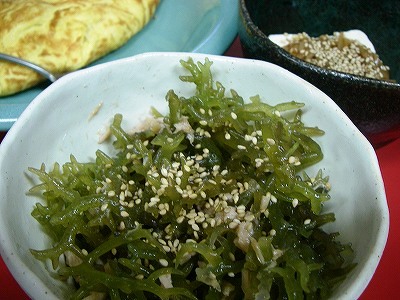
-Aosa or sea lettuce comprising comprise the genus Ulva, a group of edible green algae that are widely distributed along the coasts of the world’s oceans.

-Aonori (青海苔 or アオノリ, “blue seaweed” or “green seaweed”), also known as green laver, a type of edible green seaweed, including species from the genera Monostroma and Enteromorpha of Ulvaceae. It is commercially cultivated in some bay areas in Japan, such as Ise Bay. It contains rich minerals such as calcium, magnesium, lithium, vitamins, and amino acids such as methionine.

-Umibudou, or sea grapes, a delicacy of its own!

MARKET AVAILABILITY IN JAPAN:

In Japan it is interesting to note you can easily buy seaweed in paste form:

Konbu

Aosa

Hijiki

Next here are some pics to help you discover/recognize edible varieties in the markets:

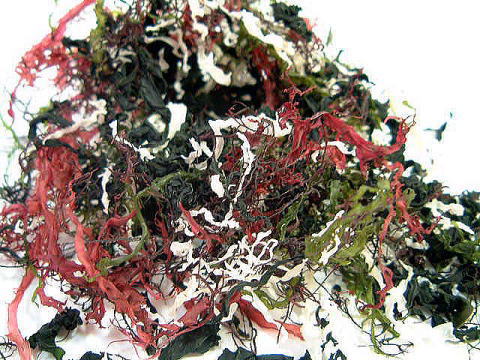
Akamoku

Makusa

They often come as a mixture!

Red Algae

JAPANESE GASTRONOMY:

Here are some examples of the use of seaweed in Japanese gastronomy that can be expanded and inspired from wherever in the world you are, you being vegan, vegetarian or omnivore!
I have reduced the size of the pictures. Click on them to enlarge and copy them!

Agar or Crystal Kaiso/Crystal Seaweed!

The same in a salad!

An example of seaweed salad with wakame and agar.

Another seaweed salad with samples harvested in Noto Peninsula, Ishikawa Prefecture!

An Okinawa variety called somen nori!

Another local variety called Tsunotama/Horns and Balls!

Wakame appetizer!

Wakame Noodles!

Another Wakame salad!

Wakame sticks cooked with miso paste!

Wakame and Miso Paste mix from Kanzanji, Shizuoka Prefecture!

Wakame and Miso Bread!

Wakame Miso Soup!

Wakame, tofu and miso Soup!

A bowl of freshly steamed rice with seaweed paste!

Soba/Buckwheat noodles with nori and green leaf vegetables!

Seaweed, trefoil and ground sesame seeds salad!

The best way to eat rice?

RECOMMENDED RELATED WEBSITES

So Good Sushi Restaurant in Nice France
Navigating Nagoya by Paige, Shop with Intent by Debbie, BULA KANA in Fiji, Kraemer’s Culinary blog by Frank Kraemer in New York,Tokyo Food File by Robbie Swinnerton, Green Tea Club by Satoshi Nihonyanagi in Shizuoka!, Mind Some by Tina in Taiwan, Le Manger by Camille Oger (French), The Indian Tourist, Masala Herb by Helene Dsouza in Goa, India, Mummy I Can Cook! by Shu Han in London, Pie
rre.Cuisine
, Francescannotwrite, My White Kitchen, Foodhoe, Chucks Eats, Things that Fizz & Stuff, Five Euro Food by Charles,Red Shallot Kitchen by Priscilla,With a Glass, Nami | Just One Cookbook, Peach Farm Studio, Clumsyfingers by Xethia, PepperBento, Hapabento, Kitchen Cow, Lunch In A Box, Susan at Arkonlite, Vegan Lunch Box; Tokyo Tom Baker, Daily Food Porn/Osaka, Only Nature Food Porn, Happy Little Bento, J-Mama’s Kitchen, Cook, Eat, Play, Repeat, Bento Lunch Blog (German), Adventures In Bento, Anna The Red’s Bento Factory, Ohayo Bento,

Must-see tasting websites:

-Sake: Ichi For The Michi by Rebekah Wilson-Lye in Tokyo, Tokyo Through The Drinking Glass, Tokyo Foodcast, Urban Sake, Sake World
-Wine: Palate To Pen, Warren Bobrow, Cellar Tours, Ancient Fire Wines Blog
-Beer: Another Pint, Please!, Beering In Good Mind: All about Craft Beer in Kansai by Nevitt Reagan!
ABRACADABREW, Magical Craftbeer from Japan
-Whisky: Nonjatta: All about whisky in Japan by Stefan Van Eycken
-Japanese Pottery to enjoy your favourite drinks: Yellin Yakimono Gallery

Non gastronomy must-see sites by Shizuoka Residents

Vegan & Vegetarian Sushi Bento

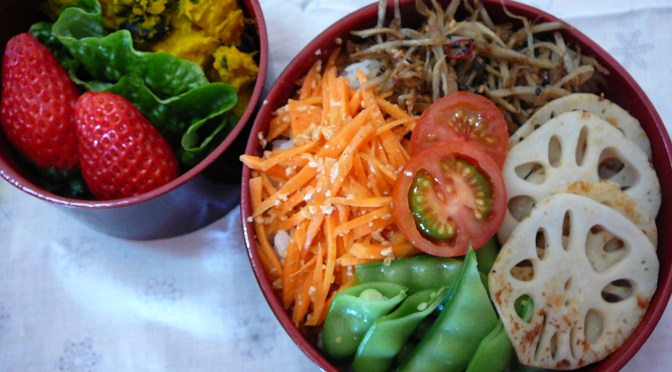
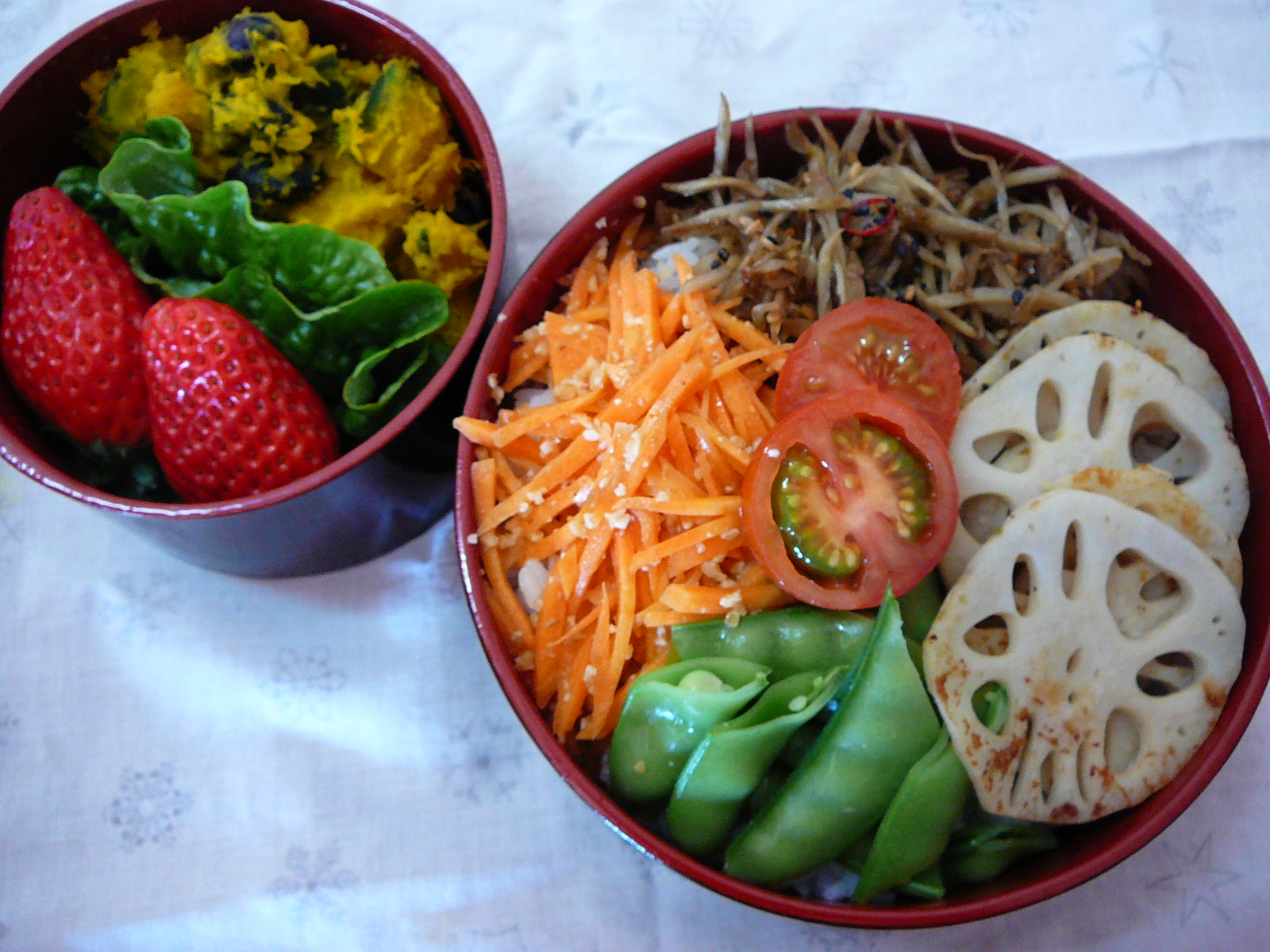
Although I’m not a vegetarian I’ve wanted for a long time the Missus to concoct me an entirely vegetarian bento. Not only she complied, but she made it a sushi as well!

She first steamed the rice and prepared it as sushi rice (blending it a little salt, sugar and rice vinegar) before mixing plenty of sesame seeds in.
She then proceeded to cover the lot with vegetables.

She fried sliced lotus roots in spices for a hot addition to the plain boiled green peas in their pods (“snap endo” in Japanese).

Then, keeping in mind the color arrangement and the whole balance, she first added a shredded carrot salad seasoned with gomadare/sesame dressing and crushed peanuts, and next gobo kinpira/stir-fried spicy burdock root (seasoned with chili pepper and black sesame seeds). She finally topped the whole with some sliced plum tomato.

For salad and dessert she prepared a vegan/vegetarian kabocha and black beans salad to which she added fresh lettuce and Akihime strawberries from Shizuoka!

I don’t plan to be a vegan or vegetarian but my sometimes tired body can really appreciate the cuisine now and then! At least this could give good ideas to my vegetarian/vegan friends!

RECOMMENDED RELATED WEBSITES

So Good Sushi Restaurant in Nice France
Navigating Nagoya by Paige, Shop with Intent by Debbie, BULA KANA in Fiji, Kraemer’s Culinary blog by Frank Kraemer in New York,Tokyo Food File by Robbie Swinnerton, Green Tea Club by Satoshi Nihonyanagi in Shizuoka!, Mind Some by Tina in Taiwan, Le Manger by Camille Oger (French), The Indian Tourist, Masala Herb by Helene Dsouza in Goa, India, Mummy I Can Cook! by Shu Han in London, Pie
rre.Cuisine
, Francescannotwrite, My White Kitchen, Foodhoe, Chucks Eats, Things that Fizz & Stuff, Five Euro Food by Charles,Red Shallot Kitchen by Priscilla,With a Glass, Nami | Just One Cookbook, Peach Farm Studio, Clumsyfingers by Xethia, PepperBento, Hapabento, Kitchen Cow, Lunch In A Box, Susan at Arkonlite, Vegan Lunch Box; Tokyo Tom Baker, Daily Food Porn/Osaka, Only Nature Food Porn, Happy Little Bento, J-Mama’s Kitchen, Cook, Eat, Play, Repeat, Bento Lunch Blog (German), Adventures In Bento, Anna The Red’s Bento Factory, Ohayo Bento,

Must-see tasting websites:

-Sake: Ichi For The Michi by Rebekah Wilson-Lye in Tokyo, Tokyo Through The Drinking Glass, Tokyo Foodcast, Urban Sake, Sake World
-Wine: Palate To Pen, Warren Bobrow, Cellar Tours, Ancient Fire Wines Blog
-Beer: Another Pint, Please!, Beering In Good Mind: All about Craft Beer in Kansai by Nevitt Reagan!
ABRACADABREW, Magical Craftbeer from Japan
-Whisky: Nonjatta: All about whisky in Japan by Stefan Van Eycken
-Japanese Pottery to enjoy your favourite drinks: Yellin Yakimono Gallery

Non gastronomy must-see sites by Shizuoka Residents

Shizuoka Gastronomy on Manhole Covers!

SN3O5522

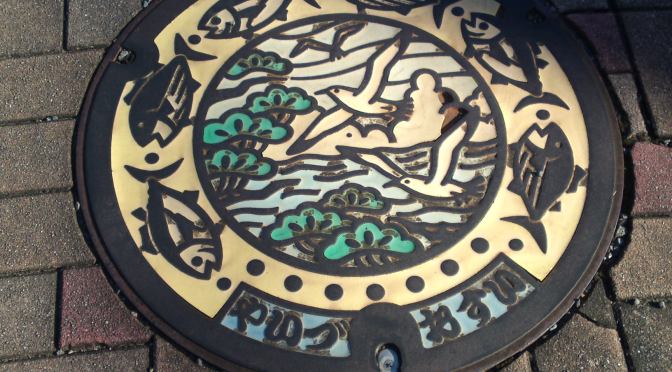
Yaizu City is the most famous Bonito/Katsuo fishing harbor city in Japan!

Japan is increasingly becoming known all over the world for its gastronomy and more recently for its unequaled manhole covers. Shizuoka prefecture is no exception when it comes to either, or even better, to a combination of the two!

Shizuoka Prefecture has a lot to offer when it comes to gastronomy and is certainly above all when it comes to variety, be it vegetables, fruit or meat when it comes to land and a bounty of seafood when it comes to sea!

SN3O5051

Yaizu City has no less than three different manhole covers depicting Katsuo/Bonito for the simple reason it is the most important fishing harbor in Japan as far as bonito is concerned!

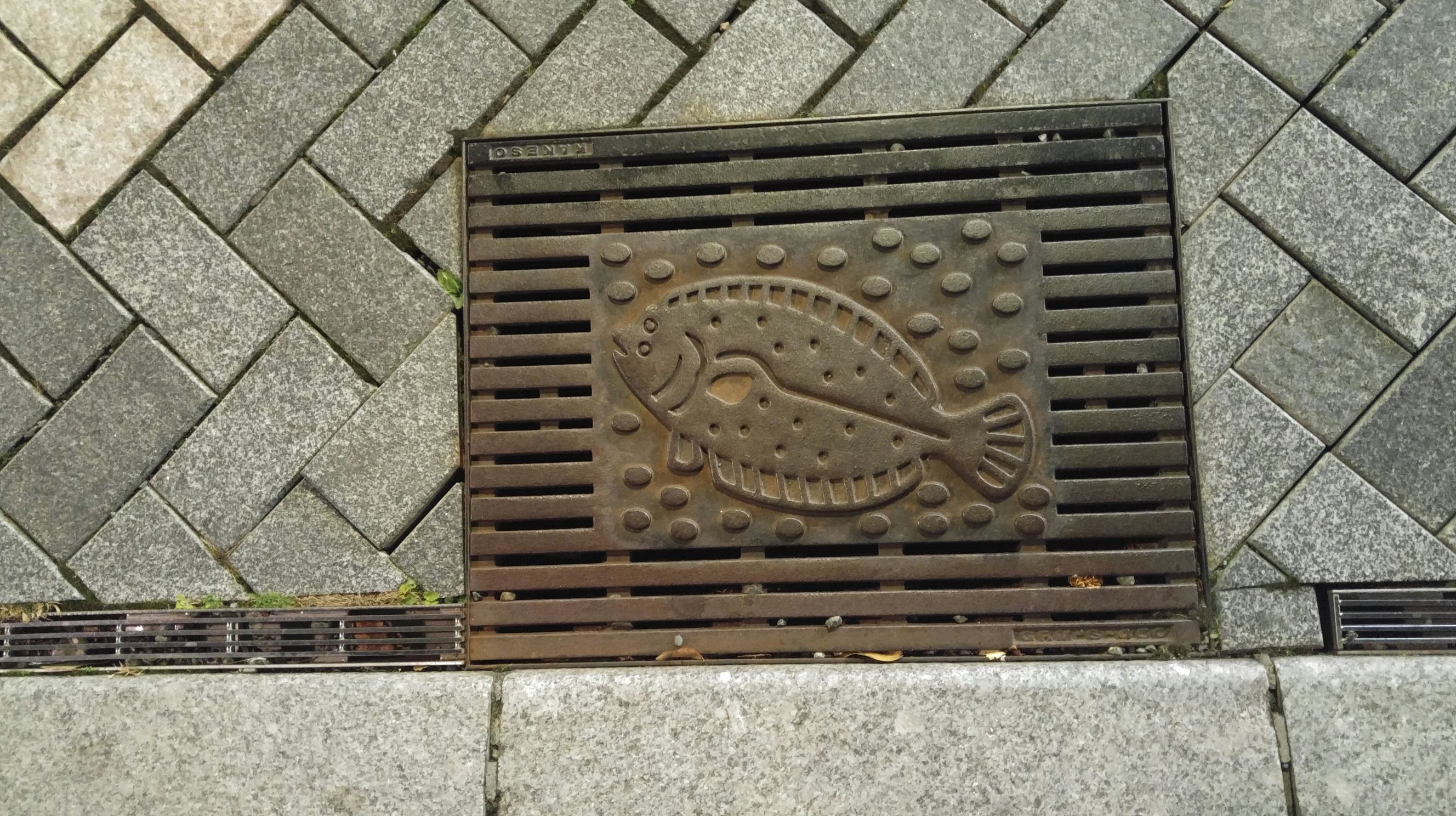
Hirame/Soles or Flounders in Hamamatsu City!

But when it comes to seafood, Yaizu City is only a portion of it all!
Come to Hamamatsu City for example. They managed to make a pun out of their own manhole covers! In Sakana, an area in downtown Hamamatsu City they have no less than four covers representing fish because “sakana” written with a different kanji/Japanese character means “fish”!

“Tara” or Cod!

Another “Hirame”/sole or Flounder!

And “Maguro”/Tuna!

Shall we continue with seafood?
Hatsushima Island is one of the few islands administered by Shizuoka Prefecture. It can be easily reached by ferry boat from Atami City.
It is celebrated for its “Iseebi”/Spiny lobster and “Sazae”/Turbo shell!

Izu Inatori fishing harbor in south west Izu Peninsula is celebrated all over Japan for its “Kinmedai”/Splendid Alfonsino!

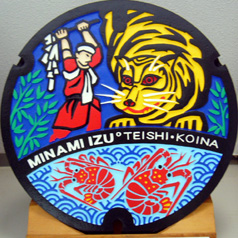
At the very tip of Izu Peninsula Minami Izu is also proud of its “Iseebi”?Spiny lobsters!

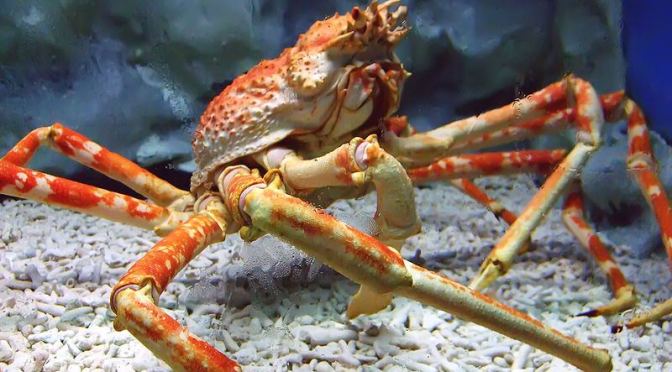
Heda, in North eastern Izu Peninsula, now part of Numazu City, is known for “Takahashigani”/Japanese Giant Crab, the largest crab in the World!

SN3O5096

And to conclude with seafoods one must visit Yui, Shimizu Ward, Shizuoka City, known all over japan for its “Sakuarebi”/Cherry Shrimps. Actually there two more tiny covers depicting this little gastronomic treasure!

It is about time to switch to land products, and one cannot overlook green tea! Introduced to Shizuoka Prefecture more than 800 years ago, we are still the biggest producer in Japan. Interestingly enough, covers depicting tea are to be found only (that is, for the present!) in Kikugawa City with two different types, one of them representing the “Cha Musume”/Tea leaves handpicking girl/lady!

Shizuoka Prefecture is also renown for its strawberries and one can find them on covers in Nirayama, Izu City, also famous for World Heritage Hansharo and its beautiful views of Mount Fuji!

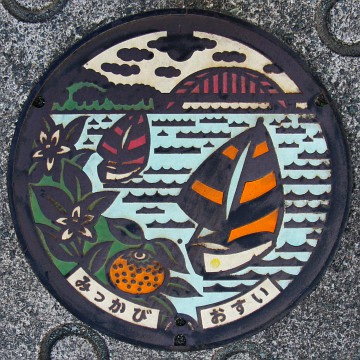
Hamamatsu City is not only famous for its fish, eels in particular, or oysters, but also for its oranges to be found in Mikkabi!

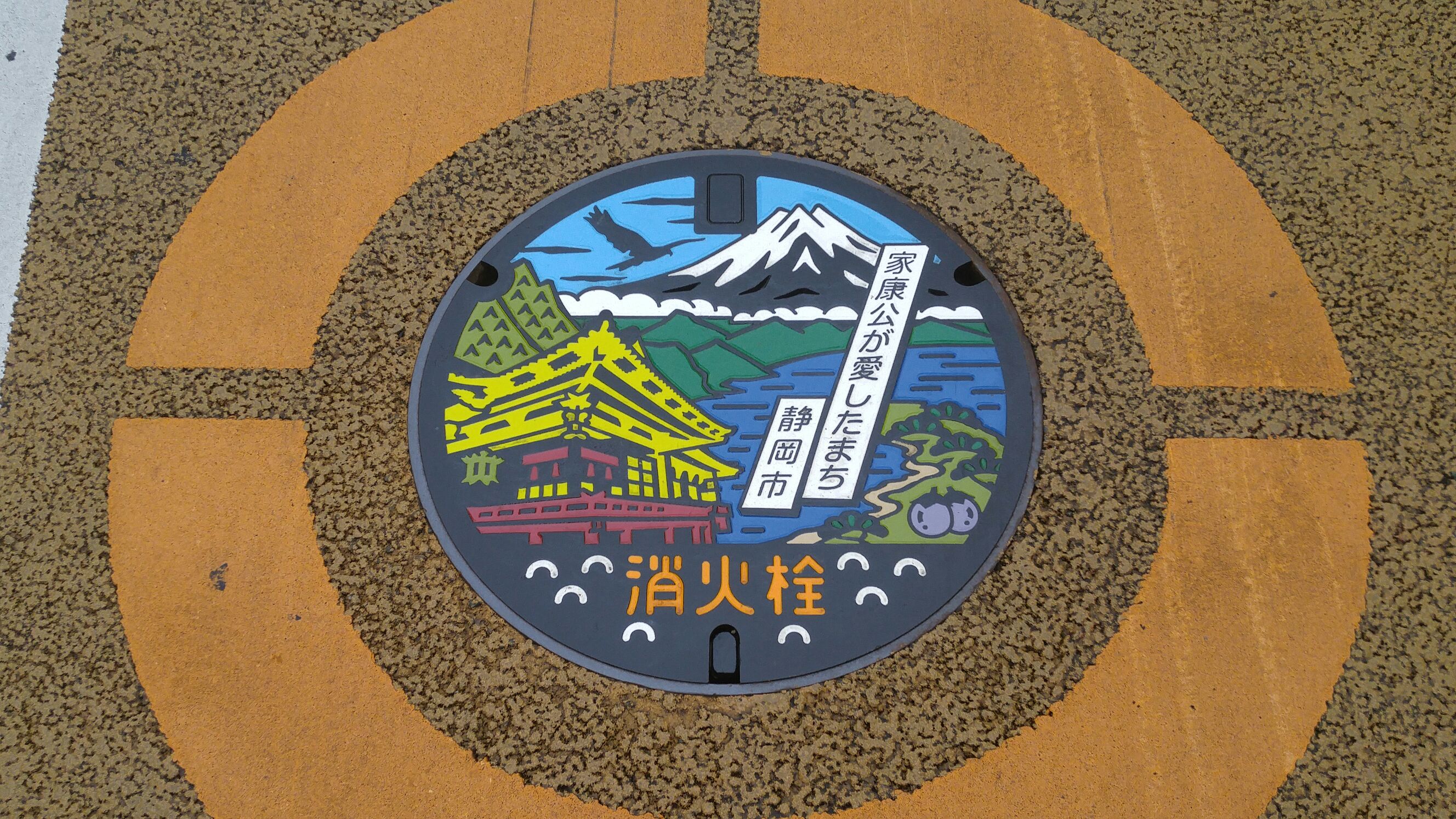
And we can conclude (that is, for the moment, as there must be others to come in the future, what with the booming tourism!) with a lesser known piece of gastronomy: back to the beginning of the 17th Century when Shogun Tokugawa Ieayasu retired to Sumpu (present Shizuoka City) he discovered “nasu”/egg plants exclusively grown in the Orito area (prensently Shimizu Ward, Shizuoka City) and grew so fond of them that he awarded them the appellation of “Orito Nasu”/Orito eggplants. These are still grown there and are a rare vegetable searched by all sorts of renown chefs!
Can you see it at the bottom right of the manhole cover?

Good search and bon appetit!

RECOMMENDED RELATED WEBSITES

So Good Sushi Restaurant in Nice France
Navigating Nagoya by Paige, Shop with Intent by Debbie, BULA KANA in Fiji, Kraemer’s Culinary blog by Frank Kraemer in New York,Tokyo Food File by Robbie Swinnerton, Green Tea Club by Satoshi Nihonyanagi in Shizuoka!, Mind Some by Tina in Taiwan, Le Manger by Camille Oger (French), The Indian Tourist, Masala Herb by Helene Dsouza in Goa, India, Mummy I Can Cook! by Shu Han in London, Pie
rre.Cuisine
, Francescannotwrite, My White Kitchen, Foodhoe, Chucks Eats, Things that Fizz & Stuff, Five Euro Food by Charles,Red Shallot Kitchen by Priscilla,With a Glass, Nami | Just One Cookbook, Peach Farm Studio, Clumsyfingers by Xethia, PepperBento, Hapabento, Kitchen Cow, Lunch In A Box, Susan at Arkonlite, Vegan Lunch Box; Tokyo Tom Baker, Daily Food Porn/Osaka, Only Nature Food Porn, Happy Little Bento, J-Mama’s Kitchen, Cook, Eat, Play, Repeat, Bento Lunch Blog (German), Adventures In Bento, Anna The Red’s Bento Factory, Ohayo Bento,

Must-see tasting websites:

-Sake: Ichi For The Michi by Rebekah Wilson-Lye in Tokyo, Tokyo Through The Drinking Glass, Tokyo Foodcast, Urban Sake, Sake World
-Wine: Palate To Pen, Warren Bobrow, Cellar Tours, Ancient Fire Wines Blog
-Beer: Another Pint, Please!, Beering In Good Mind: All about Craft Beer in Kansai by Nevitt Reagan!
ABRACADABREW, Magical Craftbeer from Japan
-Whisky: Nonjatta: All about whisky in Japan by Stefan Van Eycken
-Japanese Pottery to enjoy your favourite drinks: Yellin Yakimono Gallery

Non gastronomy must-see sites by Shizuoka Residents

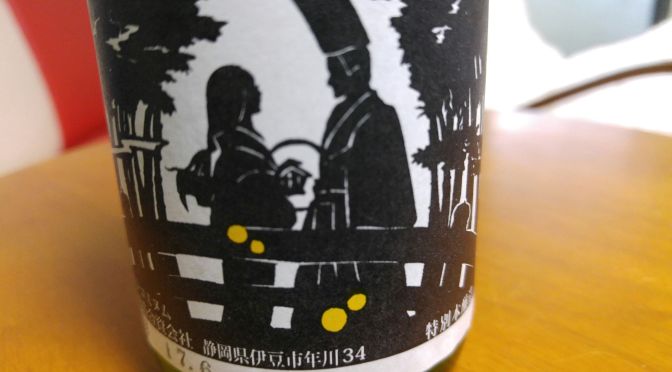
Shizuoka Sake Tasting: Bandai Brewery-Shuzenji Monogatari Tokubetsu Honjozo

Shuzenji in Izu City, Izu Peninsula, is witnessing a fast resurgence of its tourism, what with the increasing influx of overseas tourists and the Olympics looming large over the whole Peninsula.
Accordingly local products tend to reflect the local history and folklore more and more for the pleasure of visitors.
Bandai Brewery, the only sake sake brewery in the Peninsula has come out with a brand of its Tokubetsu Honjozo with the name of Shuzenji Monogatari/Shuzenji Story!

Rice milled down to 60%
Alcohol: 15 degrees

Clarity: very clear
Color: light golden hue
Aroma: dry and fruity. Dry plums
Taste: Dry and fruity attack.
Dry plums,loquats.
Lingers for while warming up the palate before departing on note of drier plums.
Turns smoother with food.

Overa;;: solid, dependable and straightforward sake conceived to accompany food.
A lit unusual for Shizuoka for its old fashioned approach.
Will make for a nice souvenir back home though.
Recommended pairings: Japanese yam salad, onsen tamago:hot spring eggs, marinated oysters.

RECOMMENDED RELATED WEBSITES

So Good Sushi Restaurant in Nice France
Navigating Nagoya by Paige, Shop with Intent by Debbie, BULA KANA in Fiji, Kraemer’s Culinary blog by Frank Kraemer in New York,Tokyo Food File by Robbie Swinnerton, Green Tea Club by Satoshi Nihonyanagi in Shizuoka!, Mind Some by Tina in Taiwan, Le Manger by Camille Oger (French), The Indian Tourist, Masala Herb by Helene Dsouza in Goa, India, Mummy I Can Cook! by Shu Han in London, Pie
rre.Cuisine
, Francescannotwrite, My White Kitchen, Foodhoe, Chucks Eats, Things that Fizz & Stuff, Five Euro Food by Charles,Red Shallot Kitchen by Priscilla,With a Glass, Nami | Just One Cookbook, Peach Farm Studio, Clumsyfingers by Xethia, PepperBento, Hapabento, Kitchen Cow, Lunch In A Box, Susan at Arkonlite, Vegan Lunch Box; Tokyo Tom Baker, Daily Food Porn/Osaka, Only Nature Food Porn, Happy Little Bento, J-Mama’s Kitchen, Cook, Eat, Play, Repeat, Bento Lunch Blog (German), Adventures In Bento, Anna The Red’s Bento Factory, Ohayo Bento,

Must-see tasting websites:

-Sake: Ichi For The Michi by Rebekah Wilson-Lye in Tokyo, Tokyo Through The Drinking Glass, Tokyo Foodcast, Urban Sake, Sake World
-Wine: Palate To Pen, Warren Bobrow, Cellar Tours, Ancient Fire Wines Blog
-Beer: Another Pint, Please!, Beering In Good Mind: All about Craft Beer in Kansai by Nevitt Reagan!
ABRACADABREW, Magical Craftbeer from Japan
-Whisky: Nonjatta: All about whisky in Japan by Stefan Van Eycken
-Japanese Pottery to enjoy your favourite drinks: Yellin Yakimono Gallery

Non gastronomy must-see sites by Shizuoka Residents

Early Spring Sushi Millefeuille by Kenta Birukawa at Sushi Shokunin Birukawa in Shizuoka City!

Service: shy but extremely attentive and kind
Equipment & Facilities: overall very clean. Excellent washroom. Non-smoking private room possible
Prices: reasonable (that is for true sushi!)
Strong points: Sushi mainly created with local seafood. 3-year old wasabi root exclusively used. Grilled and deep-fried fish, tempura. Excellent list of sake and shochu.

The other day I finally managed to find a couple of seats free at Sushi Shokunin Birukawa, my favorite sushi restaurant in Shizuoka Prefecture I have already introduced to many an overseas client. The problem is that it is very popular and it is tough, nigh impossible to get a seat on holidays or weekends! Even on a Thrursday it was fully booked by 6 pm!

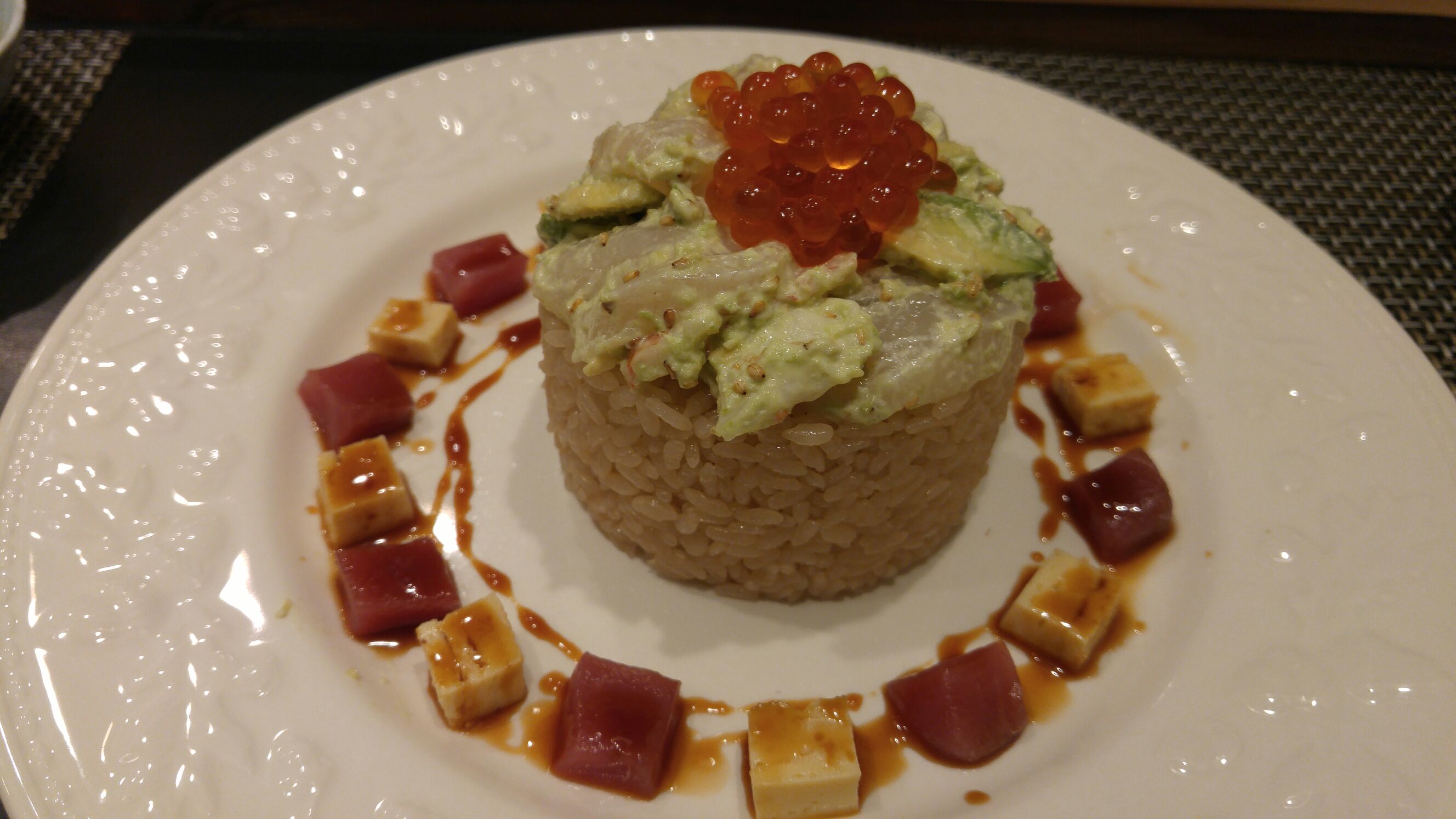
Anyway, to make along story short, we once again challenged our good friend, chef Kenta Birukawa who moved some 15 years ago to Shizuoka from his native Akita Prefecture to another Sushi Millefeuille! It is not listed on the menu, but if you are recommended in person by your servant he will be happy enough to concoct you an original one according to your taste and priorities!

The only thing we agreed on was the name: Early Spring (that is, for 2018!) Sushi Millefeuille!
Bear in mind that “Early Spring” in Japan, and especially in Shizuoka City, quite before the real Spring has actually come to grace us with its mild weather after this year’s unusually severe winter!

The Dragon (my worse half!) did not wait to demolish as it is her sorry habit but I had time enough to notice that the sushi rice is made in Kenta’s particular recipe, that is the rice vinegar used in seasoning the rice contains red amazu rice vinegar for 1/10th ration and that the millefeuille was topped with avocado nmayonnaise and salmon roe!

I could notice before Dragon further demolished the edifice that it contained scallops, squid and boiled lotus root!

And I forgot to mention that the banderolle around the millefeuille was composed of small cubes of akami/red lean tuna and Japanese omelet/Tamagoyaki!

Can’t wait for the next one!

SUSHI SHOKUNIN BIRUKAWA/寿司職人尾留川

420-0037 Shizuoka City, Aoi Ku, Hitoyado-Cho, 2-5-8
Tel.: 054-251-9787
Opening hours: 17:00~23:00
Closed on Wednesdays
Reservations highly recommended
Credit cards OK

RECOMMENDED RELATED WEBSITES

So Good Sushi Restaurant in Nice France
Navigating Nagoya by Paige, Shop with Intent by Debbie, BULA KANA in Fiji, Kraemer’s Culinary blog by Frank Kraemer in New York,Tokyo Food File by Robbie Swinnerton, Green Tea Club by Satoshi Nihonyanagi in Shizuoka!, Mind Some by Tina in Taiwan, Le Manger by Camille Oger (French), The Indian Tourist, Masala Herb by Helene Dsouza in Goa, India, Mummy I Can Cook! by Shu Han in London, Pie
rre.Cuisine
, Francescannotwrite, My White Kitchen, Foodhoe, Chucks Eats, Things that Fizz & Stuff, Five Euro Food by Charles,Red Shallot Kitchen by Priscilla,With a Glass, Nami | Just One Cookbook, Peach Farm Studio, Clumsyfingers by Xethia, PepperBento, Hapabento, Kitchen Cow, Lunch In A Box, Susan at Arkonlite, Vegan Lunch Box; Tokyo Tom Baker, Daily Food Porn/Osaka, Only Nature Food Porn, Happy Little Bento, J-Mama’s Kitchen, Cook, Eat, Play, Repeat, Bento Lunch Blog (German), Adventures In Bento, Anna The Red’s Bento Factory, Ohayo Bento,

Must-see tasting websites:

-Sake: Ichi For The Michi by Rebekah Wilson-Lye in Tokyo, Tokyo Through The Drinking Glass, Tokyo Foodcast, Urban Sake, Sake World
-Wine: Palate To Pen, Warren Bobrow, Cellar Tours, Ancient Fire Wines Blog
-Beer: Another Pint, Please!, Beering In Good Mind: All about Craft Beer in Kansai by Nevitt Reagan!
ABRACADABREW, Magical Craftbeer from Japan
-Whisky: Nonjatta: All about whisky in Japan by Stefan Van Eycken
-Japanese Pottery to enjoy your favourite drinks: Yellin Yakimono Gallery

Non gastronomy must-see sites by Shizuoka Residents

Shizuoka Shochu Tasting: Umeera by Bandai Brewery!

This is another schochu by Bandai Brewery in Shuzenji, Izu City in the Izu Peninsula and is the more interesting for using another famous local farm product!

It was also awarded the Izu Peninsula Geopark label!

The name, “Umeera” means “very tasty”!

It is made with fresh water collected in deep sea water currents of the Izu Penisula and New Summer Ornages cultivated in Izu Prefecture!

Classified as liqueur in Japan
Rice white lees shochu, pure rice alcohol, Izu Peninsula New Summer Oranges, sugars, deep-sea fresh water
Single distilling method
Alcohol: 25~26 degrees

Clarity: very clear
Color: transparent
Aroma: dry and fruity. strong summer oranges
Body: very fluid
Taste: dry and fruity attack. Deep new Summer oranges
Lingers for quite a while on the palate with more soft of the same oranges and rice spreading over the palate.
Changes little with food if for a slightly sweeter turn.

Overall: another rare, elegant and intriguing shochu!
Drinks like a fine strong aperitif distilled alcohol or liqueur.
Very elegant liqueur, but low enough in alcohol to enjoy at ease.
Would well poured on a cassata ice cream!
Will do very with asparaguses, salads, and seafood in Western gastronomy!
Another splendid gift to offer anywhere in Japan and overseas!

RECOMMENDED RELATED WEBSITES

So Good Sushi Restaurant in Nice France
Navigating Nagoya by Paige, Shop with Intent by Debbie, BULA KANA in Fiji, Kraemer’s Culinary blog by Frank Kraemer in New York,Tokyo Food File by Robbie Swinnerton, Green Tea Club by Satoshi Nihonyanagi in Shizuoka!, Mind Some by Tina in Taiwan, Le Manger by Camille Oger (French), The Indian Tourist, Masala Herb by Helene Dsouza in Goa, India, Mummy I Can Cook! by Shu Han in London, Pie
rre.Cuisine
, Francescannotwrite, My White Kitchen, Foodhoe, Chucks Eats, Things that Fizz & Stuff, Five Euro Food by Charles,Red Shallot Kitchen by Priscilla,With a Glass, Nami | Just One Cookbook, Peach Farm Studio, Clumsyfingers by Xethia, PepperBento, Hapabento, Kitchen Cow, Lunch In A Box, Susan at Arkonlite, Vegan Lunch Box; Tokyo Tom Baker, Daily Food Porn/Osaka, Only Nature Food Porn, Happy Little Bento, J-Mama’s Kitchen, Cook, Eat, Play, Repeat, Bento Lunch Blog (German), Adventures In Bento, Anna The Red’s Bento Factory, Ohayo Bento,

Must-see tasting websites:

-Sake: Ichi For The Michi by Rebekah Wilson-Lye in Tokyo, Tokyo Through The Drinking Glass, Tokyo Foodcast, Urban Sake, Sake World
-Wine: Palate To Pen, Warren Bobrow, Cellar Tours, Ancient Fire Wines Blog
-Beer: Another Pint, Please!, Beering In Good Mind: All about Craft Beer in Kansai by Nevitt Reagan!
ABRACADABREW, Magical Craftbeer from Japan
-Whisky: Nonjatta: All about whisky in Japan by Stefan Van Eycken
-Japanese Pottery to enjoy your favourite drinks: Yellin Yakimono Gallery

Non gastronomy must-see sites by Shizuoka Residents

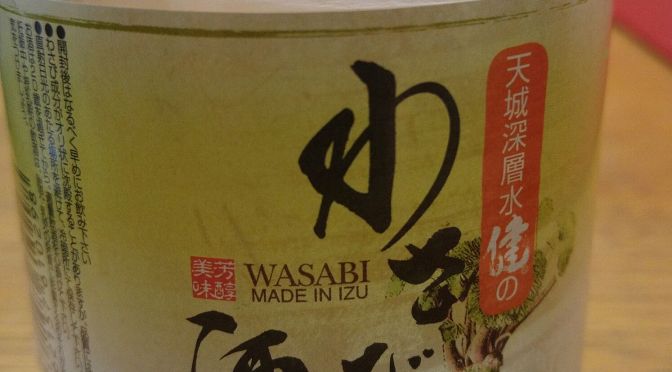
Shizuoka Shochu Tasting: Wasabi Shu by Bandai Brewery

It has been quite some time since I enjoyed the only true shochu made with wasabi in Japan, namely Wasabi Shu (can also be pronounced “Wasabi sake”)!

it is made by the only sake brewery/shochu distillery in Izu Peninsula in Shuzenji, Izu City!

Although made with rice shochu and wasabi essence it is sold as a liqueur for various lawful reasons!

Classified as liqueur in Japan
Rice white lees shochu, wasabi essence (20%)
Single distilling method
Alcohol: 20 degrees

Clarity: very clear
Color: transparent
Aroma: dry and fruity. mild wasabi
Body: very fluid
Taste: dry and fruity attack.
Soft and mild wasabi
Lingers for quite a while on the palate with more soft wasabi and rice spreading over the palate.
Changes little with food if for a drier turn.

Overall: A rare, elegant and intriguing shochu!
The rare kind that even ladies would drink straight at any time of an evening or of a celebration.
Thoroughly enjoyable at any temperature or on the rocks, although best on its own.
Probably best enjoyed on its own as a nightcap but will go with any Japanese food, especially sashimi and light vegetables dishes.
Will do very with asparaguses and oysters in Western gastronomy!
A splendid gift to offer anywhere in Japan and overseas!

RECOMMENDED RELATED WEBSITES

So Good Sushi Restaurant in Nice France
Navigating Nagoya by Paige, Shop with Intent by Debbie, BULA KANA in Fiji, Kraemer’s Culinary blog by Frank Kraemer in New York,Tokyo Food File by Robbie Swinnerton, Green Tea Club by Satoshi Nihonyanagi in Shizuoka!, Mind Some by Tina in Taiwan, Le Manger by Camille Oger (French), The Indian Tourist, Masala Herb by Helene Dsouza in Goa, India, Mummy I Can Cook! by Shu Han in London, Pie
rre.Cuisine
, Francescannotwrite, My White Kitchen, Foodhoe, Chucks Eats, Things that Fizz & Stuff, Five Euro Food by Charles,Red Shallot Kitchen by Priscilla,With a Glass, Nami | Just One Cookbook, Peach Farm Studio, Clumsyfingers by Xethia, PepperBento, Hapabento, Kitchen Cow, Lunch In A Box, Susan at Arkonlite, Vegan Lunch Box; Tokyo Tom Baker, Daily Food Porn/Osaka, Only Nature Food Porn, Happy Little Bento, J-Mama’s Kitchen, Cook, Eat, Play, Repeat, Bento Lunch Blog (German), Adventures In Bento, Anna The Red’s Bento Factory, Ohayo Bento,

Must-see tasting websites:

-Sake: Ichi For The Michi by Rebekah Wilson-Lye in Tokyo, Tokyo Through The Drinking Glass, Tokyo Foodcast, Urban Sake, Sake World
-Wine: Palate To Pen, Warren Bobrow, Cellar Tours, Ancient Fire Wines Blog
-Beer: Another Pint, Please!, Beering In Good Mind: All about Craft Beer in Kansai by Nevitt Reagan!
ABRACADABREW, Magical Craftbeer from Japan
-Whisky: Nonjatta: All about whisky in Japan by Stefan Van Eycken
-Japanese Pottery to enjoy your favourite drinks: Yellin Yakimono Gallery

Non gastronomy must-see sites by Shizuoka Residents

Gastronomic Destinations: Annam Vietnamese Restaurant in Sendai City, Miyagi Prefecture!

Service: a bit shy, but smiling and extremely attentive
Equipment & Facilities: overall spotless clean. Beautiful washroom. Completely nonsmoking
Prices: fair
Strong points: authentic Vietnamese cuisine prepare by Vietnamese chef with many local products. Vietnamese liqueurs and all kind of drinks available.
Private parties welcome
Credit cards OK

Annam is not only the newest but also the sole authentic Vietnamese Restaurant In the whole of Sendai City!
And it has a remarkable story (history)!

The very restaurant actually used to be in Shizuoka City, Shizuoka Prefecture!
The chef/owner, Miss Nguyen Thi Hong (Japanese name, Mai Kudo), was the Chef in the Shizuoka City Restaurant when the previous owner, also a Vietnamese/Japanese National had to retire for family reasons.

Among their faithful customers were a family from Sendai City who had taken a special liking to Miss Nguyen to the point of adopting her into their family!

So when the shop closed they proposed her to move to Sendai City with them and re-open the restaurant under the same name, with the same furniture and the same cuisine concept!
And their common venture was opened in August 2017 in Sendai City!
I used to be one of their faithful customers back in Shizuoka City and when I visited Sendai City I just could not miss it!
Mai San (Nguyen Thi Hong) was certainly surprised!

And it was such a pleasure to enjoy the same and delicious morsels!

Fresh Spring Rolls!

Vietnamese Green Papaya salad!

For a closer view!

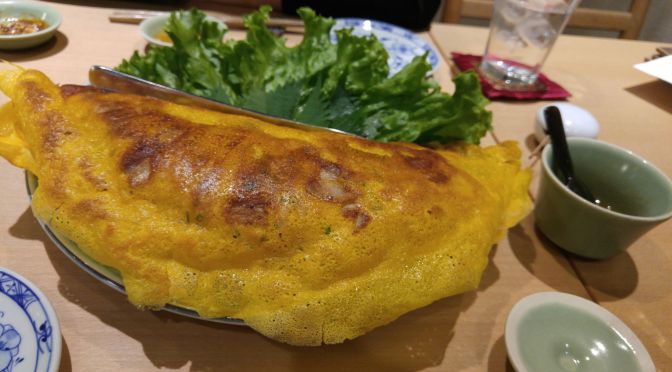
Vietnamese style o-konomiyaki!

Paper-thin crispy omelet!

Plenty of beansprouts inside!

Pan-fried rice vermicelli!

With all kinds of deep-fried tidbits!

Delicious vermicelli!

Pig ears terrine!

And don’t forget the Pho Soups!

Unbeatable!

Looking forward to my next trip to Sendai City!

ANNAM VIETNAMESE RESTAURANT
Chef: Nguyen Thi Hong Mai

983-0038 Sendai City, Aoba Ku, ichi ban Cho, 2-7-9. Dai Nana Masakougyou Bldg, 2F
Tel.: 022-0038
Opening hours: 11:30~14:00, 17:30~22:00
FACEBOOK
Reservations strongly recommenedd on week ends
Private parties welcome
Credit Cards OK

RECOMMENDED RELATED WEBSITES

So Good Sushi Restaurant in Nice France
Navigating Nagoya by Paige, Shop with Intent by Debbie, BULA KANA in Fiji, Kraemer’s Culinary blog by Frank Kraemer in New York,Tokyo Food File by Robbie Swinnerton, Green Tea Club by Satoshi Nihonyanagi in Shizuoka!, Mind Some by Tina in Taiwan, Le Manger by Camille Oger (French), The Indian Tourist, Masala Herb by Helene Dsouza in Goa, India, Mummy I Can Cook! by Shu Han in London, Pie
rre.Cuisine
, Francescannotwrite, My White Kitchen, Foodhoe, Chucks Eats, Things that Fizz & Stuff, Five Euro Food by Charles,Red Shallot Kitchen by Priscilla,With a Glass, Nami | Just One Cookbook, Peach Farm Studio, Clumsyfingers by Xethia, PepperBento, Hapabento, Kitchen Cow, Lunch In A Box, Susan at Arkonlite, Vegan Lunch Box; Tokyo Tom Baker, Daily Food Porn/Osaka, Only Nature Food Porn, Happy Little Bento, J-Mama’s Kitchen, Cook, Eat, Play, Repeat, Bento Lunch Blog (German), Adventures In Bento, Anna The Red’s Bento Factory, Ohayo Bento,

Must-see tasting websites:

-Sake: Ichi For The Michi by Rebekah Wilson-Lye in Tokyo, Tokyo Through The Drinking Glass, Tokyo Foodcast, Urban Sake, Sake World
-Wine: Palate To Pen, Warren Bobrow, Cellar Tours, Ancient Fire Wines Blog
-Beer: Another Pint, Please!, Beering In Good Mind: All about Craft Beer in Kansai by Nevitt Reagan!
ABRACADABREW, Magical Craftbeer from Japan
-Whisky: Nonjatta: All about whisky in Japan by Stefan Van Eycken
-Japanese Pottery to enjoy your favourite drinks: Yellin Yakimono Gallery

Non gastronomy must-see sites by Shizuoka Residents

Japanese Seafood: Japanese~English Lexicon (latest amended in November 2017)

I thought that such a lexicon would become handy both for English-speaking newcomers and long term residents!

I wrote the Japanese pronunciation first, the Chinese (Japanese kanji) characters and the English translations.

Bear in mind that many seafood have many names depending on the Japanese region. These are the common names.
If you have a question I will be glad to investigate!

By seafood I meant everything used as food from the sea except fish which is treated in a separate article!

A separate lexicon is being prepared for sushi!

———————————————–
CRABS

CRAB-1

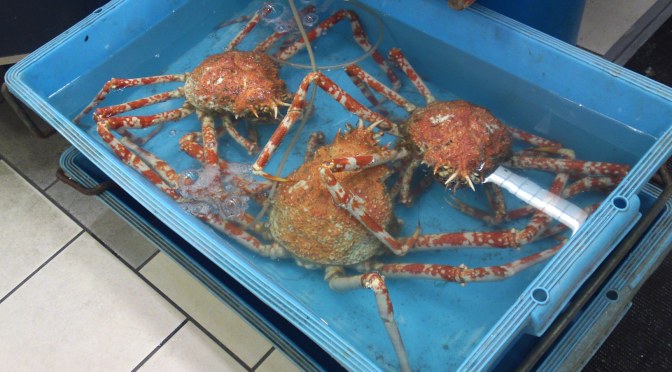
Takaashigani/高足蟹: Japanese spider crab, the largest crab in the world!
Aburagani/油蟹: blue king crab
Asahigani/旭蟹: frog crab, red frog crab
Benigani/紅蟹: another name for a Japanese variety of Zuwaigani/頭矮蟹: Snow crab
Gazami/蝤蛑(also called Wataraigani/渡り蟹): Swimming crab、Japanese blue crab
Kegani/毛蟹: Horsehair crab, Horse crab
Kurigani/栗蟹: Helmet Crab
Mozukugani/藻屑蟹: Japanese mitten crab
Taiwan gazami/台湾蝤蛑: Swimming blue crab, flower crab, blue crab, blue swimmer crab. blue manna crab

SN3O0199
SN3O0199

Takaashigani/高足蟹: Japanese spider crab
Tarabagani/鱈場蟹: red king crab
Wataraigani/渡り蟹 (also called Gazami/蝤蛑): Swimming crab、Japanese blue crab
Zuwaigani/頭矮蟹: Snow crab

SHELLFISH

HAMAGURI

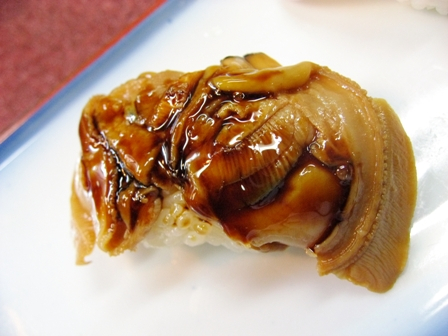
Hamaguri/蛤: Common orient clam as sushi!
Agemaki/揚巻: jack knife clam, sinonovacula constricta
Akaawabi/赤鮑 (also called Megaiawabi/目外鰒): a big variety of red abalone, haliotis (nordotis) gigantean Gmelin, 1791
Akagai/赤貝: Blood shellfish
Akanaeawabi/茜鮑: red abalone, Haliotis (Nordotis) rufescens Swainson
Aoyagi/青柳: Chinese mactra (also called Bakagai/破家蛤)
Atsuezobora/厚蝦夷法螺: a variety of buccinum whelk, neptunea helos (Gray, 1850)
Asari/浅利: Japanese littleneck, Manila clam
Awabi/鮑: abalone
Bai (or Baigai)/ 蛽、海蠃、海螄 : Japanese ivory shell, Japanese Babylon (also called Umi Tsubo/海つぼ)
Bakagai/破家蛤:Chinese mactra (also called Aoyagi/青柳)
Bateira/馬蹄螺: Top-shell (also called Isomono/いそもの)
Chigai/稚貝: small Scallops
Chiri awabi/チリ鮑: abalone imported from Chile
Ezo Awabi/蝦夷鰒: ezo abalone
Ezobai/蝦夷バイ: Small whelk variety Buccinum middendorff Verkruzen, 1882 (also called Iso Tsubugai/磯つぶ貝)
Hamaguri/蛤: Common orient clam
Himeshakogai/姫硨磲貝: a small Okinawan tridacninae, tridacna crocea
Hiougikai/緋扇貝: noble scallop
Hokkigai/北寄貝: Sakhalin surf clam (also called Ubagai/姥貝)
Honbinosugai/ホンビノスガイ: hard clam, Northern quahog

SN3O0012
SN3O0012

Hotate/帆立: scallops
Ishigakigai/石垣貝: clinocardium californiense
Isomono/いそもの: Top-shell (also called Bateira/馬蹄螺)
Iso Tsubugai/磯つぶ貝: Small whelk variety Buccinum middendorff Verkruzen, 1882 (also called Ezobai/蝦夷バイ)
Kaki/牡蠣: oyster
Kuro awabi/黒鰒: black abalone
Madaka awabi/まだか鰒: madaka abalone
Mategai/馬刀貝: razor clam
Matsubu/真螺: whelk
Megai awabi/雌貝鰒 (also called Akaawabi/赤鮑): Megai abalone, a big variety of red abalone, haliotis (nordotis) gigantean Gmelin, 1791
Mirugai/海松貝: mirugai clam, (type of) horse clam, (type of) gaper clam (also called Mirukui/海松食、水松食)
Mirukui/海松食、水松食 8also called Shiromiru/白海松): mirugai clam, (type of) horse clam, (type of) gaper clam
Oomategai/大馬刀貝: larger razor clam
Oomizogai/大溝貝: siliqua alta
Rokogai/ロコ貝/ Baranacle Rock-shell, Concholepas concholepas (Bruguie, 1789)
Saragai/皿貝 (also called Shirogai/白貝): northern great tellin,megangulus venulosa (Schrenk)
Satougai/佐藤貝: bloody clam, Scapharca satowi (Dunker,1882)
Sazae/栄螺、拳螺: Horned Turban
Shirobai/白蛽、白海蠃、白海螄: white Japanese ivory shell, white Japanese babylon
Shirogai/白貝 (also called Saragai/皿貝): northern great tellin,megangulus venulosa (Schrenk)
Shiromiru/白海松 (also called Mirukui/海松食、水松食): mirugai clam, (type of) horse clam, (type of) gaper clam
Sudaregai/すだれ貝: Venus clam
Tairagai/平貝 (also called Tairagi/玉珧): pen shell
Tairagi/玉珧 (also called Tairagai/平貝): pen shell
Tokobushi/床臥, 常節: small ablone, Sulculus diversicolor supertexta
Torigai/鳥貝: Heart Clam、Japanese Cockle
Tsubugai/螺貝 (or Tsubu/螺): whelk
Ubagai/姥貝: Sakhalin surf clam (also called Hokkigai/北寄貝)
Umi Tsubo/海つぼ: Japanese ivory shell, Japanese Babylon(also called Bai (or Baigai)/ 蛽、海蠃、海螄 )
Yakougai/夜光貝: Great Green Turban

CRUSTACEANS

SN3O0290
SN3O0290

Botan ebi/牡丹海老: Large Prawn
Aka ebi/赤海老: Red rice prawn, whiskered velvet shrimp

SN3O5189
SN3O5189

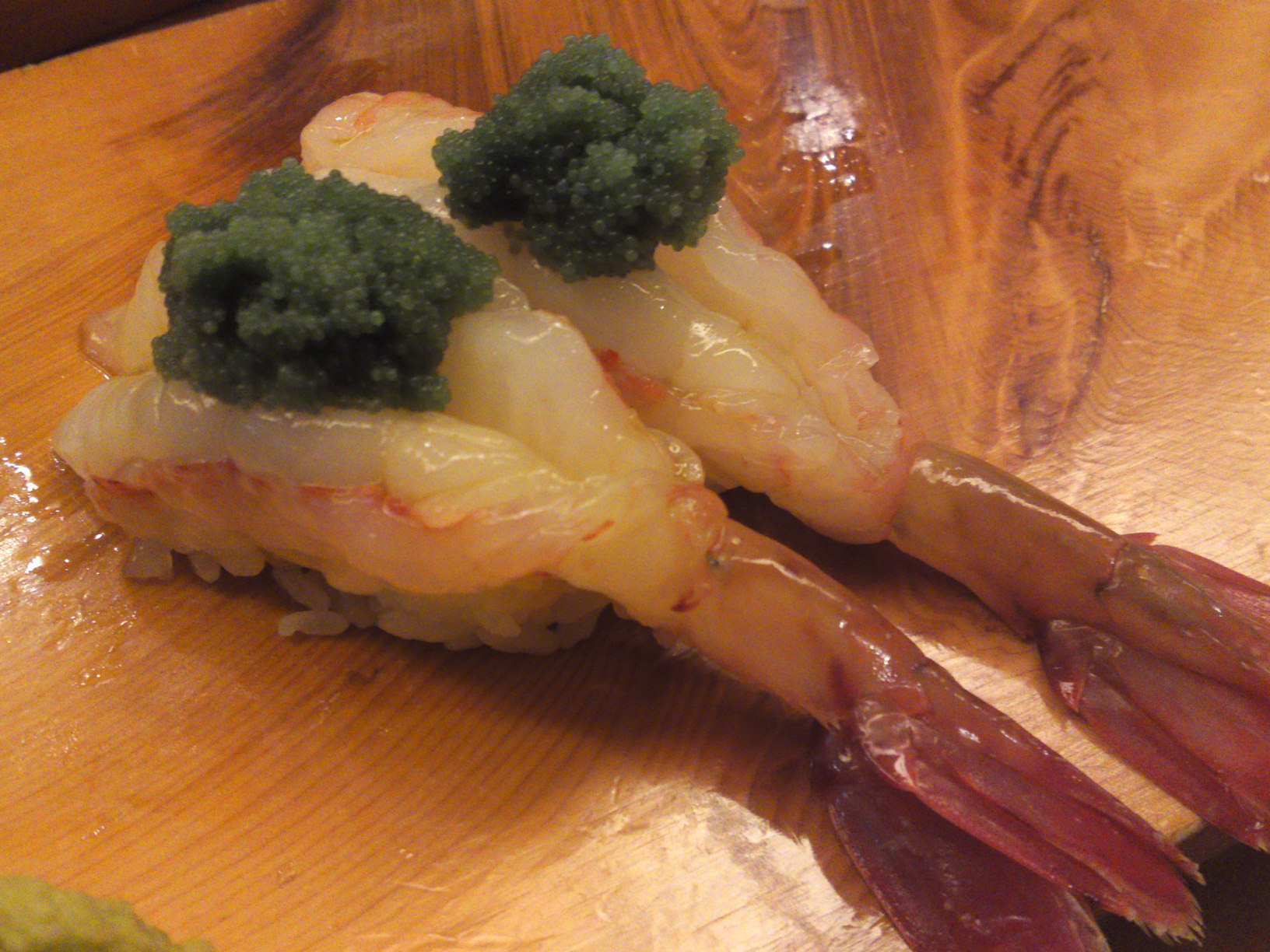
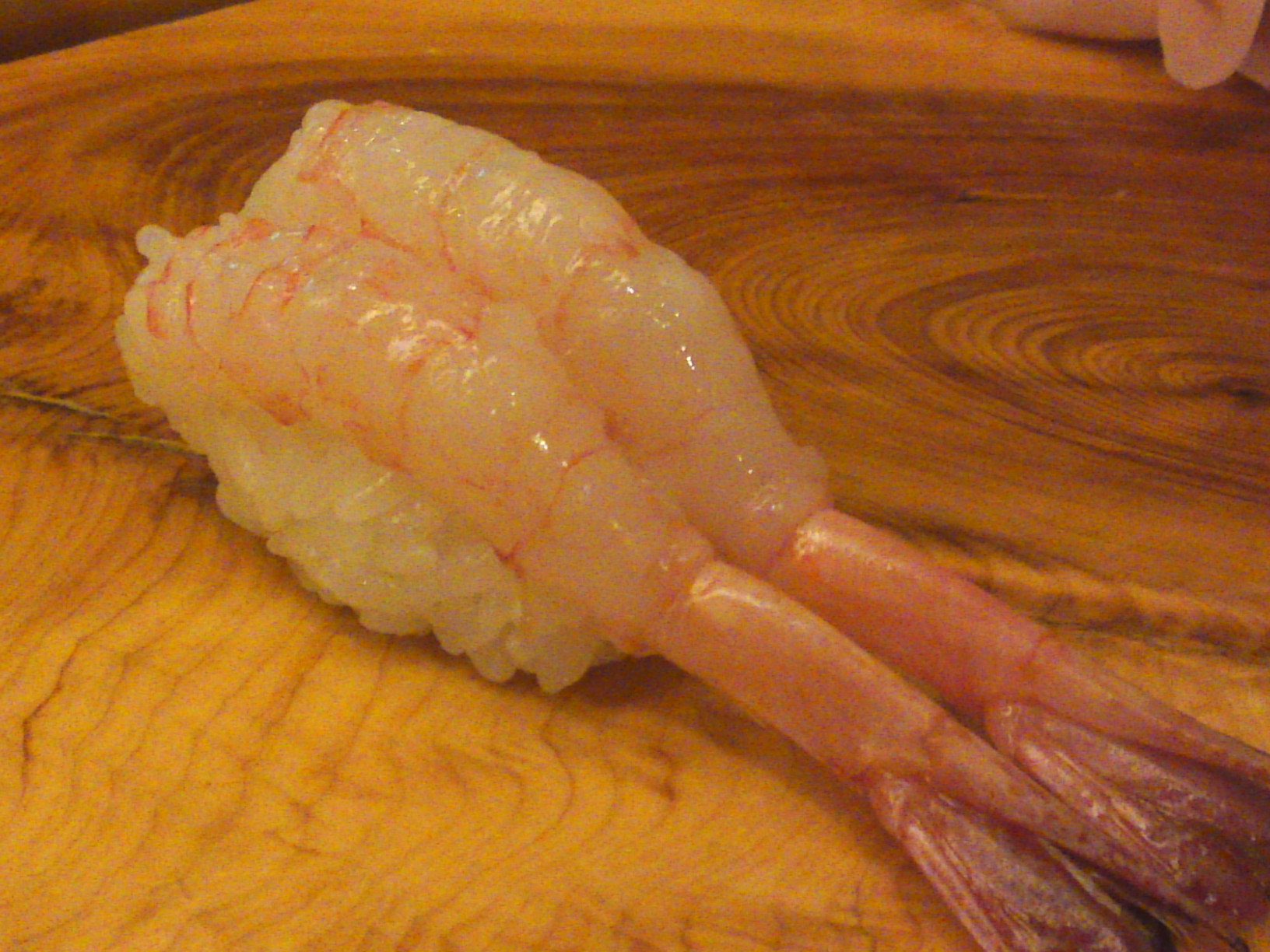
Ama ebi/甘海老: sweet shrimp
Ashiaka ebi/足赤 (also called Kuma ebi/クマエビ): Green tiger prawn, Penaeus (Penaeus) semisulcatus De.Haan.1844
Botan ebi/牡丹海老: Large Prawn
Budou ebi/葡萄海老: “Grape shrimp”, pandalopsis miyakei hayashi
Burakku Taigaa ebi/ブラックタイガー海老: black tiger prawn
Ebi/海老、蝦、鰕: prawn, shrimp
Hokkai ebi/北海海老 (also called Shima ebi/縞海老): hokkai shrimp
Ibaramo ebi/茨藻海老(also called Oni ebi/鬼海老):spiny lebbeid, Greenland lebbeid
Ise ebi/伊勢海老: spiny lobster
Kuma ebi/クマエビ(also called Ashiaka/足赤): Green tiger prawn, Penaeus (Penaeus) semisulcatus De.Haan.1844
Kuruma ebi/車海老 (also called Saimakiebi/才巻き海老): large prawn
Oni ebi/鬼海老 (also called Ibaramo ebi/茨藻海老):spiny lebbeid, Greenland lebbeid
Saimakiebi/才巻き海老 (also called Kuruma ebi/車海老): large prawn

SN3O2972
SN3O2972

Sakura ebi/桜海老: cherry shrimp
Shako/蝦蛄: Squilla
Shiba ebi/芝海老: Shiba shrimp, Metapenaeus joyneri (Miers, 1880)
Shima ebi/縞海老 (also called Hokkai ebi/北海海老): hokkai shrimp
Shiro ebi/白海老: white shrimp
Uchiwa ebi/団扇海老: fan lobster, sand crayfish
Vannamei ebi/バナメイ海老: Vannamei shrimp

FISH PARTS

SN3O0011
SN3O0011

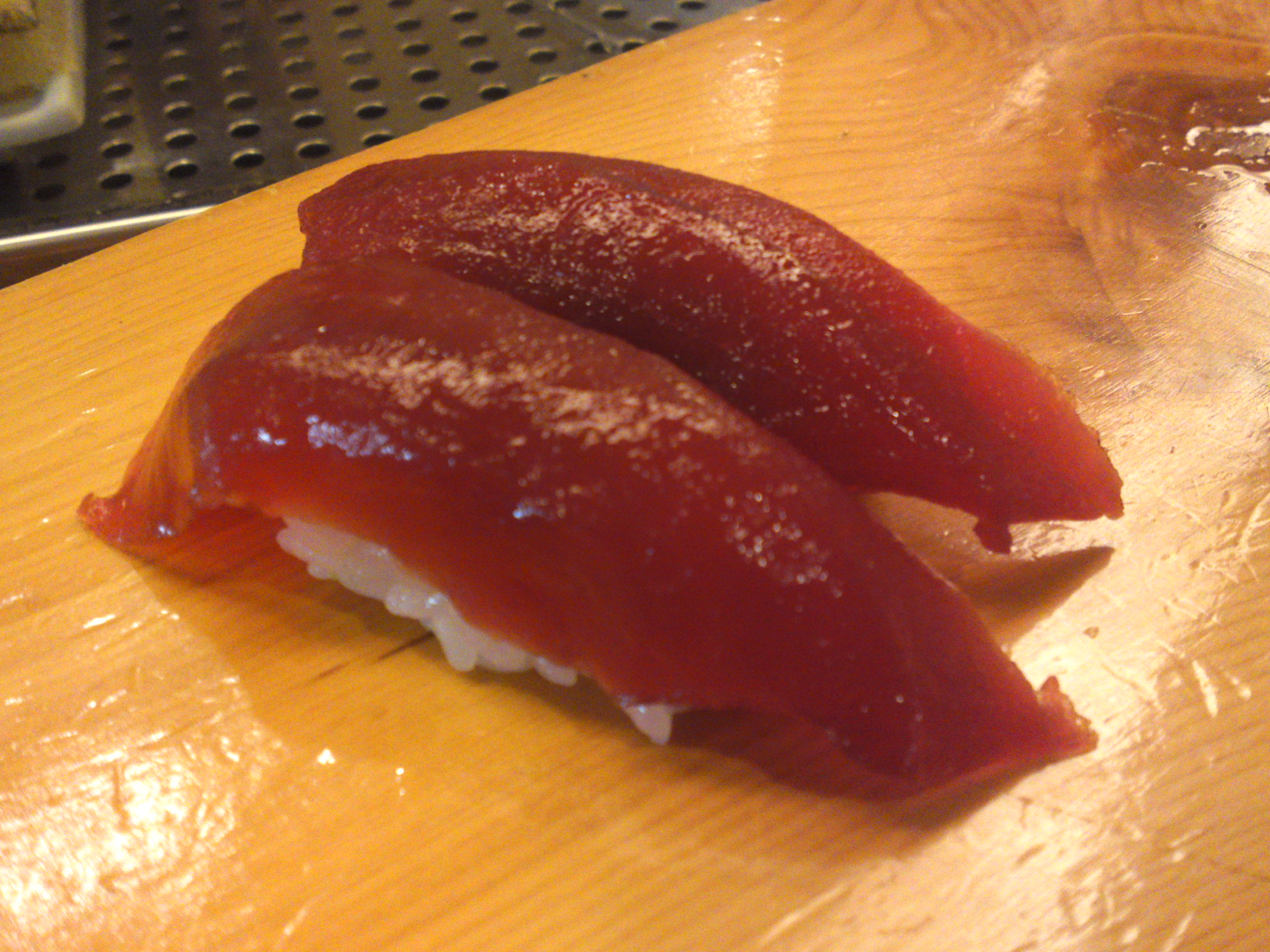
Akami/赤身: red lean part nigiri
Akami/赤身: red lean part
Chuutoro/中トロ:semi fat part
Chiai/血合い: the whole bloody central part of tuna, never used in sushi
Chiai gishi/血合いぎし: the bloody central part under the skin of tuna, never used in sushi
Engawa/縁側: border flesh of the fillets, especially with soles and flatfish
Fukahire/鱶ヒレ: shark fin
Ho/頬: “Cheek”, flesh near mouth (tuna in particular)

SN3O0293
SN3O0293

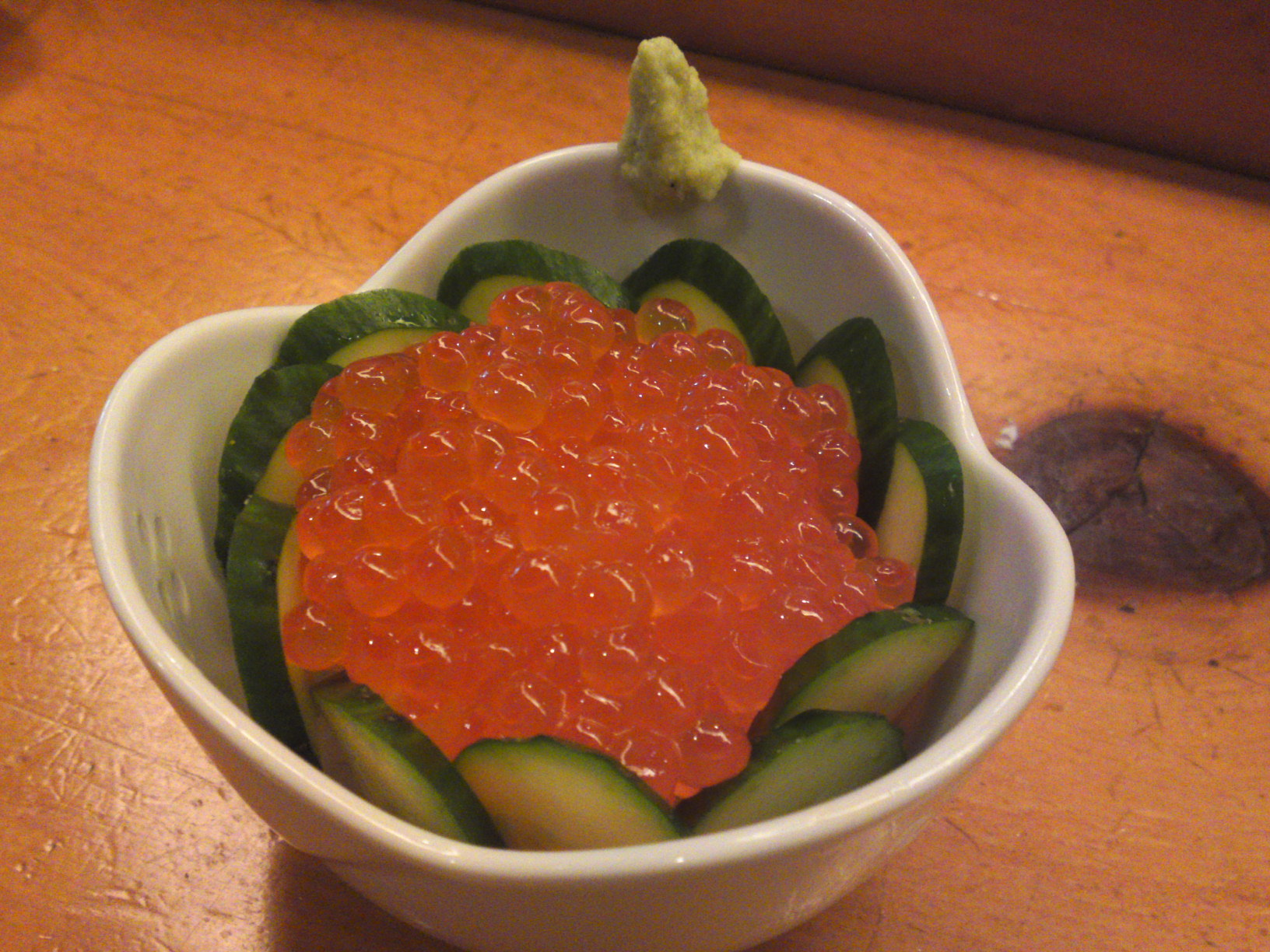
Ikura Konb\donburi/いくら小丼:small salmon roe sushi bowl

Ikura/いくら: salmon roe
Kama/かま: Flesh near the gills (tuna in particular)
Kami/上: part/flesh of a fish from the head (tuna in particular)
Kaperinko/カぺリン子: the eggs of a variety of Shishamo/柳葉魚: Shishamo (meaning willow leaf fish, a kind of Japanese smelt), Spirinchus lanceolatus
Kazunoko/数の子、鯑: herring roe
Madarako/真鱈子: Pacific cod roe
Mentaiko/明太子: spicy cod roe
Naka/中: central part/flesh of a fish (tuna in particular)

SN3O2973
SN3O2973

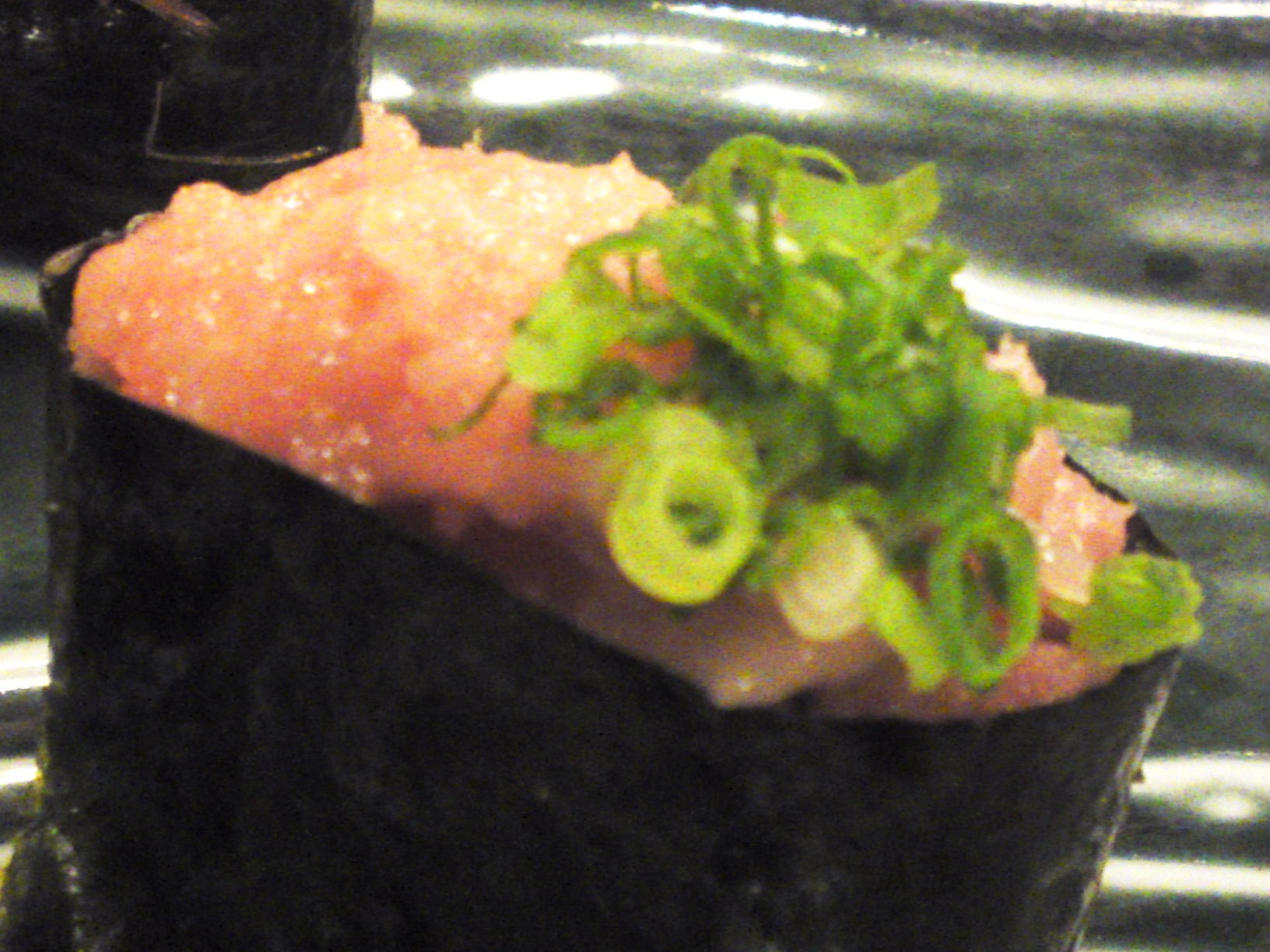
Negitoro/ネギトロ: scraped underbelly part gunkan nigiri

Negitoro/ネギトロ: scraped underbelly part
O-Toro/おトロ: fat part, belly part
Shimo/下: part/flesh of fish near the tail (tuna in particular)
Sumiika/墨烏賊: Cuttlefish, Sepia (Platysepia) esculenta Hoyle,1885
Shimesaba/〆鯖: pickled mackerel, a popular way to serve it as sashimi or sushi

SN3O2974
SN3O2974

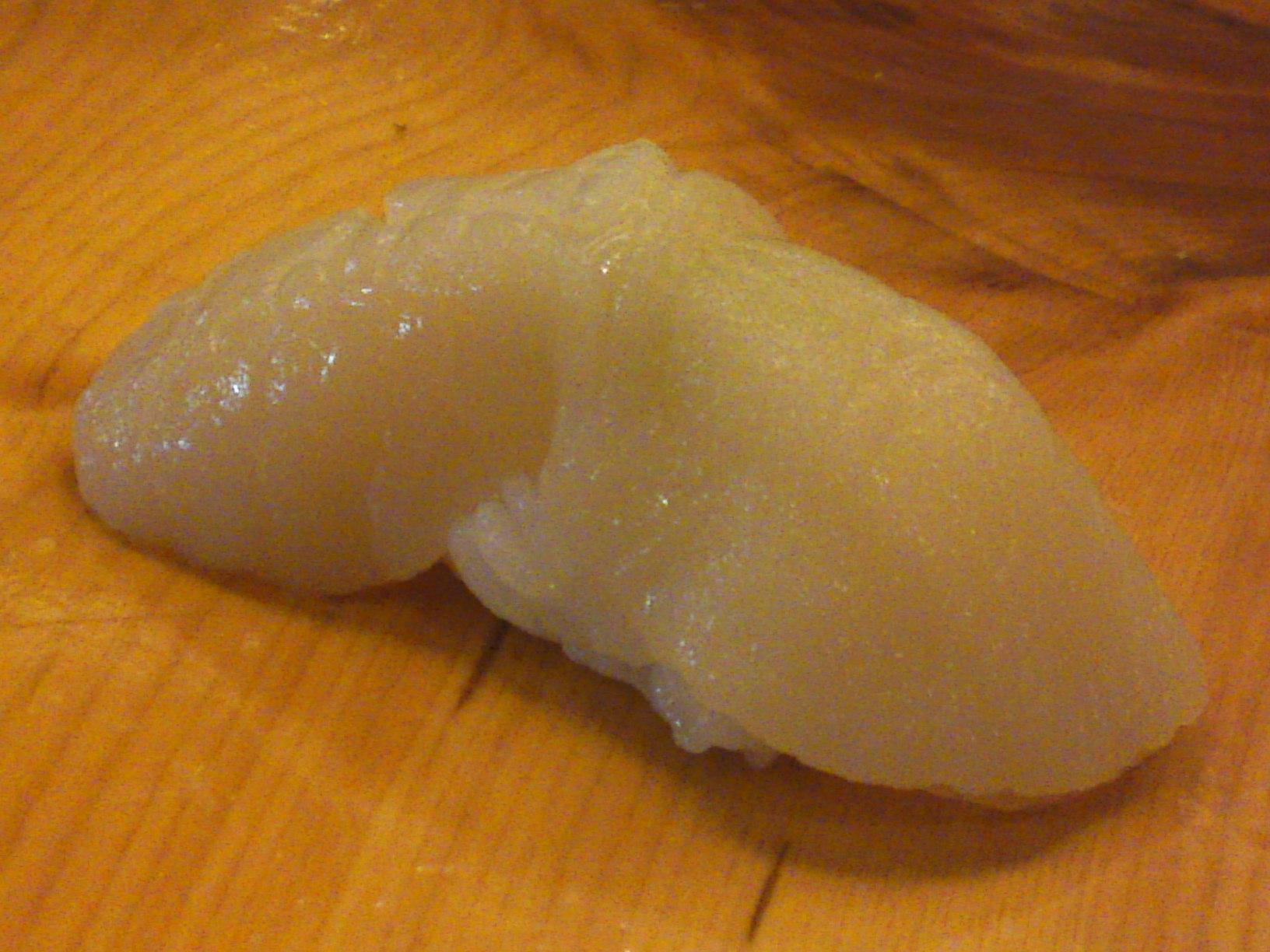
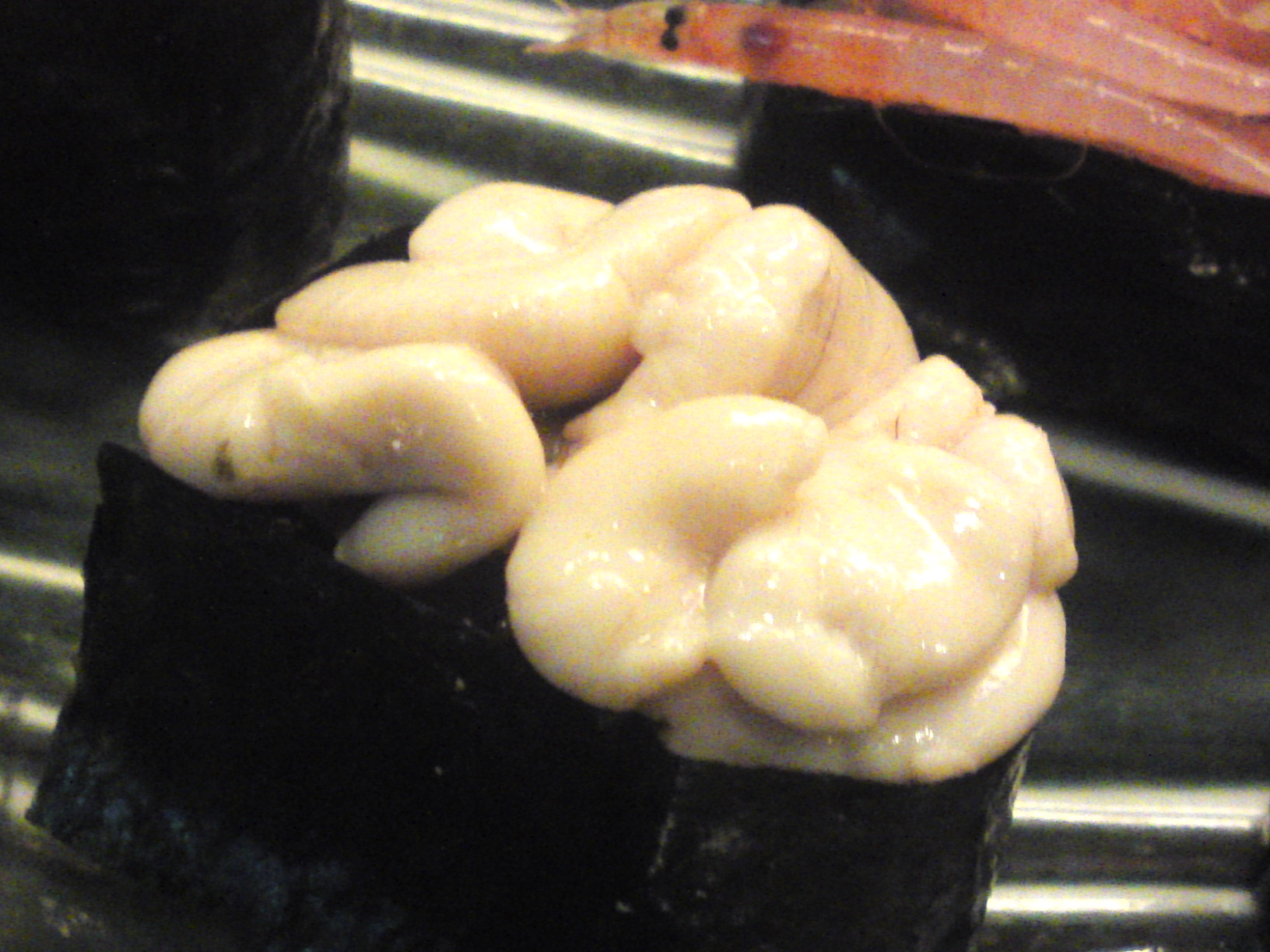
Tara Shirako/白子: Cod Male fish whiting, sperm sacs gunkan nigiri

Shirako/白子: Male fish whiting, sperm sacs
Tarako/鱈子: Cod roe
Tobiko/飛子: flying fish roe

SQUIDS/CUTTLEFISH

SN3O0375
SN3O0375

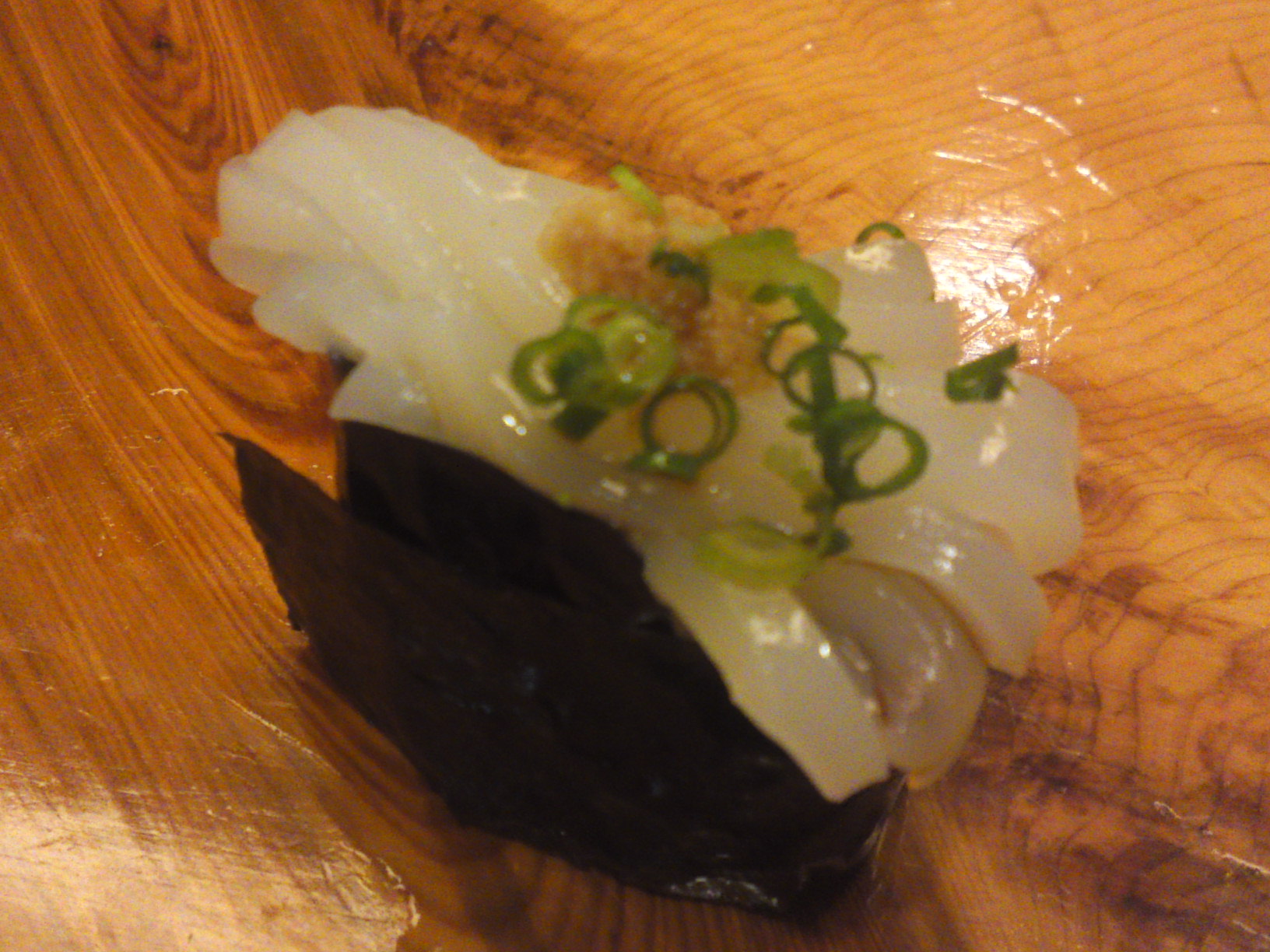
Aka Ika/赤烏賊: red spear squid gunkan nigiri

Aka Ika/赤烏賊: red spear squid
Aori ika/障泥烏賊 (also called Mizu ika/水烏賊): bigfin reef squid
Beika/米烏賊: a variety of spear squid loliolus (nipponololig) beka sasaki, 1929
Bozu ika/ボウズ烏賊: North Pacific bobtail, rossia (rossia) pacifica Berry, 1911
Budou ika/葡萄烏賊 (also called Kensaki ika/剣先烏賊: swordtip squid: “Grape squid”, Loligo (photololigo) forma budo Wakiya and Ishikawa, 1921
Ezohariika/蝦夷針烏賊: Andrea cuttlefish, Sepia (Doratosepion) andreana Steenstrup,1875
Hakutenkouika/泊天甲烏賊: Sepia (Doratosepion) aureomaculata Okutani & Horikawa, 1987
Hiika/
Himekouika/姫甲烏賊:Kobi cuttlefish, Sepia (Doratosepion) kobiensis Hoyle, 1885
Hotaru ika/蛍烏賊:
Hiika/ヒイカ( also called Shindo ika/深度烏賊: A variety of Sumiika/墨烏賊): Chinese ink cuttlefish, Sepia (Platysepia) esculenta Hoyle,1885
Ika/烏賊、魷: cuttlefish, squid
Kaminari ika/雷烏賊: Kisslip cuttlefish, Sepia (Acanthosepion) lycidas Gray, 1849
Kensaki ika/剣先烏賊: swordtip squid (also called Budou ika/葡萄烏賊: “Grape squid”), Loligo (photololigo) forma budo Wakiya and Ishikawa, 1921
Kou ika/子烏賊 (also called Mongouika/紋甲烏賊): Golden cuttlefish, Sepia (Platysepia) esculenta Hoyle, 1885
Mizu ika/水烏賊 (also called Aori ika/障泥烏賊): bigfin reef squid
Mongouika/紋甲烏賊 (also called Kou ika/子烏賊): Golden cuttlefish, Sepia (Platysepia) esculenta Hoyle, 1885
Shindo ika/深度烏賊: A variety of Sumiika/墨烏賊 (also called Hiika/ヒイカ): Chinese ink cuttlefish, Sepia (Platysepia) esculenta Hoyle,1885
Shiriyake ika/尻焼け烏賊: Japanese spineless cuttlefish, Sepiella japonica Sasaki, 1929
Sode ika/袖烏賊:Rhomboid squid, Thysanoteuthis rhombus Troschel, 1857
Suji ika/筋烏賊: Luminous flying squid, ucleoteuthis luminosa (Sasaki, 1915)
Sumiika/墨烏賊: Chinese ink cuttlefish, Sepia (Platysepia) esculenta Hoyle,1885
Surume/鯣: dried cuttlefish, squid
Surume ika/鯣烏賊: Japanese flying squid, Japanese common squid, Pacific flying squid
Usubeni ika/薄紅烏賊: “light red cuttlefish”
Yariika/槍烏賊: Spear Squid

Octopuses
Chiirodako/知色鮹: Chiiro octopus
Iidako/飯蛸: Ocellated octopus
Madago/真鮹: Common octopus
Mizudako/水鮹: North Pacific Giant Octopuss
Tako/蛸、鮹: octopus

OTHERS

SN3O2976
SN3O2976

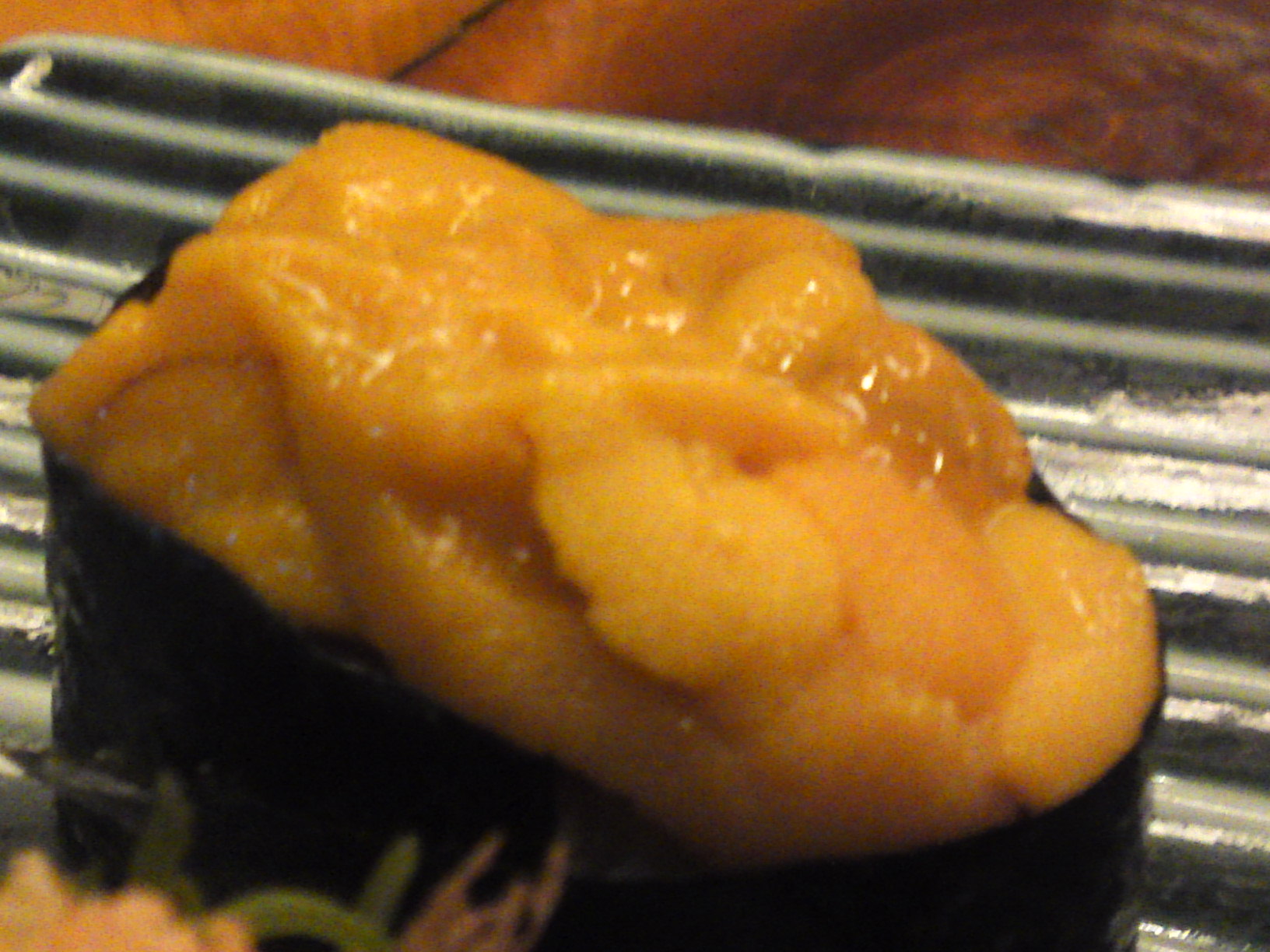
Uni/海胆: Sea urchin gunkan nigiri

Aka uni/赤海胆:red sea urchin, pseudocentrotus depressus
Amerika murasaki uni/アメリカ紫海胆: North-American violet urchin
Bafun uni/馬糞海胆: japanese variety of Ezobafun uni/蝦夷馬糞海胆: short-spined sea urchin
Chiri uni/チリ海胆: imported Chilean sea urchin
Ezobafun uni/蝦夷馬糞海胆 (also called Oobafun uni/大馬糞海胆): short-spined sea urchin, strongylocentrotus intermedius (A.Agassiz)
Hokuyouoobafun uni/北洋大馬糞海胆: North Pacific short-spined sea urchin
Hoya/海鞘: Sea squirt
Kitamurasaki uni/北紫海胆: north violet sea urchin, Strongylocentrotus nudus
Komochi konbu/子持ち昆布: Herring roe sandwiched on both sides of seaweed sheets
Kujira/鯨: whale
Kurage/海月: jellyfish
Murasaki uni/紫海胆:Japanese variety violet sea urchin
Namako/海鼠: Sea slug, sea cucumber
Oobafun uni/大馬糞海胆 (also called Ezobafun uni/蝦夷馬糞海胆): short-spined sea urchin, strongylocentrotus intermedius (A.Agassiz)
Shirohige uni/白髭海胆: “white beard sea urchin”, collector sea urchin, Tripneustes gratilla
Uni/海胆: Sea urchin
———————————————–

RECOMMENDED RELATED WEBSITES

So Good Sushi Restaurant in Nice France
Navigating Nagoya by Paige, Shop with Intent by Debbie, BULA KANA in Fiji, Kraemer’s Culinary blog by Frank Kraemer in New York,Tokyo Food File by Robbie Swinnerton, Green Tea Club by Satoshi Nihonyanagi in Shizuoka!, Mind Some by Tina in Taiwan, Le Manger by Camille Oger (French), The Indian Tourist, Masala Herb by Helene Dsouza in Goa, India, Mummy I Can Cook! by Shu Han in London, Pie
rre.Cuisine
, Francescannotwrite, My White Kitchen, Foodhoe, Chucks Eats, Things that Fizz & Stuff, Five Euro Food by Charles,Red Shallot Kitchen by Priscilla,With a Glass, Nami | Just One Cookbook, Peach Farm Studio, Clumsyfingers by Xethia, PepperBento, Hapabento, Kitchen Cow, Lunch In A Box, Susan at Arkonlite, Vegan Lunch Box; Tokyo Tom Baker, Daily Food Porn/Osaka, Only Nature Food Porn, Happy Little Bento, J-Mama’s Kitchen, Cook, Eat, Play, Repeat, Bento Lunch Blog (German), Adventures In Bento, Anna The Red’s Bento Factory, Ohayo Bento,

Must-see tasting websites:

-Sake: Ichi For The Michi by Rebekah Wilson-Lye in Tokyo, Tokyo Through The Drinking Glass, Tokyo Foodcast, Urban Sake, Sake World
-Wine: Palate To Pen, Warren Bobrow, Cellar Tours, Ancient Fire Wines Blog
-Beer: Another Pint, Please!, Beering In Good Mind: All about Craft Beer in Kansai by Nevitt Reagan!
ABRACADABREW, Magical Craftbeer from Japan
-Whisky: Nonjatta: All about whisky in Japan by Stefan Van Eycken
-Japanese Pottery to enjoy your favourite drinks: Yellin Yakimono Gallery

Non gastronomy must-see sites by Shizuoka Residents