Japanese Gastronomy: Sushi & Sashimi – Eat Local!

009

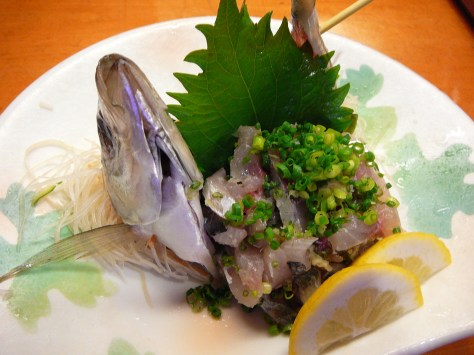
Saurel pike/Aji from Suruga Bay, Shizuoka Prefecture

Very few people will disagree with the notion that Japan is the ideal place to discover and savour sushi and sashimi in the whole world. Nevertheless, there are a few rules of the thumb to respect, even in this gastronomic paradise.
The overriding rule is that you should try and eat only local fish or seafood.
Tsukiji might be considered a sushi paradise by Tokyoites (it has or will be moved to another location), but the cheap prices enjoyed by tourists cannot conceal the reality: the fish and seafood are “imported” from all over Japan and beyond!
More than often, Edomae (Tokyo) sushi is nothing but a clever way to “dress up” ingredients to lure officionados (and customers) into believing they are eating top quality sushi (with the consequent prices).
Now, if you have the chance and time to explore Japan beyond Tokyo, you will discover an unfathomable treasure trove of gastronomic pleasure and knowledge!
After all, this country is a vast archipelago stretched across greatly different seas and climates, making for a diversity difficult to equal.
So, even if you cannot possibly explore all the shores of this nation, make a point to learn about the food available wherever you choose to stay.
The same goes for residents, not only for their own sake, but for that of their visitors and friends!
018

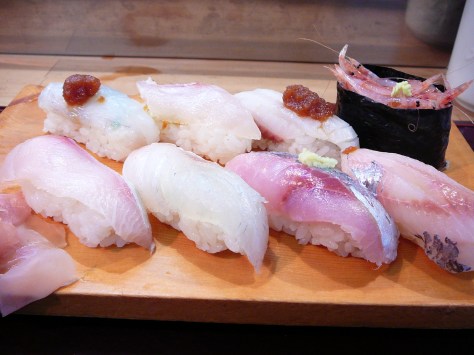
Sushi set with fish all caught in Suruga Bay, Shizuoka Prefecture

You also ought to do some homework. Sushi chefs worthy of their salt will be only too happy to answer questions to genuinely interested customers and come up with revelations of their own.
As an example to illustrate the need for some basic knowledge, in Hokkaido “oyakodon” (“parent and child”) is not cooked chicken and omelette on a bowl of rice, but raw salmon and its roe spread on top the same bowl of rice!
Likewise, the same fish will more than often be sold under a myriad of names.
Many morsels will not be found anywhere else suc as “sakura ebi/cherry shrimps” and fresh”shirasu/sardine whiting” in Shizuoka Prefecture.
Sashimi in most cases has to be perfectly fresh as typified by “kubiore saba” in Yakushima Island where fishermen break the neck (“kubiore”) of mackerels (“saba”) to preserve their quality upon catching. The same fish will be served within a few hours, or less, on the local tables.
On the other hand, tuna sashimi is best consumed first thawed and then ripened for a few days in a refrigerator.
In Hokkaido, large shrimps, especially “botan ebi” will be served only raw, whereas “kuruma ebi” will be first boiled in other regions.

If you ask for “tataki”, make sure it means the whole fish, especially “aji/mackerel pike” that will be served finely cut as tartare atop the dressed fish. And if the fish is really fresh such small and medium fish will have their bones and heads served deep-fried for a beautiful crispy snack!
002

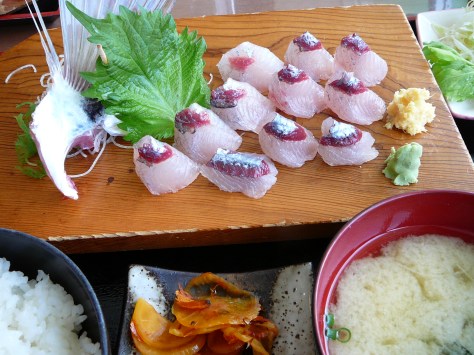
Flying Fish/Tobiuo sashimi from Yakushima Island

On the other hand, sushi follows different rules.
Fish and seafood placed on “donburi” (bowl) are usually of the freshly brought variety but fish served as nigiri is prepared in a different way.
The greatest sushi (and this cannot be done in Tsukiji!) are made with fish which has been gutted and cleaned live within seconds, then dressed into strips/fillets left to mature in a refrigerator on clean cloth/kitchen paper. This can be done only with fish caught locally!
The same obviously goes with shellfish and other marine ceatures: One cannot sample better “uni/sea urchin” away from Hokkaido or sakura ebi from Shizuoka.

Vegan and vegetarians, upon finding a restaurant willing to satisfy their priorities should also ask for food grown locally, a search easier than one might think at first as there are many non-meat eaters in this mainly Buddhist country.
The same vegetables will make for the perfect combination when associated with local fish!

RECOMMENDED RELATED WEBSITES

Masala Herb by Helene Dsouza in Goa, India
Mummy I Can Cook! by Shu Han in London
Pierre.Cuisine, Francescannotwrite, My White Kitchen, 47 Japanese Farms Through The Eyes of Its Rural Communities, Foodhoe, Chucks Eats, Things that Fizz & Stuff, Five Euro Food by Charles,Red Shallot Kitchen by Priscilla,With a Glass, Nami | Just One Cookbook, Peach Farm Studio, Clumsyfingers by Xethia, PepperBento,Adventures in Bento Making, American Bent, Beanbento, Bento No, Bento Wo Tsukurimashou, Cooking Cute, Eula, Hapabento , Happy Bento, Jacki’s Bento Blog, Kitchen Cow, Leggo My Obento, Le Petit Journal Bento & CO (French), Lunch In A Box,
Susan at Arkonlite, Vegan Lunch Box; Tokyo Tom Baker, Daily Food Porn/Osaka, Only Nature Food Porn, Happy Little Bento, The Herbed Kitchen, J-Mama’s Kitchen, Cook, Eat, Play, Repeat, Bento Lunch Blog (German), Adventures In Bento, Anna The Red’s Bento Factory, Cooking Cute, Timeless Gourmet, Bento Bug, Ideal Meal, Bentosaurus, Mr. Foodie (London/UK), Ohayo Bento,

Must-see tasting websites:

-Sake: Tokyo Through The Drinking Glass, Tokyo Foodcast, Urban Sake, Sake World
-Wine: Palate To Pen, Warren Bobrow, Cellar Tours, Ancient Fire Wines Blog
-Beer: Good Beer & Country Boys, Another Pint, Please!
-Japanese Pottery to enjoy your favourite drinks: Yellin Yakimono Gallery

Shizuoka Musk Melons-Japan’s obsession with perfect fruit by Roland Buerk of the BBC

Farmer Masaomi Suzuki has to keep the temperature constant to achieve the perfect crop

By Roland Buerk
BBC News, Tokyo and Shizuoka

Giving fruit as a gift is a common custom in Japan. But this fruit is not your normal greengrocers’ produce, complete with bumps, bruises and blemishes. The pick of the crop is grown with exquisite care and attention to detail – and commands an eye-watering price when it comes to market.
————————–
Masaomi Suzuki has been working in his steamy greenhouses for 50 years, but even after all that time he says he still learns something new every day.

The process begins with the perfect seeds. The local farmers’ association breeds a new strain every year, seeking continuous improvements. Weak seedlings are weeded out. Then when the flowers appear, poor specimens are ruthlessly plucked and discarded.

READ THE FULL ARTICLE BY ROLAND BUERK HERE

RECOMMENDED RELATED WEBSITES

Masala Herb by Helene Dsouza in Goa, India
Mummy I Can Cook! by Shu Han in London
Pierre.Cuisine, Francescannotwrite, My White Kitchen, 47 Japanese Farms Through The Eyes of Its Rural Communities, Foodhoe, Chucks Eats, Things that Fizz & Stuff, Five Euro Food by Charles,Red Shallot Kitchen by Priscilla,With a Glass, Nami | Just One Cookbook, Peach Farm Studio, Clumsyfingers by Xethia, PepperBento,Adventures in Bento Making, American Bent, Beanbento, Bento No, Bento Wo Tsukurimashou, Cooking Cute, Eula, Hapabento , Happy Bento, Jacki’s Bento Blog, Kitchen Cow, Leggo My Obento, Le Petit Journal Bento & CO (French), Lunch In A Box,
Susan at Arkonlite, Vegan Lunch Box; Tokyo Tom Baker, Daily Food Porn/Osaka, Only Nature Food Porn, Happy Little Bento, The Herbed Kitchen, J-Mama’s Kitchen, Cook, Eat, Play, Repeat, Bento Lunch Blog (German), Adventures In Bento, Anna The Red’s Bento Factory, Cooking Cute, Timeless Gourmet, Bento Bug, Ideal Meal, Bentosaurus, Mr. Foodie (London/UK), Ohayo Bento,

Must-see tasting websites:

-Sake: Tokyo Through The Drinking Glass, Tokyo Foodcast, Urban Sake, Sake World
-Wine: Palate To Pen, Warren Bobrow, Cellar Tours, Ancient Fire Wines Blog
-Beer: Good Beer & Country Boys, Another Pint, Please!
-Japanese Pottery to enjoy your favourite drinks: Yellin Yakimono Gallery
French Gastronomy: Organic Vegetables & Madai Seabream at Pissenlit-Shizuoka City!

Service: Excellent and very friendly.
Facilities: Great cleanliness overall. Superb washroom (mouthwash and toothpicks provided!)!
Prices: Reasonable to slightly expensive, very good value.
Strong points: Interesting wine list. Great use of local products, especially organic vegetables and Shizuoka-bred meat.

Difficult to believe as it is, but Shizuoka Prefecture, both officially at the Government level and unofficially by all gastronomes here, has the largest number of varieties of food grown, bred or caught both on land and at sea in Japan!
No wonder that the local restaurants find it both so easy and pleasurable to associate local products any time of the year!

So the other day, actually Saturday last week when I had lunch at Pissenlit in Shizuoka City, Chef Touru Arima/有馬亨さん first served me as an amuse-bouche a veloute/smooth soup made from organic Takinogawa burdock root from Kitayama Farm in Fujinomiya City.

The wine served then was not from Shizuoka, but it is worth talking about it as it was made in Osaka from Delaware and Koshu grapes! Its name, “Ganko Oyaji Tetsukuri Wain”, means “Wine hand-made by an old stubborn man”!

Nakamura Winery in Osaka also makes the above white wine called “Yume Asuka” or “Dream Asuka”!

Here is the happy marriage of products from the land and sea of Shizuoka Prefecture!

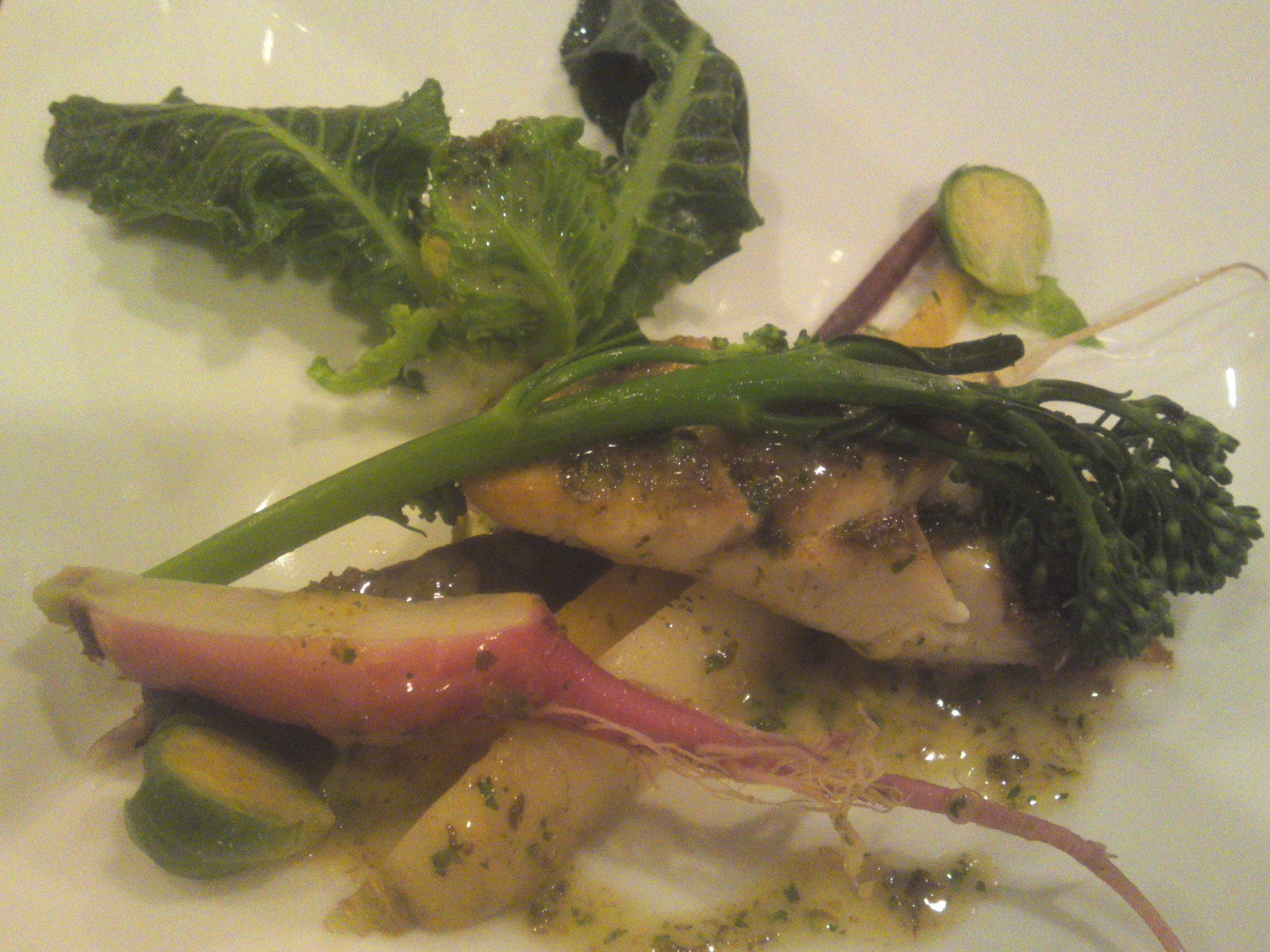
The Madai/真鯛/”True Seabream” was caught off Sagara/相良 shore, west of Shizuoka City, an area of Suruga Bay replete with semi-deep water fish.
First sauteed on its skin and then finished in the oven, the skin had a beautiful crispy bite in superb contradiction with the flesh perfect tenderness. The sauce kept to a minimum with lemon and butter accentuated all the freshness of the fish.

The organic vegetables came from two distinct farms: Shizuen No Chikara In Shizuoka City and Kitayama in Fujinomiya City!

Beautiful carrots!

Now, what is this organic vegetable from Kitayama Farm?

Romanesco broccoli bud!
So extravagant, elegant, beautiful and full of flavors!

To be continued… (can you wait?)

PISSENLIT

420-0839 Shizuoka City, Aoi Ku, Takajo, 2-3-4
Tel.: 054-270-8768
Fax: 054-627-3868
Business hours: 11:30~14:30; 17:00~22:00
Closed on Tuesdays and Sunday evening
HOMEPAGE (Japanese)
E-Mail: pissenlit2008@ybb.ne.jp
Credit Cards OK
Entirely non-smoking!

RECOMMENDED RELATED WEBSITES

Masala Herb by Helene Dsouza in Goa, India
Mummy I Can Cook! by Shu Han in London
Pierre.Cuisine, Francescannotwrite, My White Kitchen, 47 Japanese Farms Through The Eyes of Its Rural Communities, Foodhoe, Chucks Eats, Things that Fizz & Stuff, Five Euro Food by Charles,Red Shallot Kitchen by Priscilla,With a Glass, Nami | Just One Cookbook, Peach Farm Studio, Clumsyfingers by Xethia, PepperBento,Adventures in Bento Making, American Bent, Beanbento, Bento No, Bento Wo Tsukurimashou, Cooking Cute, Eula, Hapabento , Happy Bento, Jacki’s Bento Blog, Kitchen Cow, Leggo My Obento, Le Petit Journal Bento & CO (French), Lunch In A Box,
Susan at Arkonlite, Vegan Lunch Box; Tokyo Tom Baker, Daily Food Porn/Osaka, Only Nature Food Porn, Happy Little Bento, The Herbed Kitchen, J-Mama’s Kitchen, Cook, Eat, Play, Repeat, Bento Lunch Blog (German), Adventures In Bento, Anna The Red’s Bento Factory, Cooking Cute, Timeless Gourmet, Bento Bug, Ideal Meal, Bentosaurus, Mr. Foodie (London/UK), Ohayo Bento,

Must-see tasting websites:

-Sake: Tokyo Through The Drinking Glass, Tokyo Foodcast, Urban Sake, Sake World
-Wine: Palate To Pen, Warren Bobrow, Cellar Tours, Ancient Fire Wines Blog
-Beer: Good Beer & Country Boys, Another Pint, Please!
-Japanese Pottery to enjoy your favourite drinks: Yellin Yakimono Gallery

Japanese Gastronomy: Soba-The Basic Recipe (Buckwheat Noodles)

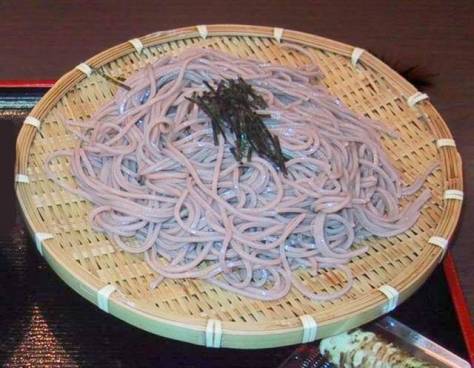
soba-saru

I’ve been asked for some time how to make your own soba/buckwheat noodles at home.
It is not that difficult, although you might need some particular tools.
Here is a simple recipe from which you can freely improvise.

INGREDIENTS:
Enough for 5 people
Buckwheat Flour/Soba-ko: 400g
Wheat flour (normal): 100g
Cold water: 250g
Some additional buckwheat flour for folding

TOOLS:
Large pan
Wooden rolling pin
Large Chinese/Japanese-style chopping knife
Wooden working surface/board
Board for guiding knife

RECIPE:

First step:
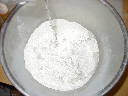
soba_1
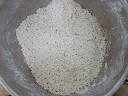
Pour buckwheat flour and Wheat flour into a large basin/pan and mix well.
Pour in one third of the water slowly in a thin flow. Mix with tip of fingers.

Step 2:
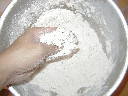
soba_2
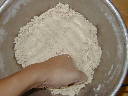
Break eventual hard lumps between fingers.

Step 3:
soba_3
Repeat step 1 twice again until you obtain a fine mixture.
Work as fast as possible.

Step 4:
soba_4
Once satisfied with the uniformity of the mixture, press hard with your knuckles.

Step 5:
soba_5
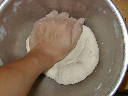
Once the flour has changed into one lump, fold and press with palm of the hand.

Step 6:
soba_6
Repeat Step 5 until lump has become shiny. Fold into a ball.

Step 7:
soba_7
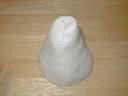
Shape the lump into a pyramid.

Step 8:
soba_8
Turn pyramid onto its tip and press hard as to form a saucer.

Step 9:
soba_9
Start spreading lump with wooden roll pin. first angle by angle as to form square.

Step 10:
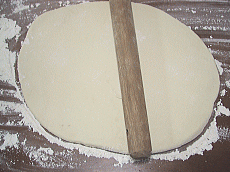
soba_10
Once you have spread the lump until the square has diminished to a 2 mm thickness, first sprinkle some buckwheat flour all over the surface and fold in two.

Step 11:
soba_11
Sprinkle with buckwheat flour and fold again (4 layers).

Step 12:
soba_12
Cut soba lump with the heavy chopping knife, using the wooden guide board for even cutting by shifting the guide board slightly after each cut.

Step 13:
soba_13
Bring a large large pan of water to boil, drop noodles into water separating them between your fingers as they fall out. Boil for 2~3 minutes stirring with long chopsticks.

Step 14:
soba_14
Take noodles out of pan (the soba tsuyu/soba soup can be used hot later) with a sieve and coll down under running cold water. Drain.

Step 15:
soba_15
Serve onto plate with or without dry seaweed, wasabi, soba soup or whatever you feel like.
You could also make maki with the same soba.
Variations are many!

RECOMMENDED RELATED WEBSITES

Masala Herb by Helene Dsouza in Goa, India
Mummy I Can Cook! by Shu Han in London
Pierre.Cuisine, Francescannotwrite, My White Kitchen, 47 Japanese Farms Through The Eyes of Its Rural Communities, Foodhoe, Chucks Eats, Things that Fizz & Stuff, Five Euro Food by Charles,Red Shallot Kitchen by Priscilla,With a Glass, Nami | Just One Cookbook, Peach Farm Studio, Clumsyfingers by Xethia, PepperBento,Adventures in Bento Making, American Bent, Beanbento, Bento No, Bento Wo Tsukurimashou, Cooking Cute, Eula, Hapabento , Happy Bento, Jacki’s Bento Blog, Kitchen Cow, Leggo My Obento, Le Petit Journal Bento & CO (French), Lunch In A Box,
Susan at Arkonlite, Vegan Lunch Box; Tokyo Tom Baker, Daily Food Porn/Osaka, Only Nature Food Porn, Happy Little Bento, The Herbed Kitchen, J-Mama’s Kitchen, Cook, Eat, Play, Repeat, Bento Lunch Blog (German), Adventures In Bento, Anna The Red’s Bento Factory, Cooking Cute, Timeless Gourmet, Bento Bug, Ideal Meal, Bentosaurus, Mr. Foodie (London/UK), Ohayo Bento,

Must-see tasting websites:

-Sake: Tokyo Through The Drinking Glass, Tokyo Foodcast, Urban Sake, Sake World
-Wine: Palate To Pen, Warren Bobrow, Cellar Tours, Ancient Fire Wines Blog
-Beer: Good Beer & Country Boys, Another Pint, Please!
-Japanese Pottery to enjoy your favourite drinks: Yellin Yakimono Gallery

French Gastronomy: Organic Rape Flowers and Egg in Meurette style at Pissenlit-Shizuoka City!

Service: Excellent and very friendly.
Facilities: Great cleanliness overall. Superb washroom (mouthwash and toothpicks provided!)!
Prices: Reasonable to slightly expensive, very good value.
Strong points: Interesting wine list. Great use of local products, especially organic vegetables and Shizuoka-bred meat.

Last Saturday since I needed to talk with Chef Touru Arima/有馬亨さん at pissenlit in Shizuoka City, I took the opportunity to eat a late lunch there.
In fact I was too late for the specials of the day which all gone by then…

Side view!

But I had noticed some beautiful rape flowers resting inside a bowl in the kitchen when I walked past the large glass windows which allow a full sight of the chef’s lair!
I asked if an “appetizer” could be done with them…
Right-O! was the reply…

A “riding” view!

The rape flowers were organic from Shizen no Chikara Farm in Shizuoka City.
Rape flowers, na no Hana/菜の花, also go by the name of Broccolini and Tenderstem Broccoli.
Actually I wonder if i should call them rape flowers at all also they are also of the Brassica Family!
Chef Arima simply gently boiled them, then fried with a minimum of seasoning.
He placed an enormous poached on top with a generous portion of wine sauce according to my homeland, Bourgogne, recipe for oeufs en meurette!
The egg comes from Mr. Hotta farm in Okabe, Fujieda City and are branded under the name of “Yuseiran/有精卵!

This is what happens when you cut across the egg, releasing a delicious golden flow over your dish!

This promises to be the best appetizer of the year!

PISSENLIT

420-0839 Shizuoka City, Aoi Ku, Takajo, 2-3-4
Tel.: 054-270-8768
Fax: 054-627-3868
Business hours: 11:30~14:30; 17:00~22:00
Closed on Tuesdays and Sunday evening
HOMEPAGE (Japanese)
E-Mail: pissenlit2008@ybb.ne.jp
Credit Cards OK
Entirely non-smoking!

RECOMMENDED RELATED WEBSITES

Masala Herb by Helene Dsouza in Goa, India
Mummy I Can Cook! by Shu Han in London
Pierre.Cuisine, Francescannotwrite, My White Kitchen, 47 Japanese Farms Through The Eyes of Its Rural Communities, Foodhoe, Chucks Eats, Things that Fizz & Stuff, Five Euro Food by Charles,Red Shallot Kitchen by Priscilla,With a Glass, Nami | Just One Cookbook, Peach Farm Studio, Clumsyfingers by Xethia, PepperBento,Adventures in Bento Making, American Bent, Beanbento, Bento No, Bento Wo Tsukurimashou, Cooking Cute, Eula, Hapabento , Happy Bento, Jacki’s Bento Blog, Kitchen Cow, Leggo My Obento, Le Petit Journal Bento & CO (French), Lunch In A Box,
Susan at Arkonlite, Vegan Lunch Box; Tokyo Tom Baker, Daily Food Porn/Osaka, Only Nature Food Porn, Happy Little Bento, The Herbed Kitchen, J-Mama’s Kitchen, Cook, Eat, Play, Repeat, Bento Lunch Blog (German), Adventures In Bento, Anna The Red’s Bento Factory, Cooking Cute, Timeless Gourmet, Bento Bug, Ideal Meal, Bentosaurus, Mr. Foodie (London/UK), Ohayo Bento,

Must-see tasting websites:

-Sake: Tokyo Through The Drinking Glass, Tokyo Foodcast, Urban Sake, Sake World
-Wine: Palate To Pen, Warren Bobrow, Cellar Tours, Ancient Fire Wines Blog
-Beer: Good Beer & Country Boys, Another Pint, Please!
-Japanese Pottery to enjoy your favourite drinks: Yellin Yakimono Gallery

Japanese Gastronomy: Udon-The Basic Recipe

Udon/饂飩/うどん, although not suitable for wheat allergics, can be easily turned vegetarian or vegan, depending on the soup and seasonings/accompaniments.
It is fullfilling and healthy and can be eaten hot in soup or fried, or cold, especially in salads!

INGREDIENTS (basic):

-Wheat flour: 1 kg (fine, light type)
-Salt: 40 g (can be reduced to 30 g)
-Water: 460 ml

RECIPE:

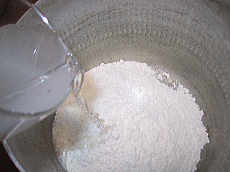
Dissolve salt in water first.
Pour flour in an all-purpose large bowl.
Pour the water onto the flour little by little.

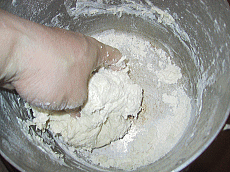
Mix and knead little by little until all the water has been used.
At that time you may think you haven’t added enough water. Don’t worry. Just keep kneading for 10 minutes. it will eventually become smooth.

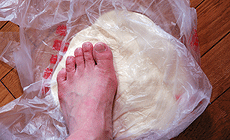
The following is interesting. In restaurants it is done with a special wooden lever with the chef standing on one end!
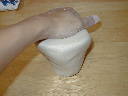
Wrap the dough in a cellophane paper and press the whole (wash your feet!) with the whole foot until the dough has spread somewhat flat. Take the dough out of the cellophane paper, shape it into a ball, wrap it again and press again with your foot.
Do that for 15 minutes.
Do not skip that step!
Ask hubby or (big) kids to help if necessary!

Shape the dough in a ball, wrap it in cellophane paper and leave it to rest for a while.

Sprinkle flour on a working table.
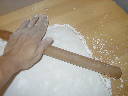
Roll the dough out into a 3 mm thick sheet.

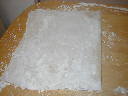
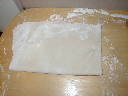
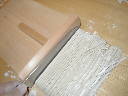
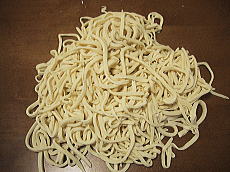
Sprinkle flour on the dough sheet surface, fold the dough as shown on pic above and cut every 3 mm to obtain square section noodles/udon.

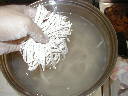
Shake and separate the udon and gather them as in picture above.
They are ready!

Throw the udon in water heated just before boiling point. Cook (make sure the water does not boil) for 6 minutes.
You can use the udon just after after but it is better to go through the next step:

Drop the udon into a strainer and wash them quickly under cold clear water. They will look far more appetizing this way and easy to conserve until you drop them into soup, fry them or dress them into a salad!

As for the soup, there are many ways to make it, whereas you are vegan, vegetarian or omnivore. If you use dashi, use konbu/seaweed dashi if you are not an omnivore. One can add soy sauce, mirin/sweet sake and sugar.
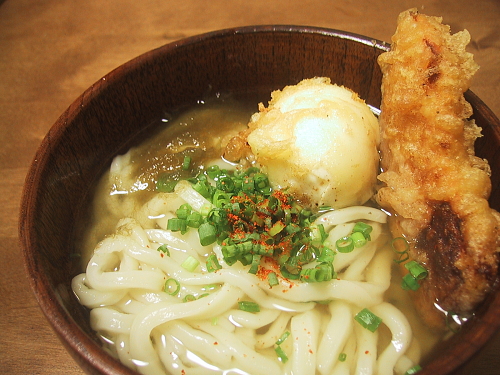
Serve the udon as they are or with chopped leeks and aburaage tofu and so forth!

RECOMMENDED RELATED WEBSITES

Masala Herb by Helene Dsouza in Goa, India
Mummy I Can Cook! by Shu Han in London
Pierre.Cuisine, Francescannotwrite, My White Kitchen, 47 Japanese Farms Through The Eyes of Its Rural Communities, Foodhoe, Chucks Eats, Things that Fizz & Stuff, Five Euro Food by Charles,Red Shallot Kitchen by Priscilla,With a Glass, Nami | Just One Cookbook, Peach Farm Studio, Clumsyfingers by Xethia, PepperBento,Adventures in Bento Making, American Bent, Beanbento, Bento No, Bento Wo Tsukurimashou, Cooking Cute, Eula, Hapabento , Happy Bento, Jacki’s Bento Blog, Kitchen Cow, Leggo My Obento, Le Petit Journal Bento & CO (French), Lunch In A Box,
Susan at Arkonlite, Vegan Lunch Box; Tokyo Tom Baker, Daily Food Porn/Osaka, Only Nature Food Porn, Happy Little Bento, The Herbed Kitchen, J-Mama’s Kitchen, Cook, Eat, Play, Repeat, Bento Lunch Blog (German), Adventures In Bento, Anna The Red’s Bento Factory, Cooking Cute, Timeless Gourmet, Bento Bug, Ideal Meal, Bentosaurus, Mr. Foodie (London/UK), Ohayo Bento,

Must-see tasting websites:

-Sake: Tokyo Through The Drinking Glass, Tokyo Foodcast, Urban Sake, Sake World
-Wine: Palate To Pen, Warren Bobrow, Cellar Tours, Ancient Fire Wines Blog
-Beer: Good Beer & Country Boys, Another Pint, Please!
-Japanese Pottery to enjoy your favourite drinks: Yellin Yakimono Gallery

Vegan Life & Gastronomy in Japan (& Shizuoka)

Vegan Fried Avocado

I have always been intrigued by the priorities and needs of my vegan and vegetarian friends. I’m an incorrigible omnivore and will ever be, but I can appreciate other gastronomies, be they even based on vegetables only.
I also hold a deep interest in anything organic, although I don’t make it a tenet of my everyday life.
As a general rule I strive for balance.
Vegans and vegetarians have their reasons to be so, and that is their private concern. Full stop.
On the other hand, I cannot be forced into changing my ways. I did recently have to fend a concerted hate mail assault by a group of slightly misled vegans following an article of mine, but that is not going to stop me from trying to help my friends in this country.

Many vegans and vegetarians harbour doubts as to whether visit Japan, or Shizuoka for that matter.
They should not be wary of the life here. I dare say that it is almost the ideal country for them to live!
Shizuokaisalso a paradise for organic vegetables. I know of one extraordinary farmer who grows more than 190 varieties on 3 ha in Fujinomiya City!
Alright, vegans and vegetarians certainly need to be prepared!

Japanese Vegan Dashi

The very first query I have to field is:
-“But they use dashi everywhere!”
The Japanese certainly do, but there two basic kinds of dashi/Japanese soupstocks: one made with dry bonito shavings and the other made with konbu/seaweed. Check Vegan Dashi Recipe.

Now miso is also vegan, so you can imagine all the soup recipes you can concoct! Just Have a look at Vegan Recipes and you will discover what I’m suggesting!

-“Alright! Now, I have my soup to keep me hot in winter. But I also fancy a drink with my food. Now, what would you recommend?”
Well there is a atriaght easy answer: Japanese Sake!
To cut a long story short, do read what I wrote about the ultimate vegan drink!
Let just me say that true high quality (Shizuoka is the best! Lucky, aren’t I?) is made with pure water, rice, and yeast. That is all! Sometimes lactic acid is used, but it is of vegetal origin.
Incidentally, high quality shochu is also vegan!

Vegan sashimi at Yasaitei, Japan.

Now, that we have covered this important subject, shall we go to our main concern, namely vegetables?
You will be, I’m ready to bet about it, really flabbergasted by the variety of vegetables available in this country and especially Shizuoka, a famed area for organic vegetable cultivation.
The Japanese are even cultivating vegetables that have been forgotten elsewhere!
Check the following:
Vegetables Facts & Tips.
For Vegans and Vegetarians: Forgotten Vegetables.

tomii-veg31

Mountain vegetables at Tomii, Shzuoka City.

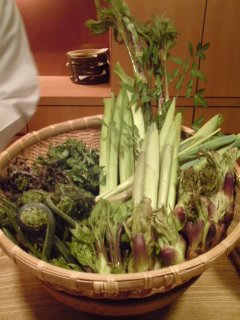
Have you heard of the Japanese mountain vegetables/Sansai/山菜?
It is just mind-boggling to discover them all!
Check: Japanese Mountain Vegetables!

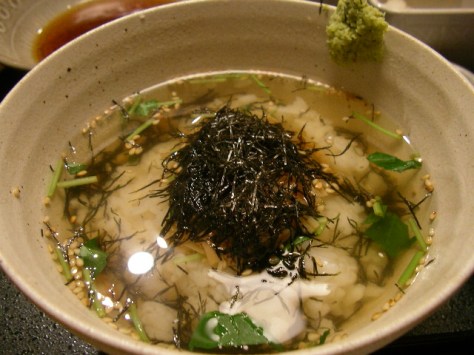
Do not forget that tea and soba can be vegan! How about a combination of tea and soba for a quick lunch?

CHAZUKE-1

Chazuke

And how about Somen, Chazuke, and Tofu?

zarudofu

“Zarudofu”

Learn how to make your own Tofu!

tofu-kinds-5

“Tofu Doughnuts” at Shizutetsu Supermarket in Shizuoka City

Ever heard of Tofu Donuts?
Why don’t you try your hand after reading that easy Vegan Tofu Donut Recipe?

Vegan sushi plate at Sushi Ko, Shizuoka City.

-“I want to eat sushi, but how can I get vegan sushi in Japan?”
That should not be a problem.
First why don’t you have a look at the following:
Vegan & Vegetarian Sushi.
Vegan Sushi Recipe Suggestions.

Just walk around and try to find a friendly Sushi Restaurant along with some friends first and gently ask for vegetable sushi (without the bonito shavings or mayonnaise!). Keep going to the same place and soon or later the chef will enjoy the challenge and even propose you new creations.
Or check the Sushi Rice Basic Recipe and try making it at home!

And Wasabi is also vegan!

Mozuku seaweed served at Yasaitei, Shizuoka City.

Do not forget all the possibilities offered by seaweed, probably the most ubiquitous gastronomic ingredient in this country!
And ther are plenty of varieties: check Seaweed, the Vegetable of the Oceans!
Actually Shizuoka is not only a great producer of agar but also boasts the greatest number of edible seaweed varieties!

The all-organic vegetables lunch tray at Magokoro in Kamakura, Kanagawa Prefecture. They have a vegan version!

I’m not that keen on religion, but if your are a Buddhist, Japanese temples sometimes offer vegan/vegetarian meals! Kamakura is just but an example!

WAGASHI-1

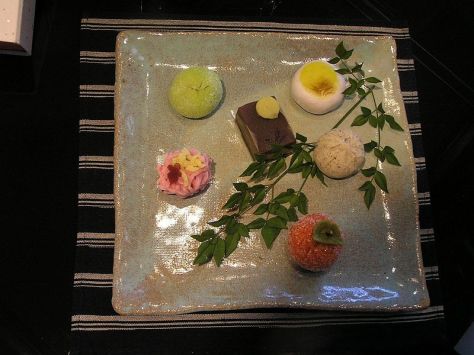
Wagashi Tray.

-“And what for dessert?”
I knew you were going to ask that!
Have you heard of Wagashi?
Just reading about it will make you salivate!

Aright, if you need help, just drop me a line!LOL
At least I sincerely hope I have contributed to the image of Japan you wished to see!

RECOMMENDED RELATED WEBSITES

Masala Herb by Helene Dsouza in Goa, India
Mummy I Can Cook! by Shu Han in London
Pierre.Cuisine, Francescannotwrite, My White Kitchen, 47 Japanese Farms Through The Eyes of Its Rural Communities, Foodhoe, Chucks Eats, Things that Fizz & Stuff, Five Euro Food by Charles,Red Shallot Kitchen by Priscilla,With a Glass, Nami | Just One Cookbook, Peach Farm Studio, Clumsyfingers by Xethia, PepperBento,Adventures in Bento Making, American Bent, Beanbento, Bento No, Bento Wo Tsukurimashou, Cooking Cute, Eula, Hapabento , Happy Bento, Jacki’s Bento Blog, Kitchen Cow, Leggo My Obento, Le Petit Journal Bento & CO (French), Lunch In A Box,
Susan at Arkonlite, Vegan Lunch Box; Tokyo Tom Baker, Daily Food Porn/Osaka, Only Nature Food Porn, Happy Little Bento, The Herbed Kitchen, J-Mama’s Kitchen, Cook, Eat, Play, Repeat, Bento Lunch Blog (German), Adventures In Bento, Anna The Red’s Bento Factory, Cooking Cute, Timeless Gourmet, Bento Bug, Ideal Meal, Bentosaurus, Mr. Foodie (London/UK), Ohayo Bento,

Must-see tasting websites:

-Sake: Tokyo Through The Drinking Glass, Tokyo Foodcast, Urban Sake, Sake World
-Wine: Palate To Pen, Warren Bobrow, Cellar Tours, Ancient Fire Wines Blog
-Beer: Good Beer & Country Boys, Another Pint, Please!
-Japanese Pottery to enjoy your favourite drinks: Yellin Yakimono Gallery

Kyoto Gastronomy: Kyoto Vegetables-Kyoyasai/京野菜

I have just come back from a 3-day “holiday” in Kyoto, a touristic spot famed all over the world.
Kyoto does have its own gastronomy, what with the untold number of temples of different religions and sects.
Vegetables have been the staple of the city for a long time and when they are grown in Kyoto they are simply called “Kyo-yasai” (“kyo” for “Kyoto” and “yasai” for “vegetables”).
There are officially 41 traditional varieties of them including 21 with a registered brand/controlled appelation and 43 more varieties have also been recently recognised as such.

One way to discover them if you do not have the opportunity or time to discover vegetable fields is to visit the long and narrow Nishiki/錦 covered market in Central Kyoto.

Unfortunately, in my own view, the market has turned into a crowded touristic spot with all the pitfalls bound to open under your feet.
The real Kyoto vegetables are the minority and you need to understand Japanese to discern what is real and what is “fake”. I even found anorexic wasabi imported from South Korea!
Moreover, so-called Kyo-yasai are increasingly being grown away from Kyoto, especially in Shizuoka where the single town of Iwata grows 80% of all “ebi-imo”, one of the most representative vegetables of the famed city!

But there is another way to discover those celebrated vegetables for the pleasure of vegans, vegetarians and vegans!
About lunch time or before dinner time, just walk past the restaurants lining the side and back streets!

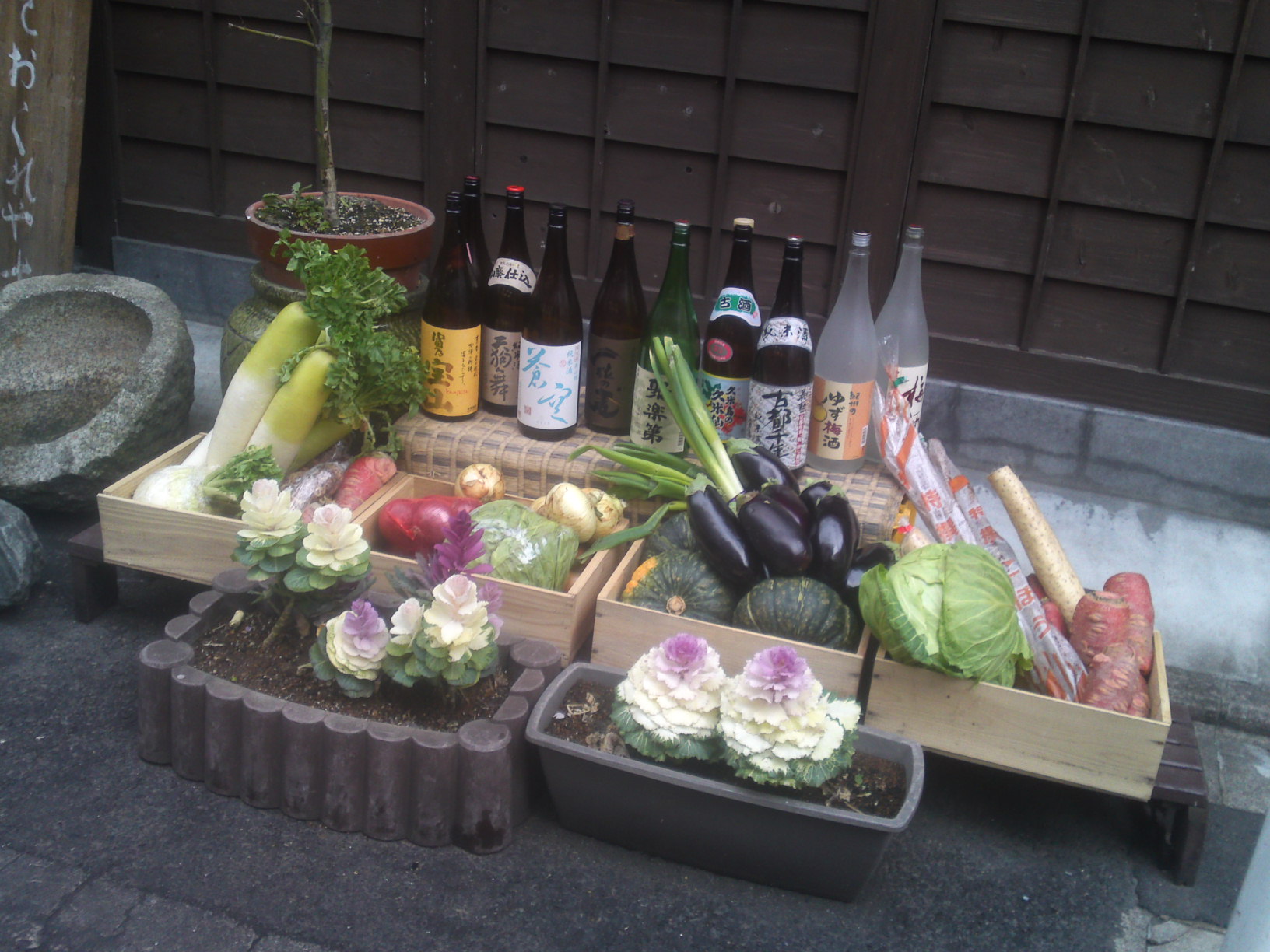
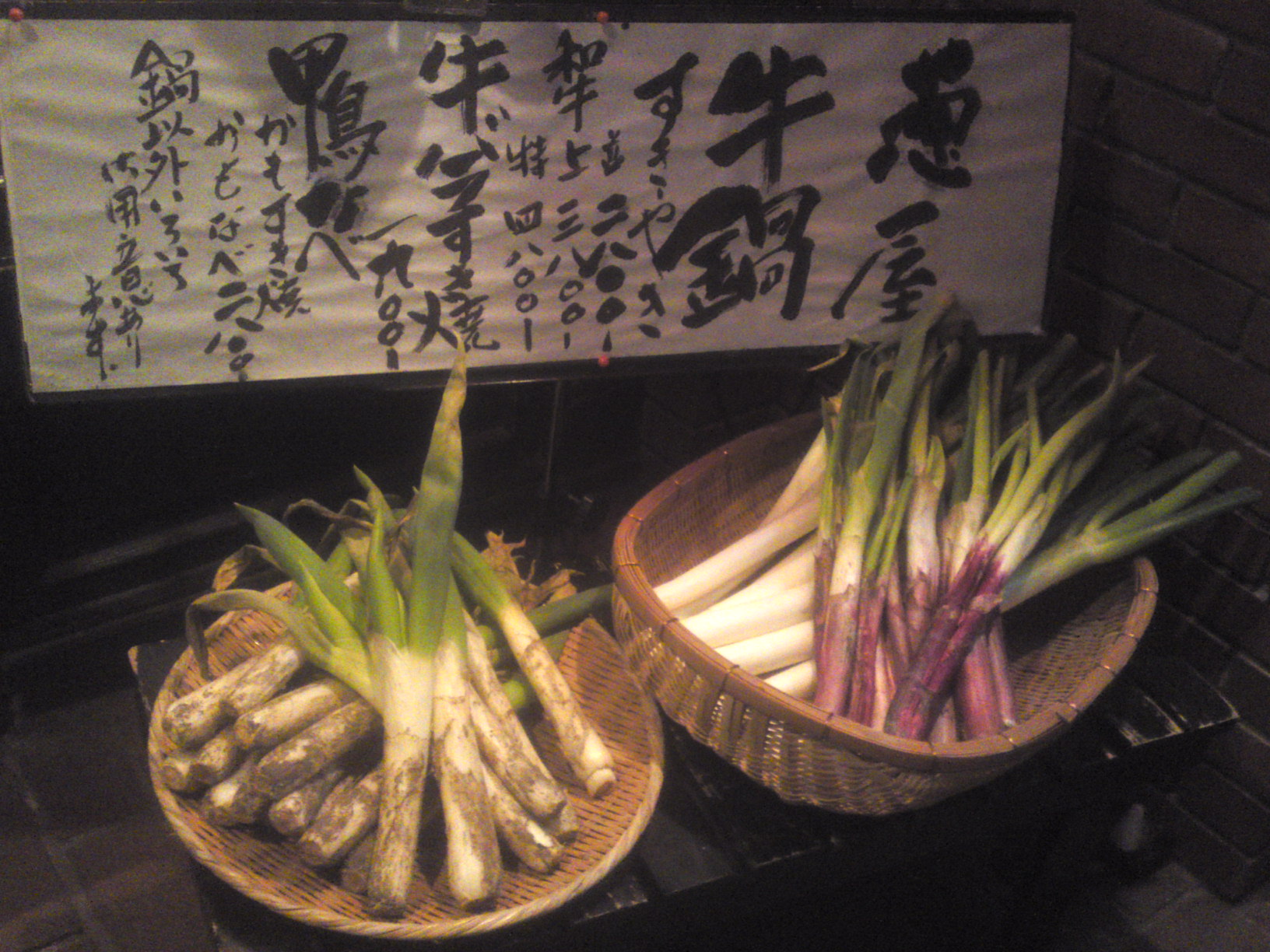
All izakayas and restaurants proud of their vegetables will display them outside for all to see!

They make for great souvenir photographs to show back home!

For a closer view!
Do you recognize any?

Even in front of Italian restaurants!

Placed in front of the outdoors menu board…

For a more distant view to discover the small Japanese restaurant at lunch time!

In front of another busy Japanese restaurant at night!

But this was my favorite!

Lined between a small cabbage garden and a great queue of Japanese sake!

I hope this will give you another idea as to how visit Kyoto!

RECOMMENDED RELATED WEBSITES

Masala Herb by Helene Dsouza in Goa, India
Mummy I Can Cook! by Shu Han in London
Pierre.Cuisine, Francescannotwrite, My White Kitchen, 47 Japanese Farms Through The Eyes of Its Rural Communities, Foodhoe, Chucks Eats, Things that Fizz & Stuff, Five Euro Food by Charles,Red Shallot Kitchen by Priscilla,With a Glass, Nami | Just One Cookbook, Peach Farm Studio, Clumsyfingers by Xethia, PepperBento,Adventures in Bento Making, American Bent, Beanbento, Bento No, Bento Wo Tsukurimashou, Cooking Cute, Eula, Hapabento , Happy Bento, Jacki’s Bento Blog, Kitchen Cow, Leggo My Obento, Le Petit Journal Bento & CO (French), Lunch In A Box,
Susan at Arkonlite, Vegan Lunch Box; Tokyo Tom Baker, Daily Food Porn/Osaka, Only Nature Food Porn, Happy Little Bento, The Herbed Kitchen, J-Mama’s Kitchen, Cook, Eat, Play, Repeat, Bento Lunch Blog (German), Adventures In Bento, Anna The Red’s Bento Factory, Cooking Cute, Timeless Gourmet, Bento Bug, Ideal Meal, Bentosaurus, Mr. Foodie (London/UK), Ohayo Bento,

Must-see tasting websites:

-Sake: Tokyo Through The Drinking Glass, Tokyo Foodcast, Urban Sake, Sake World
-Wine: Palate To Pen, Warren Bobrow, Cellar Tours, Ancient Fire Wines Blog
-Beer: Good Beer & Country Boys, Another Pint, Please!
-Japanese Pottery to enjoy your favourite drinks: Yellin Yakimono Gallery

Japanese Gastronomy: Yuzu Koshio/Lime & Chilies Mix-Recipe

YUZU-KOSHIO-1

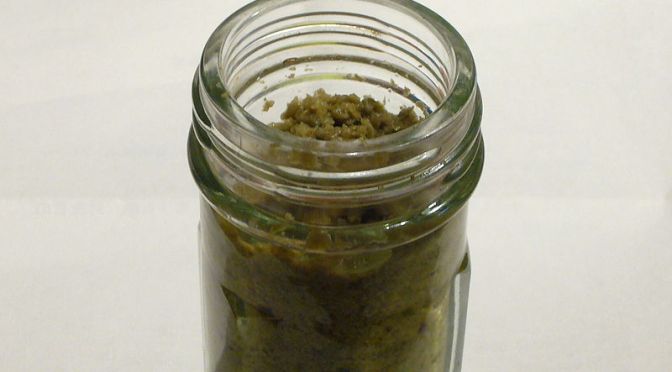
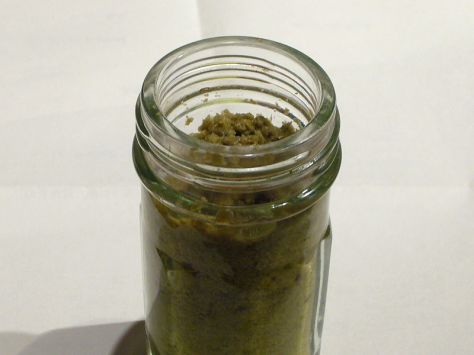
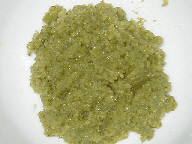
Yuzu Koshio or lime and Chili mix is prepared with green hot chili (as opposed to red one) and lime skin/zest.
It is quite comnon in Kyushu Island, especially in Oita Prefecture, as well as far as in Okinawa.
It is quickly becoming more and more popular all over Japan, and is even locally produced in our Prefecture, Shizuoka!
It is a very versatile condiment that can be used in all kinds of Asian cuisines by vegans, vegetarians and omnivores alike!

Here is a simple recipe. Don’t forget you can replace green chilies with red chilies for two varieties!

INGREDIENTS:

-Green lime: 1 large
-Fresh green chilies: 6
-Salt: to taste

RECIPE:

YUZU-KOSHIO-2

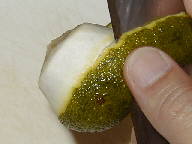
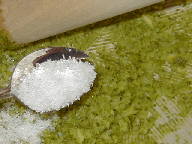
-Peel the lime.
Wash the lime zests and green chilies in clean cold water.

YUZU-KOSHIO-3

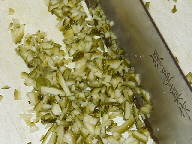
-Chop lime zests as fine as possible.

YUZU-KOSHIO-4

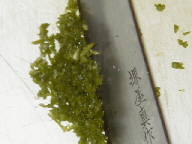
-Cut the chilies in two, discard the seeds and chop them all as fine as possible.

YUZU-KOSHIO-5

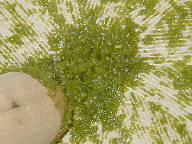
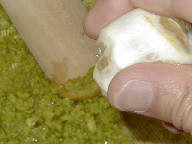
-Grind lime zests and chilies with a pestle so as to obtain a paste.

YUZU-KOSHIO-6

-Add salt (experimentation might be needed there) and mix well.

YUZU-KOSHIO-7

-Add lime juice (experimentation might be needed there, too) and mix well.

YUZU-KOSHIO-8

-Wrap the mix in cellophane paper and store in a tupperware box, or pour it inside a small bottle. Keep it in the fridge away from the light.
Consume as soon as possible!

RECOMMENDED RELATED WEBSITES

Masala Herb by Helene Dsouza in Goa, India
Mummy I Can Cook! by Shu Han in London
Pierre.Cuisine, Francescannotwrite, My White Kitchen, 47 Japanese Farms Through The Eyes of Its Rural Communities, Foodhoe, Chucks Eats, Things that Fizz & Stuff, Five Euro Food by Charles,Red Shallot Kitchen by Priscilla,With a Glass, Nami | Just One Cookbook, Peach Farm Studio, Clumsyfingers by Xethia, PepperBento,Adventures in Bento Making, American Bent, Beanbento, Bento No, Bento Wo Tsukurimashou, Cooking Cute, Eula, Hapabento , Happy Bento, Jacki’s Bento Blog, Kitchen Cow, Leggo My Obento, Le Petit Journal Bento & CO (French), Lunch In A Box,
Susan at Arkonlite, Vegan Lunch Box; Tokyo Tom Baker, Daily Food Porn/Osaka, Only Nature Food Porn, Happy Little Bento, The Herbed Kitchen, J-Mama’s Kitchen, Cook, Eat, Play, Repeat, Bento Lunch Blog (German), Adventures In Bento, Anna The Red’s Bento Factory, Cooking Cute, Timeless Gourmet, Bento Bug, Ideal Meal, Bentosaurus, Mr. Foodie (London/UK), Ohayo Bento,

Must-see tasting websites:

-Sake: Tokyo Through The Drinking Glass, Tokyo Foodcast, Urban Sake, Sake World
-Wine: Palate To Pen, Warren Bobrow, Cellar Tours, Ancient Fire Wines Blog
-Beer: Good Beer & Country Boys, Another Pint, Please!
-Japanese Pottery to enjoy your favourite drinks: Yellin Yakimono Gallery

Japanese Gastronomy: Steamed Sushi-Recipe

A foodie friend of mine, was just mentioning she could not wait to come to Japan to eat sushi, as it was just frustrating and terribly expensive in her own country.
Well, why not making it yourself, then?
“It’s too difficult and one cannot get the ingredients!”
Really? There must be enough stores all over the world by now which sell the basics. So why don’t you try this simple recipe for a start!

Steamed sushi!

INGREDIENTS: For 3~ people

-Rice: 3 cups/600 cc

Sushi vinegar:
-Rice vinegar: 3 tablespoons
-Sugar: just under 3 tablespoons
-Salt: 1 teaspoon

-Conger eels (anago/穴子): 3 (can be bought frozen)
-Soy sauce: 2 tablespoons
-Mirin/Japanese sweet sake: 2 tablespoons

-Dried shiitake mushrooms: 3~4 (medium-sized)
-Dashi/Japanese soup stock: 1 cup/200 cc/ml
-Sugar: 1 tablespoon
-Soy sauce:1 tablespoon

-Trefoil or Italian Parsley: 1 bunch

-Eggs: 5
-Sugar: 1 teaspoon
-Salt: 1/2 teaspoon

-Amazu jinja/ginger marinated in sweet vinegar: as appropriate for decoration/seasoning

RECIPE:

-Wash rice and steam in the normal way

-Unless you can buy the conger eels already cooked and seasoned, cut their heads and tail, cut in half lengthwise and across again into one-bite sized pieces. Fry slowly with soy sauce and mirin/sweet sake until cooked and well-impregnated with seasoning sauce. Set apart.

-In a pan pour the dashi/Japanese soup stock. Add the dried shiitake and stew until the mushrooms have become soft. Add the sugar and soy sauce. Keep simmering until all liquid has disappeared. Let cool. Cut into fine slices. Set apart.

-Drop the trefoil in hot salted water for a few seconds. Drain well and cut into 2 cm long pieces.

-Make a thin omelette with the eggs beaten with sugar and salt. Cut into thin threads.

-Once the rice has been steamed, transfer it into a large vessel (wooden preferably, but a large ceramic dish will do). add the rice vinegar, sugar and salt evenly over it. Mix by “cutting in” the rice with a wet paddle. Add conger eels and their juices, shiitake mushrooms and mix lightly.

-Place an equal amount of the rice into bowls and steam (with a lid on) for 15 minutes over a strong fire. Open the lid, place an equal amount of egg ribbons and steam again for 1 more minute.

-Serve topped with trefoil and sweet vinegar marinated ginger!

RECOMMENDED RELATED WEBSITES

Masala Herb by Helene Dsouza in Goa, India
Mummy I Can Cook! by Shu Han in London
Pierre.Cuisine, Francescannotwrite, My White Kitchen, 47 Japanese Farms Through The Eyes of Its Rural Communities, Foodhoe, Chucks Eats, Things that Fizz & Stuff, Five Euro Food by Charles,Red Shallot Kitchen by Priscilla,With a Glass, Nami | Just One Cookbook, Peach Farm Studio, Clumsyfingers by Xethia, PepperBento,Adventures in Bento Making, American Bent, Beanbento, Bento No, Bento Wo Tsukurimashou, Cooking Cute, Eula, Hapabento , Happy Bento, Jacki’s Bento Blog, Kitchen Cow, Leggo My Obento, Le Petit Journal Bento & CO (French), Lunch In A Box,
Susan at Arkonlite, Vegan Lunch Box; Tokyo Tom Baker, Daily Food Porn/Osaka, Only Nature Food Porn, Happy Little Bento, The Herbed Kitchen, J-Mama’s Kitchen, Cook, Eat, Play, Repeat, Bento Lunch Blog (German), Adventures In Bento, Anna The Red’s Bento Factory, Cooking Cute, Timeless Gourmet, Bento Bug, Ideal Meal, Bentosaurus, Mr. Foodie (London/UK), Ohayo Bento,

Must-see tasting websites:

-Sake: Tokyo Through The Drinking Glass, Tokyo Foodcast, Urban Sake, Sake World
-Wine: Palate To Pen, Warren Bobrow, Cellar Tours, Ancient Fire Wines Blog
-Beer: Good Beer & Country Boys, Another Pint, Please!
-Japanese Pottery to enjoy your favourite drinks: Yellin Yakimono Gallery

Japanese Gastronomy: Oysters steamed in Rice/Kaki Meshi Recipe

Winter means a large supply of fresh oyters in Japan and many other countries! But we certainly need some fresh and simple ideas to consume them, even if raw oysters are the norm.
Oyster chowder is a traditional option for example.
Have you heard of this typical Japanese dish called “Kaki Meshi/牡蠣飯, or oysters steamed in rice?
It has the advantage of being a hearty, simple and very healthy recipe.

Here is the basic recipe. There are plenty of options open for it!

INGREDIENTS: As I often do with basic Japanese recipes, I leave it to you as for exact quantities to accomodate personal preferences and priorities.

-Oysters/蠣
-Rice/米
-Soy sauce/醤油
-Japanese sake/酒
-Dashi/Japanese soup stock/出汁
-Grated daikon/大根おろし
-Ginger/生姜/cut into very fine strips
-Lime/yuzu/柚子/grated zest
-Thin leeks/子葱/コネギ
-Trefoil/Mitsuba/三葉

RECIPE:

Oysters:
Using fresh oysters in their shells (don’t forget to take them out!LOL) is a bit too extravagant for this recipe, and hard work.
In Japan they can be found in any markets sold packed in water. This country being very strict on hygiene rules, I have no problem using them.

Rice:
Prepare the rice before opening the pack of oysters.
3 “go”, or about 540 cc (liquid measure) should be enough. Use Japanese round rice. Check if it has to be washed first or not, as both varieties are available.
(After washing the rice, if necessary) let soak the rice in clear water for 30 minutes.
Drain thoroughly.

Massaging the oysters in grated daikon:
This is a very important step which will ensure that the oysters are properly cleaned.
Prepare enough grated daikon.
If you use oysters just taken out of their shells, massaging them with salt might be better.
Wash quickly under clear clean water and drain thoroughly.

Pre-cooking the oysters:
In pan pour just enough sake and soft soy sauce variety to simmer the the oysters in for 2~3 minutes.
The more sake, the better!
Do experiment!

Sieving/filter the juices:
Take oysters out with a sieve ladle and keep aside.
Strain/filter the juices into the rice cooker.

Preparing the rice steaming liquid/soup:
Add dashi/Japanese soup stock so that the total liquid is the equivalent of the rice volume x 1.2=about 650 cc.

Steaming:
Pour the rice into the steaming liquid.
Place oysters and ginger on top.
Close rice cooker and switch on.

Wait until the rice is cooked.
DO NOT OPEN the cooker at once, but leave it closed for 10 more minutes!
Open the cooker.
Drop in 90% of the chopped thin leeks, grated yuzu zest and cut trefoil.
Mix in quickly.
Serve at once sprinkled with some more thin leeks, grated yuzu and cut trefoil.

RECOMMENDED RELATED WEBSITES

Masala Herb by Helene Dsouza in Goa, India
Mummy I Can Cook! by Shu Han in London
Pierre.Cuisine, Francescannotwrite, My White Kitchen, 47 Japanese Farms Through The Eyes of Its Rural Communities, Foodhoe, Chucks Eats, Things that Fizz & Stuff, Five Euro Food by Charles,Red Shallot Kitchen by Priscilla,With a Glass, Nami | Just One Cookbook, Peach Farm Studio, Clumsyfingers by Xethia, PepperBento,Adventures in Bento Making, American Bent, Beanbento, Bento No, Bento Wo Tsukurimashou, Cooking Cute, Eula, Hapabento , Happy Bento, Jacki’s Bento Blog, Kitchen Cow, Leggo My Obento, Le Petit Journal Bento & CO (French), Lunch In A Box,
Susan at Arkonlite, Vegan Lunch Box; Tokyo Tom Baker, Daily Food Porn/Osaka, Only Nature Food Porn, Happy Little Bento, The Herbed Kitchen, J-Mama’s Kitchen, Cook, Eat, Play, Repeat, Bento Lunch Blog (German), Adventures In Bento, Anna The Red’s Bento Factory, Cooking Cute, Timeless Gourmet, Bento Bug, Ideal Meal, Bentosaurus, Mr. Foodie (London/UK), Ohayo Bento,

Must-see tasting websites:

-Sake: Tokyo Through The Drinking Glass, Tokyo Foodcast, Urban Sake, Sake World
-Wine: Palate To Pen, Warren Bobrow, Cellar Tours, Ancient Fire Wines Blog
-Beer: Good Beer & Country Boys, Another Pint, Please!
-Japanese Pottery to enjoy your favourite drinks: Yellin Yakimono Gallery

Gastronomic Feast: Spring Dinner by Pissenlit and Nori-Behind the Scene!

On Saturday March 10th a very special dinner organised by two of the best chefs in Shizuoka, Fuminori Nishitani/藤谷文紀 of Nori in Fujieda City and Tooru Arima/有馬亨 of Pissenlit in Shizuoka City was held at Pissenlit Restaurant in Shizuoka City with the help of two great farmers, Mr. Yoshinori Iguchi/井口芳則 in Fujieda City and Mr. Masaaki Hirakaki/平垣正明 in Fujinomiya City who provided the vegetables. most of them organic!

The event was called:
“春の食の都 仕事人ウイーク”スペシャルディナー
“Spring Gastronomy City (Shizuoka) Chefs Week” Special Dinner

For once I was not sitting at the table enjoying the food and drinks but in the kitchen reporting behind the scene(s)!
This report is thus a photography rendition of the event seen from the other side of the fence:

Tooru Arima/有馬亨 and Fuminori Nishitani/藤谷文紀!

The dining room staff planning in the dark…

table setting.

White Asparagus flans were ready.

What are these dried mini carrots for?

We’Il see those again later!

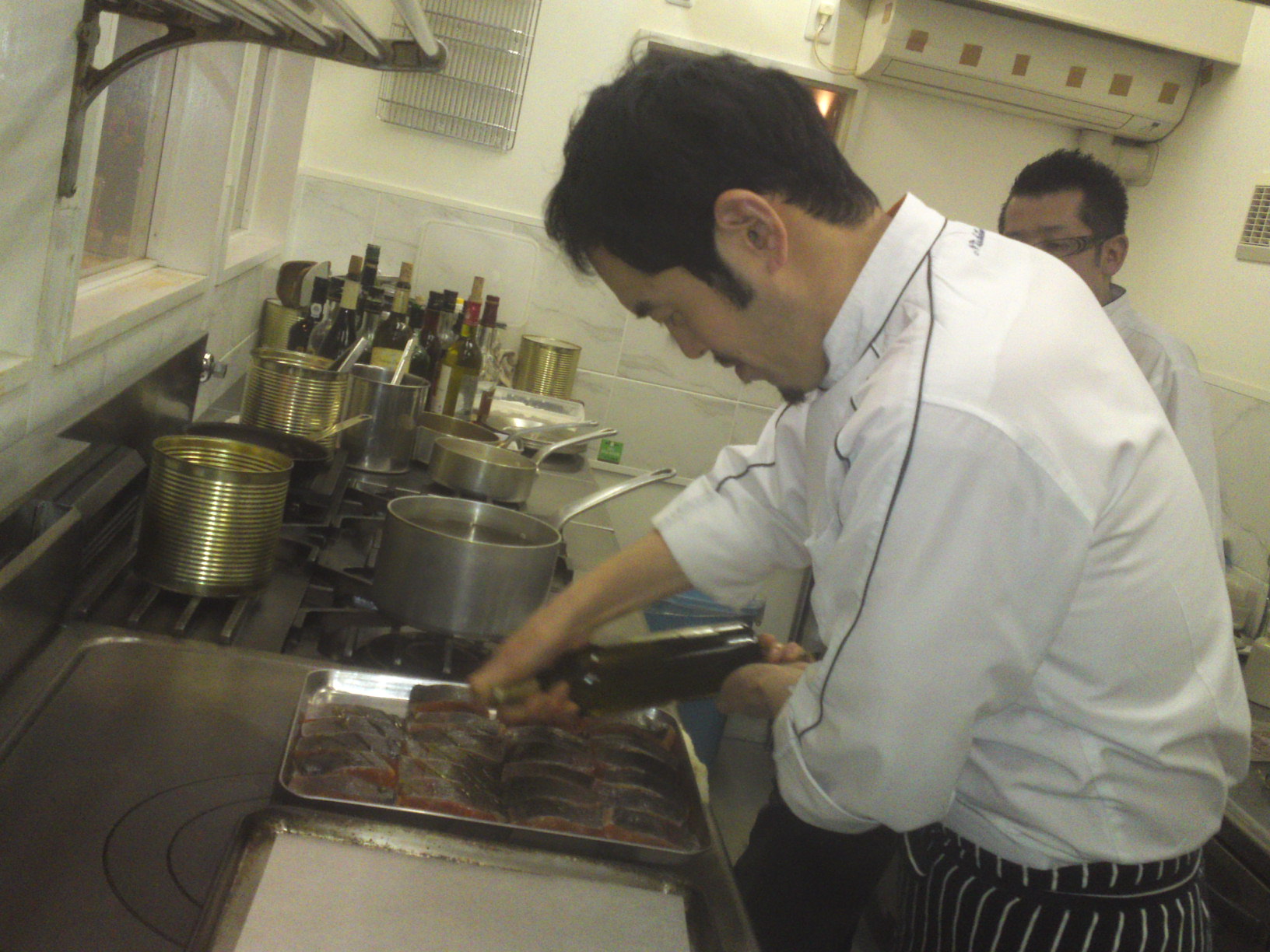
Seasoning the fish.

Was that enough seasoning?
Yup!

The dining room is ready to welcome the guests!

Rainbow Trout from Kunugi Fish Farm in Fujinomya City!

Getting ready for the aperitifs!

Mr. Yoshinori Iguchi/井口芳則 and Mr. Masaaki Hirakaki/平垣正明, the men who made it possible!

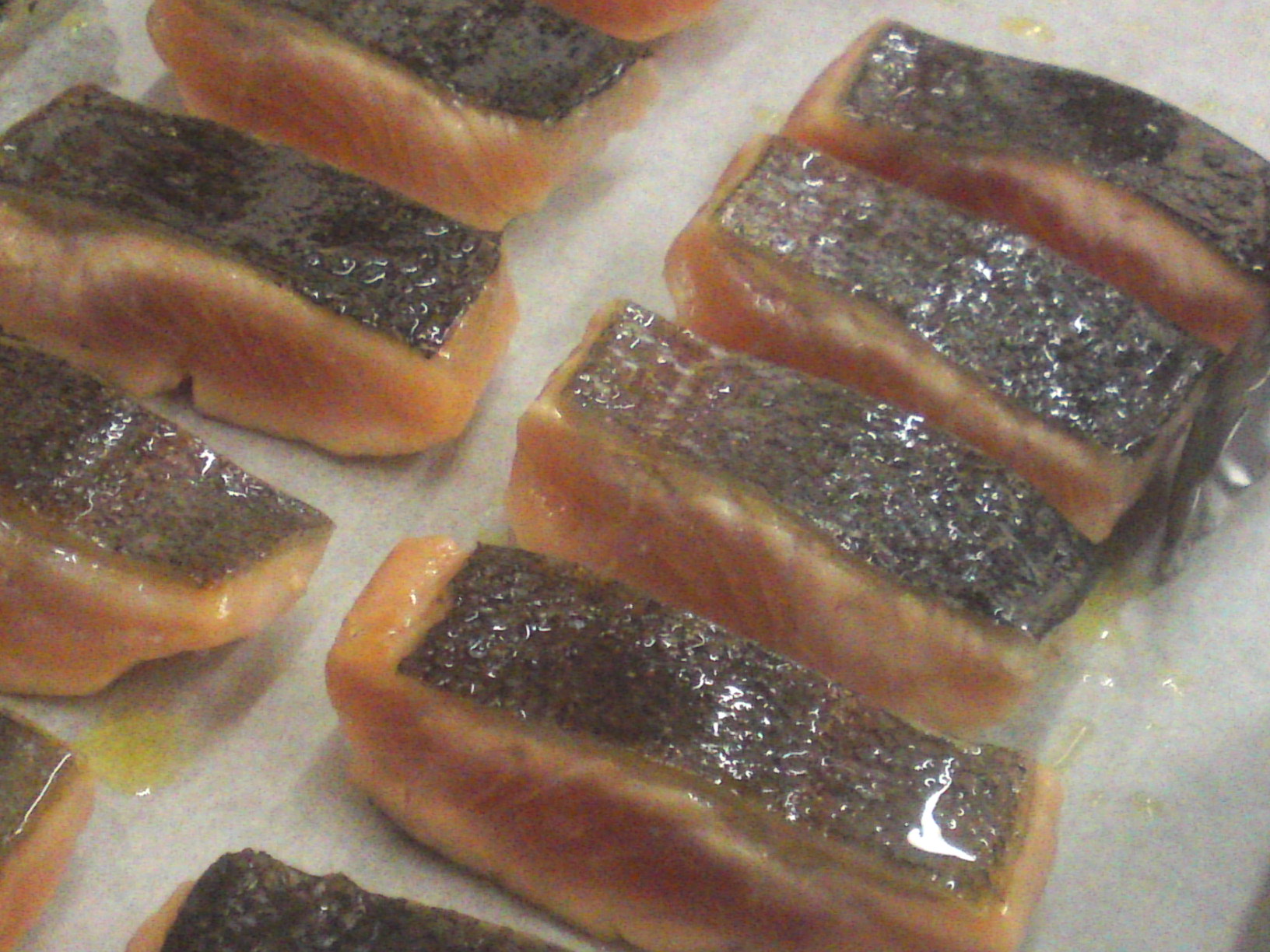
Searing the fish beforehand.

Only seared but already beautiful!

Home-made bread naturally!

Organic vegetables!

The aperitif was umeshu flavored with matcha by Fuji Takasago Brewery in Fujinomiya City!

Brushing pies with egg yolk.

The first (cold) hors d’oeuvre taking shape.

I had a hard time keeping my hands off these!

Adding the Genovese capellini.

The first cold hors d’oeuvres!

Searing the veal caillette in crepinette!

The second (hot) hors d’oeuvres in the starting blocks!

The white asparagus flans on parade.

Almost ready with the leek and spinach pies flavored with truffles!

The second (hot) hors d’oeuvres!

Oura burdock chips.

Oura burdock veloute.

Takinogawa burdock agnelotti being boiled!

The pasta dish taking shape!

Almost ready…

Some Pecorino cheese…

The pasta dish!

Some veal caillette in crepinette still to be prepared.

Fresh bamboo shoots from Fujieda City!

The sasa bamboo leaves to support the fish.

Shiso/perilla flowers for decoration.

The fish course taking shape.

Almost ready…

Rainbow trout on a black plate!

The same on a white plate!

Back to the veal caillettes in crepinete…

The same being seared…

into the oven…

The sauce!

finished with a torch instead of a salamander!

Onto the plates…

A meat dish so simple and so beautiful!

The last touch!

The meat course!

Organic deep red carrot gelato!

Sugar on the dried carrots…

Organic Takinogawa burdock tart!

You won’t find these outside Japan!

Such a healthy and beautiful dessert!

Time to go!

Incidentally, part of the bill was earmarked for charity for the victims of the Fukushima disaster!

PISSENLIT

420-0839 Shizuoka City, Aoi Ku, Takajo, 2-3-4
Tel.: 054-270-8768
Fax: 054-627-3868
Business hours: 11:30~14:30; 17:00~22:00
Closed on Tuesdays and Sunday evening
HOMEPAGE (Japanese)
E-Mail: pissenlit2008@ybb.ne.jp
Credit Cards OK
Entirely non-smoking!

NORI

426-0204 Shizuoka Ken, Fujieda Shi, Tokigaya, 864-3
Tel./Fax: 054-641-4778
Opening hours: 11:30~14:00; 18:00~22:00
On reservation only for dinner
Closed on Tuesdays and first Monday
Credit cards OK
HOMEPAGE (Japanese, but do check it for great photographs of the house and garden!)
Entirely non-smoking!

RECOMMENDED RELATED WEBSITES

Masala Herb by Helene Dsouza in Goa, India
Mummy I Can Cook! by Shu Han in London
Pierre.Cuisine, Francescannotwrite, My White Kitchen, 47 Japanese Farms Through The Eyes of Its Rural Communities, Foodhoe, Chucks Eats, Things that Fizz & Stuff, Five Euro Food by Charles,Red Shallot Kitchen by Priscilla,With a Glass, Nami | Just One Cookbook, Peach Farm Studio, Clumsyfingers by Xethia, PepperBento,Adventures in Bento Making, American Bent, Beanbento, Bento No, Bento Wo Tsukurimashou, Cooking Cute, Eula, Hapabento , Happy Bento, Jacki’s Bento Blog, Kitchen Cow, Leggo My Obento, Le Petit Journal Bento & CO (French), Lunch In A Box,
Susan at Arkonlite, Vegan Lunch Box; Tokyo Tom Baker, Daily Food Porn/Osaka, Only Nature Food Porn, Happy Little Bento, The Herbed Kitchen, J-Mama’s Kitchen, Cook, Eat, Play, Repeat, Bento Lunch Blog (German), Adventures In Bento, Anna The Red’s Bento Factory, Cooking Cute, Timeless Gourmet, Bento Bug, Ideal Meal, Bentosaurus, Mr. Foodie (London/UK), Ohayo Bento,

Must-see tasting websites:

-Sake: Tokyo Through The Drinking Glass, Tokyo Foodcast, Urban Sake, Sake World
-Wine: Palate To Pen, Warren Bobrow, Cellar Tours, Ancient Fire Wines Blog
-Beer: Good Beer & Country Boys, Another Pint, Please!
-Japanese Pottery to enjoy your favourite drinks: Yellin Yakimono Gallery
Shizuoka Sake Bar: Sachiho in Shizuoka City!

Some famous Shizuoka Sake!

Service: Very friendly and informal
Facilities: Very clean overall. Superb washroom
Prices: Reasonable
Strong points: Shizuoka Sake of course!

At long last a bar that offers a wide range of Shizuoka sakes as a theme was opened last December in Shizuoka City!
And it is entirely non-smoking!

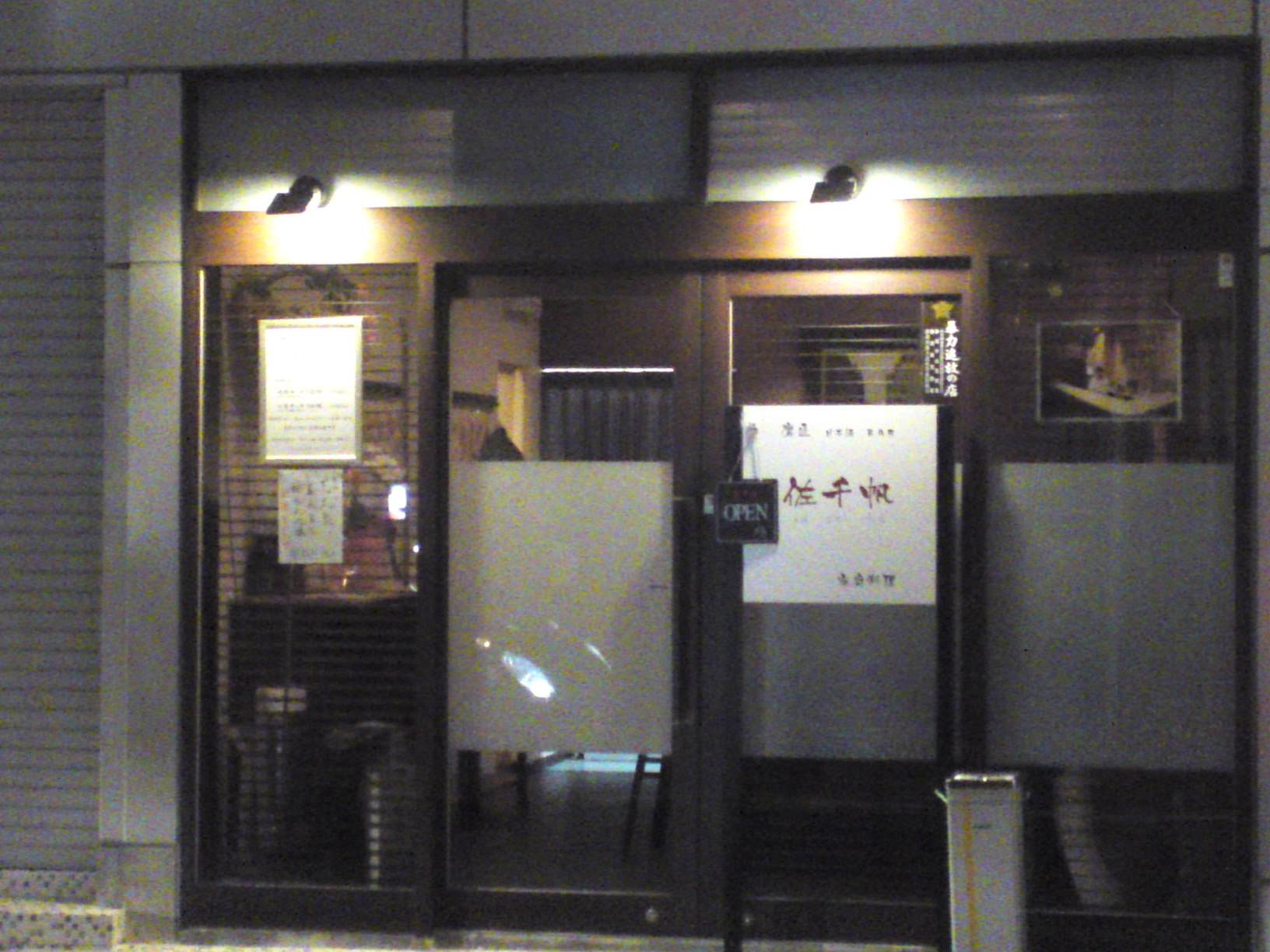
Mind you, since it opens at 5 pm, it is not always easy to take pictures outside or inside if you do not want to bother people with a flash!

It is conveniently tucked away in Takajo, Aoi Ku, a very busy place at night.
It also has the merit to be patronized both by ladies and gentlemen, mostly real Japanese and Shizuoka sake connoisseurs!

Ms. Sachiho Nagasawa/長沢佐線帆さん has shochu with her own label!

Plenty of sake on display but I know for a fact there are some hidden (better become a regular customer! LOL)!

There are only 7 seats at the counter.
No risk of a noisy crowd, although it might be a good idea to reserve!

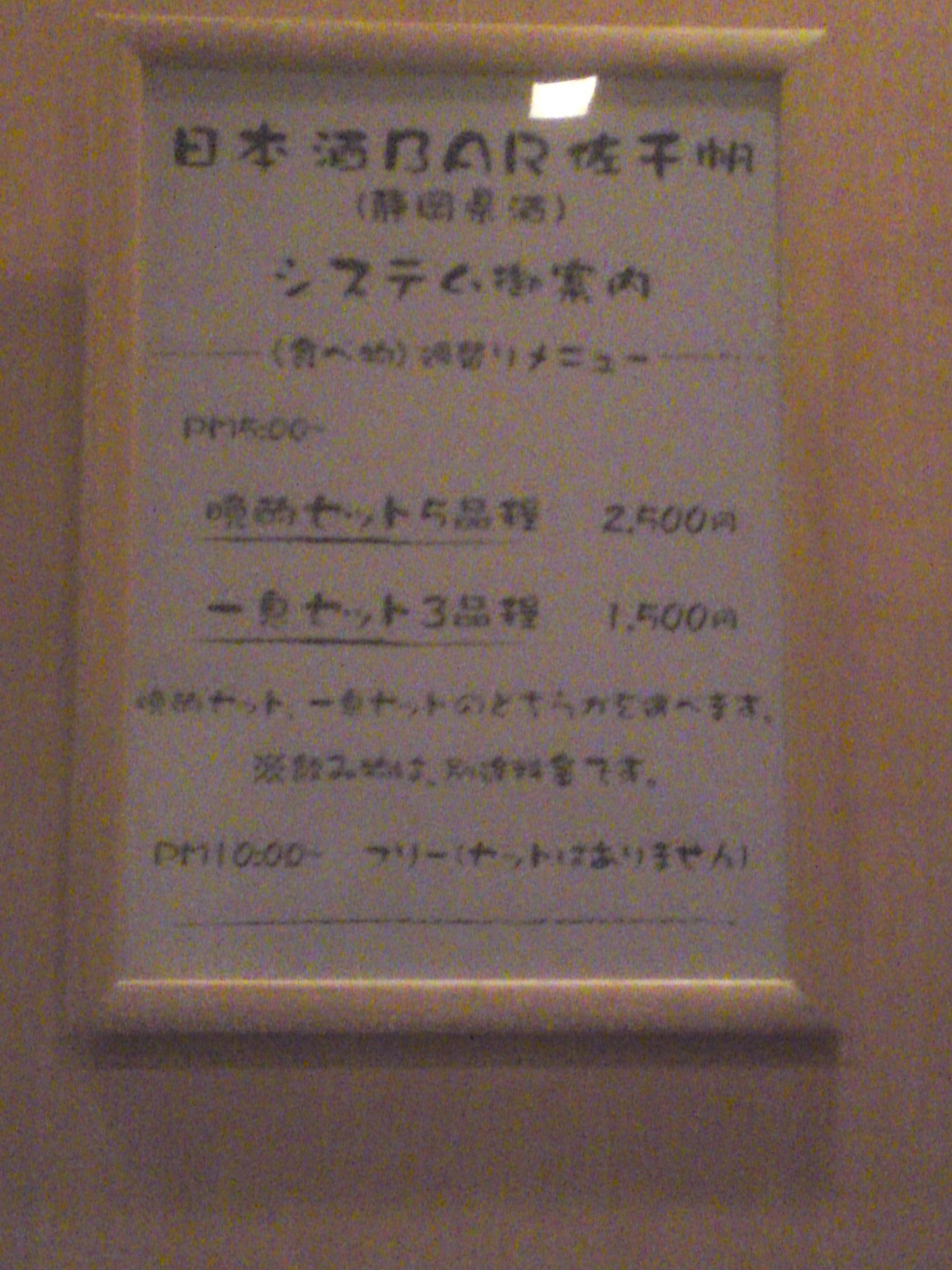
The system is pretty simple:
Between 05:00 and 10:00 you must choose between the menus at 1,500 yen or 2,500 yen, all home-style food.
After 10:00 only drinks is ok!

A nice message on your paper napkin!

Now I like that! The sake is served in wine glasses for proper tasting!
Do confer with Sachiho San before choosing your sake!

All typical local homey food!
Shizuoka oden!

Salad.
Sorry for the fuzzy pictures.
It was my first visit and my “camera” did not agree with me!
In any case I will come again soon and I promise better pics!

Simmered sardine.

Stewed chicken and vegetables.

Savory salad.

Japanese pickles.

Don’t worry, I’ll be back there very soon!
I’m actually thinking of conducting some real tasting late at night there!

To be continued…

Sachiho Japanese Sake Bar
420-0389 Shizuoka City, Aoi Ku, Takajyo, 1-49
Tel.: 054-255-6767
Opening hours: 17:00~24:00
Closed on Sundays & Mondays

RECOMMENDED RELATED WEBSITES

Masala Herb by Helene Dsouza in Goa, India
Mummy I Can Cook! by Shu Han in London
Pierre.Cuisine, Francescannotwrite, My White Kitchen, 47 Japanese Farms Through The Eyes of Its Rural Communities, Foodhoe, Chucks Eats, Things that Fizz & Stuff, Five Euro Food by Charles,Red Shallot Kitchen by Priscilla,With a Glass, Nami | Just One Cookbook, Peach Farm Studio, Clumsyfingers by Xethia, PepperBento,Adventures in Bento Making, American Bent, Beanbento, Bento No, Bento Wo Tsukurimashou, Cooking Cute, Eula, Hapabento , Happy Bento, Jacki’s Bento Blog, Kitchen Cow, Leggo My Obento, Le Petit Journal Bento & CO (French), Lunch In A Box,
Susan at Arkonlite, Vegan Lunch Box; Tokyo Tom Baker, Daily Food Porn/Osaka, Only Nature Food Porn, Happy Little Bento, The Herbed Kitchen, J-Mama’s Kitchen, Cook, Eat, Play, Repeat, Bento Lunch Blog (German), Adventures In Bento, Anna The Red’s Bento Factory, Cooking Cute, Timeless Gourmet, Bento Bug, Ideal Meal, Bentosaurus, Mr. Foodie (London/UK), Ohayo Bento,

Must-see tasting websites:

-Sake: Tokyo Through The Drinking Glass, Tokyo Foodcast, Urban Sake, Sake World
-Wine: Palate To Pen, Warren Bobrow, Cellar Tours, Ancient Fire Wines Blog
-Beer: Good Beer & Country Boys, Another Pint, Please!
-Japanese Pottery to enjoy your favourite drinks: Yellin Yakimono Gallery
Austrian Gastronomy: Austrian Cake Factory in Fujieda City!

Yesterday my good friend Pat, a cake lover if there is one, kindly drove me all the way to Fujieda City in Kariyado away from it all to pay a visit to an Austrian Chef and his wife who have been creating succulent Austrian cakes and other desserts for the past three years.

Peter Golbach who plied his trade in Wien, New York, Lyon before meeting his wife Shouko/昌子 in Wien where she worked for Sony Co., came to Fujieda City three years to establish a bakery with his wife in her large parents’ house.

It takes a little bit of driving to reach their place but it is worth the effort as you run across some beautiful land off the beaten tracks!

“Austrian Cake Factory”!

If you plan to pay them a deserved visit contact them on their mobile phone first!

The bakery may be Austrian but this is rural Japan!
Peter and his lively wife Shoko are a model of great hospitality and passion for their trade. It was a personal pleasure to meet them in person, I can assure you!

All the cakes and desserts are created in a very clean, sensible, practical and no-frill kitchen!

The ultra modern oven to bake Peter’s creations!

Peter and his wife create 7 varieties of Kugelhof and 1 Sachertorte as well as Vanille Kiffel crescent biscuits, order-made chocolate cakes and cheese cakes and other desserts.
All ingredients are natural and among them feature their own gyokuro tea macha and yuzu lime!

Some of their succulent and beautiful Kugelhof!

My favorite, the Fujieda gyokuro tea macha Kugelhof, a true Shizuoka Kugelhof!

One of Peter’s specialties: Yoghurt and Yuzu Cake!

An order-made Birthday Cake!

The four of us shared a long talk around coffee and some of their cakes reminiscing about the “joys of Europe”!
I had a hard time wrenching myself off their so hospitable home and table!

But I didn’t take my leave before savoring a magnificent yoghurt and lemon mousse!

Peter and Shoko will be selling their cakes in Aoba Park Street in Shizuoka City for 3 days in May.
I will have the pleasure to interview them again and I will announce it in good time beforehand!

Cakes can be ordered and reserved over the phone or by e-mail. Ask for directions!

Peter & Shoko Golbach at Austrian Cake Factory
426-0001, Fujieda City, Kariyado, 1092
E-mail: shoko-amano@hotmail.com
Mobile phone: 090-1629-3004
HOMEPAGE

RECOMMENDED RELATED WEBSITES

Masala Herb by Helene Dsouza in Goa, India
Mummy I Can Cook! by Shu Han in London
Pierre.Cuisine, Francescannotwrite, My White Kitchen, 47 Japanese Farms Through The Eyes of Its Rural Communities, Foodhoe, Chucks Eats, Things that Fizz & Stuff, Five Euro Food by Charles,Red Shallot Kitchen by Priscilla,With a Glass, Nami | Just One Cookbook, Peach Farm Studio, Clumsyfingers by Xethia, PepperBento,Adventures in Bento Making, American Bent, Beanbento, Bento No, Bento Wo Tsukurimashou, Cooking Cute, Eula, Hapabento , Happy Bento, Jacki’s Bento Blog, Kitchen Cow, Leggo My Obento, Le Petit Journal Bento & CO (French), Lunch In A Box,
Susan at Arkonlite, Vegan Lunch Box; Tokyo Tom Baker, Daily Food Porn/Osaka, Only Nature Food Porn, Happy Little Bento, The Herbed Kitchen, J-Mama’s Kitchen, Cook, Eat, Play, Repeat, Bento Lunch Blog (German), Adventures In Bento, Anna The Red’s Bento Factory, Cooking Cute, Timeless Gourmet, Bento Bug, Ideal Meal, Bentosaurus, Mr. Foodie (London/UK), Ohayo Bento,

Must-see tasting websites:

-Sake: Tokyo Through The Drinking Glass, Tokyo Foodcast, Urban Sake, Sake World
-Wine: Palate To Pen, Warren Bobrow, Cellar Tours, Ancient Fire Wines Blog
-Beer: Good Beer & Country Boys, Another Pint, Please!
-Japanese Pottery to enjoy your favourite drinks: Yellin Yakimono Gallery
Bryan Baird’s Newsletter (2012/03/09): Seasonal Release: Second Strike Apple Ale; Upcoming Taproom Event: Lucky 7 Stout Week

Baird Beer & Taproom Events Bulletin
bryan-sayuri.gif

Seasonal Release: Second Strike Apple Ale; Upcoming Taproom Event: Lucky 7 Stout Week

Dear Taproom Friend & Baird Beer Enthusiast:

March is the month of dynamic transition from winter to spring. As brewers, we try to embody this change with equal dynamism in the lineup of beers which we release. Today we are tapping a seasonal beer whose beauty is fully intertwined with the bounty of nature: Second Strike Apple Ale.

New Baird Beer Seasonal Release:

*Second Strike Apple Ale (ABV 5.5%): The concept, and the succulent Nagano prefecture apples, for this brisk and refreshing fruited ale, brewed for a third consecutive year, were provided by our friends at the Harajuku-based company Alias. This year we have lowered the wort strength considerably (from 13.6 to 11.9 plato) and lightened the hopping (25 to 15 IBUs) in order to accentuate more fully the wonderful flavor of the Nagano apples we use. We mashed long and low to achieve a very high fermentation attenuation (88.2%) and thus a dry, cider-like character. We fermented this year with our house Scottish ale yeast. The result is our best Second Strike Apple Ale to date.

Second Strike Apple Ale is on tap at each of our Taproom pubs and is available for immediate shipment (kegs and bottles) to Japan-based Baird Beer retailers.

Upcoming Taproom Events:
*Lucky 7 Stout Week @ Nakameguro Taproom (March 17 – March 23):

Each of the past several years we have used the Irish national holiday, St. Patrick’s Day (March 17), as an excuse to celebrate the quintessential Irish ale style — Stout. Stout, of course, is a wonderful pitch-black ale that enjoys many stylistic manifestations. We serve up seven different interpretations of Stout during our week-long celebration which we call Lucky 7 Stout Week. This year we will be holding Lucky 7 Stout Week at our Nakameguro Taproom, kicking off at noon on Saturday, March 17 and running through Friday, March 23.

The Stout list this year is as follows:

Mama’s Milk Stout
Chocolate Wheat Stout
Smoke & Fire Stout (brewed with smoked base malt and Habanero peppers)
Midnight Oil Export Stout
Morning Coffee Stout
Belgian Chocolate Stout
Dark Sky Imperial Stout
Our wonderful year-round Dry Irish Stout, Shimaguni Stout, will round out the Baird Stout lineup. Additionally, we plan to serve a few specialty guest Stouts from other world craft beer brewers. We also will make St. Patrick’s Day the occasion to tap our yearly ‘real ale’ tribute to Irish beer culture: Luck of the Irish Red Ale.
We will be selling special Lucky 7 Stout drink cards throughout the week and purchasing customers who complete the card during the week will be eligible for a raffle of special Baird Beer prizes. The NT kitchen will be serving seven Irish specialty dishes all week to match the stouts. Please follow the Nakameguro Taproom blog for more Lucky 7 Stout Week details as event kickoff approaches.

Cheers,

Bryan Baird

Baird Brewing Company
Numazu, Japan
HOMEPAGE

RECOMMENDED RELATED WEBSITES

Masala Herb by Helene Dsouza in Goa, India
Mummy I Can Cook! by Shu Han in London
Pierre.Cuisine, Francescannotwrite, My White Kitchen, 47 Japanese Farms Through The Eyes of Its Rural Communities, Foodhoe, Chucks Eats, Things that Fizz & Stuff, Five Euro Food by Charles,Red Shallot Kitchen by Priscilla,With a Glass, Nami | Just One Cookbook, Peach Farm Studio, Clumsyfingers by Xethia, PepperBento,Adventures in Bento Making, American Bent, Beanbento, Bento No, Bento Wo Tsukurimashou, Cooking Cute, Eula, Hapabento , Happy Bento, Jacki’s Bento Blog, Kitchen Cow, Leggo My Obento, Le Petit Journal Bento & CO (French), Lunch In A Box,
Susan at Arkonlite, Vegan Lunch Box; Tokyo Tom Baker, Daily Food Porn/Osaka, Only Nature Food Porn, Happy Little Bento, The Herbed Kitchen, J-Mama’s Kitchen, Cook, Eat, Play, Repeat, Bento Lunch Blog (German), Adventures In Bento, Anna The Red’s Bento Factory, Cooking Cute, Timeless Gourmet, Bento Bug, Ideal Meal, Bentosaurus, Mr. Foodie (London/UK), Ohayo Bento,

Must-see tasting websites:

-Sake: Tokyo Through The Drinking Glass, Tokyo Foodcast, Urban Sake, Sake World
-Wine: Palate To Pen, Warren Bobrow, Cellar Tours, Ancient Fire Wines Blog
-Beer: Good Beer & Country Boys, Another Pint, Please!
-Japanese Pottery to enjoy your favourite drinks: Yellin Yakimono Gallery