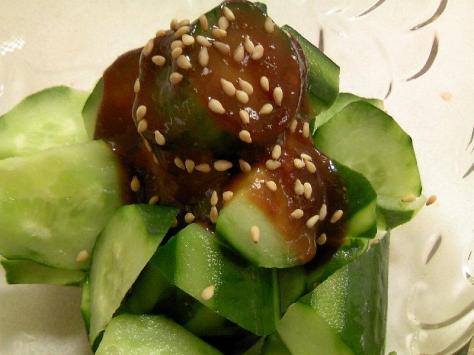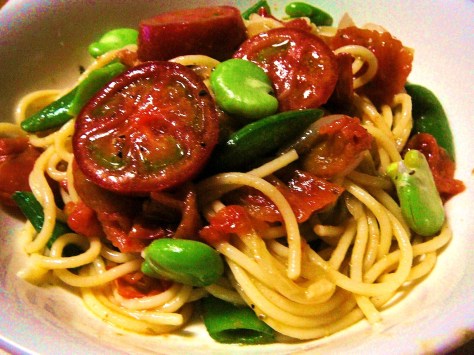
Category Archives: Gastronomy

Zucchini Flower Fritters (updated)

Zucchini flowers have been a long-time favorite of people living around the Mediterranean Sea, especially in Italy and French Provence.
The Japanese have recently grown fond of not only zucchini, but also their flowers and are growing them with a vengeance!
It is little wonder they come up with their own, if much simpler, version of zucchini flower fritters!
Since we are again in season (at long last) I tohought it might help some friends!

INGREDIENTS: For 4 people

-Zucchini Flowers: 4
-Prawns/shrimps: 6 (medium-sized)
-Mozzarella Cheese (they make it in Japan, now, even in Shizuoka Prefecture! And that from real water buffaloes!): 1
-Onion: 3 tablespoons (very finely chopped)
-Flour: as appropriate (or if you are Japanese food cognizant, use tempura batter. Rice flour is OK, too)
-Lemon juice: 1/2
-Baby leaves mix for accompaniment: as much as you like!
-Salt: as appropriate
-Pepper: as appropriate
-White wine: a little

RECIPE:

-Take the pistils out the zucchini flowers.

-“Peel” the shrimps if necessary and clean them. Cut them into 2 cm long pieces. Cut off half of the zucchini green part (not the flower) and cut again into 1 cm long pieces.

-Lightly fry the zucchini and shrimps with olive oil. Season with a litle salt, pepper and white wine. Transfer into a bowl and let cool for a while.

-Cut the mozzarella into small pieces and add into the bowl. Mix the lot.

-Delicately open the zucchini flowers and fill them with the above mixture. Do not fill completely as you need to close the flower by twisting their extremities.

-Either wrap the flowers in a little flour or tempura batter and delicately them fry them in shallow olive oil.

-Serve with baby leaves seasoned with a very little salt, some pepper and wine vinegar, and a wedge of lemon/lime.

RECOMMENDED RELATED SITES:
With a Glass,
Bread + Butter, Zoy Zhang, Hungry Neko, Think Twice, Frank Fariello, Mangantayon, Hapabento, Elinluv Tidbit Corner, Tokyo Terrace, Maison de Christina, Chrys Niles,Lexi, Culinary Musings, Wheeling Gourmet, Comestiblog, Chronicles Of A Curious Cook, Tokyo Through The Drinking Glass, Tokyo Foodcast, Palate To Pen, Yellin Yakimono Gallery, Tokyo Terrace, Hilah Cooking, More than a Mount Full, Arkonite Bento, Happy Little Bento; 5 Star Foodie; Jefferson’s Table; Oyster Culture; Gourmet Fury; Island Vittles; Good Beer & Country Boys; Rubber Slippers In Italy; Color Food daidokoro/Osaka;/a; The Witchy Kitchen; Citron Et Vanille, Lunsj Med Buffet/Estonian Gastronomy (English), Cook, Eat, Play, Repeat, Chrisoscope, Agrigraph, The Agriculture Portal to shizuoka!

Vegetarian Italian Cuisine at Piatto!

Service: Very friendly and relaxed. Slow food!
Equipment: Great cleanliness and splendid washroom
Prices: Appropriate
Strong Points: Vegetables, especially local and organic whenever possible. Local products. Good French and Italian wine-list

I’m not a vegetarian, but if one can come up with a superlative vegetarian dish I will not hesitate!
And if the vegetables are organic and local to boot I will ignore meat and fish for the whole meal (and postpone the latter to my next visit! LOL)

Kazuo Igarashi originally comes from Tokyo, but with a wife from Shizuoka and a constant access to extravagant ingredients convinced him to open Piatto in downtown Shizuoka City on June 12th 2006.
Since then he has acquired such a fame that his own peers advised me to pay him a visit as soon as possible!

Kazuo’s cuisine is definitely Italian in inspiration but his small establishment is a happy fusion of European and Japanese influences with plates and dishes being chosen among the artworks of three different potters. Food is served on wooden (wood and fabric material and colors are everywhere!) trays with wooden chopsticks and spoons (although you can ask for forks and knives!) and in art glassware. Frankly speaking I would need to write a separate article to describe the place (which I will do next time!)!

I almost cried when I found a Mercurey white wine on his menu! Mercurey is my home-place back in Bourgogne, France!
A very tasty appetizer was served in a beautiful glass: yuuba (skimmed tofu sheet) with parmegiano, pepper and olive oil!

A first for me!

“Bagna Couda”: Italian-style hot dip vegetable tray!

The small deep dish was placed on larger pot containing a combustible to heat the dip.
Both the dish and “burner” were made of sophisticated Japanese pottery!

The dip recipe is a secret of course but it does contain parmegiano and anchovy paste!
I did not leave a drop!

The vegetables, all local and most organic, were more of a Japanese concept, proving that superlative Italian gastronomy can be successfully achieved anywhere if you have quality ingredients!

A little explanation here:
The eggplant is mizu nasu/水茄子, a variety which is eaten raw. The renkon/蓮根/lotus root and takenoko/筍/bamboo shoot are definitely Japanese in concept.
And even more so the mini melons eaten as vegetables in our Prefecture!

Kazuo’s focaccia seems to be known all over town.
Carrot focaccia to finish my dip sauce!

What did I tell you about pottery?
I know some people who would visit the place just to have the pleasure in eating with them!

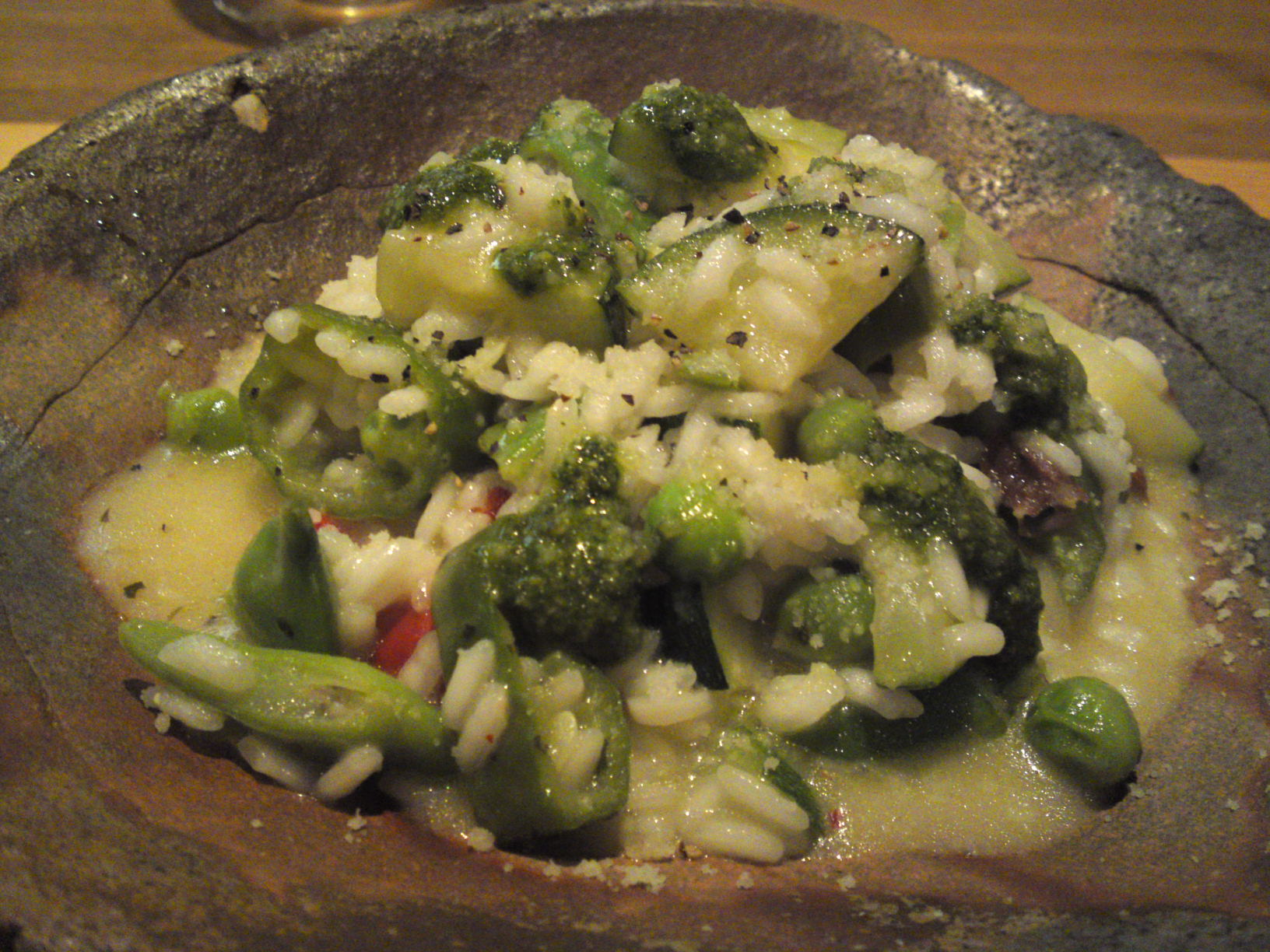
A risotto was of course on the cards!
I just asked Kazuo to concoct me one with vegetables!

It just shows that green can be become such an appetizing color in the hands of a great chef!

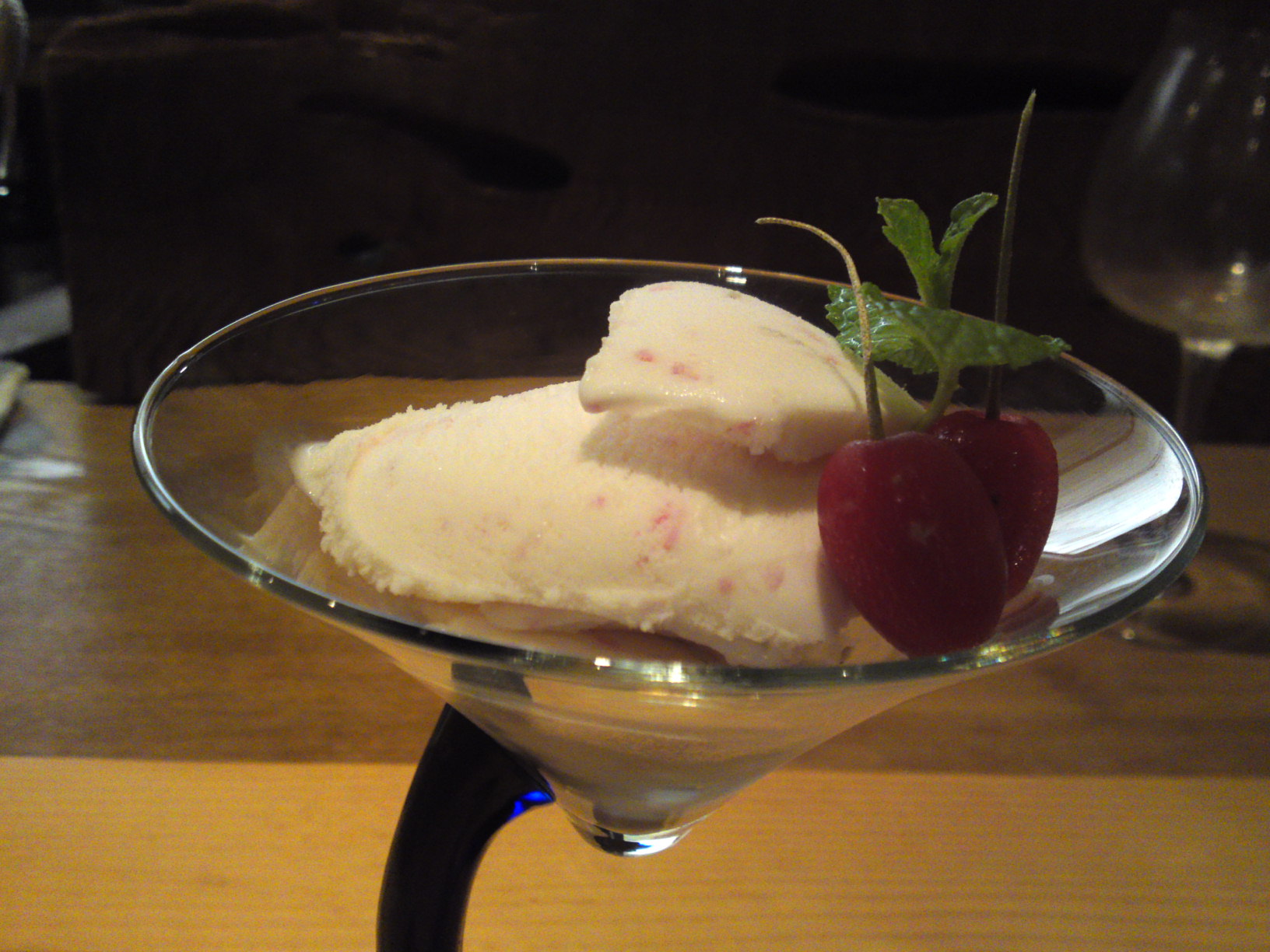
Even the dessert was local!
Can you guess?

I almost took the same picture: Cherry tree flower Ice cream! Yes you read well: flowers!

I’m afraid this is still a bit short of an article as Kazuo Ishigarashi’s cuisine will take time to explore, but don’t woory, I’ll be back soon!

PIATTO
Shisuoka Shi, Aoi Ku, Kooyamachi, 5-12, 2F
TEl.: 054-253-8844
Business hours: Lunch, 11:30~14:30 on Monday, Saturday, Sunday & National Holidays. Dinner: 17:30~23:00
Closed on Thursdays
Credit Cards OK
HOMEPAGE (Japanese and a little English)

RECOMMENDED RELATED SITES:
With a Glass,
Bread + Butter, Zoy Zhang, Hungry Neko, Think Twice, Frank Fariello, Mangantayon, Hapabento, Elinluv Tidbit Corner, Tokyo Terrace, Maison de Christina, Chrys Niles,Lexi, Culinary Musings, Wheeling Gourmet, Comestiblog, Chronicles Of A Curious Cook, Tokyo Through The Drinking Glass, Tokyo Foodcast, Palate To Pen, Yellin Yakimono Gallery, Tokyo Terrace, Hilah Cooking, More than a Mount Full, Arkonite Bento, Happy Little Bento; 5 Star Foodie; Jefferson’s Table; Oyster Culture; Gourmet Fury; Island Vittles; Good Beer & Country Boys; Rubber Slippers In Italy; Color Food daidokoro/Osaka;/a; The Witchy Kitchen; Citron Et Vanille, Lunsj Med Buffet/Estonian Gastronomy (English), Cook, Eat, Play, Repeat, Chrisoscope, Agrigraph, The Agriculture Portal to shizuoka!

Non-Smoking & Partially non-Smoking Restaurants List in Shizuoka Prefecture (updated/June 2011)

I agree that this particular article has been long overdue.
Not only my expats friends, but many Japanese friends have been at pains at finding restaurants, bars and cafes where they wouldn’t have to put up with the hazards and stink of smoke inhaled and expelled by uncaring customers.

This is of course not an exhaustive list, but it will be regularly updated as I visit establishments for work!

One more important point: Non-smoking is not the only criterion, good food is, too!

ENTIRELY NON-SMOKING ESTABLISHMENTS:

HARMONY
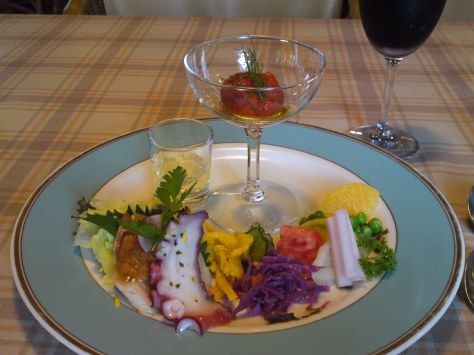
Service: easy-going and friendly
Facilities: good general cleanliness
Prices: reasonable
Strong points: Most of ingredients are local!
Completely non-smoking!

HARMONY
438-0831, Shizuoka Ken, Iwata Shi, Kamishinya, 499-1
Tel.: 0538-21-1511
Fax: 0538-21-1515
Business hours: 11:00~14:00, 17:00~21:00
Closed on Mondays, 1st & 3rd Tuesdays
Big parking available
HOMEPAGE
————————–
TETSUYA SUGIMOTO

Ranking
Service: Highly professional and friendly
Equipment: Great overall cleanliness. Beautiful washroom
Prices:~
Strong points:Freshest produce and ingredients only, mainly from Shizuoka Prefecture. Organic vegetables. Seasonal food only

Map (Japanese)
Entirely non-smoking!

Tetsuya SUGIMOTO
420-0038 Shizuoka City, Aoi Ku, Umeya,, 2-13,1F
Tel./Fax: 054-251-3051
Opening hours:11:30~14:30,17:30~21:30
Holidays: undecided
Credit cards OK
HOMEPAGE
————————————
PISSENLIT
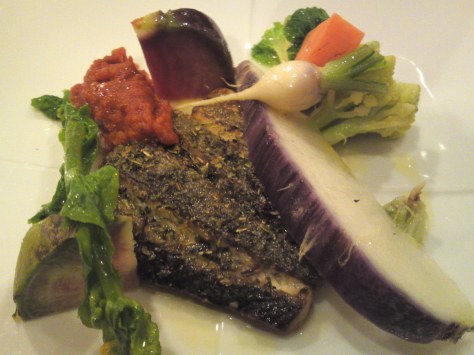
Service: excellent and very friendly
Facilities: great washroom, great cleanliness overall
Prices: reasonable, good value.
Strong points: Interesting wine list. Great use of local products.
no-smoking-logoentirely non-smoking!

PISSENLIT
420-0839 Shizuoka City, Aoi Ku, Takajo, 2-3-4
Tel.: 054-270-8768
Fax: 054-627-3868
Business hours: 11:30~14:30; 17:00~22:00
Closed on Tuesdays and Sunday evening
Homepage (Japanese)
Credit Cards OK
————————————-
“Real Food Restaurant” Italytei
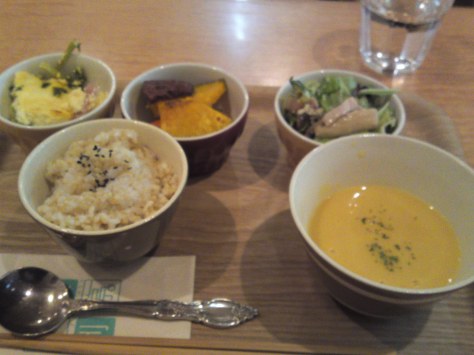
Service: Very friendly and attentive. slow food!
Equipment: Great general cleanliness
Prices: reasonable
Strong points: Mainly local vegetables. Vegetarian meal ok!. Local sake, too!
Completely Non smoking!

Real Food Restaurant Italytei/リアルフードレストラン伊太リ亭
Shizuoka Shi, Aoi Ku, Gofuku Cho, 3-4, Basement of Gofuku Cho
Tel.: 054-251-0456
Opening hours: 11:00~20:00
Closed on Tuesdays
Private parties possible
HOMEPAGE (Japanese)
————————————–
Grill Kuramoto
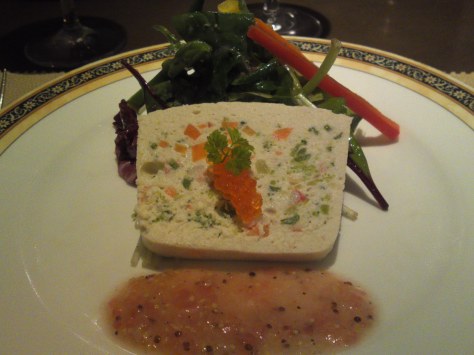
Service:A bit shy but friendly
Equipment: Great general cleanliness. Beautiful washroom
Prices: Reasonable
Strong points: Interesting combination of French and Japanese bistro-style cuisine. Traditional tarts and cakes.
Entirely non-smoking!

Grill-Kuraramoto
420-0081 Shizuoka Shi, Aoi Ku, Gofuku-cho, 2-5-17
Tel.: 054-255-3090
Business hours: 11:30^14:00, 17:30~20:00
Closed on Wednesdays and 3rd Tuesday
HOMEPAGE (Japanese)

————————————–
IL CASTAGNO
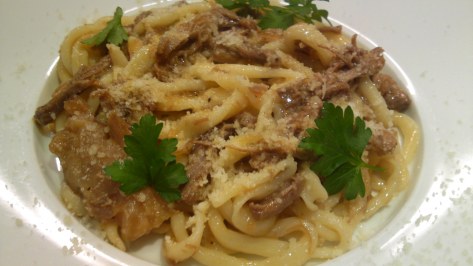
Service: Excellent and very friendly
Facilities: clean
Prices: reasonable
Specialty: Central and south Italian-style cuisine. Home-made pasta. Very reasonables prices. Progressive wine list.
no-smoking-logo1 Non-smoking!

IL CASTAGNO
420-0843 Shizuoka Shi, Aoi Ku, Tomoe Cho, 48 (along Kitakaido Street)
Tel. & Fax: 054-247-0709
Business hours: 11:45~14:00, 17:30~21:00
Closed on Mondays and second Tuesdays
Lunch: 1,260 and 1,860 yen
Dinner: 4,000 and 5,000 yen
A la Carte menu and wine list available. Wine by the glass ok
Reservations recommended.
Credit Cards OK (evening only)
HOMEPAGE (Japanese)
————————————-
VENTY-DUE

Service: Excellent and very friendly
Facilities: great cleanliness
Prices: reasonable
Specialty: Real Napolitan Pizza baked on wood fire
no-smoking-logo1 Completely Non-smoking!

22 Venty Due
420-0839 Shizuoka City, Aoi Ku, Takajyo Machi, 3-21-20
Tel & Fax: 054-260-4522
Business hours:18:00~21:30
Closed on Sundays
Reservations advised.
————————————
CONTORNO
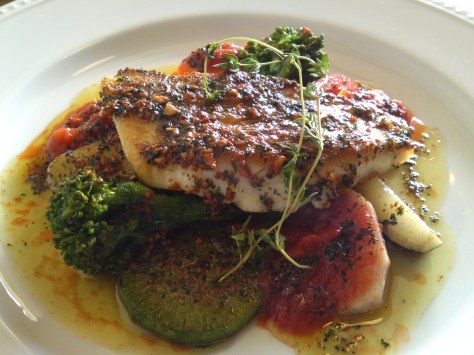
Service: Excellent and very friendly
Facilities: great cleanliness overall
Prices: reasonable.
Strong points: Many local products be they from the land or the sea. Organic vegetables. Car park.
no-smoking-logo1 Entirely non-smoking!
Map

CONTORNO
421-0122, Shizuoka City, Suruga Ku, Mochimune, 5-1-10, Sunrise Mochimune (5 minutes walk from Mochimune JR Station. Second stop after Shizuoka)
Tel.: 054-2565877
Business hours: 11:30~14:30, 17:00~21:30
Closed on Wednesdays
Credit Cards OK
HOMEPAGE (Japanese)
BLOG
—————————————-
LAVIGNE (French Wines & Food Stand Bar)

OC-1

Service: Very friendly and easy-going
Facilities: Very clea. large beautiful Washroom
Prices: Reasonable
Strong points: French wines only. Great snacks.
no-smoking-logo1 Entirely non-smoking!

LAVIGNE
420-0852, Shizuoka City, Aoi-Ku, Kutsunoya Cho, 17-2, 1F (2 minutes walk from JR Station)
Tel/fax: 054-205-4181
Opening hours: 11:00~22:00
HOMEPAGE (Japanese)

—————————————–
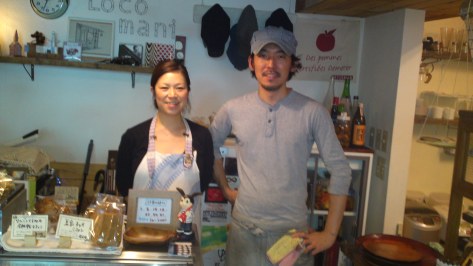
LOCOMANI
Ranking
Very friendly and relaxed
Equipment: Very clean
Prices: Very reasonable
Strong points:Freshest produce and ingredients only, mainly from Shizuoka Prefecture. Organic vegetables. Seasonal food only

Entirely non-smoking!

LOCOMANI
Shizuoka City, Aoi Ku, Takajo machi, 1-10-06
静岡市葵区鷹匠町1-10-06
Tel.: 054-260-6622
opening hours: 11:30~20:00
Closed on Wednesdays

Blog: http://rokomani.exblog.jp/
—————————————-
CHAM
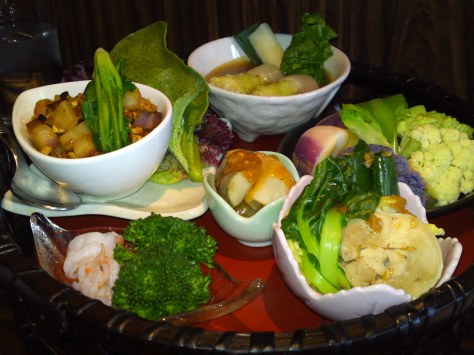
Service: excellent and very friendly
Facilities: great cleanliness overall
Prices: very reasonable, good value.
Strong points: Great use of local Shizuoka Vegetables and products. Great Chinese Teas!
no-smoking-logo non-smoking at lunch time/Fully non-smoking!strong>

Cham
Shizuoka Shi, Suruga Ku, Minami Cho, 6-7, inside Irifune Yokocho
Tel.: 054-285-71115
Business hours: 17:00~24:00; lunches on order only (1 day advance)
HOMEPAGE
———————————
ANNAM
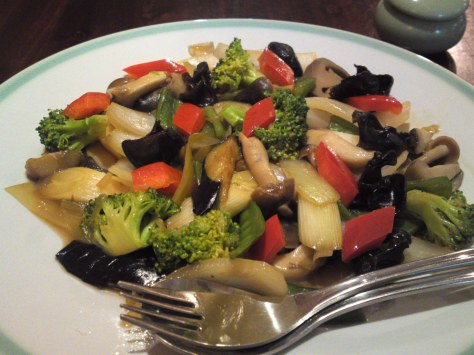
Service: Very friendly and attentive
Equipment: Very clean and beautiful washroom.
Prices: reasonable
Strong points: Authentic Vietnamese cuisine prepared by all-vietnamese staff!
Great use of local products.
Entirely non-smoking!

Owner: Ms. Le Thi Hong Vinh
Chef: Ms. Nguyen Thi Hong Mai

ANNAM
420-0858 Shizuoka City, Aoi Ku, Tenmacho, 17-9
Tel.: 054-250-2266
Fax: 054-250-2323
Business hours: 11:30~14:00, 17:30~22:00
Closed on Monday (or next day if National Holiday)
HOMEPAGE
Credit Cards OK
——————————————————-
BEER NO YOKOTA BAR

Service: very friendly
Facilities: very clean
no-smoking-logoNon-smoking!
Strong points: The beer! Especially Baird Beer!

Beer No Yokota
Shizuoka Shi, Aoi Ku, Gofuku-Cho, 2-5-22, Social Kadode bldg 2F (behind the City Hall)
Tel.: 054-255-3683
Opening hours: 17:00~24:00 (15:00~24:00 on Saturdays)
Closed on Thursdays
HOMEPAGE
——————————————————
SOBA SAKE KAWAKATSU
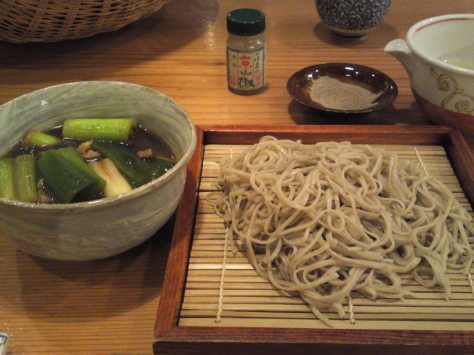
Service: Friendly
Equipment: traditional. Clean. Beautiful toilets
Prices: Appropriate
Strong points: Very fresh ingredients. Most ingredients not only local but sef-grown or self-raised! Local sake and shochu!
no-smoking-logoentirely non-smoking!

Sake Soba Kawakatsu
426-0034, Fujieda Shi, Eki mae, 1-8-4
Tel./Fax: 054-645-1770
Business hours: 11:30~14:00, 17:30~22:00
Closed on Mondays, 1st & 3rd Tuesdays
————————–
SOBA NO MI
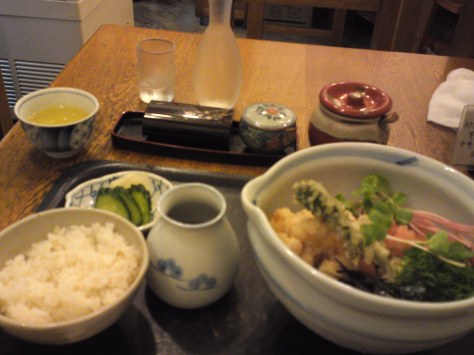
Service: Friendly
Equipment: a bit old but clean
Prices: Appropriate
Strong points: Very fresh ingredients. Old-fashioned atmosphere
no-smoking-logoentirely non-smoking!

Soba No Mi
Shizuoka Shi, Aoi Ku, Kawabe Cho, 2-2-3
Tel.: 054-251-8000
Business hours: 11:00~21:00 (or until soba are exhausted)
Closed on Tuesdays and third Wednesdays
HOMEPAGE
————————————-
BISTRO OGAWA
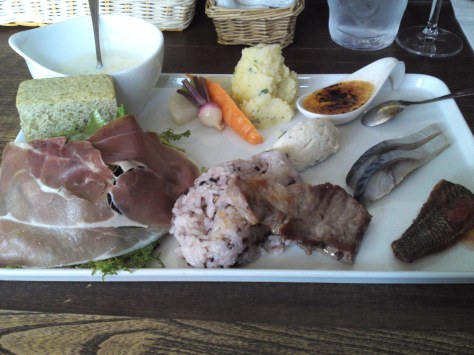
Service: Friendly
Facilities: old but very clean. Very clean washroom!
Prices: very reasonable
Strong points: excellent French cuisine without ostentation. Great local products from the land and the sea
no-smoking-logoentirely non-smoking!

Bistro Ogawa
411-0856, Shizuoka ken, Mishima Shi, Hirokoji Machi, 1-37, 2F
Business hours: 11:30~14:00, 18:00~
Closed on Sunday, Thursday lunch and Saturday dinner
Tel.: 055-972-5040
Cards OK (+5% handling fees)
—————————

PARTIALLY NON-SMOKING ESTABLISHMENTS:

TOMII
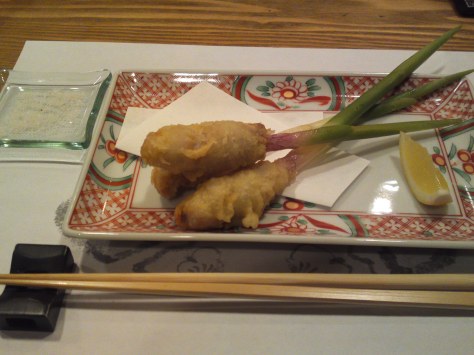
Service: Professional & Friendly
Facilities: Very clean overall, beautiful toilets
Prices: reasonable to expensive
Strong points: great choice of Shizuoka sake. Seasonal cuisine only. Shizuoka oden. Top-class Japanese food at reasonable prices
Non-smoking at counter

TOMII
Shizuoka City, Aoi Ku, Tokiwa-cho, 1-2-7, Tomii Bldg, 1F
Tel.: 054-274-0666
Business hours: 17:00~22:00
Closed on Sundays
HOMEPAGE (Japanese)
—————————————
IL PALADINO
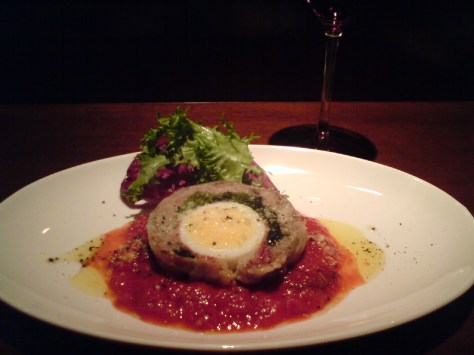
Service: Excellent and very friendly
Facilities: great and very large washroom, great cleanliness overall
Prices: reasonable to expensive.
Specialty:Sicilian Cuisine. Top-class Italian wines and great collection of Grappa.
no-smoking-logo1 Non-smoking at tables. Private room can be made entirely non-smoking!

————————————
OSTERIA PORTA PORTA
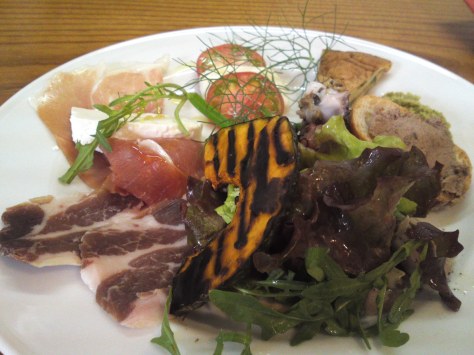
Service: Very friendly and attentive
Equipment: Great general cleanliness
Prices: reasonable
Strong points: Great appetizers. Mainly local vegetables. Good wine list.
Non smoking at lunch time!

Osteria Porta Porta
420-0839 Shizuoka Shi, Aoi Ku, Takajyo, 2-13-11, Topia Takajyo, 103
Tel./fax: 054-266-7320
Business hours: 11:30~14:00, 17:30^22:00
Closed on Wednesdays
Credit cards OK from July
—————————
UZU
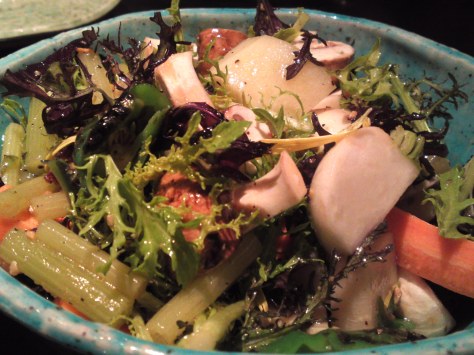
Mixed salad of organic vegetables from Matsuki bio Farm

Service: excellent, easy-going and very friendly
Facilities: great washroom, great cleanliness overall
Prices: very reasonable, good value.
Strong points: Very fresh local ingredients, especially organic vegetables extensively used. Local sake. Home-made umeshu. Great shochu list.
Non-smoking on Sundays and National Holidays!

UZU
Shizuoka City, Otowa-cho, 3-18
Tel.: 054-249-6262
Business hours: 17:00~23:00
Lunch on reservation only
Closed on Mondays and first Tuesday
Reservations recommended
Credit cards OK
HOMEPAGE (Japanese)
——————————–
AQUAVITE

First appetizer from the side.
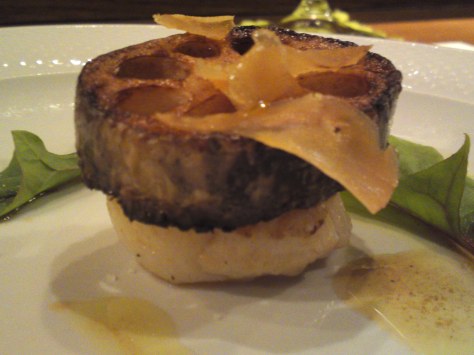
First appetizer from the side.

Service: Excellent and very friendly
Facilities: great and very large washroom, great cleanliness overall
Prices: reasonable to expensive. Top-class Italian wines. Private room for~8 people.
no-smoking-logo1 Non-smoking at counter! Private room can be m,ade completely non-smoking!

AQUAVITE
Address: 420-0034 Shizuoka Shi, Tokiwa-cho, 1-2-7, Tomii Bldg. 3F
Tel. & fax: 054-2740777
Opening hours: 11:30~14:00 18:00~22:00
Closed on Sundays
Homepage (Japanese)
Credit Cards OK
——————————-
CAPU
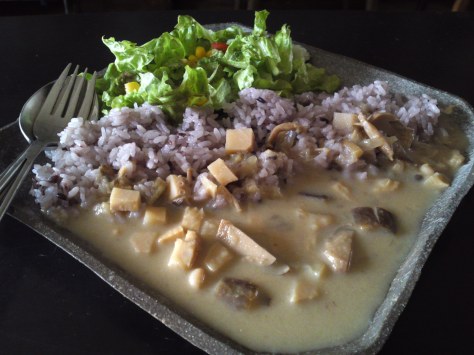
Service: Very friendly
Facilities: old but clean
Prices: reasonable
Strong points: Vegetarian and ethnic cuisine. Easy-going atmosphere for all ages and trends. Home-made umeshu and biscuits.
Non-smoking on Second Floor!

Food & Craft cafe CAPU/カフエカプ
3-6-13, Tokiwa-cho, aoi-ku, Shizuoka City, 静岡市葵ときわちょうー6-13
Tel.: 054-252-5343
Business hours: 12:00~21:00 (Sat. & Sun. ~22:00)
Closed on Wednesdays.
Private parties possible.
HOMEPAGE
——————————–
HANA HANA
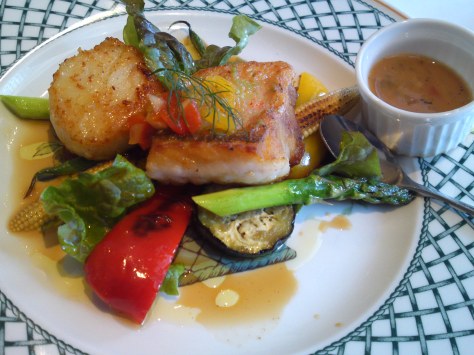
Service: Very friendly. Slow food
Facilities: Very clean all over. Enormous beautiful washroom
Prices: Reasonable
Strong points: Classical French/Italian Cuisine of very good value. Good list of wines and Japanese sake. Great lunches!
Non smoking at lunch!
Map

Hana Hana
〒420-0037Shizuoka City, Aoi Ku, Hitoyado-cho, 1- 3-12
静岡県静岡市葵区人宿町1丁目3−12
Tel.: 054-221-0087 ‎
Business hours: 11:30~15:00, 17:30~22:00
Closed on Wednesdays
Credit cards OK
——————————–

GENTIL
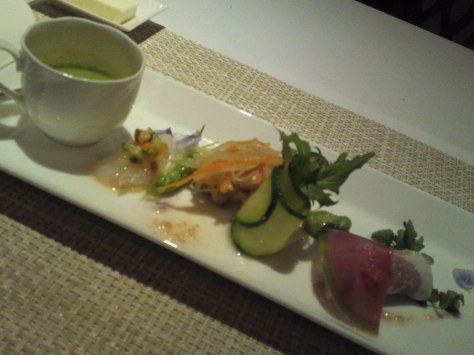
Ranking
Service: very professional
Facilities: Very clean, superb facilities.
Prices:~ Slightly expensive to expensive
Strong points: Beautiful and fresh ingredients presented and combined to perfection. Local ingredients whenever possible. Superb wine list. The best cheese trays in Japan! Everything thoroughly and kindly explained!

Map
no-smoking-logoNon-smoking at tables (bar’s smoke does not reach tables)!

Restaurant Gentil
Address:420-0031 Shizuoka Shi, Gofuku-cho, 2-9-1, Gennan Kairaku building, 2F
Tel.: 054-2547655 (Reservations advisable)
Fax: 054-2210509
Opening hours: 12:00~14:00, 18:00~last orders for meals at 21:30. Bar time 18:00~23:30. Closed on Mondays.
Credit cards OK
Homepage (Japanese)

RECOMMENDED RELATED SITES:
With a Glass,
Bread + Butter, Zoy Zhang, Hungry Neko, Think Twice, Frank Fariello, Mangantayon, Hapabento, Elinluv Tidbit Corner, Tokyo Terrace, Maison de Christina, Chrys Niles,Lexi, Culinary Musings, Wheeling Gourmet, Comestiblog, Chronicles Of A Curious Cook, Tokyo Through The Drinking Glass, Tokyo Foodcast, Palate To Pen, Yellin Yakimono Gallery, Tokyo Terrace, Hilah Cooking, More than a Mount Full, Arkonite Bento, Happy Little Bento; 5 Star Foodie; Jefferson’s Table; Oyster Culture; Gourmet Fury; Island Vittles; Good Beer & Country Boys; Rubber Slippers In Italy; Color Food daidokoro/Osaka;/a; The Witchy Kitchen; Citron Et Vanille, Lunsj Med Buffet/Estonian Gastronomy (English), Cook, Eat, Play, Repeat, Chrisoscope, Agrigraph, The Agriculture Portal to shizuoka!

Vegan Feast with Shizuoka Products at Yasaitei!

Service: Very friendly and attentive
Facilities: Very clean overall. Superb toilets.
Prices: Appropriate
Strong points: Great choice of local & Japanese vegetables. Kansai-style oden. All traditionally-clad ladies staff in a traditional izakaya. Good wines, shochu and sake List.

Chef Aki Suzuki/鈴木朋 never rests on her laurels in a constant search for new local vegetables of the best quality and freshness to please and titillate her customers.
Luckily enough, Shizuoka Prefecture is fast developing into THE reference when it comes to variety and quality of vegetables in Japan.
Moreover, whenever a producer cannot achieve a full organic culture the predominant trend is to reduce any artificial fertilizer or pesticide to a strict minimum.

The result is that the general level has reached such an elevated status that vegetables imported from other Prefectures are of an unheard quality.
It is thus easy to understand why restaurants and izakayas in Shizuoka Prefecture are increasingly using only the safest vegetables as a matter of course!

A very Japanese setting!
With my first glass of my favorite local rice-shochu, “Doman” by Hamamatsu-Tenjingura Brewery, the o-toshi/first snack was a morsel that vegans would run for!

Tokoroten/心太/seaweed jelly!
Served with some finely chopped dry nori/seaweed and Japanese hot mustard, it makes for a delicious healthy snack, even for an omnivore like me!

The sashimi plate of the day!
All the vegetables came from Shizuoka Prefecture and almost half of them were organic!

I know this corn as I have already written about it. Kankan Musume Corn by Takeshi Ichikawa in Iwata City. Served raw, it is so juicy and sweet!

This ko aka daikon/radish/小赤大根 come from Shizen no Chikara Organic Farm in Shizuoka City. Their raw leaves are great with grain mustard!

Juicy daikon and crisp perilla leaf/shiso/紫蘇. The sweet onion/tamanegi/玉葱 behind the shiso leaf is also from Shizen no Chikara Organic Farm.

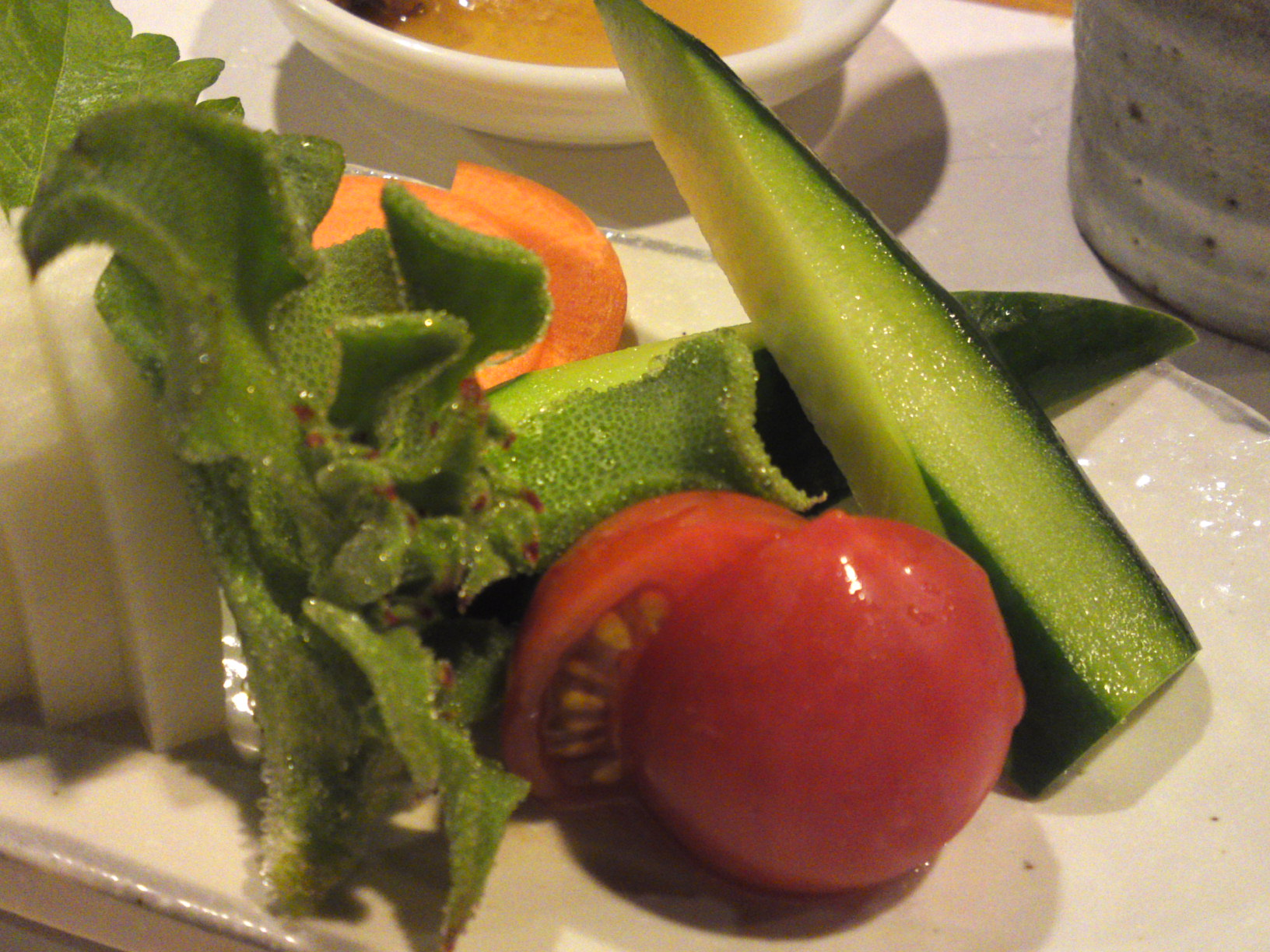
Juicy tomatoes (from the same farm!), crispy cucumber and quaint ice-plants!

Organic carrot backing up the chopped sweet onion!

As usual the “dressing” consisted of top-class kome miso (the miso paste contains whole rice grains), sesame oil and salt!

Aki san had just received organic broad beans (you can eat them raw!). I asked her to prepare some as tempura!

Little jewels!

And I was off to my second report of the night… LOL

YASAITEI/野菜亭
Shizuoka City, Aoi Ku, Tokiwa-Cho, 1-6-2 Green Heights Wamon 1-C
Tel.: 054-2543277
Business hours: 17:30~22:00
Closed on Sundays
Reservations highly recommended
Seating: 6 at counter + 12 at tables
Set Courses: 3,000, 4,000, 5,000 yen
HOMEPAGE (Japanese)

RECOMMENDED RELATED SITES:
With a Glass,
Bread + Butter, Zoy Zhang, Hungry Neko, Think Twice, Frank Fariello, Mangantayon, Hapabento, Elinluv Tidbit Corner, Tokyo Terrace, Maison de Christina, Chrys Niles,Lexi, Culinary Musings, Wheeling Gourmet, Comestiblog, Chronicles Of A Curious Cook, Tokyo Through The Drinking Glass, Tokyo Foodcast, Palate To Pen, Yellin Yakimono Gallery, Tokyo Terrace, Hilah Cooking, More than a Mount Full, Arkonite Bento, Happy Little Bento; 5 Star Foodie; Jefferson’s Table; Oyster Culture; Gourmet Fury; Island Vittles; Good Beer & Country Boys; Rubber Slippers In Italy; Color Food daidokoro/Osaka;/a; The Witchy Kitchen; Citron Et Vanille, Lunsj Med Buffet/Estonian Gastronomy (English), Cook, Eat, Play, Repeat, Chrisoscope, Agrigraph, The Agriculture Portal to shizuoka!

Chinese Cuisine: Hana Oto

Service: Very friendly and attentive
Equipment: Great general cleanliness. Beautiful toilets
Prices: reasonable
Strong points: Great use of local ingredients in beautiful Chinese Cuisine. Great sake and shochu!

Whatever the nationality or the genre of the gastronomy, a good chef makes an exclusively use of ingredients not only superlative but whenever possible local! Only then the skills make the difference between a good and a great chef!

The entrance to Hana Oto/華音 is simple and unassuming, always a good sign!

Chef Yuusuke Toozaki/登崎雄介 had recently to move to a larger establishment to be able to welcome all his guests!
It is always a good idea to reserve a seat either at the counter or on the tatami floor!

The man himself (frightening smile!)

First of all he caters for all tastes as far as drinks come!

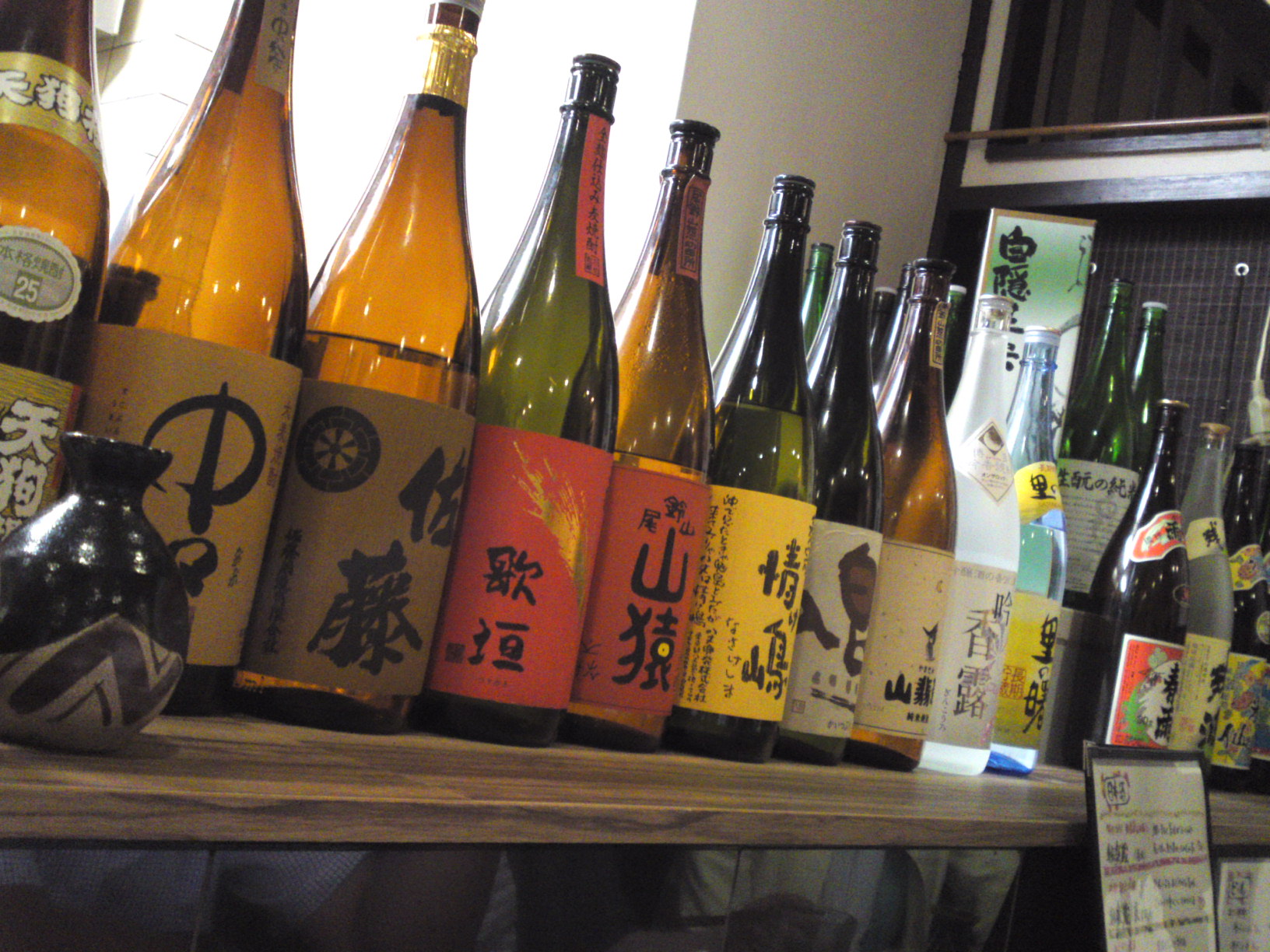
A shochu paradise!

You may as well as consult him before choosing a shochu if that is what you want!
Of course beer and wine are available!

Nice tokkuri!

As for the Japanese sake, there is plenty to choose from, too!
At least three great sake from Shizuoka Prefecture are catered!

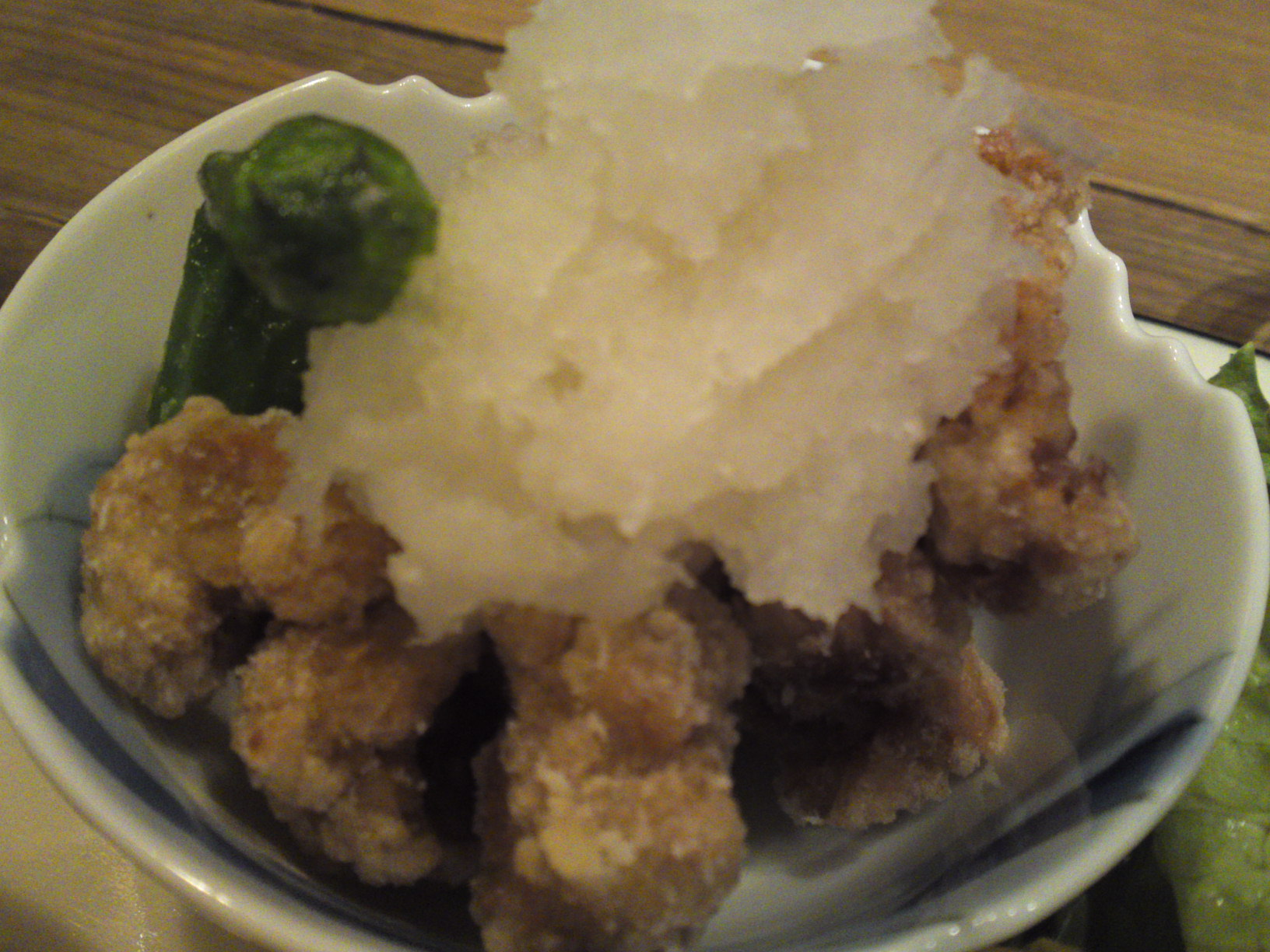
Now Hana Oto is one of the rare restaurants serving Amagi Shamo, arguably the best chicken in the Prefecture and probably Japan!

This chicken is, among others, fed with wasabi leaves and soy milk from Izu Peninsula!

Served with freshly grated Shizuoka wasabi (and maybe a little soy sauce), a rare delicacy!

On that night I had beautiful sake brewed by Eikun (Yui) and Sugii (Fujieda) breweries!

Jukusei Tomato to Tamago Pirikara Itame/熟成とまとト卵ピリ辛炒め/Stir-fried hot ripe tomatoes and eggs!

Toozaki san makes an extensive use of the best quality vegetables of the Prefecture!
These ripe tomatoes were grown at Suzuki Tomato Garden in Shizuoka City!

A fulfilling and healthy dish with a great balance!

Unctuous eggs fried to perfection!

Nasu no Shyouga Shoyu Itame/茄子の生姜醤油炒め/Stir-ried eggplants in ginger and soy sauce!

These eggplants were grown organically in a family garden in Shimizu Ku, Shizuoka City, proving a great search for the best ingredients!

Matsuki Farm Romeenu Retasu to Hikiniku no Pirikara Itame/松木ファームロメーンレタストひき肉のピリ辛炒め/Hot stir-fried Matsuki Farm Romaine Lettuce and minced meat!

The Romaine lettuce was organically grown at Matsuki Farm in Fujinomiya City!

Well, you can be assured this is only the start of a long relationship considering the untried dishes and the changes with seasons!
Keep tuned! LOL

HANA OTO/華音
420-0032 Shizuoka Shi, Aoi Ku, Ryougae Cho, 5-8, Shin Kamogawa Bldg., 2F-D
Business hours: 17:30~24:00
Closed on Mondays

RECOMMENDED RELATED SITES:
With a Glass,
Bread + Butter, Zoy Zhang, Hungry Neko, Think Twice, Frank Fariello, Mangantayon, Hapabento, Elinluv Tidbit Corner, Tokyo Terrace, Maison de Christina, Chrys Niles,Lexi, Culinary Musings, Wheeling Gourmet, Comestiblog, Chronicles Of A Curious Cook, Tokyo Through The Drinking Glass, Tokyo Foodcast, Palate To Pen, Yellin Yakimono Gallery, Tokyo Terrace, Hilah Cooking, More than a Mount Full, Arkonite Bento, Happy Little Bento; 5 Star Foodie; Jefferson’s Table; Oyster Culture; Gourmet Fury; Island Vittles; Good Beer & Country Boys; Rubber Slippers In Italy; Color Food daidokoro/Osaka;/a; The Witchy Kitchen; Citron Et Vanille, Lunsj Med Buffet/Estonian Gastronomy (English), Cook, Eat, Play, Repeat, Chrisoscope, Agrigraph, The Agriculture Portal to shizuoka!

Italian Cuisine: Dinner at Il Castagno!

Service: Very friendly and attentive
Equipment: Great general cleanliness
Prices: reasonable
Strong points: Great appetizers. Home-made pasta!.
Entirely non-smoking!

Not many chefs spend their good time making their own fresh pasta in Japan, and that only would be a good enough reason to visit Il Castagno in Shizuoka City!
But Chef Kenji Inami 謙司, who spent quite some time in the South of Italy, also endeavors to use ingredients from our Prefecture, be they vegetables, meat or fish for the best freshness and quality!

I’ve visited his restaurant countless times but only for lunch. Since we have just moved in the neighborhood we finally had the chance to share a full dinner there!

One cannot enjoy a true Italian dinner without (lots of) wine!
This white Lugano was perfect for a start!

We started with the set of appetizers!

Vegetables and Parmegiano quiche!

Deep-fried Parmegiano balls!

Home-smoked salmon!

Home-made ham!

Squid ink pasta!

Pork Pate di Campani with home-made pickles!

Exclusively home-made bread!

By then the white wine had disappeared, so we switched to a fine Montalcino red!

The Suruga Bay in Shizuoka has enough varieties of fish to satisfy any cuisine in the world!

Madai/red seabream~grouper!

We then naturally switched to pasta mode!
I dare say that Il Castagno offers the best (home-made) short pasta in town!

But you must also try his own style of Bolognese long pasta!

For a closer view!
Next time I’m thinking of a pasta only dinner! LOL

Yes, we still had room for dessert!

Fig compote!

Tempting, aren’t they?

Sorry, but I couldn’t resist the cheese!

It is a promise: next time all pasta!

Il Castagno
420-0843 Shizuoka Shi, Aoi Ku, Tomoe Cho, 48
Tel/Fax: 054-247-0709
Business hours: 11:45~14:00, 17:30~21:00
Closed every Monday and 3rd Tuesday
Credit cards OK (dinner only)
HOMEPAGE (Japanese)

RECOMMENDED RELATED SITES:
With a Glass,
Bread + Butter, Zoy Zhang, Hungry Neko, Think Twice, Frank Fariello, Mangantayon, Hapabento, Elinluv Tidbit Corner, Tokyo Terrace, Maison de Christina, Chrys Niles,Lexi, Culinary Musings, Wheeling Gourmet, Comestiblog, Chronicles Of A Curious Cook, Tokyo Through The Drinking Glass, Tokyo Foodcast, Palate To Pen, Yellin Yakimono Gallery, Tokyo Terrace, Hilah Cooking, More than a Mount Full, Arkonite Bento, Happy Little Bento; 5 Star Foodie; Jefferson’s Table; Oyster Culture; Gourmet Fury; Island Vittles; Good Beer & Country Boys; Rubber Slippers In Italy; Color Food daidokoro/Osaka;/a; The Witchy Kitchen; Citron Et Vanille, Lunsj Med Buffet/Estonian Gastronomy (English), Cook, Eat, Play, Repeat, Chrisoscope, Agrigraph, The Agriculture Portal to shizuoka!
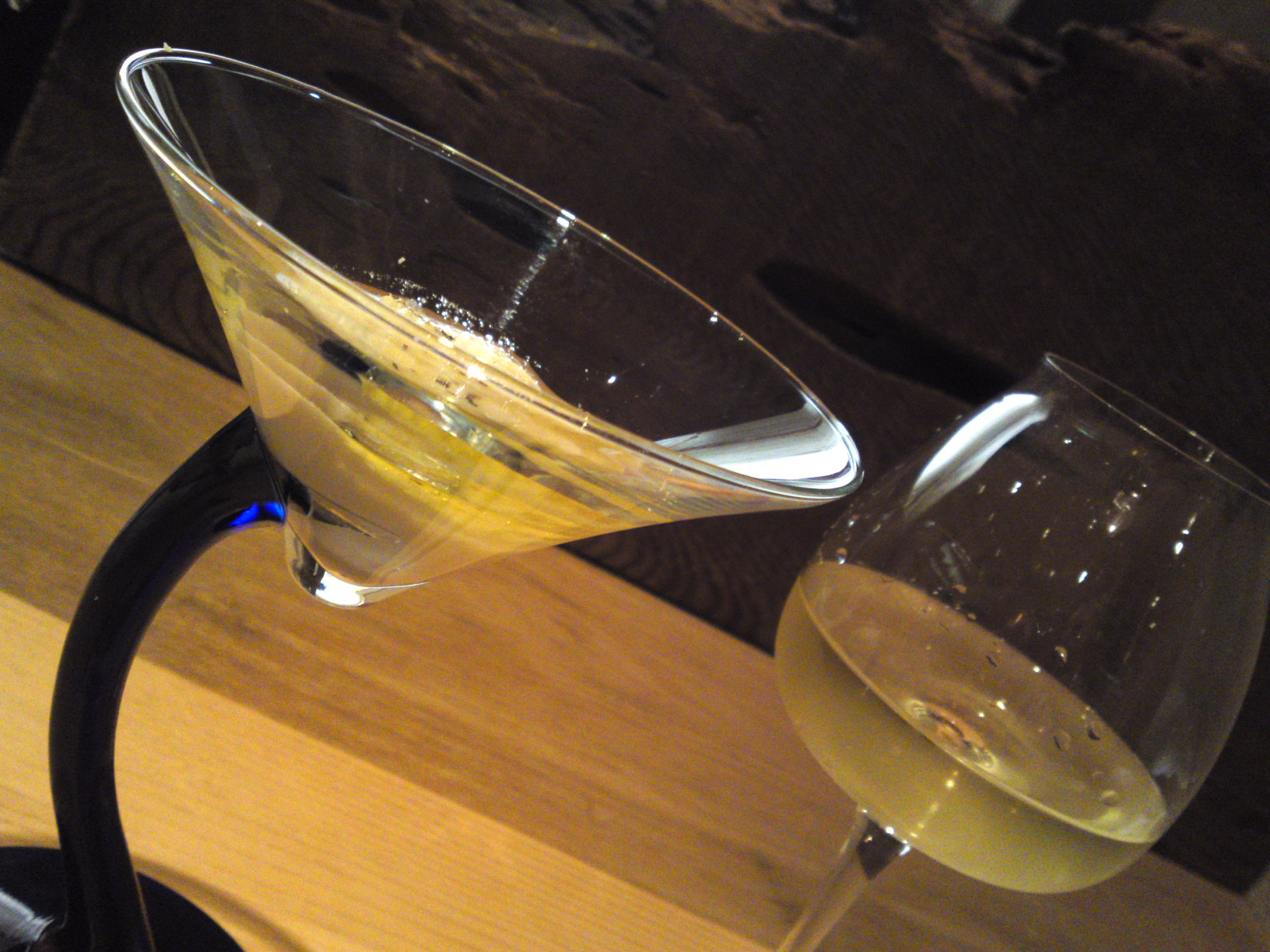
Shizuoka Agriculture New Generation: Takeshi Ichikawa!

Takeshi Ichikawa/市川武史 (22 years old!)

The Western part of Shizuoka Prefecture is also called the greatest garden of Japan by many for good reasons.
Not so much for the quantity but for the extravagant quality and abundance of varieties!
A lot of devoted farmers and cooperating researchers from all fields have contributed to this amply justified reputation, but all this work would have come to nought without an emerging new generation, the more for it that the previous generation was practically lost to the lure of towns and desk jobs.

Takeshi Ichikawa and one of his clients, Chef Hiroyuki Adachi/足立久幸 at Harmony!

Fortunately times have changed, and with the advent of the Internet more young people are attracted to a healthier life, however physically strenuous it might prove.
That is why more and more young men and women like Takeshi Ichikawa, instead of wasting time at universities where students are increasingly losing their goals, prefer to learn and study through real experience and enjoy the joys of true social life with their peers and customers.

Takeshi Ichikawa ‘s outdoors corn fields!

Takeshi Ichikawa, after graduating from Iwata Prefceture Agriculture High School, decided neither to continue school or succeed to his father as a Nashi/Japanese pear producer, but to start his own corn and lettuce cultivation. At the age of 22 he already has 5 years of experience and is still learning fast!
It was never easy, especially considering the resistance of older generations to changes. He has been trying for some time to encourage young farmers like him to venture into new types of culture including poly-culture. He told me that still too few are allowed by their families to move that step forward…

That crow has become a real scarecrow!

But Takeshi has stayed humble all the time. He fully realizes he still has lots to learn. He couldn’t believe me when I told him crows are found all over the world!

These corn ears in the outdoors fields will soon be harvested!

Greenhouse corn

Takeshi grows two varieties of corn, kankan Musume and SKA 318, both Japanese hybrids, both in greenhouses and outdoors for a longer harvesting season.
This means very few holidays during the year. Fortunately for him his school sweetheart has become his wife and she has become the true half of their farming team.
I was invited inside their home and I can tell you these two are really young at heart and certainly more modern and world-conscious than many people of their age!

That is what I call real corn!

Takeshi is appalled at the idea that some people use gene-modified corn and will replant corn only from his own crop!
These kankan musume corn are a real beauty not only in shape and color but in taste.
I tasted them both raw (juicy and so sweet!) and cooked. No wonder they fetch a good price on the market!

Takeshi does not rest on his laurels and grows other vegetables like Qing geng cai (Green pak choi) to answer market demands and his own consumption.

They certainly look appetizing, but once again it looks like a lot of work!

His education at a top-class agricultural high school is paying off as he is conducting his own experiments on potential crops!

But this does not mean he is rejecting his own roots: he grows his own rice!

I told him it reminded me of an English lawn!

Now, Takeshi’s father is a renown grower of nashi/Japanese pears with fields dispersed all over the city!
A proof that his kosui/幸水 and hosui/豊水 are popular is that he sells them exclusively on a direct-sale basis!

These trees are 30 years old!

These fruits need constant pruning, a back-breaking and neck-twisting work if there is one!

These fruit will be ripe next August!
I do not need telling you when I’m paying my next visit to Takeshi! (and his father!)

Takeshi Ichikawa/Chouchou Farm
438-0804 Shizuoka Ken, Iwata Shi, Kamo, 200
静岡県磐田市加茂200
Tel/Fax: 0538-34-0629
Mobile: 080-1614-2271

Lettuce: October~April
Corn: June~July (May for greenhouse)
Japanese pears/nashi: August~September
Rice: Middle of September
Other vegetables (please call for more information!)
Private orders welcome!

RECOMMENDED RELATED SITES:
With a Glass,
Bread + Butter, Zoy Zhang, Hungry Neko, Think Twice, Frank Fariello, Mangantayon, Hapabento, Elinluv Tidbit Corner, Tokyo Terrace, Maison de Christina, Chrys Niles,Lexi, Culinary Musings, Wheeling Gourmet, Comestiblog, Chronicles Of A Curious Cook, Tokyo Through The Drinking Glass, Tokyo Foodcast, Palate To Pen, Yellin Yakimono Gallery, Tokyo Terrace, Hilah Cooking, More than a Mount Full, Arkonite Bento, Happy Little Bento; 5 Star Foodie; Jefferson’s Table; Oyster Culture; Gourmet Fury; Island Vittles; Good Beer & Country Boys; Rubber Slippers In Italy; Color Food daidokoro/Osaka;/a; The Witchy Kitchen; Citron Et Vanille, Lunsj Med Buffet/Estonian Gastronomy (English), Cook, Eat, Play, Repeat, Chrisoscope, Agrigraph, The Agriculture Portal to shizuoka!

Daikon or Turnip Leaves Furikake Recipe

My new Swiss friend Sissi and her pals at With a Glass got stuck with daikon and other root vegetable leaves and asked me to help with a few recipes!
Japan gastronomy has the great merit to accomodate as much as possible of any vegetables you can get your hands on as they know too well that thrift and simple recipes come hand in hand!

Here is a simple and easy to adapt “furikake” recipe you can use on top of a bowl of rice or on its own!
“furikake” means ‘condiment to be sprinkled over a dish”.
By the way daikon leaves is daikon ha/大根葉 and turnip leaves is kabu ha/蕪葉!

INGREDIENTS:

-Daikon leaves or turnip leaves: the equivalent of the leaves of one root (you might have to increase that particular ingredient. Do experiment!)
-Seame oil: 1 + 1/2 tablespoons
-Sake/Jappanese cooking sake: 2 tablespoons
-Mirin/sweet sake: 1 + 1/2tablespoons
-Soy sauce: 1 + 1/2 tablespoons
-Katsuo Bushi/dry bonito shavings: 2 pinches
-White roasted sesame: 2 tablespoons
-If you have them, dried small shrimps (saura ebi or others) or small dried fish

RECIPE:

1) Wash the leaves throroughly and cut thin.. Heat frying pan and pour sesame oil in it.

2) Fry daikon/turnip leaves over a strong fire.. Once they have become soft, add sake, mirin, and soy sauce once a t a time and fry each time until ingredient is absorbed.

3) Add seame seeds and katsuo bushi and fry just a little. If you have the shrimps and fish first fry them over a frypan with as they are and add them at the last moment with the sesame seeds and katsuo bushi..

Serve hot or lukewarm over a bowl of hot rice.
Can be kept inside a Tupperware in the fridge (no need to freeze) and served cold or reheated1

Will come with more soon!

RECOMMENDED RELATED SITES:
With a Glass,
Bread + Butter, Zoy Zhang, Hungry Neko, Think Twice, Frank Fariello, Mangantayon, Hapabento, Elinluv Tidbit Corner, Tokyo Terrace, Maison de Christina, Chrys Niles,Lexi, Culinary Musings, Wheeling Gourmet, Comestiblog, Chronicles Of A Curious Cook, Tokyo Through The Drinking Glass, Tokyo Foodcast, Palate To Pen, Yellin Yakimono Gallery, Tokyo Terrace, Hilah Cooking, More than a Mount Full, Arkonite Bento, Happy Little Bento; 5 Star Foodie; Jefferson’s Table; Oyster Culture; Gourmet Fury; Island Vittles; Good Beer & Country Boys; Rubber Slippers In Italy; Color Food daidokoro/Osaka;/a; The Witchy Kitchen; Citron Et Vanille, Lunsj Med Buffet/Estonian Gastronomy (English), Cook, Eat, Play, Repeat, Chrisoscope, Agrigraph, The Agriculture Portal to shizuoka!

Vegetarian Japanese Lunch at Locomani!

Service: Very friendly although a bit shy!
Equipment: Great overall cleanliness
Prices: reasonable
Strong points: Vegetarian menus. Healthy rice flour cakes.
Completely non-smoking!

Light-hearted vegetarianism has become increasingly popular with vegetarians and non-vegetarians in this City and Prefecture.
The access to abundant vegetables, many of them organic all year round, is the main reason. Another reason is that this region of Japan is noted for its exceptional gastronomy and that gastronomes are happy to switch to a healthier and lighter fare from time to time to give a much needed rest to their system!

A Mediterranean look to the facade!

Menus of the day written on blackboard outside,

and inside!

All wood warm atmosphere inside.

Keep an eye (and a space inside your stomach!) open the home-made very healthy cakes!

Cream cheese cake!

Natural brownies made with rice flour!

Apple and walnuts pound cake made with rice flour!

Mr. Shigeyuki Aoshima/青島茂幸 prepares at least 2 full vegetarian and one non-vegetarian courses every day apart of single dishes and others.
As the menus change regularly according to the vegetables in season one does not tire from visiting the place regularly!
This time I chose the “deep-fried soy bean meat lunch course/大豆ミート唐揚げランチ”!

Raw and cooked vegetable salads (some from Shizen no hikara Organic Farm!)!

Lettuce and warm potato & onion salads!

String bean salad and Japanese-style pickled cucumber and seaweed!

Deep-fried soy bean “meat” with grated daikon (and ponzu)!

Rice (half whole/genmai and half polished)!

Miso soup and organic tea!

I couldn’t resist a dessert!

A succulent cream cheese cake!

I certainly felt both full and healthy!

LOCOMANI
420-0839 Shizuoka City, Aoi Ku, Takajyo, 1-10-6
Tel.: 054-260-6622
Closed every Wednesday and one Monday
HOMEPAGE (Japanese)

RECOMMENDED RELATED SITES:
With a Glass,
Bread + Butter, Zoy Zhang, Hungry Neko, Think Twice, Frank Fariello, Mangantayon, Hapabento, Elinluv Tidbit Corner, Tokyo Terrace, Maison de Christina, Chrys Niles,Lexi, Culinary Musings, Wheeling Gourmet, Comestiblog, Chronicles Of A Curious Cook, Tokyo Through The Drinking Glass, Tokyo Foodcast, Palate To Pen, Yellin Yakimono Gallery, Tokyo Terrace, Hilah Cooking, More than a Mount Full, Arkonite Bento, Happy Little Bento; 5 Star Foodie; Jefferson’s Table; Oyster Culture; Gourmet Fury; Island Vittles; Good Beer & Country Boys; Rubber Slippers In Italy; Color Food daidokoro/Osaka;/a; The Witchy Kitchen; Citron Et Vanille, Lunsj Med Buffet/Estonian Gastronomy (English), Cook, Eat, Play, Repeat, Chrisoscope, Agrigraph, The Agriculture Portal to shizuoka!

Organic Tea First Harvest with Marufuku Tea Factory!

Bunji and Asami Itoh! 伊藤文治さん,麻実さん!

This year’s green tea in Shizuoka, although of high quality, grew very slowly due to an unusually cold winter and spring, but I finally had the pleasure to experience my first ichiban (first of the year) green tea picking!

We drove all the way along off the beaten tracks thoroughfares just wide enough for a mini car up to an altitude of 8oo meters in Hirano along the Abe River and not far from the famous wasabi fields of Utogi.

Some tea fields can be found on steeper slopes, but this was already pretty steep!

Mr. Bunji Itoh has been growing exclusively organic green tea on these particular slopes for some time and plans to expand these fields. You know that no chemicals are used when you discover the luxuriant moss on the path!

The first leaves were just long enough to be picked!

These are the most valuable tea leaves of the year!

When you pick them by hand you twist off the stems just under the second leaf. If it does not snap between your thumb and index, cut the stem just under the first leaves!

This was my personal harvest in my hip tea basket with some wild mountain vegetables found around the rows!

These leaves are exceptionally delicious as tempura (Pissenlit Restaurant in Shizuoka City!)!

While I was picking some of the best leaves by hand Mr. Itoh’s employees were “shaving” the rows with curved cutting machines like this one. That is the reason behind the peculiar shape of Japanese tea tree rows!

You have to work in teams of three as one has to hold the bag for the leaves being cut by the other two holding the cutter walking between the rows!

Tea trees rows have to be “shaved” in two steps, along the left and then back along the right!

They let me help with (only) one row. Not easy work as you have to walk backwards. I didn’t too badly as they let me do it until the end of the (long) row!

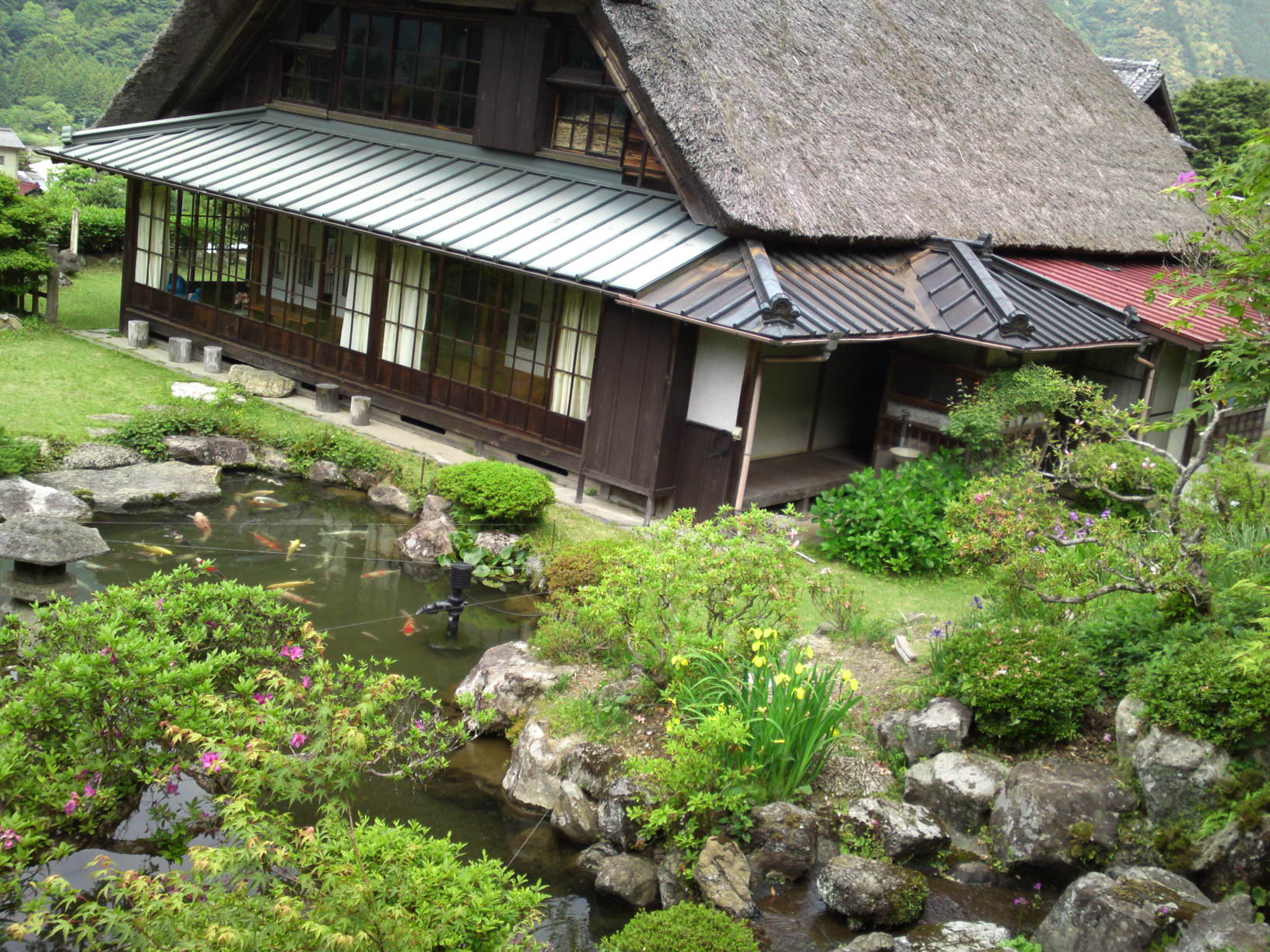
On the way back Mr. Itoh showed me the house of Oomura Family which has been growing tea there since the Edo Era!

They have grown green tea in this same spot for hundreds of years!

Finding ourselves brought back in time!

Very valuable carps up in the mountains!

The whole (privately-owned) property has been registered as Cultural Asset!

Mr. Itoh finally took me to a local tea-processing factory he is contracted with to show me how these organic leaves are treated, not so much as for tea, but as edible organic tea leaves.
The fresh leaves are first steamed.

They are then dried.

And next they will be frozen to be sold to restaurants!

Mr. Itoh also has a field of organic of Japanese plum trees. I will go there soon to pick ume/plums to make umeshu!

Marufuku Seishya Co. Ltd. (Mr. Bunji Itoh)
Shizuoka Shi, Aoi Ku, Wakamatsu Cho, 25
Tel.: 054-271-2011
Fax: 054-271-2010

RECOMMENDED RELATED SITES:
With a Glass,
Bread + Butter, Zoy Zhang, Hungry Neko, Think Twice, Frank Fariello, Mangantayon, Hapabento, Elinluv Tidbit Corner, Tokyo Terrace, Maison de Christina, Chrys Niles,Lexi, Culinary Musings, Wheeling Gourmet, Comestiblog, Chronicles Of A Curious Cook, Tokyo Through The Drinking Glass, Tokyo Foodcast, Palate To Pen, Yellin Yakimono Gallery, Tokyo Terrace, Hilah Cooking, More than a Mount Full, Arkonite Bento, Happy Little Bento; 5 Star Foodie; Jefferson’s Table; Oyster Culture; Gourmet Fury; Island Vittles; Good Beer & Country Boys; Rubber Slippers In Italy; Color Food daidokoro/Osaka;/a; The Witchy Kitchen; Citron Et Vanille, Lunsj Med Buffet/Estonian Gastronomy (English), Cook, Eat, Play, Repeat, Chrisoscope, Agrigraph, The Agriculture Portal to shizuoka!

Japanese Soy Sauce Varieties (updated)

SOY-2-KINDS
Japanese meal served with two kinds of soy sauce

To answer a query by my friend Sissi at With a Glass on tamari soy sauce, I thought that the best way to answer was to republish this old article of mine!

Almost everyone knows or has heard about soy sauce (or soya sauce in Europe).
It is even used in all kinds of cuisines in the world, be they vegetarian or not.

SOY-VATS
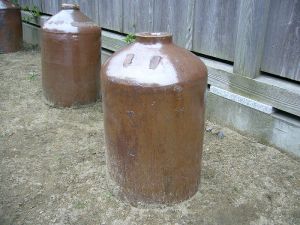
Ancient soy vats.

Authentic soy sauces are made by mixing the grain and/or soybeans with yeast or kōji (麹, the mold Aspergillus oryzae or A. sojae) and other related microorganisms. Traditionally soy sauces were fermented under natural conditions, such as in giant urns and under the sun, which was believed to contribute to additional flavours. Today, most of the commercially-produced counterparts are instead fermented under machine-controlled environments.

Although there are many types of soy sauce, all are salty and “earthy”-tasting brownish liquids used to season food while cooking or at the table. Soy sauce has a distinct basic taste called umami by the Japanese (旨味, literally “delicious taste”). Umami was first identified as a basic taste in 1908 by Kikunae Ikeda of the Tokyo Imperial University. The free glutamates which naturally occur in soy sauce are what give it this taste quality.

SOY-3-KINDS
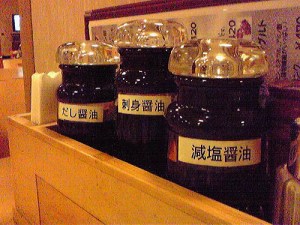
3 kinds of soy sauce as served in a Japanese izakaya: だし醤油/Dashi Soy Sauce, 刺身醤油/soy Sauce for sashimi, 減塩醤油/salt-reduced soy sauce

Artificially hydrolyzed Soy sauce
Many cheaper brands of soy sauces are made from hydrolyzed soy protein instead of brewed from natural bacterial and fungal cultures. These soy sauces do not have the natural color of authentic soy sauces and are typically colored with caramel coloring, and are popular in Southeast Asia and China, and are exported to Asian markets around the globe. They are derogatorily called Chemical Soy Sauce (“化學醬油” in Chinese), but despite this name are the most widely used type because they are cheap. Similar products are also sold as “liquid aminos” in the US and Canada.

Some artificial soy sauces pose potential health risks due to their content of the chloropropanols carcinogens 3-MCPD (3-chloro-1,2-propanediol) and all artificial soy sauces came under scrutiny for possible health risks due to the unregulated 1,3-DCP (1,3-dichloro-2-propanol) which are minor byproducts of the hydrochloric acid hydrolysis.

SOY-2-KINDSa
Difference in colour between 薄口醤油/light soy sauce and 濃口醤油/strong soy sauce

Japanese soy sauce varieties

Buddhist monks introduced soy sauce into Japan in the 7th century, where it is known as “shōyu”. The Japanese word “tamari” is derived from the verb “tamaru” that signifies “to accumulate”, referring to the fact that tamari was traditionally from the liquid byproduct produced during the fermentation of miso. Japan is the leading producer of tamari.

Japanese soy sauce or shō-yu (しょうゆ, or 醤油), is traditionally divided into 5 main categories depending on differences in their ingredients and method of production. Most but not all Japanese soy sauces include wheat as a primary ingredient, which tends to give them a slightly sweeter taste than their Chinese counterparts. They also tend towards an alcoholic sherry-like flavor, due to the addition of alcohol in the product. Not all soy sauces are interchangeable.

Koikuchi (濃口, “strong flavor”)
Originating in the Kantō region, its usage eventually spread all over Japan. Over 80% of the Japanese domestic soy sauce production is of koikuchi, and can be considered the typical Japanese soy sauce. It is produced from roughly equal quantities of soybean and wheat. This variety is also called kijōyu (生醤油) or namashōyu (生しょうゆ) when it is not pasteurized.
Usukuchi (淡口, “light flavor”)
Particularly popular in the Kansai region of Japan, it is both saltier and lighter in color than koikuchi. The lighter color arises from the usage of amazake, a sweet liquid made from fermented rice, that is used in its production.
Tamari (たまり)
Produced mainly in the Chūbu region of Japan, tamari is darker in appearance and richer in flavour than koikuchi. It contains little or no wheat; wheat-free tamari is popular among people eating a wheat free diet. It is the “original” Japanese soy sauce, as its recipe is closest to the soy sauce originally introduced to Japan from China. Technically, this variety is known as miso-damari (味噌溜り), as this is the liquid that runs off miso as it matures.
Shiro (白, “white”)
A very light colored soy sauce. In contrast to “tamari” soy sauce, “shiro” soy sauce uses mostly wheat and very little soybean, lending it a light appearance and sweet taste. It is more commonly used in the Kansai region to highlight the appearances of food, for example sashimi.
Saishikomi (再仕込, “twice-brewed”)
This variety substitutes previously-made koikuchi for the brine normally used in the process. Consequently, it is much darker and more strongly flavored. This type is also known as kanro shoyu (甘露醤油) or “sweet shoyu”.

Newer varieties of Japanese soy sauce include:

Gen’en (減塩, “reduced salt”)
Low-salt soy sauces also exist, but are not considered to be a separate variety of soy sauce, since the reduction in salt content is a process performed outside of the standard manufacture of soy sauce.
Amakuchi (甘口, “sweet flavor”)
Called “Hawaiian soy sauce” in those few parts of the US familiar with it, this is a variant of “koikuchi” soy sauce.

All of these varieties are sold in the marketplace in three different grades according to how they were produced:

Honjōzō hōshiki (本醸造 方式)
Contains 100% naturally fermented product.
Shinshiki hōshiki (新式 方式)
Contains 30-50% naturally fermented product.
Tennen jōzō (天然 醸造)
Means no added ingredients except alcohol.

All the varieties and grades may be sold according to three official levels of quality:

Hyōjun (標準)
Standard pasteurized.
Tokkyū (特級)
Special quality, not pasteurized.
Tokusen (特選)
Premium quality, usually implies limited quantity.

Other terms unrelated to the three official levels of quality:

Hatsuakane (初茜)
Refers to industrial grade used for flavoring, powder.
Chōtokusen (超特選)
Used by marketers to imply the best.

RECOMMENDED RELATED SITES:
With a Glass,
Bread + Butter, Zoy Zhang, Hungry Neko, Think Twice, Frank Fariello, Mangantayon, Hapabento, Elinluv Tidbit Corner, Tokyo Terrace, Maison de Christina, Chrys Niles,Lexi, Culinary Musings, Wheeling Gourmet, Comestiblog, Chronicles Of A Curious Cook, Tokyo Through The Drinking Glass, Tokyo Foodcast, Palate To Pen, Yellin Yakimono Gallery, Tokyo Terrace, Hilah Cooking, More than a Mount Full, Arkonite Bento, Happy Little Bento; 5 Star Foodie; Jefferson’s Table; Oyster Culture; Gourmet Fury; Island Vittles; Good Beer & Country Boys; Rubber Slippers In Italy; Color Food daidokoro/Osaka;/a; The Witchy Kitchen; Citron Et Vanille, Lunsj Med Buffet/Estonian Gastronomy (English), Cook, Eat, Play, Repeat, Chrisoscope, Agrigraph, The Agriculture Portal to shizuoka!

2nd Great Shizuoka Local Food Meet by Nagashima Liquor Shop!

Shizen No Chikara Organic Farm was participating!

A great consciousness of the merits, both gastronomic and healthy, of locally produced foods, drinks and processed foods has developed into a veritable revolution in Shizuoka Prefecture.
Uncountable events are organized and eagerly participated to all over the Prefecture, and one such event of note is the “Chisan Chishou.Shindofuji-Umai Mon Kai
./地産地消.身土不二・旨いもん会/ Locally produced and Consumed. Good Food Slogan and Association organized on May 29th by Nagashima Liquor Shop (Shizuoka City) at Fugetsuro/浮月楼, the former last residence of the Tokugawa Shogun Family.
Shindofuji/身土不二 was a slogan created in 1907 to exhort citizens to produce and eat local food!

Nagashima Liquor Shop was also contributing part of the fees paid by guests to help the victims of the recent terrible earthquake and tsunami in the north east of Japan!

As usual I came a bit early to check the preparations and take pictures of all participants before the guests would be in the way!

Amano Shoyu/a producer of great soy sauce made with the water of Mount Fuji in Gotenba City!

Local processed foods by Suzuyo Stores from Hamamatsu City!

Naturally the sake from Shizuoka Prefecture were well represented:
Shidaizumi Brewery in Fujieda City!

Fuji Takasago Brewery in Fujinomiya City!

Eikun Brewery from Yui, Shimizu Ku, Shizuoka City!

Sanwa Brewery from Shimizu Ku, Shizuoka City!

Kanzawagawa Brewery from Yui, Shimizu Ku, Shizuoka City!

Suruga Brewery from Suruga Ku, Shizuoka City!

Isojiman Brewery in Yaizu City!

Hatsukame Brewery from Okabe, Fujieda City!

Oumuraya Brewery in Shimada City!

Morimoto Brewery from Kikugawa City!

Hana No Mai Brewery from Nishi Ku, Hamamatsu City!

Aoshima Brewery from Fujieda Citry!

Sugii Brewery from Fujieda City!

Sorry, but I did not have the time to take a picture of Takashima Brewery, Numazu City!

Shizuoka wine was also represented by Naka Izu Winery all the way from the Izu Peninsula!

Wines from Yamanashi Prefecture were represented by three guest wineries!

Superlative organic vegetables from Shizuoka Prefecture were introduced by Shizen No Chikara farm!

All the food, cold and hot, was prepared by Fugetsurou!

Roast beef salad!

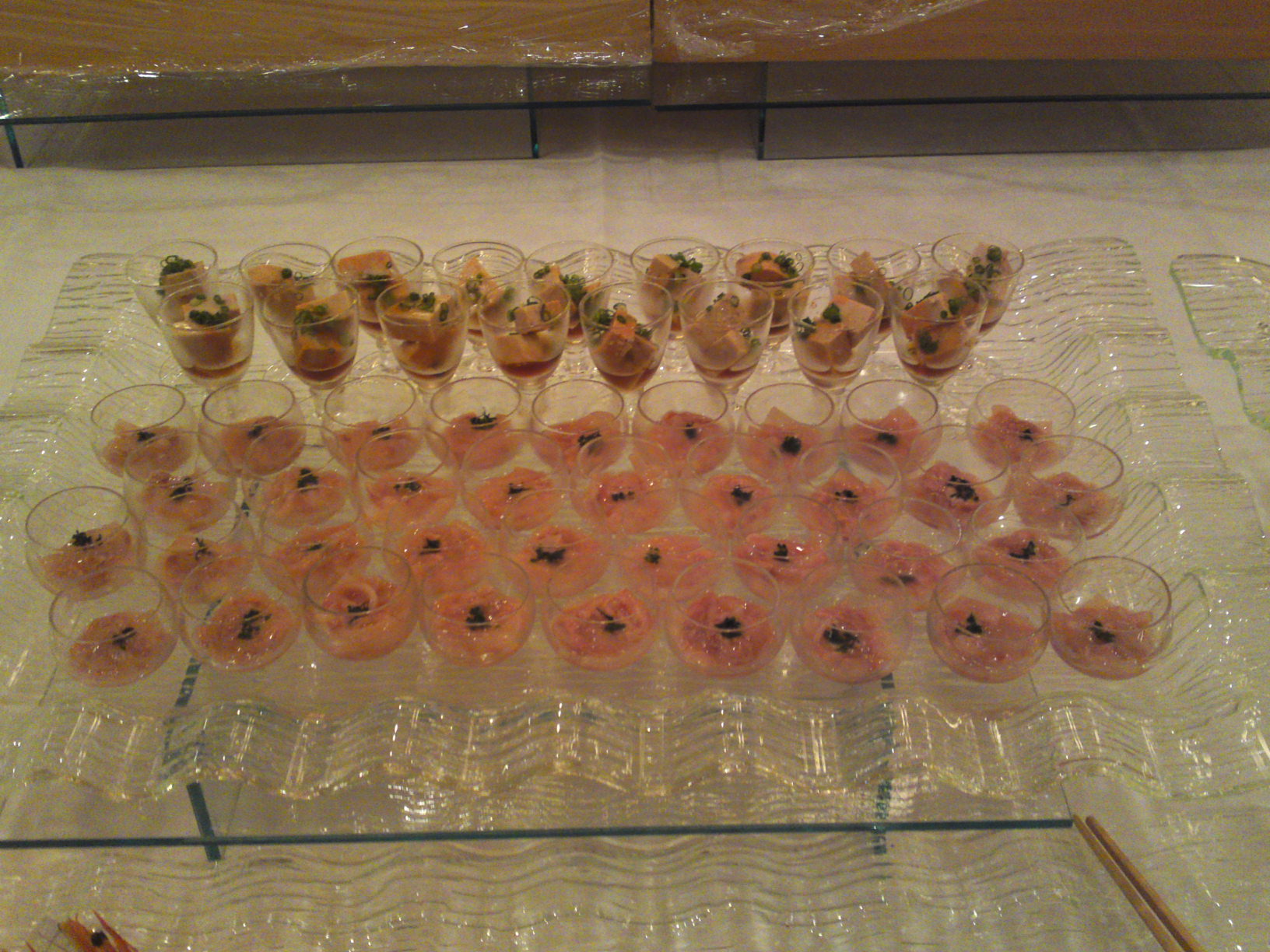
Japanese appetizers!

More Japanese appetizers!

And more Japanese appetizers!

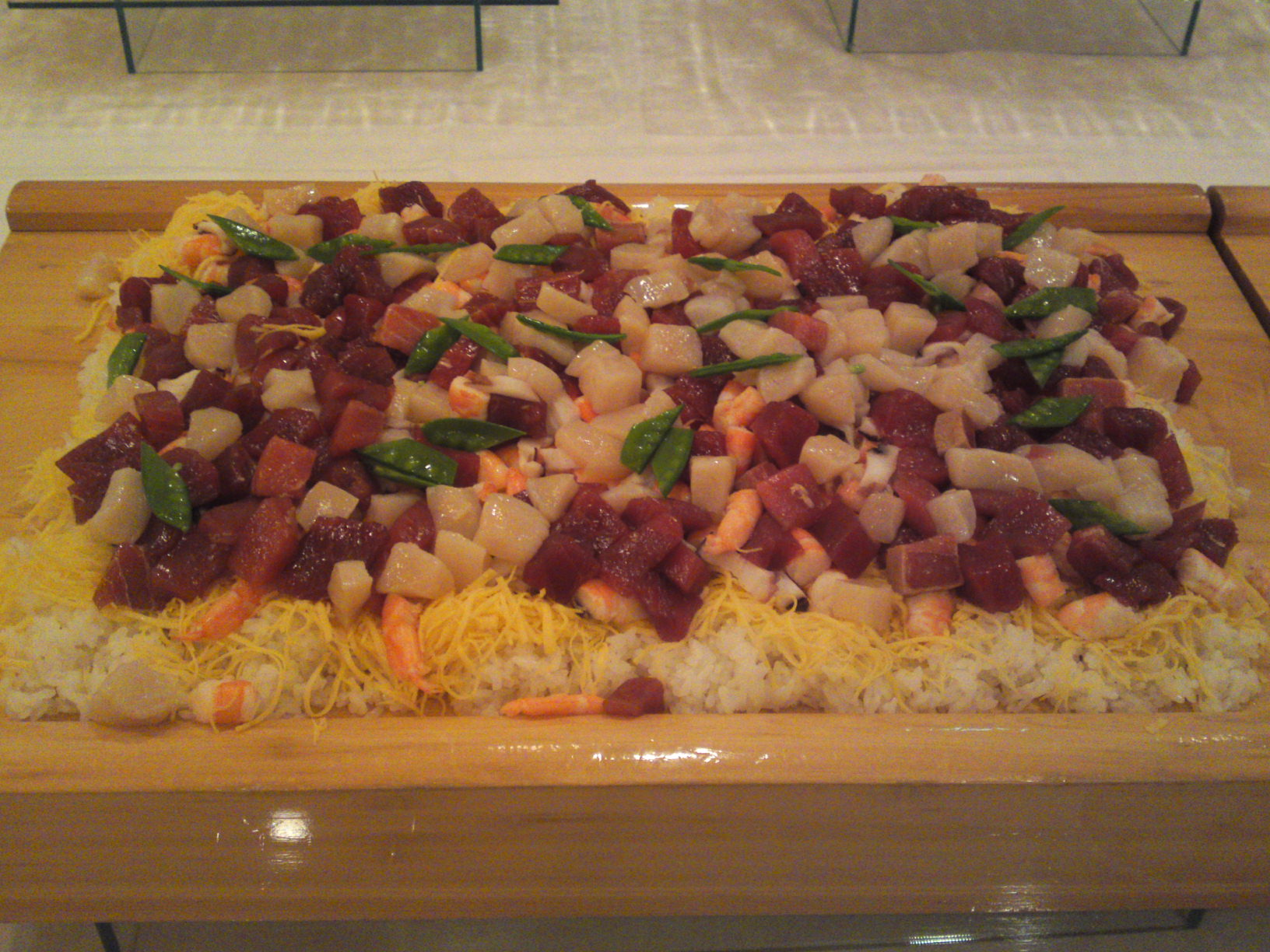
Chirashi Sushi!

I finished my round of pictures just in time before the guests made their entrance!

The place was soon crowded with more than 120 guests!

Some well-known faces!

Well, after that I was very busy for the next two hours tasting, eating, chatting and introducing many friends to each other.

At the end of the party Nagashima Liquor Shop and Kasai Izakaya expressed their sincere thanks to all the guests for a very successful party again!
More of the same is planned in the very near future, I can tell you!
Anyway this will lead to many interviews in the near future!

Nagashima Liquor Shop/長嶋酒店
420-0804, Shizuoka City, Aoi Ku, Ryuunan, 1-12-7
Tel.: 054-245-9260
Fax: 054-245-9252
BLOG (Japanese)

RECOMMENDED RELATED SITES:
With a Glass,
Bread + Butter, Zoy Zhang, Hungry Neko, Think Twice, Frank Fariello, Mangantayon, Hapabento, Elinluv Tidbit Corner, Tokyo Terrace, Maison de Christina, Chrys Niles,Lexi, Culinary Musings, Wheeling Gourmet, Comestiblog, Chronicles Of A Curious Cook, Tokyo Through The Drinking Glass, Tokyo Foodcast, Palate To Pen, Yellin Yakimono Gallery, Tokyo Terrace, Hilah Cooking, More than a Mount Full, Arkonite Bento, Happy Little Bento; 5 Star Foodie; Jefferson’s Table; Oyster Culture; Gourmet Fury; Island Vittles; Good Beer & Country Boys; Rubber Slippers In Italy; Color Food daidokoro/Osaka;/a; The Witchy Kitchen; Citron Et Vanille, Lunsj Med Buffet/Estonian Gastronomy (English), Cook, Eat, Play, Repeat, Chrisoscope, Agrigraph, The Agriculture Portal to shizuoka!

Shizuoka Vegetables: Shizen No Chikara Garden Party at Aquavite!

Service: Excellent and very friendly
Facilities: great and very large washroom, great cleanliness overall
Prices: reasonable to expensive. Top-class Italian wines. Private room for~8 people.
no-smoking-logo1 Non-smoking at counter! Private room can be made non-smoking, too!

Yesterday a party for 23 happy guests was organized by Shizen no Chikara Garden (“The Power of Nature”) at Aquavite with the help of Chef Masaru Aoki/青木勝!

A printed menu had been prepared for everyone for easy comprehension (if you asked for the translation in Italian, anyone would have understood! LOL)

I usually make a point to come a bit early at such parties “to take the temperature”!
The place was used to full capacity on that day!

The preparations started as early as the day before!
Incidentally I was sitting at the middle of the counter away from the crowd!

Real battle in the kitchen!

The Focaccia before being baked!

Out of the oven!

On the plate!

Organic vegetable directly from Shizen No Chikara Garden!

The first appetizer!
Can you guess what these green leaves are?
Green tea!

Second appetizer. Remember that all the vegetables are organic from the same Garden!

Cute little Spring onion!

Aquavite-style Barniacauda!

From another angle!
Such fun and pleasure dipping first-class vegetables into sophisticated dip!

Aiko pearl tomato spaghetti!

Unlike the other guests, I had the pleasure to witness their creation in front of my very eyes!

Involtini: broad beans and ricotta paste-filled Asahi Chicken roll!

.

From another angle!

Baked risotto!

The Involtini!

It was such a pleasure to break it up!

Making desserts from vegetables for such a big party is just unpractical, so Chef Aoki came with his own!

Sherbet created with musk melon from Fukuroi City!

Chef Aoki’s (very) special Tiramisu!

A big thanks to chef Aoki for a true pro’s work!

AQUAVITE
Address: 420-0034 Shizuoka Shi, Tokiwa-cho, 1-2-7, Tomii Bldg. 3F
Tel. & fax: 054-2740777
Opening hours: 11:30~14:00 18:00~22:00
Closed on Sundays
Homepage (Japanese)
Credit Cards OK

RECOMMENDED RELATED SITES:
With a Glass,
Bread + Butter, Zoy Zhang, Hungry Neko, Think Twice, Frank Fariello, Mangantayon, Hapabento, Elinluv Tidbit Corner, Tokyo Terrace, Maison de Christina, Chrys Niles,Lexi, Culinary Musings, Wheeling Gourmet, Comestiblog, Chronicles Of A Curious Cook, Tokyo Through The Drinking Glass, Tokyo Foodcast, Palate To Pen, Yellin Yakimono Gallery, Tokyo Terrace, Hilah Cooking, More than a Mount Full, Arkonite Bento, Happy Little Bento; 5 Star Foodie; Jefferson’s Table; Oyster Culture; Gourmet Fury; Island Vittles; Good Beer & Country Boys; Rubber Slippers In Italy; Color Food daidokoro/Osaka;/a; The Witchy Kitchen; Citron Et Vanille, Lunsj Med Buffet/Estonian Gastronomy (English), Cook, Eat, Play, Repeat, Chrisoscope, Agrigraph, The Agriculture Portal to shizuoka!

Japanese Vegetables: Potatoes (updated)

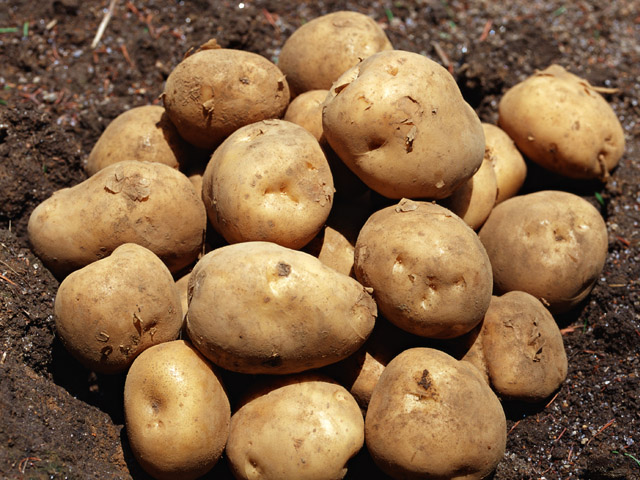
potatoes

Potatoes were first introduced to Japan in 1910 by Baron Kawata from Great Britain/Ireland giving the name of “Danshaku/Baron” to the most commonly used potato in Japan, especially in croquettes and salads.
The biggest potato exporters to Japan are China and India, although more and more are grown locally.
Over the years Japanese famers have greatly expanded the number of varieties, and it has became an embarrassment of choices.

FACTS:

Potatoes are available all year round, but are at their peak from May to July in Japan when new potatoes can be eaten whole!
New potatoes can be found from Februray to June.

-Analytic data (as per 100g):
Energy: 76 kcal
Water: 79.8 g
Carbohydrates: 17.6 g
Proteins: 1.6 g
Inorganic qualities:
Potassium: 410 mg
Magnesium: 20 mg
Phosphorus: 40 mg
Iron: 0.4 mg
Zinc: 0.2 mg
Manganese: 0.11 mg
Vitamins:
B1: 0.09mg
B2: 0.03 mg
B6: 0.18 mg
C: 35 mg
Dietary fibers: 1.3 g

TIPS:

-Preservation: Wrap potatoes inside newspaper and keep them in a dark, well-ventilated place away from the sunlight.

-Choose specimens well-rounded and with healthy skin. Avoid specimens with buds or of greenish colour (risks of diarrhea). Cut out all “dark spots”!
-Preserve them together with apples to prevent buds from coming out!
-To avoid a change of colour, wash potatoes in water after peeling or cutting.
-If you want to keep your potatoes for a while after boiling them, plunge them in (change it as many times as necessary) cold water until completely cooled down. They will not break or crumble when used later.
-After boiling cut potatoes, throw away water and keep heating them until they have lost a great part of their moisture. They will attain a crispy enough nature without resorting to deep-frying!

HEALTH FACTS:

-Combined with kiwi fruit or cucumber, or green tea, or mayonnaise, they help combat cancer, high blood pressure and ageing.
-Combined with Chinese cabbage, or peach, or banana, or honey, they help combat digestive disorders.
-Combined with lemon, or strawberries, or spinach, or broccoli, they help combat stress, constipation and cancer.
-Combined with vinegar, or chicken, or bonito (katsuo), or oysters, they provide extra body stamina.

VARIETIES

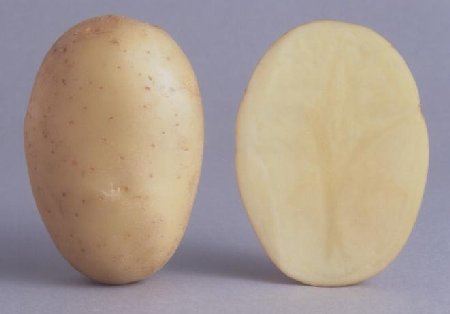
danshaku-potato

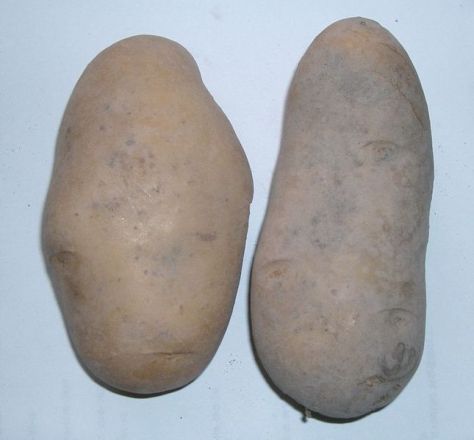
“Danshaku”

kitaakari-potato
“Kita Akari” used for mashed potatoes and croquettes,

mayqueen-potato
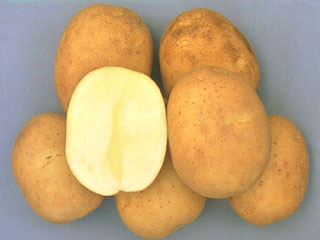
“May Queen” used in stews,

toyoshiro-potato
“Toyoshishiro” used for fried potatoes,

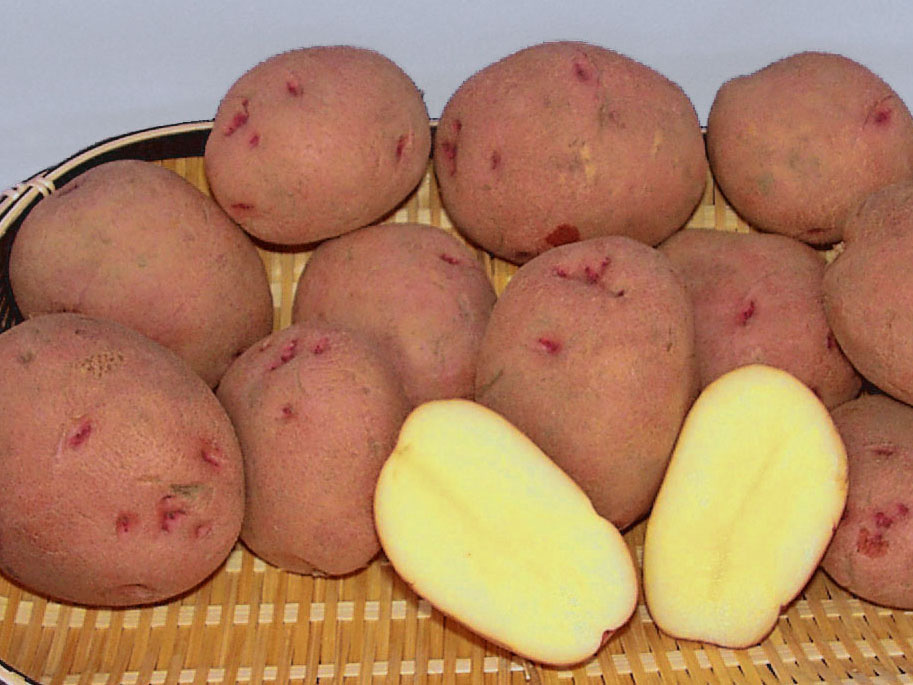
redandespotato
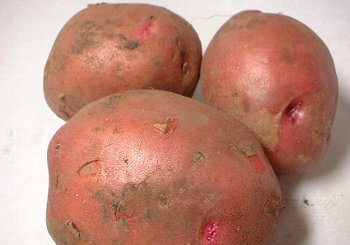
“Red Andes” used for croquettes and Pot au feu,

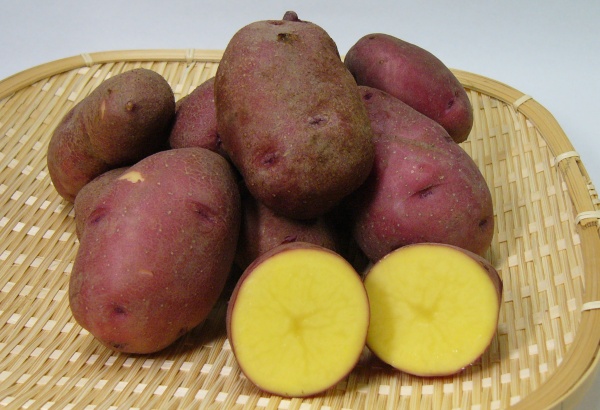
incanomezame-potato
“Inca No Mezame” used for stews.

“Inca No Hitomi”. Also called “Inca no Mezame”, they are popular for their nutty taste.

“Hokkai Kogane”. Grown mainly in Hokkaido Island, they have the particularity to oxydize and change colour a lot later than other potatoes.

“Tokachi Kogane”. Can be stocked and preserved a long time. Make for great fried potato chips!

“Mathilda”. Fine-grained and usually vey regular-shaped, theycan be presented whole for good effect.

“Touya”. Very good for long cooking as they don’t break away easily.

“Star Ruby”. A relatively new viety very apt for stews.

“Cynthia”. Recently imported vaiety from France. Very fine grain. Does break up even after being cooked long time.

“Kita Murasaki”. Very unusual potato with skin and flesh of the same colour. Better fried than boiled as wate will get couloured.

“Red Moon”. Also called “Red May Queen”, great for stews.

RECOMMENDED RELATED SITES:
With a Glass,
Bread + Butter, Zoy Zhang, Hungry Neko, Think Twice, Frank Fariello, Mangantayon, Hapabento, Elinluv Tidbit Corner, Tokyo Terrace, Maison de Christina, Chrys Niles,Lexi, Culinary Musings, Wheeling Gourmet, Comestiblog, Chronicles Of A Curious Cook, Tokyo Through The Drinking Glass, Tokyo Foodcast, Palate To Pen, Yellin Yakimono Gallery, Tokyo Terrace, Hilah Cooking, More than a Mount Full, Arkonite Bento, Happy Little Bento; 5 Star Foodie; Jefferson’s Table; Oyster Culture; Gourmet Fury; Island Vittles; Good Beer & Country Boys; Rubber Slippers In Italy; Color Food daidokoro/Osaka;/a; The Witchy Kitchen; Citron Et Vanille, Lunsj Med Buffet/Estonian Gastronomy (English), Cook, Eat, Play, Repeat, Chrisoscope, Agrigraph, The Agriculture Portal to shizuoka!
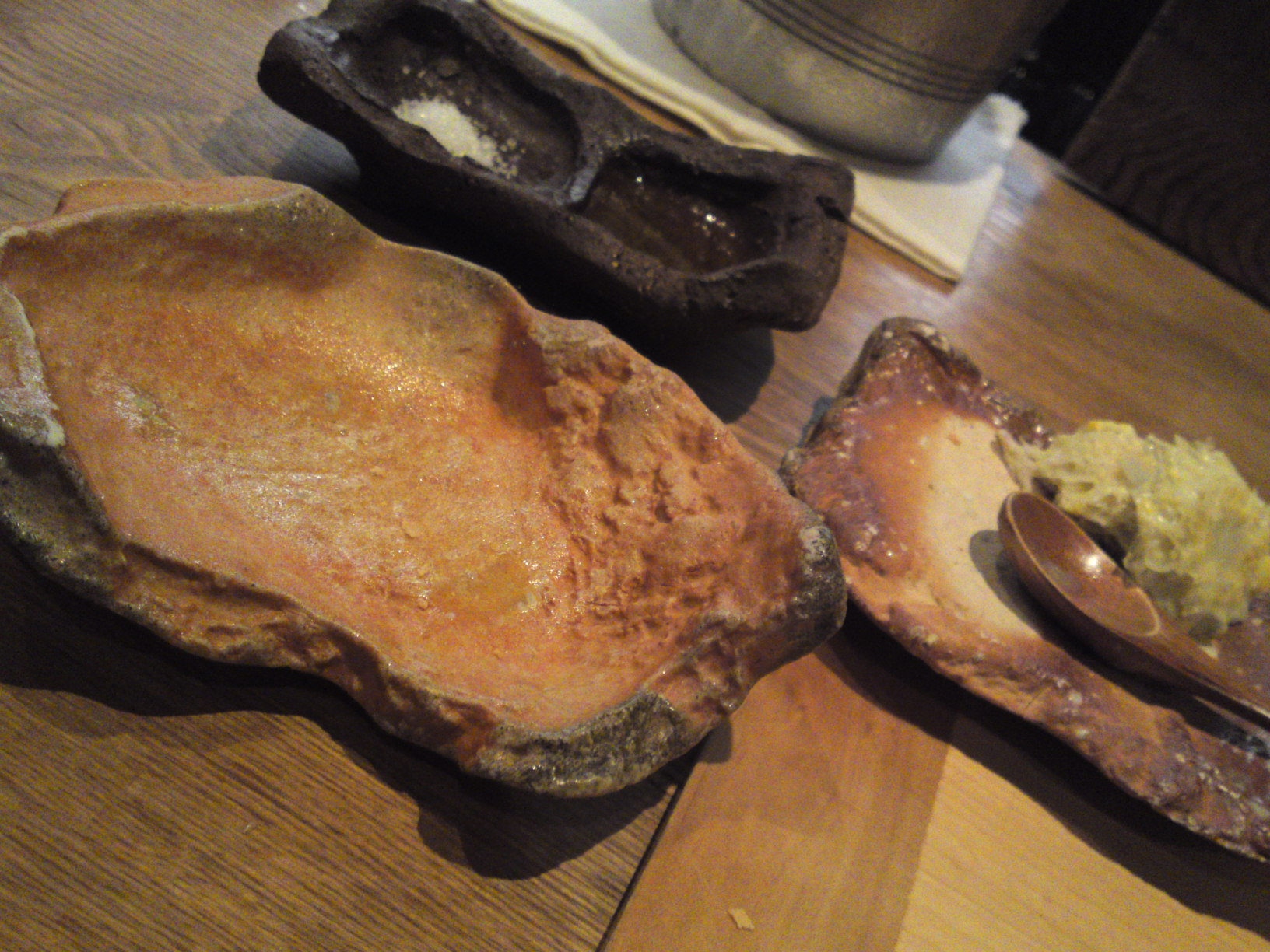
Miso: The Basics (updated)

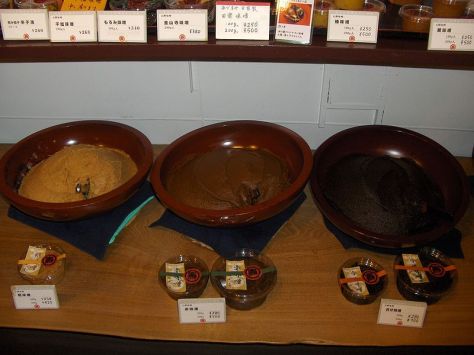
MISO-1
Three types of miso

Since Sissi and her many friends seem to be more than interested in miso I thought it was grand time i published again this old article of mine, hoping it will prove useful to many

Miso (みそ or 味噌) is a traditional Japanese seasoning produced by fermenting rice, barley and/or soybeans, with salt and a yeast called kōjikin (麹菌) in Japanese, the most typical miso being made with soybeans. The result is a thick paste used for sauces and spreads, pickling vegetables or meats, and mixing with dashi soup stock to serve as miso soup, Misoshiru (味噌汁), a Japanese culinary staple. High in protein and rich in vitamins and minerals, miso played an important nutritional role in feudal Japan. Miso is still very widely used in Japan, both in traditional and modern cooking, and has been gaining world-wide interest. Miso is typically salty, but its flavor and aroma depend on various factors in the ingredients and fermentation process. Different varieties of miso have been described as salty, sweet, earthy, fruity, and savory, and there is an extremely wide variety of miso available.

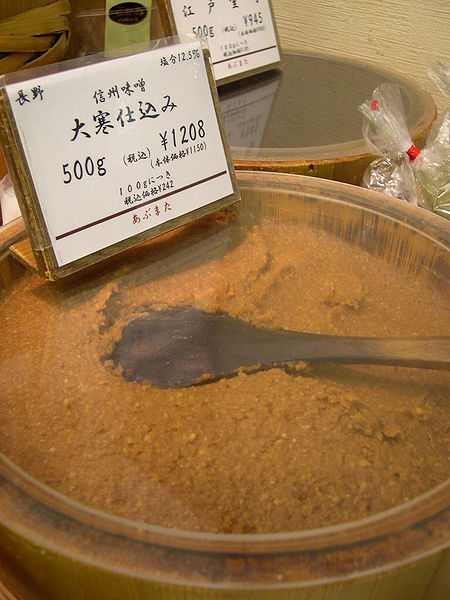
MISO-8
Miso from Nagano Prefecture on sale in Kyoto

The predecessor of miso originated in China during the 3rd century BC or earlier, and it is probable that this, together with related fermented soy-based foods, was introduced to Japan at the same time as Buddhism in the 6th century AD.This fermented food was called “Shi”.
Until the Muromachi era, miso was made without grinding the soybeans, somewhat like natto. In the Kamakura era, a common meal was made up of a bowl of rice, some dried fish, a serving of miso, and a fresh vegetable. In the Muromachi era, Buddhist monks discovered that soybeans could be ground into a paste, spawning new cooking methods where miso was used to flavor other foods.
In the Sengoku (Feudal) era, miso was useful as a military provision and precious nourishing food for soldiers.
During the Edo period miso was also called hishio and kuki.
In the modern era, the industrial method of producing miso in large quantities was established and it became rare to make miso at home, although miso made in farms has suddenly become fashinable as a health food.

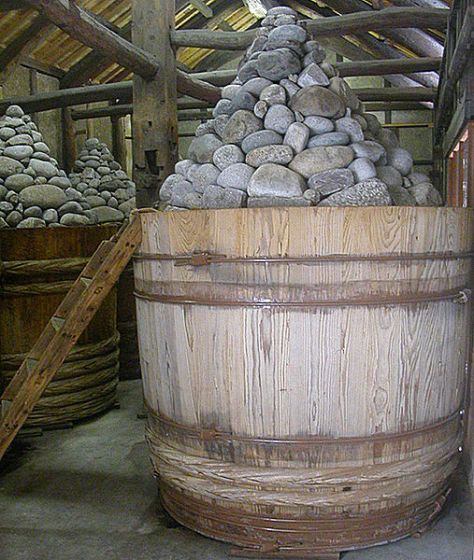
MISO-2
Miso being fermented inside a large wood cask

VARIETIES (FLAVOUR)

The taste, aroma, texture, and appearance of any specific miso vary with the miso type as well as the region and season for which the miso was made. The ingredients used, temperature and duration of fermentation, salt content, variety of kōji/yeast, and fermenting vessel all contribute. The most common flavor categories of soy miso are:

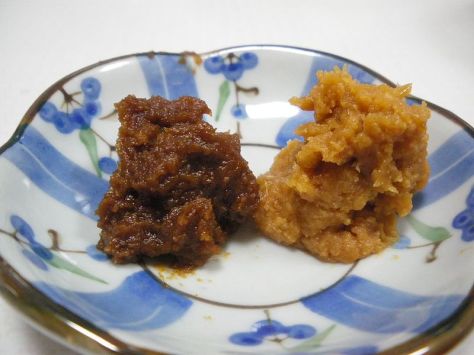
Shiromiso, “white miso”
Akamiso, “red miso”

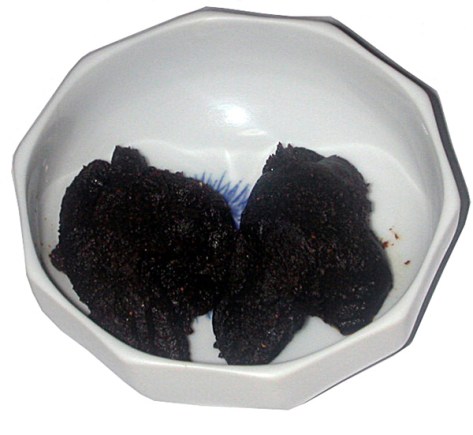
MISO-5
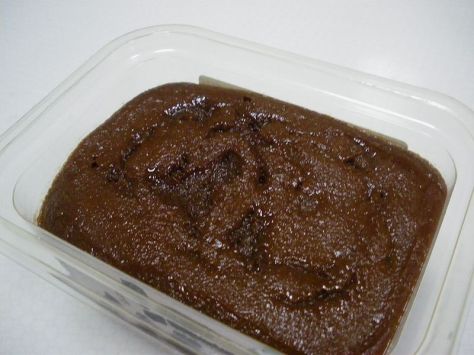
Kuromiso, “black miso”

Hatchomiso
White and red (shiromiso and akamiso) are the basic types of miso available in all of Japan as well as overseas. Different varieties are preferred in particular regions. For example, in the eastern Kantō region that includes Tokyo, the lighter shiromiso is popular, while in the western Kansai region encompassing Osaka, Kyoto, and Kobe, darker brownish hatchomiso is preferred, and akamiso is favored in the Tokai area.

MISO-4
Akamiso and shiromiso

VARIETIES (INGREDIENTS)

The raw materials used to produce miso may include any mix of soybeans, barley, rice, buckwheat, millet, rye, wheat, hemp seed, and cycad, among others. Lately, producers in other countries have also begun selling miso made from chick peas, corn, azuki beans, amaranth, and quinoa. Fermentation time ranges from as little as five days to several years. The wide variety of Japanese miso is difficult to classify, but is commonly done by grain type, color, taste, and background.

MISO-6
Kinzanji/Kinzan Temple (金山寺味噌) miso

mugi (麦): barley
tsubu (粒): whole wheat/barley
aka (赤): red, made with rice koji and soybeans, medium flavor, most widely used in Japan
Hatchō (八丁): aged, strongest flavor, used mostly in Central Japan
shiro (白): rice, sweet white, fresh
shinshu (信州): rice, brown color
genmai (玄米): brown rice
awase (合わせ): layered, typically in supermarket
moromi (醪): chunky, healthy (kōji/yeast is unblended)
nanban (南蛮): chunky, sweet, for dipping sauce
inaka (田舎): farmstyle
taima (大麻): hemp seed
sobamugi (蕎麦): buckwheat
hadakamugi (裸麦): rye
meri (蘇鉄): made from cycad pulp, Buddhist temple diet
gokoku (五穀): “5 grains”: soy, wheat, barley, proso millet, and foxtail millet
Many regions have their own specific variation on the miso standard. For example, the soybeans used in Sendai miso are much more coarsely mashed than in normal soy miso.

Miso made with rice (including shinshu and shiro miso) is called kome (rice) miso (米味噌).

MISO-3
Miso sold in plastic container.

STORAGE AND PREPARATION

Miso typically comes as a paste in a sealed container, and should be kept refrigerated after opening. It can be eaten raw, and cooking changes its flavor and nutritional value; when used in miso soup, most cooks do not allow the miso to come to a full boil. Some people, especially those outside of Japan, go so far as to only add miso to preparations after they have cooled, to preserve the biological activity of the kōjikin/fermented yeast. Since miso and soy foods play a large role in the Japanese diet, there are a variety of cooked miso dishes as well.

MISO-7
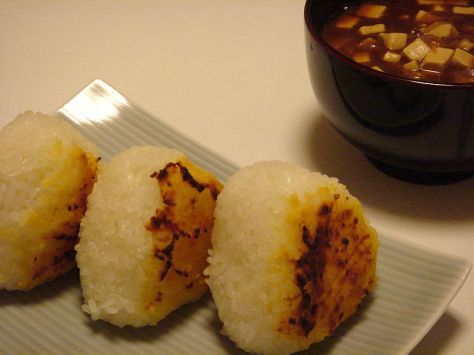
Grilled miso seasoned rice balls and miso soup

MISO AS FOOD

Miso is a part of many Japanese-style meals. It most commonly appears as the main ingredient of miso soup, which is eaten daily by much of the Japanese population. The pairing of plain rice and miso soup is considered a fundamental unit of Japanese cuisine. This pairing is the basis of a traditional Japanese breakfast, although more and more Japanese in big towns eat European style as opposed to people living in the country.

MISO-9
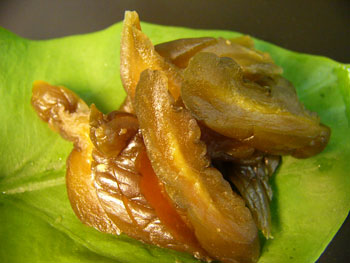
Cucmber pickled in “gold miso”

Miso is used in many other types of soup and souplike dishes, including some kinds of ramen, udon, nabe, and imoni. Generally, such dishes have the title miso prepended to their name (for example, miso-udon), and have a heavier, earthier flavor and aroma compared to other Japanese soups that are not miso-based.

MISO-10
Fresh cucumber served with miso and sesame seeds

Many traditional confections use a sweet, thick miso glaze, such as mochidango. Miso glazed treats are strongly associated with Japanese festivals, although they are available year-round at supermarkets. The consistency of miso glaze ranges from thick and taffy-like to thin and drippy.

Soy miso is used to make a type of pickle called “misozuke” (味噌漬け). These pickles are typically made from cucumber, daikon, hakusai/Chinese cabbage, or eggplant/aubergine, and are sweeter and less salty than the standard Japanese salt pickle. Barley miso, or nukamiso (糠味噌), is used to make another type of pickle. Nukamiso is a fermented product, and considered a type of miso in Japanese culture and linguistics, but does not contain soy, and so is functionally quite different. Like soy miso, nukamiso is fermented using kōji mold.

Other foods with miso as an ingredient include:

dengaku (charcoal-grilled miso covered tofu)
yakimochi (charcoal-grilled miso covered mochi)
miso braised vegetables or mushrooms
marinades: fish or chicken can be marinated in miso and sake overnight to be grilled.
corn on the cob in Japan is usually coated with shiro miso, wrapped in foil and grilled.
sauces: sauces like misoyaki (a variant on teriyaki) are common.

NUTRITION AND HEALTH

The nutritional benefits of miso have been widely touted by commercial enterprises and home cooks alike. However, claims that miso is high in vitamin B12 have been contradicted in some studies. Part of the confusion may stem from the fact that some soy products are high in B vitamins (though not necessarily B12), and some, such as soy milk, may be fortified with vitamin B12. Some, especially proponents of healthy eating, suggest that miso can help treat radiation sickness, citing cases in Japan and Russia where people have been fed miso after the Chernobyl nuclear disaster and the atomic bombings of Hiroshima and Nagasaki. Also some experts suggest that miso is a source of Lactobacillus acidophilus or Lecithin which is a kind of phospholipid caused by fermentation is effective in the prevention of high blood pressure. Miso contains salt. A small amount is essential to animal life but most scientists believe an excess of it can cause a variety of health problems.

RECOMMENDED RELATED SITES:
With a Glass,
Bread + Butter, Zoy Zhang, Hungry Neko, Think Twice, Frank Fariello, Mangantayon, Hapabento, Elinluv Tidbit Corner, Tokyo Terrace, Maison de Christina, Chrys Niles,Lexi, Culinary Musings, Wheeling Gourmet, Comestiblog, Chronicles Of A Curious Cook, Tokyo Through The Drinking Glass, Tokyo Foodcast, Palate To Pen, Yellin Yakimono Gallery, Tokyo Terrace, Hilah Cooking, More than a Mount Full, Arkonite Bento, Happy Little Bento; 5 Star Foodie; Jefferson’s Table; Oyster Culture; Gourmet Fury; Island Vittles; Good Beer & Country Boys; Rubber Slippers In Italy; Color Food daidokoro/Osaka;/a; The Witchy Kitchen; Citron Et Vanille, Lunsj Med Buffet/Estonian Gastronomy (English), Cook, Eat, Play, Repeat, Chrisoscope, Agrigraph, The Agriculture Portal to shizuoka!