Tag Archives: 美食

Japanese Cheese Cake (1): The Basic Recipe

CHEESE-CAKE-1

I have been recently asked a lot of questions, notably by Sissi at Withe a Glass about Japanese-style cheese cakes. Incidentally I had never heard of cheese cakes before I came to Japan 36 years ago. After investigation, cheese cakes have been around the world for quite a long time and developped into many varieties. Among them, the Japanese style seems to have acquired a lot of popularity, to the point that many customers expect them to be on offer in Japanese Izakayas abroad!
I decided it was about time to re-publish a series of them!

Here is the basic recipe as far as it goes in this very country.
It should provide a base from which one can create more sophisticated desserts!

INGREDIENTS: For an 18cm-diameter cake
-Cream cheese (Philadelphia style): 250 g
-Fresh cream: 1 cup/200 ml
-Eggs: 2
-Sugar: 80 g
-All purpose flour: 3 large tablespoons
-Lemon juice: 2 large tablespoons
For the base:
-Biscuits (or crackers of your choice): 90 g
-Unsalted butter: 40 g

RECIPE:
CHEESE-CAKE-2

-Put biscuits/crackers inside a tight seal vynil pouch. Close. Crush until fine.
Take crumbs out and mix with melted unsalted sugar.
Lay cooking paper inside a cake mold.
Spread crumbs on the bottom. Press with masher for uniformity and solidity.

-Soften cream cheese inside microwve oven for 30 seconds~1 minute.
Divide into 3 or 4 parts.

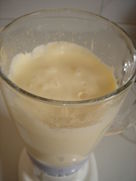
-In a mixer/blender drop eggs, sugar, lemon juice and flour. Mix well.
CHEESE-CAKE-3

Pour in fresh cream and then cream cheese little by little. Mix well. Stir with a spatula from time to time to help.

CHEESE-CAKE-4

-Pour the cheese cake mixture over the crumbs.
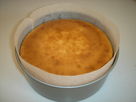
Preheat oven at 170 degrees and bake for 40~45 minutes.
CHEESE-CAKE-5

The colour should be a nice brown-orange. In Japan they say “kitsune iro/fox colour”!
Leave inside the mold.
Let it cool completely.
Leave inside the fridge at leat 12 hours. before unmolding and serving.

For better cutting, wipe the knife clean after every cut!

If the cake attains its colour before the cooking time has elapsed, cover with foil paper and put back into the oven.
In the case colour does come quickly enough raise the oven temperature.

RECOMMENDED RELATED WEBSITES

Le Manger by Camille Oger (French), The Indian Tourist, Masala Herb by Helene Dsouza in Goa, India, Mummy I Can Cook! by Shu Han in London, Pierre.Cuisine, Francescannotwrite, My White Kitchen, 47 Japanese Farms Through The Eyes of Its Rural Communities, Foodhoe, Chucks Eats, Things that Fizz & Stuff, Five Euro Food by Charles,Red Shallot Kitchen by Priscilla,With a Glass, Nami | Just One Cookbook, Peach Farm Studio, Clumsyfingers by Xethia, PepperBento,Adventures in Bento Making, American Bent, Beanbento, Bento No, Bento Wo Tsukurimashou, Cooking Cute, Eula, Hapabento , Happy Bento, Jacki’s Bento Blog, Kitchen Cow, Leggo My Obento, Le Petit Journal Bento & CO (French), Lunch In A Box,
Susan at Arkonlite, Vegan Lunch Box; Tokyo Tom Baker, Daily Food Porn/Osaka, Only Nature Food Porn, Happy Little Bento, The Herbed Kitchen, J-Mama’s Kitchen, Cook, Eat, Play, Repeat, Bento Lunch Blog (German), Adventures In Bento, Anna The Red’s Bento Factory, Cooking Cute, Timeless Gourmet, Bento Bug, Ideal Meal, Bentosaurus, Mr. Foodie (London/UK), Ohayo Bento,

Must-see tasting websites:

-Sake: Tokyo Through The Drinking Glass, Tokyo Foodcast, Urban Sake, Sake World
-Wine: Palate To Pen, Warren Bobrow, Cellar Tours, Ancient Fire Wines Blog
-Beer: Good Beer & Country Boys, Another Pint, Please!
-Japanese Pottery to enjoy your favourite drinks: Yellin Yakimono Gallery

Italian Gastronomy: Spring “Tidbits” at Soloio in Shizuoka City, Japan!

Now, what was that superlative risotto made with?
Read below!

Service: Pro and very friendly
Equipment & Facilities: Great overall cleanliness and superb washroom
Prices: Reasonable
Strong points: Fresh local ingredients whenever possible. Both traditional and inventive Italian cuisine. Good wine list at moderate prices. Open late!

Whenever I discover a new risotto concocted by Chef Takehiko Katoh/加藤武彦, who unofficially make the best in Shizuoka Prefecture, it seems to reminds me of Charles at Five Euro Food.. It might be time to challenge him to create a risotto for 5 euros!

I’ve already introduced Solio in Shizuoka many a time, but I go there regularly for a glass of wine and a single dish in between work I’ll just proceed directly to introduce the “tidbits” I recently enjoyed!

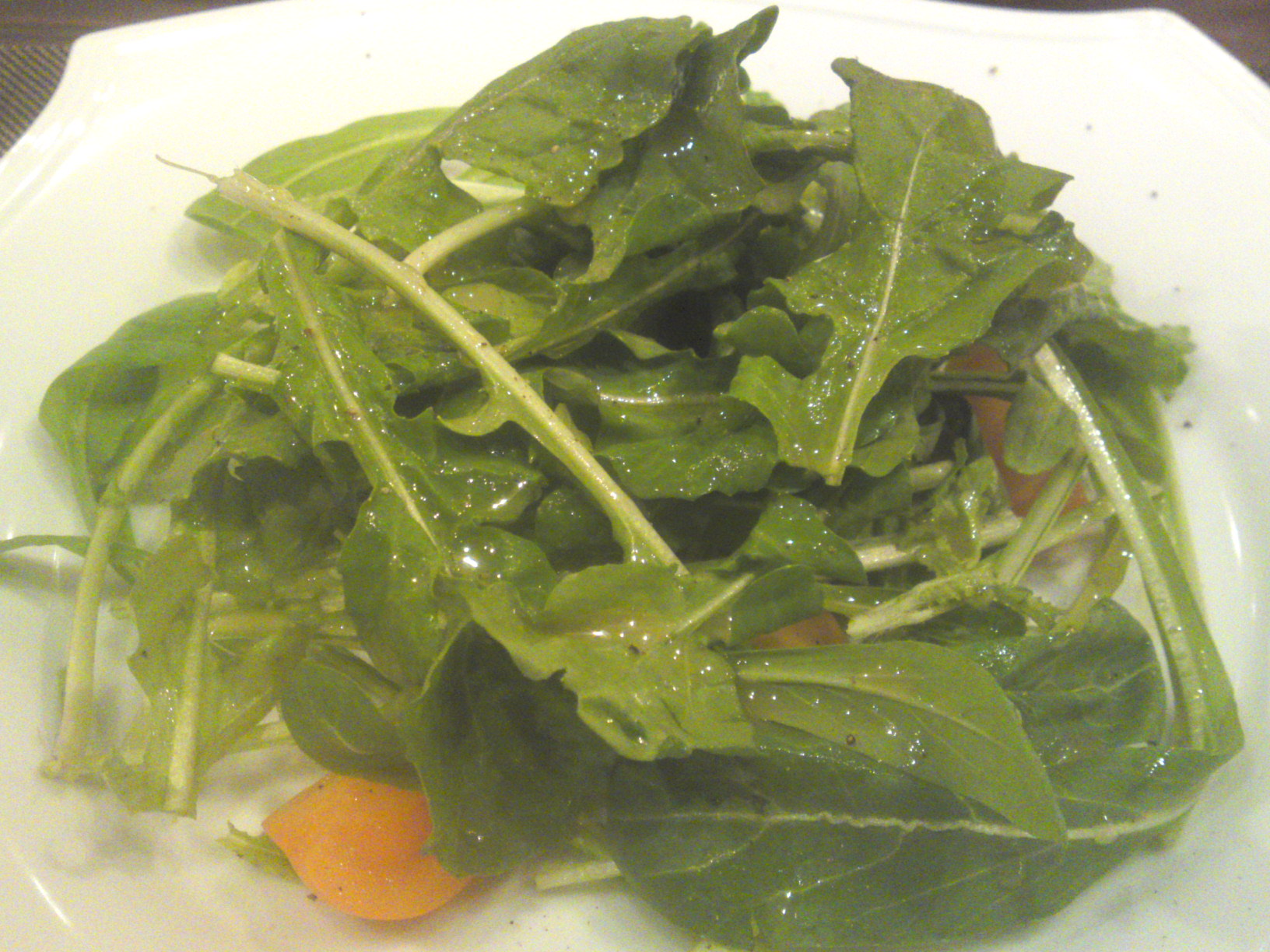
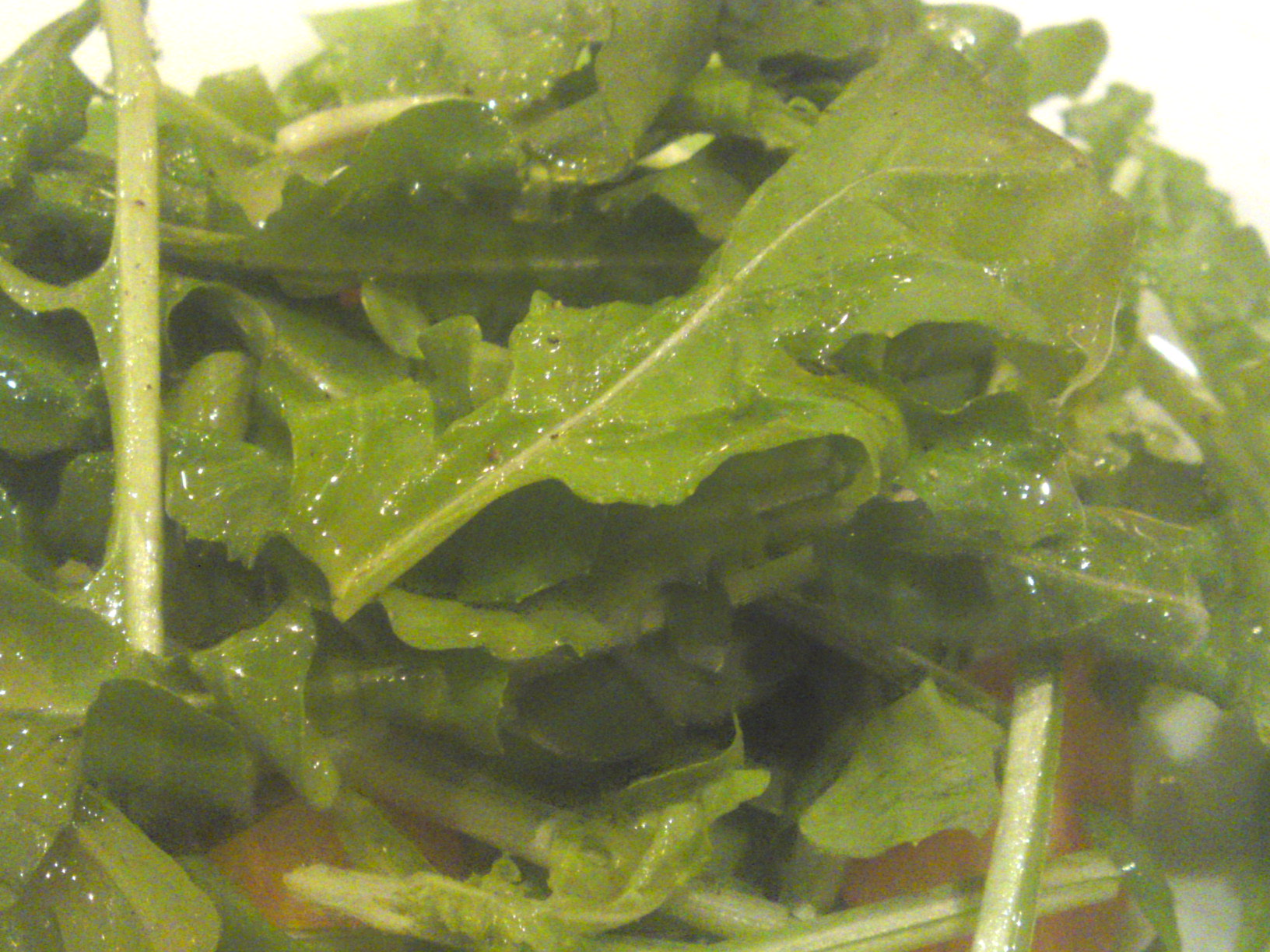
This salad was prepared with enormous lucolla/roquette leaves organically grown by one of the Chef’s neighbors!
In Shizuoka there is very little in using imported or mass-produced vegetables!

Beautiful lucolla leaves! Enormous, crispy and so delicious with a minimal dressing. Health in heaven!

The orange tomatoes are also grown in Shizuoka City!

Solio’s risottos are mostly seasonal.
The other day I asked if Chef Takehiko Katoh/加藤武彦 had any secrets for his famous recipes.
He simply enough replied:
“Any good chef can come up with truly great risottos if he uses good and fresh products. The only difference is the stock/stock soup!”
Great answer, but I will never know his secret stock!
Now, what was the above risotto made with?

Shizuoka-grown Na no Hana/Broccolini and Hokkaido “Kegani/毛蟹/Horsehair crab, Horse crab, supposedly the best crab in Japan!
Extravagant!

Now, how about this creamy one I had last night?

Sora mame/蚕豆/Broad beans and Talegio Cheese!

Takehiko asked me to try and come when the restaurant is not too busy as I tend to request dishes that are written on the official menu…

To be continued…

SOLOIO
420-0858 Shizuoka City, Aoi Ku, Tenmacho, 9-7, Kita, 1
Tel./fax: 054-260-4637
Business hours: 16:00~24:00
Closed on Monday
Credit cards OK
Private parties welcome!
Smoking allowed BUT Non-smoking until 20:00 everyday!

RECOMMENDED RELATED WEBSITES

Le Manger by Camille Oger (French), The Indian Tourist, Masala Herb by Helene Dsouza in Goa, India, Mummy I Can Cook! by Shu Han in London, Pierre.Cuisine, Francescannotwrite, My White Kitchen, 47 Japanese Farms Through The Eyes of Its Rural Communities, Foodhoe, Chucks Eats, Things that Fizz & Stuff, Five Euro Food by Charles,Red Shallot Kitchen by Priscilla,With a Glass, Nami | Just One Cookbook, Peach Farm Studio, Clumsyfingers by Xethia, PepperBento,Adventures in Bento Making, American Bent, Beanbento, Bento No, Bento Wo Tsukurimashou, Cooking Cute, Eula, Hapabento , Happy Bento, Jacki’s Bento Blog, Kitchen Cow, Leggo My Obento, Le Petit Journal Bento & CO (French), Lunch In A Box,
Susan at Arkonlite, Vegan Lunch Box; Tokyo Tom Baker, Daily Food Porn/Osaka, Only Nature Food Porn, Happy Little Bento, The Herbed Kitchen, J-Mama’s Kitchen, Cook, Eat, Play, Repeat, Bento Lunch Blog (German), Adventures In Bento, Anna The Red’s Bento Factory, Cooking Cute, Timeless Gourmet, Bento Bug, Ideal Meal, Bentosaurus, Mr. Foodie (London/UK), Ohayo Bento,

Must-see tasting websites:

-Sake: Tokyo Through The Drinking Glass, Tokyo Foodcast, Urban Sake, Sake World
-Wine: Palate To Pen, Warren Bobrow, Cellar Tours, Ancient Fire Wines Blog
-Beer: Good Beer & Country Boys, Another Pint, Please!
-Japanese Pottery to enjoy your favourite drinks: Yellin Yakimono Gallery
Japanese Fish Recipe: Curry-marinated Pike Mackerel/Aji No Kari Marine

Pike Mackerel, Horse Mackerel or Saurel is called Aji/鯵 in Japanese.
Shizuoka Prefecture, and especially Suruga Bay is very famous for great quality pike Mackerel almost all year round.

Here is a simple way to eat it cold, a welcome notion for the coming summer!

Curry-marinated Pike Mackerel/Aji No Kari Marine!
INGREDIENTS: for 5 persons

-Pike mackerel/Saurel: 2
-Red onion: 1
-Lemon slices: 3~4
-Flour: 2 tablespoons
-Curry mix powder: 1 tablespoon
-Salad oil: 100 cc/ml/1/2 cup
-Rice vinegar: 50 cc/ml/1/4 cup
-Salt: a little

RECIPE:

-Dress the fish (cut out the fillets) and cut into 4cm long pieces. Sprinkle with a little salt.

-Cut the red onion in half. Cut out the hard core. Slice it thin. Let the onion slices rest into clean cold water long enough to take out astringency (bitterness).

-Peel the lemon slices and cut them 6~8 “quarters”.

-Mix the flour with curry mix powder and lightly coat the fish with it. Deep-fry the fish.

-Line a large enough flat vessel (preferably rectangular) with the deep-fried fish. Place the lemon bits evenly on top. Cover evenly with the sliced red onion (drain it thouroughly first). Mix the oil, rice vinegar and salt and then pour the lot over the fish.
Cover with cellophane paper and let it marinate inside the fridge long enough for the taste to penetrate the fish.

SUGGESTION:

Grill sweet red pimentoes. Peel off the skin. Cut it in strips. You could do the same with string beans you boil first and then cut in strips.
Add them to the marinade for added taste and effect.

Don’t forget that the presentation will be the more important that this dish is simple!

RECOMMENDED RELATED WEBSITES

Le Manger by Camille Oger (French), The Indian Tourist, Masala Herb by Helene Dsouza in Goa, India, Mummy I Can Cook! by Shu Han in London, Pierre.Cuisine, Francescannotwrite, My White Kitchen, 47 Japanese Farms Through The Eyes of Its Rural Communities, Foodhoe, Chucks Eats, Things that Fizz & Stuff, Five Euro Food by Charles,Red Shallot Kitchen by Priscilla,With a Glass, Nami | Just One Cookbook, Peach Farm Studio, Clumsyfingers by Xethia, PepperBento,Adventures in Bento Making, American Bent, Beanbento, Bento No, Bento Wo Tsukurimashou, Cooking Cute, Eula, Hapabento , Happy Bento, Jacki’s Bento Blog, Kitchen Cow, Leggo My Obento, Le Petit Journal Bento & CO (French), Lunch In A Box,
Susan at Arkonlite, Vegan Lunch Box; Tokyo Tom Baker, Daily Food Porn/Osaka, Only Nature Food Porn, Happy Little Bento, The Herbed Kitchen, J-Mama’s Kitchen, Cook, Eat, Play, Repeat, Bento Lunch Blog (German), Adventures In Bento, Anna The Red’s Bento Factory, Cooking Cute, Timeless Gourmet, Bento Bug, Ideal Meal, Bentosaurus, Mr. Foodie (London/UK), Ohayo Bento,

Must-see tasting websites:

-Sake: Tokyo Through The Drinking Glass, Tokyo Foodcast, Urban Sake, Sake World
-Wine: Palate To Pen, Warren Bobrow, Cellar Tours, Ancient Fire Wines Blog
-Beer: Good Beer & Country Boys, Another Pint, Please!
-Japanese Pottery to enjoy your favourite drinks: Yellin Yakimono Gallery

Japanese Crustacean Species 7: Sakura Shrimp-Sakura Ebi-桜海老

My favorite, sakura ebi sashimi served with grated ginger!

SWakura Ebi Portal in Yui!

“Sakura Ebi” or Sakura shrimp/桜海老 is a vey small (maximum 5 cm) crustacean mostly caught in the Suruga Bay off the shores of Shizuoka Prefecture. Most of ships are anchored in Yui, formerly a city recently merged to Shizuoka City in Shimizu Ku, and also Oigawa Harbor in Yaizu City.

Sakura ebi ships leaving Yui before dusk!

The modern technique is to catch them in a net between two ships and next to syphon them out of the net for a neat separation from other seafood.
The shrimps are displayed in special net baskets according to long traditions before they are put on the market immediately for auction.
Many fishermen open their own sushi restaurants, bars and often serve their catches of the night until early in the afternoon before taking a well-earned sleep.

For people who prefer them as sushi, the gunkan style is the most appreciated!

Most French and Italian Restaurants in Shizuoka City and around will serve them in quiches!

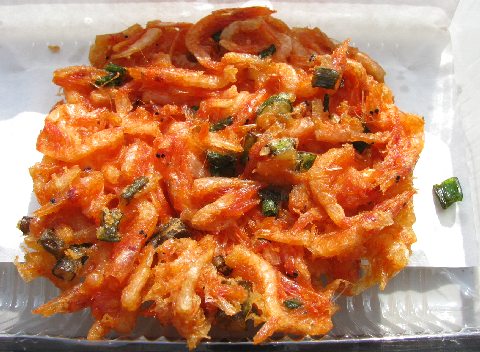
Another popular way to eat them is of course as a tempura called kaki-age, either with fresh sakura ebi in season or dried ones.

The same in my bento!

Fishermen use to dry their catch for sale and export until the government had the great idea to run an expressway just along the harbour!

The shrimps are now dried along nearby Fujikawa River, creating large quaint rose expanses in the most useen for locations!

Next time you visit Shizuoka don’t forget to buy sakura ebi senbei as a souvenir!

RECOMMENDED RELATED WEBSITES

Le Manger by Camille Oger (French), The Indian Tourist, Masala Herb by Helene Dsouza in Goa, India, Mummy I Can Cook! by Shu Han in London, Pierre.Cuisine, Francescannotwrite, My White Kitchen, 47 Japanese Farms Through The Eyes of Its Rural Communities, Foodhoe, Chucks Eats, Things that Fizz & Stuff, Five Euro Food by Charles,Red Shallot Kitchen by Priscilla,With a Glass, Nami | Just One Cookbook, Peach Farm Studio, Clumsyfingers by Xethia, PepperBento,Adventures in Bento Making, American Bent, Beanbento, Bento No, Bento Wo Tsukurimashou, Cooking Cute, Eula, Hapabento , Happy Bento, Jacki’s Bento Blog, Kitchen Cow, Leggo My Obento, Le Petit Journal Bento & CO (French), Lunch In A Box,
Susan at Arkonlite, Vegan Lunch Box; Tokyo Tom Baker, Daily Food Porn/Osaka, Only Nature Food Porn, Happy Little Bento, The Herbed Kitchen, J-Mama’s Kitchen, Cook, Eat, Play, Repeat, Bento Lunch Blog (German), Adventures In Bento, Anna The Red’s Bento Factory, Cooking Cute, Timeless Gourmet, Bento Bug, Ideal Meal, Bentosaurus, Mr. Foodie (London/UK), Ohayo Bento,

Must-see tasting websites:

-Sake: Tokyo Through The Drinking Glass, Tokyo Foodcast, Urban Sake, Sake World
-Wine: Palate To Pen, Warren Bobrow, Cellar Tours, Ancient Fire Wines Blog
-Beer: Good Beer & Country Boys, Another Pint, Please!
-Japanese Pottery to enjoy your favourite drinks: Yellin Yakimono Gallery

Cheese: Queso Fresco made by Jean Sabedora Garcia in Shizuoka City, Japan!

Who said they don’t make cheese in Japan?
Actually, a lot is made especially in the North, that is, in Hokkaido Island, and some had been made in the Eastern part of Shizuoka Prefecture from cow’s milk for at least ten years, not withstanding the numerous smoked cheese made here and there…

And now, I discovered a cheese maker in Shimizu Ku, Shizuoka City who makes his cheese from cow’s milk!

Jean Sabedora Garcia (I will have to check the proper spelling in a soon to come interview!) is a Peruvian gentleman who makes his cheese the way they fabricate it in South America.

The cheese is made with pasteurized cow’s milk, food salt, potassium chloride and rennet, all clearly indicated on the package label.

The consumption date is also clearly indicated and it is double-packed for maximum food safety. It should be stored at a temperature of 10 degrees Celsius.

Queso fresco (Spanish), Queijo Fresco (Portuguese) or “Natural Cheese” (Japanese) is of a beautiful white color and very firm, making it easy to cut and serve.
It is quite similar to feta in concept, firmness and color but slightly more salted.
The aroma is very pleasant.
Surprisingly well-balanced and easy to eat.
Although made from cow’s milk, it tastes very much like a very young goat’s milk cheese.
Best appreciated on its own with high quality crackers, or in caprese style salad.
I had a little weakness for it toasted on home-made bread!
Really worth discovering!

Jean Sabodera Garcia
DEKASEGUI PRODUCTS-JF Shokuhin Kougyou
Shizuoka City, Shimizu ku, Minato Minami Cho, 1-11-1F
Tel.: 054-537-0374
Mobile Phone: 090-65953065

RECOMMENDED RELATED WEBSITES

Le Manger by Camille Oger (French), The Indian Tourist, Masala Herb by Helene Dsouza in Goa, India, Mummy I Can Cook! by Shu Han in London, Pierre.Cuisine, Francescannotwrite, My White Kitchen, 47 Japanese Farms Through The Eyes of Its Rural Communities, Foodhoe, Chucks Eats, Things that Fizz & Stuff, Five Euro Food by Charles,Red Shallot Kitchen by Priscilla,With a Glass, Nami | Just One Cookbook, Peach Farm Studio, Clumsyfingers by Xethia, PepperBento,Adventures in Bento Making, American Bent, Beanbento, Bento No, Bento Wo Tsukurimashou, Cooking Cute, Eula, Hapabento , Happy Bento, Jacki’s Bento Blog, Kitchen Cow, Leggo My Obento, Le Petit Journal Bento & CO (French), Lunch In A Box,
Susan at Arkonlite, Vegan Lunch Box; Tokyo Tom Baker, Daily Food Porn/Osaka, Only Nature Food Porn, Happy Little Bento, The Herbed Kitchen, J-Mama’s Kitchen, Cook, Eat, Play, Repeat, Bento Lunch Blog (German), Adventures In Bento, Anna The Red’s Bento Factory, Cooking Cute, Timeless Gourmet, Bento Bug, Ideal Meal, Bentosaurus, Mr. Foodie (London/UK), Ohayo Bento,

Must-see tasting websites:

-Sake: Tokyo Through The Drinking Glass, Tokyo Foodcast, Urban Sake, Sake World
-Wine: Palate To Pen, Warren Bobrow, Cellar Tours, Ancient Fire Wines Blog
-Beer: Good Beer & Country Boys, Another Pint, Please!
-Japanese Pottery to enjoy your favourite drinks: Yellin Yakimono Gallery

Japanese Crustacean Species 6: Japanese Imperial Prawn-Kuruma Ebi-車海老

KURUMA-EBI-1

Kuruma Ebi/車海老, or Japanese Imperial Prwan, is probably the most popular prawn in Japan!
It has different names depending on its size: Saimaki (up to 5 cm), Maki (up to 10cm)

Its season lasts from late Autumn to the end of Winter.
It is found south of Hokkaido Island down to the Indian Ocean until depths of 50 metres.
It had been successfully artificially grown for some time until diseases put a momentary stop on the breeding.
The prawn has steadily become a rare morsel. Altogether, natural and human-raised specimen, the annual catch amounts only to 2,000 tonnes.

KURUMA-EBI-1a

Raw, or

KURUMA-EBI-2

boiled, they make for great decoration on top of succulent taste!

KURUMA-EBI-4

They are very much appreciated a sashimi, especially after having been made to “dance” in Japanese sake!

Grilled on the stick would tempt many an officionado!

They make for extravagant tempura!

As sushi Nigiri, they are equally popular raw, or

boiled!

If you the chance to buy tem alive (In shizuoka, we do have them kicking), especially coming from Okinawa, put them in a pan with Japanese sake under a lid. Wait until they have grown “quiet”, and prepare them right away!

RECOMMENDED RELATED WEBSITES

Le Manger by Camille Oger (French), The Indian Tourist, Masala Herb by Helene Dsouza in Goa, India, Mummy I Can Cook! by Shu Han in London, Pierre.Cuisine, Francescannotwrite, My White Kitchen, 47 Japanese Farms Through The Eyes of Its Rural Communities, Foodhoe, Chucks Eats, Things that Fizz & Stuff, Five Euro Food by Charles,Red Shallot Kitchen by Priscilla,With a Glass, Nami | Just One Cookbook, Peach Farm Studio, Clumsyfingers by Xethia, PepperBento,Adventures in Bento Making, American Bent, Beanbento, Bento No, Bento Wo Tsukurimashou, Cooking Cute, Eula, Hapabento , Happy Bento, Jacki’s Bento Blog, Kitchen Cow, Leggo My Obento, Le Petit Journal Bento & CO (French), Lunch In A Box,
Susan at Arkonlite, Vegan Lunch Box; Tokyo Tom Baker, Daily Food Porn/Osaka, Only Nature Food Porn, Happy Little Bento, The Herbed Kitchen, J-Mama’s Kitchen, Cook, Eat, Play, Repeat, Bento Lunch Blog (German), Adventures In Bento, Anna The Red’s Bento Factory, Cooking Cute, Timeless Gourmet, Bento Bug, Ideal Meal, Bentosaurus, Mr. Foodie (London/UK), Ohayo Bento,

Must-see tasting websites:

-Sake: Tokyo Through The Drinking Glass, Tokyo Foodcast, Urban Sake, Sake World
-Wine: Palate To Pen, Warren Bobrow, Cellar Tours, Ancient Fire Wines Blog
-Beer: Good Beer & Country Boys, Another Pint, Please!
-Japanese Pottery to enjoy your favourite drinks: Yellin Yakimono Gallery

Japanese Gastronomy: Vegan Red Miso Dressing

This posting has been prompted by vegan and vegetarian friends who wanted to get some information for a red miso dipping sauce.
Although this particular recipe is more a dressing than anything else, it could be used as a dipping sauce if you mixed in fresh cream. The cream will solidify when combined with oil.
Unfortunately it will not qualify as a vegan recipe, then.
I wonder if soy milk cream exists!

INGREDIENTS:: for 60 ml/cc of dressing

-Red miso: 1.5 tablespoons
-Soy sauce: 1/2 tablespoon
-Rice vinegar: 1.5 tablespoons
-Sugar: 1 tablespoon
-Salad oil of your choice: 3 tablespoons
-Ground sesame seeds: 1.5 tablespoons
-Freshly grated ginger: a little
-Freshly grated garlic: a little

RECIPE:

-First mix miso, soy sauce, sugar, ground sesame, grated ginger and garlic until you obtain a smooth mixture. Add oil and rice vinegar and stir well.

-Serve it on fresh vegetables and tofu salad!

-Great for taste and look on freshly boiled or steamed vegetables!

RECOMMENDED RELATED WEBSITES

Le Manger by Camille Oger (French), The Indian Tourist, Masala Herb by Helene Dsouza in Goa, India, Mummy I Can Cook! by Shu Han in London, Pierre.Cuisine, Francescannotwrite, My White Kitchen, 47 Japanese Farms Through The Eyes of Its Rural Communities, Foodhoe, Chucks Eats, Things that Fizz & Stuff, Five Euro Food by Charles,Red Shallot Kitchen by Priscilla,With a Glass, Nami | Just One Cookbook, Peach Farm Studio, Clumsyfingers by Xethia, PepperBento,Adventures in Bento Making, American Bent, Beanbento, Bento No, Bento Wo Tsukurimashou, Cooking Cute, Eula, Hapabento , Happy Bento, Jacki’s Bento Blog, Kitchen Cow, Leggo My Obento, Le Petit Journal Bento & CO (French), Lunch In A Box,
Susan at Arkonlite, Vegan Lunch Box; Tokyo Tom Baker, Daily Food Porn/Osaka, Only Nature Food Porn, Happy Little Bento, The Herbed Kitchen, J-Mama’s Kitchen, Cook, Eat, Play, Repeat, Bento Lunch Blog (German), Adventures In Bento, Anna The Red’s Bento Factory, Cooking Cute, Timeless Gourmet, Bento Bug, Ideal Meal, Bentosaurus, Mr. Foodie (London/UK), Ohayo Bento,

Must-see tasting websites:

-Sake: Tokyo Through The Drinking Glass, Tokyo Foodcast, Urban Sake, Sake World
-Wine: Palate To Pen, Warren Bobrow, Cellar Tours, Ancient Fire Wines Blog
-Beer: Good Beer & Country Boys, Another Pint, Please!
-Japanese Pottery to enjoy your favourite drinks: Yellin Yakimono Gallery

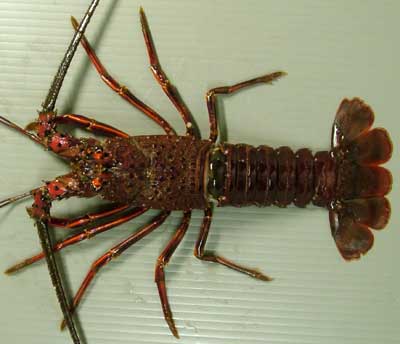
Japanese Crustacean Species 5: Spiny Lobster-Ise Ebi-伊勢海老

ISE-EBI-1

Ise Ebi/伊勢海老, or Japanese Spiny Lobster is one the Spiny lobster varieties so popular all over the World.
The Japanese variety is smaller, or more precisely is more popular under a certain size.

Also called Kamakura Ebi, it is caught off the shores of Chiba, Wakayama, Mie and Shizuoka Prefectures.

The best specimens are aught in Winter, although imported lobsters can be found in other seasons.

The annual catch is fairly stable at 1,000 tonnes a year.
Imprted specimens account for 10,000 tonnes, mainly from Australia, New Zealand and New Caledonia.
In that case they are also called Minami/South Ebi.

The Japanese appreciate their lobsters raw.

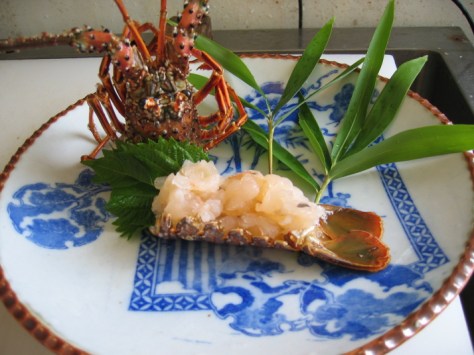
ISE-EBI-SASHIMI

As o-tsukuri/sashimi plate they are quite spectacular!

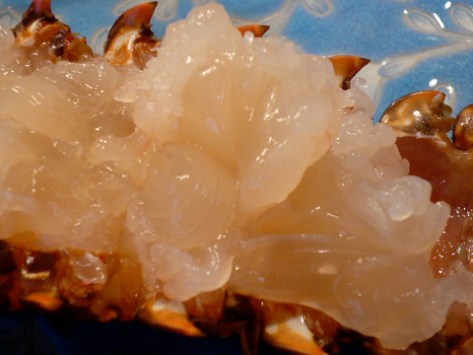
ISE-EBI-SASHIMI2

For a closer look!

Another extravagant to serve as sashimi is to have them slightly seared outside and raw inside!

They are natuarally very popular as a sushi nigiri!

If they are small enough they can be served as another extravagant sushi grilled whole over a single ball of rice/shari!

And the larger specimens can be prepared western-style in gratin!

RECOMMENDED RELATED WEBSITES

Le Manger by Camille Oger (French), The Indian Tourist, Masala Herb by Helene Dsouza in Goa, India, Mummy I Can Cook! by Shu Han in London, Pierre.Cuisine, Francescannotwrite, My White Kitchen, 47 Japanese Farms Through The Eyes of Its Rural Communities, Foodhoe, Chucks Eats, Things that Fizz & Stuff, Five Euro Food by Charles,Red Shallot Kitchen by Priscilla,With a Glass, Nami | Just One Cookbook, Peach Farm Studio, Clumsyfingers by Xethia, PepperBento,Adventures in Bento Making, American Bent, Beanbento, Bento No, Bento Wo Tsukurimashou, Cooking Cute, Eula, Hapabento , Happy Bento, Jacki’s Bento Blog, Kitchen Cow, Leggo My Obento, Le Petit Journal Bento & CO (French), Lunch In A Box,
Susan at Arkonlite, Vegan Lunch Box; Tokyo Tom Baker, Daily Food Porn/Osaka, Only Nature Food Porn, Happy Little Bento, The Herbed Kitchen, J-Mama’s Kitchen, Cook, Eat, Play, Repeat, Bento Lunch Blog (German), Adventures In Bento, Anna The Red’s Bento Factory, Cooking Cute, Timeless Gourmet, Bento Bug, Ideal Meal, Bentosaurus, Mr. Foodie (London/UK), Ohayo Bento,

Must-see tasting websites:

-Sake: Tokyo Through The Drinking Glass, Tokyo Foodcast, Urban Sake, Sake World
-Wine: Palate To Pen, Warren Bobrow, Cellar Tours, Ancient Fire Wines Blog
-Beer: Good Beer & Country Boys, Another Pint, Please!
-Japanese Pottery to enjoy your favourite drinks: Yellin Yakimono Gallery

Bryan Baird’s Newsletter (2012/04/04): Three Spring Seasonal Releases

Baird Beer & Taproom Events Bulletin
bryan-sayuri.gif

Three Spring Seasonal Releases

Dear Taproom Friend & Baird Beer Enthusiast:

April in Japan coincides with the new school and business year. The scene around Tokyo is of thousands of newbusiness suit-cladded shain (company employees) shuffling around apprehensively from one orientation meeting to another. When they are not attending indoctrination rallies, they are busy carrying out their first corporate assignment: organizing and reserving space for the company Hanami party. Hanami parties in Japan, of course, involve consumption of copious amounts of alcoholic beverages. It is one of our spring seasonal missions at Baird Beer to class up the alcohol beverage scene at Hanami parties. In addition to our terrific lineup of year-round beer, this year we are releasing three wonderful seasonal brews tailored especially for this rite-of-passage month: Bureiko Jikan Strong Golden Ale, Pawa-Hara Golden Ale, and Temple Garden Yuzu Ale.

New Baird Beer Seasonal Releases:
*Bureiko Jikan Strong Golden Ale (ABV 8.5%):

The inspiration for this refreshing, effervescent yet potent brew is the renowned Belgian classic, Duvel. The key attributes of Duvel are light body, high alcohol, and spritzy effervescence. We aim for the light body and strong alcohol through a high starting gravity (18 Plato) that contains a large amount of Japanese korizato sugar (25 percent). High attenuation and natural carbonation through secondary fermentation in package provide the sprite, refreshing character. A touch of spicy-floral hop flavor and aroma (Sterling, Saaz, Styrian Golding) helps to round out the character.

Bureiko jikan (literally, “time for impertinence“) is a classic Japanese cultural construct: it is a time when, generally fueled by alcohol, the strict bonds of hierarchical relationships melt away and individuals on the lower rungs of those relationships can let their true feelings and frustrations out without threat of later recrimination. It is a cathartic venting mechanism that effectively perserves the hierarchical system of relationships here. So, invite your boss or senpai out for a Baird Beer, order up a glass of Bureiko Jikan Strong Golden Ale, and let it fly!

Bureiko Jikan Strong Golden Ale is available for immediate release in both kegs and bottles (630 ml).

*Pawa-Hara Golden Ale (ABV 6.5%):

Recently I have heard of a new and interesting Japanese cultural construct which is essentially the polar opposite of bureiko jikan. Japanese call it pawa-hara which is short for “power harassment”. This is a situation in which someone on the top rungs of the hierarchical relationship ladder invites underlings out for a drink and bite with the express intent of bullying and berating them. Alcohol, it seems, fuels this newly coined social custom too.

Well, if this is going to take place, we feel there needs to be a good beer suitable to the occasion. Our answer: Pawa-Hara Golden Ale. The recipe is exactly the same as Bureiko Jikan, only the original gravity (14.2 Plato), alcohol (6.5%) and hop bittering units (20) have been lowered somewhat. The result is a beer of seductive but not overwhelming strength; ideal for buttering someone up for the lambasting to come!

Due to its experimental social nature, and the fact that it is a small batch yielding only a minimal number of kegs, Pawa-Hara Golden Ale will be available on draught exclusively at our Taproom pubs. If you are a person in a position of power and need to berate the troops a bit, come on in to a Taproom — we got the elixir you’ll need!

*Temple Garden Yuzu Ale (ABV 5.5%):

This lovely spring ale is brewed with wonderfully piquant and aromatic yuzu fruit that is local and fresh. To put it simply, this is a sublime fruited ale. Because it is our policy to use only fresh fruit in season, and mostly local fruit, we can only brew Temple Garden once a year. Sadly, our supply of yuzu fruit was very limited this year enabling us to brew only two small batches. This has yielded only a very small quantity of kegs and no bottles. We apologize to all good Baird Beer retailing accounts that are unable to procure Temple Garden Yuzu Ale this year. We will do our best to find and procure more yuzu fruit next year and turn it into a far greater volume of this one-of-a-kind ale.

Cheers,

Bryan Baird

Baird Brewing Company
Numazu, Japan
HOMEPAGE

RECOMMENDED RELATED WEBSITES

Le Manger by Camille Oger (French), The Indian Tourist, Masala Herb by Helene Dsouza in Goa, India, Mummy I Can Cook! by Shu Han in London, Pierre.Cuisine, Francescannotwrite, My White Kitchen, 47 Japanese Farms Through The Eyes of Its Rural Communities, Foodhoe, Chucks Eats, Things that Fizz & Stuff, Five Euro Food by Charles,Red Shallot Kitchen by Priscilla,With a Glass, Nami | Just One Cookbook, Peach Farm Studio, Clumsyfingers by Xethia, PepperBento,Adventures in Bento Making, American Bent, Beanbento, Bento No, Bento Wo Tsukurimashou, Cooking Cute, Eula, Hapabento , Happy Bento, Jacki’s Bento Blog, Kitchen Cow, Leggo My Obento, Le Petit Journal Bento & CO (French), Lunch In A Box,
Susan at Arkonlite, Vegan Lunch Box; Tokyo Tom Baker, Daily Food Porn/Osaka, Only Nature Food Porn, Happy Little Bento, The Herbed Kitchen, J-Mama’s Kitchen, Cook, Eat, Play, Repeat, Bento Lunch Blog (German), Adventures In Bento, Anna The Red’s Bento Factory, Cooking Cute, Timeless Gourmet, Bento Bug, Ideal Meal, Bentosaurus, Mr. Foodie (London/UK), Ohayo Bento,

Must-see tasting websites:

-Sake: Tokyo Through The Drinking Glass, Tokyo Foodcast, Urban Sake, Sake World
-Wine: Palate To Pen, Warren Bobrow, Cellar Tours, Ancient Fire Wines Blog
-Beer: Good Beer & Country Boys, Another Pint, Please!
-Japanese Pottery to enjoy your favourite drinks: Yellin Yakimono Gallery

Japanese Crustacean Species 4: Alaskan Pink Shrimp-Pink Shrimp-Amaebi-甘海老

AMAEBI-1

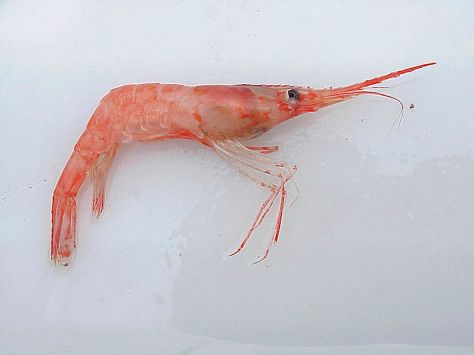
Amaebi (甘海老 in Japanese) or by its Latin name Pandalus borealis (also called Pandalus eous) is a species of shrimp found in cold parts of the Atlantic and Pacific Oceans. Many different English names are used, with little consensus (deep-water shrimp, cold-water shrimp, northern shrimp, Alaskan pink shrimp, pink shrimp, northern red shrimp, Greenland prawn (UK)). Often the word shrimp is replaced by prawn, albeit incorrectly.

In Japan, it is also known as Akaebi, Hokkoku Akaebi/North Country Red Shrimp, Nanban Ebi or Tongarasahi.

The season in Japan is Winter, although it can be found all year round thanks to large imports from Greenland and Canada. Yearly domestic catch amount to 2,000 tonnes in Hokkaido and 800 tonnes in Ishikawa Prefecture.

It is a species famous for its sexual properties: the shrimps are hermaphroditic. They start out male, but after a year or two, their testicles turn to ovaries and they complete their lives as females. However, if there is a predominance of female Pandalus shrimp, the males will delay their transformation. Likewise should there be a shortage of females, the male shrimp will begin their transformation earlier, all for the sake of maintaining balance for procreational purposes.

They are called “Ama Ebi/Sweet Shrimp” in Japanese as they will turn very sweet after a couple of days in the refrigerator, whereas they will show no sweetness at all when fresh!

They are great as sashimi on their own, in salads or as part of a larger sashimi plate!

Of course, as sushi, they are a superb morsel!

RECOMMENDED RELATED WEBSITES

Le Manger by Camille Oger (French), The Indian Tourist, Masala Herb by Helene Dsouza in Goa, India, Mummy I Can Cook! by Shu Han in London, Pierre.Cuisine, Francescannotwrite, My White Kitchen, 47 Japanese Farms Through The Eyes of Its Rural Communities, Foodhoe, Chucks Eats, Things that Fizz & Stuff, Five Euro Food by Charles,Red Shallot Kitchen by Priscilla,With a Glass, Nami | Just One Cookbook, Peach Farm Studio, Clumsyfingers by Xethia, PepperBento,Adventures in Bento Making, American Bent, Beanbento, Bento No, Bento Wo Tsukurimashou, Cooking Cute, Eula, Hapabento , Happy Bento, Jacki’s Bento Blog, Kitchen Cow, Leggo My Obento, Le Petit Journal Bento & CO (French), Lunch In A Box,
Susan at Arkonlite, Vegan Lunch Box; Tokyo Tom Baker, Daily Food Porn/Osaka, Only Nature Food Porn, Happy Little Bento, The Herbed Kitchen, J-Mama’s Kitchen, Cook, Eat, Play, Repeat, Bento Lunch Blog (German), Adventures In Bento, Anna The Red’s Bento Factory, Cooking Cute, Timeless Gourmet, Bento Bug, Ideal Meal, Bentosaurus, Mr. Foodie (London/UK), Ohayo Bento,

Must-see tasting websites:

-Sake: Tokyo Through The Drinking Glass, Tokyo Foodcast, Urban Sake, Sake World
-Wine: Palate To Pen, Warren Bobrow, Cellar Tours, Ancient Fire Wines Blog
-Beer: Good Beer & Country Boys, Another Pint, Please!
-Japanese Pottery to enjoy your favourite drinks: Yellin Yakimono Gallery

Potato Gastronomy: The Real Potato Chips!

Now, what are real potato chips?

Not the French fries, which are actually Belgian fries.

And not the poor imitations you wolf down with untold amounts of salt and preservatives!

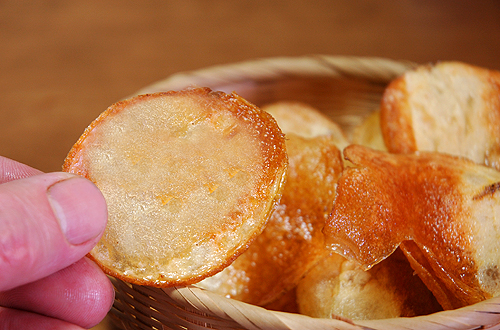
Real potato chips, as known in Great Britain or France (!) are made with potatoes, real ones I mean, and they are easy to make and much, much healthier!

Now, what do you need?
Potatoes, of course, a (very) little salt and good oil.

How do you prepare them?

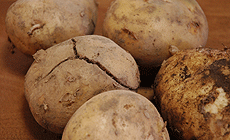
Your potatoes, being old or not, can be used with a simple technique.

If they are old, no problem.
If you brush them (with a real hard brush) under clear water, you will be able to reduce their outer layer to a very thin skin that is edible (actually most of the really beneficient matters are contained in their skin!).

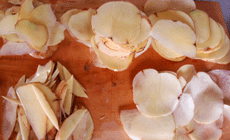
Cut them as thin as possible (with their skin!).

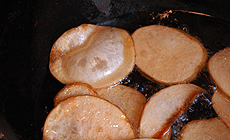
Important: slices of different thickness should not be fried together.
Try to separate them as shown on above pic and fry them separately.
Great fun if you have the kids around!

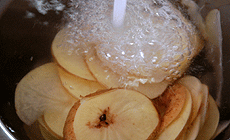
Clean potato slices in cold running water. This is an important step unless you want them to stick together, turn black and make a mess!
Dry them thoroughly inside a large clean cloth (or the water will fly upon frying!).

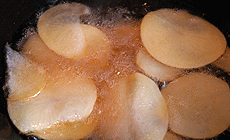
Heat frying oil to 170 degrees Celsius.

This is how your chips should look just before frying!

Use long wooden chopsticks to prevent chips from sticking to each other.

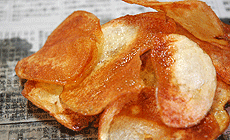
Your chips will change colour and, if the oil is at proper temperature, swell nicely!

Once you are satisfied with their colour, take them out of the oil and let them rest for a very short while over a fine mesh to get rid of excess oil. Sprinkle a (very) little salt for taste. I personally like some parmegiano and pepper instead of the salt!

Don’t forget the “wrong shapes”! They make for great chips, too, especially with the kids!

I usually serve the round chips with oven-baked chicken or guinea fowl!

Did I mention vegans can eat these?

RECOMMENDED RELATED WEBSITES

The Indian Tourist, Masala Herb by Helene Dsouza in Goa, India
Mummy I Can Cook! by Shu Han in London
Pierre.Cuisine, Francescannotwrite, My White Kitchen, 47 Japanese Farms Through The Eyes of Its Rural Communities, Foodhoe, Chucks Eats, Things that Fizz & Stuff, Five Euro Food by Charles,Red Shallot Kitchen by Priscilla,With a Glass, Nami | Just One Cookbook, Peach Farm Studio, Clumsyfingers by Xethia, PepperBento,Adventures in Bento Making, American Bent, Beanbento, Bento No, Bento Wo Tsukurimashou, Cooking Cute, Eula, Hapabento , Happy Bento, Jacki’s Bento Blog, Kitchen Cow, Leggo My Obento, Le Petit Journal Bento & CO (French), Lunch In A Box,
Susan at Arkonlite, Vegan Lunch Box; Tokyo Tom Baker, Daily Food Porn/Osaka, Only Nature Food Porn, Happy Little Bento, The Herbed Kitchen, J-Mama’s Kitchen, Cook, Eat, Play, Repeat, Bento Lunch Blog (German), Adventures In Bento, Anna The Red’s Bento Factory, Cooking Cute, Timeless Gourmet, Bento Bug, Ideal Meal, Bentosaurus, Mr. Foodie (London/UK), Ohayo Bento,

Must-see tasting websites:

-Sake: Tokyo Through The Drinking Glass, Tokyo Foodcast, Urban Sake, Sake World
-Wine: Palate To Pen, Warren Bobrow, Cellar Tours, Ancient Fire Wines Blog
-Beer: Good Beer & Country Boys, Another Pint, Please!
-Japanese Pottery to enjoy your favourite drinks: Yellin Yakimono Gallery

Japanese Crustacean Species 3: Squiila-Mantis Shrimp-Shako-蝦蛄

A tropical squilla!

Squillae as found on Japanese markets.
Note the dun color as they come from dark northern seas!

The Squilla or “Shako” (蝦蛄in Japanese) is a delicacy that appears on the sushi bar counters from April to Summer, although different varieties can be found in Hokkaido markets (Otaru City in particular) almost all year round.
You will discover it under names such as “Shaku” and “Gazaebi”.
They are actually caught in almost all Japanese seas, but the best are supposed to originate from Hokkaido.

Served boiled or steamed on their own, they make for a great snack!

Like any crustaceans, they can be eaten in many ways.
The Japanese favor the small kind with a violet back. I had the opportunity to buy some very large specimen in Otaru, and eat them just boiled and served with rice vinegar mixed with a little Japanese mustard, or in salads.
They almost disappeared from Tokyo Bay in the 1960’s but reappeared in the 1970’s. Most fishermen in the Kanto (Eastern Japan) area will place them in boxes themselves to sell them directly at fish markets. The market value can vary wildly, but look for the genuine harbor markets and buy them yourself.

Simple nigiri with boiled/steamed squilla

Naturally, they are most popular as nigiri sushi. Customers jokingly ask for “garage” (in English) as “shako” also means (different kanji, of course: 車庫) “garage”!

Seasoned with “tare” sauce.

An unusual offering with grilled squilla!

RECOMMENDED RELATED WEBSITES

The Indian Tourist, Masala Herb by Helene Dsouza in Goa, India
Mummy I Can Cook! by Shu Han in London
Pierre.Cuisine, Francescannotwrite, My White Kitchen, 47 Japanese Farms Through The Eyes of Its Rural Communities, Foodhoe, Chucks Eats, Things that Fizz & Stuff, Five Euro Food by Charles,Red Shallot Kitchen by Priscilla,With a Glass, Nami | Just One Cookbook, Peach Farm Studio, Clumsyfingers by Xethia, PepperBento,Adventures in Bento Making, American Bent, Beanbento, Bento No, Bento Wo Tsukurimashou, Cooking Cute, Eula, Hapabento , Happy Bento, Jacki’s Bento Blog, Kitchen Cow, Leggo My Obento, Le Petit Journal Bento & CO (French), Lunch In A Box,
Susan at Arkonlite, Vegan Lunch Box; Tokyo Tom Baker, Daily Food Porn/Osaka, Only Nature Food Porn, Happy Little Bento, The Herbed Kitchen, J-Mama’s Kitchen, Cook, Eat, Play, Repeat, Bento Lunch Blog (German), Adventures In Bento, Anna The Red’s Bento Factory, Cooking Cute, Timeless Gourmet, Bento Bug, Ideal Meal, Bentosaurus, Mr. Foodie (London/UK), Ohayo Bento,

Must-see tasting websites:

-Sake: Tokyo Through The Drinking Glass, Tokyo Foodcast, Urban Sake, Sake World
-Wine: Palate To Pen, Warren Bobrow, Cellar Tours, Ancient Fire Wines Blog
-Beer: Good Beer & Country Boys, Another Pint, Please!
-Japanese Pottery to enjoy your favourite drinks: Yellin Yakimono Gallery

Oil Varieties: An Introduction

OLIVE-OIL-PRODUCTION
(The Manufacture of Oil drawn and engraved by J Amman in the Sixteenth Century/Wikipedia)

Once again, the other day during my bus ride to work (it’s pouring on weekends these days!), I was thinking of my vegan and vegetarian friends and also my omnivore (I’m one of them!) ones. As far as I can recollect, there is little written about oils and I thought I could write up a useful posting for all to copy and borrow!

Have you ever wondered how many kinds of oil there are out there?

All right, shall we start (and I’m sure to forget some along the way!):

OLIVE OIL
OIL-OLIVES

Now, we all seem to know what olive oile is all about.
But there is only one good type of olive oil: Extra Vrigin Olive Oil! That is what comes out first caused by the natural pressure of all these olives piled upon each other.
The rest is sub-standard, whatever the name.
Back in France (and most probably in may other countries) we have olive oil sommeliers/tasters!
have you ever heard of the expressions: fruitiness, bitterness, pungency, and mouth feel.
And I’m not talking about the olives themselves!
I will not tell and hope I got you hooked!

SWEET ALMOND OIL
OIL-ALMOND

Almond Oil was used as perfume in ancient times.
Light and very fragrant, it is particularly welcome in marinades (raw salmon seasoned with dill or basil) or drizzled over seafood, pasta or fish prior to serving.

ARGAN OIL
OIL-ARGAN

Also called Moroccan Fennel Oil, Argan oil is an oil produced from the kernels of the endemic argan tree, that is valued for its nutritive, cosmetic and numerous medicinal properties. That tree is found only in North Africa.
Bold and wild in taste, it is a favourite of mine. Use it isparingly n salads, couscous and tagines. Works wonders on a beef carpaccio and on goat cheese.

PEANUT and ROASTED PEANUT OIL
OIL-PEANUTS

Peanuts oil is very common, all right, but roasted peanut has a startling flavour. Perfect for salad and cheese dishes. Suited to all warm climate cuisines: Mexican, African, Indonesian.

CANOLA or RAPE SEED OIL
OIL-RAPESEED

The Japanese eat the unopened flowers and young shoots after boiling them.
They reveal a full-bodied in taste with a distinct cabbage flavor. Enhances potato or beet salads. Try it on fresh cottage cheese!

HAZLENUT OIL
OIL-HAZELNUT

Another favourite of mine. I use it extensively in salad dressings.
Hazelnuts are rich in protein and unsaturated fat. Moreover, they contain significant amounts of thiamine and vitamin B6, as well as smaller amounts of other B vitamins.
Suave and lightly aromatic. Great in all types of salads. Replaces butter (vegans, listen!) on all starches, vegetables, fish, pasta, pastries. Adds a festive touch when drizzled on a potato, green bean or carrot dish.

WALNUT OIL
OIL-WALNUT

Another favourite of mine!
In France we make bread, pickles and liqueurs with them!
Walnuts are also an excellent source of omega-3 fatty acids, and have been shown as helpful in lowering cholesterol.
They have a pronounced nutty flavour. Well suited for bitter greens (endives, chicory, dandelion); excellent drizzled on starches. This oil is a good companion to a lightly seasoned fresh cheese. This oil fears heat!

PECAN NUTOIL
OIL-PECAN

Pecans are a good source of protein and unsaturated fats. A diet rich in nuts can lower the risk of gallstones in women. The antioxidants and plant sterols found in pecans reduce high cholesterol by reducing the “bad” LDL cholesterol levels.
It reveals a pronounced nut taste, in between walnut and almond. Good on any type of rice, cold, hot or in a salad.

GRAPE SEED OIL
OIL-GRAPESEED

Grape seed oil is also a preferred cosmetic ingredient for damaged and stressed tissues!
Neutral taste (it is unscented). Perfect for mixing with other more pungent oils; ideal for deep frying. Grape seed contains potent antioxidants such as vitamin E alpha and procyandanians, which contribute to its numerous health benefits.

PINE NUT OIL
PINE-NUT

Pine nut oil has a relatively low smoke point, and is therefore not generally used during cooking. Rather, it is added to foods for “finishing”, to add flavor.
It reveals a very subtle and mild taste. Enhances the flavour of any dish on which it is drizzled. Added in the final moments of cooking, it does wonders with seafood stews, sauces (especially wine) and soups (particularly minestrone).

PISTACHIO OIL
OIL-PISTACHIO

In July 2003, the Food and Drug Administration (FDA) approved the first qualified health claim specific to nuts lowering the risk of heart disease.
Its oil has a very distinct, long-lasting taste. It is not suited to all types of vinegars: balsamic and honey are the best. A vinaigrette composed of this oil, balsamic vinegar, chives and seasoning is superb on an endive and smoked trout (or salmon) salad.

SESAME OIL
OIL-SESAME

In Japan, the best tempura is deep-fried in pure sesame oil only!
Used extensivley all over the World, it has a very strong roasted, nutty flavour. A few drops in a salad or stir fry gives the dish a definite oriental touch.
I use it extensively with tofu, natto and salads!

SOY BEAN OIL
OIL-SOYBEAN

Soy bean oil is mainly used as a bulk cooking oil especially in South Asia and in the Middle East.
The most important point regarding the use of soybeans for human nutrition is the absolute necessity to cook the soybean with “wet” heat in order to destroy the trypsin inhibitors; serine protease inhibitors.
Soybeans are considered by many agencies, including the US Food and Drug Administration, to be a source of complete protein.

MUST-SEE WEBSITE:
1001 HUILES (Engish & French)

RECOMMENDED RELATED WEBSITES

The Indian Tourist, Masala Herb by Helene Dsouza in Goa, India
Mummy I Can Cook! by Shu Han in London
Pierre.Cuisine, Francescannotwrite, My White Kitchen, 47 Japanese Farms Through The Eyes of Its Rural Communities, Foodhoe, Chucks Eats, Things that Fizz & Stuff, Five Euro Food by Charles,Red Shallot Kitchen by Priscilla,With a Glass, Nami | Just One Cookbook, Peach Farm Studio, Clumsyfingers by Xethia, PepperBento,Adventures in Bento Making, American Bent, Beanbento, Bento No, Bento Wo Tsukurimashou, Cooking Cute, Eula, Hapabento , Happy Bento, Jacki’s Bento Blog, Kitchen Cow, Leggo My Obento, Le Petit Journal Bento & CO (French), Lunch In A Box,
Susan at Arkonlite, Vegan Lunch Box; Tokyo Tom Baker, Daily Food Porn/Osaka, Only Nature Food Porn, Happy Little Bento, The Herbed Kitchen, J-Mama’s Kitchen, Cook, Eat, Play, Repeat, Bento Lunch Blog (German), Adventures In Bento, Anna The Red’s Bento Factory, Cooking Cute, Timeless Gourmet, Bento Bug, Ideal Meal, Bentosaurus, Mr. Foodie (London/UK), Ohayo Bento,

Must-see tasting websites:

-Sake: Tokyo Through The Drinking Glass, Tokyo Foodcast, Urban Sake, Sake World
-Wine: Palate To Pen, Warren Bobrow, Cellar Tours, Ancient Fire Wines Blog
-Beer: Good Beer & Country Boys, Another Pint, Please!
-Japanese Pottery to enjoy your favourite drinks: Yellin Yakimono Gallery

Japanese Gastronomy: Vegan Japanese Simmered Egg Plant

Egg plants or aubergines, originating from India, are very popular in Japan and chefs have come up with many simple and succulent recipes in this country!

Here is a very simple one to satisfy the priorities of a vegan or vegetarian.
It makes for a great snack with your drink!

Japanese Simmered Egg plant/Nasi no Ni Komi/茄子乃煮込み

INGREDIENTS For 3 egg plants

Egg plants: 3 shortish and round
Soy sauce: 2 tablespoons
Sugar: 3 tablespoons
Dry short chili (鷹の爪): 1
Sesame oil: as appropriate

RECIPE

1)
Take/cut off the sepals and puncture the egg plant with a tooth pick in dozen places.

2)
In a wok or saucepan drop the egg plants and add soy sauce, sugar and chili. Switch the fire on to hot.
Rool the eggplant in the juices regularly.

3)
Once the liquid has reduced to half, turn the fire down to medium.

4)
Once the liquid has been absorbed by the eggplant add the sesame oil and roll the eggplants in them.
Switch off fire and serve!

RECOMMENDED RELATED WEBSITES

The Indian Tourist, Masala Herb by Helene Dsouza in Goa, India
Mummy I Can Cook! by Shu Han in London
Pierre.Cuisine, Francescannotwrite, My White Kitchen, 47 Japanese Farms Through The Eyes of Its Rural Communities, Foodhoe, Chucks Eats, Things that Fizz & Stuff, Five Euro Food by Charles,Red Shallot Kitchen by Priscilla,With a Glass, Nami | Just One Cookbook, Peach Farm Studio, Clumsyfingers by Xethia, PepperBento,Adventures in Bento Making, American Bent, Beanbento, Bento No, Bento Wo Tsukurimashou, Cooking Cute, Eula, Hapabento , Happy Bento, Jacki’s Bento Blog, Kitchen Cow, Leggo My Obento, Le Petit Journal Bento & CO (French), Lunch In A Box,
Susan at Arkonlite, Vegan Lunch Box; Tokyo Tom Baker, Daily Food Porn/Osaka, Only Nature Food Porn, Happy Little Bento, The Herbed Kitchen, J-Mama’s Kitchen, Cook, Eat, Play, Repeat, Bento Lunch Blog (German), Adventures In Bento, Anna The Red’s Bento Factory, Cooking Cute, Timeless Gourmet, Bento Bug, Ideal Meal, Bentosaurus, Mr. Foodie (London/UK), Ohayo Bento,

Must-see tasting websites:

-Sake: Tokyo Through The Drinking Glass, Tokyo Foodcast, Urban Sake, Sake World
-Wine: Palate To Pen, Warren Bobrow, Cellar Tours, Ancient Fire Wines Blog
-Beer: Good Beer & Country Boys, Another Pint, Please!
-Japanese Pottery to enjoy your favourite drinks: Yellin Yakimono Gallery
Japanese Crustacean Species 2: Large Sweet Prawn-Botan Ebi-牡丹海老

Botanebi/”Botan” Prawn, or “Pandalus nipponesis” for the specialists, is a large prawn found in all seas of Japan, especially off Hokkaido Island, at depths varying from 300 to 500 metres. They are caught at 200~300 metres depth in Suruga Bay and along the Western coast of Izu Peninsula In Shizuoka Prefecture. Once abundant, they have become scarce and only small specimens are found, whereas Hokkaido produces up to 20cm-long prawns.

They are known under different names: “Toyamaebi and Kijiebi”.
It is not a cheap morsel in Sushi bars. But it is interesting to note they are essentially eaten raw as like “Amaebi”. They become very sweet after some time in the refrigerator.

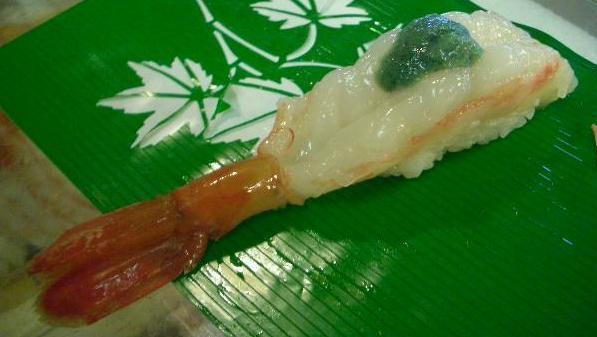
They make for big servings as sushi nigiri!

Now, if you are lucky enough to find them fresh with their eggs, ask your chef to dress them as above for sashimi…

as sushi nigiri,…

or even better, put the eggs on top of a “gunkan nigiri”!

And one more thing, if they are fresh again, don’t forget to ask for the heads deep-fried!

Incidentally, botanebi change sex (gender) with age to end up as big juicy females!

RECOMMENDED RELATED WEBSITES

The Indian Tourist, Masala Herb by Helene Dsouza in Goa, India
Mummy I Can Cook! by Shu Han in London
Pierre.Cuisine, Francescannotwrite, My White Kitchen, 47 Japanese Farms Through The Eyes of Its Rural Communities, Foodhoe, Chucks Eats, Things that Fizz & Stuff, Five Euro Food by Charles,Red Shallot Kitchen by Priscilla,With a Glass, Nami | Just One Cookbook, Peach Farm Studio, Clumsyfingers by Xethia, PepperBento,Adventures in Bento Making, American Bent, Beanbento, Bento No, Bento Wo Tsukurimashou, Cooking Cute, Eula, Hapabento , Happy Bento, Jacki’s Bento Blog, Kitchen Cow, Leggo My Obento, Le Petit Journal Bento & CO (French), Lunch In A Box,
Susan at Arkonlite, Vegan Lunch Box; Tokyo Tom Baker, Daily Food Porn/Osaka, Only Nature Food Porn, Happy Little Bento, The Herbed Kitchen, J-Mama’s Kitchen, Cook, Eat, Play, Repeat, Bento Lunch Blog (German), Adventures In Bento, Anna The Red’s Bento Factory, Cooking Cute, Timeless Gourmet, Bento Bug, Ideal Meal, Bentosaurus, Mr. Foodie (London/UK), Ohayo Bento,

Must-see tasting websites:

-Sake: Tokyo Through The Drinking Glass, Tokyo Foodcast, Urban Sake, Sake World
-Wine: Palate To Pen, Warren Bobrow, Cellar Tours, Ancient Fire Wines Blog
-Beer: Good Beer & Country Boys, Another Pint, Please!
-Japanese Pottery to enjoy your favourite drinks: Yellin Yakimono Gallery